Debre Berhan
University
Department of Biotechnology
Industrial Biotechnology
Tsegaye Mekuria (MSc)
Unit 3
Bioreactors
Fermentor/Bioreactor -Definition
A bioreactor is:
• A vessel for the growth of microorganisms/cells which,
while not permitting contamination, enables the
provision of conditions necessary for the maximal
production of the desired products.
• A device in which a substrate of low value is utilized by
living cells or enzymes to generate a product of higher
value.
• Vessels in the chemical industry were called reactors,
therefore fermenters are also named Bioreactors.
USE: Used for food processing, fermentation, waste
treatment, etc.
Types of Fermentors
• On the basis of the agent used, bioreactors are grouped
into the following two broad classes:
(i) Those based on living cells
(ii) Those employing enzymes.
in terms of process requirements, they are of six types:
(1) Aerated Stirred Tank batch Fermenter
(2) Bubble Column Fermenter
(3) Airlift Fermenter
(4) Fluidized Bed Fermenter
(5) Packed Bed Fermenter and
(6) Photo-Bioreactors.
1. Aerated Stirred Tank batch
Fermenter
A typical fermentor of this type is an upright closed
cylindrical tank fitted with the following parts:
Baffles: prevent vortex formation
Water jacket or coil for heating and/ or cooling,
Sparger: for aeration
Agitator with impellers for stirring/mixing
Inlets for Microorganisms and nutrients
Outlets for taking samples and for exhaust gases.
 Modern Bioreactors are also highly automated and
usually have means of continuously monitoring,
controlling or recording pH, dissolved oxygen, effluent
CO2, and chemical components of the fermentation
broth.
1. Aerated Stirred Tank batch
Fermenter
Mixing method:
Mechanical agitation
• High input required
• Baffles are constructed
• within the built-in.
• Applications include
• production of bear, wine,
antibiotics and
free/immobilized enzymes
• Draw back is that high
shear forces may break
the cells
Design of Aerated Stirred Tank batch Fermenter
2. Bubble Column Fermenter
Mixing method: Gas sparging
Cylenderical vessel with gas
distributor at the base.
 Gas in the form of bubbles comes
in contact with liquid.
Simple design
Good heat and mass transfer rates
Low energy input
Used in bioreactors where
microorganisms are utilized to
produce industrial products such
as enzymes, proteins, antibiotics,
etc. Fig. Scheme of a bubble column.
Reports on industrial uses of Bubble
Column Bioreactor
3. AIR LIFT BIOREACTOR:
Type of bioreactor that are with impeller-free
systems where the internal circulation and mixing
are achieved by bubbling air.”
Employ forced/ pressurized air to circulate cells and
nutrient medium.
Can be used to culture cells that are highly shear-
sensitive.
gas stream facilitate exchange of material between
the gas phase and the medium.
oxygen is usually transferred to the liquid, products
are removed through exchange with the gas phase.
3. STRUCTURE/ DESIGN…
• Entire reactor is divided into 2
halves by a draft tube:
• inner gassed region ( Riser)
• outer ungassed region ( Down
comer)
 Riser has gas injection
connected- air moves upwards.
 Down comer region has
degassed media and cells.
 Mean density gradient
between riser and down comer
regions causes continuous
circulation.
PARTS OF ALR…
Riser: connected gas injection- upward air flow.
Downcomer: degassed media +cells.
Base: connected to perforated nozzle bank/ plate/
sparger to pump pressurized air.
Head space: gas release region, flocculation, foam
accumulation etc.
Gas separator:
• Facilitates gas/liquid recirculation
• Maximizes gas residence time
• Reduces gas friction in downcomer.
3. AIR LIFT BIOREACTOR:
Uses
Mammalian cell cultures.
Waste water treatment
Biological processes involving biocatalysts as
solids
To produce biopharma proteins from fragile cells.
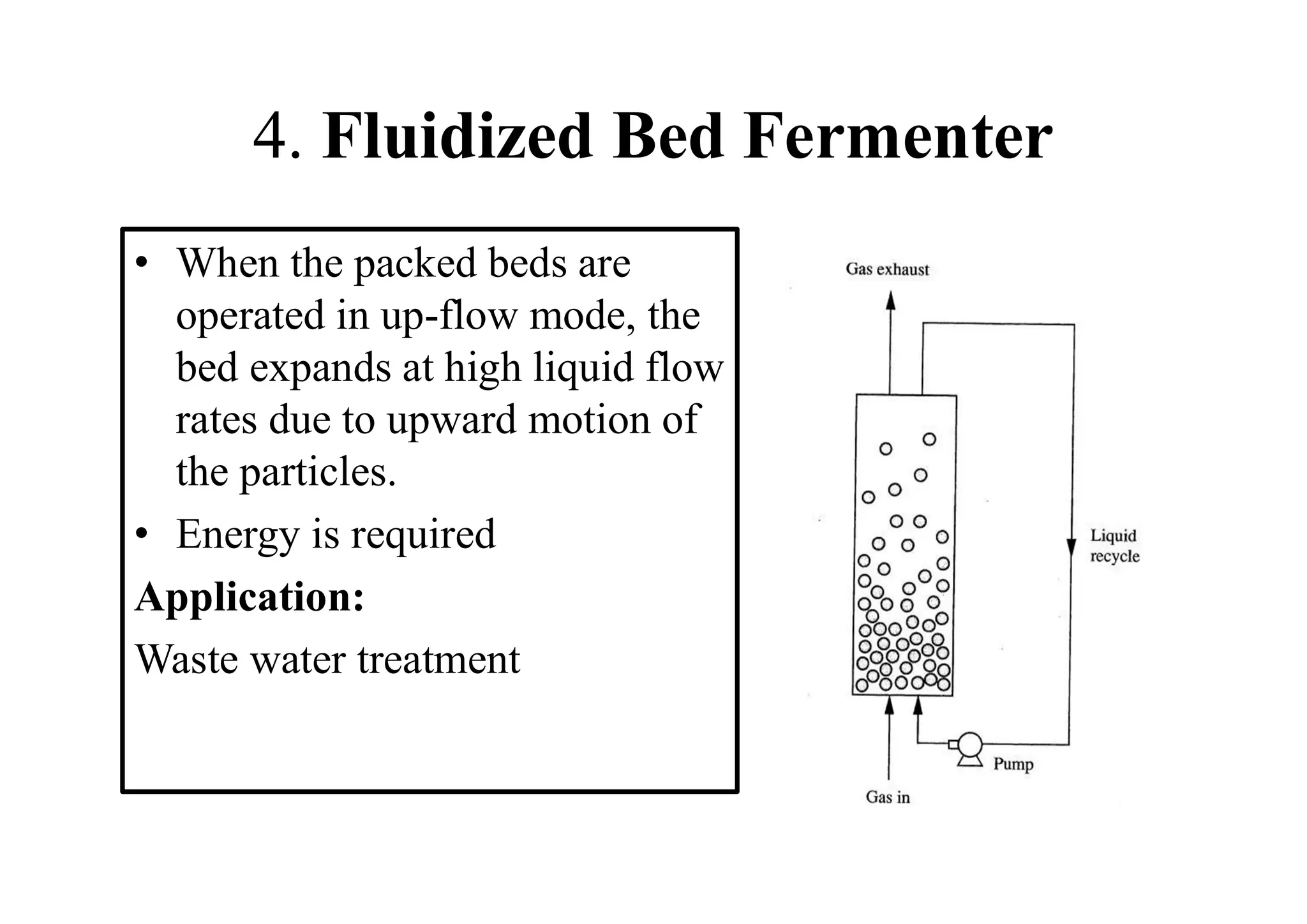
4. Fluidized Bed Fermenter
• Cells are used as biocatalyst in three phase
system (solid ,liquid and gas).
• Basically particles used in fbb can be of
three types-
– Inert core in which cell can be attached.
– Porous particles in which biocatalyst is
entrapped.
– Cell aggregates or flocs.
• Because of the higher density of the micro
carriers they can be perfused slowly from
below, at such a rate that their sedimentation
rate matches the flow rate.
• The beads therefore remain in stationary
suspension, perfused by the medium,
constantly replenishing nutrients and
collecting the product into a downstream
reservoir.
• Gas exchange is external to the reactor, and
no mechanical mixing is required.
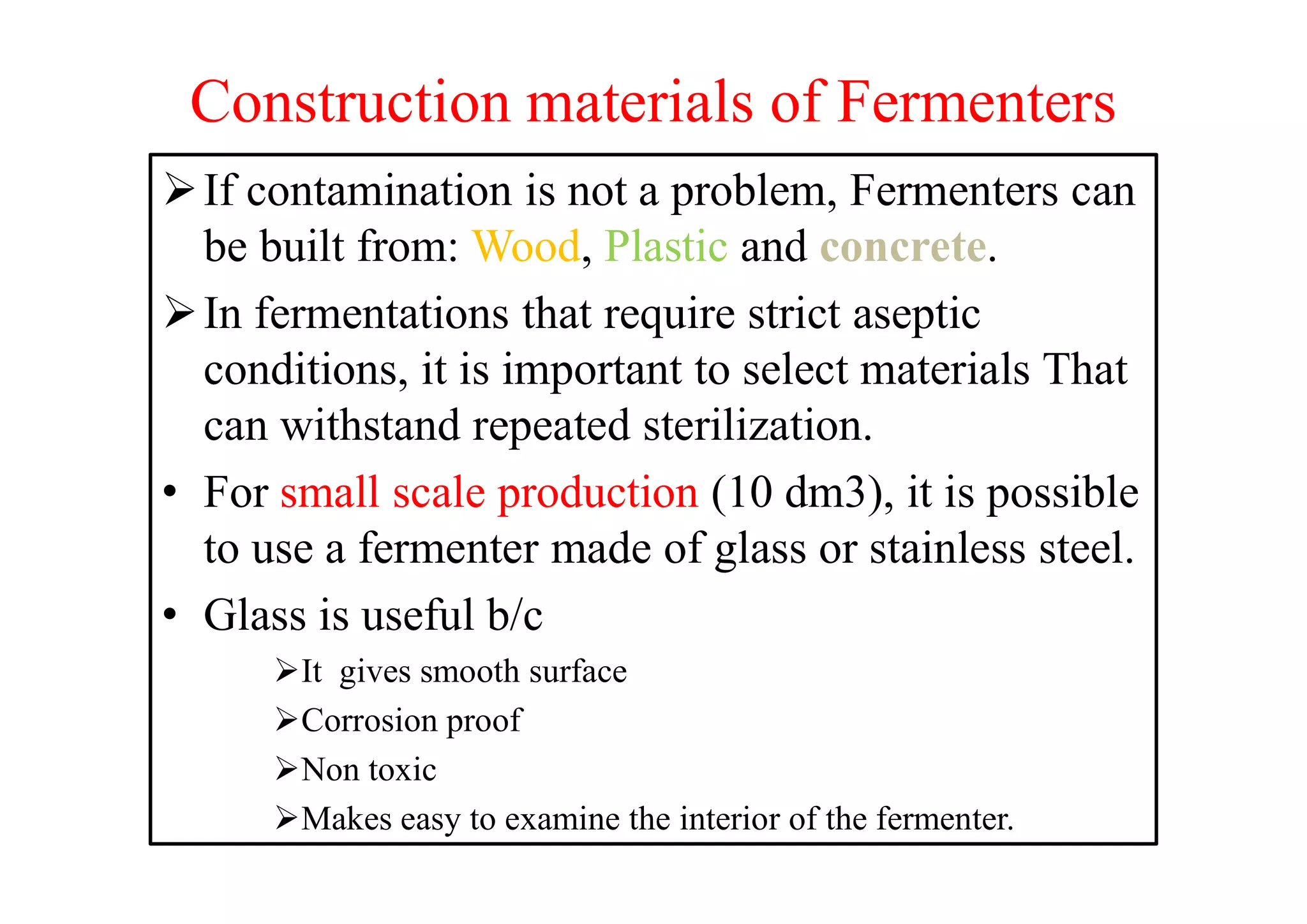
4. Fluidized Bed Fermenter
• When the packed beds are
operated in up-flow mode, the
bed expands at high liquid flow
rates due to upward motion of
the particles.
• Energy is required
Application:
Waste water treatment
5. Packed Bed Fermenter
• Liquid is sprayed onto the top
of the packing and trickles
down through the bed in small
rivulets.
• In the process, the gaseous
pollutants on the surface of the
carriers is adsorbed and
immediately biologically
mineralized (degraded) by the
microorganisms.
Packed Bed Fermenter (Trickling Filter)
6. PHOTO BIOREACTOR
Photobioreactor is a closed
vessel for phototrophic
production of products like
spirulina (SCP) and Biofuel
using algae where energy is
supplied via electric lights.
The algae are supplied with
CO2 and light in the closed
vessel.
Construction materials of Fermenters
If contamination is not a problem, Fermenters can
be built from: Wood, Plastic and concrete.
In fermentations that require strict aseptic
conditions, it is important to select materials That
can withstand repeated sterilization.
• For small scale production (10 dm3), it is possible
to use a fermenter made of glass or stainless steel.
• Glass is useful b/c
It gives smooth surface
Corrosion proof
Non toxic
Makes easy to examine the interior of the fermenter.
Construction materials, cont..
Pilot scale and industrial scale vessels are
normally constructed of stainless steel or at
least have a stainless steel cladding to limit
corrosion.
• Steel having chromium more than 4% are
called stainless steel.
• Grades of steel containing 10 – 13 %
chromium are good to resist corrosion.
• Inclusion of nickel in high percent chromium
steels enhances their resistance and improves
their engineering properties.
Construction materials, cont..
 Most commonly used stainless steel compositions for
fermentation equipments are:
SS316 Cr Ni Mo : 17 12 2
SS316L Cr Ni Mo : 18 14 3
SS317 Cr Ni Mo : 17 13 4
SS304 Cr Ni : 18.5 10
Normally the main tank is made up of 316 grades and
jackets are made up of 304 to reduce the cost.
Portions of the fermenter
Volume of Fermenter is divided into a
working volume and a head-space volume.
The working volume:
The portion of volume taken up by the
medium, microbes, and gas bubbles.
•Typically, 70-80% of the total volume.
The head space: the remaining volume
Space used for escaping droplets from
exhaust gas and foam accumulation.
If the fermentation has a tendency to foam,
then a larger headspace and smaller
working volume is needed.
Basic features of a fermenter
1. An agitator system
2. An oxygen delivery system
3. A temperature control system
4. A pH control system
5. A foam control system
6. Sampling ports
7. A cleaning and sterilization system.
8. dump line for emptying of the fermenter
1. Aeration and agitation systems
 O2 is essential for growth and yield of metabolites in aerobic Mos.
 The supply of O2 in aerobic fermentation is therefore critical.
 O2 should be dissolved in aqueous solution with nutrients to be
absorbed by the organisms.
 But as O2 is highly insoluble in water; at 20 0C water holds only
9ppm of O2.
 How to provide O2?
 Sterile air should be supplied to enrich the fermentation broth with
O2.
 The air is forced under pressure and enters through a sparger
situated at the bottom of the fermenter.
1. Aeration and agitation cont..
An agitator with its attached impellers serve to
distribute the air coming from the sparger.
Functions of the agitator:
Distribute air as fine bubbles
Mix organisms uniformly
Ensure uniform Temperature and Create local
turbulence
The power consumption of the agitator is very high.
The larger the fermenter, the high power it requires;
costly!
Viscosity of the broth affects the effectiveness of the
impellers.
1. Aeration and agitation cont..
• Baffles: The insertion of baffles eliminate the
formation of a vortex and interferes with the upward
throw of liquid against the walls of the fermenter.
• The provision of air under pressure helps remove
inhibitory volatile metabolites and contributes to the
reduction of contaminants by providing a positive air
pressure.
Large volumes of sterile air is required for aeration
in most fermentations.
Filtration is used to free the air from dust and
microorganisms.
2. Temperature Control system
• Many fermentation processes release heat, which must be
removed so as to maintain the optimum temperature for the
productivity of the organism.
• Small laboratory fermenters : to control Temperature:
– immersing the tank in a water bath;
• Medium sized fermenters; to control Temperature:
– a jacket of cold water circulating outside the tank or merely by
bathing the unjacketed cylinder with water.
• Large fermenters:
T0 is maintained by circulating refrigerated water in pipes
within the fermentor and sometimes outside it as well.
A heating coil is provided to raise the temperature when
necessary.
3. pH control system
• In some industrial fermentations, good yield
depends on accurate measurement and control of the
pH of the fermentation broth.
• Sterilizable pH probes are available and these are
inserted in the fermenter or in a suitable projection
in which the broth bathes the electrode.
• With these electrodes it is possible to use an
arrangement which will monitor pH changes and
automatically induce the introduction into the
medium of either acid or alkali.
4. Foam Control System
Foam production
• Foams are dispersions of gas in liquid.
• In fermentation they usually occur as a result
of agitation and aeration.
• In a few industrial processes, e.g. in the beer
industry, foam head retention is a desirable
quality.
• However, in most industrial fermentations,
foam has undesirable microbiological,
economic and chemical engineering
consequences, as follows:
4. Foam Control System
i) The presence of foams means that a substantial head space is
left in industrial fermentations, 30-45 percent.
ii) If the fermentation medium encourages rapid foaming, then the
maximum aeration and agitation cannot be introduced because
of excessive foaming. O2 transfere rate is reduced.
iii) contamination may be introduced when foam bubbles coalesce
and fall back into the medium after wetting non-sterile portions
of the fermenter.
(iv) Organic nutrients or inorganic ions with complex organic
compounds may be removed from the medium by foam
floatation, a phenomenon well known in beer fermentation,
when proteins, hop-resins, dextrin’s, etc., concentrate in the
foam layer.
• A loss of nutrient from fermentations in this way could lead to
reduced yield.
V. Displacement of microorganisms could also easily occur by
floatation thereby leading to reduced yields.
4. Foam Control System
 Foam can be controlled either by chemical or
mechanical means.
 Chemicals controlling of foams have been classified
into antifoams, which are added in the medium to
prevent foam formation and defoamers which are
added to knock down foams once they are formed.
 Antifoams may be added manually when foam is
observed.
 Automatic antifoam additions are also available and
depend on a probe which is activated when foams rise
and make contact with the probe.
 Mechnanical defoamers act by physically dispersing
the foams by rapidly breaking them up. Foam breakers
The end !

Unit 3 bioreactors

  • 1.
    Debre Berhan University Department ofBiotechnology Industrial Biotechnology Tsegaye Mekuria (MSc)
  • 2.
    Unit 3 Bioreactors Fermentor/Bioreactor -Definition Abioreactor is: • A vessel for the growth of microorganisms/cells which, while not permitting contamination, enables the provision of conditions necessary for the maximal production of the desired products. • A device in which a substrate of low value is utilized by living cells or enzymes to generate a product of higher value. • Vessels in the chemical industry were called reactors, therefore fermenters are also named Bioreactors. USE: Used for food processing, fermentation, waste treatment, etc.
  • 3.
    Types of Fermentors •On the basis of the agent used, bioreactors are grouped into the following two broad classes: (i) Those based on living cells (ii) Those employing enzymes. in terms of process requirements, they are of six types: (1) Aerated Stirred Tank batch Fermenter (2) Bubble Column Fermenter (3) Airlift Fermenter (4) Fluidized Bed Fermenter (5) Packed Bed Fermenter and (6) Photo-Bioreactors.
  • 4.
    1. Aerated StirredTank batch Fermenter A typical fermentor of this type is an upright closed cylindrical tank fitted with the following parts: Baffles: prevent vortex formation Water jacket or coil for heating and/ or cooling, Sparger: for aeration Agitator with impellers for stirring/mixing Inlets for Microorganisms and nutrients Outlets for taking samples and for exhaust gases.  Modern Bioreactors are also highly automated and usually have means of continuously monitoring, controlling or recording pH, dissolved oxygen, effluent CO2, and chemical components of the fermentation broth.
  • 5.
    1. Aerated StirredTank batch Fermenter Mixing method: Mechanical agitation • High input required • Baffles are constructed • within the built-in. • Applications include • production of bear, wine, antibiotics and free/immobilized enzymes • Draw back is that high shear forces may break the cells
  • 6.
    Design of AeratedStirred Tank batch Fermenter
  • 7.
    2. Bubble ColumnFermenter Mixing method: Gas sparging Cylenderical vessel with gas distributor at the base.  Gas in the form of bubbles comes in contact with liquid. Simple design Good heat and mass transfer rates Low energy input Used in bioreactors where microorganisms are utilized to produce industrial products such as enzymes, proteins, antibiotics, etc. Fig. Scheme of a bubble column.
  • 8.
    Reports on industrialuses of Bubble Column Bioreactor
  • 9.
    3. AIR LIFTBIOREACTOR: Type of bioreactor that are with impeller-free systems where the internal circulation and mixing are achieved by bubbling air.” Employ forced/ pressurized air to circulate cells and nutrient medium. Can be used to culture cells that are highly shear- sensitive. gas stream facilitate exchange of material between the gas phase and the medium. oxygen is usually transferred to the liquid, products are removed through exchange with the gas phase.
  • 10.
    3. STRUCTURE/ DESIGN… •Entire reactor is divided into 2 halves by a draft tube: • inner gassed region ( Riser) • outer ungassed region ( Down comer)  Riser has gas injection connected- air moves upwards.  Down comer region has degassed media and cells.  Mean density gradient between riser and down comer regions causes continuous circulation.
  • 11.
    PARTS OF ALR… Riser:connected gas injection- upward air flow. Downcomer: degassed media +cells. Base: connected to perforated nozzle bank/ plate/ sparger to pump pressurized air. Head space: gas release region, flocculation, foam accumulation etc. Gas separator: • Facilitates gas/liquid recirculation • Maximizes gas residence time • Reduces gas friction in downcomer.
  • 12.
    3. AIR LIFTBIOREACTOR: Uses Mammalian cell cultures. Waste water treatment Biological processes involving biocatalysts as solids To produce biopharma proteins from fragile cells.
  • 13.
    4. Fluidized BedFermenter • Cells are used as biocatalyst in three phase system (solid ,liquid and gas). • Basically particles used in fbb can be of three types- – Inert core in which cell can be attached. – Porous particles in which biocatalyst is entrapped. – Cell aggregates or flocs. • Because of the higher density of the micro carriers they can be perfused slowly from below, at such a rate that their sedimentation rate matches the flow rate. • The beads therefore remain in stationary suspension, perfused by the medium, constantly replenishing nutrients and collecting the product into a downstream reservoir. • Gas exchange is external to the reactor, and no mechanical mixing is required.
  • 14.
    4. Fluidized BedFermenter • When the packed beds are operated in up-flow mode, the bed expands at high liquid flow rates due to upward motion of the particles. • Energy is required Application: Waste water treatment
  • 15.
    5. Packed BedFermenter • Liquid is sprayed onto the top of the packing and trickles down through the bed in small rivulets. • In the process, the gaseous pollutants on the surface of the carriers is adsorbed and immediately biologically mineralized (degraded) by the microorganisms.
  • 16.
    Packed Bed Fermenter(Trickling Filter)
  • 17.
    6. PHOTO BIOREACTOR Photobioreactoris a closed vessel for phototrophic production of products like spirulina (SCP) and Biofuel using algae where energy is supplied via electric lights. The algae are supplied with CO2 and light in the closed vessel.
  • 18.
    Construction materials ofFermenters If contamination is not a problem, Fermenters can be built from: Wood, Plastic and concrete. In fermentations that require strict aseptic conditions, it is important to select materials That can withstand repeated sterilization. • For small scale production (10 dm3), it is possible to use a fermenter made of glass or stainless steel. • Glass is useful b/c It gives smooth surface Corrosion proof Non toxic Makes easy to examine the interior of the fermenter.
  • 19.
    Construction materials, cont.. Pilotscale and industrial scale vessels are normally constructed of stainless steel or at least have a stainless steel cladding to limit corrosion. • Steel having chromium more than 4% are called stainless steel. • Grades of steel containing 10 – 13 % chromium are good to resist corrosion. • Inclusion of nickel in high percent chromium steels enhances their resistance and improves their engineering properties.
  • 20.
    Construction materials, cont.. Most commonly used stainless steel compositions for fermentation equipments are: SS316 Cr Ni Mo : 17 12 2 SS316L Cr Ni Mo : 18 14 3 SS317 Cr Ni Mo : 17 13 4 SS304 Cr Ni : 18.5 10 Normally the main tank is made up of 316 grades and jackets are made up of 304 to reduce the cost.
  • 21.
    Portions of thefermenter Volume of Fermenter is divided into a working volume and a head-space volume. The working volume: The portion of volume taken up by the medium, microbes, and gas bubbles. •Typically, 70-80% of the total volume. The head space: the remaining volume Space used for escaping droplets from exhaust gas and foam accumulation. If the fermentation has a tendency to foam, then a larger headspace and smaller working volume is needed.
  • 22.
    Basic features ofa fermenter 1. An agitator system 2. An oxygen delivery system 3. A temperature control system 4. A pH control system 5. A foam control system 6. Sampling ports 7. A cleaning and sterilization system. 8. dump line for emptying of the fermenter
  • 23.
    1. Aeration andagitation systems  O2 is essential for growth and yield of metabolites in aerobic Mos.  The supply of O2 in aerobic fermentation is therefore critical.  O2 should be dissolved in aqueous solution with nutrients to be absorbed by the organisms.  But as O2 is highly insoluble in water; at 20 0C water holds only 9ppm of O2.  How to provide O2?  Sterile air should be supplied to enrich the fermentation broth with O2.  The air is forced under pressure and enters through a sparger situated at the bottom of the fermenter.
  • 24.
    1. Aeration andagitation cont.. An agitator with its attached impellers serve to distribute the air coming from the sparger. Functions of the agitator: Distribute air as fine bubbles Mix organisms uniformly Ensure uniform Temperature and Create local turbulence The power consumption of the agitator is very high. The larger the fermenter, the high power it requires; costly! Viscosity of the broth affects the effectiveness of the impellers.
  • 25.
    1. Aeration andagitation cont.. • Baffles: The insertion of baffles eliminate the formation of a vortex and interferes with the upward throw of liquid against the walls of the fermenter. • The provision of air under pressure helps remove inhibitory volatile metabolites and contributes to the reduction of contaminants by providing a positive air pressure. Large volumes of sterile air is required for aeration in most fermentations. Filtration is used to free the air from dust and microorganisms.
  • 26.
    2. Temperature Controlsystem • Many fermentation processes release heat, which must be removed so as to maintain the optimum temperature for the productivity of the organism. • Small laboratory fermenters : to control Temperature: – immersing the tank in a water bath; • Medium sized fermenters; to control Temperature: – a jacket of cold water circulating outside the tank or merely by bathing the unjacketed cylinder with water. • Large fermenters: T0 is maintained by circulating refrigerated water in pipes within the fermentor and sometimes outside it as well. A heating coil is provided to raise the temperature when necessary.
  • 27.
    3. pH controlsystem • In some industrial fermentations, good yield depends on accurate measurement and control of the pH of the fermentation broth. • Sterilizable pH probes are available and these are inserted in the fermenter or in a suitable projection in which the broth bathes the electrode. • With these electrodes it is possible to use an arrangement which will monitor pH changes and automatically induce the introduction into the medium of either acid or alkali.
  • 28.
    4. Foam ControlSystem Foam production • Foams are dispersions of gas in liquid. • In fermentation they usually occur as a result of agitation and aeration. • In a few industrial processes, e.g. in the beer industry, foam head retention is a desirable quality. • However, in most industrial fermentations, foam has undesirable microbiological, economic and chemical engineering consequences, as follows:
  • 29.
    4. Foam ControlSystem i) The presence of foams means that a substantial head space is left in industrial fermentations, 30-45 percent. ii) If the fermentation medium encourages rapid foaming, then the maximum aeration and agitation cannot be introduced because of excessive foaming. O2 transfere rate is reduced. iii) contamination may be introduced when foam bubbles coalesce and fall back into the medium after wetting non-sterile portions of the fermenter. (iv) Organic nutrients or inorganic ions with complex organic compounds may be removed from the medium by foam floatation, a phenomenon well known in beer fermentation, when proteins, hop-resins, dextrin’s, etc., concentrate in the foam layer. • A loss of nutrient from fermentations in this way could lead to reduced yield. V. Displacement of microorganisms could also easily occur by floatation thereby leading to reduced yields.
  • 30.
    4. Foam ControlSystem  Foam can be controlled either by chemical or mechanical means.  Chemicals controlling of foams have been classified into antifoams, which are added in the medium to prevent foam formation and defoamers which are added to knock down foams once they are formed.  Antifoams may be added manually when foam is observed.  Automatic antifoam additions are also available and depend on a probe which is activated when foams rise and make contact with the probe.  Mechnanical defoamers act by physically dispersing the foams by rapidly breaking them up. Foam breakers The end !