Introduction
 purification of fermentation products may be difficult and









cost
Recovery costs of microbial products may vary from 15% to
70% of total production cost
The main objective of the first stage for the recovery of an
extracellular product is the removal of large solid particles
and microbial cells usually by centrifugation or filtration
In the next stage, the broth is fractionated or extracted into
major fractions
further more precise chromatographic techniques and
crystallization to obtain a product which is highly
concentrated and essentially free from impurities.
The major problem currently faced in product recovery is
the large-scale purification of biologically active molecules
Stages in the recovery of product
The choice of recovery process is
based on the following criteria
REMOVAL OF MICROBIAL CELLS
AND OTHER SOLID MATTER
 Normally separated from the harvested broth by

filtration or centrifugation
 foam separation E. coli using lauric acid, stearyl amine
t-octyl amine as surfactants, it was shown that up 90%
of the cells were removed in 1 minute and 99% 10
minutes
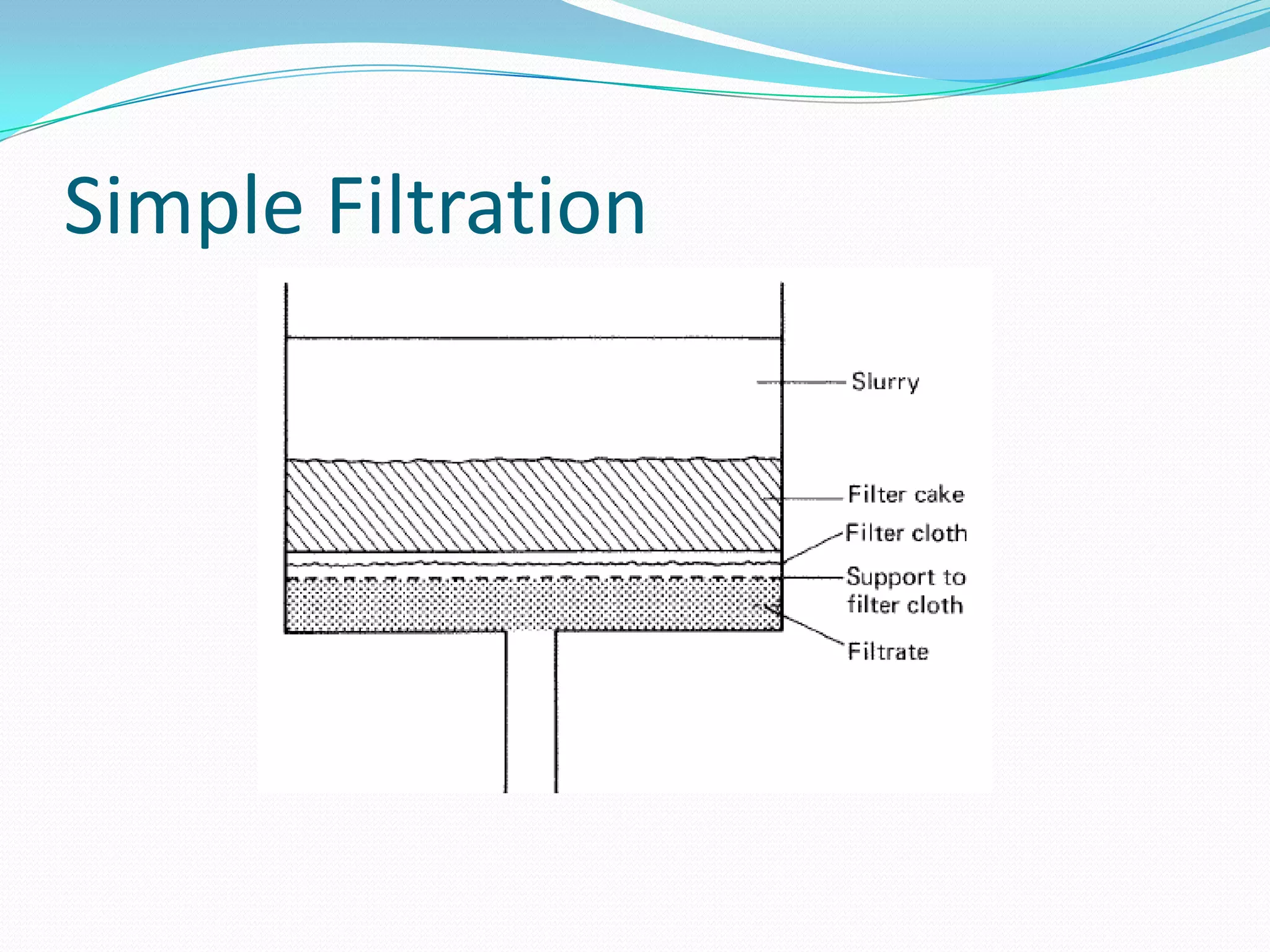
 It is common practice to use filter aids when filtering is
slow. Kieselguhr (diatomaceous earth) is the most
widely used materiaI
Simple Filtration
CENTRIFUGATION
 Although a centrifuge may be expensive when

compared with a filter it may be essential when
1. Filtration is slow and difficult.
2. The cells or other suspended matter must be
obtained free of filter aids.
3. Continuous separation to a high standard of hygiene
is required.
CELL DISRUPTION
 Any potential method of disruption must ensure that

labile materials are not denatured by the process or
hydrolysed by enzymes present in the cell
 Methods for cell disruption available fall into two
major categories
 Physico-mechanical methods
 Chemical methods
Physical-mechanical Methods
(a) Liquid shear.
(b) Solid shear.
(c) Agitation with abrasives.
(d) Freeze-thawing.
(e) Ultrasonication.
Chemical methods
(a) Detergents.
(b) Osmotic shock.
(c) Alkali treatment.
(d) Enzyme treatment.
LIQUID-LIQUID EXTRACTION
 The separation of a component from

a liquid mixture by treatment with a
solvent in which the desired
component is preferentially soluble
is known as liquid-liquid extraction
 Polar liquids mix with each other
and dissolve salts and other polar
solids.
 The solvents for non-polar
compounds are liquids of low or nil
polarity
 The dielectric constant is a measure
of the degree of molar polarization
of a compound
Dielectric constants of solvents at
25'C
TWO-PHASE AQUEOUS
EXTRACTION
 Liquid-liquid extraction is a well established

technology in chemical processing
 However, the use of organic solvents has limited
application in the processing of sensitive biologicals
 Aqueous two-phase systems, on the other hand, have a
high water content and low interfacial surface tension
and are regarded as being biocompatible
 Phase separation occurs when hydrophilic polymers
are added to an aqueous solution, and when the
concentrations exceed a certain value two immiscible
aqueous phases are formed.
Aqueous two-phase systems are
available
SOLVENT
RECOVERY
 Solvent use for extraction

are excessable, therefore
need to recovery to reduced
cost
 Solvent recovery usually
using
destillation/evaporation
method
 Evaporation is the removal
of solvent from a solution by
the application of heat to
the solution
CHROMATOGRAPHY
 In many fermentation processes, chromatographic

techniques are used to isolate and purify relatively low
concentrations of metabolic products
 The techniques can be grouped as follows
 Adsorption chromatography.
 Ion-exchange chromatography.
 Gel permeation chromatography.
 Affinity chromatography.
 Reverse phase chromatography.
 High performance liquid chromatography
MEMBRANE PROCESSES

 Both processes utilize semi-permeable membranes to

separate molecules of different sizes and therefore act
in a similar manner to conventional filters.
 Ultrafiltration can be described as a process in which
solutes of high molecular weight are retained when the
solvent and low molecular weight solutes are forced
under hydraulic pressure (around 7 atmospheres)
through a membrane of a very fine pore size.
 Reverse osmosis is a separation process where the
solvent molecules are forced by an applied pressure to
flow through a semi-permeable membrane in the
opposite direction to that dictated by osmotic
forces, and hence is termed reverse osmosis.
DRYING
 The drying of any product (including biological

products) is often the last stage of a manufacturing
process
 Drying is undertaken because:
 The cost of transport can be reduced.
 The material is easier to handle and package.
 The material can be stored more conveniently in the dry

state.
CRYSTALLIZATION
 Crystallization wide used for final purification of a

diverse range of compounds.
 In citric acid production:
 the filtered broth is treated with Ca(OH)2, so that the

relatively insoluble calcium crystals will be precipitated
from solution.
 The calcium citrate is filtered off and treated with
sulphuric acid to precipitated the calcium as the
insoluble sulphate and release the citric acid.
 After clarification with active carbon, the aqueous citric
acid is evaporated to the point of crystallization
Purification of cephamycin C: sequential ion
exchange process
Recovery and
partial
purification of
penicillin G
Purification of micrococcal nuclease
Recovery and purification of citric
acid

Purification product

  • 2.
    Introduction  purification offermentation products may be difficult and      cost Recovery costs of microbial products may vary from 15% to 70% of total production cost The main objective of the first stage for the recovery of an extracellular product is the removal of large solid particles and microbial cells usually by centrifugation or filtration In the next stage, the broth is fractionated or extracted into major fractions further more precise chromatographic techniques and crystallization to obtain a product which is highly concentrated and essentially free from impurities. The major problem currently faced in product recovery is the large-scale purification of biologically active molecules
  • 3.
    Stages in therecovery of product
  • 4.
    The choice ofrecovery process is based on the following criteria
  • 5.
    REMOVAL OF MICROBIALCELLS AND OTHER SOLID MATTER  Normally separated from the harvested broth by filtration or centrifugation  foam separation E. coli using lauric acid, stearyl amine t-octyl amine as surfactants, it was shown that up 90% of the cells were removed in 1 minute and 99% 10 minutes  It is common practice to use filter aids when filtering is slow. Kieselguhr (diatomaceous earth) is the most widely used materiaI
  • 6.
  • 7.
    CENTRIFUGATION  Although acentrifuge may be expensive when compared with a filter it may be essential when 1. Filtration is slow and difficult. 2. The cells or other suspended matter must be obtained free of filter aids. 3. Continuous separation to a high standard of hygiene is required.
  • 8.
    CELL DISRUPTION  Anypotential method of disruption must ensure that labile materials are not denatured by the process or hydrolysed by enzymes present in the cell  Methods for cell disruption available fall into two major categories  Physico-mechanical methods  Chemical methods
  • 9.
    Physical-mechanical Methods (a) Liquidshear. (b) Solid shear. (c) Agitation with abrasives. (d) Freeze-thawing. (e) Ultrasonication.
  • 10.
    Chemical methods (a) Detergents. (b)Osmotic shock. (c) Alkali treatment. (d) Enzyme treatment.
  • 11.
    LIQUID-LIQUID EXTRACTION  Theseparation of a component from a liquid mixture by treatment with a solvent in which the desired component is preferentially soluble is known as liquid-liquid extraction  Polar liquids mix with each other and dissolve salts and other polar solids.  The solvents for non-polar compounds are liquids of low or nil polarity  The dielectric constant is a measure of the degree of molar polarization of a compound
  • 12.
    Dielectric constants ofsolvents at 25'C
  • 13.
    TWO-PHASE AQUEOUS EXTRACTION  Liquid-liquidextraction is a well established technology in chemical processing  However, the use of organic solvents has limited application in the processing of sensitive biologicals  Aqueous two-phase systems, on the other hand, have a high water content and low interfacial surface tension and are regarded as being biocompatible  Phase separation occurs when hydrophilic polymers are added to an aqueous solution, and when the concentrations exceed a certain value two immiscible aqueous phases are formed.
  • 14.
  • 15.
    SOLVENT RECOVERY  Solvent usefor extraction are excessable, therefore need to recovery to reduced cost  Solvent recovery usually using destillation/evaporation method  Evaporation is the removal of solvent from a solution by the application of heat to the solution
  • 16.
    CHROMATOGRAPHY  In manyfermentation processes, chromatographic techniques are used to isolate and purify relatively low concentrations of metabolic products  The techniques can be grouped as follows  Adsorption chromatography.  Ion-exchange chromatography.  Gel permeation chromatography.  Affinity chromatography.  Reverse phase chromatography.  High performance liquid chromatography
  • 17.
    MEMBRANE PROCESSES  Bothprocesses utilize semi-permeable membranes to separate molecules of different sizes and therefore act in a similar manner to conventional filters.  Ultrafiltration can be described as a process in which solutes of high molecular weight are retained when the solvent and low molecular weight solutes are forced under hydraulic pressure (around 7 atmospheres) through a membrane of a very fine pore size.  Reverse osmosis is a separation process where the solvent molecules are forced by an applied pressure to flow through a semi-permeable membrane in the opposite direction to that dictated by osmotic forces, and hence is termed reverse osmosis.
  • 18.
    DRYING  The dryingof any product (including biological products) is often the last stage of a manufacturing process  Drying is undertaken because:  The cost of transport can be reduced.  The material is easier to handle and package.  The material can be stored more conveniently in the dry state.
  • 19.
    CRYSTALLIZATION  Crystallization wideused for final purification of a diverse range of compounds.  In citric acid production:  the filtered broth is treated with Ca(OH)2, so that the relatively insoluble calcium crystals will be precipitated from solution.  The calcium citrate is filtered off and treated with sulphuric acid to precipitated the calcium as the insoluble sulphate and release the citric acid.  After clarification with active carbon, the aqueous citric acid is evaporated to the point of crystallization
  • 20.
    Purification of cephamycinC: sequential ion exchange process
  • 21.
  • 22.
  • 23.