Building
Methods &
Construction
Technology
Types of
Foundation
Definition of the Term
‘Foundation’
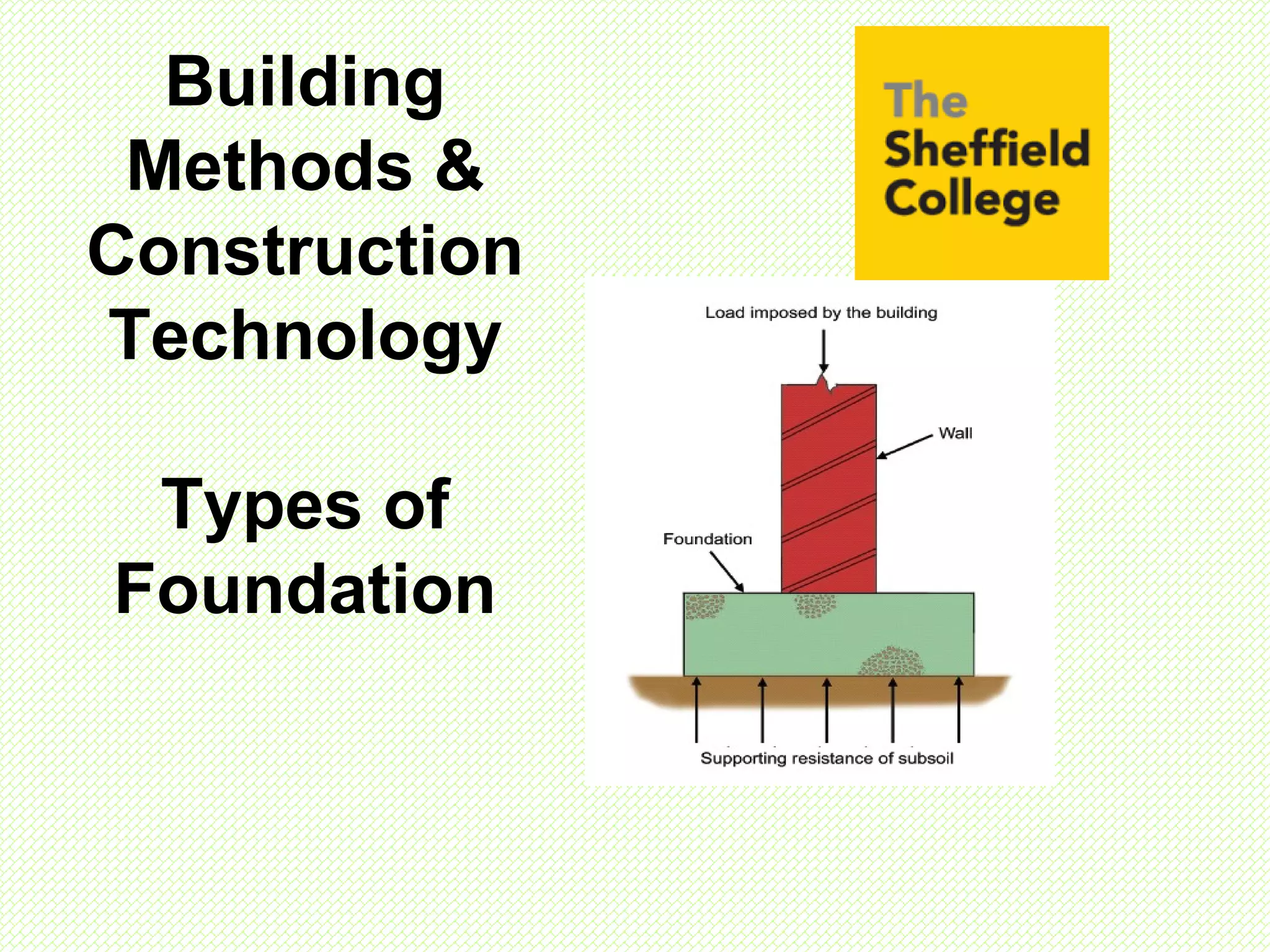
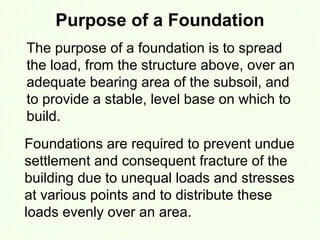
A foundation is that part of a building or structure
which is in direct contact with the ground and
which transfers the loads imposed upon it to the
subsoil beneath.
Natural Foundation
Artificial Foundation
wall
Load imposed by the building
Purpose of a Foundation
The purpose of a foundation is to spread
the load, from the structure above, over an
adequate bearing area of the subsoil, and
to provide a stable, level base on which to
build.
Foundations are required to prevent undue
settlement and consequent fracture of the
building due to unequal loads and stresses
at various points and to distribute these
loads evenly over an area.
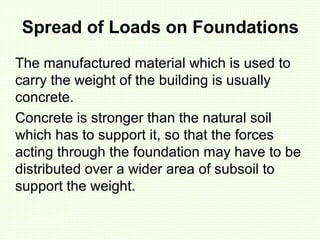
Spread of Loads on Foundations
The manufactured material which is used to
carry the weight of the building is usually
concrete.
Concrete is stronger than the natural soil
which has to support it, so that the forces
acting through the foundation may have to be
distributed over a wider area of subsoil to
support the weight.
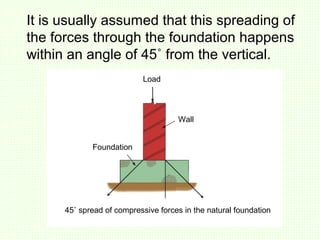
It is usually assumed that this spreading of
the forces through the foundation happens
within an angle of 45˚ from the vertical.
Load
Wall
Foundation
45˚ spread of compressive forces in the natural foundation
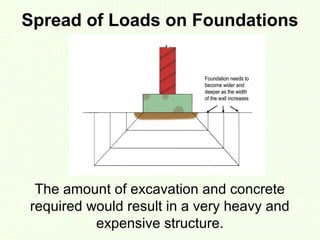
Spread of Loads on Foundations
The amount of excavation and concrete
required would result in a very heavy and
expensive structure.
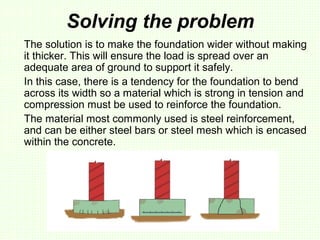
Solving the problem
The solution is to make the foundation wider without making
it thicker. This will ensure the load is spread over an
adequate area of ground to support it safely.
In this case, there is a tendency for the foundation to bend
across its width so a material which is strong in tension and
compression must be used to reinforce the foundation.
The material most commonly used is steel reinforcement,
and can be either steel bars or steel mesh which is encased
within the concrete.
Settlement
Almost all of the settlement of foundations in
soils is due to water between the particles
being forced out, enabling the solid particles to
pack closer together.
After a long dry spell of weather, cracks
sometimes appear in buildings which have
stood for many years, indicating that the
foundation has moved.
In this case, the cause is likely to be that the
water in the subsoil has dried out and the soil
itself has shrunk.
Heave
When water freezes, it expands; in very
cold weather, the water in the subsoil
may freeze and cause the soil to heave’,
i.e. move upwards.
When this occurs beneath a foundation,
the pressure exerted could be sufficient
to lift the foundation.
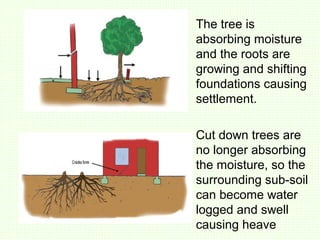
The tree is
absorbing moisture
and the roots are
growing and shifting
foundations causing
settlement.
Cut down trees are
no longer absorbing
the moisture, so the
surrounding sub-soil
can become water
logged and swell
causing heave
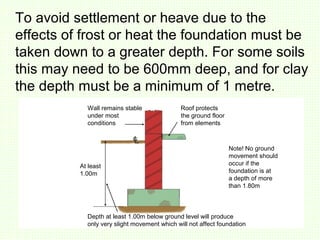
To avoid settlement or heave due to the
effects of frost or heat the foundation must be
taken down to a greater depth. For some soils
this may need to be 600mm deep, and for clay
the depth must be a minimum of 1 metre.
Wall remains stable
under most
conditions
Roof protects
the ground floor
from elements
Note! No ground
movement should
occur if the
foundation is at
a depth of more
than 1.80m
Depth at least 1.00m below ground level will produce
only very slight movement which will not affect foundation
At least
1.00m
Foundation Types
• Pad foundation
• Strip Foundation
• Wide strip foundations
• Stepped strip foundation
• Narrow strip or trench fill foundation
• Short bored piles
• Raft foundations
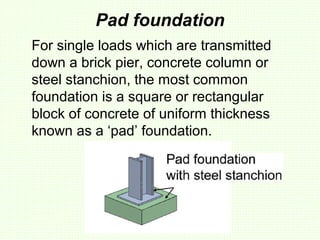
Pad foundation
For single loads which are transmitted
down a brick pier, concrete column or
steel stanchion, the most common
foundation is a square or rectangular
block of concrete of uniform thickness
known as a ‘pad’ foundation.
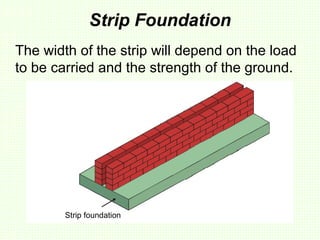
Strip Foundation
The width of the strip will depend on the load
to be carried and the strength of the ground.
Strip foundation
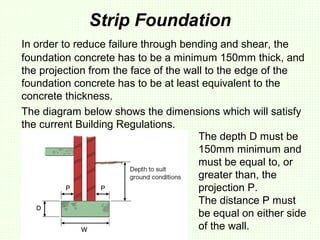
In order to reduce failure through bending and shear, the
foundation concrete has to be a minimum 150mm thick, and
the projection from the face of the wall to the edge of the
foundation concrete has to be at least equivalent to the
concrete thickness.
The diagram below shows the dimensions which will satisfy
the current Building Regulations.
Strip Foundation
The depth D must be
150mm minimum and
must be equal to, or
greater than, the
projection P.
The distance P must
be equal on either side
of the wall.
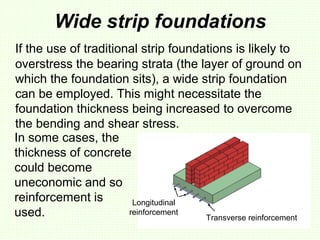
Wide strip foundations
If the use of traditional strip foundations is likely to
overstress the bearing strata (the layer of ground on
which the foundation sits), a wide strip foundation
can be employed. This might necessitate the
foundation thickness being increased to overcome
the bending and shear stress.
In some cases, the
thickness of concrete
could become
uneconomic and so
reinforcement is
used.
Longitudinal
reinforcement
Transverse reinforcement
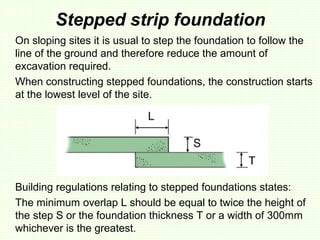
Stepped strip foundation
On sloping sites it is usual to step the foundation to follow the
line of the ground and therefore reduce the amount of
excavation required.
When constructing stepped foundations, the construction starts
at the lowest level of the site.
Building regulations relating to stepped foundations states:
The minimum overlap L should be equal to twice the height of
the step S or the foundation thickness T or a width of 300mm
whichever is the greatest.
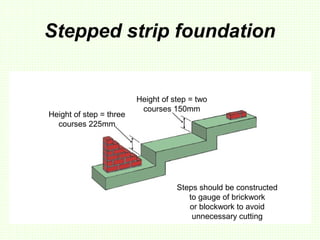
Stepped strip foundation
Height of step = three
courses 225mm
Height of step = two
courses 150mm
Steps should be constructed
to gauge of brickwork
or blockwork to avoid
unnecessary cutting
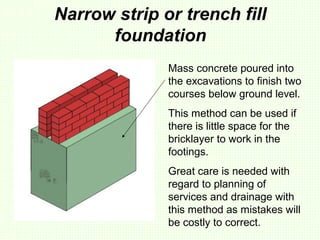
Narrow strip or trench fill
foundation
Mass concrete poured into
the excavations to finish two
courses below ground level.
This method can be used if
there is little space for the
bricklayer to work in the
footings.
Great care is needed with
regard to planning of
services and drainage with
this method as mistakes will
be costly to correct.
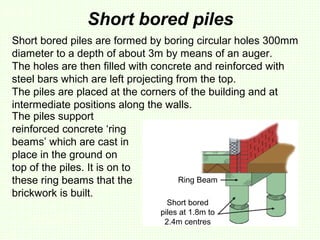
Short bored piles
Short bored piles are formed by boring circular holes 300mm
diameter to a depth of about 3m by means of an auger.
The holes are then filled with concrete and reinforced with
steel bars which are left projecting from the top.
The piles are placed at the corners of the building and at
intermediate positions along the walls.
The piles support
reinforced concrete ‘ring
beams’ which are cast in
place in the ground on
top of the piles. It is on to
these ring beams that the
brickwork is built.
Ring Beam
Short bored
piles at 1.8m to
2.4m centres
Raft foundations
Raft foundations are often used on poor subsoils
for lightly loaded buildings and are designed to
be capable of accommodating small settlements
of the subsoil.
A raft foundation covers the whole of the floor
and wall area of the structure.
The reinforced floor slab is generally thickened
out substantially under all the walls, and the
loads from the walls are subsequently
transferred into the whole of the slab.
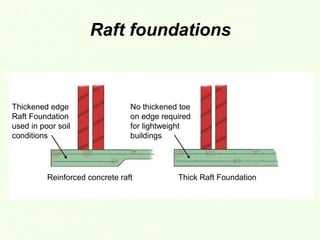
Raft foundations
Thickened edge
Raft Foundation
used in poor soil
conditions
No thickened toe
on edge required
for lightweight
buildings
Reinforced concrete raft Thick Raft Foundation

Tutor types of foundations

  • 1.
  • 2.
    Definition of theTerm ‘Foundation’ A foundation is that part of a building or structure which is in direct contact with the ground and which transfers the loads imposed upon it to the subsoil beneath. Natural Foundation Artificial Foundation wall Load imposed by the building
  • 3.
    Purpose of aFoundation The purpose of a foundation is to spread the load, from the structure above, over an adequate bearing area of the subsoil, and to provide a stable, level base on which to build. Foundations are required to prevent undue settlement and consequent fracture of the building due to unequal loads and stresses at various points and to distribute these loads evenly over an area.
  • 4.
    Spread of Loadson Foundations The manufactured material which is used to carry the weight of the building is usually concrete. Concrete is stronger than the natural soil which has to support it, so that the forces acting through the foundation may have to be distributed over a wider area of subsoil to support the weight.
  • 5.
    It is usuallyassumed that this spreading of the forces through the foundation happens within an angle of 45˚ from the vertical. Load Wall Foundation 45˚ spread of compressive forces in the natural foundation
  • 6.
    Spread of Loadson Foundations The amount of excavation and concrete required would result in a very heavy and expensive structure.
  • 7.
    Solving the problem Thesolution is to make the foundation wider without making it thicker. This will ensure the load is spread over an adequate area of ground to support it safely. In this case, there is a tendency for the foundation to bend across its width so a material which is strong in tension and compression must be used to reinforce the foundation. The material most commonly used is steel reinforcement, and can be either steel bars or steel mesh which is encased within the concrete.
  • 8.
    Settlement Almost all ofthe settlement of foundations in soils is due to water between the particles being forced out, enabling the solid particles to pack closer together. After a long dry spell of weather, cracks sometimes appear in buildings which have stood for many years, indicating that the foundation has moved. In this case, the cause is likely to be that the water in the subsoil has dried out and the soil itself has shrunk.
  • 9.
    Heave When water freezes,it expands; in very cold weather, the water in the subsoil may freeze and cause the soil to heave’, i.e. move upwards. When this occurs beneath a foundation, the pressure exerted could be sufficient to lift the foundation.
  • 10.
    The tree is absorbingmoisture and the roots are growing and shifting foundations causing settlement. Cut down trees are no longer absorbing the moisture, so the surrounding sub-soil can become water logged and swell causing heave
  • 11.
    To avoid settlementor heave due to the effects of frost or heat the foundation must be taken down to a greater depth. For some soils this may need to be 600mm deep, and for clay the depth must be a minimum of 1 metre. Wall remains stable under most conditions Roof protects the ground floor from elements Note! No ground movement should occur if the foundation is at a depth of more than 1.80m Depth at least 1.00m below ground level will produce only very slight movement which will not affect foundation At least 1.00m
  • 12.
    Foundation Types • Padfoundation • Strip Foundation • Wide strip foundations • Stepped strip foundation • Narrow strip or trench fill foundation • Short bored piles • Raft foundations
  • 13.
    Pad foundation For singleloads which are transmitted down a brick pier, concrete column or steel stanchion, the most common foundation is a square or rectangular block of concrete of uniform thickness known as a ‘pad’ foundation.
  • 14.
    Strip Foundation The widthof the strip will depend on the load to be carried and the strength of the ground. Strip foundation
  • 15.
    In order toreduce failure through bending and shear, the foundation concrete has to be a minimum 150mm thick, and the projection from the face of the wall to the edge of the foundation concrete has to be at least equivalent to the concrete thickness. The diagram below shows the dimensions which will satisfy the current Building Regulations. Strip Foundation The depth D must be 150mm minimum and must be equal to, or greater than, the projection P. The distance P must be equal on either side of the wall.
  • 16.
    Wide strip foundations Ifthe use of traditional strip foundations is likely to overstress the bearing strata (the layer of ground on which the foundation sits), a wide strip foundation can be employed. This might necessitate the foundation thickness being increased to overcome the bending and shear stress. In some cases, the thickness of concrete could become uneconomic and so reinforcement is used. Longitudinal reinforcement Transverse reinforcement
  • 17.
    Stepped strip foundation Onsloping sites it is usual to step the foundation to follow the line of the ground and therefore reduce the amount of excavation required. When constructing stepped foundations, the construction starts at the lowest level of the site. Building regulations relating to stepped foundations states: The minimum overlap L should be equal to twice the height of the step S or the foundation thickness T or a width of 300mm whichever is the greatest.
  • 18.
    Stepped strip foundation Heightof step = three courses 225mm Height of step = two courses 150mm Steps should be constructed to gauge of brickwork or blockwork to avoid unnecessary cutting
  • 19.
    Narrow strip ortrench fill foundation Mass concrete poured into the excavations to finish two courses below ground level. This method can be used if there is little space for the bricklayer to work in the footings. Great care is needed with regard to planning of services and drainage with this method as mistakes will be costly to correct.
  • 20.
    Short bored piles Shortbored piles are formed by boring circular holes 300mm diameter to a depth of about 3m by means of an auger. The holes are then filled with concrete and reinforced with steel bars which are left projecting from the top. The piles are placed at the corners of the building and at intermediate positions along the walls. The piles support reinforced concrete ‘ring beams’ which are cast in place in the ground on top of the piles. It is on to these ring beams that the brickwork is built. Ring Beam Short bored piles at 1.8m to 2.4m centres
  • 21.
    Raft foundations Raft foundationsare often used on poor subsoils for lightly loaded buildings and are designed to be capable of accommodating small settlements of the subsoil. A raft foundation covers the whole of the floor and wall area of the structure. The reinforced floor slab is generally thickened out substantially under all the walls, and the loads from the walls are subsequently transferred into the whole of the slab.
  • 22.
    Raft foundations Thickened edge RaftFoundation used in poor soil conditions No thickened toe on edge required for lightweight buildings Reinforced concrete raft Thick Raft Foundation