1
LINTELS
• Introduction
• Classification of lintels
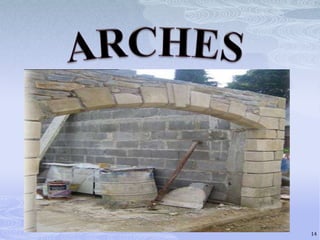
ARCHES
• Arches : Terms to be used
• Stability of an arch
• Classification of an arches

2
Lintels
 Introduction


Classification of lintels

3
Introduction


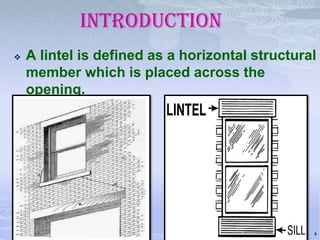
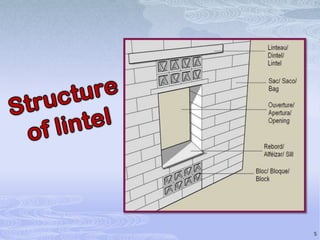
A lintel is defined as a horizontal structural
member which is placed across the
opening.

4
5
Classification of lintel
Lintels are classified into the following
types, according to the materials of
their construction:
 [1] Timber lintels
 [2] Stone lintels
 [3] Brick lintels
 [4] Reinforced Brick lintels
 [5] Steel lintels
 [6] Reinforced cement concrete lintels
6
Timber lintels





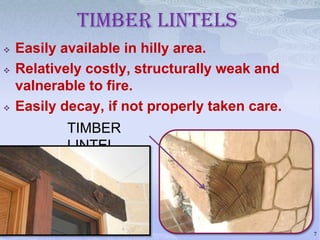
Easily available in hilly area.
Relatively costly, structurally weak and
valnerable to fire.
Easily decay, if not properly taken care.
TIMBER
LINTEL

7
Stone lintels






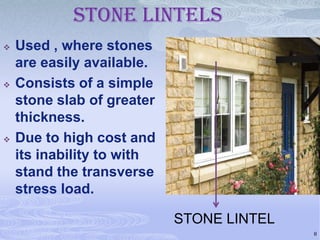
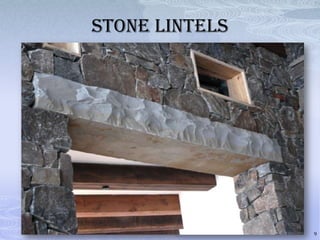
Used , where stones
are easily available.
Consists of a simple
stone slab of greater
thickness.
Due to high cost and
its inability to with
stand the transverse
stress load.
STONE LINTEL
8
Stone lintels

9
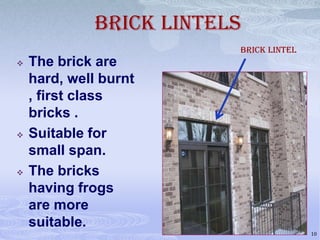
Brick lintels
BRICK LINTEL






The brick are
hard, well burnt
, first class
bricks .
Suitable for
small span.
The bricks
having frogs
are more
suitable.
10
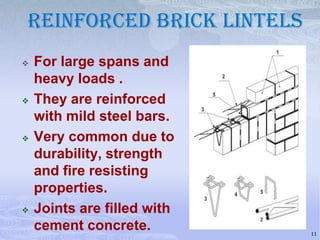
Reinforced Brick lintels








For large spans and
heavy loads .
They are reinforced
with mild steel bars.
Very common due to
durability, strength
and fire resisting
properties.
Joints are filled with
cement concrete.

11
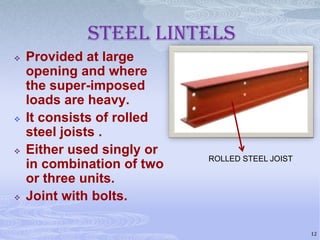
Steel lintels








Provided at large
opening and where
the super-imposed
loads are heavy.
It consists of rolled
steel joists .
Either used singly or
in combination of two
or three units.
Joint with bolts.

ROLLED STEEL JOIST

12
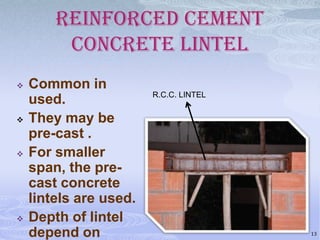
REINFORCED CEMENT
CONCRETE LINTEL








Common in
used.
They may be
pre-cast .
For smaller
span, the precast concrete
lintels are used.
Depth of lintel
depend on

R.C.C. LINTEL

13
14
ARCHES


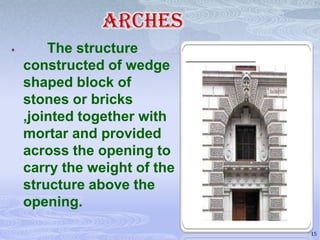
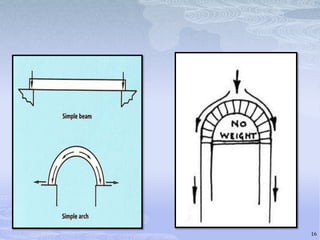
The structure
constructed of wedge
shaped block of
stones or bricks
,jointed together with
mortar and provided
across the opening to
carry the weight of the
structure above the
opening.
15
16
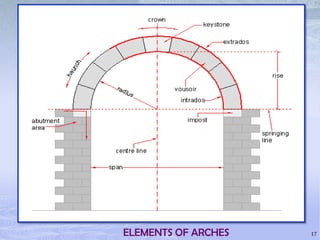
ELEMENTS OF ARCHES

17
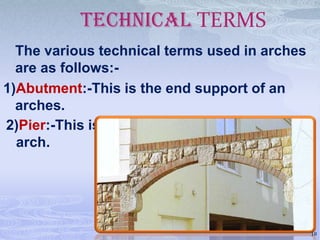
TECHNICAL TERMS
The various technical terms used in arches
are as follows:1)Abutment:-This is the end support of an
arches.
2)Pier:-This is support an intermediate of an
arch.

18
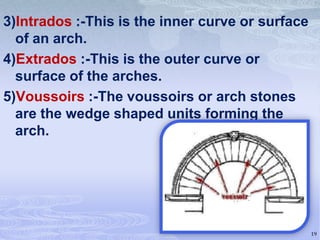
3)Intrados :-This is the inner curve or surface
of an arch.
4)Extrados :-This is the outer curve or
surface of the arches.
5)Voussoirs :-The voussoirs or arch stones
are the wedge shaped units forming the
arch.

19
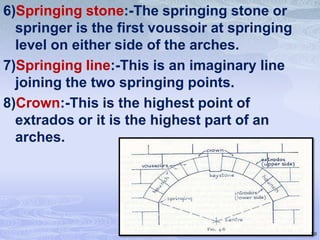
6)Springing stone:-The springing stone or
springer is the first voussoir at springing
level on either side of the arches.
7)Springing line:-This is an imaginary line
joining the two springing points.
8)Crown:-This is the highest point of
extrados or it is the highest part of an
arches.

20
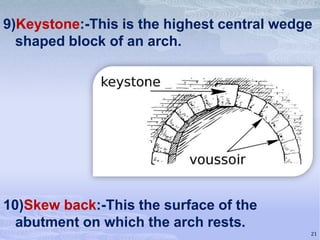
9)Keystone:-This is the highest central wedge
shaped block of an arch.

10)Skew back:-This the surface of the
abutment on which the arch rests.
21
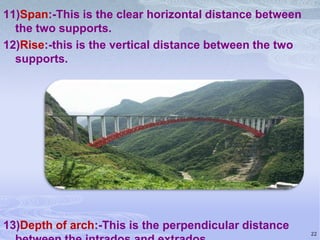
11)Span:-This is the clear horizontal distance between
the two supports.
12)Rise:-this is the vertical distance between the two
supports.

13)Depth of arch:-This is the perpendicular distance

22
14)Haunch of an arch:-This is the portion of
arch situated centrally between the key and
skew backs.
15)Spandril:-This is the triangular walling
enclosed by the extrados of the arch, a
horizontal line from the crown of the arch
and perpendicular line from the springing
of the outer curves.

23




EVERY ELEMENT OF ARCH REMAINS IN
COMPRESSION.
An arches fail due to:1)Crushing of the masonry.
2)Sliding of voussoirs.
3)Rotation of some joints about an edge.
4)Uneven settlement of an abutment or pier.

24
CRUSHING OF THE MASONARY




If the compressive stress
exceeds the safe crushing strength of
the masonry unit and mortar , the arch
will fail in crushing.
The material should be of adequate
strength and size of voussoirs and
should be properly designed to bear the
thrust transmitted through them.
25
SLIDING OF VOUSSOIRS
To safeguard against sliding of
voussoirs past each other due to
transverse shear ,the voussoirs of
greater height should be provided.

ROTATION OF SOME JOINT ABOUT AN EDGE
Rotation can be prevented ,if the line of
resistance is kept within intrados and
extrados.
Also, the line of thrust should be made to
cross the joint away from the edge to prevent
the crushing of that edge.

26
UNEVEN SETTLEMENT OF AN ABUTMENT
OR PIER
Uneven settlement of abutment ,which
causes secondary stresses in arch.
Hence, the abutment which has
ultimately to bear all the load transferred
to the arch , should be strong enough.
Also, the arch should be symmetrical ,
so that unequal settlements of the two
abutment is minimised.
27
28
Classification of arches
An arch may be classified
according to their:
1)Material of construction and
workmanship
2)Shape of curve formed by their soffit
or intrados
3)Number of centers.
29
CLASSIFICATION BASED ON
MATERIAL AND WORKMANSHIP


BRICK ARCHES

*Rough brick arches
*Axed brick arches
*Gauged brick arches


STONE ARCHES

*Rubble arches
*Ashlar arches


GAUGED ARCHES

*Precast concrete block arches
*Monolithic concrete arches

30
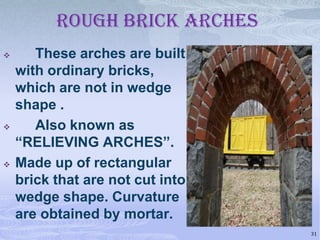
ROUGH BRICK ARCHES






These arches are built
with ordinary bricks,
which are not in wedge
shape .
Also known as
“RELIEVING ARCHES”.
Made up of rectangular
brick that are not cut into
wedge shape. Curvature
are obtained by mortar.
31
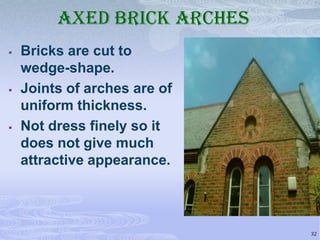
AXED BRICK ARCHES






Bricks are cut to
wedge-shape.
Joints of arches are of
uniform thickness.
Not dress finely so it
does not give much
attractive appearance.

32
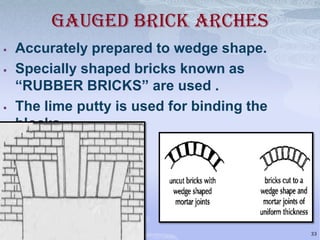
GAUGED BRICK ARCHES





Accurately prepared to wedge shape.
Specially shaped bricks known as
“RUBBER BRICKS” are used .
The lime putty is used for binding the
blocks.

33
RUBBLE ARCHES




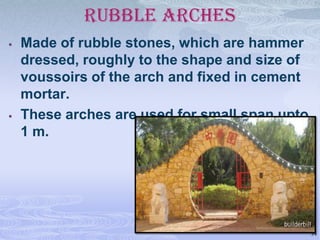
Made of rubble stones, which are hammer
dressed, roughly to the shape and size of
voussoirs of the arch and fixed in cement
mortar.
These arches are used for small span upto
1 m.

34
ASHLAR ARCHES




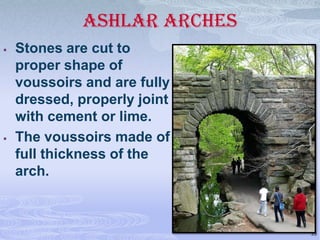
Stones are cut to
proper shape of
voussoirs and are fully
dressed, properly joint
with cement or lime.
The voussoirs made of
full thickness of the
arch.

35
PRECAST CONCRETE BLOCK
ARCHES






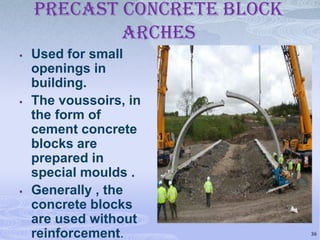
Used for small
openings in
building.
The voussoirs, in
the form of
cement concrete
blocks are
prepared in
special moulds .
Generally , the
concrete blocks
are used without
reinforcement.

36
MONOLITHIC CONCRETE ARCHES






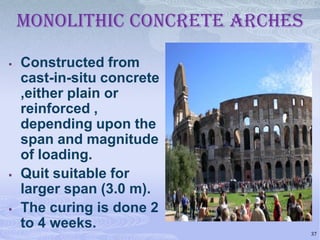
Constructed from
cast-in-situ concrete
,either plain or
reinforced ,
depending upon the
span and magnitude
of loading.
Quit suitable for
larger span (3.0 m).
The curing is done 2
to 4 weeks.
37
Classification according
to shape






Flat arch
Segmental arch
Semi-circular arch
Relieving arch
Dutch or French arch

38
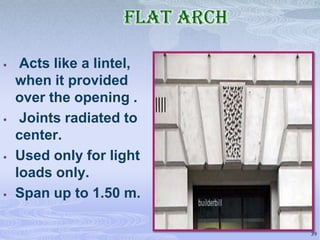
FLAT ARCH








Acts like a lintel,
when it provided
over the opening .
Joints radiated to
center.
Used only for light
loads only.
Span up to 1.50 m.
39
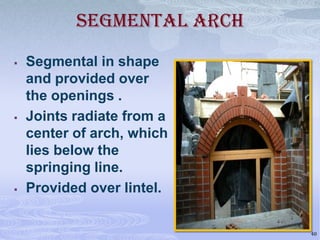
SEGMENTAL ARCH






Segmental in shape
and provided over
the openings .
Joints radiate from a
center of arch, which
lies below the
springing line.
Provided over lintel.
40
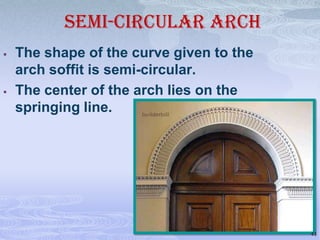
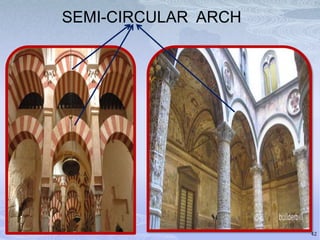
SEMI-CIRCULAR ARCH




The shape of the curve given to the
arch soffit is semi-circular.
The center of the arch lies on the
springing line.

41
SEMI-CIRCULAR ARCH

42
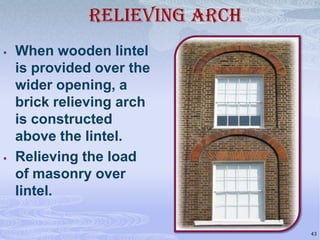
RELIEVING ARCH




When wooden lintel
is provided over the
wider opening, a
brick relieving arch
is constructed
above the lintel.
Relieving the load
of masonry over
lintel.
43
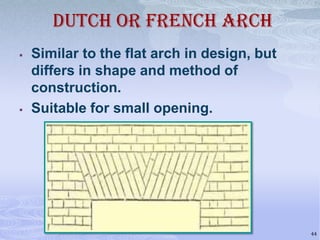
DUTCH OR FRENCH ARCH




Similar to the flat arch in design, but
differs in shape and method of
construction.
Suitable for small opening.

44
CLASSIFICATION BASED ON
NUMBER OF CENTRES







One centred arch.
Two centred arch.
Three centred arch.
Four centred
arch.
Five centred
arch.
45
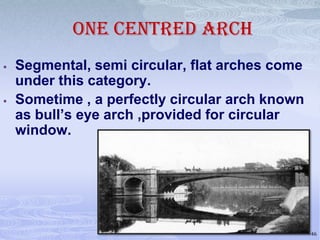
ONE CENTRED ARCH




Segmental, semi circular, flat arches come
under this category.
Sometime , a perfectly circular arch known
as bull’s eye arch ,provided for circular
window.

46
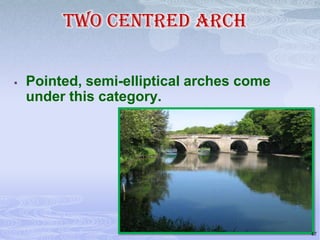
TWO CENTRED ARCH


Pointed, semi-elliptical arches come
under this category.

47
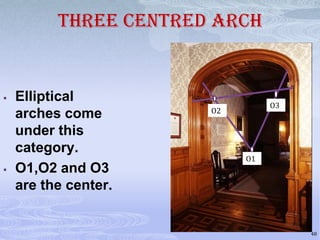
THREE CENTRED ARCH





Elliptical
arches come
under this
category.
O1,O2 and O3
are the center.

O3

O2

O1

48
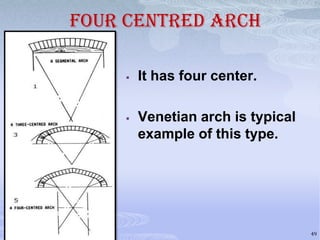
FOUR CENTRED ARCH


It has four center.



Venetian arch is typical
example of this type.

49
FIVE CENTRED ARCH


This type of arch ,having five centre's
,gives good semi-elliptical shape.

50
reference




BOOKS : -“BUILDING CONSTRUCTION”
by
A.S.Kotadia ( mahajan
publication)
-B.C.POONMIA
INTERNET : - www.google.com

51
52

Lintels and arches in construction

  • 1.
  • 2.
    LINTELS • Introduction • Classificationof lintels ARCHES • Arches : Terms to be used • Stability of an arch • Classification of an arches 2
  • 3.
  • 4.
    Introduction  A lintel isdefined as a horizontal structural member which is placed across the opening. 4
  • 5.
  • 6.
    Classification of lintel Lintelsare classified into the following types, according to the materials of their construction:  [1] Timber lintels  [2] Stone lintels  [3] Brick lintels  [4] Reinforced Brick lintels  [5] Steel lintels  [6] Reinforced cement concrete lintels 6
  • 7.
    Timber lintels    Easily availablein hilly area. Relatively costly, structurally weak and valnerable to fire. Easily decay, if not properly taken care. TIMBER LINTEL 7
  • 8.
    Stone lintels    Used ,where stones are easily available. Consists of a simple stone slab of greater thickness. Due to high cost and its inability to with stand the transverse stress load. STONE LINTEL 8
  • 9.
  • 10.
    Brick lintels BRICK LINTEL    Thebrick are hard, well burnt , first class bricks . Suitable for small span. The bricks having frogs are more suitable. 10
  • 11.
    Reinforced Brick lintels     Forlarge spans and heavy loads . They are reinforced with mild steel bars. Very common due to durability, strength and fire resisting properties. Joints are filled with cement concrete. 11
  • 12.
    Steel lintels     Provided atlarge opening and where the super-imposed loads are heavy. It consists of rolled steel joists . Either used singly or in combination of two or three units. Joint with bolts. ROLLED STEEL JOIST 12
  • 13.
    REINFORCED CEMENT CONCRETE LINTEL     Commonin used. They may be pre-cast . For smaller span, the precast concrete lintels are used. Depth of lintel depend on R.C.C. LINTEL 13
  • 14.
  • 15.
    ARCHES  The structure constructed ofwedge shaped block of stones or bricks ,jointed together with mortar and provided across the opening to carry the weight of the structure above the opening. 15
  • 16.
  • 17.
  • 18.
    TECHNICAL TERMS The varioustechnical terms used in arches are as follows:1)Abutment:-This is the end support of an arches. 2)Pier:-This is support an intermediate of an arch. 18
  • 19.
    3)Intrados :-This isthe inner curve or surface of an arch. 4)Extrados :-This is the outer curve or surface of the arches. 5)Voussoirs :-The voussoirs or arch stones are the wedge shaped units forming the arch. 19
  • 20.
    6)Springing stone:-The springingstone or springer is the first voussoir at springing level on either side of the arches. 7)Springing line:-This is an imaginary line joining the two springing points. 8)Crown:-This is the highest point of extrados or it is the highest part of an arches. 20
  • 21.
    9)Keystone:-This is thehighest central wedge shaped block of an arch. 10)Skew back:-This the surface of the abutment on which the arch rests. 21
  • 22.
    11)Span:-This is theclear horizontal distance between the two supports. 12)Rise:-this is the vertical distance between the two supports. 13)Depth of arch:-This is the perpendicular distance 22
  • 23.
    14)Haunch of anarch:-This is the portion of arch situated centrally between the key and skew backs. 15)Spandril:-This is the triangular walling enclosed by the extrados of the arch, a horizontal line from the crown of the arch and perpendicular line from the springing of the outer curves. 23
  • 24.
      EVERY ELEMENT OFARCH REMAINS IN COMPRESSION. An arches fail due to:1)Crushing of the masonry. 2)Sliding of voussoirs. 3)Rotation of some joints about an edge. 4)Uneven settlement of an abutment or pier. 24
  • 25.
    CRUSHING OF THEMASONARY   If the compressive stress exceeds the safe crushing strength of the masonry unit and mortar , the arch will fail in crushing. The material should be of adequate strength and size of voussoirs and should be properly designed to bear the thrust transmitted through them. 25
  • 26.
    SLIDING OF VOUSSOIRS Tosafeguard against sliding of voussoirs past each other due to transverse shear ,the voussoirs of greater height should be provided. ROTATION OF SOME JOINT ABOUT AN EDGE Rotation can be prevented ,if the line of resistance is kept within intrados and extrados. Also, the line of thrust should be made to cross the joint away from the edge to prevent the crushing of that edge. 26
  • 27.
    UNEVEN SETTLEMENT OFAN ABUTMENT OR PIER Uneven settlement of abutment ,which causes secondary stresses in arch. Hence, the abutment which has ultimately to bear all the load transferred to the arch , should be strong enough. Also, the arch should be symmetrical , so that unequal settlements of the two abutment is minimised. 27
  • 28.
  • 29.
    Classification of arches Anarch may be classified according to their: 1)Material of construction and workmanship 2)Shape of curve formed by their soffit or intrados 3)Number of centers. 29
  • 30.
    CLASSIFICATION BASED ON MATERIALAND WORKMANSHIP  BRICK ARCHES *Rough brick arches *Axed brick arches *Gauged brick arches  STONE ARCHES *Rubble arches *Ashlar arches  GAUGED ARCHES *Precast concrete block arches *Monolithic concrete arches 30
  • 31.
    ROUGH BRICK ARCHES    Thesearches are built with ordinary bricks, which are not in wedge shape . Also known as “RELIEVING ARCHES”. Made up of rectangular brick that are not cut into wedge shape. Curvature are obtained by mortar. 31
  • 32.
    AXED BRICK ARCHES    Bricksare cut to wedge-shape. Joints of arches are of uniform thickness. Not dress finely so it does not give much attractive appearance. 32
  • 33.
    GAUGED BRICK ARCHES    Accuratelyprepared to wedge shape. Specially shaped bricks known as “RUBBER BRICKS” are used . The lime putty is used for binding the blocks. 33
  • 34.
    RUBBLE ARCHES   Made ofrubble stones, which are hammer dressed, roughly to the shape and size of voussoirs of the arch and fixed in cement mortar. These arches are used for small span upto 1 m. 34
  • 35.
    ASHLAR ARCHES   Stones arecut to proper shape of voussoirs and are fully dressed, properly joint with cement or lime. The voussoirs made of full thickness of the arch. 35
  • 36.
    PRECAST CONCRETE BLOCK ARCHES    Usedfor small openings in building. The voussoirs, in the form of cement concrete blocks are prepared in special moulds . Generally , the concrete blocks are used without reinforcement. 36
  • 37.
    MONOLITHIC CONCRETE ARCHES    Constructedfrom cast-in-situ concrete ,either plain or reinforced , depending upon the span and magnitude of loading. Quit suitable for larger span (3.0 m). The curing is done 2 to 4 weeks. 37
  • 38.
    Classification according to shape      Flatarch Segmental arch Semi-circular arch Relieving arch Dutch or French arch 38
  • 39.
    FLAT ARCH     Acts likea lintel, when it provided over the opening . Joints radiated to center. Used only for light loads only. Span up to 1.50 m. 39
  • 40.
    SEGMENTAL ARCH    Segmental inshape and provided over the openings . Joints radiate from a center of arch, which lies below the springing line. Provided over lintel. 40
  • 41.
    SEMI-CIRCULAR ARCH   The shapeof the curve given to the arch soffit is semi-circular. The center of the arch lies on the springing line. 41
  • 42.
  • 43.
    RELIEVING ARCH   When woodenlintel is provided over the wider opening, a brick relieving arch is constructed above the lintel. Relieving the load of masonry over lintel. 43
  • 44.
    DUTCH OR FRENCHARCH   Similar to the flat arch in design, but differs in shape and method of construction. Suitable for small opening. 44
  • 45.
    CLASSIFICATION BASED ON NUMBEROF CENTRES      One centred arch. Two centred arch. Three centred arch. Four centred arch. Five centred arch. 45
  • 46.
    ONE CENTRED ARCH   Segmental,semi circular, flat arches come under this category. Sometime , a perfectly circular arch known as bull’s eye arch ,provided for circular window. 46
  • 47.
    TWO CENTRED ARCH  Pointed,semi-elliptical arches come under this category. 47
  • 48.
    THREE CENTRED ARCH   Elliptical archescome under this category. O1,O2 and O3 are the center. O3 O2 O1 48
  • 49.
    FOUR CENTRED ARCH  Ithas four center.  Venetian arch is typical example of this type. 49
  • 50.
    FIVE CENTRED ARCH  Thistype of arch ,having five centre's ,gives good semi-elliptical shape. 50
  • 51.
    reference   BOOKS : -“BUILDINGCONSTRUCTION” by A.S.Kotadia ( mahajan publication) -B.C.POONMIA INTERNET : - www.google.com 51
  • 52.