Done by:
Aditya Raj Pradhan BE/10575/2014
Rishikesh Prabhakar BE/10667/2014
 Lowest part of a structure
 Provides a base for the super structure
 Transmits the load on the structure including the dead
weight of the structure itself to the soil below.
Foundation

Deep foundations
Shallow foundations
Types of Foundation:

 Foundation placed immediately lowest part of the
super structure.
 Used to distribute the structural load over a wide
horizontal area at a shallow depth below the ground
level.
 According to Terzaghi, a foundation is shallow if its
depth is equal to or less than its width.
Shallow Foundation

 Spread footing
 Combined footing
 Mat or raft footing
Types of Shallow
Foundations
 Structural members are used to support columns and
walls and to transmit their loads to their loads to the
soil.
Spread footing

 Wall footings
 Reinforced Concrete footings
 Inverted arch Footing
 Column Footings
Types of Spread footing

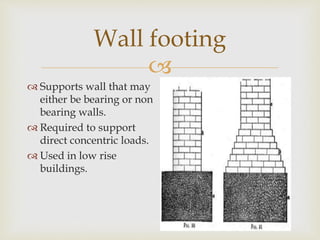
Wall footing
 Supports wall that may
either be bearing or non
bearing walls.
 Required to support
direct concentric loads.
 Used in low rise
buildings.

Reinforced Concrete
Footing
 Relatively heavy
loading than wall
footing.
 Bearing capacity of soil
is low.
 Reinforcing steel is
placed in the bottom of
the footing in a
direction perpendicular
to the wall.

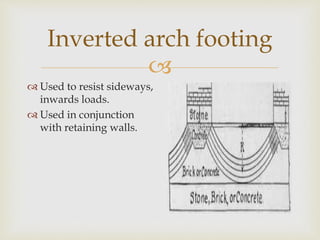
Inverted arch footing
 Used to resist sideways,
inwards loads.
 Used in conjunction
with retaining walls.

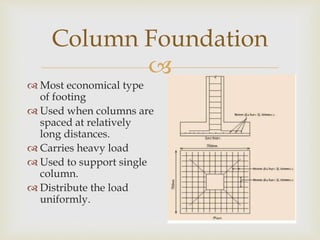
Column Foundation
 Most economical type
of footing
 Used when columns are
spaced at relatively
long distances.
 Carries heavy load
 Used to support single
column.
 Distribute the load
uniformly.

 Usually supports two or three columns not in a row.
 Used when two columns are so close that single
footings cannot be used or when one column is
located at or near a property line.
Combined footings

Combined Footing
 Two columns are close
together causing
overlap of adjacent
isolated footings.
 Soil bearing capacity is
low causing overlap of
adjacent isolated
footings.

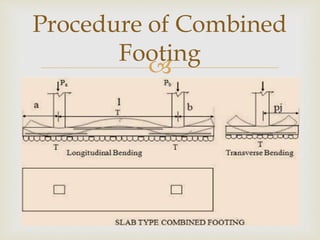
Procedure of Combined
Footing

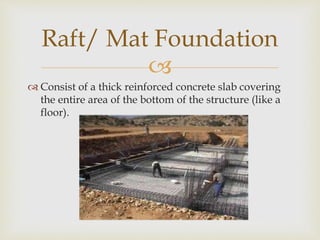
 Consist of a thick reinforced concrete slab covering
the entire area of the bottom of the structure (like a
floor).
Raft/ Mat Foundation

 Base soil has low bearing capacity or
 Column load are so large that more than 50% of the
area covered by conventional spread footing.
 Resist unequal settlement due to earthquake.
 Quickness of construction work.
Raft Foundation

Different types of Raft
 Spread footers being installed is too shallow (2-3 feet below), which
does not eliminate the effects of expansive soil.
 Foundation repair will last longer than a week as the excavations
are made and the concrete will have to be cured before the holes can
be refilled.
 A huge amount of earthwork is to be done in mat foundation
 If the shoring system cannot resist the pressure of outside land, then
the structure surrounding the area may be damaged by deflection of
soil.
 Ground water may come out when earthwork is done.
 Limited to dealing with point loads.
Limitations of Shallow
Foundation

 Quick process compared to others construction
work.
 Economically cheaper.
 Can resist ground water absorption.
 Damage due to earthquake is lesser than any other
type of foundation.
 Consist of reinforced concrete slab which is more
thicker than footing foundation.
 Prevents unequal settlements.
Advantages of shallow
foundation

Shallow foundation

  • 1.
    Done by: Aditya RajPradhan BE/10575/2014 Rishikesh Prabhakar BE/10667/2014
  • 2.
     Lowest partof a structure  Provides a base for the super structure  Transmits the load on the structure including the dead weight of the structure itself to the soil below. Foundation
  • 3.
  • 4.
      Foundation placedimmediately lowest part of the super structure.  Used to distribute the structural load over a wide horizontal area at a shallow depth below the ground level.  According to Terzaghi, a foundation is shallow if its depth is equal to or less than its width. Shallow Foundation
  • 5.
      Spread footing Combined footing  Mat or raft footing Types of Shallow Foundations
  • 6.
     Structural membersare used to support columns and walls and to transmit their loads to their loads to the soil. Spread footing
  • 8.
      Wall footings Reinforced Concrete footings  Inverted arch Footing  Column Footings Types of Spread footing
  • 9.
     Wall footing  Supportswall that may either be bearing or non bearing walls.  Required to support direct concentric loads.  Used in low rise buildings.
  • 10.
     Reinforced Concrete Footing  Relativelyheavy loading than wall footing.  Bearing capacity of soil is low.  Reinforcing steel is placed in the bottom of the footing in a direction perpendicular to the wall.
  • 11.
     Inverted arch footing Used to resist sideways, inwards loads.  Used in conjunction with retaining walls.
  • 12.
     Column Foundation  Mosteconomical type of footing  Used when columns are spaced at relatively long distances.  Carries heavy load  Used to support single column.  Distribute the load uniformly.
  • 13.
      Usually supportstwo or three columns not in a row.  Used when two columns are so close that single footings cannot be used or when one column is located at or near a property line. Combined footings
  • 14.
     Combined Footing  Twocolumns are close together causing overlap of adjacent isolated footings.  Soil bearing capacity is low causing overlap of adjacent isolated footings.
  • 15.
  • 16.
      Consist ofa thick reinforced concrete slab covering the entire area of the bottom of the structure (like a floor). Raft/ Mat Foundation
  • 17.
      Base soilhas low bearing capacity or  Column load are so large that more than 50% of the area covered by conventional spread footing.  Resist unequal settlement due to earthquake.  Quickness of construction work. Raft Foundation
  • 18.
  • 19.
     Spread footersbeing installed is too shallow (2-3 feet below), which does not eliminate the effects of expansive soil.  Foundation repair will last longer than a week as the excavations are made and the concrete will have to be cured before the holes can be refilled.  A huge amount of earthwork is to be done in mat foundation  If the shoring system cannot resist the pressure of outside land, then the structure surrounding the area may be damaged by deflection of soil.  Ground water may come out when earthwork is done.  Limited to dealing with point loads. Limitations of Shallow Foundation
  • 20.
      Quick processcompared to others construction work.  Economically cheaper.  Can resist ground water absorption.  Damage due to earthquake is lesser than any other type of foundation.  Consist of reinforced concrete slab which is more thicker than footing foundation.  Prevents unequal settlements. Advantages of shallow foundation