Communication skills
Tutor Copy
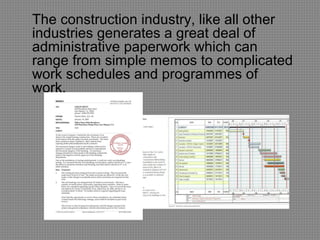
The construction industry, like all other
industries generates a great deal of
administrative paperwork which can
range from simple memos to complicated
work schedules and programmes of
work.
All these documents are designed to
improve efficiency and ensure good
communication links between the firm, other
organisations as well as departments,
sections and individuals within the firm.
Communication
1. VERBAL or ORAL
communication
This involves people talking to
one another face- to-face or
one to one.
There are other ways of using
verbal communication:
• Group discussions.
• Meetings, lectures etc.
• None face-to-face.
• Telephone conversations,
video links.
2. WRITTEN communication
• Letters Personal and official.
• Memos and notes Short and precise form of letter.
• Timesheets Various forms.
• Invoices Used to bill customers.
• Drawings and sketches Used to communicate
technical information.
• Specifications Precise technical information
associated with drawings.
• Schedules Lists of building components.
• Graphs and charts Used to display data.
• Photographs Used to present images.
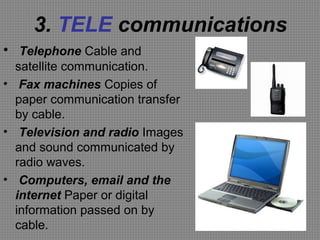
3. TELE communications
• Telephone Cable and
satellite communication.
• Fax machines Copies of
paper communication transfer
by cable.
• Television and radio Images
and sound communicated by
radio waves.
• Computers, email and the
internet Paper or digital
information passed on by
cable.
Meetings
There are two kinds of meetings:
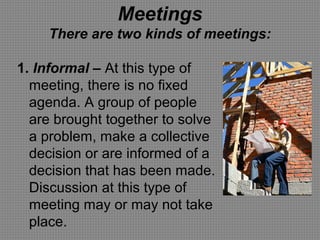
1. Informal – At this type of
meeting, there is no fixed
agenda. A group of people
are brought together to solve
a problem, make a collective
decision or are informed of a
decision that has been made.
Discussion at this type of
meeting may or may not take
place.
Meetings
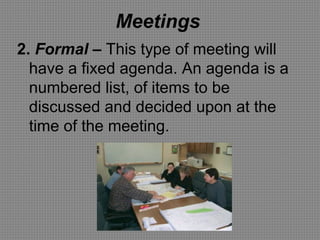
2. Formal – This type of meeting will
have a fixed agenda. An agenda is a
numbered list, of items to be
discussed and decided upon at the
time of the meeting.
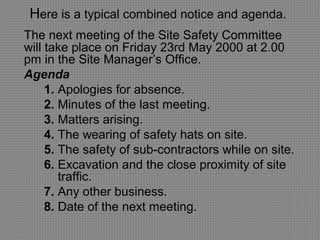
Here is a typical combined notice and agenda.
The next meeting of the Site Safety Committee
will take place on Friday 23rd May 2000 at 2.00
pm in the Site Manager’s Office.
Agenda
1. Apologies for absence.
2. Minutes of the last meeting.
3. Matters arising.
4. The wearing of safety hats on site.
5. The safety of sub-contractors while on site.
6. Excavation and the close proximity of site
traffic.
7. Any other business.
8. Date of the next meeting.
Verbal Communication
As far as you and your job within the construction
industry are concerned, you are more likely to use
the following methods of verbal communication:
• Informal conversation.
• Formal conversation.
• Receive instructions.
• Use the telephone.
• Take part in meetings.
• Oral presentation.
Communicating skills
No matter what method is used to pass on information,
there are certain rules which must be adopted to ensure
that effective communication takes place.
Where speech is concerned:
1. The information passed on should be accurate and easily
understood, otherwise, if it is passed on to another
person, the wrong information could be received.
2. Information should be precise, clear, straightforward,
simple to understand, accurate and as short as possible.
3. Listen carefully to receive the correct information, and
speak clearly and pronounce the words correctly.

Tutor communication skills ppt1

  • 1.
  • 2.
  • 3.
    The construction industry,like all other industries generates a great deal of administrative paperwork which can range from simple memos to complicated work schedules and programmes of work.
  • 4.
    All these documentsare designed to improve efficiency and ensure good communication links between the firm, other organisations as well as departments, sections and individuals within the firm. Communication
  • 5.
    1. VERBAL orORAL communication This involves people talking to one another face- to-face or one to one. There are other ways of using verbal communication: • Group discussions. • Meetings, lectures etc. • None face-to-face. • Telephone conversations, video links.
  • 6.
    2. WRITTEN communication •Letters Personal and official. • Memos and notes Short and precise form of letter. • Timesheets Various forms. • Invoices Used to bill customers. • Drawings and sketches Used to communicate technical information. • Specifications Precise technical information associated with drawings. • Schedules Lists of building components. • Graphs and charts Used to display data. • Photographs Used to present images.
  • 7.
    3. TELE communications •Telephone Cable and satellite communication. • Fax machines Copies of paper communication transfer by cable. • Television and radio Images and sound communicated by radio waves. • Computers, email and the internet Paper or digital information passed on by cable.
  • 8.
    Meetings There are twokinds of meetings: 1. Informal – At this type of meeting, there is no fixed agenda. A group of people are brought together to solve a problem, make a collective decision or are informed of a decision that has been made. Discussion at this type of meeting may or may not take place.
  • 9.
    Meetings 2. Formal –This type of meeting will have a fixed agenda. An agenda is a numbered list, of items to be discussed and decided upon at the time of the meeting.
  • 10.
    Here is atypical combined notice and agenda. The next meeting of the Site Safety Committee will take place on Friday 23rd May 2000 at 2.00 pm in the Site Manager’s Office. Agenda 1. Apologies for absence. 2. Minutes of the last meeting. 3. Matters arising. 4. The wearing of safety hats on site. 5. The safety of sub-contractors while on site. 6. Excavation and the close proximity of site traffic. 7. Any other business. 8. Date of the next meeting.
  • 11.
    Verbal Communication As faras you and your job within the construction industry are concerned, you are more likely to use the following methods of verbal communication: • Informal conversation. • Formal conversation. • Receive instructions. • Use the telephone. • Take part in meetings. • Oral presentation.
  • 12.
    Communicating skills No matterwhat method is used to pass on information, there are certain rules which must be adopted to ensure that effective communication takes place. Where speech is concerned: 1. The information passed on should be accurate and easily understood, otherwise, if it is passed on to another person, the wrong information could be received. 2. Information should be precise, clear, straightforward, simple to understand, accurate and as short as possible. 3. Listen carefully to receive the correct information, and speak clearly and pronounce the words correctly.