PREPARED BY
Mohit Goyal
Civil Engineer
FOUNDATIONS
OBJECTIVES
To know the construction of foundation
To know the different types foundations
To know which type of foundation is suitable for
different types soils.
FOUNDATION
 Every structure consists of two parts:
 Sub-structure or foundation and
 Super structure
Foundation : It is the lowest part of a structure which
is constructed below the ground level.
 The function of foundation is to transmit the
weight of super structure to the sub soil.
TYPES OF FOUNDATIONS
1. SHALLOW FOUNDATIONS (D<= B)
2. DEEP FOUNDATIONS (D>= B)
D
B
G L
FOUNDATION
TRENCH
TYPES OF FONDATIONS
1. SHALLOW FOUNDATIONS
 WALL FOUNDATION
 ISOLATED COLUMN
FOUNDATION
 COMBINED FOUNDATION
 MAT OR RAFT FOUNDATION
2. DEEP FONDATIONS
 PILE FOUNDATIONS
 UNDER-REAMED PILE
 WELL FOUNDATIONS
WALL FOUNDATION
RAMMER
FOUNDATION
TRENCH
SAND OR PEIECES OF
BRICKS ETC..,
P C C
WALL
SIMPLE
FOUNDATION
P C C
I FOOTING
WALL
STEPPED
FOUNDATION
II FOOTING
WALL FOUNDATION
ISOLATED FOOTING
It is provided under columns to transfer the load safely to
bed soil
These footings may be slab, stepped or sloped ones.
P C C
FOOTING
COLUMN
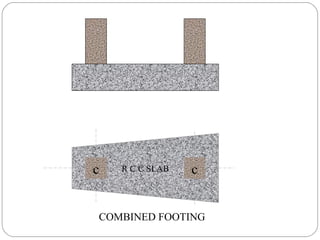
COMBINED FOOTING
A combined footing is the one which supports two columns and it
may be rectangular or trapezoidal in plan.
The aim is to get uniform pressure distribution under the footing.
For this the center of gravity of the footing area should coincide
with the center of gravity of the combined loads of the two
columns.
Combined footings are used in the following situations:
When the columns are very near to each other so that their
footings overlap.
When the bearing capacity of the soil is less, requiring more area
under individual footing.
When the end column is near a property line so that its footing
cannot spread in that direction.
R C C SLABc c
COMBINED FOOTING
MAT FOUNDATION
It is most suitable foundation when the soil at the site
proposed for the construction of a structure is erratic,
soft clay, made up ground or marshy land with low
bearing capacity.
Mat foundation is constructed of RCC slab covering the
whole area of the bottom of the structure. The slab is
provided with steel reinforcing bars in both directions.
When column loads are heavy, the main beams and
secondary beams are provided monolithically with raft
slab.
PCC BED
R C C SLAB
C C
SECTION ALONG AA
MAT FOUNDATION
COLUMN
A A
MAIN BEAM
SECONDARY
BEAM
MAIN BEAM
PILE FOUNDATIONS
Pile foundation is more commonly used in building
construction.
Pile foundations are used in the following situations:
The load of the super structure is heavy and its distribution
is uneven
The top soil has poor bearing capacity
The subsoil water level is high
There is large fluctuations in subsoil water level
Canal or deep drainage lines exist near the foundation
The structure is situated on the sea shore or river bed
PILES
END BEARING PILES FRICTION PILES ANCHOR PILESTENSION PILESCOMPACTION PILES
CLASSIFICATION OF PILES
BASED ON FUNCTION
PILES
CONCRETE PILES TIMBER PILES STEEL PILES COMPOSITE PILES
PRE-CAST PILES
CAST-IN SITU PILES
H - PILE
PIPE PILE
SHEET PILE
CONCRETE AND TIMBER
CONCRETE AND STEEL
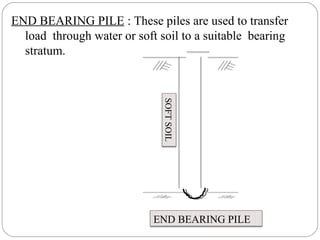
END BEARING PILE : These piles are used to transfer
load through water or soft soil to a suitable bearing
stratum.
END BEARING PILE
SOFTSOIL
FRICTION PILE: These piles are used to transfer loads to a
depth of a friction load carrying material by means of
skin friction along the length of pile.
FRICTION PILE
COMPACTION PILECOMPACTION PILE
COMPACTION PILE: these piles are used to compact loose soils,
thus increasing their bearing capacity. The compaction piles
themselves do not carry any load.Hence they may be of weaker
material (sand). The pile tube, driven to compact the soil, is
gradually taken out and sand is filled in its place thus forming a
‘sand pile’.
UNDER REAMED PILE
In black cotton soils and other expansive type of
soils, buildings often crack due to relative ground
movements. This is caused by alternate swelling
and shrinking of the soil due to changes in its
moisture content.
The under-reamed pile is used to safe guard this
movement effectively. Generally this foundation is
used for machine foundation, factory building,
transmission line towers and other tall structures
also.
BORE HOLE UNDER-REAMED
EQUIPMENT
UNDER-REAMED PILEUNDER-REAMED PILE
WELL FOUNDATION
 Well foundation is a box of timber, metal, reinforced
concrete or masonry which open both at the top and
bottom, and is used for building for building and bridge
foundations.
Types of well shapes:
 Circular
 Rectangular
 Double – D
 Twin circular etc..,
CUTTING EDGE
CURB
STEINING
BOTTOM PLUG
TOP PLUG
WELL CAP
PIER
WELL FOUNDATIONWELL FOUNDATION
SAND FIILING
FRAMED STRUCTURE
Factors affecting choice of foundation
The type of construction.
The magnitude of load.
Drainage conditions.
Feasibility in terms of available skilled labors and cost.
The type and bearing capacity of soil.
The seismic hazard and vulnerability of site to
earthquake.
Construction of foundation
Construction of foundation consists upon the
following activities:
Site preparation
Site layout
Excavation
Pour footing
Pour slab on grade
Pour concrete foundation walls
Site Preparation
• Remove trees and any debris
• Remove top soil (4-6” below surface)
Site Layout
• Define the boundaries by using chalk powder.
• Layout building perimeter, Establish building
corners & building perimeter.
•Use surveying instruments
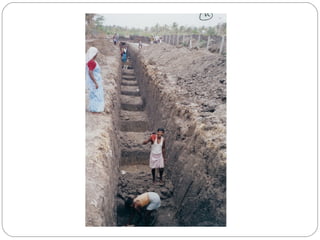
Excavation
•Excavate foundation along line created.
•Excavate remainder of soil inside perimeter
•(Don’t excavate inside soil if slab on
grade)
•If deep foundation, taper edges to prevent
collapse
•If soil unstable, or very deep - use shoring
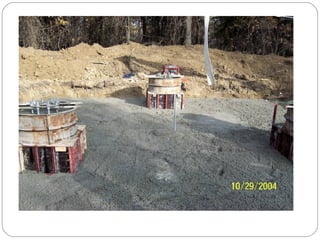
Pour Footings
•Construct formwork (if required)
•Install reinforcement (rebar) for footing.
•Pour concrete footings
•Smooth / finish surface
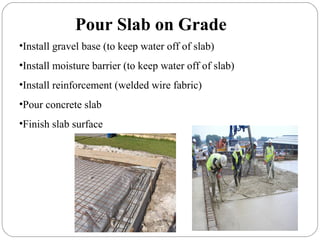
Pour Slab on Grade
•Install gravel base (to keep water off of slab)
•Install moisture barrier (to keep water off of slab)
•Install reinforcement (welded wire fabric)
•Pour concrete slab
•Finish slab surface
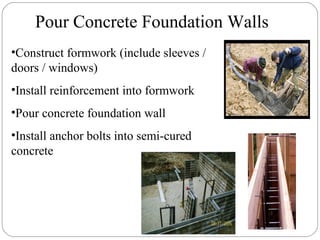
Pour Concrete Foundation Walls
•Construct formwork (include sleeves /
doors / windows)
•Install reinforcement into formwork
•Pour concrete foundation wall
•Install anchor bolts into semi-cured
concrete
Pour Concrete Foundation Walls
•Allow concrete to cure adequately (7-10 days)
•Strip forms
•Apply waterproofing
•Backfill
Protecting
Foundation Against
Moisture
Waterproofing
 Structures Below Ground subject to
penetration of ground water
 More extreme, if below H2O table
 Two basic approaches to Waterproofing
– Waterproof Membranes, or
– Drainage
– Generally - both used in tandem
Waterproofing Membranes
 Materials
– Liquid or sheet (plastic, asphaltic,
synthetic rubber)
– Coatings (asphaltic)
– Cementitious plasters & admixtures
– Bentonite clay
 Protecting boards or panels
– Protection board
– Water stop
» Unit of measure - SF, in (thickness)
Stone & Perforated Pipe Drainage Mat & Perforated Pipe
Drainage Methods
Damp proofing
Typically, a liquid asphalt
Applied with a
Roller or sprayer
Not an effective barrier
For water under pressure.
But, will prevent ground
‘Moisture’ from migrating
Through a wall.
Typically used in conjunction
Will drainage pipe.
Underpinning
Underpinning is the process of strengthening the
foundation of an existing building or other structure.
Underpinning may be necessary for A variety of reasons:
The original foundation is simply not strong or stable
enough.
The usage of the structure has changed.
The properties of the soil supporting the foundation may
have changed (possibly through subsidence) or were
mischaracterized during design.
The construction of nearby structures necessitates the
excavation of soil supporting existing foundations.
•To increase the depth or load capacity of existing foundations to
support the addition of another storey to the building (above or
below grade).
•It is more economical, due to land price or otherwise, to work on
the present structure's foundation than to build a new one.
•Earthquake, flood, drought or other natural causes have caused the
structure to move, thereby requiring stabilization of foundation soils
and/or footings.
•Underpinning may be accomplished by extending the foundation in
depth or in breadth so it either rests on a more supportive soil
stratum or distributes its load across a greater area. Use of micro
pilesand jet grouting are common methods in underpinning

Foundation

  • 1.
    PREPARED BY Mohit Goyal CivilEngineer FOUNDATIONS
  • 2.
    OBJECTIVES To know theconstruction of foundation To know the different types foundations To know which type of foundation is suitable for different types soils.
  • 3.
    FOUNDATION  Every structureconsists of two parts:  Sub-structure or foundation and  Super structure Foundation : It is the lowest part of a structure which is constructed below the ground level.  The function of foundation is to transmit the weight of super structure to the sub soil.
  • 4.
    TYPES OF FOUNDATIONS 1.SHALLOW FOUNDATIONS (D<= B) 2. DEEP FOUNDATIONS (D>= B) D B G L FOUNDATION TRENCH
  • 5.
    TYPES OF FONDATIONS 1.SHALLOW FOUNDATIONS  WALL FOUNDATION  ISOLATED COLUMN FOUNDATION  COMBINED FOUNDATION  MAT OR RAFT FOUNDATION 2. DEEP FONDATIONS  PILE FOUNDATIONS  UNDER-REAMED PILE  WELL FOUNDATIONS
  • 8.
  • 9.
    P C C WALL SIMPLE FOUNDATION PC C I FOOTING WALL STEPPED FOUNDATION II FOOTING WALL FOUNDATION
  • 10.
    ISOLATED FOOTING It isprovided under columns to transfer the load safely to bed soil These footings may be slab, stepped or sloped ones. P C C FOOTING COLUMN
  • 13.
    COMBINED FOOTING A combinedfooting is the one which supports two columns and it may be rectangular or trapezoidal in plan. The aim is to get uniform pressure distribution under the footing. For this the center of gravity of the footing area should coincide with the center of gravity of the combined loads of the two columns. Combined footings are used in the following situations: When the columns are very near to each other so that their footings overlap. When the bearing capacity of the soil is less, requiring more area under individual footing. When the end column is near a property line so that its footing cannot spread in that direction.
  • 14.
    R C CSLABc c COMBINED FOOTING
  • 15.
    MAT FOUNDATION It ismost suitable foundation when the soil at the site proposed for the construction of a structure is erratic, soft clay, made up ground or marshy land with low bearing capacity. Mat foundation is constructed of RCC slab covering the whole area of the bottom of the structure. The slab is provided with steel reinforcing bars in both directions. When column loads are heavy, the main beams and secondary beams are provided monolithically with raft slab.
  • 16.
    PCC BED R CC SLAB C C SECTION ALONG AA MAT FOUNDATION COLUMN A A MAIN BEAM SECONDARY BEAM MAIN BEAM
  • 19.
    PILE FOUNDATIONS Pile foundationis more commonly used in building construction. Pile foundations are used in the following situations: The load of the super structure is heavy and its distribution is uneven The top soil has poor bearing capacity The subsoil water level is high There is large fluctuations in subsoil water level Canal or deep drainage lines exist near the foundation The structure is situated on the sea shore or river bed
  • 20.
    PILES END BEARING PILESFRICTION PILES ANCHOR PILESTENSION PILESCOMPACTION PILES CLASSIFICATION OF PILES BASED ON FUNCTION PILES CONCRETE PILES TIMBER PILES STEEL PILES COMPOSITE PILES PRE-CAST PILES CAST-IN SITU PILES H - PILE PIPE PILE SHEET PILE CONCRETE AND TIMBER CONCRETE AND STEEL
  • 21.
    END BEARING PILE: These piles are used to transfer load through water or soft soil to a suitable bearing stratum. END BEARING PILE SOFTSOIL
  • 22.
    FRICTION PILE: Thesepiles are used to transfer loads to a depth of a friction load carrying material by means of skin friction along the length of pile. FRICTION PILE
  • 23.
    COMPACTION PILECOMPACTION PILE COMPACTIONPILE: these piles are used to compact loose soils, thus increasing their bearing capacity. The compaction piles themselves do not carry any load.Hence they may be of weaker material (sand). The pile tube, driven to compact the soil, is gradually taken out and sand is filled in its place thus forming a ‘sand pile’.
  • 25.
    UNDER REAMED PILE Inblack cotton soils and other expansive type of soils, buildings often crack due to relative ground movements. This is caused by alternate swelling and shrinking of the soil due to changes in its moisture content. The under-reamed pile is used to safe guard this movement effectively. Generally this foundation is used for machine foundation, factory building, transmission line towers and other tall structures also.
  • 26.
  • 27.
  • 28.
    WELL FOUNDATION  Wellfoundation is a box of timber, metal, reinforced concrete or masonry which open both at the top and bottom, and is used for building for building and bridge foundations. Types of well shapes:  Circular  Rectangular  Double – D  Twin circular etc..,
  • 29.
    CUTTING EDGE CURB STEINING BOTTOM PLUG TOPPLUG WELL CAP PIER WELL FOUNDATIONWELL FOUNDATION SAND FIILING
  • 31.
  • 32.
    Factors affecting choiceof foundation The type of construction. The magnitude of load. Drainage conditions. Feasibility in terms of available skilled labors and cost. The type and bearing capacity of soil. The seismic hazard and vulnerability of site to earthquake.
  • 33.
    Construction of foundation Constructionof foundation consists upon the following activities: Site preparation Site layout Excavation Pour footing Pour slab on grade Pour concrete foundation walls
  • 34.
    Site Preparation • Removetrees and any debris • Remove top soil (4-6” below surface)
  • 35.
    Site Layout • Definethe boundaries by using chalk powder. • Layout building perimeter, Establish building corners & building perimeter. •Use surveying instruments
  • 36.
    Excavation •Excavate foundation alongline created. •Excavate remainder of soil inside perimeter •(Don’t excavate inside soil if slab on grade) •If deep foundation, taper edges to prevent collapse •If soil unstable, or very deep - use shoring
  • 37.
    Pour Footings •Construct formwork(if required) •Install reinforcement (rebar) for footing. •Pour concrete footings •Smooth / finish surface
  • 38.
    Pour Slab onGrade •Install gravel base (to keep water off of slab) •Install moisture barrier (to keep water off of slab) •Install reinforcement (welded wire fabric) •Pour concrete slab •Finish slab surface
  • 39.
    Pour Concrete FoundationWalls •Construct formwork (include sleeves / doors / windows) •Install reinforcement into formwork •Pour concrete foundation wall •Install anchor bolts into semi-cured concrete
  • 40.
    Pour Concrete FoundationWalls •Allow concrete to cure adequately (7-10 days) •Strip forms •Apply waterproofing •Backfill
  • 41.
  • 42.
    Waterproofing  Structures BelowGround subject to penetration of ground water  More extreme, if below H2O table  Two basic approaches to Waterproofing – Waterproof Membranes, or – Drainage – Generally - both used in tandem
  • 43.
    Waterproofing Membranes  Materials –Liquid or sheet (plastic, asphaltic, synthetic rubber) – Coatings (asphaltic) – Cementitious plasters & admixtures – Bentonite clay  Protecting boards or panels – Protection board – Water stop » Unit of measure - SF, in (thickness)
  • 44.
    Stone & PerforatedPipe Drainage Mat & Perforated Pipe Drainage Methods
  • 45.
    Damp proofing Typically, aliquid asphalt Applied with a Roller or sprayer Not an effective barrier For water under pressure. But, will prevent ground ‘Moisture’ from migrating Through a wall. Typically used in conjunction Will drainage pipe.
  • 46.
    Underpinning Underpinning is theprocess of strengthening the foundation of an existing building or other structure. Underpinning may be necessary for A variety of reasons: The original foundation is simply not strong or stable enough. The usage of the structure has changed. The properties of the soil supporting the foundation may have changed (possibly through subsidence) or were mischaracterized during design. The construction of nearby structures necessitates the excavation of soil supporting existing foundations.
  • 47.
    •To increase thedepth or load capacity of existing foundations to support the addition of another storey to the building (above or below grade). •It is more economical, due to land price or otherwise, to work on the present structure's foundation than to build a new one. •Earthquake, flood, drought or other natural causes have caused the structure to move, thereby requiring stabilization of foundation soils and/or footings. •Underpinning may be accomplished by extending the foundation in depth or in breadth so it either rests on a more supportive soil stratum or distributes its load across a greater area. Use of micro pilesand jet grouting are common methods in underpinning

Editor's Notes

  • #5 It defined as the depth of foundation is less than or equal to Breadth of foundation. Shallow foundations are generally for 2 to 3m depth