Introduction
A foundation is that part of the structure that is in
direct contact with the ground. It is that part of the
structure that transmits the weight of the structure
to the ground. The foundation is, therefore, a
connecting link between the structure proper and
the ground that supports it. Foundation transfers
the load of the structure to the soil below on a large
area. It prevents the differential settlement by
evenly loading the substrata. Foundations are
generally built of bricks, stones, concrete, steel, etc.
The selection of the material and type of foundation
depends upon the type of the structure above and
the underlying soil.[1]
TYPES OF FOUNDATIONS:
Shallow Foundation
Deep Foundation
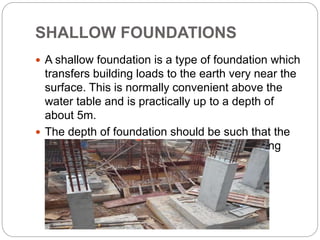
SHALLOW FOUNDATIONS
 A shallow foundation is a type of foundation which
transfers building loads to the earth very near the
surface. This is normally convenient above the
water table and is practically up to a depth of
about 5m.
 The depth of foundation should be such that the
foundation rests on soil with adequate bearing
capacity.
VARIOUS TYPES OF SHALLOW
FOUNDATION:
 Strip footing.
 Spread or isolated footing.
 Combined footing.
 Strap or cantilever footing.
 Mat or raft Foundation.
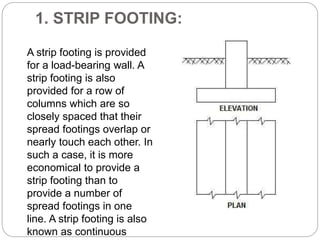
1. STRIP FOOTING:
A strip footing is provided
for a load-bearing wall. A
strip footing is also
provided for a row of
columns which are so
closely spaced that their
spread footings overlap or
nearly touch each other. In
such a case, it is more
economical to provide a
strip footing than to
provide a number of
spread footings in one
line. A strip footing is also
known as continuous
2. SPREAD OR ISOLATED
FOOTING:
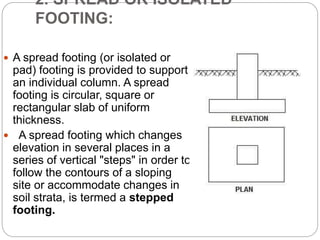
 A spread footing (or isolated or
pad) footing is provided to support
an individual column. A spread
footing is circular, square or
rectangular slab of uniform
thickness.
 A spread footing which changes
elevation in several places in a
series of vertical "steps" in order to
follow the contours of a sloping
site or accommodate changes in
soil strata, is termed a stepped
footing.
3. COMBINED FOOTING:
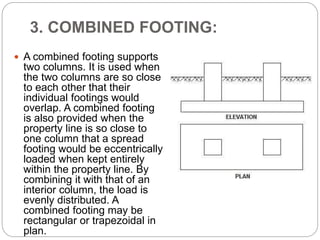
 A combined footing supports
two columns. It is used when
the two columns are so close
to each other that their
individual footings would
overlap. A combined footing
is also provided when the
property line is so close to
one column that a spread
footing would be eccentrically
loaded when kept entirely
within the property line. By
combining it with that of an
interior column, the load is
evenly distributed. A
combined footing may be
rectangular or trapezoidal in
plan.
4. STRAP OR CANTILEVER
FOOTING:
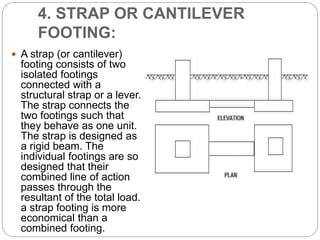
 A strap (or cantilever)
footing consists of two
isolated footings
connected with a
structural strap or a lever.
The strap connects the
two footings such that
they behave as one unit.
The strap is designed as
a rigid beam. The
individual footings are so
designed that their
combined line of action
passes through the
resultant of the total load.
a strap footing is more
economical than a
combined footing.
5. MAT OR RAFT FOUNDATIONS:
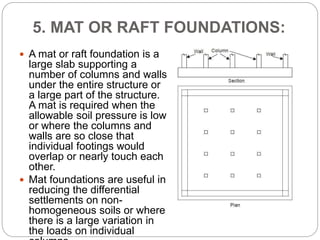
 A mat or raft foundation is a
large slab supporting a
number of columns and walls
under the entire structure or
a large part of the structure.
A mat is required when the
allowable soil pressure is low
or where the columns and
walls are so close that
individual footings would
overlap or nearly touch each
other.
 Mat foundations are useful in
reducing the differential
settlements on non-
homogeneous soils or where
there is a large variation in
the loads on individual
DEEP FOUNDATION
 A deep foundation is a type of foundation which
transfers building loads to the earth farther down
from the surface than a shallow foundation does,
to a subsurface layer or a range of depths.
 Deep foundations are commonly implemented
when dealing with very large design loads, such
as those associated with large buildings or
bridges. Some deep foundations are driven into
the ground, such as concrete piles, while others
are put in place by excavation and drilling.
Deep Foundations:
(a) Pile Foundation:
The most common type of deep
foundation for modern bridge
construction is piling. Piles used for
bridge construction may be concrete,
steel, or timber; the most common of
which is pre-cast concrete piles.
Timber piles are not used now a
days, firstly due to lack of suitable
logs of long length and secondly due
to susceptibility to damage by rot.
Concrete piles can be precast or cast
in situ. Since bridge structure involve
foundation under water or in soil with
high water table, precast piles are
often preferred. The main advantage
of an in-situ pile is that there is no
wastage of concrete and no chance
of damaging to pile during driving
exists.
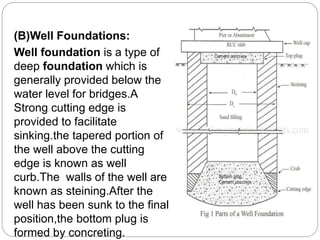
(B)Well Foundations:
Well foundation is a type of
deep foundation which is
generally provided below the
water level for bridges.A
Strong cutting edge is
provided to facilitate
sinking.the tapered portion of
the well above the cutting
edge is known as well
curb.The walls of the well are
known as steining.After the
well has been sunk to the final
position,the bottom plug is
formed by concreting.
Importance of Foundation in Civil
Engineering Structures
Foundation is the bottom most part of a structure which is
hidden inside the soil in most of the cases.Therefore more
quality control is required as it is possible to hide the mistakes
underground. Unfortunately foundation will have given less
importance compared to externally visible portions of the
structure in most of the cases. It is a normal practice to provide
the foundation without proper Geo technical assessment. More
importance is given to structural aspects and foundation is
provided from a structural point of view only. Repair of failed
foundation is not an easy matter and it involves complicated
engineering techniques with high cost in most of the cases. It is
also seen that damaged portion of the highways is repaired from
the top leading to the failure at the same location in a case
where the failure is occurred in the foundation portion. Special
care is required in cases of weak compressible soils and water
table variations.It is required to have a combined assessment of
Geo technical and structural engineering with equal importance
in providing foundation for Structures. Also the Soil assessment
laboratories with experts shall be made available to common
people to solve their foundation issues.[2]
Case study:
TAJ MAHAL
The foundations of Taj Mahal
 The foundations of Taj Mahal were laid in 1631, thus work
on foundations had already begun when Mumtaz’s body
was moved from Burhanpur to Agra in January 1632.
 Taj Mahal has what is famously known as the well
foundation. Building the foundations in this way was
probably the most crucial step technologically, as the
riverbank sand had to be stabilised. A series of conduits,
and drainage pipes encased in stone and mortar were built
into the foundation to divert the river water. Wells were
then sunk and cased with wood and were filled with rubble
and masonry.
 After the foundation was complete the river terrace or the
first plinth was constructed. Unskilled labourers built the
plinth with stone and masonry which was faced with red
sandstone by the skilled labourers. The second plinth was
similarly constructed and faced with white marble attached
with the help of iron clamps and dowels.[3]
Reference
1. Basic Civil Engineering by Satheesh Gopi
2. Importance of Foundation in Civil
Engineering Structures by fphzus.
(https://fphzus.wordpress.com)
3. TAJ MAHAL (ART AND
ARCHITECTURE)(HTTP://THETAJMAHAL.CO.
IN)
4. Soil mechanics and foundation engineering by
Dr. K.R. Arora.
Types of foundations.

Types of foundations.

  • 2.
    Introduction A foundation isthat part of the structure that is in direct contact with the ground. It is that part of the structure that transmits the weight of the structure to the ground. The foundation is, therefore, a connecting link between the structure proper and the ground that supports it. Foundation transfers the load of the structure to the soil below on a large area. It prevents the differential settlement by evenly loading the substrata. Foundations are generally built of bricks, stones, concrete, steel, etc. The selection of the material and type of foundation depends upon the type of the structure above and the underlying soil.[1]
  • 3.
    TYPES OF FOUNDATIONS: ShallowFoundation Deep Foundation
  • 4.
    SHALLOW FOUNDATIONS  Ashallow foundation is a type of foundation which transfers building loads to the earth very near the surface. This is normally convenient above the water table and is practically up to a depth of about 5m.  The depth of foundation should be such that the foundation rests on soil with adequate bearing capacity.
  • 5.
    VARIOUS TYPES OFSHALLOW FOUNDATION:  Strip footing.  Spread or isolated footing.  Combined footing.  Strap or cantilever footing.  Mat or raft Foundation.
  • 6.
    1. STRIP FOOTING: Astrip footing is provided for a load-bearing wall. A strip footing is also provided for a row of columns which are so closely spaced that their spread footings overlap or nearly touch each other. In such a case, it is more economical to provide a strip footing than to provide a number of spread footings in one line. A strip footing is also known as continuous
  • 7.
    2. SPREAD ORISOLATED FOOTING:  A spread footing (or isolated or pad) footing is provided to support an individual column. A spread footing is circular, square or rectangular slab of uniform thickness.  A spread footing which changes elevation in several places in a series of vertical "steps" in order to follow the contours of a sloping site or accommodate changes in soil strata, is termed a stepped footing.
  • 8.
    3. COMBINED FOOTING: A combined footing supports two columns. It is used when the two columns are so close to each other that their individual footings would overlap. A combined footing is also provided when the property line is so close to one column that a spread footing would be eccentrically loaded when kept entirely within the property line. By combining it with that of an interior column, the load is evenly distributed. A combined footing may be rectangular or trapezoidal in plan.
  • 9.
    4. STRAP ORCANTILEVER FOOTING:  A strap (or cantilever) footing consists of two isolated footings connected with a structural strap or a lever. The strap connects the two footings such that they behave as one unit. The strap is designed as a rigid beam. The individual footings are so designed that their combined line of action passes through the resultant of the total load. a strap footing is more economical than a combined footing.
  • 10.
    5. MAT ORRAFT FOUNDATIONS:  A mat or raft foundation is a large slab supporting a number of columns and walls under the entire structure or a large part of the structure. A mat is required when the allowable soil pressure is low or where the columns and walls are so close that individual footings would overlap or nearly touch each other.  Mat foundations are useful in reducing the differential settlements on non- homogeneous soils or where there is a large variation in the loads on individual
  • 11.
    DEEP FOUNDATION  Adeep foundation is a type of foundation which transfers building loads to the earth farther down from the surface than a shallow foundation does, to a subsurface layer or a range of depths.  Deep foundations are commonly implemented when dealing with very large design loads, such as those associated with large buildings or bridges. Some deep foundations are driven into the ground, such as concrete piles, while others are put in place by excavation and drilling.
  • 12.
    Deep Foundations: (a) PileFoundation: The most common type of deep foundation for modern bridge construction is piling. Piles used for bridge construction may be concrete, steel, or timber; the most common of which is pre-cast concrete piles. Timber piles are not used now a days, firstly due to lack of suitable logs of long length and secondly due to susceptibility to damage by rot. Concrete piles can be precast or cast in situ. Since bridge structure involve foundation under water or in soil with high water table, precast piles are often preferred. The main advantage of an in-situ pile is that there is no wastage of concrete and no chance of damaging to pile during driving exists.
  • 13.
    (B)Well Foundations: Well foundationis a type of deep foundation which is generally provided below the water level for bridges.A Strong cutting edge is provided to facilitate sinking.the tapered portion of the well above the cutting edge is known as well curb.The walls of the well are known as steining.After the well has been sunk to the final position,the bottom plug is formed by concreting.
  • 14.
    Importance of Foundationin Civil Engineering Structures Foundation is the bottom most part of a structure which is hidden inside the soil in most of the cases.Therefore more quality control is required as it is possible to hide the mistakes underground. Unfortunately foundation will have given less importance compared to externally visible portions of the structure in most of the cases. It is a normal practice to provide the foundation without proper Geo technical assessment. More importance is given to structural aspects and foundation is provided from a structural point of view only. Repair of failed foundation is not an easy matter and it involves complicated engineering techniques with high cost in most of the cases. It is also seen that damaged portion of the highways is repaired from the top leading to the failure at the same location in a case where the failure is occurred in the foundation portion. Special care is required in cases of weak compressible soils and water table variations.It is required to have a combined assessment of Geo technical and structural engineering with equal importance in providing foundation for Structures. Also the Soil assessment laboratories with experts shall be made available to common people to solve their foundation issues.[2]
  • 15.
  • 16.
    The foundations ofTaj Mahal  The foundations of Taj Mahal were laid in 1631, thus work on foundations had already begun when Mumtaz’s body was moved from Burhanpur to Agra in January 1632.  Taj Mahal has what is famously known as the well foundation. Building the foundations in this way was probably the most crucial step technologically, as the riverbank sand had to be stabilised. A series of conduits, and drainage pipes encased in stone and mortar were built into the foundation to divert the river water. Wells were then sunk and cased with wood and were filled with rubble and masonry.  After the foundation was complete the river terrace or the first plinth was constructed. Unskilled labourers built the plinth with stone and masonry which was faced with red sandstone by the skilled labourers. The second plinth was similarly constructed and faced with white marble attached with the help of iron clamps and dowels.[3]
  • 17.
    Reference 1. Basic CivilEngineering by Satheesh Gopi 2. Importance of Foundation in Civil Engineering Structures by fphzus. (https://fphzus.wordpress.com) 3. TAJ MAHAL (ART AND ARCHITECTURE)(HTTP://THETAJMAHAL.CO. IN) 4. Soil mechanics and foundation engineering by Dr. K.R. Arora.