Aim of a Civil engineer:
 To construct a building which is
Stable
Durable
Economy Friendly
Interior of a building
 The aesthetic feeling that we get when we enter the
building depends on
1. Finishing Given to WALLS
2. Finishing given to FLOOR
Floor
 Floors are horizontal structural element of a building
which divide building into levels for purpose of
accommodation.
 Floor are horizontal soft structures that make us feel
comfortable.
Why is it economy related?
 Economy related topic because most of the times
expenditure goes beyond ESTIMATED due to the
Revision of design of Finishing Given to floor and
walls
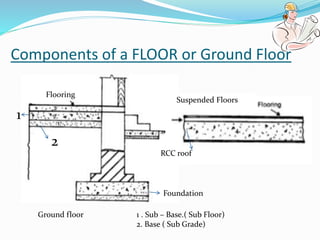
Components of a FLOOR or Ground Floor
i. Sub- Floor( Sub – Base):
It is a Hardcore Filling Consisting of hardcore materials
and a sand layer at its top.
ii. Base (or Sub Grade):
It is a course of 1:4:8 lean concrete not less than 100 mm
thick.
iii. Finished Floor (Finishing):
It is final finishing given in form of mosaic or ceramic
tiles and other etc.. Also called as TOPPING
 As a rule finished top level should be at least 45 cm(1.5 ft)
above general ground level around the building
 We have to provide an under layer of 1:2:4 concrete with
12.5 mm as minimum chip size of aggregate.
Components of a FLOOR or Ground Floor
Ground floor
Flooring
Foundation
RCC roof
1
2
1 . Sub – Base.( Sub Floor)
2. Base ( Sub Grade)
Suspended Floors
Types of FLOOR
 There are many different types of floors.
 They are divided based on many things like level,
material, type of material etc…
Types of FLOORs based on level:
1. Ground Floor: Those which layed just above the
ground level.
2. Suspended Floor: Those which are layed above the
roof or Slab
Types of FLOORs based on Material used:
 We use different type of materials for laying of floors.
 On that basis we divide floor into mainly Six types:
1. Cement and concrete flooring
2. Stone Flooring
3. Tile Flooring ( Tiling)
4. Resilient Floor
5. Terrazzo Floor
6. Wood Floor
Types of FLOORs based on Material used:
 Cement and concrete flooring : These are the floors in which
cement concrete is used as topping.
 Types of cement concrete floors:
1. Concrete floors with Granolithic topping: Also known as
Patent stone flooring and used in low cost constructions.
2. Concrete floor with fine finish: For ordinary low traffic
situations.
3. Burnt Clay Brick floor(with or without concrete base): For
heavy traffic situations.
4. Red Oxide concrete floors: Concrete floors with red oxide
finish
5. Rough Concrete floors: For courtyard and terrace where the
floor should be rough and skid proof
Stone Flooring
 Stone floors are extensively recommended for offices, educational
institutions, etc… where the traffic is heavy and maintenance is
minimal.
 It is also Used in Kitchens in our houses as the many stones are
resistant to acids etc..
 Machine cut and polished stones are used as small tiles.
 Other types of Stone floors:
1. Marble : marble of different colors and steaks.
2. Granite : Granite stone of different colors and steak.
3. Kota Stone : thickness of 20,30,40 mm are specified.
4. Red or white Fine dressed sand stone : Thick 40 mm
5. Shahabad Stones
6. Cuddapa Slabs :(usually black in color)
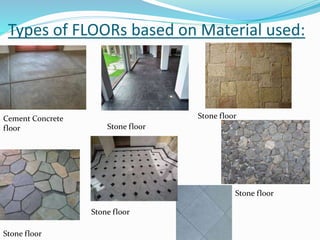
Types of FLOORs based on Material used:
Cement Concrete
floor Stone floor
Stone floor
Stone floor
Stone floor
Stone floor
Ceramic and Tiles
 Now a days these are most extensively used in
residential buildings.
 They have become most common even in India.
 Some of the tiles used are :
Earthen ware tiles
Stone ware tiles
Terracota and faience
Glazed Tiles
Fully Virtified tiles
Porcelein tiles
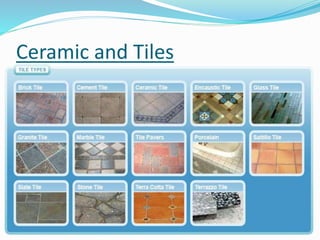
Ceramic and Tiles
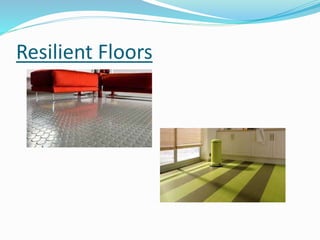
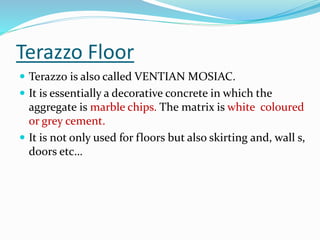
Resilient Floors
 Floor made of PVC, linoleum, rubber etc.. Are called Resilient
floors.
 These are used in offices, computer rooms, Show rooms etc…
 Main types:
1. PVC ( vinyl floor): Made of poly vinyl chloride polymer . Its
normal thickness is 1.5 to 4 mm and is supplied in rolls of 1- 2 m
width and 10m length
2. Linoleum : consists of oxidised linseed oil. Normal thick 1.6 to
6.7mm. And supplied in rolls of 2m width and 3 to 5.5 m thick.
3. Rubber Flooring: Composed of natural rubber with various
filling components and laying this is specialized job.
Resilient Floors
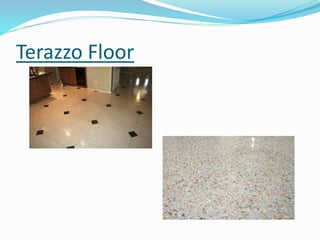
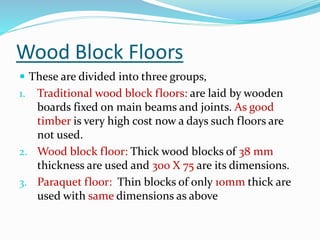
Terazzo Floor
 Terazzo is also called VENTIAN MOSIAC.
 It is essentially a decorative concrete in which the
aggregate is marble chips. The matrix is white coloured
or grey cement.
 It is not only used for floors but also skirting and, wall s,
doors etc…
Terazzo Floor
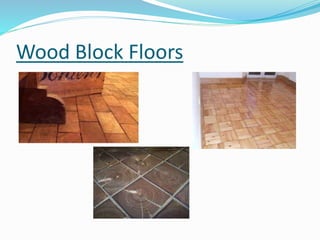
Wood Block Floors
 These are divided into three groups,
1. Traditional wood block floors: are laid by wooden
boards fixed on main beams and joints. As good
timber is very high cost now a days such floors are
not used.
2. Wood block floor: Thick wood blocks of 38 mm
thickness are used and 300 X 75 are its dimensions.
3. Paraquet floor: Thin blocks of only 10mm thick are
used with same dimensions as above
Wood Block Floors
Thank you
 Presentation by
 Sadhvi .
 Srikanth
 Sugandha
 NAGADATT SHARMA.

Flooring and types of flooring

  • 1.
    Aim of aCivil engineer:  To construct a building which is Stable Durable Economy Friendly
  • 2.
    Interior of abuilding  The aesthetic feeling that we get when we enter the building depends on 1. Finishing Given to WALLS 2. Finishing given to FLOOR
  • 4.
    Floor  Floors arehorizontal structural element of a building which divide building into levels for purpose of accommodation.  Floor are horizontal soft structures that make us feel comfortable.
  • 5.
    Why is iteconomy related?  Economy related topic because most of the times expenditure goes beyond ESTIMATED due to the Revision of design of Finishing Given to floor and walls
  • 6.
    Components of aFLOOR or Ground Floor i. Sub- Floor( Sub – Base): It is a Hardcore Filling Consisting of hardcore materials and a sand layer at its top. ii. Base (or Sub Grade): It is a course of 1:4:8 lean concrete not less than 100 mm thick. iii. Finished Floor (Finishing): It is final finishing given in form of mosaic or ceramic tiles and other etc.. Also called as TOPPING  As a rule finished top level should be at least 45 cm(1.5 ft) above general ground level around the building  We have to provide an under layer of 1:2:4 concrete with 12.5 mm as minimum chip size of aggregate.
  • 7.
    Components of aFLOOR or Ground Floor Ground floor Flooring Foundation RCC roof 1 2 1 . Sub – Base.( Sub Floor) 2. Base ( Sub Grade) Suspended Floors
  • 8.
    Types of FLOOR There are many different types of floors.  They are divided based on many things like level, material, type of material etc… Types of FLOORs based on level: 1. Ground Floor: Those which layed just above the ground level. 2. Suspended Floor: Those which are layed above the roof or Slab
  • 9.
    Types of FLOORsbased on Material used:  We use different type of materials for laying of floors.  On that basis we divide floor into mainly Six types: 1. Cement and concrete flooring 2. Stone Flooring 3. Tile Flooring ( Tiling) 4. Resilient Floor 5. Terrazzo Floor 6. Wood Floor
  • 10.
    Types of FLOORsbased on Material used:  Cement and concrete flooring : These are the floors in which cement concrete is used as topping.  Types of cement concrete floors: 1. Concrete floors with Granolithic topping: Also known as Patent stone flooring and used in low cost constructions. 2. Concrete floor with fine finish: For ordinary low traffic situations. 3. Burnt Clay Brick floor(with or without concrete base): For heavy traffic situations. 4. Red Oxide concrete floors: Concrete floors with red oxide finish 5. Rough Concrete floors: For courtyard and terrace where the floor should be rough and skid proof
  • 11.
    Stone Flooring  Stonefloors are extensively recommended for offices, educational institutions, etc… where the traffic is heavy and maintenance is minimal.  It is also Used in Kitchens in our houses as the many stones are resistant to acids etc..  Machine cut and polished stones are used as small tiles.  Other types of Stone floors: 1. Marble : marble of different colors and steaks. 2. Granite : Granite stone of different colors and steak. 3. Kota Stone : thickness of 20,30,40 mm are specified. 4. Red or white Fine dressed sand stone : Thick 40 mm 5. Shahabad Stones 6. Cuddapa Slabs :(usually black in color)
  • 12.
    Types of FLOORsbased on Material used: Cement Concrete floor Stone floor Stone floor Stone floor Stone floor Stone floor
  • 13.
    Ceramic and Tiles Now a days these are most extensively used in residential buildings.  They have become most common even in India.  Some of the tiles used are : Earthen ware tiles Stone ware tiles Terracota and faience Glazed Tiles Fully Virtified tiles Porcelein tiles
  • 14.
  • 15.
    Resilient Floors  Floormade of PVC, linoleum, rubber etc.. Are called Resilient floors.  These are used in offices, computer rooms, Show rooms etc…  Main types: 1. PVC ( vinyl floor): Made of poly vinyl chloride polymer . Its normal thickness is 1.5 to 4 mm and is supplied in rolls of 1- 2 m width and 10m length 2. Linoleum : consists of oxidised linseed oil. Normal thick 1.6 to 6.7mm. And supplied in rolls of 2m width and 3 to 5.5 m thick. 3. Rubber Flooring: Composed of natural rubber with various filling components and laying this is specialized job.
  • 16.
  • 17.
    Terazzo Floor  Terazzois also called VENTIAN MOSIAC.  It is essentially a decorative concrete in which the aggregate is marble chips. The matrix is white coloured or grey cement.  It is not only used for floors but also skirting and, wall s, doors etc…
  • 18.
  • 19.
    Wood Block Floors These are divided into three groups, 1. Traditional wood block floors: are laid by wooden boards fixed on main beams and joints. As good timber is very high cost now a days such floors are not used. 2. Wood block floor: Thick wood blocks of 38 mm thickness are used and 300 X 75 are its dimensions. 3. Paraquet floor: Thin blocks of only 10mm thick are used with same dimensions as above
  • 20.
  • 21.
    Thank you  Presentationby  Sadhvi .  Srikanth  Sugandha  NAGADATT SHARMA.