Cavity Walls
Wall ties in cavity walls
Tutor Copy
The purpose of wall ties in cavity
walls
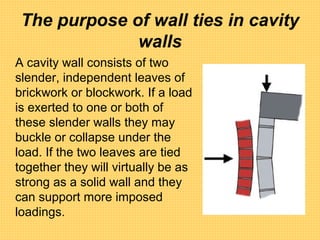
A cavity wall consists of two
slender, independent leaves of
brickwork or blockwork. If a load
is exerted to one or both of
these slender walls they may
buckle or collapse under the
load. If the two leaves are tied
together they will virtually be as
strong as a solid wall and they
can support more imposed
loadings.
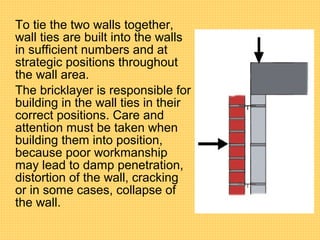
To tie the two walls together,
wall ties are built into the walls
in sufficient numbers and at
strategic positions throughout
the wall area.
The bricklayer is responsible for
building in the wall ties in their
correct positions. Care and
attention must be taken when
building them into position,
because poor workmanship
may lead to damp penetration,
distortion of the wall, cracking
or in some cases, collapse of
the wall.
Types of wall ties
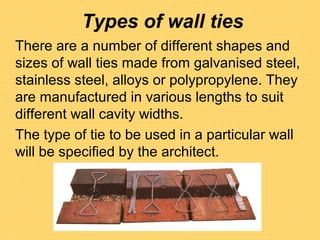
There are a number of different shapes and
sizes of wall ties made from galvanised steel,
stainless steel, alloys or polypropylene. They
are manufactured in various lengths to suit
different wall cavity widths.
The type of tie to be used in a particular wall
will be specified by the architect.
It is up to the bricklayer to exercise some skill
and common sense when placing the wall
ties.
The ties should be placed in accordance with
the Building Regulations which specifies
where the ties should be placed and spaced
horizontally and vertically namely:
• A distance of 150mm max from the edge
of an opening (BR).
• Vertically spaced every block course or
• Every 4th course if both wall leaves are of
brickwork.
• A distance of 750mm max horizontally
and 450mm vertically.
Note:
When placing wall ties, a
good rule of thumb is that
more ties are better than
fewer.
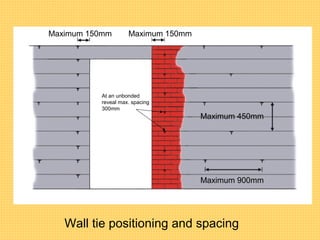
Maximum 150mm Maximum 150mm
Maximum 900mm
Maximum 450mm
Wall tie positioning and spacing
At an unbonded
reveal max. spacing
300mm
Placing ties correctly
As a guide to placing wall ties effectively the following points of good
workmanship may be of help.
• For strength, all ties must be bedded at least 50mm into each wall leaf.
• The ties must be positioned with any drip in the centre of the cavity, and
pointing downwards.
• Ties should be pressed down into the mortar bed.
• Ties should never be pushed into a joint as they will not be effective in
tying in the two leaves together.
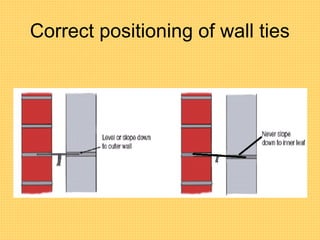
• Ties should be inclined downwards towards the outer leaf, never to the
inner leaf as they may provide a bridge for water.
• Always maintain the gauge of the brickwork and consistency of joint
thickness.
• Ties should never be bent to suit courses.
• Ties must be cleared of mortar droppings which can provide a passage
for water across the cavity.
• Use only specified type of tie.
• Use extra ties around openings if needed.
• Use extra ties at the tops of gable walls.
Correct positioning of wall ties
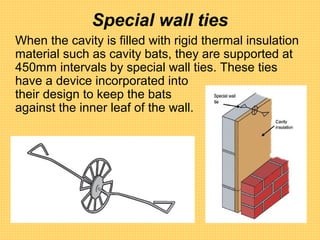
Special wall ties
When the cavity is filled with rigid thermal insulation
material such as cavity bats, they are supported at
450mm intervals by special wall ties. These ties
have a device incorporated into
their design to keep the bats
against the inner leaf of the wall.

Tutor wall ties in cavity walls .ppt 2

  • 1.
    Cavity Walls Wall tiesin cavity walls
  • 2.
  • 3.
    The purpose ofwall ties in cavity walls A cavity wall consists of two slender, independent leaves of brickwork or blockwork. If a load is exerted to one or both of these slender walls they may buckle or collapse under the load. If the two leaves are tied together they will virtually be as strong as a solid wall and they can support more imposed loadings.
  • 4.
    To tie thetwo walls together, wall ties are built into the walls in sufficient numbers and at strategic positions throughout the wall area. The bricklayer is responsible for building in the wall ties in their correct positions. Care and attention must be taken when building them into position, because poor workmanship may lead to damp penetration, distortion of the wall, cracking or in some cases, collapse of the wall.
  • 5.
    Types of wallties There are a number of different shapes and sizes of wall ties made from galvanised steel, stainless steel, alloys or polypropylene. They are manufactured in various lengths to suit different wall cavity widths. The type of tie to be used in a particular wall will be specified by the architect.
  • 6.
    It is upto the bricklayer to exercise some skill and common sense when placing the wall ties. The ties should be placed in accordance with the Building Regulations which specifies where the ties should be placed and spaced horizontally and vertically namely: • A distance of 150mm max from the edge of an opening (BR). • Vertically spaced every block course or • Every 4th course if both wall leaves are of brickwork. • A distance of 750mm max horizontally and 450mm vertically.
  • 7.
    Note: When placing wallties, a good rule of thumb is that more ties are better than fewer.
  • 8.
    Maximum 150mm Maximum150mm Maximum 900mm Maximum 450mm Wall tie positioning and spacing At an unbonded reveal max. spacing 300mm
  • 9.
    Placing ties correctly Asa guide to placing wall ties effectively the following points of good workmanship may be of help. • For strength, all ties must be bedded at least 50mm into each wall leaf. • The ties must be positioned with any drip in the centre of the cavity, and pointing downwards. • Ties should be pressed down into the mortar bed. • Ties should never be pushed into a joint as they will not be effective in tying in the two leaves together. • Ties should be inclined downwards towards the outer leaf, never to the inner leaf as they may provide a bridge for water. • Always maintain the gauge of the brickwork and consistency of joint thickness. • Ties should never be bent to suit courses. • Ties must be cleared of mortar droppings which can provide a passage for water across the cavity. • Use only specified type of tie. • Use extra ties around openings if needed. • Use extra ties at the tops of gable walls.
  • 10.
  • 11.
    Special wall ties Whenthe cavity is filled with rigid thermal insulation material such as cavity bats, they are supported at 450mm intervals by special wall ties. These ties have a device incorporated into their design to keep the bats against the inner leaf of the wall.