Building
Foundation
Foundation is partof a
building, usually below the
ground, that transfers and
distributes the weight of the
building onto the ground such
that the compressive stresses
do not exceed the bearing
capacity of the soil.
4.
The function ofany foundation is to safely sustain and transmit to
the ground on which it rests the combined dead, imposed and wind
loads in such a manner as not to cause any settlement or other
movement which would impair the stability or cause damage to any
part of the building.
Foundation
5.
Foundation Design Principles
Themain objectives of foundation design are to:-ensure that the
structural loads are transmitted to the subsoil safely, economically and
without any unacceptable movement during the construction period
and throughout the anticipated life of the building or structure.
6.
Basic Design Procedure
Assessmentof site conditions in the context of the site & soil investigation report
Calculation of anticipated structural loading
Choosing the foundation type, should consider:
•Soil condition
•Type of structure
•Structural loading
•Economic factors
•Time factors relative to the proposed contract period
•Construction problem
Sizing the chosen foundation in
the context of loading, ground
bearing capacity & any likely
future movement of the building
/ structure
The foundation runsunder all the loadbearing walls.
A typical modern detached house will,
where possible, sit on strip foundations.
Providing the ground is suitable, this is the
simplest and cheapest form of foundation.
In this example this includes the external walls……
and the internal
walls
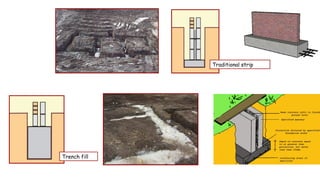
Strip Footing
10.
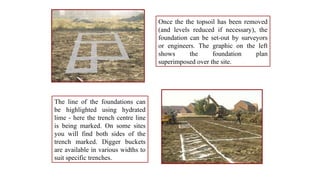
Once the thetopsoil has been removed
(and levels reduced if necessary), the
foundation can be set-out by surveyors
or engineers. The graphic on the left
shows the foundation plan
superimposed over the site.
The line of the foundations can
be highlighted using hydrated
lime - here the trench centre line
is being marked. On some sites
you will find both sides of the
trench marked. Digger buckets
are available in various widths to
suit specific trenches.
11.
A continuous stripof concrete under a continuous wall carrying a
uniformly distributed load.
12.
Wide Strip Footing
Usein a situation where the load bearing
capacity of the soil is low
(e.g. soft clay silt, made ground)
Site which may be subjected to “unequal
settlement” (mining areas), or where the
subsoil is “not uniform” in character.
A deep stripfooting is a narrow footing
which is used for normal soil and
normal loads and is made 0.9m deep.
Excavation by hand is not possible.
Brickwork cannot be built up from the
bottom.
Excavation by mechanical means is
possible.
Deep Strip Footing
A stepped stripfoundation is often used
on a sloping site where the steps allow the
foundation to follow the slope without too
much excavation, when compared with
excavations and retaining walls.
Stepped Strip Footing
20.
• Pad footingis the support used at a
point load such as columns or
framed structures.
• They may be circular, square or
rectangular and consist of a block
or slab of the thickness.
Isolated/ Pad Footing
21.
• The padfooting may be stepped if they are required to spread the load
from a heavy column. The pads are usually shallow but deep ones can
be found depending on the structure.
• Isolated or independent slab of concrete foundation to support
concrete columns or steel pillars, detached brick or masonry piers
• The pier or column bearing on the centre point of the slab
22.
• Combined Footings– used where the bearing areas of closely spaced
columns overlapped. Combined footings usually support two columns,
or three columns not in a row. Combined footings are used when tow
columns are so close that single footings can not be used or when one
column is located at or near a property line.
• Cantilever Footings – designed to accommodate eccentric loads
23.
Stepped Footing
Stepped Foundations~ these are usually considered in the context of strip
foundations and are used mainly on sloping sites to reduce the amount of
excavation and materials required to produce an adequate foundation.
25.
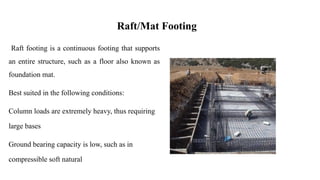
Raft footing isa continuous footing that supports
an entire structure, such as a floor also known as
foundation mat.
Best suited in the following conditions:
Column loads are extremely heavy, thus requiring
large bases
Ground bearing capacity is low, such as in
compressible soft natural
Raft/Mat Footing
28.
Pile foundation
Pilefoundation is a special kind of deep foundation, where the depth
of the foundation is much greater than the width of the foundation
Today, pile foundation is much more common than any other type of
deep foundation
USES
It is used where the soil is compressible,
It is used where the soil is water logged
It is used when stratum of required bearing capacity is at greater
depth
Major uses ofpiles :
To carry vertical compression loads,
To resist uplift loads
To resist horizontal or inclined loads
Classification of piles
1. Based on the function
end bearing pile
Friction pile
Compaction pile
Sheet pile
Batter pile
Tension pile
Fender pile and dolphins
31.
2. Based onthe material& composition
Concrete pile
Timber pile
Steel pile
Composite pile: concrete& timber concrete& steel
3. Based on the method of installation;
Driven pile
cast-in situ pile
Driven and cast-in-situ pile
33.
Timber Piles ~these are usually square sawn and can be used for small
contracts on sites with shallow alluvial deposits overlying a suitable
bearing strata (e.g. river banks and estuaries.)
Timber piles are percussion driven.
34.
Preformed Concrete Piles~
variety of types available
which are generally used on
medium to large contracts of
not less than one hundred piles
where soft soil deposits overlie
a firmer strata. These piles are
percussion driven using a drop
or single acting hammer.
35.
Preformed Concrete Piles† jointing with a peripheral steel splicing
collar as shown on the preceding page is adequate for most
concentrically or directly loaded situations. Where very long piles
are to be used and/or high stresses due to compression, tension and
bending from the superstructure or the ground conditions are
anticipated, the 4 or 8 lock pile joint may be considered.
37.
Steel Box and`H' Sections ~ standard steel sheet pile sections can be
used to form box section piles whereas the `H' section piles are cut from
standard rolled sections. These piles are percussion driven and are used
mainly in connection with marine structures.