1
FOUNDATIONS - OVERVIEW

 Loads and settlements of foundations - Safe foundations
 Types of soils that make up the foundation - Properties
 Properties of foundations: Strength, Stability, Drainage,
    etc. - Estimating soil properties: Exploration and testing
   Construction of foundations - Type of soil layers at the top,
    excavation, support for soil, soil strengthening, de-
    watering
   Types of foundations - Shallow and deep - Influence zone
   Precautions - Seismic base isolation; Underpinning during
    construction; Retaining walls; Waterproofing, drainage,
    reinforcing & insulation; Frost protection
   Foundation design for optimal cost
INTRODUCTION TO
             FOUNDATIONS
 Transfer the structural loads from a building
  safely into the ground.
 Foundation should reach the underlying
  soil that the soil or the rock on which it is
  founded is competent to carry its massive
  loads
 Foundation design is a highly specialized
  field of geotechnical engineering.
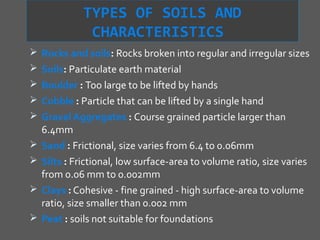
TYPES OF SOILS AND
               CHARACTERISTICS
 Rocks and soils: Rocks broken into regular and irregular sizes
 Soils: Particulate earth material
 Boulder : Too large to be lifted by hands
 Cobble : Particle that can be lifted by a single hand
 Gravel Aggregates : Course grained particle larger than
    6.4mm
   Sand : Frictional, size varies from 6.4 to 0.06mm
   Silts : Frictional, low surface-area to volume ratio, size varies
    from 0.06 mm to 0.002mm
   Clays : Cohesive - fine grained - high surface-area to volume
    ratio, size smaller than 0.002 mm
   Peat : soils not suitable for foundations
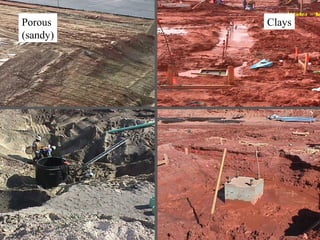
Porous    Clays
(sandy)
Foundation Loads

   Dead Load
   Live Load
   Wind Load
   Horizontal Pressures Below Grade
   Structural Member Forces
   Uplift
   Earthquake
PROPERTIES OF FOUNDATION
 Strength:
           Load bearing capacities
           Crystalline rocks (very strong - 12,000 psf)
           Sedimentary rocks (intermediate - 6,000 psf)
           Other types of soils (relatively lower - 2,000 to 3,000 psf)
 Stable under loads : Creep, shrinkage and swelling
 Drainage characteristics: Porosity and permeability
 Soil property estimation
                          Water table
                          Particle size
                          Plastic limit
                          Permeability
                          Moisture content
CONSTRUCTION OF FOUNDATIONS
 Some amount of excavation required for every building
 Top soil consisting of organic matter is removed to the required depth at
    which the bearing capacity necessary for the building is met
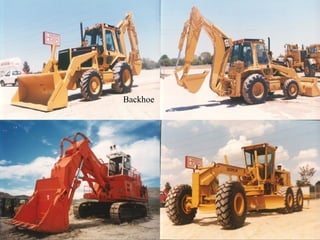
 A variety of machines used for excavation
 The sides of excavation too be protected from caving in by benching,
    sheeting (soldier beams and lagging, sheet piles, slurry walls, etc.) or
    bracing (cross-slot, rockers or tiebacks)
 De-watering using well-points & sumps, and watertight barriers - Mixing
    the soil by rotating paddles
 Bulldozers          * Shovel dozers                   * Back hoes
 Bucket loaders      * Scrapers                        * Trenching machines
   Power shovel      * Tractor-mounted rippers        * Pneumatic hammers
 Drop balls         * Hydraulic splitters              * Blasting
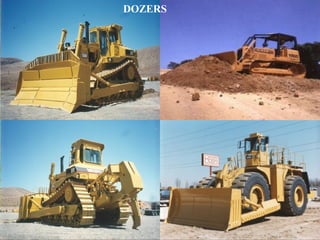
DOZERS
Backhoe
TYPES OF FOUNDATION

    Two types foundations :
      Shallow Foundation
    Depth is less than width
    Column footings without or with tie/grade beams, individual or
    combined wall footing, slab on grade, raft

      Deep Foundation
    Depth is more than width
    Caissons with or without sockets, end bearing or friction piles, pile
    groups zone of influence, made of concrete
Primary Factors Affecting
             Foundation Choice


   Subsurface soil

   Ground water conditions

   Structural requirements
Secondary Factors Affecting Foundation
               Choice
   Construction access, methods & site conditions
   Environmental factors
   Building Codes & Regulations
   Impact on surrounding structures
   Construction schedule
   Construction risks
Shallow Foundations

   Requirements
    – Suitable soil bearing capacity
    – Undisturbed soil or engineered fill

   Basic types or configurations
    – Column footings
    – Wall or strip footings
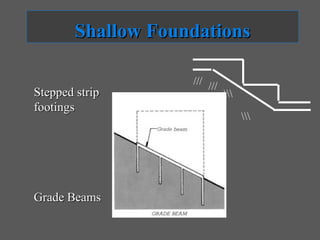
Shallow Foundations

                    /// ///
Stepped strip                 
footings
                                    
                       ///


Grade Beams
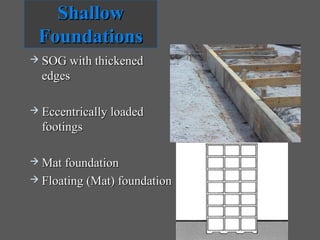
Shallow
 Foundations
 SOG with thickened
  edges

 Eccentrically loaded
  footings

 Mat foundation
 Floating (Mat) foundation
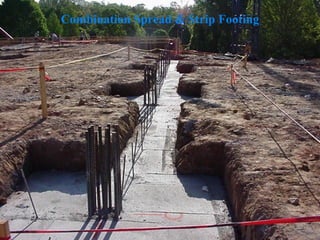
Combination Spread & Strip Footing
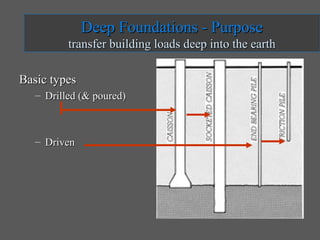
Deep Foundations - Purpose
          transfer building loads deep into the earth

Basic types
   – Drilled (& poured)


   – Driven
Types of Deep Foundation

   Pile Foundation
   Caisson Foundation
   Well Foundation
   Inverted Arch Foundation


                               19
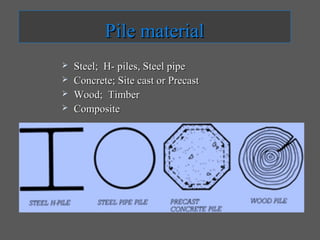
Pile material
   Steel; H- piles, Steel pipe
   Concrete; Site cast or Precast
   Wood; Timber
   Composite
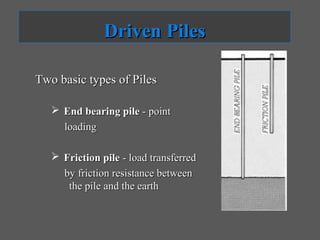
Driven Piles

Two basic types of Piles

    End bearing pile - point
     loading

    Friction pile - load transferred
     by friction resistance between
      the pile and the earth
Driven Piles
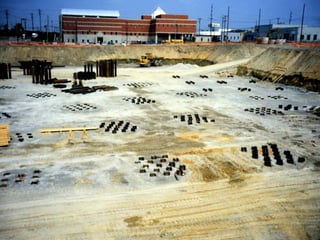
The following photo sequence was taken at the site of the:
               Nashville Coliseum
 67,000 seat sports coliseum in Nashville, TN
  The Facility had Deep Foundations:
     » 3,500 Driven Piles; 12x53 H Piles w/ End Bearing
     » Pile length varied from 25’-75’
     » Used 3 Pile Drivers w/ Diesel Powered Hammers
     » Driving rate: 20-25 piles/day/rig
     » Driving tolerance: 3”-6”
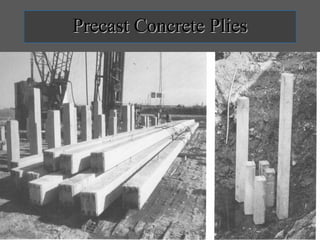
Precast Concrete Plies
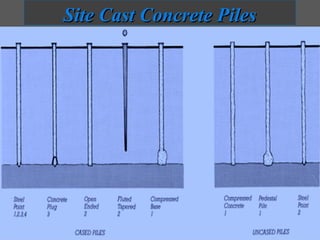
Site Cast Concrete Piles
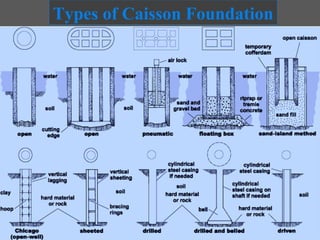
Types of Caisson Foundation


                              28
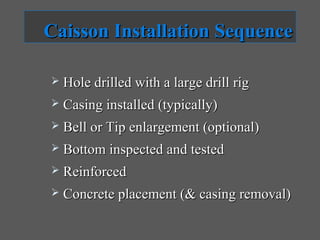
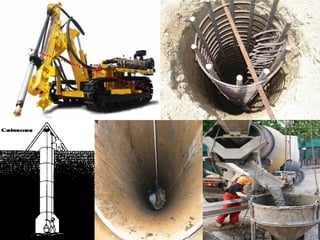
Caisson Installation Sequence

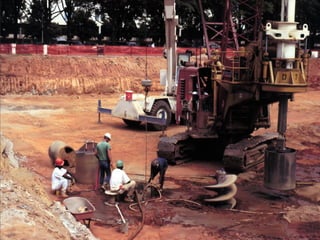
   Hole drilled with a large drill rig
   Casing installed (typically)
   Bell or Tip enlargement (optional)
   Bottom inspected and tested
   Reinforced
   Concrete placement (& casing removal)
30
Retention System Depends On:

   Proximity to Buildings
   Type of Soil
   Water Table Level
   Temporary or Permanent
   Contractor Preference
   Cost - KEY Consideration
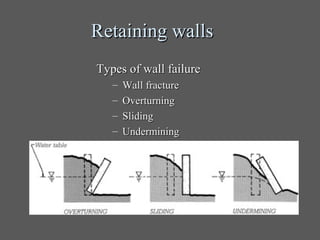
Retaining walls
Types of wall failure
   –   Wall fracture
   –   Overturning
   –   Sliding
   –   Undermining
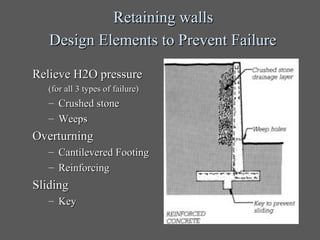
Retaining walls
   Design Elements to Prevent Failure

Relieve H2O pressure
   (for all 3 types of failure)
   – Crushed stone
   – Weeps
Overturning
   – Cantilevered Footing
   – Reinforcing
Sliding
   – Key
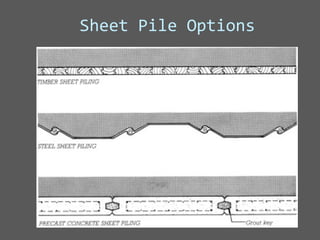
Sheet Pile Options
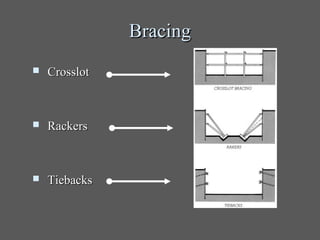
Bracing
   Crosslot


   Rackers


   Tiebacks
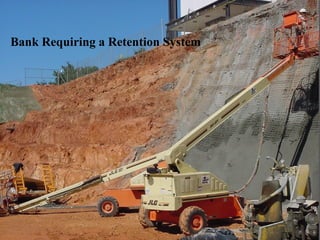
Bank Requiring a Retention System
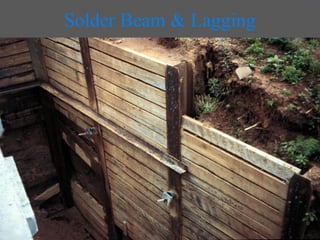
Solder Beam & Lagging
Problem of Water inside the foundation


                                         38
Dewatering

   A process of removing Water and/or lowering the
    Water Table within a construction site
   Purpose: To Provide a Dry working platform -
    (typically required by Code and Specification)
   If the Water Table is above the working platform;
    Options:
       » Keep water out
       » Let water in & remove it
       » Combination
Waterproofing

   Structures Below Ground subject to penetration of
    ground water
   More extreme, if below H2O table
   Two basic approaches to Waterproofing
      Waterproof Membranes, or
      Drainage
      Generally - both used in tandem
Waterproofing Membranes
   Materials
    –   Liquid or Sheet (Plastic, asphaltic, synthetic rubber)
    –   Coatings (asphaltic)
    –   Cementitious Plasters & admixtures
    –   Bentonite clay
   Accessories
    – Protection Board
    – Water stop
   Unit of Measure - SF, Mils (thickness)
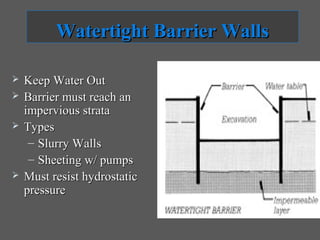
Watertight Barrier Walls

   Keep Water Out
   Barrier must reach an
    impervious strata
   Types
     – Slurry Walls
     – Sheeting w/ pumps
   Must resist hydrostatic
    pressure
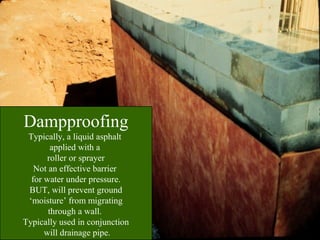
Dampproofing
 Typically, a liquid asphalt
        applied with a
       roller or sprayer
   Not an effective barrier
  for water under pressure.
 BUT, will prevent ground
 ‘moisture’ from migrating
       through a wall.
Typically used in conjunction
      will drainage pipe.
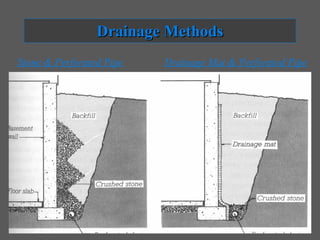
Drainage Methods
Stone & Perforated Pipe   Drainage Mat & Perforated Pipe
PRECAUTIONS TO BE TAKEN
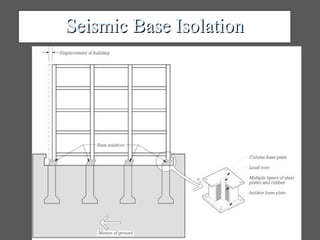
 Seismic base isolation in seismic areas
 Underpinning
   Required to carry out repairs to the existing building or
  to add some changes in the foundation
 Retaining walls
   To hold the soil back from caving in:
 Water proofing
   Use waterproof membranes
   Asphalt coating
 drainage
  Perforated pipes of foundations
 Basement insulation
  Polystyrene or glass fiber boards placed
  on the outside or inside with drainage
  mats
 Frost protection
  Through protective coatings and plastic
  foam insulation - Back-filling with
  properly draining soils
                                             46
 Types of failure
 Overturning
 Sliding
 Undermining


                     47
Seismic Base Isolation
SETTLEMENTS OF FOUNDATIONS
•   Types of Settlements:
                    Uniform Settlement
                    Differential Settlement
    Depending upon type of soil

 Requirements of a Safe Foundation:
    Structure-foundation system safe against settlements
    that would lead to collapse
    Foundation settlement should not damage the structure
    Foundation must be technically and economically feasible
SETTLEMENTS OF FOUNDATIONS


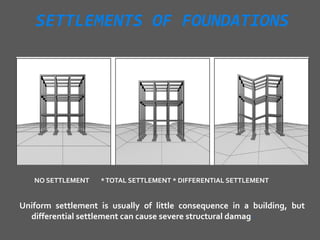
   NO SETTLEMENT   * TOTAL SETTLEMENT * DIFFERENTIAL SETTLEMENT


Uniform settlement is usually of little consequence in a building, but
  differential settlement can cause severe structural damage
2.9 FOUNDATION DESIGN FOR OPTIMAL COST

 Controlled by many factors: (i) Integrated decision-making and
  functioning of architects, structural engineers and foundation
  engineers; (ii) Building below the water table level is costly and
  sometimes damaging to the building; (iii) Building close to an
  existing structure to be avoided (any digging activity on either
  sites will affect one another and can lead to costly repairs); (iv)
  Column or wall load becoming more than that which can be
  supported by a shallow foundation (deep foundations are
  expensive) ; (v) Uncertainties can be avoided by using larger
  factors of safety in design of foundations over soils

Fondation

  • 1.
  • 2.
    FOUNDATIONS - OVERVIEW Loads and settlements of foundations - Safe foundations  Types of soils that make up the foundation - Properties  Properties of foundations: Strength, Stability, Drainage, etc. - Estimating soil properties: Exploration and testing  Construction of foundations - Type of soil layers at the top, excavation, support for soil, soil strengthening, de- watering  Types of foundations - Shallow and deep - Influence zone  Precautions - Seismic base isolation; Underpinning during construction; Retaining walls; Waterproofing, drainage, reinforcing & insulation; Frost protection  Foundation design for optimal cost
  • 3.
    INTRODUCTION TO FOUNDATIONS  Transfer the structural loads from a building safely into the ground.  Foundation should reach the underlying soil that the soil or the rock on which it is founded is competent to carry its massive loads  Foundation design is a highly specialized field of geotechnical engineering.
  • 4.
    TYPES OF SOILSAND CHARACTERISTICS  Rocks and soils: Rocks broken into regular and irregular sizes  Soils: Particulate earth material  Boulder : Too large to be lifted by hands  Cobble : Particle that can be lifted by a single hand  Gravel Aggregates : Course grained particle larger than 6.4mm  Sand : Frictional, size varies from 6.4 to 0.06mm  Silts : Frictional, low surface-area to volume ratio, size varies from 0.06 mm to 0.002mm  Clays : Cohesive - fine grained - high surface-area to volume ratio, size smaller than 0.002 mm  Peat : soils not suitable for foundations
  • 5.
    Porous Clays (sandy)
  • 6.
    Foundation Loads  Dead Load  Live Load  Wind Load  Horizontal Pressures Below Grade  Structural Member Forces  Uplift  Earthquake
  • 7.
    PROPERTIES OF FOUNDATION Strength: Load bearing capacities Crystalline rocks (very strong - 12,000 psf) Sedimentary rocks (intermediate - 6,000 psf) Other types of soils (relatively lower - 2,000 to 3,000 psf)  Stable under loads : Creep, shrinkage and swelling  Drainage characteristics: Porosity and permeability  Soil property estimation Water table Particle size Plastic limit Permeability Moisture content
  • 8.
    CONSTRUCTION OF FOUNDATIONS Some amount of excavation required for every building  Top soil consisting of organic matter is removed to the required depth at which the bearing capacity necessary for the building is met  A variety of machines used for excavation  The sides of excavation too be protected from caving in by benching, sheeting (soldier beams and lagging, sheet piles, slurry walls, etc.) or bracing (cross-slot, rockers or tiebacks)  De-watering using well-points & sumps, and watertight barriers - Mixing the soil by rotating paddles  Bulldozers * Shovel dozers * Back hoes  Bucket loaders * Scrapers * Trenching machines  Power shovel * Tractor-mounted rippers * Pneumatic hammers  Drop balls * Hydraulic splitters * Blasting
  • 9.
  • 10.
  • 11.
    TYPES OF FOUNDATION Two types foundations :  Shallow Foundation Depth is less than width Column footings without or with tie/grade beams, individual or combined wall footing, slab on grade, raft  Deep Foundation Depth is more than width Caissons with or without sockets, end bearing or friction piles, pile groups zone of influence, made of concrete
  • 12.
    Primary Factors Affecting Foundation Choice  Subsurface soil  Ground water conditions  Structural requirements
  • 13.
    Secondary Factors AffectingFoundation Choice  Construction access, methods & site conditions  Environmental factors  Building Codes & Regulations  Impact on surrounding structures  Construction schedule  Construction risks
  • 14.
    Shallow Foundations  Requirements – Suitable soil bearing capacity – Undisturbed soil or engineered fill  Basic types or configurations – Column footings – Wall or strip footings
  • 15.
    Shallow Foundations /// /// Stepped strip footings /// Grade Beams
  • 16.
    Shallow Foundations  SOGwith thickened edges  Eccentrically loaded footings  Mat foundation  Floating (Mat) foundation
  • 17.
    Combination Spread &Strip Footing
  • 18.
    Deep Foundations -Purpose transfer building loads deep into the earth Basic types – Drilled (& poured) – Driven
  • 19.
    Types of DeepFoundation  Pile Foundation  Caisson Foundation  Well Foundation  Inverted Arch Foundation 19
  • 20.
    Pile material  Steel; H- piles, Steel pipe  Concrete; Site cast or Precast  Wood; Timber  Composite
  • 21.
    Driven Piles Two basictypes of Piles  End bearing pile - point loading  Friction pile - load transferred by friction resistance between the pile and the earth
  • 22.
    Driven Piles The followingphoto sequence was taken at the site of the: Nashville Coliseum 67,000 seat sports coliseum in Nashville, TN  The Facility had Deep Foundations: » 3,500 Driven Piles; 12x53 H Piles w/ End Bearing » Pile length varied from 25’-75’ » Used 3 Pile Drivers w/ Diesel Powered Hammers » Driving rate: 20-25 piles/day/rig » Driving tolerance: 3”-6”
  • 23.
  • 25.
  • 28.
    Types of CaissonFoundation 28
  • 29.
    Caisson Installation Sequence  Hole drilled with a large drill rig  Casing installed (typically)  Bell or Tip enlargement (optional)  Bottom inspected and tested  Reinforced  Concrete placement (& casing removal)
  • 30.
  • 31.
    Retention System DependsOn:  Proximity to Buildings  Type of Soil  Water Table Level  Temporary or Permanent  Contractor Preference  Cost - KEY Consideration
  • 32.
    Retaining walls Types ofwall failure – Wall fracture – Overturning – Sliding – Undermining
  • 33.
    Retaining walls Design Elements to Prevent Failure Relieve H2O pressure (for all 3 types of failure) – Crushed stone – Weeps Overturning – Cantilevered Footing – Reinforcing Sliding – Key
  • 34.
  • 35.
    Bracing  Crosslot  Rackers  Tiebacks
  • 36.
    Bank Requiring aRetention System
  • 37.
  • 38.
    Problem of Waterinside the foundation 38
  • 39.
    Dewatering  A process of removing Water and/or lowering the Water Table within a construction site  Purpose: To Provide a Dry working platform - (typically required by Code and Specification)  If the Water Table is above the working platform; Options: » Keep water out » Let water in & remove it » Combination
  • 40.
    Waterproofing  Structures Below Ground subject to penetration of ground water  More extreme, if below H2O table  Two basic approaches to Waterproofing  Waterproof Membranes, or  Drainage  Generally - both used in tandem
  • 41.
    Waterproofing Membranes  Materials – Liquid or Sheet (Plastic, asphaltic, synthetic rubber) – Coatings (asphaltic) – Cementitious Plasters & admixtures – Bentonite clay  Accessories – Protection Board – Water stop  Unit of Measure - SF, Mils (thickness)
  • 42.
    Watertight Barrier Walls  Keep Water Out  Barrier must reach an impervious strata  Types – Slurry Walls – Sheeting w/ pumps  Must resist hydrostatic pressure
  • 43.
    Dampproofing Typically, aliquid asphalt applied with a roller or sprayer Not an effective barrier for water under pressure. BUT, will prevent ground ‘moisture’ from migrating through a wall. Typically used in conjunction will drainage pipe.
  • 44.
    Drainage Methods Stone &Perforated Pipe Drainage Mat & Perforated Pipe
  • 45.
    PRECAUTIONS TO BETAKEN  Seismic base isolation in seismic areas  Underpinning Required to carry out repairs to the existing building or to add some changes in the foundation  Retaining walls To hold the soil back from caving in:  Water proofing Use waterproof membranes Asphalt coating  drainage Perforated pipes of foundations
  • 46.
     Basement insulation Polystyrene or glass fiber boards placed on the outside or inside with drainage mats  Frost protection Through protective coatings and plastic foam insulation - Back-filling with properly draining soils 46
  • 47.
     Types offailure  Overturning  Sliding  Undermining 47
  • 48.
  • 49.
    SETTLEMENTS OF FOUNDATIONS • Types of Settlements: Uniform Settlement Differential Settlement Depending upon type of soil  Requirements of a Safe Foundation: Structure-foundation system safe against settlements that would lead to collapse Foundation settlement should not damage the structure Foundation must be technically and economically feasible
  • 50.
    SETTLEMENTS OF FOUNDATIONS NO SETTLEMENT * TOTAL SETTLEMENT * DIFFERENTIAL SETTLEMENT Uniform settlement is usually of little consequence in a building, but differential settlement can cause severe structural damage
  • 52.
    2.9 FOUNDATION DESIGNFOR OPTIMAL COST  Controlled by many factors: (i) Integrated decision-making and functioning of architects, structural engineers and foundation engineers; (ii) Building below the water table level is costly and sometimes damaging to the building; (iii) Building close to an existing structure to be avoided (any digging activity on either sites will affect one another and can lead to costly repairs); (iv) Column or wall load becoming more than that which can be supported by a shallow foundation (deep foundations are expensive) ; (v) Uncertainties can be avoided by using larger factors of safety in design of foundations over soils