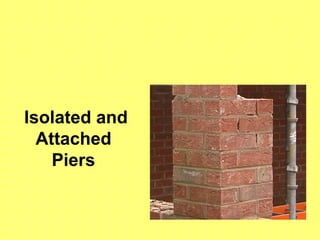
Isolated and
Attached
Piers
Tutor Copy
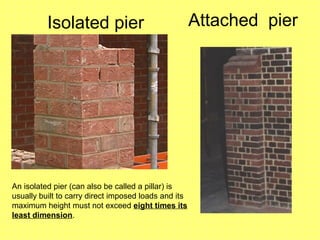
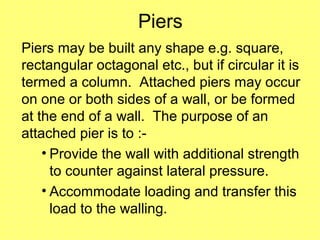
Isolated pier Attached pier
An isolated pier (can also be called a pillar) is
usually built to carry direct imposed loads and its
maximum height must not exceed eight times its
least dimension.
Piers
Piers may be built any shape e.g. square,
rectangular octagonal etc., but if circular it is
termed a column. Attached piers may occur
on one or both sides of a wall, or be formed
at the end of a wall. The purpose of an
attached pier is to :-
• Provide the wall with additional strength
to counter against lateral pressure.
• Accommodate loading and transfer this
load to the walling.
Lateral
pressures
Loading The Building Regulations state
that external walls for small
buildings such as garages,
porches and conservatories,
must be supported by piers at
the ends and also along the wall
length.
Distance between piers must not
exceed 3 metres.
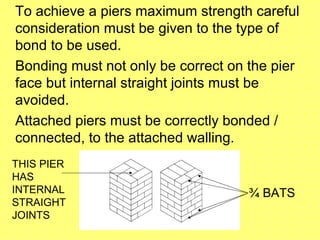
To achieve a piers maximum strength careful
consideration must be given to the type of
bond to be used.
Bonding must not only be correct on the pier
face but internal straight joints must be
avoided.
Attached piers must be correctly bonded /
connected, to the attached walling.
THIS PIER
HAS
INTERNAL
STRAIGHT
JOINTS
¾ BATS
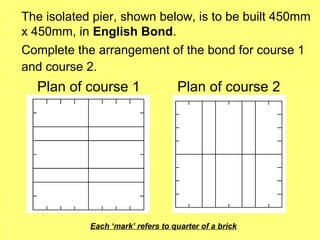
The isolated pier, shown below, is to be built 450mm
x 450mm, in English Bond.
Complete the arrangement of the bond for course 1
and course 2.
Plan of course 1 Plan of course 2
Each ‘mark’ refers to quarter of a brick
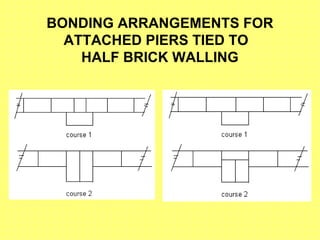
BONDING ARRANGEMENTS FOR
ATTACHED PIERS TIED TO
HALF BRICK WALLING
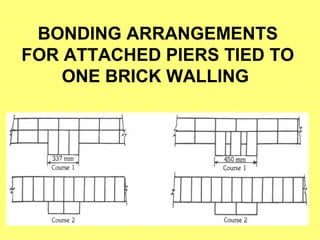
BONDING ARRANGEMENTS
FOR ATTACHED PIERS TIED TO
ONE BRICK WALLING
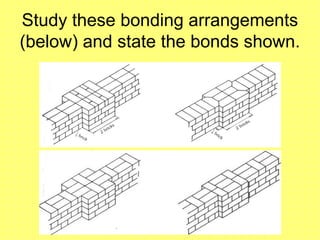
Study these bonding arrangements
(below) and state the bonds shown.
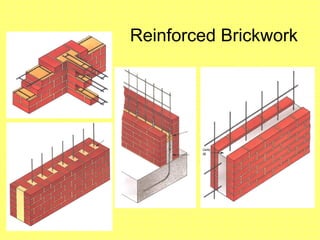
Reinforced Brickwork
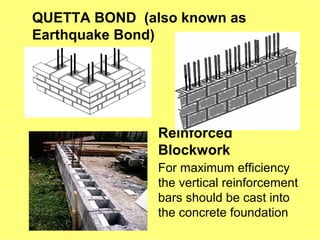
QUETTA BOND (also known as
Earthquake Bond)
Reinforced
Blockwork
For maximum efficiency
the vertical reinforcement
bars should be cast into
the concrete foundation
Pad Stones
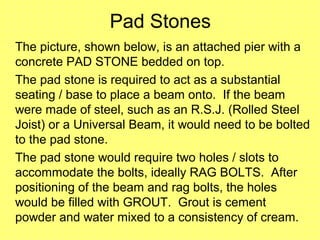
The picture, shown below, is an attached pier with a
concrete PAD STONE bedded on top.
The pad stone is required to act as a substantial
seating / base to place a beam onto. If the beam
were made of steel, such as an R.S.J. (Rolled Steel
Joist) or a Universal Beam, it would need to be bolted
to the pad stone.
The pad stone would require two holes / slots to
accommodate the bolts, ideally RAG BOLTS. After
positioning of the beam and rag bolts, the holes
would be filled with GROUT. Grout is cement
powder and water mixed to a consistency of cream.
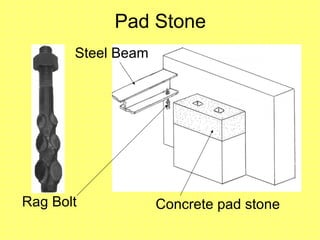
Pad Stone
Rag Bolt
Steel Beam
Concrete pad stone
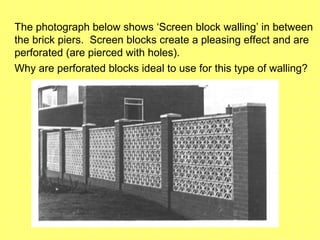
The photograph below shows ‘Screen block walling’ in between
the brick piers. Screen blocks create a pleasing effect and are
perforated (are pierced with holes).
Why are perforated blocks ideal to use for this type of walling?
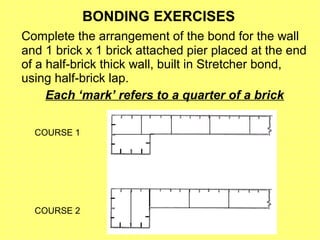
BONDING EXERCISES
Complete the arrangement of the bond for the wall
and 1 brick x 1 brick attached pier placed at the end
of a half-brick thick wall, built in Stretcher bond,
using half-brick lap.
Each ‘mark’ refers to a quarter of a brick
COURSE 1
COURSE 2
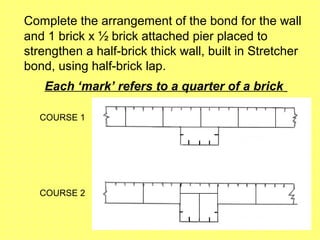
Complete the arrangement of the bond for the wall
and 1 brick x ½ brick attached pier placed to
strengthen a half-brick thick wall, built in Stretcher
bond, using half-brick lap.
Each ‘mark’ refers to a quarter of a brick
COURSE 1
COURSE 2
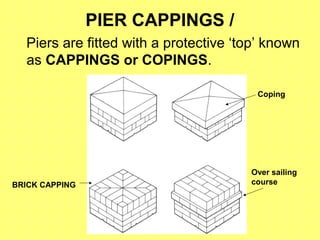
PIER CAPPINGS /
Piers are fitted with a protective ‘top’ known
as CAPPINGS or COPINGS.
BRICK CAPPING
Over sailing
course
Coping
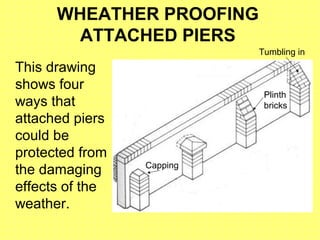
WHEATHER PROOFING
ATTACHED PIERS
This drawing
shows four
ways that
attached piers
could be
protected from
the damaging
effects of the
weather.
Capping
Plinth
bricks
Tumbling in
What materials would they be
made from?
• Capping – Concrete / Stone / Brick on edge
• Coping – Concrete / stone
• Plinth – Plinth headers and strechers
• Tumbling in - Bricks

Tutor isolated and attached piers .ppt1

  • 1.
  • 2.
  • 3.
    Isolated pier Attachedpier An isolated pier (can also be called a pillar) is usually built to carry direct imposed loads and its maximum height must not exceed eight times its least dimension.
  • 4.
    Piers Piers may bebuilt any shape e.g. square, rectangular octagonal etc., but if circular it is termed a column. Attached piers may occur on one or both sides of a wall, or be formed at the end of a wall. The purpose of an attached pier is to :- • Provide the wall with additional strength to counter against lateral pressure. • Accommodate loading and transfer this load to the walling.
  • 5.
    Lateral pressures Loading The BuildingRegulations state that external walls for small buildings such as garages, porches and conservatories, must be supported by piers at the ends and also along the wall length. Distance between piers must not exceed 3 metres.
  • 6.
    To achieve apiers maximum strength careful consideration must be given to the type of bond to be used. Bonding must not only be correct on the pier face but internal straight joints must be avoided. Attached piers must be correctly bonded / connected, to the attached walling. THIS PIER HAS INTERNAL STRAIGHT JOINTS ¾ BATS
  • 7.
    The isolated pier,shown below, is to be built 450mm x 450mm, in English Bond. Complete the arrangement of the bond for course 1 and course 2. Plan of course 1 Plan of course 2 Each ‘mark’ refers to quarter of a brick
  • 8.
    BONDING ARRANGEMENTS FOR ATTACHEDPIERS TIED TO HALF BRICK WALLING
  • 9.
    BONDING ARRANGEMENTS FOR ATTACHEDPIERS TIED TO ONE BRICK WALLING
  • 10.
    Study these bondingarrangements (below) and state the bonds shown.
  • 11.
  • 12.
    QUETTA BOND (alsoknown as Earthquake Bond) Reinforced Blockwork For maximum efficiency the vertical reinforcement bars should be cast into the concrete foundation
  • 13.
    Pad Stones The picture,shown below, is an attached pier with a concrete PAD STONE bedded on top. The pad stone is required to act as a substantial seating / base to place a beam onto. If the beam were made of steel, such as an R.S.J. (Rolled Steel Joist) or a Universal Beam, it would need to be bolted to the pad stone. The pad stone would require two holes / slots to accommodate the bolts, ideally RAG BOLTS. After positioning of the beam and rag bolts, the holes would be filled with GROUT. Grout is cement powder and water mixed to a consistency of cream.
  • 14.
    Pad Stone Rag Bolt SteelBeam Concrete pad stone
  • 15.
    The photograph belowshows ‘Screen block walling’ in between the brick piers. Screen blocks create a pleasing effect and are perforated (are pierced with holes). Why are perforated blocks ideal to use for this type of walling?
  • 16.
    BONDING EXERCISES Complete thearrangement of the bond for the wall and 1 brick x 1 brick attached pier placed at the end of a half-brick thick wall, built in Stretcher bond, using half-brick lap. Each ‘mark’ refers to a quarter of a brick COURSE 1 COURSE 2
  • 17.
    Complete the arrangementof the bond for the wall and 1 brick x ½ brick attached pier placed to strengthen a half-brick thick wall, built in Stretcher bond, using half-brick lap. Each ‘mark’ refers to a quarter of a brick COURSE 1 COURSE 2
  • 18.
    PIER CAPPINGS / Piersare fitted with a protective ‘top’ known as CAPPINGS or COPINGS. BRICK CAPPING Over sailing course Coping
  • 19.
    WHEATHER PROOFING ATTACHED PIERS Thisdrawing shows four ways that attached piers could be protected from the damaging effects of the weather. Capping Plinth bricks Tumbling in
  • 20.
    What materials wouldthey be made from? • Capping – Concrete / Stone / Brick on edge • Coping – Concrete / stone • Plinth – Plinth headers and strechers • Tumbling in - Bricks