Trigonometry 
Class:IX 
1
 Trigonometry is the 
branch of mathematics 
which deals with 
triangles, particularly 
triangles in a plane 
where one angle of the 
triangle is 90 degrees. 
. 
Trigonometry 
2
 Trigonometry specifically deals with 
 the relationships between the 
 sides and the angles of triangles. 
---------------------------------------- 
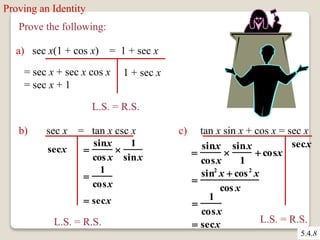
-------- 
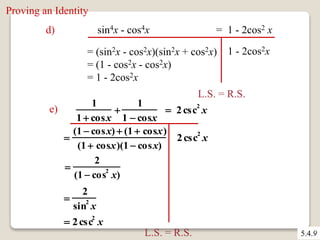
3
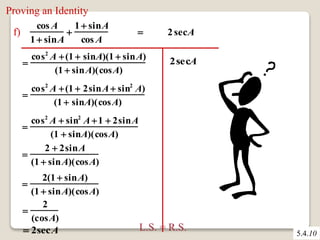
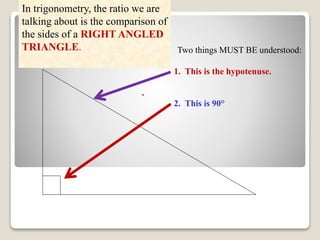
In trigonometry, the ratio we are 
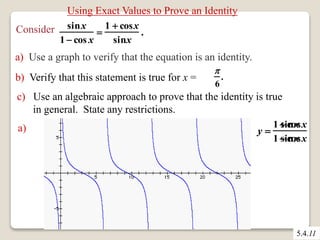
talking about is the comparison of 
the sides of a RIGHT ANGLED 
TRIANGLE. Two things MUST BE understood: 
1. This is the hypotenuse. 
. 
2. This is 90°
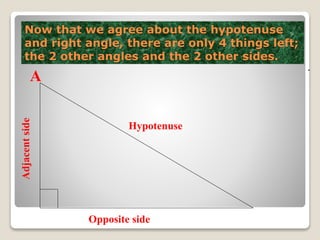
Now that we agree about the hypotenuse 
and right angle, there are only 4 things left; 
the 2 other angles and the 2 other sides. 
A 
. 
Opposite side 
Adjacent side 
Hypotenuse
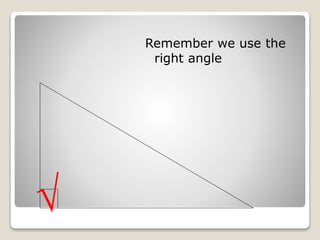
Remember we use the 
right angle 
√
One more thing… 
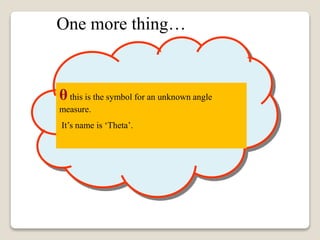
θ this is the symbol for an unknown angle 
measure. 
It’s name is ‘Theta’.
Trigonometric Ratios 
Name 
“say” Sine Cosine tangent 
Abbreviation 
Sin Cos Tan 
Ratio of an 
angle 
measure 
Sinθ = opposite side 
hypotenuse 
cosθ = adjacent side 
hypotenuse 
tanθ =opposite side 
adjacent side
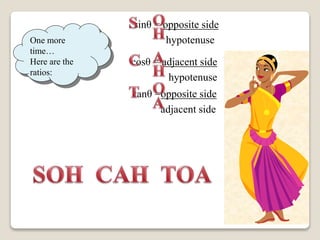
One more 
time… 
Here are the 
ratios: 
sinθ = opposite side 
hypotenuse 
cosθ = adjacent side 
hypotenuse 
tanθ =opposite side 
adjacent side
Trigonometric Identities 
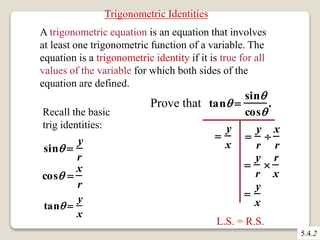
A trigonometric equation is an equation that involves 
at least one trigonometric function of a variable. The 
equation is a trigonometric identity if it is true for all 
values of the variable for which both sides of the 
equation are defined. 
Prove that tan  
sin 
cos 
. 
 
y 
x 
 
y 
r 
 
x 
r 
 
y 
r 
 
r 
x 
 
y 
x 
L.S. = R.S. 
5.4.2 
Recall the basic 
trig identities: 
sin  
y 
r 
cos  
x 
r 
tan  
y 
x
5.4.3 
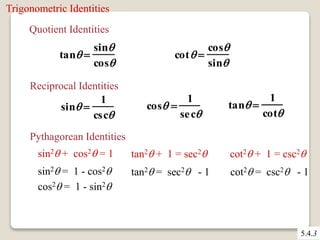
Trigonometric Identities 
Quotient Identities 
tan  
sin 
cos 
cot  
cos 
sin 
Reciprocal Identities 
sin  
1 
csc 
cos  
1 
se c 
tan  
1 
cot 
Pythagorean Identities 
sin2 + cos2 = 1 tan2 + 1 = sec2 cot2 + 1 = csc2 
sin2 = 1 - cos2 
cos2 = 1 - sin2 
tan2 = sec2 - 1 cot2 = csc2 - 1
Trigonometric Identities [cont’d] 
sinx x sinx = sin2x 
cos  
1 
cos 
 
cos2 
cos 
 
1 
cos 
 
cos2  1 
cos 
sinA cos A2 
 sin2 A 2sinAcos A cos2 A 
 12sinAcosA 
cosA 
sinA 
1 
sinA 
 
cosA 
sinA 
 
sinA 
1 
= cosA 
5.4.4
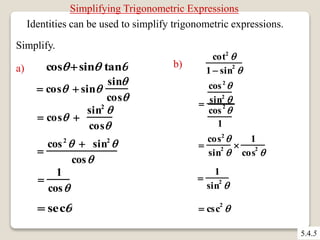
Simplifying Trigonometric Expressions 
Identities can be used to simplify trigonometric expressions. 
Simplify. 
c os sin tan 
 cos  sin 
sin 
cos 
 cos  
sin2  
cos 
 
cos 2  sin2 
cos 
 
1 
cos 
 sec 
a) 
b) 
cot2  
1  sin2  
 
cos 2 
sin2  
cos 2 
1 
 
1 
sin2  
 csc2  
5.4.5 
 
cos2 
sin2  
 
1 
cos2 
5.4.6 
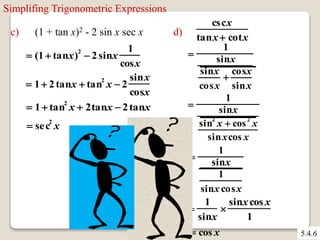
Simplifing Trigonometric Expressions 
c) (1 + tan x)2 - 2 sin x sec x 
 1  2 tanx  tan2 x  2 
sinx 
cosx 
 1 tan2 x  2tanx  2tanx 
 sec2 x 
d) 
cscx 
tanx  cotx 
 
1 
sinx 
sinx 
cosx 
 
cosx 
sinx 
 
1 
sinx 
sin2 x  cos 2 x 
sinxcos x 
 
 
1 
sinx 
1 
sinx cosx 
1 
sinx 
 
sinx cos x 
1 
 cos x 
 (1  tanx)2  2 sinx 
1 
cosx
5.4.7 
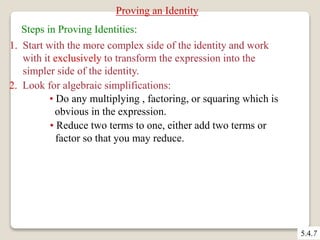
Proving an Identity 
Steps in Proving Identities: 
1. Start with the more complex side of the identity and work 
with it exclusively to transform the expression into the 
simpler side of the identity. 
2. Look for algebraic simplifications: 
• Do any multiplying , factoring, or squaring which is 
obvious in the expression. 
• Reduce two terms to one, either add two terms or 
factor so that you may reduce.
16 
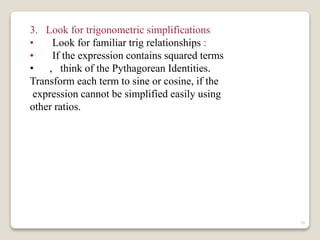
3. Look for trigonometric simplifications 
• Look for familiar trig relationships : 
• If the expression contains squared terms 
• , think of the Pythagorean Identities. 
Transform each term to sine or cosine, if the 
expression cannot be simplified easily using 
other ratios.
5.4.8 
Proving an Identity 
Prove the following: 
a) sec x(1 + cos x) = 1 + sec x 
= sec x + sec x cos x 
= sec x + 1 
1 + sec x 
L.S. = R.S. 
b) sec x = tan x csc x 
 
sinx 
cos x 
 
1 
sinx 
 
1 
cosx 
 secx 
secx 
L.S. = R.S. 
c) tan x sin x + cos x = sec x 
 
sinx 
cosx 
 
sinx 
1 
 cosx 
 
sin2 x  cos 2 x 
cos x 
 
1 
cosx 
 secx 
secx 
L.S. = R.S.
d) sin4x - cos4x = 1 - 2cos2 x 
= (sin2x - cos2x)(sin2x + cos2x) 
= (1 - cos2x - cos2x) 
= 1 - 2cos2x 
1 - 2cos2x 
L.S. = R.S. 
e) 
1 
1  cosx 
 
1 
1  cosx 
 2 csc2 x 
 
(1  cosx)  (1  cosx) 
(1  cosx)(1  cosx) 
 
2 
(1  cos2 x) 
 
2 
sin2 x 
 2csc2 x 
2csc2 x 
L.S. = R.S. 
Proving an Identity 
5.4.9
Proving an Identity 
5.4.10 
f) 
cosA 
1  sinA 
 
1  sinA 
cos A 
 2 secA 
 
cos2 A  (1  sinA)(1  sinA) 
(1  sinA)(cosA) 
 
cos2 A  (1  2sinA sin2 A) 
(1  sinA)(cosA) 
 
cos2 A  sin2 A1  2sinA 
(1  sinA)(cosA) 
 
2  2sinA 
(1  sinA)(cosA) 
 
2(1  sinA) 
(1  sinA)(cosA) 
 
2 
(cosA) 
 2secA 
2secA 
L.S. = R.S.
Using Exact Values to Prove an Identity 
5.4.11 
Consider sinx 
1  cos x 
 
1  cosx 
sinx 
. 
a) Use a graph to verify that the equation is an identity. 
b) Verify that this statement is true for x = 
 
6 
. 
c) Use an algebraic approach to prove that the identity is true 
in general. State any restrictions. 
y  
1  sinx 
cosx 
1  sinx 
cosx 
a)
Using Exact Values to Prove an Identity [cont’d] 
b) Verify that this statement is true for x = 
sinx 
1  cosx 
 
1  cosx 
sinx 
 
1 
2 
1  
3 
2 
 
6 
. 
 
sin 
 
6 
1  cos 
 
6 
 
1 
2 
 
2 
2  3 
 
1 
2  3 
 
1  cos 
 
6 
sin 
 
6 
3 
2 
1 
2 
 1  
 
2  3 
2 
 
2 
1 
 2  3 
 2  3 
Rationalize the 
denominator: 
 
1 
2  3 
1 
2  3 
 
2  3 
2  3 
 
2  3 
4  3 
 2  3 
L.S. = R.S. 
Therefore, the identity is 
true for the particular 
case of x  
5.4.12 
 
6 
.
Using Exact Values to Prove an Identity [cont’d] 
c) Use an algebraic approach to prove that the identity is true 
in general. State any restrictions. 
5.4.13 
sinx 
1  cosx 
 
1  cosx 
sinx 
 
sinx 
1  cosx 
 
1  cosx 
1  cosx 
 
sinx(1  cosx) 
1  cos2 x 
 
sinx(1  cosx) 
sin2 x 
 
1  cosx 
sinx 
1  cosx 
sinx 
L.S. = R.S. 
Restrictions: 
Note the left side of the 
equation has the restriction 
1 - cos x ≠ 0 or cos x ≠ 1. 
Therefore, x ≠ 0 + 2 n, 
where n is any integer. 
The right side of the 
equation has the restriction 
sin x ≠ 0. x = 0 and  
Therefore, x ≠ 0 + 2n 
and x ≠  + 2n, where 
n is any integer.
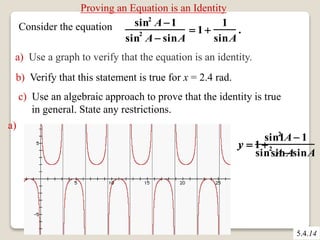
Proving an Equation is an Identity 
Consider the equation sin2 A1 
sin2 A sinA 
 1  
1 
sinA 
. 
a) Use a graph to verify that the equation is an identity. 
b) Verify that this statement is true for x = 2.4 rad. 
c) Use an algebraic approach to prove that the identity is true 
in general. State any restrictions. 
y  
sin2 A 1 
sin2 A sinA 
1  
1 
sinA 
a) 
5.4.14
Proving an Equation is an Identity [cont’d] 
b) Verify that this statement is true for x = 2.4 rad. 
sin2 A1 
sin2 A sinA 
 1  
1 
sinA 
 
(s in 2.4)2  1 
(s in 2.4)2  sin2.4 
= 2.480 466 
 1  
1 
sin 2.4 
= 2.480 466 
L.S. = R.S. 
Therefore, the equation is true for x = 2.4 rad. 
5.4.15
5.4.16 
Proving an Equation is an Identity [cont’d] 
c) Use an algebraic approach to prove that the identity is true 
in general. State any restrictions. 
sin2 A1 
sin2 A sinA 
 1  
1 
sinA 
 
(s inA1)(sinA 1) 
sinA(s inA1) 
 
(sinA1) 
sinA 
 
sinA 
sinA 
 
1 
sinA 
 1  
1 
sinA 
1  
1 
sinA 
L.S. = R.S. 
Note the left side of the 
equation has the restriction: 
sin2A - sin A ≠ 0 
sin A(sin A - 1) ≠ 0 
sin A ≠ 0 or sin A ≠ 1 
A  0, or A 
 
2 
Therefore A,  0  2 n or 
A  + 2n, or 
A  
 
2 
 2 n, wheren is 
any integer. 
The right side of the 
equation has the restriction 
sin A ≠ 0, or A ≠ 0. 
Therefore, A ≠ 0,  + 2 n, 
where n is any integer.
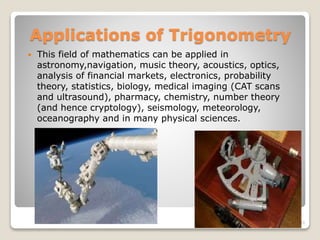
Applications of Trigonometry 
 This field of mathematics can be applied in 
astronomy,navigation, music theory, acoustics, optics, 
analysis of financial markets, electronics, probability 
theory, statistics, biology, medical imaging (CAT scans 
and ultrasound), pharmacy, chemistry, number theory 
(and hence cryptology), seismology, meteorology, 
oceanography and in many physical sciences. 
26
Trigonometry is a branch of Mathematics 
with several important and useful 
applications. Hence it attracts more and 
more research with several theories 
published year after year 
27 
Conclusion
Trignometry

Trignometry

  • 1.
  • 2.
     Trigonometry isthe branch of mathematics which deals with triangles, particularly triangles in a plane where one angle of the triangle is 90 degrees. . Trigonometry 2
  • 3.
     Trigonometry specificallydeals with  the relationships between the  sides and the angles of triangles. ---------------------------------------- -------- 3
  • 4.
    In trigonometry, theratio we are talking about is the comparison of the sides of a RIGHT ANGLED TRIANGLE. Two things MUST BE understood: 1. This is the hypotenuse. . 2. This is 90°
  • 5.
    Now that weagree about the hypotenuse and right angle, there are only 4 things left; the 2 other angles and the 2 other sides. A . Opposite side Adjacent side Hypotenuse
  • 6.
    Remember we usethe right angle √
  • 7.
    One more thing… θ this is the symbol for an unknown angle measure. It’s name is ‘Theta’.
  • 8.
    Trigonometric Ratios Name “say” Sine Cosine tangent Abbreviation Sin Cos Tan Ratio of an angle measure Sinθ = opposite side hypotenuse cosθ = adjacent side hypotenuse tanθ =opposite side adjacent side
  • 9.
    One more time… Here are the ratios: sinθ = opposite side hypotenuse cosθ = adjacent side hypotenuse tanθ =opposite side adjacent side
  • 10.
    Trigonometric Identities Atrigonometric equation is an equation that involves at least one trigonometric function of a variable. The equation is a trigonometric identity if it is true for all values of the variable for which both sides of the equation are defined. Prove that tan  sin cos .  y x  y r  x r  y r  r x  y x L.S. = R.S. 5.4.2 Recall the basic trig identities: sin  y r cos  x r tan  y x
  • 11.
    5.4.3 Trigonometric Identities Quotient Identities tan  sin cos cot  cos sin Reciprocal Identities sin  1 csc cos  1 se c tan  1 cot Pythagorean Identities sin2 + cos2 = 1 tan2 + 1 = sec2 cot2 + 1 = csc2 sin2 = 1 - cos2 cos2 = 1 - sin2 tan2 = sec2 - 1 cot2 = csc2 - 1
  • 12.
    Trigonometric Identities [cont’d] sinx x sinx = sin2x cos  1 cos  cos2 cos  1 cos  cos2  1 cos sinA cos A2  sin2 A 2sinAcos A cos2 A  12sinAcosA cosA sinA 1 sinA  cosA sinA  sinA 1 = cosA 5.4.4
  • 13.
    Simplifying Trigonometric Expressions Identities can be used to simplify trigonometric expressions. Simplify. c os sin tan  cos  sin sin cos  cos  sin2  cos  cos 2  sin2 cos  1 cos  sec a) b) cot2  1  sin2   cos 2 sin2  cos 2 1  1 sin2   csc2  5.4.5  cos2 sin2   1 cos2 
  • 14.
    5.4.6 Simplifing TrigonometricExpressions c) (1 + tan x)2 - 2 sin x sec x  1  2 tanx  tan2 x  2 sinx cosx  1 tan2 x  2tanx  2tanx  sec2 x d) cscx tanx  cotx  1 sinx sinx cosx  cosx sinx  1 sinx sin2 x  cos 2 x sinxcos x   1 sinx 1 sinx cosx 1 sinx  sinx cos x 1  cos x  (1  tanx)2  2 sinx 1 cosx
  • 15.
    5.4.7 Proving anIdentity Steps in Proving Identities: 1. Start with the more complex side of the identity and work with it exclusively to transform the expression into the simpler side of the identity. 2. Look for algebraic simplifications: • Do any multiplying , factoring, or squaring which is obvious in the expression. • Reduce two terms to one, either add two terms or factor so that you may reduce.
  • 16.
    16 3. Lookfor trigonometric simplifications • Look for familiar trig relationships : • If the expression contains squared terms • , think of the Pythagorean Identities. Transform each term to sine or cosine, if the expression cannot be simplified easily using other ratios.
  • 17.
    5.4.8 Proving anIdentity Prove the following: a) sec x(1 + cos x) = 1 + sec x = sec x + sec x cos x = sec x + 1 1 + sec x L.S. = R.S. b) sec x = tan x csc x  sinx cos x  1 sinx  1 cosx  secx secx L.S. = R.S. c) tan x sin x + cos x = sec x  sinx cosx  sinx 1  cosx  sin2 x  cos 2 x cos x  1 cosx  secx secx L.S. = R.S.
  • 18.
    d) sin4x -cos4x = 1 - 2cos2 x = (sin2x - cos2x)(sin2x + cos2x) = (1 - cos2x - cos2x) = 1 - 2cos2x 1 - 2cos2x L.S. = R.S. e) 1 1  cosx  1 1  cosx  2 csc2 x  (1  cosx)  (1  cosx) (1  cosx)(1  cosx)  2 (1  cos2 x)  2 sin2 x  2csc2 x 2csc2 x L.S. = R.S. Proving an Identity 5.4.9
  • 19.
    Proving an Identity 5.4.10 f) cosA 1  sinA  1  sinA cos A  2 secA  cos2 A  (1  sinA)(1  sinA) (1  sinA)(cosA)  cos2 A  (1  2sinA sin2 A) (1  sinA)(cosA)  cos2 A  sin2 A1  2sinA (1  sinA)(cosA)  2  2sinA (1  sinA)(cosA)  2(1  sinA) (1  sinA)(cosA)  2 (cosA)  2secA 2secA L.S. = R.S.
  • 20.
    Using Exact Valuesto Prove an Identity 5.4.11 Consider sinx 1  cos x  1  cosx sinx . a) Use a graph to verify that the equation is an identity. b) Verify that this statement is true for x =  6 . c) Use an algebraic approach to prove that the identity is true in general. State any restrictions. y  1  sinx cosx 1  sinx cosx a)
  • 21.
    Using Exact Valuesto Prove an Identity [cont’d] b) Verify that this statement is true for x = sinx 1  cosx  1  cosx sinx  1 2 1  3 2  6 .  sin  6 1  cos  6  1 2  2 2  3  1 2  3  1  cos  6 sin  6 3 2 1 2  1   2  3 2  2 1  2  3  2  3 Rationalize the denominator:  1 2  3 1 2  3  2  3 2  3  2  3 4  3  2  3 L.S. = R.S. Therefore, the identity is true for the particular case of x  5.4.12  6 .
  • 22.
    Using Exact Valuesto Prove an Identity [cont’d] c) Use an algebraic approach to prove that the identity is true in general. State any restrictions. 5.4.13 sinx 1  cosx  1  cosx sinx  sinx 1  cosx  1  cosx 1  cosx  sinx(1  cosx) 1  cos2 x  sinx(1  cosx) sin2 x  1  cosx sinx 1  cosx sinx L.S. = R.S. Restrictions: Note the left side of the equation has the restriction 1 - cos x ≠ 0 or cos x ≠ 1. Therefore, x ≠ 0 + 2 n, where n is any integer. The right side of the equation has the restriction sin x ≠ 0. x = 0 and  Therefore, x ≠ 0 + 2n and x ≠  + 2n, where n is any integer.
  • 23.
    Proving an Equationis an Identity Consider the equation sin2 A1 sin2 A sinA  1  1 sinA . a) Use a graph to verify that the equation is an identity. b) Verify that this statement is true for x = 2.4 rad. c) Use an algebraic approach to prove that the identity is true in general. State any restrictions. y  sin2 A 1 sin2 A sinA 1  1 sinA a) 5.4.14
  • 24.
    Proving an Equationis an Identity [cont’d] b) Verify that this statement is true for x = 2.4 rad. sin2 A1 sin2 A sinA  1  1 sinA  (s in 2.4)2  1 (s in 2.4)2  sin2.4 = 2.480 466  1  1 sin 2.4 = 2.480 466 L.S. = R.S. Therefore, the equation is true for x = 2.4 rad. 5.4.15
  • 25.
    5.4.16 Proving anEquation is an Identity [cont’d] c) Use an algebraic approach to prove that the identity is true in general. State any restrictions. sin2 A1 sin2 A sinA  1  1 sinA  (s inA1)(sinA 1) sinA(s inA1)  (sinA1) sinA  sinA sinA  1 sinA  1  1 sinA 1  1 sinA L.S. = R.S. Note the left side of the equation has the restriction: sin2A - sin A ≠ 0 sin A(sin A - 1) ≠ 0 sin A ≠ 0 or sin A ≠ 1 A  0, or A  2 Therefore A,  0  2 n or A  + 2n, or A   2  2 n, wheren is any integer. The right side of the equation has the restriction sin A ≠ 0, or A ≠ 0. Therefore, A ≠ 0,  + 2 n, where n is any integer.
  • 26.
    Applications of Trigonometry  This field of mathematics can be applied in astronomy,navigation, music theory, acoustics, optics, analysis of financial markets, electronics, probability theory, statistics, biology, medical imaging (CAT scans and ultrasound), pharmacy, chemistry, number theory (and hence cryptology), seismology, meteorology, oceanography and in many physical sciences. 26
  • 27.
    Trigonometry is abranch of Mathematics with several important and useful applications. Hence it attracts more and more research with several theories published year after year 27 Conclusion