TRIGONOMETRY
INTRODUCTION
Trigonometry is a branch
of mathematics that
studies triangles and the
relationships between the
lengths of their sides and
the angles between those sides.
HISTORY OF TRIGONOMETRY
Early study of triangles can be traced to
the 2nd millennium BC, in Egyptian
mathematics and Babylonian
mathematics. Systematic study of
trigonometric functions began
in Hellenistic mathematics, reaching
India as part of Hellenistic astronomy.
Uses of trigonometry
Scientific fields that make use of trigonometry
include:
architecture, astronomy, civil
engineering, geophysics, electrical
engineering, electronics, land surveying
and many physical sciences, mechanical
engineering, oceanography, optics, pharmac
ology, probability theory, seismology, statistics.
TRIGONOMETRY AND
TRIANGLES
Using Trigonometry we can find
the relationships between the
lengths of sides of the triangle
and the angles between those
sides.
TRIGONOMETRY AND TRIANGLES

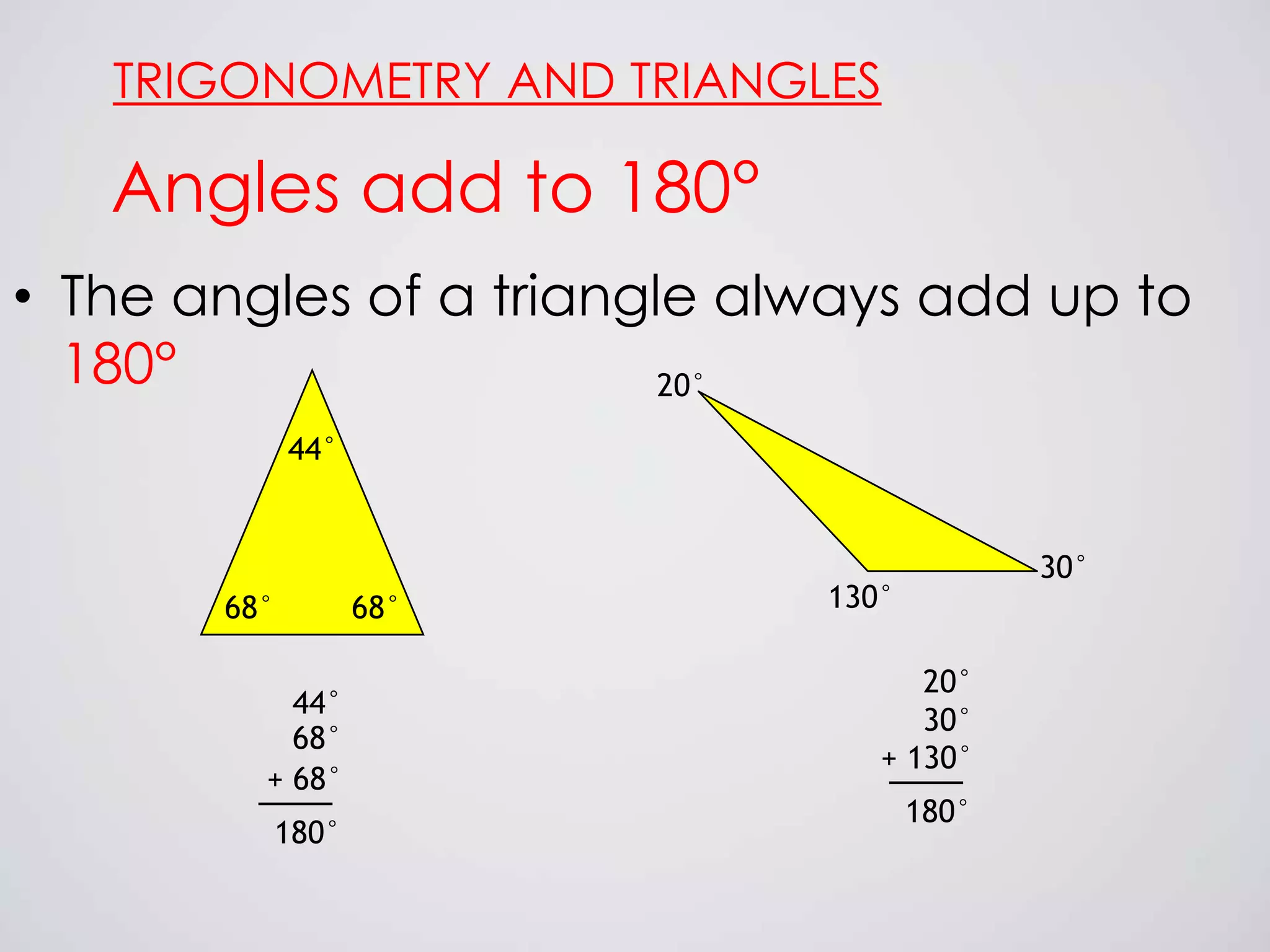
Angles add to 180°
• The angles of a triangle always add up to
180°
20°
44°

68°
44°
68°
+ 68°
180°

68°

30°

130°
20°
30°
+ 130°
180°
TRIGONOMETRY AND TRIANGLES

Right triangles
• We only care about right triangles.
– A right triangle is one in which one of the angles is 90°
– Here’s a right triangle:
opposite

Here’s the
right angle

Here’s the angle
we are looking at

adjacent

• We call the longest side the hypotenuse
• We pick one of the other angles--not the right angle
• We name the other two sides relative to that angle
TRIGONOMETRY AND TRIANGLES

The Pythagorean Theorem
If you square the length of
the two shorter sides and
add them, you get the
square of the length of the
hypotenuse
adj2 + opp2 = hyp2
32 + 42 = 52, or 9 + 16 = 25
TRIGONOMETRY AND TRIANGLES

The Pythagorean Theorem
• There are few triangles with
integer sides that satisfy the
Pythagorean formula
• 3-4-5 and its
multiples (6-8-10, etc.)
are the best known
• 5-12-13 and its multiples
form another set.
• 25 + 144 = 169

opp

adj
TRIGONOMETRY AND TRIANGLES

Ratios
opposite

• Since a triangle has three
sides, there are six ways to
divide the lengths of the
sides
adjacent
• Each of these six ratios has a
name (and an abbreviation)
• Three ratios are most used:
• The ratios depend on
– sine = sin = opp / hyp
the shape of the triangle
– cosine = cos = adj / hyp
(the angles) but not on
– tangent = tan = opp / adj
the size
• The other three ratios are
redundant with these and
can be ignored
TRIGONOMETRY AND TRIANGLES

Using the ratios

opposite

• With these functions, if you know an angle (in addition
to the right angle) and the length of a side, you can
compute all other angles and lengths of sides

adjacent

• If you know the angle marked in blue (call it A) and
you know the length of the adjacent side, then
– tan A = opp / adj, so length of opposite side is given by
opp = adj * tan A
– cos A = adj / hyp, so length of hypotenuse is given by
hyp = adj / cos A
TRIGONOMETRY AND TRIANGLES

Important Formulas
• The formulas for right-triangle
trigonometric functions are:
– Sine = Opposite / Hypotenuse
– Cosine = Adjacent / Hypotenuse
– Tangent = Opposite / Adjacent

• Mnemonics for those formulas are:
– Some Old Horse Caught Another Horse
Taking Oats Away
– Saints On High Can Always Have Tea Or
Alcohol
THANK YOU
By – Remin Rajesh

Trigonometry

  • 1.
  • 2.
    INTRODUCTION Trigonometry is abranch of mathematics that studies triangles and the relationships between the lengths of their sides and the angles between those sides.
  • 3.
    HISTORY OF TRIGONOMETRY Earlystudy of triangles can be traced to the 2nd millennium BC, in Egyptian mathematics and Babylonian mathematics. Systematic study of trigonometric functions began in Hellenistic mathematics, reaching India as part of Hellenistic astronomy.
  • 4.
    Uses of trigonometry Scientificfields that make use of trigonometry include: architecture, astronomy, civil engineering, geophysics, electrical engineering, electronics, land surveying and many physical sciences, mechanical engineering, oceanography, optics, pharmac ology, probability theory, seismology, statistics.
  • 5.
    TRIGONOMETRY AND TRIANGLES Using Trigonometrywe can find the relationships between the lengths of sides of the triangle and the angles between those sides.
  • 6.
    TRIGONOMETRY AND TRIANGLES Anglesadd to 180° • The angles of a triangle always add up to 180° 20° 44° 68° 44° 68° + 68° 180° 68° 30° 130° 20° 30° + 130° 180°
  • 7.
    TRIGONOMETRY AND TRIANGLES Righttriangles • We only care about right triangles. – A right triangle is one in which one of the angles is 90° – Here’s a right triangle: opposite Here’s the right angle Here’s the angle we are looking at adjacent • We call the longest side the hypotenuse • We pick one of the other angles--not the right angle • We name the other two sides relative to that angle
  • 8.
    TRIGONOMETRY AND TRIANGLES ThePythagorean Theorem If you square the length of the two shorter sides and add them, you get the square of the length of the hypotenuse adj2 + opp2 = hyp2 32 + 42 = 52, or 9 + 16 = 25
  • 9.
    TRIGONOMETRY AND TRIANGLES ThePythagorean Theorem • There are few triangles with integer sides that satisfy the Pythagorean formula • 3-4-5 and its multiples (6-8-10, etc.) are the best known • 5-12-13 and its multiples form another set. • 25 + 144 = 169 opp adj
  • 10.
    TRIGONOMETRY AND TRIANGLES Ratios opposite •Since a triangle has three sides, there are six ways to divide the lengths of the sides adjacent • Each of these six ratios has a name (and an abbreviation) • Three ratios are most used: • The ratios depend on – sine = sin = opp / hyp the shape of the triangle – cosine = cos = adj / hyp (the angles) but not on – tangent = tan = opp / adj the size • The other three ratios are redundant with these and can be ignored
  • 11.
    TRIGONOMETRY AND TRIANGLES Usingthe ratios opposite • With these functions, if you know an angle (in addition to the right angle) and the length of a side, you can compute all other angles and lengths of sides adjacent • If you know the angle marked in blue (call it A) and you know the length of the adjacent side, then – tan A = opp / adj, so length of opposite side is given by opp = adj * tan A – cos A = adj / hyp, so length of hypotenuse is given by hyp = adj / cos A
  • 12.
    TRIGONOMETRY AND TRIANGLES ImportantFormulas • The formulas for right-triangle trigonometric functions are: – Sine = Opposite / Hypotenuse – Cosine = Adjacent / Hypotenuse – Tangent = Opposite / Adjacent • Mnemonics for those formulas are: – Some Old Horse Caught Another Horse Taking Oats Away – Saints On High Can Always Have Tea Or Alcohol
  • 13.
    THANK YOU By –Remin Rajesh