01 
TechniqWuTeemspIlNa atenTdE R 
Strategies in 
Teaching 
Mathematics 
Presented by: Imelda S. 
Bautista ♥
02 
“Teacher, can you spare a sign?” 
My worst experience with a teacher was 
during our Math class. I loved math and really 
thought I knew and understood math. But my math 
teacher sent me home crying everyday because 
she marked my homework and test wrong since I 
used to get my positive and negative signs wrong. I 
knew how to do the problems, but I always got my 
answers with wrong sign.
03 
Reflect: The scenario 
illustrates the difficulties experienced 
by some unfortunate learners. But can 
we afford to let such kind of teachers? 
They affect the way our learners feel 
about math. Let’s hope not.
04 
• Therefore, it depends upon every 
teacher to strive to improve her/his 
teaching style to increase the number 
of children liking, and even loving 
Mathematics. Such should start as 
early as in the elementary grades. 
Furthermore, the use of varied and 
appropriate teaching approaches can 
entice more learners to like and love 
math.
Discovery 
Approach
05 
A. DISCOVERY APPROACH 
The ultimate goal of this approach is that 
learners learn how to learn rather than what 
to learn. 
•for developing their higher-order thinking 
skills. 
•This approach refers to an “Inductive Method” 
of guiding learners to discuss and use ideas 
already acquired as a means of discovering 
new ideas.
01 
WINTER Template 
A. DISCOVERY APPROACH 
It is "International Learning”, 
both the teacher and the 
learner play active roles in 
discovery learning.
Inquiry 
Teaching
02 
B. INQUIRY TEACHING 
-providing learners with content-related 
problems that serve as the foci for class 
research activities. 
-The teacher provides/presents a 
problem then the learners identify the 
problem. 
-Such problem provides the focus which 
lead to the formulation of the hypothesis 
by the learners
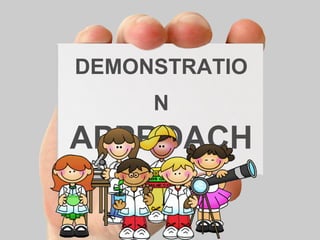
DEMONSTRATIO 
N 
APPROACH
B. DEMONSTRATION 03 
APPROACH 
-providing learners with content-related problems 
that serve as the foci for class research activities. 
-The teacher provides/presents a problem then the 
learners identify the problem. 
-Such problem provides the focus which lead to 
the formulation of the hypothesis by the learners. 
-Once the hypotheses have been formulated, the 
learners’ task is to gather data to test hypotheses. 
-The gathered data are being organized then data 
analysis follow to arrive to 
conclusion/generalization.
B. DEMONSTRATION 03 
APPROACH 
The teacher provides/presents 
a problem then the learners 
identify the problem. 
Such problem provides the 
focus which lead to the 
formulation of the hypothesis by 
the learners.
B. DEMONSTRATION 03 
APPROACH 
Once the hypotheses have 
been formulated, the learners’ 
task is to gather data to test 
hypotheses. 
The gathered data are being 
organized then data analysis 
follow to arrive to 
conclusion/generalization.
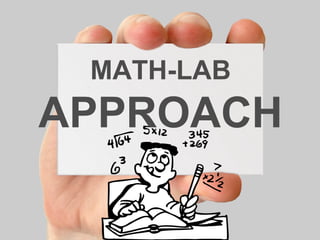
MATH-LAB 
APPROACH
C. MATH-LAB APPROACH 04 
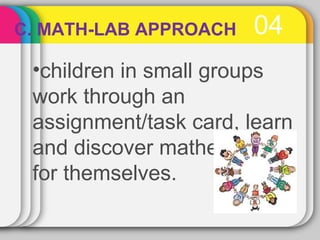
•children in small groups 
work through an 
assignment/task card, learn 
and discover mathematics 
for themselves.
C. MATH-LAB APPROACH 04 
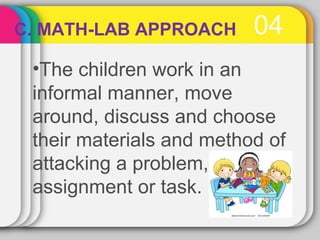
•The children work in an 
informal manner, move 
around, discuss and choose 
their materials and method of 
attacking a problem, 
assignment or task.
D. PRACTICAL WORK 05 
APPROACH (PWA) 
-The learners in this approach, manipulate 
concrete objects and/or perform activities to 
arrive at a conceptual understanding of 
phenomena, situation, or concept. The 
environment is a laboratory where the natural 
events/phenomena can be subjects of 
mathematical or scientific investigations. 
Activities can be done in the garden, in the 
yard, in the field, in the school grounds, or 
anywhere as long as the safety of the learners 
is assured. That’s why elementary schools are 
encouraged to put up a Math park.
D. PRACTICAL WORK 05 
APPROACH (PWA) 
-The learners in this approach, manipulate 
concrete objects and/or perform activities to 
arrive at a conceptual understanding of 
phenomena, situation, or concept. The 
environment is a laboratory where the natural 
events/phenomena can be subjects of 
mathematical or scientific investigations. 
Activities can be done in the garden, in the 
yard, in the field, in the school grounds, or 
anywhere as long as the safety of the learners 
is assured. That’s why elementary schools are 
encouraged to put up a Math park.
D. PRACTICAL WORK 05 
APPROACH (PWA) 
The environment is a laboratory where 
the natural events/phenomena can be subjects 
of mathematical or scientific investigations. 
Activities can be done in the garden, in the 
yard, in the field, in the school grounds, or 
anywhere as long as the safety of the learners 
is assured. That’s why elementary schools are 
encouraged to put up a Math park.
INDIVIDUALIZED 
INSTRUCTION 
USING MODULES
01 
WINTER Template 
INDIVIDUALIZED INSTRUCTION 
USING MODULES 
• This permits the learners to 
progress by mastering steps 
through the curriculum at his/her 
own rate and independently of 
the progress of other pupils.
01 
WINTER Template 
INDIVIDUALIZED INSTRUCTION 
USING MODULES 
• Individualizing instruction does not imply 
that every pupil in the class must be 
involved in an activity separates and distinct 
from that of every other child. There are 
many ways of individualizing instruction: 
grouping, modules- self-learning 
kits/materials, programmed materials, daily 
prescriptions, contracts, etc.
BRAIN 
STORMING
02 
BRAINSTORMING 
• teacher elicits from the learners as many 
ideas as possible but refrains from 
evaluating them until all possible ideas 
have been generated. 
• It is an excellent strategy for stimulating 
creativity among learners.
PROBLEM 
SOLVING
03 
PROBLEM-SOLVING 
• a learner-directed strategy in which 
learners “think patiently and 
analytically about complex situations in 
order to find answers to questions”.
PROBLEM-SOLVING 04 
When using problem-solving for the first time: 
select a simple problem that can be 
completed in a short amount of time. 
Consider learners’ interest, ability level, and 
maturation level. 
Make sure resources (materials or 
equipment) are available. 
Make sure that learners are familiar with 
brainstorming before you implement problem-solving.
COOPERATIVE 
Learning
05 
COOPERATIVE LEARNING 
•eliminates competition among learners. 
It encourages them to work together 
towards common goals. 
•It fosters positive intergroup attitudes in 
the classroom. It encourages learners 
to work in small groups to learn.
01 
WINTER Template 
COOPERATIVE LEARNING 
•The group learns a particular 
content/concept and every member 
is expected to participate actively in 
the discussion, with the fast 
learners helping the slower ones 
learn the lesson.
Inquiry 
Teaching
02 
B. INQUIRY TEACHING 
-providing learners with content-related problems 
that serve as the foci for class research activities. 
The teacher provides/presents a problem then 
the learners identify the problem. 
Such problem provides the focus which lead to 
the formulation of the hypothesis by the learners. 
Once the hypotheses have been formulated, the 
learners’ task is to gather data to test hypotheses. 
The gathered data are being organized then 
data analysis follow to arrive to 
conclusion/generalization.
INTEGRATIVE 
Technique
03 
INTEGRATIVE TECHNIQUE 
-The Integrated Curriculum Mode 
(Integrative teaching to some) is 
both a “method of teaching and a 
way of organizing the instructional 
program so that many subject areas 
and skills provided in the curriculum 
can be linked to one another”.
Modes of Integration: 04 
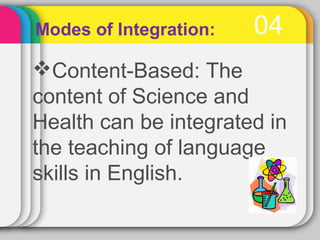
Content-Based: The 
content of Science and 
Health can be integrated in 
the teaching of language 
skills in English.
Modes of Integration: 04 
Some topics/content in 
Sibika at Kultura and 
Heograpiya/ Kasaysayan/ 
Sibika were used as vehicle 
for the language skills 
development in Filipino.
Modes of Integration: 04 
Using Thematic 
Teaching: Some themes 
can center on celebrations, 
current issues, learner’s 
interests/hobbies, priority
05 
Ten Creative 
Ways to 
Teach Math
1. Use dramatizations 
• Invite children pretend to be in a ball 
(sphere) or box (rectangular prism), 
feeling the faces, edges, and corners 
and to dramatize simple arithmetic 
problems such as: Three frogs 
jumped in the pond, then one more, 
how many are there in all?
2. Use children's 
bodies • Suggest that children show how many feet, 
mouths, and so on they have. Invite children to 
show numbers with fingers, starting with the 
familiar, "How old are you?" to showing numbers 
you say, to showing numbers in different ways 
(for example, five as three on one hand and two 
on the other).
3. Use children's play • Engage children in block play that 
allows them to do mathematics in 
numerous ways, including 
sorting, creating symmetric 
designs and buildings, making 
patterns, and so forth
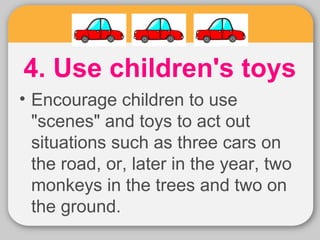
4. Use children's toys 
• Encourage children to use 
"scenes" and toys to act out 
situations such as three cars on 
the road, or, later in the year, two 
monkeys in the trees and two on 
the ground.
5. Use children's stories 
• Share books with children 
that address Mathematics 
but are also good stories. 
Later, help children see 
Mathematics in any book.
6. Use children's natural 
creativity 
• Children's ideas about 
mathematics should be 
discussed with all 
children.
7. Use children's problem-solving 
abilities • Ask children to describe how they would 
figure out problems such as getting just 
enough scissors for their table or how 
many snacks they would need if a guest 
were joining the group. Encourage them to 
use their own fingers or manipulatives or 
whatever else might be handy for problem 
solving.
8. Use a variety of 
strategies • Bring mathematics everywhere you go in 
your classroom, from counting children at 
morning meeting to setting the table, to 
asking children to clean up a given 
number or shape of items. Also, use a 
research-based curriculum to incorporate 
a sequenced series of learning activities 
into your program.
9. Use technology 
• Try digital cameras to record children's 
mathematical work, in their play and in planned 
activities, and then use the photographs to aid 
discussions and reflections with children, 
curriculum planning, and communication with 
parents. Use computers wisely to mathematize 
situations and provide individualized instruction.
10. Use assessments to measure 
children's mathematics learning 
• Use observations, discussions with 
children, and small-group activities to 
learn about children's mathematical 
thinking and to make informed decisions 
about what each child might be able to 
learn from future experiences.
REFLECTION: 
• Choose the best strategy 
suited to you and your 
students. Explain how will 
you employ it in your 
class.

Techniques and Strategies in Teaching Math

  • 1.
    01 TechniqWuTeemspIlNa atenTdER Strategies in Teaching Mathematics Presented by: Imelda S. Bautista ♥
  • 2.
    02 “Teacher, canyou spare a sign?” My worst experience with a teacher was during our Math class. I loved math and really thought I knew and understood math. But my math teacher sent me home crying everyday because she marked my homework and test wrong since I used to get my positive and negative signs wrong. I knew how to do the problems, but I always got my answers with wrong sign.
  • 3.
    03 Reflect: Thescenario illustrates the difficulties experienced by some unfortunate learners. But can we afford to let such kind of teachers? They affect the way our learners feel about math. Let’s hope not.
  • 4.
    04 • Therefore,it depends upon every teacher to strive to improve her/his teaching style to increase the number of children liking, and even loving Mathematics. Such should start as early as in the elementary grades. Furthermore, the use of varied and appropriate teaching approaches can entice more learners to like and love math.
  • 5.
  • 6.
    05 A. DISCOVERYAPPROACH The ultimate goal of this approach is that learners learn how to learn rather than what to learn. •for developing their higher-order thinking skills. •This approach refers to an “Inductive Method” of guiding learners to discuss and use ideas already acquired as a means of discovering new ideas.
  • 7.
    01 WINTER Template A. DISCOVERY APPROACH It is "International Learning”, both the teacher and the learner play active roles in discovery learning.
  • 8.
  • 9.
    02 B. INQUIRYTEACHING -providing learners with content-related problems that serve as the foci for class research activities. -The teacher provides/presents a problem then the learners identify the problem. -Such problem provides the focus which lead to the formulation of the hypothesis by the learners
  • 10.
  • 11.
    B. DEMONSTRATION 03 APPROACH -providing learners with content-related problems that serve as the foci for class research activities. -The teacher provides/presents a problem then the learners identify the problem. -Such problem provides the focus which lead to the formulation of the hypothesis by the learners. -Once the hypotheses have been formulated, the learners’ task is to gather data to test hypotheses. -The gathered data are being organized then data analysis follow to arrive to conclusion/generalization.
  • 12.
    B. DEMONSTRATION 03 APPROACH The teacher provides/presents a problem then the learners identify the problem. Such problem provides the focus which lead to the formulation of the hypothesis by the learners.
  • 13.
    B. DEMONSTRATION 03 APPROACH Once the hypotheses have been formulated, the learners’ task is to gather data to test hypotheses. The gathered data are being organized then data analysis follow to arrive to conclusion/generalization.
  • 14.
  • 15.
    C. MATH-LAB APPROACH04 •children in small groups work through an assignment/task card, learn and discover mathematics for themselves.
  • 16.
    C. MATH-LAB APPROACH04 •The children work in an informal manner, move around, discuss and choose their materials and method of attacking a problem, assignment or task.
  • 17.
    D. PRACTICAL WORK05 APPROACH (PWA) -The learners in this approach, manipulate concrete objects and/or perform activities to arrive at a conceptual understanding of phenomena, situation, or concept. The environment is a laboratory where the natural events/phenomena can be subjects of mathematical or scientific investigations. Activities can be done in the garden, in the yard, in the field, in the school grounds, or anywhere as long as the safety of the learners is assured. That’s why elementary schools are encouraged to put up a Math park.
  • 18.
    D. PRACTICAL WORK05 APPROACH (PWA) -The learners in this approach, manipulate concrete objects and/or perform activities to arrive at a conceptual understanding of phenomena, situation, or concept. The environment is a laboratory where the natural events/phenomena can be subjects of mathematical or scientific investigations. Activities can be done in the garden, in the yard, in the field, in the school grounds, or anywhere as long as the safety of the learners is assured. That’s why elementary schools are encouraged to put up a Math park.
  • 19.
    D. PRACTICAL WORK05 APPROACH (PWA) The environment is a laboratory where the natural events/phenomena can be subjects of mathematical or scientific investigations. Activities can be done in the garden, in the yard, in the field, in the school grounds, or anywhere as long as the safety of the learners is assured. That’s why elementary schools are encouraged to put up a Math park.
  • 20.
  • 21.
    01 WINTER Template INDIVIDUALIZED INSTRUCTION USING MODULES • This permits the learners to progress by mastering steps through the curriculum at his/her own rate and independently of the progress of other pupils.
  • 22.
    01 WINTER Template INDIVIDUALIZED INSTRUCTION USING MODULES • Individualizing instruction does not imply that every pupil in the class must be involved in an activity separates and distinct from that of every other child. There are many ways of individualizing instruction: grouping, modules- self-learning kits/materials, programmed materials, daily prescriptions, contracts, etc.
  • 23.
  • 24.
    02 BRAINSTORMING •teacher elicits from the learners as many ideas as possible but refrains from evaluating them until all possible ideas have been generated. • It is an excellent strategy for stimulating creativity among learners.
  • 25.
  • 26.
    03 PROBLEM-SOLVING •a learner-directed strategy in which learners “think patiently and analytically about complex situations in order to find answers to questions”.
  • 27.
    PROBLEM-SOLVING 04 Whenusing problem-solving for the first time: select a simple problem that can be completed in a short amount of time. Consider learners’ interest, ability level, and maturation level. Make sure resources (materials or equipment) are available. Make sure that learners are familiar with brainstorming before you implement problem-solving.
  • 28.
  • 29.
    05 COOPERATIVE LEARNING •eliminates competition among learners. It encourages them to work together towards common goals. •It fosters positive intergroup attitudes in the classroom. It encourages learners to work in small groups to learn.
  • 30.
    01 WINTER Template COOPERATIVE LEARNING •The group learns a particular content/concept and every member is expected to participate actively in the discussion, with the fast learners helping the slower ones learn the lesson.
  • 31.
  • 32.
    02 B. INQUIRYTEACHING -providing learners with content-related problems that serve as the foci for class research activities. The teacher provides/presents a problem then the learners identify the problem. Such problem provides the focus which lead to the formulation of the hypothesis by the learners. Once the hypotheses have been formulated, the learners’ task is to gather data to test hypotheses. The gathered data are being organized then data analysis follow to arrive to conclusion/generalization.
  • 33.
  • 34.
    03 INTEGRATIVE TECHNIQUE -The Integrated Curriculum Mode (Integrative teaching to some) is both a “method of teaching and a way of organizing the instructional program so that many subject areas and skills provided in the curriculum can be linked to one another”.
  • 35.
    Modes of Integration:04 Content-Based: The content of Science and Health can be integrated in the teaching of language skills in English.
  • 36.
    Modes of Integration:04 Some topics/content in Sibika at Kultura and Heograpiya/ Kasaysayan/ Sibika were used as vehicle for the language skills development in Filipino.
  • 37.
    Modes of Integration:04 Using Thematic Teaching: Some themes can center on celebrations, current issues, learner’s interests/hobbies, priority
  • 38.
    05 Ten Creative Ways to Teach Math
  • 39.
    1. Use dramatizations • Invite children pretend to be in a ball (sphere) or box (rectangular prism), feeling the faces, edges, and corners and to dramatize simple arithmetic problems such as: Three frogs jumped in the pond, then one more, how many are there in all?
  • 40.
    2. Use children's bodies • Suggest that children show how many feet, mouths, and so on they have. Invite children to show numbers with fingers, starting with the familiar, "How old are you?" to showing numbers you say, to showing numbers in different ways (for example, five as three on one hand and two on the other).
  • 41.
    3. Use children'splay • Engage children in block play that allows them to do mathematics in numerous ways, including sorting, creating symmetric designs and buildings, making patterns, and so forth
  • 42.
    4. Use children'stoys • Encourage children to use "scenes" and toys to act out situations such as three cars on the road, or, later in the year, two monkeys in the trees and two on the ground.
  • 43.
    5. Use children'sstories • Share books with children that address Mathematics but are also good stories. Later, help children see Mathematics in any book.
  • 44.
    6. Use children'snatural creativity • Children's ideas about mathematics should be discussed with all children.
  • 45.
    7. Use children'sproblem-solving abilities • Ask children to describe how they would figure out problems such as getting just enough scissors for their table or how many snacks they would need if a guest were joining the group. Encourage them to use their own fingers or manipulatives or whatever else might be handy for problem solving.
  • 46.
    8. Use avariety of strategies • Bring mathematics everywhere you go in your classroom, from counting children at morning meeting to setting the table, to asking children to clean up a given number or shape of items. Also, use a research-based curriculum to incorporate a sequenced series of learning activities into your program.
  • 47.
    9. Use technology • Try digital cameras to record children's mathematical work, in their play and in planned activities, and then use the photographs to aid discussions and reflections with children, curriculum planning, and communication with parents. Use computers wisely to mathematize situations and provide individualized instruction.
  • 48.
    10. Use assessmentsto measure children's mathematics learning • Use observations, discussions with children, and small-group activities to learn about children's mathematical thinking and to make informed decisions about what each child might be able to learn from future experiences.
  • 50.
    REFLECTION: • Choosethe best strategy suited to you and your students. Explain how will you employ it in your class.