Arithmetic Progression
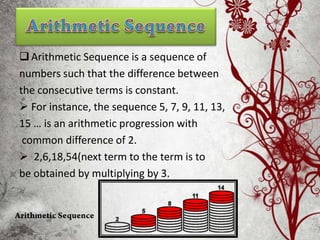
 Arithmetic Sequence is a sequence of
numbers such that the difference between
the consecutive terms is constant.
 For instance, the sequence 5, 7, 9, 11, 13,
15 … is an arithmetic progression with
common difference of 2.
 2,6,18,54(next term to the term is to
be obtained by multiplying by 3.
• A finite portion of an arithmetic progression
is called a finite arithmetic progression and
sometimes just called an arithmetic
progression. The sum of a finite arithmetic
progression is called an Arithmetic series.
• The behavior of the arithmetic progression
depends on the common difference d. If the
common difference is:
 Positive, the members (terms) will grow
towards positive infinity.
 Negative, the members (terms) will grow
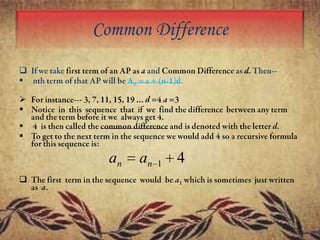
Common Difference







an


an

1

4
Arithmetic Progression
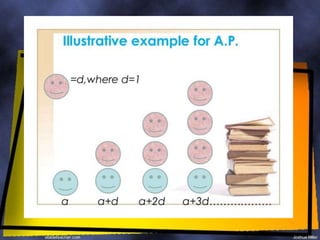
 If the initial term of an arithmetic progression is a1 and the
common difference of successive members is d, then the
nth term of the sequence (an) is given by:



An= a1+(n-1)d

And in general

An= a1+ (n-m)d
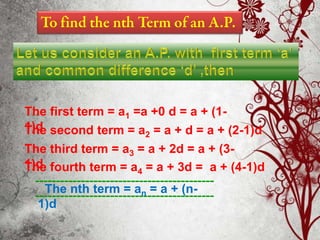
The first term = a1 =a +0 d = a + (11)d second term = a = a + d = a + (2-1)d
The
2

The third term = a3 = a + 2d = a + (31)d fourth term = a = a + 3d = a + (4-1)d
The
4
------------------------------------------The nth term = an = a + (n------------------------------------------1)d
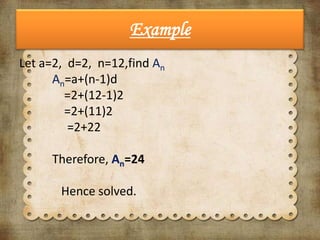
Example
Let a=2, d=2, n=12,find An
An=a+(n-1)d
=2+(12-1)2
=2+(11)2
=2+22
Therefore, An=24

Hence solved.
(i) 2, 6, 10, 14….
(i) Here first term a = 2,
find differences in the next terms
a2-a1 = 6 – 2 = 4

a3-a2 = 10 –6 = 4
a4-a3 = 14 – 10 = 4
Since the differences are common.

Hence the given terms are in A.P.
. Find 10th term of A.P. 12, 18, 24, 30.. …
Solution. Given A.P. is 12, 18, 24, 30..
First term is

a = 12

Common difference is d = 18- 12 = 6

nth term is

an = a + (n-1)d

Put n = 10,

a10 = 12 + (10-1)6
= 12 + 9 x 6

= 12 + 54
a10 = 66
.

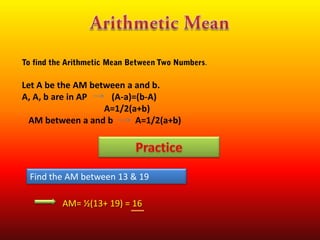
Let A be the AM between a and b.
A, A, b are in AP
(A-a)=(b-A)
A=1/2(a+b)
AM between a and b
A=1/2(a+b)

Find the AM between 13 & 19
AM= ½(13+ 19) = 16
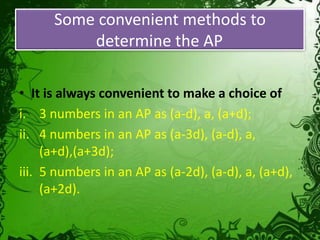
Some convenient methods to
determine the AP
• It is always convenient to make a choice of
i. 3 numbers in an AP as (a-d), a, (a+d);
ii. 4 numbers in an AP as (a-3d), (a-d), a,
(a+d),(a+3d);
iii. 5 numbers in an AP as (a-2d), (a-d), a, (a+d),
(a+2d).
Practice
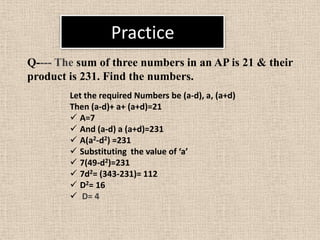
Q---- The sum of three numbers in an AP is 21 & their
product is 231. Find the numbers.
Let the required Numbers be (a-d), a, (a+d)
Then (a-d)+ a+ (a+d)=21
 A=7
 And (a-d) a (a+d)=231
 A(a2-d2) =231
 Substituting the value of ‘a’
 7(49-d2)=231
 7d2= (343-231)= 112
 D2= 16
 D= 4
The sum of n terms, we find as,
Sum = n X [(first term + last term) / 2]
Now last term will be = a + (n-1) d
Therefore,


Sn = ½ n [ 2a + (n - 1)d ]

 It can also be written as



Sn = ½ n [ a + a n ]
Problem 1. Find the sum of 30 terms of given A.P.

12 + 20 + 28 + 36………
Solution : Given A.P. is 12 , 20, 28 , 36
Its first term is a = 12

Common difference is d = 20 – 12 = 8

The sum to n terms of an arithmetic progression
Sn = ½ n [ 2a + (n - 1)d ]
= ½ x 30 [ 2x 12 + (30-1)x 8]
= 15 [ 24 + 29 x8]
= 15[24 + 232]
= 15 x 246
= 3690
Practice
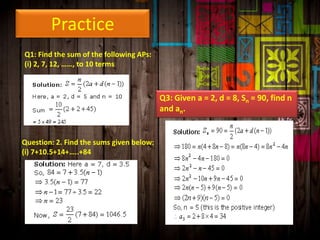
Q1: Find the sum of the following APs:
(i) 2, 7, 12, ……, to 10 terms

Q3: Given a = 2, d = 8, Sn = 90, find n
and an.

Question: 2. Find the sums given below:
(i) 7+10.5+14+…..+84
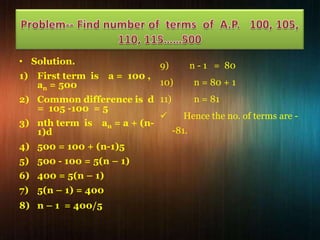
• Solution.
1) First term is
an = 500

a = 100 ,

9)

n - 1 = 80

10)

n = 80 + 1

n = 81
2) Common difference is d 11)
= 105 -100 = 5

Hence the no. of terms are 3) nth term is an = a + (n-81.
1)d
4) 500 = 100 + (n-1)5
5) 500 - 100 = 5(n – 1)
6) 400 = 5(n – 1)
7) 5(n – 1) = 400
8) n – 1 = 400/5
Practice
Question: 1. Find the sum of first 22 terms of an AP in which d = 7 and 22nd
term is 149.

Question: 2. Find the sum of first 51 terms of an AP whose second and third
terms are 14 and 18 respectively.
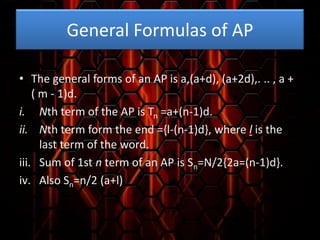
General Formulas of AP
• The general forms of an AP is a,(a+d), (a+2d),. .. , a +
( m - 1)d.
i. Nth term of the AP is Tn =a+(n-1)d.
ii. Nth term form the end ={l-(n-1)d}, where l is the
last term of the word.
iii. Sum of 1st n term of an AP is Sn=N/2{2a=(n-1)d}.
iv. Also Sn=n/2 (a+l)
MADE BY-: ,Anirudh Prasad, Ayush Gupta,
Chhavi Bansal&
Teena Kaushik
X- D
ROLL NO-6,10 , 12 & 33

Arithmetic progression

  • 1.
  • 2.
     Arithmetic Sequenceis a sequence of numbers such that the difference between the consecutive terms is constant.  For instance, the sequence 5, 7, 9, 11, 13, 15 … is an arithmetic progression with common difference of 2.  2,6,18,54(next term to the term is to be obtained by multiplying by 3.
  • 3.
    • A finiteportion of an arithmetic progression is called a finite arithmetic progression and sometimes just called an arithmetic progression. The sum of a finite arithmetic progression is called an Arithmetic series. • The behavior of the arithmetic progression depends on the common difference d. If the common difference is:  Positive, the members (terms) will grow towards positive infinity.  Negative, the members (terms) will grow
  • 4.
  • 6.
    Arithmetic Progression  Ifthe initial term of an arithmetic progression is a1 and the common difference of successive members is d, then the nth term of the sequence (an) is given by:  An= a1+(n-1)d And in general An= a1+ (n-m)d
  • 7.
    The first term= a1 =a +0 d = a + (11)d second term = a = a + d = a + (2-1)d The 2 The third term = a3 = a + 2d = a + (31)d fourth term = a = a + 3d = a + (4-1)d The 4 ------------------------------------------The nth term = an = a + (n------------------------------------------1)d
  • 8.
    Example Let a=2, d=2,n=12,find An An=a+(n-1)d =2+(12-1)2 =2+(11)2 =2+22 Therefore, An=24 Hence solved.
  • 9.
    (i) 2, 6,10, 14…. (i) Here first term a = 2, find differences in the next terms a2-a1 = 6 – 2 = 4 a3-a2 = 10 –6 = 4 a4-a3 = 14 – 10 = 4 Since the differences are common. Hence the given terms are in A.P.
  • 10.
    . Find 10thterm of A.P. 12, 18, 24, 30.. … Solution. Given A.P. is 12, 18, 24, 30.. First term is a = 12 Common difference is d = 18- 12 = 6 nth term is an = a + (n-1)d Put n = 10, a10 = 12 + (10-1)6 = 12 + 9 x 6 = 12 + 54 a10 = 66
  • 11.
    . Let A bethe AM between a and b. A, A, b are in AP (A-a)=(b-A) A=1/2(a+b) AM between a and b A=1/2(a+b) Find the AM between 13 & 19 AM= ½(13+ 19) = 16
  • 12.
    Some convenient methodsto determine the AP • It is always convenient to make a choice of i. 3 numbers in an AP as (a-d), a, (a+d); ii. 4 numbers in an AP as (a-3d), (a-d), a, (a+d),(a+3d); iii. 5 numbers in an AP as (a-2d), (a-d), a, (a+d), (a+2d).
  • 13.
    Practice Q---- The sumof three numbers in an AP is 21 & their product is 231. Find the numbers. Let the required Numbers be (a-d), a, (a+d) Then (a-d)+ a+ (a+d)=21  A=7  And (a-d) a (a+d)=231  A(a2-d2) =231  Substituting the value of ‘a’  7(49-d2)=231  7d2= (343-231)= 112  D2= 16  D= 4
  • 14.
    The sum ofn terms, we find as, Sum = n X [(first term + last term) / 2] Now last term will be = a + (n-1) d Therefore,  Sn = ½ n [ 2a + (n - 1)d ]  It can also be written as  Sn = ½ n [ a + a n ]
  • 15.
    Problem 1. Findthe sum of 30 terms of given A.P. 12 + 20 + 28 + 36……… Solution : Given A.P. is 12 , 20, 28 , 36 Its first term is a = 12 Common difference is d = 20 – 12 = 8 The sum to n terms of an arithmetic progression Sn = ½ n [ 2a + (n - 1)d ] = ½ x 30 [ 2x 12 + (30-1)x 8] = 15 [ 24 + 29 x8] = 15[24 + 232] = 15 x 246 = 3690
  • 16.
    Practice Q1: Find thesum of the following APs: (i) 2, 7, 12, ……, to 10 terms Q3: Given a = 2, d = 8, Sn = 90, find n and an. Question: 2. Find the sums given below: (i) 7+10.5+14+…..+84
  • 17.
    • Solution. 1) Firstterm is an = 500 a = 100 , 9) n - 1 = 80 10) n = 80 + 1 n = 81 2) Common difference is d 11) = 105 -100 = 5  Hence the no. of terms are 3) nth term is an = a + (n-81. 1)d 4) 500 = 100 + (n-1)5 5) 500 - 100 = 5(n – 1) 6) 400 = 5(n – 1) 7) 5(n – 1) = 400 8) n – 1 = 400/5
  • 18.
    Practice Question: 1. Findthe sum of first 22 terms of an AP in which d = 7 and 22nd term is 149. Question: 2. Find the sum of first 51 terms of an AP whose second and third terms are 14 and 18 respectively.
  • 19.
    General Formulas ofAP • The general forms of an AP is a,(a+d), (a+2d),. .. , a + ( m - 1)d. i. Nth term of the AP is Tn =a+(n-1)d. ii. Nth term form the end ={l-(n-1)d}, where l is the last term of the word. iii. Sum of 1st n term of an AP is Sn=N/2{2a=(n-1)d}. iv. Also Sn=n/2 (a+l)
  • 20.
    MADE BY-: ,AnirudhPrasad, Ayush Gupta, Chhavi Bansal& Teena Kaushik X- D ROLL NO-6,10 , 12 & 33