Review of Trigonometry for Calculus 1
Review of Trigonometry for Calculus
“Trigon” =triangle +“metry”=measurement
=Trigonometry
so Trigonometry got its name as the science of measuring triangles.
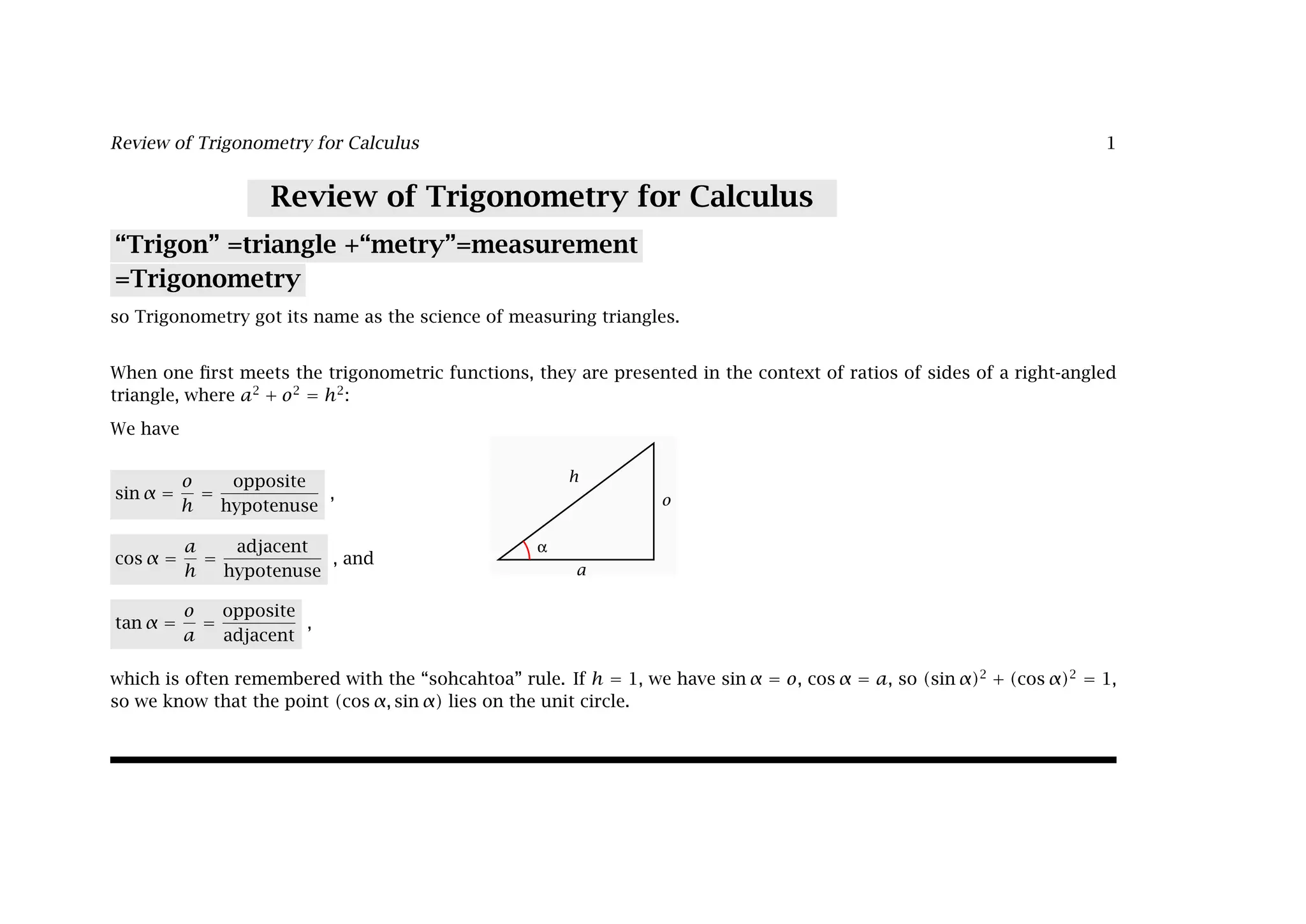
When one first meets the trigonometric functions, they are presented in the context of ratios of sides of a right-angled
triangle, where a2
+ o2
= h2
:
a
o
h
α
We have
sin α =
o
h
=
opposite
hypotenuse
,
cos α =
a
h
=
adjacent
hypotenuse
, and
tan α =
o
a
=
opposite
adjacent
,
which is often remembered with the “sohcahtoa” rule. If h = 1, we have sin α = o, cos α = a, so (sin α)2
+ (cos α)2
= 1,
so we know that the point (cos α, sin α) lies on the unit circle.
2 Review of Trigonometry for Calculus
The Unit Circle:
In Calculus, most references to the trigonometric functions are based on the unit circle, x2
+ y2
= 1. Points on this circle
determine angles measured from the point (0, 1) on the x-axis, where the counter- clockwise direction is considered to
be positive.
Units of Angular Measurement
The most natural unit of measurement for angles in Geometry is the right angle . The revolution is used in the
study of rotary motion, and is what the “r” stands for in “rpm”s. The degree , 1/90 of a right angle, was probably first
adopted for navigational purposes. The mil , 1/1600 of a right angle, is used by the military. However, the basic unit
of measurement for angles in Calculus is the radian .
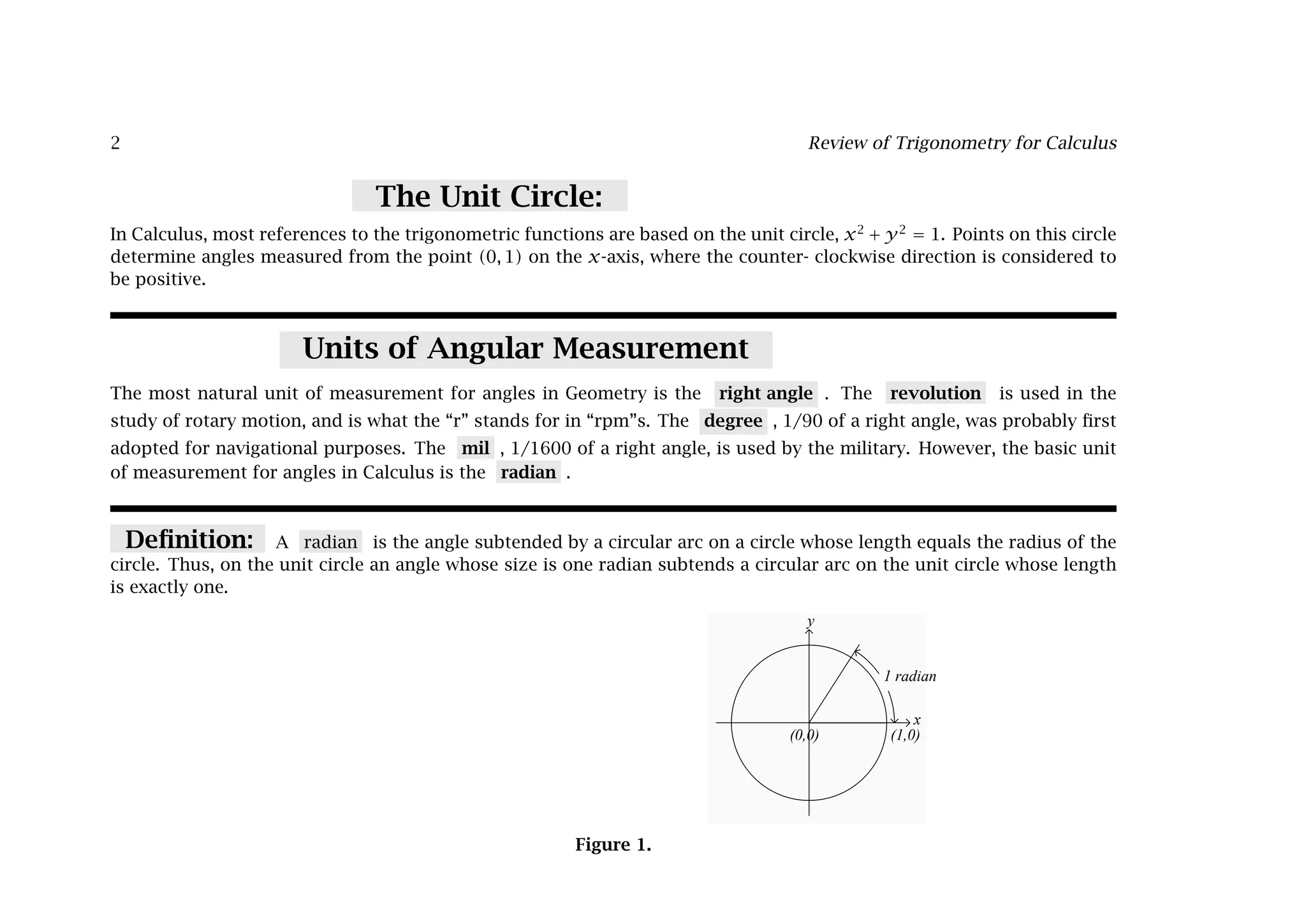
Definition: A radian is the angle subtended by a circular arc on a circle whose length equals the radius of the
circle. Thus, on the unit circle an angle whose size is one radian subtends a circular arc on the unit circle whose length
is exactly one.
1 radian
x
y
(0,0) (1,0)
Figure 1.
Review of Trigonometry for Calculus 3
Radian measure and degrees
Since the circumference of a circle is 2π times its radius, we have
2π radians = 360◦
= 4 right angles,
so
1 radian =
360
2π
◦
=
180
π
◦
=
4 right angles
2π
=
2
π
right angles
or
1◦
=
2π
360
radians =
π
180
radians =
1
90
right angles
In high school trigonometry, the trigonometric functions are used to solve problems concerning triangles and related
geometric figures. In the Calculus, the trigonometric functions are used in the analysis of rotating bodies. It turns out
that the degree, the unit of measurement of angles adopted by the Babylonians over 4,000 years ago, is not particularly
well adapted to the analysis of jet engines, radar systems and CAT scanners.
The radian is, because The sine and cosine functions live on the unit circle!
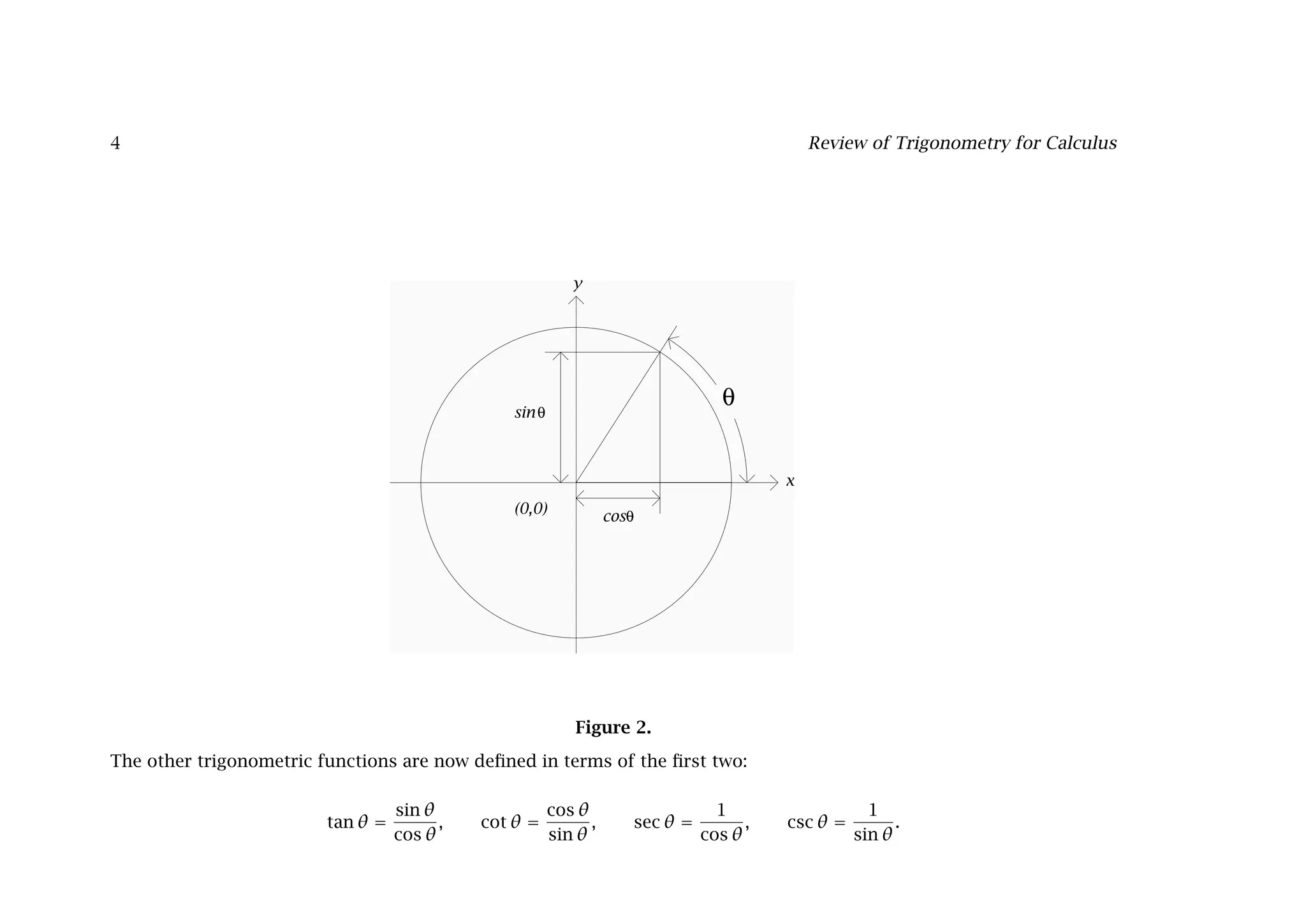
If θ is a number, then cos θ and sin θ are defined to be the x- and y- coordinate, respectively, of the point on the unit
circle obtained by measuring off the angle θ (in radians!) from the point (0, 1). If θ is positive, the angle is measured
off in the counter-clockwise direction, and if θ is negative it is measured off in the clockwise direction. For an animated
interactive look at these two functions, take a look at the applet Sine and Cosine Functions
4 Review of Trigonometry for Calculus
x
y
(0,0)
cos
sin
θ
θ
θ
Figure 2.
The other trigonometric functions are now defined in terms of the first two:
tan θ =
sin θ
cos θ
, cot θ =
cos θ
sin θ
, sec θ =
1
cos θ
, csc θ =
1
sin θ
.
Review of Trigonometry for Calculus 5
Fundamental Angles of the First Quadrant:
There are three acute angles for which the trigonometric function values are known and must be memorized by the
student of Calculus. They are
(in radians)
π
6
,
π
4
, and
π
3
,
(in degrees) 30◦
, 45◦
, and 60◦
,
(in right angles) 1/3, 1/2, and 2/3.
In addition, the values of the trig functions for the angles 0 and
π
2
must be known. The following tables show how they
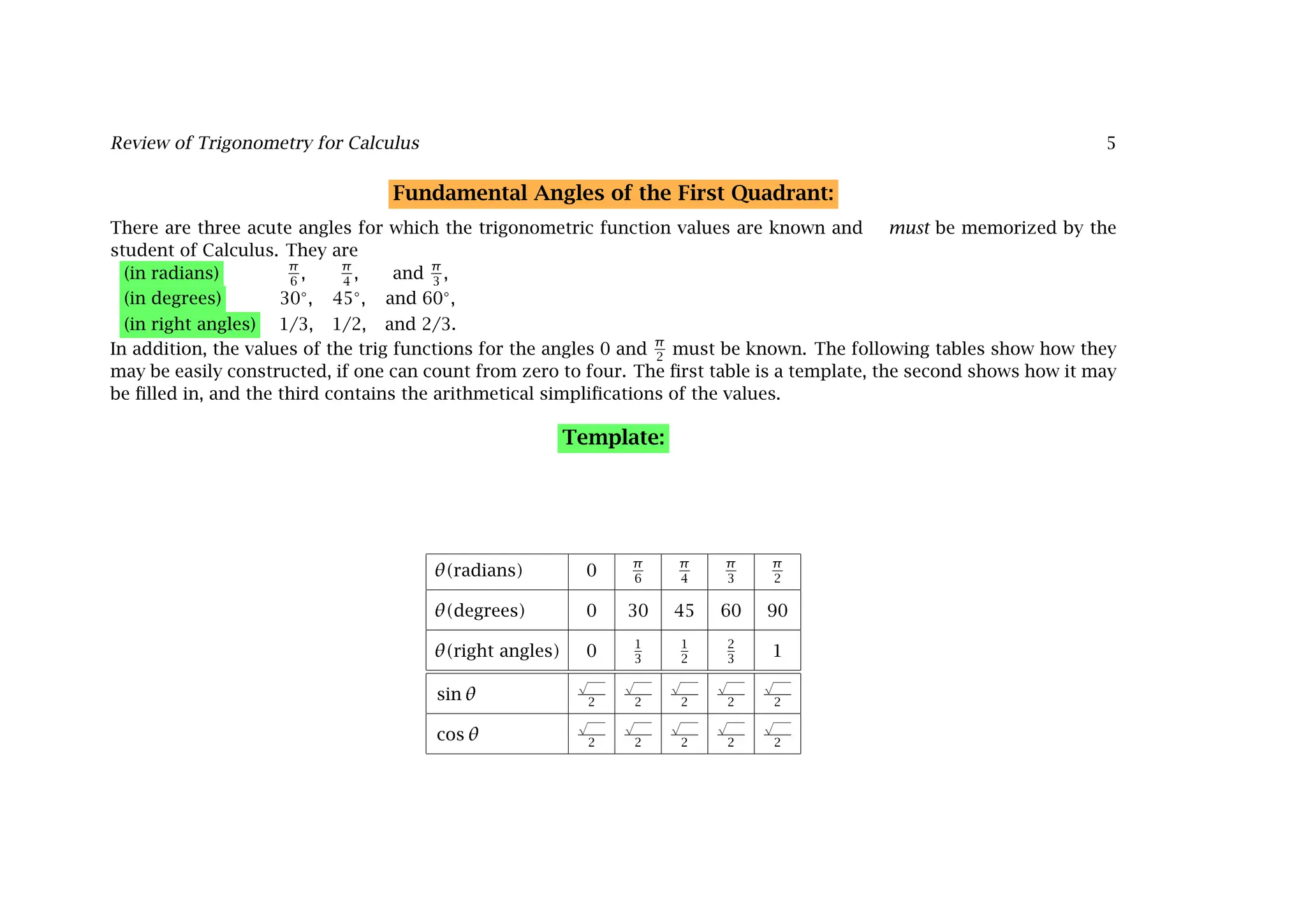
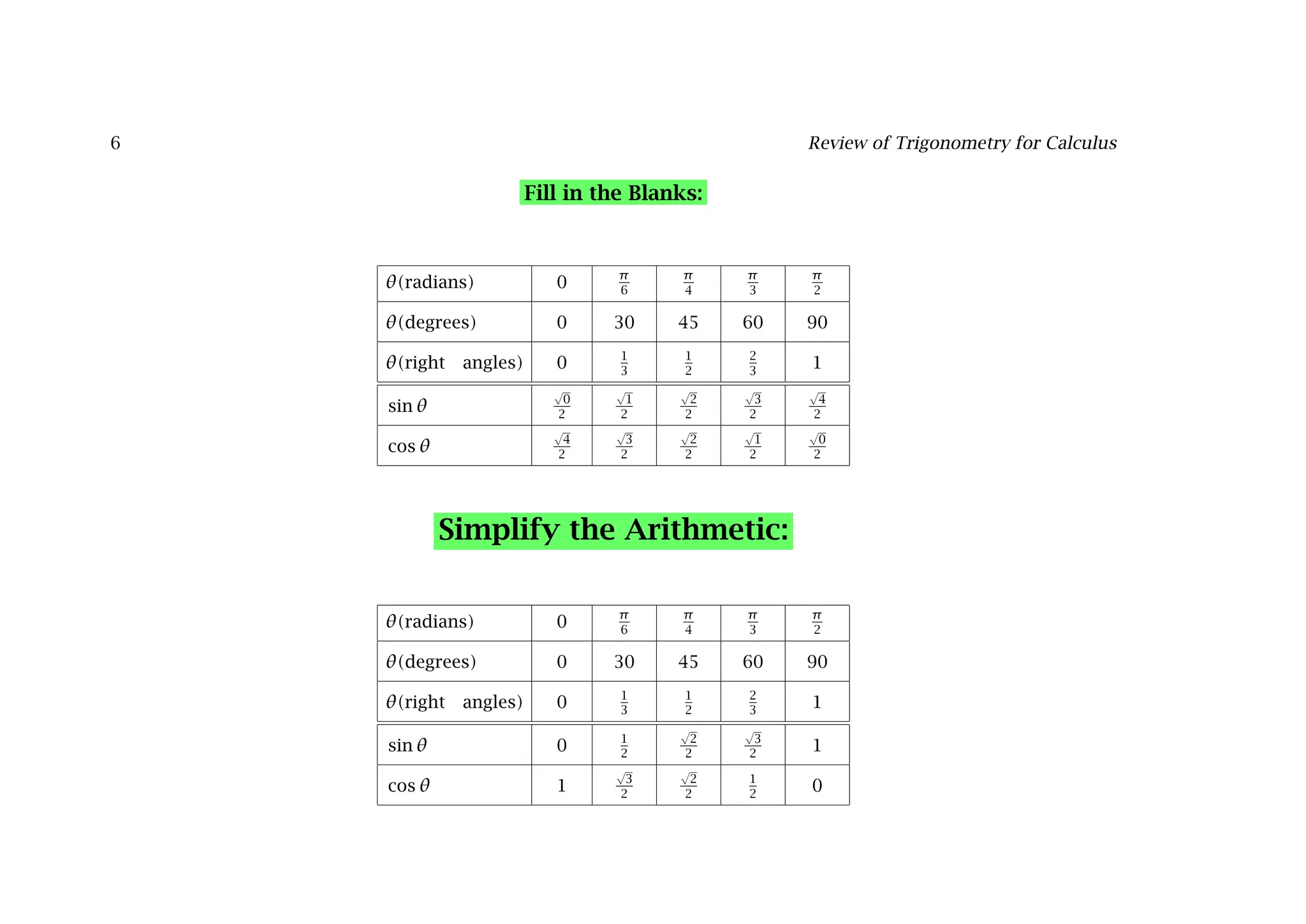
may be easily constructed, if one can count from zero to four. The first table is a template, the second shows how it may
be filled in, and the third contains the arithmetical simplifications of the values.
Template:
θ(radians) 0 π
6
π
4
π
3
π
2
θ(degrees) 0 30 45 60 90
θ(right angles) 0 1
3
1
2
2
3
1
sin θ
√
2
√
2
√
2
√
2
√
2
cos θ
√
2
√
2
√
2
√
2
√
2
6 Review of Trigonometry for Calculus
Fill in the Blanks:
θ(radians) 0
π
6
π
4
π
3
π
2
θ(degrees) 0 30 45 60 90
θ(right angles) 0
1
3
1
2
2
3
1
sin θ
√
0
2
√
1
2
√
2
2
√
3
2
√
4
2
cos θ
√
4
2
√
3
2
√
2
2
√
1
2
√
0
2
Simplify the Arithmetic:
θ(radians) 0 π
6
π
4
π
3
π
2
θ(degrees) 0 30 45 60 90
θ(right angles) 0
1
3
1
2
2
3
1
sin θ 0
1
2
√
2
2
√
3
2
1
cos θ 1
√
3
2
√
2
2
1
2
0
Review of Trigonometry for Calculus 7
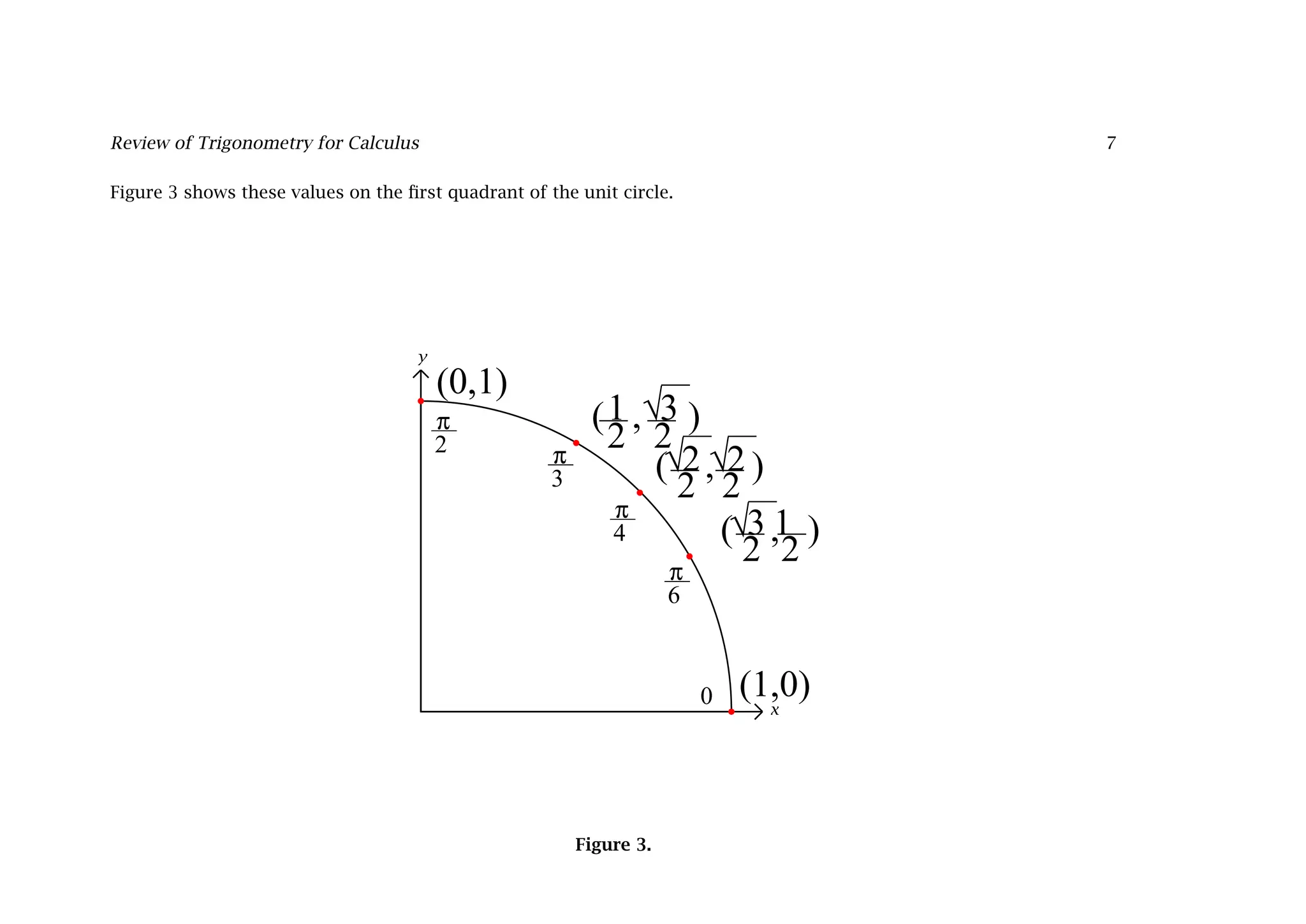
Figure 3 shows these values on the first quadrant of the unit circle.
x
y
(0,1)
( , )
( , )
( , )
(1,0)
— —
— —
— —
—
— —
—
2 2
2 2
2 2
1 3
2 2
3 1
π
π
π
π
√
√ √
√
—
—
—
—
2
3
4
6
0
Figure 3.
8 Review of Trigonometry for Calculus
Moving Beyond the First Quadrant
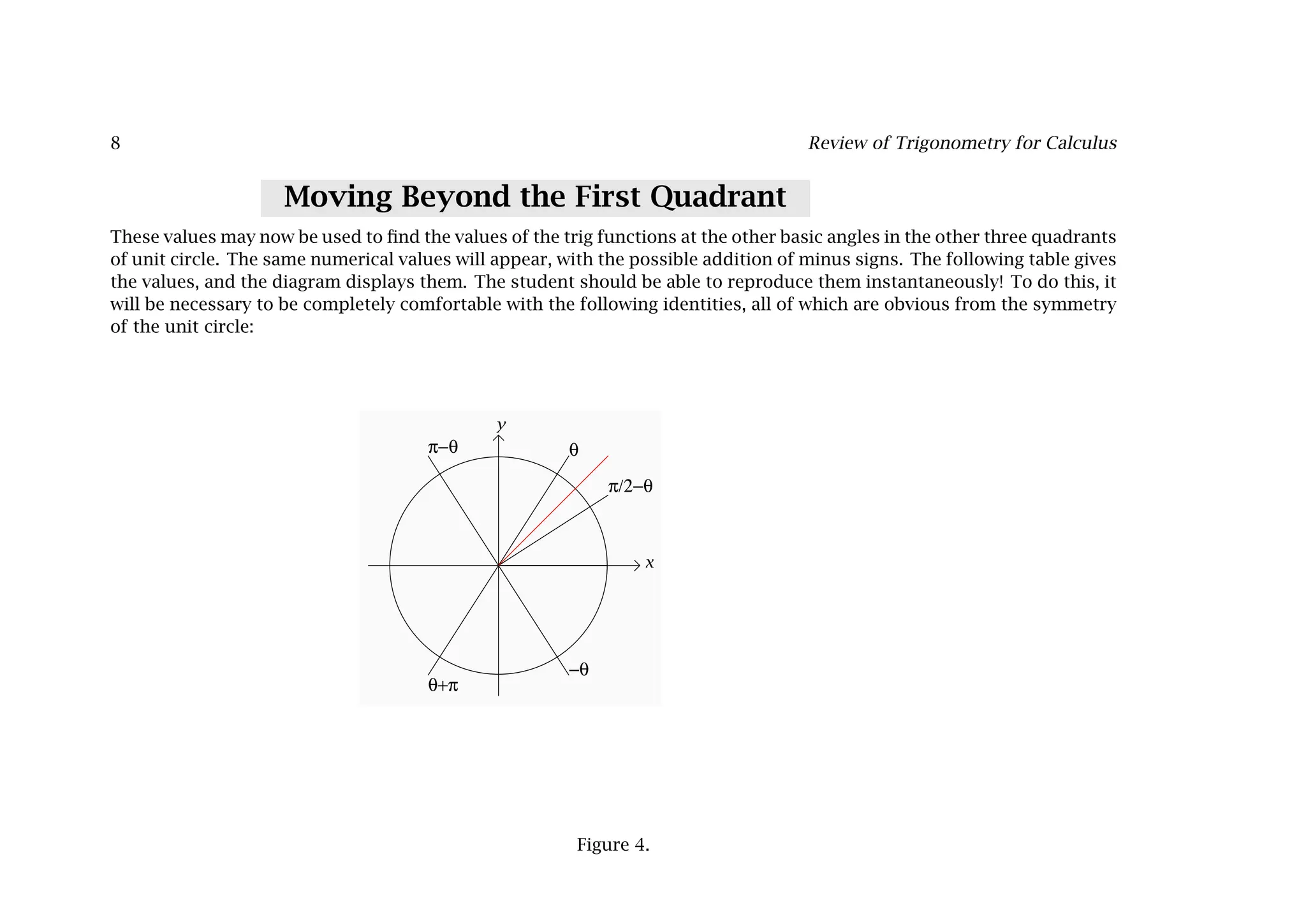
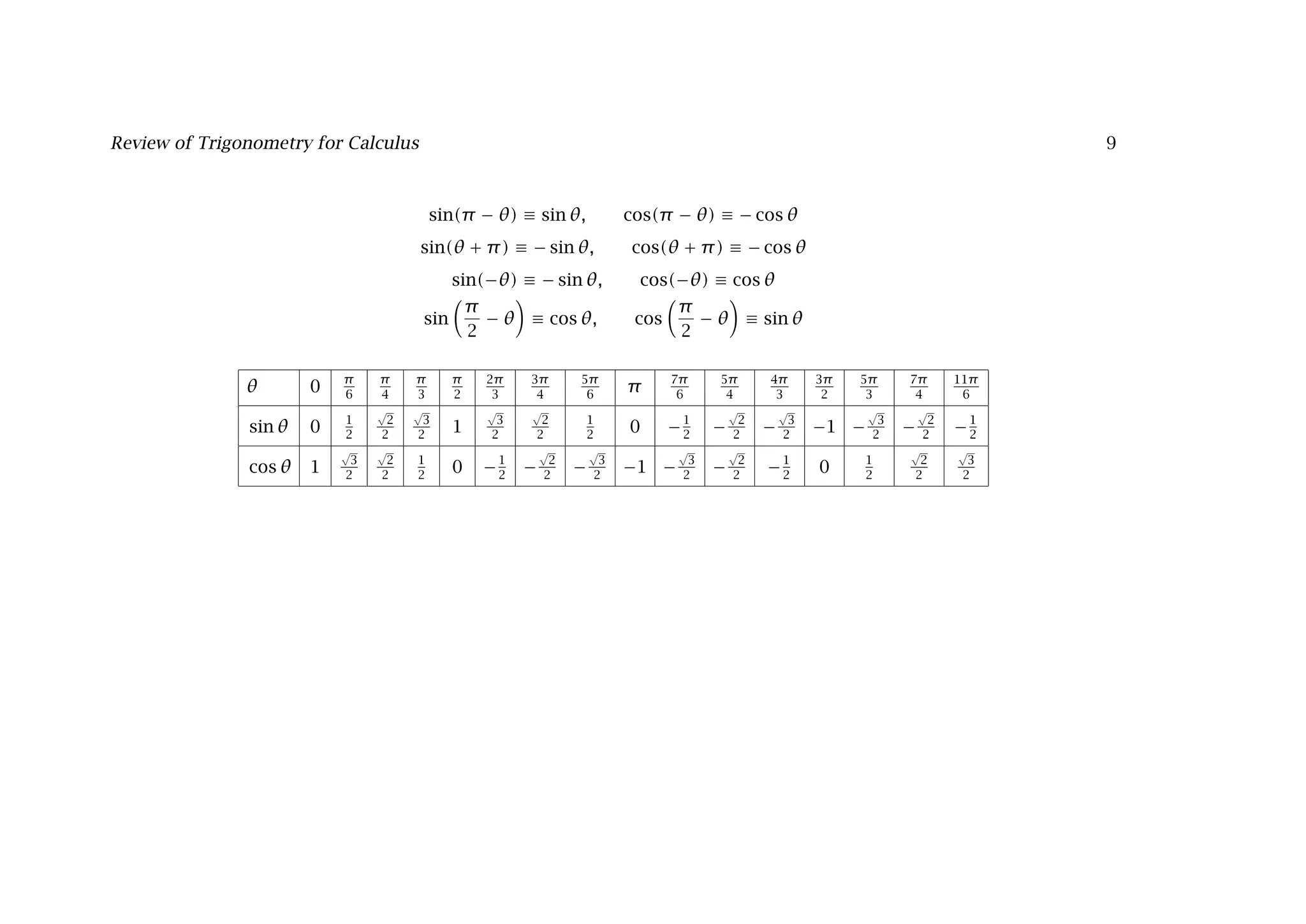
These values may now be used to find the values of the trig functions at the other basic angles in the other three quadrants
of unit circle. The same numerical values will appear, with the possible addition of minus signs. The following table gives
the values, and the diagram displays them. The student should be able to reproduce them instantaneously! To do this, it
will be necessary to be completely comfortable with the following identities, all of which are obvious from the symmetry
of the unit circle:
x
y
θ
−θ
θ+π
π−θ
π/2−θ
Figure 4.
Review of Trigonometry for Calculus 9
sin(π − θ) ≡ sin θ, cos(π − θ) ≡ − cos θ
sin(θ + π) ≡ − sin θ, cos(θ + π) ≡ − cos θ
sin(−θ) ≡ − sin θ, cos(−θ) ≡ cos θ
sin

π
2
− θ

≡ cos θ, cos

π
2
− θ

≡ sin θ
θ 0 π
6
π
4
π
3
π
2
2π
3
3π
4
5π
6
π
7π
6
5π
4
4π
3
3π
2
5π
3
7π
4
11π
6
sin θ 0
1
2
√
2
2
√
3
2
1
√
3
2
√
2
2
1
2
0 −
1
2
−
√
2
2
−
√
3
2
−1 −
√
3
2
−
√
2
2
−
1
2
cos θ 1
√
3
2
√
2
2
1
2
0 −
1
2
−
√
2
2
−
√
3
2
−1 −
√
3
2
−
√
2
2
−1
2
0 1
2
√
2
2
√
3
2
10 Review of Trigonometry for Calculus
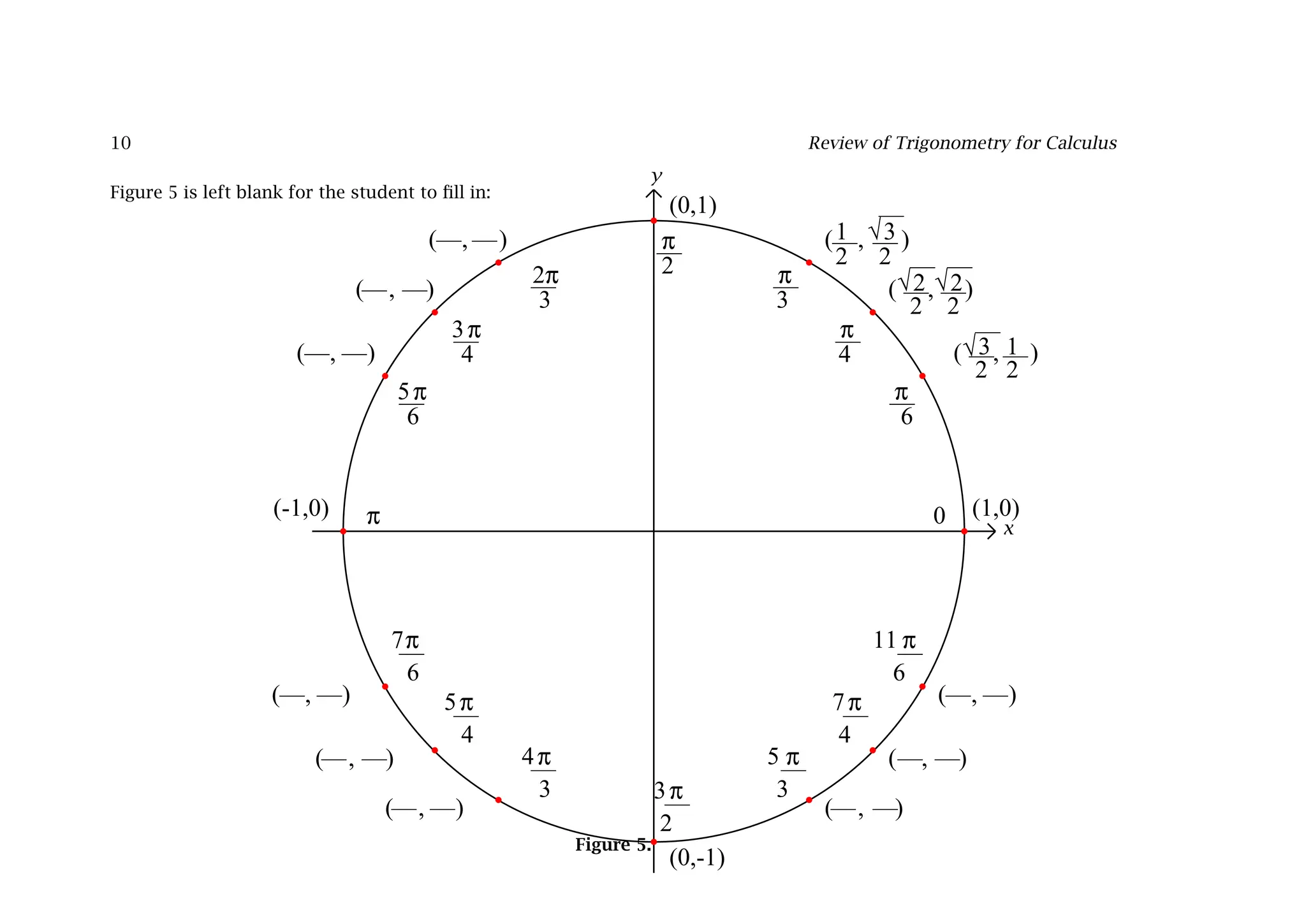
Figure 5 is left blank for the student to fill in:
x
y
(1,0)
( , )
( , )
( , )
(0,1)
( , )
( , )
( , )
(-1,0)
( , )
( , )
( , )
(0,-1)
( , )
( , )
( , )
—
—
—
—
—
—
—
—
—
—
—
—
— —
— —
— — — —
— —
— —
—
— —
—
2 2
2 2
2 2
1 3
2 2
3 1
π
π
π
π
π
π
π
π
π
π
π
π
π
π
π
√
√ √
√
—
—
—
—
—
—
—
—
—
—
—
—
—
—
2
3
4
6
3
4
6
2
3
4
6
3
4
6
2
3
5
4
5
7
3
5
7
11
0
Figure 5.
Review of Trigonometry for Calculus 11
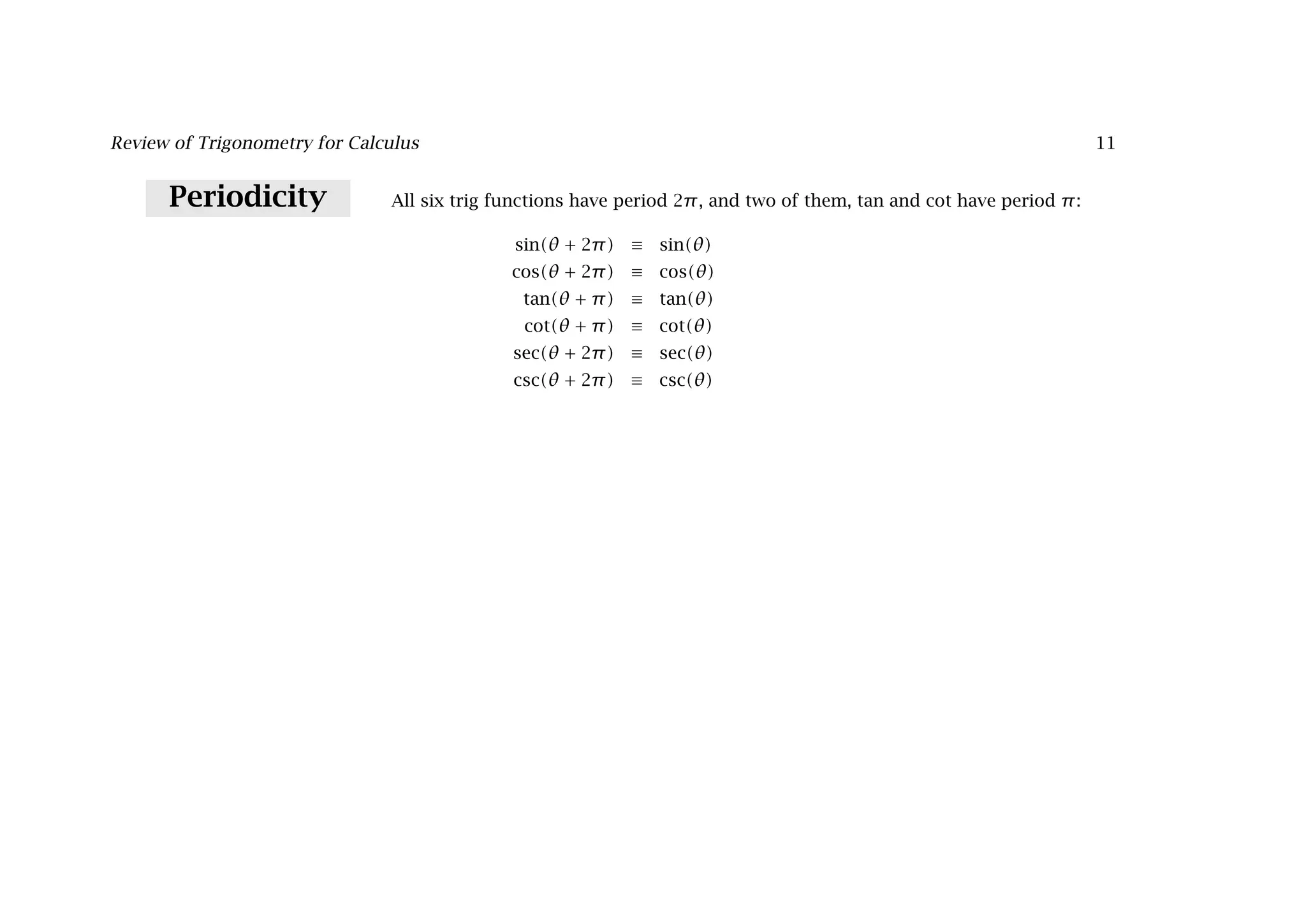
Periodicity All six trig functions have period 2π, and two of them, tan and cot have period π:
sin(θ + 2π) ≡ sin(θ)
cos(θ + 2π) ≡ cos(θ)
tan(θ + π) ≡ tan(θ)
cot(θ + π) ≡ cot(θ)
sec(θ + 2π) ≡ sec(θ)
csc(θ + 2π) ≡ csc(θ)
12 Review of Trigonometry for Calculus
Identities of the sine and cosine functions
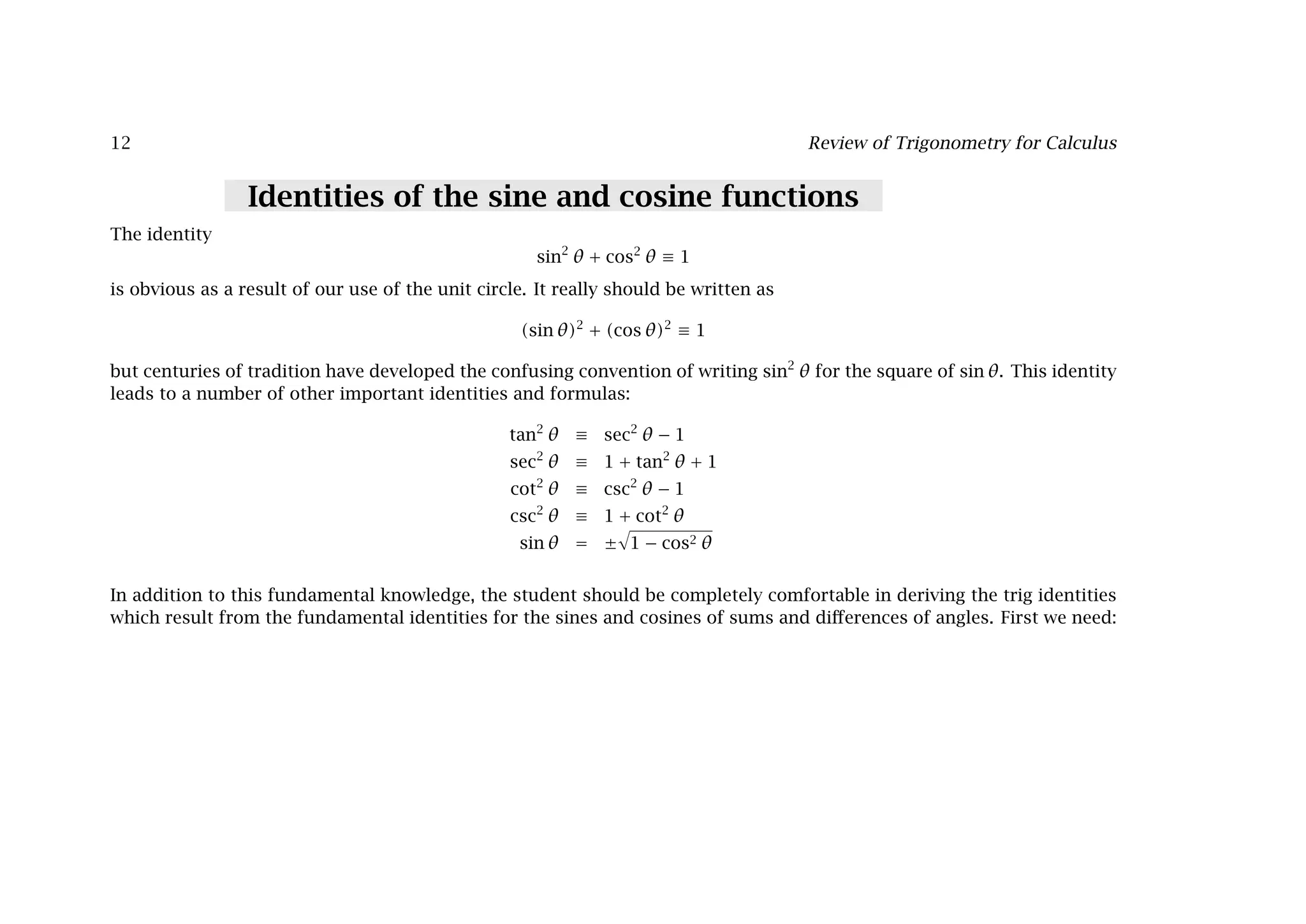
The identity
sin2
θ + cos2
θ ≡ 1
is obvious as a result of our use of the unit circle. It really should be written as
(sin θ)2
+ (cos θ)2
≡ 1
but centuries of tradition have developed the confusing convention of writing sin2
θ for the square of sin θ. This identity
leads to a number of other important identities and formulas:
tan2
θ ≡ sec2
θ − 1
sec2
θ ≡ 1 + tan2
θ + 1
cot2
θ ≡ csc2
θ − 1
csc2
θ ≡ 1 + cot2
θ
sin θ = ±

1 − cos2 θ
In addition to this fundamental knowledge, the student should be completely comfortable in deriving the trig identities
which result from the fundamental identities for the sines and cosines of sums and differences of angles. First we need:
Review of Trigonometry for Calculus 13
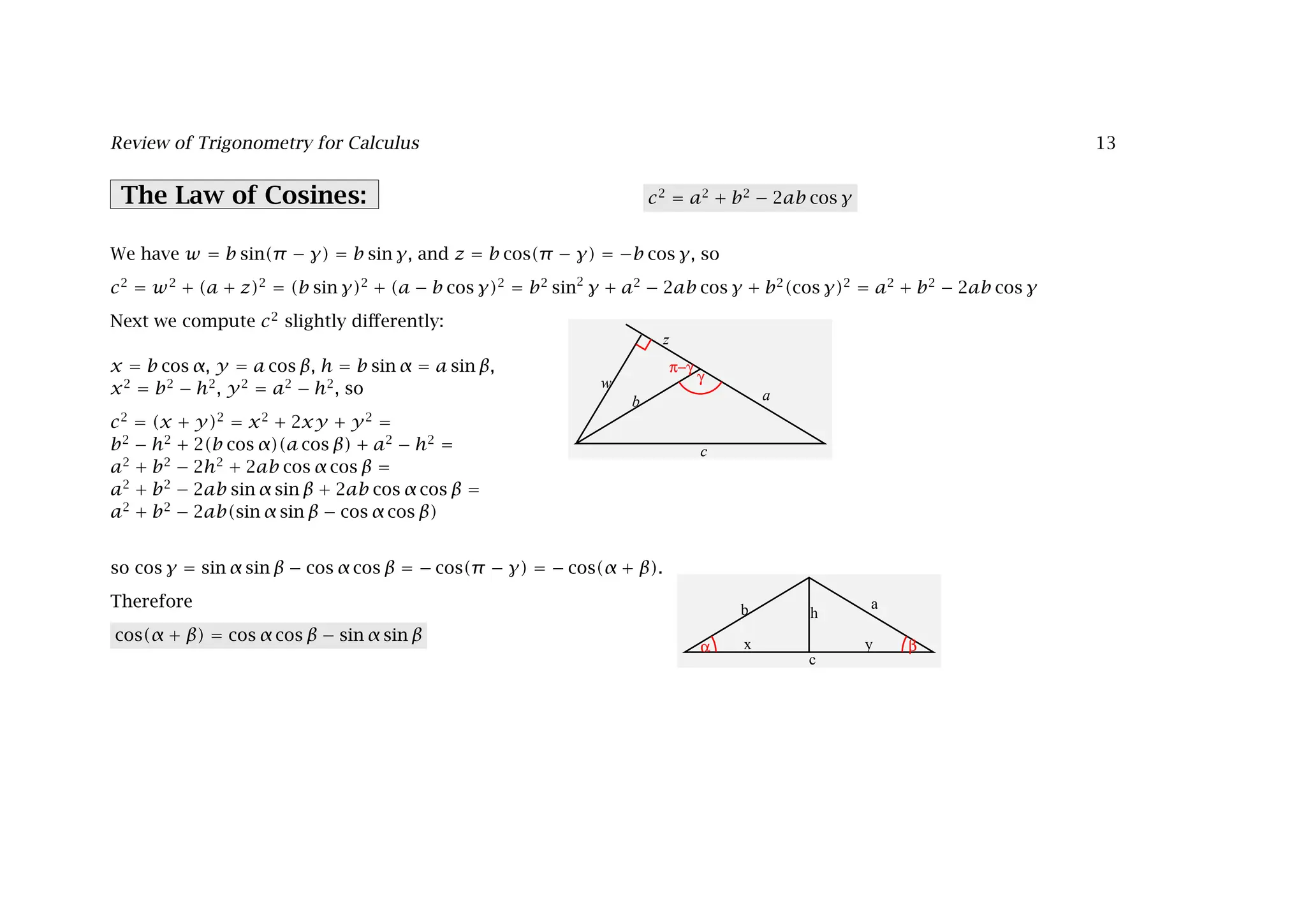
The Law of Cosines: c2
= a2
+ b2
− 2ab cos γ
a
c
b
w
z
γ
π−γ
We have w = b sin(π − γ) = b sin γ, and z = b cos(π − γ) = −b cos γ, so
c2
= w2
+ (a + z)2
= (b sin γ)2
+ (a − b cos γ)2
= b2
sin2
γ + a2
− 2ab cos γ + b2
(cos γ)2
= a2
+ b2
− 2ab cos γ
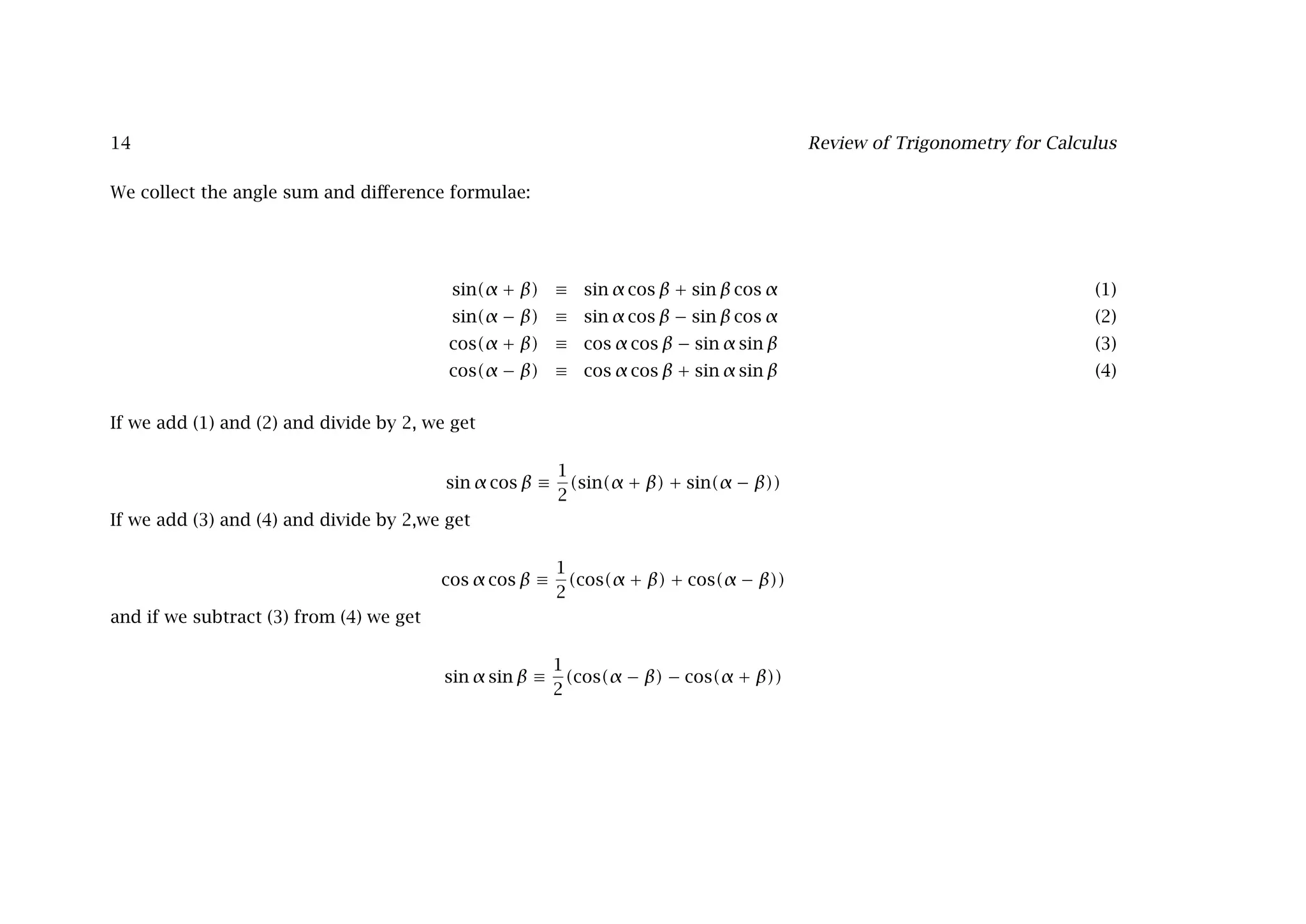
Next we compute c2
slightly differently:
a
c
b h
x y
α β
x = b cos α, y = a cos β, h = b sin α = a sin β,
x2
= b2
− h2
, y2
= a2
− h2
, so
c2
= (x + y)2
= x2
+ 2xy + y2
=
b2
− h2
+ 2(b cos α)(a cos β) + a2
− h2
=
a2
+ b2
− 2h2
+ 2ab cos α cos β =
a2
+ b2
− 2ab sin α sin β + 2ab cos α cos β =
a2
+ b2
− 2ab(sin α sin β − cos α cos β)
so cos γ = sin α sin β − cos α cos β = − cos(π − γ) = − cos(α + β).
Therefore
cos(α + β) = cos α cos β − sin α sin β
14 Review of Trigonometry for Calculus
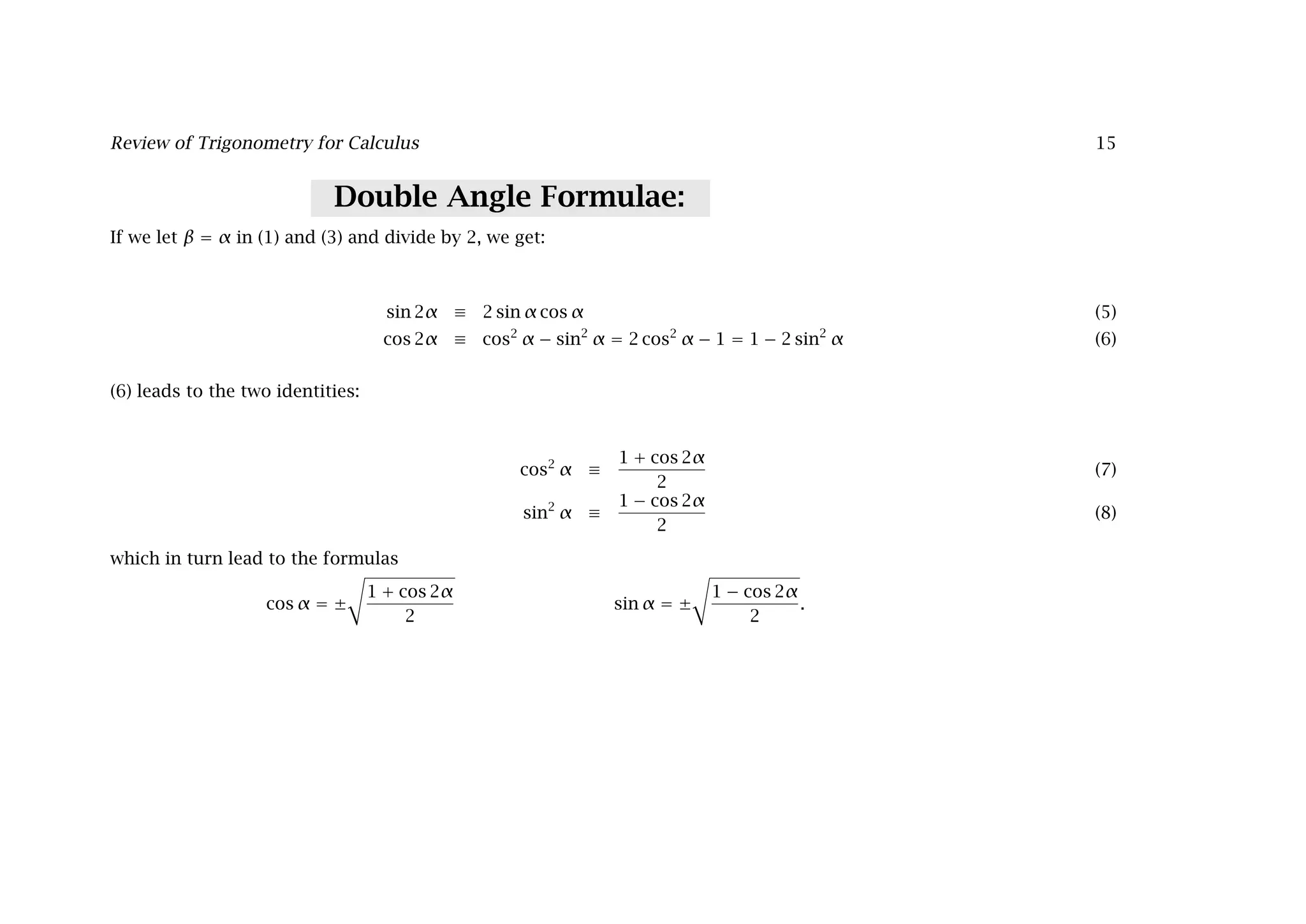
We collect the angle sum and difference formulae:
sin(α + β) ≡ sin α cos β + sin β cos α (1)
sin(α − β) ≡ sin α cos β − sin β cos α (2)
cos(α + β) ≡ cos α cos β − sin α sin β (3)
cos(α − β) ≡ cos α cos β + sin α sin β (4)
If we add (1) and (2) and divide by 2, we get
sin α cos β ≡
1
2
(sin(α + β) + sin(α − β))
If we add (3) and (4) and divide by 2,we get
cos α cos β ≡
1
2
(cos(α + β) + cos(α − β))
and if we subtract (3) from (4) we get
sin α sin β ≡
1
2
(cos(α − β) − cos(α + β))
Review of Trigonometry for Calculus 15
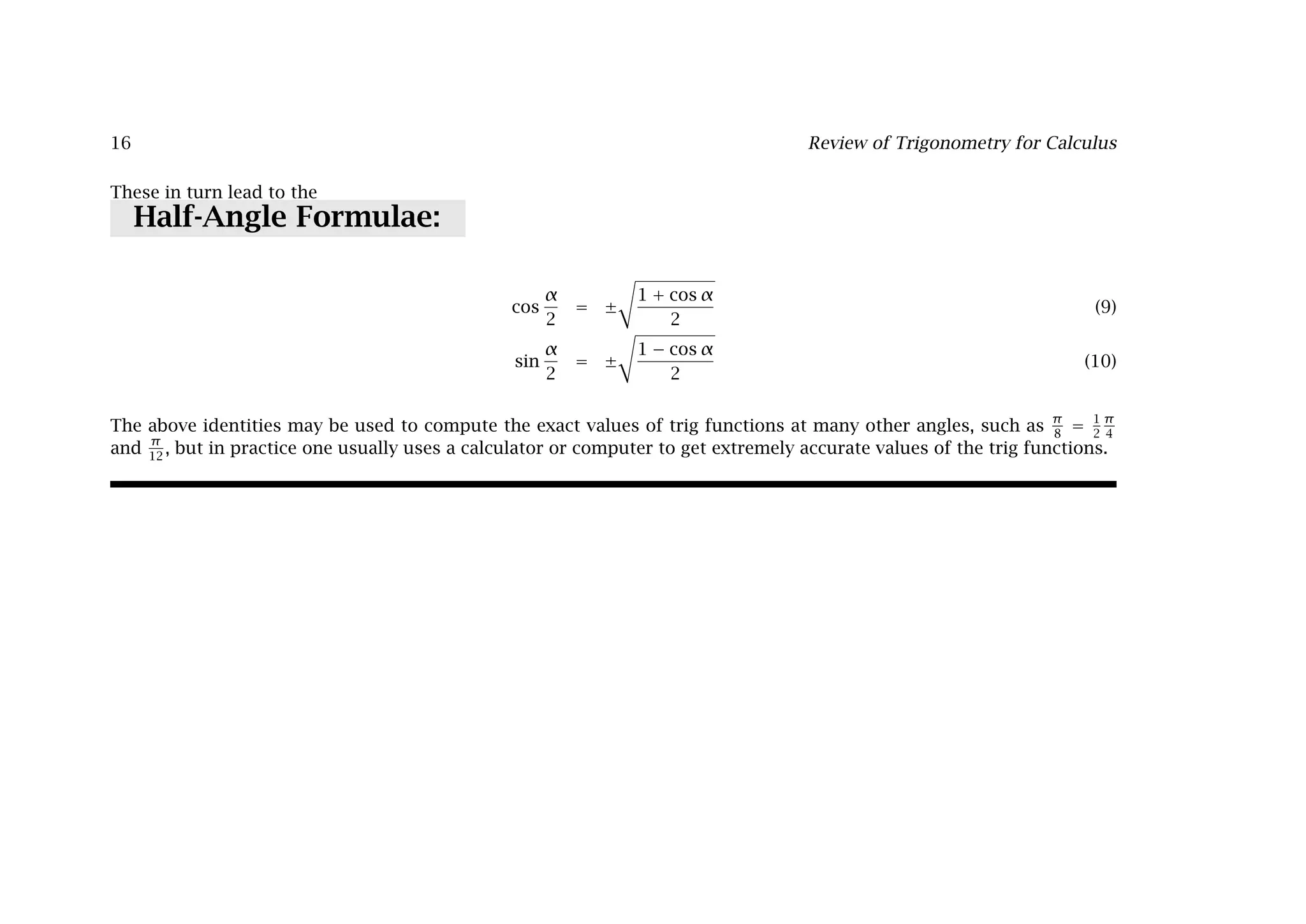
Double Angle Formulae:
If we let β = α in (1) and (3) and divide by 2, we get:
sin 2α ≡ 2 sin α cos α (5)
cos 2α ≡ cos2
α − sin2
α = 2 cos2
α − 1 = 1 − 2 sin2
α (6)
(6) leads to the two identities:
cos2
α ≡
1 + cos 2α
2
(7)
sin2
α ≡
1 − cos 2α
2
(8)
which in turn lead to the formulas
cos α = ±

1 + cos 2α
2
sin α = ±

1 − cos 2α
2
.
16 Review of Trigonometry for Calculus
These in turn lead to the
Half-Angle Formulae:
cos
α
2
= ±

1 + cos α
2
(9)
sin
α
2
= ±

1 − cos α
2
(10)
The above identities may be used to compute the exact values of trig functions at many other angles, such as
π
8
=
1
2
π
4
and
π
12
, but in practice one usually uses a calculator or computer to get extremely accurate values of the trig functions.
Review of Trigonometry for Calculus 17
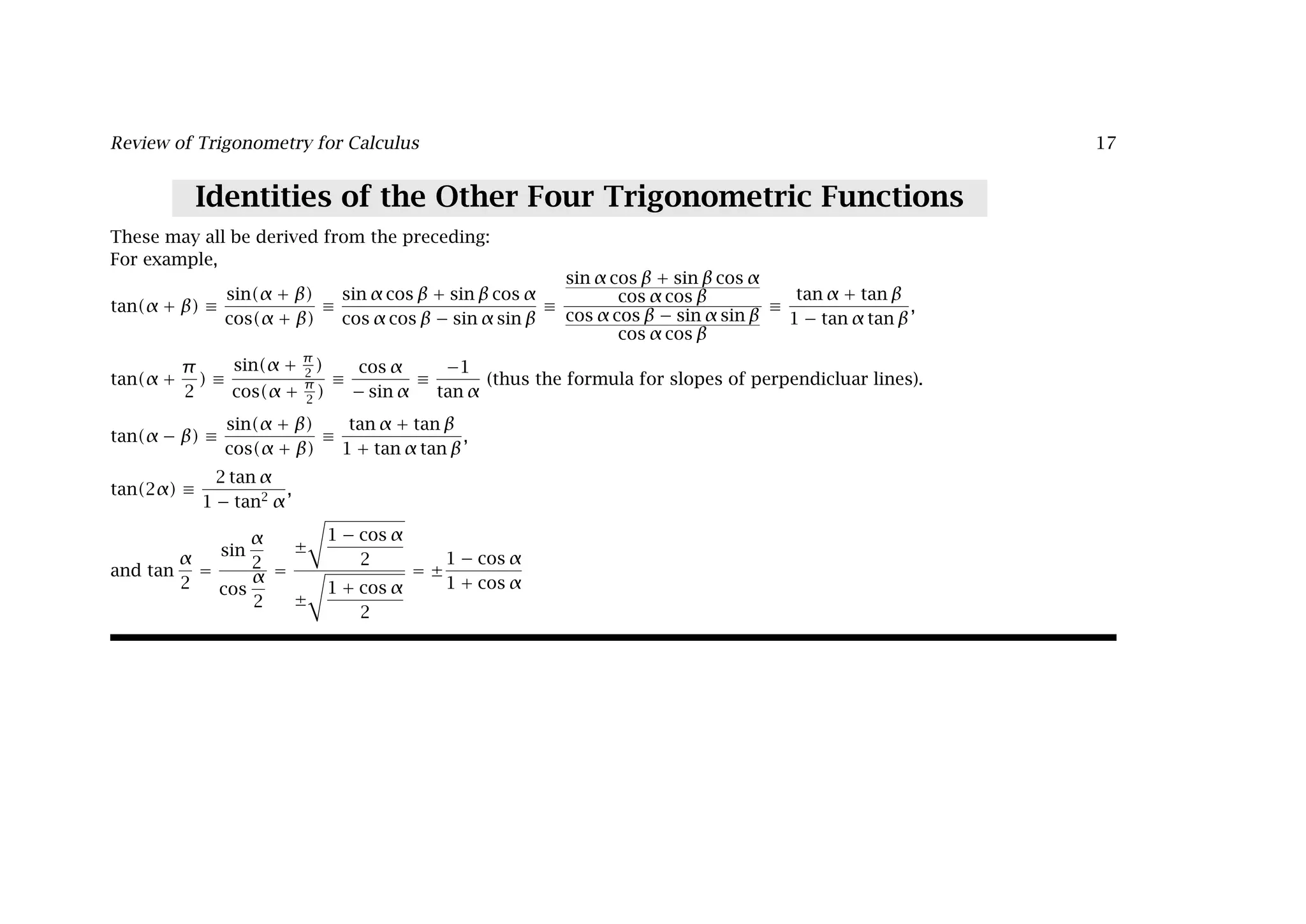
Identities of the Other Four Trigonometric Functions
These may all be derived from the preceding:
For example,
tan(α + β) ≡
sin(α + β)
cos(α + β)
≡
sin α cos β + sin β cos α
cos α cos β − sin α sin β
≡
sin α cos β + sin β cos α
cos α cos β
cos α cos β − sin α sin β
cos α cos β
≡
tan α + tan β
1 − tan α tan β
,
tan(α +
π
2
) ≡
sin(α + π
2
)
cos(α +
π
2
)
≡
cos α
− sin α
≡
−1
tan α
(thus the formula for slopes of perpendicluar lines).
tan(α − β) ≡
sin(α + β)
cos(α + β)
≡
tan α + tan β
1 + tan α tan β
,
tan(2α) ≡
2 tan α
1 − tan2
α
,
and tan
α
2
=
sin
α
2
cos
α
2
=
±

1 − cos α
2
±

1 + cos α
2
= ±
1 − cos α
1 + cos α
18 Review of Trigonometry for Calculus
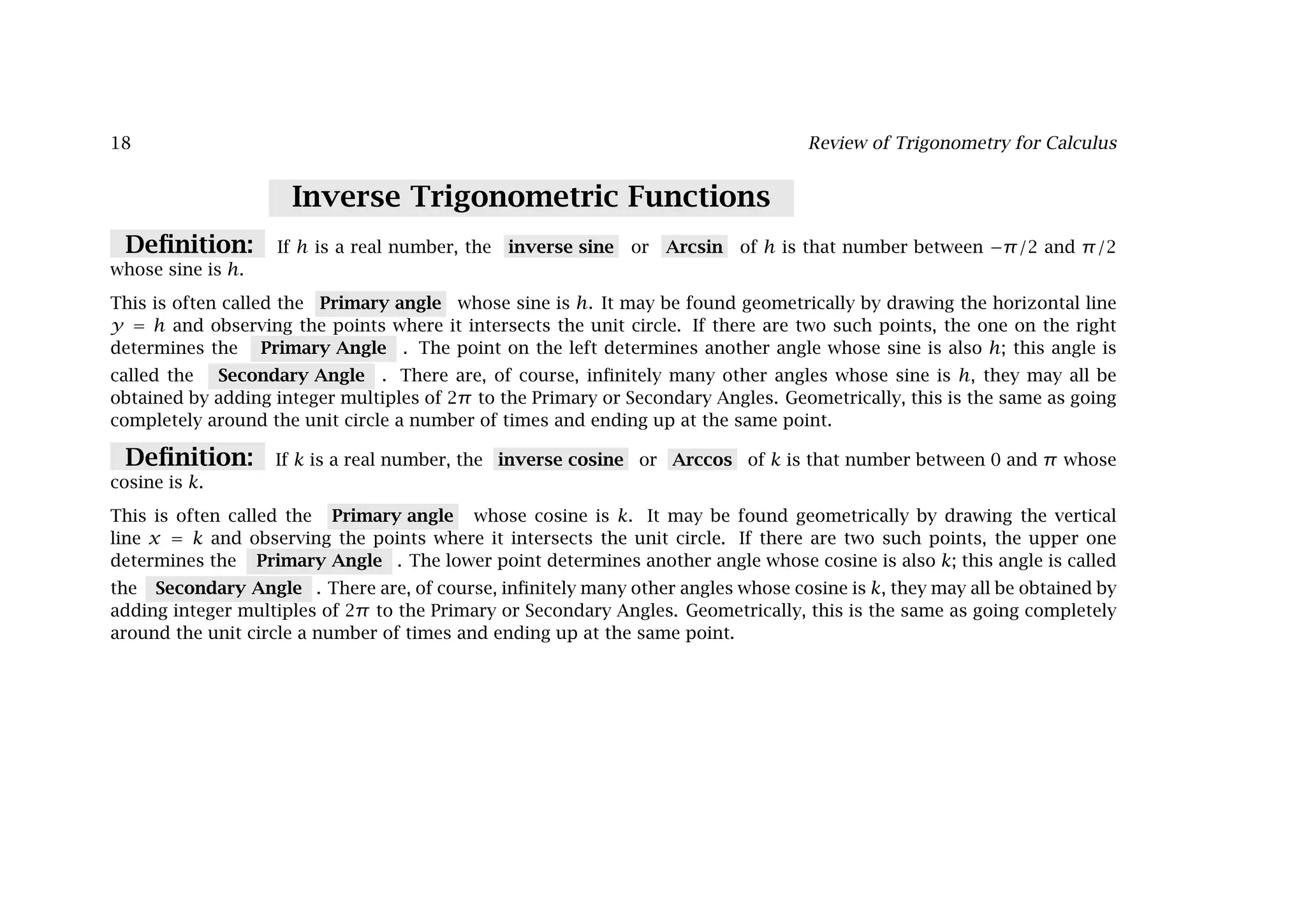
Inverse Trigonometric Functions
Definition: If h is a real number, the inverse sine or Arcsin of h is that number between −π/2 and π/2
whose sine is h.
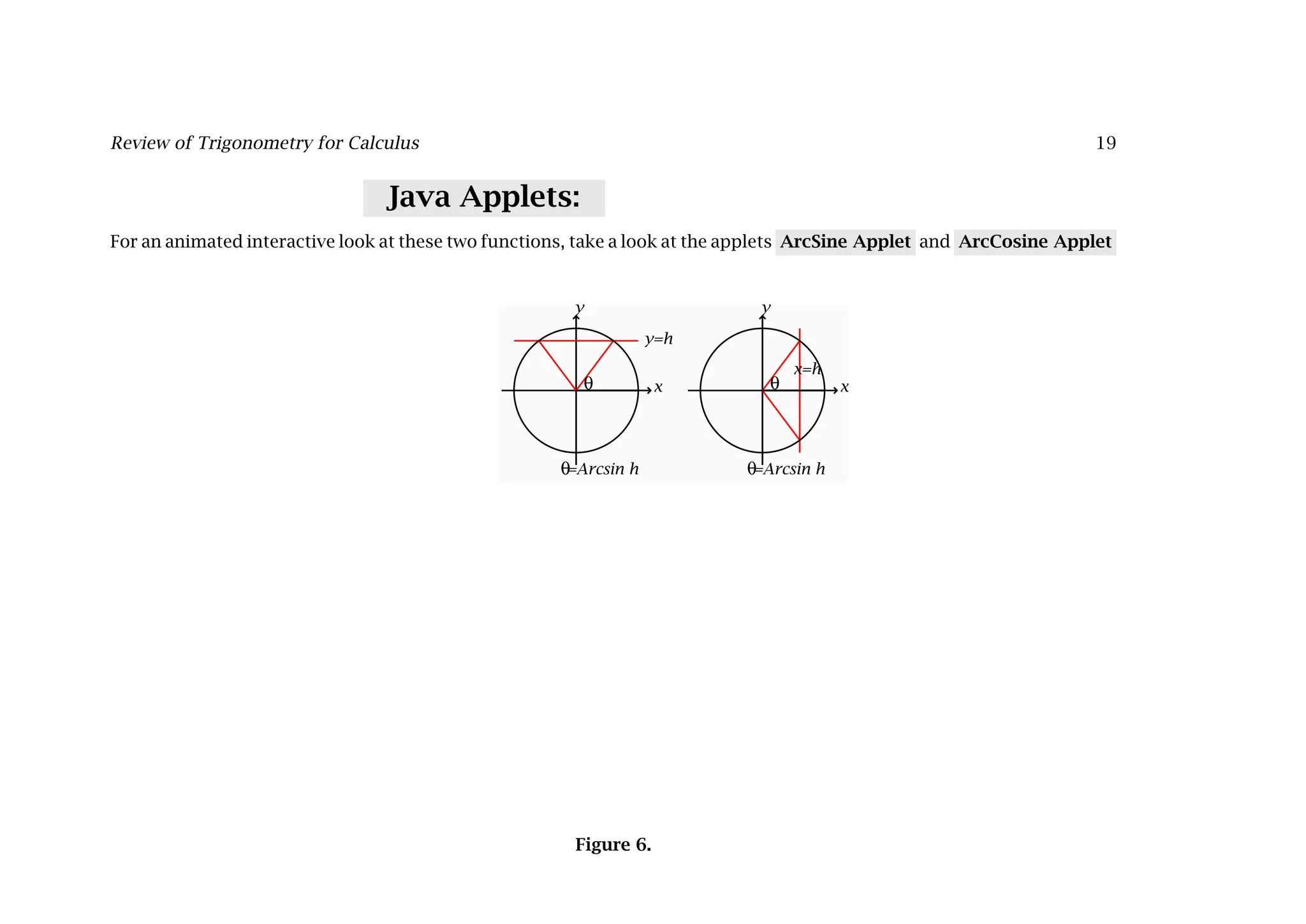
This is often called the Primary angle whose sine is h. It may be found geometrically by drawing the horizontal line
y = h and observing the points where it intersects the unit circle. If there are two such points, the one on the right
determines the Primary Angle . The point on the left determines another angle whose sine is also h; this angle is
called the Secondary Angle . There are, of course, infinitely many other angles whose sine is h, they may all be
obtained by adding integer multiples of 2π to the Primary or Secondary Angles. Geometrically, this is the same as going
completely around the unit circle a number of times and ending up at the same point.
Definition: If k is a real number, the inverse cosine or Arccos of k is that number between 0 and π whose
cosine is k.
This is often called the Primary angle whose cosine is k. It may be found geometrically by drawing the vertical
line x = k and observing the points where it intersects the unit circle. If there are two such points, the upper one
determines the Primary Angle . The lower point determines another angle whose cosine is also k; this angle is called
the Secondary Angle . There are, of course, infinitely many other angles whose cosine is k, they may all be obtained by
adding integer multiples of 2π to the Primary or Secondary Angles. Geometrically, this is the same as going completely
around the unit circle a number of times and ending up at the same point.
Review of Trigonometry for Calculus 19
Java Applets:
For an animated interactive look at these two functions, take a look at the applets ArcSine Applet and ArcCosine Applet
x
y
=Arcsin h
y=h
θ
θ
x
y
=Arcsin h
x=h
θ
θ
Figure 6.
20 Review of Trigonometry for Calculus
Appendix
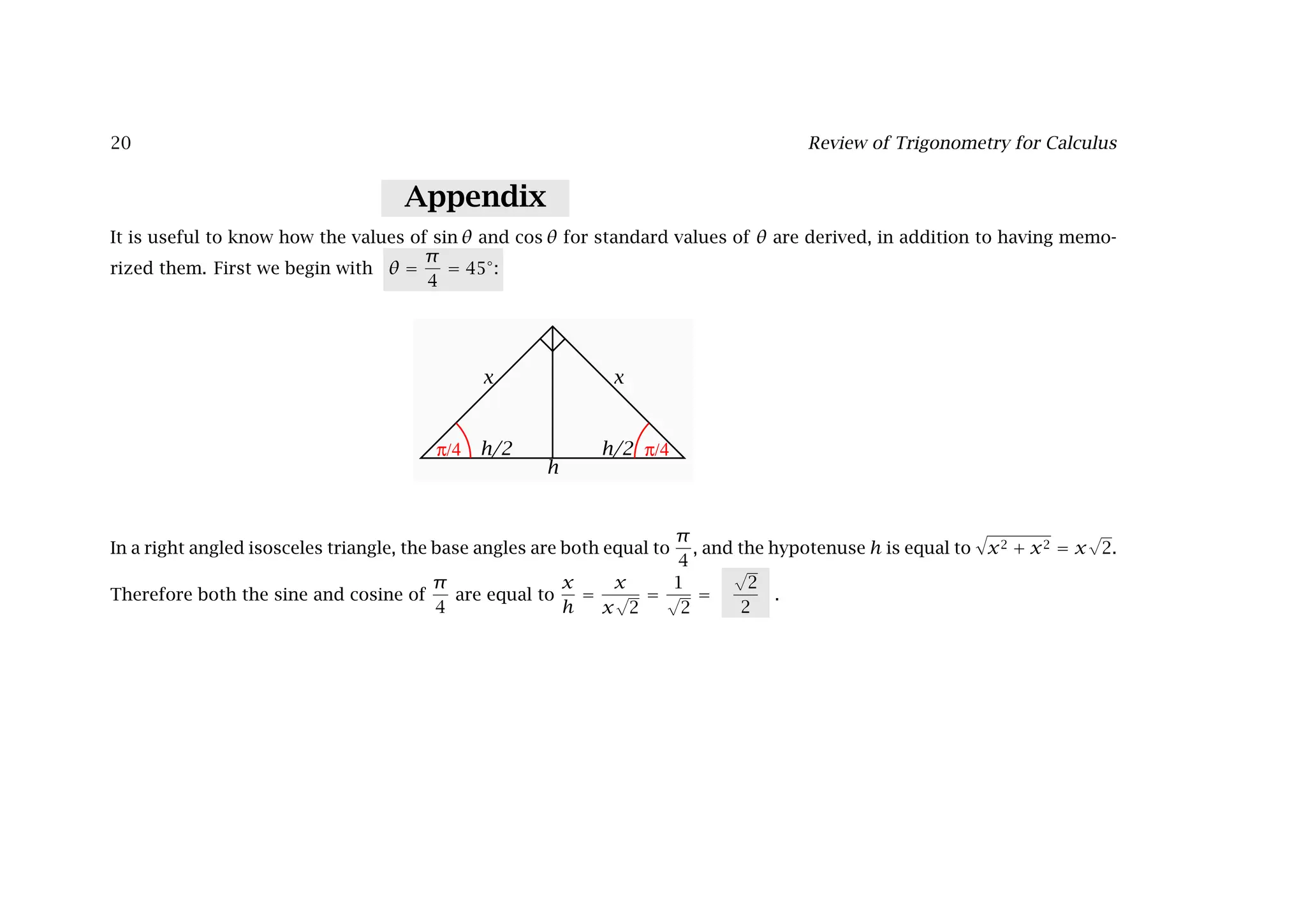
It is useful to know how the values of sin θ and cos θ for standard values of θ are derived, in addition to having memo-
rized them. First we begin with θ =
π
4
= 45◦
:
h
h/2 h/2
x x
π/4 π/4
In a right angled isosceles triangle, the base angles are both equal to
π
4
, and the hypotenuse h is equal to

x2 + x2 = x
√
2.
Therefore both the sine and cosine of
π
4
are equal to
x
h
=
x
x
√
2
=
1
√
2
=
√
2
2
.
Review of Trigonometry for Calculus 21
Next we look at θ =
π
6
= 30◦
and θ =
π
3
= 60◦
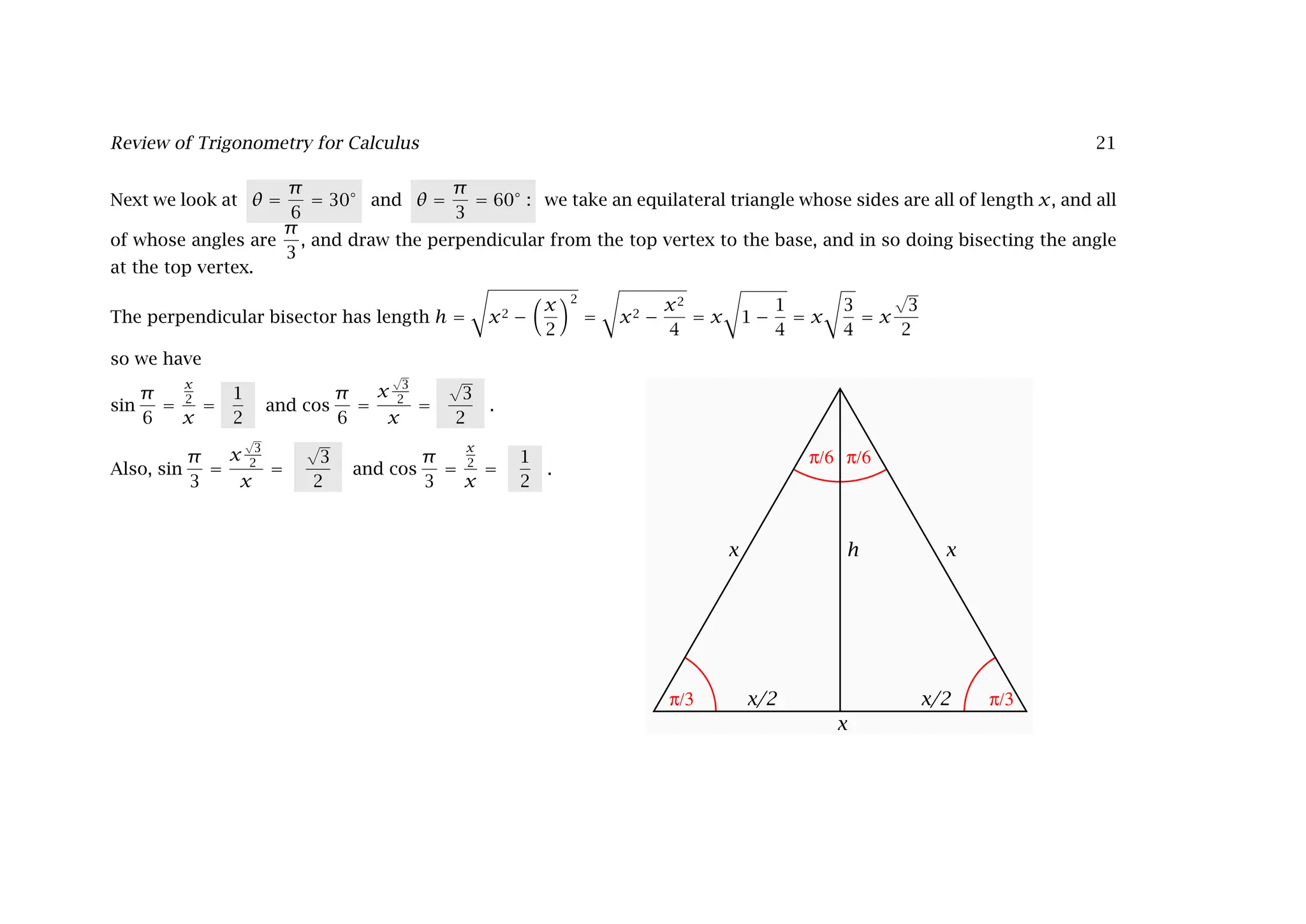
: we take an equilateral triangle whose sides are all of length x, and all
of whose angles are
π
3
, and draw the perpendicular from the top vertex to the base, and in so doing bisecting the angle
at the top vertex.
π/3 π/3
π/6 π/6
x/2 x/2
x x
x
h
The perpendicular bisector has length h =

x2 −

x
2
2
=

x2 −
x2
4
= x

1 −
1
4
= x

3
4
= x
√
3
2
so we have
sin
π
6
=
x
2
x
=
1
2
and cos
π
6
=
x
√
3
2
x
=
√
3
2
.
Also, sin
π
3
=
x
√
3
2
x
=
√
3
2
and cos
π
3
=
x
2
x
=
1
2
.

Review of Trigonometry for Calculus “Trigon” =triangle +“metry”=measurement =Trigonometry so Trigonometry got its name as the science of measuring triangles.

  • 1.
    Review of Trigonometryfor Calculus 1 Review of Trigonometry for Calculus “Trigon” =triangle +“metry”=measurement =Trigonometry so Trigonometry got its name as the science of measuring triangles. When one first meets the trigonometric functions, they are presented in the context of ratios of sides of a right-angled triangle, where a2 + o2 = h2 : a o h α We have sin α = o h = opposite hypotenuse , cos α = a h = adjacent hypotenuse , and tan α = o a = opposite adjacent , which is often remembered with the “sohcahtoa” rule. If h = 1, we have sin α = o, cos α = a, so (sin α)2 + (cos α)2 = 1, so we know that the point (cos α, sin α) lies on the unit circle.
  • 2.
    2 Review ofTrigonometry for Calculus The Unit Circle: In Calculus, most references to the trigonometric functions are based on the unit circle, x2 + y2 = 1. Points on this circle determine angles measured from the point (0, 1) on the x-axis, where the counter- clockwise direction is considered to be positive. Units of Angular Measurement The most natural unit of measurement for angles in Geometry is the right angle . The revolution is used in the study of rotary motion, and is what the “r” stands for in “rpm”s. The degree , 1/90 of a right angle, was probably first adopted for navigational purposes. The mil , 1/1600 of a right angle, is used by the military. However, the basic unit of measurement for angles in Calculus is the radian . Definition: A radian is the angle subtended by a circular arc on a circle whose length equals the radius of the circle. Thus, on the unit circle an angle whose size is one radian subtends a circular arc on the unit circle whose length is exactly one. 1 radian x y (0,0) (1,0) Figure 1.
  • 3.
    Review of Trigonometryfor Calculus 3 Radian measure and degrees Since the circumference of a circle is 2π times its radius, we have 2π radians = 360◦ = 4 right angles, so 1 radian = 360 2π ◦ = 180 π ◦ = 4 right angles 2π = 2 π right angles or 1◦ = 2π 360 radians = π 180 radians = 1 90 right angles In high school trigonometry, the trigonometric functions are used to solve problems concerning triangles and related geometric figures. In the Calculus, the trigonometric functions are used in the analysis of rotating bodies. It turns out that the degree, the unit of measurement of angles adopted by the Babylonians over 4,000 years ago, is not particularly well adapted to the analysis of jet engines, radar systems and CAT scanners. The radian is, because The sine and cosine functions live on the unit circle! If θ is a number, then cos θ and sin θ are defined to be the x- and y- coordinate, respectively, of the point on the unit circle obtained by measuring off the angle θ (in radians!) from the point (0, 1). If θ is positive, the angle is measured off in the counter-clockwise direction, and if θ is negative it is measured off in the clockwise direction. For an animated interactive look at these two functions, take a look at the applet Sine and Cosine Functions
  • 4.
    4 Review ofTrigonometry for Calculus x y (0,0) cos sin θ θ θ Figure 2. The other trigonometric functions are now defined in terms of the first two: tan θ = sin θ cos θ , cot θ = cos θ sin θ , sec θ = 1 cos θ , csc θ = 1 sin θ .
  • 5.
    Review of Trigonometryfor Calculus 5 Fundamental Angles of the First Quadrant: There are three acute angles for which the trigonometric function values are known and must be memorized by the student of Calculus. They are (in radians) π 6 , π 4 , and π 3 , (in degrees) 30◦ , 45◦ , and 60◦ , (in right angles) 1/3, 1/2, and 2/3. In addition, the values of the trig functions for the angles 0 and π 2 must be known. The following tables show how they may be easily constructed, if one can count from zero to four. The first table is a template, the second shows how it may be filled in, and the third contains the arithmetical simplifications of the values. Template: θ(radians) 0 π 6 π 4 π 3 π 2 θ(degrees) 0 30 45 60 90 θ(right angles) 0 1 3 1 2 2 3 1 sin θ √ 2 √ 2 √ 2 √ 2 √ 2 cos θ √ 2 √ 2 √ 2 √ 2 √ 2
  • 6.
    6 Review ofTrigonometry for Calculus Fill in the Blanks: θ(radians) 0 π 6 π 4 π 3 π 2 θ(degrees) 0 30 45 60 90 θ(right angles) 0 1 3 1 2 2 3 1 sin θ √ 0 2 √ 1 2 √ 2 2 √ 3 2 √ 4 2 cos θ √ 4 2 √ 3 2 √ 2 2 √ 1 2 √ 0 2 Simplify the Arithmetic: θ(radians) 0 π 6 π 4 π 3 π 2 θ(degrees) 0 30 45 60 90 θ(right angles) 0 1 3 1 2 2 3 1 sin θ 0 1 2 √ 2 2 √ 3 2 1 cos θ 1 √ 3 2 √ 2 2 1 2 0
  • 7.
    Review of Trigonometryfor Calculus 7 Figure 3 shows these values on the first quadrant of the unit circle. x y (0,1) ( , ) ( , ) ( , ) (1,0) — — — — — — — — — — 2 2 2 2 2 2 1 3 2 2 3 1 π π π π √ √ √ √ — — — — 2 3 4 6 0 Figure 3.
  • 8.
    8 Review ofTrigonometry for Calculus Moving Beyond the First Quadrant These values may now be used to find the values of the trig functions at the other basic angles in the other three quadrants of unit circle. The same numerical values will appear, with the possible addition of minus signs. The following table gives the values, and the diagram displays them. The student should be able to reproduce them instantaneously! To do this, it will be necessary to be completely comfortable with the following identities, all of which are obvious from the symmetry of the unit circle: x y θ −θ θ+π π−θ π/2−θ Figure 4.
  • 9.
    Review of Trigonometryfor Calculus 9 sin(π − θ) ≡ sin θ, cos(π − θ) ≡ − cos θ sin(θ + π) ≡ − sin θ, cos(θ + π) ≡ − cos θ sin(−θ) ≡ − sin θ, cos(−θ) ≡ cos θ sin π 2 − θ ≡ cos θ, cos π 2 − θ ≡ sin θ θ 0 π 6 π 4 π 3 π 2 2π 3 3π 4 5π 6 π 7π 6 5π 4 4π 3 3π 2 5π 3 7π 4 11π 6 sin θ 0 1 2 √ 2 2 √ 3 2 1 √ 3 2 √ 2 2 1 2 0 − 1 2 − √ 2 2 − √ 3 2 −1 − √ 3 2 − √ 2 2 − 1 2 cos θ 1 √ 3 2 √ 2 2 1 2 0 − 1 2 − √ 2 2 − √ 3 2 −1 − √ 3 2 − √ 2 2 −1 2 0 1 2 √ 2 2 √ 3 2
  • 10.
    10 Review ofTrigonometry for Calculus Figure 5 is left blank for the student to fill in: x y (1,0) ( , ) ( , ) ( , ) (0,1) ( , ) ( , ) ( , ) (-1,0) ( , ) ( , ) ( , ) (0,-1) ( , ) ( , ) ( , ) — — — — — — — — — — — — — — — — — — — — — — — — — — — — 2 2 2 2 2 2 1 3 2 2 3 1 π π π π π π π π π π π π π π π √ √ √ √ — — — — — — — — — — — — — — 2 3 4 6 3 4 6 2 3 4 6 3 4 6 2 3 5 4 5 7 3 5 7 11 0 Figure 5.
  • 11.
    Review of Trigonometryfor Calculus 11 Periodicity All six trig functions have period 2π, and two of them, tan and cot have period π: sin(θ + 2π) ≡ sin(θ) cos(θ + 2π) ≡ cos(θ) tan(θ + π) ≡ tan(θ) cot(θ + π) ≡ cot(θ) sec(θ + 2π) ≡ sec(θ) csc(θ + 2π) ≡ csc(θ)
  • 12.
    12 Review ofTrigonometry for Calculus Identities of the sine and cosine functions The identity sin2 θ + cos2 θ ≡ 1 is obvious as a result of our use of the unit circle. It really should be written as (sin θ)2 + (cos θ)2 ≡ 1 but centuries of tradition have developed the confusing convention of writing sin2 θ for the square of sin θ. This identity leads to a number of other important identities and formulas: tan2 θ ≡ sec2 θ − 1 sec2 θ ≡ 1 + tan2 θ + 1 cot2 θ ≡ csc2 θ − 1 csc2 θ ≡ 1 + cot2 θ sin θ = ± 1 − cos2 θ In addition to this fundamental knowledge, the student should be completely comfortable in deriving the trig identities which result from the fundamental identities for the sines and cosines of sums and differences of angles. First we need:
  • 13.
    Review of Trigonometryfor Calculus 13 The Law of Cosines: c2 = a2 + b2 − 2ab cos γ a c b w z γ π−γ We have w = b sin(π − γ) = b sin γ, and z = b cos(π − γ) = −b cos γ, so c2 = w2 + (a + z)2 = (b sin γ)2 + (a − b cos γ)2 = b2 sin2 γ + a2 − 2ab cos γ + b2 (cos γ)2 = a2 + b2 − 2ab cos γ Next we compute c2 slightly differently: a c b h x y α β x = b cos α, y = a cos β, h = b sin α = a sin β, x2 = b2 − h2 , y2 = a2 − h2 , so c2 = (x + y)2 = x2 + 2xy + y2 = b2 − h2 + 2(b cos α)(a cos β) + a2 − h2 = a2 + b2 − 2h2 + 2ab cos α cos β = a2 + b2 − 2ab sin α sin β + 2ab cos α cos β = a2 + b2 − 2ab(sin α sin β − cos α cos β) so cos γ = sin α sin β − cos α cos β = − cos(π − γ) = − cos(α + β). Therefore cos(α + β) = cos α cos β − sin α sin β
  • 14.
    14 Review ofTrigonometry for Calculus We collect the angle sum and difference formulae: sin(α + β) ≡ sin α cos β + sin β cos α (1) sin(α − β) ≡ sin α cos β − sin β cos α (2) cos(α + β) ≡ cos α cos β − sin α sin β (3) cos(α − β) ≡ cos α cos β + sin α sin β (4) If we add (1) and (2) and divide by 2, we get sin α cos β ≡ 1 2 (sin(α + β) + sin(α − β)) If we add (3) and (4) and divide by 2,we get cos α cos β ≡ 1 2 (cos(α + β) + cos(α − β)) and if we subtract (3) from (4) we get sin α sin β ≡ 1 2 (cos(α − β) − cos(α + β))
  • 15.
    Review of Trigonometryfor Calculus 15 Double Angle Formulae: If we let β = α in (1) and (3) and divide by 2, we get: sin 2α ≡ 2 sin α cos α (5) cos 2α ≡ cos2 α − sin2 α = 2 cos2 α − 1 = 1 − 2 sin2 α (6) (6) leads to the two identities: cos2 α ≡ 1 + cos 2α 2 (7) sin2 α ≡ 1 − cos 2α 2 (8) which in turn lead to the formulas cos α = ± 1 + cos 2α 2 sin α = ± 1 − cos 2α 2 .
  • 16.
    16 Review ofTrigonometry for Calculus These in turn lead to the Half-Angle Formulae: cos α 2 = ± 1 + cos α 2 (9) sin α 2 = ± 1 − cos α 2 (10) The above identities may be used to compute the exact values of trig functions at many other angles, such as π 8 = 1 2 π 4 and π 12 , but in practice one usually uses a calculator or computer to get extremely accurate values of the trig functions.
  • 17.
    Review of Trigonometryfor Calculus 17 Identities of the Other Four Trigonometric Functions These may all be derived from the preceding: For example, tan(α + β) ≡ sin(α + β) cos(α + β) ≡ sin α cos β + sin β cos α cos α cos β − sin α sin β ≡ sin α cos β + sin β cos α cos α cos β cos α cos β − sin α sin β cos α cos β ≡ tan α + tan β 1 − tan α tan β , tan(α + π 2 ) ≡ sin(α + π 2 ) cos(α + π 2 ) ≡ cos α − sin α ≡ −1 tan α (thus the formula for slopes of perpendicluar lines). tan(α − β) ≡ sin(α + β) cos(α + β) ≡ tan α + tan β 1 + tan α tan β , tan(2α) ≡ 2 tan α 1 − tan2 α , and tan α 2 = sin α 2 cos α 2 = ± 1 − cos α 2 ± 1 + cos α 2 = ± 1 − cos α 1 + cos α
  • 18.
    18 Review ofTrigonometry for Calculus Inverse Trigonometric Functions Definition: If h is a real number, the inverse sine or Arcsin of h is that number between −π/2 and π/2 whose sine is h. This is often called the Primary angle whose sine is h. It may be found geometrically by drawing the horizontal line y = h and observing the points where it intersects the unit circle. If there are two such points, the one on the right determines the Primary Angle . The point on the left determines another angle whose sine is also h; this angle is called the Secondary Angle . There are, of course, infinitely many other angles whose sine is h, they may all be obtained by adding integer multiples of 2π to the Primary or Secondary Angles. Geometrically, this is the same as going completely around the unit circle a number of times and ending up at the same point. Definition: If k is a real number, the inverse cosine or Arccos of k is that number between 0 and π whose cosine is k. This is often called the Primary angle whose cosine is k. It may be found geometrically by drawing the vertical line x = k and observing the points where it intersects the unit circle. If there are two such points, the upper one determines the Primary Angle . The lower point determines another angle whose cosine is also k; this angle is called the Secondary Angle . There are, of course, infinitely many other angles whose cosine is k, they may all be obtained by adding integer multiples of 2π to the Primary or Secondary Angles. Geometrically, this is the same as going completely around the unit circle a number of times and ending up at the same point.
  • 19.
    Review of Trigonometryfor Calculus 19 Java Applets: For an animated interactive look at these two functions, take a look at the applets ArcSine Applet and ArcCosine Applet x y =Arcsin h y=h θ θ x y =Arcsin h x=h θ θ Figure 6.
  • 20.
    20 Review ofTrigonometry for Calculus Appendix It is useful to know how the values of sin θ and cos θ for standard values of θ are derived, in addition to having memo- rized them. First we begin with θ = π 4 = 45◦ : h h/2 h/2 x x π/4 π/4 In a right angled isosceles triangle, the base angles are both equal to π 4 , and the hypotenuse h is equal to x2 + x2 = x √ 2. Therefore both the sine and cosine of π 4 are equal to x h = x x √ 2 = 1 √ 2 = √ 2 2 .
  • 21.
    Review of Trigonometryfor Calculus 21 Next we look at θ = π 6 = 30◦ and θ = π 3 = 60◦ : we take an equilateral triangle whose sides are all of length x, and all of whose angles are π 3 , and draw the perpendicular from the top vertex to the base, and in so doing bisecting the angle at the top vertex. π/3 π/3 π/6 π/6 x/2 x/2 x x x h The perpendicular bisector has length h = x2 − x 2 2 = x2 − x2 4 = x 1 − 1 4 = x 3 4 = x √ 3 2 so we have sin π 6 = x 2 x = 1 2 and cos π 6 = x √ 3 2 x = √ 3 2 . Also, sin π 3 = x √ 3 2 x = √ 3 2 and cos π 3 = x 2 x = 1 2 .