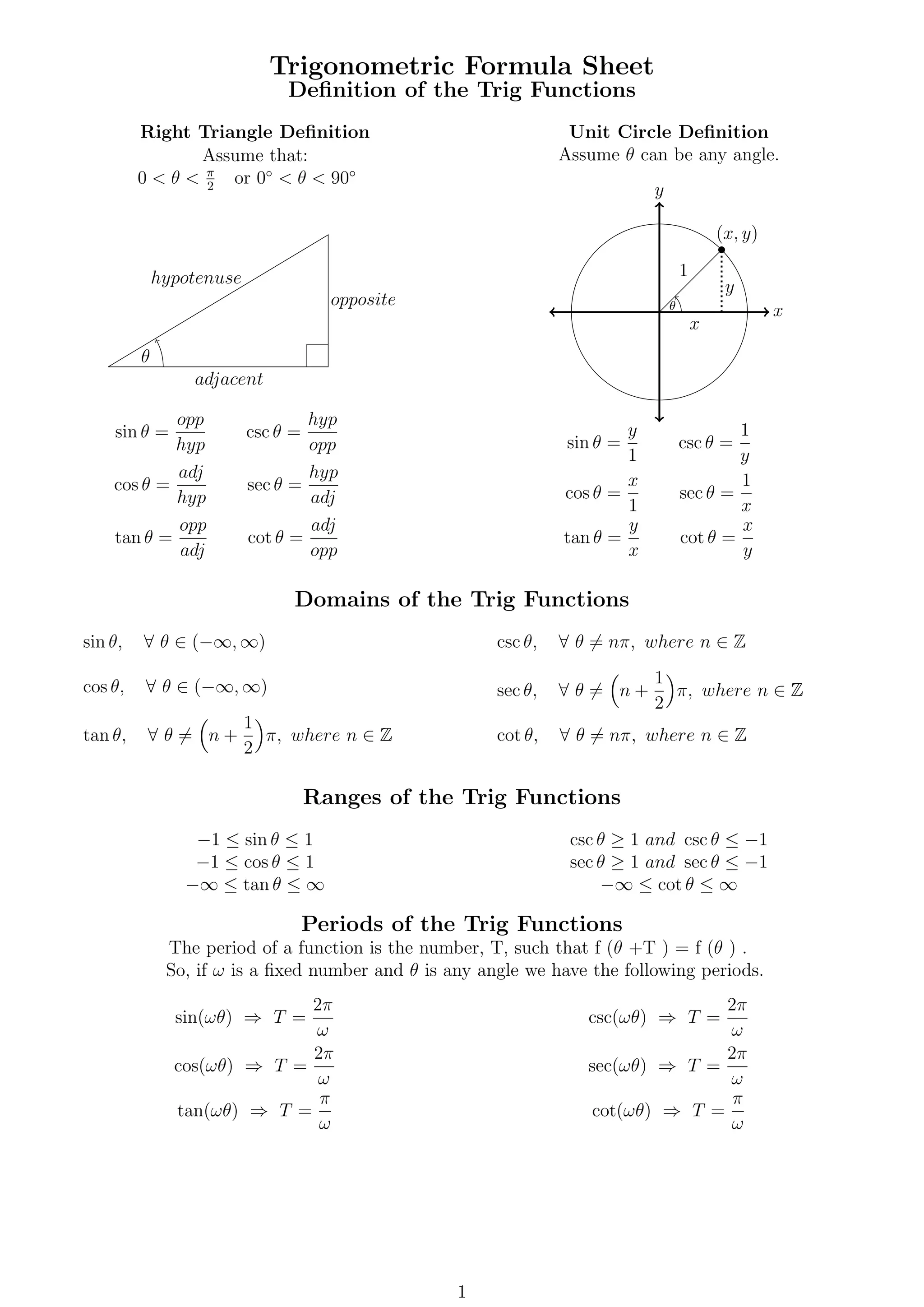
Trigonometric Formula Sheet
Definition of the Trig Functions
Right Triangle Definition
Assume that:
0 < θ < π
2
or 0◦
< θ < 90◦
hypotenuse
adjacent
opposite
θ
sin θ =
opp
hyp
csc θ =
hyp
opp
cos θ =
adj
hyp
sec θ =
hyp
adj
tan θ =
opp
adj
cot θ =
adj
opp
Unit Circle Definition
Assume θ can be any angle.
x
y
y
x
1
(x, y)
θ
sin θ =
y
1
csc θ =
1
y
cos θ =
x
1
sec θ =
1
x
tan θ =
y
x
cot θ =
x
y
Domains of the Trig Functions
sin θ, ∀ θ ∈ (−∞, ∞)
cos θ, ∀ θ ∈ (−∞, ∞)
tan θ, ∀ θ = n +
1
2
π, where n ∈ Z
csc θ, ∀ θ = nπ, where n ∈ Z
sec θ, ∀ θ = n +
1
2
π, where n ∈ Z
cot θ, ∀ θ = nπ, where n ∈ Z
Ranges of the Trig Functions
−1 ≤ sin θ ≤ 1
−1 ≤ cos θ ≤ 1
−∞ ≤ tan θ ≤ ∞
csc θ ≥ 1 and csc θ ≤ −1
sec θ ≥ 1 and sec θ ≤ −1
−∞ ≤ cot θ ≤ ∞
Periods of the Trig Functions
The period of a function is the number, T, such that f (θ +T ) = f (θ ) .
So, if ω is a fixed number and θ is any angle we have the following periods.
sin(ωθ) ⇒ T =
2π
ω
cos(ωθ) ⇒ T =
2π
ω
tan(ωθ) ⇒ T =
π
ω
csc(ωθ) ⇒ T =
2π
ω
sec(ωθ) ⇒ T =
2π
ω
cot(ωθ) ⇒ T =
π
ω
1
Identities and Formulas
Tangent and Cotangent Identities
tan θ =
sin θ
cos θ
cot θ =
cos θ
sin θ
Reciprocal Identities
sin θ =
1
csc θ
csc θ =
1
sin θ
cos θ =
1
sec θ
sec θ =
1
cos θ
tan θ =
1
cot θ
cot θ =
1
tan θ
Pythagorean Identities
sin2
θ + cos2
θ = 1
tan2
θ + 1 = sec2
θ
1 + cot2
θ = csc2
θ
Even and Odd Formulas
sin(−θ) = − sin θ
cos(−θ) = cos θ
tan(−θ) = − tan θ
csc(−θ) = − csc θ
sec(−θ) = sec θ
cot(−θ) = − cot θ
Periodic Formulas
If n is an integer
sin(θ + 2πn) = sin θ
cos(θ + 2πn) = cos θ
tan(θ + πn) = tan θ
csc(θ + 2πn) = csc θ
sec(θ + 2πn) = sec θ
cot(θ + πn) = cot θ
Double Angle Formulas
sin(2θ) = 2 sin θ cos θ
cos(2θ) = cos2
θ − sin2
θ
= 2 cos2
θ − 1
= 1 − 2 sin2
θ
tan(2θ) =
2 tan θ
1 − tan2
θ
Degrees to Radians Formulas
If x is an angle in degrees and t is an angle in
radians then:
π
180◦
=
t
x
⇒ t =
πx
180◦
and x =
180◦
t
π
Half Angle Formulas
sin θ = ±
1 − cos(2θ)
2
cos θ = ±
1 + cos(2θ)
2
tan θ = ±
1 − cos(2θ)
1 + cos(2θ)
Sum and Difference Formulas
sin(α ± β) = sin α cos β ± cos α sin β
cos(α ± β) = cos α cos β sin α sin β
tan(α ± β) =
tan α ± tan β
1 tan α tan β
Product to Sum Formulas
sin α sin β =
1
2
[cos(α − β) − cos(α + β)]
cos α cos β =
1
2
[cos(α − β) + cos(α + β)]
sin α cos β =
1
2
[sin(α + β) + sin(α − β)]
cos α sin β =
1
2
[sin(α + β) − sin(α − β)]
Sum to Product Formulas
sin α + sin β = 2 sin
α + β
2
cos
α − β
2
sin α − sin β = 2 cos
α + β
2
sin
α − β
2
cos α + cos β = 2 cos
α + β
2
cos
α − β
2
cos α − cos β = −2 sin
α + β
2
sin
α − β
2
Cofunction Formulas
sin
π
2
− θ = cos θ
csc
π
2
− θ = sec θ
tan
π
2
− θ = cot θ
cos
π
2
− θ = sin θ
sec
π
2
− θ = csc θ
cot
π
2
− θ = tan θ
2
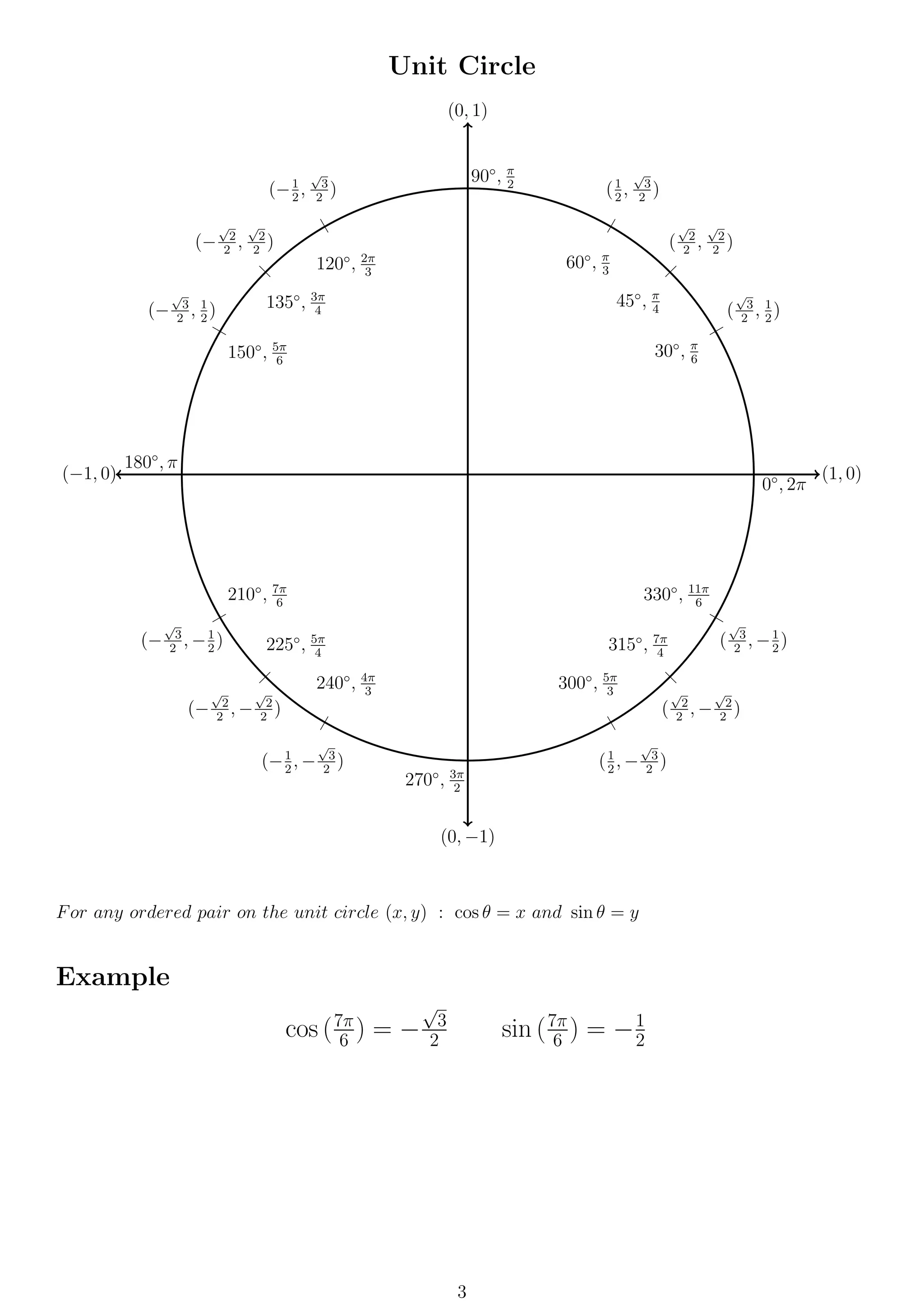
Unit Circle
0◦
, 2π
(1, 0)
180◦
, π
(−1, 0)
(0, 1)
90◦
, π
2
(0, −1)
270◦
, 3π
2
30◦
, π
6
(
√
3
2
, 1
2
)45◦
, π
4
(
√
2
2
,
√
2
2
)
60◦
, π
3
(1
2
,
√
3
2
)
120◦
, 2π
3
(−1
2
,
√
3
2
)
135◦
, 3π
4
(−
√
2
2
,
√
2
2
)
150◦
, 5π
6
(−
√
3
2
, 1
2
)
210◦
, 7π
6
(−
√
3
2
, −1
2
) 225◦
, 5π
4
(−
√
2
2
, −
√
2
2
)
240◦
, 4π
3
(−1
2
, −
√
3
2
)
300◦
, 5π
3
(1
2
, −
√
3
2
)
315◦
, 7π
4
(
√
2
2
, −
√
2
2
)
330◦
, 11π
6
(
√
3
2
, −1
2
)
For any ordered pair on the unit circle (x, y) : cos θ = x and sin θ = y
Example
cos (7π
6 ) = −
√
3
2 sin (7π
6 ) = −1
2
3
Inverse Trig Functions
Definition
θ = sin−1
(x) is equivalent to x = sin θ
θ = cos−1
(x) is equivalent to x = cos θ
θ = tan−1
(x) is equivalent to x = tan θ
Domain and Range
Function
θ = sin−1
(x)
θ = cos−1
(x)
θ = tan−1
(x)
Domain
−1 ≤ x ≤ 1
−1 ≤ x ≤ 1
−∞ ≤ x ≤ ∞
Range
−
π
2
≤ θ ≤
π
2
0 ≤ θ ≤ π
−
π
2
< θ <
π
2
Inverse Properties
These properties hold for x in the domain and θ in
the range
sin(sin−1
(x)) = x
cos(cos−1
(x)) = x
tan(tan−1
(x)) = x
sin−1
(sin(θ)) = θ
cos−1
(cos(θ)) = θ
tan−1
(tan(θ)) = θ
Other Notations
sin−1
(x) = arcsin(x)
cos−1
(x) = arccos(x)
tan−1
(x) = arctan(x)
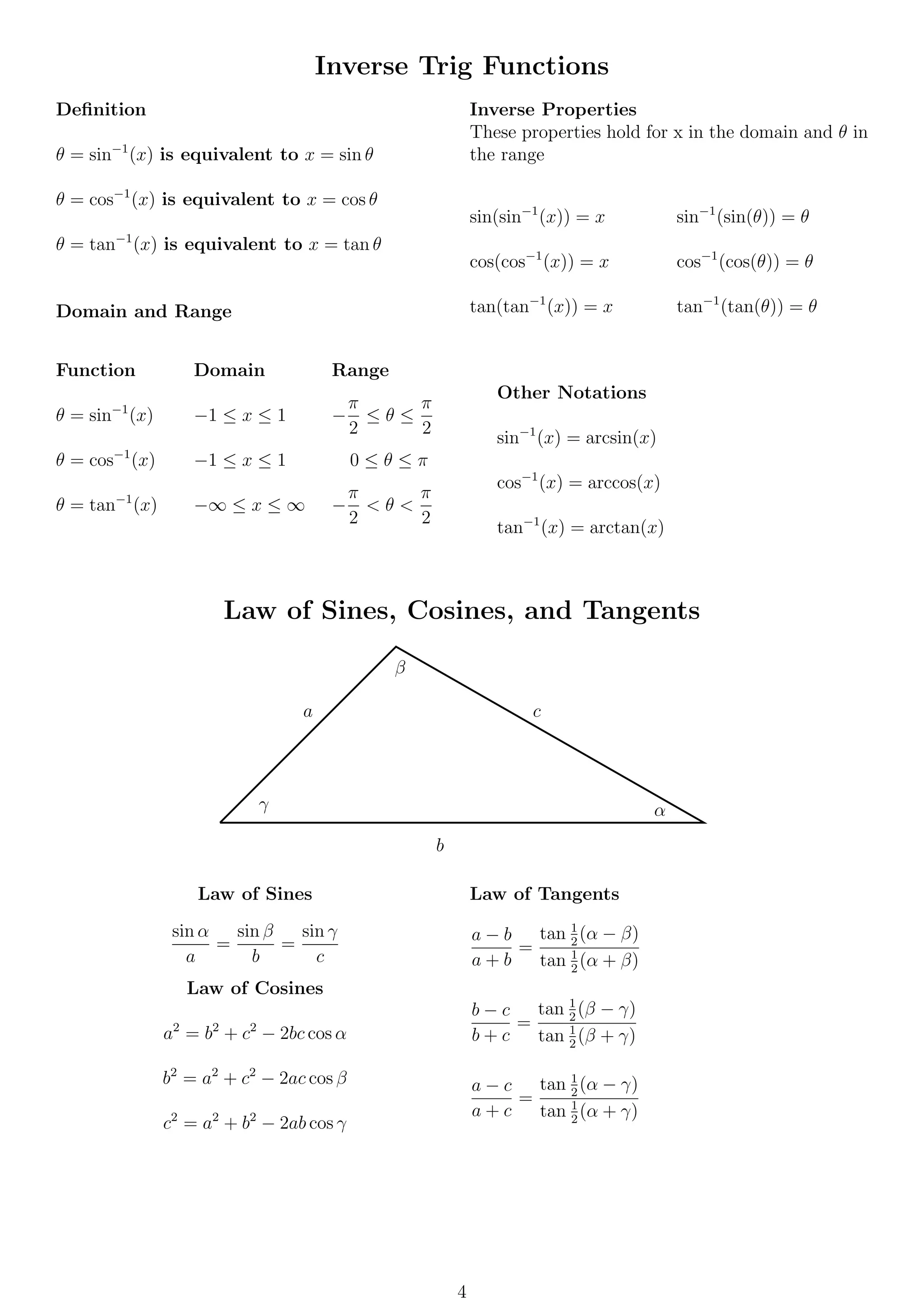
Law of Sines, Cosines, and Tangents
a
b
c
α
β
γ
Law of Sines
sin α
a
=
sin β
b
=
sin γ
c
Law of Cosines
a2
= b2
+ c2
− 2bc cos α
b2
= a2
+ c2
− 2ac cos β
c2
= a2
+ b2
− 2ab cos γ
Law of Tangents
a − b
a + b
=
tan 1
2
(α − β)
tan 1
2
(α + β)
b − c
b + c
=
tan 1
2
(β − γ)
tan 1
2
(β + γ)
a − c
a + c
=
tan 1
2
(α − γ)
tan 1
2
(α + γ)
4
Complex Numbers
i =
√
−1 i2
= −1 i3
= −i i4
= 1
√
−a = i
√
a, a ≥ 0
(a + bi) + (c + di) = a + c + (b + d)i
(a + bi) − (c + di) = a − c + (b − d)i
(a + bi)(c + di) = ac − bd + (ad + bc)i
(a + bi)(a − bi) = a2
+ b2
|a + bi| =
√
a2 + b2 Complex Modulus
(a + bi) = a − bi Complex Conjugate
(a + bi)(a + bi) = |a + bi|2
DeMoivre’s Theorem
Let z = r(cos θ + i sin θ), and let n be a positive integer.
Then:
zn
= rn
(cos nθ + i sin nθ).
Example: Let z = 1 − i, find z6
.
Solution: First write z in polar form.
r = (1)2 + (−1)2 =
√
2
θ = arg(z) = tan−1 −1
1
= −
π
4
Polar Form: z =
√
2 cos −
π
4
+ i sin −
π
4
Applying DeMoivre’s Theorem gives :
z6
=
√
2
6
cos 6 · −
π
4
+ i sin 6 · −
π
4
= 23
cos −
3π
2
+ i sin −
3π
2
= 8(0 + i(1))
= 8i
5
Finding the nth roots of a number using DeMoivre’s Theorem
Example: Find all the complex fourth roots of 4. That is, find all the complex solutions of
x4
= 4.
We are asked to find all complex fourth roots of 4.
These are all the solutions (including the complex values) of the equation x4
= 4.
For any positive integer n , a nonzero complex number z has exactly n distinct nth roots.
More specifically, if z is written in the trigonometric form r(cos θ + i sin θ), the nth roots of
z are given by the following formula.
(∗) r
1
n cos
θ
n
+
360◦
k
n
+ i sin
θ
n
+
360◦
k
n
, for k = 0, 1, 2, ..., n − 1.
Remember from the previous example we need to write 4 in trigonometric form by using:
r = (a)2 + (b)2 and θ = arg(z) = tan−1 b
a
.
So we have the complex number a + ib = 4 + i0.
Therefore a = 4 and b = 0
So r = (4)2 + (0)2 = 4 and
θ = arg(z) = tan−1 0
4
= 0
Finally our trigonometric form is 4 = 4(cos 0◦
+ i sin 0◦
)
Using the formula (∗) above with n = 4, we can find the fourth roots of 4(cos 0◦
+ i sin 0◦
)
• For k = 0, 4
1
4 cos
0◦
4
+
360◦
∗ 0
4
+ i sin
0◦
4
+
360◦
∗ 0
4
=
√
2 (cos(0◦
) + i sin(0◦
)) =
√
2
• For k = 1, 4
1
4 cos
0◦
4
+
360◦
∗ 1
4
+ i sin
0◦
4
+
360◦
∗ 1
4
=
√
2 (cos(90◦
) + i sin(90◦
)) =
√
2i
• For k = 2, 4
1
4 cos
0◦
4
+
360◦
∗ 2
4
+ i sin
0◦
4
+
360◦
∗ 2
4
=
√
2 (cos(180◦
) + i sin(180◦
)) = −
√
2
• For k = 3, 4
1
4 cos
0◦
4
+
360◦
∗ 3
4
+ i sin
0◦
4
+
360◦
∗ 3
4
=
√
2 (cos(270◦
) + i sin(270◦
)) = −
√
2i
Thus all of the complex roots of x4
= 4 are:
√
2,
√
2i, −
√
2, −
√
2i .
6
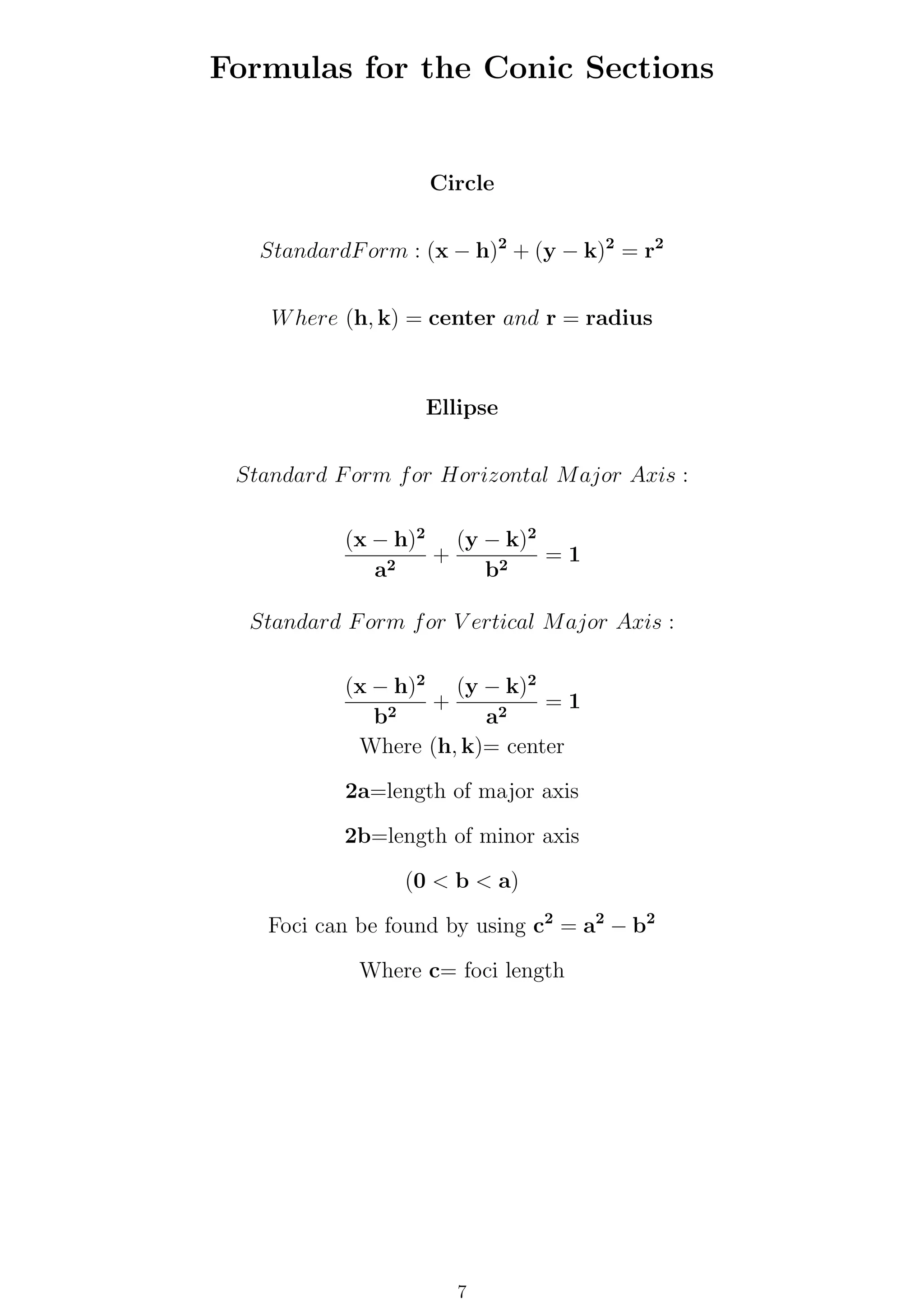
Formulas for the Conic Sections
Circle
StandardForm : (x − h)2
+ (y − k)2
= r2
Where (h, k) = center and r = radius
Ellipse
Standard Form for Horizontal Major Axis :
(x − h)2
a2
+
(y − k)2
b2
= 1
Standard Form for V ertical Major Axis :
(x − h)2
b2
+
(y − k)2
a2
= 1
Where (h, k)= center
2a=length of major axis
2b=length of minor axis
(0 < b < a)
Foci can be found by using c2
= a2
− b2
Where c= foci length
7
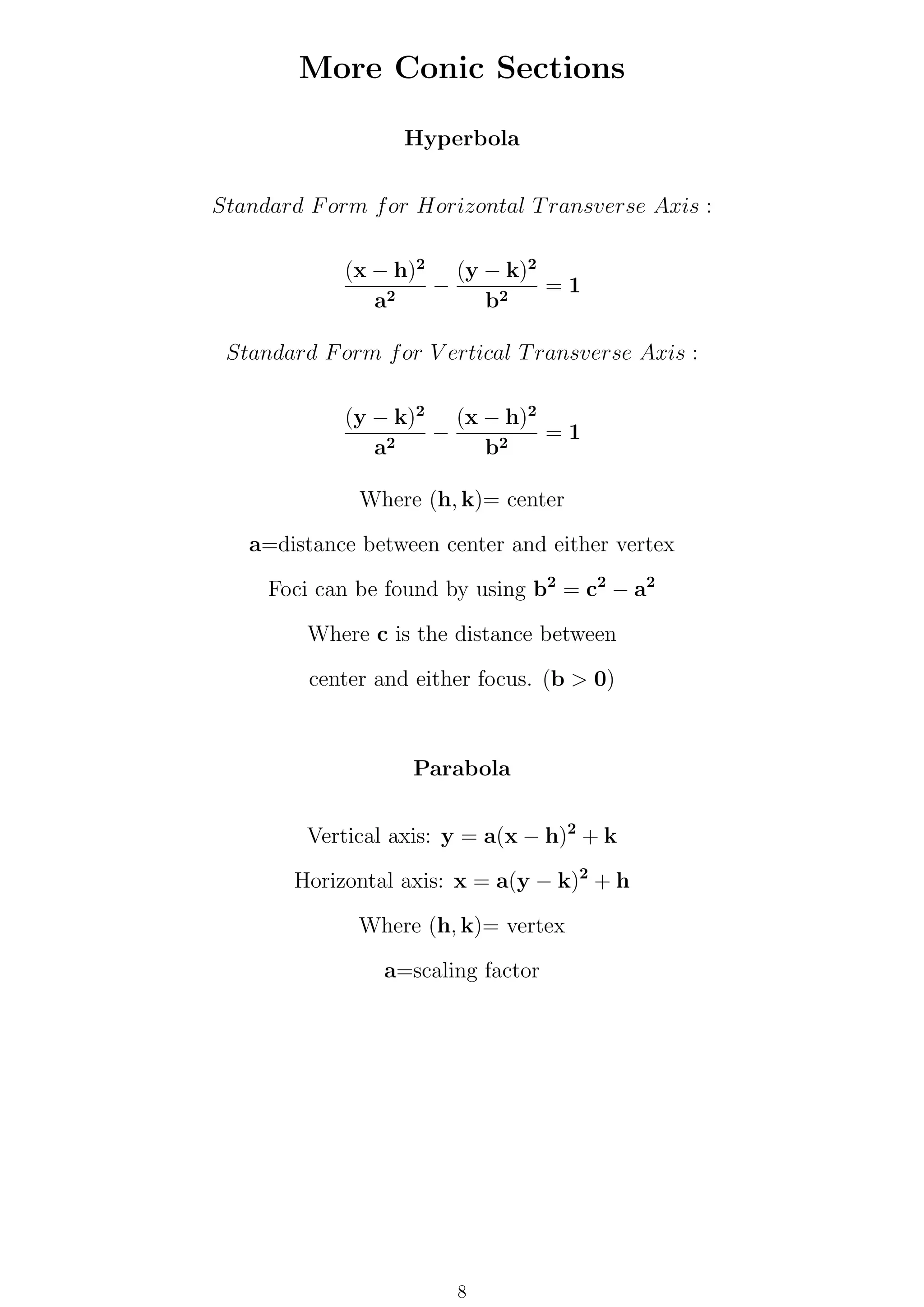
More Conic Sections
Hyperbola
Standard Form for Horizontal Transverse Axis :
(x − h)2
a2
−
(y − k)2
b2
= 1
Standard Form for V ertical Transverse Axis :
(y − k)2
a2
−
(x − h)2
b2
= 1
Where (h, k)= center
a=distance between center and either vertex
Foci can be found by using b2
= c2
− a2
Where c is the distance between
center and either focus. (b > 0)
Parabola
Vertical axis: y = a(x − h)2
+ k
Horizontal axis: x = a(y − k)2
+ h
Where (h, k)= vertex
a=scaling factor
8
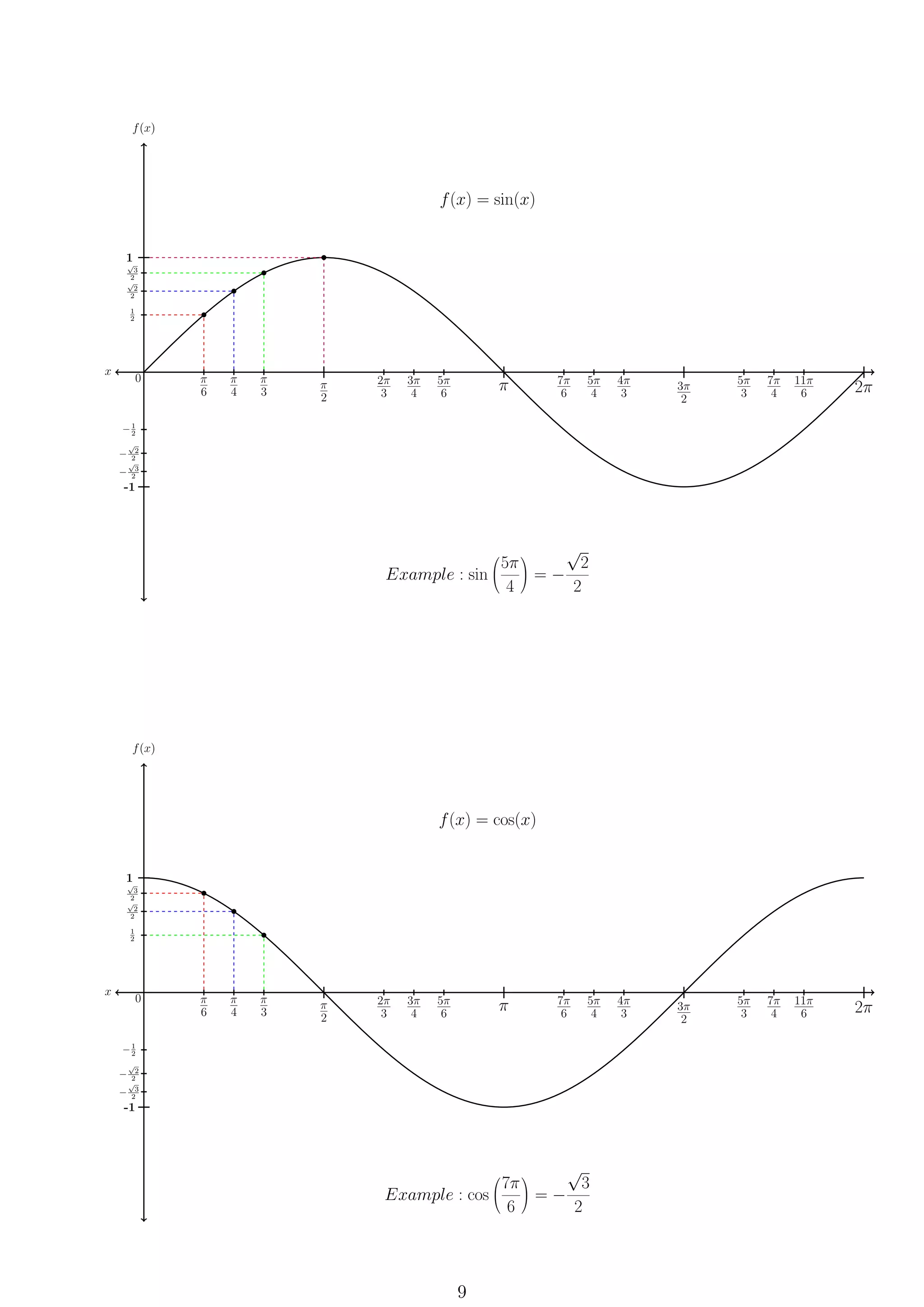
x
Example : sin


5π
4

 = −
√
2
2
f(x)
f(x) = sin(x)
0 π
6
π
4
π
3
π
2
2π
3
3π
4
5π
6
π 7π
6
5π
4
4π
3
3π
2
5π
3
7π
4
11π
6 2π
1
-1
1
2
√
2
2
√
3
2
−1
2
−
√
2
2
−
√
3
2
x
Example : cos


7π
6

 = −
√
3
2
f(x)
f(x) = cos(x)
0 π
6
π
4
π
3
π
2
2π
3
3π
4
5π
6
π 7π
6
5π
4
4π
3
3π
2
5π
3
7π
4
11π
6 2π
1
-1
1
2
√
2
2
√
3
2
−1
2
−
√
2
2
−
√
3
2
9
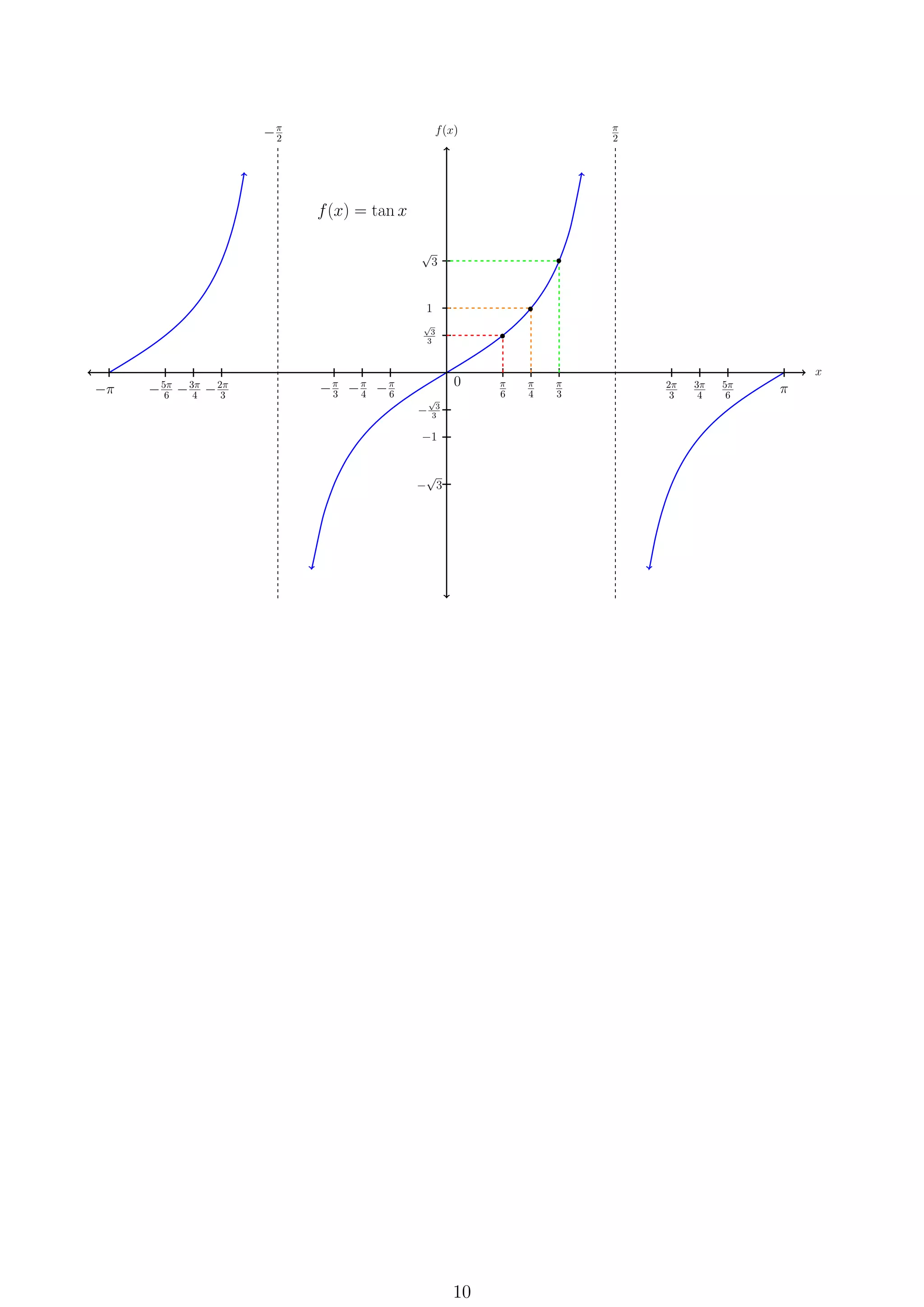
x
f(x)
f(x) = tan x
π
2−π
2
√
3
3
1
√
3
−
√
3
3
−1
−
√
3
π
4−π
4
0 π
6−π
6
π
3−π
3
2π
3−2π
3
3π
4−3π
4
5π
6−5π
6
π−π
10

Math resources trigonometric_formulas

  • 1.
    Trigonometric Formula Sheet Definitionof the Trig Functions Right Triangle Definition Assume that: 0 < θ < π 2 or 0◦ < θ < 90◦ hypotenuse adjacent opposite θ sin θ = opp hyp csc θ = hyp opp cos θ = adj hyp sec θ = hyp adj tan θ = opp adj cot θ = adj opp Unit Circle Definition Assume θ can be any angle. x y y x 1 (x, y) θ sin θ = y 1 csc θ = 1 y cos θ = x 1 sec θ = 1 x tan θ = y x cot θ = x y Domains of the Trig Functions sin θ, ∀ θ ∈ (−∞, ∞) cos θ, ∀ θ ∈ (−∞, ∞) tan θ, ∀ θ = n + 1 2 π, where n ∈ Z csc θ, ∀ θ = nπ, where n ∈ Z sec θ, ∀ θ = n + 1 2 π, where n ∈ Z cot θ, ∀ θ = nπ, where n ∈ Z Ranges of the Trig Functions −1 ≤ sin θ ≤ 1 −1 ≤ cos θ ≤ 1 −∞ ≤ tan θ ≤ ∞ csc θ ≥ 1 and csc θ ≤ −1 sec θ ≥ 1 and sec θ ≤ −1 −∞ ≤ cot θ ≤ ∞ Periods of the Trig Functions The period of a function is the number, T, such that f (θ +T ) = f (θ ) . So, if ω is a fixed number and θ is any angle we have the following periods. sin(ωθ) ⇒ T = 2π ω cos(ωθ) ⇒ T = 2π ω tan(ωθ) ⇒ T = π ω csc(ωθ) ⇒ T = 2π ω sec(ωθ) ⇒ T = 2π ω cot(ωθ) ⇒ T = π ω 1
  • 2.
    Identities and Formulas Tangentand Cotangent Identities tan θ = sin θ cos θ cot θ = cos θ sin θ Reciprocal Identities sin θ = 1 csc θ csc θ = 1 sin θ cos θ = 1 sec θ sec θ = 1 cos θ tan θ = 1 cot θ cot θ = 1 tan θ Pythagorean Identities sin2 θ + cos2 θ = 1 tan2 θ + 1 = sec2 θ 1 + cot2 θ = csc2 θ Even and Odd Formulas sin(−θ) = − sin θ cos(−θ) = cos θ tan(−θ) = − tan θ csc(−θ) = − csc θ sec(−θ) = sec θ cot(−θ) = − cot θ Periodic Formulas If n is an integer sin(θ + 2πn) = sin θ cos(θ + 2πn) = cos θ tan(θ + πn) = tan θ csc(θ + 2πn) = csc θ sec(θ + 2πn) = sec θ cot(θ + πn) = cot θ Double Angle Formulas sin(2θ) = 2 sin θ cos θ cos(2θ) = cos2 θ − sin2 θ = 2 cos2 θ − 1 = 1 − 2 sin2 θ tan(2θ) = 2 tan θ 1 − tan2 θ Degrees to Radians Formulas If x is an angle in degrees and t is an angle in radians then: π 180◦ = t x ⇒ t = πx 180◦ and x = 180◦ t π Half Angle Formulas sin θ = ± 1 − cos(2θ) 2 cos θ = ± 1 + cos(2θ) 2 tan θ = ± 1 − cos(2θ) 1 + cos(2θ) Sum and Difference Formulas sin(α ± β) = sin α cos β ± cos α sin β cos(α ± β) = cos α cos β sin α sin β tan(α ± β) = tan α ± tan β 1 tan α tan β Product to Sum Formulas sin α sin β = 1 2 [cos(α − β) − cos(α + β)] cos α cos β = 1 2 [cos(α − β) + cos(α + β)] sin α cos β = 1 2 [sin(α + β) + sin(α − β)] cos α sin β = 1 2 [sin(α + β) − sin(α − β)] Sum to Product Formulas sin α + sin β = 2 sin α + β 2 cos α − β 2 sin α − sin β = 2 cos α + β 2 sin α − β 2 cos α + cos β = 2 cos α + β 2 cos α − β 2 cos α − cos β = −2 sin α + β 2 sin α − β 2 Cofunction Formulas sin π 2 − θ = cos θ csc π 2 − θ = sec θ tan π 2 − θ = cot θ cos π 2 − θ = sin θ sec π 2 − θ = csc θ cot π 2 − θ = tan θ 2
  • 3.
    Unit Circle 0◦ , 2π (1,0) 180◦ , π (−1, 0) (0, 1) 90◦ , π 2 (0, −1) 270◦ , 3π 2 30◦ , π 6 ( √ 3 2 , 1 2 )45◦ , π 4 ( √ 2 2 , √ 2 2 ) 60◦ , π 3 (1 2 , √ 3 2 ) 120◦ , 2π 3 (−1 2 , √ 3 2 ) 135◦ , 3π 4 (− √ 2 2 , √ 2 2 ) 150◦ , 5π 6 (− √ 3 2 , 1 2 ) 210◦ , 7π 6 (− √ 3 2 , −1 2 ) 225◦ , 5π 4 (− √ 2 2 , − √ 2 2 ) 240◦ , 4π 3 (−1 2 , − √ 3 2 ) 300◦ , 5π 3 (1 2 , − √ 3 2 ) 315◦ , 7π 4 ( √ 2 2 , − √ 2 2 ) 330◦ , 11π 6 ( √ 3 2 , −1 2 ) For any ordered pair on the unit circle (x, y) : cos θ = x and sin θ = y Example cos (7π 6 ) = − √ 3 2 sin (7π 6 ) = −1 2 3
  • 4.
    Inverse Trig Functions Definition θ= sin−1 (x) is equivalent to x = sin θ θ = cos−1 (x) is equivalent to x = cos θ θ = tan−1 (x) is equivalent to x = tan θ Domain and Range Function θ = sin−1 (x) θ = cos−1 (x) θ = tan−1 (x) Domain −1 ≤ x ≤ 1 −1 ≤ x ≤ 1 −∞ ≤ x ≤ ∞ Range − π 2 ≤ θ ≤ π 2 0 ≤ θ ≤ π − π 2 < θ < π 2 Inverse Properties These properties hold for x in the domain and θ in the range sin(sin−1 (x)) = x cos(cos−1 (x)) = x tan(tan−1 (x)) = x sin−1 (sin(θ)) = θ cos−1 (cos(θ)) = θ tan−1 (tan(θ)) = θ Other Notations sin−1 (x) = arcsin(x) cos−1 (x) = arccos(x) tan−1 (x) = arctan(x) Law of Sines, Cosines, and Tangents a b c α β γ Law of Sines sin α a = sin β b = sin γ c Law of Cosines a2 = b2 + c2 − 2bc cos α b2 = a2 + c2 − 2ac cos β c2 = a2 + b2 − 2ab cos γ Law of Tangents a − b a + b = tan 1 2 (α − β) tan 1 2 (α + β) b − c b + c = tan 1 2 (β − γ) tan 1 2 (β + γ) a − c a + c = tan 1 2 (α − γ) tan 1 2 (α + γ) 4
  • 5.
    Complex Numbers i = √ −1i2 = −1 i3 = −i i4 = 1 √ −a = i √ a, a ≥ 0 (a + bi) + (c + di) = a + c + (b + d)i (a + bi) − (c + di) = a − c + (b − d)i (a + bi)(c + di) = ac − bd + (ad + bc)i (a + bi)(a − bi) = a2 + b2 |a + bi| = √ a2 + b2 Complex Modulus (a + bi) = a − bi Complex Conjugate (a + bi)(a + bi) = |a + bi|2 DeMoivre’s Theorem Let z = r(cos θ + i sin θ), and let n be a positive integer. Then: zn = rn (cos nθ + i sin nθ). Example: Let z = 1 − i, find z6 . Solution: First write z in polar form. r = (1)2 + (−1)2 = √ 2 θ = arg(z) = tan−1 −1 1 = − π 4 Polar Form: z = √ 2 cos − π 4 + i sin − π 4 Applying DeMoivre’s Theorem gives : z6 = √ 2 6 cos 6 · − π 4 + i sin 6 · − π 4 = 23 cos − 3π 2 + i sin − 3π 2 = 8(0 + i(1)) = 8i 5
  • 6.
    Finding the nthroots of a number using DeMoivre’s Theorem Example: Find all the complex fourth roots of 4. That is, find all the complex solutions of x4 = 4. We are asked to find all complex fourth roots of 4. These are all the solutions (including the complex values) of the equation x4 = 4. For any positive integer n , a nonzero complex number z has exactly n distinct nth roots. More specifically, if z is written in the trigonometric form r(cos θ + i sin θ), the nth roots of z are given by the following formula. (∗) r 1 n cos θ n + 360◦ k n + i sin θ n + 360◦ k n , for k = 0, 1, 2, ..., n − 1. Remember from the previous example we need to write 4 in trigonometric form by using: r = (a)2 + (b)2 and θ = arg(z) = tan−1 b a . So we have the complex number a + ib = 4 + i0. Therefore a = 4 and b = 0 So r = (4)2 + (0)2 = 4 and θ = arg(z) = tan−1 0 4 = 0 Finally our trigonometric form is 4 = 4(cos 0◦ + i sin 0◦ ) Using the formula (∗) above with n = 4, we can find the fourth roots of 4(cos 0◦ + i sin 0◦ ) • For k = 0, 4 1 4 cos 0◦ 4 + 360◦ ∗ 0 4 + i sin 0◦ 4 + 360◦ ∗ 0 4 = √ 2 (cos(0◦ ) + i sin(0◦ )) = √ 2 • For k = 1, 4 1 4 cos 0◦ 4 + 360◦ ∗ 1 4 + i sin 0◦ 4 + 360◦ ∗ 1 4 = √ 2 (cos(90◦ ) + i sin(90◦ )) = √ 2i • For k = 2, 4 1 4 cos 0◦ 4 + 360◦ ∗ 2 4 + i sin 0◦ 4 + 360◦ ∗ 2 4 = √ 2 (cos(180◦ ) + i sin(180◦ )) = − √ 2 • For k = 3, 4 1 4 cos 0◦ 4 + 360◦ ∗ 3 4 + i sin 0◦ 4 + 360◦ ∗ 3 4 = √ 2 (cos(270◦ ) + i sin(270◦ )) = − √ 2i Thus all of the complex roots of x4 = 4 are: √ 2, √ 2i, − √ 2, − √ 2i . 6
  • 7.
    Formulas for theConic Sections Circle StandardForm : (x − h)2 + (y − k)2 = r2 Where (h, k) = center and r = radius Ellipse Standard Form for Horizontal Major Axis : (x − h)2 a2 + (y − k)2 b2 = 1 Standard Form for V ertical Major Axis : (x − h)2 b2 + (y − k)2 a2 = 1 Where (h, k)= center 2a=length of major axis 2b=length of minor axis (0 < b < a) Foci can be found by using c2 = a2 − b2 Where c= foci length 7
  • 8.
    More Conic Sections Hyperbola StandardForm for Horizontal Transverse Axis : (x − h)2 a2 − (y − k)2 b2 = 1 Standard Form for V ertical Transverse Axis : (y − k)2 a2 − (x − h)2 b2 = 1 Where (h, k)= center a=distance between center and either vertex Foci can be found by using b2 = c2 − a2 Where c is the distance between center and either focus. (b > 0) Parabola Vertical axis: y = a(x − h)2 + k Horizontal axis: x = a(y − k)2 + h Where (h, k)= vertex a=scaling factor 8
  • 9.
    x Example : sin   5π 4  = − √ 2 2 f(x) f(x) = sin(x) 0 π 6 π 4 π 3 π 2 2π 3 3π 4 5π 6 π 7π 6 5π 4 4π 3 3π 2 5π 3 7π 4 11π 6 2π 1 -1 1 2 √ 2 2 √ 3 2 −1 2 − √ 2 2 − √ 3 2 x Example : cos   7π 6   = − √ 3 2 f(x) f(x) = cos(x) 0 π 6 π 4 π 3 π 2 2π 3 3π 4 5π 6 π 7π 6 5π 4 4π 3 3π 2 5π 3 7π 4 11π 6 2π 1 -1 1 2 √ 2 2 √ 3 2 −1 2 − √ 2 2 − √ 3 2 9
  • 10.
    x f(x) f(x) = tanx π 2−π 2 √ 3 3 1 √ 3 − √ 3 3 −1 − √ 3 π 4−π 4 0 π 6−π 6 π 3−π 3 2π 3−2π 3 3π 4−3π 4 5π 6−5π 6 π−π 10