Introduction to trigonometry
Made By-
Pranav Ahlawat, class X-A, 4540/RH
Mathematics Holiday Assignment
Contents
 Introduction
 What is trigonometry?
 History
 Trigonometric ratios.
 Easy way to learn trigonometric ratios.
 Ratios of some specific angles.
 Trigonometric ratios of complementary
angles.
 Trigonometric identities.
 Applications of trigonometry.
 Applications of trigonometry in astronomy.
 Applications of trigonometry in architecture.
Introduction
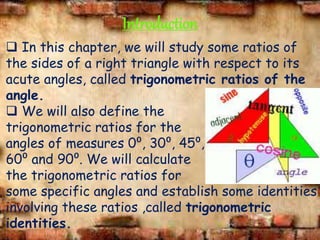
 In this chapter, we will study some ratios of
the sides of a right triangle with respect to its
acute angles, called trigonometric ratios of the
angle.
 We will also define the
trigonometric ratios for the
angles of measures 0⁰, 30⁰, 45⁰,
60⁰ and 90⁰. We will calculate
the trigonometric ratios for
some specific angles and establish some identities
involving these ratios ,called trigonometric
identities.
What is trigonometry?
 Trigonometry is a branch of mathematics dealing
with the relations of the sides and angles of triangles
and with the relevant functions of any
angles.
 The word “trigonometry” is derived
from the Greek words ‘tri’ meaning three,
‘gon’ meaning sides and ‘metron’ meaning
measure.
 The distances or heights can be easily
found out by using ‘trigonometry’.
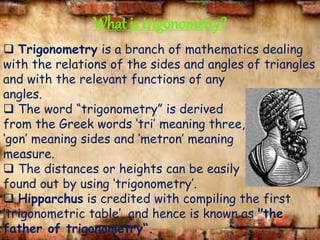
 Hipparchus is credited with compiling the first
‘trigonometric table’, and hence is known as "the
father of trigonometry“.
History
The first use of the idea of ‘sine’ in the way we
use it today was in the work Aryabhatiyam by
Aryabhatta, in A.D. 500. Aryabhatta
used the word ardha-jya for the half-
chord, which was shortened to jya or
jiva in due course. The word jiva was
translated into sinus, which means
curve, when the Arabic version was
translated into Latin. Soon the word sinus, also
used as sine, became common in mathematical
texts throughout Europe.
History
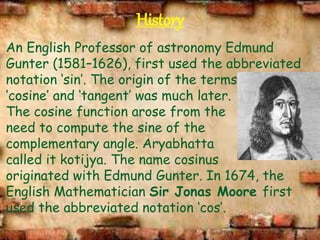
An English Professor of astronomy Edmund
Gunter (1581–1626), first used the abbreviated
notation ‘sin’. The origin of the terms
‘cosine’ and ‘tangent’ was much later.
The cosine function arose from the
need to compute the sine of the
complementary angle. Aryabhatta
called it kotijya. The name cosinus
originated with Edmund Gunter. In 1674, the
English Mathematician Sir Jonas Moore first
used the abbreviated notation ‘cos’.
Trigonometric ratios
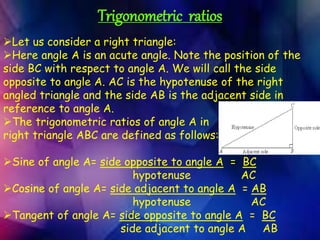
Let us consider a right triangle:
Here angle A is an acute angle. Note the position of the
side BC with respect to angle A. We will call the side
opposite to angle A. AC is the hypotenuse of the right
angled triangle and the side AB is the adjacent side in
reference to angle A.
The trigonometric ratios of angle A in
right triangle ABC are defined as follows:
Sine of angle A= side opposite to angle A = BC
hypotenuse AC
Cosine of angle A= side adjacent to angle A = AB
hypotenuse AC
Tangent of angle A= side opposite to angle A = BC
side adjacent to angle A AB
Trigonometric ratios
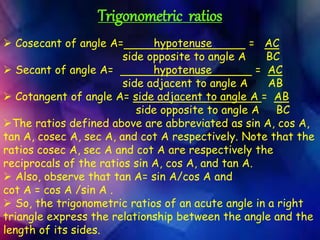
 Cosecant of angle A= hypotenuse = AC
side opposite to angle A BC
 Secant of angle A= hypotenuse = AC
side adjacent to angle A AB
 Cotangent of angle A= side adjacent to angle A = AB
side opposite to angle A BC
The ratios defined above are abbreviated as sin A, cos A,
tan A, cosec A, sec A, and cot A respectively. Note that the
ratios cosec A, sec A and cot A are respectively the
reciprocals of the ratios sin A, cos A, and tan A.
 Also, observe that tan A= sin A/cos A and
cot A = cos A /sin A .
 So, the trigonometric ratios of an acute angle in a right
triangle express the relationship between the angle and the
length of its sides.
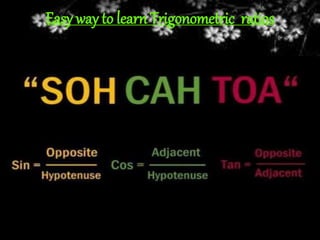
Easy way to learn Trigonometric ratios
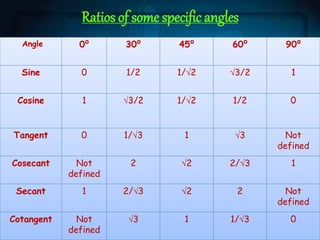
Ratios of some specific angles
Angle 0⁰ 30⁰ 45⁰ 60⁰ 90⁰
Sine 0 1/2 1/2 3/2 1
Cosine 1 3/2 1/2 1/2 0
Tangent 0 1/3 1 3 Not
defined
Cosecant Not
defined
2 2 2/3 1
Secant 1 2/3 2 2 Not
defined
Cotangent Not
defined
3 1 1/3 0
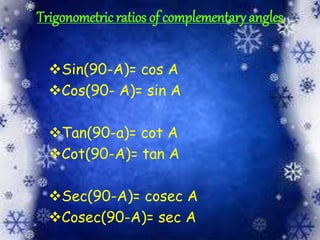
Trigonometric ratios of complementary angles
Sin(90-A)= cos A
Cos(90- A)= sin A
Tan(90-a)= cot A
Cot(90-A)= tan A
Sec(90-A)= cosec A
Cosec(90-A)= sec A
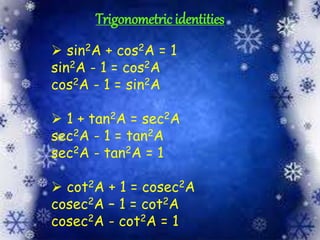
Trigonometric identities
 sin2A + cos2A = 1
sin2A - 1 = cos2A
cos2A - 1 = sin2A
 1 + tan2A = sec2A
sec2A - 1 = tan2A
sec2A - tan2A = 1
 cot2A + 1 = cosec2A
cosec2A – 1 = cot2A
cosec2A - cot2A = 1
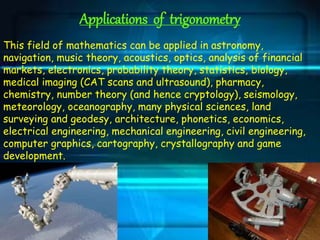
Applications of trigonometry
This field of mathematics can be applied in astronomy,
navigation, music theory, acoustics, optics, analysis of financial
markets, electronics, probability theory, statistics, biology,
medical imaging (CAT scans and ultrasound), pharmacy,
chemistry, number theory (and hence cryptology), seismology,
meteorology, oceanography, many physical sciences, land
surveying and geodesy, architecture, phonetics, economics,
electrical engineering, mechanical engineering, civil engineering,
computer graphics, cartography, crystallography and game
development.
Applications of trigonometry in astronomy
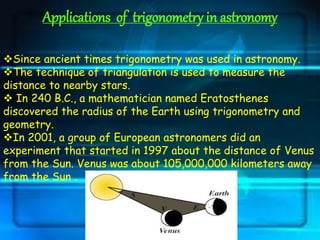
Since ancient times trigonometry was used in astronomy.
The technique of triangulation is used to measure the
distance to nearby stars.
 In 240 B.C., a mathematician named Eratosthenes
discovered the radius of the Earth using trigonometry and
geometry.
In 2001, a group of European astronomers did an
experiment that started in 1997 about the distance of Venus
from the Sun. Venus was about 105,000,000 kilometers away
from the Sun .
Applications of trigonometry in architecture
Many modern buildings have beautifully curved surfaces.
Making these curves out of steel, stone, concrete or glass is
extremely difficult, but not impossible.
One way around to address this problem is to piece the
surface together out of many flat panels, each sitting at an
angle to the one next to it, so that all together they create
what looks like a curved surface. The more regular these
shapes, the easier the building process.
 Regular flat shapes can be made out of triangles, and so
trigonometry plays an important role in architecture.
conclusion
 Trigonometry is a branch of mathematics
with several useful and important
applications.
 Hence, it attracts more and more
researches with several theories published
year after year.
Introduction to trigonometry

Introduction to trigonometry

  • 1.
    Introduction to trigonometry MadeBy- Pranav Ahlawat, class X-A, 4540/RH Mathematics Holiday Assignment
  • 2.
    Contents  Introduction  Whatis trigonometry?  History  Trigonometric ratios.  Easy way to learn trigonometric ratios.  Ratios of some specific angles.  Trigonometric ratios of complementary angles.  Trigonometric identities.  Applications of trigonometry.  Applications of trigonometry in astronomy.  Applications of trigonometry in architecture.
  • 3.
    Introduction  In thischapter, we will study some ratios of the sides of a right triangle with respect to its acute angles, called trigonometric ratios of the angle.  We will also define the trigonometric ratios for the angles of measures 0⁰, 30⁰, 45⁰, 60⁰ and 90⁰. We will calculate the trigonometric ratios for some specific angles and establish some identities involving these ratios ,called trigonometric identities.
  • 4.
    What is trigonometry? Trigonometry is a branch of mathematics dealing with the relations of the sides and angles of triangles and with the relevant functions of any angles.  The word “trigonometry” is derived from the Greek words ‘tri’ meaning three, ‘gon’ meaning sides and ‘metron’ meaning measure.  The distances or heights can be easily found out by using ‘trigonometry’.  Hipparchus is credited with compiling the first ‘trigonometric table’, and hence is known as "the father of trigonometry“.
  • 5.
    History The first useof the idea of ‘sine’ in the way we use it today was in the work Aryabhatiyam by Aryabhatta, in A.D. 500. Aryabhatta used the word ardha-jya for the half- chord, which was shortened to jya or jiva in due course. The word jiva was translated into sinus, which means curve, when the Arabic version was translated into Latin. Soon the word sinus, also used as sine, became common in mathematical texts throughout Europe.
  • 6.
    History An English Professorof astronomy Edmund Gunter (1581–1626), first used the abbreviated notation ‘sin’. The origin of the terms ‘cosine’ and ‘tangent’ was much later. The cosine function arose from the need to compute the sine of the complementary angle. Aryabhatta called it kotijya. The name cosinus originated with Edmund Gunter. In 1674, the English Mathematician Sir Jonas Moore first used the abbreviated notation ‘cos’.
  • 7.
    Trigonometric ratios Let usconsider a right triangle: Here angle A is an acute angle. Note the position of the side BC with respect to angle A. We will call the side opposite to angle A. AC is the hypotenuse of the right angled triangle and the side AB is the adjacent side in reference to angle A. The trigonometric ratios of angle A in right triangle ABC are defined as follows: Sine of angle A= side opposite to angle A = BC hypotenuse AC Cosine of angle A= side adjacent to angle A = AB hypotenuse AC Tangent of angle A= side opposite to angle A = BC side adjacent to angle A AB
  • 8.
    Trigonometric ratios  Cosecantof angle A= hypotenuse = AC side opposite to angle A BC  Secant of angle A= hypotenuse = AC side adjacent to angle A AB  Cotangent of angle A= side adjacent to angle A = AB side opposite to angle A BC The ratios defined above are abbreviated as sin A, cos A, tan A, cosec A, sec A, and cot A respectively. Note that the ratios cosec A, sec A and cot A are respectively the reciprocals of the ratios sin A, cos A, and tan A.  Also, observe that tan A= sin A/cos A and cot A = cos A /sin A .  So, the trigonometric ratios of an acute angle in a right triangle express the relationship between the angle and the length of its sides.
  • 9.
    Easy way tolearn Trigonometric ratios
  • 10.
    Ratios of somespecific angles Angle 0⁰ 30⁰ 45⁰ 60⁰ 90⁰ Sine 0 1/2 1/2 3/2 1 Cosine 1 3/2 1/2 1/2 0 Tangent 0 1/3 1 3 Not defined Cosecant Not defined 2 2 2/3 1 Secant 1 2/3 2 2 Not defined Cotangent Not defined 3 1 1/3 0
  • 11.
    Trigonometric ratios ofcomplementary angles Sin(90-A)= cos A Cos(90- A)= sin A Tan(90-a)= cot A Cot(90-A)= tan A Sec(90-A)= cosec A Cosec(90-A)= sec A
  • 12.
    Trigonometric identities  sin2A+ cos2A = 1 sin2A - 1 = cos2A cos2A - 1 = sin2A  1 + tan2A = sec2A sec2A - 1 = tan2A sec2A - tan2A = 1  cot2A + 1 = cosec2A cosec2A – 1 = cot2A cosec2A - cot2A = 1
  • 13.
    Applications of trigonometry Thisfield of mathematics can be applied in astronomy, navigation, music theory, acoustics, optics, analysis of financial markets, electronics, probability theory, statistics, biology, medical imaging (CAT scans and ultrasound), pharmacy, chemistry, number theory (and hence cryptology), seismology, meteorology, oceanography, many physical sciences, land surveying and geodesy, architecture, phonetics, economics, electrical engineering, mechanical engineering, civil engineering, computer graphics, cartography, crystallography and game development.
  • 14.
    Applications of trigonometryin astronomy Since ancient times trigonometry was used in astronomy. The technique of triangulation is used to measure the distance to nearby stars.  In 240 B.C., a mathematician named Eratosthenes discovered the radius of the Earth using trigonometry and geometry. In 2001, a group of European astronomers did an experiment that started in 1997 about the distance of Venus from the Sun. Venus was about 105,000,000 kilometers away from the Sun .
  • 15.
    Applications of trigonometryin architecture Many modern buildings have beautifully curved surfaces. Making these curves out of steel, stone, concrete or glass is extremely difficult, but not impossible. One way around to address this problem is to piece the surface together out of many flat panels, each sitting at an angle to the one next to it, so that all together they create what looks like a curved surface. The more regular these shapes, the easier the building process.  Regular flat shapes can be made out of triangles, and so trigonometry plays an important role in architecture.
  • 16.
    conclusion  Trigonometry isa branch of mathematics with several useful and important applications.  Hence, it attracts more and more researches with several theories published year after year.