Chapter 1 Trigonometry
1
1 TRIGONOMETRY
Objectives
After studying this chapter you should
• be able to handle with confidence a wide range of
trigonometric identities;
• be able to express linear combinations of sine and cosine in
any of the forms Rsin θ ± α( ) or Rcos θ ± α( );
• know how to find general solutions of trigonometric equations;
• be familiar with inverse trigonometric functions and the
associated calculus.
1.0 Introduction
In the first Pure Mathematics book in this series, you will have
encountered many of the elementary results concerning the
trigonometric functions. These will, by and large, be taken as
read in this chapter. However, in the first few sections there is
some degree of overlap between the two books: this will be good
revision for you.
1.1 Sum and product formulae
You may recall that
sin A + B( ) = sin Acos B + cos Asin B
sin A − B( ) = sin Acos B − cos Asin B
Adding these two equations gives
sin A + B( )+ sin A − B( ) = 2sin Acos B (1)
Let C = A + B and D = A − B,
then C + D = 2A and C − D = 2B. Hence
A =
C + D
2
, B =
C − D
2
and (1) can be written as
Chapter 1 Trigonometry
2
sin C + sin D = 2sin C + D
2




cos C − D
2




This is more easily remembered as
'sine plus sine = twice sine half the sum( )cos half the difference( )'
Activity 1
In a similar way to above, derive the formulae for
(a) sinC − sin D (b) cosC + cos D (c) cosC − cos D
By reversing these formulae, write down further formulae for
(a) 2sin E cos F (b) 2cos E cos F (c) 2sin Esin F
Example
Show that cos59°+sin59°= 2 cos14°.
Solution
Firstly, sin59°= cos31°, since sinθ = cos 90 − θ( )
So LHS = cos59°+ cos31°
= 2cos
59 + 31
2





 cos
59 − 31
2






= 2cos45°×cos14°
= 2 ×
2
2
cos14°
= 2 cos14°
= RHS
Example
Prove that sin x + sin2x + sin3x = sin2x 1+ 2cos x( ).
Solution
LHS = sin2x + sin x + sin3x( )
= sin2x + 2sin
3x + x
2




cos
3x − x
2




= sin2x + 2sin2x cos x
= sin2x 1+ 2cos x( )
Chapter 1 Trigonometry
3
Example
Write cos4x cos x − sin6xsin3x as a product of terms.
Solution
Now cos4x cos x =
1
2
cos 4x + x( )+ cos 4x − x( ){ }
=
1
2
cos5x +
1
2
cos3x
and sin6x sin3x =
1
2
cos 6x − 3x( )− cos 6x + 3x( ){ }
=
1
2
cos3x −
1
2
cos9x
Thus, LHS =
1
2
cos5x +
1
2
cos3x −
1
2
cos3x +
1
2
cos9x
=
1
2
(cos5x + cos9x)
=
1
2
× 2cos
5x + 9x
2




cos
5x − 9x
2




= cos7x cos2x
The sum formulae are given by
sin A + sin B = 2sin
A + B
2




cos
A − B
2




sin A − sin B = 2cos
A + B
2




sin
A − B
2




cos A + cos B = 2cos
A + B
2




cos
A − B
2




cos A − cos B = –2sin
A + B
2




sin
A − B
2




and the product formulae by
sin Acos B =
1
2
(sin(A + B) + sin(A − B))
cos Acos B =
1
2
(cos(A + B) + cos(A − B))
sin Asin B =
1
2
(cos(A − B) − cos(A + B))
Chapter 1 Trigonometry
4
Exercise 1A
1. Write the following expressions as products:
(a) cos5x − cos3x (b) sin11x − sin7x
(c) cos2x + cos9x (d) sin3x + sin13x
(e) cos
2π
15
+ cos
14π
15
+ cos
4π
15
+ cos
8π
15
(f) sin40°+sin50°+sin60°
(g) cos114°+sin24°
2. Evaluate in rational/surd form
sin75°+sin15°
3. Write the following expressions as sums or
differences:
(a) 2cos7xcos5x
(b) 2cos
1
2
x





 cos
5x
2






(c) 2sin
π
4
− 3θ



cos
π
4
+ θ



(d) 2sin165°cos105°
1.2 Linear combinations of sin
and cos
Expressions of the form acosθ + bsinθ , for constants a and b,
involve two trig functions which, on the surface, makes them
difficult to handle. After working through the following
activity, however, you should be able to see that such
expressions (called linear combinations of sin and cos – linear
since they involve no squared terms or higher powers) can be
written as a single trig function. By re-writing them in this way
you can deduce many results from the elementary properties of
the sine or cosine function, and solve equations, without having
to resort to more complicated techniques.
For this next activity you will find it very useful to have a graph
plotting facility. Remember, you will be working in radians.
Activity 2
Sketch the graph of a function of the form
y = asin x + bcos x
(where a and b are constants) in the range −π ≤ x ≤ π .
4. Establish the following identities:
(a) cosθ − cos3θ = 4sin
2
θ cosθ
(b) sin6x + sin4x − sin2x = 4cos3xsin2xcosx
(c)
2sin4A + sin6A + sin2A
2sin4A − sin6A − sin2A
= cot
2
A
(d)
sin A + B( )+ sin A − B( )
cos A + B( )+ cos A − B( )
= tan A
(e)
cos θ + 30°( )+ cos θ + 60°( )
sin θ + 30°( )+ sin θ + 60°( )
=
1− tanθ
1+ tanθ
5. Write cos12x + cos6x + cos4x + cos2x as a product
of terms.
6. Express cos3xcos x − cos7xcos5x as a product of
terms.
Chapter 1 Trigonometry
5
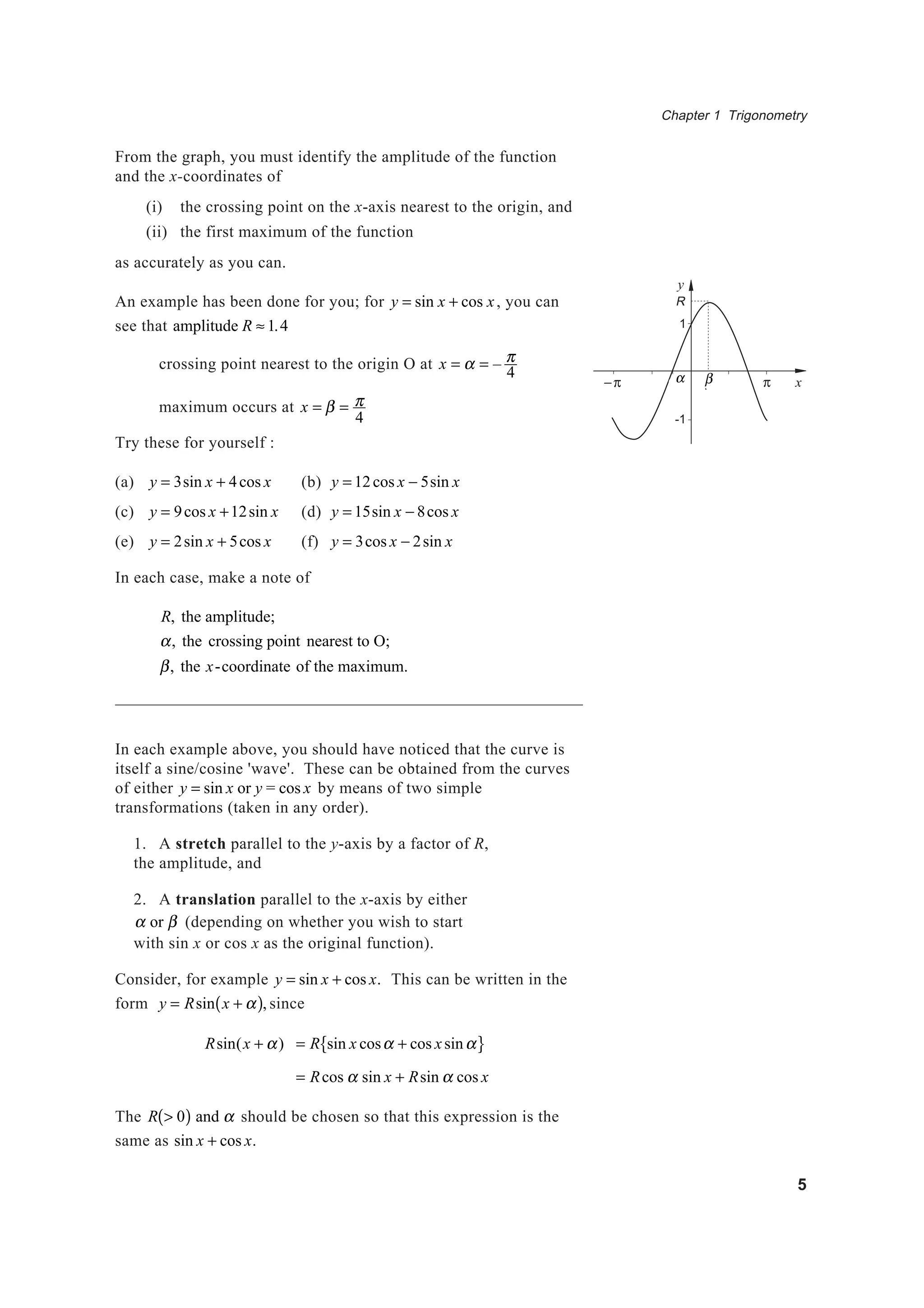
From the graph, you must identify the amplitude of the function
and the x-coordinates of
(i) the crossing point on the x-axis nearest to the origin, and
(ii) the first maximum of the function
as accurately as you can.
An example has been done for you; for y = sin x + cos x, you can
see that amplitude R ≈ 1.4
crossing point nearest to the origin O at x = α = – π
4
maximum occurs at x = β = π
4
Try these for yourself :
(a) y = 3sin x + 4cos x (b) y = 12cos x − 5sin x
(c) y = 9cos x +12sin x (d) y = 15sin x − 8cos x
(e) y = 2sin x + 5cos x (f) y = 3cos x − 2sin x
In each case, make a note of
R, the amplitude;
α, the crossing point nearest to O;
β, the x-coordinate of the maximum.
In each example above, you should have noticed that the curve is
itself a sine/cosine 'wave'. These can be obtained from the curves
of either y = sin x or y = cos x by means of two simple
transformations (taken in any order).
1. A stretch parallel to the y-axis by a factor of R,
the amplitude, and
2. A translation parallel to the x-axis by either
α or β (depending on whether you wish to start
with sin x or cos x as the original function).
Consider, for example y = sin x + cos x. This can be written in the
form y = Rsin x + α( ), since
Rsin(x + α) = R sin x cosα + cos xsinα{ }
= Rcos α sin x + Rsin α cos x
The R > 0( ) and α should be chosen so that this expression is the
same as sin x + cos x.
−π π x
y
1
-1
R
βα
R
α β
Chapter 1 Trigonometry
6
Thus
Rcosα =1 and Rsinα =1
Dividing these terms gives
tanα =1⇒ α =
π
4
Squaring and adding the two terms gives
R2
cos2
α + R2
sin2
α = 12
+12
R2
cos2
α + sin2
α( ) = 2
Since cos2
α + sin2
α = 1,
R2
= 2 ⇒ R = 2
Thus
sin x + cos x = 2 sin x +
π
4




Activity 3
Express the function sin x + cos x in the form
sin x + cos x = Rcos(x − α)
Find suitable values for R and α using the method shown above.
Another way of obtaining the result in Activity 3 is to note that
sinθ = cos
π
2
− θ



so that
sin x + cos x = 2 sin x +
π
4




= 2 cos
π
2
− x +
π
4










= 2 cos
π
4
− x



= 2 cos x −
π
4




since cos(−θ) = cosθ.
Chapter 1 Trigonometry
7
Example
Write 7sin x − 4cos x in the form Rsin x − α( )
where R > 0 and 0 < α < π
2 .
Solution
Assuming the form of the result,
7sin x − 4cos x = Rsin(x − α)
= Rsin xcosα − Rcos xsinα
To satisfy the equation, you need
Rcosα = 7
Rsinα = 4
Squaring and adding, as before, gives
R = 7
2
+ 4
2
= 65
Thus
cosα =
7
65
, sinα =
4
65
or tanα =
4
7




⇒ α = 0.519 radians, to 3 sig. figs.
so 7sin x − 4cos x = 65 sin(x − 0.519)
Exercise 1B
Write (in each case, R > 0 and 0 < α < π
2 )
1. 3sin x + 4cosx in the form Rsin(x + α)
2. 4cos x + 3sin x in the form Rcos x − α( )
3. 15sin x − 8cos x in the form Rsin x − α( )
4. 6cosx − 2sin x in the form Rcos x + α( )
5. 20sin x − 21cosx in the form Rsin x − α( )
6. 14cosx + sin x in the form Rcos x − α( )
7. 2cos2x − sin2x in the form Rcos 2x + α( )
8. 3cos 1
2 x + 5sin 1
2 x in the form Rsin 1
2 x + α( )
Chapter 1 Trigonometry
8
1.3 Linear trigonometric
equations
In this section you will be looking at equations of the form
acos x + bsin x = c
for given constants a, b and c.
Example
Solve 3cos x + sin x = 2 for 0°≤ x ≤ 360°.
Solution
Method 1
Note that cos2
x and sin2
x are very simply linked using
cos2
x + sin2
x = 1 so a 'rearranging and squaring' approach
would seem in order.
Rearranging: 3cos x = 2 − sin x
Squaring: 9cos2
x = 4 − 4sin x + sin2
x
⇒ 9 1− sin2
x( )= 4 − 4sin x + sin2
x
⇒ 0 = 10sin2
x − 4sin x − 5
The quadratic formula now gives sin x =
4 ± 216
20
and sin x ≈ 0.93485 or − 0.534847
giving x = 69.2°,110.8° or 212.3°, 327.7° (1 d.p.)
Method 2
Write 3cos x + sin x as Rcos x − α( ) (or Rsin x − α( ))
3cos x + sin x = Rcos x − α( )
Firstly, R = 32
+12
= 10
so 3cos x + sin x = 10
3
10
cos x +
1
10
sin x






≡ 10 cos x cosα + sin xsinα( )
Chapter 1 Trigonometry
9
Thus cosα =
3
10
or sinα =
7
10
or tanα =
1
3





 => α = 18.43°
The equation 3cos x + sin x = 2 can now be written as
10 cos x −18.43°( ) = 2
⇒ cos x −18.43°( ) =
2
10
⇒ x −18.43°= cos−1 2
10






⇒ x −18.43°= 50.77° or 309.23°
and
x = 50.77°+18.43° or 309.23°+18.43°
x = 69.2° or 327.7° (1 d.p.)
The question now arises as to why one method yields four answers,
the other only two. If you check all four answers you will find that
the two additional solutions in Method 1 do not fit the equation
3cos x + sin x = 2. They have arisen as extra solutions created by
the squaring process. (Think of the difference between the
equations x = 2 and x2
= 4: the second one has two solutions.) If
Method 1 is used, then the final answers always need to be checked
in order to discard the extraneous solutions.
Exercise 1C
1. By writing 7sin x + 6cosx in the form
Rsin x + α( ) R > 0,0°< α < 90°( ) solve the equation
7sin x + 6cosx = 9 for values of x between
0° and 360° .
2. Use the 'rearranging and squaring' method to solve
(a) 4cosθ + 3sinθ = 2
(b) 3sinθ − 2cosθ = 1
for 0°≤ θ ≤ 360° .
3. Write 3 cosθ + sinθ as Rcos θ − α( ),
where R > 0and 0 < α <
π
2
and hence solve
3 cosθ + sinθ = 2 for 0 ≤ θ ≤ 2π .
4. Solve
(a) 7cos x − 6sin x = 4 for −180°≤ x ≤180°
(b) 6sinθ + 8cosθ = 7 for 0°≤ θ ≤180°
(c) 4cos x + 2sin x = 5 for 0°≤ x ≤ 360°
(d) sec x + 5tan x +12 = 0 for 0 ≤ x ≤ 2π
Chapter 1 Trigonometry
10
1.4 More demanding equations
In this section you will need to keep in mind all of the identities
that you have encountered so far – including the Addition
Formulae, the Sum and Product Formulae and the Multiple
Angle Identities – in order to solve the given equations.
Example
Solve cos5θ + cosθ = cos3θ for 0°≤ θ ≤180°
Solution
Using cos A + cos B = 2cos
A + B
2




cos
A − B
2




LHS = 2cos3θ cos2θ
Thus 2cos3θ cos2θ = cos3θ
⇒ cos3θ 2cos2θ −1( ) = 0
Then
(a) cos3θ = 0
⇒ 3θ = 90°, 270°, 450°
⇒ θ = 30°, 90°,150°
or
(b) 2cos2θ −1 = 0
⇒ cos2θ = 1
2
⇒ 2θ = 60°, 300°
⇒ θ = 30°,150° as already found.
Solutions are θ = 30°(twice), 90°,150°(twice).
[Remember, for final solutions in range 0°≤ θ ≤ 180°, solutions
for 3θ must be in range 0°≤ θ ≤ 3 ×180°= 540°.]
Exercise 1D
1. Solve for 0°≤ θ ≤180° :
(a) cosθ + cos3θ = 0 (b) sin4θ + sin3θ = 0
(c) sinθ + sin3θ = sin2θ .
2. Find all the values of x satisfying the equation
sin x = 2sin
π
3
− x



for 0 ≤ x ≤ 2π .
Chapter 1 Trigonometry
11
3. By writing 3θ as 2θ + θ , show that
cos3θ = 4cos3
θ − 3cosθ
and find a similar expresion for sin3θ in terms of
powers of sinθ only.
Use these results to solve, for 0 ≤ θ ≤ 360° ,
(a) cos3θ + 2cosθ = 0
(b) sin3θ = 3sin2θ
(c) cosθ − cos3θ = tan2
θ
4. Show that tan x + cot x = 2cosec2x . Hence solve
tan x + cot x = 8cos2x for 0 ≤ x ≤ π .
5. Solve the equation
sin2x + sin3x + sin5x = 0 for 0°≤ x ≤180°
1.5 The inverse trigonometric
functions
In the strictest sense, for a function f to have an inverse it has to
be 1–1 ('one-to-one'). Now the three trigonometric functions
sine, cosine and tangent are each periodic. Thus the equation
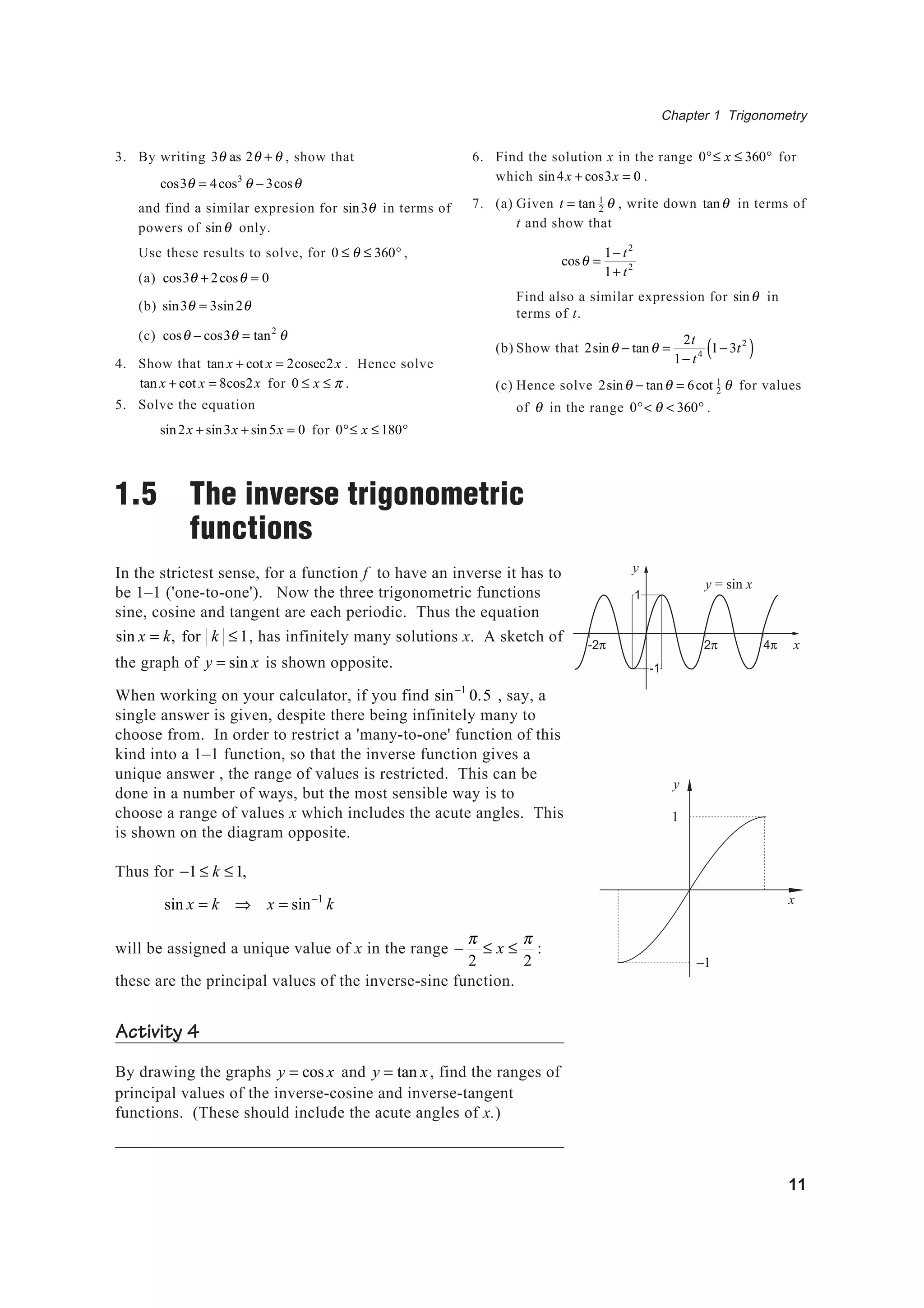
sin x = k, for k ≤1, has infinitely many solutions x. A sketch of
the graph of y = sin x is shown opposite.
When working on your calculator, if you find sin−1
0.5 , say, a
single answer is given, despite there being infinitely many to
choose from. In order to restrict a 'many-to-one' function of this
kind into a 1–1 function, so that the inverse function gives a
unique answer , the range of values is restricted. This can be
done in a number of ways, but the most sensible way is to
choose a range of values x which includes the acute angles. This
is shown on the diagram opposite.
Thus for −1 ≤ k ≤ 1,
sin x = k ⇒ x = sin−1
k
will be assigned a unique value of x in the range −
π
2
≤ x ≤
π
2
:
these are the principal values of the inverse-sine function.
Activity 4
By drawing the graphs y = cos x and y = tan x, find the ranges of
principal values of the inverse-cosine and inverse-tangent
functions. (These should include the acute angles of x.)
6. Find the solution x in the range 0°≤ x ≤ 360° for
which sin4x + cos3x = 0 .
7. (a) Given t = tan 1
2 θ , write down tanθ in terms of
t and show that
cosθ =
1− t2
1+ t2
Find also a similar expression for sinθ in
terms of t.
(b) Show that 2sinθ − tanθ =
2t
1− t4
1− 3t2
( )
(c) Hence solve 2sinθ − tanθ = 6cot 1
2 θ for values
of θ in the range 0°< θ < 360° .
y = sin x
2π 4π-2π x
y
1
-1
y
x
1
–1
Chapter 1 Trigonometry
12
Note that the inverse functions are denoted here by
sin−1
x, cos−1
, tan−1
x
These are not the same as
sin x( )−1
=
1
sin x
, etc.
and to avoid this confusion, some texts denote the inverse
functions as
arcsin x, arccos x, arctan x.
1.6 General solutions
Up until now you have been asked for solutions of trigonometric
equations within certain ranges. For example:
Solve sin3x = 1
2 for 0°< x <180°
or
Find the values of θ for which sin2θ + sin2
θ = 0
with 0 ≤ θ ≤ 2π .
At the same time, you will have been aware that even the simplest
trig equation can have infinitely many solutions: sinθ = 0
(θ radians) is true when θ = 0, π, 2π,3π,K and also for all
negative multiples of π as well.
Overall, one could say that the equation sinθ = 0 has general
solution θ = n π where n is an integer. Moreover, there are no
values of θ which satisfy this equation that do not take this form.
Thus, 'θ = n π ' describes all the values of θ satisfying 'sinθ = 0 '
as n is allowed to take any integer value. This is what is meant by
a general solution.
General solution for the cosine function
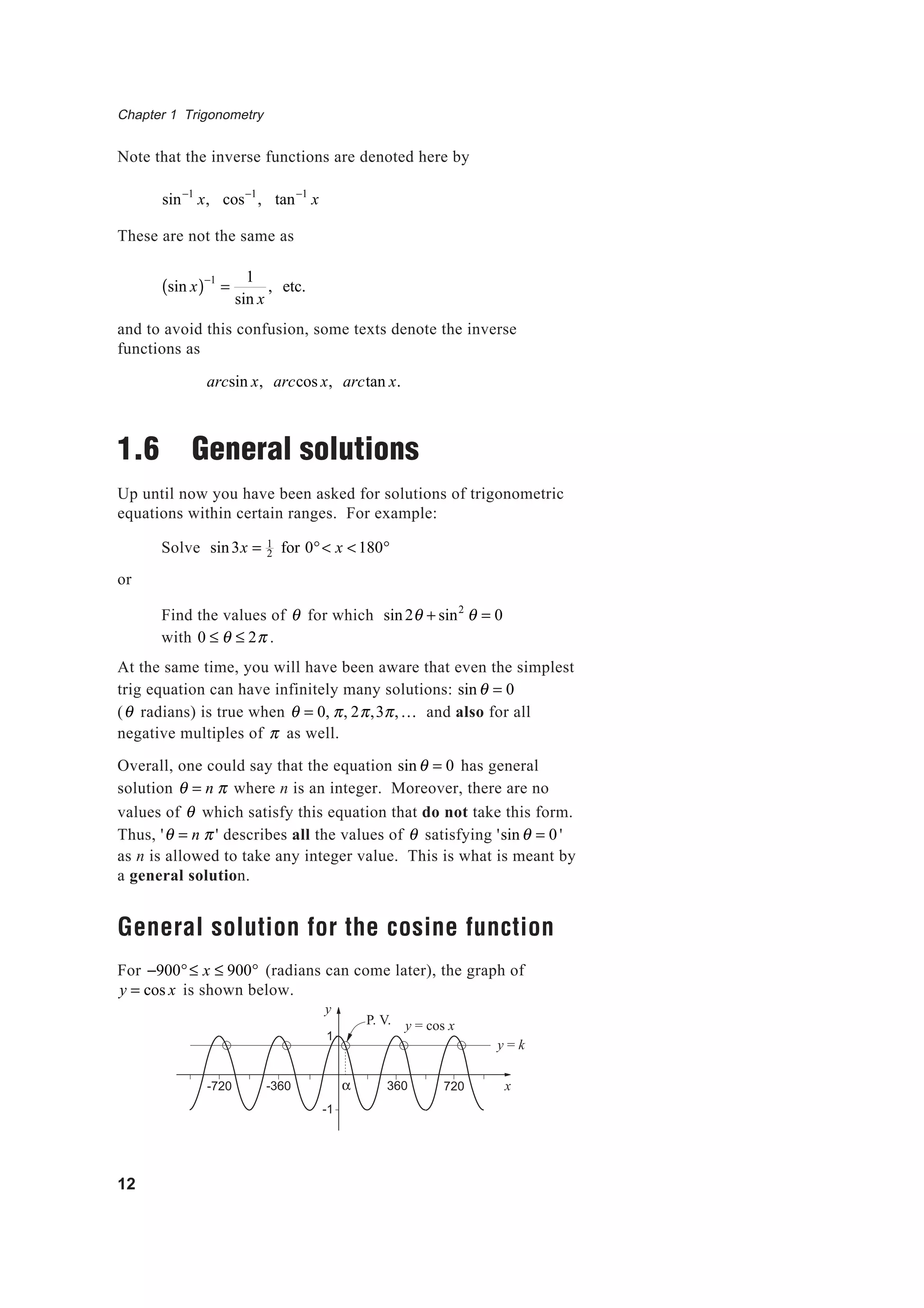
For −900°≤ x ≤ 900° (radians can come later), the graph of
y = cos x is shown below.
y = cos x
360 720-360 x
y
1
-1
-720
y = k
P. V.
α
Chapter 1 Trigonometry
13
The line y = k (k is chosen as positive here, but as long as
−1 ≤ k ≤ 1, the actual value is immaterial) is also drawn on the
sketch.
The principal value of x for which x = cos−1
k (representing the
point when y = k and y = cos x intersect) is circled and labelled
'P.V.' Since the cosine function is periodic with period 360°, all
other solutions to the equation cos x = k corresponding to this
principal value are obtained by adding, or subtracting, a
multiple of 360° to it. The points of intersection of the two
graphs representing these solutions are circled also.
Now the cosine curve here is symmetric in the y-axis. So if α is
the principal value of x for which cos x = k , then −α is also a
solution, and this is not obtained by adding, or subtracting, a
multiple of 360° to, or from, α . All the remaining solutions of
the equation can be obtained by adding or subtracting a multiple
of 360° to or from −α .
The general solution of the equation
cos x = k −1 ≤ k ≤ 1( )
is then x = 360n ± α
where α = cos−1
k
is the principal value of the inverse cosine function and n is an
integer.
In radians, using 360°≡ 2π radians, the general solution looks
like
x = 2nπ ± α , n an integer.
Activity 5
Use the graphs of y = tan x and y = sin x to find the general
solutions of the equations (in degrees) of the equations
tan x = k −∞ < k < ∞( )
and
sin x = k −1 ≤ k ≤ 1( ).
In each case, let α be the principal value concerned, let n be an
integer, and express the general solutions in terms of radians
once the results have been found in terms of degrees.
Chapter 1 Trigonometry
14
These results are summarised as follows:
In radians In degrees
If sinθ = sinα , then If sinθ = sinα , then
θ = nπ + −1( )n
α θ = 180n + −1( )n
α
If cosθ = cosα , then If cosθ = cosα , then
θ = 2nπ ± α θ = 360n ± α
If tanθ = tanα , then If tanθ = tanα , then
θ = nπ + α θ = 180n + α
[In each case, n is an integer.]
The AEB's Booklet of Formulae gives only the set of results for
θ, α in radians, but you should be able to convert the results into
degrees without any difficulty by remembering that
180°≡ π radians, etc.
Example
Find the general solution, in degrees, of the equation
tan3θ = 3
Solution
tan3θ = 3
⇒ tan3θ = tan60°
⇒ 3θ = 180n + 60 quoting the above result
⇒ θ = 60n + 20( )°
[K; n = −1⇒θ = −40°; n = 0 ⇒ θ = 20°; n = 1⇒ 0 = 80°;K]
Sometimes, you may have to do some work first.
Example
Find the general solution, in radians, of the equation
8sinθ +15cosθ = 6.
Chapter 1 Trigonometry
15
Solution
Rewriting the LHS of this equation in the form Rsin θ + α( ), for
instance, gives R = 82
+152
= 17 and cosθ =
8
17
or sinθ =
15
17
or tanθ =
15
8
so that θ ≈ 1.081 radians. [Check this working
through to make sure you can see where it comes from.]
The equation can now be written as
17sin θ +1.081( ) = 6
⇒ sin θ +1.081( ) =
6
17
= sin 0.3607
⇒ θ +1.081 = nπ + −1( )n
0.3607
⇒ θ = nπ + −1( )n
0.3607 −1.081
One could proceed to make this more appealing to the eye by
considering the cases n even and n odd separately, but there is
little else to be gained by proceeding in this way.
Note on accuracy: although final, non-exact numerical answers
are usually required to three significant places, the 0.3607 and
1.081 in the answer above are really intermediate answers and
hence are given to 4 significant figure accuracy. However,
unless a specific value of n is to be substituted in order to
determine an individual value of θ , you will not be penalised
for premature rounding provided your working is clear and the
answers correspond appropriately.
This final example illustrates the sort of ingenuity you might
have to employ in finding a general solution of some equation.
Example
Find the values of x for which cos x − sin 4x = 0.
Solution
Using the result sin A = cos
π
2
− A



, the above equation can be
written as
cos x = cos
π
2
− 4x



whence
x = 2nπ ±
π
2
− 4x



(principal value of sin−1 6
17
)
Chapter 1 Trigonometry
16
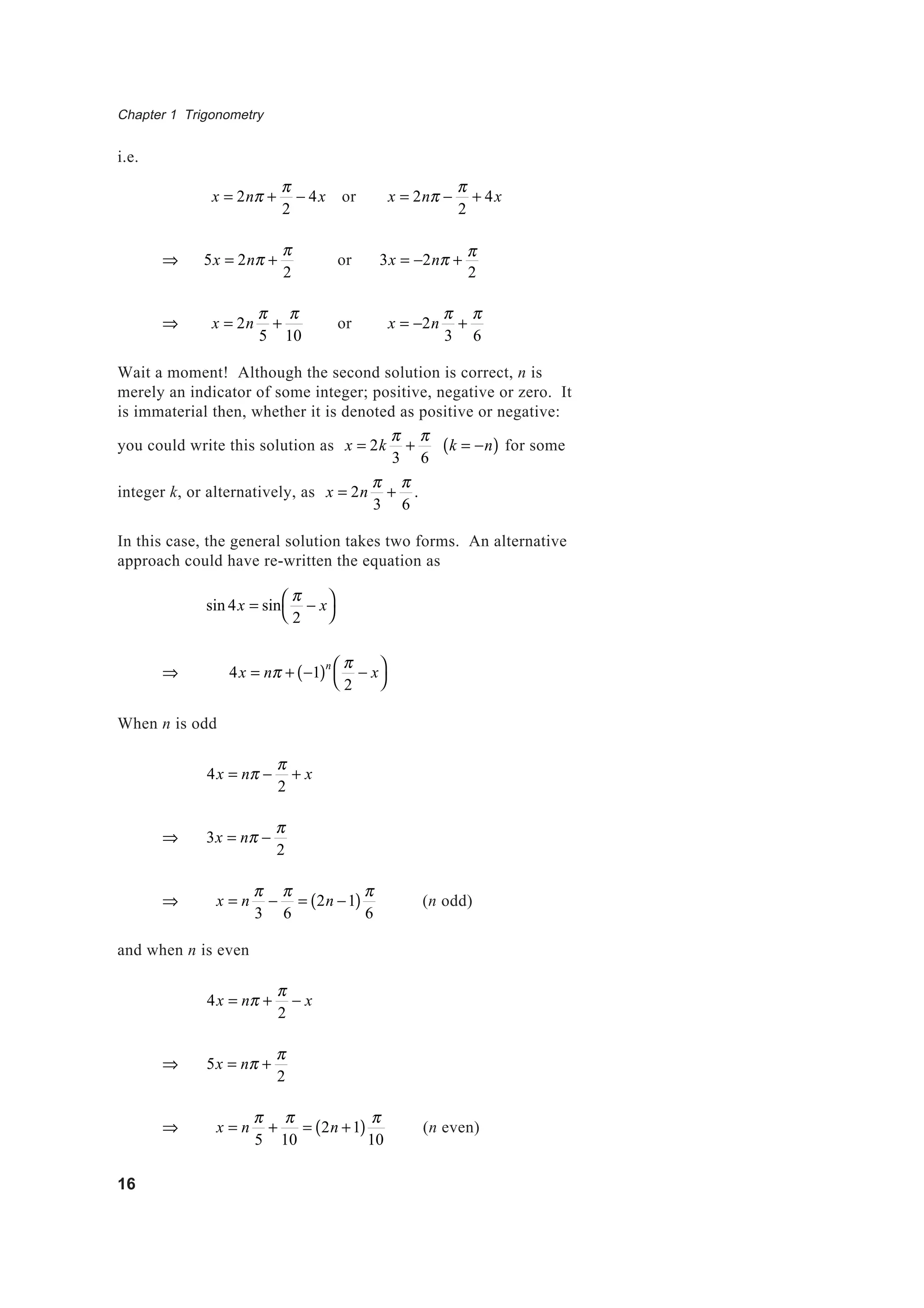
i.e.
x = 2nπ +
π
2
− 4x or x = 2nπ −
π
2
+ 4x
⇒ 5x = 2nπ +
π
2
or 3x = −2nπ +
π
2
⇒ x = 2n
π
5
+
π
10
or x = −2n
π
3
+
π
6
Wait a moment! Although the second solution is correct, n is
merely an indicator of some integer; positive, negative or zero. It
is immaterial then, whether it is denoted as positive or negative:
you could write this solution as x = 2k
π
3
+
π
6
k = −n( ) for some
integer k, or alternatively, as x = 2n
π
3
+
π
6
.
In this case, the general solution takes two forms. An alternative
approach could have re-written the equation as
sin 4x = sin
π
2
− x



⇒ 4x = nπ + −1( )n π
2
− x



When n is odd
4x = nπ −
π
2
+ x
⇒ 3x = nπ −
π
2
⇒ x = n
π
3
−
π
6
= 2n −1( )
π
6
(n odd)
and when n is even
4x = nπ +
π
2
− x
⇒ 5x = nπ +
π
2
⇒ x = n
π
5
+
π
10
= 2n +1( )
π
10
(n even)
Chapter 1 Trigonometry
17
The very first way might be considered preferable since the
general solution for cos is less clumsy than that for sin.
This example also highlights another important point: two
equivalent sets of answers may look very different from each
other and yet still both be correct.
Exercise 1E
1. Find the general solutions, in degrees, of the
equations
(a) sin x = 0.766 (b) tan θ − 45°( ) =
1
3
(c) cosx = 0.17 (d) cot 60°−2θ( ) = 3
(e) 5sin x + 3cosx = 4 (f) 4cosθ + 3sinθ = 2
(g) cos3θ + cosθ = 0 (h) tan2
4x = 3
(i) sin7x − sin x = cos4x
2. Find the general solutions, in radians, of the
equations
(a) tan x = 2 (b) cos 2x +
π
6




= 1
(c) sin x = 0.35 (d) sec
1
2
x +
π
4




= 2
1.7 Calculus of the inverse
trigonometric functions
The prospect of having to differentiate the function y = sin−1
x
may seem rather daunting. However, we can write y = sin−1
x as
sin y = x. (Taking the principal range values −
π
2
≤ y ≤
π
2
ensures that this can be done.) Then, using the Chain Rule for
differentiation,
d
dx
sin y( ) =
d
dy
sin y( )
dy
dx
= cos y
dy
dx
so that sin y = x differentiates to give
⇒ cos y
dy
dx
= 1
⇒
dy
dx
=
1
cos y
(e) 6 sinθ − 2 cosθ = 2
(f) 10cosθ − 24sinθ = 13
(g) cosx − cos3x = 0
(h) tan x + cot2x = 0
[Note: cot A = tan
π
2
− A



and tan −A( ) = −tan A ]
(i) 3tan2
θ + 5secθ +1 = 0
(j) cos4x + cos6x = cos5x
3. Prove the identity cos4x + 4cos2x = 8cos4
x − 3.
Hence find the general solution, in radians, of
the equation 2cos4θ + 8cos2θ = 3.
Chapter 1 Trigonometry
18
Now, using
cos2
y = 1− sin2
y,
so that cos2
y = ± 1− sin2
y = ± 1− x2
dy
dx
= ±
1
1− x2
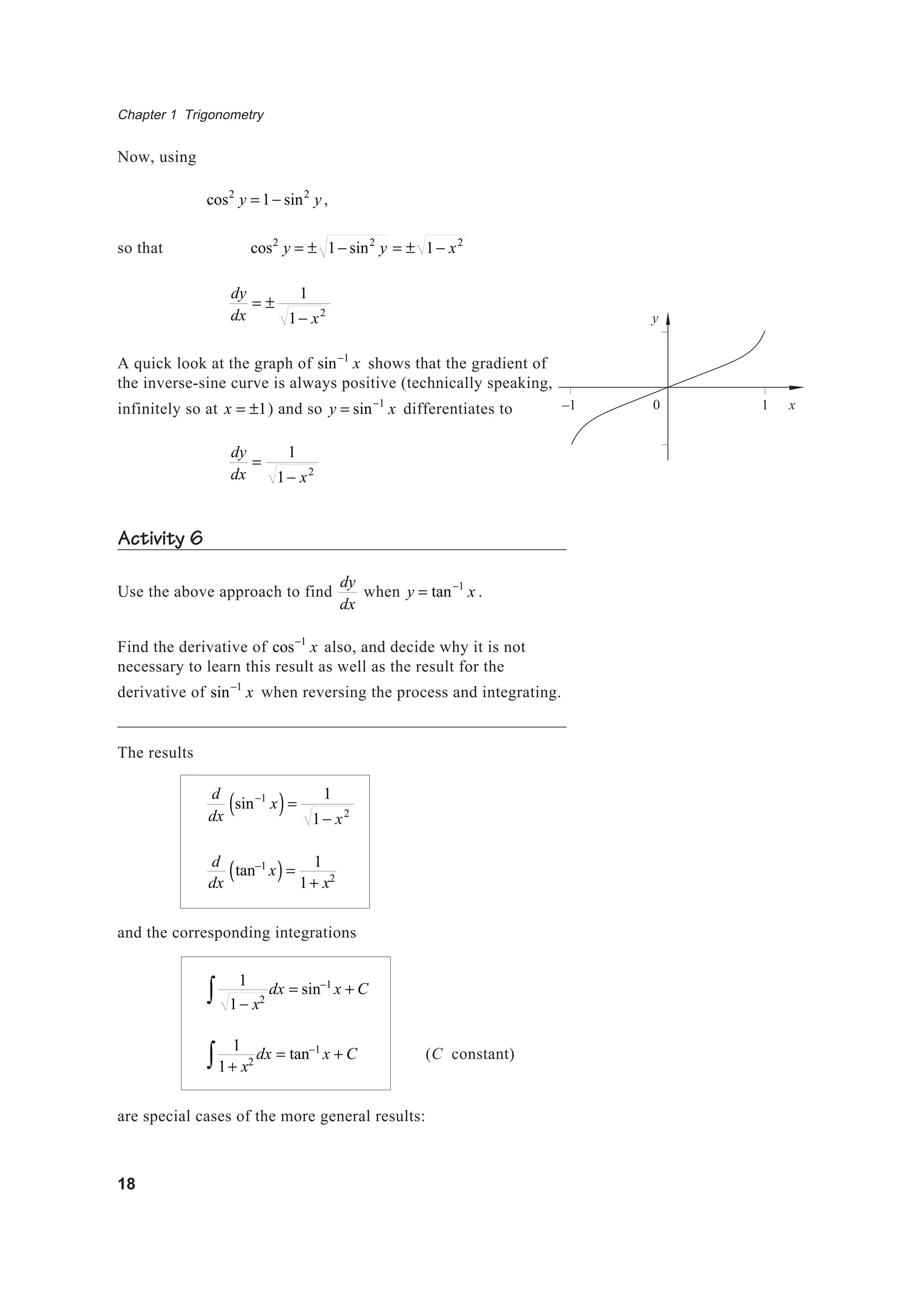
A quick look at the graph of sin−1
x shows that the gradient of
the inverse-sine curve is always positive (technically speaking,
infinitely so at x = ±1) and so y = sin−1
x differentiates to
dy
dx
=
1
1− x2
Activity 6
Use the above approach to find
dy
dx
when y = tan−1
x .
Find the derivative of cos−1
x also, and decide why it is not
necessary to learn this result as well as the result for the
derivative of sin−1
x when reversing the process and integrating.
The results
d
dx
sin−1
x( )=
1
1− x2
d
dx
tan−1
x( )=
1
1+ x2
and the corresponding integrations
1
1− x2∫ dx = sin−1
x + C
1
1+ x2∫ dx = tan−1
x + C (C constant)
are special cases of the more general results:
y
x10–1
Chapter 1 Trigonometry
19
dx
a2
− x2∫ = sin−1 x
a




+ C
dx
a2
+ x2∫ =
1
a
tan−1 x
a




+ C for constant C.
The results, in this form, are given in the AEB's Booklet of
Formulae, and may be quoted when needed.
Activity 7
(a) Use the substitution x = asinθ to prove the result
dx
a2
− x2∫ = sin−1 x
a




+ C .
(b) Use the substitution x = a tanθ to prove the result
dx
a2
+ x2∫ =
1
a
tan−1 x
a




+ C.
Example
Evaluate
dx
1− 4x20
1
4
∫
Solution
Now 1− 4x2
= 4
1
4
− x2
= 2
1
4
− x2
so that
dx
1− 4x20
1
4
∫ =
1
2
dx
1
4
− x20
1
4
∫
=
1
2
sin−1 x
1
2













0
1
4
=
1
2
sin−1
2x[ ]0
1
4
=
1
2
sin−1 1
2
− sin−1
0



=
1
2
π
6
− 0



=
π
12
(and this is now the standard
format, with a =
1
2
)
Chapter 1 Trigonometry
20
Example
Evaluate
3dx
2 + x2
1
2
∫ ,
giving your answer correct to 4 decimal places.
Solution
3dx
2 + x2
1
2
∫ = 3
dx
2( )
2
+ x21
2
∫ [so a = 2 here]
= 3
1
2
tan−1 x
2












1
2
=
3
2
tan−1
2 − tan−1 1
2






≈
3
2
0.95532 − 0.61548( )
= 0.7209 (4 d.p.)
Exercise 1F
Evaluate the following integrals, giving your
answers to four significant figures. [Remember to
work in radians.]
1.
dx
1− 8x21
4
1
8
∫
2.
4
8 + x2
4
8
∫ dx
3.
dx
5 + 9x2
2
5
∫
4.
7
7 − x20
2
∫ dx
Evaluate the following integrals exactly:
5.
3
6 + 2x2
0
3
∫ dx
[Important note: work in radians]
6.
2dx
3− x23
2
3
∫
7.
dx
6 + x2
2
6
∫
8.
dx
5− 2x20
5
2
∫
9.
dx
4 − 3x20
1
∫
10.
1− x2
1+ x2






−1
1
∫ dx*
Chapter 1 Trigonometry
21
1.8 The 't = tan 1
2 A' substitution
You will have already encountered the result:
tan2θ =
2 tanθ
1− tan2
θ
which arises from the identity
tan A + B( ) =
tan A + tan B
1− tan Atan B
Setting θ =
1
2
A then yields the result
tan A =
2t
1− t2 where t = tan
1
2
A
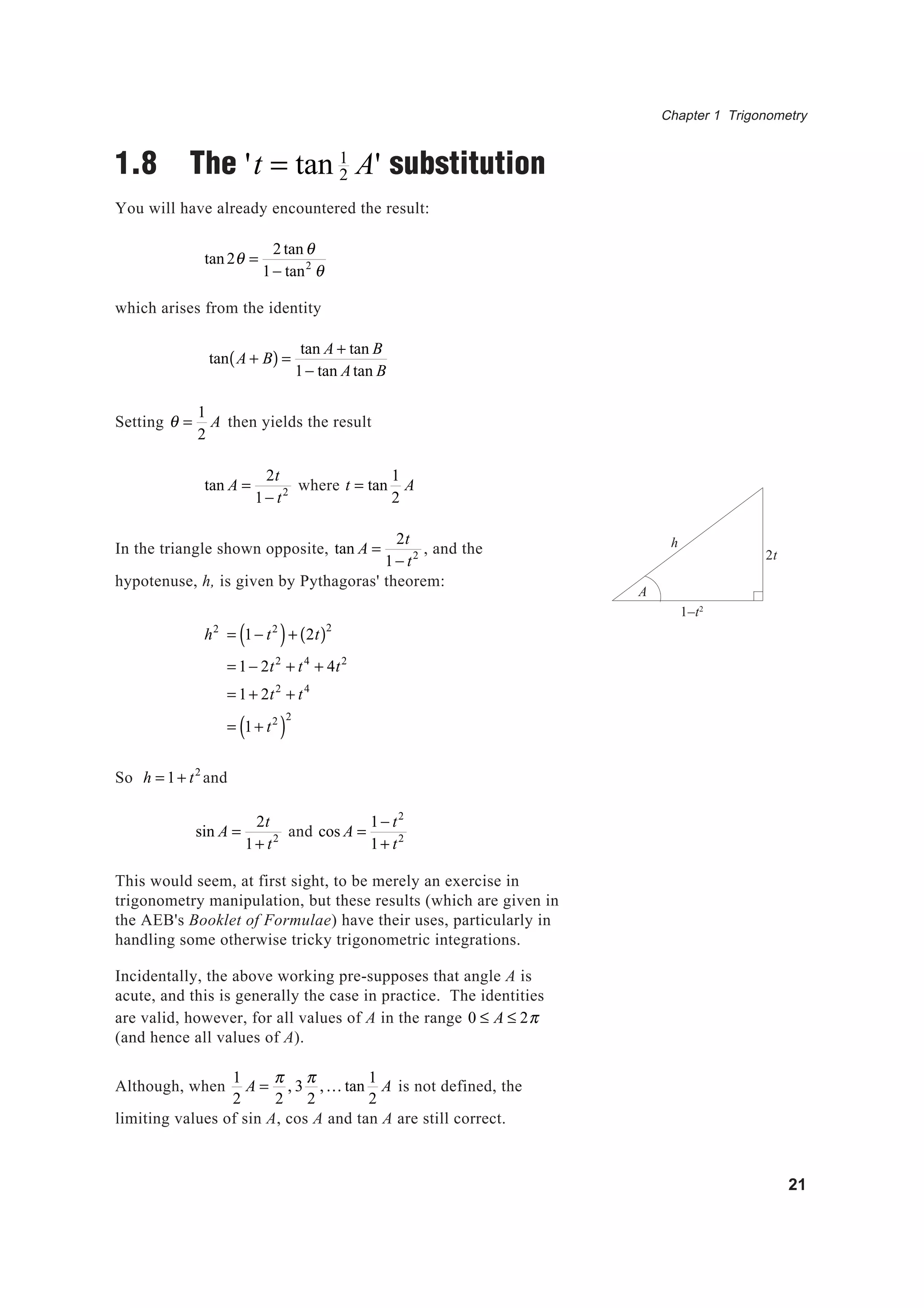
In the triangle shown opposite, tan A =
2t
1− t2 , and the
hypotenuse, h, is given by Pythagoras' theorem:
h2
= 1− t2
( )+ 2t( )2
= 1− 2t2
+ t4
+ 4t2
= 1+ 2t2
+ t4
= 1+ t2
( )
2
So h = 1+ t2
and
sin A =
2t
1+ t2 and cos A =
1− t2
1+ t2
This would seem, at first sight, to be merely an exercise in
trigonometry manipulation, but these results (which are given in
the AEB's Booklet of Formulae) have their uses, particularly in
handling some otherwise tricky trigonometric integrations.
Incidentally, the above working pre-supposes that angle A is
acute, and this is generally the case in practice. The identities
are valid, however, for all values of A in the range 0 ≤ A ≤ 2π
(and hence all values of A).
Although, when
1
2
A =
π
2
, 3
π
2
,K tan
1
2
A is not defined, the
limiting values of sin A, cos A and tan A are still correct.
1–t2
2t
h
A
Chapter 1 Trigonometry
22
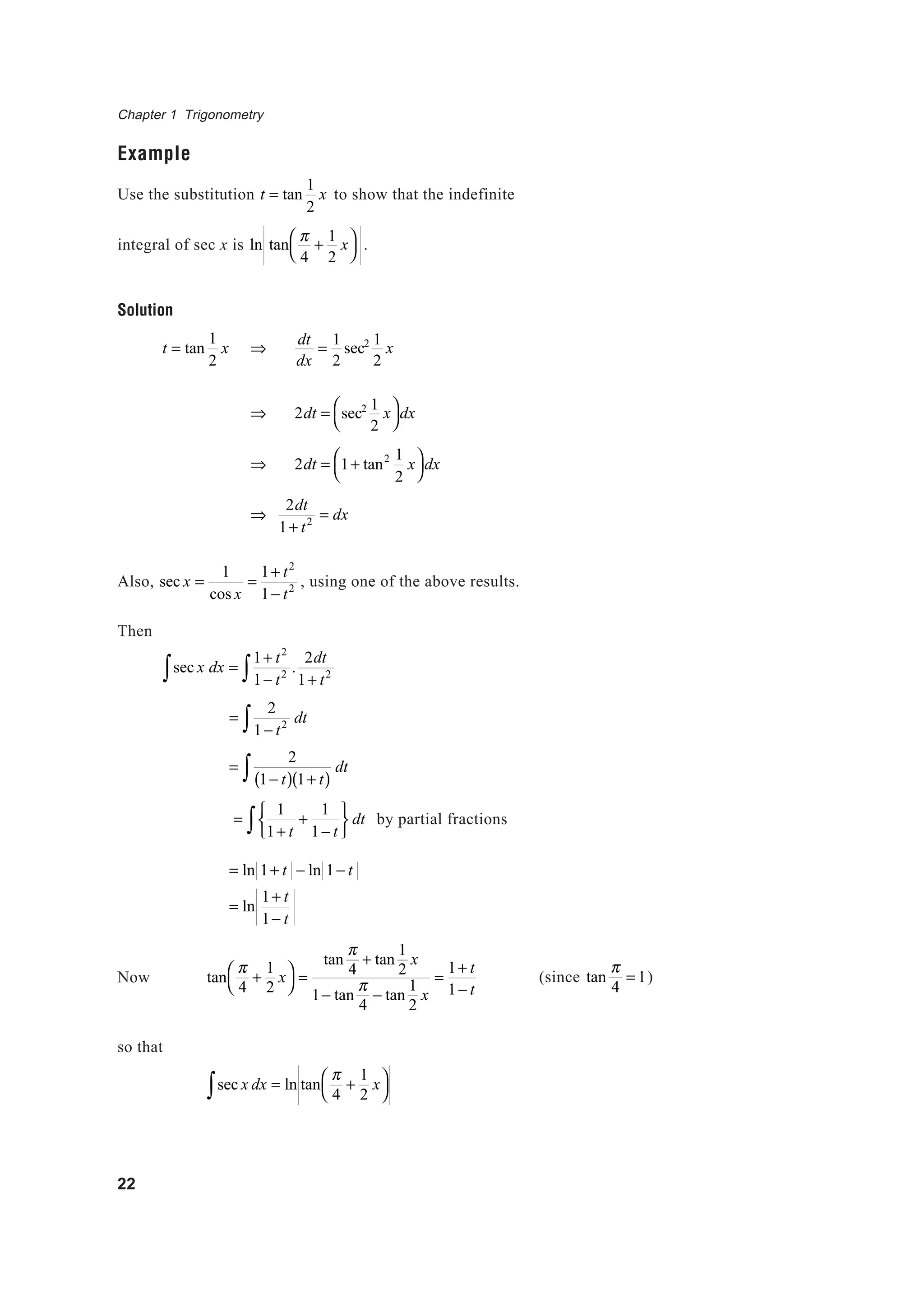
Example
Use the substitution t = tan
1
2
x to show that the indefinite
integral of sec x is ln tan
π
4
+
1
2
x



.
Solution
t = tan
1
2
x ⇒
dt
dx
=
1
2
sec2 1
2
x
⇒ 2dt = sec2 1
2
x



dx
⇒ 2dt = 1+ tan2 1
2
x



dx
⇒
2dt
1+ t2 = dx
Also, sec x =
1
cos x
=
1+ t2
1− t2 , using one of the above results.
Then
sec x dx∫ =
1+ t2
1− t2 .
2dt
1+ t2∫
=
2
1− t2∫ dt
=
2
1− t( ) 1+ t( )∫ dt
=
1
1+ t
+
1
1− t





∫ dt by partial fractions
= ln 1+ t − ln 1− t
= ln
1+ t
1− t
Now tan
π
4
+
1
2
x



=
tan
π
4
+ tan
1
2
x
1− tan
π
4
− tan
1
2
x
=
1+ t
1− t
so that
sec x dx = ln tan
π
4
+
1
2
x


∫
(since tan
π
4
= 1)
Chapter 1 Trigonometry
23
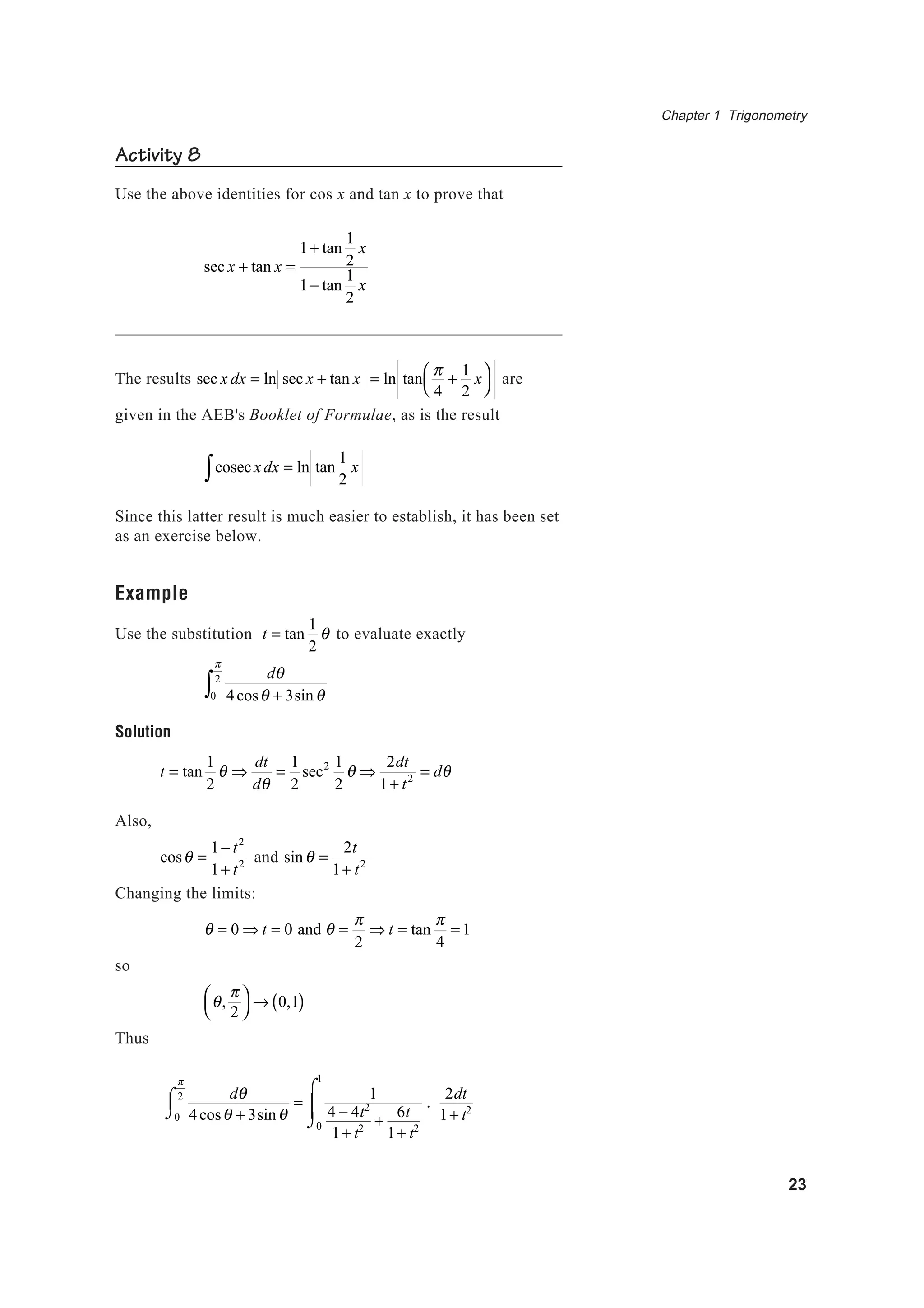
Activity 8
Use the above identities for cos x and tan x to prove that
sec x + tan x =
1+ tan
1
2
x
1− tan
1
2
x
The results sec x dx = ln sec x + tan x = ln tan
π
4
+
1
2
x



are
given in the AEB's Booklet of Formulae, as is the result
cosec x dx = ln tan
1
2
x∫
Since this latter result is much easier to establish, it has been set
as an exercise below.
Example
Use the substitution t = tan
1
2
θ to evaluate exactly
dθ
4cosθ + 3sinθ0
π
2
∫
Solution
t = tan
1
2
θ ⇒
dt
dθ
=
1
2
sec2 1
2
θ ⇒
2dt
1+ t2 = dθ
Also,
cosθ =
1− t2
1+ t2 and sinθ =
2t
1+ t2
Changing the limits:
θ = 0 ⇒ t = 0 and θ =
π
2
⇒ t = tan
π
4
= 1
so
θ,
π
2




→ 0,1( )
Thus
dθ
4cosθ + 3sinθ0
π
2⌠
⌡
 =
1
4 − 4t2
1+ t2
+
6t
1+ t20
1
⌠
⌡


.
2dt
1+ t2
Chapter 1 Trigonometry
24
=
2dt
4 − 4t2
+ 6t0
1
∫
=
dt
2 + 3t − 2t2
0
1
∫
=
1
5
2 − t
+
2
5
1+ 2t










0
1
⌠
⌡



dt
= −
1
5
ln 2 − t +
1
5
ln 1+ t


0
1
= −
1
5
ln1+
1
5
ln3



− −
1
5
ln2 −
1
5
ln1



=
1
5
ln6
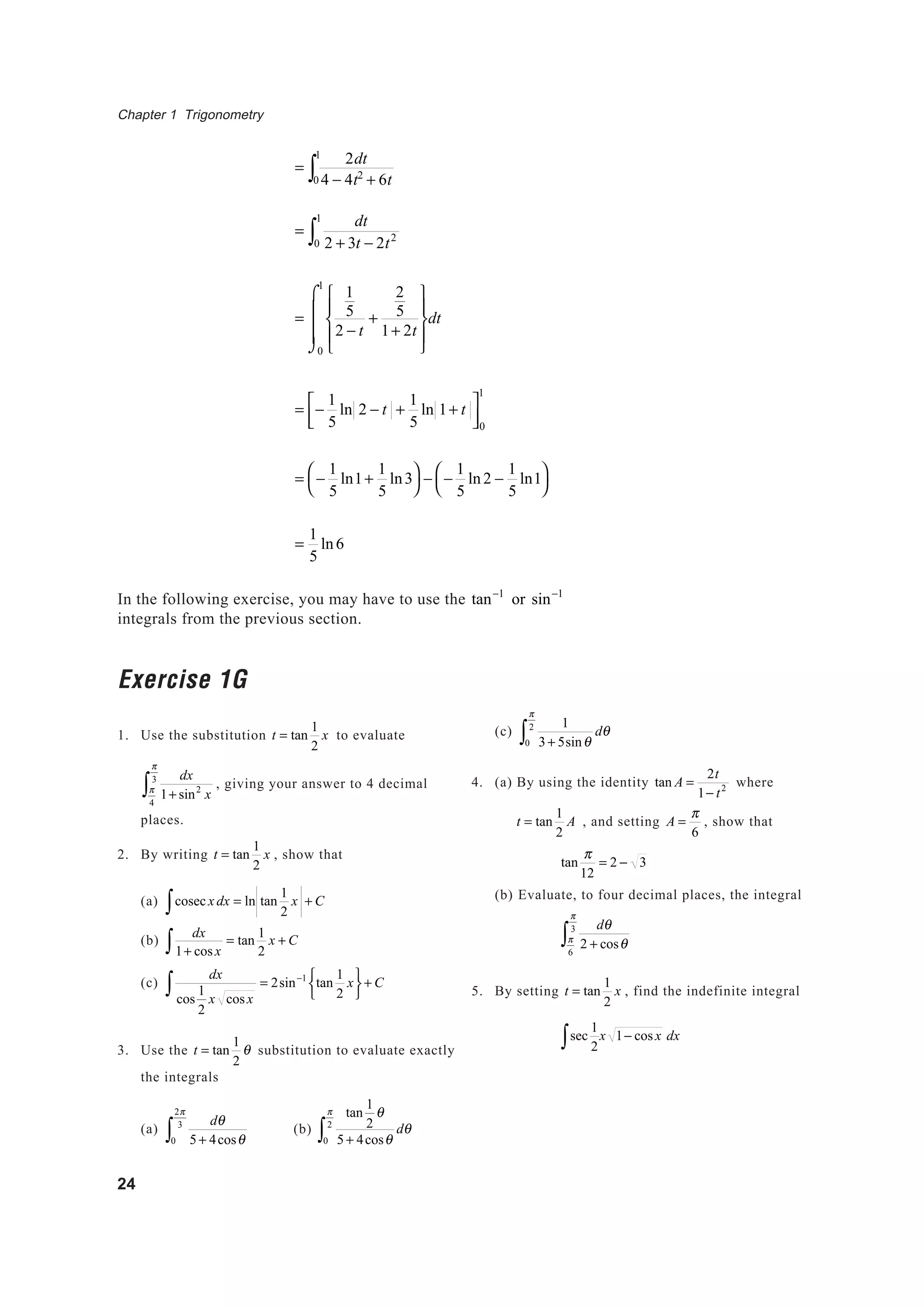
In the following exercise, you may have to use the tan−1
or sin−1
integrals from the previous section.
Exercise 1G
1. Use the substitution t = tan
1
2
x to evaluate
dx
1+ sin2
xπ
4
π
3
∫ , giving your answer to 4 decimal
places.
2. By writing t = tan
1
2
x , show that
(a) cosec∫ x dx = ln tan
1
2
x + C
(b)
dx
1+ cosx∫ = tan
1
2
x + C
(c)
dx
cos
1
2
x cosx
∫ = 2sin−1
tan
1
2
x





+ C
3. Use the t = tan
1
2
θ substitution to evaluate exactly
the integrals
(a)
dθ
5 + 4cosθ0
2π
3
∫ (b)
tan
1
2
θ
5 + 4cosθ0
π
2
∫ dθ
(c)
1
3+ 5sinθ0
π
2
∫ dθ
4. (a) By using the identity tan A =
2t
1− t2 where
t = tan
1
2
A , and setting A =
π
6
, show that
tan
π
12
= 2 − 3
(b) Evaluate, to four decimal places, the integral
dθ
2 + cosθπ
6
π
3
∫
5. By setting t = tan
1
2
x , find the indefinite integral
sec
1
2∫ x 1− cosx dx
Chapter 1 Trigonometry
25
1.9 Harder integrations
In this final section of the chapter, all of the integrations involve
the standard results for sin–1
and tan–1
, but you may have to do
some work to get them into the appropriate form.
Before you start, here are a few reminders of the algebraic
techniques which you will need, and also one or two calculus
results. To give you a clear idea of how they work out in
practice, they are incorporated into the following set of
examples.
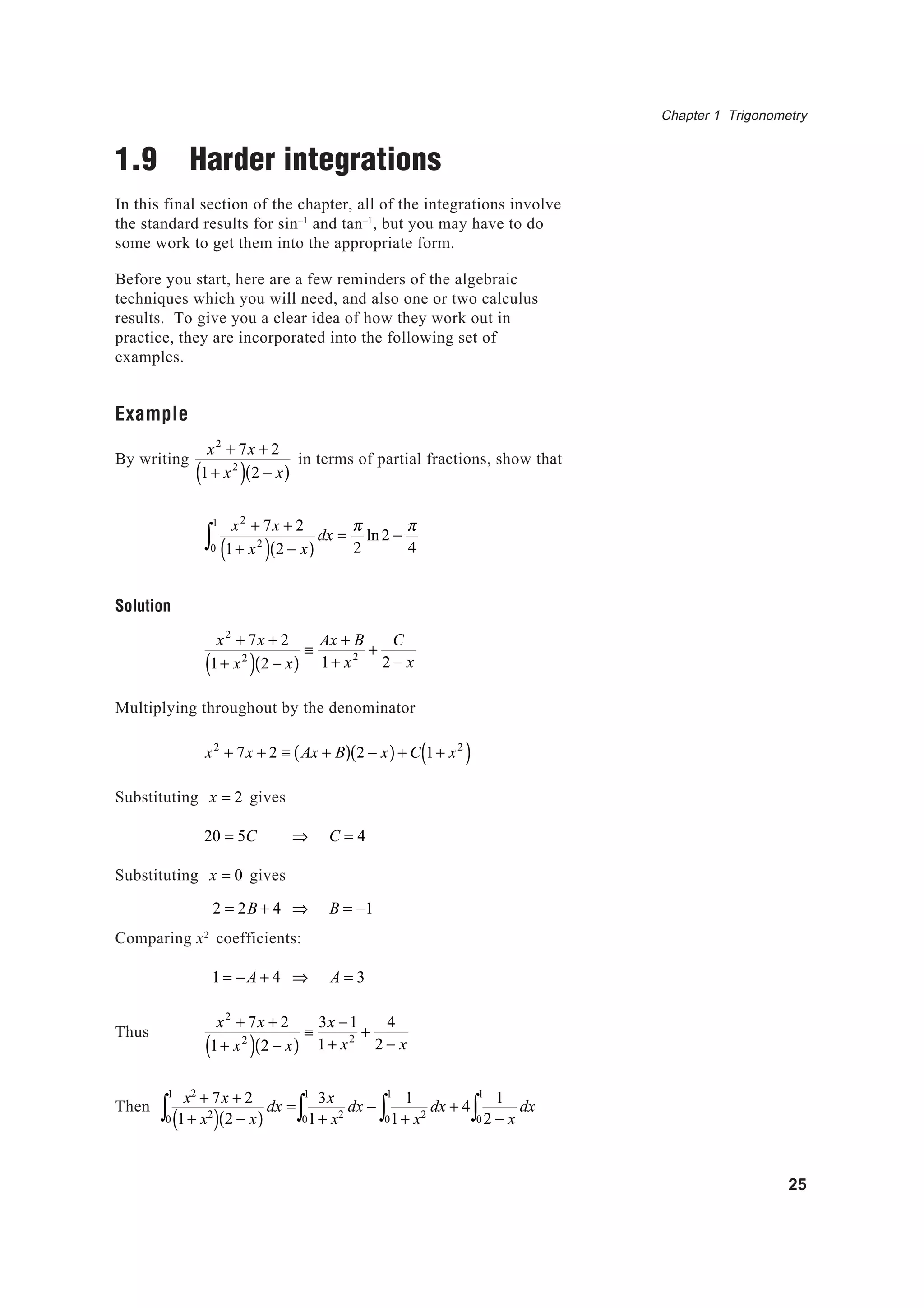
Example
By writing
x2
+ 7x + 2
1+ x2
( ) 2 − x( )
in terms of partial fractions, show that
x2
+ 7x + 2
1+ x2
( ) 2 − x( )
dx =
π
20
1
∫ ln2 −
π
4
Solution
x2
+ 7x + 2
1+ x2
( ) 2 − x( )
≡
Ax + B
1+ x2 +
C
2 − x
Multiplying throughout by the denominator
x2
+ 7x + 2 ≡ Ax + B( ) 2 − x( )+ C 1+ x2
( )
Substituting x = 2 gives
20 = 5C ⇒ C = 4
Substituting x = 0 gives
2 = 2B + 4 ⇒ B = −1
Comparing x2
coefficients:
1 = −A + 4 ⇒ A = 3
Thus
x2
+ 7x + 2
1+ x2
( ) 2 − x( )
≡
3x −1
1+ x2 +
4
2 − x
Then
x2
+ 7x + 2
1+ x2
( ) 2 − x( )
dx =
0
1
∫
3x
1+ x2
dx −
1
1+ x20
1
∫0
1
∫ dx + 4
1
2 − x0
1
∫ dx
Chapter 1 Trigonometry
26
The reason for splitting the integration up in this way is to
separate the directly integrable bits. Note that
′f x( )
f x( )
dx = ln f x( )∫ + constant
i.e. when the 'top' is exactly the differential of the 'bottom', the
integral is natural log of the 'bottom'. Now
d
dx
1+ x2
( )= 2x and
d
dx
2 − x( ) = −1, so the constants in the numerators need jiggling
but, apart from this, you should see that the three integrals are
log, tan–1
and log respectively:
=
3
2
2x
1+ x2 dx −
0
1
∫
1
1+ x2 dx − 4
−1
2 − x0
1
∫0
1
∫ dx
=
3
2
ln x2
+1( )[ ]0
1
− tan−1
x[ ]0
1
− 4 ln 2 − x( )[ ]0
1
[Strictly speaking, the log integrals should be x2
+1 and
2 − x , but 1+ x2
is always positive and 2 − x is positive for x
between 0 and 1.]
=
3
2
ln2 − ln1( )− tan−1
1− tan−1
0( )− 4 ln1− ln2( )
=
3
2
ln2 −
π
4
+ 4ln2
=
11
2
ln2 −
π
4
Example
Evaluate
3x +1
1− 3x20
1
3
∫ dx , giving your answer correct to three
significant figures.
Solution
3x +1
1− 3x20
1
3
∫ dx =
3x
1− 3x2
dx +
1
1− 3x20
1
3
∫0
1
3
∫ dx
Now the second integral on the RHS is clearly a sin–1
integral.
What about the first one?
Chapter 1 Trigonometry
27
You might just recognise where the x in the numerator comes from
if you think about it long enough. To save time: try calling
u = 1− 3x2
= 1− 3x2
( )
1
2 ;
then
du
dx
=
1
2
1− 3x2
( )−
1
2 −6x( ) using the Chain Rule
=
−3x
1− 3x2
So
3x
1− 3x2
dx = − 1− 3x2
∫
and
3x +1
1− 3x20
1
3
∫ dx =
3x
1− 3x2
dx +
1
3
dx
1
3 − x20
1
3
∫0
1
3
∫
= − 1− 3x2
[ ]0
1
3
+
1
3
sin−1 x
1
3














0
1
3
= −
2
3
+1





 +
1
3
sin−1 1
3
− sin−1
0






= 0.539 (to 3 s.f.)
Example
Integrate exactly the integrals
(a)
dx
3x2
− 6x + 41
2
∫ (b)
dx
−2 + 5x − 2x21
3
2
∫
Solution
(a)
dx
3x2
− 6x + 41
2
∫ =
1
3
dx
x2
− 2x + 4
3
1
2
∫
=
1
3
dx
1
3 + x −1( )2
1
2
∫
[This method is referred to as
'integration by recognition']
[Now x2
− 2x + 4
3 = x −1( )2
+ 1
3
by completing the square: the
factor of 3 was taken out first
in order to make this easier to
cope with.]
[This is
dx
a2
+ x2∫ with a =
1
3
and 'x' = x −1, which is allowed
when a single x is involved.]
Chapter 1 Trigonometry
28
=
1
3
1
1
3
tan−1 x −1
1
3














1
2
=
3
3
tan−1
x −1[ ] 3( )[ ]1
2
=
3
3
tan−1
3 − tan−1
0( )
=
3
3
π
3
− 0



=
π 3
9
(b)
dx
−2 + 5x − 2x21
3
2
∫ =
1
2
dx
−1+ 5
2 x − x21
3
2
∫
Completing the square:
−1+
5
2
x − x2
= − x2
−
5
2
x +1





= − x −
5
4




2
−
25
16
+1






=
9
16
− x −
5
4




2
This gives
integral =
1
2
dx
3
4( )2
− x − 5
4( )21
3
2
∫
=
1
2
sin−1 x − 5
4( )
3
4













1
3
2
=
1
2
sin−1 4x − 5( )
3












1
3
2
=
1
2
sin−1 1
3
− sin−1
−
1
3










=
1
2
2sin−1 1
3




= 2 sin−1 1
3
Chapter 1 Trigonometry
29
Exercise 1H
1. By expressing
3x +10
2 − x( ) 4 + x2
( )
in terms of partial
fractions, evaluate
3x +10
2 − x( ) 4 + x2
( )0
1
∫ dx
giving your answer to three significant figures.
2. Show that
3x + 2
9 + 2x2
0
3
2
∫ dx =
3
4
ln
4
3




+
π 2
18
.
3. Given that y = 4 − x2
, find an expression for
dy
dx
and deduce that
x
4 − x2∫ dx = C − 4 − x2
for some constant C. Hence evaluate exactly
2x − 3
4 − x21
2
∫ dx
4. Determine the values of the constants A, B and C
such that
x2
+ 2x + 7
1+ x2 ≡ A +
Bx
1+ x2 +
C
1+ x2
Show that
x2
+ 2x + 7
1+ x2
1
3
∫ dx = 3 −1+ ln2 +
π
2
5. By 'completing the square' in each of the
following cases, evaluate exactly the integrals:
(a)
dx
2x − x21
2
3
2
∫ (b)
dx
x2
− x +10
1
∫
(c)
dx
1+ 2x − 3x20
2
3
∫ (d) 2x2
− 2x + 5
(e)
dx
x − x20
1
∫ (f)
dx
x2
+ 6x +100
1
∫
6. Show that
4 − 3x
4 + 3x2
dx =
2π
3 3
−
1
2
ln13
0
2
∫ .
7. Use partial fractions to help evaluate the integral
5
1+ x2
( ) 2 + x( )0
3
∫ dx
8. Evaluate the following integrals:
(a)
5x + 4
x2
+ 4
dx
1
4
∫ (b)
4 + 3x − x2
2 + x2 dx
0
2
∫
9. Determine the values of the constants A, B and C
for which
f x( ) =
x2
+ 2x − 4
x2
− 2x + 4
≡ A + B
2x − 2
x2
− 2x + 4




+
C
x2
− 2x + 4
Hence evaluate f x( )
1
4
∫ .
10. (a) Prove that
4x
5 + x2
dx
1
2
∫ = 2ln
3
2




.
(b) Use the result of (a) to evaluate
4x + 2
5 + x2
dx
1
2
∫ ,
giving your answer correct to 3 decimal
places.
11. Show that
3x dx
1+ 6x − 3x20
1
∫ =
π
3
−1.
12. Show that
1+ x3
1− x20
3
2
∫ dx =
1
24
8π + 5( ).
[Hint:
x3
1− x2∫ dx = x2
∫ ×
x
1− x2
dx ]
*
*
Chapter 1 Trigonometry
30
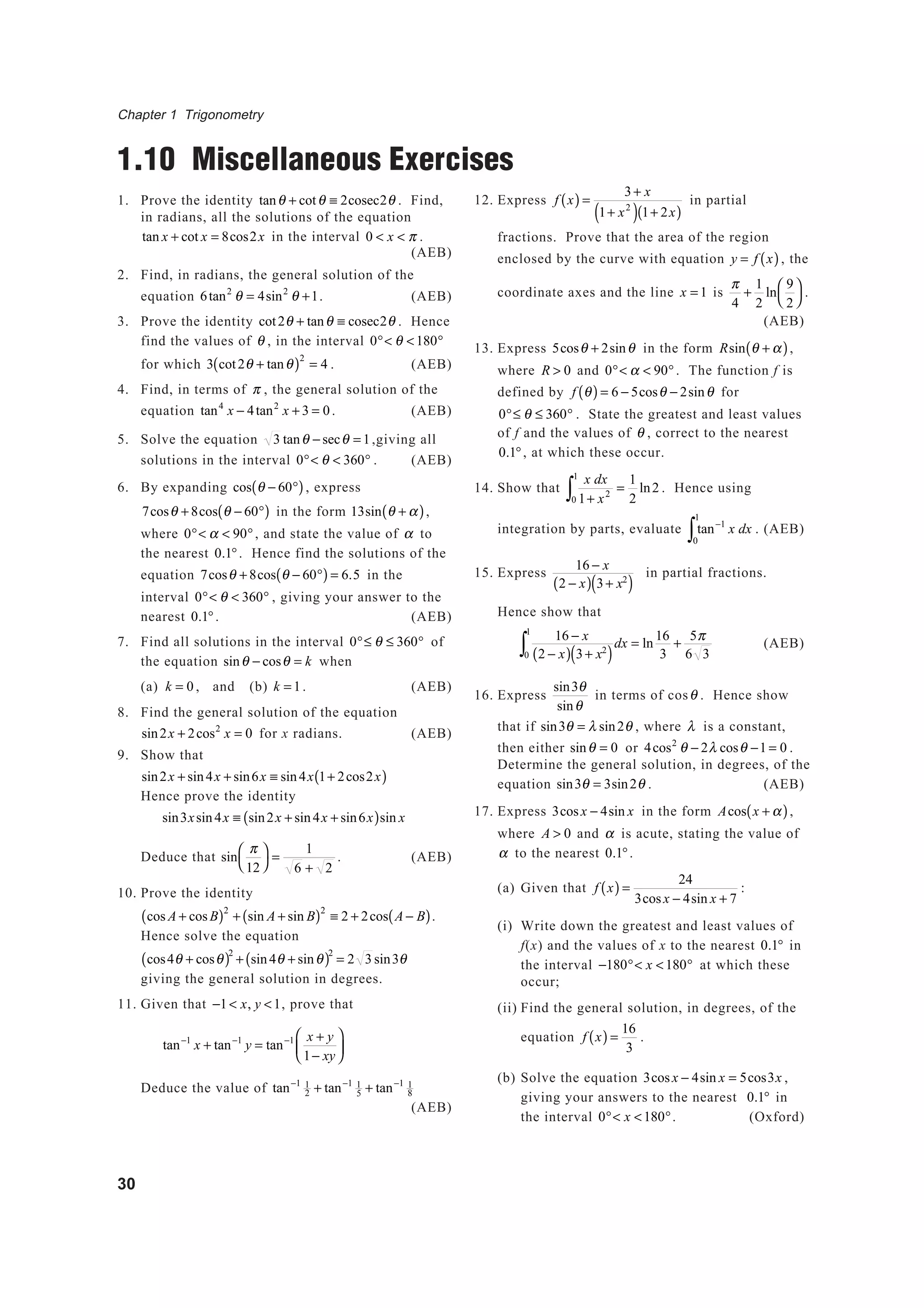
1.10 Miscellaneous Exercises
1. Prove the identity tanθ + cotθ ≡ 2cosec2θ . Find,
in radians, all the solutions of the equation
tan x + cot x = 8cos2x in the interval 0 < x < π .
(AEB)
2. Find, in radians, the general solution of the
equation 6tan2
θ = 4sin2
θ +1. (AEB)
3. Prove the identity cot2θ + tanθ ≡ cosec2θ . Hence
find the values of θ , in the interval 0°< θ <180°
for which 3 cot2θ + tanθ( )2
= 4 . (AEB)
4. Find, in terms of π , the general solution of the
equation tan4
x − 4tan2
x + 3 = 0. (AEB)
5. Solve the equation 3 tanθ − secθ = 1,giving all
solutions in the interval 0°< θ < 360° . (AEB)
6. By expanding cos θ − 60°( ), express
7cosθ + 8cos θ − 60°( ) in the form 13sin θ + α( ),
where 0°< α < 90°, and state the value of α to
the nearest 0.1°. Hence find the solutions of the
equation 7cosθ + 8cos θ − 60°( ) = 6.5 in the
interval 0°< θ < 360° , giving your answer to the
nearest 0.1°. (AEB)
7. Find all solutions in the interval 0°≤ θ ≤ 360° of
the equation sinθ − cosθ = k when
(a) k = 0 , and (b) k = 1. (AEB)
8. Find the general solution of the equation
sin2x + 2cos2
x = 0 for x radians. (AEB)
9. Show that
sin2x + sin4x + sin6x ≡ sin4x 1+ 2cos2x( )
Hence prove the identity
sin3xsin4x ≡ sin2x + sin4x + sin6x( )sin x
Deduce that sin
π
12




=
1
6 + 2
. (AEB)
10. Prove the identity
cos A + cosB( )2
+ sin A + sin B( )2
≡ 2 + 2cos A − B( ).
Hence solve the equation
cos4θ + cosθ( )2
+ sin4θ + sinθ( )2
= 2 3 sin3θ
giving the general solution in degrees.
11. Given that −1< x, y <1, prove that
tan−1
x + tan−1
y = tan−1 x + y
1− xy






Deduce the value of tan−1 1
2 + tan−1 1
5 + tan−1 1
8
(AEB)
12. Express f x( ) =
3+ x
1+ x2
( ) 1+ 2x( )
in partial
fractions. Prove that the area of the region
enclosed by the curve with equation y = f x( ), the
coordinate axes and the line x = 1 is
π
4
+
1
2
ln
9
2




.
(AEB)
13. Express 5cosθ + 2sinθ in the form Rsin θ + α( ),
where R > 0 and 0°< α < 90°. The function f is
defined by f θ( ) = 6 − 5cosθ − 2sinθ for
0°≤ θ ≤ 360° . State the greatest and least values
of f and the values of θ , correct to the nearest
0.1°, at which these occur.
14. Show that
x dx
1+ x2
0
1
∫ =
1
2
ln2 . Hence using
integration by parts, evaluate tan−1
x dx
0
1
∫ . (AEB)
15. Express
16 − x
2 − x( ) 3+ x2
( )
in partial fractions.
Hence show that
16 − x
2 − x( ) 3+ x2
( )0
1
∫ dx = ln
16
3
+
5π
6 3
(AEB)
16. Express
sin3θ
sinθ
in terms of cosθ . Hence show
that if sin3θ = λ sin2θ , where λ is a constant,
then either sinθ = 0 or 4cos2
θ − 2λ cosθ −1 = 0 .
Determine the general solution, in degrees, of the
equation sin3θ = 3sin2θ . (AEB)
17. Express 3cosx − 4sin x in the form Acos x + α( ),
where A > 0 and α is acute, stating the value of
α to the nearest 0.1°.
(a) Given that f x( ) =
24
3cosx − 4sin x + 7
:
(i) Write down the greatest and least values of
f(x) and the values of x to the nearest 0.1° in
the interval −180°< x <180° at which these
occur;
(ii) Find the general solution, in degrees, of the
equation f x( ) =
16
3
.
(b) Solve the equation 3cosx − 4sin x = 5cos3x ,
giving your answers to the nearest 0.1° in
the interval 0°< x <180°. (Oxford)
Chapter 1 Trigonometry
31
18. Given that 3cosθ + 4sinθ ≡ Rcos θ − α( ), where
R > 0 and 0 ≤ α ≤
π
2
, state the value of R and the
value of tanα .
(a) For each of the following equations, solve for
θ in the interval 0 ≤ θ ≤ 2π and give your
answers in radians correct to one decimal
place:
(i) 3cosθ + 4sinθ = 2
(ii) 3cos2θ + 4sin2θ = 5cosθ .
(b) The curve with equation
y =
10
3cosx + 4sin x + 7
, between x = −π and
x = π , cuts the y-axis at A, has a maximum
point at B and a minimum point at C. Find
the coordinates of A, B and C. (AEB)
19. Given that f x( ) = 9sin x +
π
6




+ 5cos x +
π
3




, use
the formulae for sin A + B( ) and cos A + B( ) to
express f(x) in the form Ccosx + D 3 sin x , where
C and D are integers. Hence show that f(x) can
be written in the form 61cos x − α( ) giving a
value for α in radians to three significant figures.
(Oxford)
20. Prove the identity 1+ sin2θ ≡
1+ tanθ( )2
1+ tan2
θ
. By
using the substitution t = tanθ , or otherwise, find
the general solution, in radians, of the equation
2 − tanθ( ) 1+ sin2θ( ) = 2. (AEB)
21. (a) Starting from the identity
cos A + B( ) ≡ cos AcosB − sin Asin B,
prove the identity
cos2θ ≡ 2cos2
θ −1.
(b) Find the general solution of the equation
sinθ + tanθ cos2θ = 0 , giving your answer in
radians in terms of π .
(c) Prove the identity
2cos2
θ − 2cos2
2θ ≡ cos2θ − cos4θ .
(d) By substituting θ =
π
5
in the identity in (c),
prove that cos
π
5




− cos
2π
5




=
1
2
.
(e) Hence find the value of cos
π
5




in the form
a + b 5 , stating the values of a and b.
(AEB)
22. Use identities for cos C + D( ) and cos C − D( ) to
prove that cos A + cos B = 2cos
A + B
2




cos
A − B
2




.
Hence find, in terms of π , the general solution
of the equation cos5θ + cosθ = cos3θ .
Using both the identity for cos A + cosB , and the
corresponding identity for sin A − sin B , show that
cos5α − sinα = 2sinα cos4α + cos2α( ).
The triangle PQR has angle QPR = α ≠ 0( ), angle
PQR = 5α and RP = 3RQ . Show that
sin5α = 3sinα and deduce that cos4α + cos2α = 1.
By solving a quadratic equation in cos2α , or
otherwise, find the value of α , giving your
answer to the nearest 0.1°. (AEB)
23. Given that
7x − x2
2 − x( ) x2
+1( )
≡
A
2 − x
+
Bx + C
x2
+1
,
determine the values of A, B and C. A curve has
equation y =
7x − x2
2 − x( ) x2
+1( )
. Prove that the area
of the region enclosed by the curve, the x-axis
and the line x = 1 is
7
2
ln2 −
π
4
. (AEB)
24. Use the substitution x = 1+ 2tanθ to evaluate the
integral
x
x2
− 2x + 51
3
∫ dx giving your answer
correct to two decimal places. (AEB)
25. By expressing 2cos3θ sin
θ
2
and other similar
expressions as the difference of two sines, prove
the identity
2cos3θ + 2cos2θ + 2cosθ +1( )sin
θ
2
≡ sin
7θ
2
.
Express cos3θ and cos2θ in terms of cosθ and
deduce the identity
8cos3
θ + 4cos2
θ − 4cosθ −1( )sin
θ
2
≡ sin
7θ
2
.
Hence, or otherwise, show that cos
2π
7
, cos
4π
7
and cos
6π
7
are the roots of the equation
8x3
+ 4x2
− 4x −1 = 0 . (AEB)
26. Assuming the identities
sin3θ ≡ 3sinθ − 4sin3
θ and
cos3θ ≡ 4cos3
θ − 3cosθ
prove that
cos5θ ≡ 5cosθ − 20cos3
θ +16cos5
θ .
Chapter 1 Trigonometry
32
(a) Find the set of values of θ in the interval
0 < θ < π for which cos5θ >16cos5
θ .
(b) Find the general solution, in radians, of the
equation cosx + 3cos3x + cos5x = 0. (AEB)
27. Express f θ( ) = 4cosθ + 3sinθ in the form
Rcos θ − α( ) where R > 0 and 0 < α <
π
2
.
(a) A rectangle OABC is formed from the origin,
the point A 4cosθ, 0( ), the point B, and the
point C 0, 3sinθ( ). State the coordinates of B
and express the perimeter of the rectangle in
terms of f θ( ) . Hence find the greatest
perimeter of the rectangle as θ varies in the
range 0 ≤ θ ≤
π
2
and state the coordinates of B
for which this greatest perimeter occurs.
(b) A curve has the equation
y =
1
4cos x + 3sin x( )2
0 ≤ x ≤
π
2




. Show that
the region enclosed by the curve, the x-axis,
and the lines x = 0 and x =
π
2
has area
1
12
.
(AEB)

1.trigonometry Further Mathematics Zimbabwe Zimsec Cambridge

  • 1.
    Chapter 1 Trigonometry 1 1TRIGONOMETRY Objectives After studying this chapter you should • be able to handle with confidence a wide range of trigonometric identities; • be able to express linear combinations of sine and cosine in any of the forms Rsin θ ± α( ) or Rcos θ ± α( ); • know how to find general solutions of trigonometric equations; • be familiar with inverse trigonometric functions and the associated calculus. 1.0 Introduction In the first Pure Mathematics book in this series, you will have encountered many of the elementary results concerning the trigonometric functions. These will, by and large, be taken as read in this chapter. However, in the first few sections there is some degree of overlap between the two books: this will be good revision for you. 1.1 Sum and product formulae You may recall that sin A + B( ) = sin Acos B + cos Asin B sin A − B( ) = sin Acos B − cos Asin B Adding these two equations gives sin A + B( )+ sin A − B( ) = 2sin Acos B (1) Let C = A + B and D = A − B, then C + D = 2A and C − D = 2B. Hence A = C + D 2 , B = C − D 2 and (1) can be written as
  • 2.
    Chapter 1 Trigonometry 2 sinC + sin D = 2sin C + D 2     cos C − D 2     This is more easily remembered as 'sine plus sine = twice sine half the sum( )cos half the difference( )' Activity 1 In a similar way to above, derive the formulae for (a) sinC − sin D (b) cosC + cos D (c) cosC − cos D By reversing these formulae, write down further formulae for (a) 2sin E cos F (b) 2cos E cos F (c) 2sin Esin F Example Show that cos59°+sin59°= 2 cos14°. Solution Firstly, sin59°= cos31°, since sinθ = cos 90 − θ( ) So LHS = cos59°+ cos31° = 2cos 59 + 31 2       cos 59 − 31 2       = 2cos45°×cos14° = 2 × 2 2 cos14° = 2 cos14° = RHS Example Prove that sin x + sin2x + sin3x = sin2x 1+ 2cos x( ). Solution LHS = sin2x + sin x + sin3x( ) = sin2x + 2sin 3x + x 2     cos 3x − x 2     = sin2x + 2sin2x cos x = sin2x 1+ 2cos x( )
  • 3.
    Chapter 1 Trigonometry 3 Example Writecos4x cos x − sin6xsin3x as a product of terms. Solution Now cos4x cos x = 1 2 cos 4x + x( )+ cos 4x − x( ){ } = 1 2 cos5x + 1 2 cos3x and sin6x sin3x = 1 2 cos 6x − 3x( )− cos 6x + 3x( ){ } = 1 2 cos3x − 1 2 cos9x Thus, LHS = 1 2 cos5x + 1 2 cos3x − 1 2 cos3x + 1 2 cos9x = 1 2 (cos5x + cos9x) = 1 2 × 2cos 5x + 9x 2     cos 5x − 9x 2     = cos7x cos2x The sum formulae are given by sin A + sin B = 2sin A + B 2     cos A − B 2     sin A − sin B = 2cos A + B 2     sin A − B 2     cos A + cos B = 2cos A + B 2     cos A − B 2     cos A − cos B = –2sin A + B 2     sin A − B 2     and the product formulae by sin Acos B = 1 2 (sin(A + B) + sin(A − B)) cos Acos B = 1 2 (cos(A + B) + cos(A − B)) sin Asin B = 1 2 (cos(A − B) − cos(A + B))
  • 4.
    Chapter 1 Trigonometry 4 Exercise1A 1. Write the following expressions as products: (a) cos5x − cos3x (b) sin11x − sin7x (c) cos2x + cos9x (d) sin3x + sin13x (e) cos 2π 15 + cos 14π 15 + cos 4π 15 + cos 8π 15 (f) sin40°+sin50°+sin60° (g) cos114°+sin24° 2. Evaluate in rational/surd form sin75°+sin15° 3. Write the following expressions as sums or differences: (a) 2cos7xcos5x (b) 2cos 1 2 x       cos 5x 2       (c) 2sin π 4 − 3θ    cos π 4 + θ    (d) 2sin165°cos105° 1.2 Linear combinations of sin and cos Expressions of the form acosθ + bsinθ , for constants a and b, involve two trig functions which, on the surface, makes them difficult to handle. After working through the following activity, however, you should be able to see that such expressions (called linear combinations of sin and cos – linear since they involve no squared terms or higher powers) can be written as a single trig function. By re-writing them in this way you can deduce many results from the elementary properties of the sine or cosine function, and solve equations, without having to resort to more complicated techniques. For this next activity you will find it very useful to have a graph plotting facility. Remember, you will be working in radians. Activity 2 Sketch the graph of a function of the form y = asin x + bcos x (where a and b are constants) in the range −π ≤ x ≤ π . 4. Establish the following identities: (a) cosθ − cos3θ = 4sin 2 θ cosθ (b) sin6x + sin4x − sin2x = 4cos3xsin2xcosx (c) 2sin4A + sin6A + sin2A 2sin4A − sin6A − sin2A = cot 2 A (d) sin A + B( )+ sin A − B( ) cos A + B( )+ cos A − B( ) = tan A (e) cos θ + 30°( )+ cos θ + 60°( ) sin θ + 30°( )+ sin θ + 60°( ) = 1− tanθ 1+ tanθ 5. Write cos12x + cos6x + cos4x + cos2x as a product of terms. 6. Express cos3xcos x − cos7xcos5x as a product of terms.
  • 5.
    Chapter 1 Trigonometry 5 Fromthe graph, you must identify the amplitude of the function and the x-coordinates of (i) the crossing point on the x-axis nearest to the origin, and (ii) the first maximum of the function as accurately as you can. An example has been done for you; for y = sin x + cos x, you can see that amplitude R ≈ 1.4 crossing point nearest to the origin O at x = α = – π 4 maximum occurs at x = β = π 4 Try these for yourself : (a) y = 3sin x + 4cos x (b) y = 12cos x − 5sin x (c) y = 9cos x +12sin x (d) y = 15sin x − 8cos x (e) y = 2sin x + 5cos x (f) y = 3cos x − 2sin x In each case, make a note of R, the amplitude; α, the crossing point nearest to O; β, the x-coordinate of the maximum. In each example above, you should have noticed that the curve is itself a sine/cosine 'wave'. These can be obtained from the curves of either y = sin x or y = cos x by means of two simple transformations (taken in any order). 1. A stretch parallel to the y-axis by a factor of R, the amplitude, and 2. A translation parallel to the x-axis by either α or β (depending on whether you wish to start with sin x or cos x as the original function). Consider, for example y = sin x + cos x. This can be written in the form y = Rsin x + α( ), since Rsin(x + α) = R sin x cosα + cos xsinα{ } = Rcos α sin x + Rsin α cos x The R > 0( ) and α should be chosen so that this expression is the same as sin x + cos x. −π π x y 1 -1 R βα R α β
  • 6.
    Chapter 1 Trigonometry 6 Thus Rcosα=1 and Rsinα =1 Dividing these terms gives tanα =1⇒ α = π 4 Squaring and adding the two terms gives R2 cos2 α + R2 sin2 α = 12 +12 R2 cos2 α + sin2 α( ) = 2 Since cos2 α + sin2 α = 1, R2 = 2 ⇒ R = 2 Thus sin x + cos x = 2 sin x + π 4     Activity 3 Express the function sin x + cos x in the form sin x + cos x = Rcos(x − α) Find suitable values for R and α using the method shown above. Another way of obtaining the result in Activity 3 is to note that sinθ = cos π 2 − θ    so that sin x + cos x = 2 sin x + π 4     = 2 cos π 2 − x + π 4           = 2 cos π 4 − x    = 2 cos x − π 4     since cos(−θ) = cosθ.
  • 7.
    Chapter 1 Trigonometry 7 Example Write7sin x − 4cos x in the form Rsin x − α( ) where R > 0 and 0 < α < π 2 . Solution Assuming the form of the result, 7sin x − 4cos x = Rsin(x − α) = Rsin xcosα − Rcos xsinα To satisfy the equation, you need Rcosα = 7 Rsinα = 4 Squaring and adding, as before, gives R = 7 2 + 4 2 = 65 Thus cosα = 7 65 , sinα = 4 65 or tanα = 4 7     ⇒ α = 0.519 radians, to 3 sig. figs. so 7sin x − 4cos x = 65 sin(x − 0.519) Exercise 1B Write (in each case, R > 0 and 0 < α < π 2 ) 1. 3sin x + 4cosx in the form Rsin(x + α) 2. 4cos x + 3sin x in the form Rcos x − α( ) 3. 15sin x − 8cos x in the form Rsin x − α( ) 4. 6cosx − 2sin x in the form Rcos x + α( ) 5. 20sin x − 21cosx in the form Rsin x − α( ) 6. 14cosx + sin x in the form Rcos x − α( ) 7. 2cos2x − sin2x in the form Rcos 2x + α( ) 8. 3cos 1 2 x + 5sin 1 2 x in the form Rsin 1 2 x + α( )
  • 8.
    Chapter 1 Trigonometry 8 1.3Linear trigonometric equations In this section you will be looking at equations of the form acos x + bsin x = c for given constants a, b and c. Example Solve 3cos x + sin x = 2 for 0°≤ x ≤ 360°. Solution Method 1 Note that cos2 x and sin2 x are very simply linked using cos2 x + sin2 x = 1 so a 'rearranging and squaring' approach would seem in order. Rearranging: 3cos x = 2 − sin x Squaring: 9cos2 x = 4 − 4sin x + sin2 x ⇒ 9 1− sin2 x( )= 4 − 4sin x + sin2 x ⇒ 0 = 10sin2 x − 4sin x − 5 The quadratic formula now gives sin x = 4 ± 216 20 and sin x ≈ 0.93485 or − 0.534847 giving x = 69.2°,110.8° or 212.3°, 327.7° (1 d.p.) Method 2 Write 3cos x + sin x as Rcos x − α( ) (or Rsin x − α( )) 3cos x + sin x = Rcos x − α( ) Firstly, R = 32 +12 = 10 so 3cos x + sin x = 10 3 10 cos x + 1 10 sin x       ≡ 10 cos x cosα + sin xsinα( )
  • 9.
    Chapter 1 Trigonometry 9 Thuscosα = 3 10 or sinα = 7 10 or tanα = 1 3       => α = 18.43° The equation 3cos x + sin x = 2 can now be written as 10 cos x −18.43°( ) = 2 ⇒ cos x −18.43°( ) = 2 10 ⇒ x −18.43°= cos−1 2 10       ⇒ x −18.43°= 50.77° or 309.23° and x = 50.77°+18.43° or 309.23°+18.43° x = 69.2° or 327.7° (1 d.p.) The question now arises as to why one method yields four answers, the other only two. If you check all four answers you will find that the two additional solutions in Method 1 do not fit the equation 3cos x + sin x = 2. They have arisen as extra solutions created by the squaring process. (Think of the difference between the equations x = 2 and x2 = 4: the second one has two solutions.) If Method 1 is used, then the final answers always need to be checked in order to discard the extraneous solutions. Exercise 1C 1. By writing 7sin x + 6cosx in the form Rsin x + α( ) R > 0,0°< α < 90°( ) solve the equation 7sin x + 6cosx = 9 for values of x between 0° and 360° . 2. Use the 'rearranging and squaring' method to solve (a) 4cosθ + 3sinθ = 2 (b) 3sinθ − 2cosθ = 1 for 0°≤ θ ≤ 360° . 3. Write 3 cosθ + sinθ as Rcos θ − α( ), where R > 0and 0 < α < π 2 and hence solve 3 cosθ + sinθ = 2 for 0 ≤ θ ≤ 2π . 4. Solve (a) 7cos x − 6sin x = 4 for −180°≤ x ≤180° (b) 6sinθ + 8cosθ = 7 for 0°≤ θ ≤180° (c) 4cos x + 2sin x = 5 for 0°≤ x ≤ 360° (d) sec x + 5tan x +12 = 0 for 0 ≤ x ≤ 2π
  • 10.
    Chapter 1 Trigonometry 10 1.4More demanding equations In this section you will need to keep in mind all of the identities that you have encountered so far – including the Addition Formulae, the Sum and Product Formulae and the Multiple Angle Identities – in order to solve the given equations. Example Solve cos5θ + cosθ = cos3θ for 0°≤ θ ≤180° Solution Using cos A + cos B = 2cos A + B 2     cos A − B 2     LHS = 2cos3θ cos2θ Thus 2cos3θ cos2θ = cos3θ ⇒ cos3θ 2cos2θ −1( ) = 0 Then (a) cos3θ = 0 ⇒ 3θ = 90°, 270°, 450° ⇒ θ = 30°, 90°,150° or (b) 2cos2θ −1 = 0 ⇒ cos2θ = 1 2 ⇒ 2θ = 60°, 300° ⇒ θ = 30°,150° as already found. Solutions are θ = 30°(twice), 90°,150°(twice). [Remember, for final solutions in range 0°≤ θ ≤ 180°, solutions for 3θ must be in range 0°≤ θ ≤ 3 ×180°= 540°.] Exercise 1D 1. Solve for 0°≤ θ ≤180° : (a) cosθ + cos3θ = 0 (b) sin4θ + sin3θ = 0 (c) sinθ + sin3θ = sin2θ . 2. Find all the values of x satisfying the equation sin x = 2sin π 3 − x    for 0 ≤ x ≤ 2π .
  • 11.
    Chapter 1 Trigonometry 11 3.By writing 3θ as 2θ + θ , show that cos3θ = 4cos3 θ − 3cosθ and find a similar expresion for sin3θ in terms of powers of sinθ only. Use these results to solve, for 0 ≤ θ ≤ 360° , (a) cos3θ + 2cosθ = 0 (b) sin3θ = 3sin2θ (c) cosθ − cos3θ = tan2 θ 4. Show that tan x + cot x = 2cosec2x . Hence solve tan x + cot x = 8cos2x for 0 ≤ x ≤ π . 5. Solve the equation sin2x + sin3x + sin5x = 0 for 0°≤ x ≤180° 1.5 The inverse trigonometric functions In the strictest sense, for a function f to have an inverse it has to be 1–1 ('one-to-one'). Now the three trigonometric functions sine, cosine and tangent are each periodic. Thus the equation sin x = k, for k ≤1, has infinitely many solutions x. A sketch of the graph of y = sin x is shown opposite. When working on your calculator, if you find sin−1 0.5 , say, a single answer is given, despite there being infinitely many to choose from. In order to restrict a 'many-to-one' function of this kind into a 1–1 function, so that the inverse function gives a unique answer , the range of values is restricted. This can be done in a number of ways, but the most sensible way is to choose a range of values x which includes the acute angles. This is shown on the diagram opposite. Thus for −1 ≤ k ≤ 1, sin x = k ⇒ x = sin−1 k will be assigned a unique value of x in the range − π 2 ≤ x ≤ π 2 : these are the principal values of the inverse-sine function. Activity 4 By drawing the graphs y = cos x and y = tan x, find the ranges of principal values of the inverse-cosine and inverse-tangent functions. (These should include the acute angles of x.) 6. Find the solution x in the range 0°≤ x ≤ 360° for which sin4x + cos3x = 0 . 7. (a) Given t = tan 1 2 θ , write down tanθ in terms of t and show that cosθ = 1− t2 1+ t2 Find also a similar expression for sinθ in terms of t. (b) Show that 2sinθ − tanθ = 2t 1− t4 1− 3t2 ( ) (c) Hence solve 2sinθ − tanθ = 6cot 1 2 θ for values of θ in the range 0°< θ < 360° . y = sin x 2π 4π-2π x y 1 -1 y x 1 –1
  • 12.
    Chapter 1 Trigonometry 12 Notethat the inverse functions are denoted here by sin−1 x, cos−1 , tan−1 x These are not the same as sin x( )−1 = 1 sin x , etc. and to avoid this confusion, some texts denote the inverse functions as arcsin x, arccos x, arctan x. 1.6 General solutions Up until now you have been asked for solutions of trigonometric equations within certain ranges. For example: Solve sin3x = 1 2 for 0°< x <180° or Find the values of θ for which sin2θ + sin2 θ = 0 with 0 ≤ θ ≤ 2π . At the same time, you will have been aware that even the simplest trig equation can have infinitely many solutions: sinθ = 0 (θ radians) is true when θ = 0, π, 2π,3π,K and also for all negative multiples of π as well. Overall, one could say that the equation sinθ = 0 has general solution θ = n π where n is an integer. Moreover, there are no values of θ which satisfy this equation that do not take this form. Thus, 'θ = n π ' describes all the values of θ satisfying 'sinθ = 0 ' as n is allowed to take any integer value. This is what is meant by a general solution. General solution for the cosine function For −900°≤ x ≤ 900° (radians can come later), the graph of y = cos x is shown below. y = cos x 360 720-360 x y 1 -1 -720 y = k P. V. α
  • 13.
    Chapter 1 Trigonometry 13 Theline y = k (k is chosen as positive here, but as long as −1 ≤ k ≤ 1, the actual value is immaterial) is also drawn on the sketch. The principal value of x for which x = cos−1 k (representing the point when y = k and y = cos x intersect) is circled and labelled 'P.V.' Since the cosine function is periodic with period 360°, all other solutions to the equation cos x = k corresponding to this principal value are obtained by adding, or subtracting, a multiple of 360° to it. The points of intersection of the two graphs representing these solutions are circled also. Now the cosine curve here is symmetric in the y-axis. So if α is the principal value of x for which cos x = k , then −α is also a solution, and this is not obtained by adding, or subtracting, a multiple of 360° to, or from, α . All the remaining solutions of the equation can be obtained by adding or subtracting a multiple of 360° to or from −α . The general solution of the equation cos x = k −1 ≤ k ≤ 1( ) is then x = 360n ± α where α = cos−1 k is the principal value of the inverse cosine function and n is an integer. In radians, using 360°≡ 2π radians, the general solution looks like x = 2nπ ± α , n an integer. Activity 5 Use the graphs of y = tan x and y = sin x to find the general solutions of the equations (in degrees) of the equations tan x = k −∞ < k < ∞( ) and sin x = k −1 ≤ k ≤ 1( ). In each case, let α be the principal value concerned, let n be an integer, and express the general solutions in terms of radians once the results have been found in terms of degrees.
  • 14.
    Chapter 1 Trigonometry 14 Theseresults are summarised as follows: In radians In degrees If sinθ = sinα , then If sinθ = sinα , then θ = nπ + −1( )n α θ = 180n + −1( )n α If cosθ = cosα , then If cosθ = cosα , then θ = 2nπ ± α θ = 360n ± α If tanθ = tanα , then If tanθ = tanα , then θ = nπ + α θ = 180n + α [In each case, n is an integer.] The AEB's Booklet of Formulae gives only the set of results for θ, α in radians, but you should be able to convert the results into degrees without any difficulty by remembering that 180°≡ π radians, etc. Example Find the general solution, in degrees, of the equation tan3θ = 3 Solution tan3θ = 3 ⇒ tan3θ = tan60° ⇒ 3θ = 180n + 60 quoting the above result ⇒ θ = 60n + 20( )° [K; n = −1⇒θ = −40°; n = 0 ⇒ θ = 20°; n = 1⇒ 0 = 80°;K] Sometimes, you may have to do some work first. Example Find the general solution, in radians, of the equation 8sinθ +15cosθ = 6.
  • 15.
    Chapter 1 Trigonometry 15 Solution Rewritingthe LHS of this equation in the form Rsin θ + α( ), for instance, gives R = 82 +152 = 17 and cosθ = 8 17 or sinθ = 15 17 or tanθ = 15 8 so that θ ≈ 1.081 radians. [Check this working through to make sure you can see where it comes from.] The equation can now be written as 17sin θ +1.081( ) = 6 ⇒ sin θ +1.081( ) = 6 17 = sin 0.3607 ⇒ θ +1.081 = nπ + −1( )n 0.3607 ⇒ θ = nπ + −1( )n 0.3607 −1.081 One could proceed to make this more appealing to the eye by considering the cases n even and n odd separately, but there is little else to be gained by proceeding in this way. Note on accuracy: although final, non-exact numerical answers are usually required to three significant places, the 0.3607 and 1.081 in the answer above are really intermediate answers and hence are given to 4 significant figure accuracy. However, unless a specific value of n is to be substituted in order to determine an individual value of θ , you will not be penalised for premature rounding provided your working is clear and the answers correspond appropriately. This final example illustrates the sort of ingenuity you might have to employ in finding a general solution of some equation. Example Find the values of x for which cos x − sin 4x = 0. Solution Using the result sin A = cos π 2 − A    , the above equation can be written as cos x = cos π 2 − 4x    whence x = 2nπ ± π 2 − 4x    (principal value of sin−1 6 17 )
  • 16.
    Chapter 1 Trigonometry 16 i.e. x= 2nπ + π 2 − 4x or x = 2nπ − π 2 + 4x ⇒ 5x = 2nπ + π 2 or 3x = −2nπ + π 2 ⇒ x = 2n π 5 + π 10 or x = −2n π 3 + π 6 Wait a moment! Although the second solution is correct, n is merely an indicator of some integer; positive, negative or zero. It is immaterial then, whether it is denoted as positive or negative: you could write this solution as x = 2k π 3 + π 6 k = −n( ) for some integer k, or alternatively, as x = 2n π 3 + π 6 . In this case, the general solution takes two forms. An alternative approach could have re-written the equation as sin 4x = sin π 2 − x    ⇒ 4x = nπ + −1( )n π 2 − x    When n is odd 4x = nπ − π 2 + x ⇒ 3x = nπ − π 2 ⇒ x = n π 3 − π 6 = 2n −1( ) π 6 (n odd) and when n is even 4x = nπ + π 2 − x ⇒ 5x = nπ + π 2 ⇒ x = n π 5 + π 10 = 2n +1( ) π 10 (n even)
  • 17.
    Chapter 1 Trigonometry 17 Thevery first way might be considered preferable since the general solution for cos is less clumsy than that for sin. This example also highlights another important point: two equivalent sets of answers may look very different from each other and yet still both be correct. Exercise 1E 1. Find the general solutions, in degrees, of the equations (a) sin x = 0.766 (b) tan θ − 45°( ) = 1 3 (c) cosx = 0.17 (d) cot 60°−2θ( ) = 3 (e) 5sin x + 3cosx = 4 (f) 4cosθ + 3sinθ = 2 (g) cos3θ + cosθ = 0 (h) tan2 4x = 3 (i) sin7x − sin x = cos4x 2. Find the general solutions, in radians, of the equations (a) tan x = 2 (b) cos 2x + π 6     = 1 (c) sin x = 0.35 (d) sec 1 2 x + π 4     = 2 1.7 Calculus of the inverse trigonometric functions The prospect of having to differentiate the function y = sin−1 x may seem rather daunting. However, we can write y = sin−1 x as sin y = x. (Taking the principal range values − π 2 ≤ y ≤ π 2 ensures that this can be done.) Then, using the Chain Rule for differentiation, d dx sin y( ) = d dy sin y( ) dy dx = cos y dy dx so that sin y = x differentiates to give ⇒ cos y dy dx = 1 ⇒ dy dx = 1 cos y (e) 6 sinθ − 2 cosθ = 2 (f) 10cosθ − 24sinθ = 13 (g) cosx − cos3x = 0 (h) tan x + cot2x = 0 [Note: cot A = tan π 2 − A    and tan −A( ) = −tan A ] (i) 3tan2 θ + 5secθ +1 = 0 (j) cos4x + cos6x = cos5x 3. Prove the identity cos4x + 4cos2x = 8cos4 x − 3. Hence find the general solution, in radians, of the equation 2cos4θ + 8cos2θ = 3.
  • 18.
    Chapter 1 Trigonometry 18 Now,using cos2 y = 1− sin2 y, so that cos2 y = ± 1− sin2 y = ± 1− x2 dy dx = ± 1 1− x2 A quick look at the graph of sin−1 x shows that the gradient of the inverse-sine curve is always positive (technically speaking, infinitely so at x = ±1) and so y = sin−1 x differentiates to dy dx = 1 1− x2 Activity 6 Use the above approach to find dy dx when y = tan−1 x . Find the derivative of cos−1 x also, and decide why it is not necessary to learn this result as well as the result for the derivative of sin−1 x when reversing the process and integrating. The results d dx sin−1 x( )= 1 1− x2 d dx tan−1 x( )= 1 1+ x2 and the corresponding integrations 1 1− x2∫ dx = sin−1 x + C 1 1+ x2∫ dx = tan−1 x + C (C constant) are special cases of the more general results: y x10–1
  • 19.
    Chapter 1 Trigonometry 19 dx a2 −x2∫ = sin−1 x a     + C dx a2 + x2∫ = 1 a tan−1 x a     + C for constant C. The results, in this form, are given in the AEB's Booklet of Formulae, and may be quoted when needed. Activity 7 (a) Use the substitution x = asinθ to prove the result dx a2 − x2∫ = sin−1 x a     + C . (b) Use the substitution x = a tanθ to prove the result dx a2 + x2∫ = 1 a tan−1 x a     + C. Example Evaluate dx 1− 4x20 1 4 ∫ Solution Now 1− 4x2 = 4 1 4 − x2 = 2 1 4 − x2 so that dx 1− 4x20 1 4 ∫ = 1 2 dx 1 4 − x20 1 4 ∫ = 1 2 sin−1 x 1 2              0 1 4 = 1 2 sin−1 2x[ ]0 1 4 = 1 2 sin−1 1 2 − sin−1 0    = 1 2 π 6 − 0    = π 12 (and this is now the standard format, with a = 1 2 )
  • 20.
    Chapter 1 Trigonometry 20 Example Evaluate 3dx 2+ x2 1 2 ∫ , giving your answer correct to 4 decimal places. Solution 3dx 2 + x2 1 2 ∫ = 3 dx 2( ) 2 + x21 2 ∫ [so a = 2 here] = 3 1 2 tan−1 x 2             1 2 = 3 2 tan−1 2 − tan−1 1 2       ≈ 3 2 0.95532 − 0.61548( ) = 0.7209 (4 d.p.) Exercise 1F Evaluate the following integrals, giving your answers to four significant figures. [Remember to work in radians.] 1. dx 1− 8x21 4 1 8 ∫ 2. 4 8 + x2 4 8 ∫ dx 3. dx 5 + 9x2 2 5 ∫ 4. 7 7 − x20 2 ∫ dx Evaluate the following integrals exactly: 5. 3 6 + 2x2 0 3 ∫ dx [Important note: work in radians] 6. 2dx 3− x23 2 3 ∫ 7. dx 6 + x2 2 6 ∫ 8. dx 5− 2x20 5 2 ∫ 9. dx 4 − 3x20 1 ∫ 10. 1− x2 1+ x2       −1 1 ∫ dx*
  • 21.
    Chapter 1 Trigonometry 21 1.8The 't = tan 1 2 A' substitution You will have already encountered the result: tan2θ = 2 tanθ 1− tan2 θ which arises from the identity tan A + B( ) = tan A + tan B 1− tan Atan B Setting θ = 1 2 A then yields the result tan A = 2t 1− t2 where t = tan 1 2 A In the triangle shown opposite, tan A = 2t 1− t2 , and the hypotenuse, h, is given by Pythagoras' theorem: h2 = 1− t2 ( )+ 2t( )2 = 1− 2t2 + t4 + 4t2 = 1+ 2t2 + t4 = 1+ t2 ( ) 2 So h = 1+ t2 and sin A = 2t 1+ t2 and cos A = 1− t2 1+ t2 This would seem, at first sight, to be merely an exercise in trigonometry manipulation, but these results (which are given in the AEB's Booklet of Formulae) have their uses, particularly in handling some otherwise tricky trigonometric integrations. Incidentally, the above working pre-supposes that angle A is acute, and this is generally the case in practice. The identities are valid, however, for all values of A in the range 0 ≤ A ≤ 2π (and hence all values of A). Although, when 1 2 A = π 2 , 3 π 2 ,K tan 1 2 A is not defined, the limiting values of sin A, cos A and tan A are still correct. 1–t2 2t h A
  • 22.
    Chapter 1 Trigonometry 22 Example Usethe substitution t = tan 1 2 x to show that the indefinite integral of sec x is ln tan π 4 + 1 2 x    . Solution t = tan 1 2 x ⇒ dt dx = 1 2 sec2 1 2 x ⇒ 2dt = sec2 1 2 x    dx ⇒ 2dt = 1+ tan2 1 2 x    dx ⇒ 2dt 1+ t2 = dx Also, sec x = 1 cos x = 1+ t2 1− t2 , using one of the above results. Then sec x dx∫ = 1+ t2 1− t2 . 2dt 1+ t2∫ = 2 1− t2∫ dt = 2 1− t( ) 1+ t( )∫ dt = 1 1+ t + 1 1− t      ∫ dt by partial fractions = ln 1+ t − ln 1− t = ln 1+ t 1− t Now tan π 4 + 1 2 x    = tan π 4 + tan 1 2 x 1− tan π 4 − tan 1 2 x = 1+ t 1− t so that sec x dx = ln tan π 4 + 1 2 x   ∫ (since tan π 4 = 1)
  • 23.
    Chapter 1 Trigonometry 23 Activity8 Use the above identities for cos x and tan x to prove that sec x + tan x = 1+ tan 1 2 x 1− tan 1 2 x The results sec x dx = ln sec x + tan x = ln tan π 4 + 1 2 x    are given in the AEB's Booklet of Formulae, as is the result cosec x dx = ln tan 1 2 x∫ Since this latter result is much easier to establish, it has been set as an exercise below. Example Use the substitution t = tan 1 2 θ to evaluate exactly dθ 4cosθ + 3sinθ0 π 2 ∫ Solution t = tan 1 2 θ ⇒ dt dθ = 1 2 sec2 1 2 θ ⇒ 2dt 1+ t2 = dθ Also, cosθ = 1− t2 1+ t2 and sinθ = 2t 1+ t2 Changing the limits: θ = 0 ⇒ t = 0 and θ = π 2 ⇒ t = tan π 4 = 1 so θ, π 2     → 0,1( ) Thus dθ 4cosθ + 3sinθ0 π 2⌠ ⌡  = 1 4 − 4t2 1+ t2 + 6t 1+ t20 1 ⌠ ⌡   . 2dt 1+ t2
  • 24.
    Chapter 1 Trigonometry 24 = 2dt 4− 4t2 + 6t0 1 ∫ = dt 2 + 3t − 2t2 0 1 ∫ = 1 5 2 − t + 2 5 1+ 2t           0 1 ⌠ ⌡    dt = − 1 5 ln 2 − t + 1 5 ln 1+ t   0 1 = − 1 5 ln1+ 1 5 ln3    − − 1 5 ln2 − 1 5 ln1    = 1 5 ln6 In the following exercise, you may have to use the tan−1 or sin−1 integrals from the previous section. Exercise 1G 1. Use the substitution t = tan 1 2 x to evaluate dx 1+ sin2 xπ 4 π 3 ∫ , giving your answer to 4 decimal places. 2. By writing t = tan 1 2 x , show that (a) cosec∫ x dx = ln tan 1 2 x + C (b) dx 1+ cosx∫ = tan 1 2 x + C (c) dx cos 1 2 x cosx ∫ = 2sin−1 tan 1 2 x      + C 3. Use the t = tan 1 2 θ substitution to evaluate exactly the integrals (a) dθ 5 + 4cosθ0 2π 3 ∫ (b) tan 1 2 θ 5 + 4cosθ0 π 2 ∫ dθ (c) 1 3+ 5sinθ0 π 2 ∫ dθ 4. (a) By using the identity tan A = 2t 1− t2 where t = tan 1 2 A , and setting A = π 6 , show that tan π 12 = 2 − 3 (b) Evaluate, to four decimal places, the integral dθ 2 + cosθπ 6 π 3 ∫ 5. By setting t = tan 1 2 x , find the indefinite integral sec 1 2∫ x 1− cosx dx
  • 25.
    Chapter 1 Trigonometry 25 1.9Harder integrations In this final section of the chapter, all of the integrations involve the standard results for sin–1 and tan–1 , but you may have to do some work to get them into the appropriate form. Before you start, here are a few reminders of the algebraic techniques which you will need, and also one or two calculus results. To give you a clear idea of how they work out in practice, they are incorporated into the following set of examples. Example By writing x2 + 7x + 2 1+ x2 ( ) 2 − x( ) in terms of partial fractions, show that x2 + 7x + 2 1+ x2 ( ) 2 − x( ) dx = π 20 1 ∫ ln2 − π 4 Solution x2 + 7x + 2 1+ x2 ( ) 2 − x( ) ≡ Ax + B 1+ x2 + C 2 − x Multiplying throughout by the denominator x2 + 7x + 2 ≡ Ax + B( ) 2 − x( )+ C 1+ x2 ( ) Substituting x = 2 gives 20 = 5C ⇒ C = 4 Substituting x = 0 gives 2 = 2B + 4 ⇒ B = −1 Comparing x2 coefficients: 1 = −A + 4 ⇒ A = 3 Thus x2 + 7x + 2 1+ x2 ( ) 2 − x( ) ≡ 3x −1 1+ x2 + 4 2 − x Then x2 + 7x + 2 1+ x2 ( ) 2 − x( ) dx = 0 1 ∫ 3x 1+ x2 dx − 1 1+ x20 1 ∫0 1 ∫ dx + 4 1 2 − x0 1 ∫ dx
  • 26.
    Chapter 1 Trigonometry 26 Thereason for splitting the integration up in this way is to separate the directly integrable bits. Note that ′f x( ) f x( ) dx = ln f x( )∫ + constant i.e. when the 'top' is exactly the differential of the 'bottom', the integral is natural log of the 'bottom'. Now d dx 1+ x2 ( )= 2x and d dx 2 − x( ) = −1, so the constants in the numerators need jiggling but, apart from this, you should see that the three integrals are log, tan–1 and log respectively: = 3 2 2x 1+ x2 dx − 0 1 ∫ 1 1+ x2 dx − 4 −1 2 − x0 1 ∫0 1 ∫ dx = 3 2 ln x2 +1( )[ ]0 1 − tan−1 x[ ]0 1 − 4 ln 2 − x( )[ ]0 1 [Strictly speaking, the log integrals should be x2 +1 and 2 − x , but 1+ x2 is always positive and 2 − x is positive for x between 0 and 1.] = 3 2 ln2 − ln1( )− tan−1 1− tan−1 0( )− 4 ln1− ln2( ) = 3 2 ln2 − π 4 + 4ln2 = 11 2 ln2 − π 4 Example Evaluate 3x +1 1− 3x20 1 3 ∫ dx , giving your answer correct to three significant figures. Solution 3x +1 1− 3x20 1 3 ∫ dx = 3x 1− 3x2 dx + 1 1− 3x20 1 3 ∫0 1 3 ∫ dx Now the second integral on the RHS is clearly a sin–1 integral. What about the first one?
  • 27.
    Chapter 1 Trigonometry 27 Youmight just recognise where the x in the numerator comes from if you think about it long enough. To save time: try calling u = 1− 3x2 = 1− 3x2 ( ) 1 2 ; then du dx = 1 2 1− 3x2 ( )− 1 2 −6x( ) using the Chain Rule = −3x 1− 3x2 So 3x 1− 3x2 dx = − 1− 3x2 ∫ and 3x +1 1− 3x20 1 3 ∫ dx = 3x 1− 3x2 dx + 1 3 dx 1 3 − x20 1 3 ∫0 1 3 ∫ = − 1− 3x2 [ ]0 1 3 + 1 3 sin−1 x 1 3               0 1 3 = − 2 3 +1       + 1 3 sin−1 1 3 − sin−1 0       = 0.539 (to 3 s.f.) Example Integrate exactly the integrals (a) dx 3x2 − 6x + 41 2 ∫ (b) dx −2 + 5x − 2x21 3 2 ∫ Solution (a) dx 3x2 − 6x + 41 2 ∫ = 1 3 dx x2 − 2x + 4 3 1 2 ∫ = 1 3 dx 1 3 + x −1( )2 1 2 ∫ [This method is referred to as 'integration by recognition'] [Now x2 − 2x + 4 3 = x −1( )2 + 1 3 by completing the square: the factor of 3 was taken out first in order to make this easier to cope with.] [This is dx a2 + x2∫ with a = 1 3 and 'x' = x −1, which is allowed when a single x is involved.]
  • 28.
    Chapter 1 Trigonometry 28 = 1 3 1 1 3 tan−1x −1 1 3               1 2 = 3 3 tan−1 x −1[ ] 3( )[ ]1 2 = 3 3 tan−1 3 − tan−1 0( ) = 3 3 π 3 − 0    = π 3 9 (b) dx −2 + 5x − 2x21 3 2 ∫ = 1 2 dx −1+ 5 2 x − x21 3 2 ∫ Completing the square: −1+ 5 2 x − x2 = − x2 − 5 2 x +1      = − x − 5 4     2 − 25 16 +1       = 9 16 − x − 5 4     2 This gives integral = 1 2 dx 3 4( )2 − x − 5 4( )21 3 2 ∫ = 1 2 sin−1 x − 5 4( ) 3 4              1 3 2 = 1 2 sin−1 4x − 5( ) 3             1 3 2 = 1 2 sin−1 1 3 − sin−1 − 1 3           = 1 2 2sin−1 1 3     = 2 sin−1 1 3
  • 29.
    Chapter 1 Trigonometry 29 Exercise1H 1. By expressing 3x +10 2 − x( ) 4 + x2 ( ) in terms of partial fractions, evaluate 3x +10 2 − x( ) 4 + x2 ( )0 1 ∫ dx giving your answer to three significant figures. 2. Show that 3x + 2 9 + 2x2 0 3 2 ∫ dx = 3 4 ln 4 3     + π 2 18 . 3. Given that y = 4 − x2 , find an expression for dy dx and deduce that x 4 − x2∫ dx = C − 4 − x2 for some constant C. Hence evaluate exactly 2x − 3 4 − x21 2 ∫ dx 4. Determine the values of the constants A, B and C such that x2 + 2x + 7 1+ x2 ≡ A + Bx 1+ x2 + C 1+ x2 Show that x2 + 2x + 7 1+ x2 1 3 ∫ dx = 3 −1+ ln2 + π 2 5. By 'completing the square' in each of the following cases, evaluate exactly the integrals: (a) dx 2x − x21 2 3 2 ∫ (b) dx x2 − x +10 1 ∫ (c) dx 1+ 2x − 3x20 2 3 ∫ (d) 2x2 − 2x + 5 (e) dx x − x20 1 ∫ (f) dx x2 + 6x +100 1 ∫ 6. Show that 4 − 3x 4 + 3x2 dx = 2π 3 3 − 1 2 ln13 0 2 ∫ . 7. Use partial fractions to help evaluate the integral 5 1+ x2 ( ) 2 + x( )0 3 ∫ dx 8. Evaluate the following integrals: (a) 5x + 4 x2 + 4 dx 1 4 ∫ (b) 4 + 3x − x2 2 + x2 dx 0 2 ∫ 9. Determine the values of the constants A, B and C for which f x( ) = x2 + 2x − 4 x2 − 2x + 4 ≡ A + B 2x − 2 x2 − 2x + 4     + C x2 − 2x + 4 Hence evaluate f x( ) 1 4 ∫ . 10. (a) Prove that 4x 5 + x2 dx 1 2 ∫ = 2ln 3 2     . (b) Use the result of (a) to evaluate 4x + 2 5 + x2 dx 1 2 ∫ , giving your answer correct to 3 decimal places. 11. Show that 3x dx 1+ 6x − 3x20 1 ∫ = π 3 −1. 12. Show that 1+ x3 1− x20 3 2 ∫ dx = 1 24 8π + 5( ). [Hint: x3 1− x2∫ dx = x2 ∫ × x 1− x2 dx ] * *
  • 30.
    Chapter 1 Trigonometry 30 1.10Miscellaneous Exercises 1. Prove the identity tanθ + cotθ ≡ 2cosec2θ . Find, in radians, all the solutions of the equation tan x + cot x = 8cos2x in the interval 0 < x < π . (AEB) 2. Find, in radians, the general solution of the equation 6tan2 θ = 4sin2 θ +1. (AEB) 3. Prove the identity cot2θ + tanθ ≡ cosec2θ . Hence find the values of θ , in the interval 0°< θ <180° for which 3 cot2θ + tanθ( )2 = 4 . (AEB) 4. Find, in terms of π , the general solution of the equation tan4 x − 4tan2 x + 3 = 0. (AEB) 5. Solve the equation 3 tanθ − secθ = 1,giving all solutions in the interval 0°< θ < 360° . (AEB) 6. By expanding cos θ − 60°( ), express 7cosθ + 8cos θ − 60°( ) in the form 13sin θ + α( ), where 0°< α < 90°, and state the value of α to the nearest 0.1°. Hence find the solutions of the equation 7cosθ + 8cos θ − 60°( ) = 6.5 in the interval 0°< θ < 360° , giving your answer to the nearest 0.1°. (AEB) 7. Find all solutions in the interval 0°≤ θ ≤ 360° of the equation sinθ − cosθ = k when (a) k = 0 , and (b) k = 1. (AEB) 8. Find the general solution of the equation sin2x + 2cos2 x = 0 for x radians. (AEB) 9. Show that sin2x + sin4x + sin6x ≡ sin4x 1+ 2cos2x( ) Hence prove the identity sin3xsin4x ≡ sin2x + sin4x + sin6x( )sin x Deduce that sin π 12     = 1 6 + 2 . (AEB) 10. Prove the identity cos A + cosB( )2 + sin A + sin B( )2 ≡ 2 + 2cos A − B( ). Hence solve the equation cos4θ + cosθ( )2 + sin4θ + sinθ( )2 = 2 3 sin3θ giving the general solution in degrees. 11. Given that −1< x, y <1, prove that tan−1 x + tan−1 y = tan−1 x + y 1− xy       Deduce the value of tan−1 1 2 + tan−1 1 5 + tan−1 1 8 (AEB) 12. Express f x( ) = 3+ x 1+ x2 ( ) 1+ 2x( ) in partial fractions. Prove that the area of the region enclosed by the curve with equation y = f x( ), the coordinate axes and the line x = 1 is π 4 + 1 2 ln 9 2     . (AEB) 13. Express 5cosθ + 2sinθ in the form Rsin θ + α( ), where R > 0 and 0°< α < 90°. The function f is defined by f θ( ) = 6 − 5cosθ − 2sinθ for 0°≤ θ ≤ 360° . State the greatest and least values of f and the values of θ , correct to the nearest 0.1°, at which these occur. 14. Show that x dx 1+ x2 0 1 ∫ = 1 2 ln2 . Hence using integration by parts, evaluate tan−1 x dx 0 1 ∫ . (AEB) 15. Express 16 − x 2 − x( ) 3+ x2 ( ) in partial fractions. Hence show that 16 − x 2 − x( ) 3+ x2 ( )0 1 ∫ dx = ln 16 3 + 5π 6 3 (AEB) 16. Express sin3θ sinθ in terms of cosθ . Hence show that if sin3θ = λ sin2θ , where λ is a constant, then either sinθ = 0 or 4cos2 θ − 2λ cosθ −1 = 0 . Determine the general solution, in degrees, of the equation sin3θ = 3sin2θ . (AEB) 17. Express 3cosx − 4sin x in the form Acos x + α( ), where A > 0 and α is acute, stating the value of α to the nearest 0.1°. (a) Given that f x( ) = 24 3cosx − 4sin x + 7 : (i) Write down the greatest and least values of f(x) and the values of x to the nearest 0.1° in the interval −180°< x <180° at which these occur; (ii) Find the general solution, in degrees, of the equation f x( ) = 16 3 . (b) Solve the equation 3cosx − 4sin x = 5cos3x , giving your answers to the nearest 0.1° in the interval 0°< x <180°. (Oxford)
  • 31.
    Chapter 1 Trigonometry 31 18.Given that 3cosθ + 4sinθ ≡ Rcos θ − α( ), where R > 0 and 0 ≤ α ≤ π 2 , state the value of R and the value of tanα . (a) For each of the following equations, solve for θ in the interval 0 ≤ θ ≤ 2π and give your answers in radians correct to one decimal place: (i) 3cosθ + 4sinθ = 2 (ii) 3cos2θ + 4sin2θ = 5cosθ . (b) The curve with equation y = 10 3cosx + 4sin x + 7 , between x = −π and x = π , cuts the y-axis at A, has a maximum point at B and a minimum point at C. Find the coordinates of A, B and C. (AEB) 19. Given that f x( ) = 9sin x + π 6     + 5cos x + π 3     , use the formulae for sin A + B( ) and cos A + B( ) to express f(x) in the form Ccosx + D 3 sin x , where C and D are integers. Hence show that f(x) can be written in the form 61cos x − α( ) giving a value for α in radians to three significant figures. (Oxford) 20. Prove the identity 1+ sin2θ ≡ 1+ tanθ( )2 1+ tan2 θ . By using the substitution t = tanθ , or otherwise, find the general solution, in radians, of the equation 2 − tanθ( ) 1+ sin2θ( ) = 2. (AEB) 21. (a) Starting from the identity cos A + B( ) ≡ cos AcosB − sin Asin B, prove the identity cos2θ ≡ 2cos2 θ −1. (b) Find the general solution of the equation sinθ + tanθ cos2θ = 0 , giving your answer in radians in terms of π . (c) Prove the identity 2cos2 θ − 2cos2 2θ ≡ cos2θ − cos4θ . (d) By substituting θ = π 5 in the identity in (c), prove that cos π 5     − cos 2π 5     = 1 2 . (e) Hence find the value of cos π 5     in the form a + b 5 , stating the values of a and b. (AEB) 22. Use identities for cos C + D( ) and cos C − D( ) to prove that cos A + cos B = 2cos A + B 2     cos A − B 2     . Hence find, in terms of π , the general solution of the equation cos5θ + cosθ = cos3θ . Using both the identity for cos A + cosB , and the corresponding identity for sin A − sin B , show that cos5α − sinα = 2sinα cos4α + cos2α( ). The triangle PQR has angle QPR = α ≠ 0( ), angle PQR = 5α and RP = 3RQ . Show that sin5α = 3sinα and deduce that cos4α + cos2α = 1. By solving a quadratic equation in cos2α , or otherwise, find the value of α , giving your answer to the nearest 0.1°. (AEB) 23. Given that 7x − x2 2 − x( ) x2 +1( ) ≡ A 2 − x + Bx + C x2 +1 , determine the values of A, B and C. A curve has equation y = 7x − x2 2 − x( ) x2 +1( ) . Prove that the area of the region enclosed by the curve, the x-axis and the line x = 1 is 7 2 ln2 − π 4 . (AEB) 24. Use the substitution x = 1+ 2tanθ to evaluate the integral x x2 − 2x + 51 3 ∫ dx giving your answer correct to two decimal places. (AEB) 25. By expressing 2cos3θ sin θ 2 and other similar expressions as the difference of two sines, prove the identity 2cos3θ + 2cos2θ + 2cosθ +1( )sin θ 2 ≡ sin 7θ 2 . Express cos3θ and cos2θ in terms of cosθ and deduce the identity 8cos3 θ + 4cos2 θ − 4cosθ −1( )sin θ 2 ≡ sin 7θ 2 . Hence, or otherwise, show that cos 2π 7 , cos 4π 7 and cos 6π 7 are the roots of the equation 8x3 + 4x2 − 4x −1 = 0 . (AEB) 26. Assuming the identities sin3θ ≡ 3sinθ − 4sin3 θ and cos3θ ≡ 4cos3 θ − 3cosθ prove that cos5θ ≡ 5cosθ − 20cos3 θ +16cos5 θ .
  • 32.
    Chapter 1 Trigonometry 32 (a)Find the set of values of θ in the interval 0 < θ < π for which cos5θ >16cos5 θ . (b) Find the general solution, in radians, of the equation cosx + 3cos3x + cos5x = 0. (AEB) 27. Express f θ( ) = 4cosθ + 3sinθ in the form Rcos θ − α( ) where R > 0 and 0 < α < π 2 . (a) A rectangle OABC is formed from the origin, the point A 4cosθ, 0( ), the point B, and the point C 0, 3sinθ( ). State the coordinates of B and express the perimeter of the rectangle in terms of f θ( ) . Hence find the greatest perimeter of the rectangle as θ varies in the range 0 ≤ θ ≤ π 2 and state the coordinates of B for which this greatest perimeter occurs. (b) A curve has the equation y = 1 4cos x + 3sin x( )2 0 ≤ x ≤ π 2     . Show that the region enclosed by the curve, the x-axis, and the lines x = 0 and x = π 2 has area 1 12 . (AEB)