Trigonometric Functions
Graphing the Trigonometric Function
C C S S : F . I F . 2 , 4 , 5 & 7 E ; F . T F . 1 , 2 , 5 & 8
E.Q: E.Q
1. What is a radian and how do I use it to
determine angle measure on a circle?
2. How do I use trigonometric functions to
model periodic behavior?
Mathematical Practices:
1. Make sense of problems and persevere in solving them.
 2. Reason abstractly and quantitatively.
 3. Construct viable arguments and critique the reasoning of
others.
 4. Model with mathematics.
 5. Use appropriate tools strategically.
 6. Attend to precision.
 7. Look for and make use of structure.
 8. Look for and express regularity in repeated reasoning.
Right Triangle Trigonometry
SOH
CAH
TOA
CHO
SHA
CAO
Graphing the Trig Function
5
Graphing Trigonometric Functions
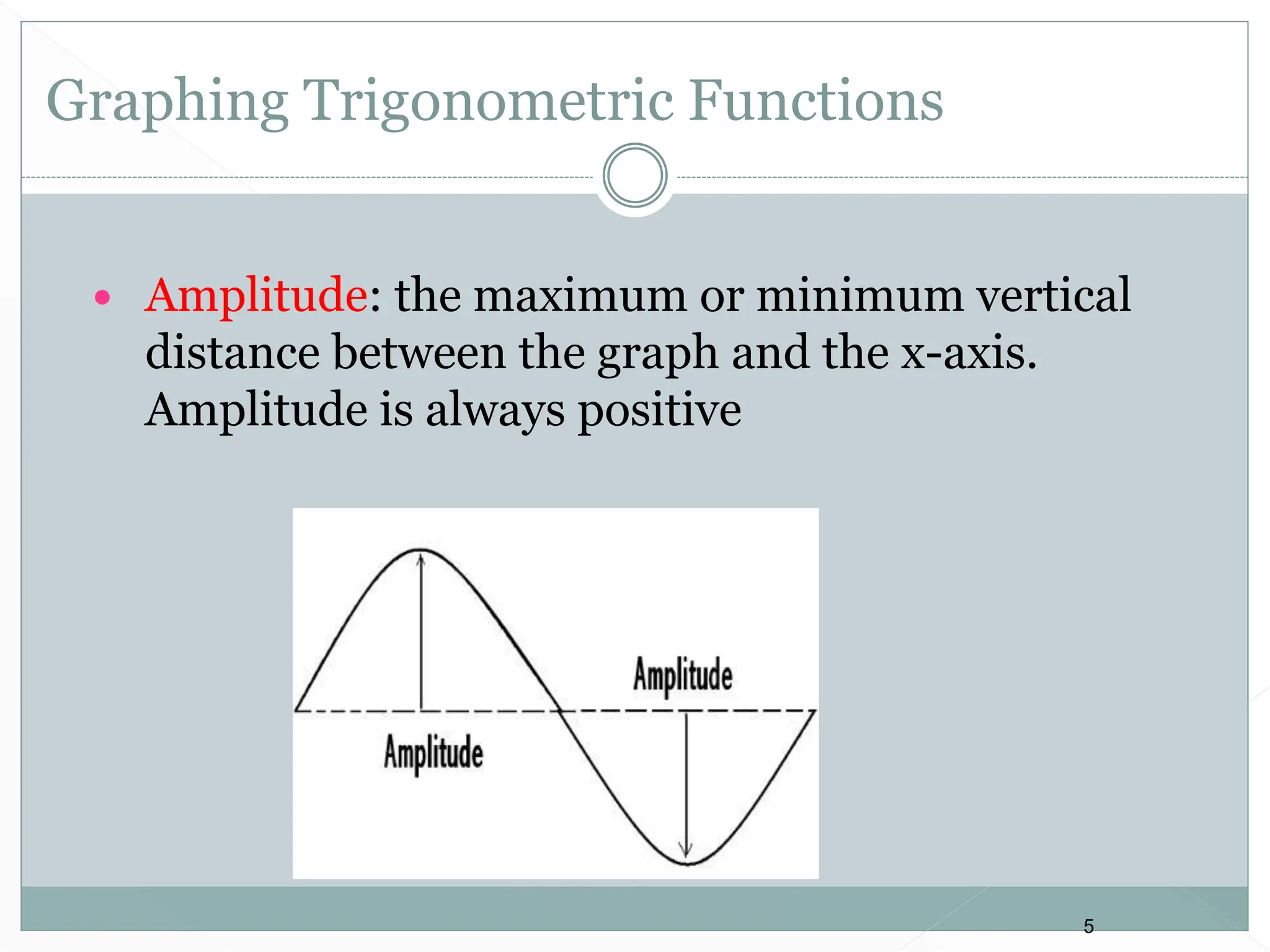
 Amplitude: the maximum or minimum vertical
distance between the graph and the x-axis.
Amplitude is always positive
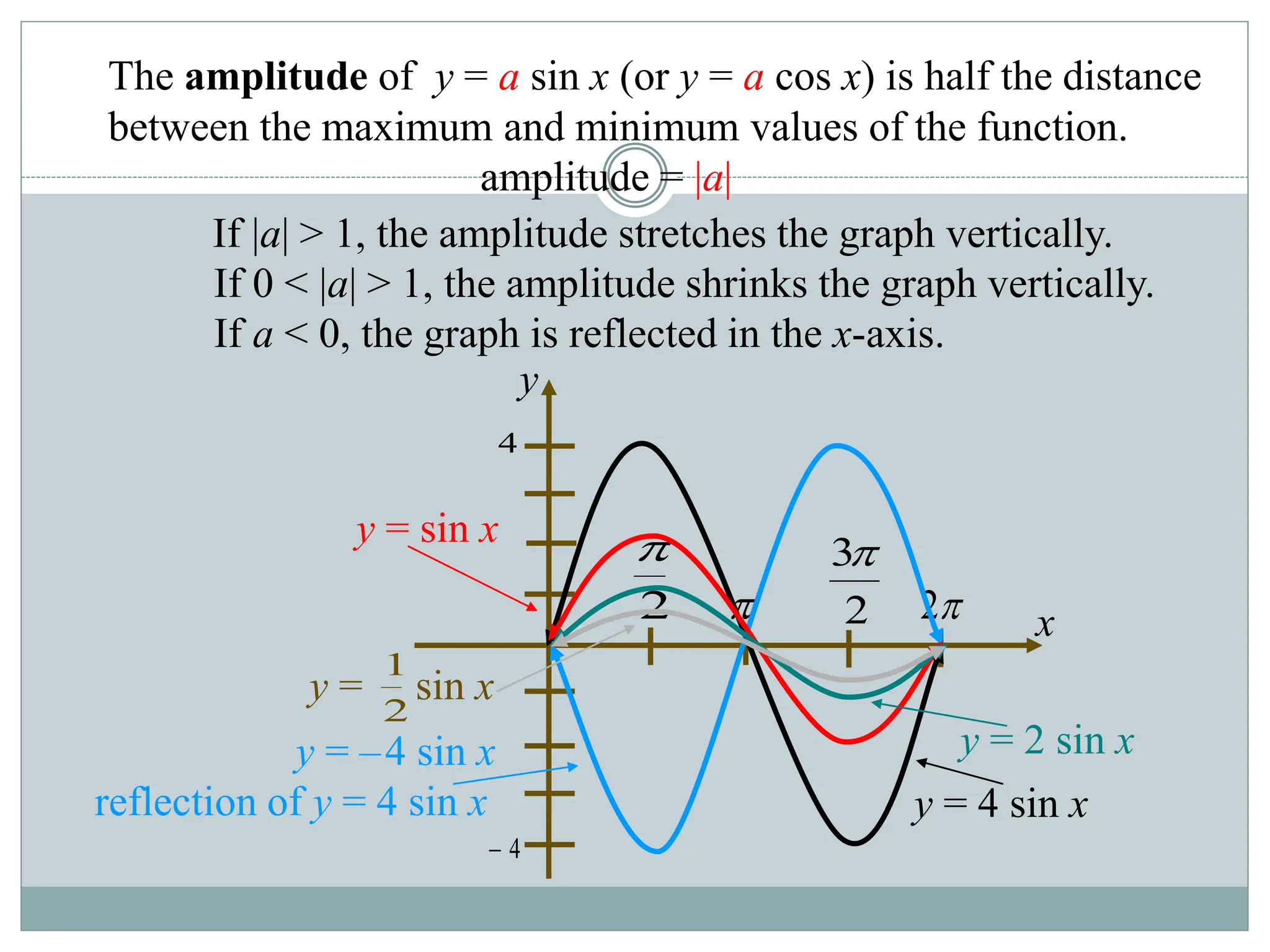
The amplitude of y = a sin x (or y = a cos x) is half the distance
between the maximum and minimum values of the function.
amplitude = |a|
If |a| > 1, the amplitude stretches the graph vertically.
If 0 < |a| > 1, the amplitude shrinks the graph vertically.
If a < 0, the graph is reflected in the x-axis.
2
3
2

4
y
x
4


2

y = –4 sin x
reflection of y = 4 sin x y = 4 sin x
y = sin x
2
1
y = sin x
y = 2 sin x
7
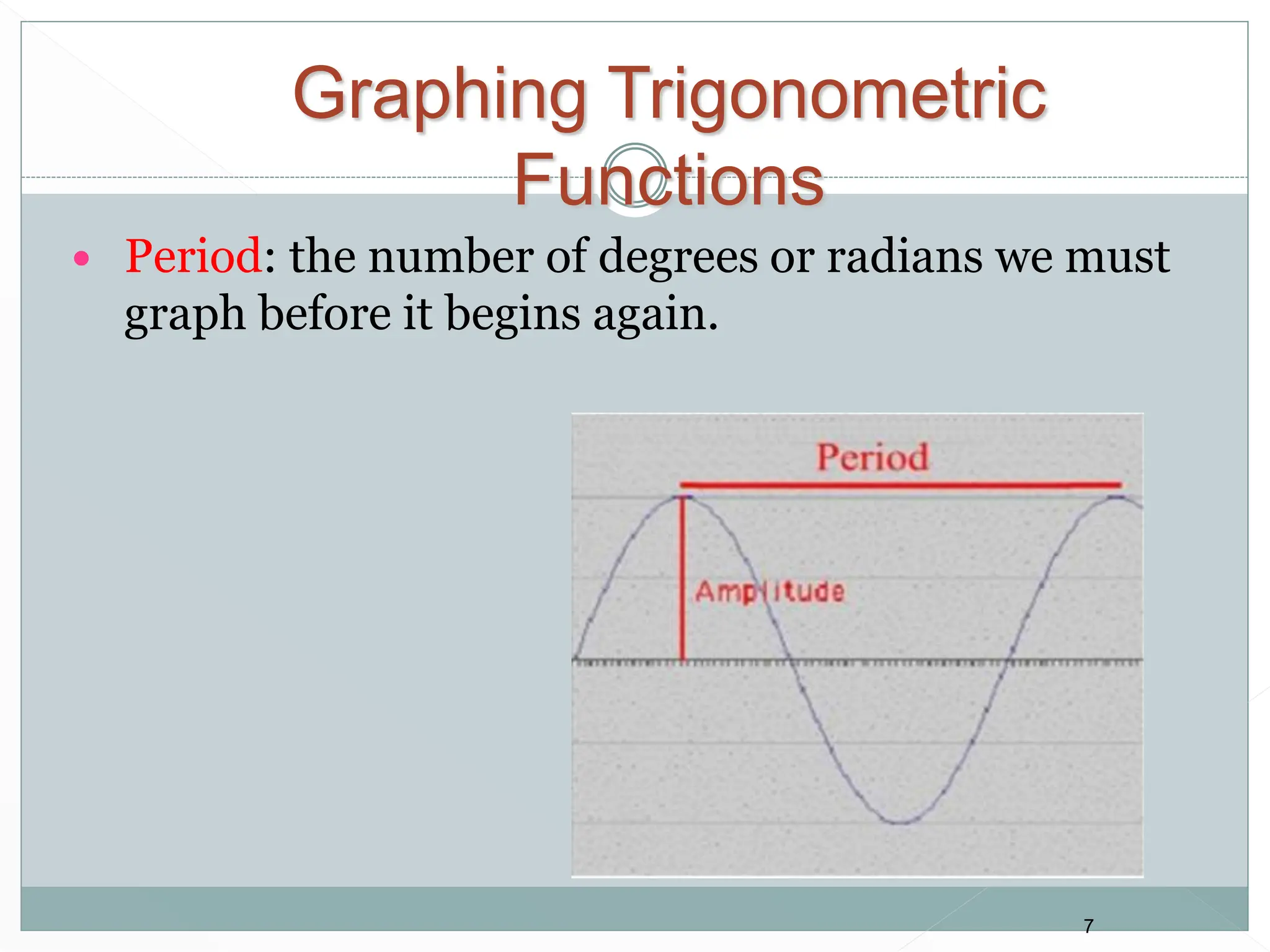
 Period: the number of degrees or radians we must
graph before it begins again.
Graphing Trigonometric
Functions
y
x

 
2

sin x
y 

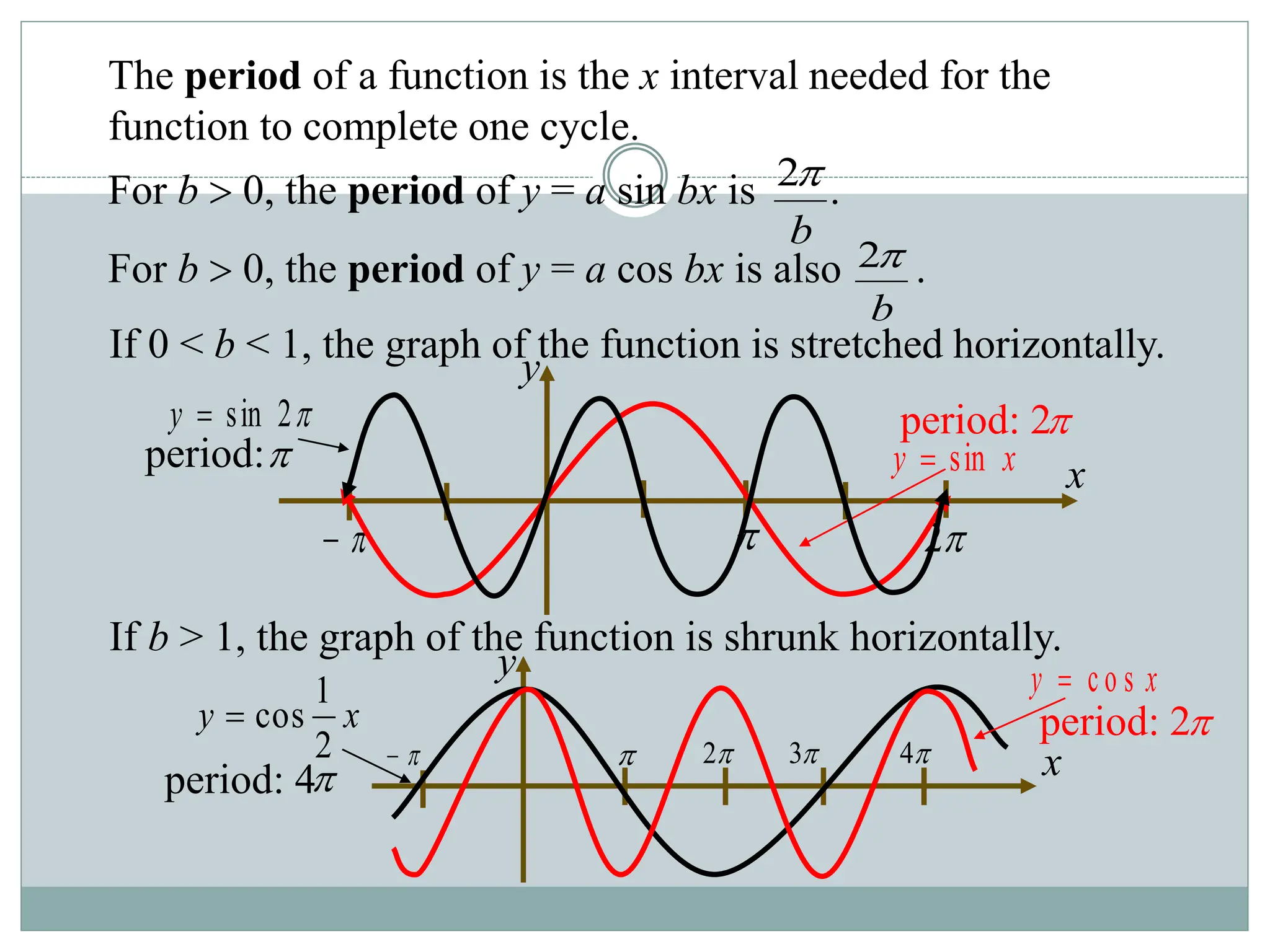
period: 2
2
sin 

y

period:
The period of a function is the x interval needed for the
function to complete one cycle.
For b  0, the period of y = a sin bx is .
b

2
For b  0, the period of y = a cos bx is also .
b

2
If 0 < b < 1, the graph of the function is stretched horizontally.
If b > 1, the graph of the function is shrunk horizontally.
y
x

 
2
 
3 
4
c o s x
y 

period: 2
2
1
cos x
y 

period: 4
Sine is a periodic function: p = 2π
,
Domain


One period
2π
0 3π
2π
π
−2π −π
−3π
sin θ
θ
sin θ: Domain (angle measures): all real numbers, (−∞, ∞)
Range (ratio of sides): −1 to 1, inclusive [−1, 1]
sin θ is an odd function; it is symmetric wrt the origin.
sin(−θ) = −sin(θ)
Graph of the Sine Function
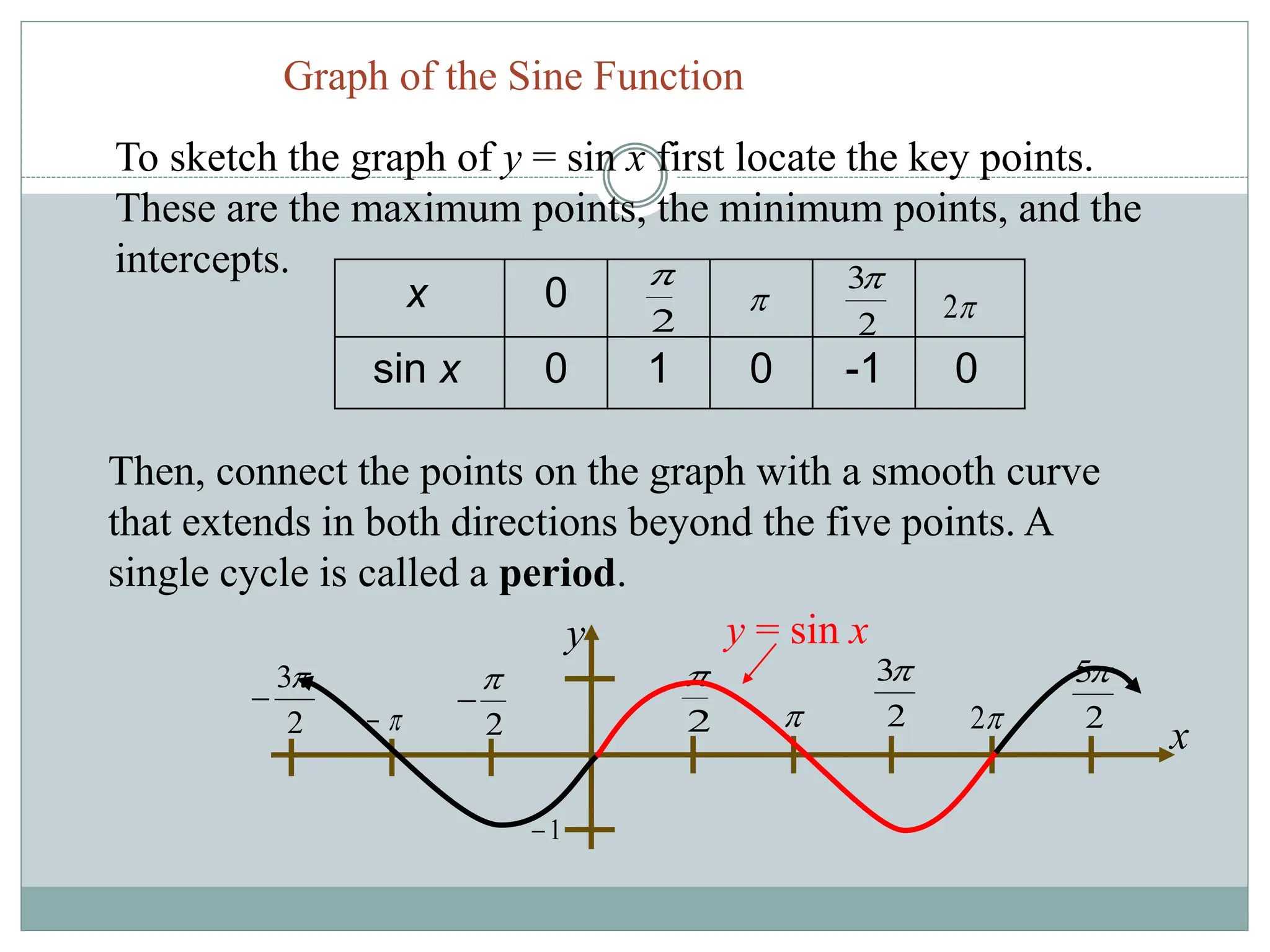
To sketch the graph of y = sin x first locate the key points.
These are the maximum points, the minimum points, and the
intercepts.
0
-1
0
1
0
sin x
0
x
2

2
3

2

Then, connect the points on the graph with a smooth curve
that extends in both directions beyond the five points. A
single cycle is called a period.
y
2
3


 2



2
2
3

2

2
5
1

x
y = sin x
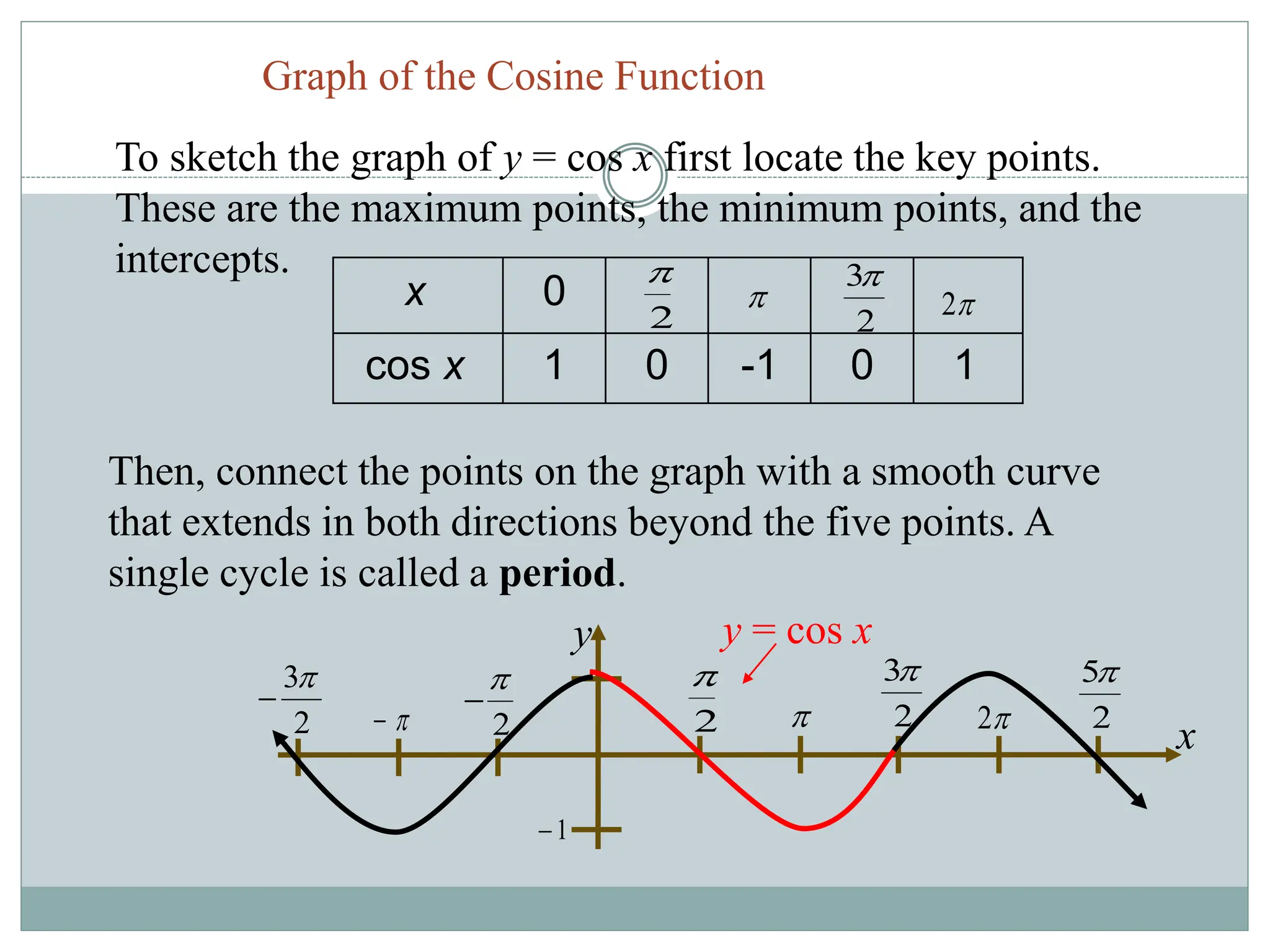
Graph of the Cosine Function
To sketch the graph of y = cos x first locate the key points.
These are the maximum points, the minimum points, and the
intercepts.
1
0
-1
0
1
cos x
0
x
2

2
3

2

Then, connect the points on the graph with a smooth curve
that extends in both directions beyond the five points. A
single cycle is called a period.
y
2
3


 2



2
2
3

2

2
5
1

x
y = cos x
Cosine is a periodic function: p = 2π
One period
2π
π 3π
−2π 2π
−π
−3π 0
θ
cos θ
cos θ: Domain (angle measures): all real numbers, (−∞, ∞)
Range (ratio of sides): −1 to 1, inclusive [−1, 1]
cos θ is an even function; it is symmetric wrt the y-axis.
cos(−θ) = cos(θ)
,
Domain


13
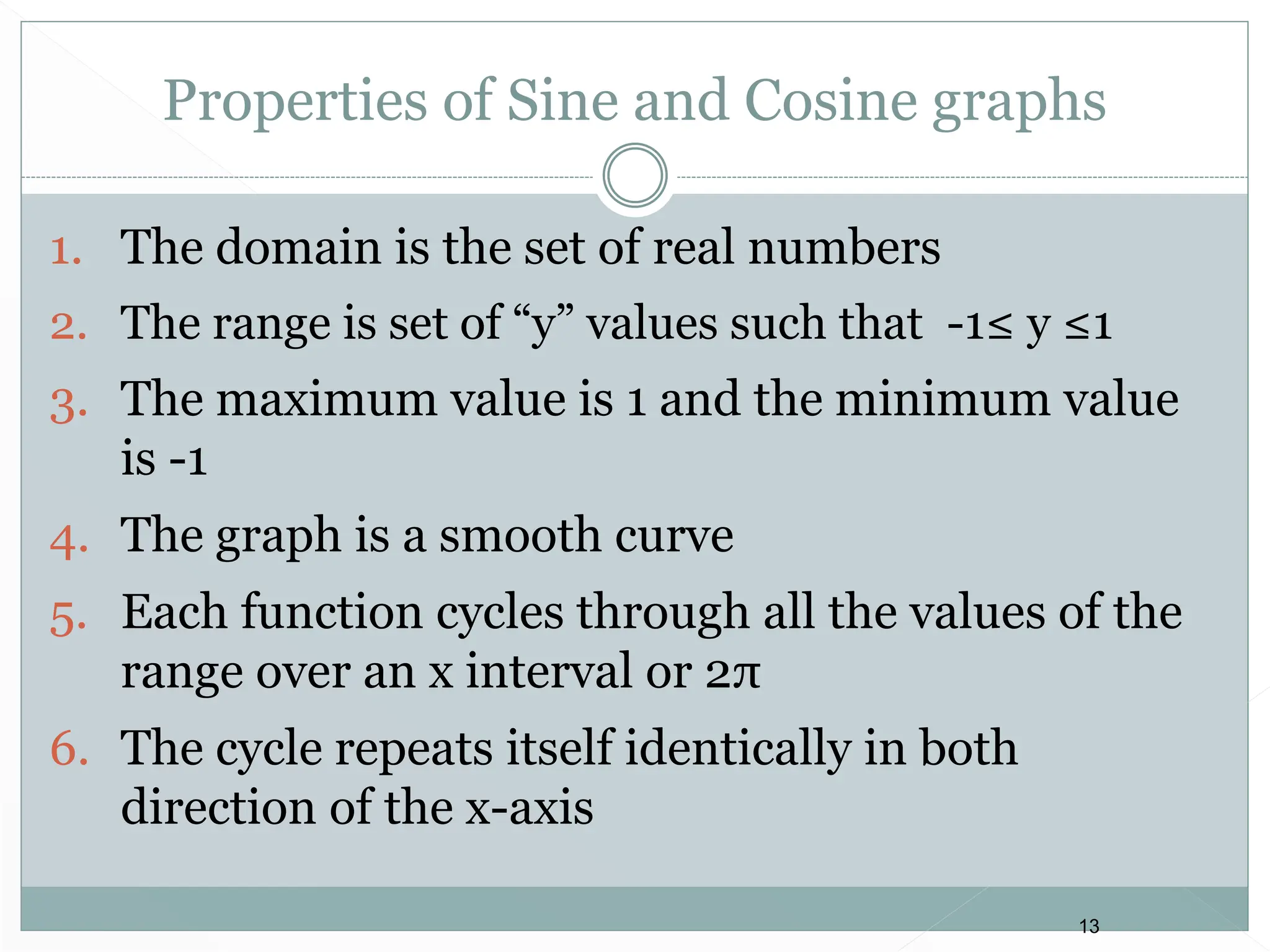
Properties of Sine and Cosine graphs
1. The domain is the set of real numbers
2. The range is set of “y” values such that -1≤ y ≤1
3. The maximum value is 1 and the minimum value
is -1
4. The graph is a smooth curve
5. Each function cycles through all the values of the
range over an x interval or 2π
6. The cycle repeats itself identically in both
direction of the x-axis
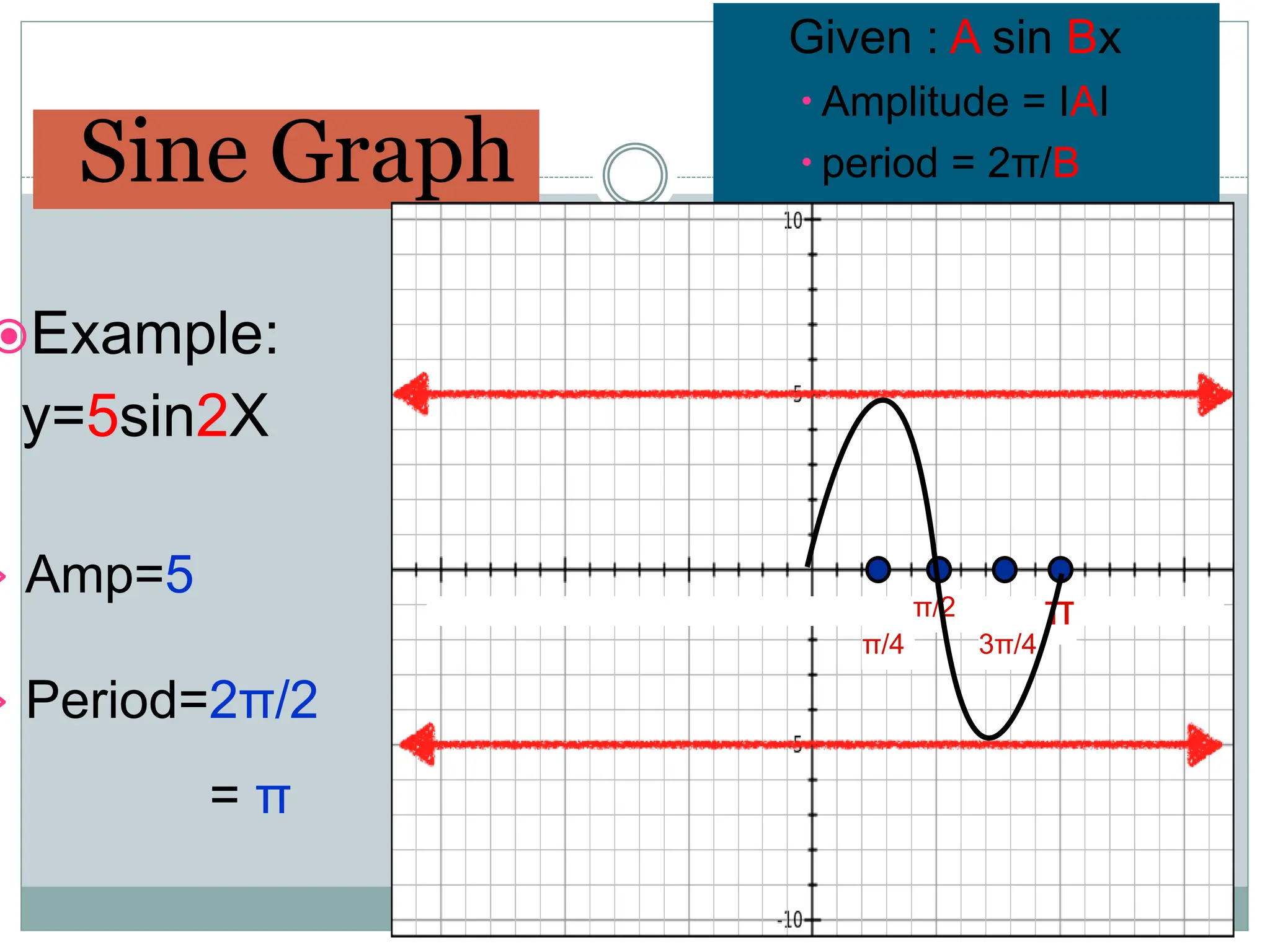
Sine Graph
Given : A sin Bx
 Amplitude = IAI
 period = 2π/B
Example:
y=5sin2X
› Amp=5
› Period=2π/2
= π
π
π/2
π/4 3π/4
y
1

2

3

2
x
 
3

2

 
4
Example: Sketch the graph of y = 3 cos x on the interval [–, 4].
Partition the interval [0, 2] into four equal parts. Find the five key
points; graph one cycle; then repeat the cycle over the interval.
max
x-int
min
x-int
max
3
0
-3
0
3
y = 3 cos x
2

0
x 2

2
3

(0, 3)
2
3
( , 0)
( , 0)
2


2
( , 3)

( , –3)
y
x

2

y = cos (–x)
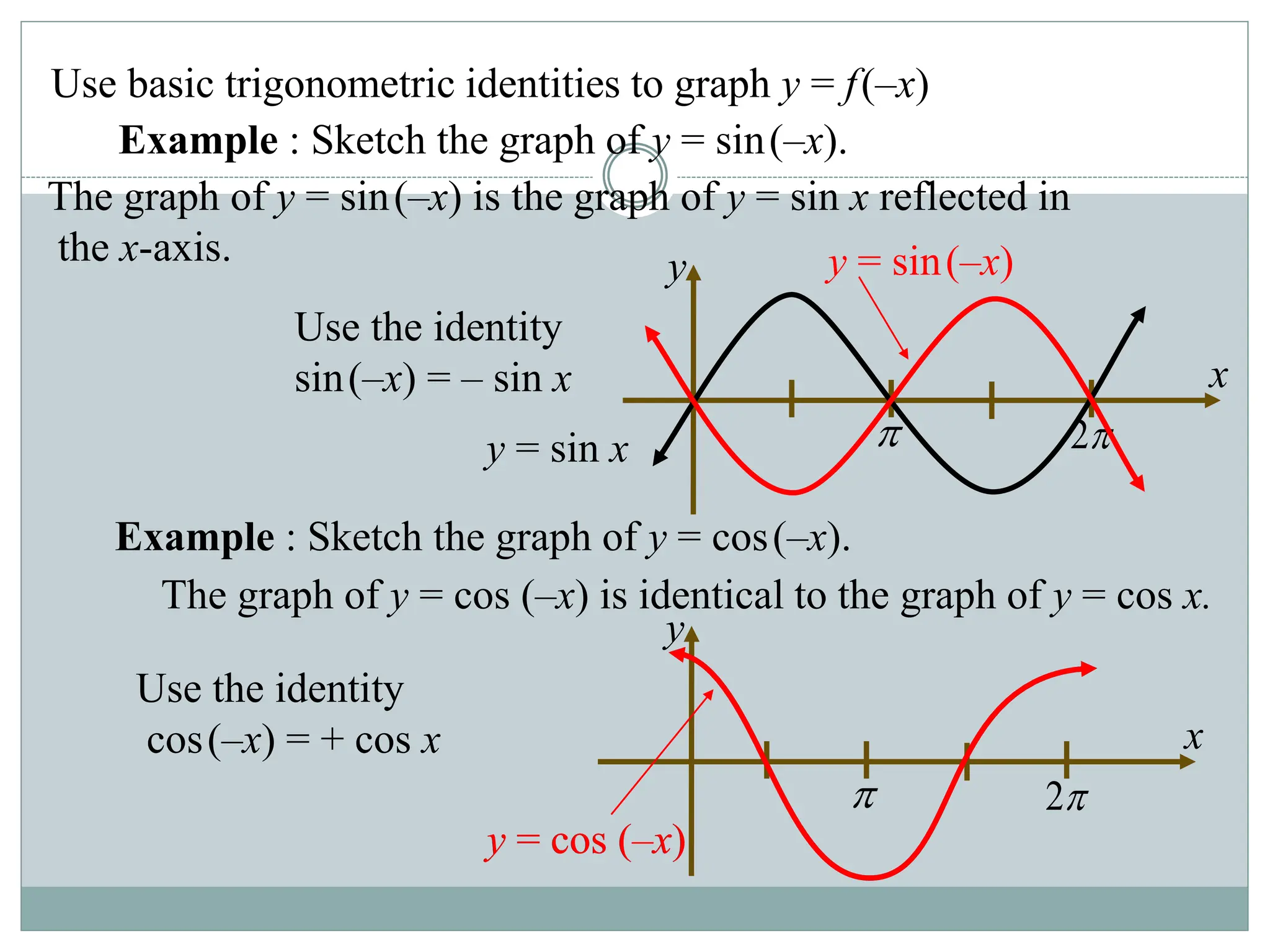
Use basic trigonometric identities to graph y = f(–x)
Example : Sketch the graph of y = sin(–x).
Use the identity
sin(–x) = – sin x
The graph of y = sin(–x) is the graph of y = sin x reflected in
the x-axis.
Example : Sketch the graph of y = cos(–x).
Use the identity
cos(–x) = + cos x
The graph of y = cos (–x) is identical to the graph of y = cos x.
y
x

2

y = sin x
y = sin(–x)
y = cos (–x)
2
y
2

6

x
2


6
5
3

3
2
6

6

3

2

3
2
0
2
0
–2
0
y = –2 sin 3x
0
x
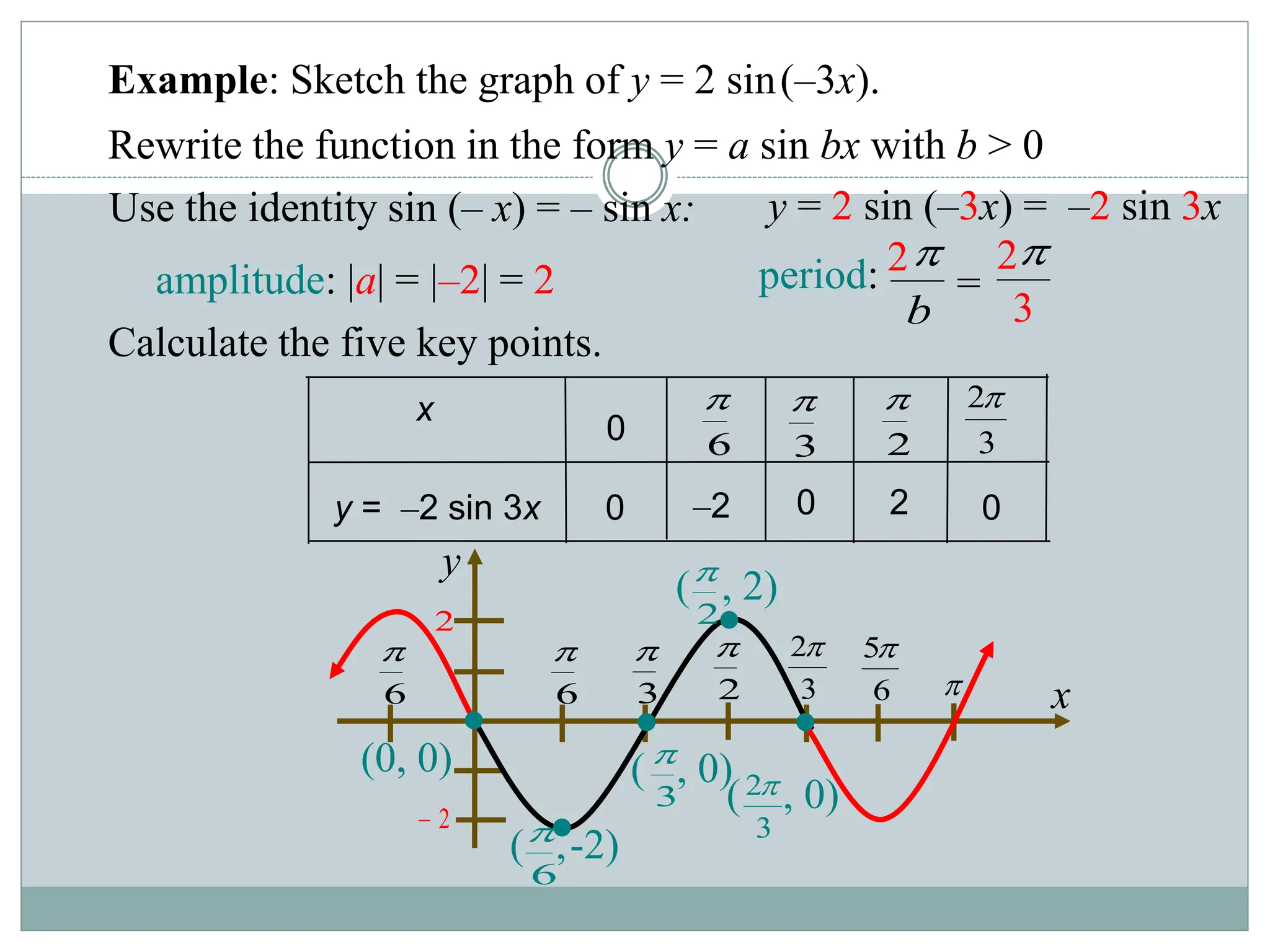
Example: Sketch the graph of y = 2 sin(–3x).
Rewrite the function in the form y = a sin bx with b > 0
amplitude: |a| = |–2| = 2
Calculate the five key points.
(0, 0) ( , 0)
3

( , 2)
2

( ,-2)
6

( , 0)
3
2
Use the identity sin (– x) = – sin x: y = 2 sin (–3x) = –2 sin 3x
period:
b

2 
2
3
=
Tangent Function
θ sin θ cos θ tan θ
−π/2
−π/4
0
π/4
π/2
θ tan θ
−π/2 und
−π/4 −1
0 0
π/4 1
π/2 und
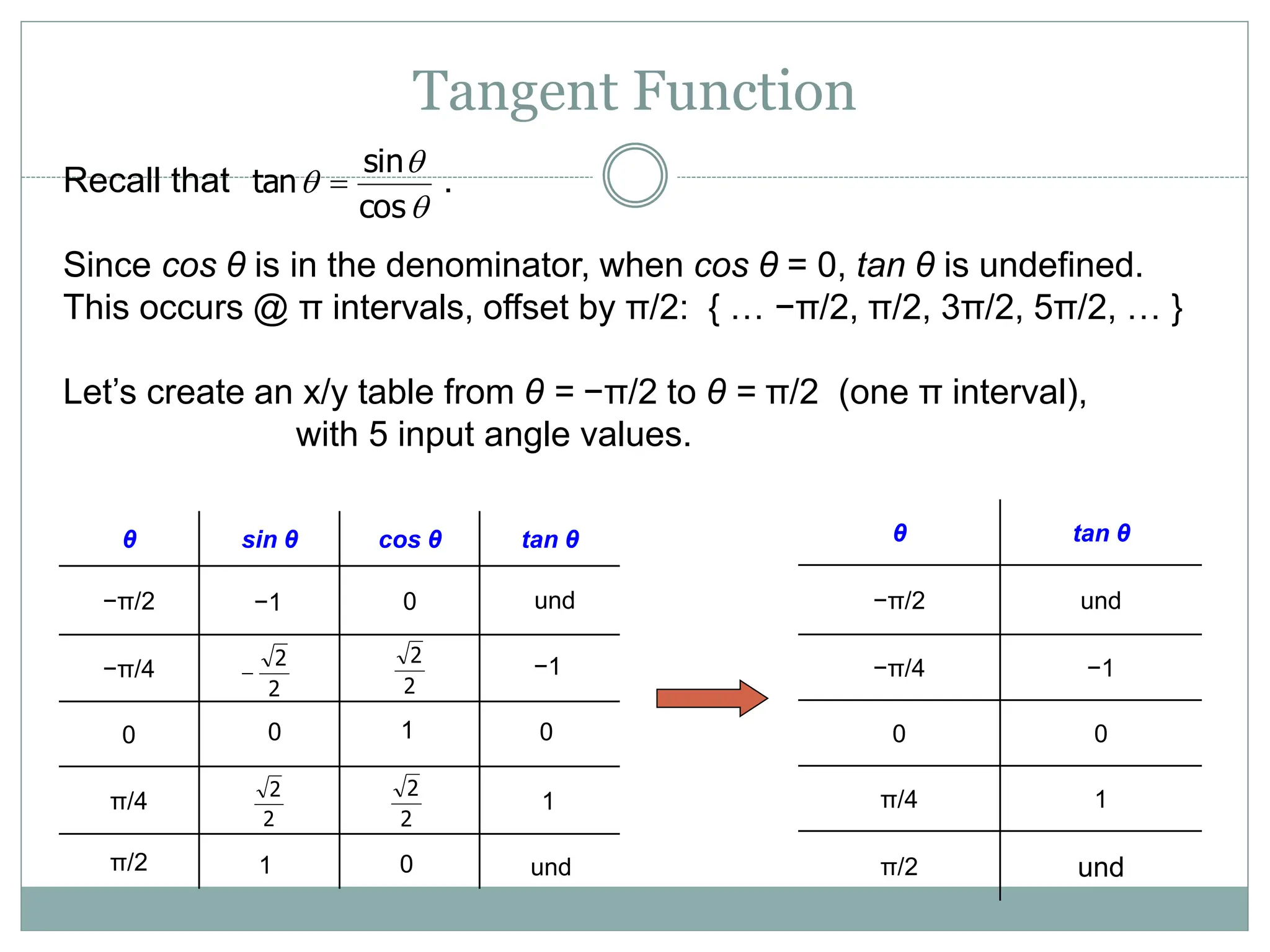
Recall that .
Since cos θ is in the denominator, when cos θ = 0, tan θ is undefined.
This occurs @ π intervals, offset by π/2: { … −π/2, π/2, 3π/2, 5π/2, … }
Let’s create an x/y table from θ = −π/2 to θ = π/2 (one π interval),
with 5 input angle values.



cos
sin
tan 
2
2
2
2
2
2
2
2

1
1
1
−1
−1
0
0 0
und
und
0
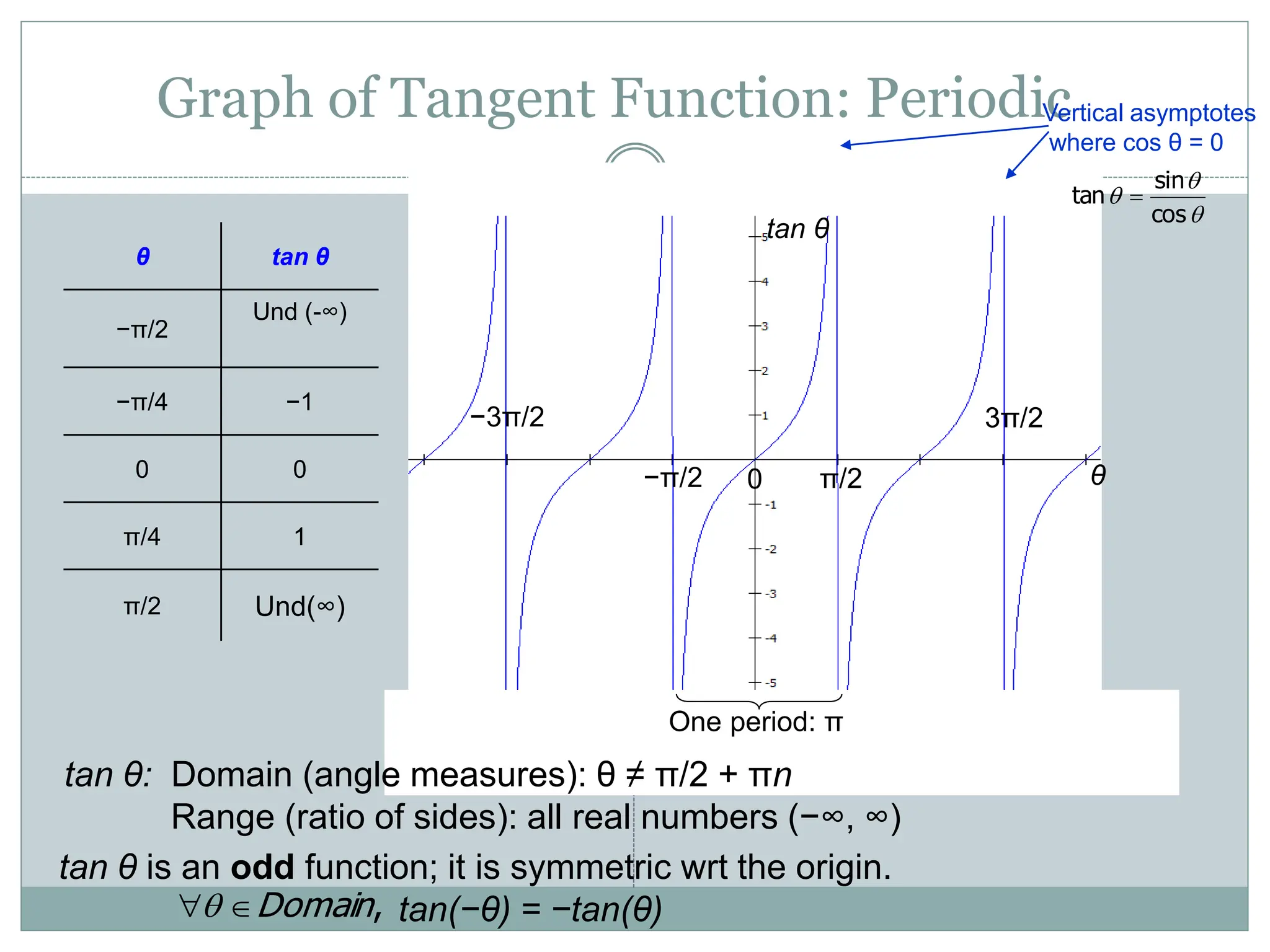
Graph of Tangent Function: Periodic
θ tan θ
−π/2
Und (-∞)
−π/4 −1
0 0
π/4 1
π/2 Und(∞)
,
Domain


tan θ is an odd function; it is symmetric wrt the origin.
tan(−θ) = −tan(θ)
0 θ
tan θ
−π/2 π/2
One period: π
tan θ: Domain (angle measures): θ ≠ π/2 + πn
Range (ratio of sides): all real numbers (−∞, ∞)
3π/2
−3π/2
Vertical asymptotes
where cos θ = 0



cos
sin
tan 
y
x
2
3

2
3
2

2


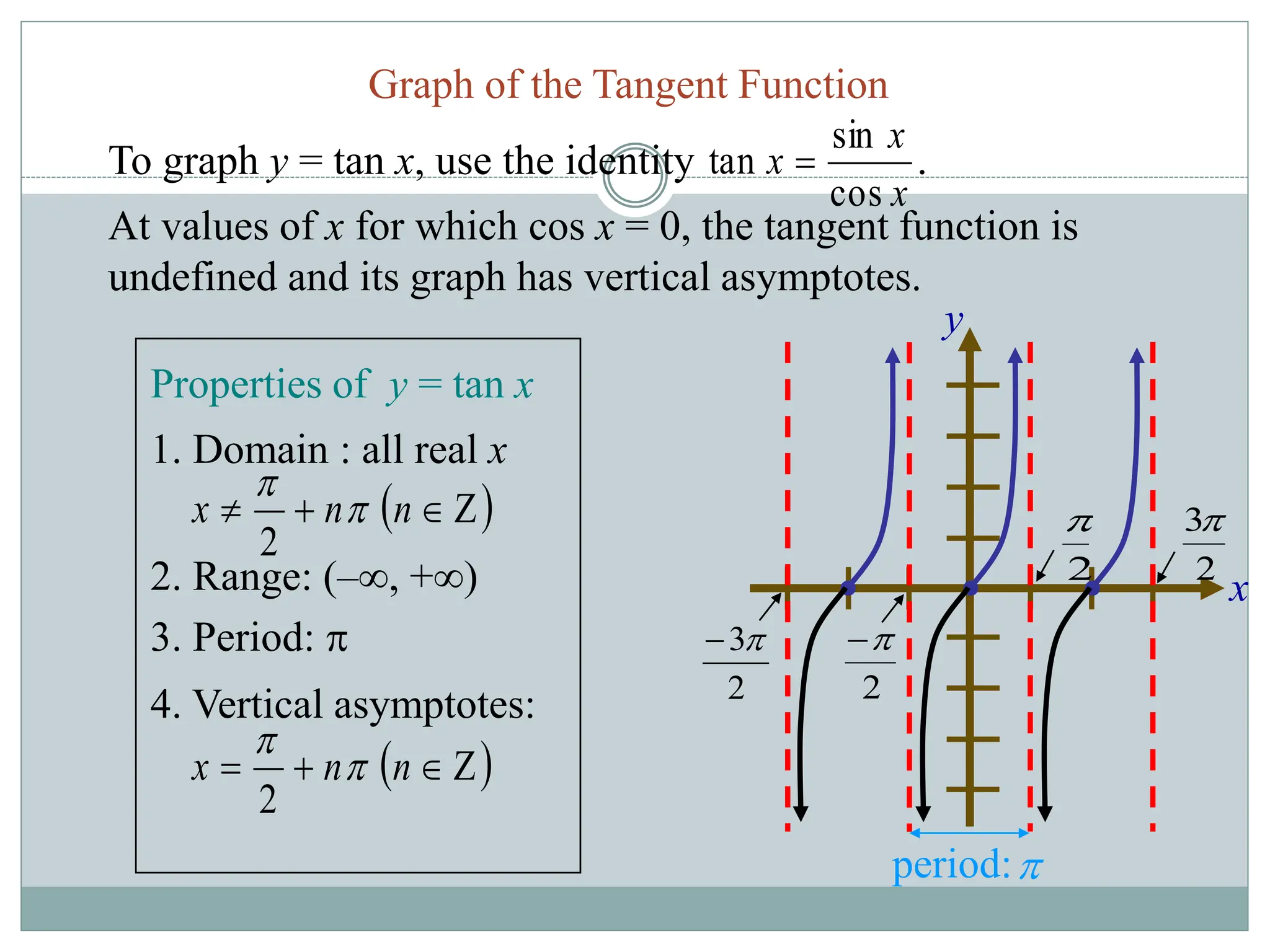
Graph of the Tangent Function
2. Range: (–, +)
3. Period: 
4. Vertical asymptotes:
 



 n
n
x
2


1. Domain : all real x
 



 n
n
x
2


Properties of y = tan x
period:
To graph y = tan x, use the identity .
x
x
x
cos
sin
tan 
At values of x for which cos x = 0, the tangent function is
undefined and its graph has vertical asymptotes.
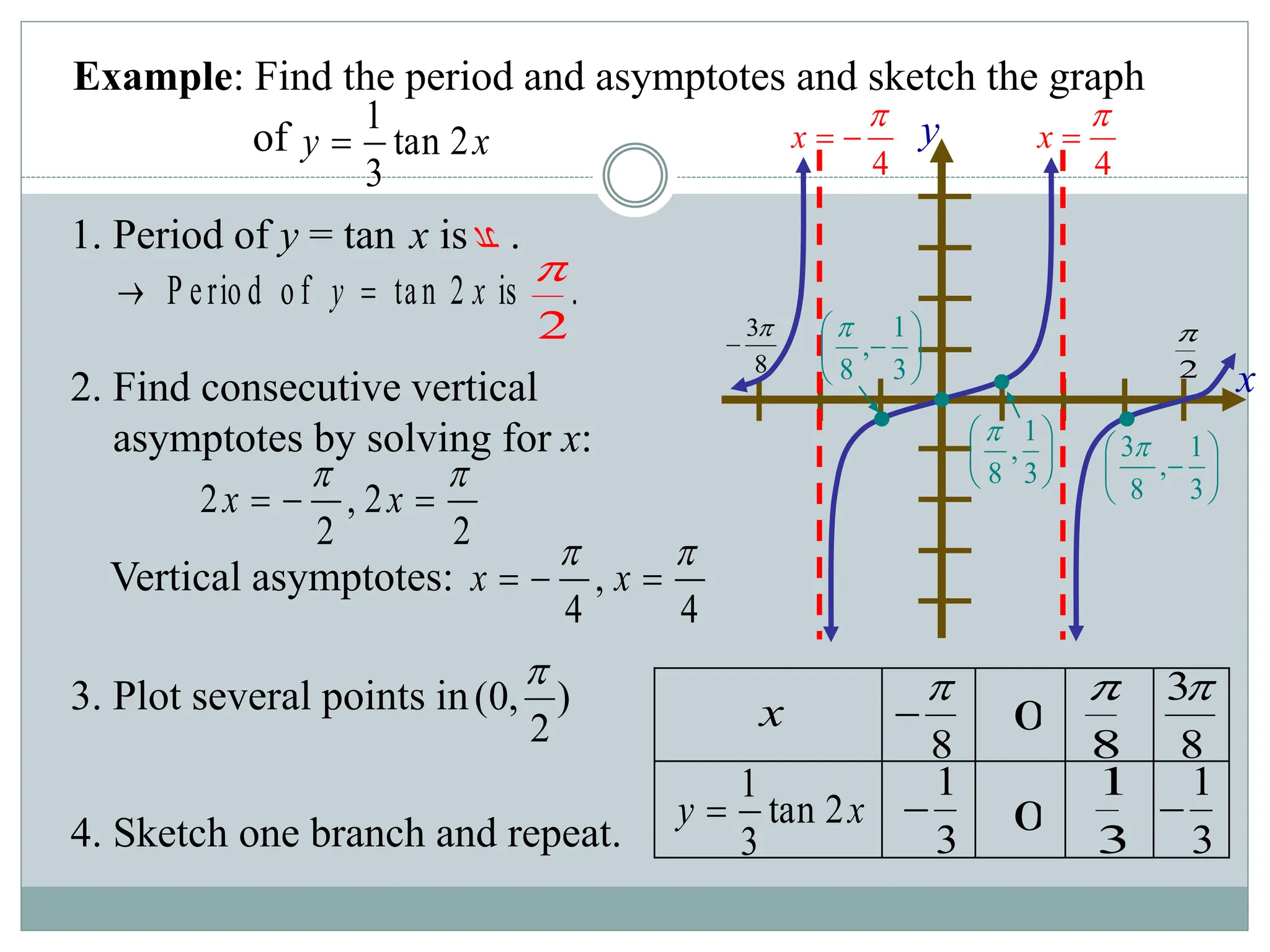
2. Find consecutive vertical
asymptotes by solving for x:
4. Sketch one branch and repeat.
Example: Find the period and asymptotes and sketch the graph
of x
y 2
tan
3
1

2
2
,
2
2




 x
x
4
,
4




 x
x
Vertical asymptotes:
)
2
,
0
(

3. Plot several points in

1. Period of y = tan x is .
2

.
is
2
tan
o f
P erio d x
y 

x
x
y 2
tan
3
1

8


3
1
 0
0
8

3
1
8
3
3
1

y
x
2

8
3

4


x
4



x







3
1
,
8







3
1
,
8








3
1
,
8
3
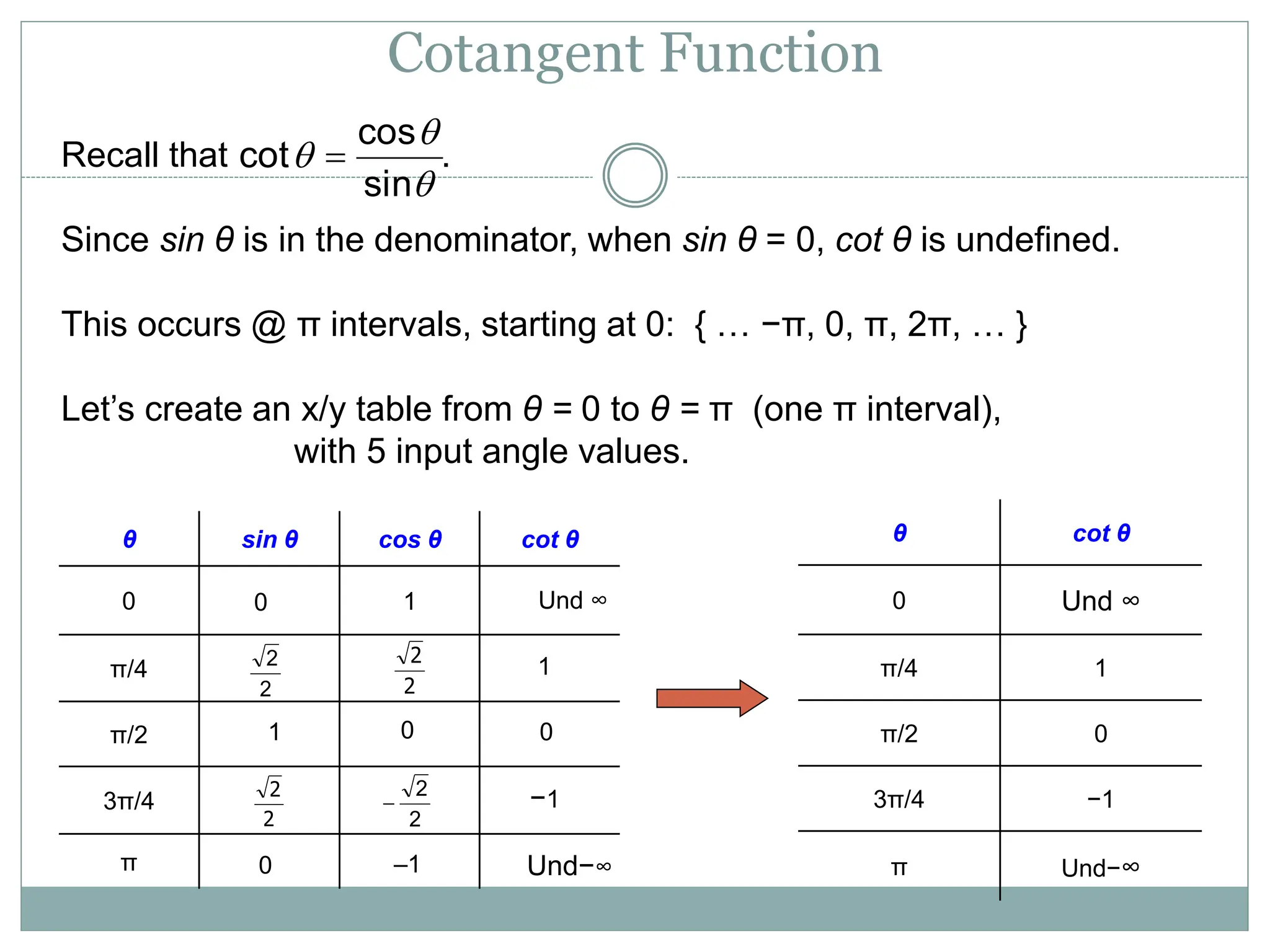
Cotangent Function
θ sin θ cos θ cot θ
0
π/4
π/2
3π/4
π
θ cot θ
0 Und ∞
π/4 1
π/2 0
3π/4 −1
π Und−∞
Recall that .
Since sin θ is in the denominator, when sin θ = 0, cot θ is undefined.
This occurs @ π intervals, starting at 0: { … −π, 0, π, 2π, … }
Let’s create an x/y table from θ = 0 to θ = π (one π interval),
with 5 input angle values.



sin
cos
cot 
2
2
2
2

2
2
2
2
0
−1
0
0
1
1
1 0
Und−∞
Und ∞
–1
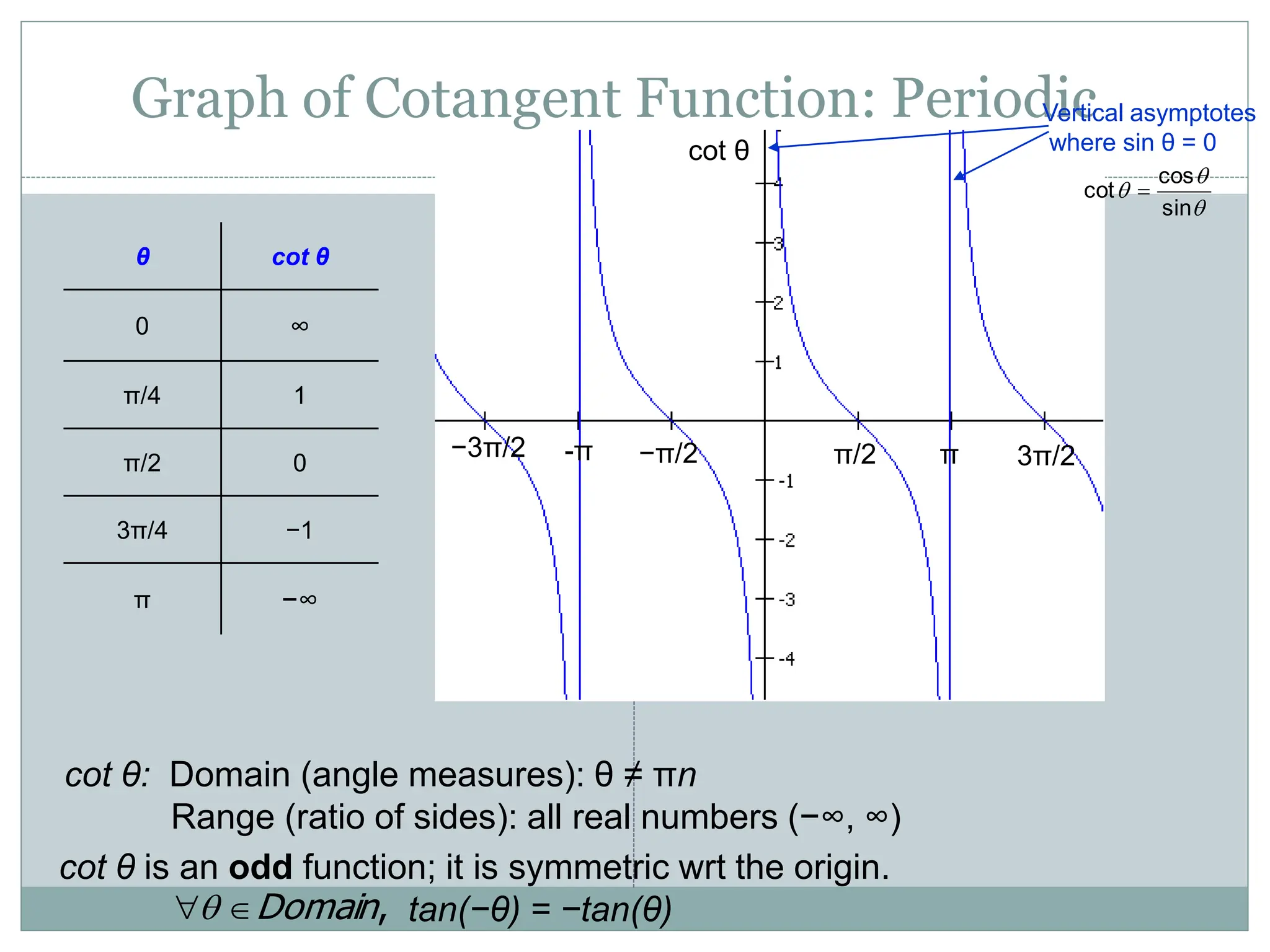
Graph of Cotangent Function: Periodic
θ cot θ
0 ∞
π/4 1
π/2 0
3π/4 −1
π −∞
,
Domain


cot θ is an odd function; it is symmetric wrt the origin.
tan(−θ) = −tan(θ)
cot θ: Domain (angle measures): θ ≠ πn
Range (ratio of sides): all real numbers (−∞, ∞)
3π/2
−3π/2
Vertical asymptotes
where sin θ = 0



sin
cos
cot 
π
-π −π/2 π/2
cot θ
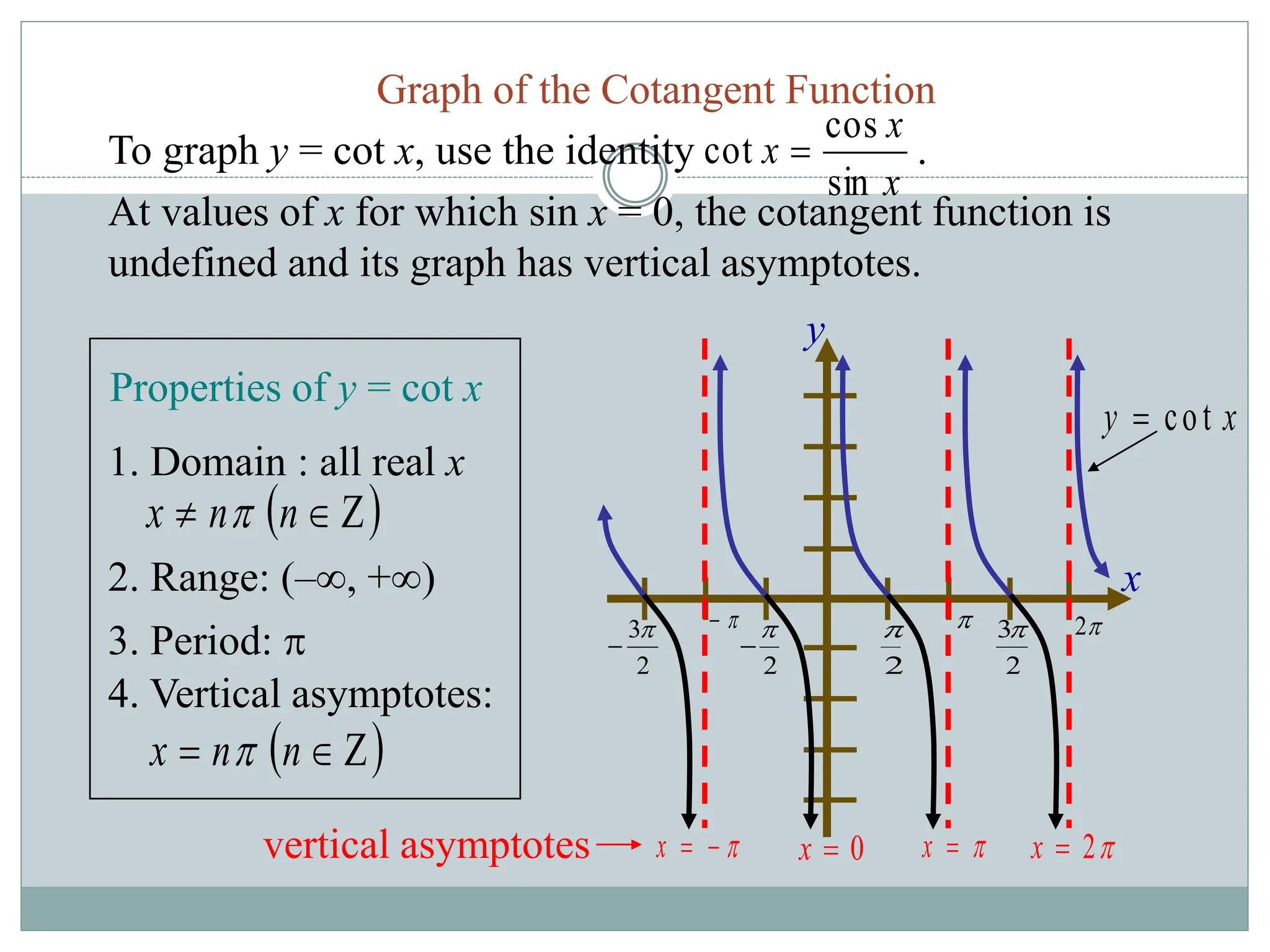
Graph of the Cotangent Function
2. Range: (–, +)
3. Period: 
4. Vertical asymptotes:
 


 n
n
x 
1. Domain : all real x
 


 n
n
x 
Properties of y = cot x
y
x
2

2



2
3
2
3


 
2
x
y cot

0

x
vertical asymptotes 

x



x 
2

x
To graph y = cot x, use the identity .
x
x
x
sin
cos
cot 
At values of x for which sin x = 0, the cotangent function is
undefined and its graph has vertical asymptotes.
Cosecant is the reciprocal of sine
sin θ: Domain: (−∞, ∞)
Range: [−1, 1]
csc θ: Domain: θ ≠ πn
(where sin θ = 0)
Range: |csc θ| ≥ 1
or (−∞, −1] U [1, ∞]
sin θ and csc θ
are odd
(symm wrt origin)
One period: 2π
π 2π 3π
0
−π
−2π
−3π
Vertical asymptotes
where sin θ = 0
θ
csc θ
sin θ

2
3
x
2

2

 
2
2
5
y
4
4

Graph of the Cosecant Function
2. range: (–,–1]  [1, +)
3. period: 
where sine is zero.
4. vertical asymptotes:
 


 n
n
x 
1. domain : all real x
 


 n
n
x 
sin
1
csc
x
x 
To graph y = csc x, use the identity .
Properties of y = csc x
x
y c sc

x
y sin

At values of x for which sin x = 0, the cosecant function
is undefined and its graph has vertical asymptotes.
Secant is the reciprocal of cosine
cos θ: Domain: (−∞, ∞)
Range: [−1, 1]
One period: 2π
π 3π
−2π 2π
−π
−3π 0
θ
sec θ
cos θ
Vertical asymptotes
where cos θ = 0
sec θ: Domain: θ ≠ π/2 + πn
(where cos θ = 0)
Range: |sec θ | ≥ 1
or (−∞, −1] U [1, ∞]
cos θ and sec θ
are even
(symm wrt y-axis)
2
3
y
x
2

2

  
2 
3
2
5
4
4

x
y c o s

Graph of the Secant Function
2. range: (–,–1]  [1, +)
3. period: 2
4. vertical asymptotes:
 



 n
n
x 

2
1. domain : all real x
)
(
2



 n
n
x 

cos
1
sec
x
x 
The graph y = sec x, use the identity .
Properties of y = sec x
x
y se c

At values of x for which cos x = 0, the secant function is undefined
and its graph has vertical asymptotes.
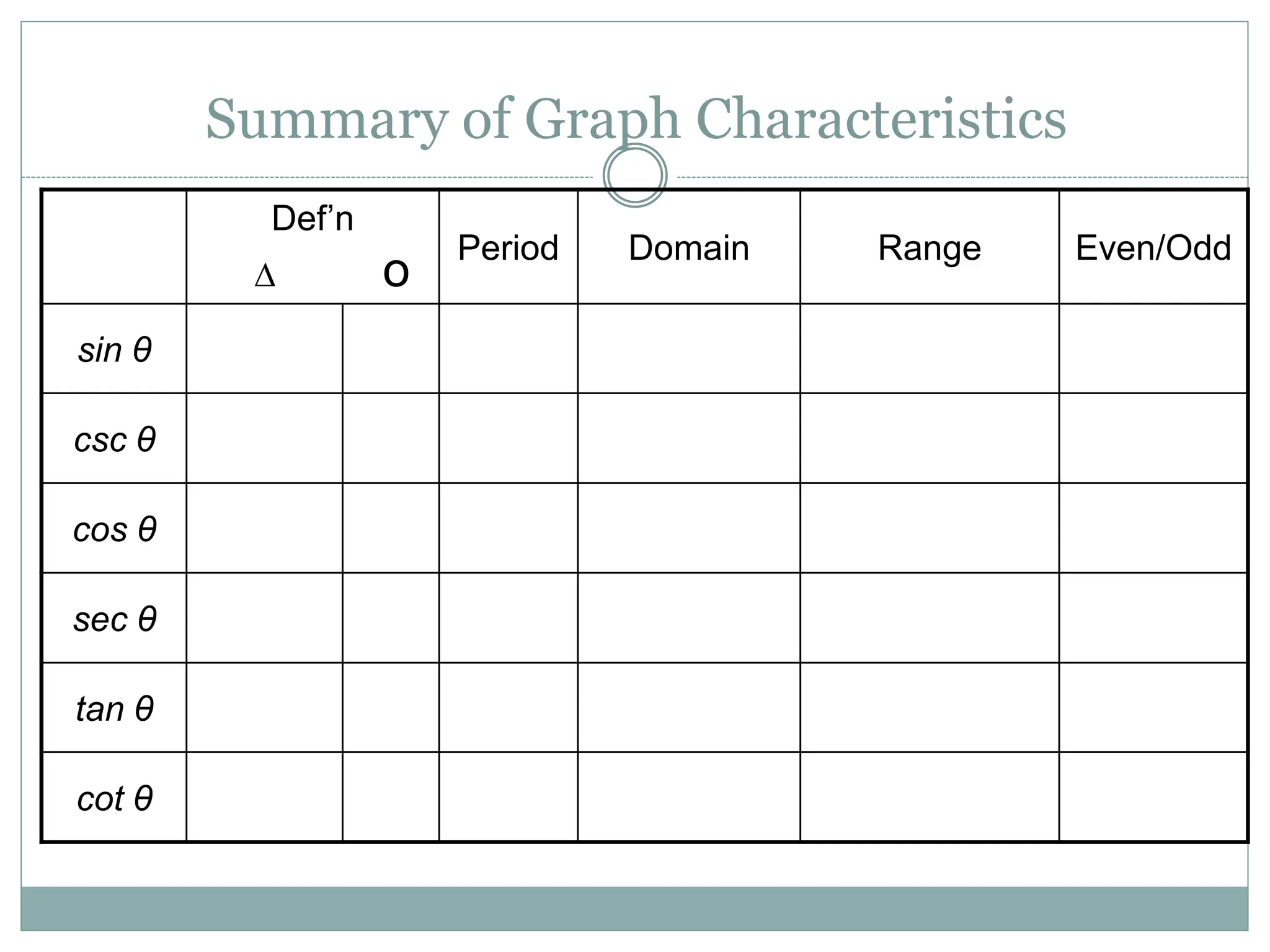
Summary of Graph Characteristics
Def’n
∆ о
Period Domain Range Even/Odd
sin θ
csc θ
cos θ
sec θ
tan θ
cot θ
Summary of Graph Characteristics
Def’n
∆ о
Period Domain Range Even/Odd
sin θ
opp
hyp
y
r 2π (−∞, ∞)
−1 ≤ x ≤ 1 or
[−1, 1]
odd
csc θ
1
.sinθ
r
.y 2π θ ≠ πn
|csc θ| ≥ 1 or
(−∞, −1] U [1, ∞)
odd
cos θ
adj
hyp
x
r 2π (−∞, ∞)
All Reals or
(−∞, ∞)
even
sec θ
1 .
cosθ
r
y 2π θ ≠ π2 +πn
|sec θ| ≥ 1 or
(−∞, −1] U [1, ∞)
even
tan θ
sinθ
cosθ
y
x π θ ≠ π2 +πn
All Reals or
(−∞, ∞)
odd
cot θ
cosθ
.sinθ
x
y π θ ≠ πn
All Reals or
(−∞, ∞)
odd
•Without looking at your notes, try to sketch the basic shape of
each trig function:
1) Sine:
2) Cosine:
3) Tangent:
Translations of Trigonometric Graphs
More Transformations
We have seen two types of transformations on trig
graphs: vertical stretches and horizontal stretches.
There are three more: vertical translations (slides),
horizontal translations, and reflections (flips).
More Transformations
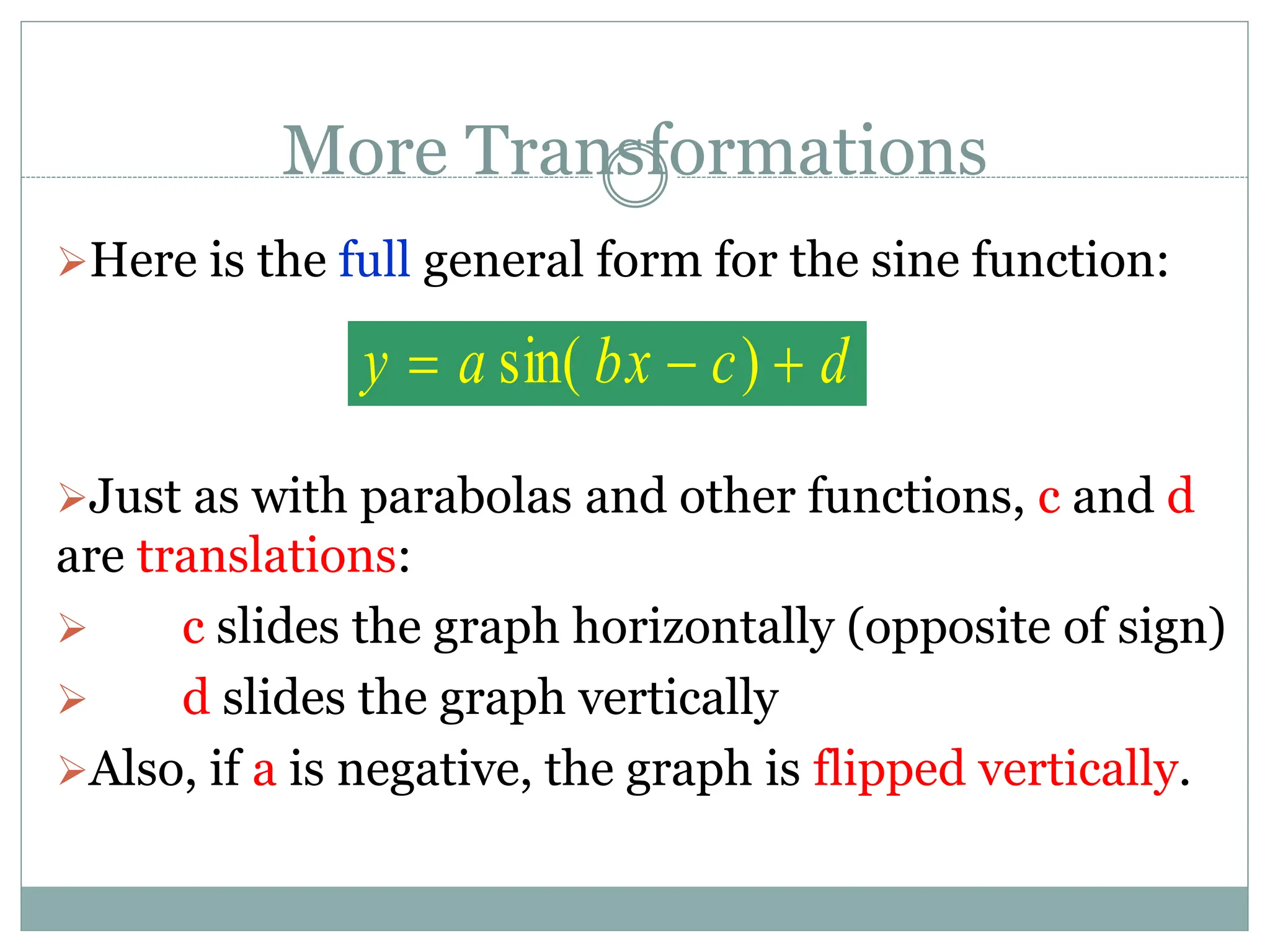
Here is the full general form for the sine function:
Just as with parabolas and other functions, c and d
are translations:
 c slides the graph horizontally (opposite of sign)
 d slides the graph vertically
Also, if a is negative, the graph is flipped vertically.
d
c
bx
a
y 

 )
sin(
More Transformations
 To graph a sine or cosine graph:
1. Graph the original graph with the correct
amplitude and period.
2. Translate c units horizontally and d units
vertically.
3. Reflect vertically at its new position if a is negative
(or reflect first, then translate).
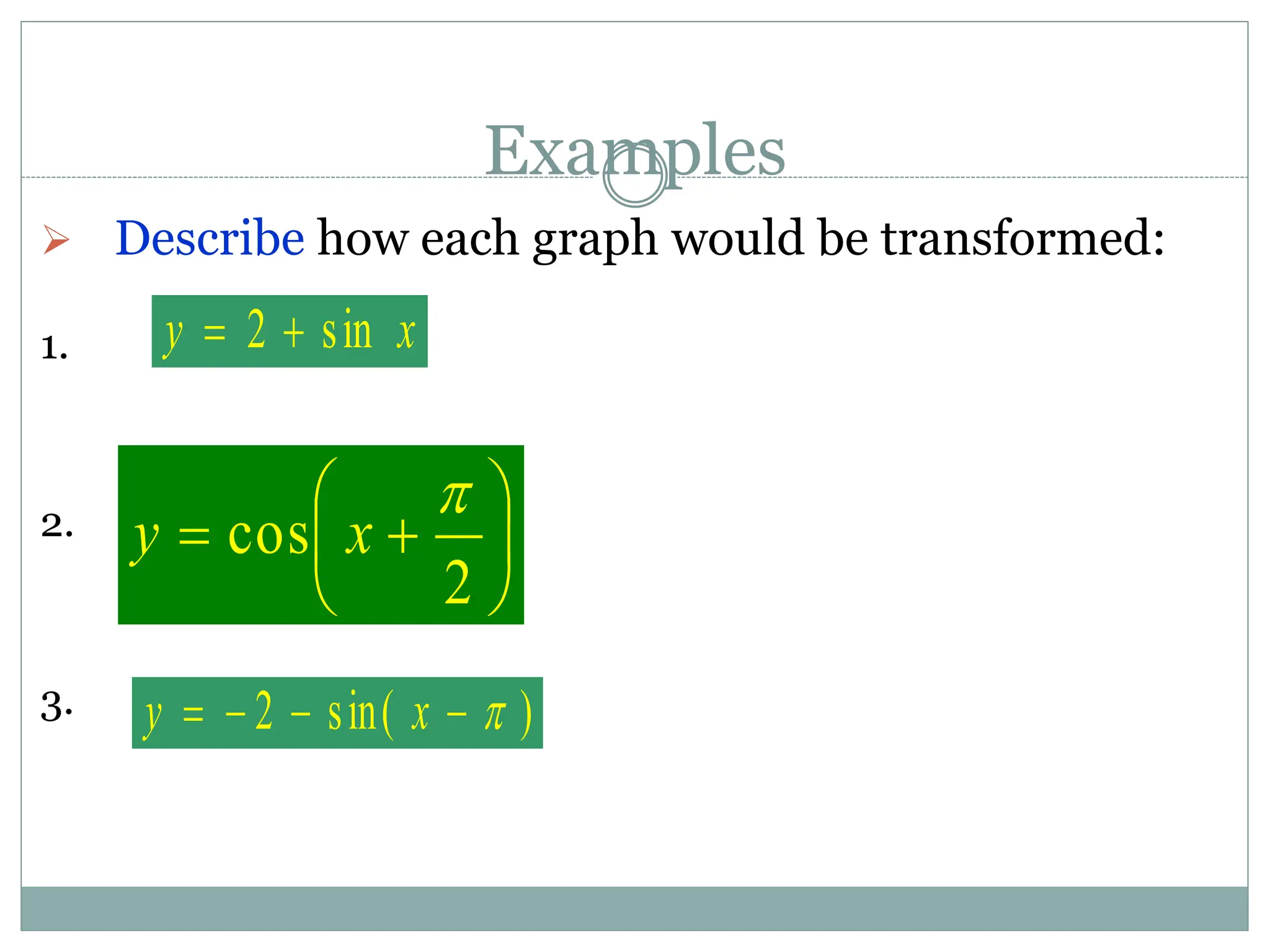
Examples
 Describe how each graph would be transformed:
1.
2.
3.
x
y sin
2 

)
sin(
2 



 x
y








2
cos

x
y
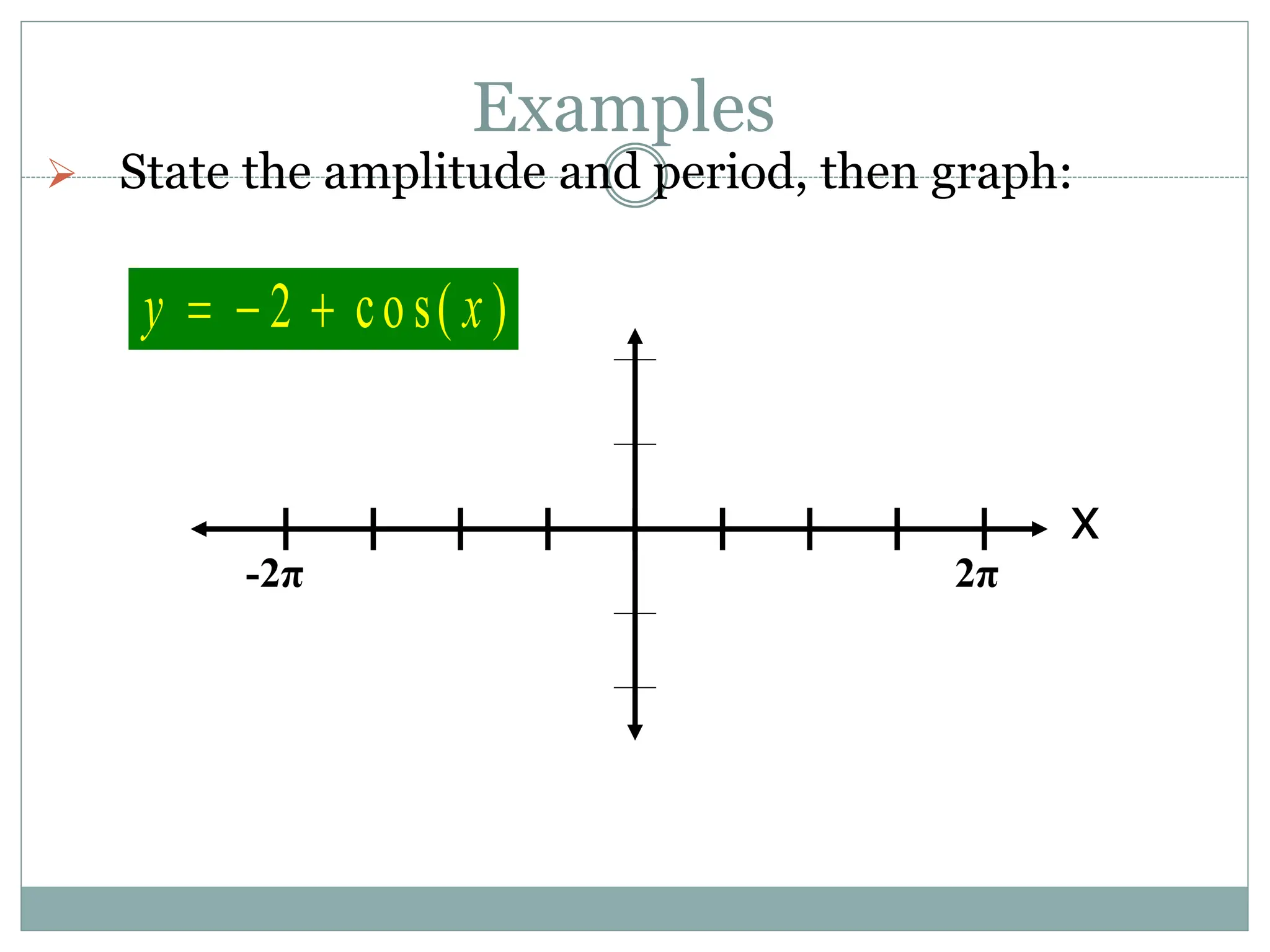
Examples
 State the amplitude and period, then graph:
)
cos(
2 x
y 


x
2π
-2π
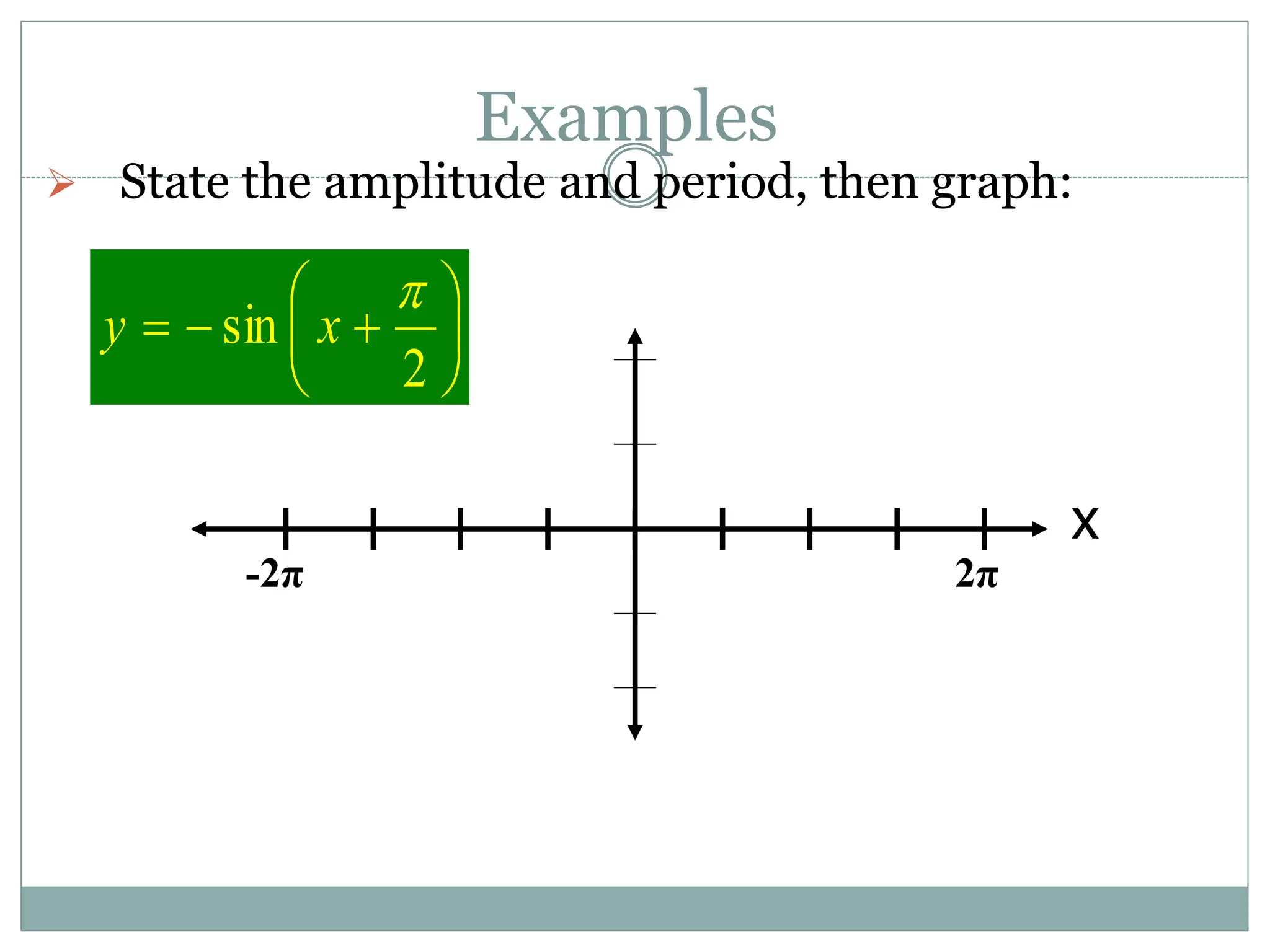
Examples
 State the amplitude and period, then graph:









2
sin

x
y
x
2π
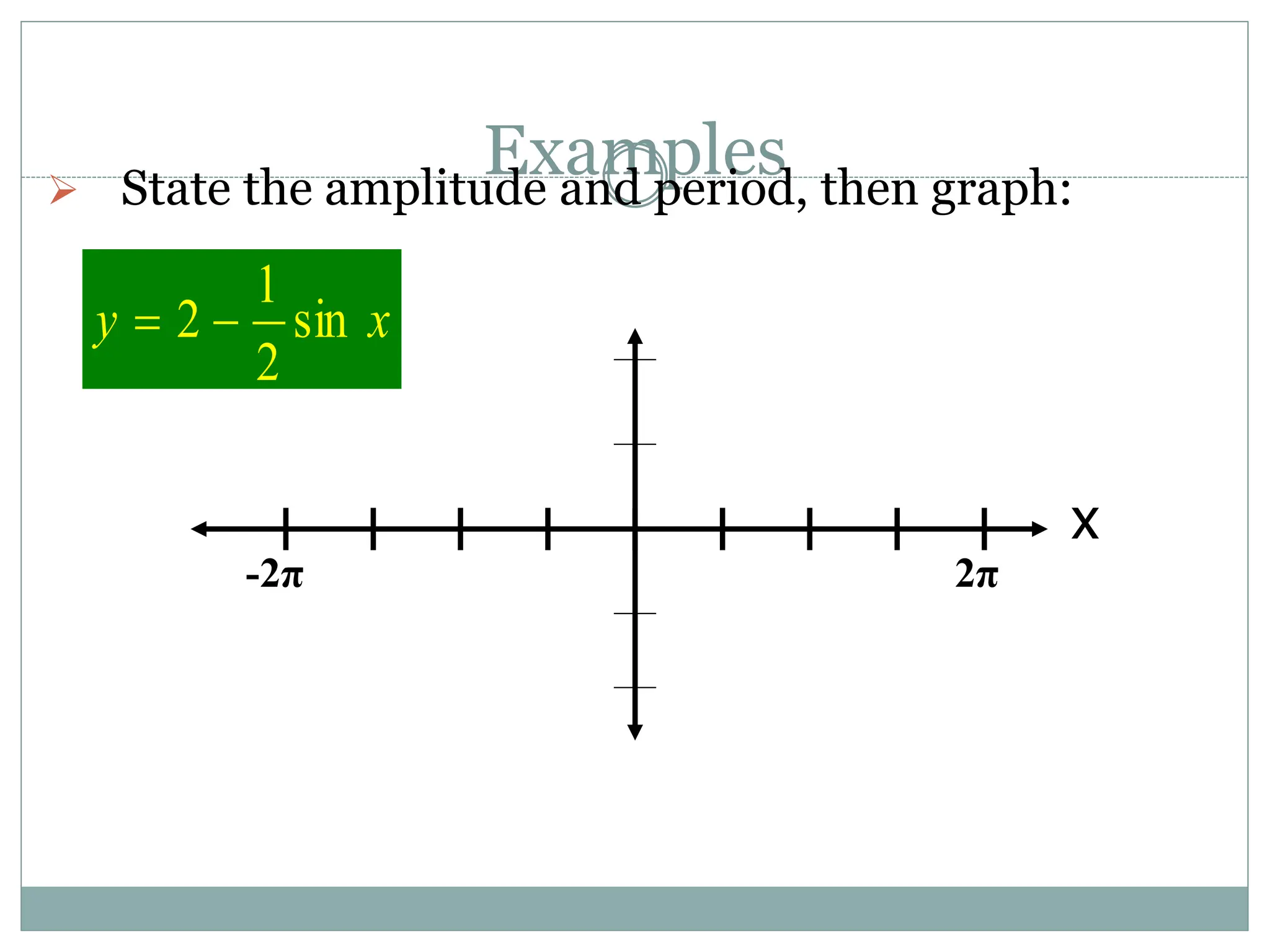
-2π
Examples
 State the amplitude and period, then graph:
x
y sin
2
1
2 

x
2π
-2π
Examples
 Write an equation of the graph described:
 The graph of y = cos x translated up 3 units,
right π units, and reflected vertically.

Graphing Trig Functions-Tangent and Cotangent.ppt

  • 1.
  • 2.
    C C SS : F . I F . 2 , 4 , 5 & 7 E ; F . T F . 1 , 2 , 5 & 8 E.Q: E.Q 1. What is a radian and how do I use it to determine angle measure on a circle? 2. How do I use trigonometric functions to model periodic behavior?
  • 3.
    Mathematical Practices: 1. Makesense of problems and persevere in solving them.  2. Reason abstractly and quantitatively.  3. Construct viable arguments and critique the reasoning of others.  4. Model with mathematics.  5. Use appropriate tools strategically.  6. Attend to precision.  7. Look for and make use of structure.  8. Look for and express regularity in repeated reasoning.
  • 4.
  • 5.
    5 Graphing Trigonometric Functions Amplitude: the maximum or minimum vertical distance between the graph and the x-axis. Amplitude is always positive
  • 6.
    The amplitude ofy = a sin x (or y = a cos x) is half the distance between the maximum and minimum values of the function. amplitude = |a| If |a| > 1, the amplitude stretches the graph vertically. If 0 < |a| > 1, the amplitude shrinks the graph vertically. If a < 0, the graph is reflected in the x-axis. 2 3 2  4 y x 4   2  y = –4 sin x reflection of y = 4 sin x y = 4 sin x y = sin x 2 1 y = sin x y = 2 sin x
  • 7.
    7  Period: thenumber of degrees or radians we must graph before it begins again. Graphing Trigonometric Functions
  • 8.
    y x    2  sin x y  period: 2 2 sin   y  period: The period of a function is the x interval needed for the function to complete one cycle. For b  0, the period of y = a sin bx is . b  2 For b  0, the period of y = a cos bx is also . b  2 If 0 < b < 1, the graph of the function is stretched horizontally. If b > 1, the graph of the function is shrunk horizontally. y x    2   3  4 c o s x y   period: 2 2 1 cos x y   period: 4
  • 9.
    Sine is aperiodic function: p = 2π , Domain   One period 2π 0 3π 2π π −2π −π −3π sin θ θ sin θ: Domain (angle measures): all real numbers, (−∞, ∞) Range (ratio of sides): −1 to 1, inclusive [−1, 1] sin θ is an odd function; it is symmetric wrt the origin. sin(−θ) = −sin(θ)
  • 10.
    Graph of theSine Function To sketch the graph of y = sin x first locate the key points. These are the maximum points, the minimum points, and the intercepts. 0 -1 0 1 0 sin x 0 x 2  2 3  2  Then, connect the points on the graph with a smooth curve that extends in both directions beyond the five points. A single cycle is called a period. y 2 3    2    2 2 3  2  2 5 1  x y = sin x
  • 11.
    Graph of theCosine Function To sketch the graph of y = cos x first locate the key points. These are the maximum points, the minimum points, and the intercepts. 1 0 -1 0 1 cos x 0 x 2  2 3  2  Then, connect the points on the graph with a smooth curve that extends in both directions beyond the five points. A single cycle is called a period. y 2 3    2    2 2 3  2  2 5 1  x y = cos x
  • 12.
    Cosine is aperiodic function: p = 2π One period 2π π 3π −2π 2π −π −3π 0 θ cos θ cos θ: Domain (angle measures): all real numbers, (−∞, ∞) Range (ratio of sides): −1 to 1, inclusive [−1, 1] cos θ is an even function; it is symmetric wrt the y-axis. cos(−θ) = cos(θ) , Domain  
  • 13.
    13 Properties of Sineand Cosine graphs 1. The domain is the set of real numbers 2. The range is set of “y” values such that -1≤ y ≤1 3. The maximum value is 1 and the minimum value is -1 4. The graph is a smooth curve 5. Each function cycles through all the values of the range over an x interval or 2π 6. The cycle repeats itself identically in both direction of the x-axis
  • 14.
    Sine Graph Given :A sin Bx  Amplitude = IAI  period = 2π/B Example: y=5sin2X › Amp=5 › Period=2π/2 = π π π/2 π/4 3π/4
  • 15.
    y 1  2  3  2 x   3  2    4 Example:Sketch the graph of y = 3 cos x on the interval [–, 4]. Partition the interval [0, 2] into four equal parts. Find the five key points; graph one cycle; then repeat the cycle over the interval. max x-int min x-int max 3 0 -3 0 3 y = 3 cos x 2  0 x 2  2 3  (0, 3) 2 3 ( , 0) ( , 0) 2   2 ( , 3)  ( , –3)
  • 16.
    y x  2  y = cos(–x) Use basic trigonometric identities to graph y = f(–x) Example : Sketch the graph of y = sin(–x). Use the identity sin(–x) = – sin x The graph of y = sin(–x) is the graph of y = sin x reflected in the x-axis. Example : Sketch the graph of y = cos(–x). Use the identity cos(–x) = + cos x The graph of y = cos (–x) is identical to the graph of y = cos x. y x  2  y = sin x y = sin(–x) y = cos (–x)
  • 17.
    2 y 2  6  x 2   6 5 3  3 2 6  6  3  2  3 2 0 2 0 –2 0 y = –2sin 3x 0 x Example: Sketch the graph of y = 2 sin(–3x). Rewrite the function in the form y = a sin bx with b > 0 amplitude: |a| = |–2| = 2 Calculate the five key points. (0, 0) ( , 0) 3  ( , 2) 2  ( ,-2) 6  ( , 0) 3 2 Use the identity sin (– x) = – sin x: y = 2 sin (–3x) = –2 sin 3x period: b  2  2 3 =
  • 18.
    Tangent Function θ sinθ cos θ tan θ −π/2 −π/4 0 π/4 π/2 θ tan θ −π/2 und −π/4 −1 0 0 π/4 1 π/2 und Recall that . Since cos θ is in the denominator, when cos θ = 0, tan θ is undefined. This occurs @ π intervals, offset by π/2: { … −π/2, π/2, 3π/2, 5π/2, … } Let’s create an x/y table from θ = −π/2 to θ = π/2 (one π interval), with 5 input angle values.    cos sin tan  2 2 2 2 2 2 2 2  1 1 1 −1 −1 0 0 0 und und 0
  • 19.
    Graph of TangentFunction: Periodic θ tan θ −π/2 Und (-∞) −π/4 −1 0 0 π/4 1 π/2 Und(∞) , Domain   tan θ is an odd function; it is symmetric wrt the origin. tan(−θ) = −tan(θ) 0 θ tan θ −π/2 π/2 One period: π tan θ: Domain (angle measures): θ ≠ π/2 + πn Range (ratio of sides): all real numbers (−∞, ∞) 3π/2 −3π/2 Vertical asymptotes where cos θ = 0    cos sin tan 
  • 20.
    y x 2 3  2 3 2  2   Graph of theTangent Function 2. Range: (–, +) 3. Period:  4. Vertical asymptotes:       n n x 2   1. Domain : all real x       n n x 2   Properties of y = tan x period: To graph y = tan x, use the identity . x x x cos sin tan  At values of x for which cos x = 0, the tangent function is undefined and its graph has vertical asymptotes.
  • 21.
    2. Find consecutivevertical asymptotes by solving for x: 4. Sketch one branch and repeat. Example: Find the period and asymptotes and sketch the graph of x y 2 tan 3 1  2 2 , 2 2      x x 4 , 4      x x Vertical asymptotes: ) 2 , 0 (  3. Plot several points in  1. Period of y = tan x is . 2  . is 2 tan o f P erio d x y   x x y 2 tan 3 1  8   3 1  0 0 8  3 1 8 3 3 1  y x 2  8 3  4   x 4    x        3 1 , 8        3 1 , 8         3 1 , 8 3
  • 22.
    Cotangent Function θ sinθ cos θ cot θ 0 π/4 π/2 3π/4 π θ cot θ 0 Und ∞ π/4 1 π/2 0 3π/4 −1 π Und−∞ Recall that . Since sin θ is in the denominator, when sin θ = 0, cot θ is undefined. This occurs @ π intervals, starting at 0: { … −π, 0, π, 2π, … } Let’s create an x/y table from θ = 0 to θ = π (one π interval), with 5 input angle values.    sin cos cot  2 2 2 2  2 2 2 2 0 −1 0 0 1 1 1 0 Und−∞ Und ∞ –1
  • 23.
    Graph of CotangentFunction: Periodic θ cot θ 0 ∞ π/4 1 π/2 0 3π/4 −1 π −∞ , Domain   cot θ is an odd function; it is symmetric wrt the origin. tan(−θ) = −tan(θ) cot θ: Domain (angle measures): θ ≠ πn Range (ratio of sides): all real numbers (−∞, ∞) 3π/2 −3π/2 Vertical asymptotes where sin θ = 0    sin cos cot  π -π −π/2 π/2 cot θ
  • 24.
    Graph of theCotangent Function 2. Range: (–, +) 3. Period:  4. Vertical asymptotes:      n n x  1. Domain : all real x      n n x  Properties of y = cot x y x 2  2    2 3 2 3     2 x y cot  0  x vertical asymptotes   x    x  2  x To graph y = cot x, use the identity . x x x sin cos cot  At values of x for which sin x = 0, the cotangent function is undefined and its graph has vertical asymptotes.
  • 25.
    Cosecant is thereciprocal of sine sin θ: Domain: (−∞, ∞) Range: [−1, 1] csc θ: Domain: θ ≠ πn (where sin θ = 0) Range: |csc θ| ≥ 1 or (−∞, −1] U [1, ∞] sin θ and csc θ are odd (symm wrt origin) One period: 2π π 2π 3π 0 −π −2π −3π Vertical asymptotes where sin θ = 0 θ csc θ sin θ
  • 26.
     2 3 x 2  2    2 2 5 y 4 4  Graph ofthe Cosecant Function 2. range: (–,–1]  [1, +) 3. period:  where sine is zero. 4. vertical asymptotes:      n n x  1. domain : all real x      n n x  sin 1 csc x x  To graph y = csc x, use the identity . Properties of y = csc x x y c sc  x y sin  At values of x for which sin x = 0, the cosecant function is undefined and its graph has vertical asymptotes.
  • 27.
    Secant is thereciprocal of cosine cos θ: Domain: (−∞, ∞) Range: [−1, 1] One period: 2π π 3π −2π 2π −π −3π 0 θ sec θ cos θ Vertical asymptotes where cos θ = 0 sec θ: Domain: θ ≠ π/2 + πn (where cos θ = 0) Range: |sec θ | ≥ 1 or (−∞, −1] U [1, ∞] cos θ and sec θ are even (symm wrt y-axis)
  • 28.
    2 3 y x 2  2     2 3 2 5 4 4  x y c o s  Graph of the Secant Function 2. range: (–,–1]  [1, +) 3. period: 2 4. vertical asymptotes:       n n x   2 1. domain : all real x ) ( 2     n n x   cos 1 sec x x  The graph y = sec x, use the identity . Properties of y = sec x x y se c  At values of x for which cos x = 0, the secant function is undefined and its graph has vertical asymptotes.
  • 29.
    Summary of GraphCharacteristics Def’n ∆ о Period Domain Range Even/Odd sin θ csc θ cos θ sec θ tan θ cot θ
  • 30.
    Summary of GraphCharacteristics Def’n ∆ о Period Domain Range Even/Odd sin θ opp hyp y r 2π (−∞, ∞) −1 ≤ x ≤ 1 or [−1, 1] odd csc θ 1 .sinθ r .y 2π θ ≠ πn |csc θ| ≥ 1 or (−∞, −1] U [1, ∞) odd cos θ adj hyp x r 2π (−∞, ∞) All Reals or (−∞, ∞) even sec θ 1 . cosθ r y 2π θ ≠ π2 +πn |sec θ| ≥ 1 or (−∞, −1] U [1, ∞) even tan θ sinθ cosθ y x π θ ≠ π2 +πn All Reals or (−∞, ∞) odd cot θ cosθ .sinθ x y π θ ≠ πn All Reals or (−∞, ∞) odd
  • 31.
    •Without looking atyour notes, try to sketch the basic shape of each trig function: 1) Sine: 2) Cosine: 3) Tangent: Translations of Trigonometric Graphs
  • 32.
    More Transformations We haveseen two types of transformations on trig graphs: vertical stretches and horizontal stretches. There are three more: vertical translations (slides), horizontal translations, and reflections (flips).
  • 33.
    More Transformations Here isthe full general form for the sine function: Just as with parabolas and other functions, c and d are translations:  c slides the graph horizontally (opposite of sign)  d slides the graph vertically Also, if a is negative, the graph is flipped vertically. d c bx a y    ) sin(
  • 34.
    More Transformations  Tograph a sine or cosine graph: 1. Graph the original graph with the correct amplitude and period. 2. Translate c units horizontally and d units vertically. 3. Reflect vertically at its new position if a is negative (or reflect first, then translate).
  • 35.
    Examples  Describe howeach graph would be transformed: 1. 2. 3. x y sin 2   ) sin( 2      x y         2 cos  x y
  • 36.
    Examples  State theamplitude and period, then graph: ) cos( 2 x y    x 2π -2π
  • 37.
    Examples  State theamplitude and period, then graph:          2 sin  x y x 2π -2π
  • 38.
    Examples  State theamplitude and period, then graph: x y sin 2 1 2   x 2π -2π
  • 39.
    Examples  Write anequation of the graph described:  The graph of y = cos x translated up 3 units, right π units, and reflected vertically.