李 希
分子医学教育部重点 室实验
lixi@shmu.edu.cn
Transcription and Post-transcription
Modification
Post-transcriptional
Processing of RNA
Making ends of RNA
RNA splicing
Primary Transcript
• Primary Transcript-the initial molecule of RNA
produced--- hnRNA ( heterogenous nuclear
RNA )
• In prokaryotes, DNA RNA protein in→ →
cytoplasm concurrently
• In eukaryotes nuclear RNA >> Cp RNA
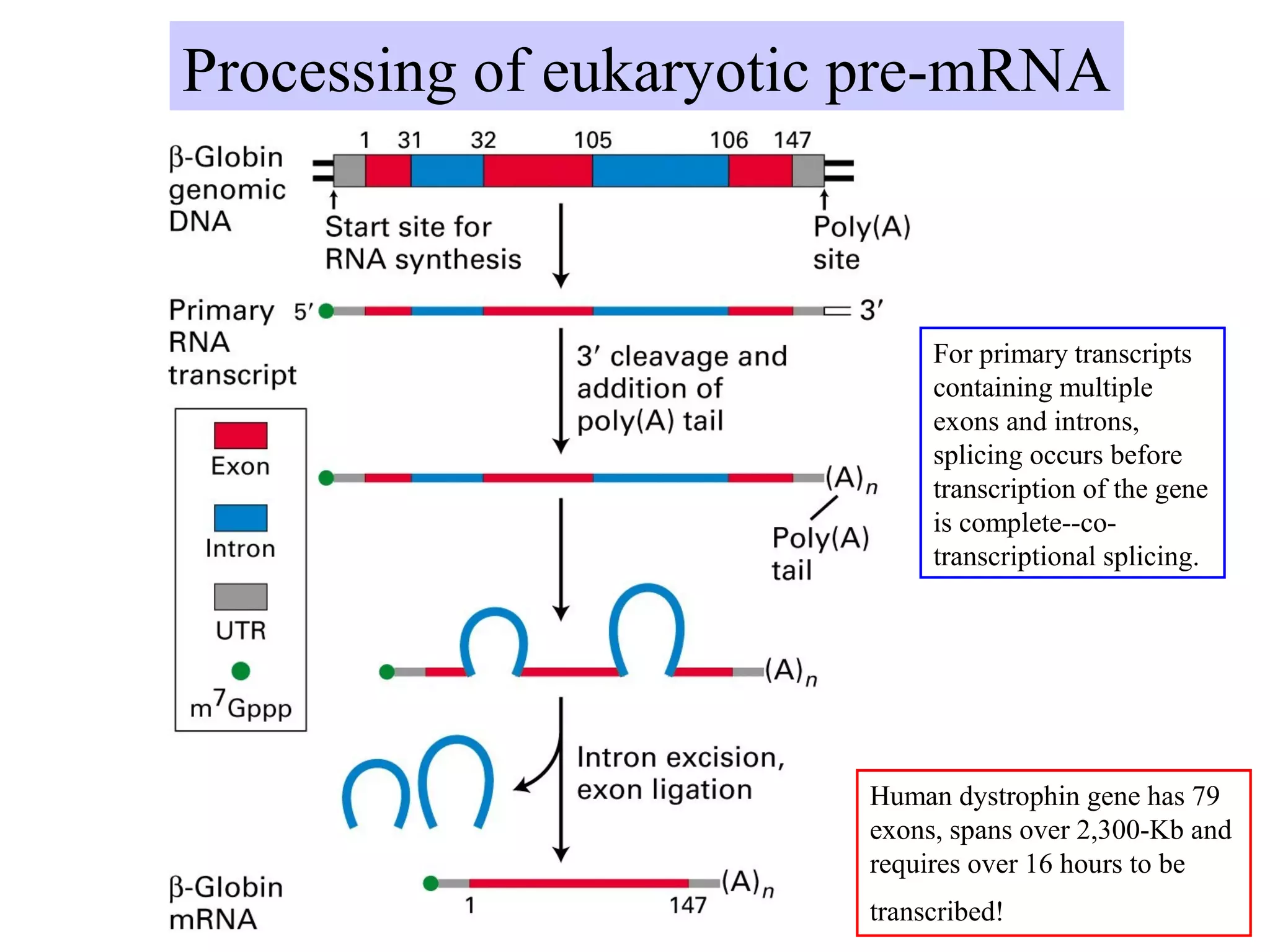
Processing of eukaryotic pre-mRNA
Human dystrophin gene has 79
exons, spans over 2,300-Kb and
requires over 16 hours to be
transcribed!
For primary transcripts
containing multiple
exons and introns,
splicing occurs before
transcription of the gene
is complete--co-
transcriptional splicing.
Types of RNA processing
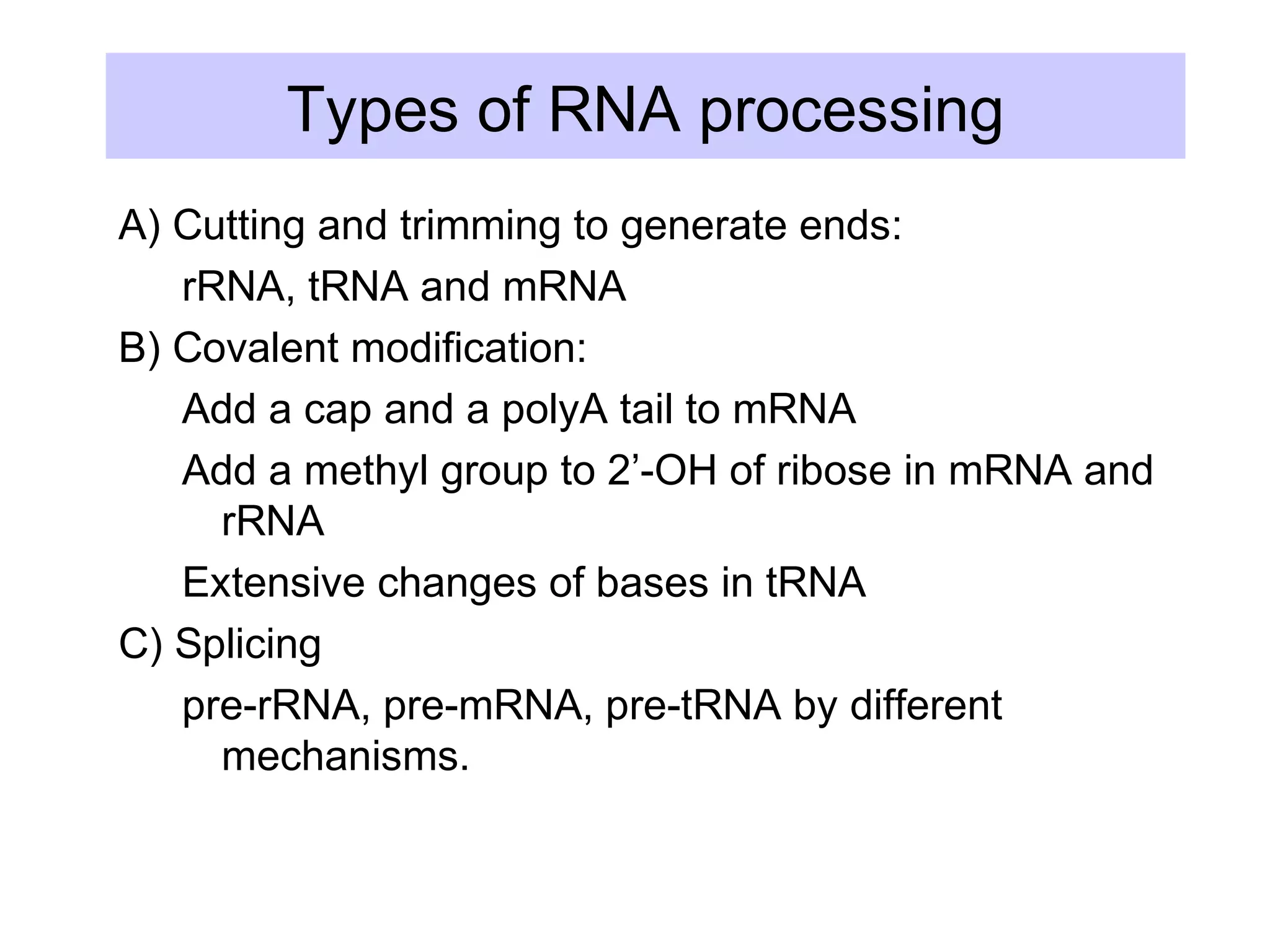
A) Cutting and trimming to generate ends:
rRNA, tRNA and mRNA
B) Covalent modification:
Add a cap and a polyA tail to mRNA
Add a methyl group to 2’-OH of ribose in mRNA and
rRNA
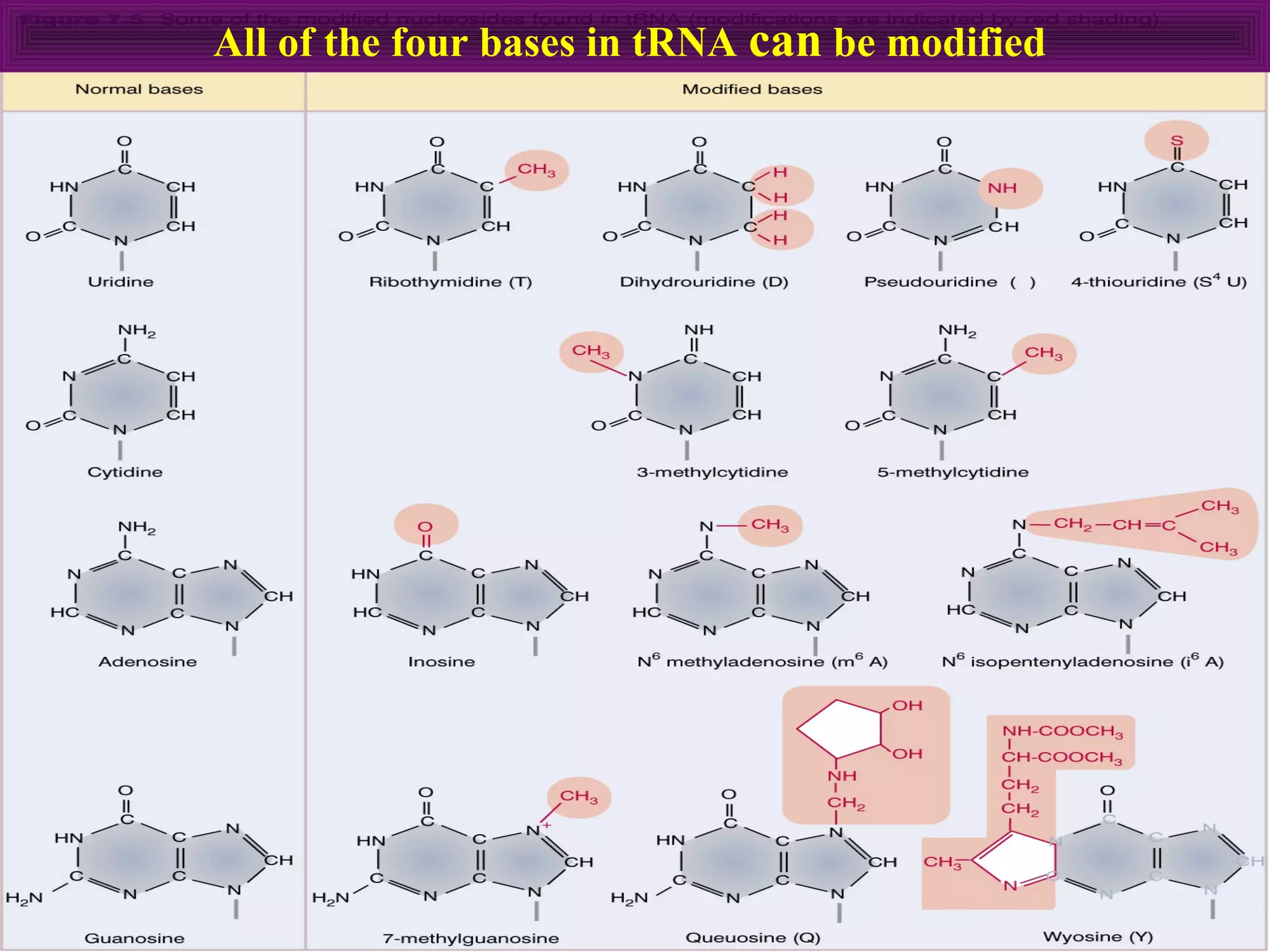
Extensive changes of bases in tRNA
C) Splicing
pre-rRNA, pre-mRNA, pre-tRNA by different
mechanisms.
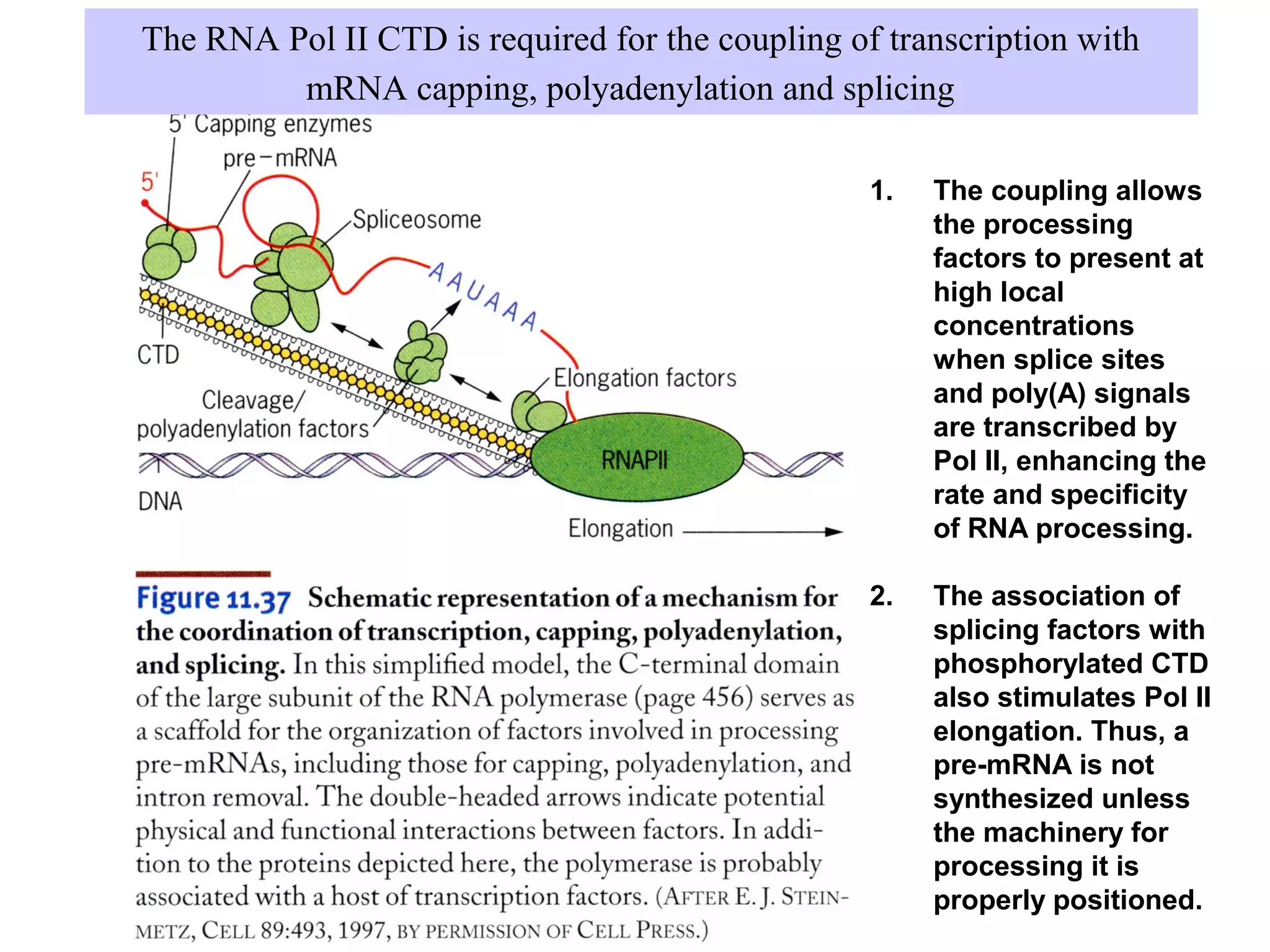
The RNA Pol II CTD is required for the coupling of transcription with
mRNA capping, polyadenylation and splicing
1. The coupling allows
the processing
factors to present at
high local
concentrations
when splice sites
and poly(A) signals
are transcribed by
Pol II, enhancing the
rate and specificity
of RNA processing.
2. The association of
splicing factors with
phosphorylated CTD
also stimulates Pol II
elongation. Thus, a
pre-mRNA is not
synthesized unless
the machinery for
processing it is
properly positioned.
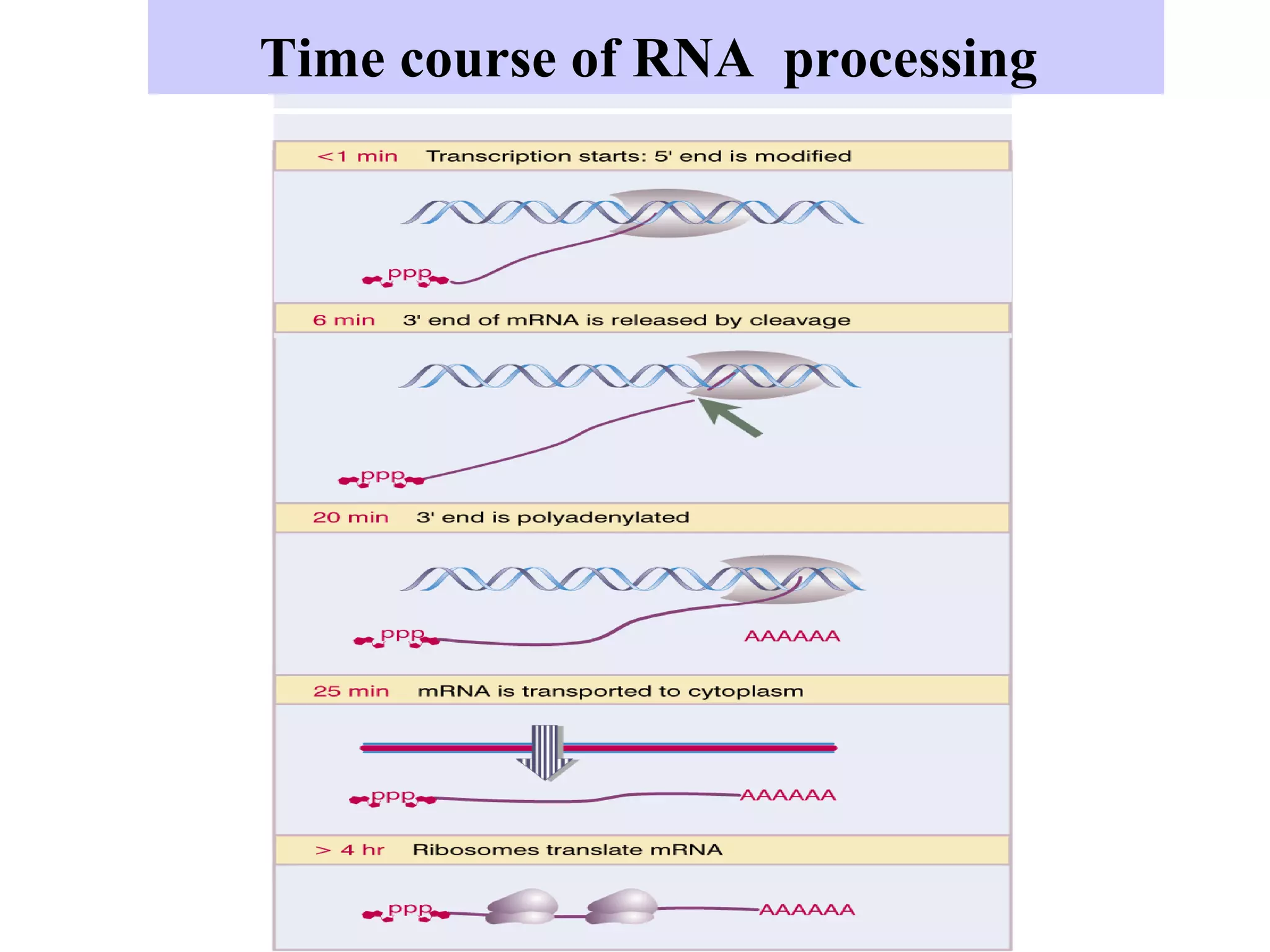
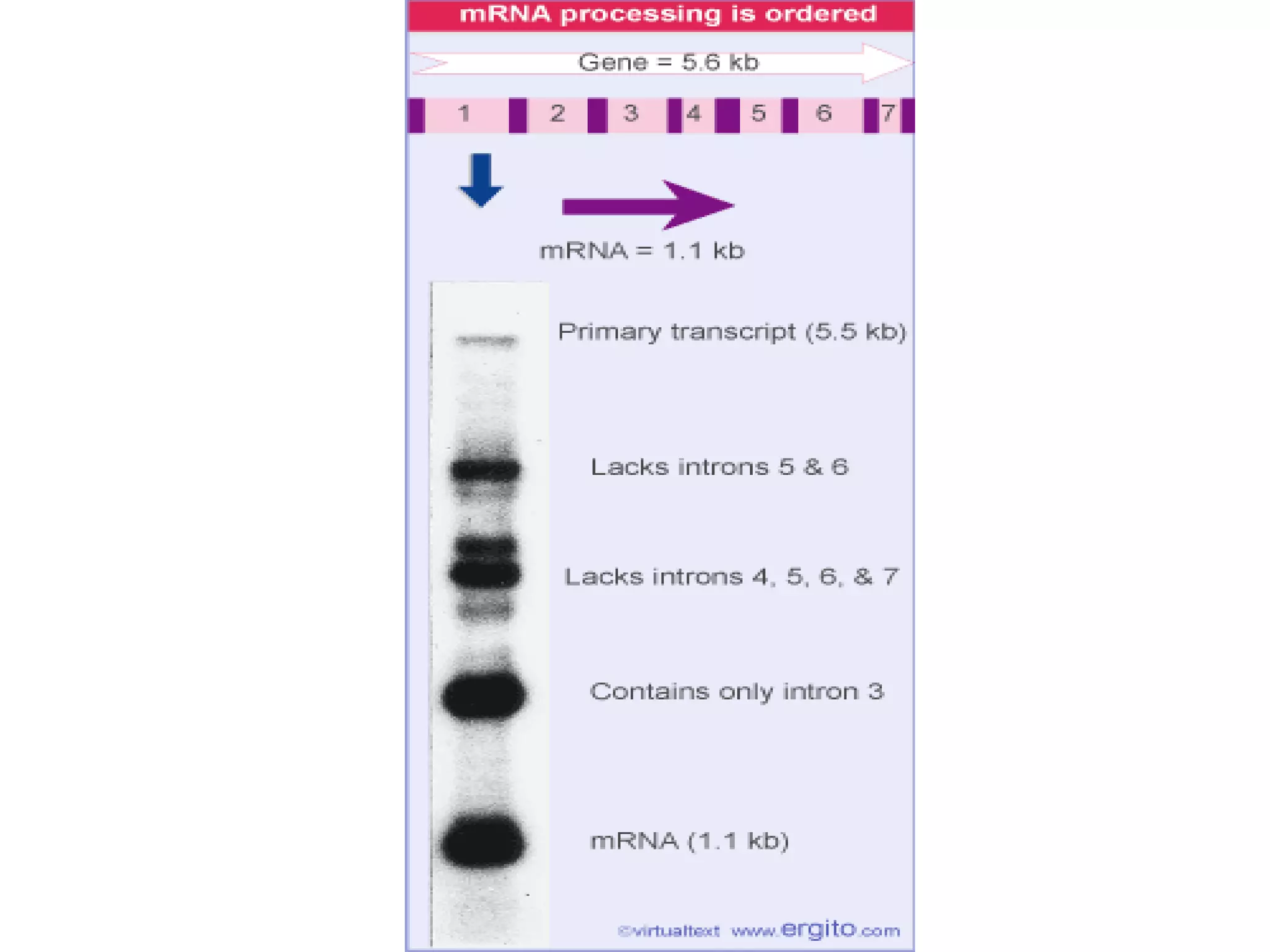
Time course of RNA processing
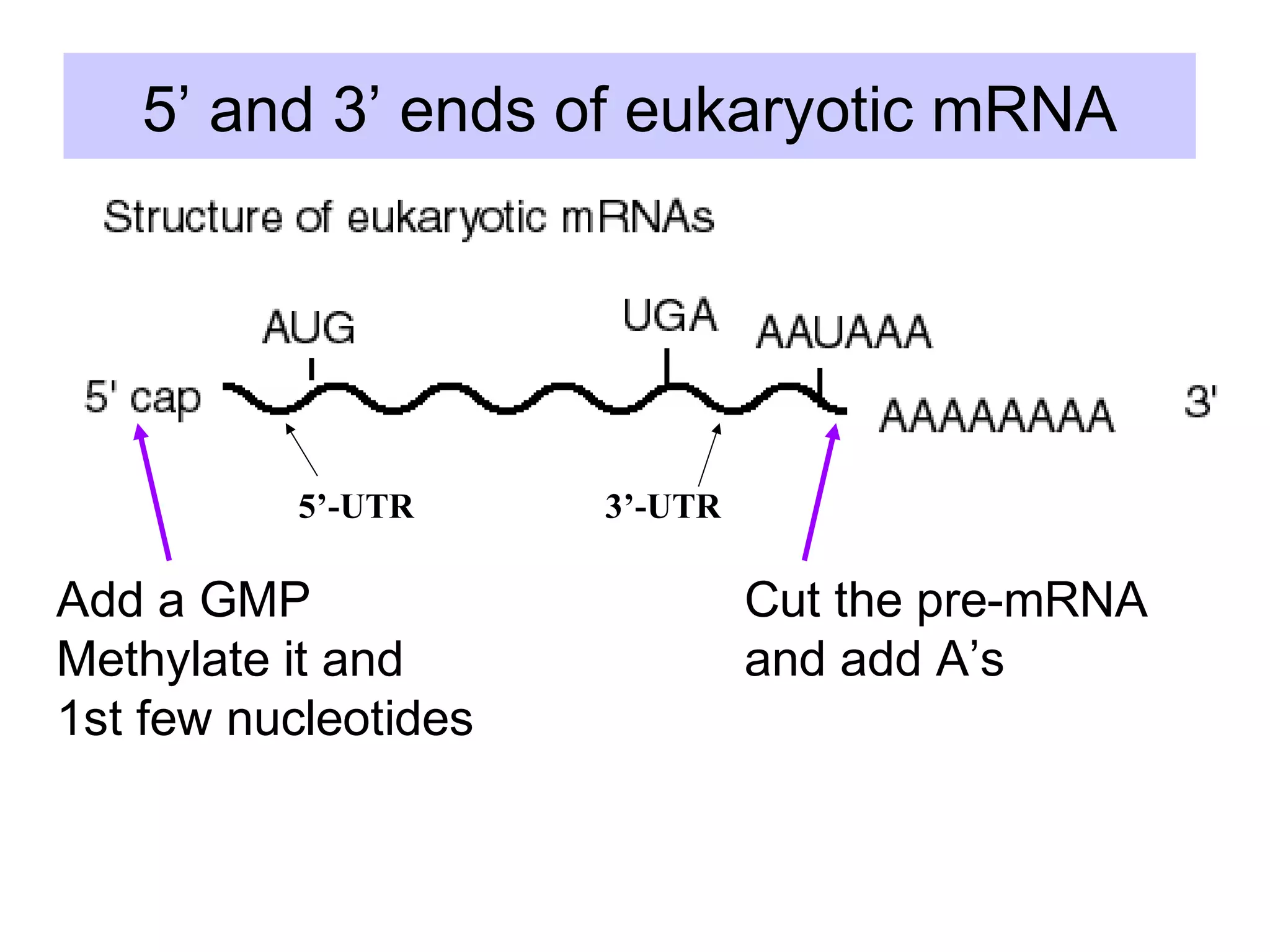
5’ and 3’ ends of eukaryotic mRNA
Add a GMP
Methylate it and
1st few nucleotides
Cut the pre-mRNA
and add A’s
5’-UTR 3’-UTR
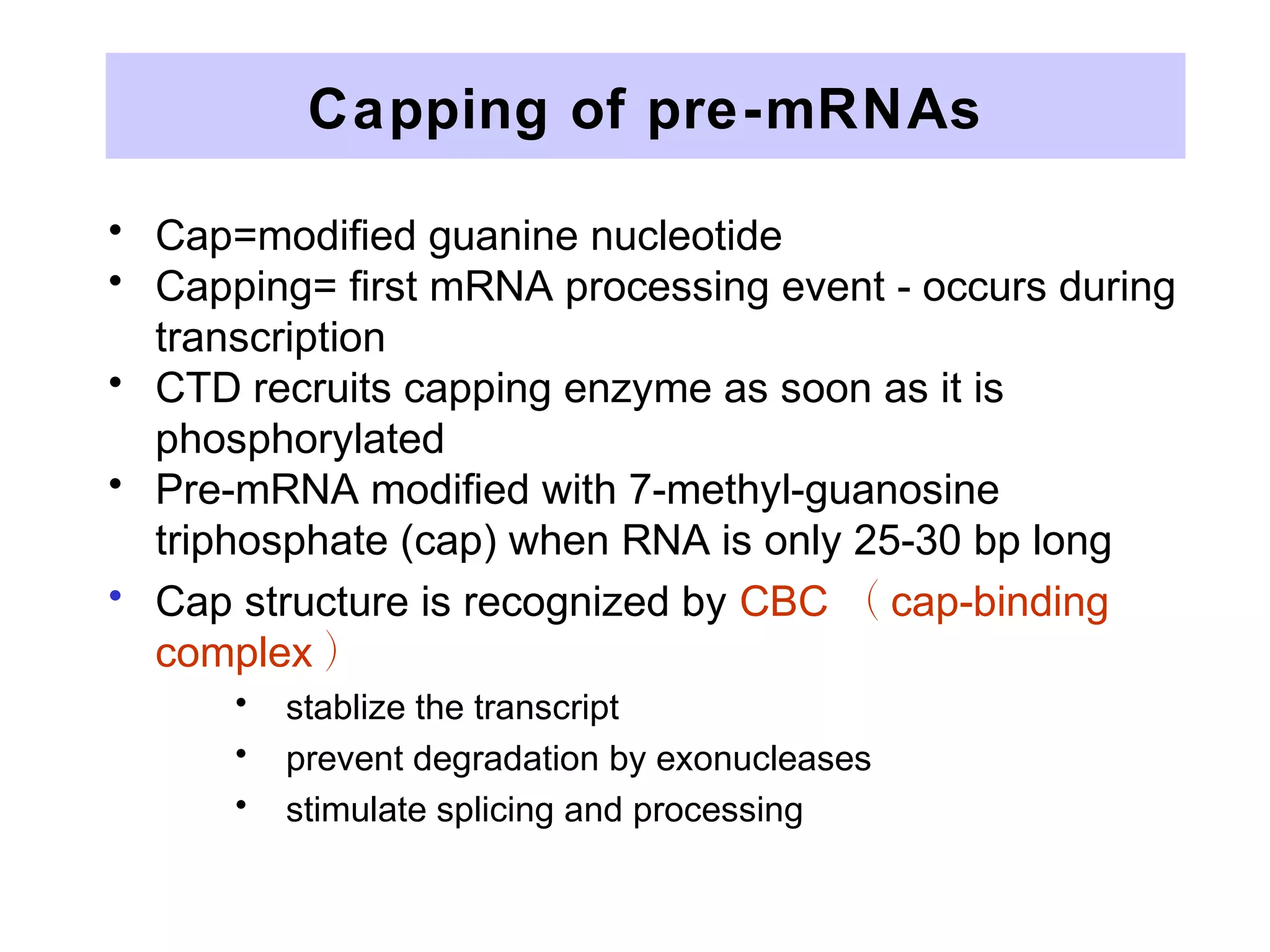
Capping of pre-mRNAs
• Cap=modified guanine nucleotide
• Capping= first mRNA processing event - occurs during
transcription
• CTD recruits capping enzyme as soon as it is
phosphorylated
• Pre-mRNA modified with 7-methyl-guanosine
triphosphate (cap) when RNA is only 25-30 bp long
• Cap structure is recognized by CBC ( cap-binding
complex )
• stablize the transcript
• prevent degradation by exonucleases
• stimulate splicing and processing
Sometimes
methylated
Sometimes
methylated
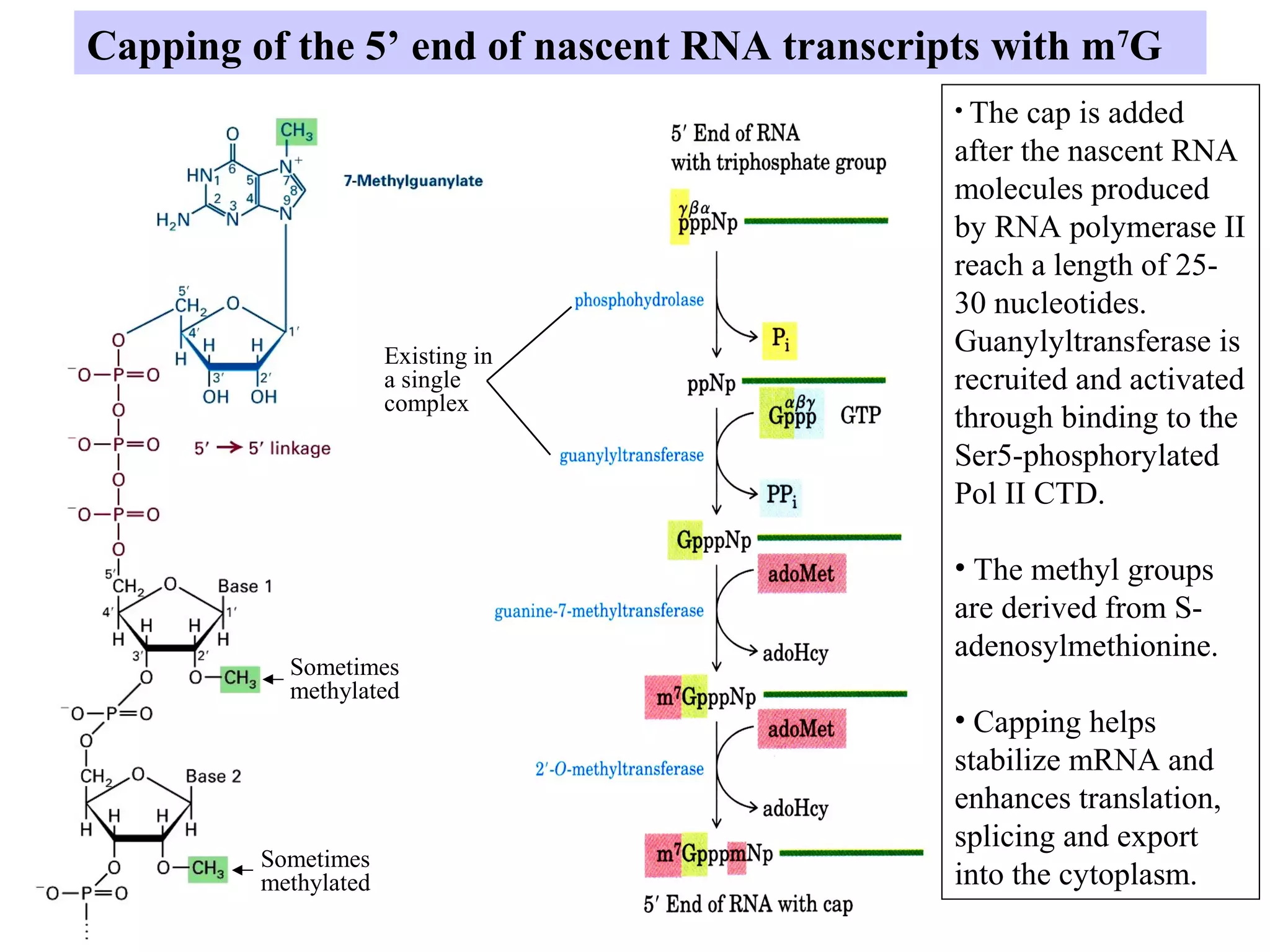
• The cap is added
after the nascent RNA
molecules produced
by RNA polymerase II
reach a length of 25-
30 nucleotides.
Guanylyltransferase is
recruited and activated
through binding to the
Ser5-phosphorylated
Pol II CTD.
• The methyl groups
are derived from S-
adenosylmethionine.
• Capping helps
stabilize mRNA and
enhances translation,
splicing and export
into the cytoplasm.
Capping of the 5’ end of nascent RNA transcripts with m7
G
Existing in
a single
complex
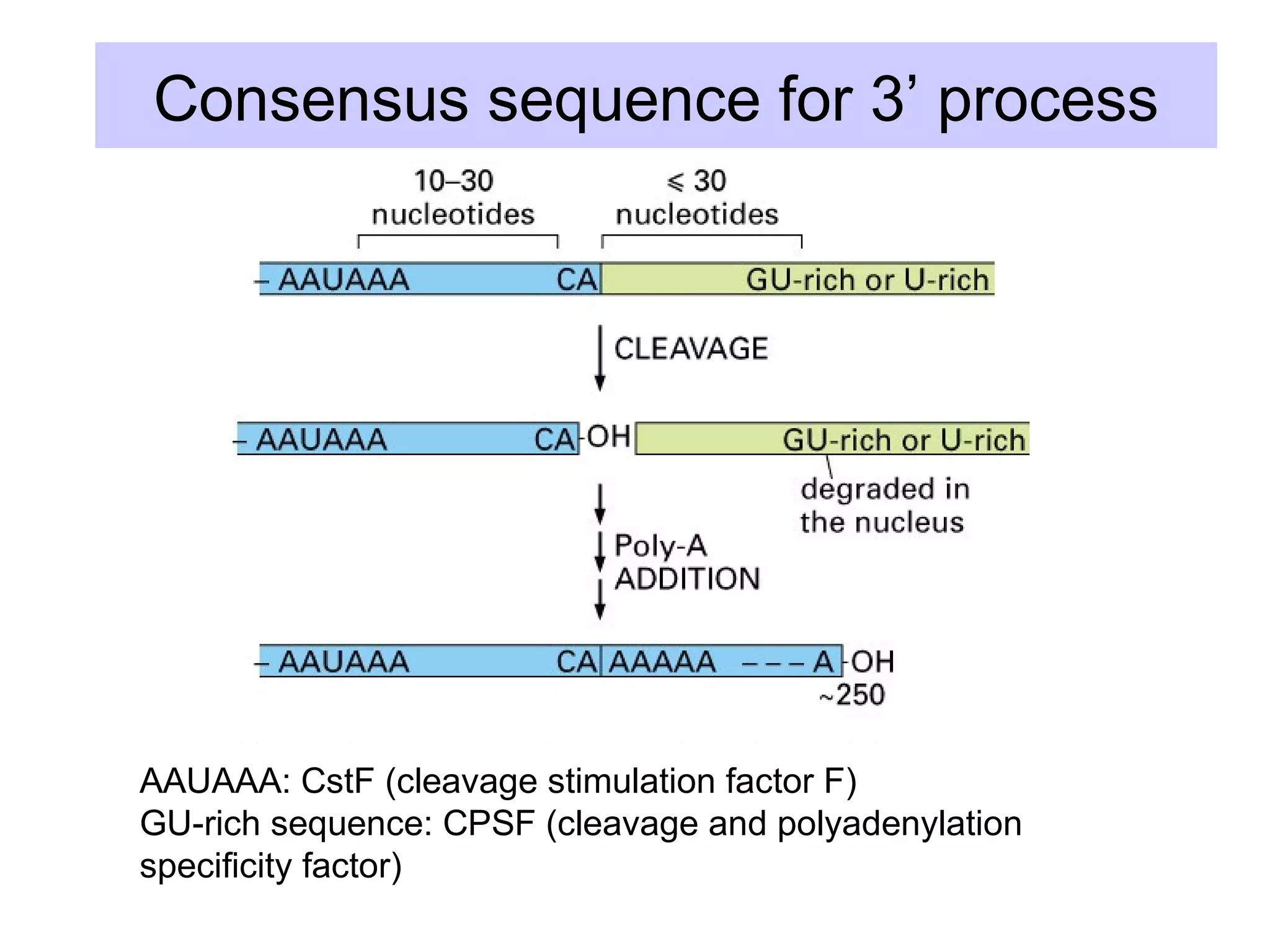
Consensus sequence for 3’ process
AAUAAA: CstF (cleavage stimulation factor F)
GU-rich sequence: CPSF (cleavage and polyadenylation
specificity factor)
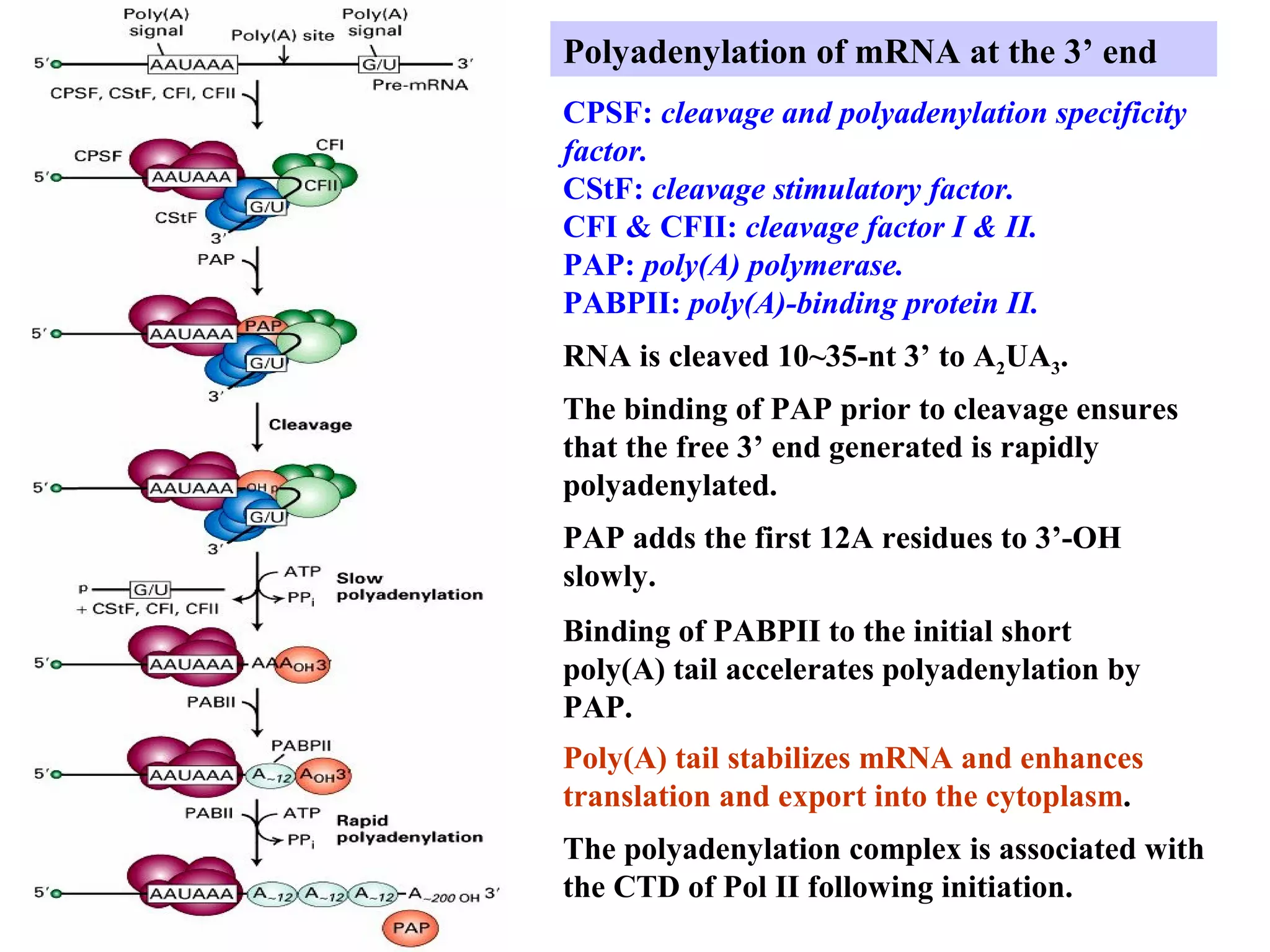
Polyadenylation of mRNA at the 3’ end
CPSF: cleavage and polyadenylation specificity
factor.
CStF: cleavage stimulatory factor.
CFI & CFII: cleavage factor I & II.
PAP: poly(A) polymerase.
PABPII: poly(A)-binding protein II.
Poly(A) tail stabilizes mRNA and enhances
translation and export into the cytoplasm.
RNA is cleaved 10~35-nt 3’ to A2UA3.
The binding of PAP prior to cleavage ensures
that the free 3’ end generated is rapidly
polyadenylated.
PAP adds the first 12A residues to 3’-OH
slowly.
Binding of PABPII to the initial short
poly(A) tail accelerates polyadenylation by
PAP.
The polyadenylation complex is associated with
the CTD of Pol II following initiation.
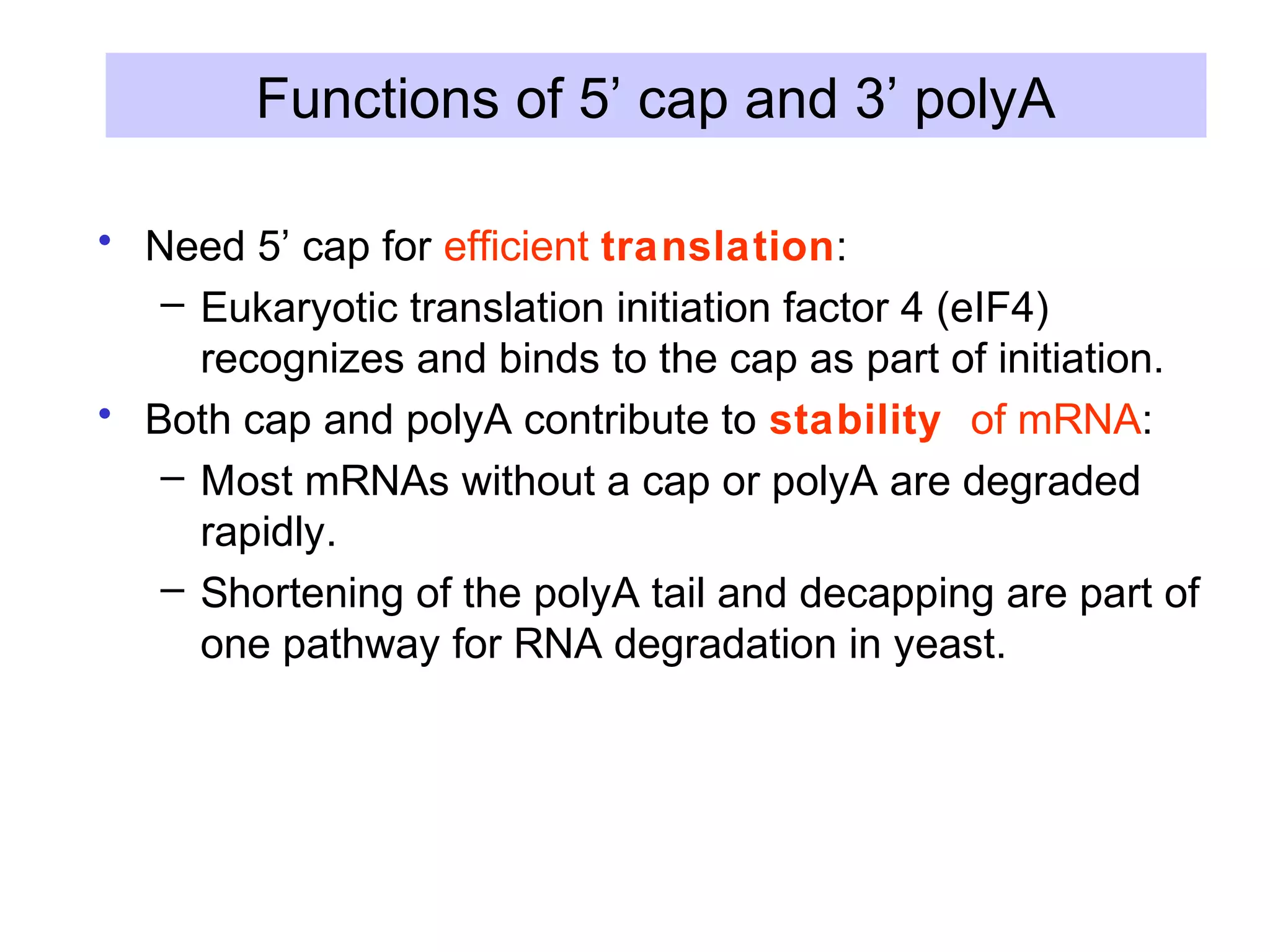
Functions of 5’ cap and 3’ polyA
• Need 5’ cap for efficient translation:
– Eukaryotic translation initiation factor 4 (eIF4)
recognizes and binds to the cap as part of initiation.
• Both cap and polyA contribute to stability of mRNA:
– Most mRNAs without a cap or polyA are degraded
rapidly.
– Shortening of the polyA tail and decapping are part of
one pathway for RNA degradation in yeast.
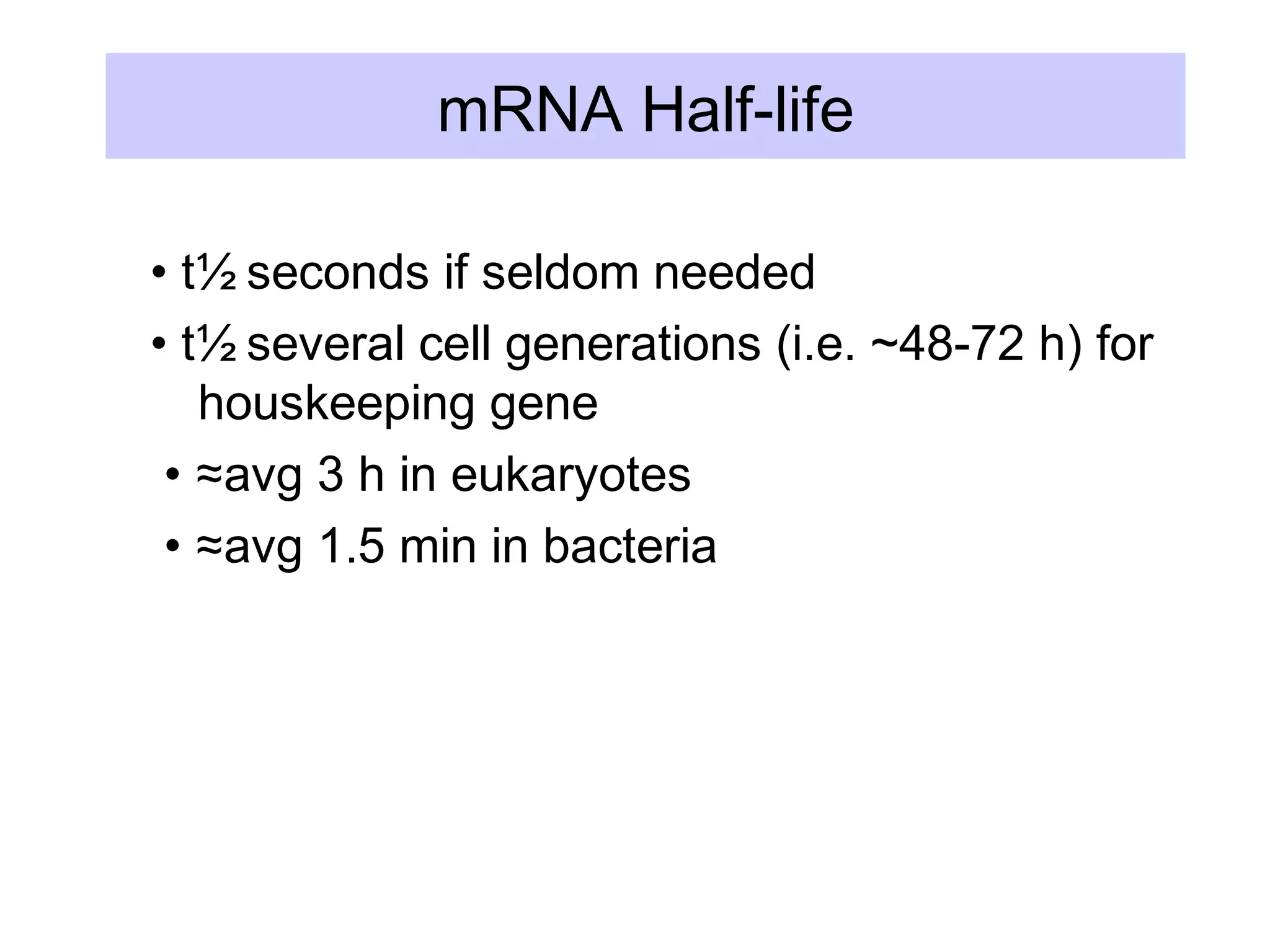
mRNA Half-life
• t½ seconds if seldom needed
• t½ several cell generations (i.e. ~48-72 h) for
houskeeping gene
• ≈avg 3 h in eukaryotes
• ≈avg 1.5 min in bacteria
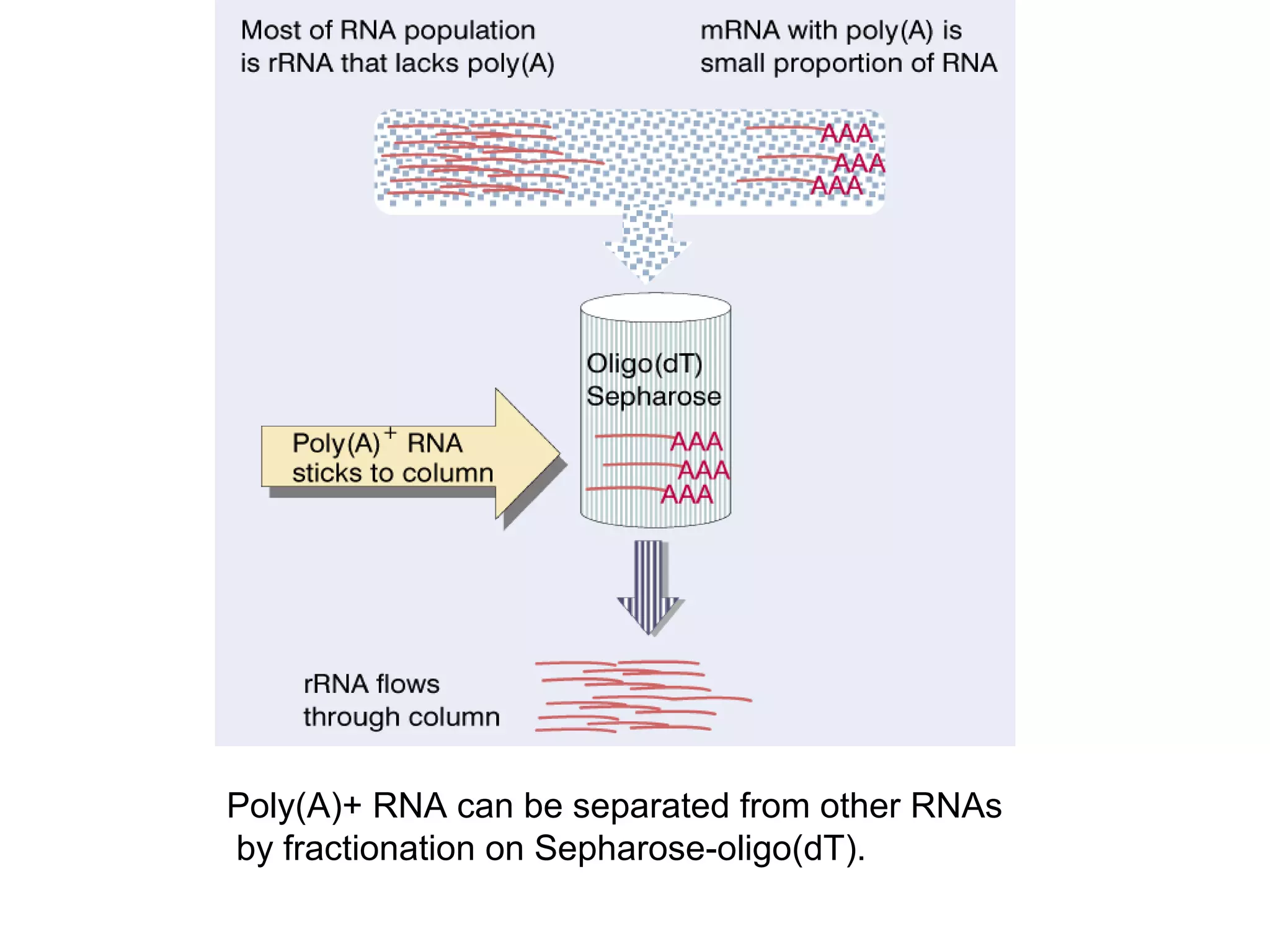
Poly(A)+ RNA can be separated from other RNAs
by fractionation on Sepharose-oligo(dT).
Split gene and mRNA splicing
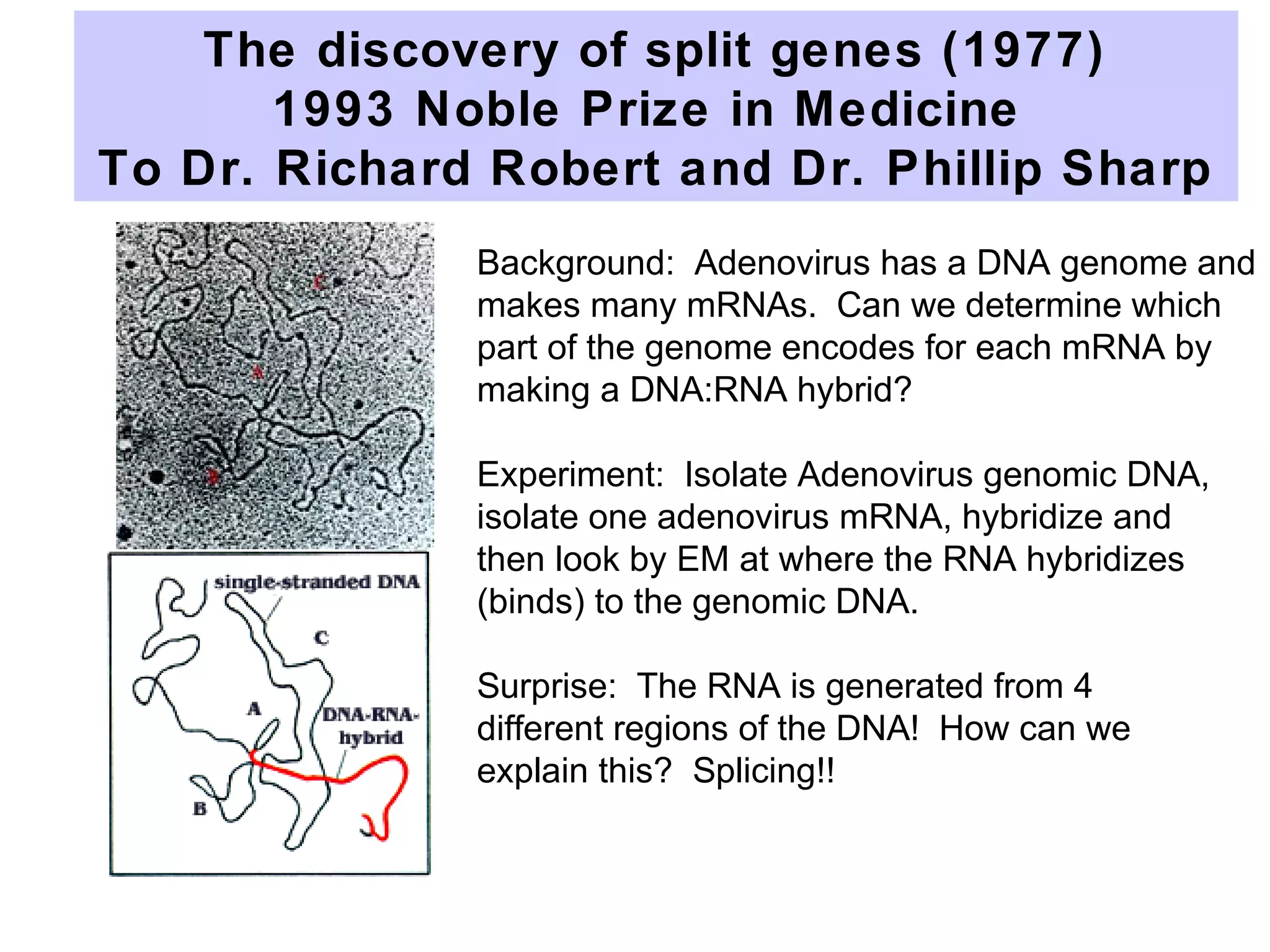
Background: Adenovirus has a DNA genome and
makes many mRNAs. Can we determine which
part of the genome encodes for each mRNA by
making a DNA:RNA hybrid?
Experiment: Isolate Adenovirus genomic DNA,
isolate one adenovirus mRNA, hybridize and
then look by EM at where the RNA hybridizes
(binds) to the genomic DNA.
Surprise: The RNA is generated from 4
different regions of the DNA! How can we
explain this? Splicing!!
The discovery of split genes (1977)
1993 Noble Prize in Medicine
To Dr. Richard Robert and Dr. Phillip Sharp
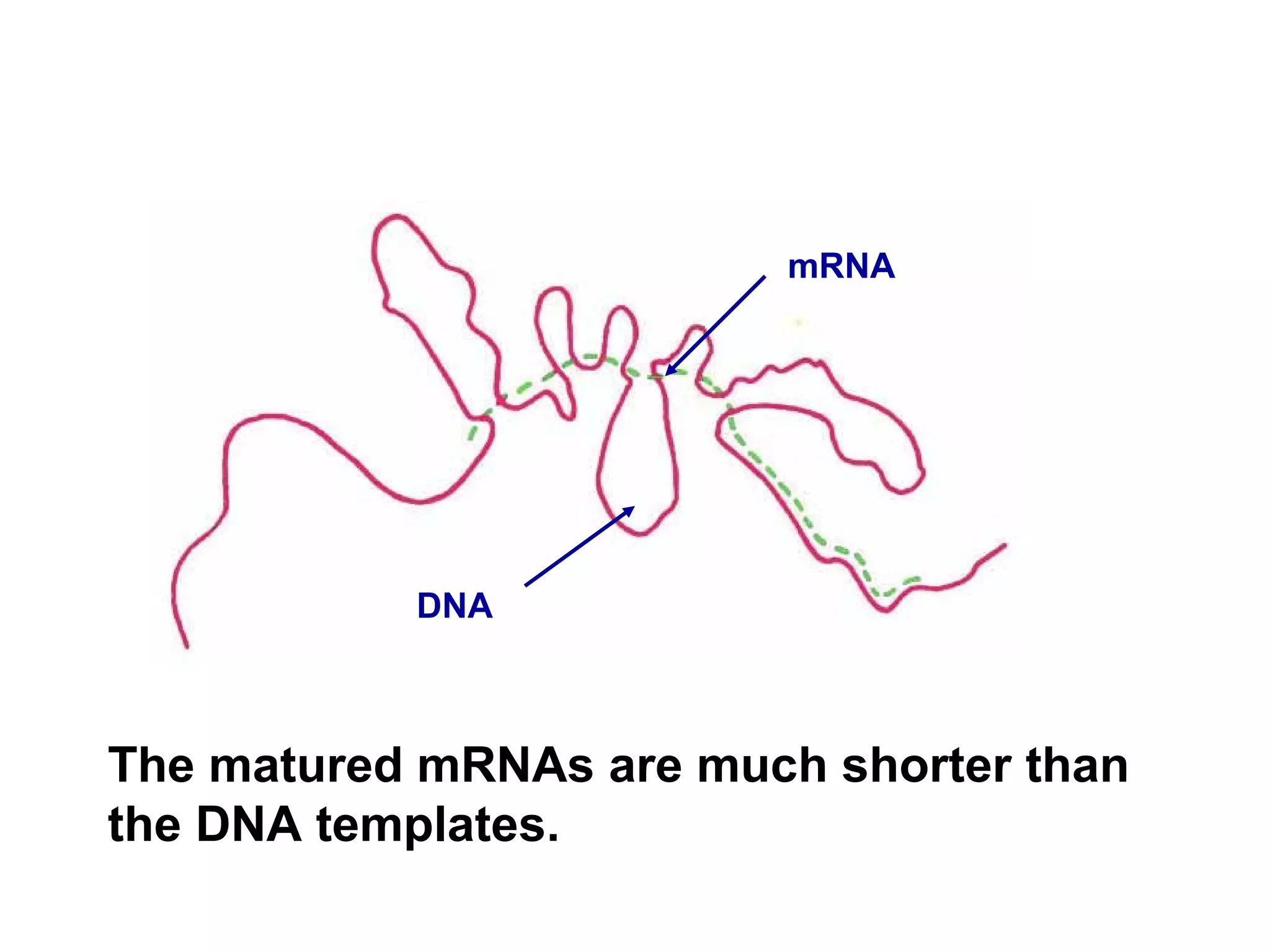
The matured mRNAs are much shorter than
the DNA templates.
DNA
mRNA
Exon and Intron
• Exon is any segment of an interrupted
gene that is represented in the mature RNA
product.
• Intron is a segment of DNA that is
transcribed, but removed from within the
transcript by splicing together the
sequences (exons) on either side of it.
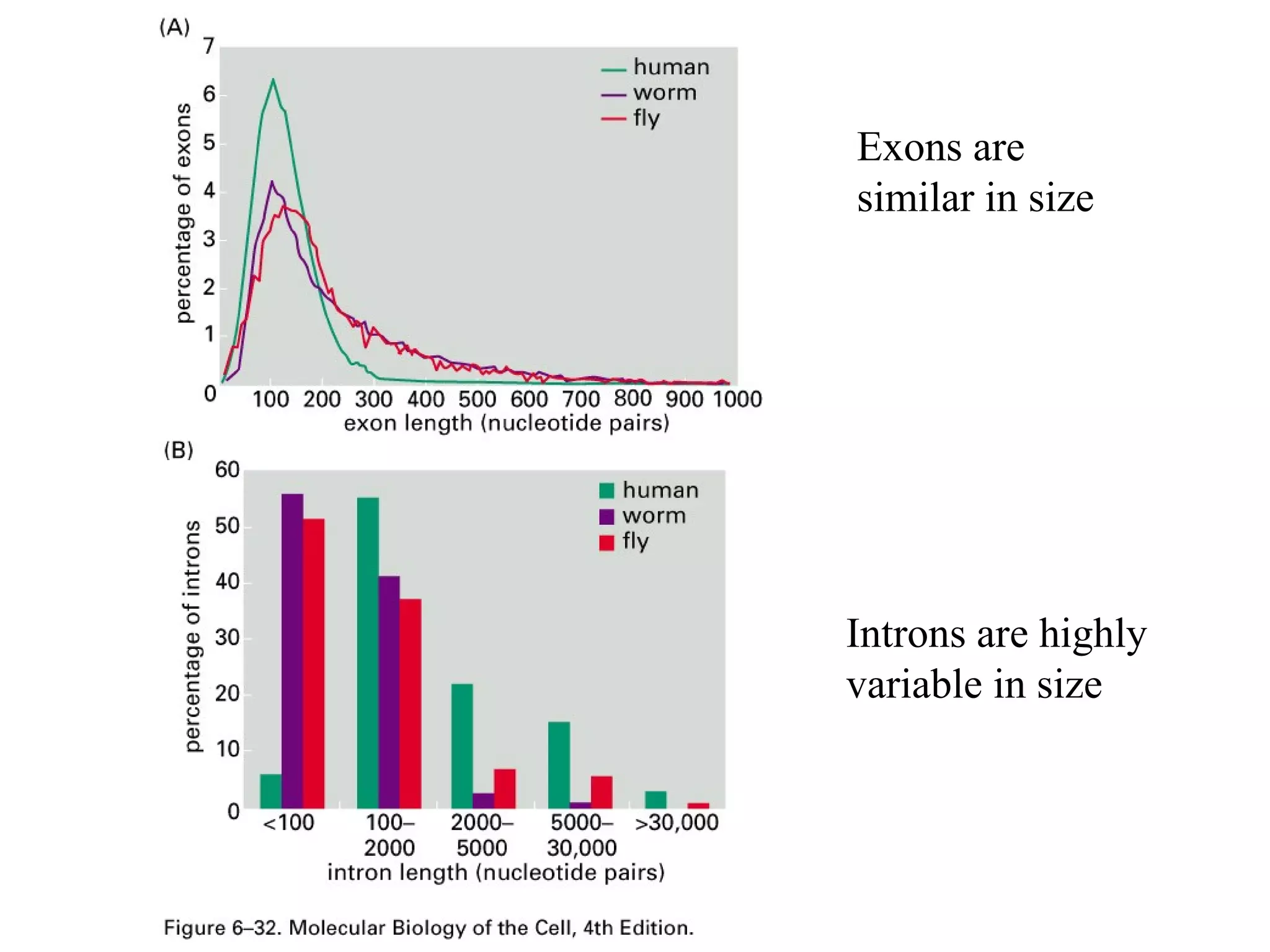
Exons are
similar in size
Introns are highly
variable in size
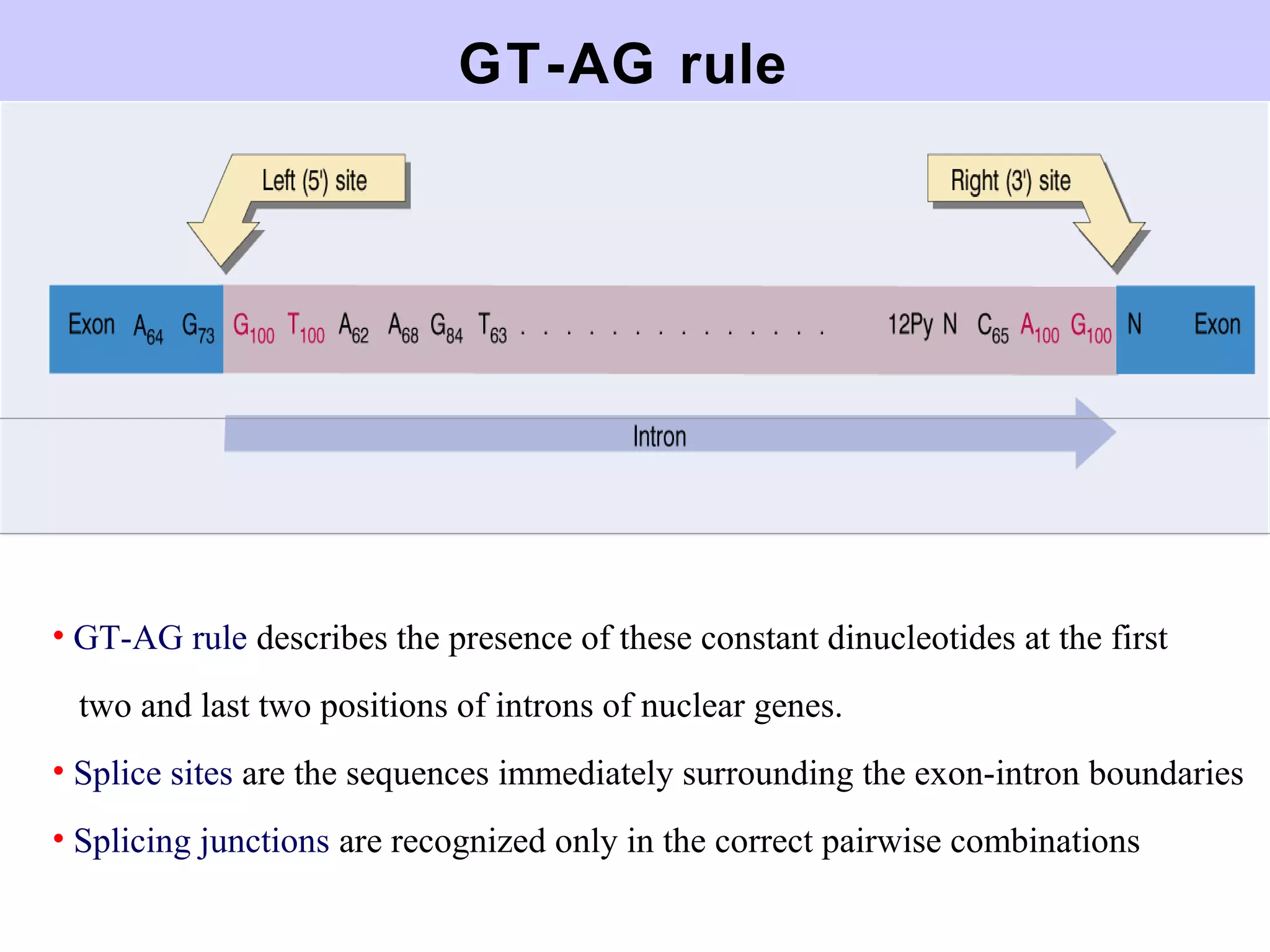
GT-AG rule
• GT-AG rule describes the presence of these constant dinucleotides at the first
two and last two positions of introns of nuclear genes.
• Splice sites are the sequences immediately surrounding the exon-intron boundaries
• Splicing junctions are recognized only in the correct pairwise combinations
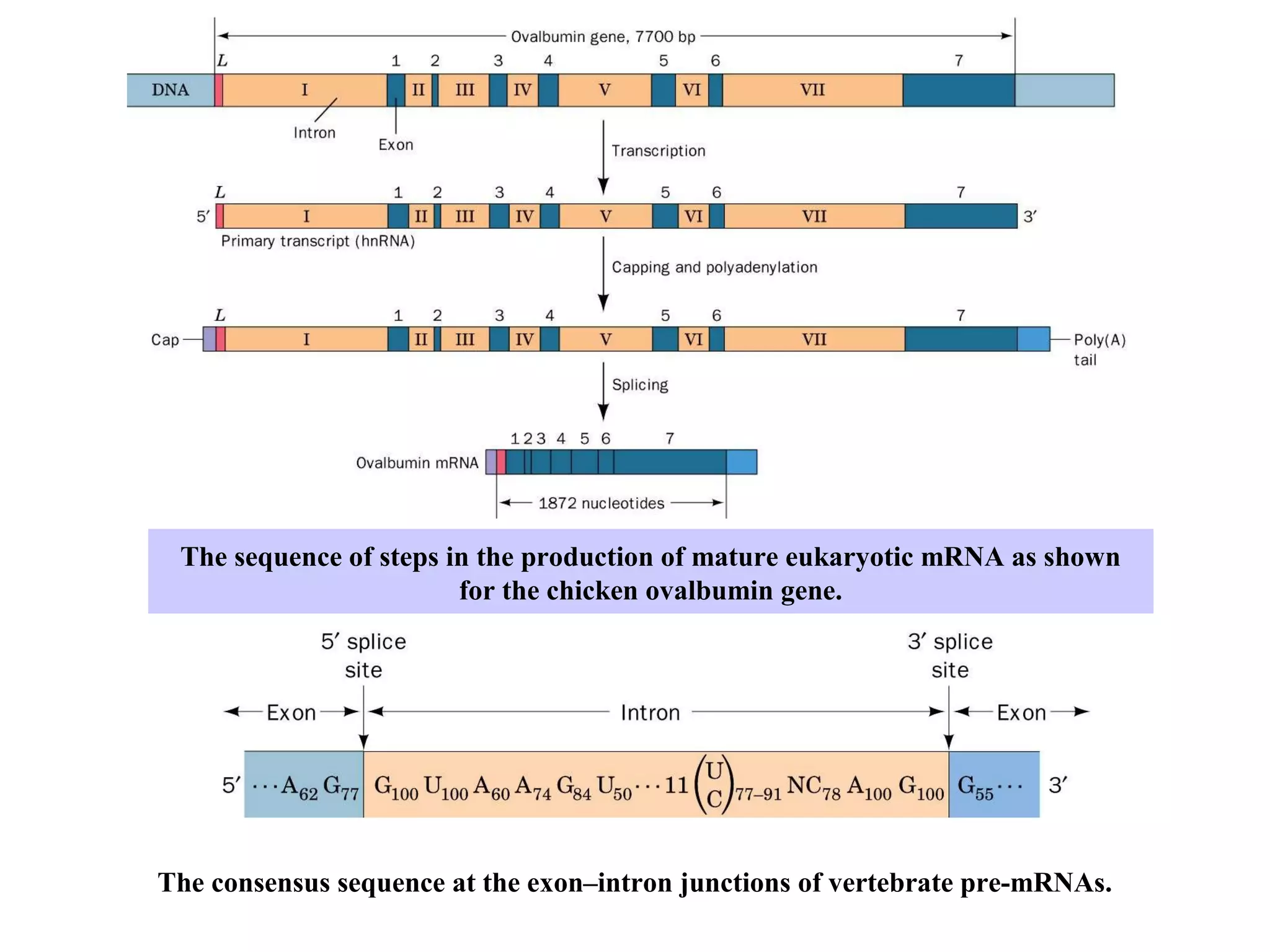
The sequence of steps in the production of mature eukaryotic mRNA as shown
for the chicken ovalbumin gene.
The consensus sequence at the exon–intron junctions of vertebrate pre-mRNAs.
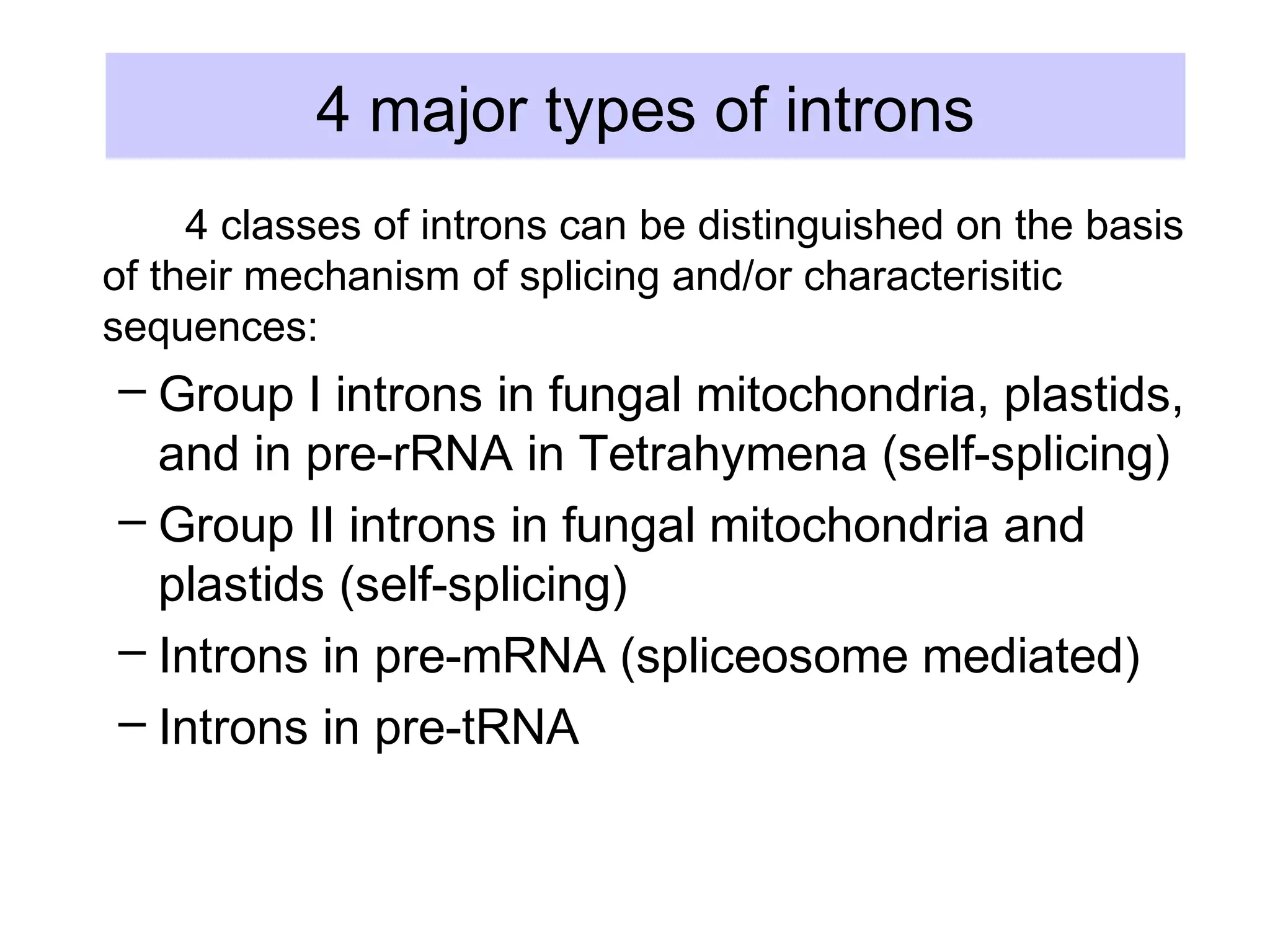
4 major types of introns
4 classes of introns can be distinguished on the basis
of their mechanism of splicing and/or characterisitic
sequences:
– Group I introns in fungal mitochondria, plastids,
and in pre-rRNA in Tetrahymena (self-splicing)
– Group II introns in fungal mitochondria and
plastids (self-splicing)
– Introns in pre-mRNA (spliceosome mediated)
– Introns in pre-tRNA
Group I and II introns
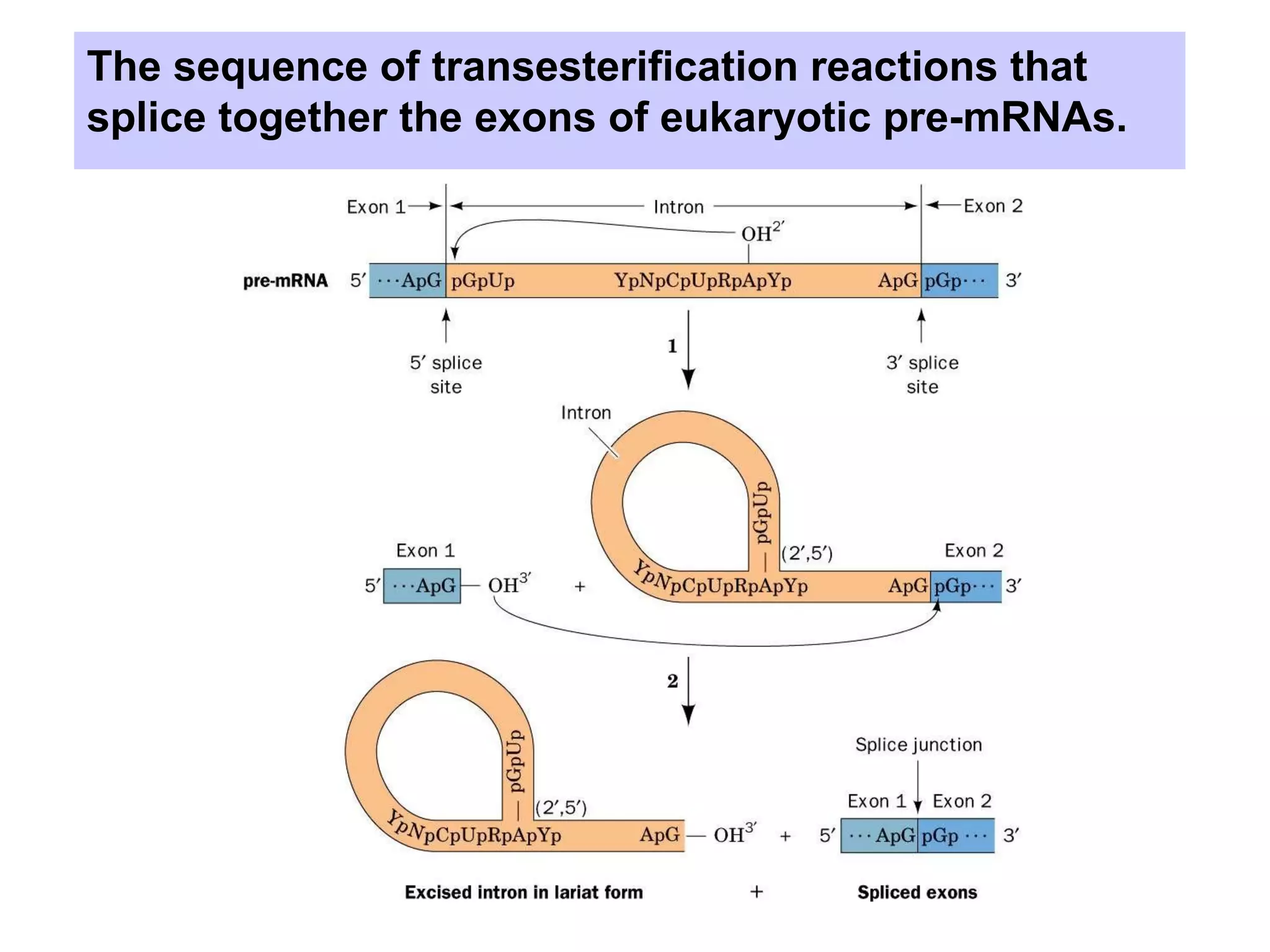
The sequence of transesterification reactions that
splice together the exons of eukaryotic pre-mRNAs.
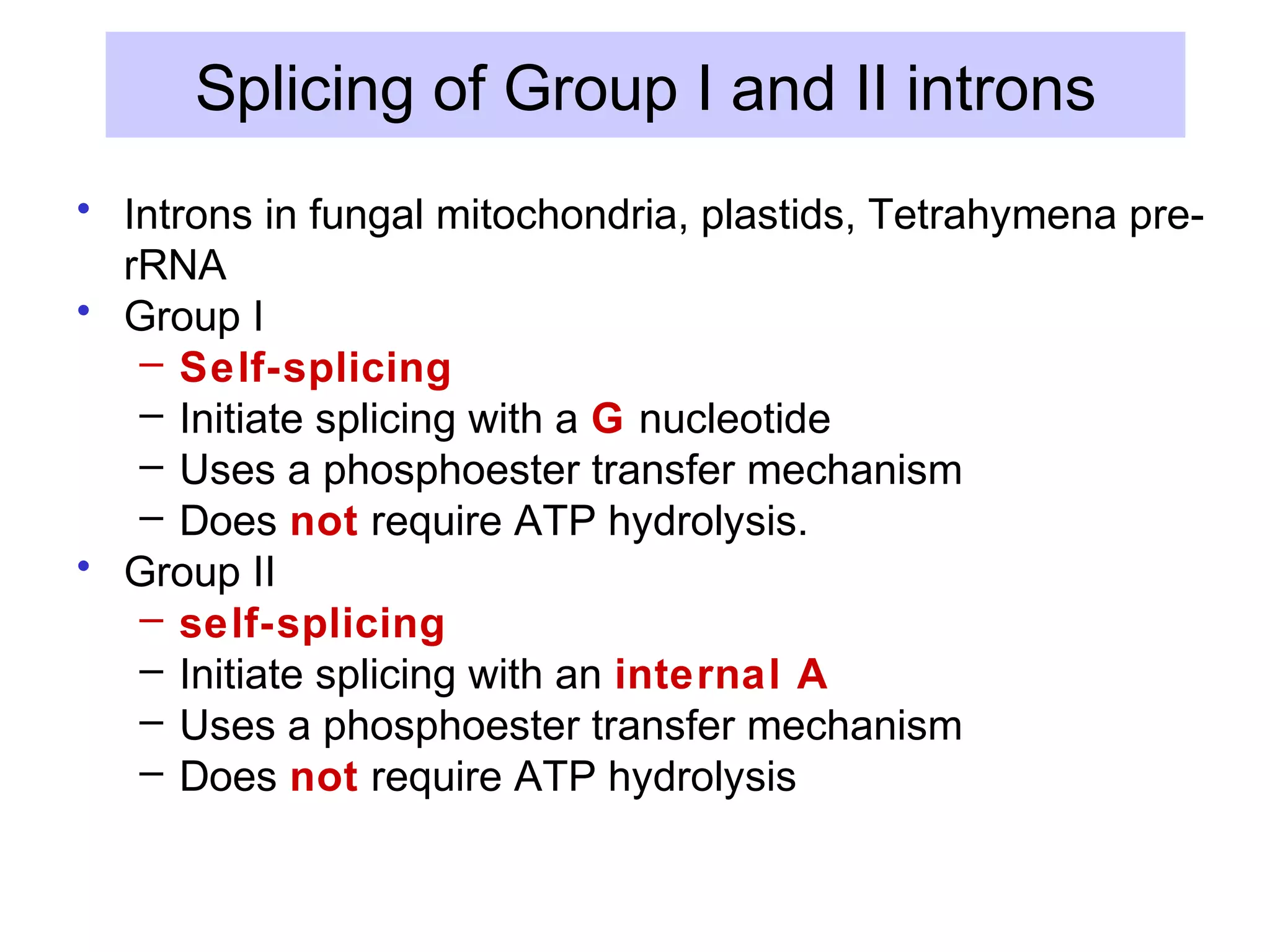
Splicing of Group I and II introns
• Introns in fungal mitochondria, plastids, Tetrahymena pre-
rRNA
• Group I
– Self-splicing
– Initiate splicing with a G nucleotide
– Uses a phosphoester transfer mechanism
– Does not require ATP hydrolysis.
• Group II
– self-splicing
– Initiate splicing with an internal A
– Uses a phosphoester transfer mechanism
– Does not require ATP hydrolysis
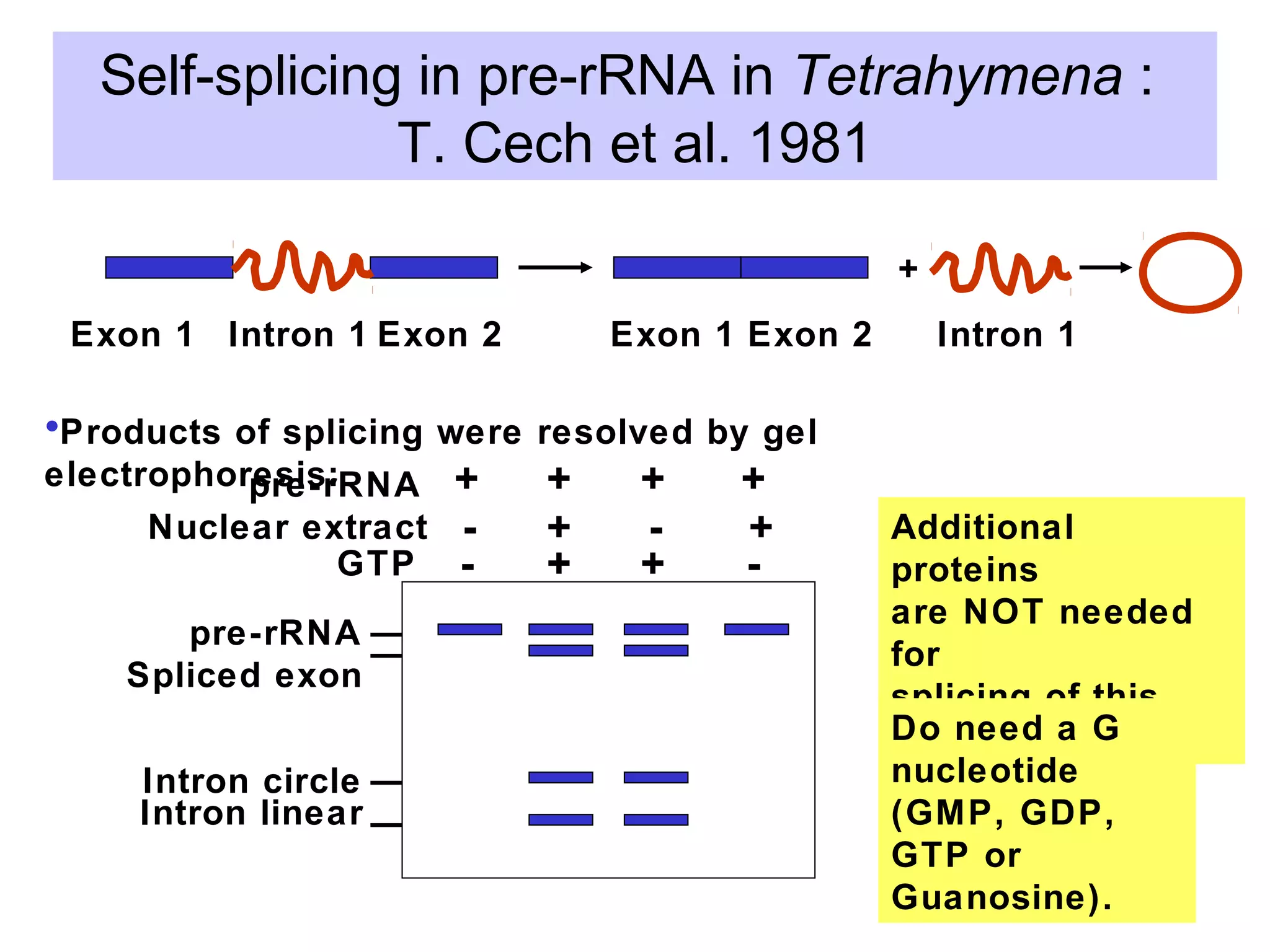
Self-splicing in pre-rRNA in Tetrahymena :
T. Cech et al. 1981
Exon 1 Exon 2Intron 1 Exon 1 Exon 2 Intron 1
+
pre-rRNA
Spliced exon
Intron circle
Intron linear
pre-rRNA
Nuclear extract
GTP
+ + + +
- + - +
- + + -
•Products of splicing were resolved by gel
electrophoresis:
Additional
proteins
are NOT needed
for
splicing of this
pre-rRNA!Do need a G
nucleotide
(GMP, GDP,
GTP or
Guanosine).
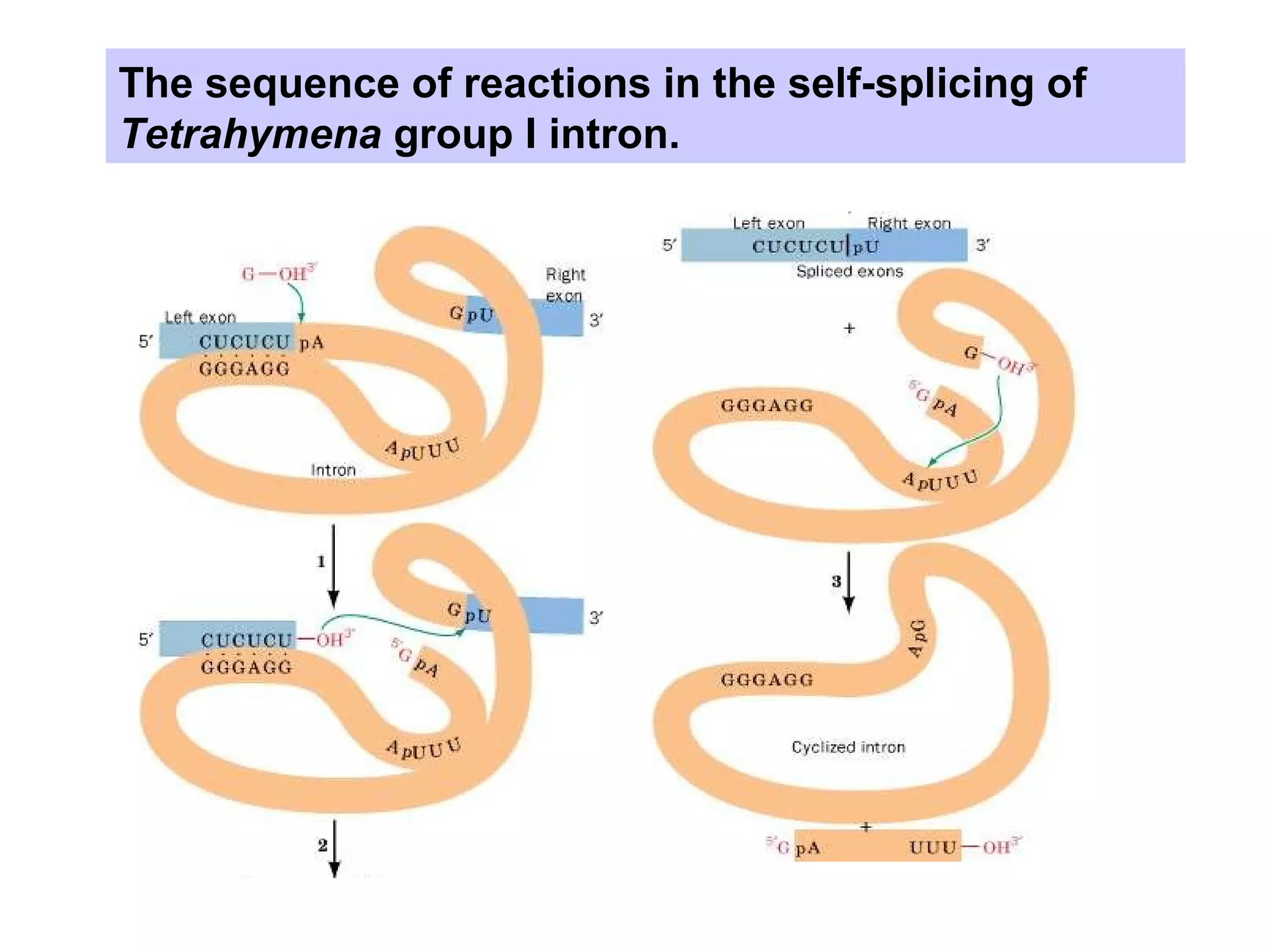
The sequence of reactions in the self-splicing of
Tetrahymena group I intron.
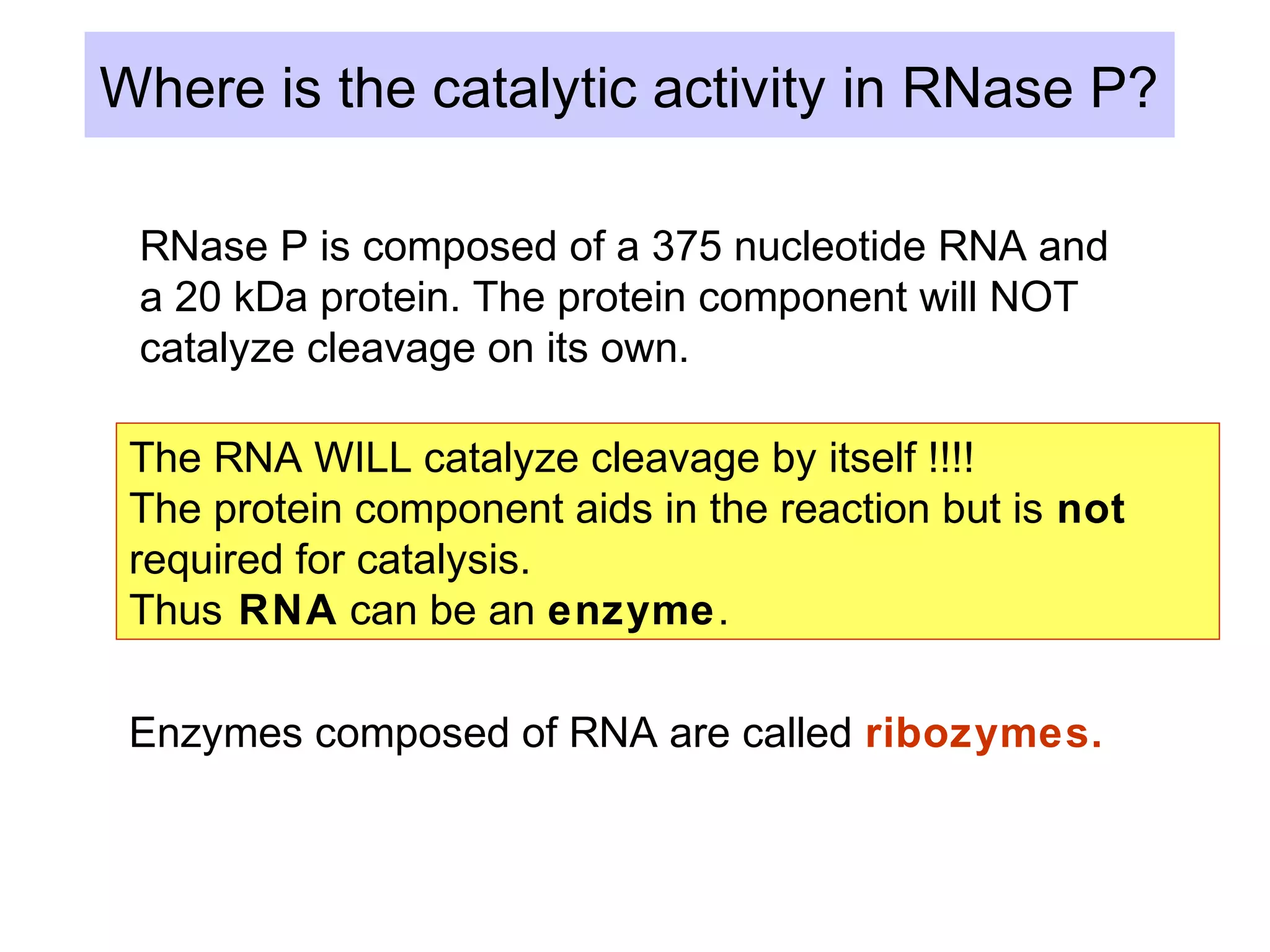
Where is the catalytic activity in RNase P?
RNase P is composed of a 375 nucleotide RNA and
a 20 kDa protein. The protein component will NOT
catalyze cleavage on its own.
The RNA WILL catalyze cleavage by itself !!!!
The protein component aids in the reaction but is not
required for catalysis.
Thus RNA can be an enzyme.
Enzymes composed of RNA are called ribozymes.
Hammerhead ribozymes
• A 58 nt structure is used in self-cleavage
• The sequence CUGA adjacent to stem-
loops is sufficient for cleavage
C
UGAG
AC C GG
GGC C
A
AA
A
C
U
C G
A
G
U
C
AC C AC
UGGUG
U
Bond that is cleaved.
5'3'
C UGA is required for catalysis
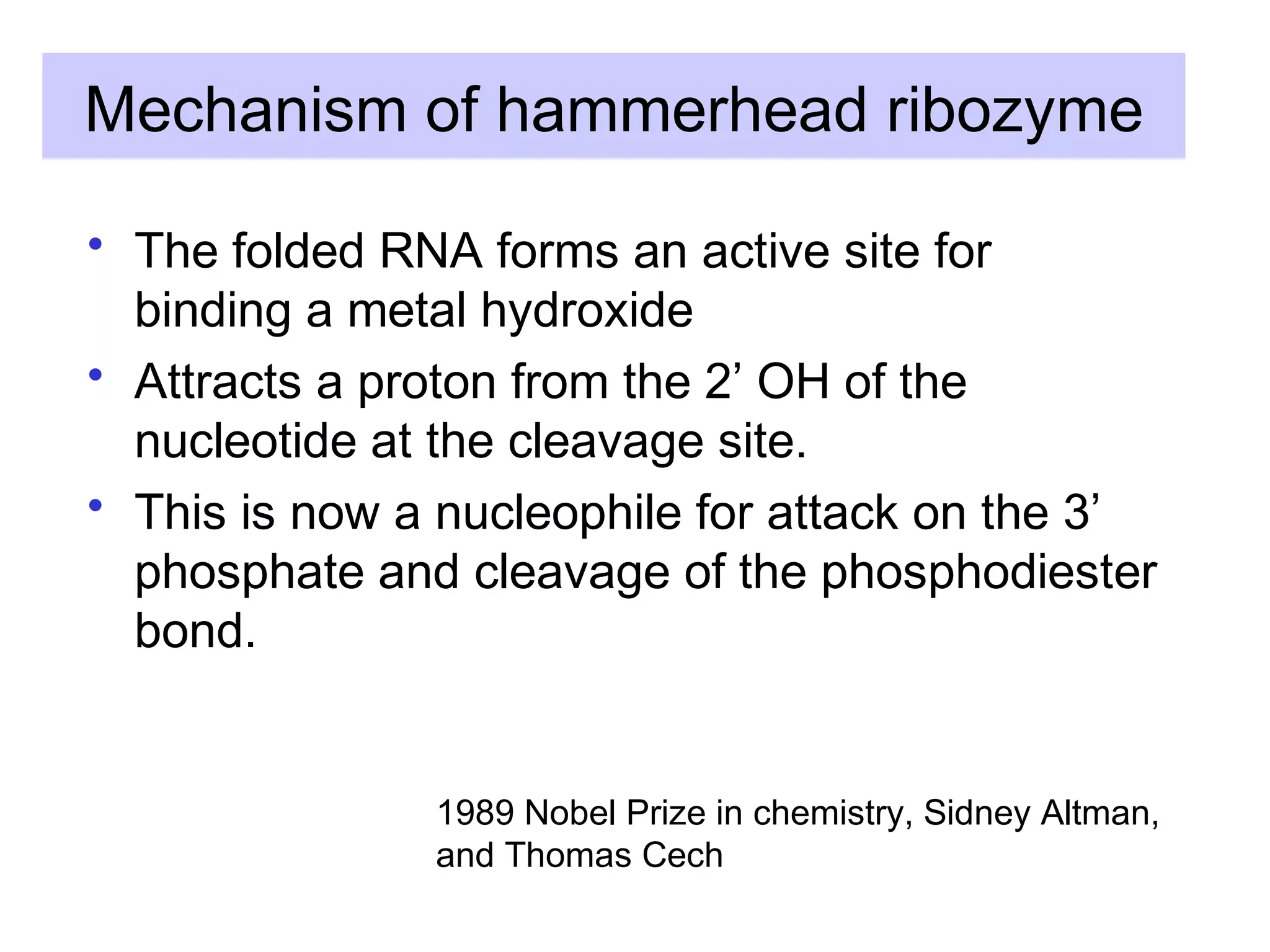
Mechanism of hammerhead ribozyme
• The folded RNA forms an active site for
binding a metal hydroxide
• Attracts a proton from the 2’ OH of the
nucleotide at the cleavage site.
• This is now a nucleophile for attack on the 3’
phosphate and cleavage of the phosphodiester
bond.
1989 Nobel Prize in chemistry, Sidney Altman,
and Thomas Cech
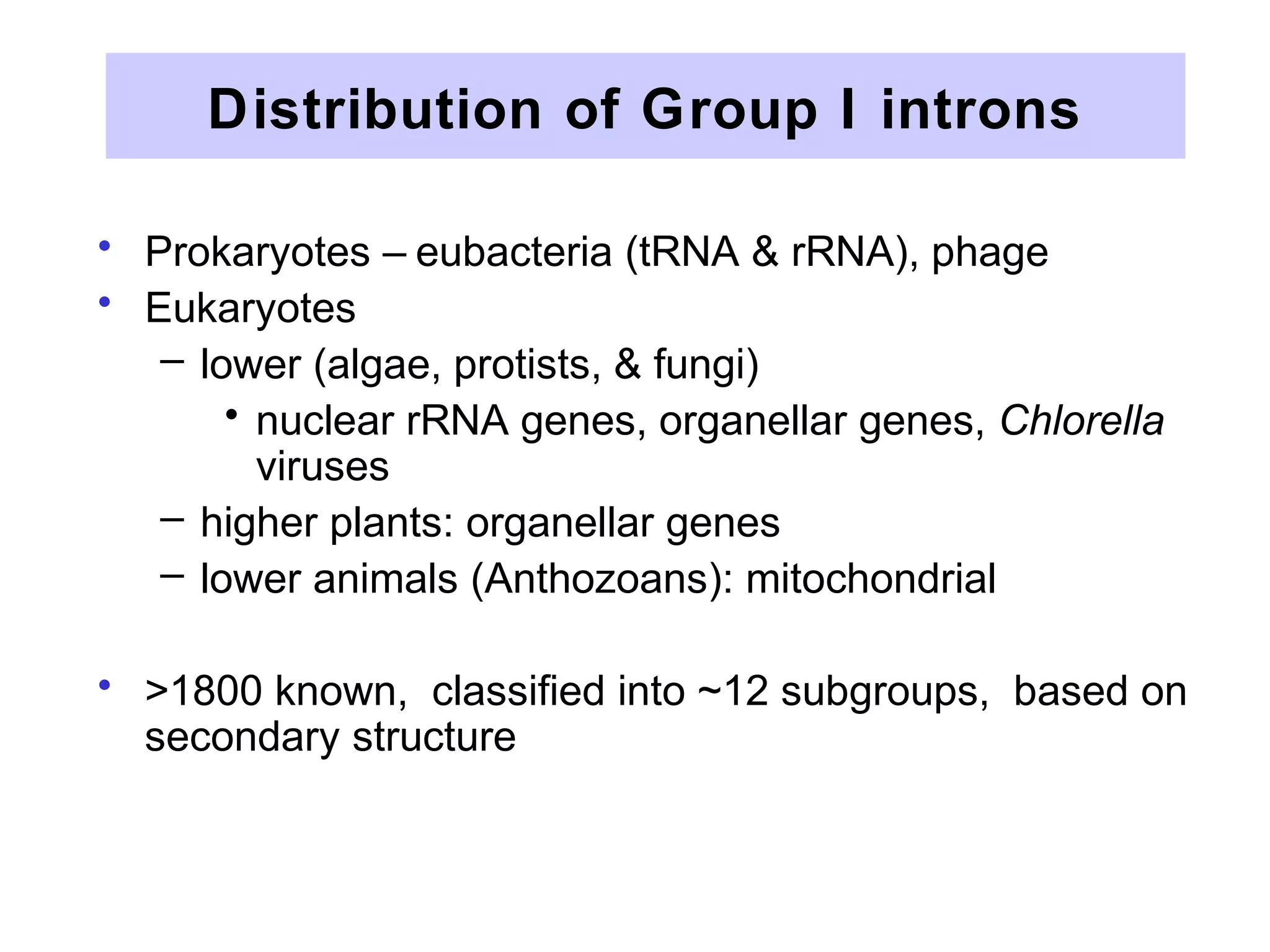
Distribution of Group I introns
• Prokaryotes – eubacteria (tRNA & rRNA), phage
• Eukaryotes
– lower (algae, protists, & fungi)
• nuclear rRNA genes, organellar genes, Chlorella
viruses
– higher plants: organellar genes
– lower animals (Anthozoans): mitochondrial
• >1800 known, classified into ~12 subgroups, based on
secondary structure
Splicing of pre-mRNA
• The introns begin and end with almost invariant
sequences: 5’ GU…AG 3’
• Use ATP hydrolysis to assemble a large
spliceosome (45S particle, 5 snRNAs and 65
proteins, same size and complexity as ribosome)
• Mechanism is similar to that of the Group II fungal
introns:
– Initiate splicing with an internal A
– Uses a phosphoester transfer mechanism for
splicing
Initiation of phosphoester transfers in pre-mRNA
• Uses 2’ OH of an A internal to the
intron
• Forms a branch point by
attacking the 5’ phosphate on the
first nucleotide of the intron
• Forms a lariat structure in the
intron
• Exons are joined and intron is
excised as a lariat
• A debranching enzyme cleaves the
lariat at the branch to generate a
linear intron
• Linear intron is degraded
Involvement of snRNAs and snRNPs
• snRNAs = small nuclear RNAs
• snRNPs = small nuclear ribonucleoproteins
particles (snRNA complex with protein)
• Addition of these antibodies to an in vitro pre-
mRNA splicing reaction blocked splicing.
• Thus the snRNPs were implicated in splicing
• Recognizing the 5’ splice site and the branch site.
• Bringing those sites together.
• Catalyzing (or helping to catalyze) the RNA cleavage.
Role of snRNPs in RNA splicing
RNA-RNA, RNA-protein and protein-protein
interactions are all important during splicing
snRNPs
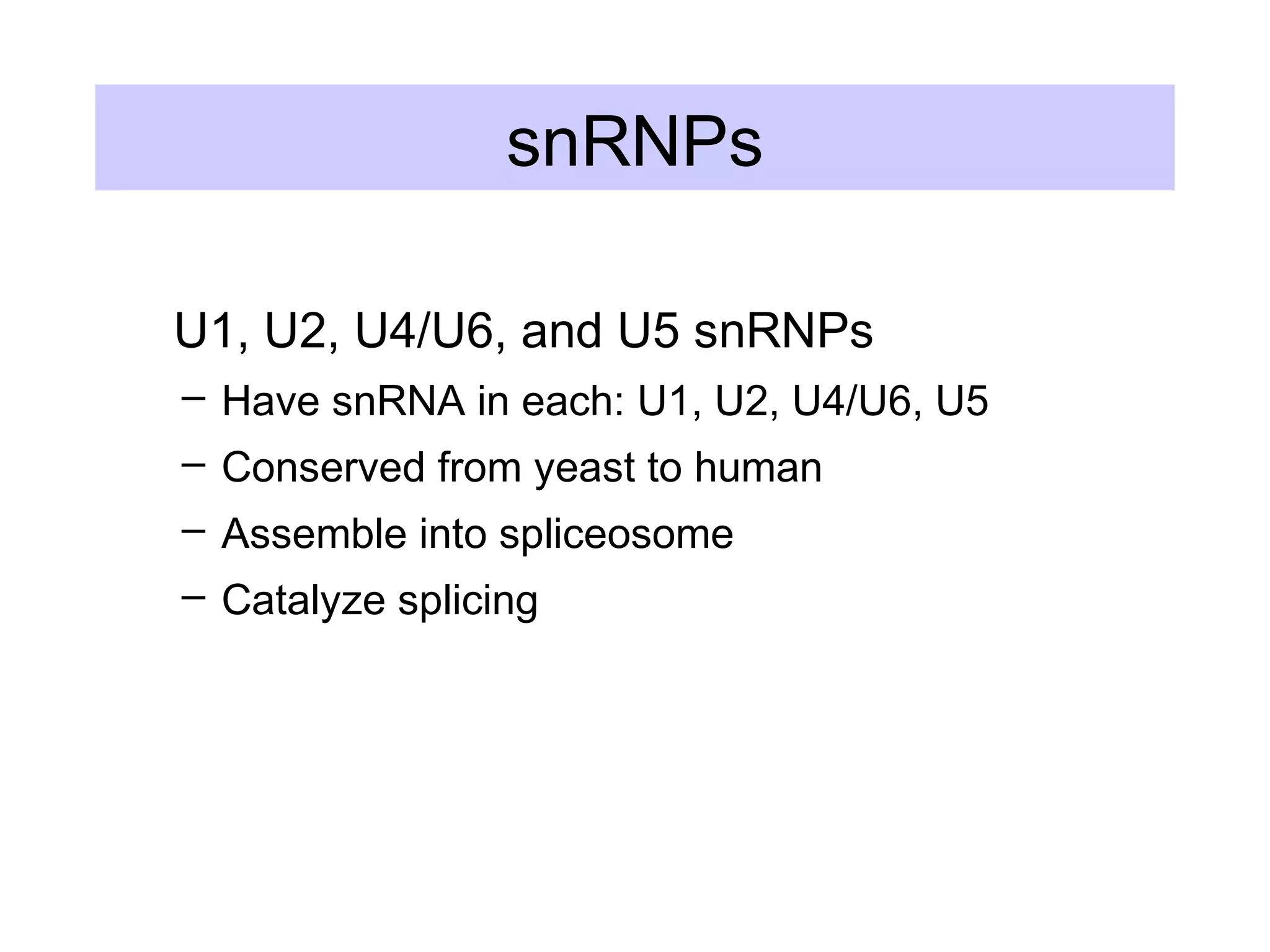
U1, U2, U4/U6, and U5 snRNPs
– Have snRNA in each: U1, U2, U4/U6, U5
– Conserved from yeast to human
– Assemble into spliceosome
– Catalyze splicing
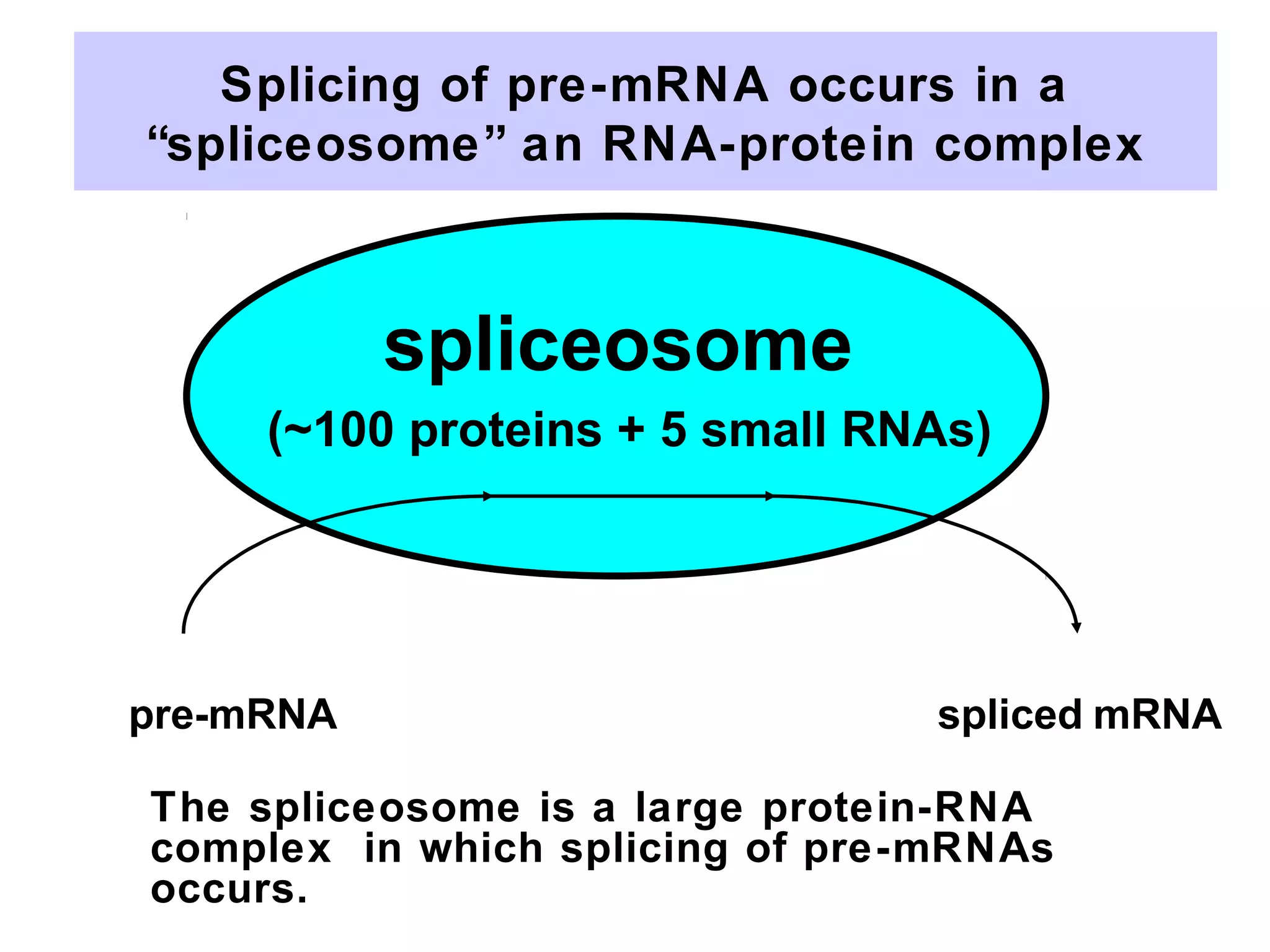
Splicing of pre-mRNA occurs in a
“spliceosome” an RNA-protein complex
pre-mRNA spliced mRNA
spliceosome
(~100 proteins + 5 small RNAs)
The spliceosome is a large protein-RNA
complex in which splicing of pre-mRNAs
occurs.
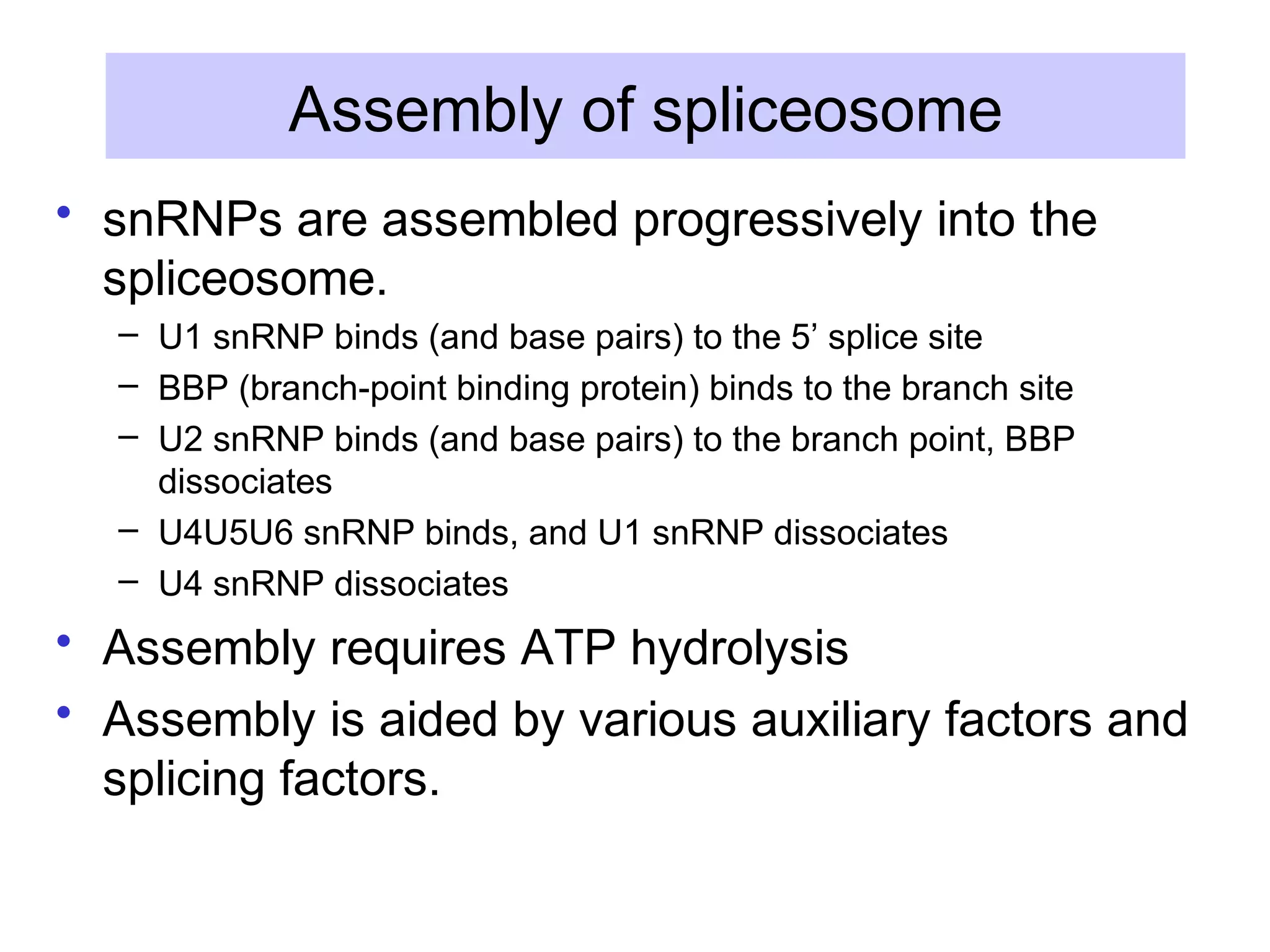
Assembly of spliceosome
• snRNPs are assembled progressively into the
spliceosome.
– U1 snRNP binds (and base pairs) to the 5’ splice site
– BBP (branch-point binding protein) binds to the branch site
– U2 snRNP binds (and base pairs) to the branch point, BBP
dissociates
– U4U5U6 snRNP binds, and U1 snRNP dissociates
– U4 snRNP dissociates
• Assembly requires ATP hydrolysis
• Assembly is aided by various auxiliary factors and
splicing factors.
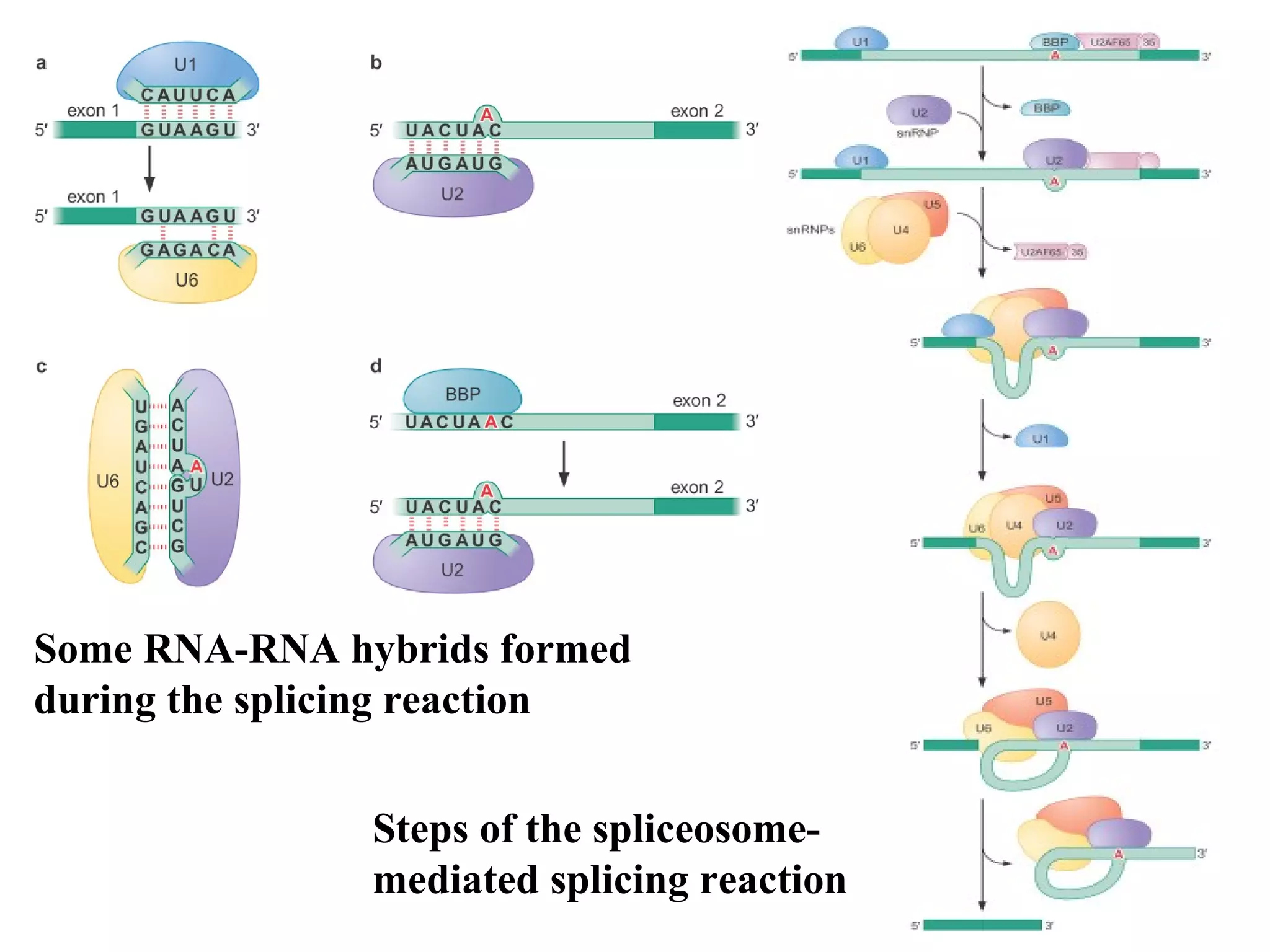
Some RNA-RNA hybrids formed
during the splicing reaction
Steps of the spliceosome-
mediated splicing reaction
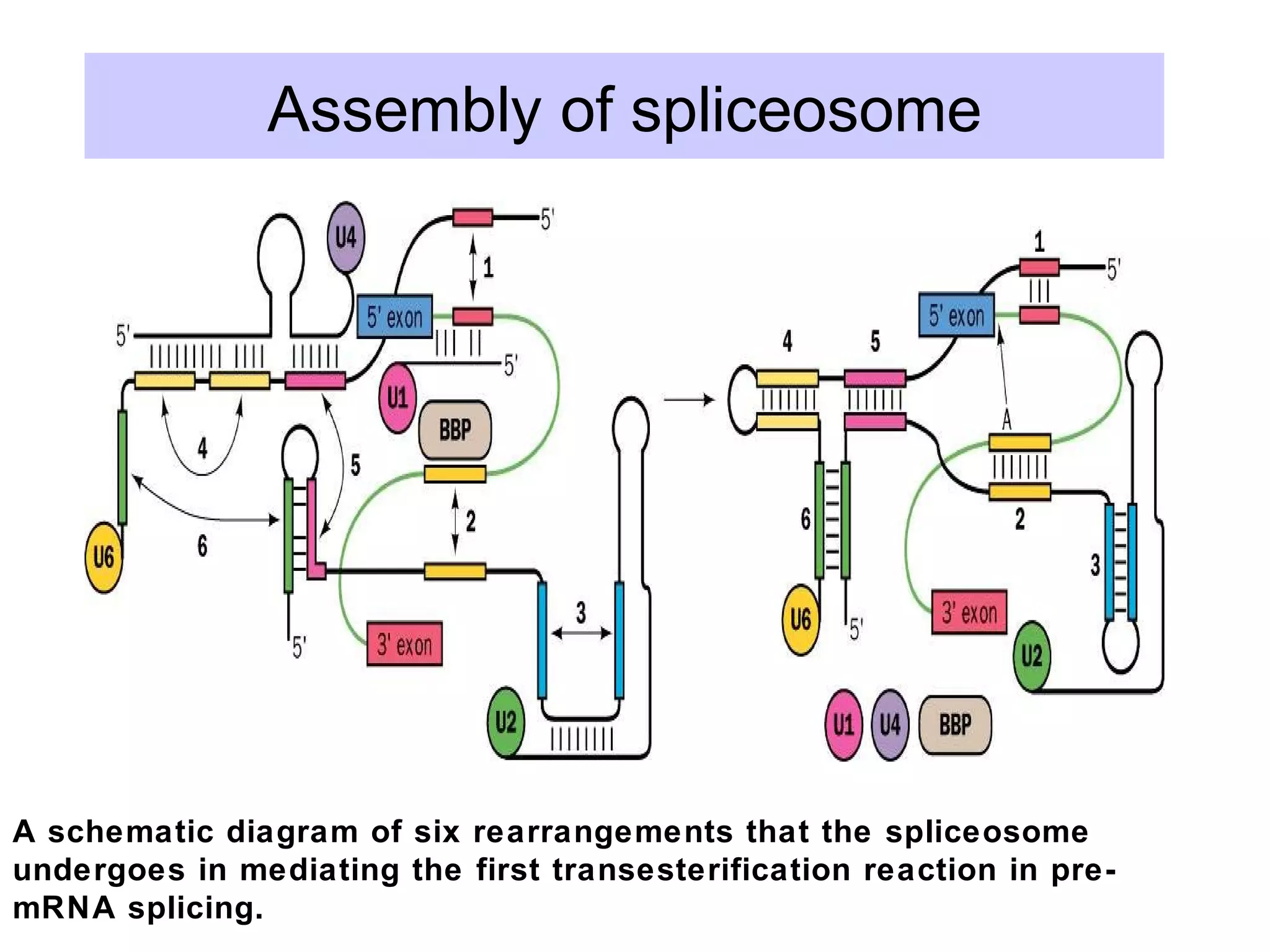
A schematic diagram of six rearrangements that the spliceosome
undergoes in mediating the first transesterification reaction in pre-
mRNA splicing.
Assembly of spliceosome
The spliceosome cycle
The Significance of Gene Splicing
• The introns are rare in prokaryotic structural
genes
• The introns are uncommon in lower eukaryote
(yeast), 239 introns in ~6000 genes, only one
intron / polypeptide
• The introns are abundant in higher eukaryotes
(lacking introns are histons and interferons)
• Unexpressed sequences constitute ~80% of a
typical vertebrate structural gene
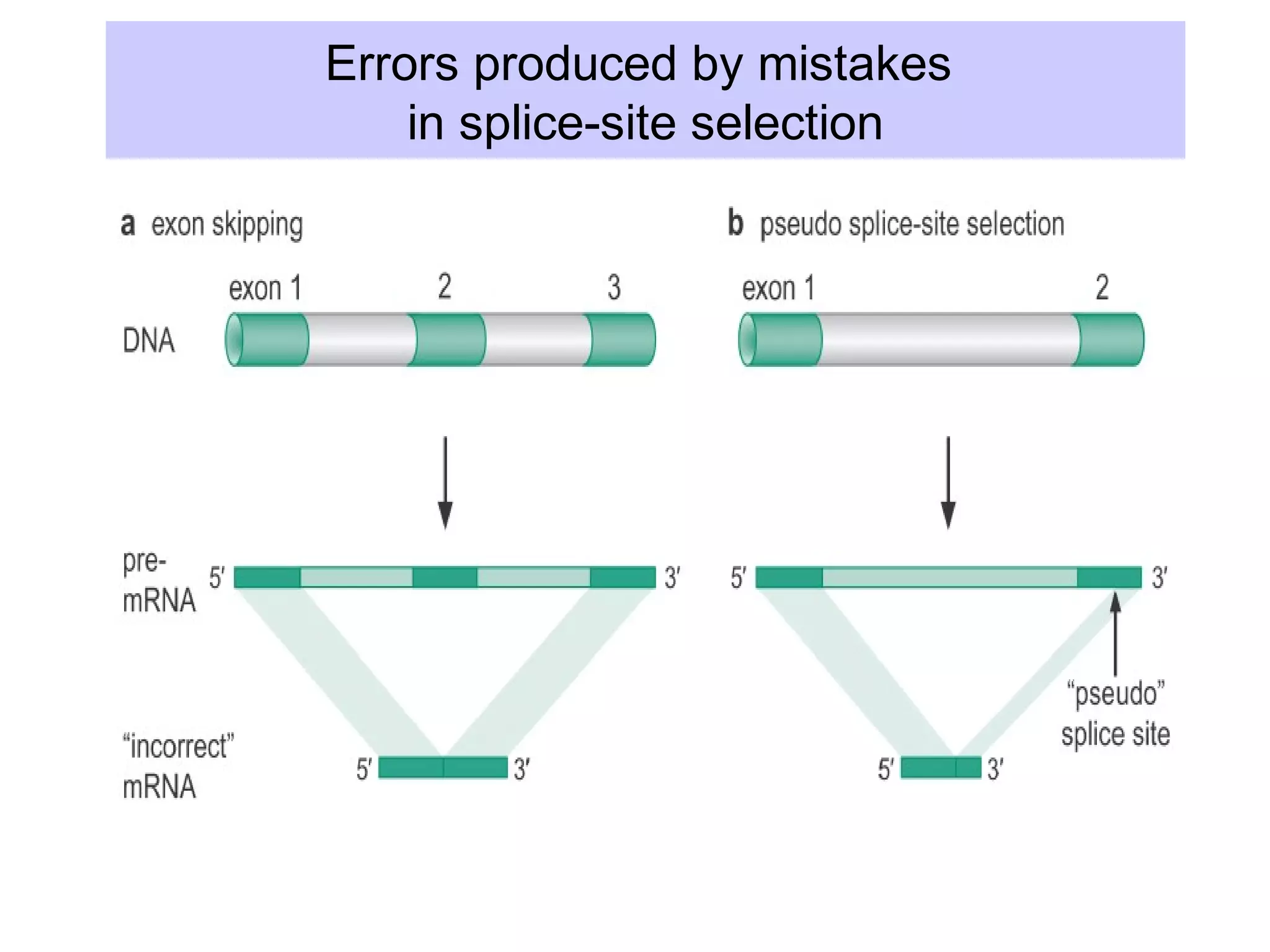
Errors produced by mistakes
in splice-site selection
Mechanisms prevent splicing error
• Co-transcriptional loading process
• SR proteins recruit spliceosome components to the 5’ and
3’ splice sites
• SR protein = Serine Arginine rich protein
• ESE = exonic splicing enhancers
• SR protein regulates alternative splicing
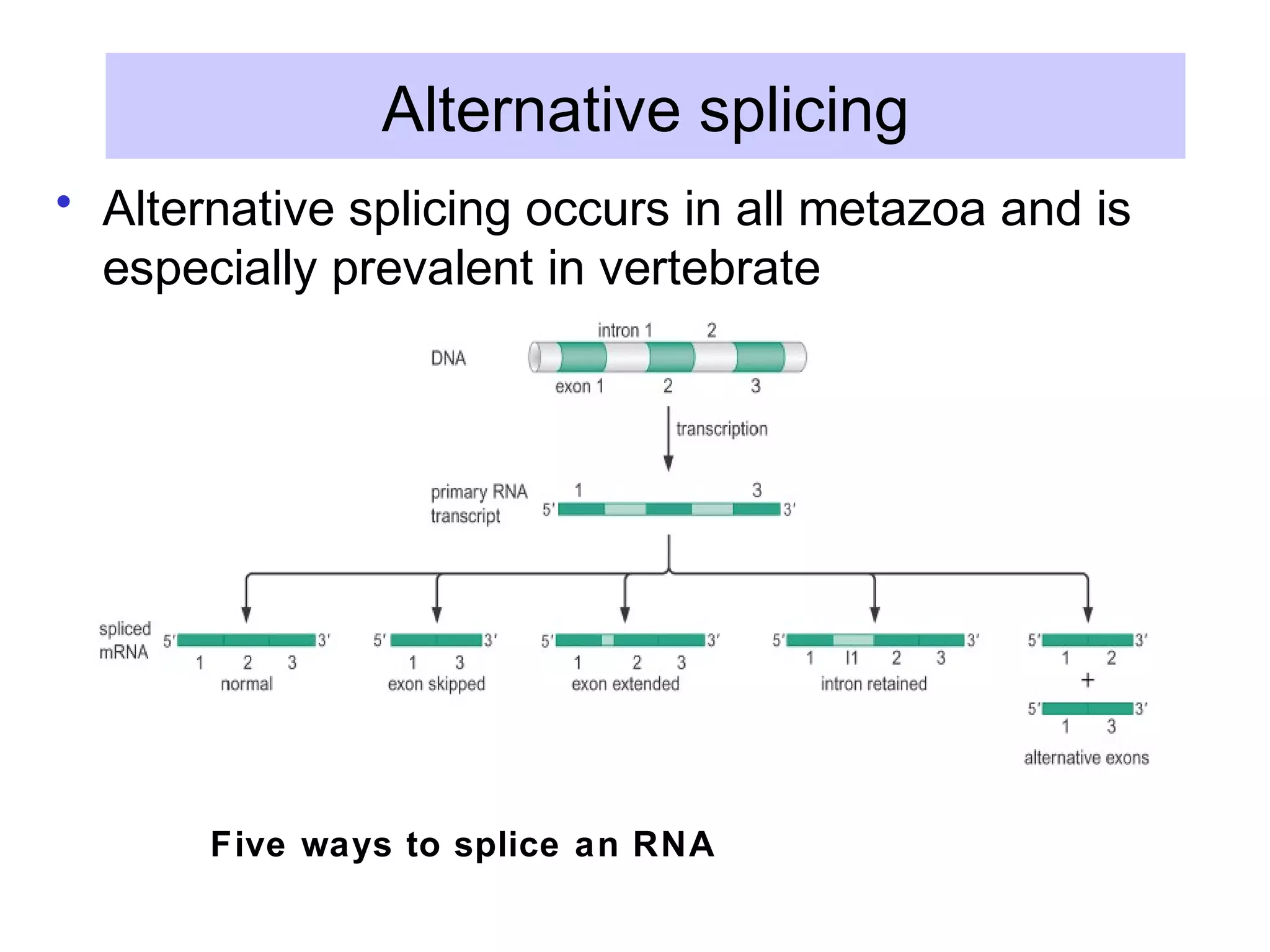
Alternative splicing
• Alternative splicing occurs in all metazoa and is
especially prevalent in vertebrate
Five ways to splice an RNA
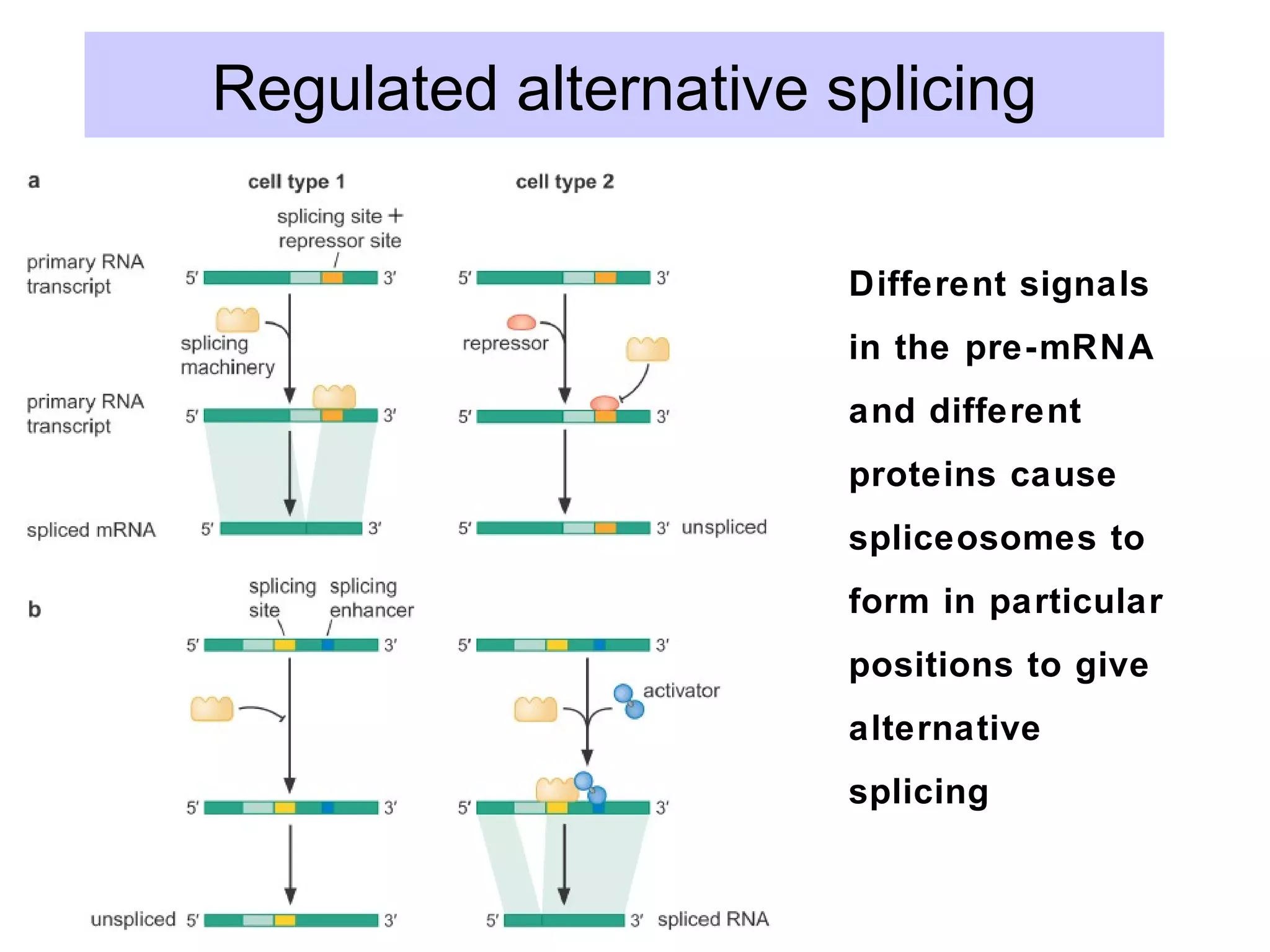
Regulated alternative splicing
Different signals
in the pre-mRNA
and different
proteins cause
spliceosomes to
form in particular
positions to give
alternative
splicing
765
75
65 7
Fas pre-mRNA
APOPTOSIS
Alternative splicing can generate mRNAs encoding
proteins with different, even opposite functions
(programmed
cell death)
Fas ligand
Soluble Fas
(membrane)
Fas
Fas ligand
(membrane-
associated)
(+)
(-)
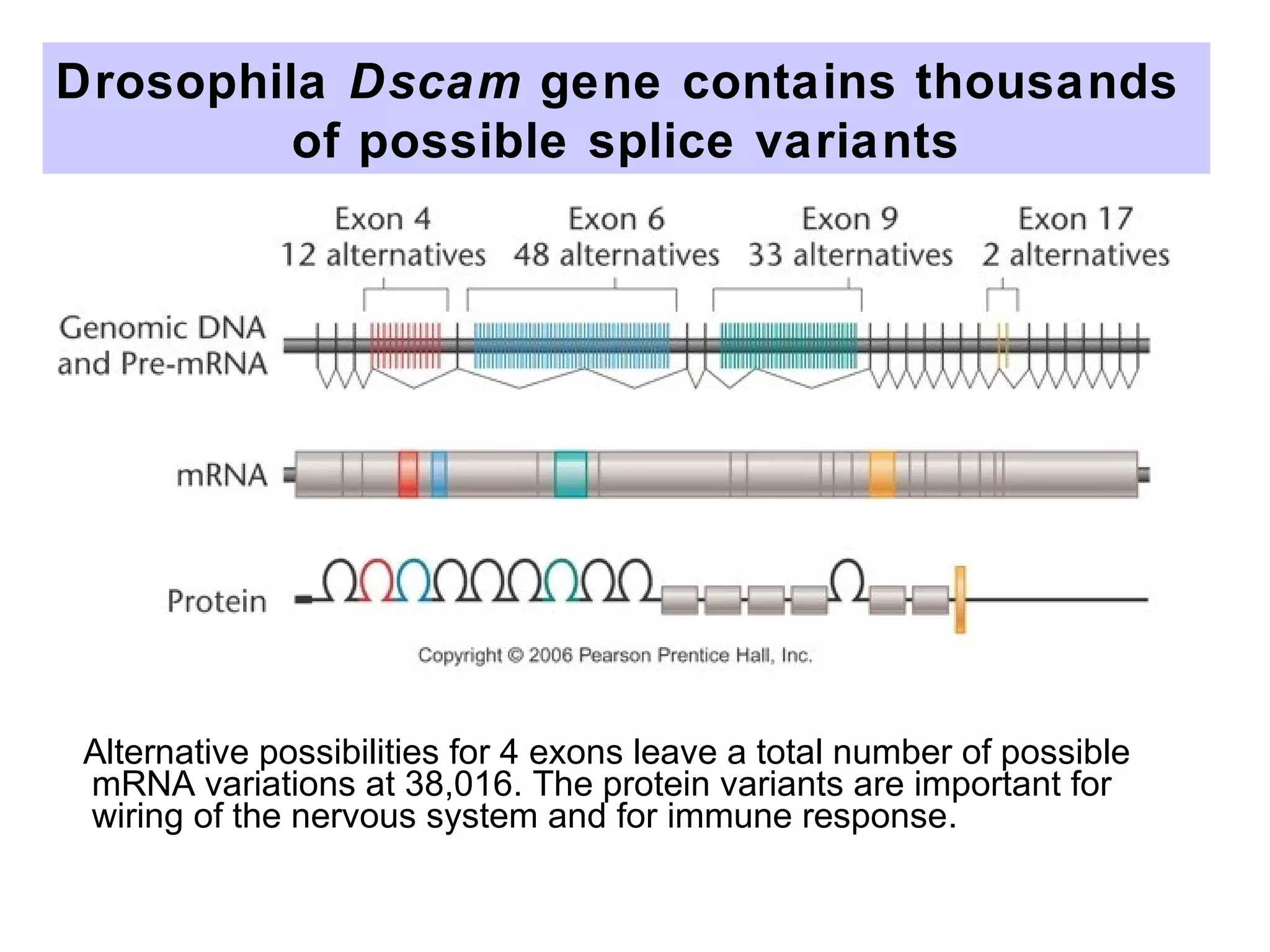
Alternative possibilities for 4 exons leave a total number of possible
mRNA variations at 38,016. The protein variants are important for
wiring of the nervous system and for immune response.
Drosophila Dscam gene contains thousands
of possible splice variants
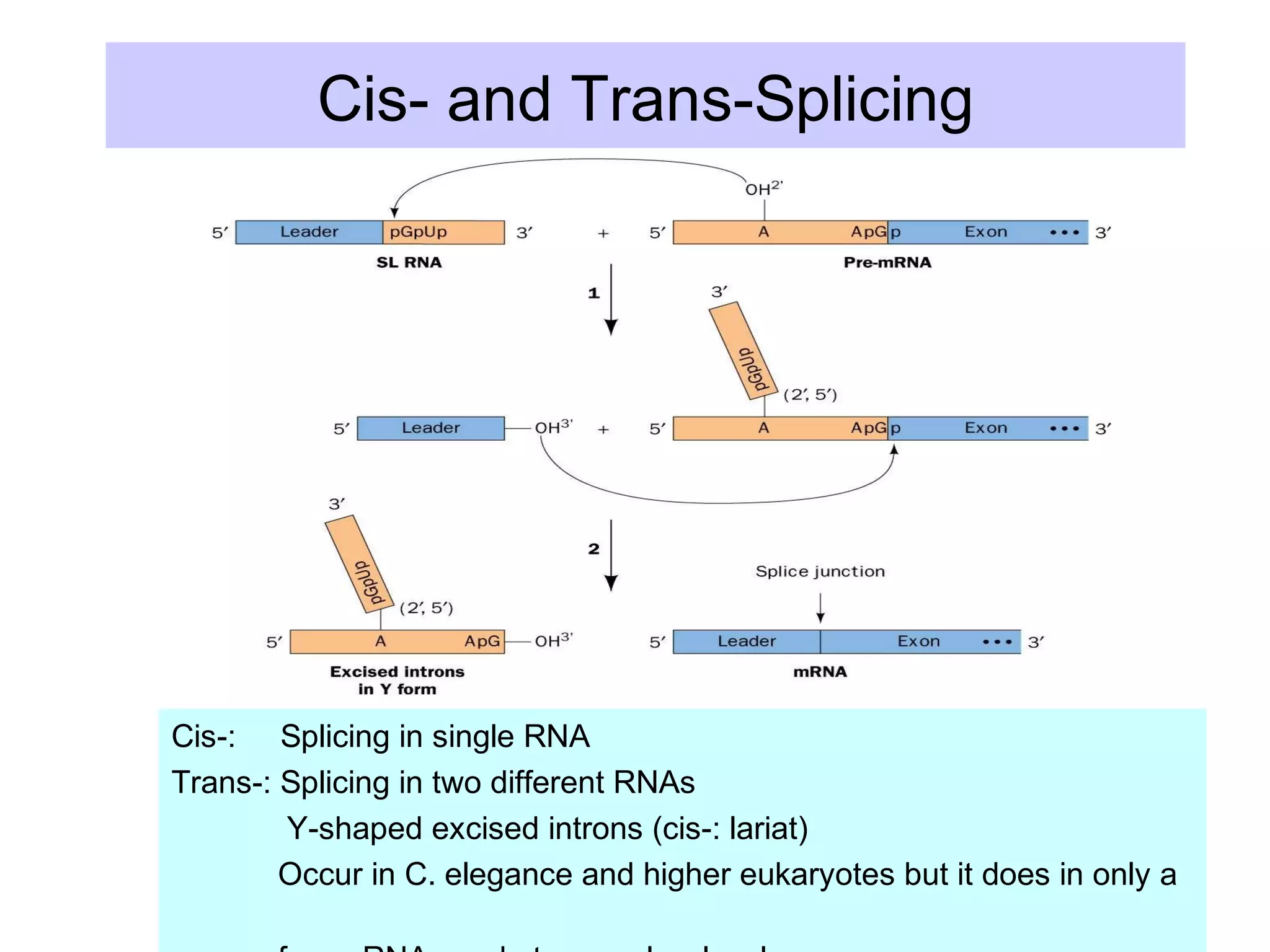
Cis- and Trans-Splicing
Cis-: Splicing in single RNA
Trans-: Splicing in two different RNAs
Y-shaped excised introns (cis-: lariat)
Occur in C. elegance and higher eukaryotes but it does in only a
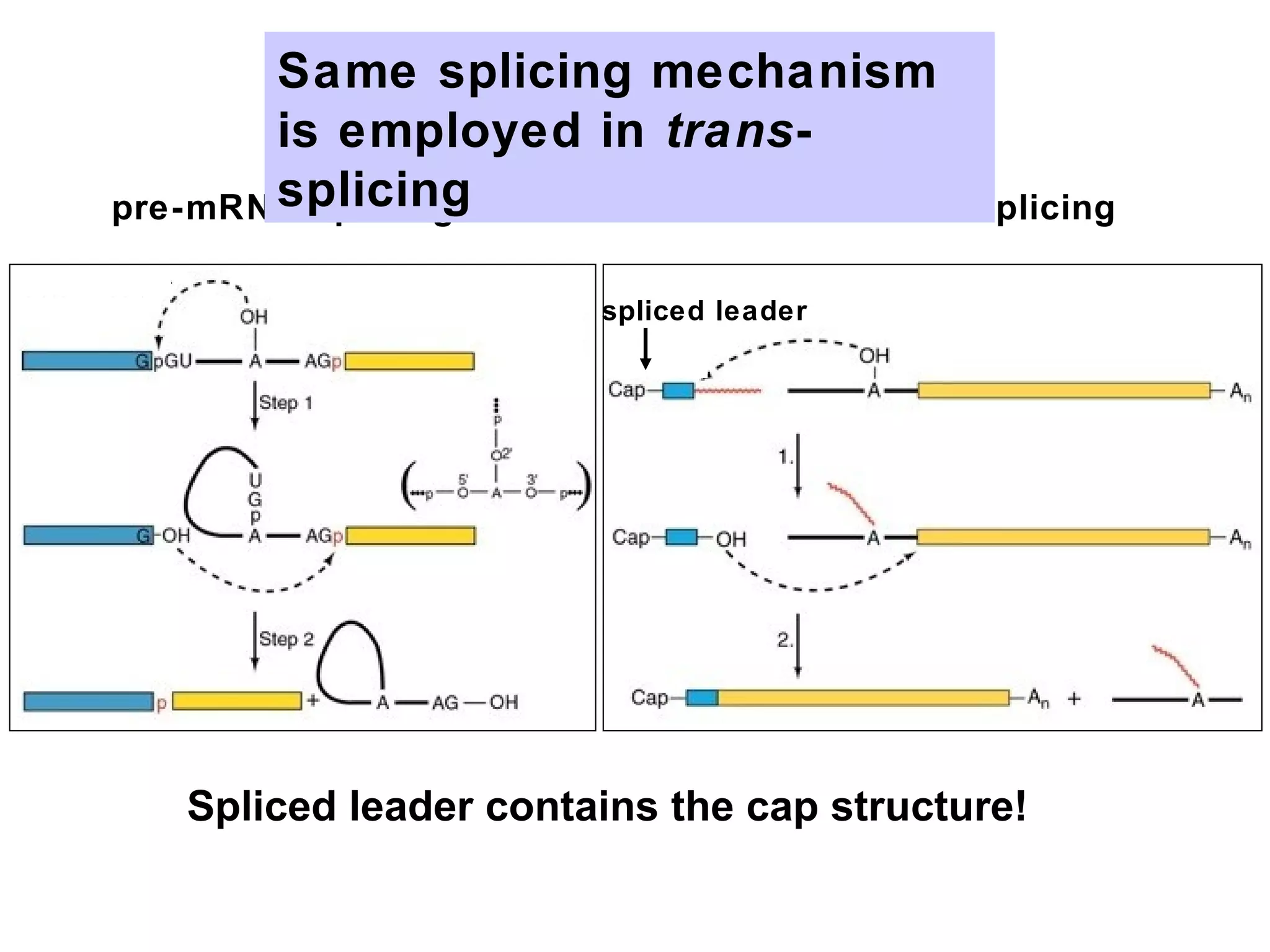
pre-mRNA splicing trans-mRNA splicing
spliced leader
Same splicing mechanism
is employed in trans-
splicing
Spliced leader contains the cap structure!
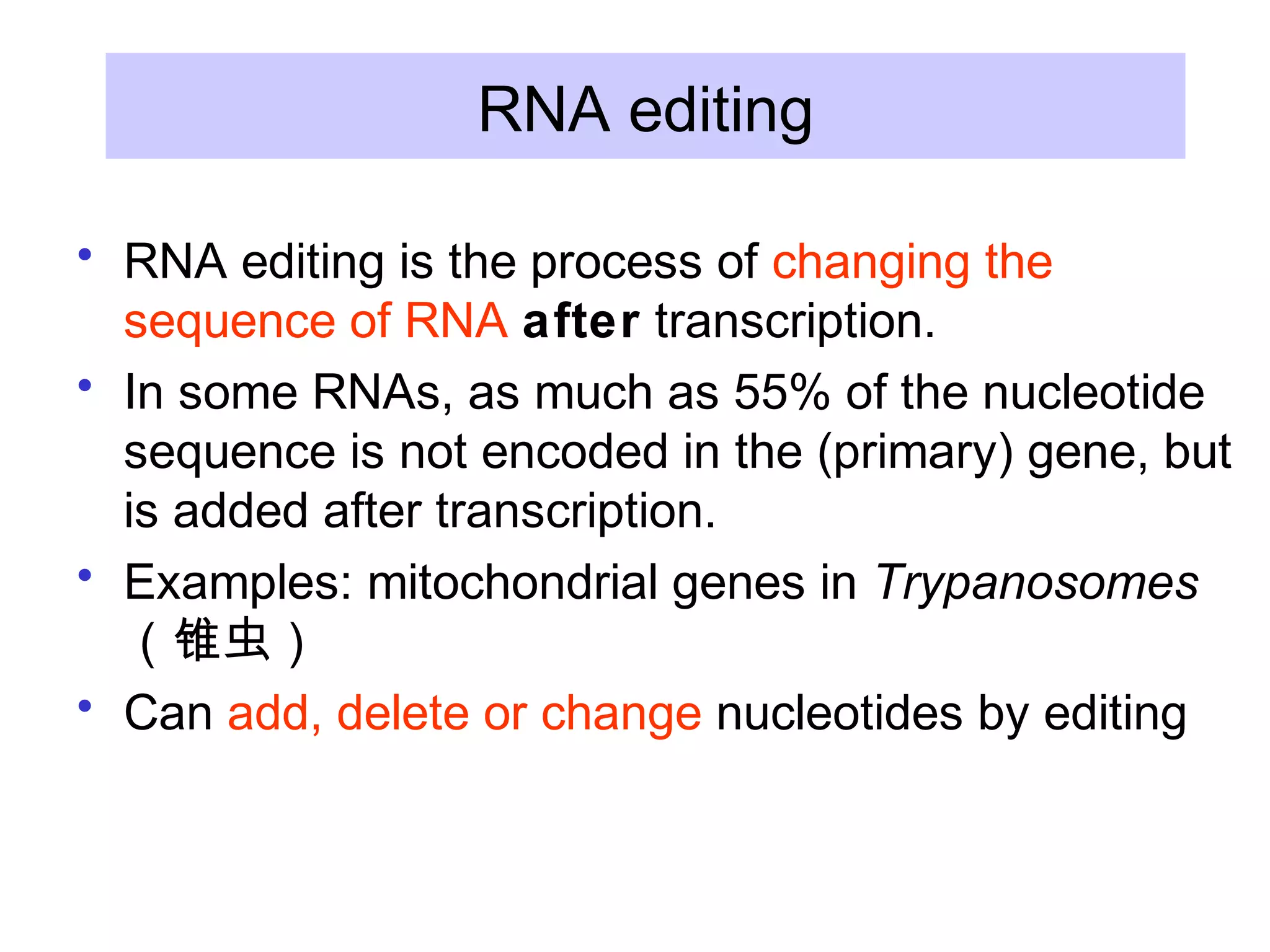
RNA editing
• RNA editing is the process of changing the
sequence of RNA after transcription.
• In some RNAs, as much as 55% of the nucleotide
sequence is not encoded in the (primary) gene, but
is added after transcription.
• Examples: mitochondrial genes in Trypanosomes
(锥虫)
• Can add, delete or change nucleotides by editing
Two mechanisms mediate editing
• Guide RNA-directed uridine
insertion or deletion
• Site-specific deamination
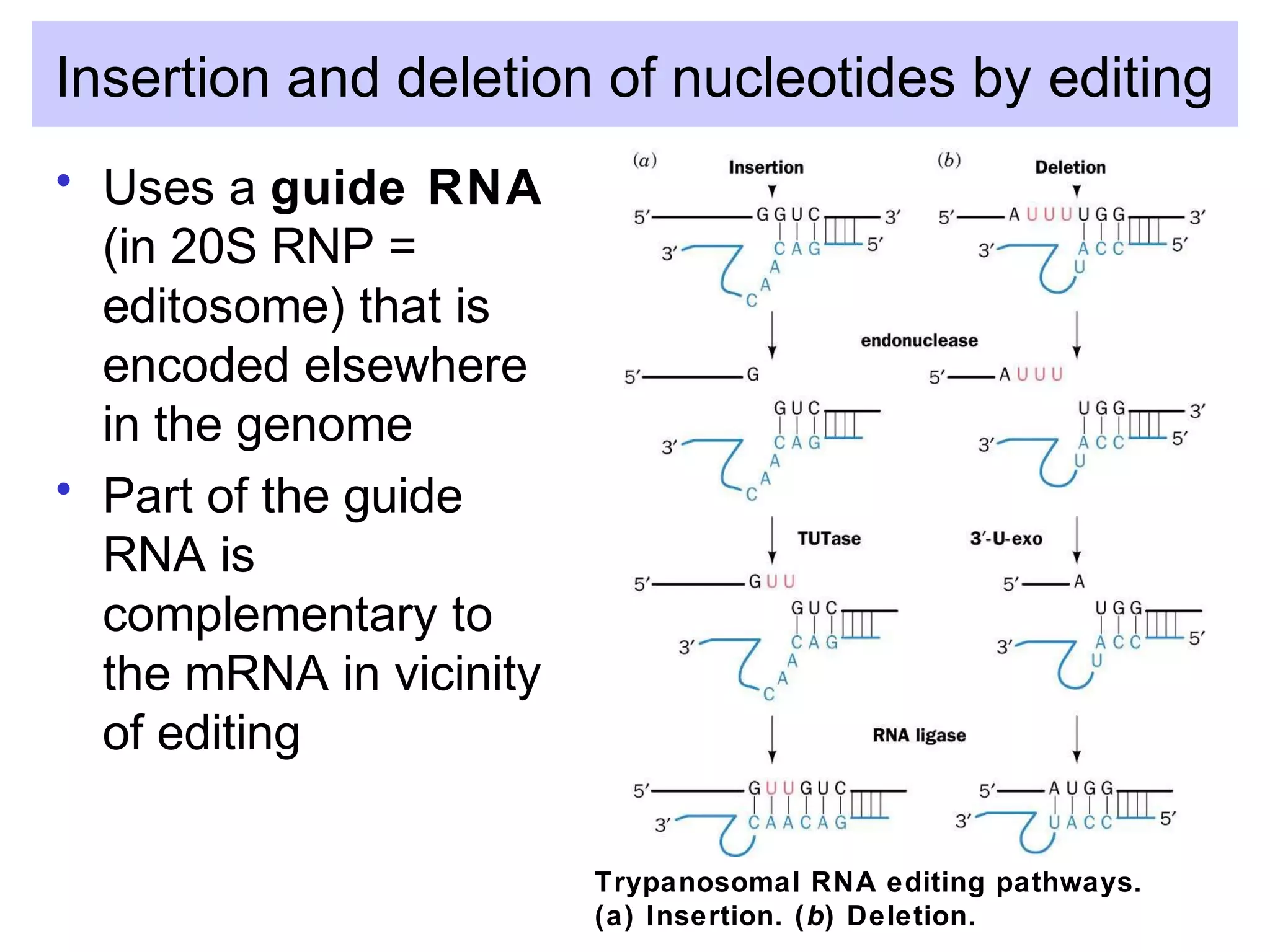
Insertion and deletion of nucleotides by editing
• Uses a guide RNA
(in 20S RNP =
editosome) that is
encoded elsewhere
in the genome
• Part of the guide
RNA is
complementary to
the mRNA in vicinity
of editing
Trypanosomal RNA editing pathways.
(a) Insertion. (b) Deletion.
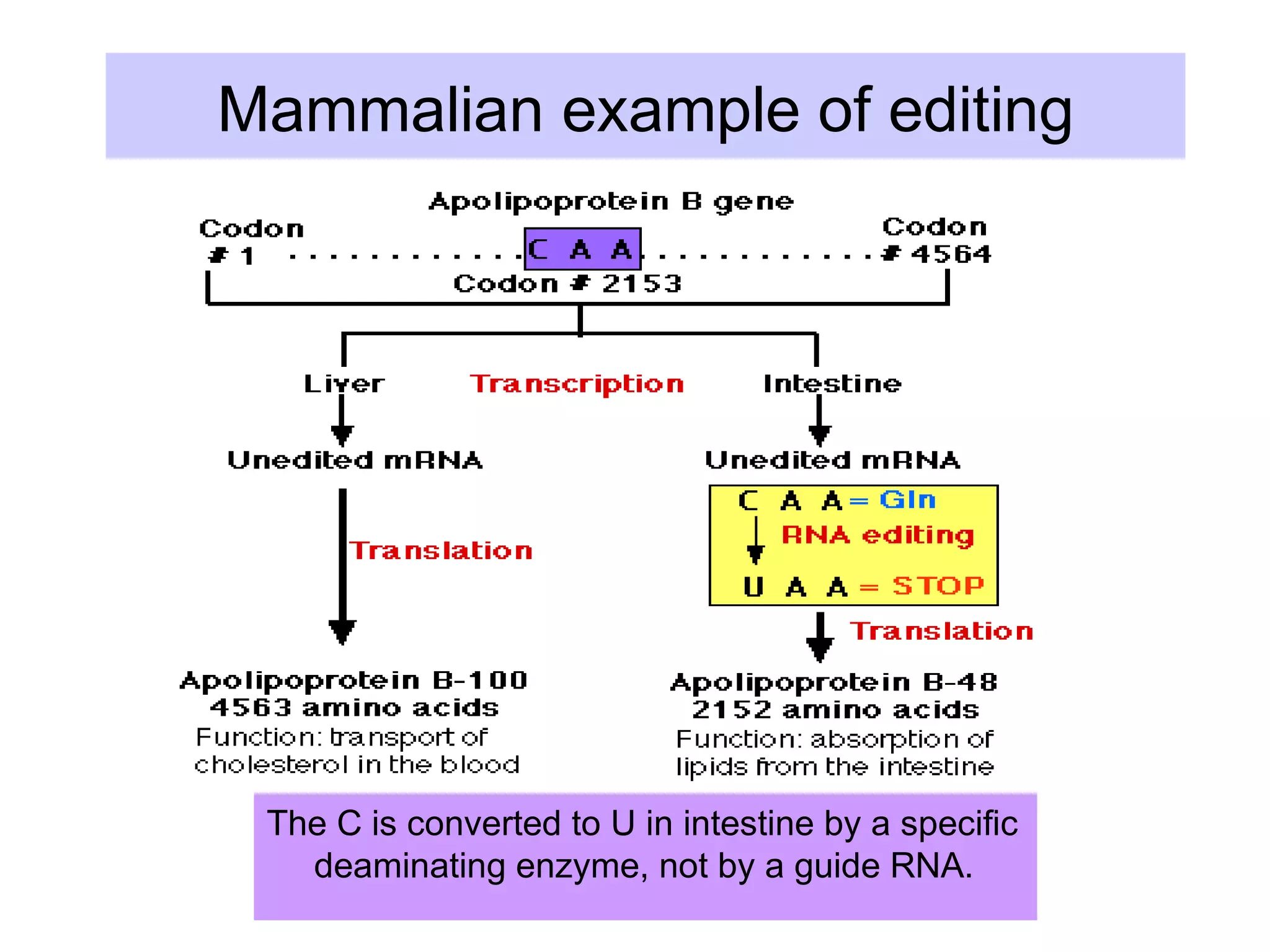
Mammalian example of editing
The C is converted to U in intestine by a specific
deaminating enzyme, not by a guide RNA.
Cutting and Trimming RNA
• Can use endonucleases to cut at specific sites
within a longer precursor RNA
• Can use exonucleases to trim back from the
new ends to make the mature product
• This general process is seen in prokaryotes and
eukaryotes for all types of RNA
The posttranscriptional processing of
E. coli rRNA.
RNase III cuts in stems of stem-loops
16S rRNA 23S rRNA
RNase III
No apparent primary sequence specificity - perhaps RNase III
recognizes a particular stem structure.
Eukaryotic rRNA Processing
• The primary rRNA transcript (~7500nt, 45S RNA)
contains 18S, 5.8S and 28S
• Methylation
occur mostly in rRNA sequence
80%: O2-methylribose, 20%: bases (A or G)
• peudouridine
95 U in rRNA in human are converted to Ψ’s
may contribute rRNA tertiary stability
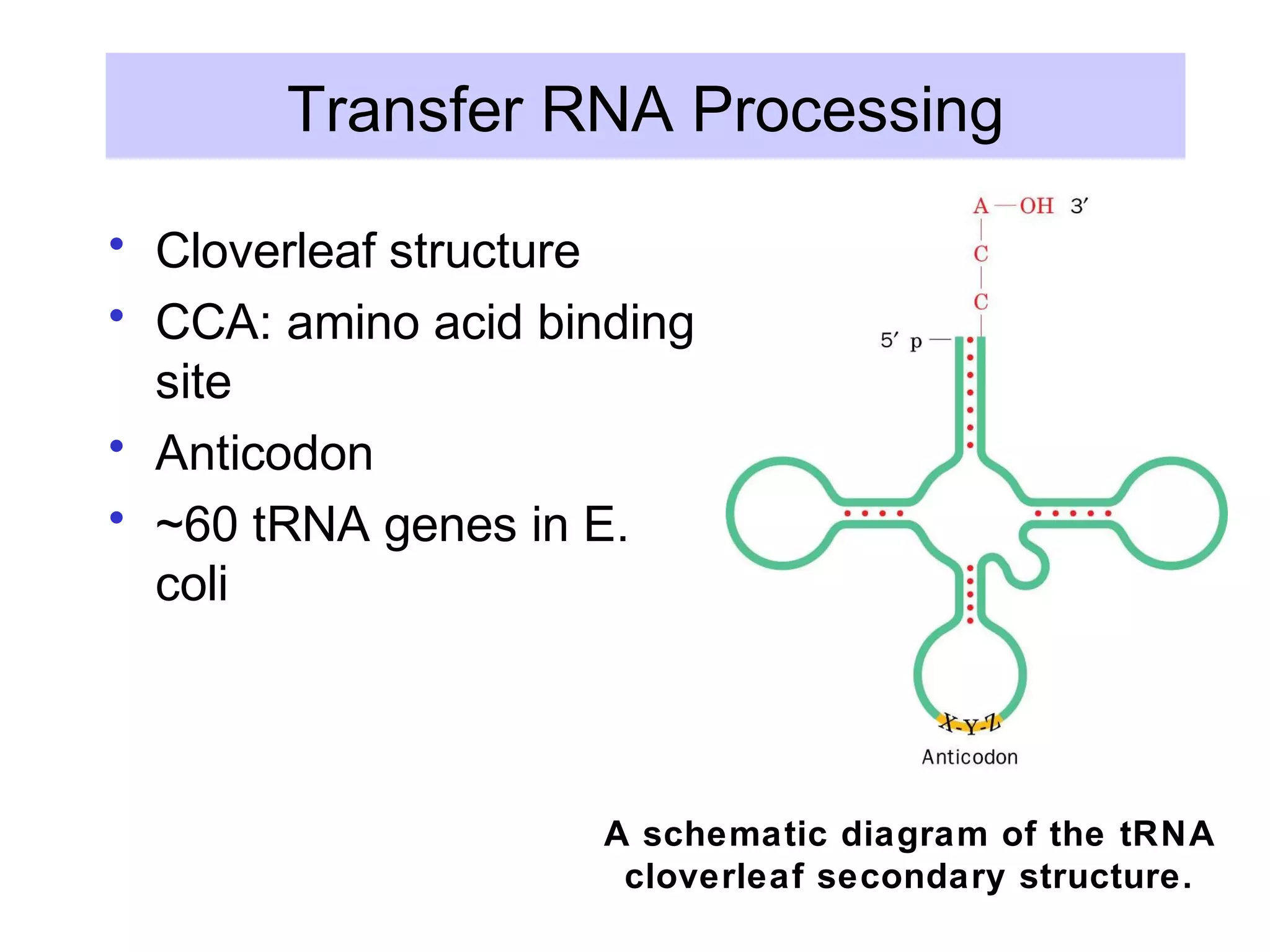
Transfer RNA Processing
• Cloverleaf structure
• CCA: amino acid binding
site
• Anticodon
• ~60 tRNA genes in E.
coli
A schematic diagram of the tRNA
cloverleaf secondary structure.
Endo- and exonucleases to generate
ends of tRNA
• Endonuclease RNase P cleaves to generate the 5’ end.
• Endonuclease RNase F cleaves 3 nucleotides past the mature 3’ end.
• Exonuclease RNase D trims 3’ to 5’, leaving the mature 3’ end.
Splicing of pre-tRNA
• Introns in pre-tRNA are very short (about 10-20
nucleotides)
• Have no consensus sequences
• Are removed by a series of enzymatic steps:
– Cleavage by an endonuclease
– Phosphodiesterase to open a cyclic intermediate and
provide a 3’OH
– Activation of one end by a kinase (with ATP hydrolysis)
– Ligation of the ends (with ATP hydrolysis)
– Phosphatase to remove the extra phosphate on the
2’OH (remaining after phosphodiesterase )
Steps in splicing of pre-tRNA
P
OH 5’
2’,3’
cyclic
phosphat
e
Excised intron
Intron of
10-20
nucleotides
1.
Endo-
nucleas
e
2. Phospho-
diesterase
3. Kinase
(ATP)
4. Ligase
(ATP)
5.
Phosphatase
+
+
Splice
d tRNA
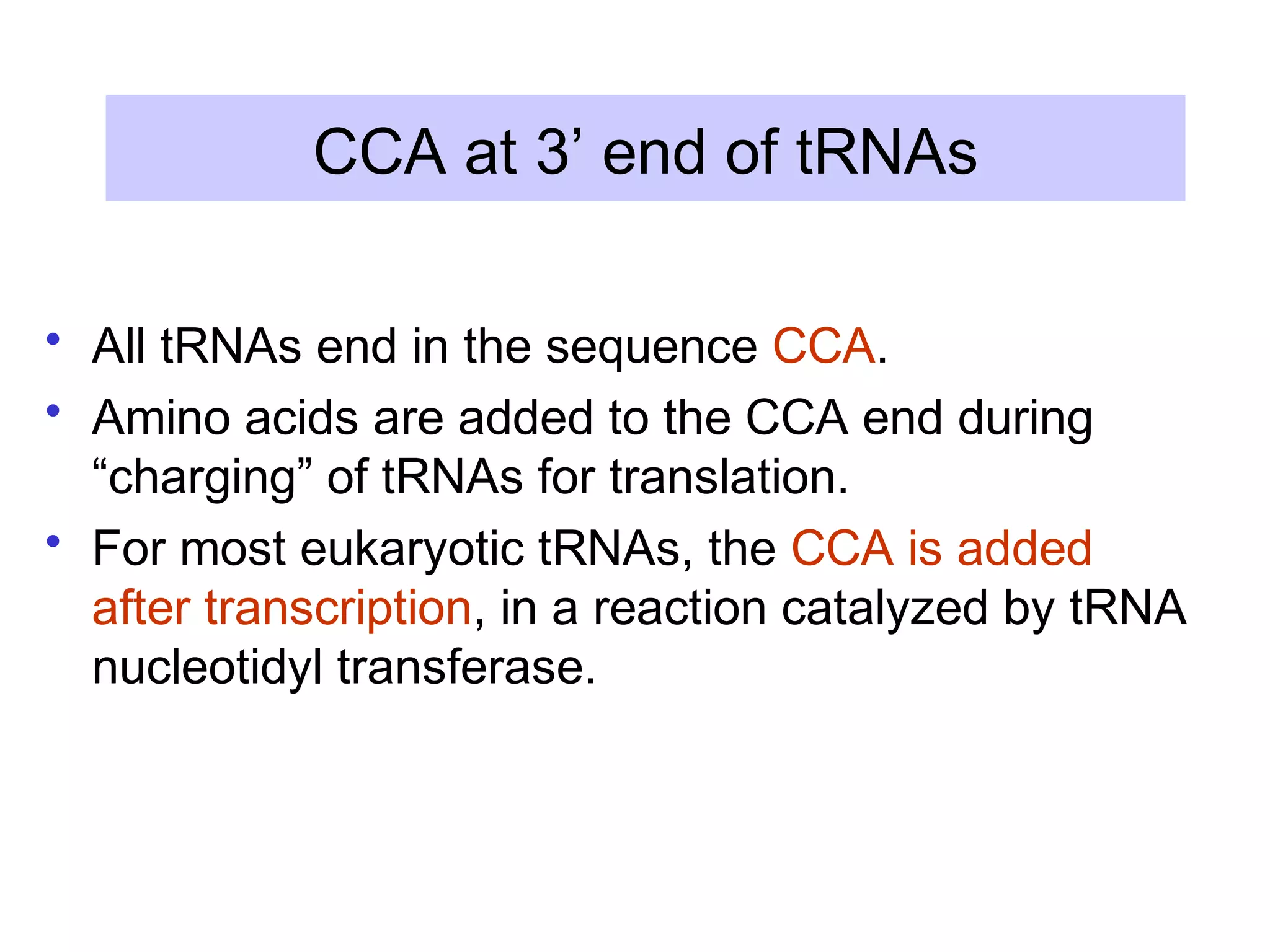
CCA at 3’ end of tRNAs
• All tRNAs end in the sequence CCA.
• Amino acids are added to the CCA end during
“charging” of tRNAs for translation.
• For most eukaryotic tRNAs, the CCA is added
after transcription, in a reaction catalyzed by tRNA
nucleotidyl transferase.
All of the four bases in tRNA can be modified
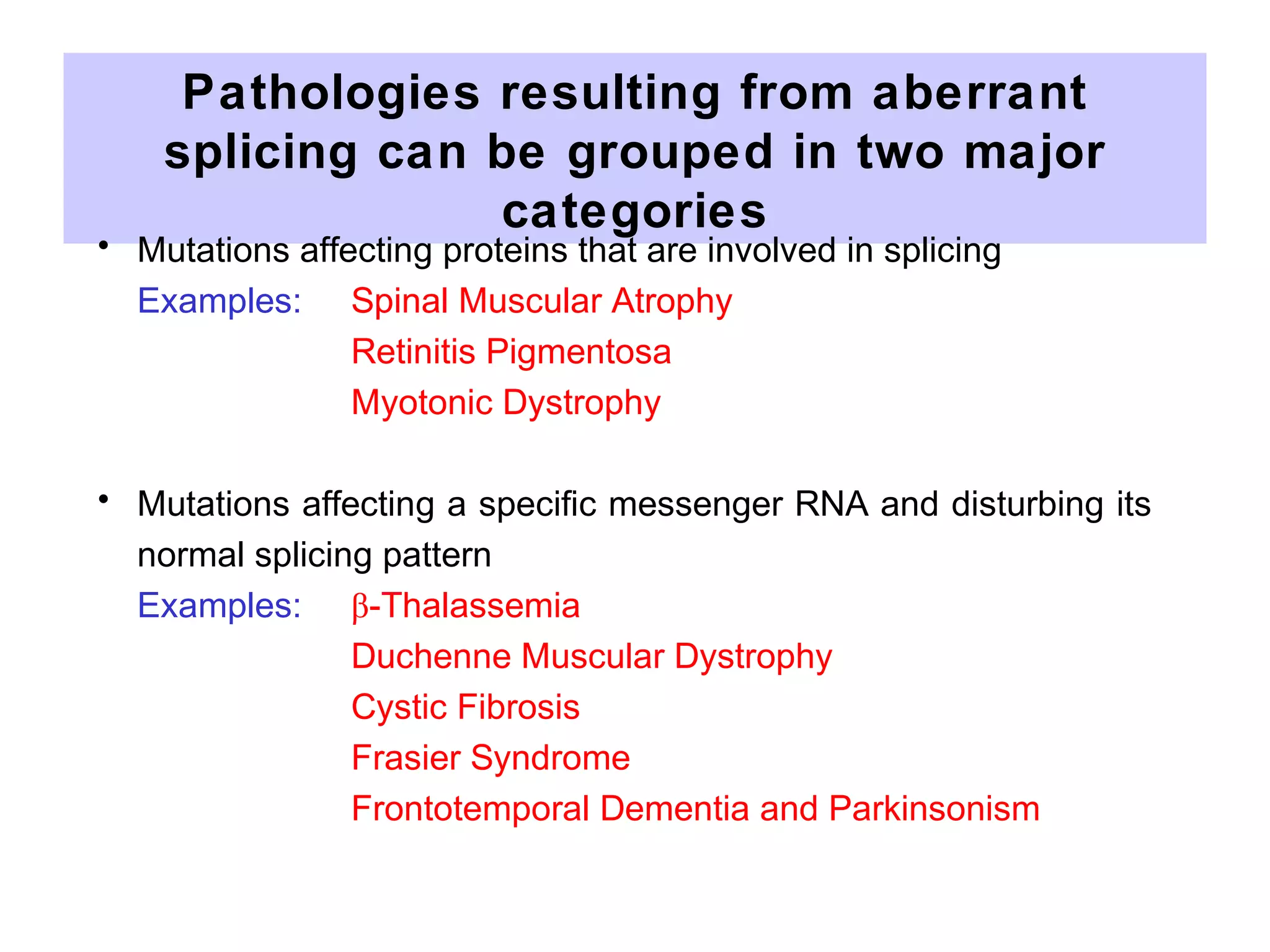
Pathologies resulting from aberrant
splicing can be grouped in two major
categories
• Mutations affecting proteins that are involved in splicing
Examples: Spinal Muscular Atrophy
Retinitis Pigmentosa
Myotonic Dystrophy
• Mutations affecting a specific messenger RNA and disturbing its
normal splicing pattern
Examples: β-Thalassemia
Duchenne Muscular Dystrophy
Cystic Fibrosis
Frasier Syndrome
Frontotemporal Dementia and Parkinsonism
Intron Advantage?
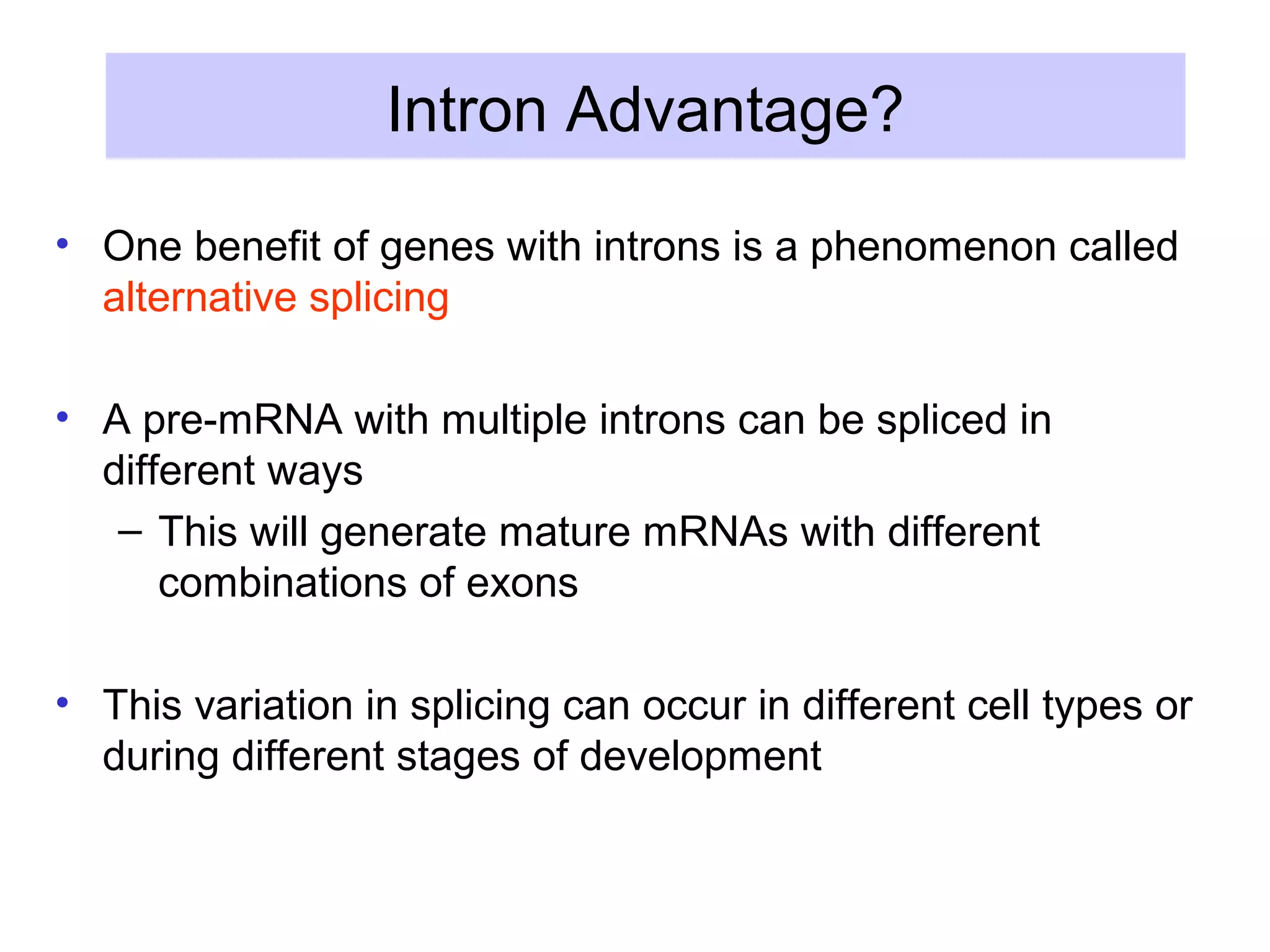
• One benefit of genes with introns is a phenomenon called
alternative splicing
• A pre-mRNA with multiple introns can be spliced in
different ways
– This will generate mature mRNAs with different
combinations of exons
• This variation in splicing can occur in different cell types or
during different stages of development
Intron Advantage?
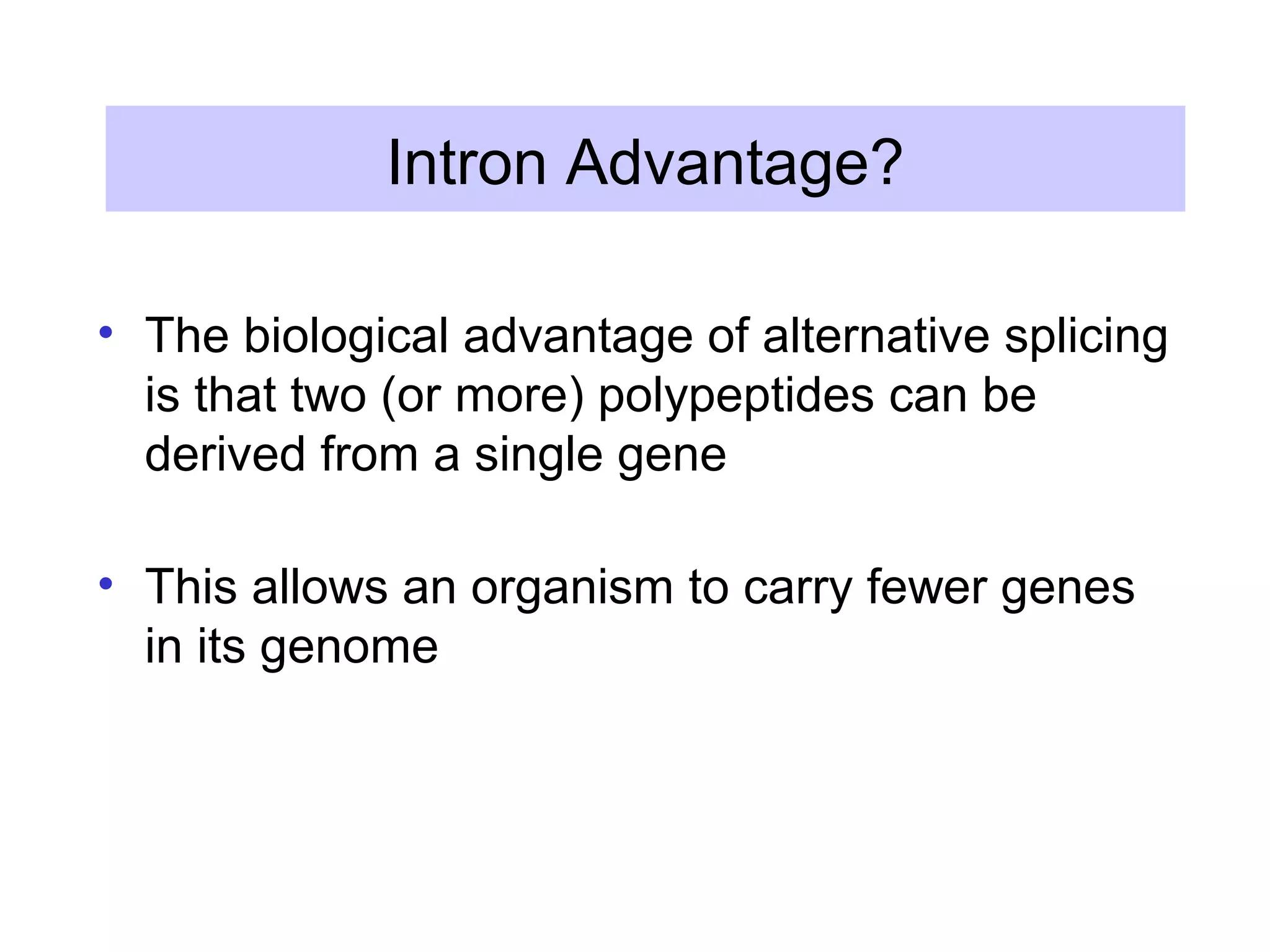
• The biological advantage of alternative splicing
is that two (or more) polypeptides can be
derived from a single gene
• This allows an organism to carry fewer genes
in its genome
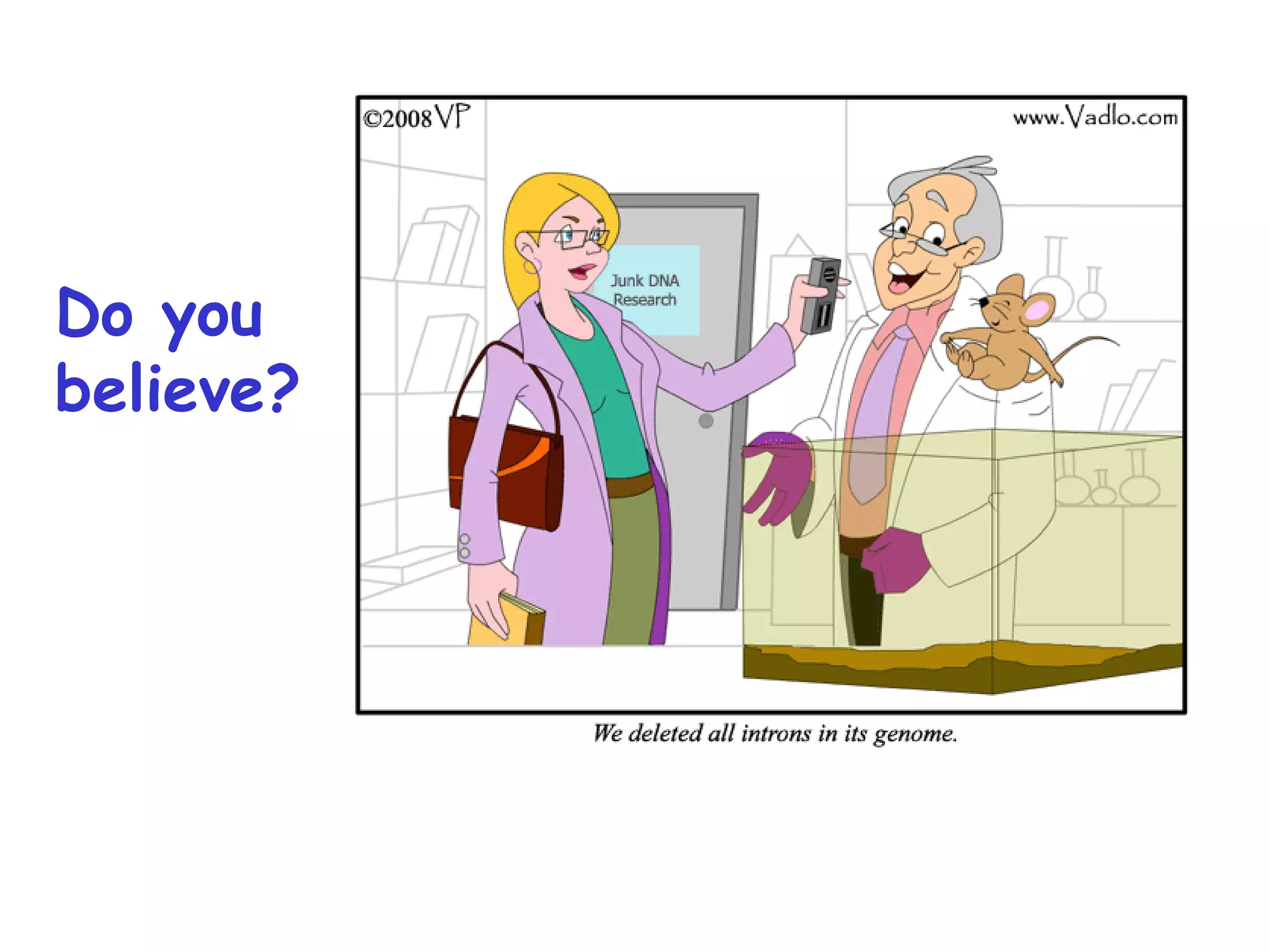
Do you
believe?
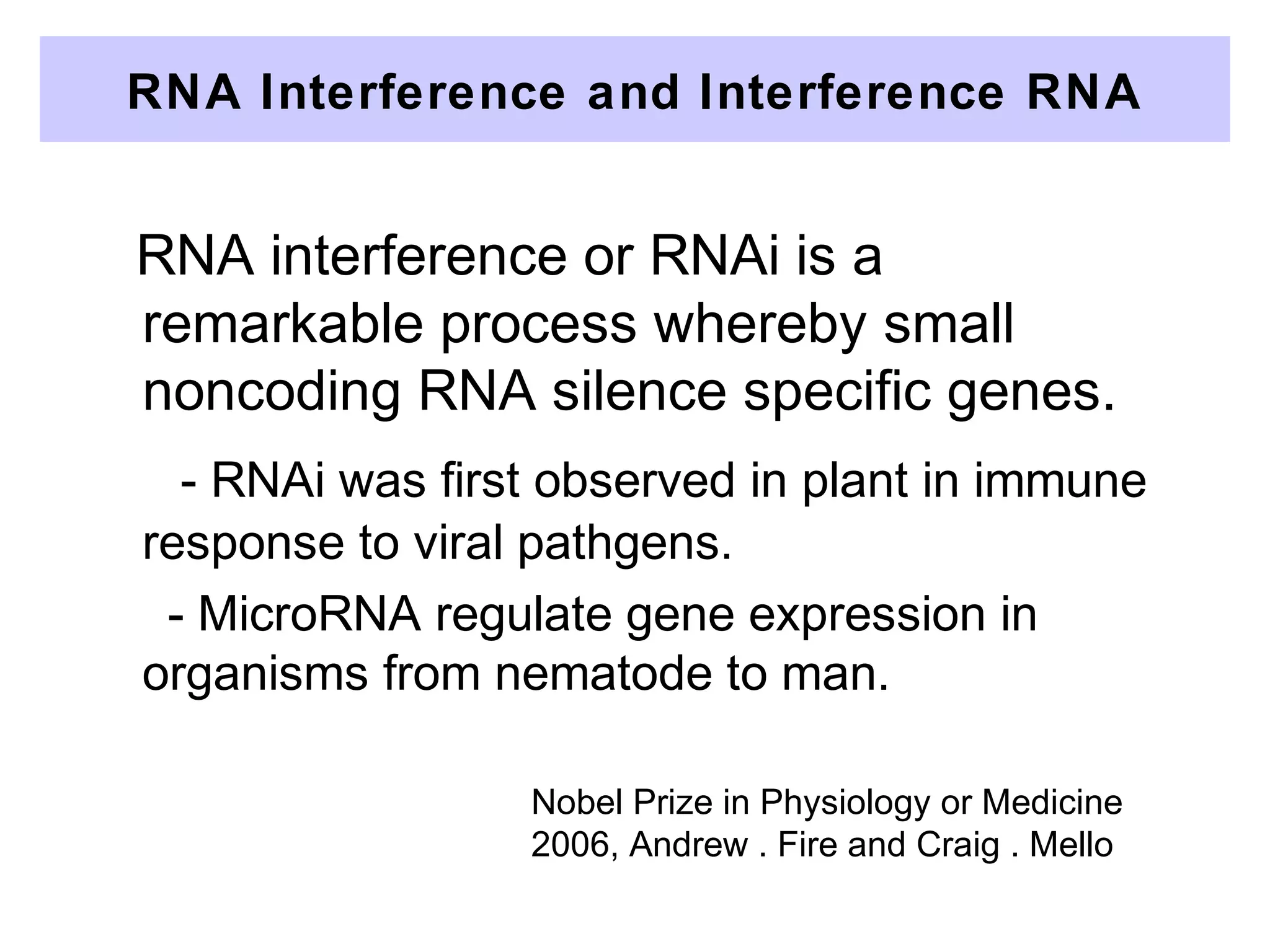
RNA interference or RNAi is a
remarkable process whereby small
noncoding RNA silence specific genes.
- RNAi was first observed in plant in immune
response to viral pathgens.
- MicroRNA regulate gene expression in
organisms from nematode to man.
RNA Interference and Interference RNA
Nobel Prize in Physiology or Medicine
2006, Andrew . Fire and Craig . Mello
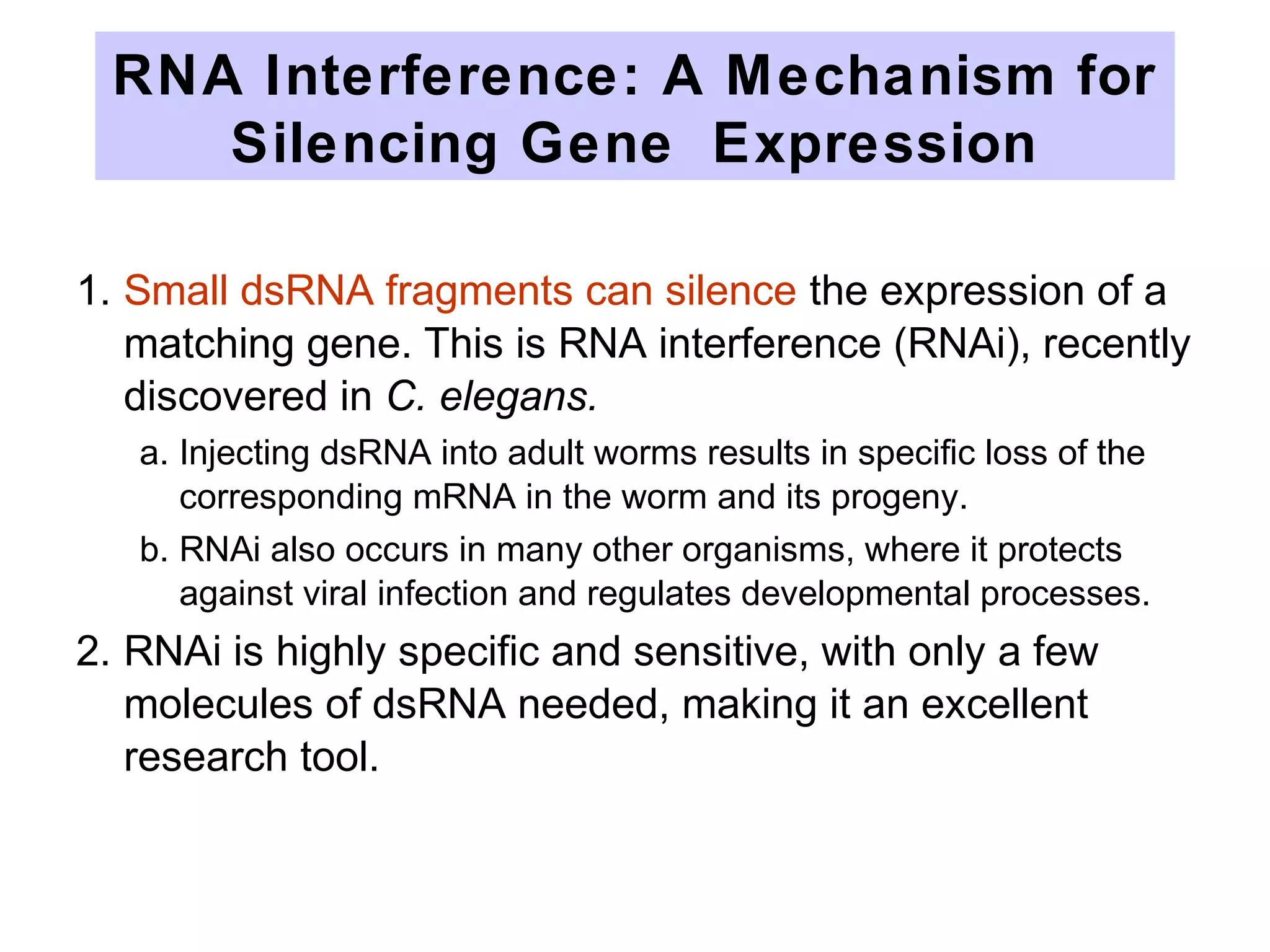
RNA Interference: A Mechanism for
Silencing Gene Expression
1. Small dsRNA fragments can silence the expression of a
matching gene. This is RNA interference (RNAi), recently
discovered in C. elegans.
a. Injecting dsRNA into adult worms results in specific loss of the
corresponding mRNA in the worm and its progeny.
b. RNAi also occurs in many other organisms, where it protects
against viral infection and regulates developmental processes.
2. RNAi is highly specific and sensitive, with only a few
molecules of dsRNA needed, making it an excellent
research tool.
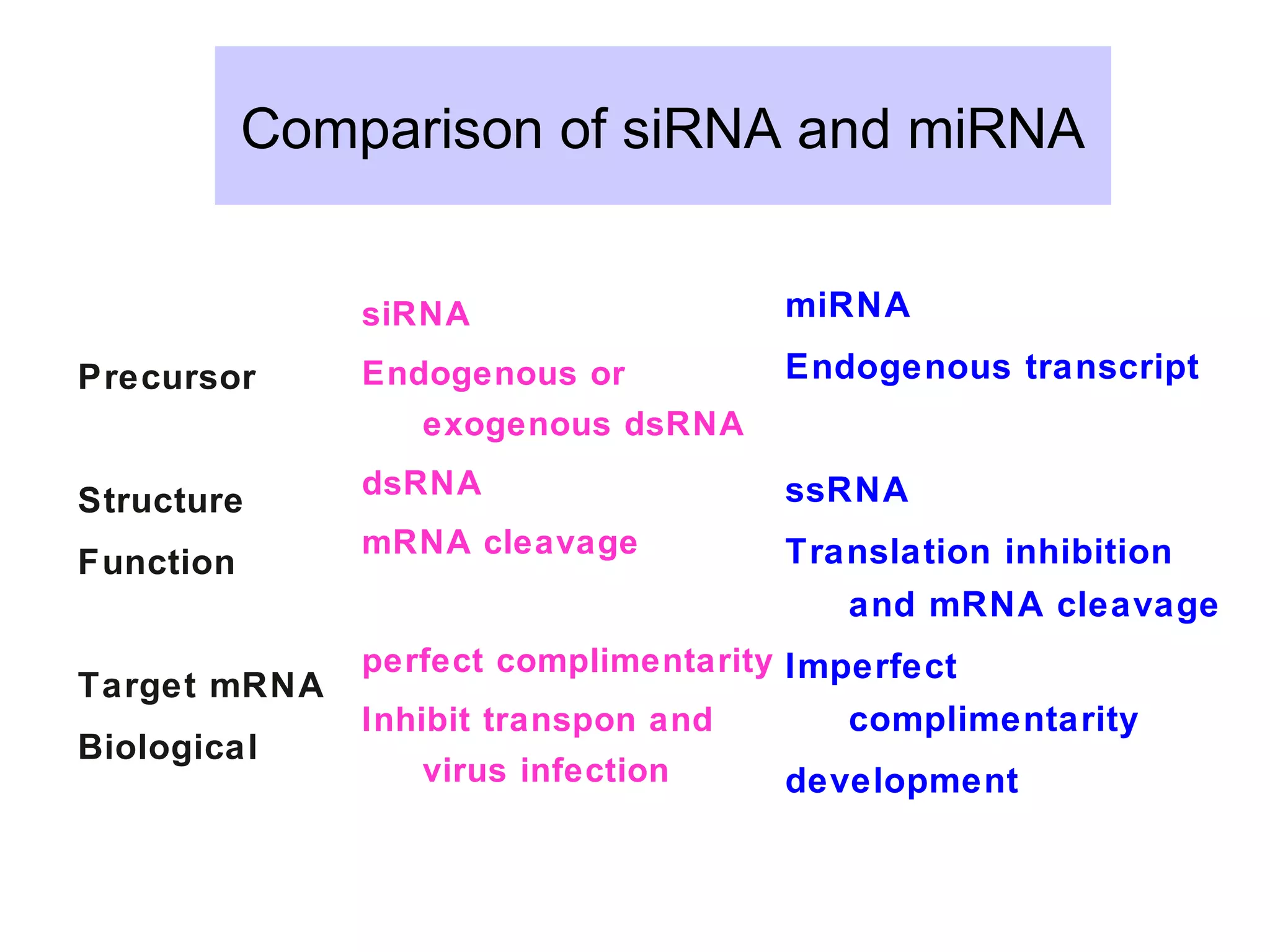
Comparison of siRNA and miRNA
Precursor
Structure
Function
Target mRNA
Biological
siRNA
Endogenous or
exogenous dsRNA
dsRNA
mRNA cleavage
perfect complimentarity
Inhibit transpon and
virus infection
miRNA
Endogenous transcript
ssRNA
Translation inhibition
and mRNA cleavage
Imperfect
complimentarity
development
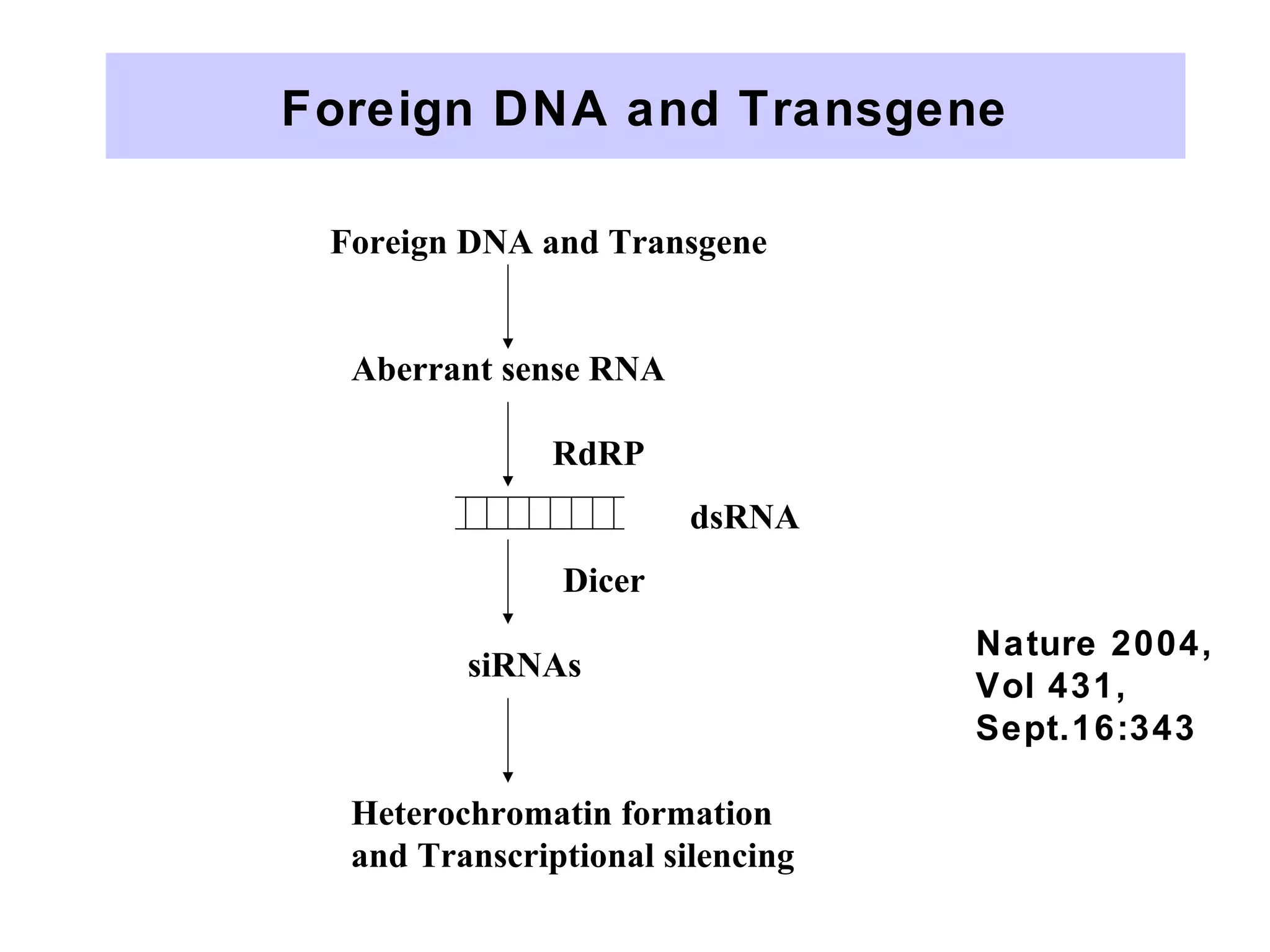
Foreign DNA and Transgene
Aberrant sense RNA
dsRNA
siRNAs
Heterochromatin formation
and Transcriptional silencing
RdRP
Dicer
Nature 2004,
Vol 431,
Sept.16:343
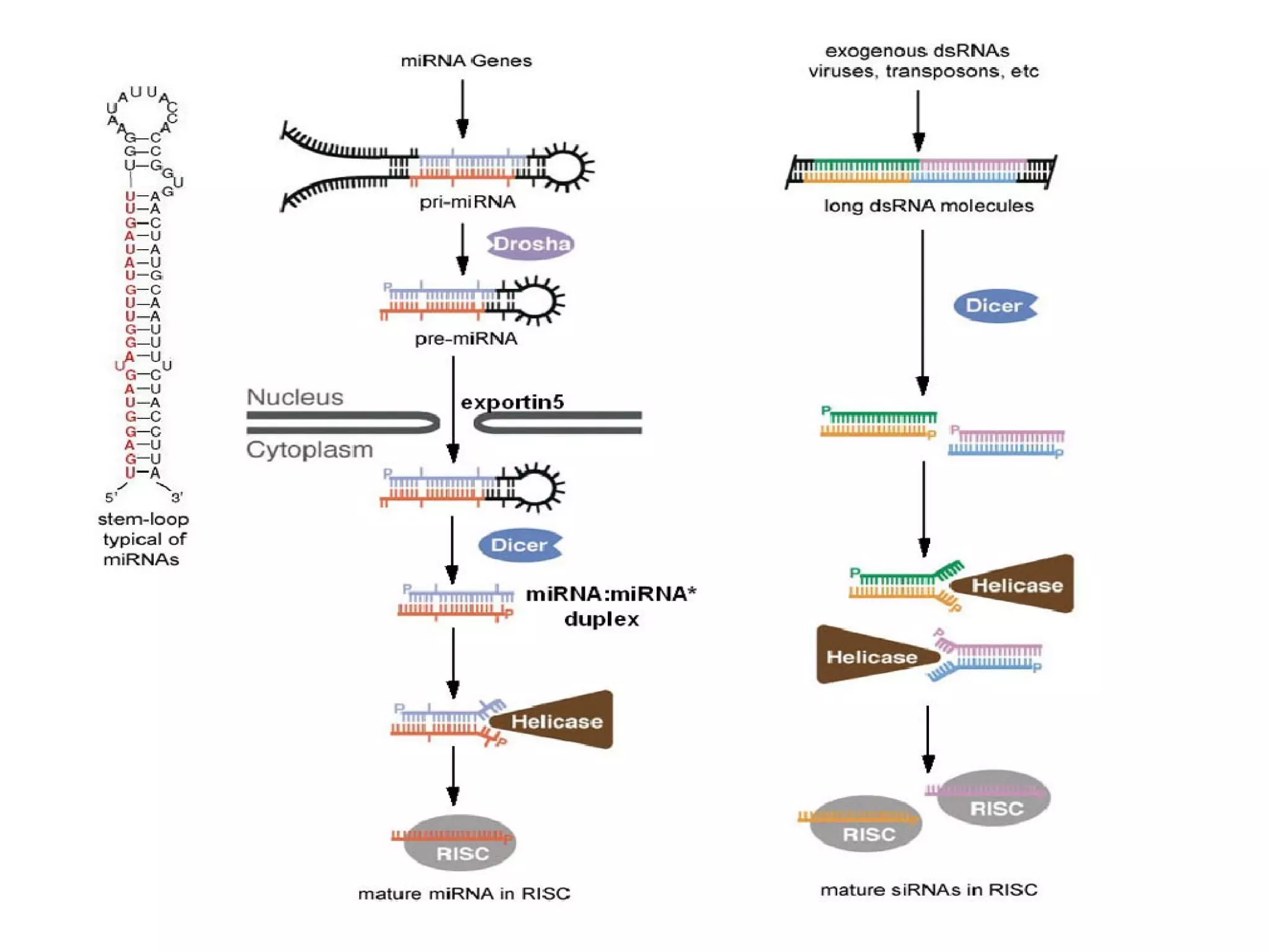
Mitrons :Short intronic
hairpins
pri-miRNA
pre-miRNAs
Micro RNAs (MiRNAs)
~22NTs
RNA Ploymerase II or
III
Dicer
Self splicing miRNA
RISC
No need of Drosha
Splicing machinery
Lariat debranching enzyme
Cell 130, July 13
2007: 89-100
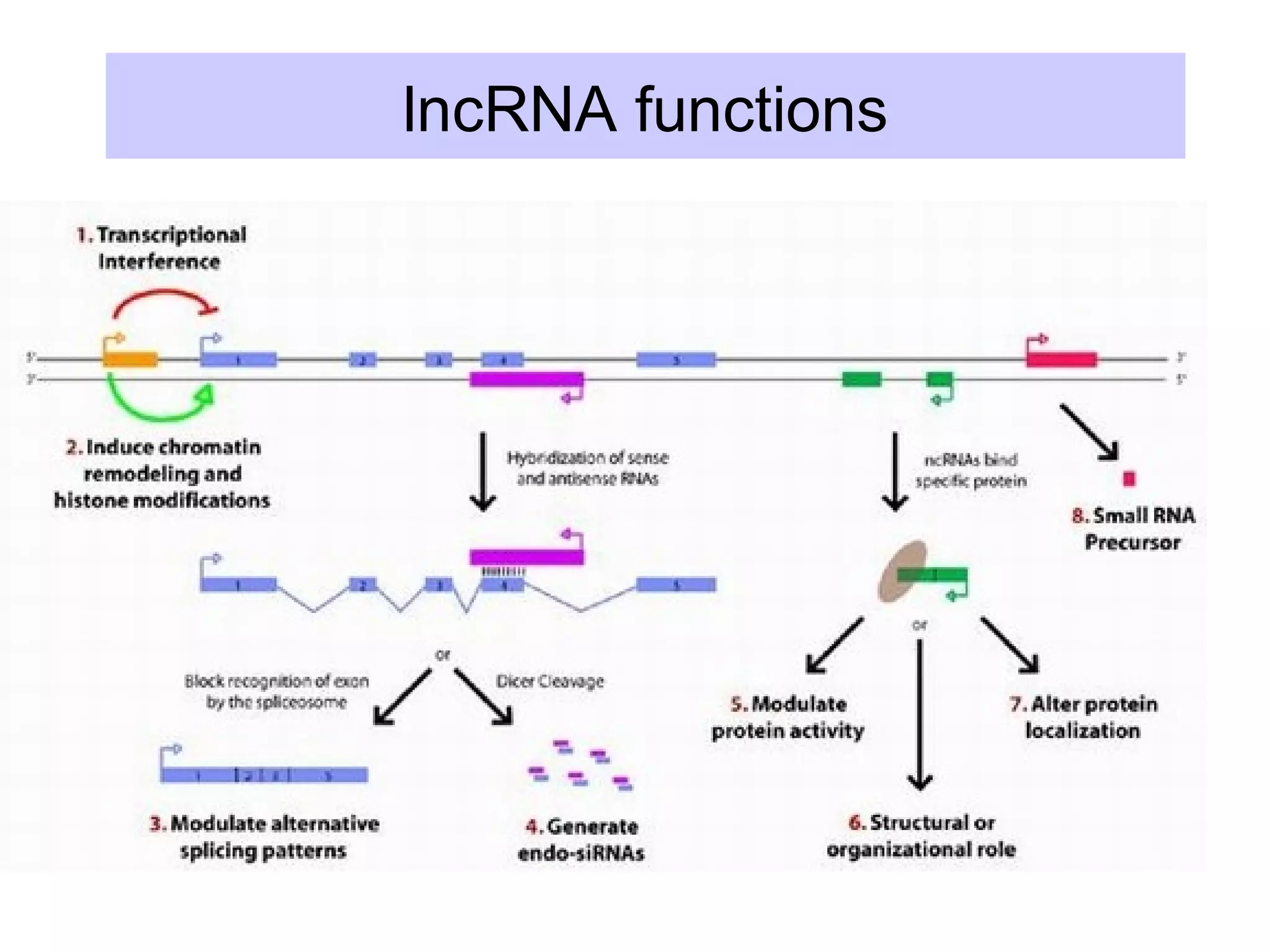
lncRNA functions
Something I may not care , but you have
to.

Post transcription

  • 1.
  • 2.
  • 3.
    Primary Transcript • PrimaryTranscript-the initial molecule of RNA produced--- hnRNA ( heterogenous nuclear RNA ) • In prokaryotes, DNA RNA protein in→ → cytoplasm concurrently • In eukaryotes nuclear RNA >> Cp RNA
  • 4.
    Processing of eukaryoticpre-mRNA Human dystrophin gene has 79 exons, spans over 2,300-Kb and requires over 16 hours to be transcribed! For primary transcripts containing multiple exons and introns, splicing occurs before transcription of the gene is complete--co- transcriptional splicing.
  • 5.
    Types of RNAprocessing A) Cutting and trimming to generate ends: rRNA, tRNA and mRNA B) Covalent modification: Add a cap and a polyA tail to mRNA Add a methyl group to 2’-OH of ribose in mRNA and rRNA Extensive changes of bases in tRNA C) Splicing pre-rRNA, pre-mRNA, pre-tRNA by different mechanisms.
  • 6.
    The RNA PolII CTD is required for the coupling of transcription with mRNA capping, polyadenylation and splicing 1. The coupling allows the processing factors to present at high local concentrations when splice sites and poly(A) signals are transcribed by Pol II, enhancing the rate and specificity of RNA processing. 2. The association of splicing factors with phosphorylated CTD also stimulates Pol II elongation. Thus, a pre-mRNA is not synthesized unless the machinery for processing it is properly positioned.
  • 7.
    Time course ofRNA processing
  • 8.
    5’ and 3’ends of eukaryotic mRNA Add a GMP Methylate it and 1st few nucleotides Cut the pre-mRNA and add A’s 5’-UTR 3’-UTR
  • 9.
    Capping of pre-mRNAs •Cap=modified guanine nucleotide • Capping= first mRNA processing event - occurs during transcription • CTD recruits capping enzyme as soon as it is phosphorylated • Pre-mRNA modified with 7-methyl-guanosine triphosphate (cap) when RNA is only 25-30 bp long • Cap structure is recognized by CBC ( cap-binding complex ) • stablize the transcript • prevent degradation by exonucleases • stimulate splicing and processing
  • 10.
    Sometimes methylated Sometimes methylated • The capis added after the nascent RNA molecules produced by RNA polymerase II reach a length of 25- 30 nucleotides. Guanylyltransferase is recruited and activated through binding to the Ser5-phosphorylated Pol II CTD. • The methyl groups are derived from S- adenosylmethionine. • Capping helps stabilize mRNA and enhances translation, splicing and export into the cytoplasm. Capping of the 5’ end of nascent RNA transcripts with m7 G Existing in a single complex
  • 11.
    Consensus sequence for3’ process AAUAAA: CstF (cleavage stimulation factor F) GU-rich sequence: CPSF (cleavage and polyadenylation specificity factor)
  • 12.
    Polyadenylation of mRNAat the 3’ end CPSF: cleavage and polyadenylation specificity factor. CStF: cleavage stimulatory factor. CFI & CFII: cleavage factor I & II. PAP: poly(A) polymerase. PABPII: poly(A)-binding protein II. Poly(A) tail stabilizes mRNA and enhances translation and export into the cytoplasm. RNA is cleaved 10~35-nt 3’ to A2UA3. The binding of PAP prior to cleavage ensures that the free 3’ end generated is rapidly polyadenylated. PAP adds the first 12A residues to 3’-OH slowly. Binding of PABPII to the initial short poly(A) tail accelerates polyadenylation by PAP. The polyadenylation complex is associated with the CTD of Pol II following initiation.
  • 13.
    Functions of 5’cap and 3’ polyA • Need 5’ cap for efficient translation: – Eukaryotic translation initiation factor 4 (eIF4) recognizes and binds to the cap as part of initiation. • Both cap and polyA contribute to stability of mRNA: – Most mRNAs without a cap or polyA are degraded rapidly. – Shortening of the polyA tail and decapping are part of one pathway for RNA degradation in yeast.
  • 14.
    mRNA Half-life • t½seconds if seldom needed • t½ several cell generations (i.e. ~48-72 h) for houskeeping gene • ≈avg 3 h in eukaryotes • ≈avg 1.5 min in bacteria
  • 15.
    Poly(A)+ RNA canbe separated from other RNAs by fractionation on Sepharose-oligo(dT).
  • 16.
    Split gene andmRNA splicing
  • 17.
    Background: Adenovirus hasa DNA genome and makes many mRNAs. Can we determine which part of the genome encodes for each mRNA by making a DNA:RNA hybrid? Experiment: Isolate Adenovirus genomic DNA, isolate one adenovirus mRNA, hybridize and then look by EM at where the RNA hybridizes (binds) to the genomic DNA. Surprise: The RNA is generated from 4 different regions of the DNA! How can we explain this? Splicing!! The discovery of split genes (1977) 1993 Noble Prize in Medicine To Dr. Richard Robert and Dr. Phillip Sharp
  • 18.
    The matured mRNAsare much shorter than the DNA templates. DNA mRNA
  • 19.
    Exon and Intron •Exon is any segment of an interrupted gene that is represented in the mature RNA product. • Intron is a segment of DNA that is transcribed, but removed from within the transcript by splicing together the sequences (exons) on either side of it.
  • 20.
    Exons are similar insize Introns are highly variable in size
  • 21.
    GT-AG rule • GT-AGrule describes the presence of these constant dinucleotides at the first two and last two positions of introns of nuclear genes. • Splice sites are the sequences immediately surrounding the exon-intron boundaries • Splicing junctions are recognized only in the correct pairwise combinations
  • 22.
    The sequence ofsteps in the production of mature eukaryotic mRNA as shown for the chicken ovalbumin gene. The consensus sequence at the exon–intron junctions of vertebrate pre-mRNAs.
  • 24.
    4 major typesof introns 4 classes of introns can be distinguished on the basis of their mechanism of splicing and/or characterisitic sequences: – Group I introns in fungal mitochondria, plastids, and in pre-rRNA in Tetrahymena (self-splicing) – Group II introns in fungal mitochondria and plastids (self-splicing) – Introns in pre-mRNA (spliceosome mediated) – Introns in pre-tRNA
  • 25.
    Group I andII introns
  • 26.
    The sequence oftransesterification reactions that splice together the exons of eukaryotic pre-mRNAs.
  • 27.
    Splicing of GroupI and II introns • Introns in fungal mitochondria, plastids, Tetrahymena pre- rRNA • Group I – Self-splicing – Initiate splicing with a G nucleotide – Uses a phosphoester transfer mechanism – Does not require ATP hydrolysis. • Group II – self-splicing – Initiate splicing with an internal A – Uses a phosphoester transfer mechanism – Does not require ATP hydrolysis
  • 28.
    Self-splicing in pre-rRNAin Tetrahymena : T. Cech et al. 1981 Exon 1 Exon 2Intron 1 Exon 1 Exon 2 Intron 1 + pre-rRNA Spliced exon Intron circle Intron linear pre-rRNA Nuclear extract GTP + + + + - + - + - + + - •Products of splicing were resolved by gel electrophoresis: Additional proteins are NOT needed for splicing of this pre-rRNA!Do need a G nucleotide (GMP, GDP, GTP or Guanosine).
  • 29.
    The sequence ofreactions in the self-splicing of Tetrahymena group I intron.
  • 30.
    Where is thecatalytic activity in RNase P? RNase P is composed of a 375 nucleotide RNA and a 20 kDa protein. The protein component will NOT catalyze cleavage on its own. The RNA WILL catalyze cleavage by itself !!!! The protein component aids in the reaction but is not required for catalysis. Thus RNA can be an enzyme. Enzymes composed of RNA are called ribozymes.
  • 31.
    Hammerhead ribozymes • A58 nt structure is used in self-cleavage • The sequence CUGA adjacent to stem- loops is sufficient for cleavage C UGAG AC C GG GGC C A AA A C U C G A G U C AC C AC UGGUG U Bond that is cleaved. 5'3' C UGA is required for catalysis
  • 32.
    Mechanism of hammerheadribozyme • The folded RNA forms an active site for binding a metal hydroxide • Attracts a proton from the 2’ OH of the nucleotide at the cleavage site. • This is now a nucleophile for attack on the 3’ phosphate and cleavage of the phosphodiester bond. 1989 Nobel Prize in chemistry, Sidney Altman, and Thomas Cech
  • 33.
    Distribution of GroupI introns • Prokaryotes – eubacteria (tRNA & rRNA), phage • Eukaryotes – lower (algae, protists, & fungi) • nuclear rRNA genes, organellar genes, Chlorella viruses – higher plants: organellar genes – lower animals (Anthozoans): mitochondrial • >1800 known, classified into ~12 subgroups, based on secondary structure
  • 34.
    Splicing of pre-mRNA •The introns begin and end with almost invariant sequences: 5’ GU…AG 3’ • Use ATP hydrolysis to assemble a large spliceosome (45S particle, 5 snRNAs and 65 proteins, same size and complexity as ribosome) • Mechanism is similar to that of the Group II fungal introns: – Initiate splicing with an internal A – Uses a phosphoester transfer mechanism for splicing
  • 35.
    Initiation of phosphoestertransfers in pre-mRNA • Uses 2’ OH of an A internal to the intron • Forms a branch point by attacking the 5’ phosphate on the first nucleotide of the intron • Forms a lariat structure in the intron • Exons are joined and intron is excised as a lariat • A debranching enzyme cleaves the lariat at the branch to generate a linear intron • Linear intron is degraded
  • 36.
    Involvement of snRNAsand snRNPs • snRNAs = small nuclear RNAs • snRNPs = small nuclear ribonucleoproteins particles (snRNA complex with protein) • Addition of these antibodies to an in vitro pre- mRNA splicing reaction blocked splicing. • Thus the snRNPs were implicated in splicing
  • 37.
    • Recognizing the5’ splice site and the branch site. • Bringing those sites together. • Catalyzing (or helping to catalyze) the RNA cleavage. Role of snRNPs in RNA splicing RNA-RNA, RNA-protein and protein-protein interactions are all important during splicing
  • 38.
    snRNPs U1, U2, U4/U6,and U5 snRNPs – Have snRNA in each: U1, U2, U4/U6, U5 – Conserved from yeast to human – Assemble into spliceosome – Catalyze splicing
  • 39.
    Splicing of pre-mRNAoccurs in a “spliceosome” an RNA-protein complex pre-mRNA spliced mRNA spliceosome (~100 proteins + 5 small RNAs) The spliceosome is a large protein-RNA complex in which splicing of pre-mRNAs occurs.
  • 40.
    Assembly of spliceosome •snRNPs are assembled progressively into the spliceosome. – U1 snRNP binds (and base pairs) to the 5’ splice site – BBP (branch-point binding protein) binds to the branch site – U2 snRNP binds (and base pairs) to the branch point, BBP dissociates – U4U5U6 snRNP binds, and U1 snRNP dissociates – U4 snRNP dissociates • Assembly requires ATP hydrolysis • Assembly is aided by various auxiliary factors and splicing factors.
  • 41.
    Some RNA-RNA hybridsformed during the splicing reaction Steps of the spliceosome- mediated splicing reaction
  • 42.
    A schematic diagramof six rearrangements that the spliceosome undergoes in mediating the first transesterification reaction in pre- mRNA splicing. Assembly of spliceosome
  • 43.
  • 44.
    The Significance ofGene Splicing • The introns are rare in prokaryotic structural genes • The introns are uncommon in lower eukaryote (yeast), 239 introns in ~6000 genes, only one intron / polypeptide • The introns are abundant in higher eukaryotes (lacking introns are histons and interferons) • Unexpressed sequences constitute ~80% of a typical vertebrate structural gene
  • 45.
    Errors produced bymistakes in splice-site selection
  • 46.
    Mechanisms prevent splicingerror • Co-transcriptional loading process • SR proteins recruit spliceosome components to the 5’ and 3’ splice sites • SR protein = Serine Arginine rich protein • ESE = exonic splicing enhancers • SR protein regulates alternative splicing
  • 47.
    Alternative splicing • Alternativesplicing occurs in all metazoa and is especially prevalent in vertebrate Five ways to splice an RNA
  • 48.
    Regulated alternative splicing Differentsignals in the pre-mRNA and different proteins cause spliceosomes to form in particular positions to give alternative splicing
  • 49.
    765 75 65 7 Fas pre-mRNA APOPTOSIS Alternativesplicing can generate mRNAs encoding proteins with different, even opposite functions (programmed cell death) Fas ligand Soluble Fas (membrane) Fas Fas ligand (membrane- associated) (+) (-)
  • 50.
    Alternative possibilities for4 exons leave a total number of possible mRNA variations at 38,016. The protein variants are important for wiring of the nervous system and for immune response. Drosophila Dscam gene contains thousands of possible splice variants
  • 51.
    Cis- and Trans-Splicing Cis-:Splicing in single RNA Trans-: Splicing in two different RNAs Y-shaped excised introns (cis-: lariat) Occur in C. elegance and higher eukaryotes but it does in only a
  • 52.
    pre-mRNA splicing trans-mRNAsplicing spliced leader Same splicing mechanism is employed in trans- splicing Spliced leader contains the cap structure!
  • 53.
    RNA editing • RNAediting is the process of changing the sequence of RNA after transcription. • In some RNAs, as much as 55% of the nucleotide sequence is not encoded in the (primary) gene, but is added after transcription. • Examples: mitochondrial genes in Trypanosomes (锥虫) • Can add, delete or change nucleotides by editing
  • 54.
    Two mechanisms mediateediting • Guide RNA-directed uridine insertion or deletion • Site-specific deamination
  • 55.
    Insertion and deletionof nucleotides by editing • Uses a guide RNA (in 20S RNP = editosome) that is encoded elsewhere in the genome • Part of the guide RNA is complementary to the mRNA in vicinity of editing Trypanosomal RNA editing pathways. (a) Insertion. (b) Deletion.
  • 56.
    Mammalian example ofediting The C is converted to U in intestine by a specific deaminating enzyme, not by a guide RNA.
  • 57.
    Cutting and TrimmingRNA • Can use endonucleases to cut at specific sites within a longer precursor RNA • Can use exonucleases to trim back from the new ends to make the mature product • This general process is seen in prokaryotes and eukaryotes for all types of RNA
  • 58.
  • 59.
    RNase III cutsin stems of stem-loops 16S rRNA 23S rRNA RNase III No apparent primary sequence specificity - perhaps RNase III recognizes a particular stem structure.
  • 60.
    Eukaryotic rRNA Processing •The primary rRNA transcript (~7500nt, 45S RNA) contains 18S, 5.8S and 28S • Methylation occur mostly in rRNA sequence 80%: O2-methylribose, 20%: bases (A or G) • peudouridine 95 U in rRNA in human are converted to Ψ’s may contribute rRNA tertiary stability
  • 61.
    Transfer RNA Processing •Cloverleaf structure • CCA: amino acid binding site • Anticodon • ~60 tRNA genes in E. coli A schematic diagram of the tRNA cloverleaf secondary structure.
  • 62.
    Endo- and exonucleasesto generate ends of tRNA • Endonuclease RNase P cleaves to generate the 5’ end. • Endonuclease RNase F cleaves 3 nucleotides past the mature 3’ end. • Exonuclease RNase D trims 3’ to 5’, leaving the mature 3’ end.
  • 63.
    Splicing of pre-tRNA •Introns in pre-tRNA are very short (about 10-20 nucleotides) • Have no consensus sequences • Are removed by a series of enzymatic steps: – Cleavage by an endonuclease – Phosphodiesterase to open a cyclic intermediate and provide a 3’OH – Activation of one end by a kinase (with ATP hydrolysis) – Ligation of the ends (with ATP hydrolysis) – Phosphatase to remove the extra phosphate on the 2’OH (remaining after phosphodiesterase )
  • 64.
    Steps in splicingof pre-tRNA P OH 5’ 2’,3’ cyclic phosphat e Excised intron Intron of 10-20 nucleotides 1. Endo- nucleas e 2. Phospho- diesterase 3. Kinase (ATP) 4. Ligase (ATP) 5. Phosphatase + + Splice d tRNA
  • 65.
    CCA at 3’end of tRNAs • All tRNAs end in the sequence CCA. • Amino acids are added to the CCA end during “charging” of tRNAs for translation. • For most eukaryotic tRNAs, the CCA is added after transcription, in a reaction catalyzed by tRNA nucleotidyl transferase.
  • 66.
    All of thefour bases in tRNA can be modified
  • 67.
    Pathologies resulting fromaberrant splicing can be grouped in two major categories • Mutations affecting proteins that are involved in splicing Examples: Spinal Muscular Atrophy Retinitis Pigmentosa Myotonic Dystrophy • Mutations affecting a specific messenger RNA and disturbing its normal splicing pattern Examples: β-Thalassemia Duchenne Muscular Dystrophy Cystic Fibrosis Frasier Syndrome Frontotemporal Dementia and Parkinsonism
  • 68.
    Intron Advantage? • Onebenefit of genes with introns is a phenomenon called alternative splicing • A pre-mRNA with multiple introns can be spliced in different ways – This will generate mature mRNAs with different combinations of exons • This variation in splicing can occur in different cell types or during different stages of development
  • 69.
    Intron Advantage? • Thebiological advantage of alternative splicing is that two (or more) polypeptides can be derived from a single gene • This allows an organism to carry fewer genes in its genome
  • 70.
  • 71.
    RNA interference orRNAi is a remarkable process whereby small noncoding RNA silence specific genes. - RNAi was first observed in plant in immune response to viral pathgens. - MicroRNA regulate gene expression in organisms from nematode to man. RNA Interference and Interference RNA Nobel Prize in Physiology or Medicine 2006, Andrew . Fire and Craig . Mello
  • 72.
    RNA Interference: AMechanism for Silencing Gene Expression 1. Small dsRNA fragments can silence the expression of a matching gene. This is RNA interference (RNAi), recently discovered in C. elegans. a. Injecting dsRNA into adult worms results in specific loss of the corresponding mRNA in the worm and its progeny. b. RNAi also occurs in many other organisms, where it protects against viral infection and regulates developmental processes. 2. RNAi is highly specific and sensitive, with only a few molecules of dsRNA needed, making it an excellent research tool.
  • 75.
    Comparison of siRNAand miRNA Precursor Structure Function Target mRNA Biological siRNA Endogenous or exogenous dsRNA dsRNA mRNA cleavage perfect complimentarity Inhibit transpon and virus infection miRNA Endogenous transcript ssRNA Translation inhibition and mRNA cleavage Imperfect complimentarity development
  • 76.
    Foreign DNA andTransgene Foreign DNA and Transgene Aberrant sense RNA dsRNA siRNAs Heterochromatin formation and Transcriptional silencing RdRP Dicer Nature 2004, Vol 431, Sept.16:343
  • 77.
    Mitrons :Short intronic hairpins pri-miRNA pre-miRNAs MicroRNAs (MiRNAs) ~22NTs RNA Ploymerase II or III Dicer Self splicing miRNA RISC No need of Drosha Splicing machinery Lariat debranching enzyme Cell 130, July 13 2007: 89-100
  • 78.
  • 79.
    Something I maynot care , but you have to.

Editor's Notes

  • #18 Richard J. Roberts and Phillip A. Sharp made their amazing discovery of split genes in the adenovirus whey they examined a hybrid between a viral mRNA and its template DNA in the electron microscope. They observed that the mRNA was not encoded as a colinear segment on the DNA molecule. Instead, remarkable loops of unhybridized DNA (A, B and C in figure) were seen. The interpretation was that mature messenger RNA was derived from four discountinuous segments on the viral DNA. The segments retained in the mRNA are called exons and the intervening sequences (A, B and C), excised during mRNA maturation, are called introns.