Transcription and post-
transcriptional modification
by Abhishek Dahal
 rRNA: ribosomal RNA
 Major component of ribosomes
 tRNA: transfer RNA
 Carries amino acids to mRNA
 An interpreter in translation
 mRNA: messenger RNA
 Encodes genetic info from DNA and convey it to
the ribosomes, where the info is translated into
amino acid sequences
Transcription
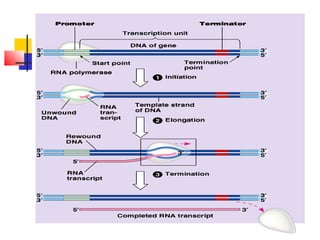
 Process in which RNA is synthesized from DNA.
 DNA expresses through RNA
 1st
product of the RNA formed is called
TRANSCRIPT which is further altered to
produce functionally active RNA molecules.
 Synthesis of RNA occurs in 5´→3´ direction
 Nucleotides ATP,GTP,CTP,UTP are necessary
 Each nucleotide pairs with the complementary
nucleotide on the DNA template.
Stages of Transcription
 Promoter Recognition
 Chain Initiation
 Chain Elongation
 Chain Termination
promoter recognition
 Transcription factors bind to promoter seque
.
 Then, RNA polymerase denatures a
small segment of the DNA.
 Promoter region which consist of "TATA
box" and "-35 sequence" where
Transcription (sigma σ ) factor of
polymerase enzyme act.
Transcription: chain initiation
 Chain initiation:
 RNA polymerase locally denatures the DNA.
 RNA polymerase does not require a primer.
 The first 8 or 9 bases of the transcript are
linked. Transcription factors(sigma) are
released, and the polymerase leaves the
promoter region.
Transcription: chain
elongation
 Chain elongation:
 RNA polymerase moves along the
transcription unit of DNA strand.
 The new RNA molecule (primary
transcript) forms a short RNA-DNA
hybrid molecule with the DNA template.
Transcription: chain
termination
 Rho(Ƥ) dependent termination : here
Rho factor binds to the RNA or Weakly
to DNA causing Polymerase to release
and mRNA is formed.
 Rho(Ƥ) independent termination via a
molecule called as Philandromes that
can form a hairpin loop and release of
mRNA and polymerase occurs.
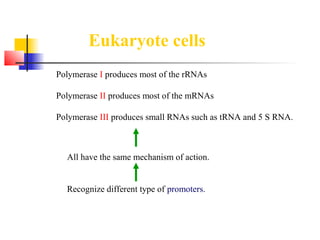
All have the same mechanism of action.
Recognize different type of promoters.
Eukaryote cells
Polymerase I produces most of the rRNAs
Polymerase II produces most of the mRNAs
Polymerase III produces small RNAs such as tRNA and 5 S RNA.
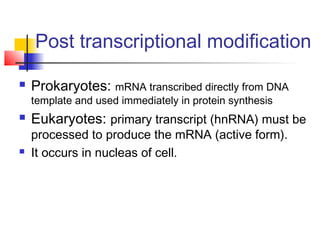
Post transcriptional modification
 Prokaryotes: mRNA transcribed directly from DNA
template and used immediately in protein synthesis
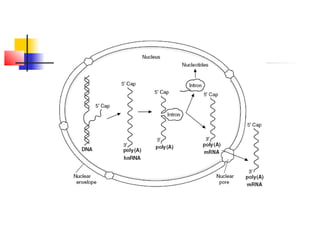
 Eukaryotes: primary transcript (hnRNA) must be
processed to produce the mRNA (active form).
 It occurs in nucleas of cell.
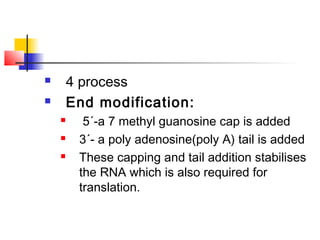
 4 process
 End modification:
 5´-a 7 methyl guanosine cap is added
 3´- a poly adenosine(poly A) tail is added
 These capping and tail addition stabilises
the RNA which is also required for
translation.
 Splicing
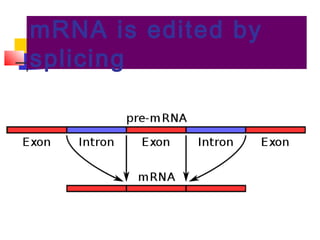
 Noncoding sequences (introns) are
removed
 Coding sequences (exons) spliced
together
 The removal is achieved by Small
nuclear ribonuclear protein (SnRNP).
 Mutations at the splice sites can cause
disease

Thalassemia • Breast cancer (BRCA 1)
mRNA is edited by
splicing
 Cutting:- here pieces of RNA are cut
which are not required( trimming).
 Chemical Modification:- new
chemical group are added and RNA is
modified into active form.
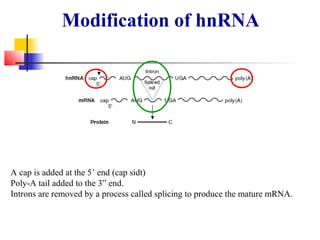
Modification of hnRNA
A cap is added at the 5’ end (cap sidt)
Poly-A tail added to the 3” end.
Introns are removed by a process called splicing to produce the mature mRNA.
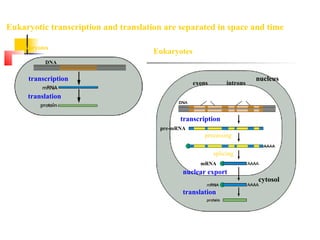
Eukaryotic transcription and translation are separated in space and time
Prokaryotes
Eukaryotes
exons introns
nucleus
cytosol
translation
translation
transcription
DNA
transcription
nuclear export
splicing
pre-mRNA
mRNA
processing

Transcription and post-transcriptional modification.

  • 1.
    Transcription and post- transcriptionalmodification by Abhishek Dahal
  • 2.
     rRNA: ribosomalRNA  Major component of ribosomes  tRNA: transfer RNA  Carries amino acids to mRNA  An interpreter in translation  mRNA: messenger RNA  Encodes genetic info from DNA and convey it to the ribosomes, where the info is translated into amino acid sequences
  • 3.
    Transcription  Process inwhich RNA is synthesized from DNA.  DNA expresses through RNA  1st product of the RNA formed is called TRANSCRIPT which is further altered to produce functionally active RNA molecules.  Synthesis of RNA occurs in 5´→3´ direction  Nucleotides ATP,GTP,CTP,UTP are necessary  Each nucleotide pairs with the complementary nucleotide on the DNA template.
  • 4.
    Stages of Transcription Promoter Recognition  Chain Initiation  Chain Elongation  Chain Termination
  • 5.
    promoter recognition  Transcriptionfactors bind to promoter seque .  Then, RNA polymerase denatures a small segment of the DNA.  Promoter region which consist of "TATA box" and "-35 sequence" where Transcription (sigma σ ) factor of polymerase enzyme act.
  • 6.
    Transcription: chain initiation Chain initiation:  RNA polymerase locally denatures the DNA.  RNA polymerase does not require a primer.  The first 8 or 9 bases of the transcript are linked. Transcription factors(sigma) are released, and the polymerase leaves the promoter region.
  • 7.
    Transcription: chain elongation  Chainelongation:  RNA polymerase moves along the transcription unit of DNA strand.  The new RNA molecule (primary transcript) forms a short RNA-DNA hybrid molecule with the DNA template.
  • 8.
    Transcription: chain termination  Rho(Ƥ)dependent termination : here Rho factor binds to the RNA or Weakly to DNA causing Polymerase to release and mRNA is formed.  Rho(Ƥ) independent termination via a molecule called as Philandromes that can form a hairpin loop and release of mRNA and polymerase occurs.
  • 10.
    All have thesame mechanism of action. Recognize different type of promoters. Eukaryote cells Polymerase I produces most of the rRNAs Polymerase II produces most of the mRNAs Polymerase III produces small RNAs such as tRNA and 5 S RNA.
  • 11.
    Post transcriptional modification Prokaryotes: mRNA transcribed directly from DNA template and used immediately in protein synthesis  Eukaryotes: primary transcript (hnRNA) must be processed to produce the mRNA (active form).  It occurs in nucleas of cell.
  • 12.
     4 process End modification:  5´-a 7 methyl guanosine cap is added  3´- a poly adenosine(poly A) tail is added  These capping and tail addition stabilises the RNA which is also required for translation.
  • 13.
     Splicing  Noncodingsequences (introns) are removed  Coding sequences (exons) spliced together  The removal is achieved by Small nuclear ribonuclear protein (SnRNP).  Mutations at the splice sites can cause disease  Thalassemia • Breast cancer (BRCA 1)
  • 14.
    mRNA is editedby splicing
  • 15.
     Cutting:- herepieces of RNA are cut which are not required( trimming).  Chemical Modification:- new chemical group are added and RNA is modified into active form.
  • 16.
    Modification of hnRNA Acap is added at the 5’ end (cap sidt) Poly-A tail added to the 3” end. Introns are removed by a process called splicing to produce the mature mRNA.
  • 18.
    Eukaryotic transcription andtranslation are separated in space and time Prokaryotes Eukaryotes exons introns nucleus cytosol translation translation transcription DNA transcription nuclear export splicing pre-mRNA mRNA processing

Editor's Notes

  • #5 Transcription can be arbitrarily divided into several stages: promoter recognition (formation of closed, then open complex), chain initiation (incorporation of the first few bases), chain elongation and chain termination.
  • #6 The closed complex of transcription (eukaryotic) is formed in the following steps: The TATA-binding protein (TBP) binds to the TATA box. TPB is bound by TFIIB, which also binds to the DNA on either side of the TBP. The TFIIB-TBP complex is bound by another complex consisting of TFIIF and RNA pol II. TFIIE and H bind to complete the closed complex. TFIIH has a helicase activity that can unwind the DNA around the transcription start site (+1).
  • #12 Transcription and translation in bacterial cells are coupled. As soon as enough of the primary transcript is synthesized to allow ribosome binding, translation begins, even if the polymerase is not finished synthesizing the transcript. In eukaryotic cells, however, the primary RNA transcript must be processed and transported to the cytoplasm before translation (protein synthesis) can begin. The DNA of eukaroytic genes contains noncoding sequences (introns) and coding sequences (exons). Introns must be removed from the RNA transcript by a process called splicing. Additionally a methylguanoisine cap is added to the 5´ end of the transcript, and a polyadenosine tail (polyA) is added to the 3´ end. The 5´ cap aids in transport of the completed mRNA from the nucleus, and the polyA tail helps to determine the stability of the mRNA molecule.