Transcription
R. C. Gupta
Professor and Head
Department of Biochemistry
National Institute of Medical Sciences
Jaipur, India
Synthesis of proteins requires DNA and
RNA
Every protein has got a unique amino
acid sequence
Information about amino acid sequence
of all the proteins is present in DNA
The information is present in DNA in a
coded form
The unit of information is a gene
DNA contains a number of genes
A gene consists of a specific base
sequence encoding a protein
Three consecutive bases in the gene
constitute a codon
The codons are code words for amino
acids
The gene is a series of code words for
amino acids
The information present in genes is
used to synthesize proteins
Different types of RNA are required to
synthesize proteins
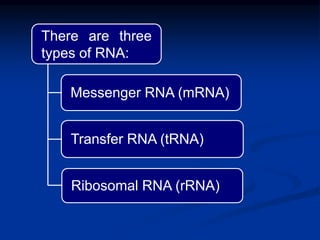
There are three
types of RNA:
Messenger RNA (mRNA)
Transfer RNA (tRNA)
Ribosomal RNA (rRNA)
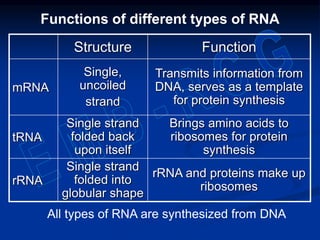
Functions of different types of RNA
Structure Function
mRNA
Single,
uncoiled
strand
Transmits information from
DNA, serves as a template
for protein synthesis
tRNA
Single strand
folded back
upon itself
Brings amino acids to
ribosomes for protein
synthesis
rRNA
Single strand
folded into
globular shape
rRNA and proteins make up
ribosomes
All types of RNA are synthesized from DNA
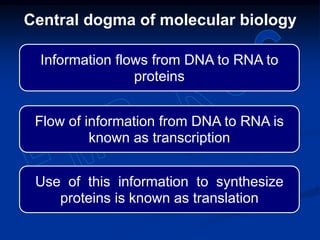
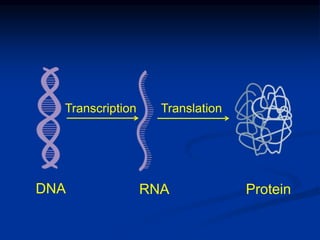
Information flows from DNA to RNA to
proteins
Flow of information from DNA to RNA is
known as transcription
Use of this information to synthesize
proteins is known as translation
Central dogma of molecular biology
DNA RNA Protein
Transcription Translation
Transcription is synthesis of RNA
The RNA synthesized is the transcript of a
gene
The base sequence of RNA is comple-
mentary to that of the gene
Transcription
A gene is made up of two strands
Only one strand acts as a template for
transcription
The base sequence of RNA is comple-
mentary to this strand
The template strand of gene is known as
sense (non-coding) strand
The other strand has a complementary
base sequence
This strand is known as anti-sense
(coding) strand
Sense and antisense
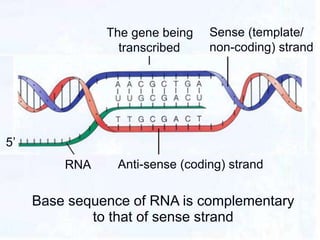
Base sequence of RNA is complementary
to that of sense strand
Anti-sense (coding) strandRNA
Sense (template/
non-coding) strand
5’
The gene being
transcribed
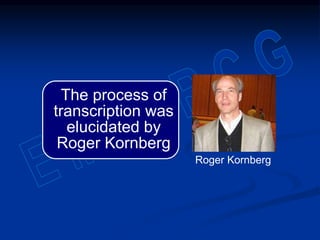
Roger Kornberg
The process of
transcription was
elucidated by
Roger Kornberg
RNA is synthesized by RNA polymerase
(RNAP)
RNAP is a DNA-dependent RNA poly-
merase
It polymerizes ribonucleotides to form
RNA
The transcription unit is a gene
The genes for proteins are known as
structural genes
RNA polymerase recognizes a certain
base sequence, and binds to it
Every structural gene has got a unique
base sequence
One RNAP cannot recognize thousands
of different base sequences
RNAP recognizes some sequences
common to all the structural genes
Each structural gene is preceded by
small sequence known as promoter
Promoter is also known as promoter site
or promoter element or promoter region
All the promoters have some common or
consensus sequences
RNA polymerase recognizes the common
sequences in the promoters
A single enzyme can thus transcribe
different structural genes
Transcription is catalysed by prokaryotic
RNA polymerase (RNAP)
RNAP recognizes the prokaryotic
promoter
Prokaryotic transcription
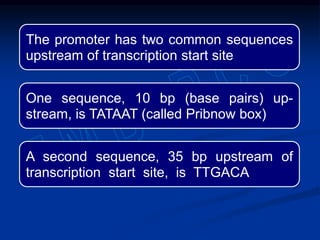
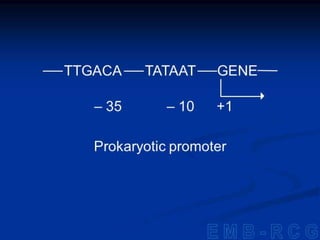
The promoter has two common sequences
upstream of transcription start site
One sequence, 10 bp (base pairs) up-
stream, is TATAAT (called Pribnow box)
A second sequence, 35 bp upstream of
transcription start site, is TTGACA
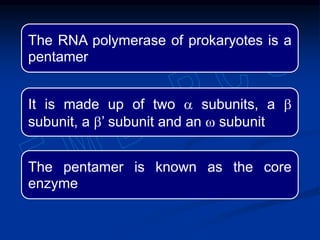
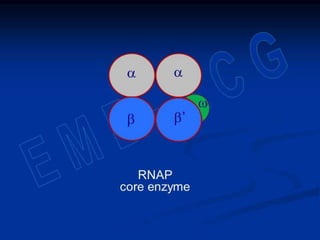
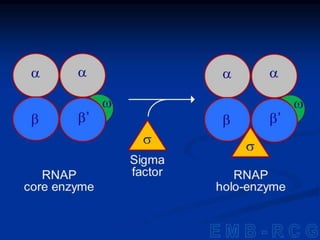
The RNA polymerase of prokaryotes is a
pentamer
It is made up of two a subunits, a b
subunit, a b’ subunit and an w subunit
The pentamer is known as the core
enzyme
The core enzyme can synthesize RNA
but it cannot recognize the promoter
It requires a protein, called sigma factor,
to recognize the promoter
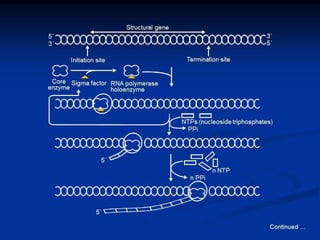
Core enzyme combines with sigma factor
to form RNA polymerase holoenzyme
The holoenzyme binds to the promoter
The process of RNA synthesis is similar
to primer synthesis
The portion of DNA which is being
transcribed is unwound (by RNAP)
RNA is synthesized in 5’  3’ direction
The substrates are ribonucleoside tri-
phosphates (ATP, GTP, CTP and UTP)
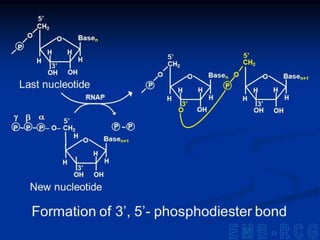
The a-phosphate group of new
nucleotide forms an ester bond with 3'
–OH group of the last nucleotide
An inorganic pyrophosphate is split off
The phosphate is thus involved in two
ester bonds – with 3’-OH of last nucleo-
tide and with 5’-OH of new nucleotide
Hence, the linkage between the last and
the new nucleotide occurs by 3’, 5’-
phosphodiester bond
The base sequence of template DNA
strand governs the base sequence of RNA
Nucleotides are selected according to the
base-pairing rule:
U opposite A
A opposite T
C opposite G
G opposite C
The process of transcription can
be divided into three phases:
Initiation phase
Elongation phase
Termination phase
RNAP holoenzyme binds to the
promoter and initiates transcription
The ribonucleotides are joined by
phosphodiester bonds
After initiation of transcription, the sigma
factor dissociates
Initiation phase
After release of sigma factor, elongation
phase begins
The core enzyme moves downstream
and adds ribonucleotides one by one
The catalytic function is performed by b
and b’ subunits
Elongation phase
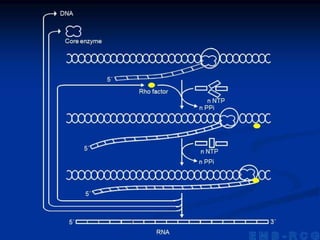
A protein called rho (r) factor binds to the
termination site
When core enzyme reaches the r factor,
the newly transcribed RNA is released
The core enzyme and r factor are also
released
Termination
The basic process of transcription is
similar in prokaryotes and eukaryotes
The eukaryotic transcription machinery is
more complex and more elaborate
Eukaryotic promoters are slightly different
from prokaryotic promoters
Eukaryotic transcription
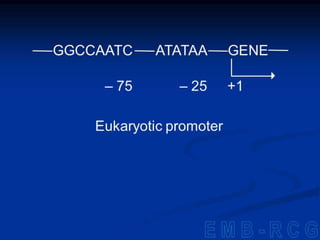
Eukaryotic promoters also have two common
sequences preceding transcription start site
One consensus sequence is 20-30 bp
upstream of transcription start site
Another consensus sequence is 70-80 bp
upstream of the transcription start site
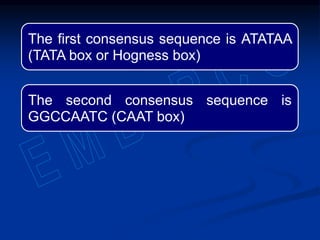
The first consensus sequence is ATATAA
(TATA box or Hogness box)
The second consensus sequence is
GGCCAATC (CAAT box)
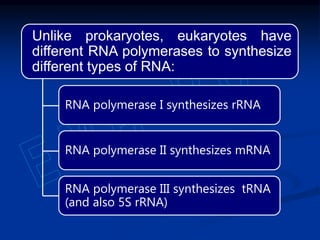
Unlike prokaryotes, eukaryotes have
different RNA polymerases to synthesize
different types of RNA:
RNA polymerase I synthesizes rRNA
RNA polymerase II synthesizes mRNA
RNA polymerase III synthesizes tRNA
(and also 5S rRNA)
The eukaryotic RNA polymerases are
bigger and have more subunits
A number of transcription factors are
required to form the basal transcription
apparatus
Sequences other than promoters affect
the transcription process and its rate
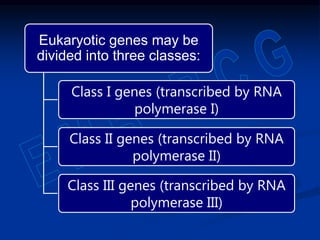
Eukaryotic genes may be
divided into three classes:
Class I genes (transcribed by RNA
polymerase I)
Class II genes (transcribed by RNA
polymerase II)
Class III genes (transcribed by RNA
polymerase III)
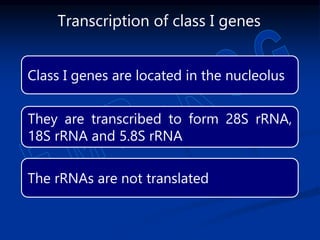
Class I genes are located in the nucleolus
They are transcribed to form 28S rRNA,
18S rRNA and 5.8S rRNA
The rRNAs are not translated
Transcription of class I genes
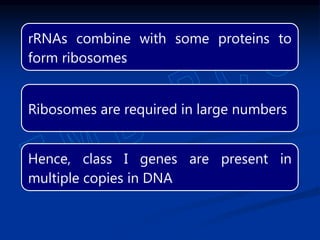
rRNAs combine with some proteins to
form ribosomes
Ribosomes are required in large numbers

Hence, class I genes are present in
multiple copies in DNA
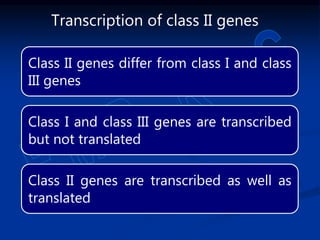
Class II genes differ from class I and class
III genes
Class I and class III genes are transcribed
but not translated
Class II genes are transcribed as well as
translated
Transcription of class II genes
Class II genes are transcribed to form
hnRNA in eukaryotes
hnRNA is processed to form mRNA
mRNA is translated to form a protein
TATA box upstream of class II genes is
the site for attachment of RNAP II
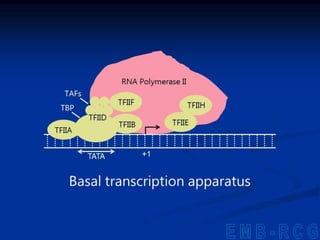
The first event is the binding of TATA
binding protein (TBP) to the TATA box
Several other proteins called TBP-
associated factors (TAFs) bind to TBP
The complex of TBP and TAFs is called
Transcription Factor IID (TFIID)
Transcription Factor IIB (TFIIB) joins TFIID
TFIIF brings RNAP II, and both attach to
the complex
TFIIF acts like the prokaryotic sigma factor
It positions RNAP II at the correct site for
initiation of transcription
TFIIA, TFIIE and TFIIH bind to the complex
This completes the basal transcription
apparatus
The apparatus is analogous to RNA
polymerase holoenzyme of prokaryotes
TFIIH possesses kinase activity which is
increased by TFIIE
TFIIH phosphorylates some serine and
threonine residues in RNAP II
This makes the enzyme active
Active RNAP II transcribes the gene
CAAT box is another consensus sequence
in eukaryotic promoters
This is present upstream of the TATA box
A protein, CAAT-binding transcription
factor (CTF), binds CAAT box
By looping of DNA, CAAT box comes
closer to TATA box
CTF also binds TAFs which are part of
TFIID
This binding increases the frequency of
transcription
GC box may also be present upstream of
CAAT box or between TATA box and
CAAT box
A protein, Sp1 binds to GC box and
TAFs, and increases the frequency of
transcription
Class III genes encode tRNAs and 5S rRNA
They are transcribed by RNA polymerase
III
Class III genes are present in multiple
copies
Transcription of class III genes
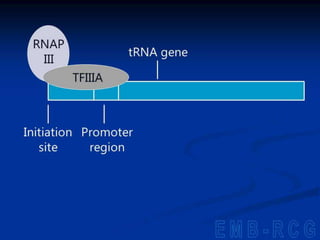
The promoters of tRNA genes are
intragenic
The promoters are located within the
gene rather than upstream of the gene
A transcription factor, TFIIIA binds to the
promoter
It positions RNA polymerase III at the
correct site to initiate transcription
The newly-synthesized RNA is the
primary transcript of the gene
Primary transcript is not usually the final
and functional RNA
It requires some modifications
Post-transcriptional modifications
Except prokaryotic mRNA, all RNAs under-
go post-transcriptional modifications
The modifications differ in different types of
RNA
rRNA is a structural constituent of
ribosomes
rRNA combines with some polypeptides
to form ribosomes
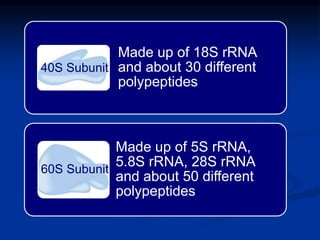
The eukaryotic 80S ribosome is made up
of a 40S subunit and a 60S subunit
Post-transcriptional processing of rRNA
Made up of 18S rRNA
and about 30 different
polypeptides
Made up of 5S rRNA,
5.8S rRNA, 28S rRNA
and about 50 different
polypeptides
40S Subunit
60S Subunit
Both eukaryotic and prokaryotic rRNA are
synthesized initially as large precursors
These are cleaved into final rRNAs
Several bases are methylated
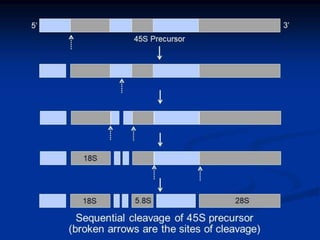
The primary transcript of rRNA gene in
eukaryotes is a 45S precursor
This is cleaved sequentially to form 28S,
18S and 5.8S rRNAs
5S rRNA is formed as such from class III
genes
Prokaryotic ribosome is 70S in size
It is made up of 30S and 50S subunits
The prokaryotic rRNAs are 5S, 16S and
23S
All are formed by cleavage of a large
precursor
Primary transcript of class II genes is
heterogeneous nuclear RNA in eukaryotes
Heterogeneous nuclear RNA (hnRNA) is
the precursor of mRNA
It is also known as pre-mRNA
Post-transcriptional processing of hnRNA
hnRNA undergoes extensive
modifications
Some modifications are common to all
hnRNAs
Some are unique to each
Two modifications common to
all the hnRNAs are:
Addition of 7-methylguanosine
triphosphate cap (7-methyl GTP
cap) at the 5'-end of RNA
Addition of poly-adenylate tail
(poly-A tail) at the 3'-end of RNA
The cap at the 5’-end helps the ribosome
in recognizing mRNA
It also prevents breakdown of mRNA by
5’-exonuclease
The tail at the 3’-end also stabilizes mRNA
by preventing the action of 3’-exonuclease
Some mRNAs do not have a poly-A tail
e.g. mRNAs for histones
The third modification is deletion of some
nucleotides from hnRNA
The deletion is different in different
hnRNAs
Eukaryotic genes contain some coding
and some non-coding sequences
Coding sequences are expressed, and
are known as exons
Non-coding sequences called introns
intervene between the coding sequences
After addition of cap and tail, the introns
are removed and the exons joined
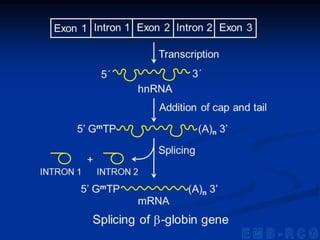
This process is known as splicing
The number and size of exons and
introns are different in different genes
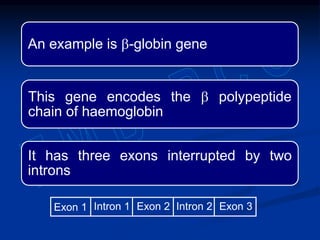
An example is b-globin gene
This gene encodes the b polypeptide
chain of haemoglobin
It has three exons interrupted by two
introns
Exon 1 Exon 2 Exon 3Intron 1 Intron 2
Splice sites are also known as splice
junctions or intron-exon junctions
Splice sites in all hnRNAs have some
common features
Splice sites
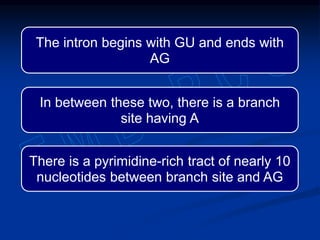
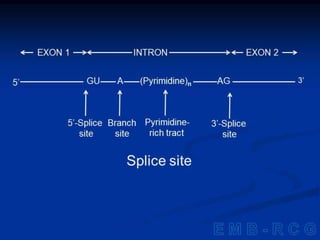
The intron begins with GU and ends with
AG
In between these two, there is a branch
site having A
There is a pyrimidine-rich tract of nearly 10
nucleotides between branch site and AG
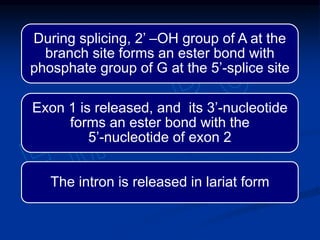
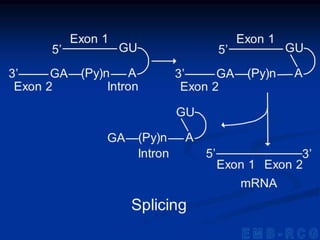
During splicing, 2’ –OH group of A at the
branch site forms an ester bond with
phosphate group of G at the 5’-splice site
Exon 1 is released, and its 3’-nucleotide
forms an ester bond with the
5’-nucleotide of exon 2
The intron is released in lariat form
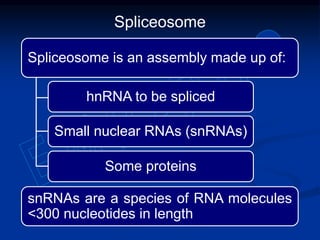
Spliceosome
Spliceosome is an assembly made up of:
hnRNA to be spliced
Small nuclear RNAs (snRNAs)
Some proteins
snRNAs are a species of RNA molecules
<300 nucleotides in length
The snRNAs combine with the proteins to
form small nuclear ribonucleoprotein
particles (snRNPs or snurps)
snRNPs are U1, U2, U4, U5 and U6
These combine with hnRNA to form a
spliceosome
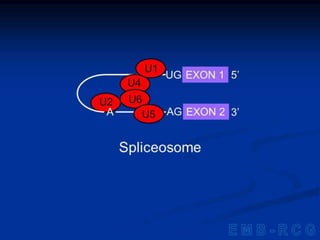
U1 binds to 5’-splice site
U2 binds to branch site
U5 binds to 3’-splice site of hnRNA
U4 and U6 bind to this complex
The splicing reaction is catalysed by the
snRNA components of snRNPs
Auto-antibodies against snRNPs are
formed in systemic lupus erythematosus
This results in wide-spread tissue
damage
Prokaryotic genes have no introns
Therefore, prokaryotes do not possess
splicing machinery
tRNA is synthesized as a precursor in
prokaryotes as well as eukaryotes
The precursor undergoes extensive post-
transcriptional modifications
Post-transcriptional processing of tRNA
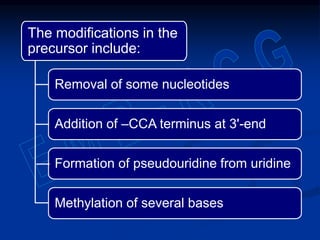
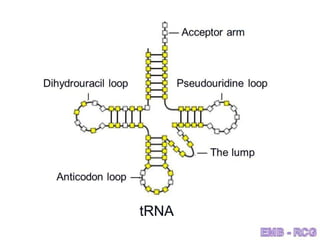
The modifications in the
precursor include:
Removal of some nucleotides
Addition of –CCA terminus at 3'-end
Formation of pseudouridine from uridine
Methylation of several bases
mRNA is synthesized by RNA poly-
merase II in eukaryotes
This enzyme binds to the promoter site
upstream of the structural gene
Besides promoter site, there are a
number of sequences in DNA which
control the rate of transcription
Regulation of transcription
Specific protein factors bind to the
regulatory sequences
The protein factors include transcription
factors, CTF, Sp1, CREB (cAMP
response element binding protein) etc
These protein factors facilitate or
increase the rate of transcription
Inducers and repressors also bind to the
regulatory sequences
Inducers increase transcription
Repressors decrease transcription
Mutations in promoter site can decrease
the rate of transcription
Enhancer elements are sequences located
far away from the gene they influence
They may be upstream or downstream
A regulatory factor binds to the enhancer
element
This increases the transcription of the
gene influenced by the enhancer element
Silencer elements are also located at a
distance from the gene they influence
They may be upstream or downstream
They suppress the transcription of the
genes that they influence
Transcription is essential for life
Inhibition of transcription prevents protein
synthesis
No organism can survive without proteins
Hence, selective inhibitors of prokaryotic
transcription can be used as antibiotics
Inhibition of transcription
Rifampicin inhibits the b subunit of RNA
polymerase
b Subunit is present only in prokaryotes
Rifampicin doesn’t inhibit the corres-
ponding human enzyme
Therefore, it can be used as an antibiotic
Transcription

Transcription

  • 1.
    Transcription R. C. Gupta Professorand Head Department of Biochemistry National Institute of Medical Sciences Jaipur, India
  • 2.
    Synthesis of proteinsrequires DNA and RNA Every protein has got a unique amino acid sequence Information about amino acid sequence of all the proteins is present in DNA
  • 3.
    The information ispresent in DNA in a coded form The unit of information is a gene DNA contains a number of genes
  • 4.
    A gene consistsof a specific base sequence encoding a protein Three consecutive bases in the gene constitute a codon The codons are code words for amino acids
  • 5.
    The gene isa series of code words for amino acids The information present in genes is used to synthesize proteins Different types of RNA are required to synthesize proteins
  • 6.
    There are three typesof RNA: Messenger RNA (mRNA) Transfer RNA (tRNA) Ribosomal RNA (rRNA)
  • 7.
    Functions of differenttypes of RNA Structure Function mRNA Single, uncoiled strand Transmits information from DNA, serves as a template for protein synthesis tRNA Single strand folded back upon itself Brings amino acids to ribosomes for protein synthesis rRNA Single strand folded into globular shape rRNA and proteins make up ribosomes All types of RNA are synthesized from DNA
  • 8.
    Information flows fromDNA to RNA to proteins Flow of information from DNA to RNA is known as transcription Use of this information to synthesize proteins is known as translation Central dogma of molecular biology
  • 9.
  • 10.
    Transcription is synthesisof RNA The RNA synthesized is the transcript of a gene The base sequence of RNA is comple- mentary to that of the gene Transcription
  • 11.
    A gene ismade up of two strands Only one strand acts as a template for transcription The base sequence of RNA is comple- mentary to this strand
  • 12.
    The template strandof gene is known as sense (non-coding) strand The other strand has a complementary base sequence This strand is known as anti-sense (coding) strand Sense and antisense
  • 13.
    Base sequence ofRNA is complementary to that of sense strand Anti-sense (coding) strandRNA Sense (template/ non-coding) strand 5’ The gene being transcribed
  • 14.
    Roger Kornberg The processof transcription was elucidated by Roger Kornberg
  • 15.
    RNA is synthesizedby RNA polymerase (RNAP) RNAP is a DNA-dependent RNA poly- merase It polymerizes ribonucleotides to form RNA
  • 16.
    The transcription unitis a gene The genes for proteins are known as structural genes RNA polymerase recognizes a certain base sequence, and binds to it
  • 17.
    Every structural genehas got a unique base sequence One RNAP cannot recognize thousands of different base sequences RNAP recognizes some sequences common to all the structural genes
  • 18.
    Each structural geneis preceded by small sequence known as promoter Promoter is also known as promoter site or promoter element or promoter region All the promoters have some common or consensus sequences
  • 19.
    RNA polymerase recognizesthe common sequences in the promoters A single enzyme can thus transcribe different structural genes
  • 20.
    Transcription is catalysedby prokaryotic RNA polymerase (RNAP) RNAP recognizes the prokaryotic promoter Prokaryotic transcription
  • 21.
    The promoter hastwo common sequences upstream of transcription start site One sequence, 10 bp (base pairs) up- stream, is TATAAT (called Pribnow box) A second sequence, 35 bp upstream of transcription start site, is TTGACA
  • 23.
    The RNA polymeraseof prokaryotes is a pentamer It is made up of two a subunits, a b subunit, a b’ subunit and an w subunit The pentamer is known as the core enzyme
  • 25.
    The core enzymecan synthesize RNA but it cannot recognize the promoter It requires a protein, called sigma factor, to recognize the promoter Core enzyme combines with sigma factor to form RNA polymerase holoenzyme The holoenzyme binds to the promoter
  • 27.
    The process ofRNA synthesis is similar to primer synthesis The portion of DNA which is being transcribed is unwound (by RNAP) RNA is synthesized in 5’  3’ direction
  • 28.
    The substrates areribonucleoside tri- phosphates (ATP, GTP, CTP and UTP) The a-phosphate group of new nucleotide forms an ester bond with 3' –OH group of the last nucleotide An inorganic pyrophosphate is split off
  • 29.
    The phosphate isthus involved in two ester bonds – with 3’-OH of last nucleo- tide and with 5’-OH of new nucleotide Hence, the linkage between the last and the new nucleotide occurs by 3’, 5’- phosphodiester bond
  • 31.
    The base sequenceof template DNA strand governs the base sequence of RNA Nucleotides are selected according to the base-pairing rule: U opposite A A opposite T C opposite G G opposite C
  • 32.
    The process oftranscription can be divided into three phases: Initiation phase Elongation phase Termination phase
  • 33.
    RNAP holoenzyme bindsto the promoter and initiates transcription The ribonucleotides are joined by phosphodiester bonds After initiation of transcription, the sigma factor dissociates Initiation phase
  • 34.
    After release ofsigma factor, elongation phase begins The core enzyme moves downstream and adds ribonucleotides one by one The catalytic function is performed by b and b’ subunits Elongation phase
  • 36.
    A protein calledrho (r) factor binds to the termination site When core enzyme reaches the r factor, the newly transcribed RNA is released The core enzyme and r factor are also released Termination
  • 38.
    The basic processof transcription is similar in prokaryotes and eukaryotes The eukaryotic transcription machinery is more complex and more elaborate Eukaryotic promoters are slightly different from prokaryotic promoters Eukaryotic transcription
  • 39.
    Eukaryotic promoters alsohave two common sequences preceding transcription start site One consensus sequence is 20-30 bp upstream of transcription start site Another consensus sequence is 70-80 bp upstream of the transcription start site
  • 40.
    The first consensussequence is ATATAA (TATA box or Hogness box) The second consensus sequence is GGCCAATC (CAAT box)
  • 42.
    Unlike prokaryotes, eukaryoteshave different RNA polymerases to synthesize different types of RNA: RNA polymerase I synthesizes rRNA RNA polymerase II synthesizes mRNA RNA polymerase III synthesizes tRNA (and also 5S rRNA)
  • 43.
    The eukaryotic RNApolymerases are bigger and have more subunits A number of transcription factors are required to form the basal transcription apparatus Sequences other than promoters affect the transcription process and its rate
  • 44.
    Eukaryotic genes maybe divided into three classes: Class I genes (transcribed by RNA polymerase I) Class II genes (transcribed by RNA polymerase II) Class III genes (transcribed by RNA polymerase III)
  • 45.
    Class I genesare located in the nucleolus They are transcribed to form 28S rRNA, 18S rRNA and 5.8S rRNA The rRNAs are not translated Transcription of class I genes
  • 46.
    rRNAs combine withsome proteins to form ribosomes Ribosomes are required in large numbers Hence, class I genes are present in multiple copies in DNA
  • 47.
    Class II genesdiffer from class I and class III genes Class I and class III genes are transcribed but not translated Class II genes are transcribed as well as translated Transcription of class II genes
  • 48.
    Class II genesare transcribed to form hnRNA in eukaryotes hnRNA is processed to form mRNA mRNA is translated to form a protein
  • 49.
    TATA box upstreamof class II genes is the site for attachment of RNAP II The first event is the binding of TATA binding protein (TBP) to the TATA box Several other proteins called TBP- associated factors (TAFs) bind to TBP
  • 50.
    The complex ofTBP and TAFs is called Transcription Factor IID (TFIID) Transcription Factor IIB (TFIIB) joins TFIID TFIIF brings RNAP II, and both attach to the complex
  • 51.
    TFIIF acts likethe prokaryotic sigma factor It positions RNAP II at the correct site for initiation of transcription
  • 52.
    TFIIA, TFIIE andTFIIH bind to the complex This completes the basal transcription apparatus The apparatus is analogous to RNA polymerase holoenzyme of prokaryotes
  • 54.
    TFIIH possesses kinaseactivity which is increased by TFIIE TFIIH phosphorylates some serine and threonine residues in RNAP II This makes the enzyme active Active RNAP II transcribes the gene
  • 55.
    CAAT box isanother consensus sequence in eukaryotic promoters This is present upstream of the TATA box A protein, CAAT-binding transcription factor (CTF), binds CAAT box
  • 56.
    By looping ofDNA, CAAT box comes closer to TATA box CTF also binds TAFs which are part of TFIID This binding increases the frequency of transcription
  • 57.
    GC box mayalso be present upstream of CAAT box or between TATA box and CAAT box A protein, Sp1 binds to GC box and TAFs, and increases the frequency of transcription
  • 58.
    Class III genesencode tRNAs and 5S rRNA They are transcribed by RNA polymerase III Class III genes are present in multiple copies Transcription of class III genes
  • 59.
    The promoters oftRNA genes are intragenic The promoters are located within the gene rather than upstream of the gene A transcription factor, TFIIIA binds to the promoter It positions RNA polymerase III at the correct site to initiate transcription
  • 61.
    The newly-synthesized RNAis the primary transcript of the gene Primary transcript is not usually the final and functional RNA It requires some modifications Post-transcriptional modifications
  • 62.
    Except prokaryotic mRNA,all RNAs under- go post-transcriptional modifications The modifications differ in different types of RNA
  • 63.
    rRNA is astructural constituent of ribosomes rRNA combines with some polypeptides to form ribosomes The eukaryotic 80S ribosome is made up of a 40S subunit and a 60S subunit Post-transcriptional processing of rRNA
  • 64.
    Made up of18S rRNA and about 30 different polypeptides Made up of 5S rRNA, 5.8S rRNA, 28S rRNA and about 50 different polypeptides 40S Subunit 60S Subunit
  • 65.
    Both eukaryotic andprokaryotic rRNA are synthesized initially as large precursors These are cleaved into final rRNAs Several bases are methylated
  • 66.
    The primary transcriptof rRNA gene in eukaryotes is a 45S precursor This is cleaved sequentially to form 28S, 18S and 5.8S rRNAs 5S rRNA is formed as such from class III genes
  • 68.
    Prokaryotic ribosome is70S in size It is made up of 30S and 50S subunits The prokaryotic rRNAs are 5S, 16S and 23S All are formed by cleavage of a large precursor
  • 69.
    Primary transcript ofclass II genes is heterogeneous nuclear RNA in eukaryotes Heterogeneous nuclear RNA (hnRNA) is the precursor of mRNA It is also known as pre-mRNA Post-transcriptional processing of hnRNA
  • 70.
    hnRNA undergoes extensive modifications Somemodifications are common to all hnRNAs Some are unique to each
  • 71.
    Two modifications commonto all the hnRNAs are: Addition of 7-methylguanosine triphosphate cap (7-methyl GTP cap) at the 5'-end of RNA Addition of poly-adenylate tail (poly-A tail) at the 3'-end of RNA
  • 72.
    The cap atthe 5’-end helps the ribosome in recognizing mRNA It also prevents breakdown of mRNA by 5’-exonuclease The tail at the 3’-end also stabilizes mRNA by preventing the action of 3’-exonuclease Some mRNAs do not have a poly-A tail e.g. mRNAs for histones
  • 73.
    The third modificationis deletion of some nucleotides from hnRNA The deletion is different in different hnRNAs
  • 74.
    Eukaryotic genes containsome coding and some non-coding sequences Coding sequences are expressed, and are known as exons Non-coding sequences called introns intervene between the coding sequences
  • 75.
    After addition ofcap and tail, the introns are removed and the exons joined This process is known as splicing The number and size of exons and introns are different in different genes
  • 76.
    An example isb-globin gene This gene encodes the b polypeptide chain of haemoglobin It has three exons interrupted by two introns Exon 1 Exon 2 Exon 3Intron 1 Intron 2
  • 77.
    Splice sites arealso known as splice junctions or intron-exon junctions Splice sites in all hnRNAs have some common features Splice sites
  • 78.
    The intron beginswith GU and ends with AG In between these two, there is a branch site having A There is a pyrimidine-rich tract of nearly 10 nucleotides between branch site and AG
  • 80.
    During splicing, 2’–OH group of A at the branch site forms an ester bond with phosphate group of G at the 5’-splice site Exon 1 is released, and its 3’-nucleotide forms an ester bond with the 5’-nucleotide of exon 2 The intron is released in lariat form
  • 83.
    Spliceosome Spliceosome is anassembly made up of: hnRNA to be spliced Small nuclear RNAs (snRNAs) Some proteins snRNAs are a species of RNA molecules <300 nucleotides in length
  • 84.
    The snRNAs combinewith the proteins to form small nuclear ribonucleoprotein particles (snRNPs or snurps) snRNPs are U1, U2, U4, U5 and U6 These combine with hnRNA to form a spliceosome
  • 85.
    U1 binds to5’-splice site U2 binds to branch site U5 binds to 3’-splice site of hnRNA U4 and U6 bind to this complex
  • 87.
    The splicing reactionis catalysed by the snRNA components of snRNPs Auto-antibodies against snRNPs are formed in systemic lupus erythematosus This results in wide-spread tissue damage
  • 88.
    Prokaryotic genes haveno introns Therefore, prokaryotes do not possess splicing machinery
  • 89.
    tRNA is synthesizedas a precursor in prokaryotes as well as eukaryotes The precursor undergoes extensive post- transcriptional modifications Post-transcriptional processing of tRNA
  • 90.
    The modifications inthe precursor include: Removal of some nucleotides Addition of –CCA terminus at 3'-end Formation of pseudouridine from uridine Methylation of several bases
  • 92.
    mRNA is synthesizedby RNA poly- merase II in eukaryotes This enzyme binds to the promoter site upstream of the structural gene Besides promoter site, there are a number of sequences in DNA which control the rate of transcription Regulation of transcription
  • 93.
    Specific protein factorsbind to the regulatory sequences The protein factors include transcription factors, CTF, Sp1, CREB (cAMP response element binding protein) etc These protein factors facilitate or increase the rate of transcription
  • 94.
    Inducers and repressorsalso bind to the regulatory sequences Inducers increase transcription Repressors decrease transcription Mutations in promoter site can decrease the rate of transcription
  • 95.
    Enhancer elements aresequences located far away from the gene they influence They may be upstream or downstream A regulatory factor binds to the enhancer element This increases the transcription of the gene influenced by the enhancer element
  • 96.
    Silencer elements arealso located at a distance from the gene they influence They may be upstream or downstream They suppress the transcription of the genes that they influence
  • 97.
    Transcription is essentialfor life Inhibition of transcription prevents protein synthesis No organism can survive without proteins Hence, selective inhibitors of prokaryotic transcription can be used as antibiotics Inhibition of transcription
  • 98.
    Rifampicin inhibits theb subunit of RNA polymerase b Subunit is present only in prokaryotes Rifampicin doesn’t inhibit the corres- ponding human enzyme Therefore, it can be used as an antibiotic