mRNA Processing
Darshan S
CONTENTS
1 Introduction
5’capping2
3 Polyadenylation
Splicing4
Conclusion5
Reference6
1
Introduction
Many of the RNA molecules in
bacteria and virtually all RNA
molecules in eukaryotes are
processed to some degree after
synthesis
1 Introduction
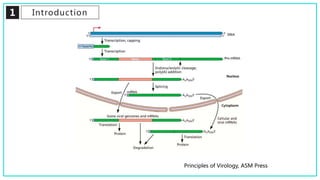
• mRNAs are synthesized by either cellular or viral
enzymes
• RNA processing- a series of covalent modifications
• Facilitate recognition of mRNAs by the protein
synthesizing machinery
• Most RNA-processing reactions were discovered in
viral systems
Principles of Virology, ASM Press
1 Introduction
2
5’Capping
m7GpppNp
2 5’Capping
Principles of Virology, ASM Press
2 5’Capping
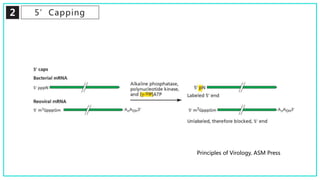
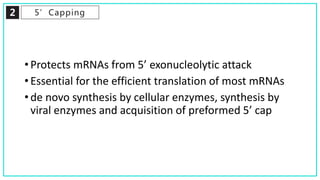
• Protects mRNAs from 5’ exonucleolytic attack
• Essential for the efficient translation of most mRNAs
• de novo synthesis by cellular enzymes, synthesis by
viral enzymes and acquisition of preformed 5’ cap
2 5’Capping
Synthesis by cellular enzymes
• Pre mRNA are substrates for cellular capping enzymes
• RNA pol II
• Cotranscriptional reaction that takes place when
nascent RNA is only 20 to 30 nucleotides in length
• Phosphorylation of paused RNA pol II at specific
serines in the C-terminal domain of the largest
subunit is the signal for binding of the capping enzyme
and capping of nascent RNA
2 5’Capping
Principles of Virology, ASM Press
2 5’Capping
Acquisition of viral 5’Cap from cellular mRNA
• 5’ caps of orthomyxoviral and bunyaviral mRNAs are
produced by cellular capping enzymes
• Viral cap dependent endonucleases cleave cellular
transcripts to produce the primers needed for viral mRNA
synthesis- cap snatching
• The 5’ terminal segments and caps of influenza virus mRNAs
are obtained from cellular pre-mRNA in nucleus
• Bunyaviral mRNA synthesis is primed with 5’ terminal
fragments cleaved from mature cellular mRNAs in cytoplasm
3
Polyadenylation
Addition of poly(A) tail to 3’ end
3 Polyadenylation
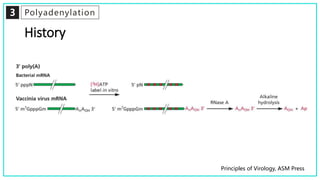
History
Principles of Virology, ASM Press
3 Polyadenylation
• Stability and increases the efficiency of translation
• 3’ terminal stemloop structures instead poly(A) tail in
mRNAs that encode histones and also in case of
reoviral and arenaviral mRNAs
• Carried out by either cellular or viral enzymes
3 Polyadenylation
By cellular Enzymes
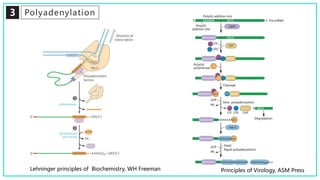
• Transcription of a gene proceeds beyond the site at
which poly(A) tail is added
• The 3’ end of the mRNA is determined by
endonucleolytic cleavage of its pre-mRNA
• Poly(A) is then added to the new 3’ terminus
• Termination of transcription
• Degradation of RNA downstream to the cleavage site
3 Polyadenylation
Principles of Virology, ASM PressLehninger principles of Biochemistry, WH Freeman
3 Polyadenylation
By Viral Enzymes
• Either posttranscriptional or during
viral mRNA synthesis
• Vaccinia virus- 2 processes with one
enzyme
• Other viruses- during mRNA synthesis
• Poly(U) sequence present at the 5’ end
of the (-) strand RNA template
Principles of Virology, ASM Press
4
Splicing
Non-coding regions are removed and
coding regions are joined together
4 Splicing
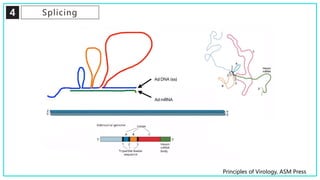
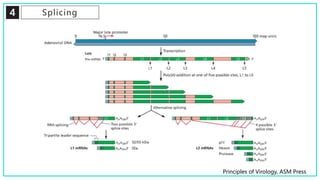
Discovery
• Nuclear precursors of mRNAs are larger than mRNAs
transported in cytoplasm and heterogenous in size
• Both ends of hnRNA retained
• 1993- Phillip Sharp and Richard Roberts
• Adenoviral late mRNAs
4 Splicing
Principles of Virology, ASM Press
4 Splicing
4 classes of introns
• Group I: Found in some nuclear, mitochondrial and
chloroplast genes that code for rRNAs, mRNAs and
tRNAs
• Group II: Found in the primary transcripts of
mitochondrial or chloroplast mRNAs in fungi,algae
and plants
• Rare examples of introns found in bacteria
4 Splicing
Lehninger principles of Biochemistry, WH Freeman
4 Splicing
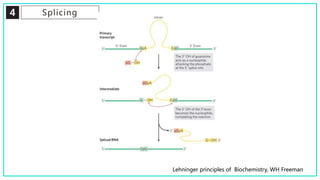
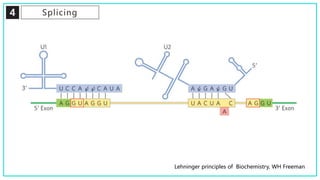
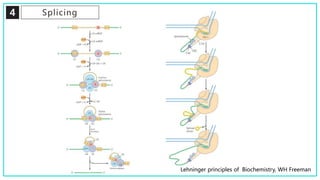
Group III Introns
• Largest class
• Found in nuclear mRNA primary transcripts
• Spliceosomal introns
• Splicing by lariat mechanism
• Spliceosome is made up of specialized RNA-protein
complexes: snRNPs
4 Splicing
Lehninger principles of Biochemistry, WH Freeman
4 Splicing
Lehninger principles of Biochemistry, WH Freeman
4 Splicing
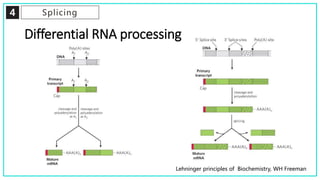
Differential RNA processing
Lehninger principles of Biochemistry, WH Freeman
4 Splicing
Principles of Virology, ASM Press
5
Conclusion
5 Conclusion
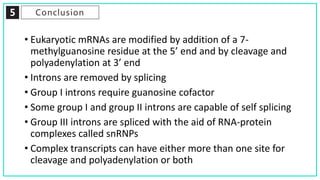
• Eukaryotic mRNAs are modified by addition of a 7-
methylguanosine residue at the 5’ end and by cleavage and
polyadenylation at 3’ end
• Introns are removed by splicing
• Group I introns require guanosine cofactor
• Some group I and group II introns are capable of self splicing
• Group III introns are spliced with the aid of RNA-protein
complexes called snRNPs
• Complex transcripts can have either more than one site for
cleavage and polyadenylation or both
6
Reference
•Flint, Racaniello, 2015, Principles of virology, 4th edition
•David L Nelson, M Cox, 2013, Lehninger Principles of
Biochemistry, sixth edition, W H Freeman and Company
THANK YOU!

mRNA processing

  • 1.
  • 2.
  • 3.
    1 Introduction Many of theRNA molecules in bacteria and virtually all RNA molecules in eukaryotes are processed to some degree after synthesis
  • 4.
    1 Introduction • mRNAsare synthesized by either cellular or viral enzymes • RNA processing- a series of covalent modifications • Facilitate recognition of mRNAs by the protein synthesizing machinery • Most RNA-processing reactions were discovered in viral systems
  • 5.
    Principles of Virology,ASM Press 1 Introduction
  • 6.
  • 7.
    2 5’Capping Principles ofVirology, ASM Press
  • 8.
    2 5’Capping • ProtectsmRNAs from 5’ exonucleolytic attack • Essential for the efficient translation of most mRNAs • de novo synthesis by cellular enzymes, synthesis by viral enzymes and acquisition of preformed 5’ cap
  • 9.
    2 5’Capping Synthesis bycellular enzymes • Pre mRNA are substrates for cellular capping enzymes • RNA pol II • Cotranscriptional reaction that takes place when nascent RNA is only 20 to 30 nucleotides in length • Phosphorylation of paused RNA pol II at specific serines in the C-terminal domain of the largest subunit is the signal for binding of the capping enzyme and capping of nascent RNA
  • 10.
    2 5’Capping Principles ofVirology, ASM Press
  • 11.
    2 5’Capping Acquisition ofviral 5’Cap from cellular mRNA • 5’ caps of orthomyxoviral and bunyaviral mRNAs are produced by cellular capping enzymes • Viral cap dependent endonucleases cleave cellular transcripts to produce the primers needed for viral mRNA synthesis- cap snatching • The 5’ terminal segments and caps of influenza virus mRNAs are obtained from cellular pre-mRNA in nucleus • Bunyaviral mRNA synthesis is primed with 5’ terminal fragments cleaved from mature cellular mRNAs in cytoplasm
  • 12.
  • 13.
  • 14.
    3 Polyadenylation • Stabilityand increases the efficiency of translation • 3’ terminal stemloop structures instead poly(A) tail in mRNAs that encode histones and also in case of reoviral and arenaviral mRNAs • Carried out by either cellular or viral enzymes
  • 15.
    3 Polyadenylation By cellularEnzymes • Transcription of a gene proceeds beyond the site at which poly(A) tail is added • The 3’ end of the mRNA is determined by endonucleolytic cleavage of its pre-mRNA • Poly(A) is then added to the new 3’ terminus • Termination of transcription • Degradation of RNA downstream to the cleavage site
  • 16.
    3 Polyadenylation Principles ofVirology, ASM PressLehninger principles of Biochemistry, WH Freeman
  • 17.
    3 Polyadenylation By ViralEnzymes • Either posttranscriptional or during viral mRNA synthesis • Vaccinia virus- 2 processes with one enzyme • Other viruses- during mRNA synthesis • Poly(U) sequence present at the 5’ end of the (-) strand RNA template Principles of Virology, ASM Press
  • 18.
    4 Splicing Non-coding regions areremoved and coding regions are joined together
  • 19.
    4 Splicing Discovery • Nuclearprecursors of mRNAs are larger than mRNAs transported in cytoplasm and heterogenous in size • Both ends of hnRNA retained • 1993- Phillip Sharp and Richard Roberts • Adenoviral late mRNAs
  • 20.
    4 Splicing Principles ofVirology, ASM Press
  • 21.
    4 Splicing 4 classesof introns • Group I: Found in some nuclear, mitochondrial and chloroplast genes that code for rRNAs, mRNAs and tRNAs • Group II: Found in the primary transcripts of mitochondrial or chloroplast mRNAs in fungi,algae and plants • Rare examples of introns found in bacteria
  • 22.
    4 Splicing Lehninger principlesof Biochemistry, WH Freeman
  • 23.
    4 Splicing Group IIIIntrons • Largest class • Found in nuclear mRNA primary transcripts • Spliceosomal introns • Splicing by lariat mechanism • Spliceosome is made up of specialized RNA-protein complexes: snRNPs
  • 24.
    4 Splicing Lehninger principlesof Biochemistry, WH Freeman
  • 25.
    4 Splicing Lehninger principlesof Biochemistry, WH Freeman
  • 26.
    4 Splicing Differential RNAprocessing Lehninger principles of Biochemistry, WH Freeman
  • 27.
    4 Splicing Principles ofVirology, ASM Press
  • 28.
  • 29.
    5 Conclusion • EukaryoticmRNAs are modified by addition of a 7- methylguanosine residue at the 5’ end and by cleavage and polyadenylation at 3’ end • Introns are removed by splicing • Group I introns require guanosine cofactor • Some group I and group II introns are capable of self splicing • Group III introns are spliced with the aid of RNA-protein complexes called snRNPs • Complex transcripts can have either more than one site for cleavage and polyadenylation or both
  • 30.
    6 Reference •Flint, Racaniello, 2015,Principles of virology, 4th edition •David L Nelson, M Cox, 2013, Lehninger Principles of Biochemistry, sixth edition, W H Freeman and Company
  • 31.