Soil-Plant Spectroscopy for
Evidence-Based Agronomy
Erick Towett and Keith Shepherd
Land Health Decisions
World Agroforestry Centre (ICRAF), Nairobi, Kenya
SCALING PRECISION NUTRIENT MANAGEMENT (PNM) PRACTICES IN SOUTH ASIAN CEREAL SYSTEM, MUSSOORIE, INDIA, APRIL 27 – 29TH, 2016
Getting the best out of light
Context
• Currently, predicting a response to fertilizer addition usually
involves performing a soil test (usually chemical extraction),
and interpreting the test results based on critical limits
developed from agronomic trials and pot studies.
• The relationship between soil tests and relative yield (RY)
response to fertilizer is subject to the influence of
environment (e.g. water, temperature, soil type & chemistry)
and management (e.g. cultivation, sowing date).
• Variability in response and risk are ignored when making
recommendations.
1
Calibrating relative yield response to soil tests
| PNM South Asia, Mussoorie | India | 27-29 April 2016|
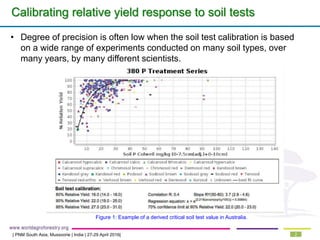
• Degree of precision is often low when the soil test calibration is based
on a wide range of experiments conducted on many soil types, over
many years, by many different scientists.
2
Figure 1: Example of a derived critical soil test value in Australia.
Calibrating relative yield response to soil tests
| PNM South Asia, Mussoorie | India | 27-29 April 2016|
• Conventional soils tests are cumbersome and of variable
accuracy when predicting relative yield response to nutrient
inputs. Huge problems with reproducibility across labs.
• Soil tests based on soil extracts do not characterize all the
nutrient pools that determine a soil’s ability to re-supply the
soil solution, e.g. readily mineralizable organic P, sorbed P, and
slowly extractable K.
• The conventional tests do not produce any absolute measure
of nutrient availability, but always have to be calibrated using
extensive agronomic field trials on different soil types to be
able to predict crop response to applied nutrients.
• Calibration trials not done in many regions. Uncertainty
ignored.
3
Calibrating relative yield response to soil tests
| PNM South Asia, Mussoorie | India | 27-29 April 2016|
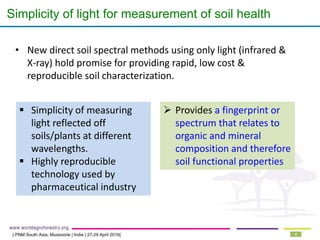
• New direct soil spectral methods using only light (infrared &
X-ray) hold promise for providing rapid, low cost &
reproducible soil characterization.
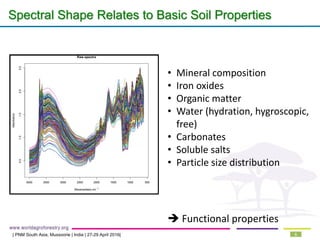
 Provides a fingerprint or
spectrum that relates to
organic and mineral
composition and therefore
soil functional properties
 Simplicity of measuring
light reflected off
soils/plants at different
wavelengths.
 Highly reproducible
technology used by
pharmaceutical industry
4
Simplicity of light for measurement of soil health
| PNM South Asia, Mussoorie | India | 27-29 April 2016|
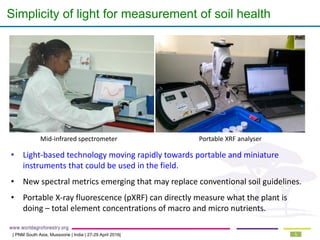
Mid-infrared spectrometer Portable XRF analyser
• Light-based technology moving rapidly towards portable and miniature
instruments that could be used in the field.
• New spectral metrics emerging that may replace conventional soil guidelines.
• Portable X-ray fluorescence (pXRF) can directly measure what the plant is
doing – total element concentrations of macro and micro nutrients.
Simplicity of light for measurement of soil health
5| PNM South Asia, Mussoorie | India | 27-29 April 2016|
Spectral Shape Relates to Basic Soil Properties
• Mineral composition
• Iron oxides
• Organic matter
• Water (hydration, hygroscopic,
free)
• Carbonates
• Soluble salts
• Particle size distribution
 Functional properties
| PNM South Asia, Mussoorie | India | 27-29 April 2016| 6
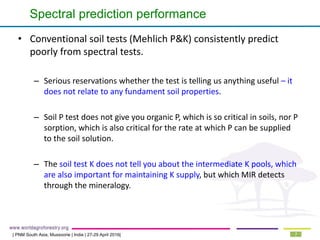
• Conventional soil tests (Mehlich P&K) consistently predict
poorly from spectral tests.
– Serious reservations whether the test is telling us anything useful – it
does not relate to any fundament soil properties.
– Soil P test does not give you organic P, which is so critical in soils, nor P
sorption, which is also critical for the rate at which P can be supplied
to the soil solution.
– The soil test K does not tell you about the intermediate K pools, which
are also important for maintaining K supply, but which MIR detects
through the mineralogy.
Spectral prediction performance
7| PNM South Asia, Mussoorie | India | 27-29 April 2016|
8
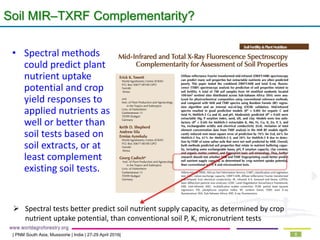
 Spectral tests better predict soil nutrient supply capacity, as determined by crop
nutrient uptake potential, than conventional soil P, K, micronutrient tests
Soil MIR–TXRF Complementarity?
• Spectral methods
could predict plant
nutrient uptake
potential and crop
yield responses to
applied nutrients as
well or better than
soil tests based on
soil extracts, or at
least complement
existing soil tests.
| PNM South Asia, Mussoorie | India | 27-29 April 2016|
• Robust - basically counting atoms!
• Enables pairing of soil and plant testing at multiple
georeferenced locations – towards an evidenced based
approach.
• Can also sample natural variation in crop growth in landscapes
to develop norms.
pXRF for plant analysis
9| PNM South Asia, Mussoorie | India | 27-29 April 2016|
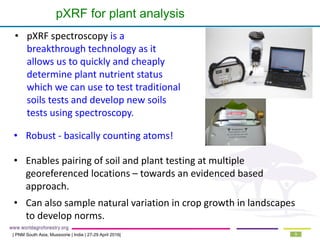
• pXRF spectroscopy is a
breakthrough technology as it
allows us to quickly and cheaply
determine plant nutrient status
which we can use to test traditional
soils tests and develop new soils
tests using spectroscopy.
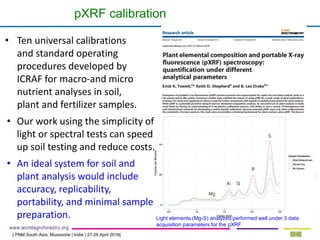
• Ten universal calibrations
and standard operating
procedures developed by
ICRAF for macro-and micro
nutrient analyses in soil,
plant and fertilizer samples.
pXRF calibration
1
0
Light elements (Mg-S) analyzed performed well under 3 data
acquisition parameters for the pXRF.
• Our work using the simplicity of
light or spectral tests can speed
up soil testing and reduce costs.
• An ideal system for soil and
plant analysis would include
accuracy, replicability,
portability, and minimal sample
preparation.
| PNM South Asia, Mussoorie | India | 27-29 April 2016|
Context
• The huge missing link is testing and validation of plant
nutrient uptake and crop response to fertilizers in relation to
soil tests.
• Plant tissue analysis can be used to directly identify nutrient-
related problems; rule out nutrition as the source of a
problem; monitor nutrient status as a basis for managing a
crop fertility program; and/or evaluate the effectiveness of a
fertility program.
• pXRF will enable greater emphasis on plant tissue analysis –
tell us what is limiting now and what will be limiting next. IR
for plant N.
1
1
Crop response to spectral test
| PNM South Asia, Mussoorie | India | 27-29 April 2016|
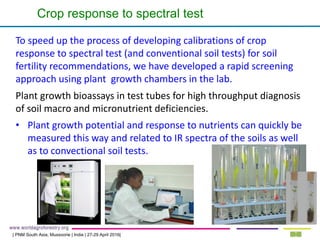
To speed up the process of developing calibrations of crop
response to spectral test (and conventional soil tests) for soil
fertility recommendations, we have developed a rapid screening
approach using plant growth chambers in the lab.
Plant growth bioassays in test tubes for high throughput diagnosis
of soil macro and micronutrient deficiencies.
• Plant growth potential and response to nutrients can quickly be
measured this way and related to IR spectra of the soils as well
as to convectional soil tests.
Crop response to spectral test
1
2
| PNM South Asia, Mussoorie | India | 27-29 April 2016|
1
3
• Around 119 million farmers in India depend on agricultural production for their
livelihoods. Information on soil health and nutrient status is of high value to
farmers to help them apply the right types and amounts of nutrient inputs and
management practices to their soils to maximize their profitability.
• Current annual capacity of existing soil laboratories in India is ≈ 1.3 million soil
samples per year, against a projected demand of about 40 million samples per
year as planned by the Government.
• ICRAF working closely with the Indian Institute of Soil Science (IISS) of the Indian
Council of Agricultural Research (ICAR) on an initiative to transfer to India its
light-based technology for rapid and cost effective analysis of soil health and
nutrient status.
• ICRAF has established a fully functional MIR and pXRF laboratory at IISS and
trained 12 Indian scientists to use the technology.
• Scanning soil archives including from fertilizer response trials.
India technology transfer and capacity building
| PNM South Asia, Mussoorie | India | 27-29 April 2016|
•IAMM, Mozambique
•AfSIS, Sotuba, Mali
•AfSIS, Salien, Tanzania
•AfSIS, Chitedze, Malawi
•CNLS, Nairobi, Kenya
•SoilCares, Kenya (mobile)
•IISS, Bhopal, India
•YPC, Kunming, China
•ATA, Addis Ababa, Ethiopia (6)
•CNRA, Abidjan, Cote D’Ivoire
•KARI, Nairobi, Kenya
•ICRAF, Yaounde, Cameroon
•IAR&T, Obafemi Awolowo
University, Ibadan, Nigeria
•IAR, Zaria, Nigeria
•FMARD, Nigeria
•IITA, Ibadan, Nigeria
•IITA, Yaounde, Cameroon
•SARI, Salien, Tanzania
Soil-Plant Spectroscopy
Support Group
PhD and MSc studentships and
training/exchange between ICRAF
and Universities across the globe.
Over 500 visitors/year to ICRAF
Spectral Diagnostics Lab
Training for agricultural officers in 47
counties in Kenya through
ChromAfrica LLC
Support to other projects:
-Optimizing Fertilizer Recommendations in
Africa (OFRA)
- World Bank Living Standards Management
Study
-Transformation of agronomic research and
delivery services for smallholder farmers in
maize-based systems of Sub-Saharan Africa
(TAMASA)
Spectral Lab Network/Outreach
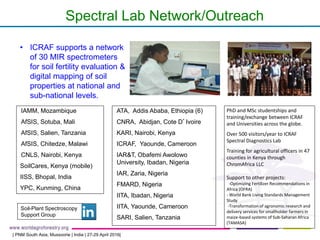
• ICRAF supports a network
of 30 MIR spectrometers
for soil fertility evaluation &
digital mapping of soil
properties at national and
sub-national levels.
| PNM South Asia, Mussoorie | India | 27-29 April 2016|
1
5
• Digital mapping of soil properties to identify soil fertility constraints, target
fertilizer supply/recommendations and soil management interventions, and map
soil carbon stocks
• Soil health baselines and monitoring in sustainable land management projects
for impact
• Soil testing services for smallholder farmers
• Soil characterization in long-term soil monitoring initiatives (e.g. VitalSigns,
World Bank Living Standards Management Study)
• Evidence-based (predictive) agronomy through low cost soil and plant nutrient
analysis in multi-location field trials, and plant bioassays in growth chambers
• Fertilizer, compost and organic resources quality testing
• Characterization of mine reclamation sites, including heavy metal detection in
soils and plants
• Nutritional and product quality testing and quality control in harvested products
(e.g. selenium in grains)
Spectral applications
| PNM South Asia, Mussoorie | India | 27-29 April 2016|
Thank you
1
6