PRECISION AGRICULTURE
By
Ammar Adl
Faculty of Computers and Information
Cairo Univ.
Scientific Research Group in Egypt
SRGE 8/4/2014 – Cairo Egypt
Scientific Research Group in Egypt
www.egyptscience.net
Overview
 Precision Agriculture (PA)
 PA Current Trends.
 Variable‐Rate Technology (VRT).
 Site-Specific Crop Management (SSCM).
 Our Own Developed Sensors.
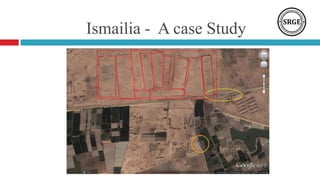
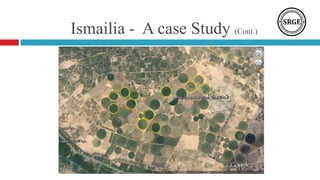
 Ismailia - A case Study.
Precision Agriculture (PA)
 An integrated information- and production-based farming system that is
designed to increase long term, site-specific and whole farm production
efficiency, productivity and profitability while minimizing unintended
impacts on wildlife and the environment.
 Precision Agriculture is NOT a Technology, it is a Management
Philosophy to respond to Spatial Variability.
PA History
The term precision agriculture appears to have been used first in 1990 as the
title of a workshop held in Great Falls, Montana, sponsored by Montana
State University. Before this, in the 80s, the terms ‘site-specific crop
management’ or ‘site-specific agriculture’.
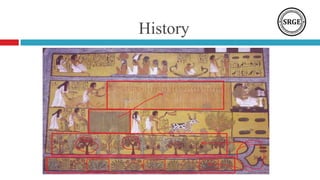
History
Precision agriculture issues
Precision agriculture aims to optimize field-level management with regard to:
• Crops:
Matching farming practices more closely to crop needs
(e.g. fertilizer inputs).
• Environmental protection:
Reducing environmental risks and footprint of farming
(e.g. limiting leaching of nitrogen);
• Economics:
Boosting competitiveness through more efficient practices
(e.g. Improved management of fertilizer usage and other inputs).
Precision agriculture issues
Precision agriculture also provides farmers with a wealth of information to:
• Build up a record of their farm.
• Improve decision-making.
• Foster greater traceability.
• Enhance marketing of farm products.
• Improve lease arrangements and relationship with landlords.
• Enhance the inherent quality of farm products. (e.g. protein level in bread-
flour wheat)
PA Stages and tools
Precision agriculture is a four-stage process using techniques to observe spatial
variability:
1- Geo-location of data:
Geo-locating a field enables the farmer to overlay information gathered from
analysis of soils and residual nitrogen, and information on previous crops and
soil resistivity.
Geo-location is done in two ways:
1- The field is outlined using an in-vehicle GPS receiver as the farmer drives a
tractor around the field.
2- The field is outlined on a base map derived from aerial or satellite imagery.
The base images must have the right level of resolution and geometric quality to
ensure that geo-location is sufficiently accurate.
PA Stages and tools (Cont.)
2- Characterizing variability:
 Field variability can result from:
 Climatic conditions (hail, drought, rain, etc. ).
 Soils (texture, depth, nitrogen levels).
 Cropping practices.
 Weeds and Disease.
This information may come from weather stations and other sensors (soil electrical
resistivity, detection with the naked eye, satellite imagery, etc.).
PA Stages and tools (Cont.)
3- Decision-making: 2 ways for dealing with variability
Using soil maps, farmers can pursue two strategies to adjust field inputs:
1- Predictive approach:
Based on analysis of static indicators (soil, resistivity, field history, etc.)
2- Control approach:
Information from static indicators is regularly updated during the crop cycle by:
• Sampling: weighing biomass, measuring leaf content, etc.
• Remote sensing: measuring parameters like temperature (air/soil), humidity (air/soil/leaf),
wind or stem diameter is possible thanks to Wireless Sensor Networks
• Aerial or satellite remote sensing: multispectral imagery is acquired and processed to derive
maps of crop biophysical parameters.
Decisions may be based on decision-support models (crop simulation models and recommendation
models), finally it is up to the farmer to decide in terms of business value and impacts on the environment.
PA Stages and tools (Cont.)
4- Implementing practices to address variability
Application of crop management decisions requires agricultural equipment that
supports variable-rate technology (VRT).
Precision agriculture uses technology on agricultural equipment (e.g. tractors, sprayers,
harvesters, etc.):
• GPS and DGPS.
• (GIS) geographic information systems.
i.e., software that makes sense of all the available data, variable-rate farming
equipment (seeder, spreader).
Current PA Trends
 Demand for high‐level GPS accuracy (few inches)
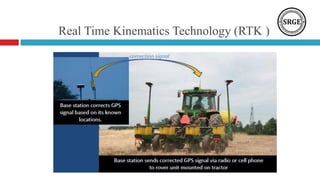
– Real Time Kinematics (RTK) Correction.
– Strip tillage, fertilizing, and planting.
 Input Management
– Precise fertilizer and pesticide application.
– Variable‐rate seeding.
 Solutions for information management
– Decision‐making.
– Utilizing yield data, zone creation.
Guidance
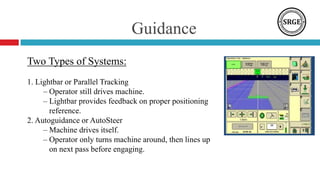
Two Types of Systems:
1. Lightbar or Parallel Tracking
– Operator still drives machine.
– Lightbar provides feedback on proper positioning
reference.
2. Autoguidance or AutoSteer
– Machine drives itself.
– Operator only turns machine around, then lines up
on next pass before engaging.
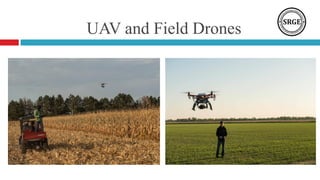
UAV and Field Drones
Real Time Kinematics Technology (RTK )
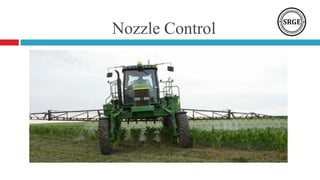
Nozzle Control
Variable‐Rate Technology (VRT)
• Any technology that enables the variable‐rate application of
agricultural inputs.
OR
• Technology which permits precise application control of inputs.
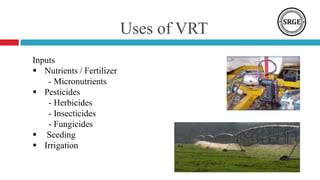
Uses of VRT
Inputs
 Nutrients / Fertilizer
- Micronutrients
 Pesticides
- Herbicides
- Insecticides
- Fungicides
 Seeding
 Irrigation
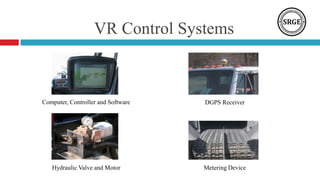
VR Control Systems
Computer, Controller and Software DGPS Receiver
Metering DeviceHydraulic Valve and Motor
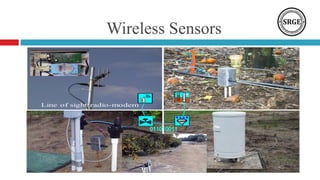
Wireless Sensors
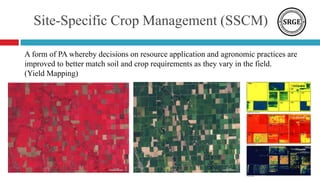
Site-Specific Crop Management (SSCM)
A form of PA whereby decisions on resource application and agronomic practices are
improved to better match soil and crop requirements as they vary in the field.
(Yield Mapping)
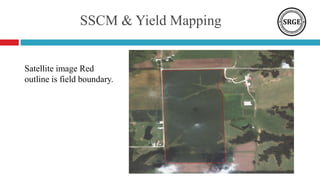
SSCM & Yield Mapping
Satellite image Red
outline is field boundary.
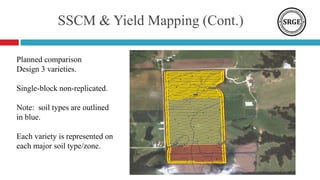
SSCM & Yield Mapping (Cont.)
Planned comparison
Design 3 varieties.
Single-block non-replicated.
Note: soil types are outlined
in blue.
Each variety is represented on
each major soil type/zone.
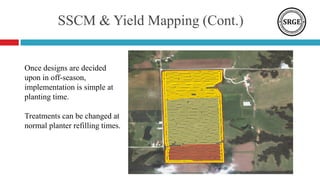
SSCM & Yield Mapping (Cont.)
Once designs are decided
upon in off-season,
implementation is simple at
planting time.
Treatments can be changed at
normal planter refilling times.
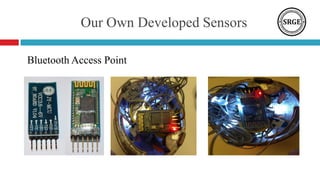
Our Own Developed Sensors
Bluetooth Access Point
Our Own Developed Sensors (Cont.)
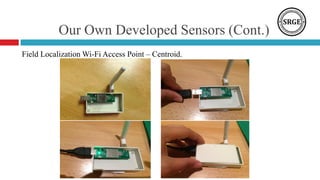
Field Localization Wi-Fi Access Point – Centroid.
Ismailia - A case Study
Ismailia - A case Study (Cont.)
PA - US
Future Directions
• Use of Augmented Reality.
• Reality Mining Services.
• Use of internet of Things.
• Use of Robotics and Cyber Organisms.
Thanks !

Precision agriculture

  • 1.
    PRECISION AGRICULTURE By Ammar Adl Facultyof Computers and Information Cairo Univ. Scientific Research Group in Egypt SRGE 8/4/2014 – Cairo Egypt
  • 2.
    Scientific Research Groupin Egypt www.egyptscience.net
  • 3.
    Overview  Precision Agriculture(PA)  PA Current Trends.  Variable‐Rate Technology (VRT).  Site-Specific Crop Management (SSCM).  Our Own Developed Sensors.  Ismailia - A case Study.
  • 4.
    Precision Agriculture (PA) An integrated information- and production-based farming system that is designed to increase long term, site-specific and whole farm production efficiency, productivity and profitability while minimizing unintended impacts on wildlife and the environment.  Precision Agriculture is NOT a Technology, it is a Management Philosophy to respond to Spatial Variability.
  • 5.
    PA History The termprecision agriculture appears to have been used first in 1990 as the title of a workshop held in Great Falls, Montana, sponsored by Montana State University. Before this, in the 80s, the terms ‘site-specific crop management’ or ‘site-specific agriculture’.
  • 6.
  • 7.
    Precision agriculture issues Precisionagriculture aims to optimize field-level management with regard to: • Crops: Matching farming practices more closely to crop needs (e.g. fertilizer inputs). • Environmental protection: Reducing environmental risks and footprint of farming (e.g. limiting leaching of nitrogen); • Economics: Boosting competitiveness through more efficient practices (e.g. Improved management of fertilizer usage and other inputs).
  • 8.
    Precision agriculture issues Precisionagriculture also provides farmers with a wealth of information to: • Build up a record of their farm. • Improve decision-making. • Foster greater traceability. • Enhance marketing of farm products. • Improve lease arrangements and relationship with landlords. • Enhance the inherent quality of farm products. (e.g. protein level in bread- flour wheat)
  • 9.
    PA Stages andtools Precision agriculture is a four-stage process using techniques to observe spatial variability: 1- Geo-location of data: Geo-locating a field enables the farmer to overlay information gathered from analysis of soils and residual nitrogen, and information on previous crops and soil resistivity. Geo-location is done in two ways: 1- The field is outlined using an in-vehicle GPS receiver as the farmer drives a tractor around the field. 2- The field is outlined on a base map derived from aerial or satellite imagery. The base images must have the right level of resolution and geometric quality to ensure that geo-location is sufficiently accurate.
  • 10.
    PA Stages andtools (Cont.) 2- Characterizing variability:  Field variability can result from:  Climatic conditions (hail, drought, rain, etc. ).  Soils (texture, depth, nitrogen levels).  Cropping practices.  Weeds and Disease. This information may come from weather stations and other sensors (soil electrical resistivity, detection with the naked eye, satellite imagery, etc.).
  • 11.
    PA Stages andtools (Cont.) 3- Decision-making: 2 ways for dealing with variability Using soil maps, farmers can pursue two strategies to adjust field inputs: 1- Predictive approach: Based on analysis of static indicators (soil, resistivity, field history, etc.) 2- Control approach: Information from static indicators is regularly updated during the crop cycle by: • Sampling: weighing biomass, measuring leaf content, etc. • Remote sensing: measuring parameters like temperature (air/soil), humidity (air/soil/leaf), wind or stem diameter is possible thanks to Wireless Sensor Networks • Aerial or satellite remote sensing: multispectral imagery is acquired and processed to derive maps of crop biophysical parameters. Decisions may be based on decision-support models (crop simulation models and recommendation models), finally it is up to the farmer to decide in terms of business value and impacts on the environment.
  • 12.
    PA Stages andtools (Cont.) 4- Implementing practices to address variability Application of crop management decisions requires agricultural equipment that supports variable-rate technology (VRT). Precision agriculture uses technology on agricultural equipment (e.g. tractors, sprayers, harvesters, etc.): • GPS and DGPS. • (GIS) geographic information systems. i.e., software that makes sense of all the available data, variable-rate farming equipment (seeder, spreader).
  • 13.
    Current PA Trends Demand for high‐level GPS accuracy (few inches) – Real Time Kinematics (RTK) Correction. – Strip tillage, fertilizing, and planting.  Input Management – Precise fertilizer and pesticide application. – Variable‐rate seeding.  Solutions for information management – Decision‐making. – Utilizing yield data, zone creation.
  • 14.
    Guidance Two Types ofSystems: 1. Lightbar or Parallel Tracking – Operator still drives machine. – Lightbar provides feedback on proper positioning reference. 2. Autoguidance or AutoSteer – Machine drives itself. – Operator only turns machine around, then lines up on next pass before engaging.
  • 15.
  • 16.
    Real Time KinematicsTechnology (RTK )
  • 17.
  • 18.
    Variable‐Rate Technology (VRT) •Any technology that enables the variable‐rate application of agricultural inputs. OR • Technology which permits precise application control of inputs.
  • 19.
    Uses of VRT Inputs Nutrients / Fertilizer - Micronutrients  Pesticides - Herbicides - Insecticides - Fungicides  Seeding  Irrigation
  • 20.
    VR Control Systems Computer,Controller and Software DGPS Receiver Metering DeviceHydraulic Valve and Motor
  • 21.
  • 22.
    Site-Specific Crop Management(SSCM) A form of PA whereby decisions on resource application and agronomic practices are improved to better match soil and crop requirements as they vary in the field. (Yield Mapping)
  • 23.
    SSCM & YieldMapping Satellite image Red outline is field boundary.
  • 24.
    SSCM & YieldMapping (Cont.) Planned comparison Design 3 varieties. Single-block non-replicated. Note: soil types are outlined in blue. Each variety is represented on each major soil type/zone.
  • 25.
    SSCM & YieldMapping (Cont.) Once designs are decided upon in off-season, implementation is simple at planting time. Treatments can be changed at normal planter refilling times.
  • 26.
    Our Own DevelopedSensors Bluetooth Access Point
  • 27.
    Our Own DevelopedSensors (Cont.) Field Localization Wi-Fi Access Point – Centroid.
  • 28.
    Ismailia - Acase Study
  • 29.
    Ismailia - Acase Study (Cont.)
  • 30.
  • 31.
    Future Directions • Useof Augmented Reality. • Reality Mining Services. • Use of internet of Things. • Use of Robotics and Cyber Organisms.
  • 32.