ICRAF Soil-Plant Spectral Diagnostics Laboratory
Kenya
Elvis Weullow
Soil analysis in your country
We have 1 spectral reference laboratory at World
Agroforestry (ICRAF) Nairobi that backstops partner labs
within Kenya e.g. Oneacrefund (Kakamega), KARLO labs at
NARL and Muguga and globally we technically backstop
and support 30 labs in 17 countries.
Are they ‘mobile’ laboratories?
We have build capacities for private companies offering mobile
testing services e.g. Agrocares, Crop Nutrition labs in Kenya.
The future of extension services relies on use of handheld
analytical devices.
Are soil test kits commonly used?
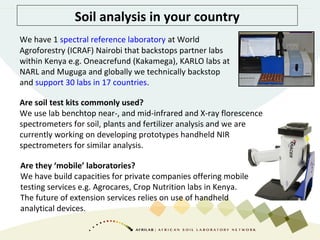
We use lab benchtop near-, and mid-infrared and X-ray florescence
spectrometers for soil, plants and fertilizer analysis and we are
currently working on developing prototypes handheld NIR
spectrometers for similar analysis.
Strength/weakness
What do you think your lab is strong at?
•Customized solutions –low cost, robust
• Standard operating procedures for field sampling, sample
preparation, spectral instrument use, data storage.
• Project planning (e.g. soil suitability mapping)
• Soil and plant health monitoring and precision agronomy.
•Spectral Technology Support
• Training and Advisory Services on spectral applications
• Spectral calibration development and use.
• Spectral Lab training, quality assurance and control.
• End-to-end Spectral to advisory support and software solutions for
application and management of spectra.
What do you think it could be improved?
•End-to-end spectral to advisory software solutions for specific use-cases (e.g.
fertilizer recommendations, soil erodibility assessment, input and product quality
testing and evaluation; spectroscopy for crop breeders).
•Low cost handhelds for field agents, stockists, blenders, aggregators.
What are your expectations out of this meeting and
GLOSOLAN?
•We think the use of dry spectroscopy methods, defined as the use of
spectroscopic techniques that directly analyse substances in a dry state or
without chemical pre-treatment using electromagnetic radiation sensors, could
present a new paradigm for development of new soil and plant diagnostic tests
•We seek to explore opportunities where spectroscopy methods, protocols and
data analysis can be standardized across globe as part of GLOSOLAN or global
soil spectroscopy network.
Thanks for your
attention
Thanks for your
attention

ICRAF: Soil-plant spectral diagnostics laboratory

  • 1.
    ICRAF Soil-Plant SpectralDiagnostics Laboratory Kenya Elvis Weullow
  • 2.
    Soil analysis inyour country We have 1 spectral reference laboratory at World Agroforestry (ICRAF) Nairobi that backstops partner labs within Kenya e.g. Oneacrefund (Kakamega), KARLO labs at NARL and Muguga and globally we technically backstop and support 30 labs in 17 countries. Are they ‘mobile’ laboratories? We have build capacities for private companies offering mobile testing services e.g. Agrocares, Crop Nutrition labs in Kenya. The future of extension services relies on use of handheld analytical devices. Are soil test kits commonly used? We use lab benchtop near-, and mid-infrared and X-ray florescence spectrometers for soil, plants and fertilizer analysis and we are currently working on developing prototypes handheld NIR spectrometers for similar analysis.
  • 3.
    Strength/weakness What do youthink your lab is strong at? •Customized solutions –low cost, robust • Standard operating procedures for field sampling, sample preparation, spectral instrument use, data storage. • Project planning (e.g. soil suitability mapping) • Soil and plant health monitoring and precision agronomy. •Spectral Technology Support • Training and Advisory Services on spectral applications • Spectral calibration development and use. • Spectral Lab training, quality assurance and control. • End-to-end Spectral to advisory support and software solutions for application and management of spectra. What do you think it could be improved? •End-to-end spectral to advisory software solutions for specific use-cases (e.g. fertilizer recommendations, soil erodibility assessment, input and product quality testing and evaluation; spectroscopy for crop breeders). •Low cost handhelds for field agents, stockists, blenders, aggregators.
  • 4.
    What are yourexpectations out of this meeting and GLOSOLAN? •We think the use of dry spectroscopy methods, defined as the use of spectroscopic techniques that directly analyse substances in a dry state or without chemical pre-treatment using electromagnetic radiation sensors, could present a new paradigm for development of new soil and plant diagnostic tests •We seek to explore opportunities where spectroscopy methods, protocols and data analysis can be standardized across globe as part of GLOSOLAN or global soil spectroscopy network.
  • 5.
  • 6.