Improving Food Security in West and East Africa through Capacity Building in Research
and Information Dissemination (Food Africa)
University of Nairobi
Strengthening Capacity for Diagnosis and
Management of Soil Micronutrient Deficiencies in
Sub-Saharan Africa for Improved Plant, Animal
and Human Nutrition
Esala Martti, Keith D. Shepherd, Mercy Nyambura, Riikka Keskinen and Michael Gatari
Healthy soils Healthy crops Healthy livestock Healthy people
Soil micronutrients important for plant (green dots), animal
(brown dots) and human nutrition (blue dots).
Micronutrient Problems
• Nutritional deficiencies” are responsible
for over 50% of years lived with
disability in children under five
• Nearly half of mortality in under-five’s
in developing countries is due to under-
nutrition,
• Underweight – Number-one contributor
to the burden of disease in Africa south
of the Sahara.
Poor soils, serious consequences
• In Sub-Saharan Africa, Multiple
secondary and micronutrients (SMN)
deficiencies are the norm - Se, I or
Co.
• High risk of failure of simple fertilizer
strategies – contributes to low
adoption.
• Asia and Africa lose 11% of GNP
every year owing to poor nutrition
• Africa soils less mineral rich than
Asia green revolution soils – need to
identify limiting factors.
Micronutrients In Africa
• Rapid and low cost analytical and diagnostic techniques that
can speed large area survey and problem prevalence
• Improved and well-targeted guidelines for managing key
micronutrient problems
• Scientific expertise in diagnosis and management of
micronutrient problems, especially in new analytical
techniques.
Capacity Development Needs
Building soil capacity to supply micronutrients to
crops is a key resilience strategy for:
Human and laboratory capacity for diagnosing, surveying and
managing soil nutrient deficiencies in Sub-Saharan is
woefully inadequate for the task (Swift & Shepherd, 2007).
1. To develop new, rapid, low cost soil-plant analytical
methods for diagnosing soil micronutrient deficiencies for
crop, livestock and human health.
2. To establish a baseline on soil micronutrient status in
sub-Saharan Africa soils.
3. To provide information for various stakeholders on
management strategies and options for tackling key
micronutrient deficiencies.
4. To strengthen African capacity on new science and
technology for soil-plant micronutrient analysis, diagnosis
and management.
Project Objectives
Sentinel site (100 km2):
-16 Clusters (1 km2).
-10 Randomly Selected Plots (1000 m2).
-4 sub plots at 0-20 and 20-50 cm depth
Geographical distribution of 60 sampling sites in
sub-Saharan Africa. The dots represent the
sampling locations.
www.africasoils.net
Ajumako site
The Project Approach
Land degradation surveillance Framework (LDSF) sampling design.
A spatially stratified, hierarchical, randomized sampling framework
• Minimized any local biases that may arise from convenience sampling.
• Modeled under medical diagnostics approaches it is built around a hierarchical field
survey and sampling protocol.
• Sentinel site (100 km2):
-16 Clusters (1 km2).
-10 Randomly Selected Plots (1000 m2).
-4 sub plots at 0-20 and 20-50 cm depth
• A total of 19000 top- and sub-soil samples
Soil Sampling
Total X-ray fluorescence spectroscopy X-ray diffraction spectroscopyInfrared spectroscopy
Spectral Fingerprinting Technologies
Portable Infrared and X-ray
spectroscopy
Getting the best out of light
• Light-based technology moving rapidly
towards portable and new spectral
metrics emerging that will replace
conventional soil guidelines.
• X-ray fluorescence (XRF) may be a
better measure of soils’ ability to supply
nutrients.
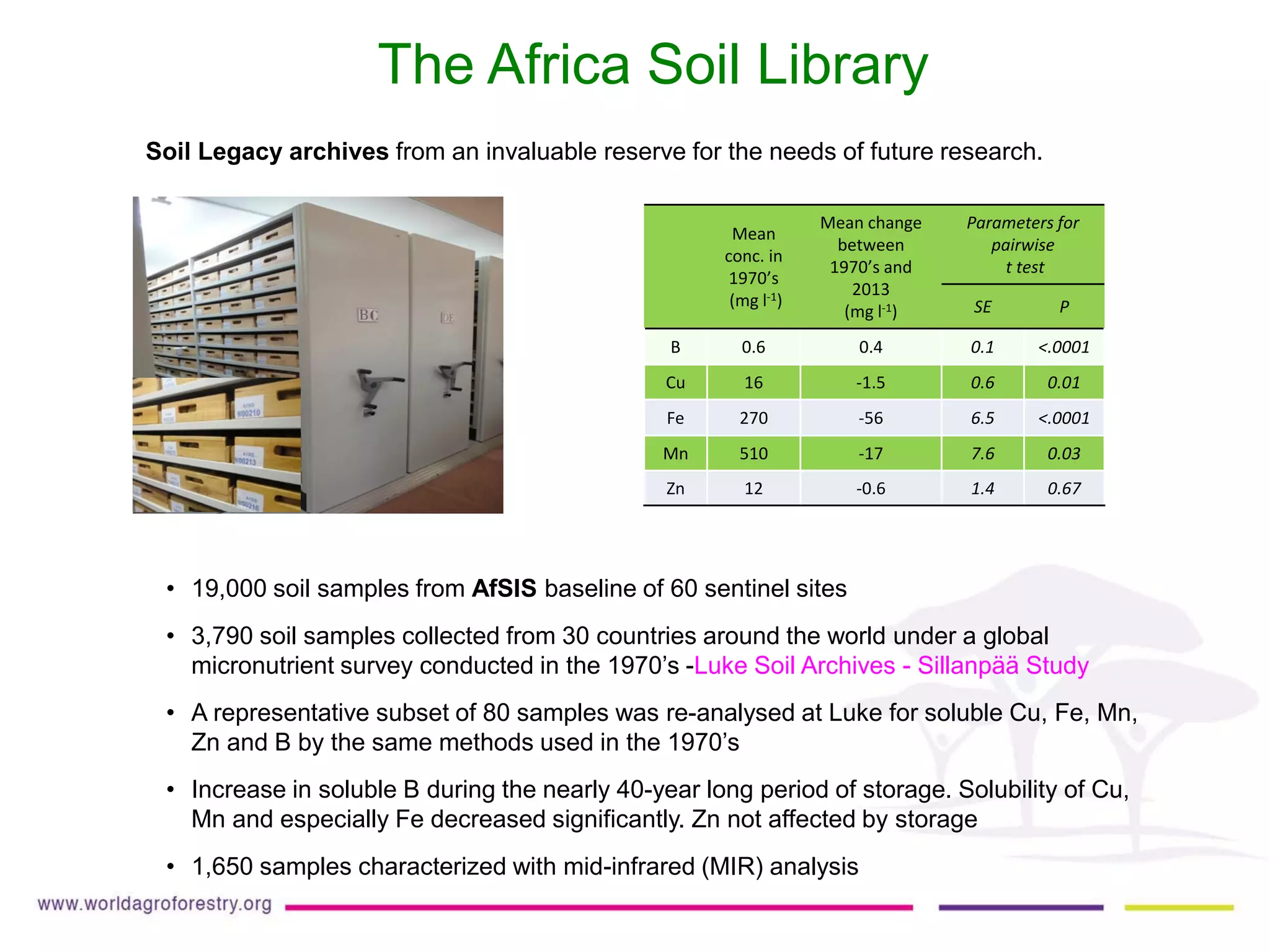
• 19,000 soil samples from AfSIS baseline of 60 sentinel sites
• 3,790 soil samples collected from 30 countries around the world under a global
micronutrient survey conducted in the 1970’s -Luke Soil Archives - Sillanpää Study
• A representative subset of 80 samples was re-analysed at Luke for soluble Cu, Fe, Mn,
Zn and B by the same methods used in the 1970’s
• Increase in soluble B during the nearly 40-year long period of storage. Solubility of Cu,
Mn and especially Fe decreased significantly. Zn not affected by storage
• 1,650 samples characterized with mid-infrared (MIR) analysis
Soil Legacy archives from an invaluable reserve for the needs of future research.
The Africa Soil Library
Mean
conc. in
1970’s
(mg l-1)
Mean change
between
1970’s and
2013
(mg l-1)
Parameters for
pairwise
t test
SE P
B 0.6 0.4 0.1 <.0001
Cu 16 -1.5 0.6 0.01
Fe 270 -56 6.5 <.0001
Mn 510 -17 7.6 0.03
Zn 12 -0.6 1.4 0.67
B Zn Mo
Micronutrient Africa Baseline
• No marked differences in the concentrations of the easily soluble elements between
topsoil and subsoil.
• Median concentrations of soluble Cu (1.3 mg l-1), Zn (0.8 mg l-1), B (0.4 mg l-1) and Fe
(64 mg l-1) in the topsoil-low relative to sufficiency guidelines for good crop growth.
• Using deficiency critical mid-points for Finnish soils as a guide, Africa topsoils have
deficiency prevalence values of Mn (8%), Fe (42%), Cu (48%), Zn (56%), and B (79%).
1
0
Theory and exploratory analysis of the Silanpaa data indicates pH, texture, and organic carbon are
important predictors of micronutrient soil test values and plant micronutrient uptake.
Spectral test can distinguish low, med and high value of plant Cu uptake ok. Standard tests only able
to pick out high uptake values and did not have much discrimination at low uptake levels.
Spectral methods could predict plant nutrient uptake potential and crop yield responses to applied
nutrients as well or better than soil tests based on soil extracts, or at least complement existing soil
tests.
Plant Micronutrient Uptake
Modelling plant micronutrient uptake from the Silanpaa pot experiment data
against soil test and MIR spectral data
Plant growth bioassays in test tubes for high
throughput diagnosis of soil macro and
micronutrient deficiencies.
Variability in response and risk are
ignored when making
recommendations
Calibrating relative yield response to soil tests
The huge missing link is testing and validation of plant nutrient uptake and crop response to
fertilizers in relation to soil tests.
Plant tissue analysis can be used to identify nutrient-related problems, rule out nutrition as the
source of a problem, monitor nutrient status as a basis for managing a crop fertility program
and/or, evaluate the effectiveness of a fertility program.
Plant growth potential and response to nutrients can quickly be measured this way and related to
IR spectra of the soils as well as to convectional soil tests.
B Zn Mo
Soil property Map of Africa
Ethiopia: current spatial
coverage of new ground
observations and
measurements
Probability topsoil
pH < 5.5 ... very acid soils
Africa Soil Information Service
www.africasoils.net
Develop micronutrient distribution maps to assist African governments, development
organizations and donors to focus on most promising strategies for alleviating the
most urgent soil and crop micronutrient problems –e.g. EthioSIS, TanSIS
Decision-making in agricultural development occurs in an environment
characterized by risk, uncertainty and imperfect information.
• Farmers, local- and national governments face big challenges in
deciding on optimal soil fertility management strategies.
• Crop production depends on applied fertiliser, however, soil testing
is used sparingly as a tool to underpin fertilizer decision in Africa.
Implications for Food Africa
Support to CGIAR, NGO and private sector projects with advice
and protocols for soil and plant analysis to facilitate the process
of establishing soil test values that will act as a guide to risk of
deficiency and field trials to validate crop response trials. e.g.
capacity development and spectral lab networks
•IAMM, Mozambique
•AfSIS, Sotuba, Mali
•AfSIS, Salien, Tanzania
•AfSIS, Chitedze, Malawi
•CNLS, Nairobi, Kenya
•SoilCares, Kenya
•IISS, Bhopal, India
•China
•ATA, Addis Ababa, Ethiopia (6)
•CNRA, Abidjan, Cote D’Ivoire
•KARI, Nairobi, Kenya
•ICRAF, Yaounde, Cameroon
•IAR&T, Obafemi Awolowo
University, Ibadan, Nigeria
•IAR, Zaria, Nigeria
•FMARD, Nigeria
•IITA, Ibadan, Nigeria
•IITA, Yaounde, Cameroon
•SARI, Salien, Tanzania
Soil-Plant Spectroscopy
Support Group
2 PhD and 5 MSc studentships
and training/exchange between
ICRAF, University of Nairobi, Luke
and James Hutton Institute
Over 400 visitors to ICRAF
Spectral Diagnostics Lab
Training for agricultural officers in
47 counties in Kenya through
ChromAfrica LLC
Support to other projects:
-Optimizing Fertilizer Recommendations
in Africa (OFRA)
-Transformation of agronomic research
and delivery services for smallholder
farmers in maize-based systems of Sub-
Saharan Africa (TAMASA)
Africa Spectral Lab Network/Outreach
Implications for Food Africa
Most smallholders farmers have access to only NPK fertilizers (the
macro-nutrients)
Preference for site specific soil diagnosis and
develop fertilizer recommendation blends for
Africa’s farmers
• NPK + secondary nutrients, and micronutrients for
efficiency and greater yields
• Addressing deficiencies for improving smallholder crop
and livestock productivity and reducing risks of
technology failure (e.g. NPK fertilizer use)-provide
value for inputs.
• Targeted for regional production capabilities for
fertiliser companies dealing with blending for more
targeted supply of appropriate fertilizers for different
regions
Exploring regional availability of ingredients for small holders options for
addressing micronutrient deficiencies using organic resources (manures,
composts, urban wastes) and lower likelihood of imbalances, toxic effects
S
When we supply NPK—
what about other
nutrients?
Soil data analytics in agronomic trials for
Advisory services to farmers and extension
agents to address micronutrient deficiencies
that affect crop growth and yield, and
agronomic practices that will reduce
micronutrient deficiencies..e.g. One acre
fund, OFRA, Gates Crop Agronomy, Soil
Cares and rural resource centre's.
Leibig’s law of the minimum:
Growth is controlled by the scarcest resource
Implications for Food Africa
Thank you
1
7

FoodAfrica seminar presentation WP1, Mercy Nyambura

  • 1.
    Improving Food Securityin West and East Africa through Capacity Building in Research and Information Dissemination (Food Africa) University of Nairobi Strengthening Capacity for Diagnosis and Management of Soil Micronutrient Deficiencies in Sub-Saharan Africa for Improved Plant, Animal and Human Nutrition Esala Martti, Keith D. Shepherd, Mercy Nyambura, Riikka Keskinen and Michael Gatari
  • 2.
    Healthy soils Healthycrops Healthy livestock Healthy people Soil micronutrients important for plant (green dots), animal (brown dots) and human nutrition (blue dots). Micronutrient Problems • Nutritional deficiencies” are responsible for over 50% of years lived with disability in children under five • Nearly half of mortality in under-five’s in developing countries is due to under- nutrition, • Underweight – Number-one contributor to the burden of disease in Africa south of the Sahara.
  • 3.
    Poor soils, seriousconsequences • In Sub-Saharan Africa, Multiple secondary and micronutrients (SMN) deficiencies are the norm - Se, I or Co. • High risk of failure of simple fertilizer strategies – contributes to low adoption. • Asia and Africa lose 11% of GNP every year owing to poor nutrition • Africa soils less mineral rich than Asia green revolution soils – need to identify limiting factors. Micronutrients In Africa
  • 4.
    • Rapid andlow cost analytical and diagnostic techniques that can speed large area survey and problem prevalence • Improved and well-targeted guidelines for managing key micronutrient problems • Scientific expertise in diagnosis and management of micronutrient problems, especially in new analytical techniques. Capacity Development Needs Building soil capacity to supply micronutrients to crops is a key resilience strategy for: Human and laboratory capacity for diagnosing, surveying and managing soil nutrient deficiencies in Sub-Saharan is woefully inadequate for the task (Swift & Shepherd, 2007).
  • 5.
    1. To developnew, rapid, low cost soil-plant analytical methods for diagnosing soil micronutrient deficiencies for crop, livestock and human health. 2. To establish a baseline on soil micronutrient status in sub-Saharan Africa soils. 3. To provide information for various stakeholders on management strategies and options for tackling key micronutrient deficiencies. 4. To strengthen African capacity on new science and technology for soil-plant micronutrient analysis, diagnosis and management. Project Objectives
  • 6.
    Sentinel site (100km2): -16 Clusters (1 km2). -10 Randomly Selected Plots (1000 m2). -4 sub plots at 0-20 and 20-50 cm depth Geographical distribution of 60 sampling sites in sub-Saharan Africa. The dots represent the sampling locations. www.africasoils.net Ajumako site The Project Approach
  • 7.
    Land degradation surveillanceFramework (LDSF) sampling design. A spatially stratified, hierarchical, randomized sampling framework • Minimized any local biases that may arise from convenience sampling. • Modeled under medical diagnostics approaches it is built around a hierarchical field survey and sampling protocol. • Sentinel site (100 km2): -16 Clusters (1 km2). -10 Randomly Selected Plots (1000 m2). -4 sub plots at 0-20 and 20-50 cm depth • A total of 19000 top- and sub-soil samples Soil Sampling
  • 8.
    Total X-ray fluorescencespectroscopy X-ray diffraction spectroscopyInfrared spectroscopy Spectral Fingerprinting Technologies Portable Infrared and X-ray spectroscopy Getting the best out of light • Light-based technology moving rapidly towards portable and new spectral metrics emerging that will replace conventional soil guidelines. • X-ray fluorescence (XRF) may be a better measure of soils’ ability to supply nutrients.
  • 9.
    • 19,000 soilsamples from AfSIS baseline of 60 sentinel sites • 3,790 soil samples collected from 30 countries around the world under a global micronutrient survey conducted in the 1970’s -Luke Soil Archives - Sillanpää Study • A representative subset of 80 samples was re-analysed at Luke for soluble Cu, Fe, Mn, Zn and B by the same methods used in the 1970’s • Increase in soluble B during the nearly 40-year long period of storage. Solubility of Cu, Mn and especially Fe decreased significantly. Zn not affected by storage • 1,650 samples characterized with mid-infrared (MIR) analysis Soil Legacy archives from an invaluable reserve for the needs of future research. The Africa Soil Library Mean conc. in 1970’s (mg l-1) Mean change between 1970’s and 2013 (mg l-1) Parameters for pairwise t test SE P B 0.6 0.4 0.1 <.0001 Cu 16 -1.5 0.6 0.01 Fe 270 -56 6.5 <.0001 Mn 510 -17 7.6 0.03 Zn 12 -0.6 1.4 0.67
  • 10.
    B Zn Mo MicronutrientAfrica Baseline • No marked differences in the concentrations of the easily soluble elements between topsoil and subsoil. • Median concentrations of soluble Cu (1.3 mg l-1), Zn (0.8 mg l-1), B (0.4 mg l-1) and Fe (64 mg l-1) in the topsoil-low relative to sufficiency guidelines for good crop growth. • Using deficiency critical mid-points for Finnish soils as a guide, Africa topsoils have deficiency prevalence values of Mn (8%), Fe (42%), Cu (48%), Zn (56%), and B (79%).
  • 11.
    1 0 Theory and exploratoryanalysis of the Silanpaa data indicates pH, texture, and organic carbon are important predictors of micronutrient soil test values and plant micronutrient uptake. Spectral test can distinguish low, med and high value of plant Cu uptake ok. Standard tests only able to pick out high uptake values and did not have much discrimination at low uptake levels. Spectral methods could predict plant nutrient uptake potential and crop yield responses to applied nutrients as well or better than soil tests based on soil extracts, or at least complement existing soil tests. Plant Micronutrient Uptake Modelling plant micronutrient uptake from the Silanpaa pot experiment data against soil test and MIR spectral data
  • 12.
    Plant growth bioassaysin test tubes for high throughput diagnosis of soil macro and micronutrient deficiencies. Variability in response and risk are ignored when making recommendations Calibrating relative yield response to soil tests The huge missing link is testing and validation of plant nutrient uptake and crop response to fertilizers in relation to soil tests. Plant tissue analysis can be used to identify nutrient-related problems, rule out nutrition as the source of a problem, monitor nutrient status as a basis for managing a crop fertility program and/or, evaluate the effectiveness of a fertility program. Plant growth potential and response to nutrients can quickly be measured this way and related to IR spectra of the soils as well as to convectional soil tests.
  • 13.
    B Zn Mo Soilproperty Map of Africa Ethiopia: current spatial coverage of new ground observations and measurements Probability topsoil pH < 5.5 ... very acid soils Africa Soil Information Service www.africasoils.net Develop micronutrient distribution maps to assist African governments, development organizations and donors to focus on most promising strategies for alleviating the most urgent soil and crop micronutrient problems –e.g. EthioSIS, TanSIS
  • 14.
    Decision-making in agriculturaldevelopment occurs in an environment characterized by risk, uncertainty and imperfect information. • Farmers, local- and national governments face big challenges in deciding on optimal soil fertility management strategies. • Crop production depends on applied fertiliser, however, soil testing is used sparingly as a tool to underpin fertilizer decision in Africa. Implications for Food Africa Support to CGIAR, NGO and private sector projects with advice and protocols for soil and plant analysis to facilitate the process of establishing soil test values that will act as a guide to risk of deficiency and field trials to validate crop response trials. e.g. capacity development and spectral lab networks
  • 15.
    •IAMM, Mozambique •AfSIS, Sotuba,Mali •AfSIS, Salien, Tanzania •AfSIS, Chitedze, Malawi •CNLS, Nairobi, Kenya •SoilCares, Kenya •IISS, Bhopal, India •China •ATA, Addis Ababa, Ethiopia (6) •CNRA, Abidjan, Cote D’Ivoire •KARI, Nairobi, Kenya •ICRAF, Yaounde, Cameroon •IAR&T, Obafemi Awolowo University, Ibadan, Nigeria •IAR, Zaria, Nigeria •FMARD, Nigeria •IITA, Ibadan, Nigeria •IITA, Yaounde, Cameroon •SARI, Salien, Tanzania Soil-Plant Spectroscopy Support Group 2 PhD and 5 MSc studentships and training/exchange between ICRAF, University of Nairobi, Luke and James Hutton Institute Over 400 visitors to ICRAF Spectral Diagnostics Lab Training for agricultural officers in 47 counties in Kenya through ChromAfrica LLC Support to other projects: -Optimizing Fertilizer Recommendations in Africa (OFRA) -Transformation of agronomic research and delivery services for smallholder farmers in maize-based systems of Sub- Saharan Africa (TAMASA) Africa Spectral Lab Network/Outreach
  • 16.
    Implications for FoodAfrica Most smallholders farmers have access to only NPK fertilizers (the macro-nutrients) Preference for site specific soil diagnosis and develop fertilizer recommendation blends for Africa’s farmers • NPK + secondary nutrients, and micronutrients for efficiency and greater yields • Addressing deficiencies for improving smallholder crop and livestock productivity and reducing risks of technology failure (e.g. NPK fertilizer use)-provide value for inputs. • Targeted for regional production capabilities for fertiliser companies dealing with blending for more targeted supply of appropriate fertilizers for different regions Exploring regional availability of ingredients for small holders options for addressing micronutrient deficiencies using organic resources (manures, composts, urban wastes) and lower likelihood of imbalances, toxic effects
  • 17.
    S When we supplyNPK— what about other nutrients? Soil data analytics in agronomic trials for Advisory services to farmers and extension agents to address micronutrient deficiencies that affect crop growth and yield, and agronomic practices that will reduce micronutrient deficiencies..e.g. One acre fund, OFRA, Gates Crop Agronomy, Soil Cares and rural resource centre's. Leibig’s law of the minimum: Growth is controlled by the scarcest resource Implications for Food Africa
  • 18.