Transforming Lives and Landscapes with Trees
Phosiso Sola, PhD; World Agroforestry (ICRAF)
And DryDev Team
Dryland Development Programme (DryDev)
Close out Webinar
30th June 2020
Transforming Lives and Landscapes with Trees
The programme
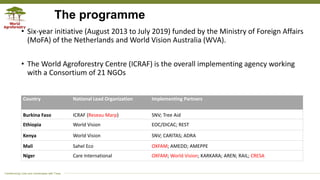
• Six-year initiative (August 2013 to July 2019) funded by the Ministry of Foreign Affairs
(MoFA) of the Netherlands and World Vision Australia (WVA).
• The World Agroforestry Centre (ICRAF) is the overall implementing agency working
with a Consortium of 21 NGOs
Country National Lead Organization Implementing Partners
Burkina Faso ICRAF (Reseau Marp) SNV; Tree Aid
Ethiopia World Vision EOC/DICAC; REST
Kenya World Vision SNV; CARITAS; ADRA
Mali Sahel Eco OXFAM; AMEDD; AMEPPE
Niger Care International OXFAM; World Vision; KARKARA; AREN; RAIL; CRESA
Transforming Lives and Landscapes with Trees
The programme
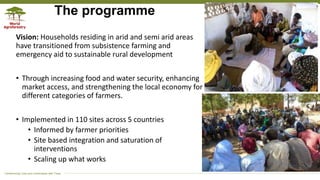
Vision: Households residing in arid and semi arid areas
have transitioned from subsistence farming and
emergency aid to sustainable rural development
• Through increasing food and water security, enhancing
market access, and strengthening the local economy for
different categories of farmers.
• Implemented in 110 sites across 5 countries
• Informed by farmer priorities
• Site based integration and saturation of
interventions
• Scaling up what works
Transforming Lives and Landscapes with Trees
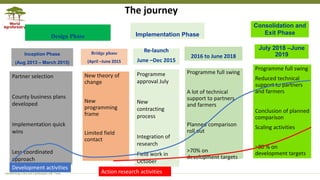
The journey
Inception Phase
(Aug 2013 – March 2015)
Implementation Phase
New theory of
change
New
programming
frame
Limited field
contact
Bridge phase
(April –June 2015
Programme full swing
A lot of technical
support to partners
and farmers
Planned comparison
roll out
>70% on
development targets
Re-launch
June –Dec 2015
2016 to June 2018
Design Phase
Partner selection
County business plans
developed
Implementation quick
wins
Less coordinated
approach
Programme
approval July
New
contracting
process
Integration of
research
Field work in
October
Consolidation and
Exit Phase
Programme full swing
Reduced technical
support to partners
and farmers
Conclusion of planned
comparison
Scaling activities
>80 % on
development targets
July 2018 –June
2019
Development activities
Action research activities
Transforming Lives and Landscapes with Trees
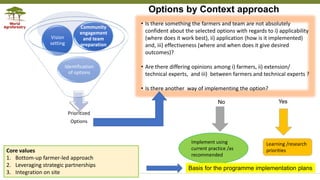
Options by Context approach
Learning /research
priorities
Yes
Implement using
current practice /as
recommended
No
• Is there something the farmers and team are not absolutely
confident about the selected options with regards to i) applicability
(where does it work best), ii) application (how is it implemented)
and, iii) effectiveness (where and when does it give desired
outcomes)?
• Are there differing opinions among i) farmers, ii) extension/
technical experts, and iii) between farmers and technical experts ?
• Is there another way of implementing the option?
Prioritized
Options
Identification
of options
Vision
setting
Community
engagement
and team
preparation
Basis for the programme implementation plans
Core values
1. Bottom-up farmer-led approach
2. Leveraging strategic partnerships
3. Integration on site
Transforming Lives and Landscapes with Trees
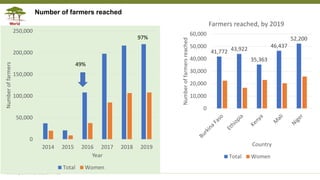
Number of farmers reached
0
50,000
100,000
150,000
200,000
250,000
2014 2015 2016 2017 2018 2019
Numberoffarmers
Year
Total Women
41,772 43,922
35,363
46,437
52,200
0
10,000
20,000
30,000
40,000
50,000
60,000
Numberoffarmersreached
Country
Farmers reached, by 2019
Total Women
49%
97%
Transforming Lives and Landscapes with Trees
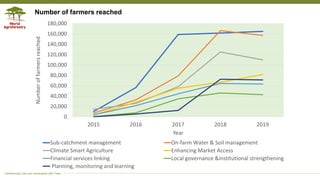
Number of farmers reached
0
20,000
40,000
60,000
80,000
100,000
120,000
140,000
160,000
180,000
2015 2016 2017 2018 2019
Numberoffarmersreached
Year
Sub-catchment management On-farm Water & Soil management
Climate Smart Agriculture Enhancing Market Access
Financial services linking Local governance &institutional strengthening
Planning, monitoring and learning
Transforming Lives and Landscapes with Trees
Overview of achievements
Outcome 1: Increased water capture & soil conservation/ fertility at
sub catchment & farm levels
Transforming Lives and Landscapes with Trees
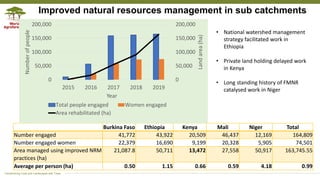
Improved natural resources management in sub catchments
Burkina Faso Ethiopia Kenya Mali Niger Total
Number engaged 41,772 43,922 20,509 46,437 12,169 164,809
Number engaged women 22,379 16,690 9,199 20,328 5,905 74,501
Area managed using improved NRM
practices (ha)
21,087.8 50,711 13,472 27,558 50,917 163,745.55
Average per person (ha) 0.50 1.15 0.66 0.59 4.18 0.99
0
50,000
100,000
150,000
200,000
0
50,000
100,000
150,000
200,000
2015 2016 2017 2018 2019
Landarea(ha)
Numberofpeople
Year
Total people engaged Women engaged
Area rehabilitated (ha)
• National watershed management
strategy facilitated work in
Ethiopia
• Private land holding delayed work
in Kenya
• Long standing history of FMNR
catalysed work in Niger
Transforming Lives and Landscapes with Trees
Burkina Faso Niger
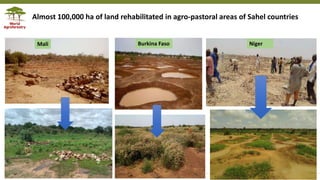
Almost 100,000 ha of land rehabilitated in agro-pastoral areas of Sahel countries
Mali
Transforming Lives and Landscapes with Trees
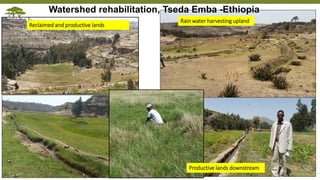
Watershed rehabilitation, Tseda Emba -Ethiopia
Rain water harvesting upland
Reclaimed and productive lands
Productive lands downstream
Transforming Lives and Landscapes with Trees
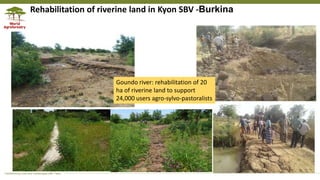
Rehabilitation of riverine land in Kyon SBV -Burkina
Goundo river: rehabilitation of 20
ha of riverine land to support
24,000 users agro-sylvo-pastoralists
Transforming Lives and Landscapes with Trees
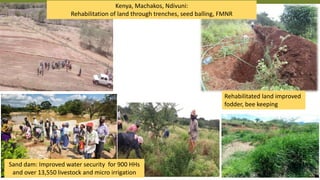
Kenya, Machakos, Ndivuni:
Rehabilitation of land through trenches, seed balling, FMNR
Rehabilitated land improved
fodder, bee keeping
Sand dam: Improved water security for 900 HHs
and over 13,550 livestock and micro irrigation
Transforming Lives and Landscapes with Trees
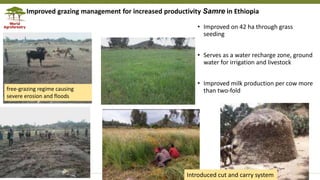
Improved grazing management for increased productivity Samre in Ethiopia
free-grazing regime causing
severe erosion and floods
Introduced cut and carry system
• Improved on 42 ha through grass
seeding
• Serves as a water recharge zone, ground
water for irrigation and livestock
• Improved milk production per cow more
than two-fold
Transforming Lives and Landscapes with Trees
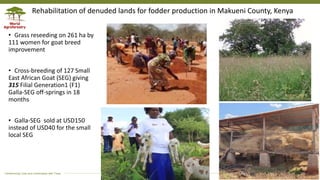
• Grass reseeding on 261 ha by
111 women for goat breed
improvement
• Cross-breeding of 127 Small
East African Goat (SEG) giving
315 Filial Generation1 (F1)
Galla-SEG off-springs in 18
months
• Galla-SEG sold at USD150
instead of USD40 for the small
local SEG
Rehabilitation of denuded lands for fodder production in Makueni County, Kenya
Transforming Lives and Landscapes with Trees
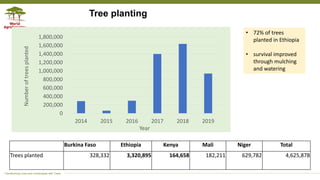
Tree planting
Burkina Faso Ethiopia Kenya Mali Niger Total
Trees planted 328,332 3,320,895 164,658 182,211 629,782 4,625,878
0
200,000
400,000
600,000
800,000
1,000,000
1,200,000
1,400,000
1,600,000
1,800,000
2014 2015 2016 2017 2018 2019
Numberoftreesplanted
Year
• 72% of trees
planted in Ethiopia
• survival improved
through mulching
and watering
Transforming Lives and Landscapes with Trees
Overview of achievements
Outcome 2: Increased production of profitable, climate‐smart
commodities & food crops
Transforming Lives and Landscapes with Trees
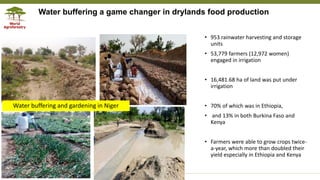
• 953 rainwater harvesting and storage
units
• 53,779 farmers (12,972 women)
engaged in irrigation
• 16,481.68 ha of land was put under
irrigation
• 70% of which was in Ethiopia,
• and 13% in both Burkina Faso and
Kenya
• Farmers were able to grow crops twice-
a-year, which more than doubled their
yield especially in Ethiopia and Kenya
Water buffering and gardening in Niger
Water buffering a game changer in drylands food production
Transforming Lives and Landscapes with Trees
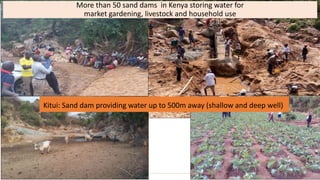
More than 50 sand dams in Kenya storing water for
market gardening, livestock and household use
Kitui: Sand dam providing water up to 500m away (shallow and deep well)
Transforming Lives and Landscapes with Trees
Burkina Faso
Mali
Ethiopia
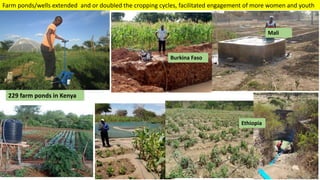
229 farm ponds in Kenya
Farm ponds/wells extended and or doubled the cropping cycles, facilitated engagement of more women and youth
Transforming Lives and Landscapes with Trees
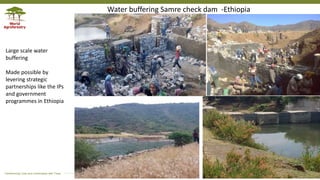
Water buffering Samre check dam -Ethiopia
Large scale water
buffering
Made possible by
levering strategic
partnerships like the IPs
and government
programmes in Ethiopia
Transforming Lives and Landscapes with Trees
Soil and water conservation (SWC) key in dryland farming
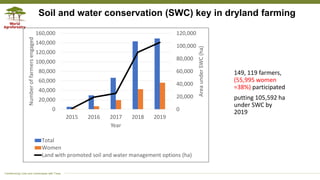
149, 119 farmers,
(55,995 women
=38%) participated
putting 105,592 ha
under SWC by
20190
20,000
40,000
60,000
80,000
100,000
120,000
0
20,000
40,000
60,000
80,000
100,000
120,000
140,000
160,000
2015 2016 2017 2018 2019
AreaunderSWC(ha)
Numberoffarmersengaged
Year
Total
Women
Land with promoted soil and water management options (ha)
Transforming Lives and Landscapes with Trees
Soil and water conservation (SWC) key in dryland farming
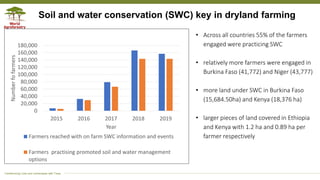
• Across all countries 55% of the farmers
engaged were practicing SWC
• relatively more farmers were engaged in
Burkina Faso (41,772) and Niger (43,777)
• more land under SWC in Burkina Faso
(15,684.50ha) and Kenya (18,376 ha)
• larger pieces of land covered in Ethiopia
and Kenya with 1.2 ha and 0.89 ha per
farmer respectively
0
20,000
40,000
60,000
80,000
100,000
120,000
140,000
160,000
180,000
2015 2016 2017 2018 2019
Numberfofarmers
Year
Farmers reached with on farm SWC information and events
Farmers practising promoted soil and water management
options
Transforming Lives and Landscapes with Trees
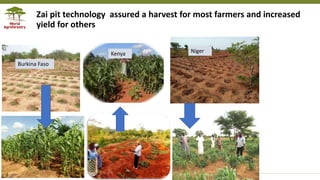
Zai pit technology assured a harvest for most farmers and increased
yield for others
NigerKenya
Burkina Faso
Transforming Lives and Landscapes with Trees
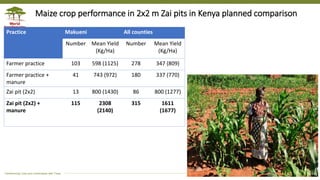
Maize crop performance in 2x2 m Zai pits in Kenya planned comparison
Practice Makueni All counties
Number Mean Yield
(Kg/Ha)
Number Mean Yield
(Kg/Ha)
Farmer practice 103 598 (1125) 278 347 (809)
Farmer practice +
manure
41 743 (972) 180 337 (770)
Zai pit (2x2) 13 800 (1430) 86 800 (1277)
Zai pit (2x2) +
manure
115 2308
(2140)
315 1611
(1677)
Transforming Lives and Landscapes with Trees
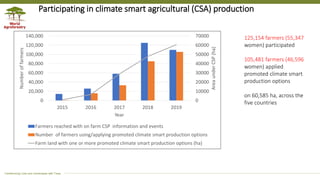
Participating in climate smart agricultural (CSA) production
125,154 farmers (55,347
women) participated
105,481 farmers (46,596
women) applied
promoted climate smart
production options
on 60,585 ha, across the
five countries0
10000
20000
30000
40000
50000
60000
70000
0
20,000
40,000
60,000
80,000
100,000
120,000
140,000
2015 2016 2017 2018 2019
AreaunderCSP(ha)
Numberoffarmers
Year
Farmers reached with on farm CSP information and events
Number of farmers using/applying promoted climate smart production options
Farm land with one or more promoted climate smart production options (ha)
Transforming Lives and Landscapes with Trees
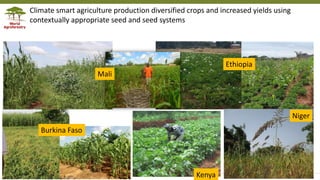
Climate smart agriculture production diversified crops and increased yields using
contextually appropriate seed and seed systems
Kenya
Niger
Burkina Faso
Ethiopia
Mali
Transforming Lives and Landscapes with Trees
Overview of achievements
Outcome 3: Increased sales of targeted value chain commodities by
male, female, and vulnerable
Transforming Lives and Landscapes with Trees
Increased participation of male, female and disadvantaged farmers in lucrative value
chains
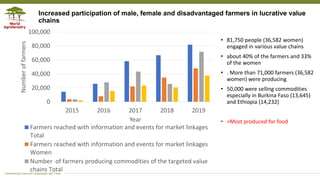
• 81,750 people (36,582 women)
engaged in various value chains
• about 40% of the farmers and 33%
of the women
• . More than 71,000 farmers (36,582
women) were producing
• 50,000 were selling commodities
especially in Burkina Faso (13,645)
and Ethiopia (14,232)
• =Most produced for food
0
20,000
40,000
60,000
80,000
100,000
2015 2016 2017 2018 2019
Numberoffarmers
Year
Farmers reached with information and events for market linkages
Total
Farmers reached with information and events for market linkages
Women
Number of farmers producing commodities of the targeted value
chains Total
Transforming Lives and Landscapes with Trees
#Farmers reached
Total W
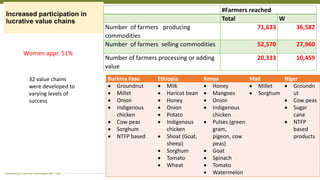
Number of farmers producing
commodities
71,633 36,582
Number of farmers selling commodities 52,570 27,960
Number of farmers processing or adding
value
20,333 10,459
32 value chains
were developed to
varying levels of
success
Burkina Faso Ethiopia Kenya Mali Niger
 Groundnut
 Millet
 Onion
 Indigenous
chicken
 Cow peas
 Sorghum
 NTFP based
 Milk
 Haricot bean
 Honey
 Onion
 Potato
 Indigenous
chicken
 Shoat (Goat,
sheep)
 Sorghum
 Tomato
 Wheat
 Honey
 Mangoes
 Onion
 Indigenous
chicken
 Pulses (green
gram,
pigeon, cow
peas)
 Goat
 Spinach
 Tomato
 Watermelon
 Millet
 Sorghum
 Groundn
ut
 Cow peas
 Sugar
cane
 NTFP
based
products
Women appr. 51%
Increased participation in
lucrative value chains
Transforming Lives and Landscapes with Trees
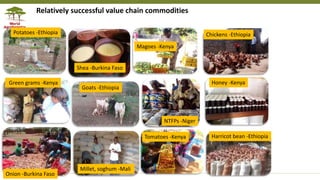
Relatively successful value chain commodities
Potatoes -Ethiopia
Shea -Burkina Faso
Honey -Kenya
Goats -Ethiopia
Harricot bean -Ethiopia
NTFPs -Niger
Green grams -Kenya
Magoes -Kenya
Chickens -Ethiopia
Onion -Burkina Faso
Millet, soghum -Mali
Tomatoes -Kenya
Transforming Lives and Landscapes with Trees
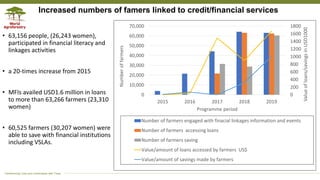
Increased numbers of famers linked to credit/financial services
• 63,156 people, (26,243 women),
participated in financial literacy and
linkages activities
• a 20-times increase from 2015
• MFIs availed USD1.6 million in loans
to more than 63,266 farmers (23,310
women)
• 60,525 farmers (30,207 women) were
able to save with financial institutions
including VSLAs.
0
200
400
600
800
1000
1200
1400
1600
1800
0
10,000
20,000
30,000
40,000
50,000
60,000
70,000
2015 2016 2017 2018 2019
Valueofloans/savingsinUSD1000
Numberoffarmers
Programme period
Number of farmers engaged with finacial linkages information and events
Number of farmers accessing loans
Number of farmers saving
Value/amount of loans accessed by farmers US$
Value/amount of savings made by farmers
Transforming Lives and Landscapes with Trees
Overview of achievements
Outcome 4: Improved local governance & institutional
functioning
Transforming Lives and Landscapes with Trees
0
10
20
30
40
50
60
70
0
20,000
40,000
60,000
80,000
100,000
120,000
2016 2017 2018 2019
%farmers
Numberoffarmers
Year
Chart Title
Number of farmers in FO
Number of people engaged in institutional capacity building
% farmers in farmer orgnisation
% women in farmer organisations
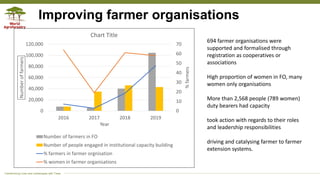
Improving farmer organisations
694 farmer organisations were
supported and formalised through
registration as cooperatives or
associations
High proportion of women in FO, many
women only organisations
More than 2,568 people (789 women)
duty bearers had capacity
took action with regards to their roles
and leadership responsibilities
driving and catalysing farmer to farmer
extension systems.
Transforming Lives and Landscapes with Trees
0 10 20 30 40
Improved compliance, certificate renewal, by law review
Increased membership, new groups, active participation
Clarity of roles, reduced conflict, more cohesion, trust
Increased participation, transparency and accountability
Improved leadership, group management
More investment/benefits, grant, loan, contributions
Activity diversification, goats, pultry, grass, treep planting,
terraces/zai pits
Vision setting, planning , record keeping, financial
management
% Respondents in Kenya
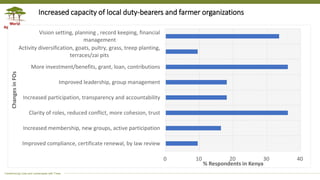
ChangesinFOs Increased capacity of local duty-bearers and farmer organizations
Transforming Lives and Landscapes with Trees
Overview of achievements
Outcome 5: Critical mass of development actors motivated, able, and resourced to
support/directly implement evidenced options
Transforming Lives and Landscapes with Trees
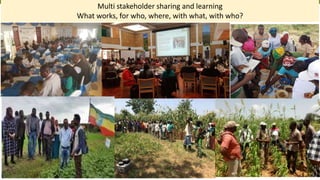
Multi stakeholder sharing and learning
What works, for who, where, with what, with who?
Transforming Lives and Landscapes with Trees
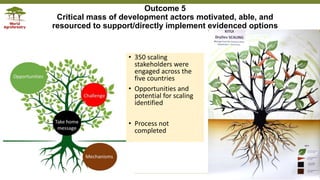
Outcome 5
Critical mass of development actors motivated, able, and
resourced to support/directly implement evidenced options
• 350 scaling
stakeholders were
engaged across the
five countries
• Opportunities and
potential for scaling
identified
• Process not
completed
Transforming Lives and Landscapes with Trees
Outcome 6
More supportive/appropriate policies & wider conducive institutional
environment for wide uptake of evidence
In the Sahel countries contributed to
• improvements in land tenure security,
• revitalization of land tenure commissions (CoFo) at village levels.
Kenya the main achievement
• domesticating the Water Act that empowers Water Resource Users Associations
• formation of village and ward level development committees and stakeholder forums for
improved coordination, cooperation and service delivery
Transforming Lives and Landscapes with Trees
Lessons and insights
Transforming Lives and Landscapes with Trees
Lessons and insights
• Options by context framework allowed promotion of locally suited and priority interventions to
farmers and cultivated a sense of ownership among the farmers and it is expected that the farmers will
sustain the programme results
• Funding research in development
• Integration of research and learning contingent on funds availability
• Limited funds constrained generation of evidence and scaling
• Need for proactive gender and social inclusion strategy
• Relatively fewer women engages -needed targeted efforts to influence and challenge existing gender
and social norms to allow women to participate and make decision about household resource
allocation including labour
Transforming Lives and Landscapes with Trees
Lessons and insights
• Meticulous partner selection is critical for consortium delivery
• Innovative delivery requires more than capacity, needs learning, ability, willingness and ability to
change, adapt
• Proper functioning of country level consortiums was key and this was not achieved in all the
countries affecting programme delivery
• Limited staffing and technical capacity in some the country teams
• DryDev not benefiting from partner development infrastructure, always treated as separate unit
• Programme governance and oversight critical in mobilising and directing technical support
• Clear separation of responsibilities, roles among the three tier structure, implementing agency,
national lead organization and implementing partner
• Responsibilities should be accompanied by adequate resoures at all levels
• Implementation time frame
• The extended inception period rendered the implementation quite short, when interventions need longer term
investment to deliver impacts
Transforming Lives and Landscapes with Trees
Lessons and insights
• Enabling sub national governance systems can make the ultimate difference
• Subnational governance systems and existence of stakeholders with capacity to engage with and leverage
resources to the programme played a key role in the success of the East Africa Programme
• Effective extension and facilitation are key for success
• DryDev relied on grassroots extension service, often weak or inexistent
• Each country teams designed technology transfer models and methods centred on farmer-to-farmer
extension, with variable degrees of success
Land tenure
• Can influence the success and appropriate strategy to design watershed management
interventions; it took longer to negotiate approach in the private land in Kenya
• Scale of intervention for natural resources management
• DryDev used the sub-catchment watershed scale to implement community-based landscape
restoration commonly used in Eastern Africa, Sahelian concept was not easily implemented
Transforming Lives and Landscapes with Trees
Key message
• Contextual tailoring of interventions, bottom up processes and co-learning
approaches enhance farmer-stakeholders interaction and technology
uptake/ adoption –builds confidence
• Generating evidence on what works where for who is critical for learning,
adoption and scaling in mega development projects
• Successful scaling of technologies require massive local level participation
facilitated by enduring local institutions including farmer organisations,
subnational governments and strategic stakeholders with capacity to
leverage resources
Transforming Lives and Landscapes with Trees
World Agroforestry (ICRAF),
United Nations Avenue, Gigiri,
P.O Box 30677-00100, Nairobi, Kenya
Phone: +254 20 722 4000
Fax: +254 20 722 4001
Email: icraf@cgiar.org
Website: www.worldagroforestry.org
Thank you!
p.sola@cgiar.org

DryDev Closeout Webinar 30th June 2020

  • 1.
    Transforming Lives andLandscapes with Trees Phosiso Sola, PhD; World Agroforestry (ICRAF) And DryDev Team Dryland Development Programme (DryDev) Close out Webinar 30th June 2020
  • 2.
    Transforming Lives andLandscapes with Trees The programme • Six-year initiative (August 2013 to July 2019) funded by the Ministry of Foreign Affairs (MoFA) of the Netherlands and World Vision Australia (WVA). • The World Agroforestry Centre (ICRAF) is the overall implementing agency working with a Consortium of 21 NGOs Country National Lead Organization Implementing Partners Burkina Faso ICRAF (Reseau Marp) SNV; Tree Aid Ethiopia World Vision EOC/DICAC; REST Kenya World Vision SNV; CARITAS; ADRA Mali Sahel Eco OXFAM; AMEDD; AMEPPE Niger Care International OXFAM; World Vision; KARKARA; AREN; RAIL; CRESA
  • 3.
    Transforming Lives andLandscapes with Trees The programme Vision: Households residing in arid and semi arid areas have transitioned from subsistence farming and emergency aid to sustainable rural development • Through increasing food and water security, enhancing market access, and strengthening the local economy for different categories of farmers. • Implemented in 110 sites across 5 countries • Informed by farmer priorities • Site based integration and saturation of interventions • Scaling up what works
  • 4.
    Transforming Lives andLandscapes with Trees The journey Inception Phase (Aug 2013 – March 2015) Implementation Phase New theory of change New programming frame Limited field contact Bridge phase (April –June 2015 Programme full swing A lot of technical support to partners and farmers Planned comparison roll out >70% on development targets Re-launch June –Dec 2015 2016 to June 2018 Design Phase Partner selection County business plans developed Implementation quick wins Less coordinated approach Programme approval July New contracting process Integration of research Field work in October Consolidation and Exit Phase Programme full swing Reduced technical support to partners and farmers Conclusion of planned comparison Scaling activities >80 % on development targets July 2018 –June 2019 Development activities Action research activities
  • 5.
    Transforming Lives andLandscapes with Trees Options by Context approach Learning /research priorities Yes Implement using current practice /as recommended No • Is there something the farmers and team are not absolutely confident about the selected options with regards to i) applicability (where does it work best), ii) application (how is it implemented) and, iii) effectiveness (where and when does it give desired outcomes)? • Are there differing opinions among i) farmers, ii) extension/ technical experts, and iii) between farmers and technical experts ? • Is there another way of implementing the option? Prioritized Options Identification of options Vision setting Community engagement and team preparation Basis for the programme implementation plans Core values 1. Bottom-up farmer-led approach 2. Leveraging strategic partnerships 3. Integration on site
  • 6.
    Transforming Lives andLandscapes with Trees Number of farmers reached 0 50,000 100,000 150,000 200,000 250,000 2014 2015 2016 2017 2018 2019 Numberoffarmers Year Total Women 41,772 43,922 35,363 46,437 52,200 0 10,000 20,000 30,000 40,000 50,000 60,000 Numberoffarmersreached Country Farmers reached, by 2019 Total Women 49% 97%
  • 7.
    Transforming Lives andLandscapes with Trees Number of farmers reached 0 20,000 40,000 60,000 80,000 100,000 120,000 140,000 160,000 180,000 2015 2016 2017 2018 2019 Numberoffarmersreached Year Sub-catchment management On-farm Water & Soil management Climate Smart Agriculture Enhancing Market Access Financial services linking Local governance &institutional strengthening Planning, monitoring and learning
  • 8.
    Transforming Lives andLandscapes with Trees Overview of achievements Outcome 1: Increased water capture & soil conservation/ fertility at sub catchment & farm levels
  • 9.
    Transforming Lives andLandscapes with Trees Improved natural resources management in sub catchments Burkina Faso Ethiopia Kenya Mali Niger Total Number engaged 41,772 43,922 20,509 46,437 12,169 164,809 Number engaged women 22,379 16,690 9,199 20,328 5,905 74,501 Area managed using improved NRM practices (ha) 21,087.8 50,711 13,472 27,558 50,917 163,745.55 Average per person (ha) 0.50 1.15 0.66 0.59 4.18 0.99 0 50,000 100,000 150,000 200,000 0 50,000 100,000 150,000 200,000 2015 2016 2017 2018 2019 Landarea(ha) Numberofpeople Year Total people engaged Women engaged Area rehabilitated (ha) • National watershed management strategy facilitated work in Ethiopia • Private land holding delayed work in Kenya • Long standing history of FMNR catalysed work in Niger
  • 10.
    Transforming Lives andLandscapes with Trees Burkina Faso Niger Almost 100,000 ha of land rehabilitated in agro-pastoral areas of Sahel countries Mali
  • 11.
    Transforming Lives andLandscapes with Trees Watershed rehabilitation, Tseda Emba -Ethiopia Rain water harvesting upland Reclaimed and productive lands Productive lands downstream
  • 12.
    Transforming Lives andLandscapes with Trees Rehabilitation of riverine land in Kyon SBV -Burkina Goundo river: rehabilitation of 20 ha of riverine land to support 24,000 users agro-sylvo-pastoralists
  • 13.
    Transforming Lives andLandscapes with Trees Kenya, Machakos, Ndivuni: Rehabilitation of land through trenches, seed balling, FMNR Rehabilitated land improved fodder, bee keeping Sand dam: Improved water security for 900 HHs and over 13,550 livestock and micro irrigation
  • 14.
    Transforming Lives andLandscapes with Trees Improved grazing management for increased productivity Samre in Ethiopia free-grazing regime causing severe erosion and floods Introduced cut and carry system • Improved on 42 ha through grass seeding • Serves as a water recharge zone, ground water for irrigation and livestock • Improved milk production per cow more than two-fold
  • 15.
    Transforming Lives andLandscapes with Trees • Grass reseeding on 261 ha by 111 women for goat breed improvement • Cross-breeding of 127 Small East African Goat (SEG) giving 315 Filial Generation1 (F1) Galla-SEG off-springs in 18 months • Galla-SEG sold at USD150 instead of USD40 for the small local SEG Rehabilitation of denuded lands for fodder production in Makueni County, Kenya
  • 16.
    Transforming Lives andLandscapes with Trees Tree planting Burkina Faso Ethiopia Kenya Mali Niger Total Trees planted 328,332 3,320,895 164,658 182,211 629,782 4,625,878 0 200,000 400,000 600,000 800,000 1,000,000 1,200,000 1,400,000 1,600,000 1,800,000 2014 2015 2016 2017 2018 2019 Numberoftreesplanted Year • 72% of trees planted in Ethiopia • survival improved through mulching and watering
  • 17.
    Transforming Lives andLandscapes with Trees Overview of achievements Outcome 2: Increased production of profitable, climate‐smart commodities & food crops
  • 18.
    Transforming Lives andLandscapes with Trees • 953 rainwater harvesting and storage units • 53,779 farmers (12,972 women) engaged in irrigation • 16,481.68 ha of land was put under irrigation • 70% of which was in Ethiopia, • and 13% in both Burkina Faso and Kenya • Farmers were able to grow crops twice- a-year, which more than doubled their yield especially in Ethiopia and Kenya Water buffering and gardening in Niger Water buffering a game changer in drylands food production
  • 19.
    Transforming Lives andLandscapes with Trees More than 50 sand dams in Kenya storing water for market gardening, livestock and household use Kitui: Sand dam providing water up to 500m away (shallow and deep well)
  • 20.
    Transforming Lives andLandscapes with Trees Burkina Faso Mali Ethiopia 229 farm ponds in Kenya Farm ponds/wells extended and or doubled the cropping cycles, facilitated engagement of more women and youth
  • 21.
    Transforming Lives andLandscapes with Trees Water buffering Samre check dam -Ethiopia Large scale water buffering Made possible by levering strategic partnerships like the IPs and government programmes in Ethiopia
  • 22.
    Transforming Lives andLandscapes with Trees Soil and water conservation (SWC) key in dryland farming 149, 119 farmers, (55,995 women =38%) participated putting 105,592 ha under SWC by 20190 20,000 40,000 60,000 80,000 100,000 120,000 0 20,000 40,000 60,000 80,000 100,000 120,000 140,000 160,000 2015 2016 2017 2018 2019 AreaunderSWC(ha) Numberoffarmersengaged Year Total Women Land with promoted soil and water management options (ha)
  • 23.
    Transforming Lives andLandscapes with Trees Soil and water conservation (SWC) key in dryland farming • Across all countries 55% of the farmers engaged were practicing SWC • relatively more farmers were engaged in Burkina Faso (41,772) and Niger (43,777) • more land under SWC in Burkina Faso (15,684.50ha) and Kenya (18,376 ha) • larger pieces of land covered in Ethiopia and Kenya with 1.2 ha and 0.89 ha per farmer respectively 0 20,000 40,000 60,000 80,000 100,000 120,000 140,000 160,000 180,000 2015 2016 2017 2018 2019 Numberfofarmers Year Farmers reached with on farm SWC information and events Farmers practising promoted soil and water management options
  • 24.
    Transforming Lives andLandscapes with Trees Zai pit technology assured a harvest for most farmers and increased yield for others NigerKenya Burkina Faso
  • 25.
    Transforming Lives andLandscapes with Trees Maize crop performance in 2x2 m Zai pits in Kenya planned comparison Practice Makueni All counties Number Mean Yield (Kg/Ha) Number Mean Yield (Kg/Ha) Farmer practice 103 598 (1125) 278 347 (809) Farmer practice + manure 41 743 (972) 180 337 (770) Zai pit (2x2) 13 800 (1430) 86 800 (1277) Zai pit (2x2) + manure 115 2308 (2140) 315 1611 (1677)
  • 26.
    Transforming Lives andLandscapes with Trees Participating in climate smart agricultural (CSA) production 125,154 farmers (55,347 women) participated 105,481 farmers (46,596 women) applied promoted climate smart production options on 60,585 ha, across the five countries0 10000 20000 30000 40000 50000 60000 70000 0 20,000 40,000 60,000 80,000 100,000 120,000 140,000 2015 2016 2017 2018 2019 AreaunderCSP(ha) Numberoffarmers Year Farmers reached with on farm CSP information and events Number of farmers using/applying promoted climate smart production options Farm land with one or more promoted climate smart production options (ha)
  • 27.
    Transforming Lives andLandscapes with Trees Climate smart agriculture production diversified crops and increased yields using contextually appropriate seed and seed systems Kenya Niger Burkina Faso Ethiopia Mali
  • 28.
    Transforming Lives andLandscapes with Trees Overview of achievements Outcome 3: Increased sales of targeted value chain commodities by male, female, and vulnerable
  • 29.
    Transforming Lives andLandscapes with Trees Increased participation of male, female and disadvantaged farmers in lucrative value chains • 81,750 people (36,582 women) engaged in various value chains • about 40% of the farmers and 33% of the women • . More than 71,000 farmers (36,582 women) were producing • 50,000 were selling commodities especially in Burkina Faso (13,645) and Ethiopia (14,232) • =Most produced for food 0 20,000 40,000 60,000 80,000 100,000 2015 2016 2017 2018 2019 Numberoffarmers Year Farmers reached with information and events for market linkages Total Farmers reached with information and events for market linkages Women Number of farmers producing commodities of the targeted value chains Total
  • 30.
    Transforming Lives andLandscapes with Trees #Farmers reached Total W Number of farmers producing commodities 71,633 36,582 Number of farmers selling commodities 52,570 27,960 Number of farmers processing or adding value 20,333 10,459 32 value chains were developed to varying levels of success Burkina Faso Ethiopia Kenya Mali Niger  Groundnut  Millet  Onion  Indigenous chicken  Cow peas  Sorghum  NTFP based  Milk  Haricot bean  Honey  Onion  Potato  Indigenous chicken  Shoat (Goat, sheep)  Sorghum  Tomato  Wheat  Honey  Mangoes  Onion  Indigenous chicken  Pulses (green gram, pigeon, cow peas)  Goat  Spinach  Tomato  Watermelon  Millet  Sorghum  Groundn ut  Cow peas  Sugar cane  NTFP based products Women appr. 51% Increased participation in lucrative value chains
  • 31.
    Transforming Lives andLandscapes with Trees Relatively successful value chain commodities Potatoes -Ethiopia Shea -Burkina Faso Honey -Kenya Goats -Ethiopia Harricot bean -Ethiopia NTFPs -Niger Green grams -Kenya Magoes -Kenya Chickens -Ethiopia Onion -Burkina Faso Millet, soghum -Mali Tomatoes -Kenya
  • 32.
    Transforming Lives andLandscapes with Trees Increased numbers of famers linked to credit/financial services • 63,156 people, (26,243 women), participated in financial literacy and linkages activities • a 20-times increase from 2015 • MFIs availed USD1.6 million in loans to more than 63,266 farmers (23,310 women) • 60,525 farmers (30,207 women) were able to save with financial institutions including VSLAs. 0 200 400 600 800 1000 1200 1400 1600 1800 0 10,000 20,000 30,000 40,000 50,000 60,000 70,000 2015 2016 2017 2018 2019 Valueofloans/savingsinUSD1000 Numberoffarmers Programme period Number of farmers engaged with finacial linkages information and events Number of farmers accessing loans Number of farmers saving Value/amount of loans accessed by farmers US$ Value/amount of savings made by farmers
  • 33.
    Transforming Lives andLandscapes with Trees Overview of achievements Outcome 4: Improved local governance & institutional functioning
  • 34.
    Transforming Lives andLandscapes with Trees 0 10 20 30 40 50 60 70 0 20,000 40,000 60,000 80,000 100,000 120,000 2016 2017 2018 2019 %farmers Numberoffarmers Year Chart Title Number of farmers in FO Number of people engaged in institutional capacity building % farmers in farmer orgnisation % women in farmer organisations Improving farmer organisations 694 farmer organisations were supported and formalised through registration as cooperatives or associations High proportion of women in FO, many women only organisations More than 2,568 people (789 women) duty bearers had capacity took action with regards to their roles and leadership responsibilities driving and catalysing farmer to farmer extension systems.
  • 35.
    Transforming Lives andLandscapes with Trees 0 10 20 30 40 Improved compliance, certificate renewal, by law review Increased membership, new groups, active participation Clarity of roles, reduced conflict, more cohesion, trust Increased participation, transparency and accountability Improved leadership, group management More investment/benefits, grant, loan, contributions Activity diversification, goats, pultry, grass, treep planting, terraces/zai pits Vision setting, planning , record keeping, financial management % Respondents in Kenya ChangesinFOs Increased capacity of local duty-bearers and farmer organizations
  • 36.
    Transforming Lives andLandscapes with Trees Overview of achievements Outcome 5: Critical mass of development actors motivated, able, and resourced to support/directly implement evidenced options
  • 37.
    Transforming Lives andLandscapes with Trees Multi stakeholder sharing and learning What works, for who, where, with what, with who?
  • 38.
    Transforming Lives andLandscapes with Trees Outcome 5 Critical mass of development actors motivated, able, and resourced to support/directly implement evidenced options • 350 scaling stakeholders were engaged across the five countries • Opportunities and potential for scaling identified • Process not completed
  • 39.
    Transforming Lives andLandscapes with Trees Outcome 6 More supportive/appropriate policies & wider conducive institutional environment for wide uptake of evidence In the Sahel countries contributed to • improvements in land tenure security, • revitalization of land tenure commissions (CoFo) at village levels. Kenya the main achievement • domesticating the Water Act that empowers Water Resource Users Associations • formation of village and ward level development committees and stakeholder forums for improved coordination, cooperation and service delivery
  • 40.
    Transforming Lives andLandscapes with Trees Lessons and insights
  • 41.
    Transforming Lives andLandscapes with Trees Lessons and insights • Options by context framework allowed promotion of locally suited and priority interventions to farmers and cultivated a sense of ownership among the farmers and it is expected that the farmers will sustain the programme results • Funding research in development • Integration of research and learning contingent on funds availability • Limited funds constrained generation of evidence and scaling • Need for proactive gender and social inclusion strategy • Relatively fewer women engages -needed targeted efforts to influence and challenge existing gender and social norms to allow women to participate and make decision about household resource allocation including labour
  • 42.
    Transforming Lives andLandscapes with Trees Lessons and insights • Meticulous partner selection is critical for consortium delivery • Innovative delivery requires more than capacity, needs learning, ability, willingness and ability to change, adapt • Proper functioning of country level consortiums was key and this was not achieved in all the countries affecting programme delivery • Limited staffing and technical capacity in some the country teams • DryDev not benefiting from partner development infrastructure, always treated as separate unit • Programme governance and oversight critical in mobilising and directing technical support • Clear separation of responsibilities, roles among the three tier structure, implementing agency, national lead organization and implementing partner • Responsibilities should be accompanied by adequate resoures at all levels • Implementation time frame • The extended inception period rendered the implementation quite short, when interventions need longer term investment to deliver impacts
  • 43.
    Transforming Lives andLandscapes with Trees Lessons and insights • Enabling sub national governance systems can make the ultimate difference • Subnational governance systems and existence of stakeholders with capacity to engage with and leverage resources to the programme played a key role in the success of the East Africa Programme • Effective extension and facilitation are key for success • DryDev relied on grassroots extension service, often weak or inexistent • Each country teams designed technology transfer models and methods centred on farmer-to-farmer extension, with variable degrees of success Land tenure • Can influence the success and appropriate strategy to design watershed management interventions; it took longer to negotiate approach in the private land in Kenya • Scale of intervention for natural resources management • DryDev used the sub-catchment watershed scale to implement community-based landscape restoration commonly used in Eastern Africa, Sahelian concept was not easily implemented
  • 44.
    Transforming Lives andLandscapes with Trees Key message • Contextual tailoring of interventions, bottom up processes and co-learning approaches enhance farmer-stakeholders interaction and technology uptake/ adoption –builds confidence • Generating evidence on what works where for who is critical for learning, adoption and scaling in mega development projects • Successful scaling of technologies require massive local level participation facilitated by enduring local institutions including farmer organisations, subnational governments and strategic stakeholders with capacity to leverage resources
  • 45.
    Transforming Lives andLandscapes with Trees World Agroforestry (ICRAF), United Nations Avenue, Gigiri, P.O Box 30677-00100, Nairobi, Kenya Phone: +254 20 722 4000 Fax: +254 20 722 4001 Email: icraf@cgiar.org Website: www.worldagroforestry.org Thank you! p.sola@cgiar.org

Editor's Notes

  • #38 Farmers learnt that no one size fits all, what works for one does not necessarily work for the other due to fine variation in context
  • #45 Farmers and scientists, technical staff, discussion results of post harvest pest control PC in Kenya