SSNM……… ,?
• SSNM an approach for the timely application of fertilizers at
optimal rates to fill the deficit between the nutrient needs
of a high yielding crops and the nutrient supply from
naturally occurring indigenous sources, including soil, crop
residues, manures and irrigation water.
• Specific Nutrient
Management (SSNM)
aims to optimize the
supply of soil nutrients
over time and space to
match the requirements
of crops through four key
principles
KEY MESSAGES
1 Site-Specific Nutrient Management (SSNM) optimizes the
supply of soil nutrients over space and time to match crop
requirements.
2 SSNM increases crop productivity and improves efficiency of
fertilizer use.
3 SSNM mitigates greenhouse gases from agriculture in areas
with high nitrogen fertilizer use.
4 Incentives for adoption of SSNM depend strongly on
fertilizer prices.
ssnm
WHY SSNM….?
• Limited resources
• Increasing chemical residues
• Growth and yield
• Soil health
• Nutrient management
• Efficient usage of cost
• SSNM provides guidelines, tools and strategies that
allow the farmers to determine when and how
much nutrients they need to apply to their fields
under actual growing conditions in a specific
location and season
ADVANTAGE
Higher profits.
• Increase and maintain yields.
• Optimizing the balance between supply and
demand of nutrients and providing more balanced
plant nutrition
• It improves nutrient use efficiency
• Provides greater returns on investments in
fertilizer
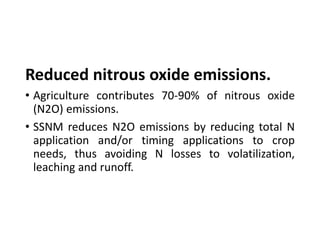
Reduced nitrous oxide emissions.
• Agriculture contributes 70-90% of nitrous oxide
(N2O) emissions.
• SSNM reduces N2O emissions by reducing total N
application and/or timing applications to crop
needs, thus avoiding N losses to volatilization,
leaching and runoff.
Improved disease resistance.
• The more balanced NPK nutrition that comes with SSNM
may lead to improved resistance to plant diseases
SSNM mitigate greenhouse gas emissions
Help adapt to and increase resilience to
climate change impacts
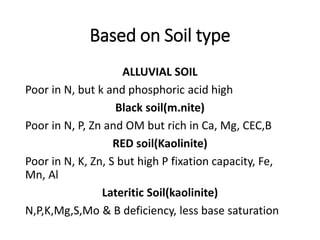
Based on Soil type
ALLUVIAL SOIL
Poor in N, but k and phosphoric acid high
Black soil(m.nite)
Poor in N, P, Zn and OM but rich in Ca, Mg, CEC,B
RED soil(Kaolinite)
Poor in N, K, Zn, S but high P fixation capacity, Fe,
Mn, Al
Lateritic Soil(kaolinite)
N,P,K,Mg,S,Mo & B deficiency, less base saturation
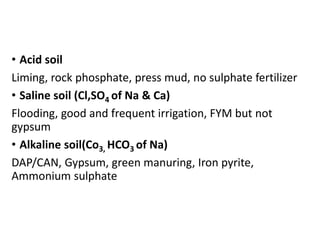
• Acid soil
Liming, rock phosphate, press mud, no sulphate fertilizer
• Saline soil (Cl,SO4 of Na & Ca)
Flooding, good and frequent irrigation, FYM but not
gypsum
• Alkaline soil(Co3, HCO3 of Na)
DAP/CAN, Gypsum, green manuring, Iron pyrite,
Ammonium sulphate
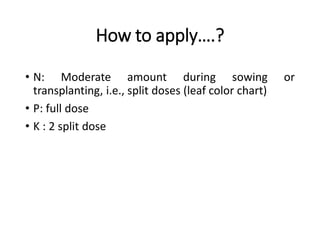
How to apply….?
• N: Moderate amount during sowing or
transplanting, i.e., split doses (leaf color chart)
• P: full dose
• K : 2 split dose
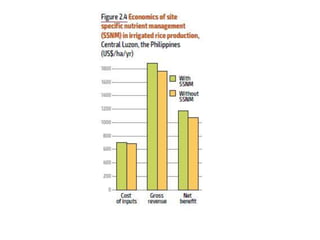
• SSNM generally maintains or increases crop yields.
• In a 2014 study of 13 sites in Southeast Asia, SSNM
led to grain yield increases of 13% over a three-year
period, although yields declined slightly in the first
year (Pasuquin et al. 2014).
• A study of 179 rice farms in 6 Asian countries found
that SSNM led to yield increases of 7% and total
profitability increases of 12% (Dobermann et al.
2002).
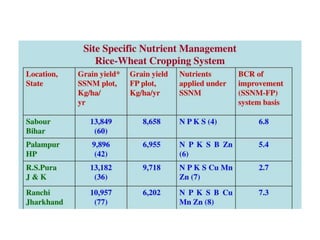
• In recent studies across large numbers of locations
in wheat systems in South Asia, SSNM led to 18-
27% increases in grain yield of wheat, when
compared to farmers’ standard fertilizer practices
(Jat and Satyanarayana 2013).
• An average of 107 on-farm experiments in Chinese
rice fields found 5% higher grain yields under SSNM
than under farmers’ practice, attributed to a
reduction in insect and disease damage caused by
optimal N inputs (Peng et al. 2010).
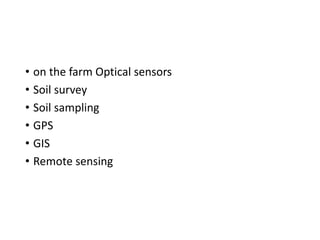
Tools for implementing SSNM
• on the farm Optical sensors
• Soil survey
• Soil sampling
• GPS
• GIS
• Remote sensing
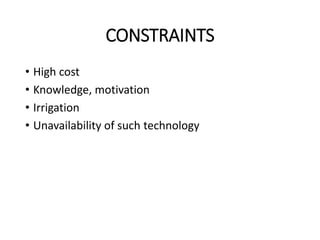
CONSTRAINTS
• High cost
• Knowledge, motivation
• Irrigation
• Unavailability of such technology
THANK YOU