Alliance
Alliance
CHERI technology
overview
A Q U I C K I N T R O D U C T I O N
Alliance
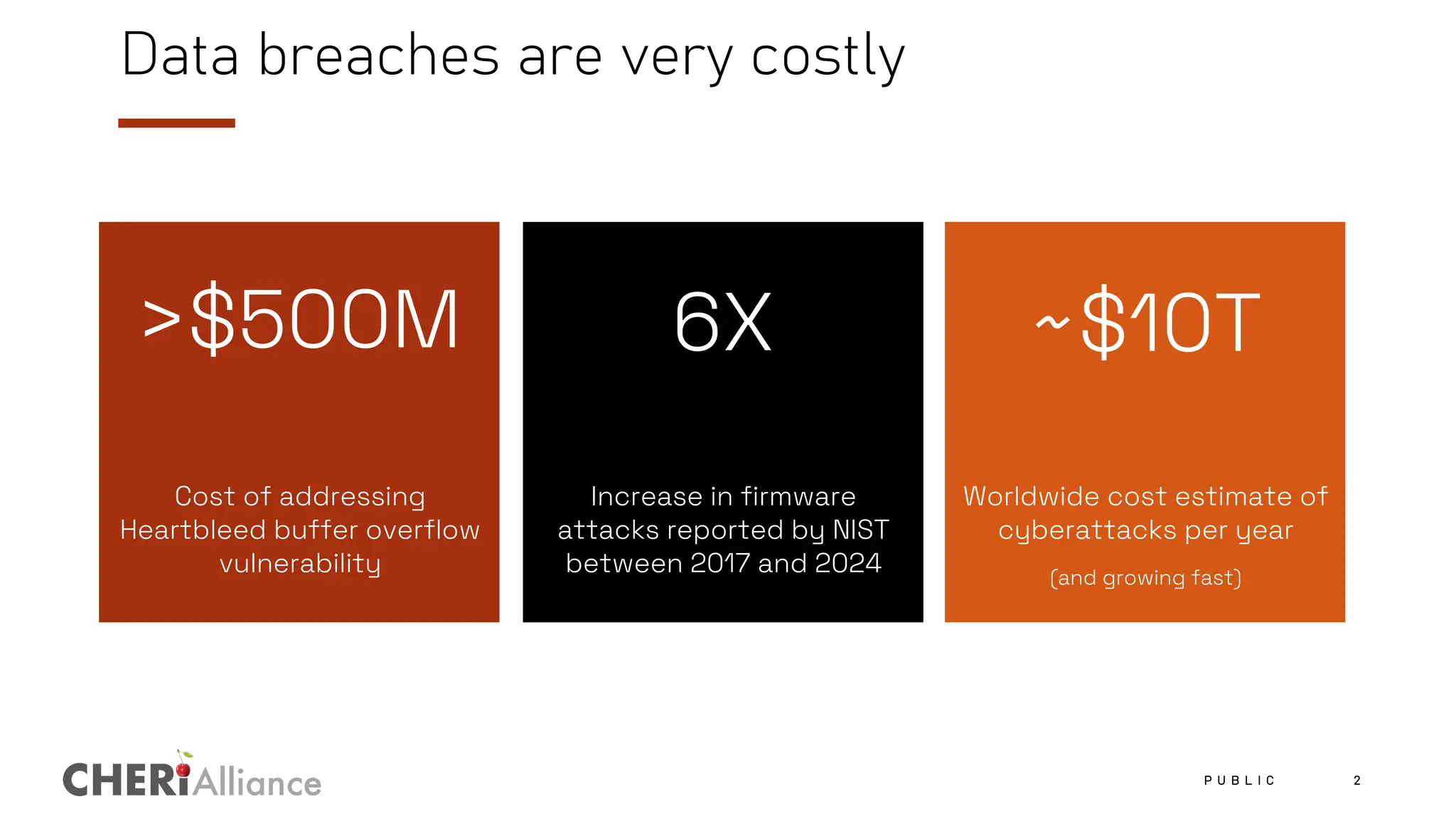
Data breaches are very costly
6X ~$10T
>$500M
Cost of addressing
Heartbleed buffer overflow
vulnerability
Worldwide cost estimate of
cyberattacks per year
(and growing fast)
Increase in firmware
attacks reported by NIST
between 2017 and 2024
P U B L I C 2
Alliance
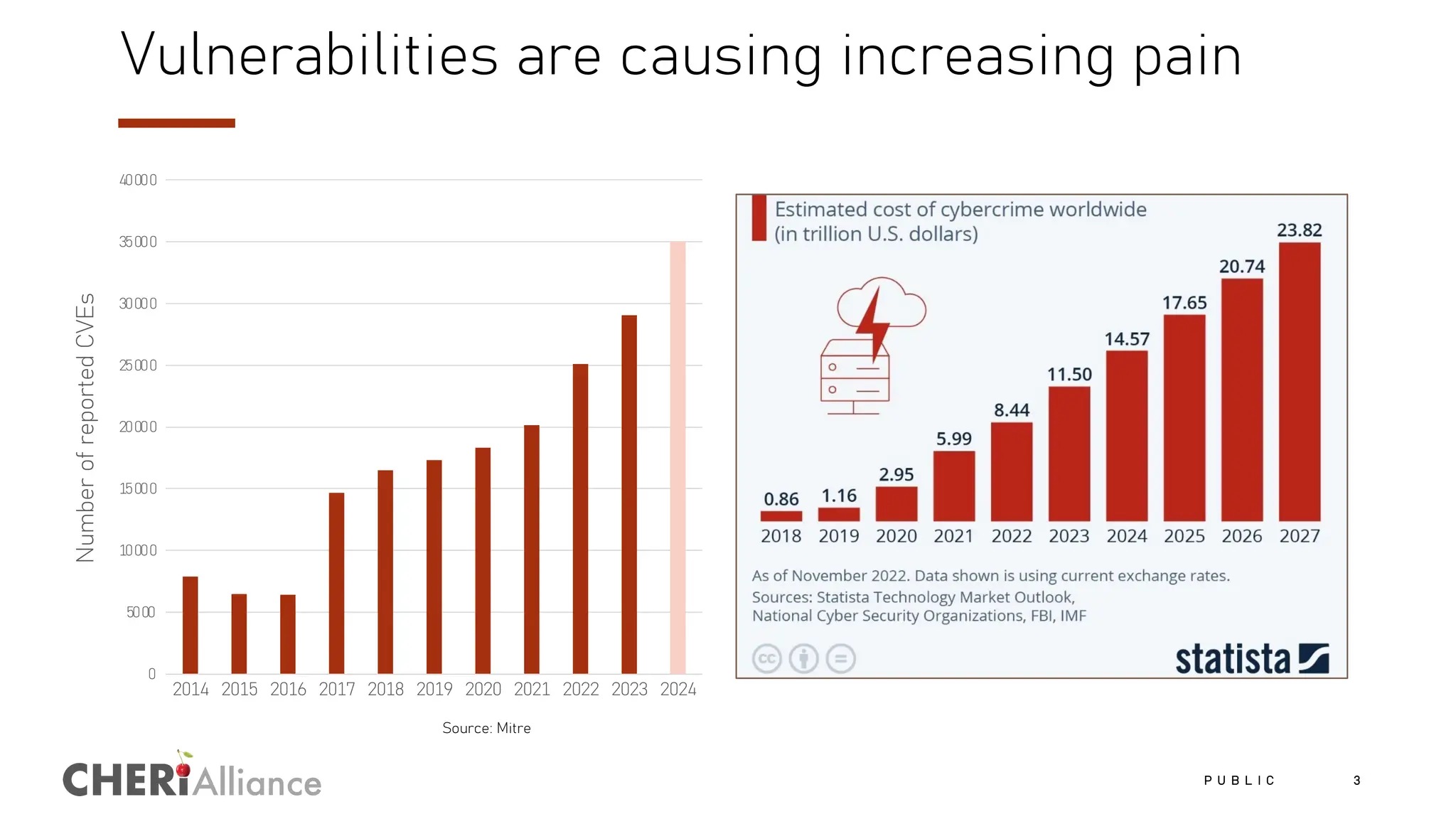
Vulnerabilities are causing increasing pain
0
5000
10000
15000
20000
25000
30000
35000
40000
2014 2015 2016 2017 2018 2019 2020 2021 2022 2023 2024
P U B L I C 3
Number
of
reported
CVEs
Source: Mitre
Alliance
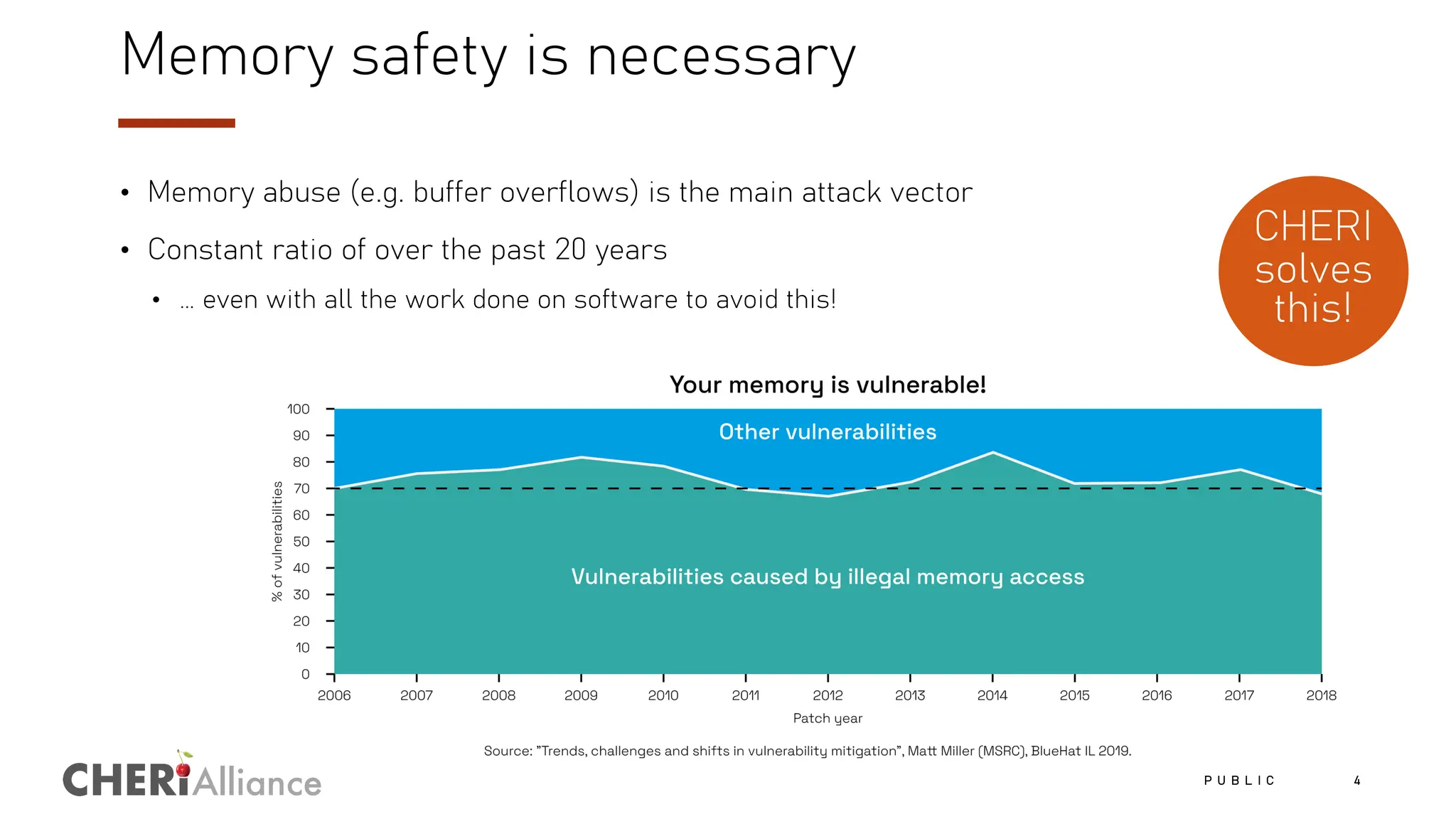
Memory safety is necessary
P U B L I C 4
• Memory abuse (e.g. buffer overflows) is the main attack vector
• Constant ratio of over the past 20 years
• … even with all the work done on software to avoid this!
CHERI
solves
this!
Alliance
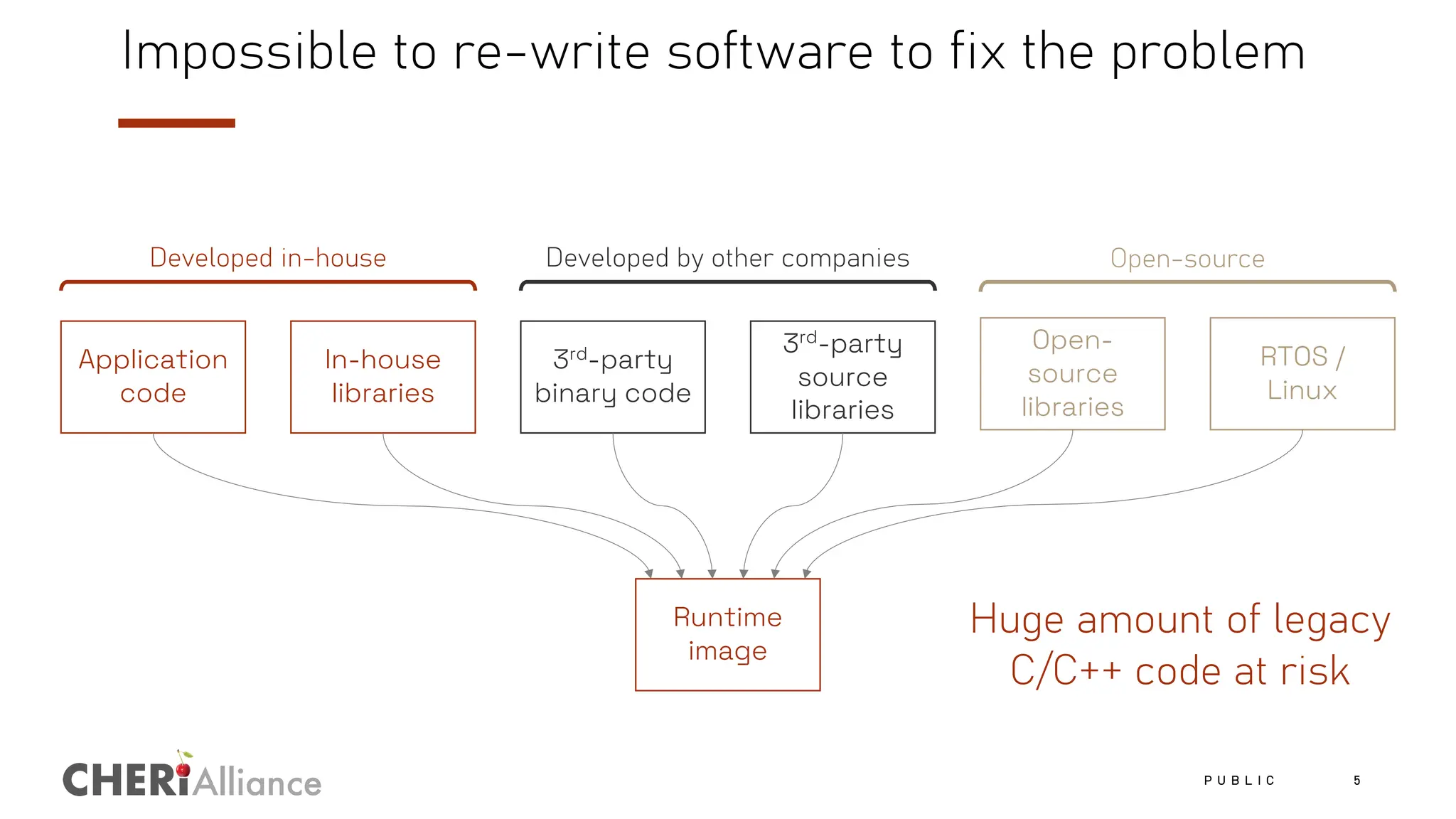
Impossible to re-write software to fix the problem
Application
code
In-house
libraries
3rd-party
binary code
3rd
-party
source
libraries
Open-
source
libraries
Developed in-house Developed by other companies Open-source
RTOS /
Linux
Runtime
image
Huge amount of legacy
C/C++ code at risk
P U B L I C 5
Alliance
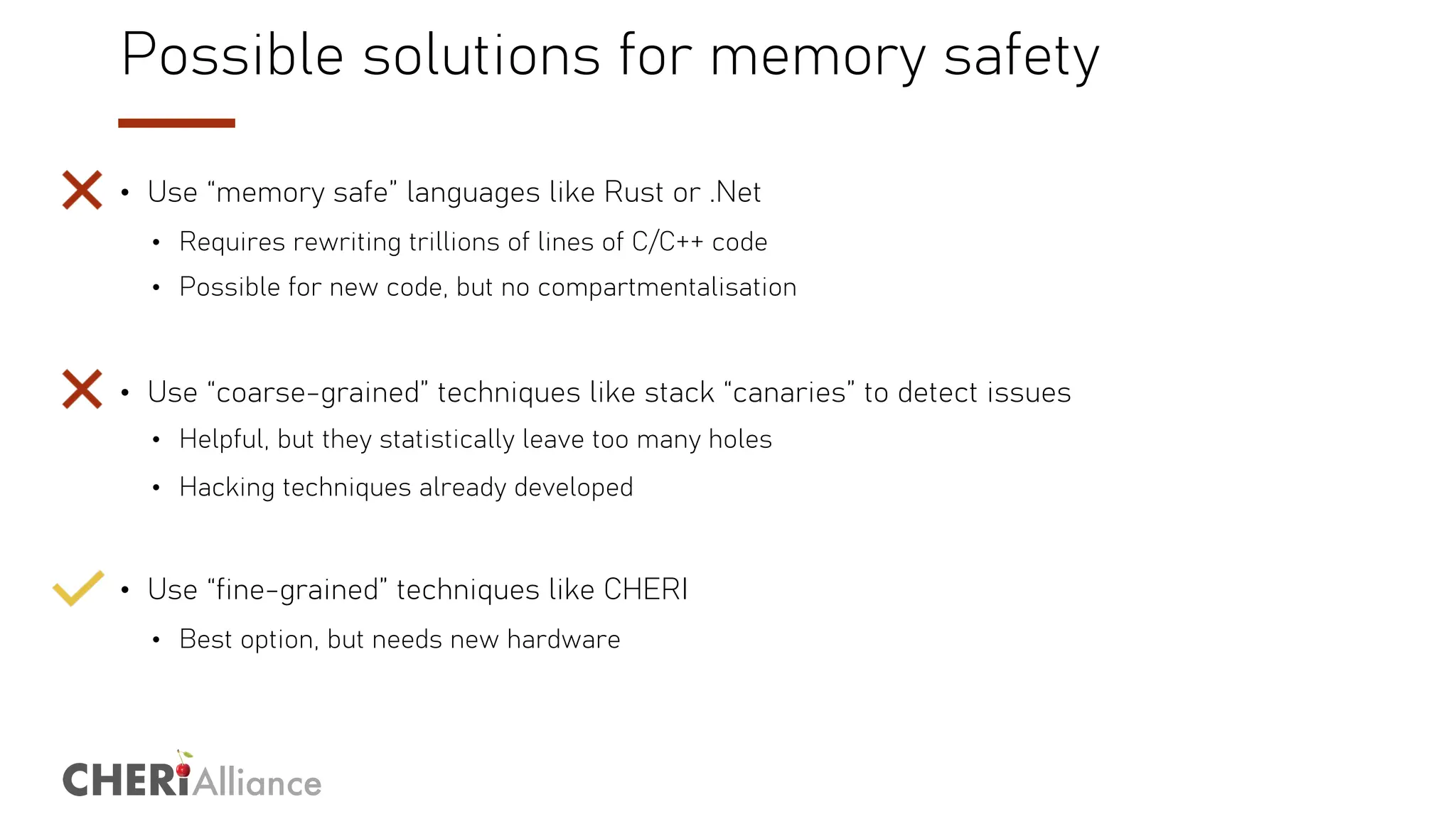
Possible solutions for memory safety
• Use “memory safe” languages like Rust or .Net
• Requires rewriting trillions of lines of C/C++ code
• Possible for new code, but no compartmentalisation
• Use “coarse-grained” techniques like stack “canaries” to detect issues
• Helpful, but they statistically leave too many holes
• Hacking techniques already developed
• Use “fine-grained” techniques like CHERI
• Best option, but needs new hardware
Alliance
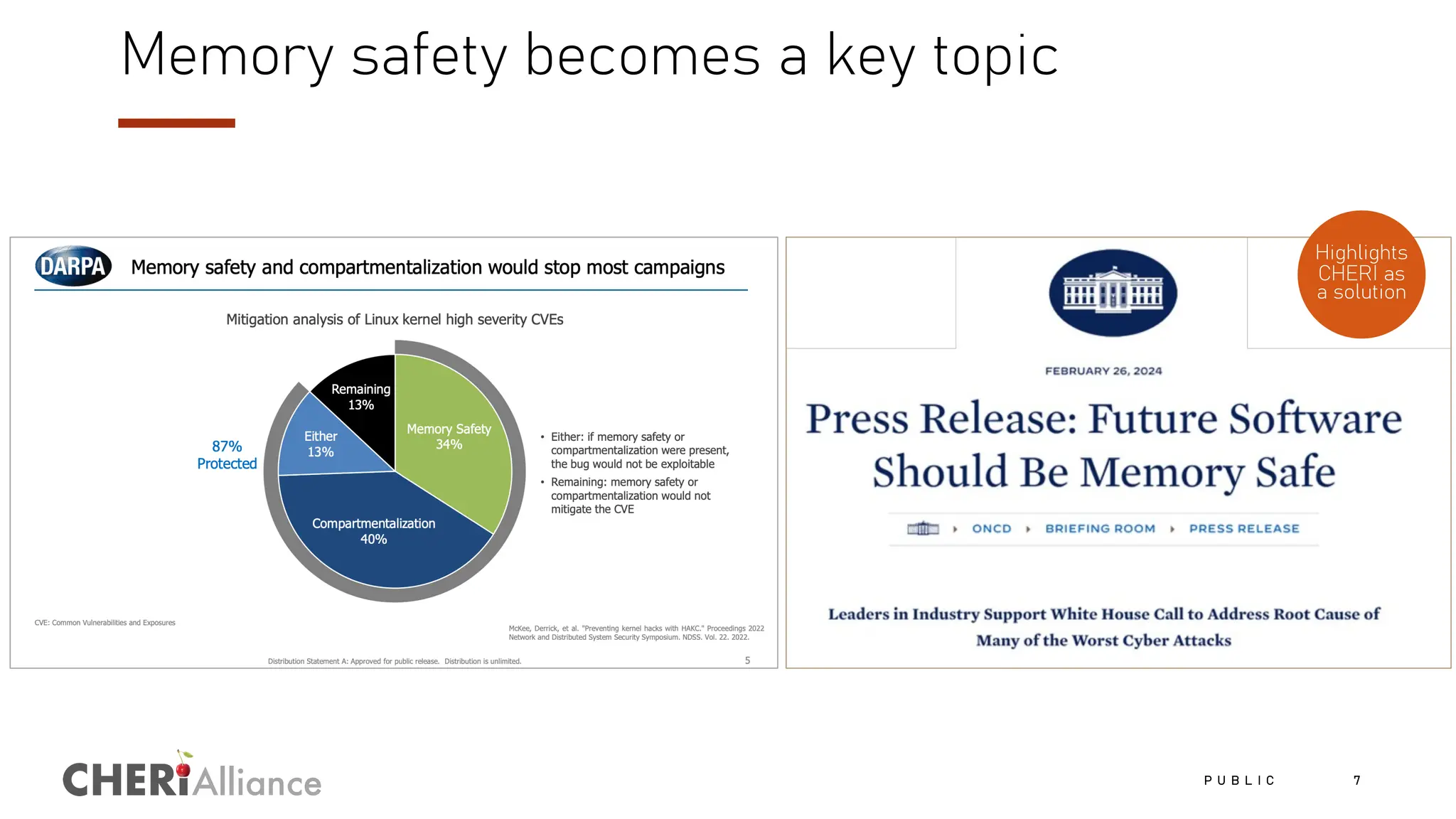
Memory safety becomes a key topic
P U B L I C 7
Highlights
CHERI as
a solution
Alliance
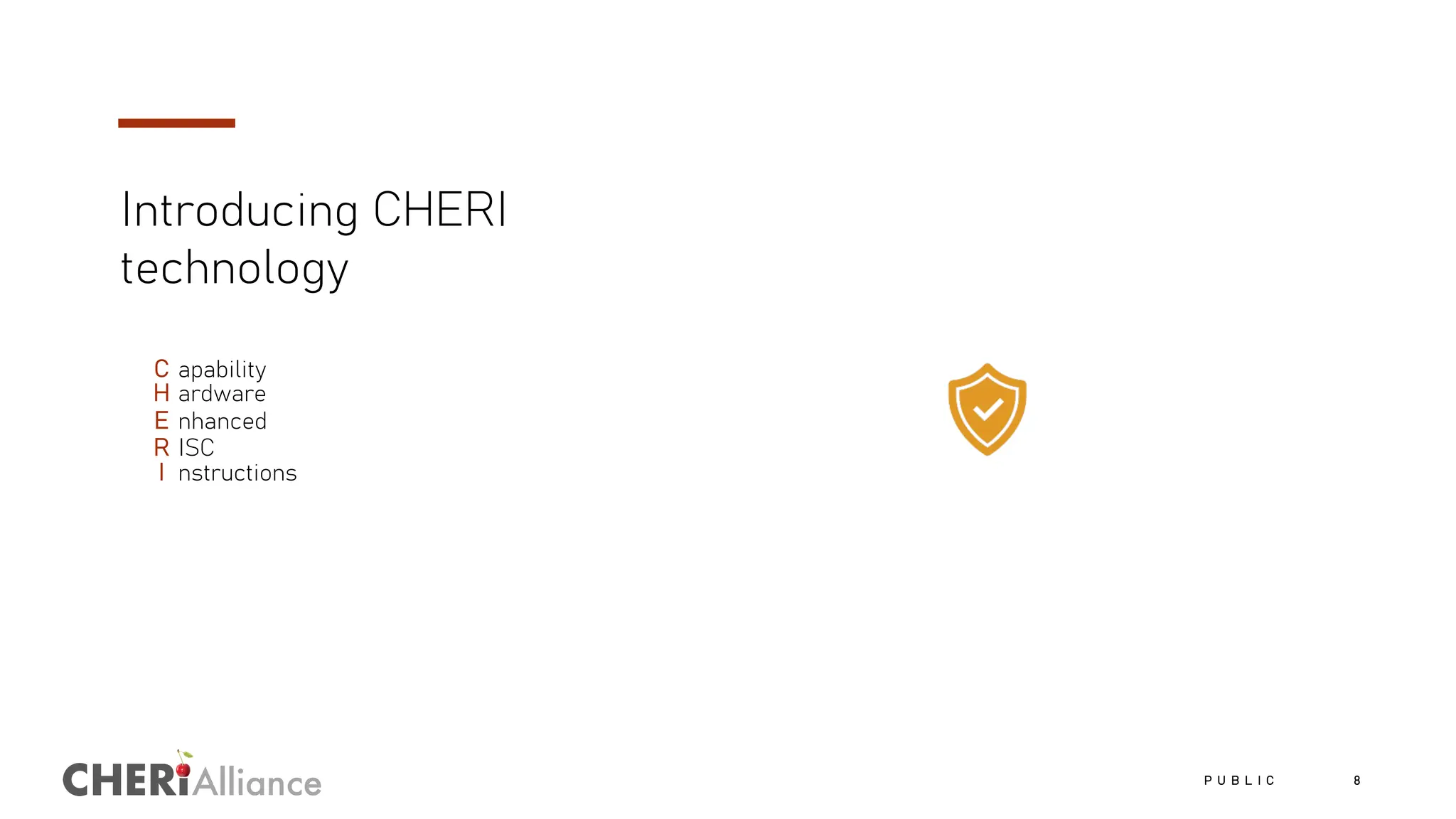
Introducing CHERI
technology
C apability
H ardware
E nhanced
R ISC
I nstructions
P U B L I C 8
Alliance
CHERI
Fine-grained memory protection
Revisits fundamental design choices in hardware and software to
dramatically improve system security
Extend conventional hardware ISAs
• Memory protection
• Scalable compartmentalization
P U B L I C 9
Alliance
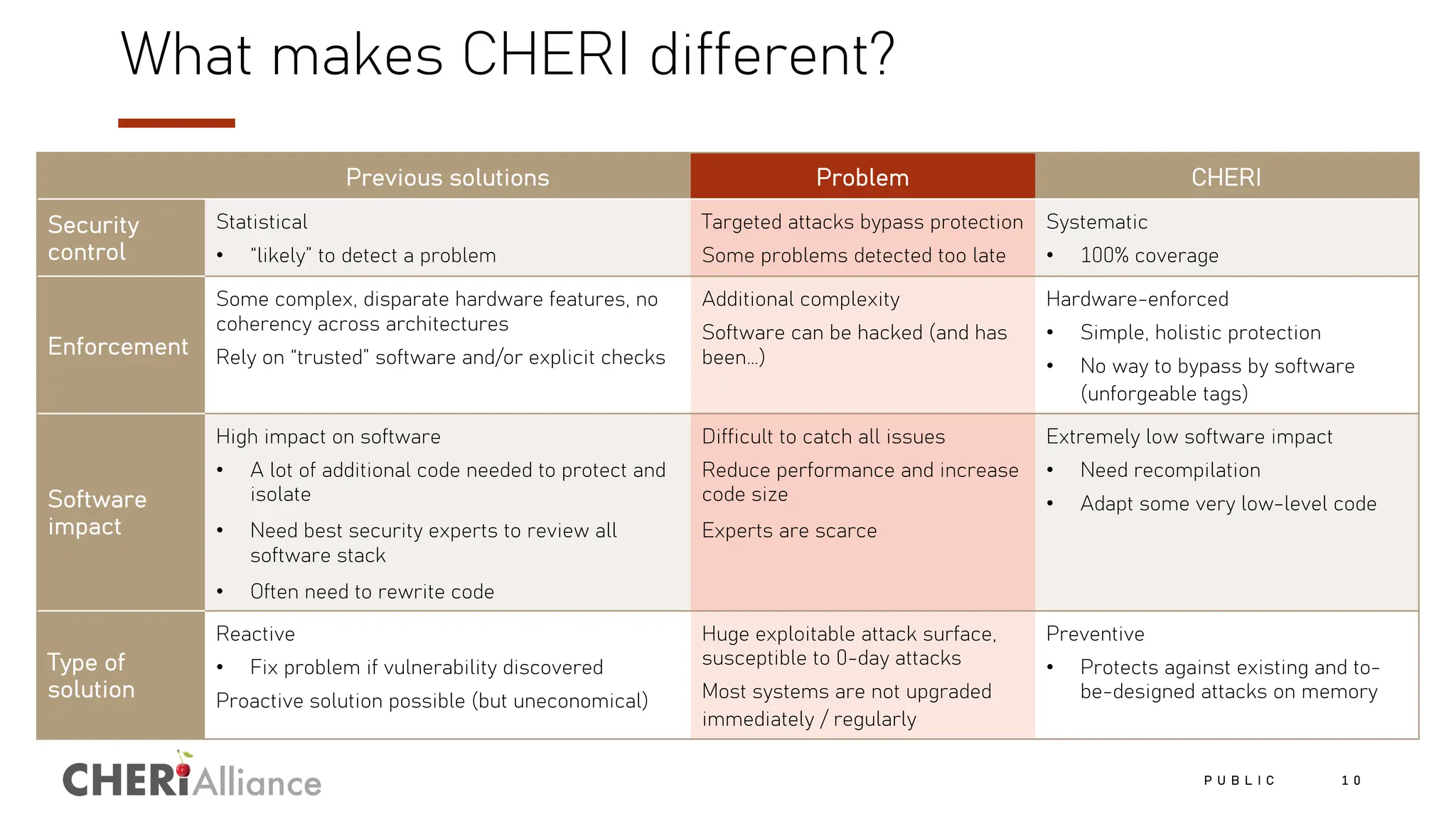
What makes CHERI different?
Previous solutions Problem CHERI
Security
control
Statistical
• “likely” to detect a problem
Targeted attacks bypass protection
Some problems detected too late
Systematic
• 100% coverage
Enforcement
Some complex, disparate hardware features, no
coherency across architectures
Rely on “trusted” software and/or explicit checks
Additional complexity
Software can be hacked (and has
been…)
Hardware-enforced
• Simple, holistic protection
• No way to bypass by software
(unforgeable tags)
Software
impact
High impact on software
• A lot of additional code needed to protect and
isolate
• Need best security experts to review all
software stack
• Often need to rewrite code
Difficult to catch all issues
Reduce performance and increase
code size
Experts are scarce
Extremely low software impact
• Need recompilation
• Adapt some very low-level code
Type of
solution
Reactive
• Fix problem if vulnerability discovered
Proactive solution possible (but uneconomical)
Huge exploitable attack surface,
susceptible to 0-day attacks
Most systems are not upgraded
immediately / regularly
Preventive
• Protects against existing and to-
be-designed attacks on memory
P U B L I C 1 0
Alliance
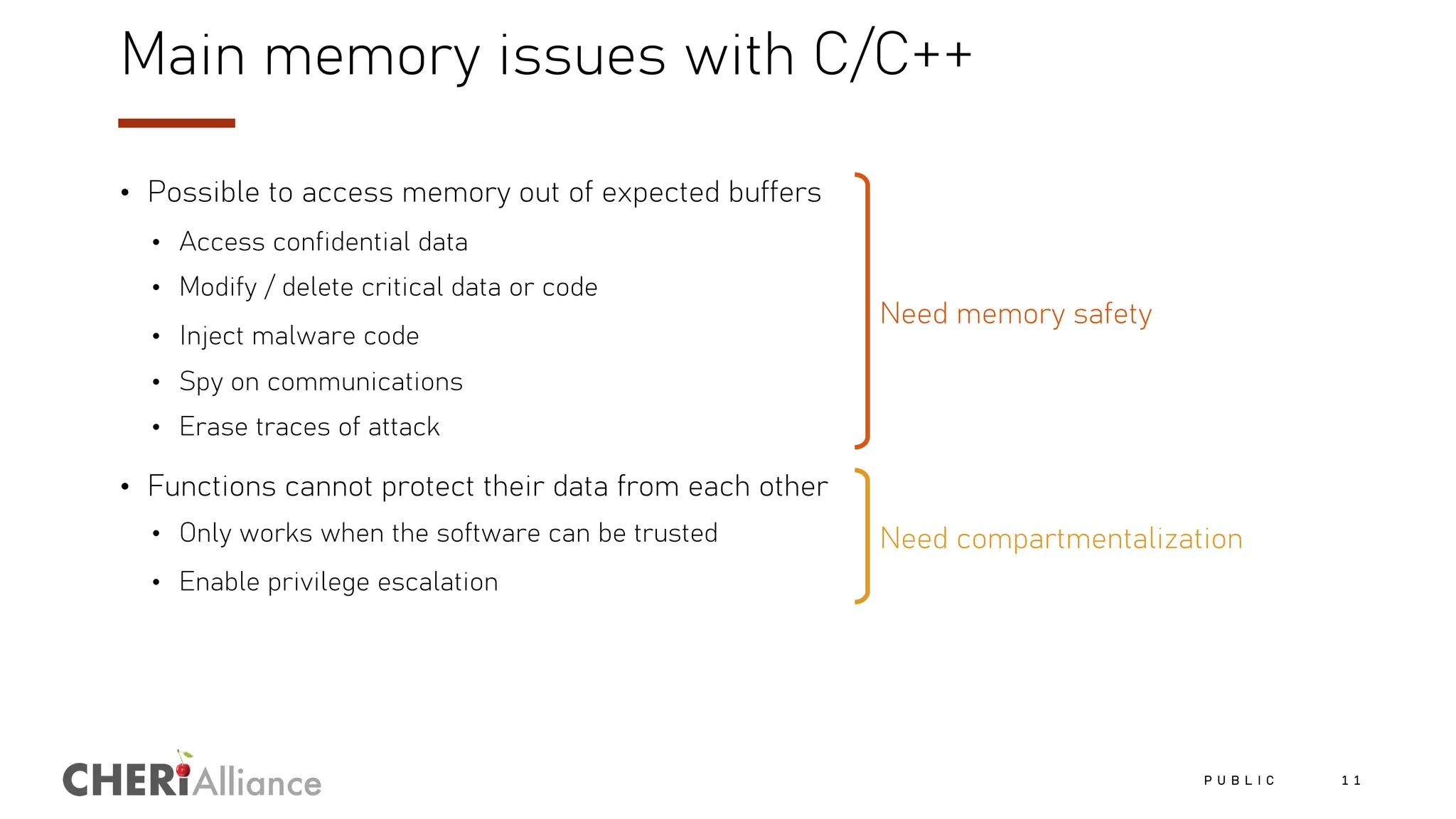
Main memory issues with C/C++
• Possible to access memory out of expected buffers
• Access confidential data
• Modify / delete critical data or code
• Inject malware code
• Spy on communications
• Erase traces of attack
• Functions cannot protect their data from each other
• Only works when the software can be trusted
• Enable privilege escalation
P U B L I C 1 1
Need memory safety
Need compartmentalization
Alliance
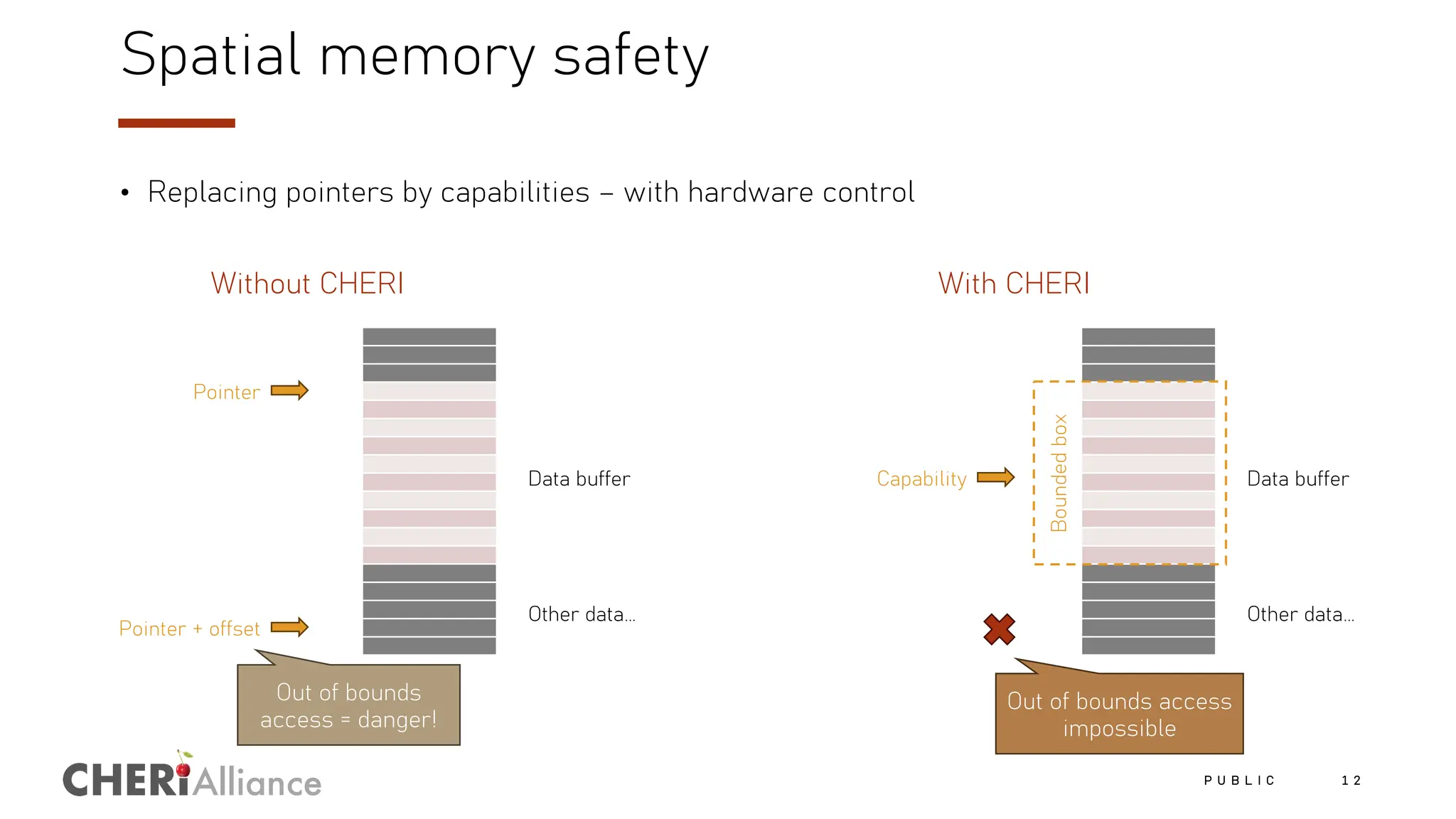
Spatial memory safety
• Replacing pointers by capabilities – with hardware control
Data buffer
Other data…
Pointer
Pointer + offset
Out of bounds
access = danger!
Capability
Bounded
box
Out of bounds access
impossible
Data buffer
Other data…
Without CHERI With CHERI
P U B L I C 1 2
Alliance
Bounded
box
Compartmentalization
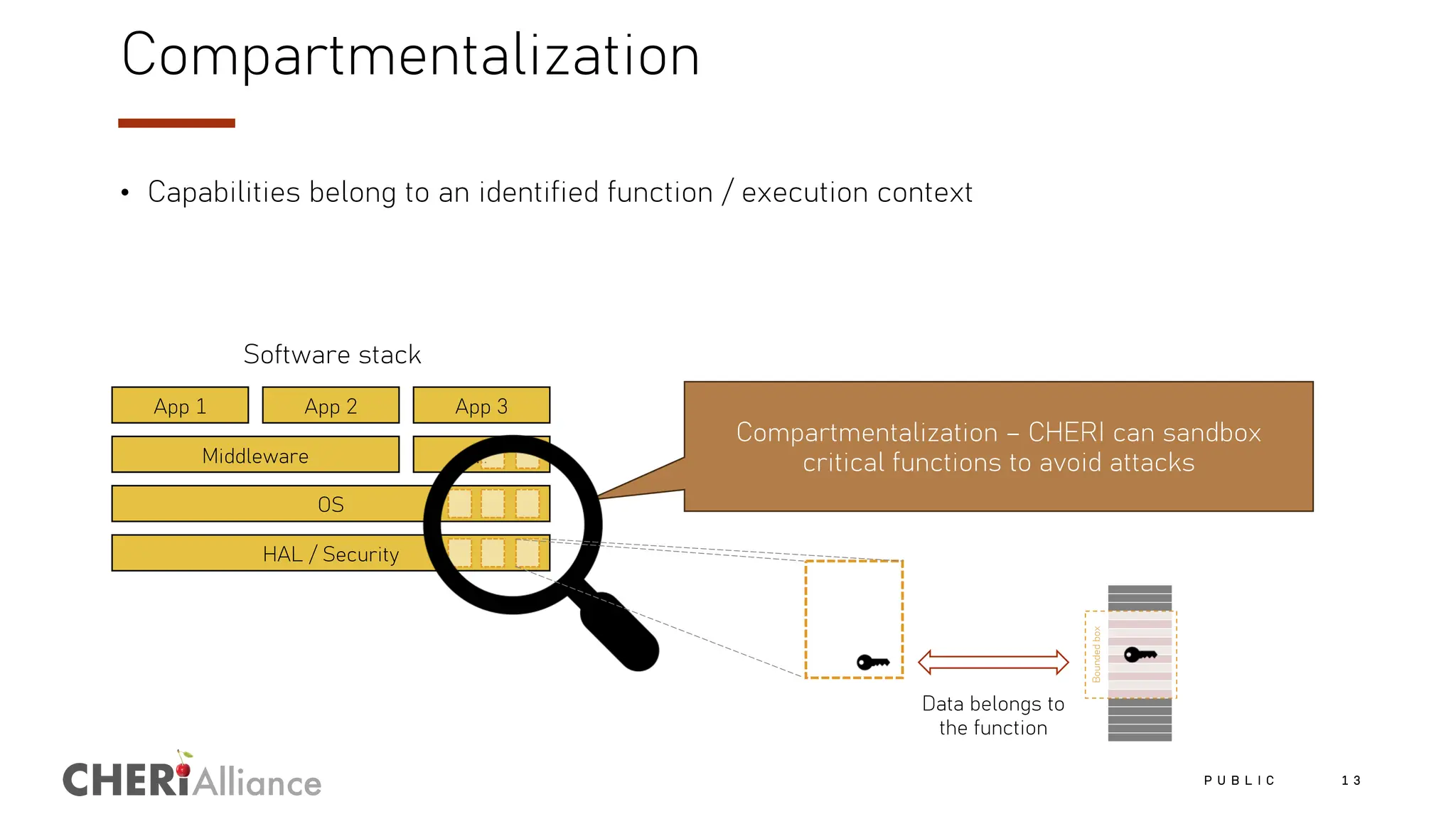
• Capabilities belong to an identified function / execution context
App 1 App 2 App 3
Middleware …
OS
HAL / Security
Compartmentalization – CHERI can sandbox
critical functions to avoid attacks
Data belongs to
the function
Software stack
P U B L I C 1 3
Alliance
CHERI relies on hardware protection
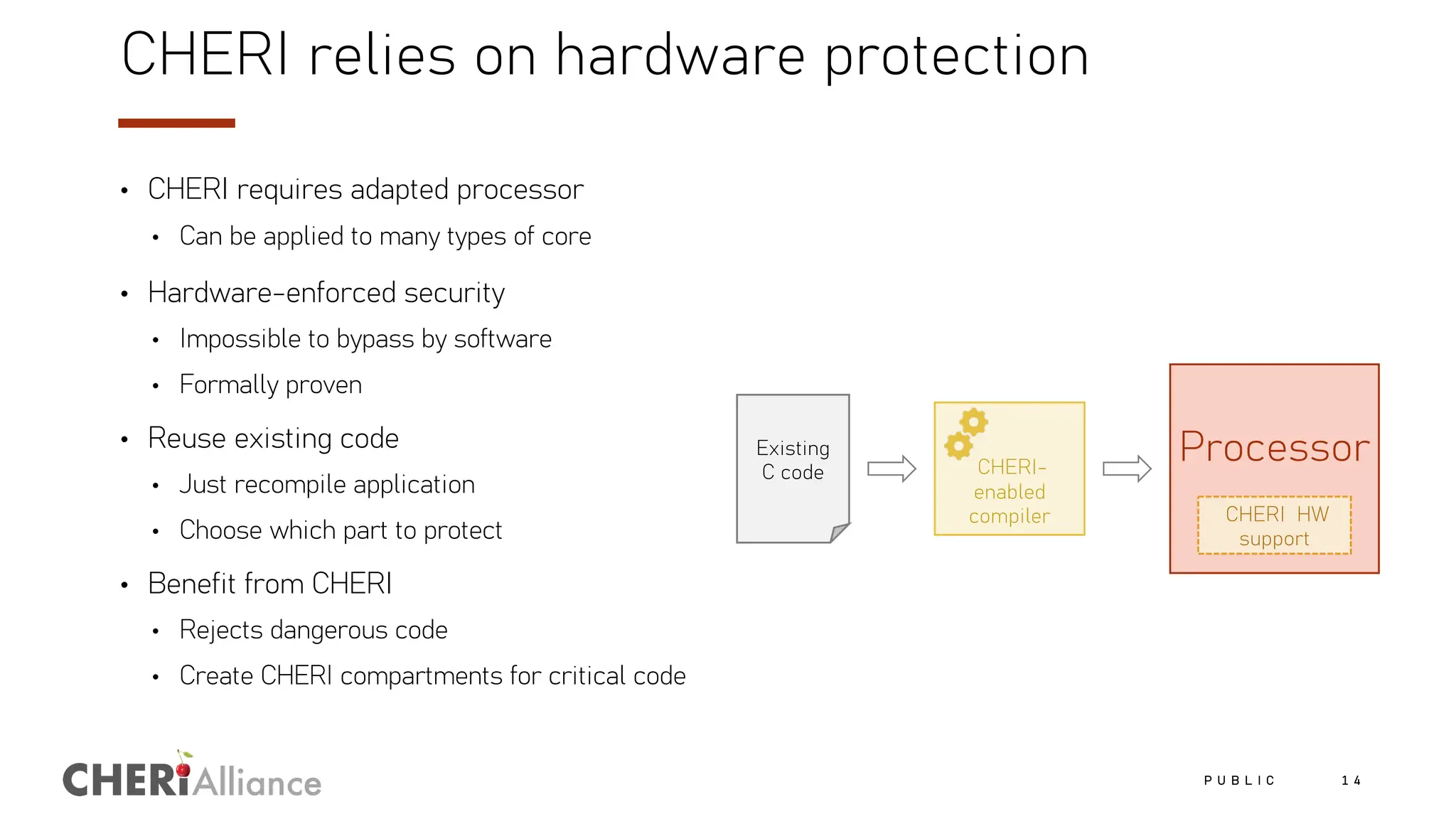
• CHERI requires adapted processor
• Can be applied to many types of core
• Hardware-enforced security
• Impossible to bypass by software
• Formally proven
• Reuse existing code
• Just recompile application
• Choose which part to protect
• Benefit from CHERI
• Rejects dangerous code
• Create CHERI compartments for critical code
Processor
CHERI HW
support
Existing
C code CHERI-
enabled
compiler
P U B L I C 1 4
Alliance
CHERI has a positive impact
• Limited costs
• Area impact
• Processor only 4% larger*
• Similar power consumption
• Similar performance**
• Memory impact
• Small area for tag storage
• Double size for pointers (mostly impacts stack)
• No change on data storage requirements
• Software development
• Need adapted tools (open-source available)
• Less than 0.5% application code*** to adapt
• Need recompilation
• OS / low-level drivers need work (but done once)
• Huge gains
• Memory safety!
• Save in patching costs
• Compiler detects mistakes in existing code
• Performance gains****
• Remove or simplify software-based mechanisms
(TEE, compartmentalization, security modes, …)
• Eliminate context switching in hypervisor
• Reduce code, improve execution speed
• Fast, low-risk integration of unsafe code
• Save security experts’ time
• Not wasting it on bug hunting…
P U B L I C 1 5
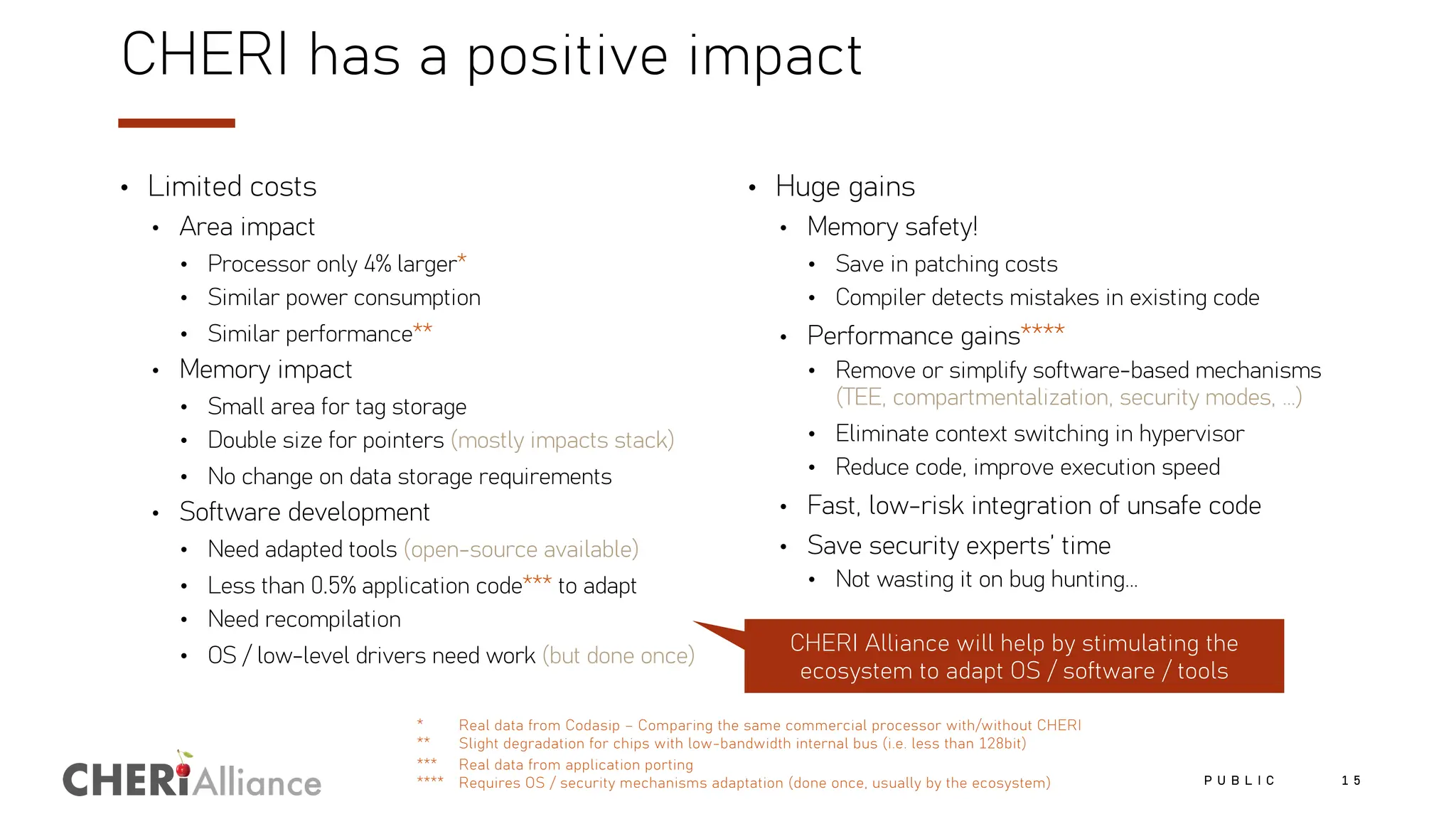
* Real data from Codasip – Comparing the same commercial processor with/without CHERI
** Slight degradation for chips with low-bandwidth internal bus (i.e. less than 128bit)
*** Real data from application porting
**** Requires OS / security mechanisms adaptation (done once, usually by the ecosystem)
CHERI Alliance will help by stimulating the
ecosystem to adapt OS / software / tools
Alliance
CHERI has already got strong supporters
P U B L I C 1 6
Alliance
CHERI projects
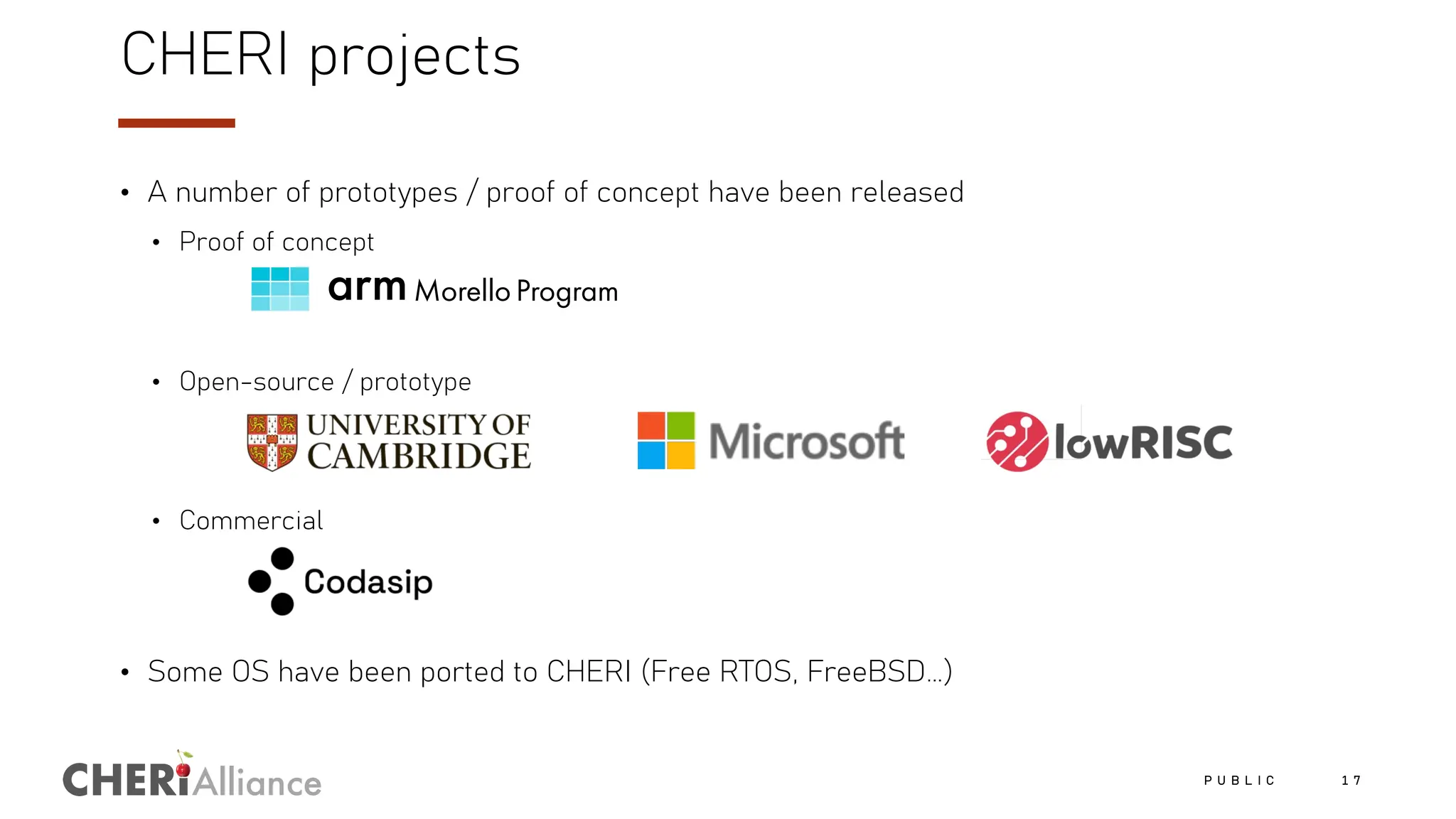
• A number of prototypes / proof of concept have been released
• Proof of concept
• Open-source / prototype
• Commercial
• Some OS have been ported to CHERI (Free RTOS, FreeBSD…)
P U B L I C 1 7
Alliance
Quotes
“The CHERI architecture's support for fine-
grain memory protection and scalable
compartmentalization promises to
revolutionise our ability to protect personal
data and provide strong defences against
malware on mobile devices and in the
cloud.”
Ben Laurie, Director of Security at Google Research
P U B L I C 1 8
Alliance
Alliance
Web: www.cheri-alliance.net
P U B L I C 1 9

Introduction to CHERI technology - Cybersecurity

  • 1.
    Alliance Alliance CHERI technology overview A QU I C K I N T R O D U C T I O N
  • 2.
    Alliance Data breaches arevery costly 6X ~$10T >$500M Cost of addressing Heartbleed buffer overflow vulnerability Worldwide cost estimate of cyberattacks per year (and growing fast) Increase in firmware attacks reported by NIST between 2017 and 2024 P U B L I C 2
  • 3.
    Alliance Vulnerabilities are causingincreasing pain 0 5000 10000 15000 20000 25000 30000 35000 40000 2014 2015 2016 2017 2018 2019 2020 2021 2022 2023 2024 P U B L I C 3 Number of reported CVEs Source: Mitre
  • 4.
    Alliance Memory safety isnecessary P U B L I C 4 • Memory abuse (e.g. buffer overflows) is the main attack vector • Constant ratio of over the past 20 years • … even with all the work done on software to avoid this! CHERI solves this!
  • 5.
    Alliance Impossible to re-writesoftware to fix the problem Application code In-house libraries 3rd-party binary code 3rd -party source libraries Open- source libraries Developed in-house Developed by other companies Open-source RTOS / Linux Runtime image Huge amount of legacy C/C++ code at risk P U B L I C 5
  • 6.
    Alliance Possible solutions formemory safety • Use “memory safe” languages like Rust or .Net • Requires rewriting trillions of lines of C/C++ code • Possible for new code, but no compartmentalisation • Use “coarse-grained” techniques like stack “canaries” to detect issues • Helpful, but they statistically leave too many holes • Hacking techniques already developed • Use “fine-grained” techniques like CHERI • Best option, but needs new hardware
  • 7.
    Alliance Memory safety becomesa key topic P U B L I C 7 Highlights CHERI as a solution
  • 8.
    Alliance Introducing CHERI technology C apability Hardware E nhanced R ISC I nstructions P U B L I C 8
  • 9.
    Alliance CHERI Fine-grained memory protection Revisitsfundamental design choices in hardware and software to dramatically improve system security Extend conventional hardware ISAs • Memory protection • Scalable compartmentalization P U B L I C 9
  • 10.
    Alliance What makes CHERIdifferent? Previous solutions Problem CHERI Security control Statistical • “likely” to detect a problem Targeted attacks bypass protection Some problems detected too late Systematic • 100% coverage Enforcement Some complex, disparate hardware features, no coherency across architectures Rely on “trusted” software and/or explicit checks Additional complexity Software can be hacked (and has been…) Hardware-enforced • Simple, holistic protection • No way to bypass by software (unforgeable tags) Software impact High impact on software • A lot of additional code needed to protect and isolate • Need best security experts to review all software stack • Often need to rewrite code Difficult to catch all issues Reduce performance and increase code size Experts are scarce Extremely low software impact • Need recompilation • Adapt some very low-level code Type of solution Reactive • Fix problem if vulnerability discovered Proactive solution possible (but uneconomical) Huge exploitable attack surface, susceptible to 0-day attacks Most systems are not upgraded immediately / regularly Preventive • Protects against existing and to- be-designed attacks on memory P U B L I C 1 0
  • 11.
    Alliance Main memory issueswith C/C++ • Possible to access memory out of expected buffers • Access confidential data • Modify / delete critical data or code • Inject malware code • Spy on communications • Erase traces of attack • Functions cannot protect their data from each other • Only works when the software can be trusted • Enable privilege escalation P U B L I C 1 1 Need memory safety Need compartmentalization
  • 12.
    Alliance Spatial memory safety •Replacing pointers by capabilities – with hardware control Data buffer Other data… Pointer Pointer + offset Out of bounds access = danger! Capability Bounded box Out of bounds access impossible Data buffer Other data… Without CHERI With CHERI P U B L I C 1 2
  • 13.
    Alliance Bounded box Compartmentalization • Capabilities belongto an identified function / execution context App 1 App 2 App 3 Middleware … OS HAL / Security Compartmentalization – CHERI can sandbox critical functions to avoid attacks Data belongs to the function Software stack P U B L I C 1 3
  • 14.
    Alliance CHERI relies onhardware protection • CHERI requires adapted processor • Can be applied to many types of core • Hardware-enforced security • Impossible to bypass by software • Formally proven • Reuse existing code • Just recompile application • Choose which part to protect • Benefit from CHERI • Rejects dangerous code • Create CHERI compartments for critical code Processor CHERI HW support Existing C code CHERI- enabled compiler P U B L I C 1 4
  • 15.
    Alliance CHERI has apositive impact • Limited costs • Area impact • Processor only 4% larger* • Similar power consumption • Similar performance** • Memory impact • Small area for tag storage • Double size for pointers (mostly impacts stack) • No change on data storage requirements • Software development • Need adapted tools (open-source available) • Less than 0.5% application code*** to adapt • Need recompilation • OS / low-level drivers need work (but done once) • Huge gains • Memory safety! • Save in patching costs • Compiler detects mistakes in existing code • Performance gains**** • Remove or simplify software-based mechanisms (TEE, compartmentalization, security modes, …) • Eliminate context switching in hypervisor • Reduce code, improve execution speed • Fast, low-risk integration of unsafe code • Save security experts’ time • Not wasting it on bug hunting… P U B L I C 1 5 * Real data from Codasip – Comparing the same commercial processor with/without CHERI ** Slight degradation for chips with low-bandwidth internal bus (i.e. less than 128bit) *** Real data from application porting **** Requires OS / security mechanisms adaptation (done once, usually by the ecosystem) CHERI Alliance will help by stimulating the ecosystem to adapt OS / software / tools
  • 16.
    Alliance CHERI has alreadygot strong supporters P U B L I C 1 6
  • 17.
    Alliance CHERI projects • Anumber of prototypes / proof of concept have been released • Proof of concept • Open-source / prototype • Commercial • Some OS have been ported to CHERI (Free RTOS, FreeBSD…) P U B L I C 1 7
  • 18.
    Alliance Quotes “The CHERI architecture'ssupport for fine- grain memory protection and scalable compartmentalization promises to revolutionise our ability to protect personal data and provide strong defences against malware on mobile devices and in the cloud.” Ben Laurie, Director of Security at Google Research P U B L I C 1 8
  • 19.