OUTLINE
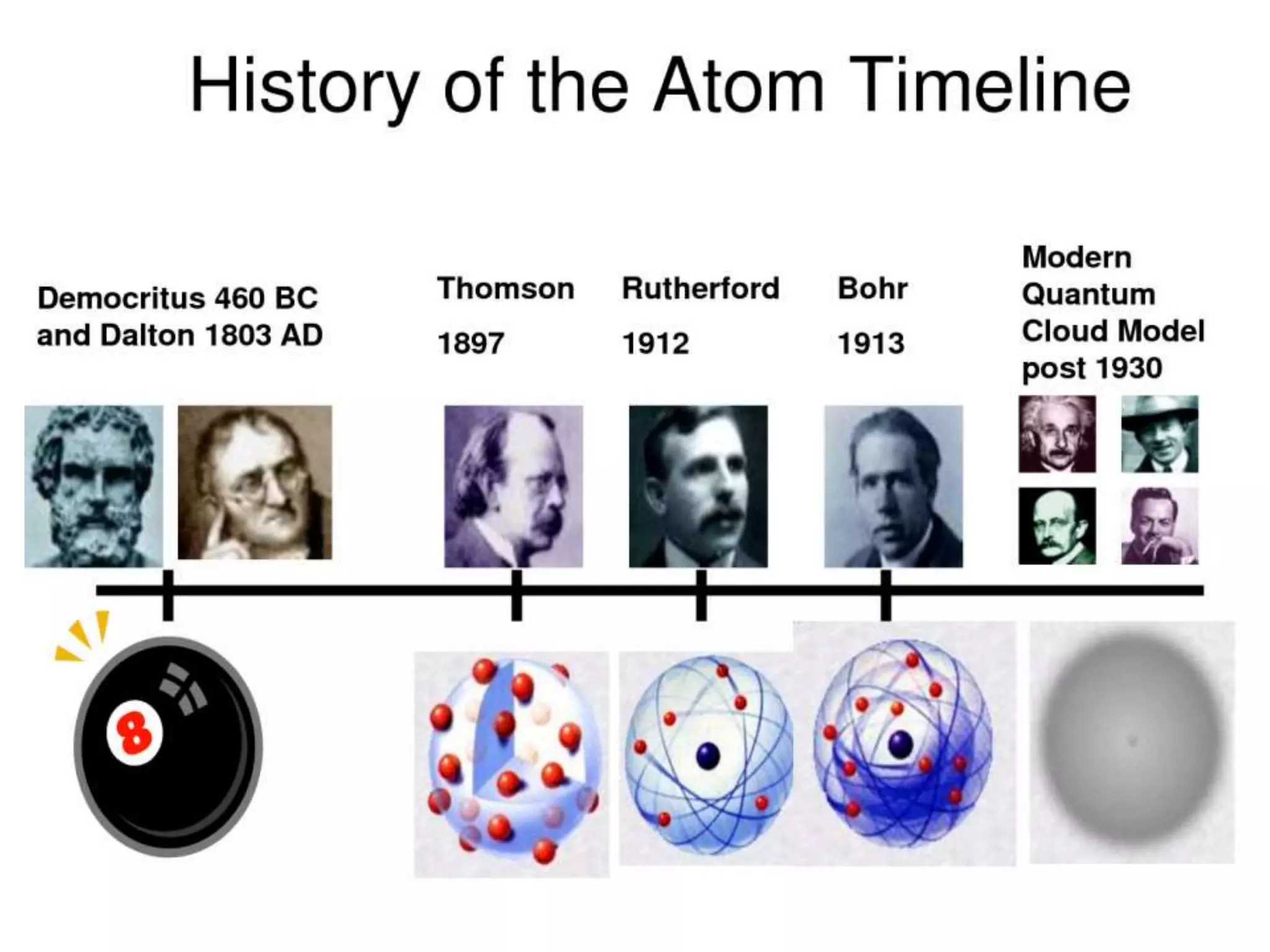
2.1 Early modelsof atom
2.1.1 Democritus
2.1.2 John Dalton
2.1.3 J.J.Thompson
2.1.4 Ernest Rutherford
5.
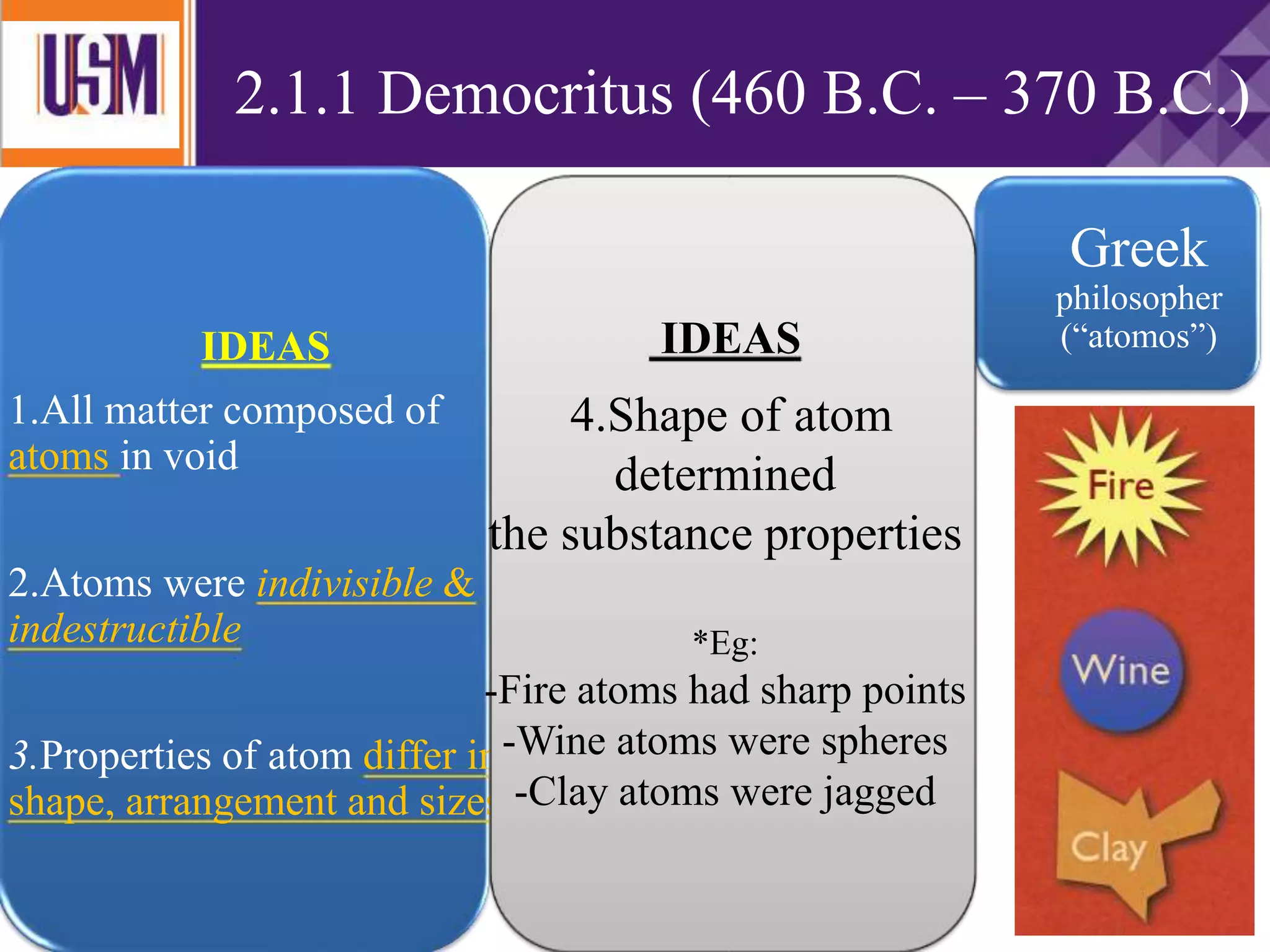
2.1.1 Democritus (460B.C. – 370 B.C.)
Greek
philosopher
(“atomos”)IDEAS
1.All matter composed of
atoms in void
2.Atoms were indivisible &
indestructible
3.Properties of atom differ in
shape, arrangement and sizes
IDEAS
4.Shape of atom
determined
the substance properties
*Eg:
-Fire atoms had sharp points
-Wine atoms were spheres
-Clay atoms were jagged
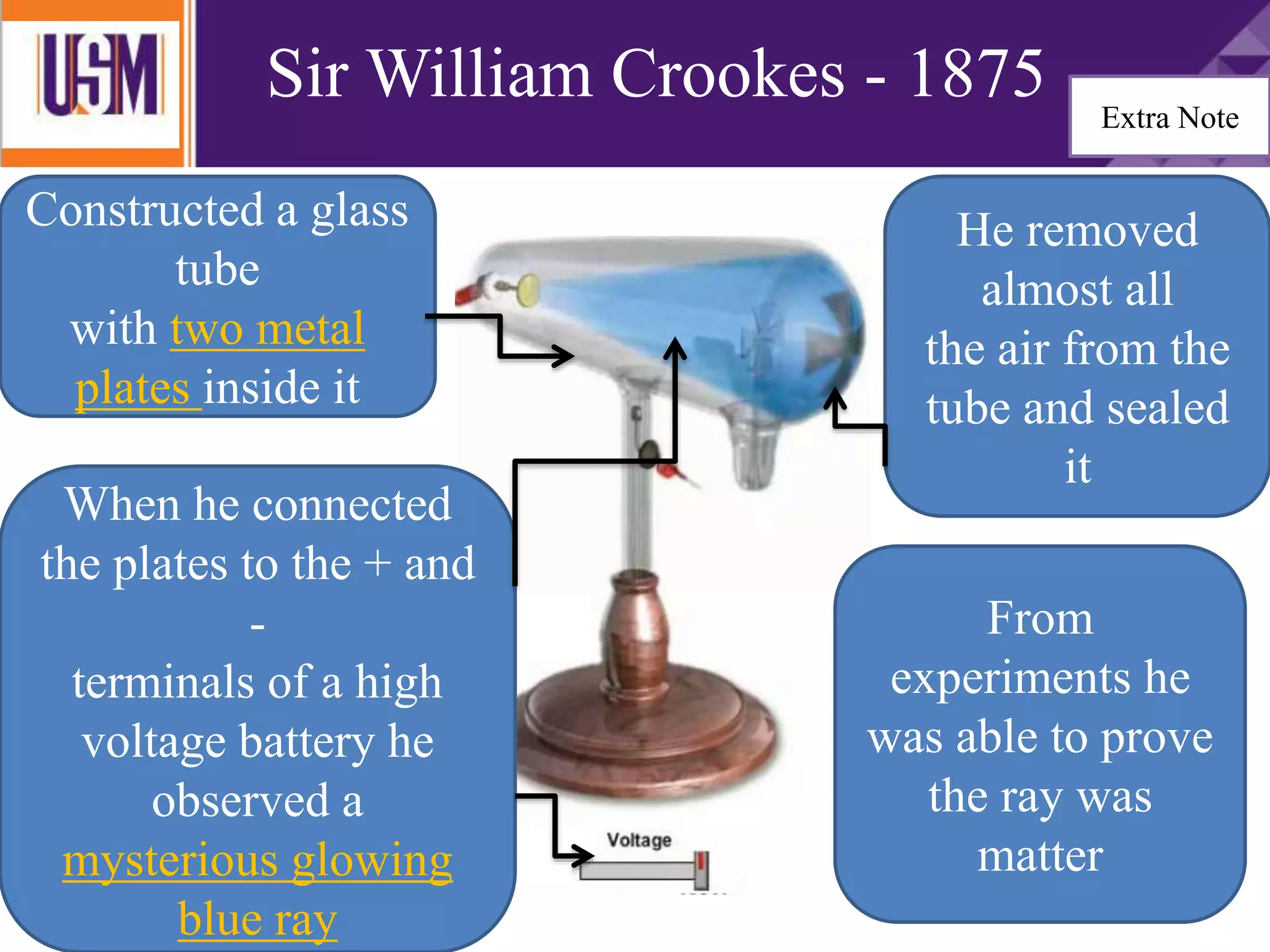
Sir William Crookes- 1875
From
experiments he
was able to prove
the ray was
matter
When he connected
the plates to the + and
-
terminals of a high
voltage battery he
observed a
mysterious glowing
blue ray
He removed
almost all
the air from the
tube and sealed
it
Constructed a glass
tube
with two metal
plates inside it
Extra Note
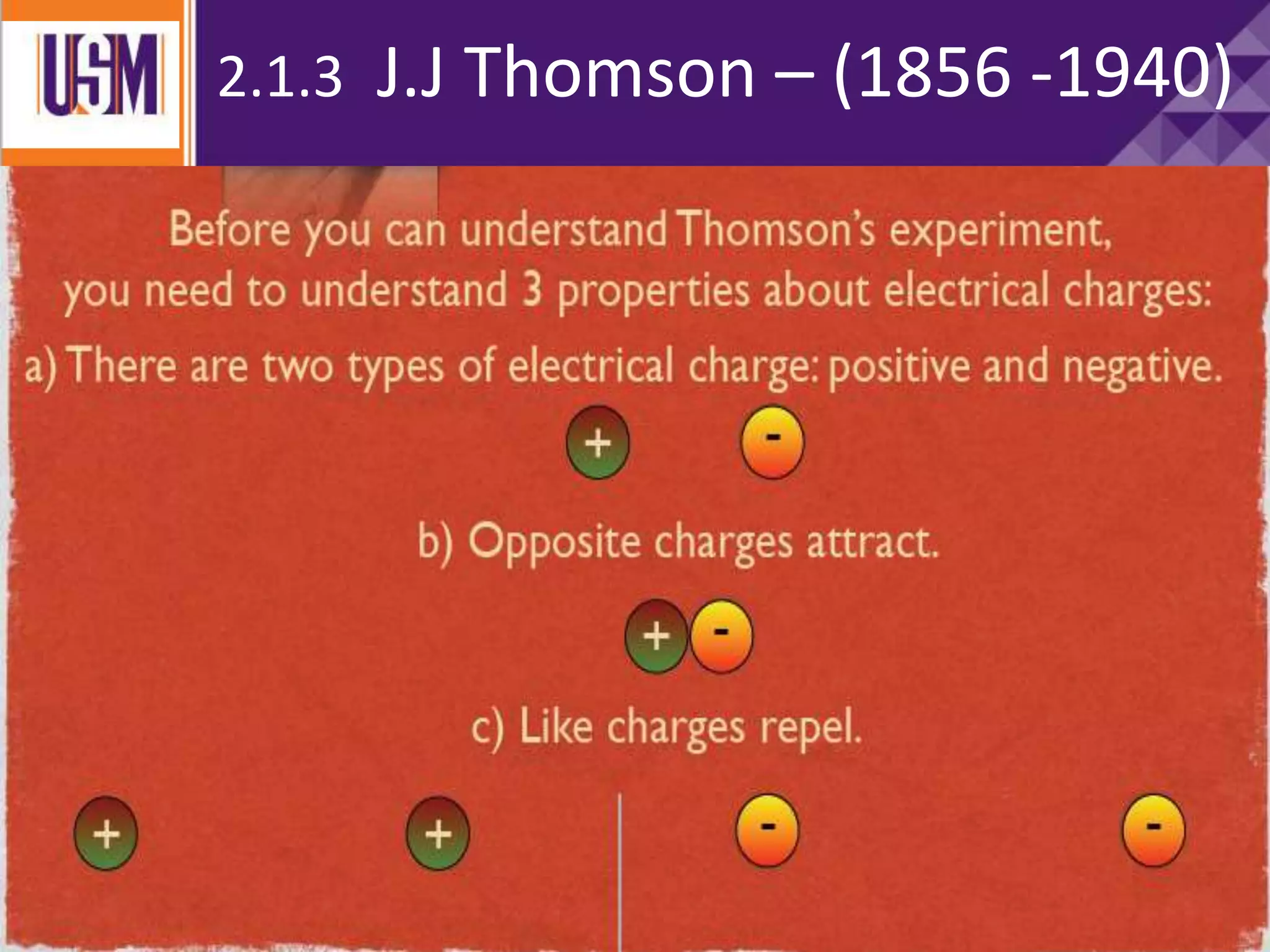
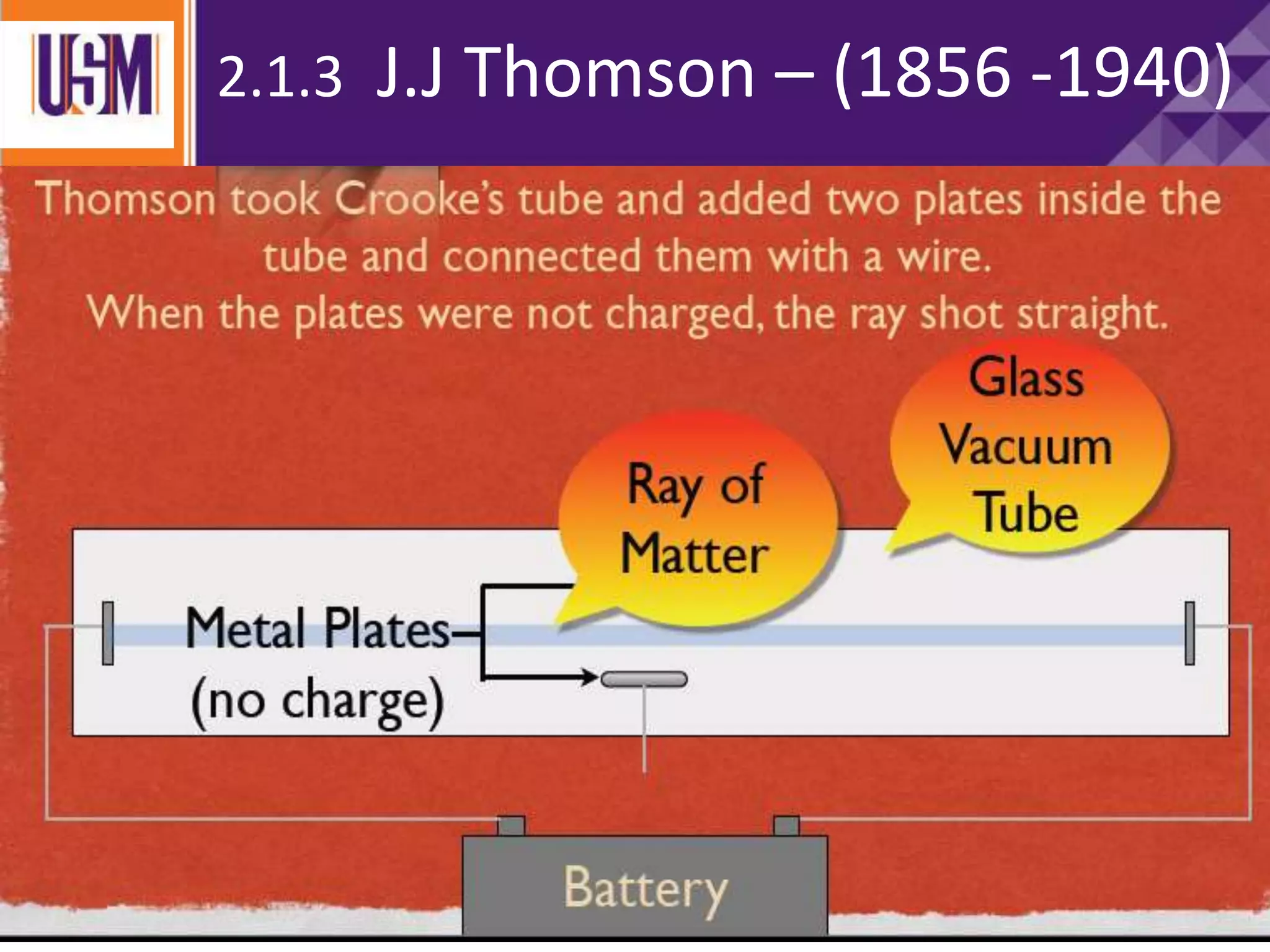
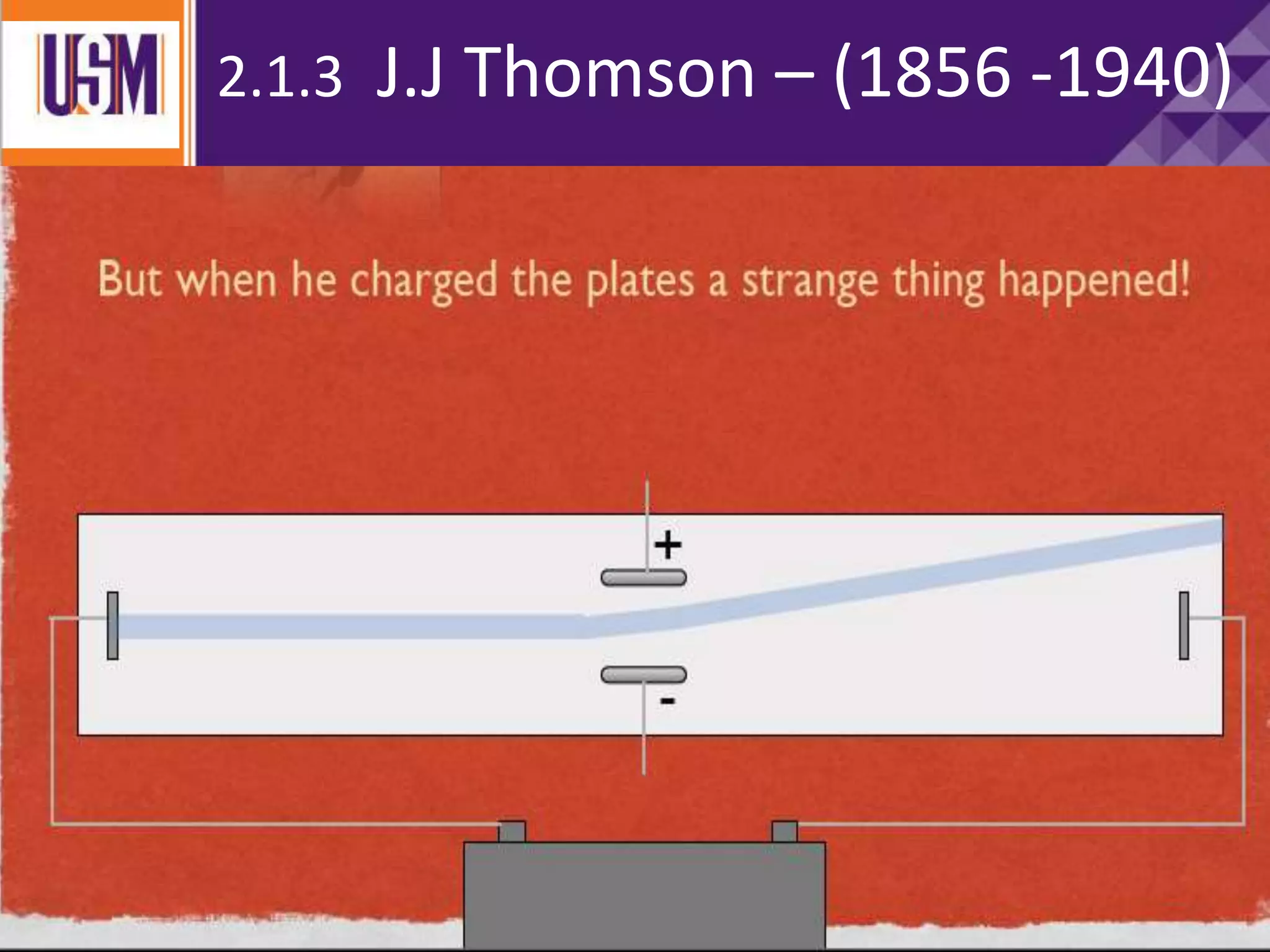
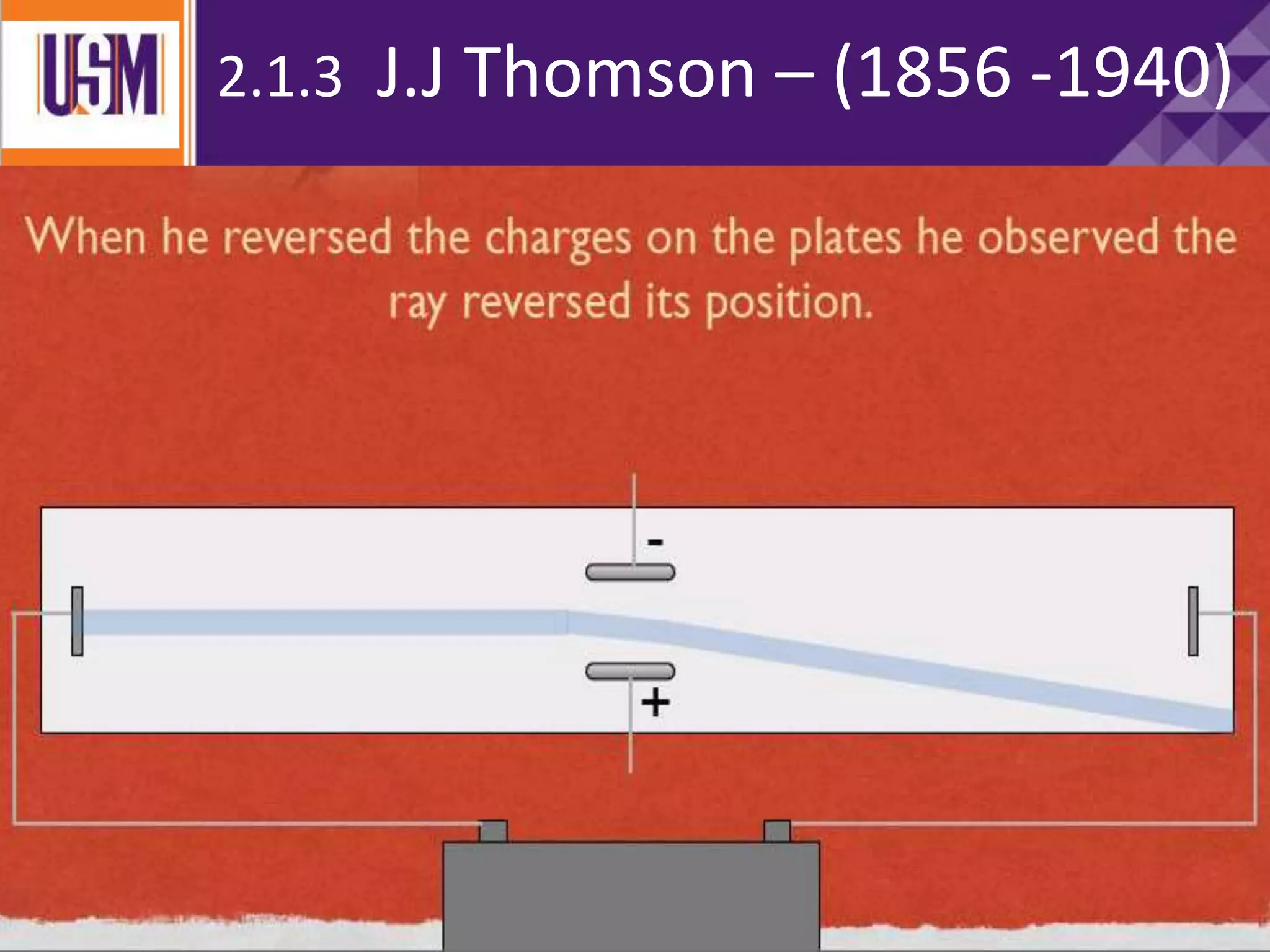
2.1.3 J.J Thomson– (1856 -1940)
Result’s
Experiment
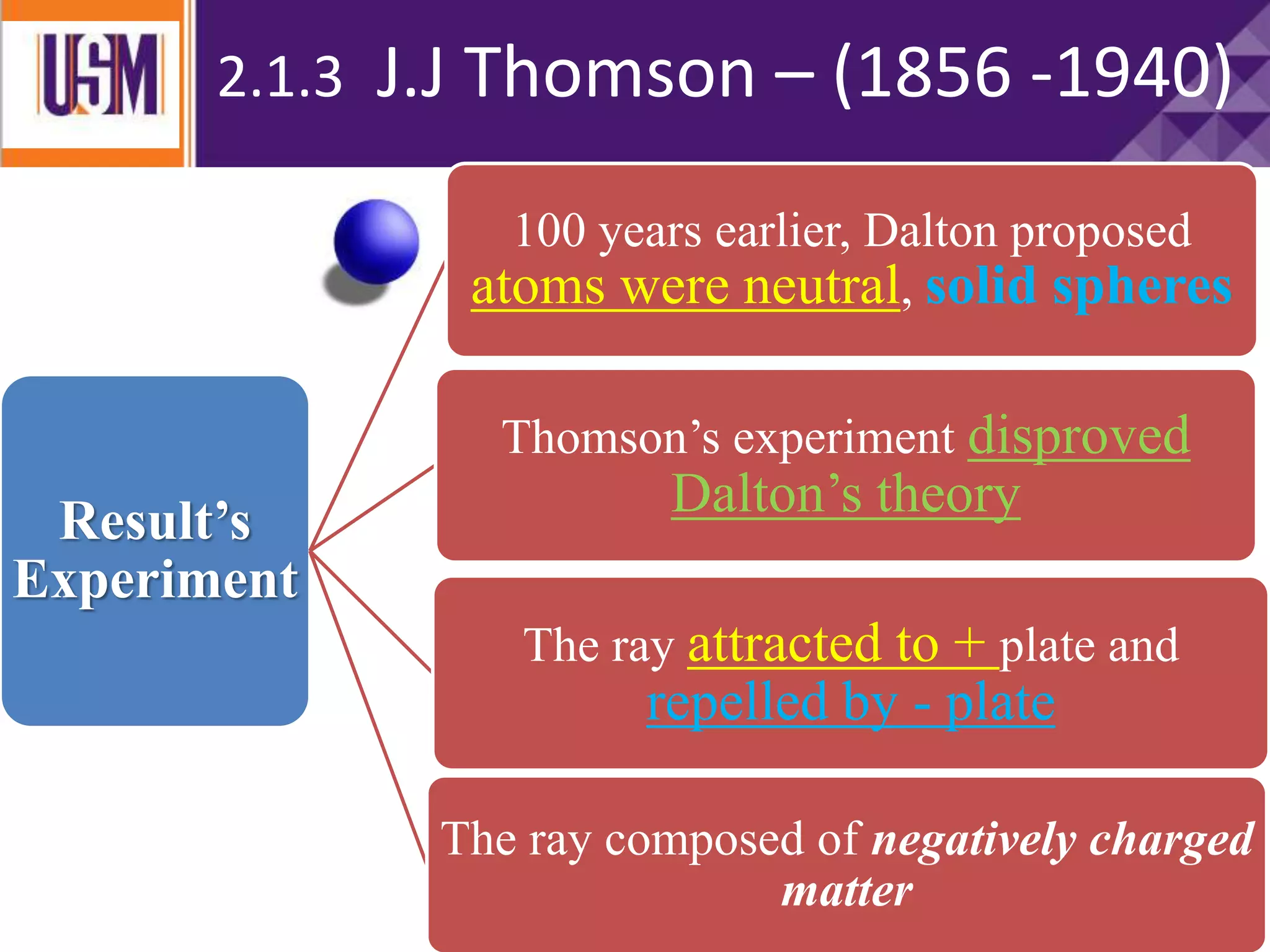
The ray composed of negatively charged
matter
The ray attracted to + plate and
repelled by - plate
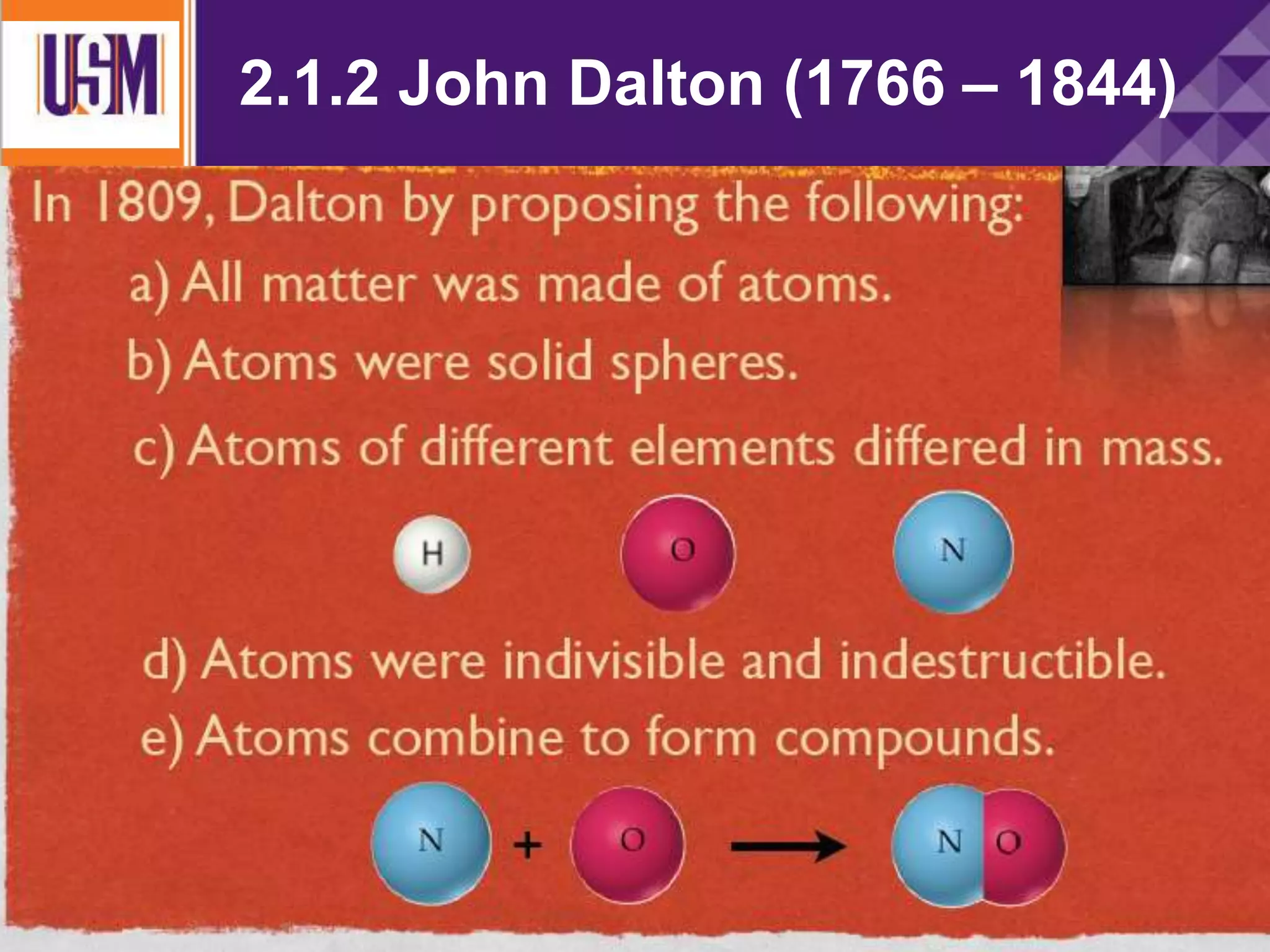
100 years earlier, Dalton proposed
atoms were neutral, solid spheres
Thomson’s experiment disproved
Dalton’s theory
13.
IDEAS
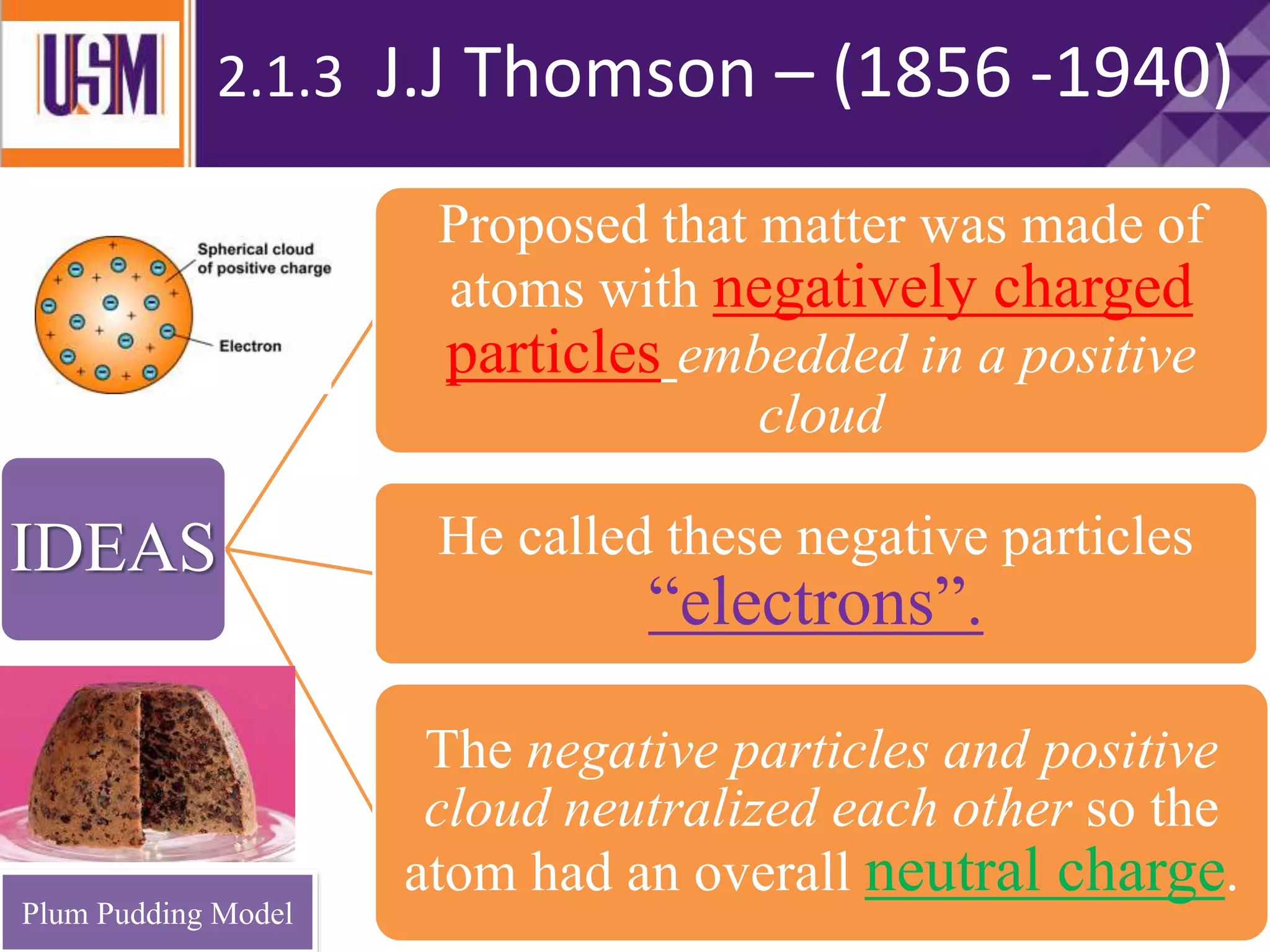
Proposed that matterwas made of
atoms with negatively charged
particles embedded in a positive
cloud
He called these negative particles
“electrons”.
The negative particles and positive
cloud neutralized each other so the
atom had an overall neutral charge.
2.1.3 J.J Thomson – (1856 -1940)
Plum Pudding Model
14.
2.1.4 ERNEST RUTHERFORD
(1871-1937)
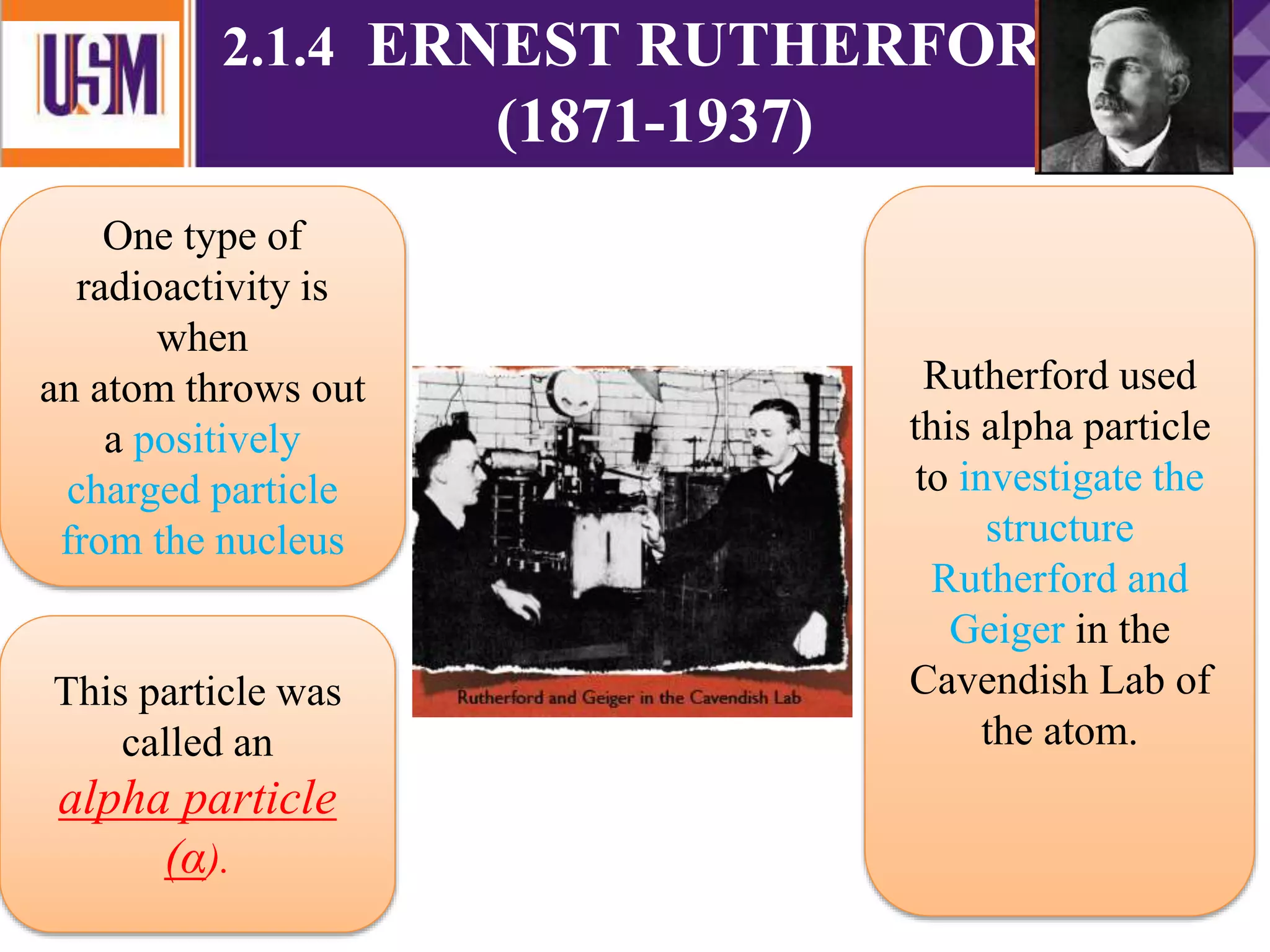
Rutherfordused
this alpha particle
to investigate the
structure
Rutherford and
Geiger in the
Cavendish Lab of
the atom.
This particle was
called an
alpha particle
(α).
One type of
radioactivity is
when
an atom throws out
a positively
charged particle
from the nucleus
15.
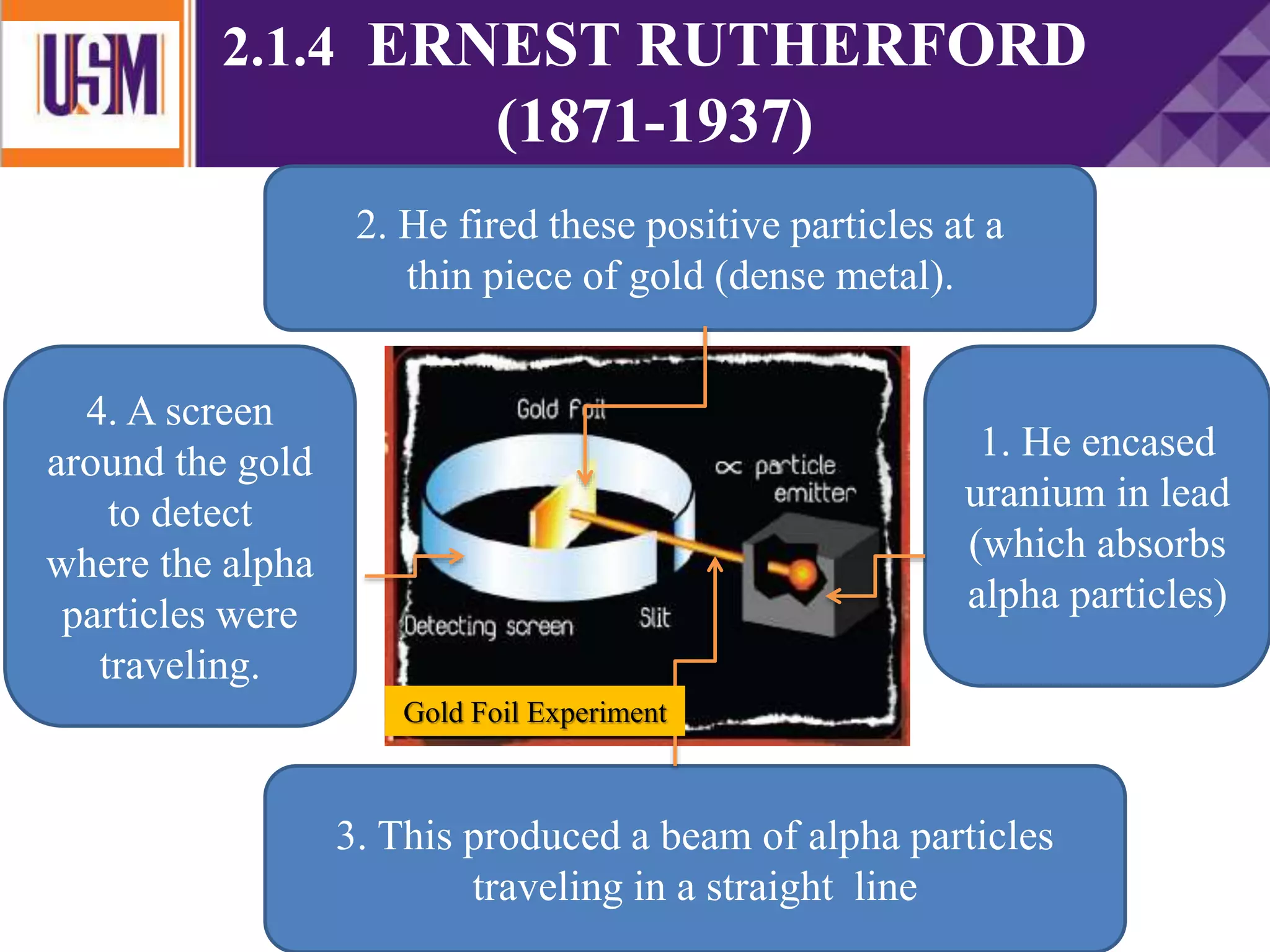
4. A screen
aroundthe gold
to detect
where the alpha
particles were
traveling.
2. He fired these positive particles at a
thin piece of gold (dense metal).
3. This produced a beam of alpha particles
traveling in a straight line
1. He encased
uranium in lead
(which absorbs
alpha particles)
2.1.4 ERNEST RUTHERFORD
(1871-1937)
Gold Foil Experiment
16.
Uranium is aradioactive
element that gives off
positive particles
(alpha particles).
Rutherford used these
positive particles to
investigate the makeup of
the atom.
URANIUM
2.1.4 ERNEST RUTHERFORD
(1871-1937)
17.
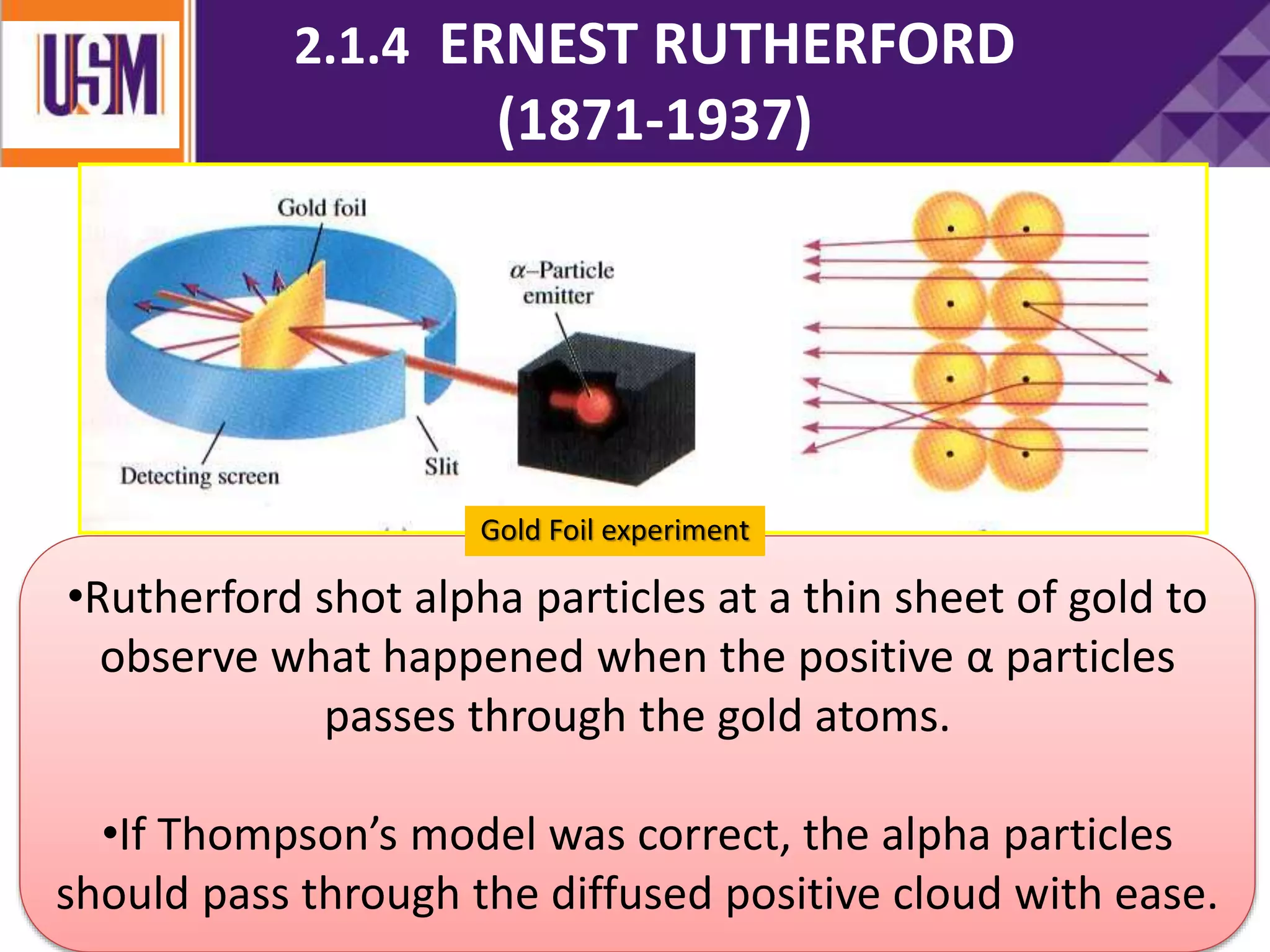
•Rutherford shot alphaparticles at a thin sheet of gold to
observe what happened when the positive α particles
passes through the gold atoms.
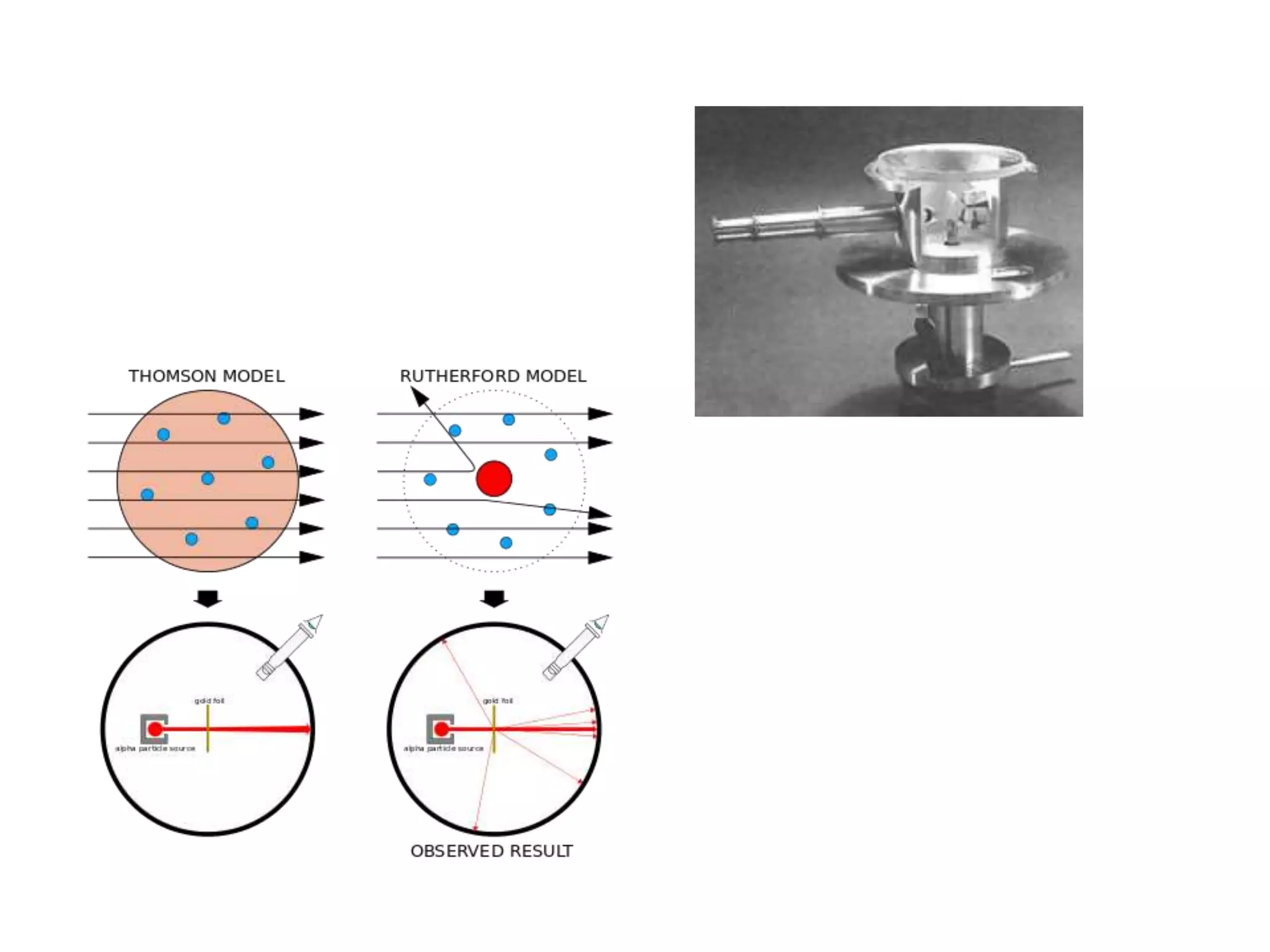
•If Thompson’s model was correct, the alpha particles
should pass through the diffused positive cloud with ease.
2.1.4 ERNEST RUTHERFORD
(1871-1937)
Gold Foil experiment
18.
He concluded thatthe
atom had a dense,
positive central nucleus
composed of + charged
protons
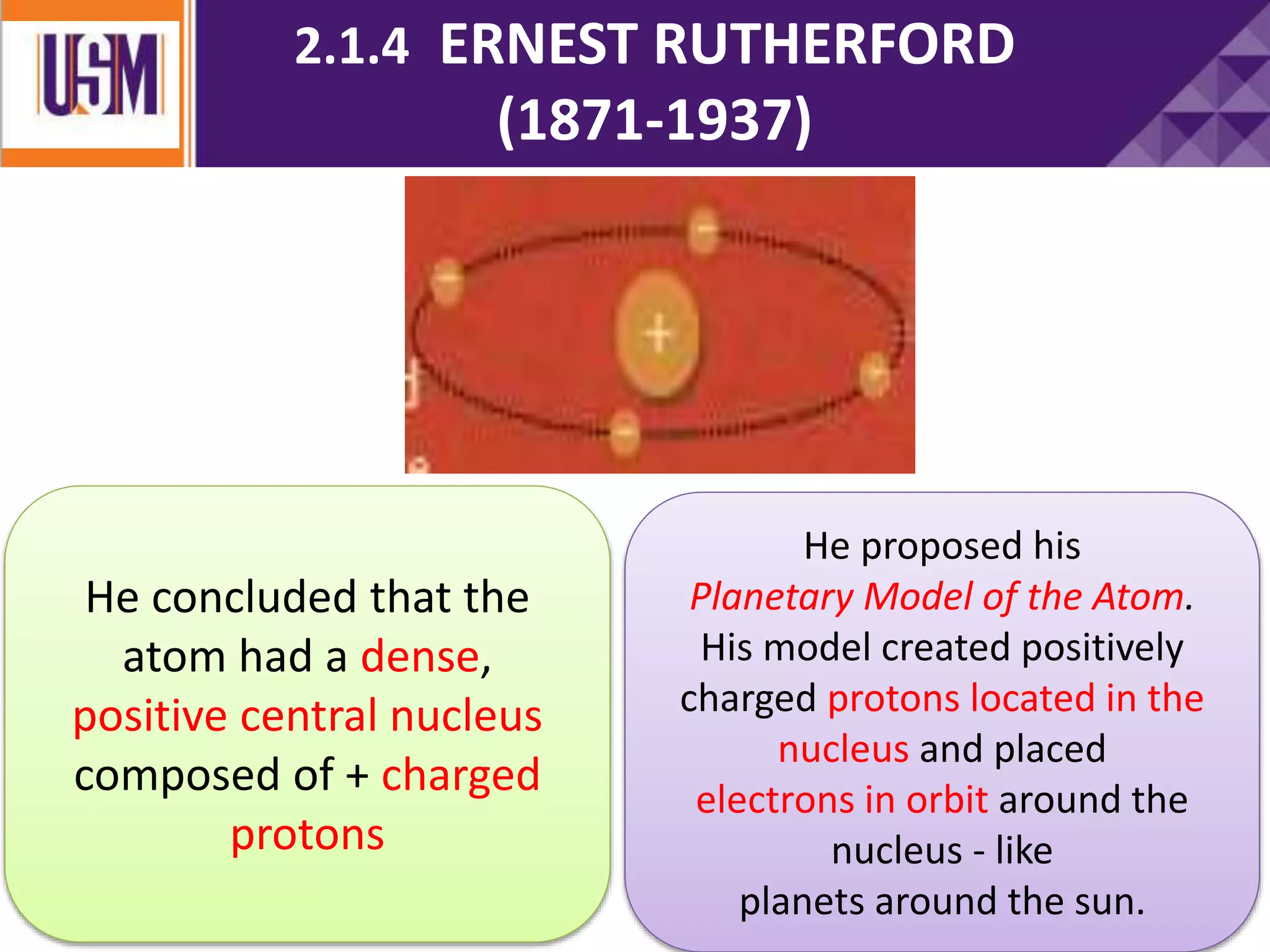
He proposed his
Planetary Model of the Atom.
His model created positively
charged protons located in the
nucleus and placed
electrons in orbit around the
nucleus - like
planets around the sun.
2.1.4 ERNEST RUTHERFORD
(1871-1937)
20.
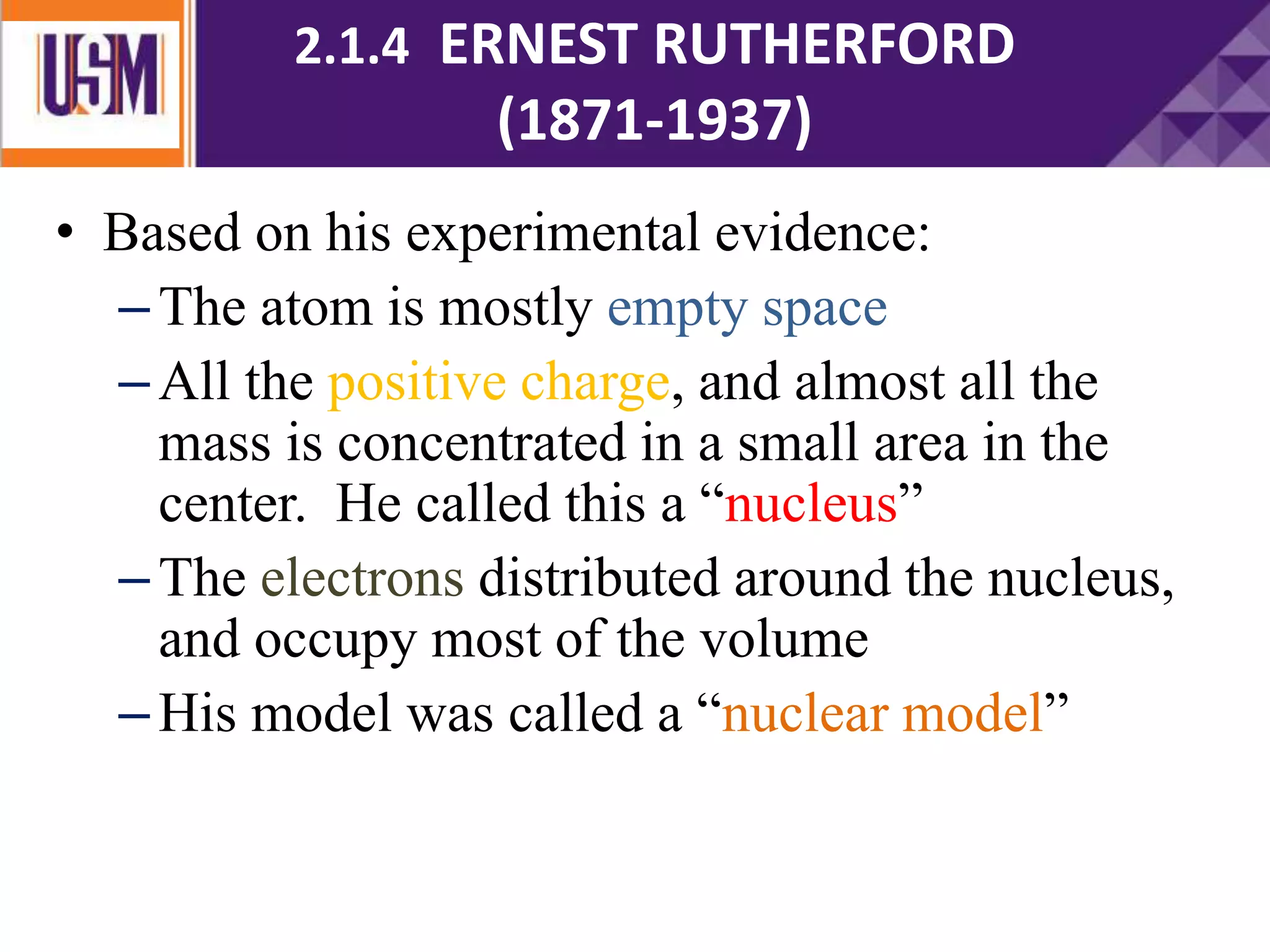
• Based onhis experimental evidence:
–The atom is mostly empty space
–All the positive charge, and almost all the
mass is concentrated in a small area in the
center. He called this a “nucleus”
–The electrons distributed around the nucleus,
and occupy most of the volume
–His model was called a “nuclear model”
2.1.4 ERNEST RUTHERFORD
(1871-1937)
SUMMARY
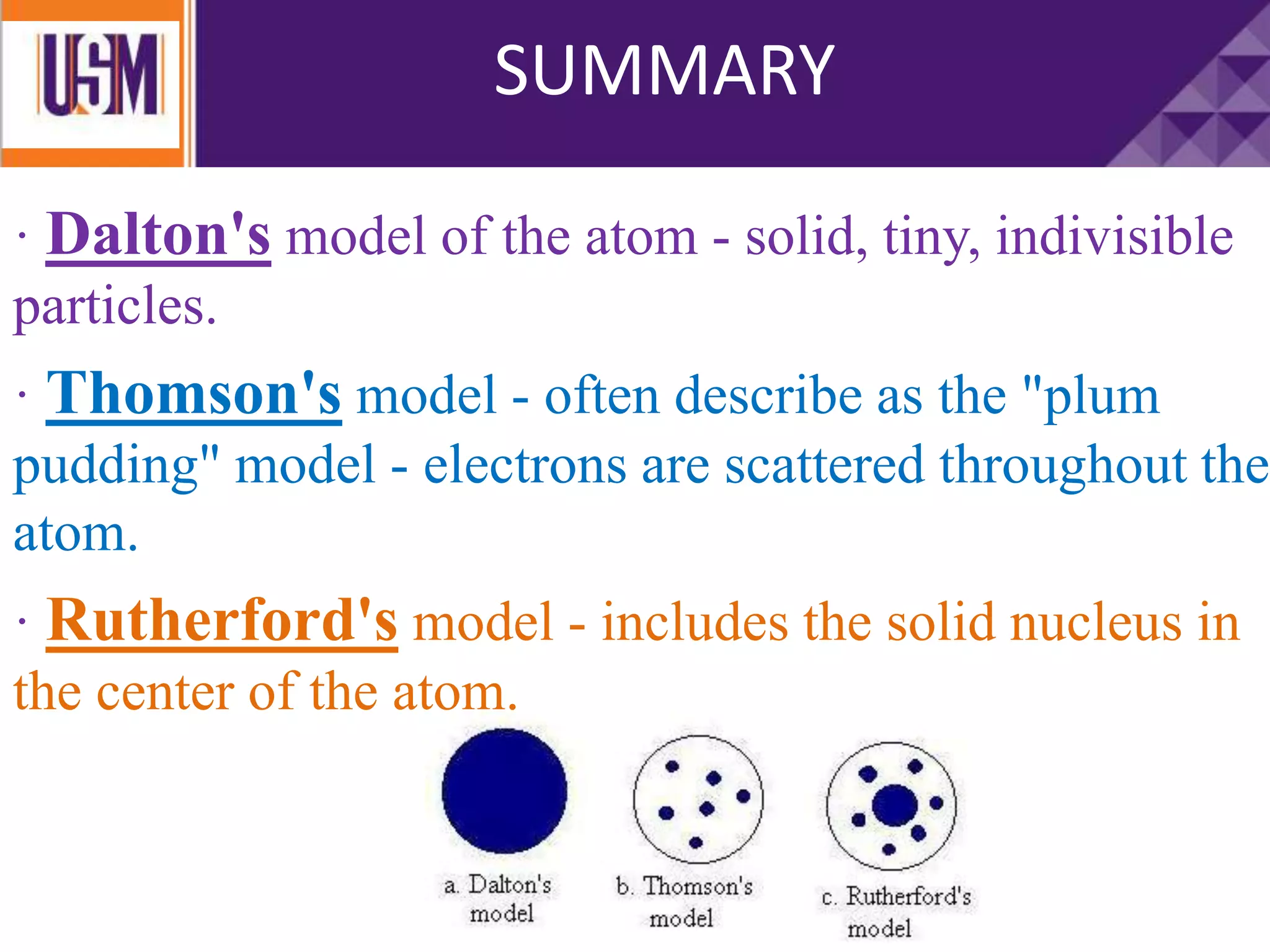
· Dalton's modelof the atom - solid, tiny, indivisible
particles.
· Thomson's model - often describe as the "plum
pudding" model - electrons are scattered throughout the
atom.
· Rutherford's model - includes the solid nucleus in
the center of the atom.
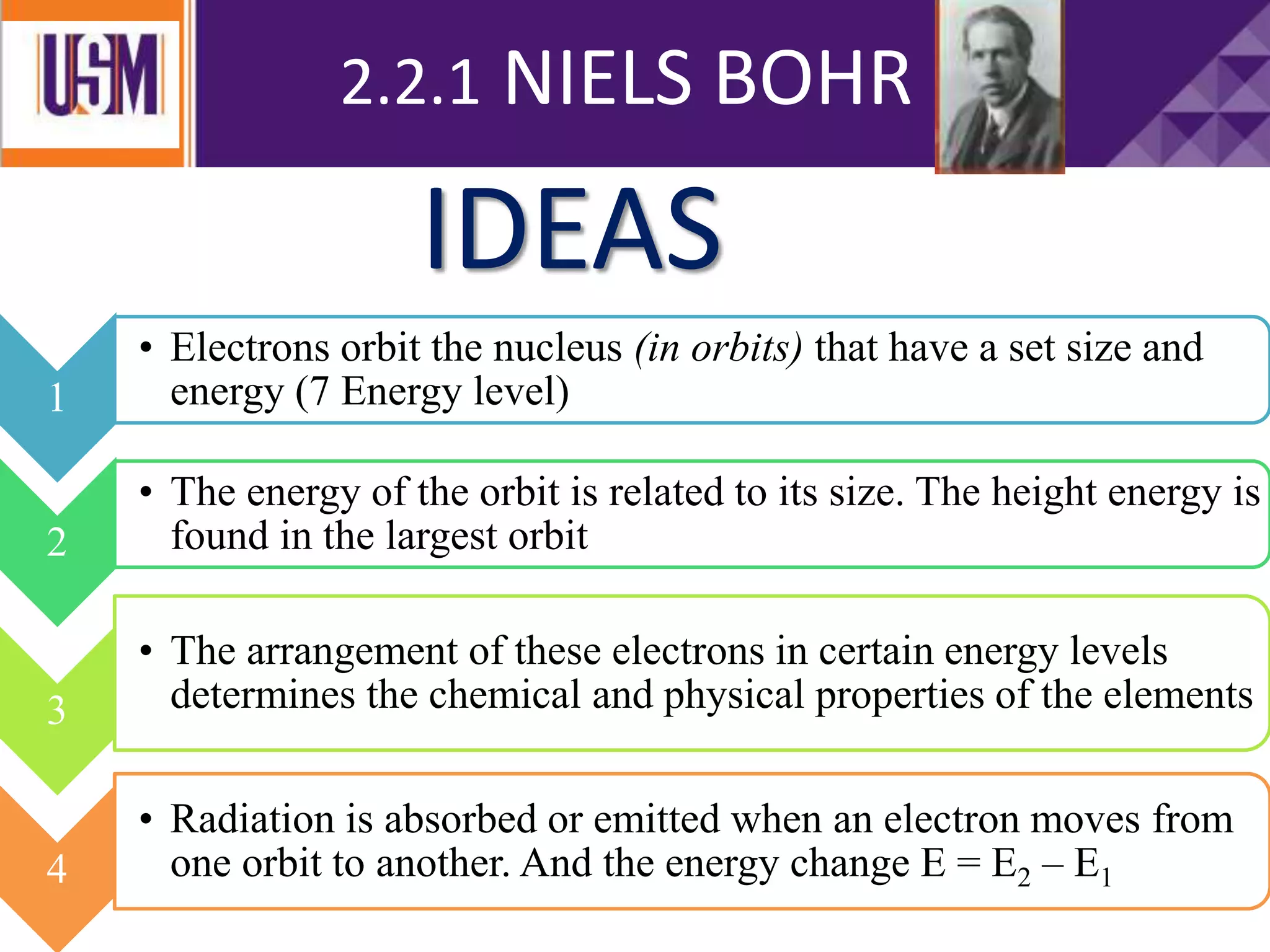
2.2.1 NIELS BOHR
1
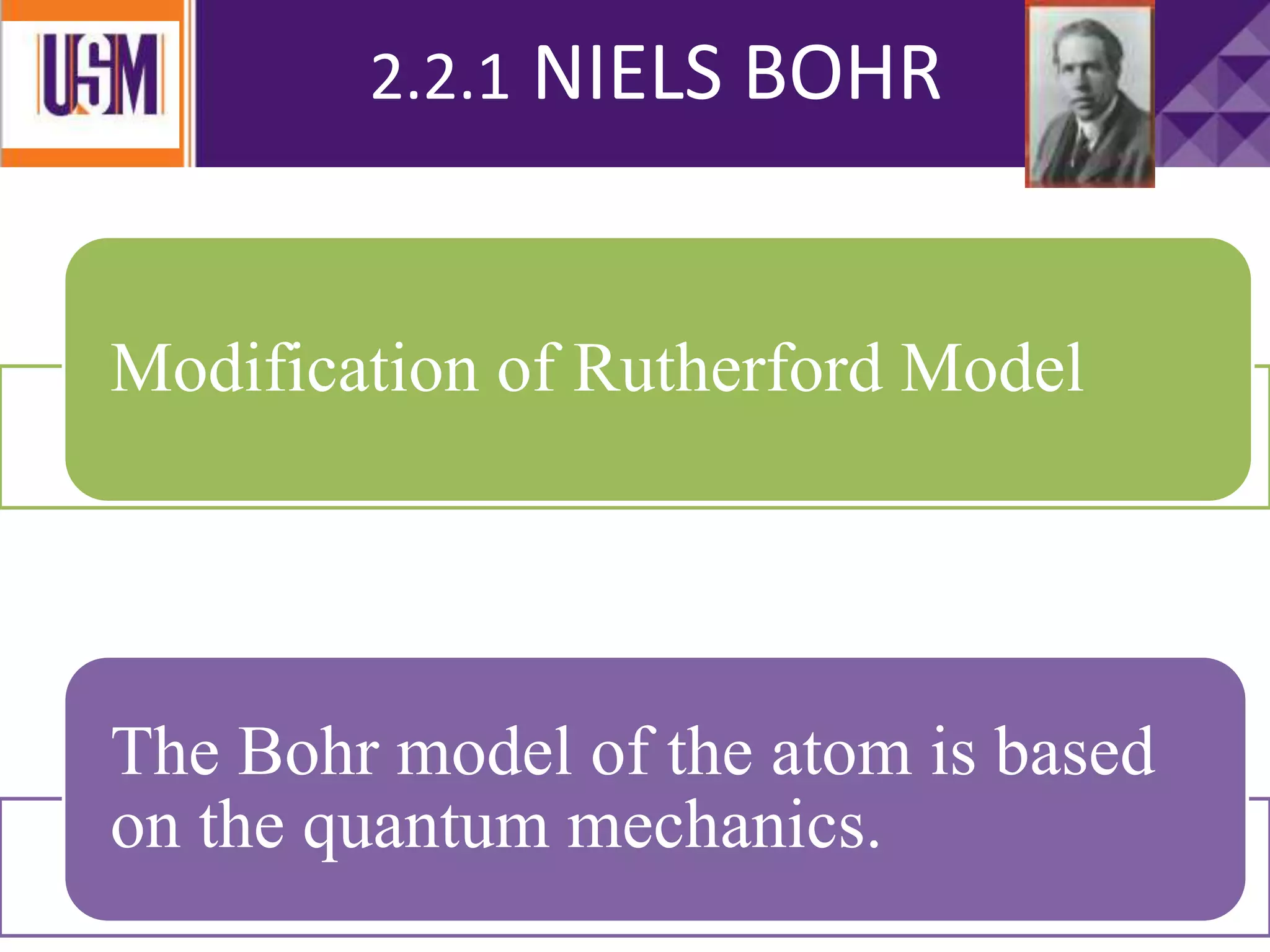
•Electrons orbit the nucleus (in orbits) that have a set size and
energy (7 Energy level)
2
• The energy of the orbit is related to its size. The height energy is
found in the largest orbit
3
• The arrangement of these electrons in certain energy levels
determines the chemical and physical properties of the elements
4
• Radiation is absorbed or emitted when an electron moves from
one orbit to another. And the energy change E = E2 – E1
IDEAS
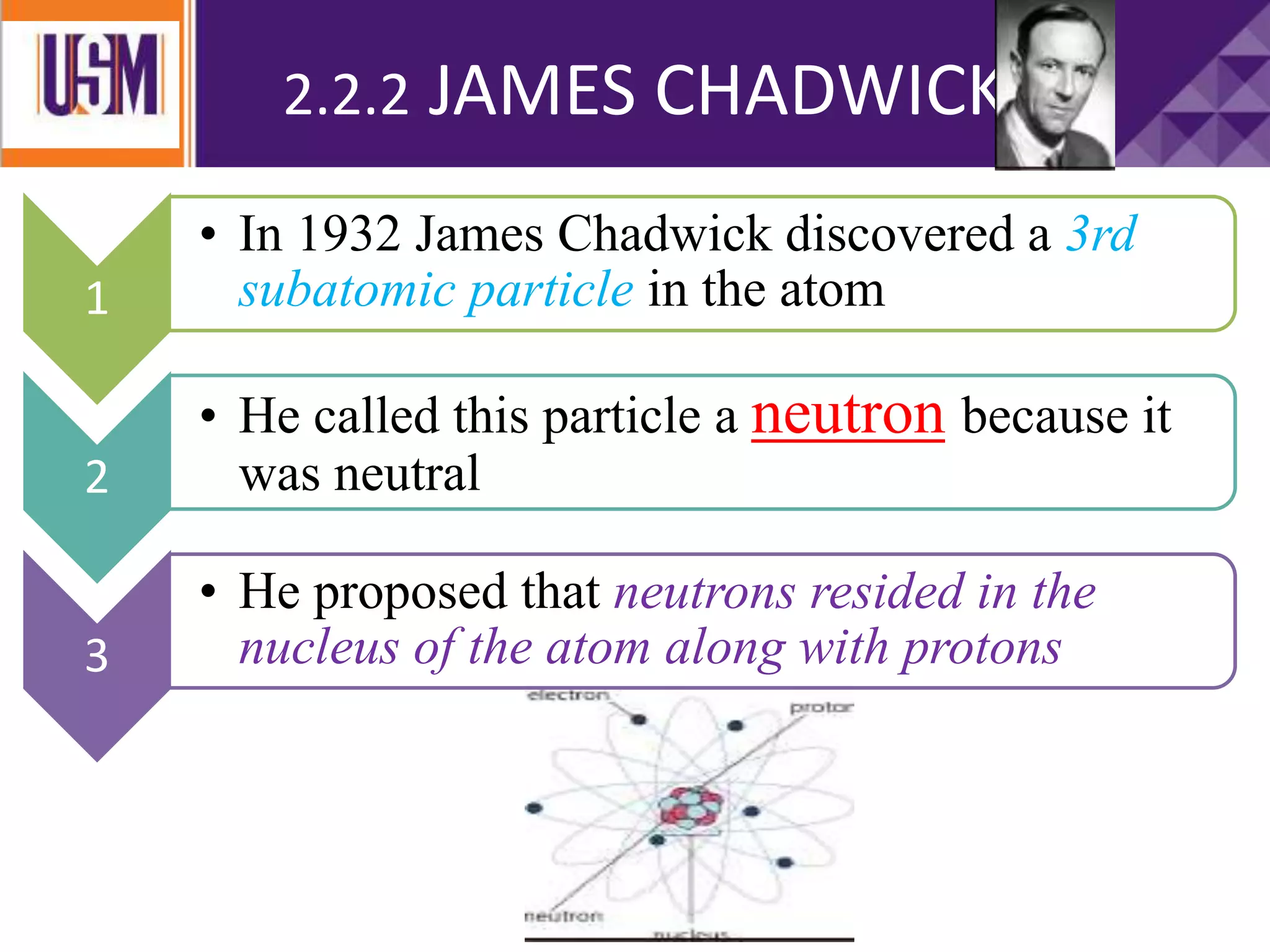
2.2.2 JAMES CHADWICK
1
•In 1932 James Chadwick discovered a 3rd
subatomic particle in the atom
2
• He called this particle a neutron because it
was neutral
3
• He proposed that neutrons resided in the
nucleus of the atom along with protons
2.1 Early modelsof atom
2.1.1 Democritus
2.1.2 John dalton
2.1.3 J.J.Thompson
2.1.4 Ernest Rutherford
OUTLINE
2.3 Structure of atom
2.3.1 Defining the atom
2.3.2 Distinguishing among atoms
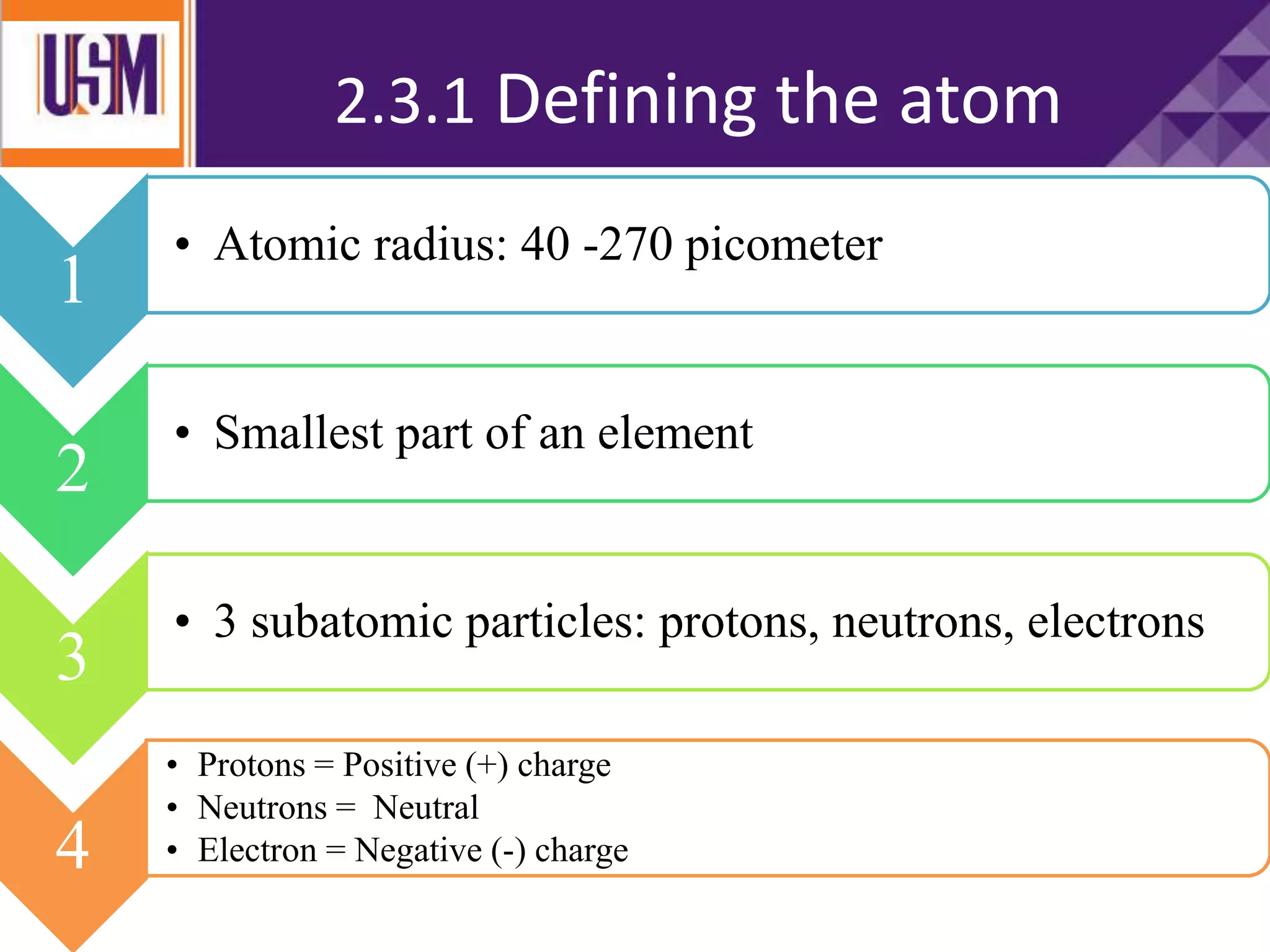
2.3.1 Defining theatom
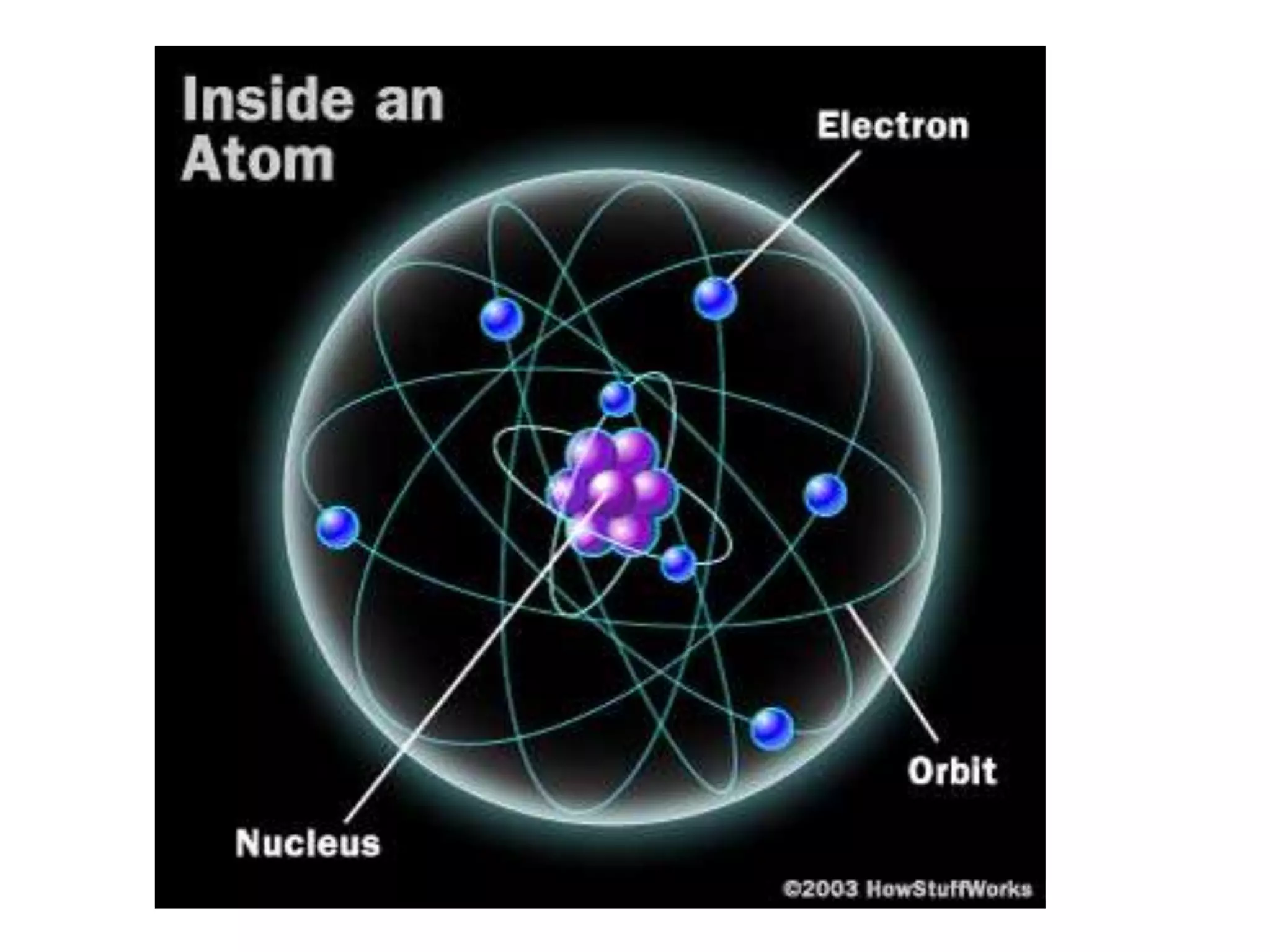
Neutrons have no lectrical
charge
1
• Atomic radius: 40 -270 picometer
2
• Smallest part of an element
3
• 3 subatomic particles: protons, neutrons, electrons
4
• Protons = Positive (+) charge
• Neutrons = Neutral
• Electron = Negative (-) charge
32.
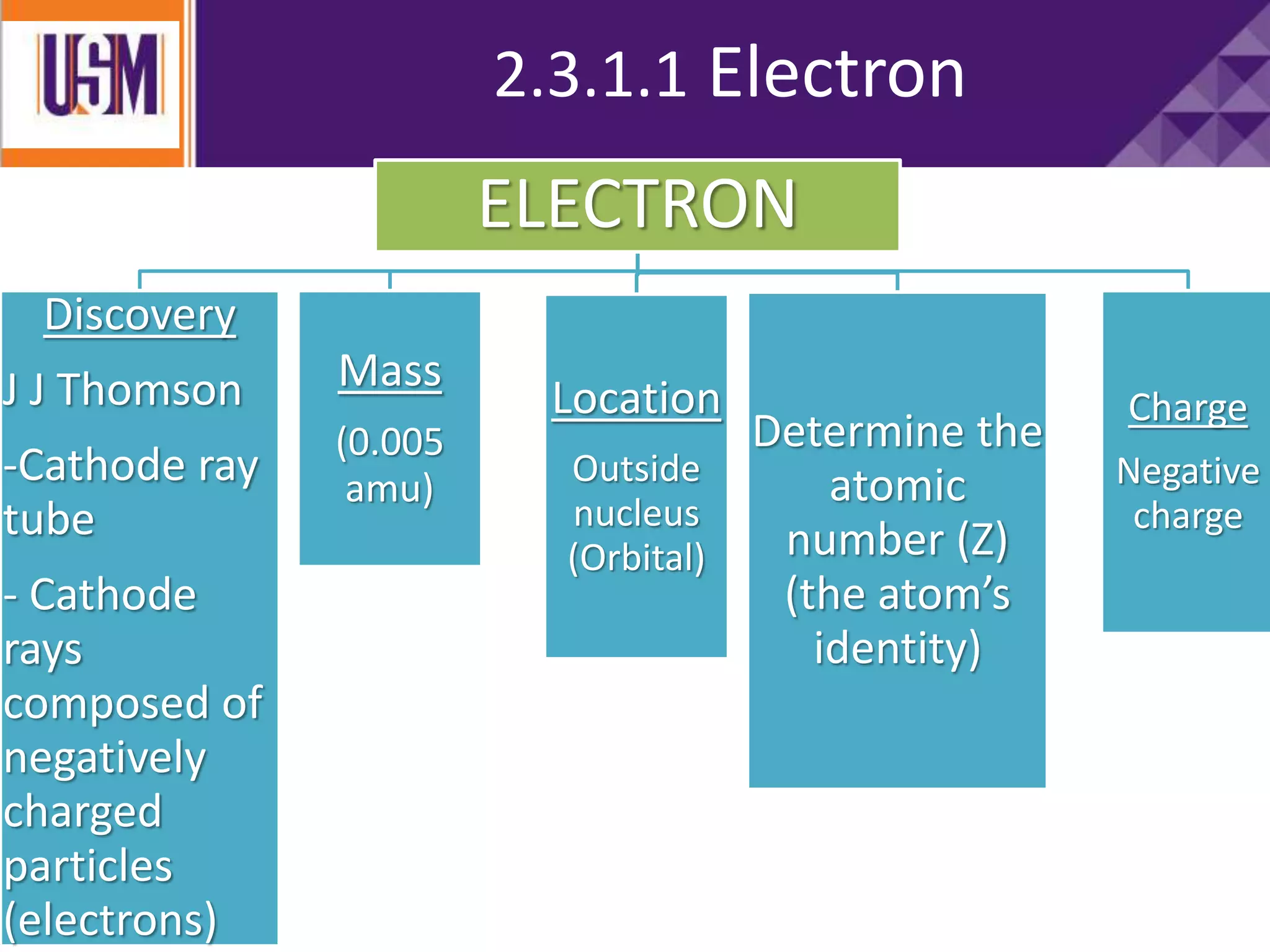
2.3.1.1 Electron
ELECTRON
Discovery
J JThomson
-Cathode ray
tube
- Cathode
rays
composed of
negatively
charged
particles
(electrons)
Mass
(0.005
amu)
Determine the
atomic
number (Z)
(the atom’s
identity)
Location
Outside
nucleus
(Orbital)
Charge
Negative
charge
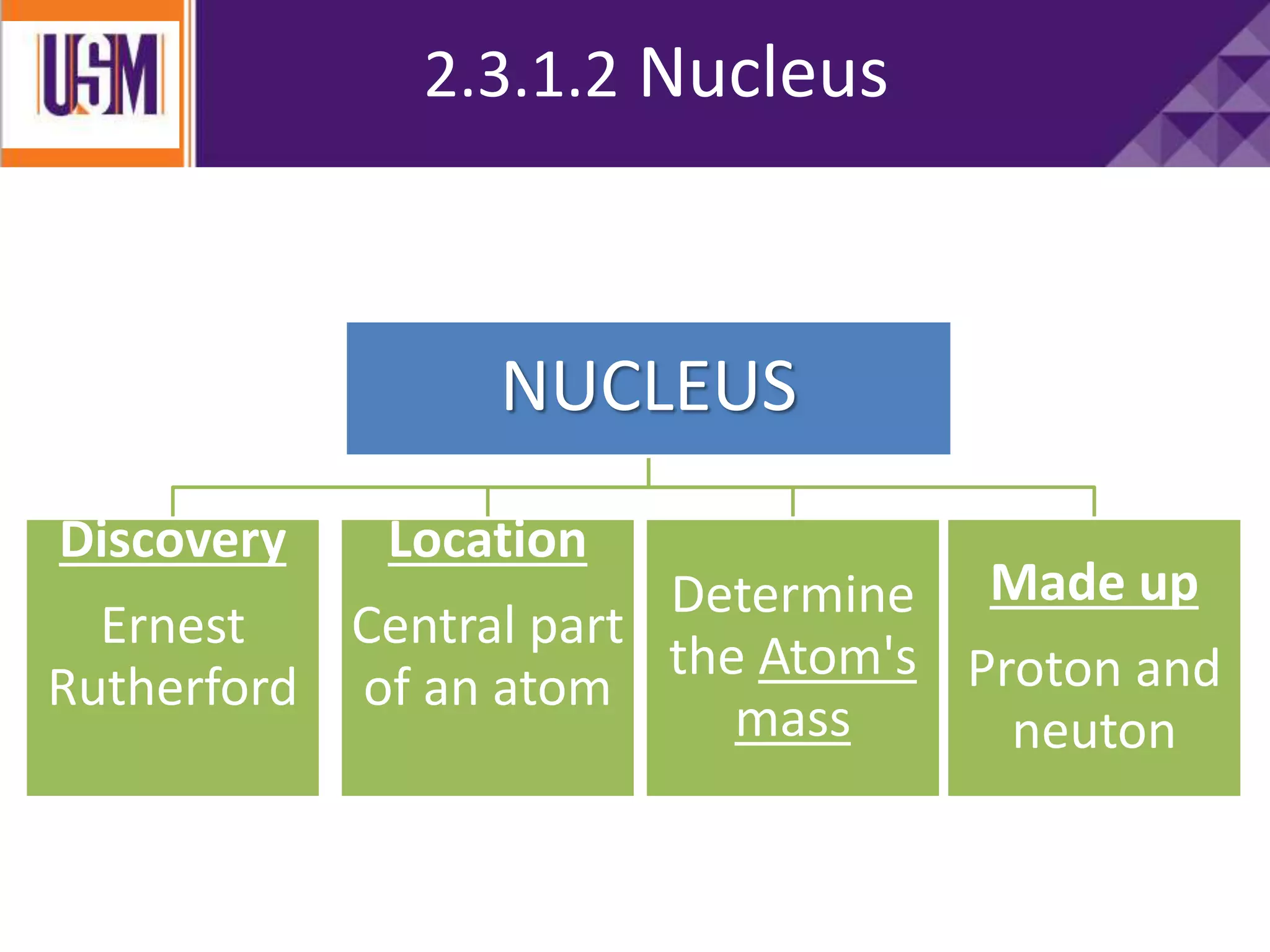
2.3.1.2 Nucleus
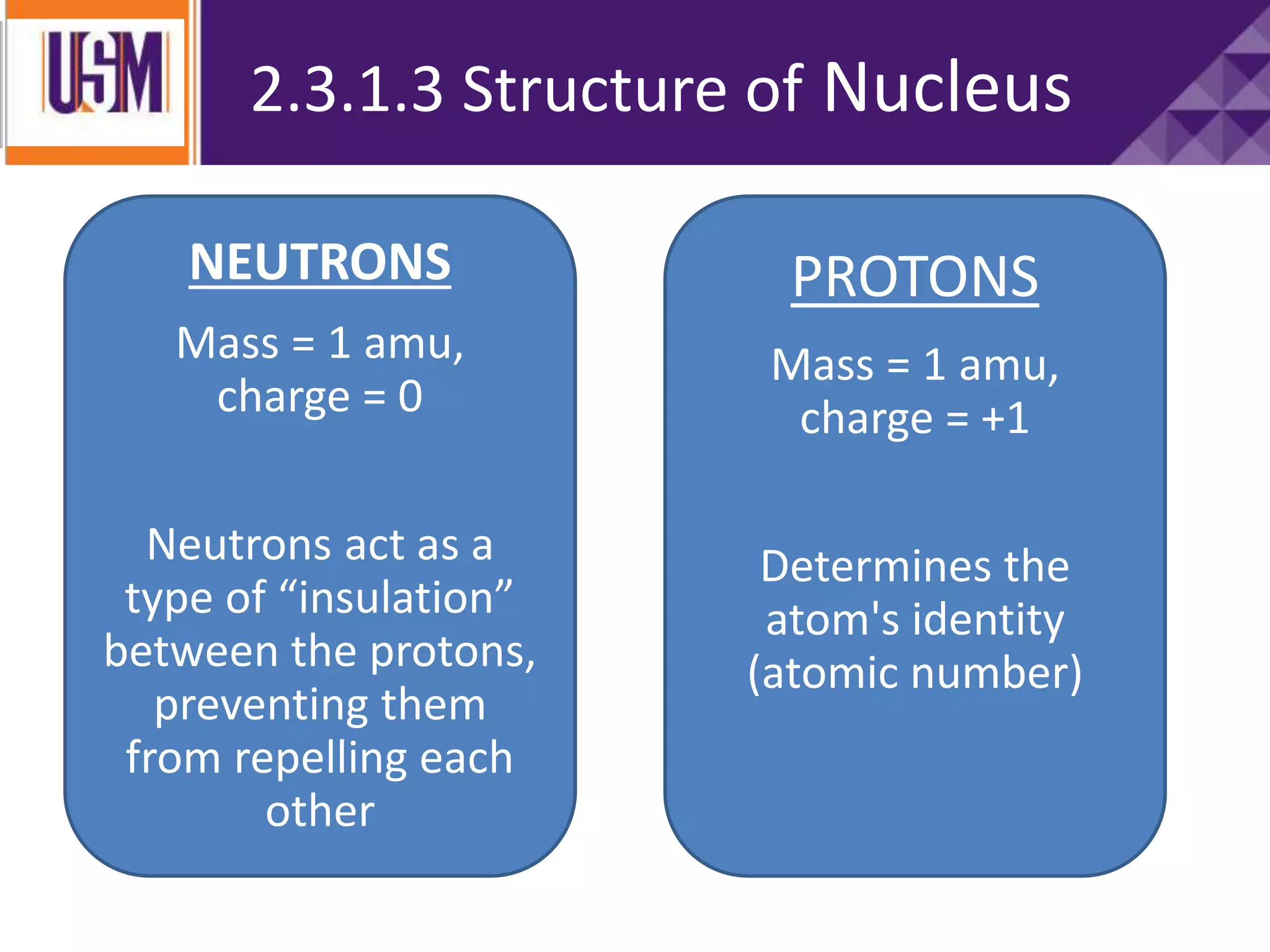
2.3.1.3 Structureof Nucleus
NEUTRONS
Mass = 1 amu,
charge = 0
Neutrons act as a
type of “insulation”
between the protons,
preventing them
from repelling each
other
PROTONS
Mass = 1 amu,
charge = +1
Determines the
atom's identity
(atomic number)
36.
OUTLINE
2.3.2 Distinguishing amongatoms
2.3.2.1 Atomic Number
2.3.2.2 Mass Number
2.3.2.3 Atomic Mass
2.3.2.4 Isotopes
2.3.2.5 Electronic Configuration
37.
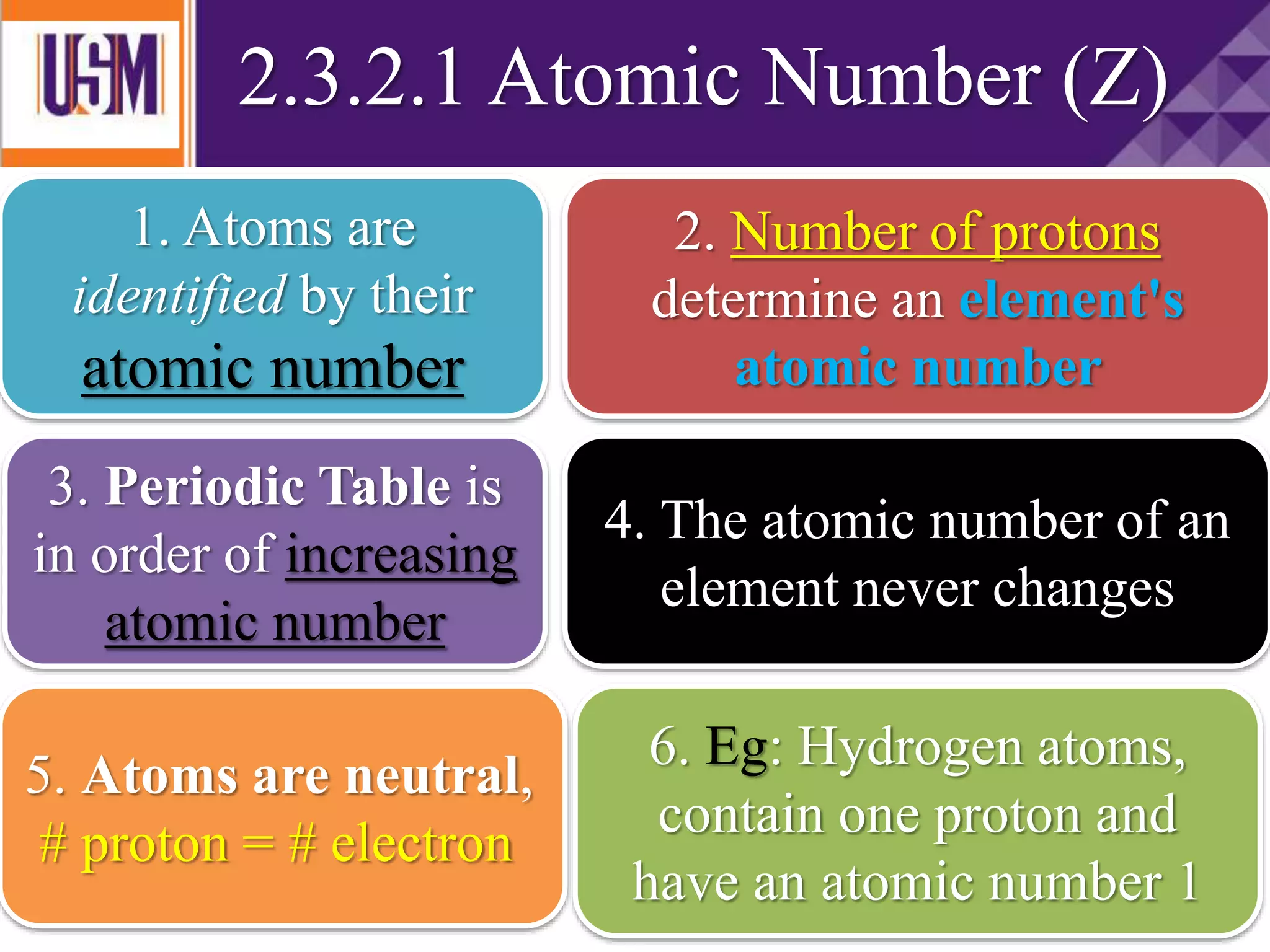
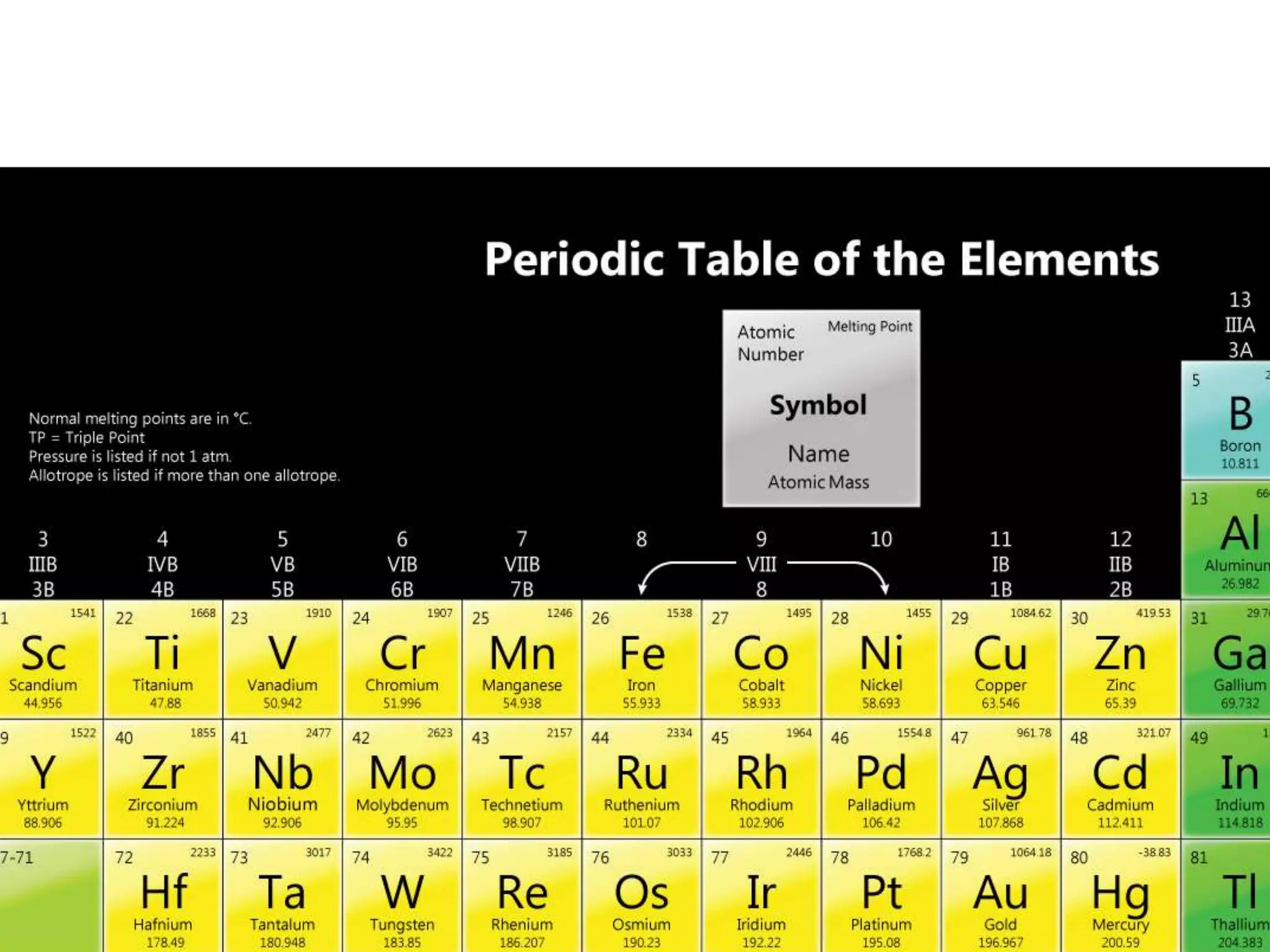
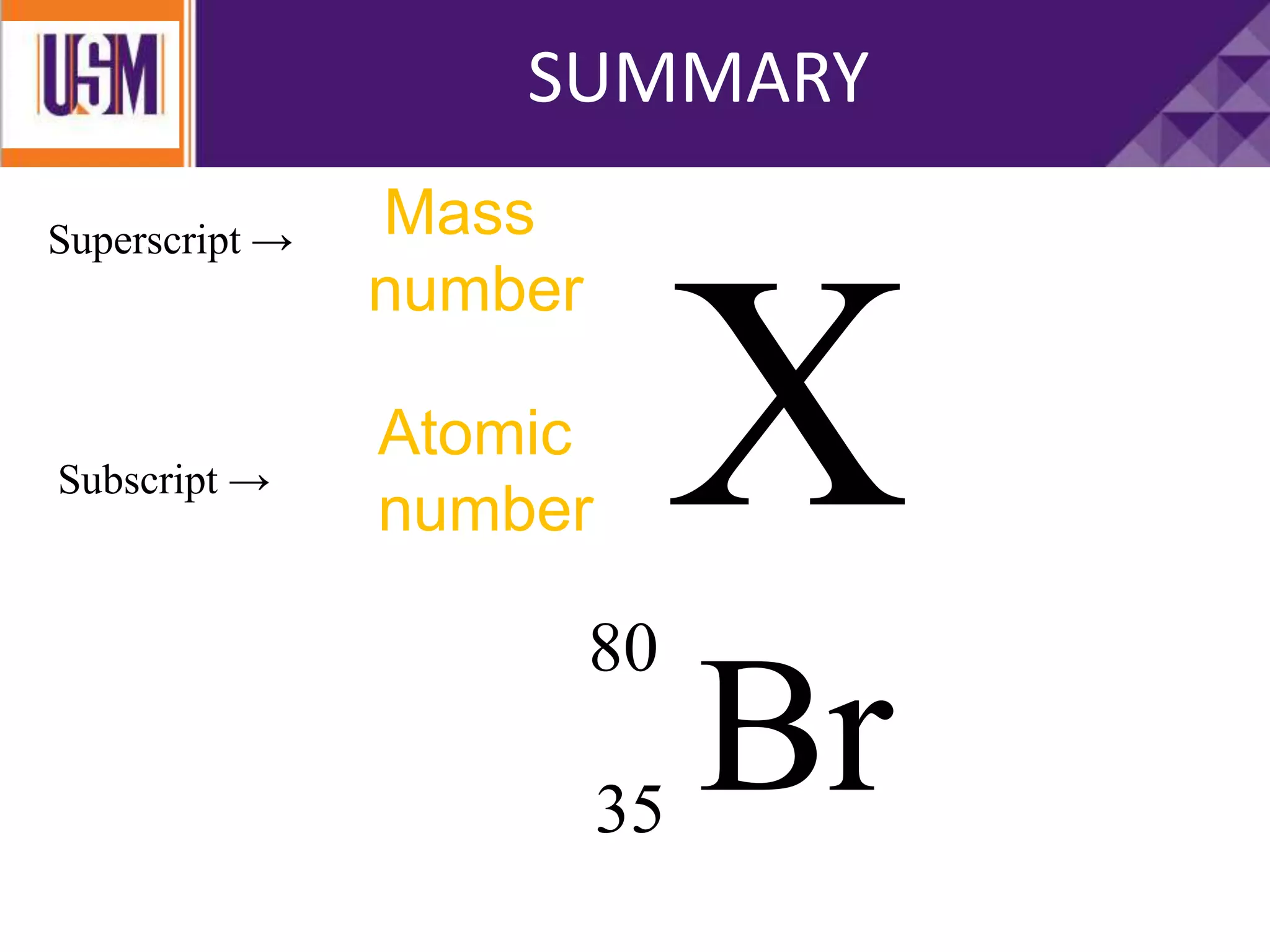
2.3.2.1 Atomic Number(Z)
5. Atoms are neutral,
# proton = # electron
1. Atoms are
identified by their
atomic number
4. The atomic number of an
element never changes
6. Eg: Hydrogen atoms,
contain one proton and
have an atomic number 1
2. Number of protons
determine an element's
atomic number
3. Periodic Table is
in order of increasing
atomic number
39.
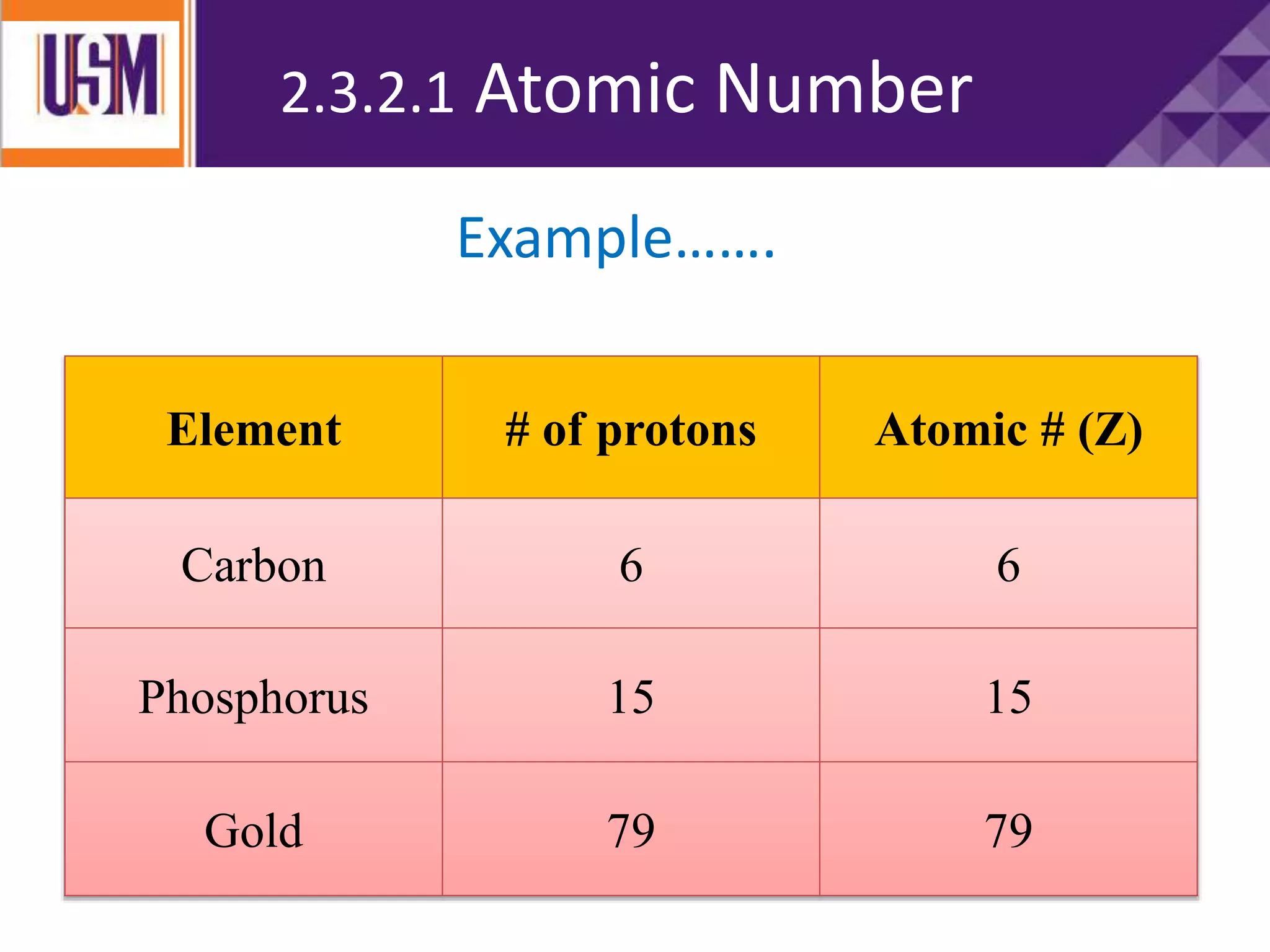
Element # ofprotons Atomic # (Z)
Carbon 6 6
Phosphorus 15 15
Gold 79 79
2.3.2.1 Atomic Number
Example…….
40.
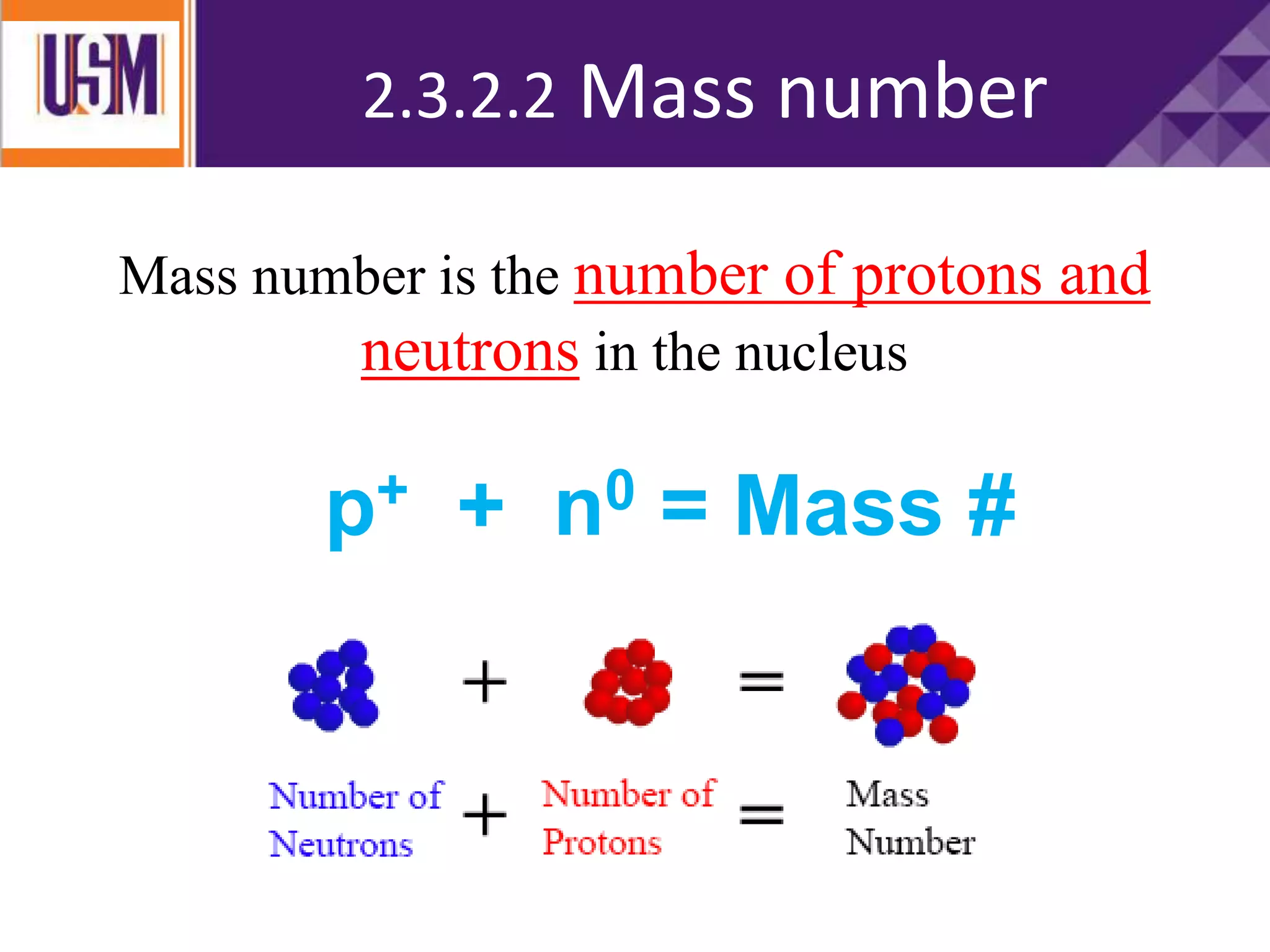
Mass number isthe number of protons and
neutrons in the nucleus
p+ + n0 = Mass #
2.3.2.2 Mass number
41.
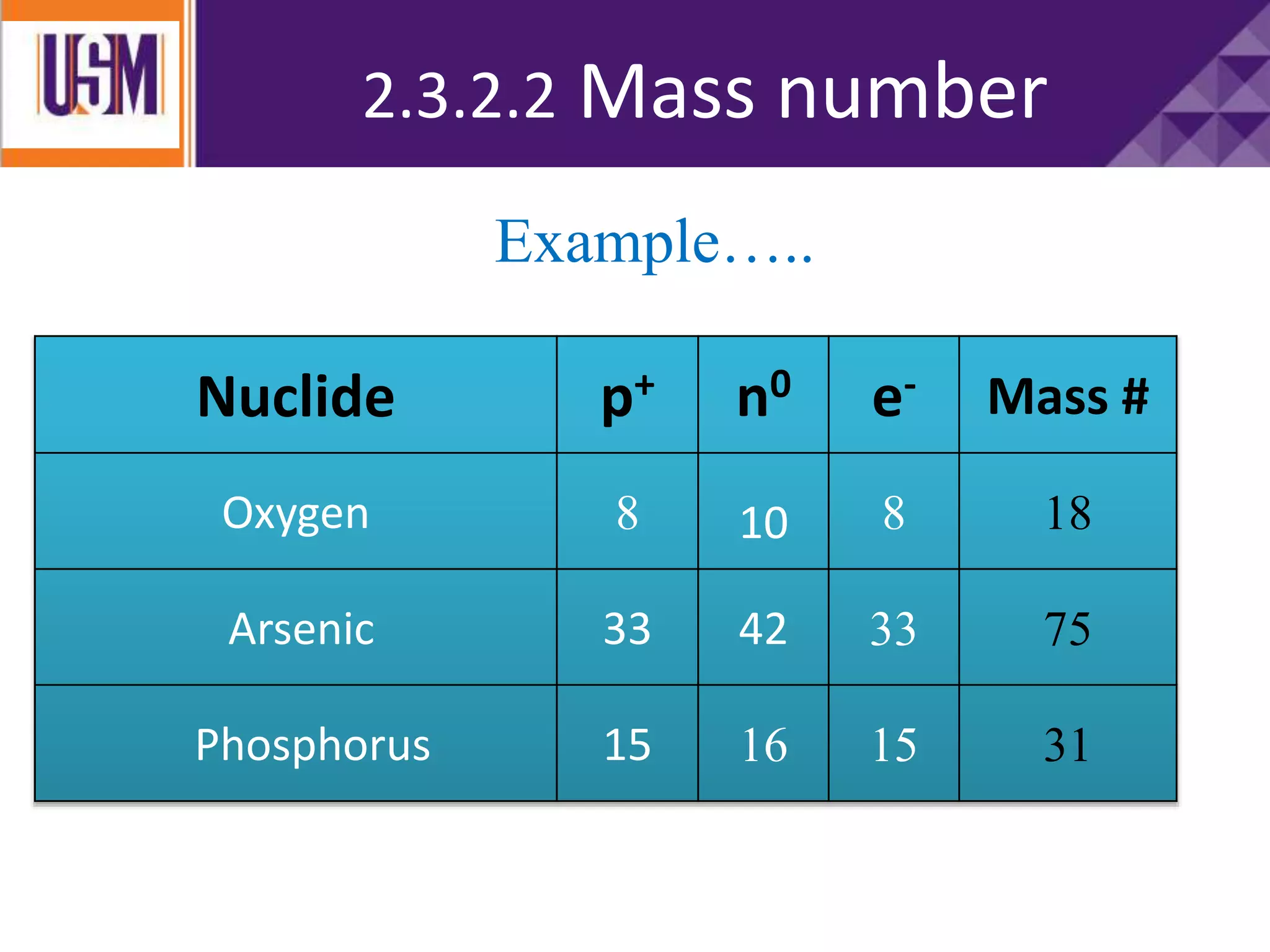
Nuclide p+ n0e- Mass #
Oxygen 8 10 8 18
Arsenic 33 42 33 75
Phosphorus 15 16 15 31
2.3.2.2 Mass number
Example…..
42.
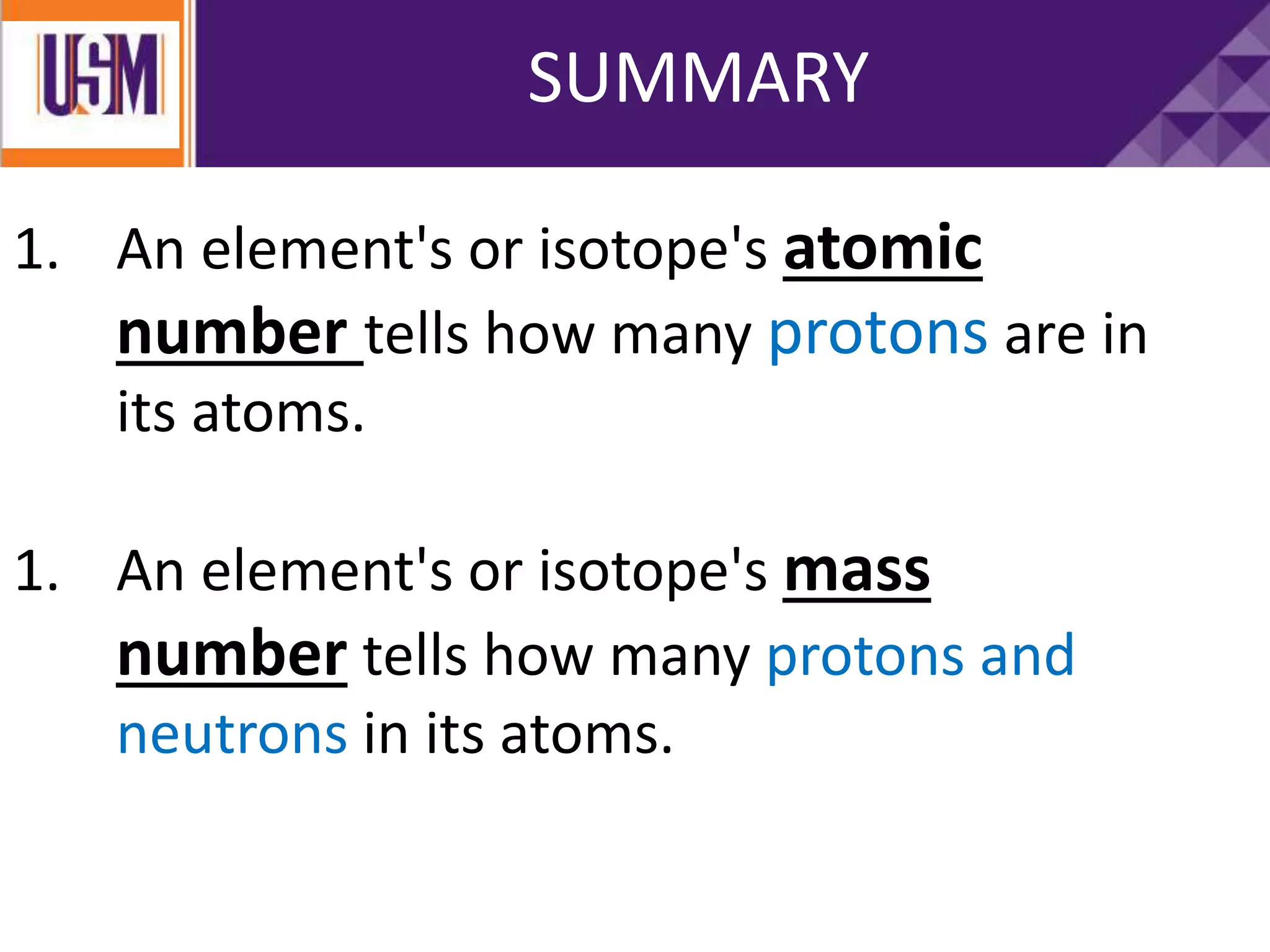
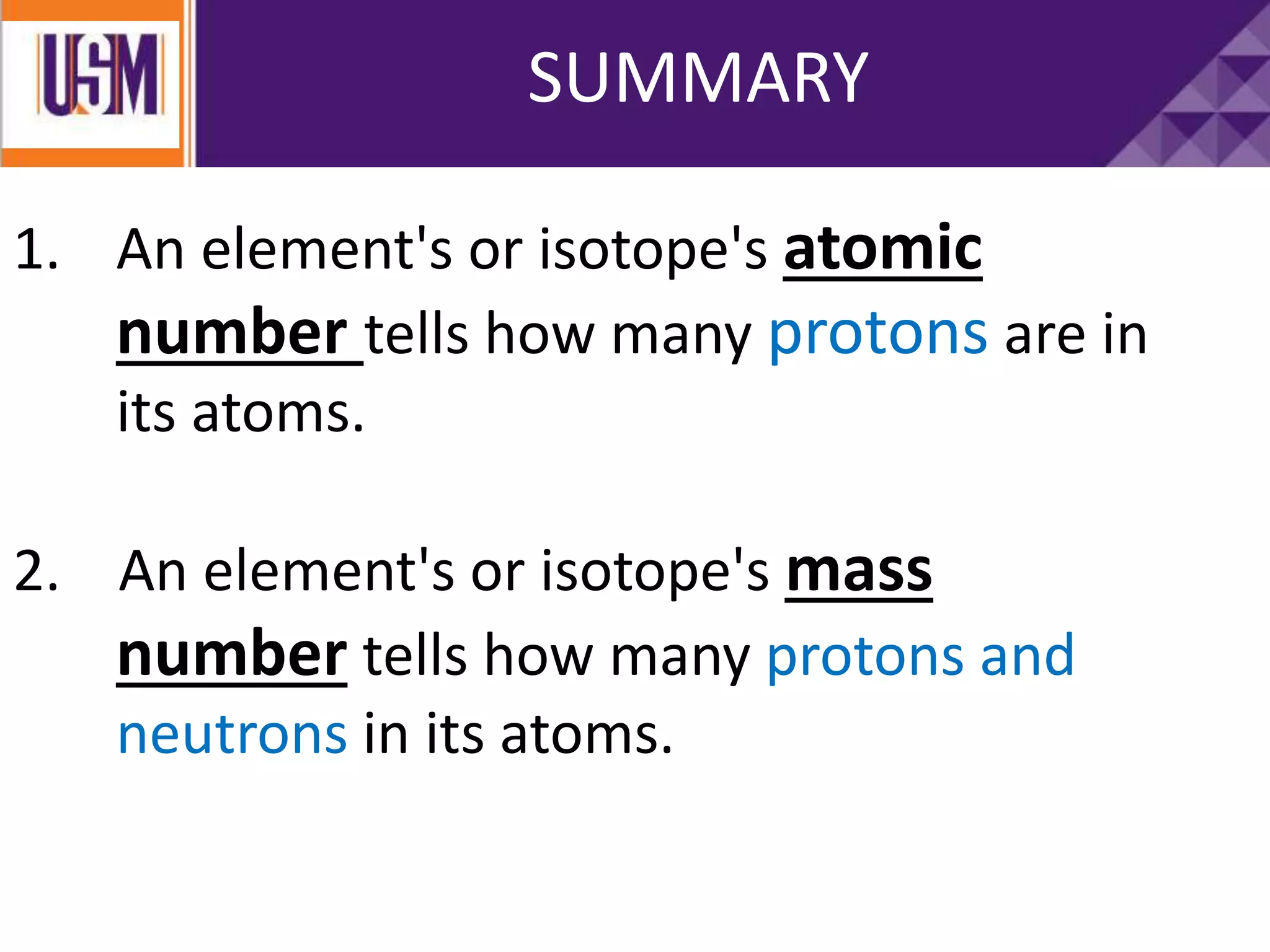
1. An element'sor isotope's atomic
number tells how many protons are in
its atoms.
1. An element's or isotope's mass
number tells how many protons and
neutrons in its atoms.
SUMMARY
43.
1. An element'sor isotope's atomic
number tells how many protons are in
its atoms.
2. An element's or isotope's mass
number tells how many protons and
neutrons in its atoms.
SUMMARY
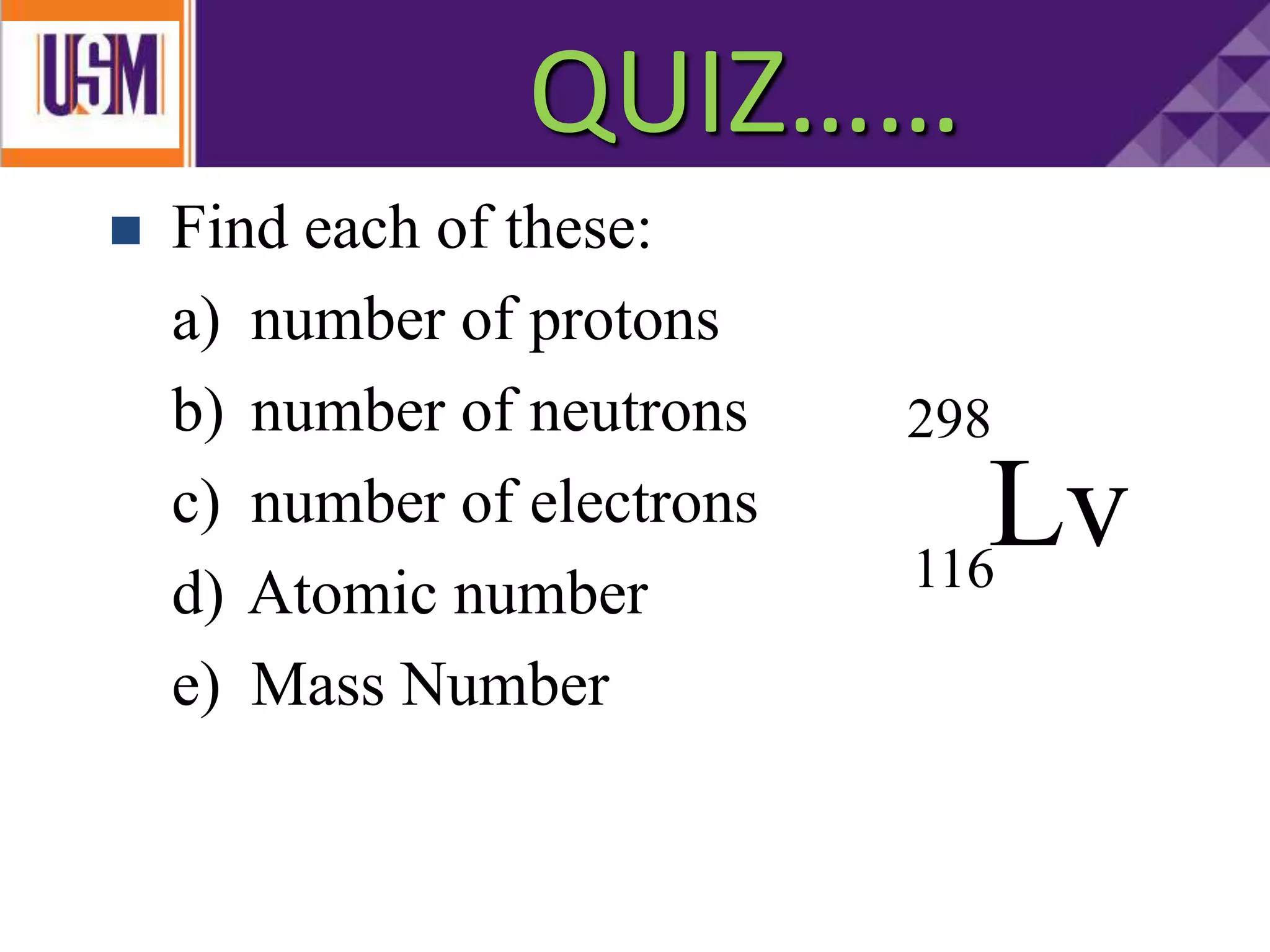
Find eachof these:
a) number of protons
b) number of neutrons
c) number of electrons
d) Atomic number
e) Mass Number
Lv
298
116
QUIZ……
46.
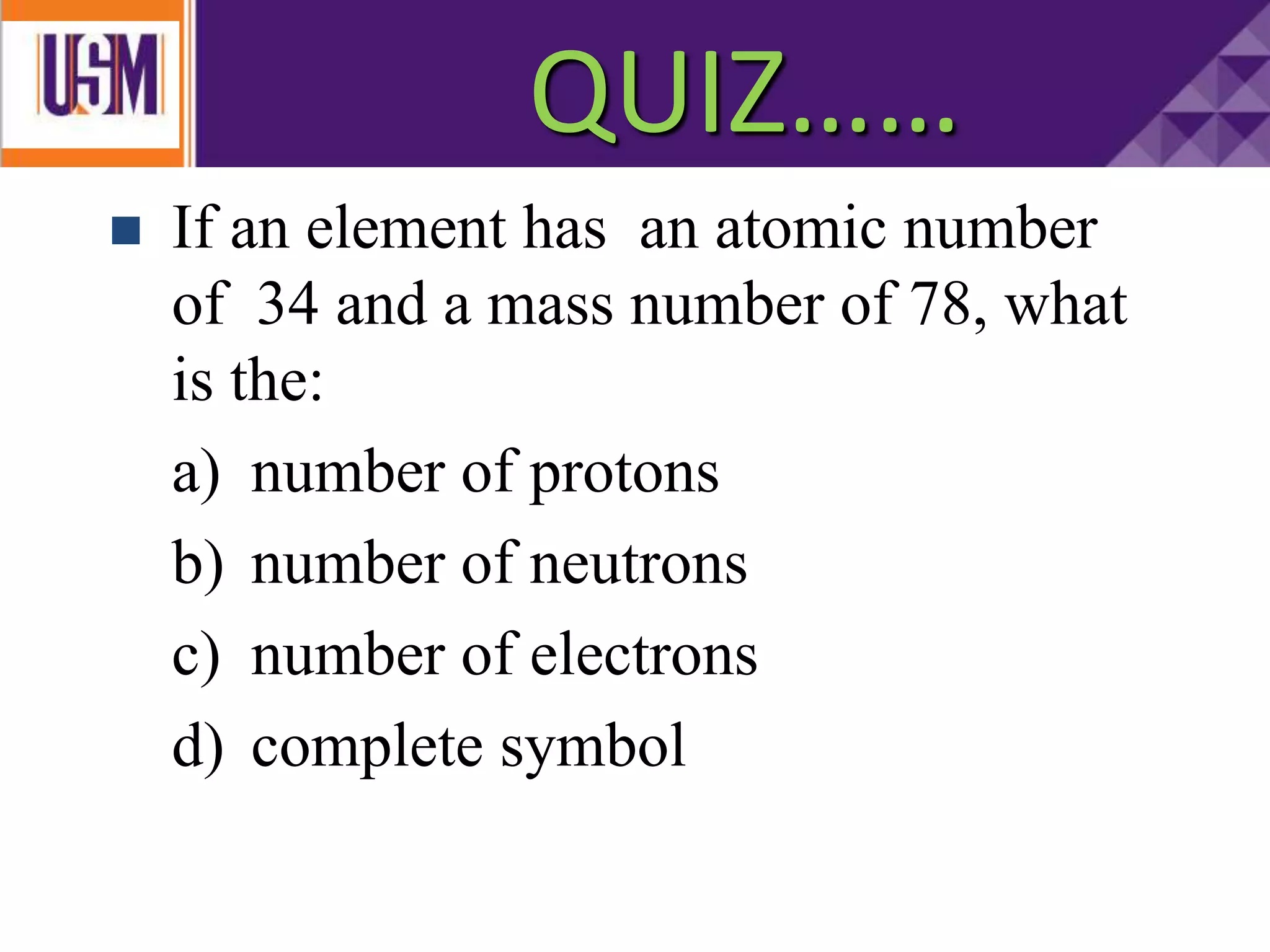
QUIZ…..
If anelement has an atomic number
of 34 and a mass number of 78, what
is the:
a) number of protons
b) number of neutrons
c) number of electrons
d) complete symbol
QUIZ……
47.
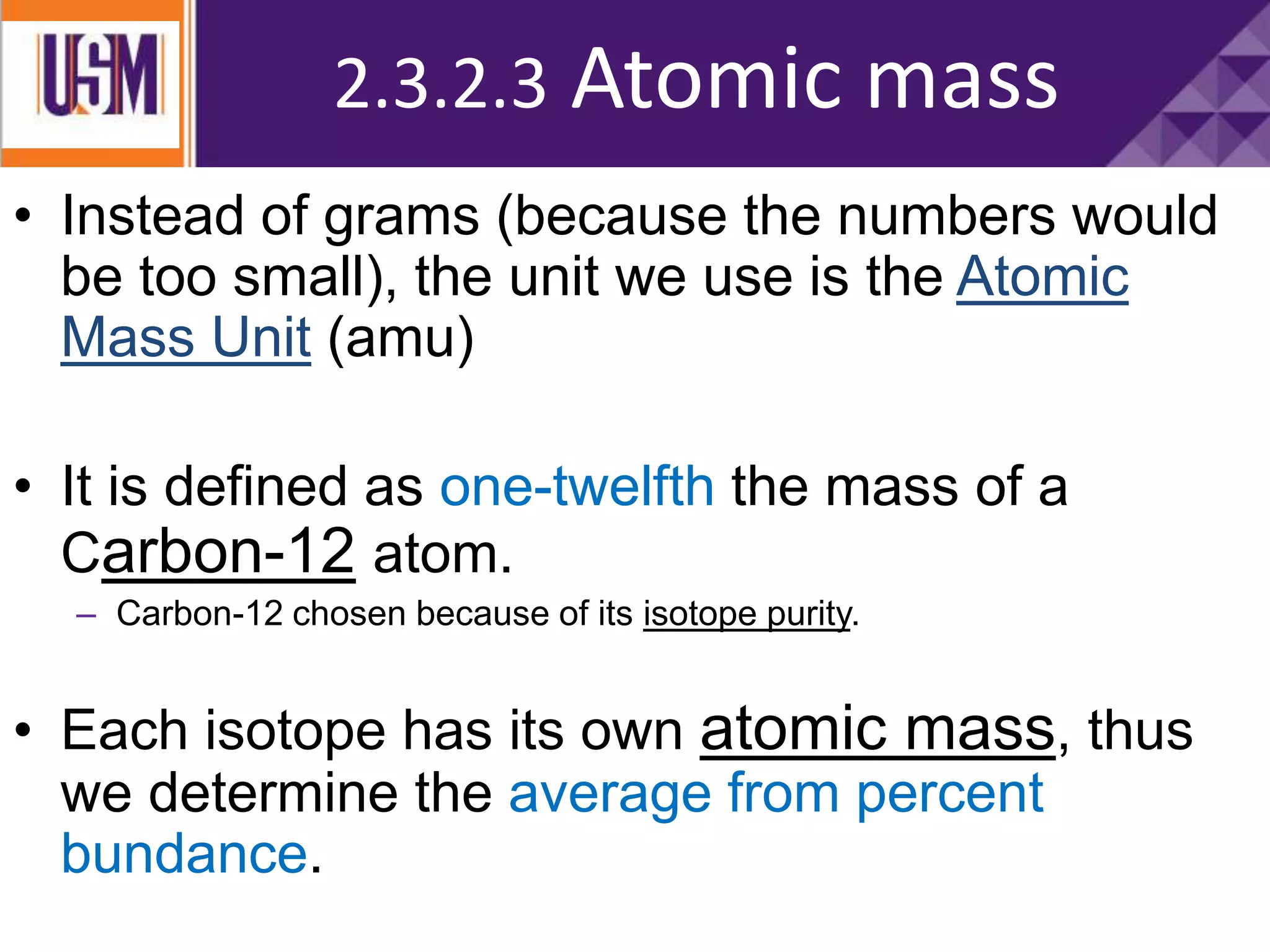
Measuring Atomic Mass
•Instead of grams (because the numbers would
be too small), the unit we use is the Atomic
Mass Unit (amu)
• It is defined as one-twelfth the mass of a
Carbon-12 atom.
– Carbon-12 chosen because of its isotope purity.
• Each isotope has its own atomic mass, thus
we determine the average from percent
bundance.
2.3.2.3 Atomic mass
48.
Eg: Howheavy is an atom of oxygen?
It depends, because there are different kinds
of oxygen atoms.
We are more concerned with the average
atomic mass.
2.3.2.3 Atomic mass
49.
To calculate theaverage:
• Multiply the atomic mass of each isotope
by it’s abundance (expressed as a
decimal), then add the results.
A = [(mass of isotope) (%abundance) ] + [(mass of isotope) %abundance)] +
100
2.3.2.3 Atomic mass
50.
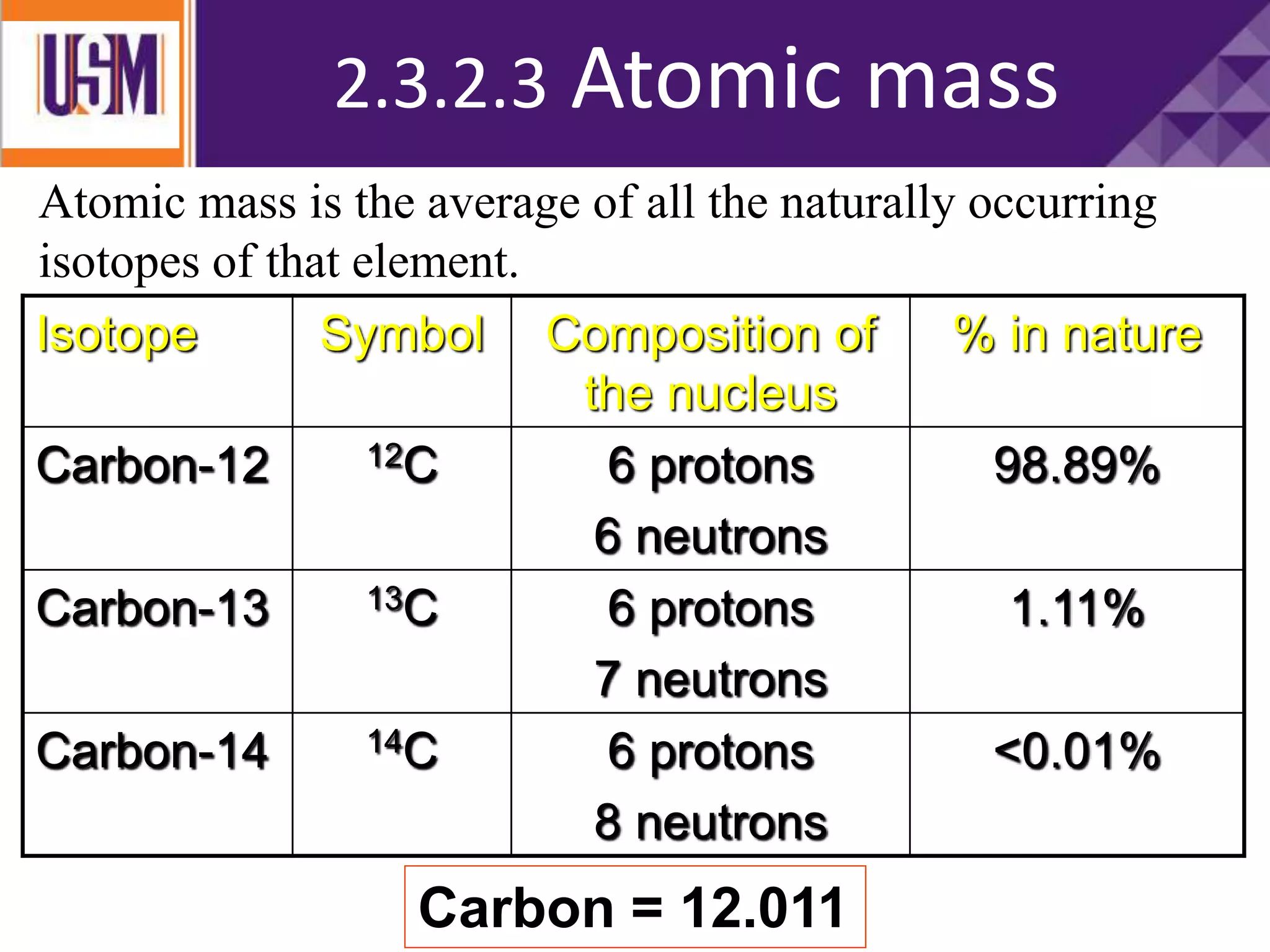
Atomic Masses
Isotope SymbolComposition of
the nucleus
% in nature
Carbon-12 12C 6 protons
6 neutrons
98.89%
Carbon-13 13C 6 protons
7 neutrons
1.11%
Carbon-14 14C 6 protons
8 neutrons
<0.01%
Atomic mass is the average of all the naturally occurring
isotopes of that element.
Carbon = 12.011
2.3.2.3 Atomic mass
51.
The natural abundancefor boron isotopes is:
19.9% 10B (10.013 amu) and 80.1% 11B (11.009amu). Calculate the
atomic weight of boron.
Atomic Mass = [19.9)(10.013)] + [(80.1)(11.009)]
100%
= [199] + [882]
100%
= 10.81 amu
so, the atomic weight of B = 10.81 amu
PROBLEM 1
52.
Verify that theatomic mass of magnesium of 24.31 amu, given the
following: 24Mg= 23.985042 amu, 78.99%
25Mg= 24.985837 amu, 10.00%
26Mg= 25.982593 amu, 11.01%
Atomic mass = [(0.7899)(23.985042)] + [(0.1)(24.985837)] +
[(0.1101)(25.982593)]
= 18.946 + 2.499 + 2.861
= 24.306 amu
PROBLEM 2
Solution:
53.
PROBLEM 3
The atomicmass of lithium is 6.94 amu, the naturally occurring isotopes
are 6Li = 6.015121 amu, and 7Li = 7.016003 amu. Determine the
percent abundance of each isotope.
6.94 = [(% 6Li)(6.015121)] + [(%7Li)(7.016003)]
Since I don’t know what the percentage are, I will have to use variables.
100% of Lithium is determined by these two naturally occurring
isotopes.
We will let 6Li = x and 7 Li = 1-x; we use 1 – x instead of 100
– x because the small number is easier to work with.
(in other words we reduced 100% to decimal form 1.00)
Solution:
54.
PROBLEM 4PROBLEM 3
6.94= [(% 6Li)(6.015121)] + [(%7Li)(7.016003)]
6.94 = [(x)(6.015121)] +[(1-x)(7.016003)]
6.94 = 6.015121x + 7.016003 – 7.016003x
6.94 -7.016003 = (6.015121x - 7.016003x)
-0.076003 = -1.000882 x
Solve for x:
x = 0.075936
6Li = x and 7 Li = 1-x
Therefore, 6Li = 0.075936 x 100% = 7.59%
7Li = (1- 0.075936 ) x 100% =
55.
Copper exists astwo isotopes: 63Cu (62.9298 amu) and 65Cu
(64.9278 amu). What are the percent abundances of the isotopes?
Atomic mass for Cu = 63.546 amu 63Cu % = 1-x 65Cu % = x
63.546 = [(1-x)(62.9298)] + [(x)(64.9278)]
63.546 = 62.9298 - 62.9298x + 64.9278x
1.3818 = 1.998x
x = 1.3818 / 1.998
x = 0.6916
65Cu = 0.6916 x 100% =69.16%
63Cu = 1 – x = 1 – 0.6916 = 0.3084 x 100% =30.84%
PROBLEM 4
Solution:
57.
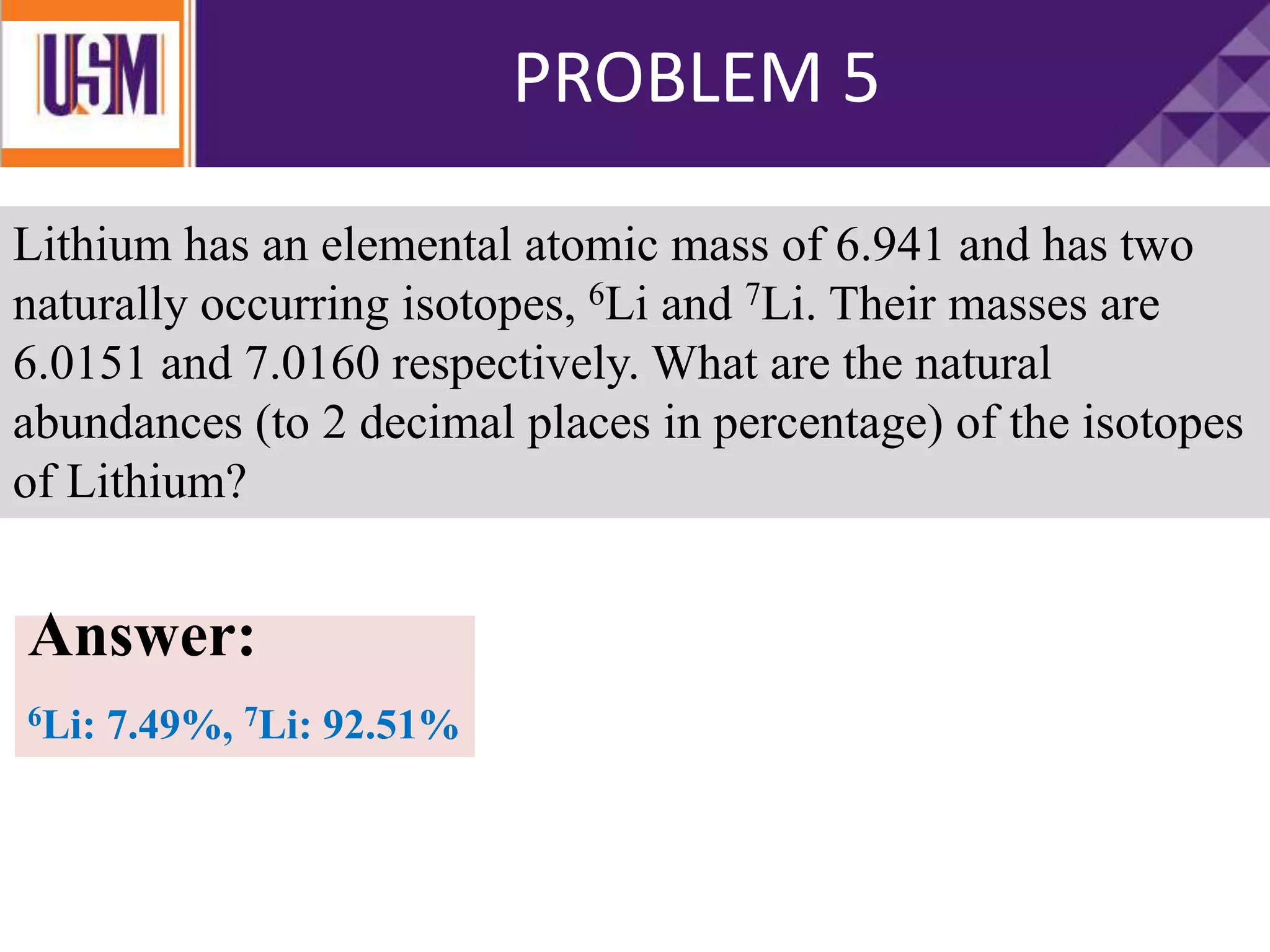
PROBLEM 5
Lithium hasan elemental atomic mass of 6.941 and has two
naturally occurring isotopes, 6Li and 7Li. Their masses are
6.0151 and 7.0160 respectively. What are the natural
abundances (to 2 decimal places in percentage) of the isotopes
of Lithium?
Answer:
6Li: 7.49%, 7Li: 92.51%
58.
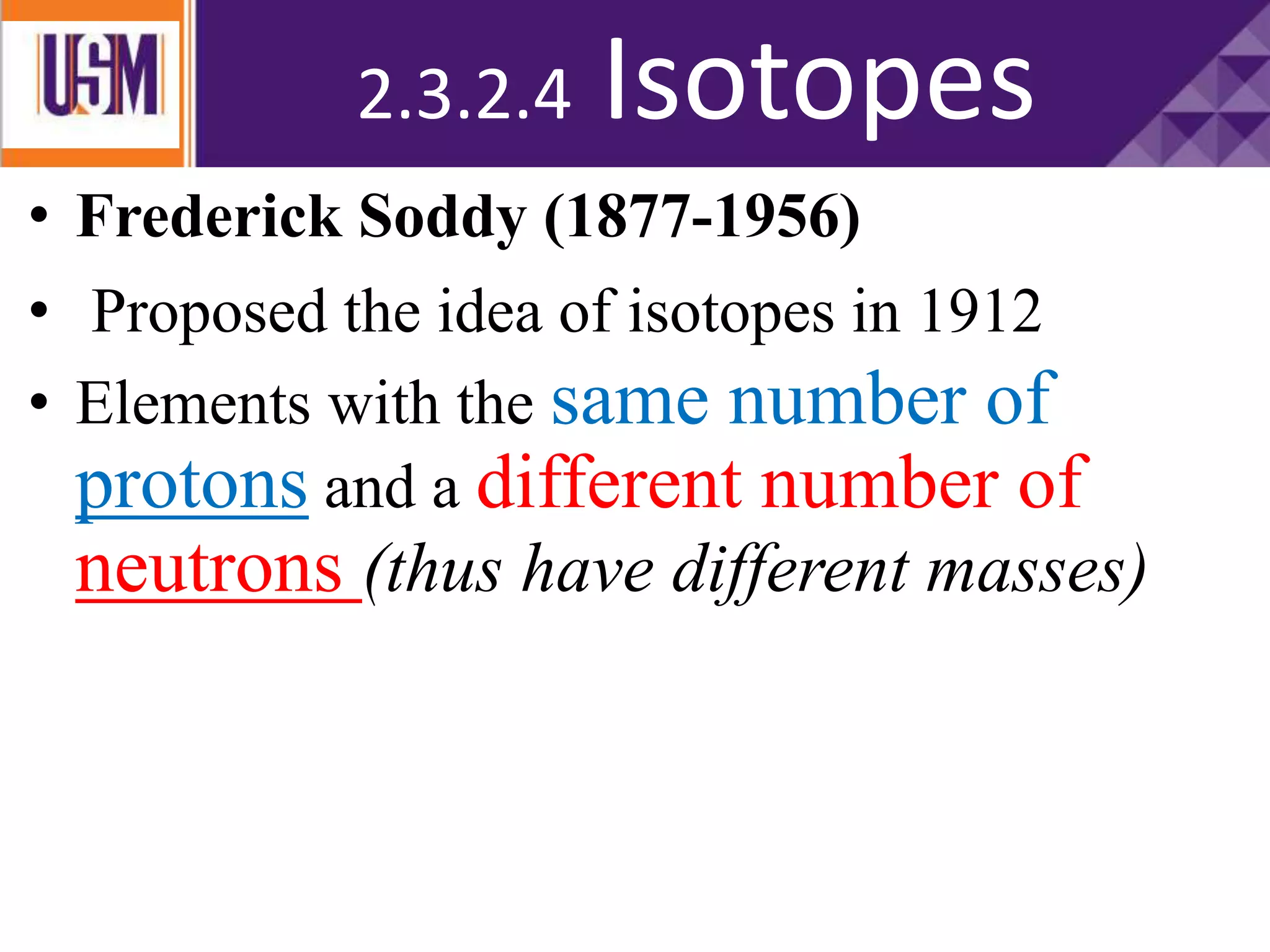
• Frederick Soddy(1877-1956)
• Proposed the idea of isotopes in 1912
• Elements with the same number of
protons and a different number of
neutrons (thus have different masses)
• different masses
2.3.2.4 Isotopes
ATOMIC STRUCTURE
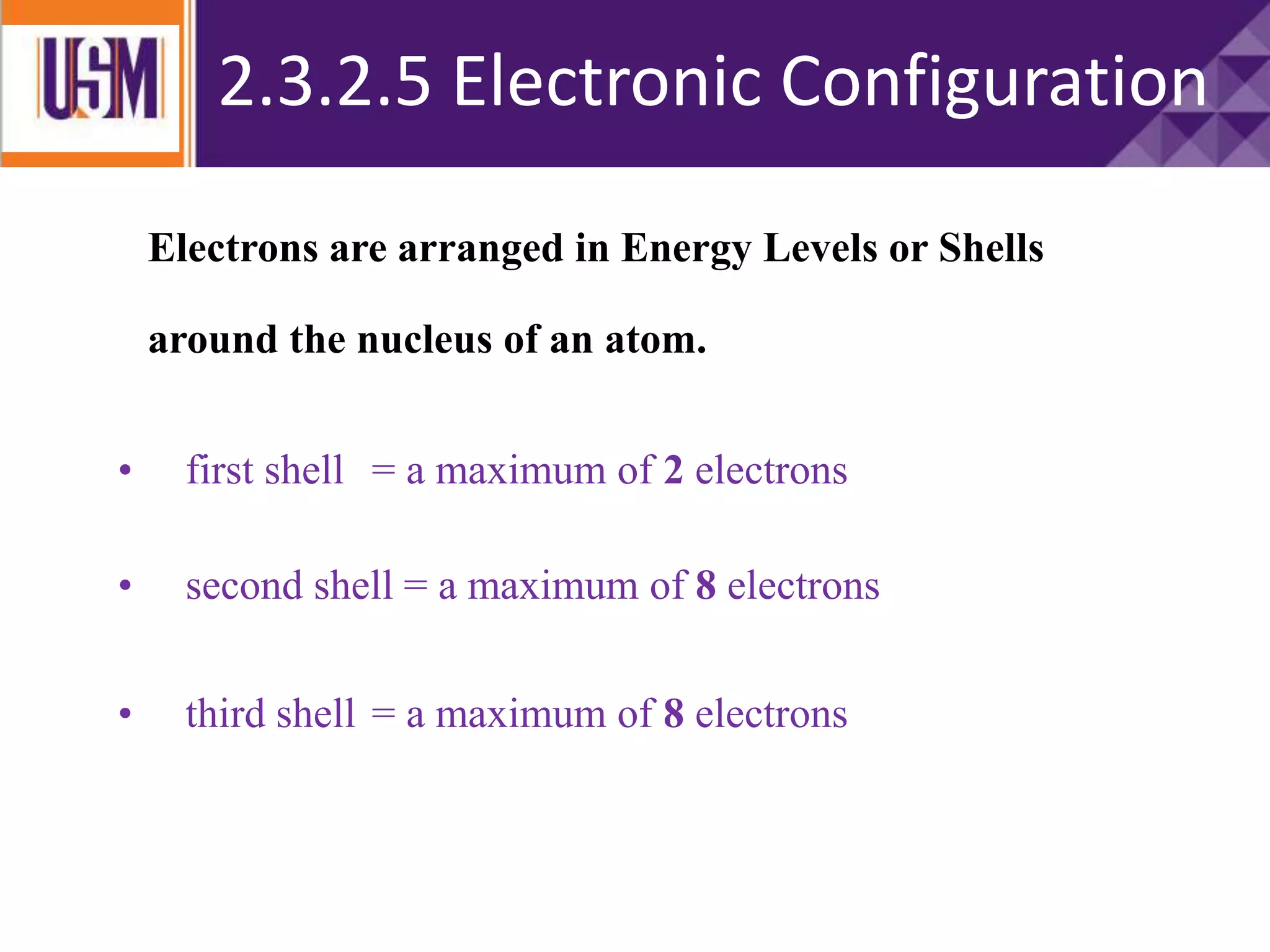
Electrons arearranged in Energy Levels or Shells
around the nucleus of an atom.
• first shell = a maximum of 2 electrons
• second shell = a maximum of 8 electrons
• third shell = a maximum of 8 electrons
2.3.2.5 Electronic Configuration
61.
ATOMIC STRUCTURE
There aretwo ways to represent the atomic structure of an
element or compound;
1. Electronic Configuration
2. Dot & Cross Diagrams
2.3.2.5 Electronic Configuration2.3.2.5 Electronic Configuration
62.
ELECTRONIC CONFIGURATION
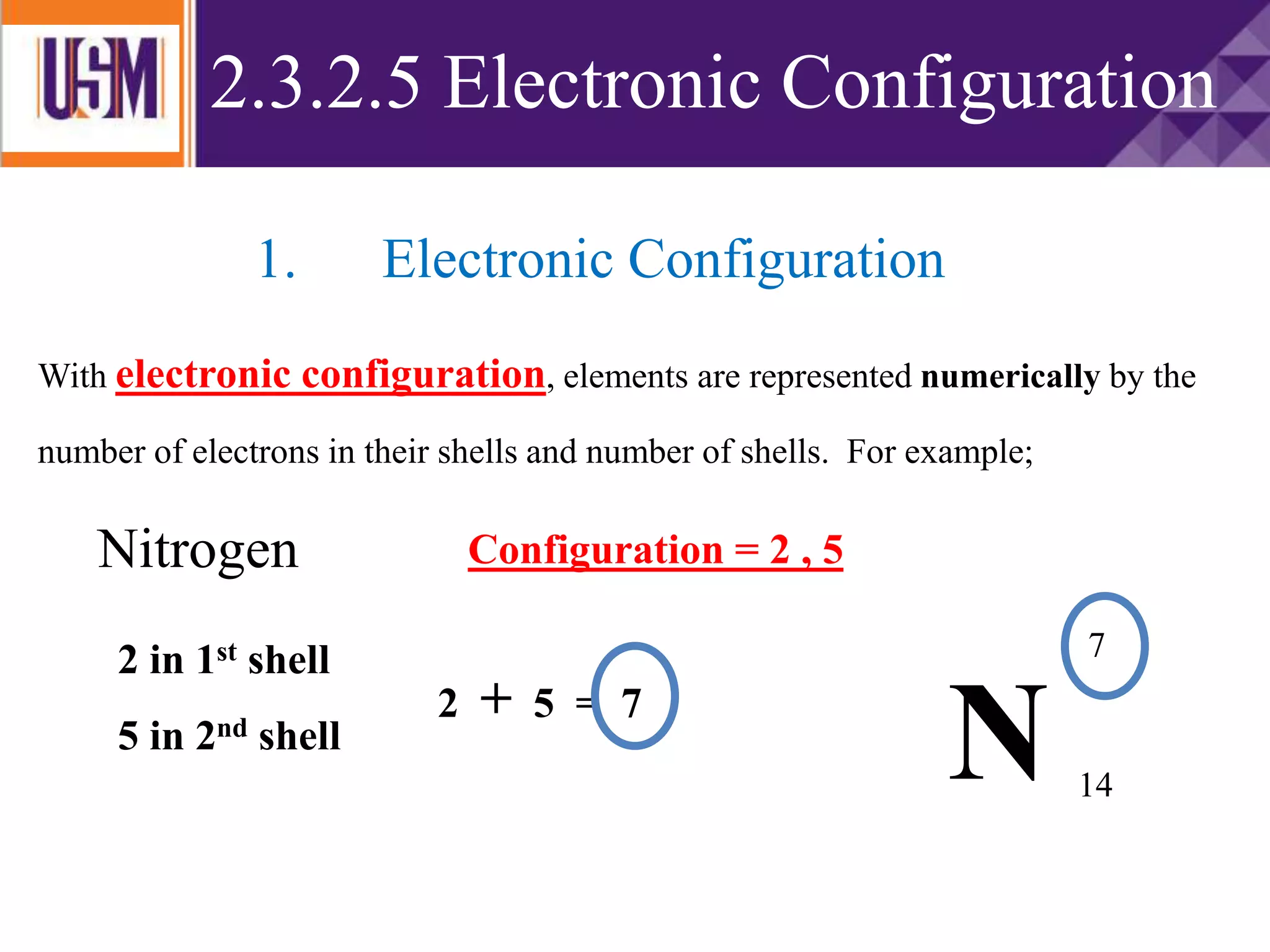
With electronicconfiguration, elements are represented numerically by the
number of electrons in their shells and number of shells. For example;
N
Nitrogen
7
14
2 in 1st shell
5 in 2nd shell
Configuration = 2 , 5
2 + 5 = 7
2.3.2.5 Electronic Configuration
1. Electronic Configuration
63.
ELECTRONIC CONFIGURATION
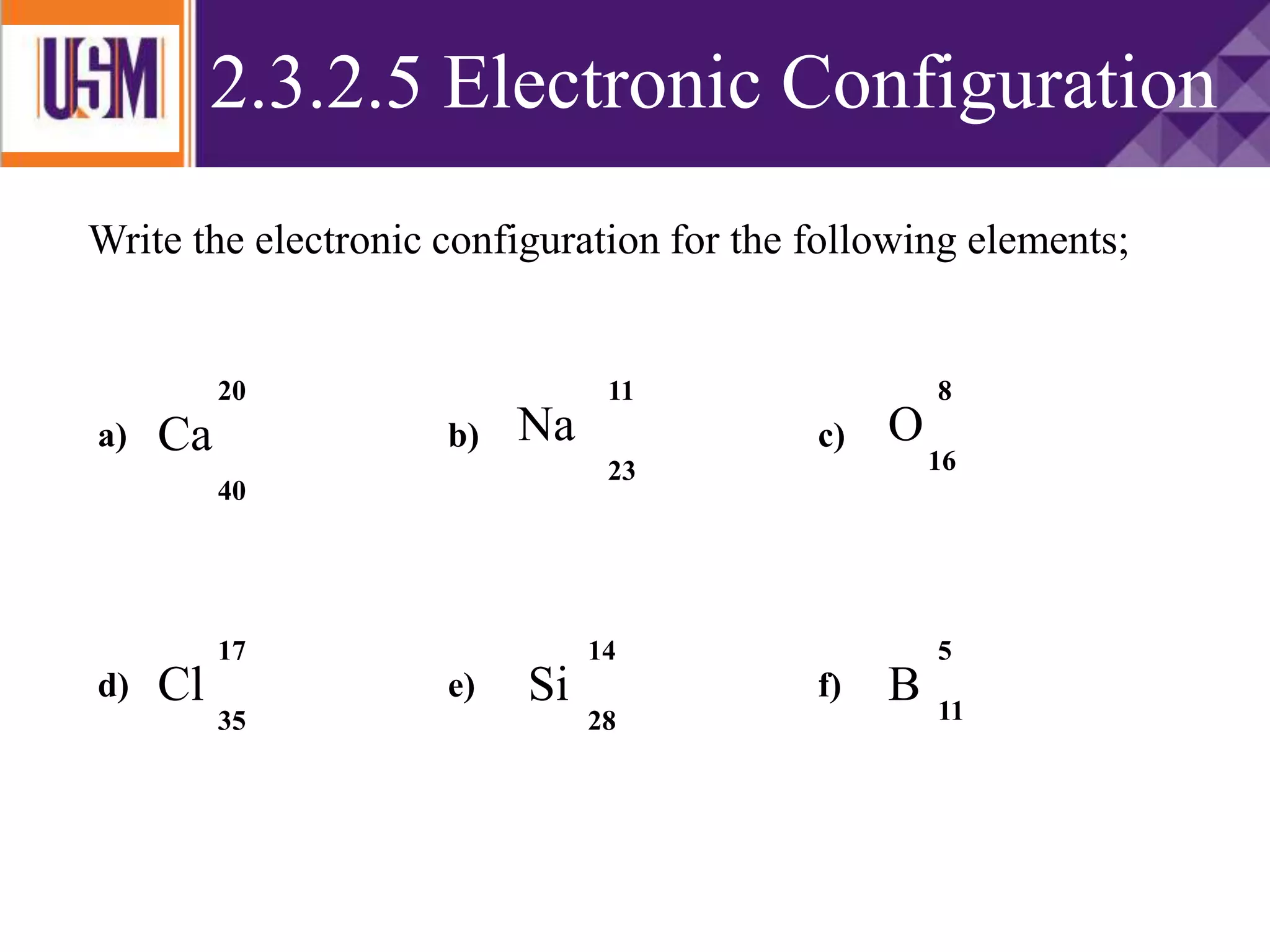
Write theelectronic configuration for the following elements;
Ca O
Cl Si
Na
20
40
11
23
8
17
16
35
14
28
B 11
5
a) b) c)
d) e) f)
2.3.2.5 Electronic Configuration
64.
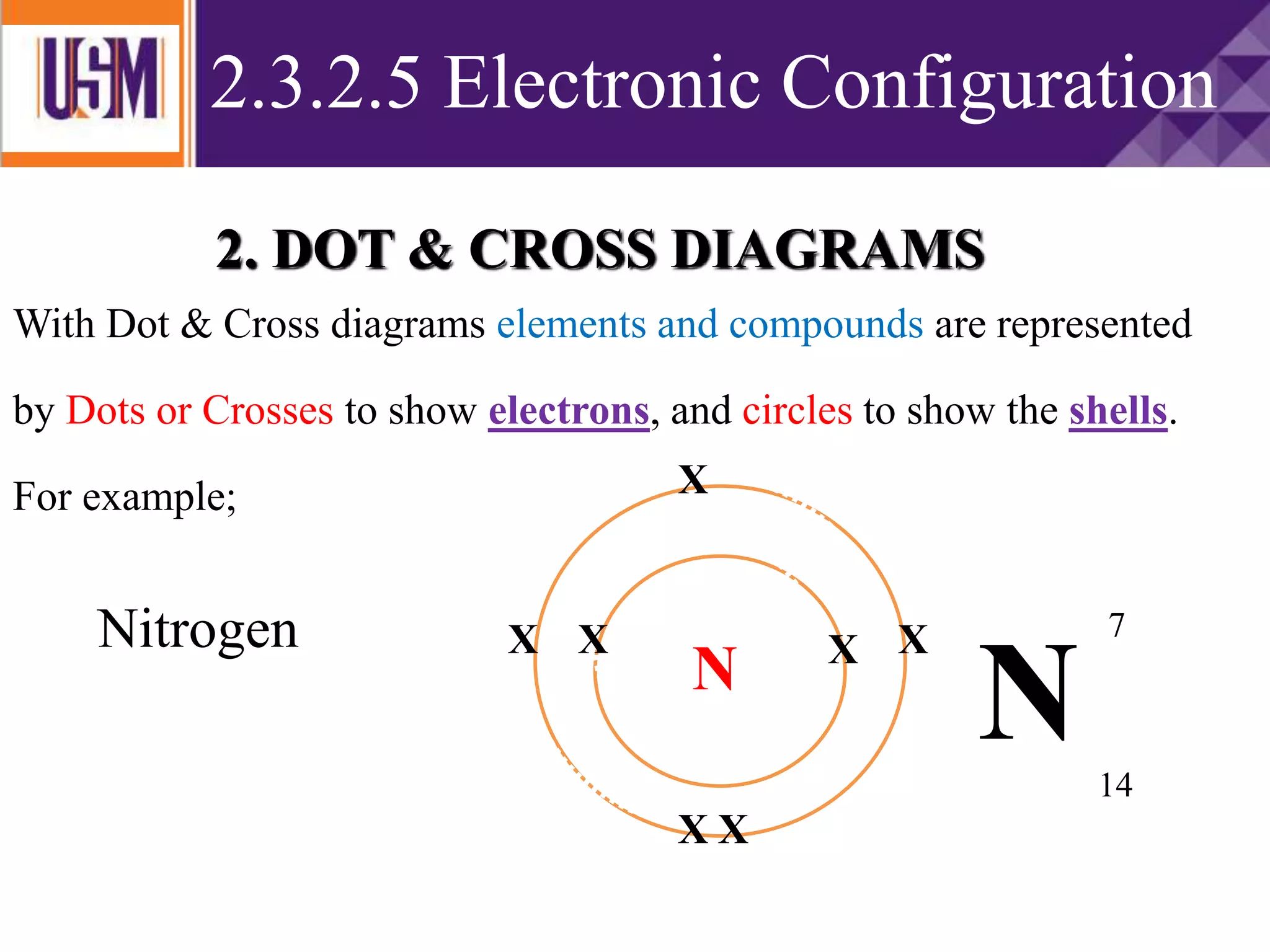
2. DOT &CROSS DIAGRAMS
With Dot & Cross diagrams elements and compounds are represented
by Dots or Crosses to show electrons, and circles to show the shells.
For example;
Nitrogen
N XX X
X
XX
X
N
7
14
2.3.2.5 Electronic Configuration
65.
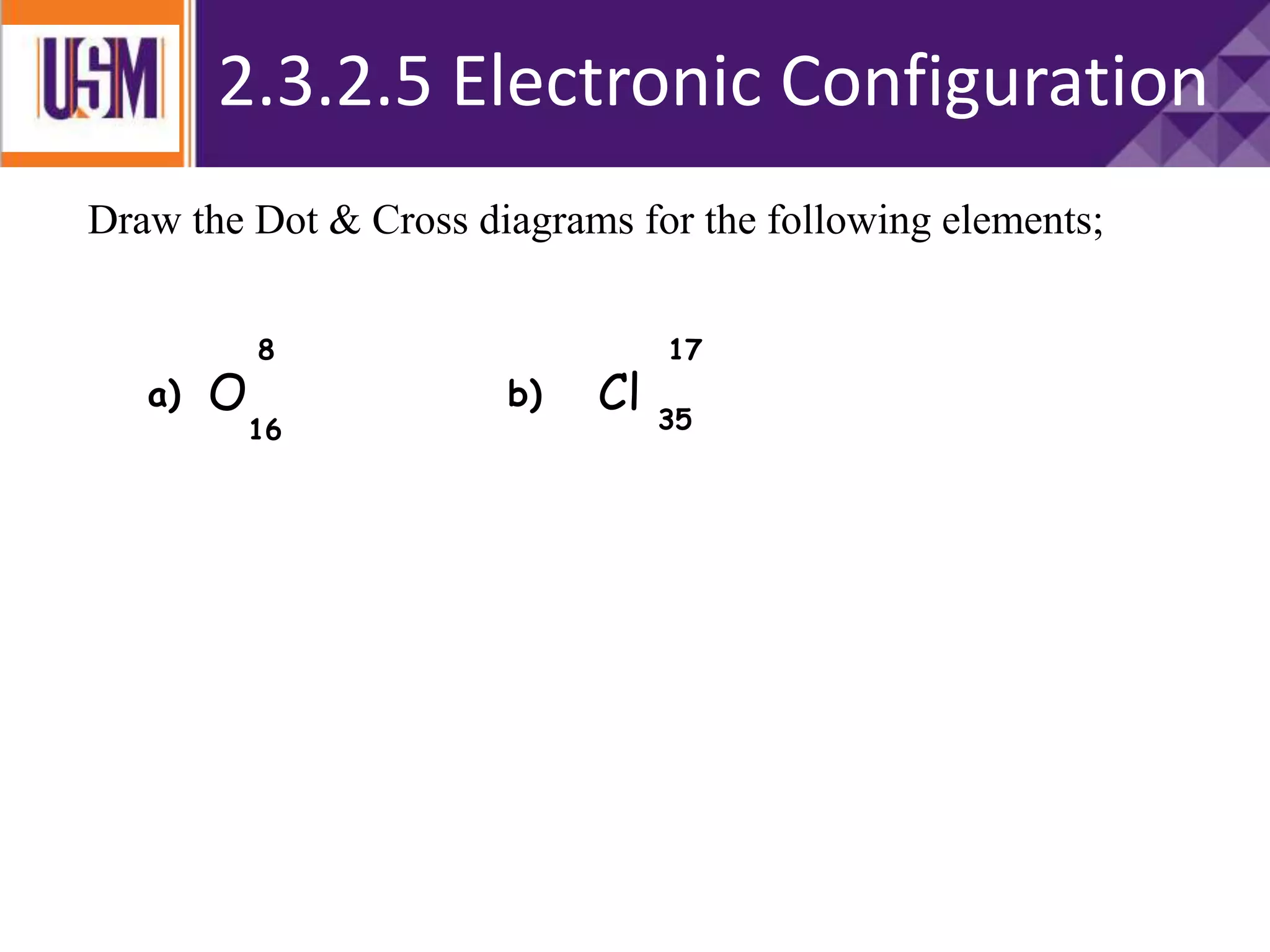
Draw the Dot& Cross diagrams for the following elements;
O Cl
8 17
16 35
a) b)
2.3.2.5 Electronic Configuration
66.
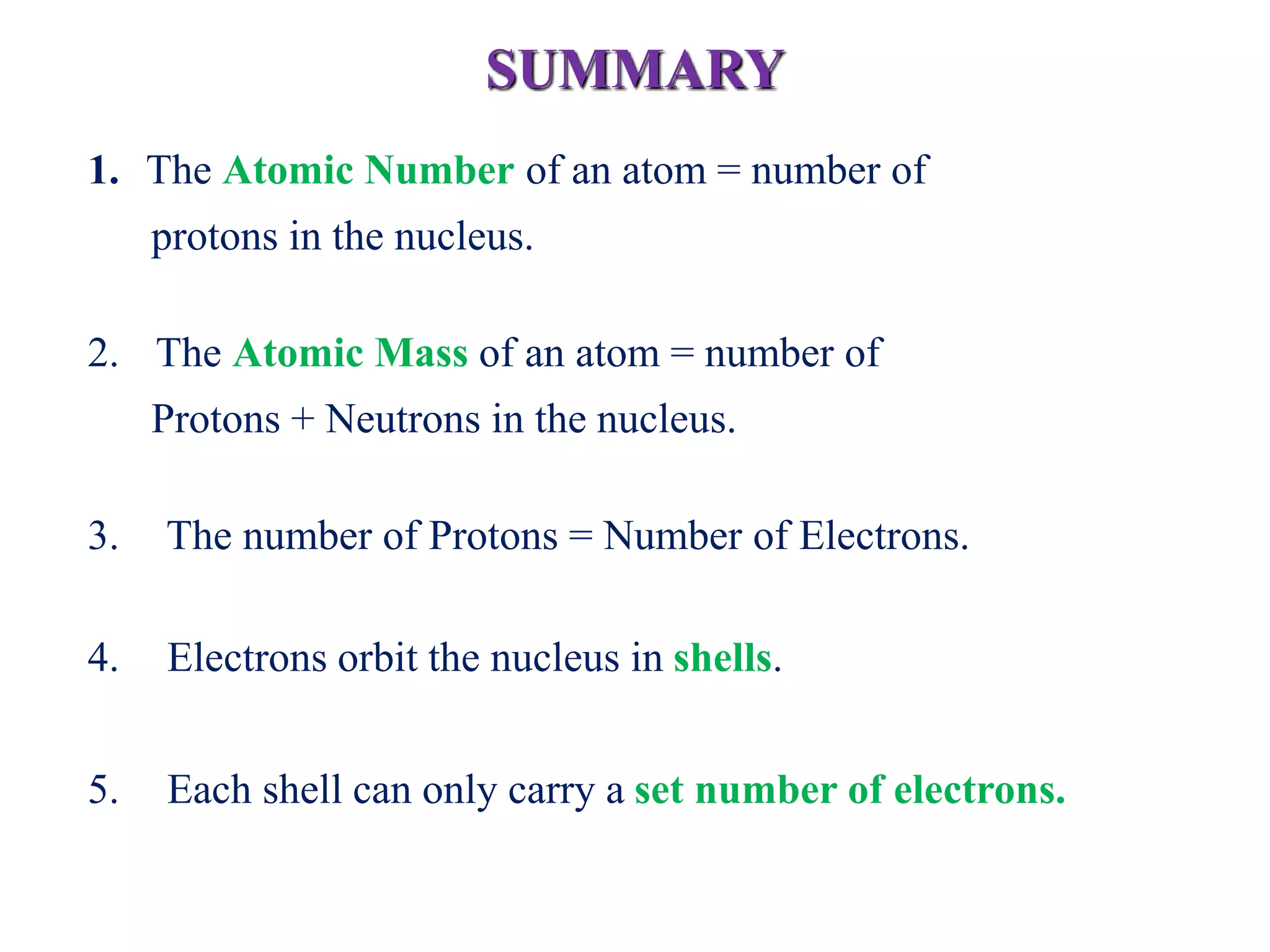
SUMMARY
1. The AtomicNumber of an atom = number of
protons in the nucleus.
2. The Atomic Mass of an atom = number of
Protons + Neutrons in the nucleus.
3. The number of Protons = Number of Electrons.
4. Electrons orbit the nucleus in shells.
5. Each shell can only carry a set number of electrons.



![To calculate the average:
• Multiply the atomic mass of each isotope
by it’s abundance (expressed as a
decimal), then add the results.
A = [(mass of isotope) (%abundance) ] + [(mass of isotope) %abundance)] +
100
2.3.2.3 Atomic mass](https://image.slidesharecdn.com/topic22-160404031530/75/Topic-2-Structure-of-matter-49-2048.jpg)
![The natural abundance for boron isotopes is:
19.9% 10B (10.013 amu) and 80.1% 11B (11.009amu). Calculate the
atomic weight of boron.
Atomic Mass = [19.9)(10.013)] + [(80.1)(11.009)]
100%
= [199] + [882]
100%
= 10.81 amu
so, the atomic weight of B = 10.81 amu
PROBLEM 1](https://image.slidesharecdn.com/topic22-160404031530/75/Topic-2-Structure-of-matter-51-2048.jpg)
![Verify that the atomic mass of magnesium of 24.31 amu, given the
following: 24Mg= 23.985042 amu, 78.99%
25Mg= 24.985837 amu, 10.00%
26Mg= 25.982593 amu, 11.01%
Atomic mass = [(0.7899)(23.985042)] + [(0.1)(24.985837)] +
[(0.1101)(25.982593)]
= 18.946 + 2.499 + 2.861
= 24.306 amu
PROBLEM 2
Solution:](https://image.slidesharecdn.com/topic22-160404031530/75/Topic-2-Structure-of-matter-52-2048.jpg)
![PROBLEM 3
The atomic mass of lithium is 6.94 amu, the naturally occurring isotopes
are 6Li = 6.015121 amu, and 7Li = 7.016003 amu. Determine the
percent abundance of each isotope.
6.94 = [(% 6Li)(6.015121)] + [(%7Li)(7.016003)]
Since I don’t know what the percentage are, I will have to use variables.
100% of Lithium is determined by these two naturally occurring
isotopes.
We will let 6Li = x and 7 Li = 1-x; we use 1 – x instead of 100
– x because the small number is easier to work with.
(in other words we reduced 100% to decimal form 1.00)
Solution:](https://image.slidesharecdn.com/topic22-160404031530/75/Topic-2-Structure-of-matter-53-2048.jpg)
![PROBLEM 4PROBLEM 3
6.94 = [(% 6Li)(6.015121)] + [(%7Li)(7.016003)]
6.94 = [(x)(6.015121)] +[(1-x)(7.016003)]
6.94 = 6.015121x + 7.016003 – 7.016003x
6.94 -7.016003 = (6.015121x - 7.016003x)
-0.076003 = -1.000882 x
Solve for x:
x = 0.075936
6Li = x and 7 Li = 1-x
Therefore, 6Li = 0.075936 x 100% = 7.59%
7Li = (1- 0.075936 ) x 100% =](https://image.slidesharecdn.com/topic22-160404031530/75/Topic-2-Structure-of-matter-54-2048.jpg)
![Copper exists as two isotopes: 63Cu (62.9298 amu) and 65Cu
(64.9278 amu). What are the percent abundances of the isotopes?
Atomic mass for Cu = 63.546 amu 63Cu % = 1-x 65Cu % = x
63.546 = [(1-x)(62.9298)] + [(x)(64.9278)]
63.546 = 62.9298 - 62.9298x + 64.9278x
1.3818 = 1.998x
x = 1.3818 / 1.998
x = 0.6916
65Cu = 0.6916 x 100% =69.16%
63Cu = 1 – x = 1 – 0.6916 = 0.3084 x 100% =30.84%
PROBLEM 4
Solution:](https://image.slidesharecdn.com/topic22-160404031530/75/Topic-2-Structure-of-matter-55-2048.jpg)