TOPIC 1
1
Dr. Nik Noor Ashikin Nik Ab Razak
School of Physics
Universiti Sains Malaysia
nnashikin@usm.my
X-RAY IMAGING SYSTEM Dr. Nik Noor Ashikin Bt Nik Ab Razak
X-RAY IMAGING SYSTEM
ZME 336 MEDICAL INSTRUMENTATION
Course outcome
227/8/2018 Dr. Nik Noor Ashikin Bt Nik Ab Razak
Objective
327/8/2018 Dr. Nik Noor Ashikin Bt Nik Ab Razak
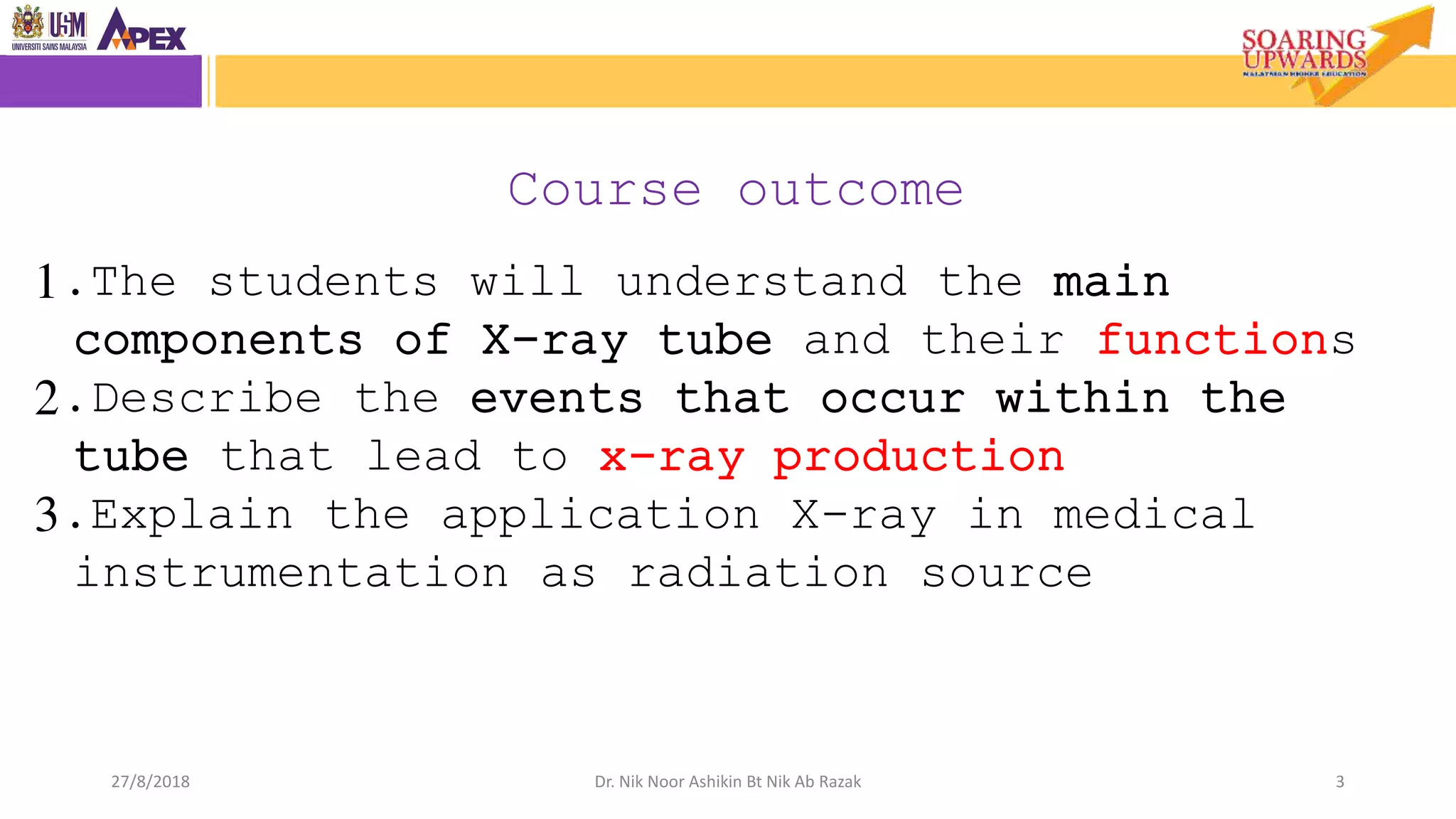
1.The students will understand the main
components of X-ray tube and their functions
2.Describe the events that occur within the
tube that lead to x-ray production
3.Explain the application X-ray in medical
instrumentation as radiation source
Course outcome
1.0 X-RAY TUBE
1.1 Anode
1.2 Cathode
1.3 Glass Envelope
1.4 Tube Housing
527/8/2018 Dr. Nik Noor Ashikin Bt Nik Ab Razak
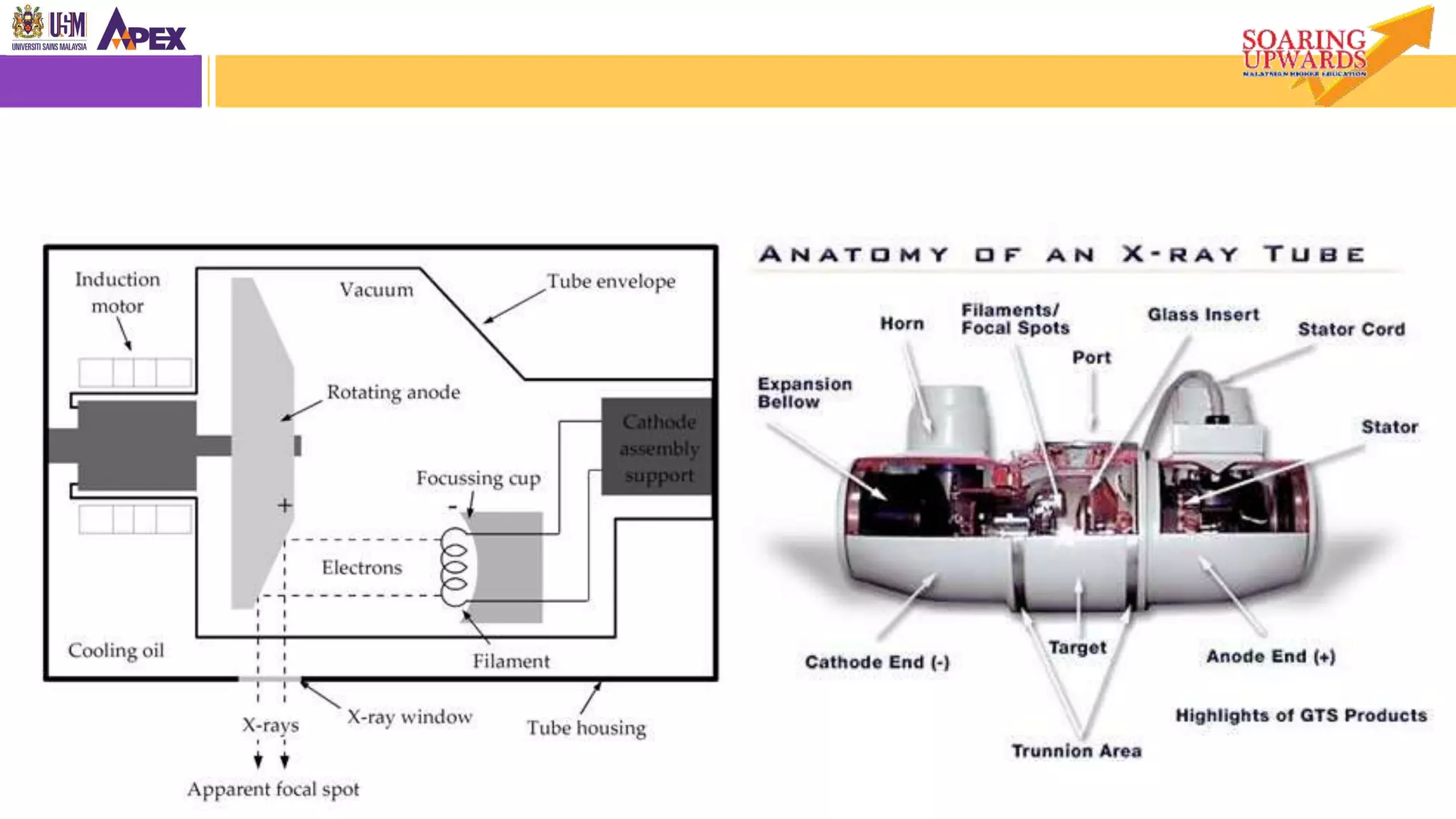
1.0 X-RAY TUBE
627/8/2018 Dr. Nik Noor Ashikin Bt Nik Ab Razak
7
NNANAR
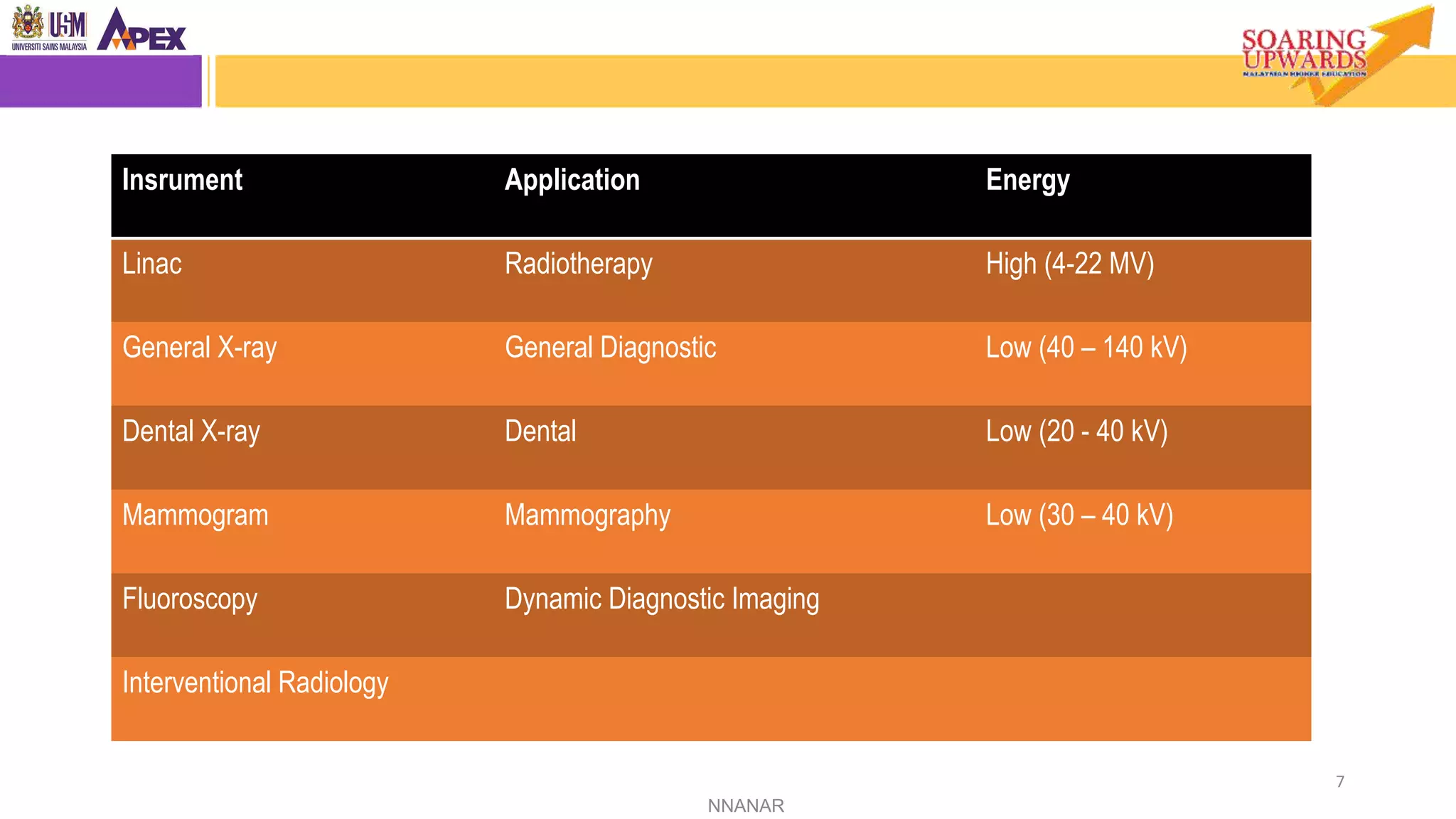
Insrument Application Energy
Linac Radiotherapy High (4-22 MV)
General X-ray General Diagnostic Low (40 – 140 kV)
Dental X-ray Dental Low (20 - 40 kV)
Mammogram Mammography Low (30 – 40 kV)
Fluoroscopy Dynamic Diagnostic Imaging
Interventional Radiology
2.1 X-ray Tube
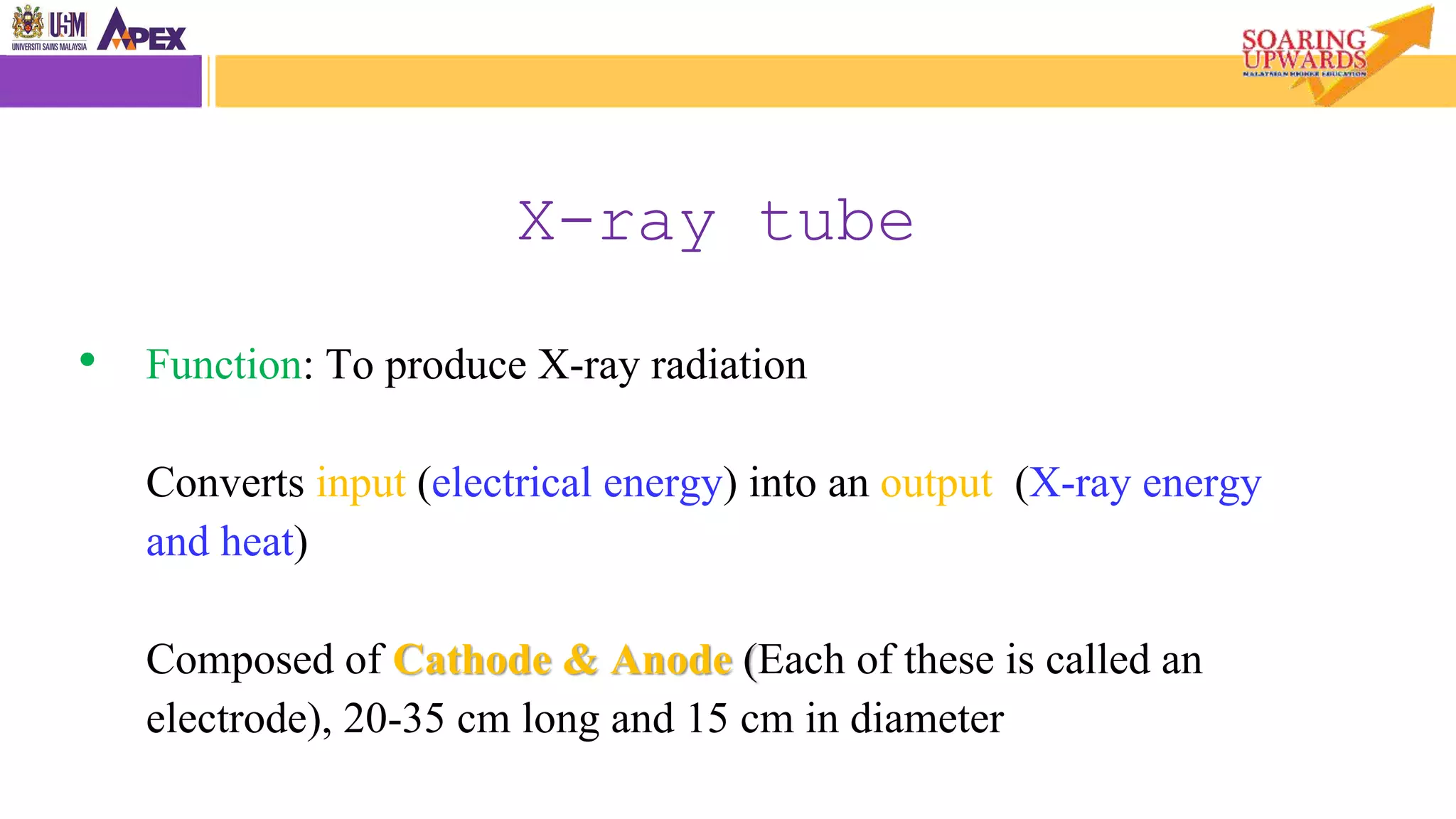
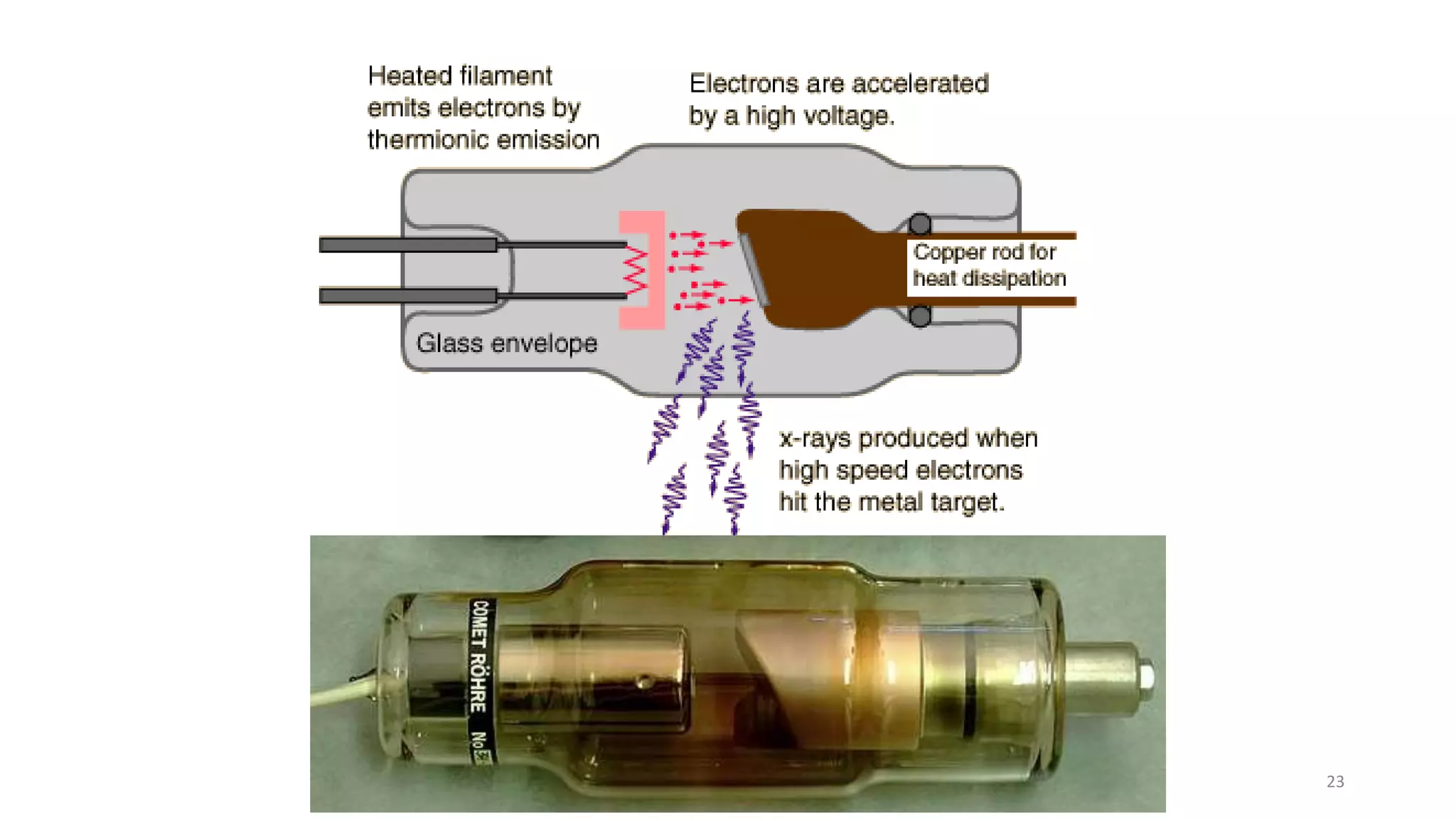
• Function: To produce X-ray radiation
Converts input (electrical energy) into an output (X-ray energy
and heat)
Composed of Cathode & Anode (Each of these is called an
electrode), 20-35 cm long and 15 cm in diameter
2.0 X-ray Tube
X-ray tube
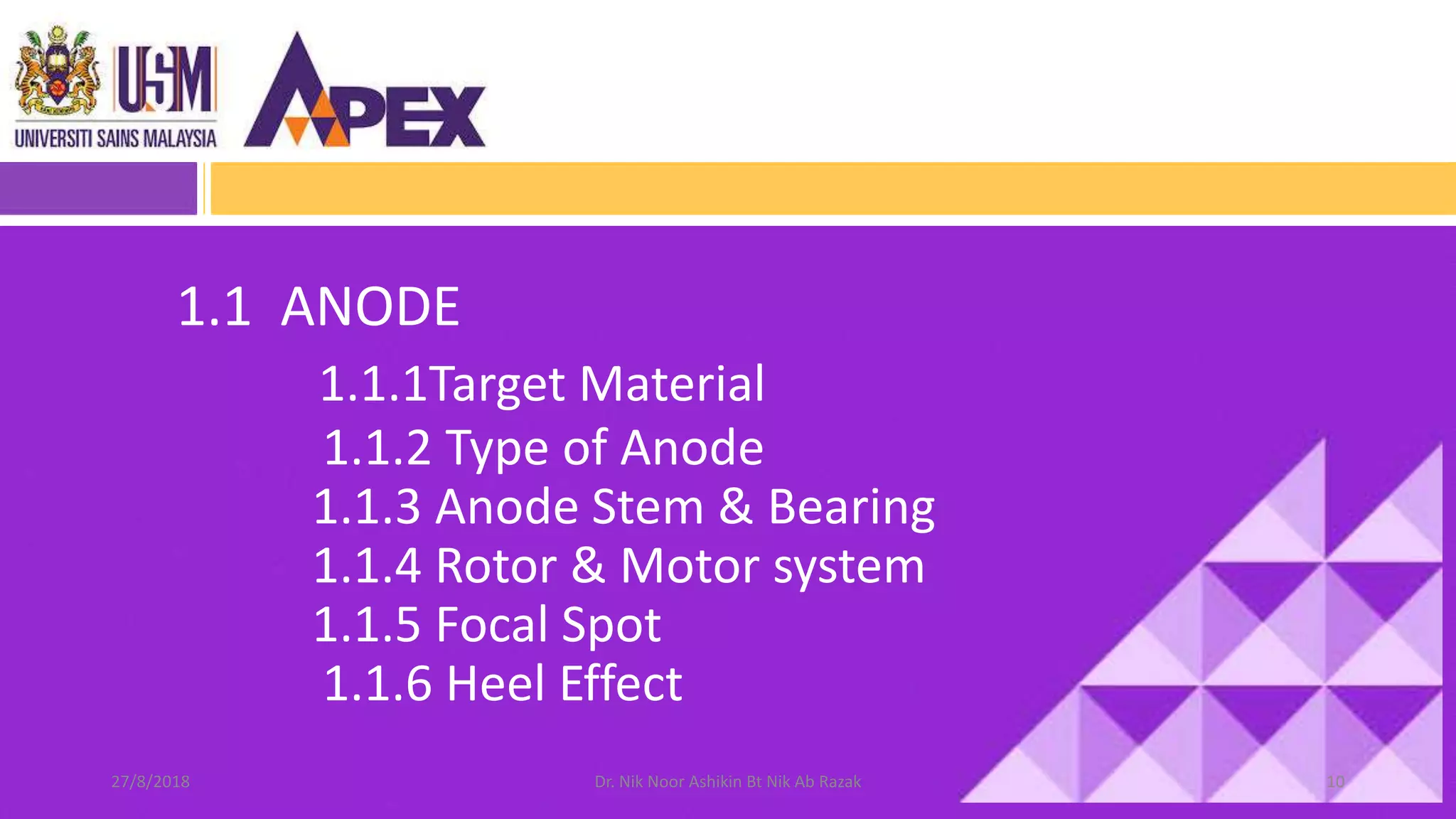
1.1 ANODE
1.1.1Target Material
1.1.2 Type of Anode
1.1.3 Anode Stem & Bearing
1.1.4 Rotor & Motor system
1.1.5 Focal Spot
1.1.6 Heel Effect
1027/8/2018 Dr. Nik Noor Ashikin Bt Nik Ab Razak
ANODE
1127/8/2018 Dr. Nik Noor Ashikin Bt Nik Ab Razak
FUNCTIONS
1. accelerating
the electrons
2. houses the
target material
3. cool the tube
1.1
1227/8/2018
Dr. Nik Noor Ashikin
2.1 Anode
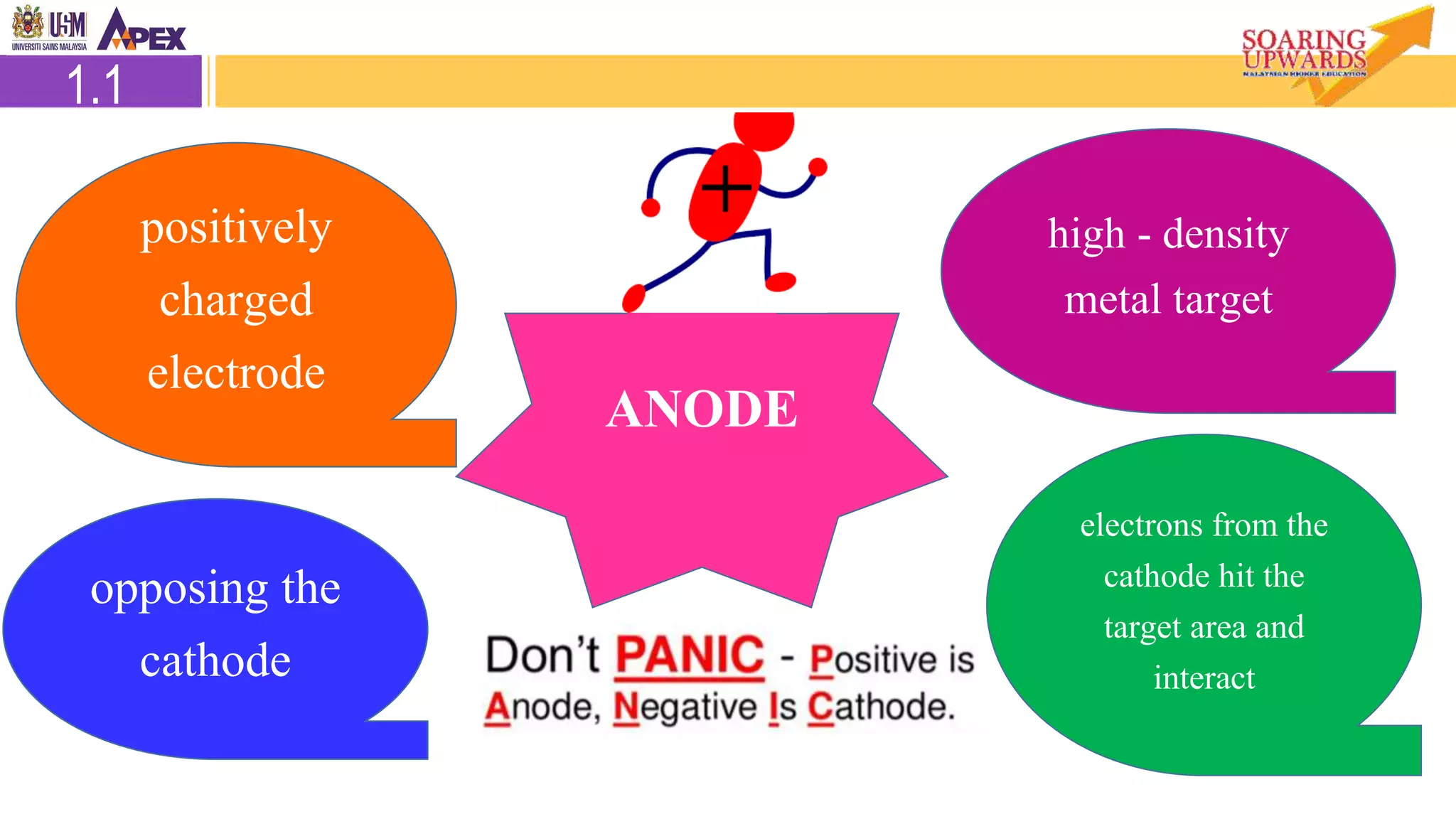
ANODE
positively
charged
electrode
electrons from the
cathode hit the
target area and
interact
high - density
metal target
opposing the
cathode
1.1
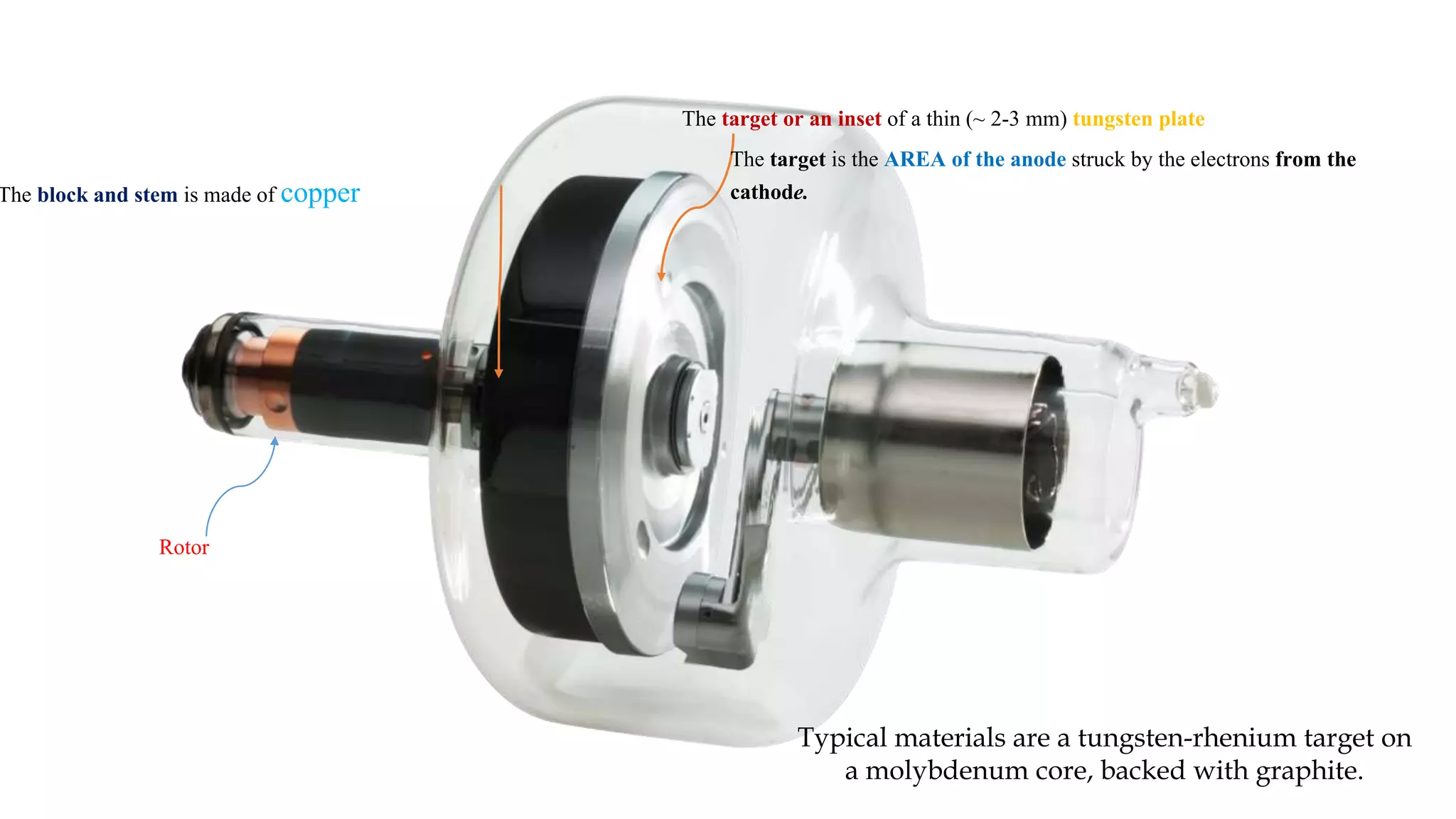
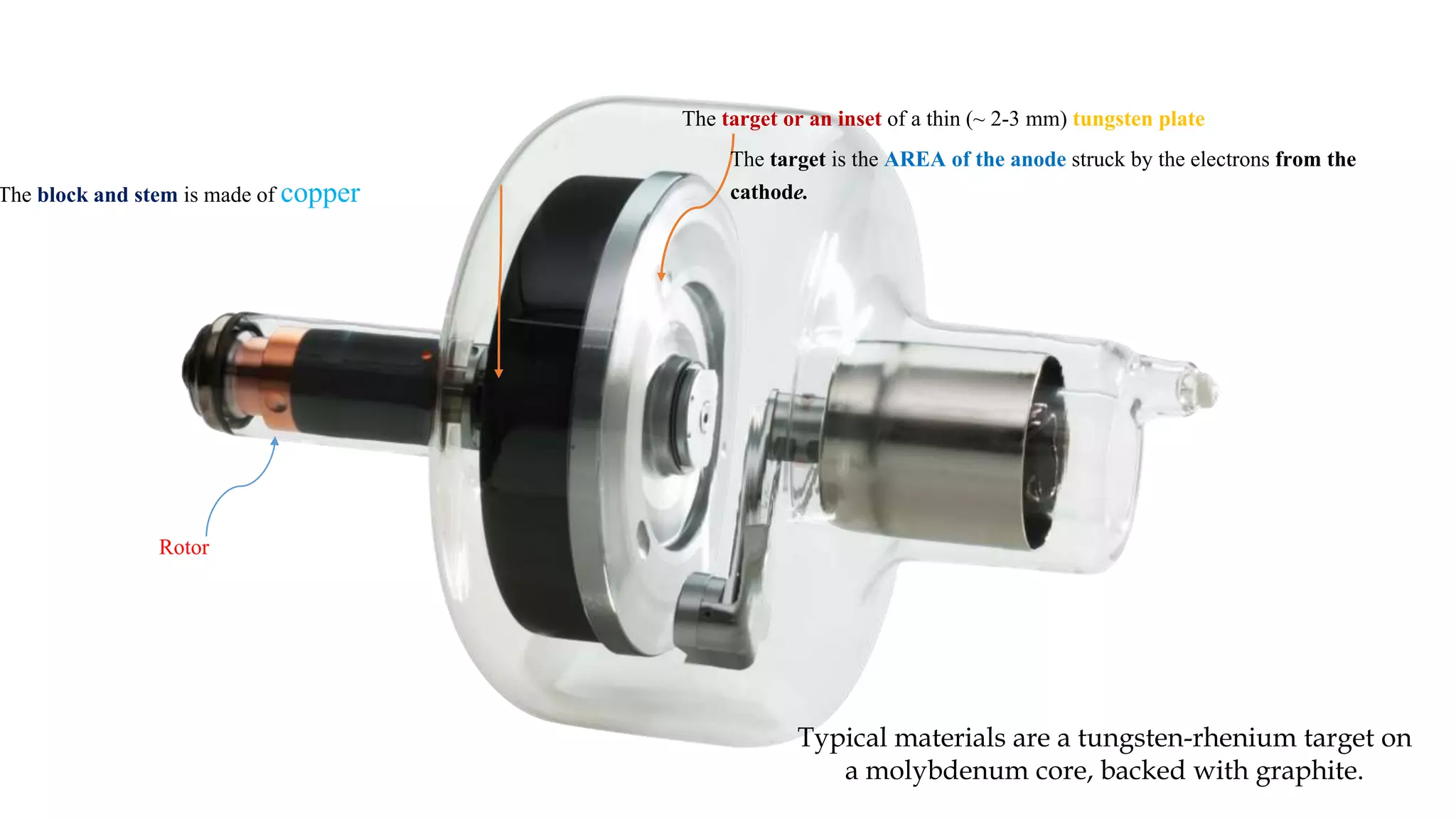
The block and stem is made of copper
The target or an inset of a thin (~ 2-3 mm) tungsten plate
Rotor
Typical materials are a tungsten-rhenium target on
a molybdenum core, backed with graphite.
The target is the AREA of the anode struck by the electrons from the
cathode.
1.1.1 Target Material
1427/8/2018 Dr. Nik Noor Ashikin Bt Nik Ab Razak
2.1.1 Target Material
1527/8/2018 Dr. Nik Noor Ashikin Bt Nik Ab Razak
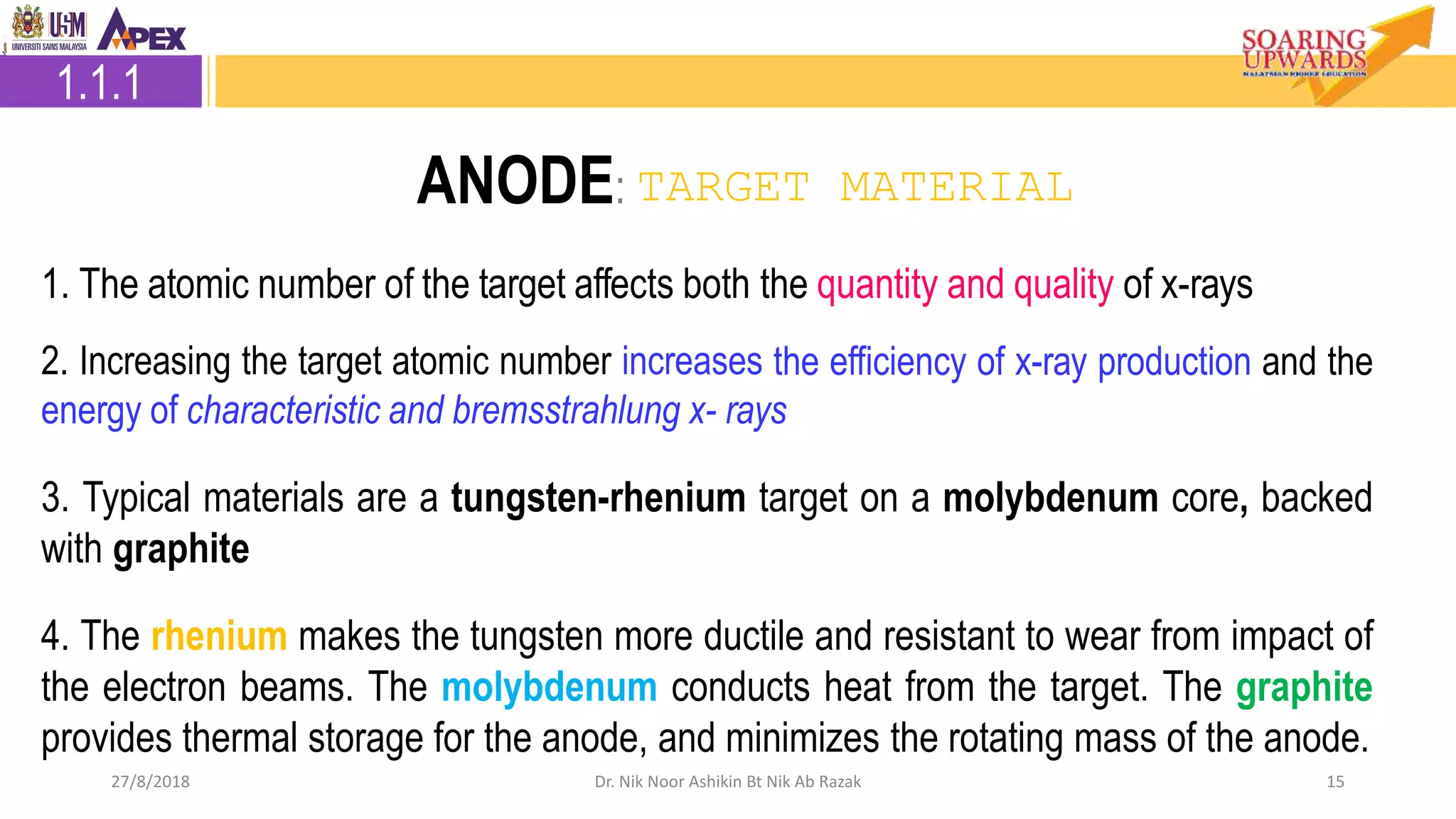
1. The atomic number of the target affects both the quantity and quality of x-rays
2. Increasing the target atomic number increases the efficiency of x-ray production and the
energy of characteristic and bremsstrahlung x- rays
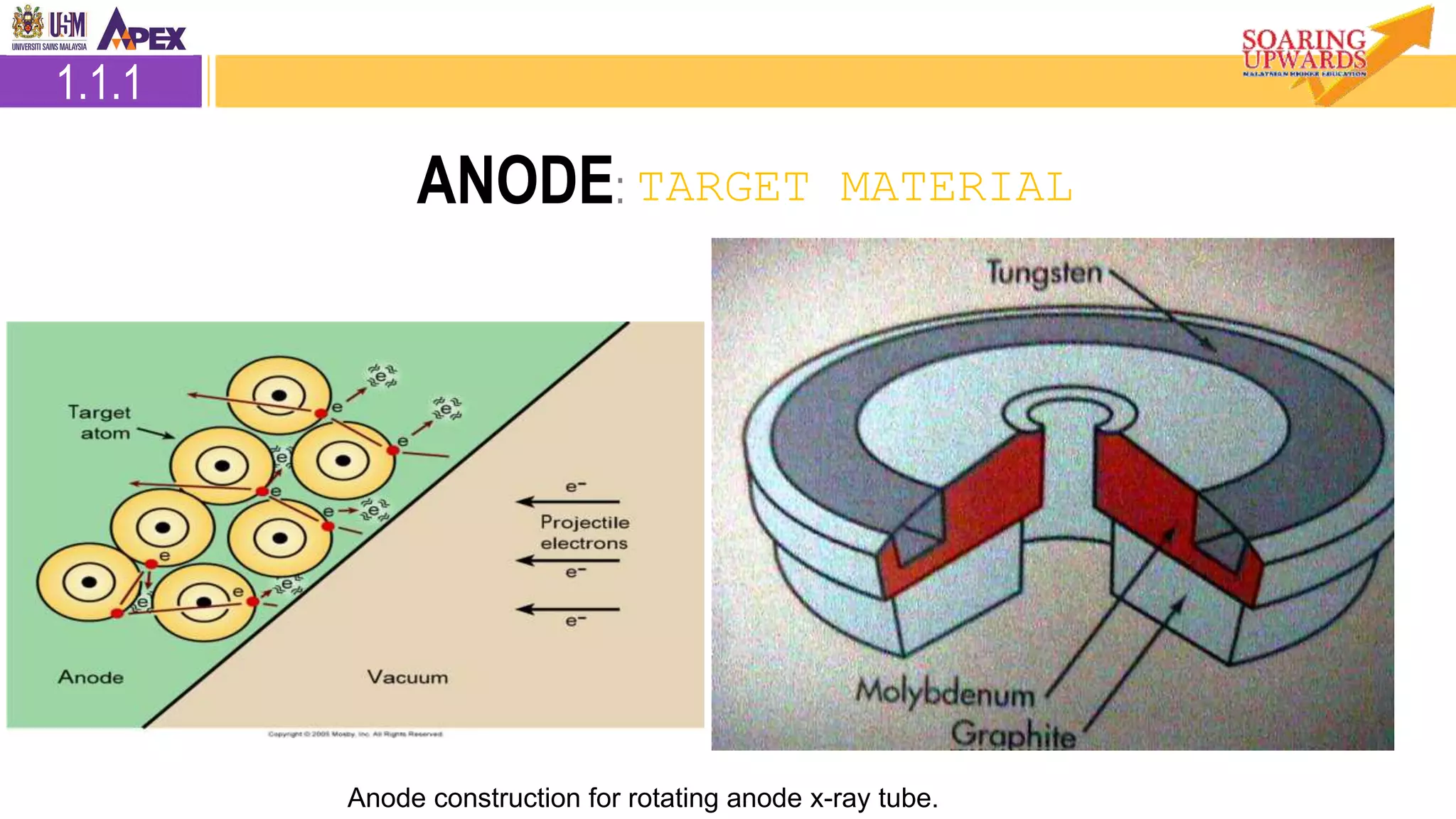
3. Typical materials are a tungsten-rhenium target on a molybdenum core, backed
with graphite
4. The rhenium makes the tungsten more ductile and resistant to wear from impact of
the electron beams. The molybdenum conducts heat from the target. The graphite
provides thermal storage for the anode, and minimizes the rotating mass of the anode.
1.1.1
ANODE: TARGET MATERIAL
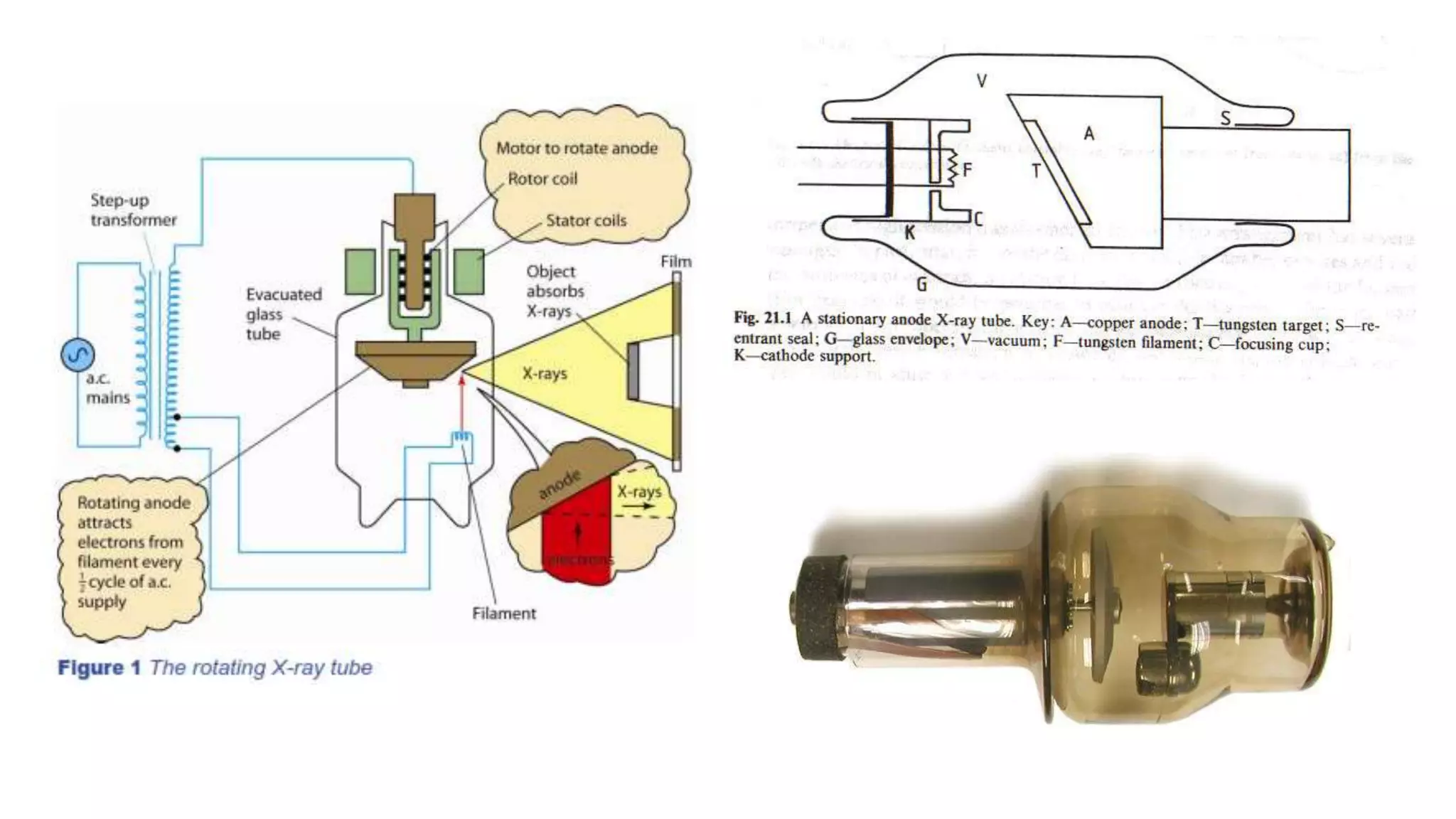
Anode construction for rotating anode x-ray tube.
1.1.1
ANODE: TARGET MATERIAL
8/27/2018 17
2.2.1 Target Material
NNANAR
2.1.1 Target Material
1.1.1
ANODE: TARGET MATERIAL
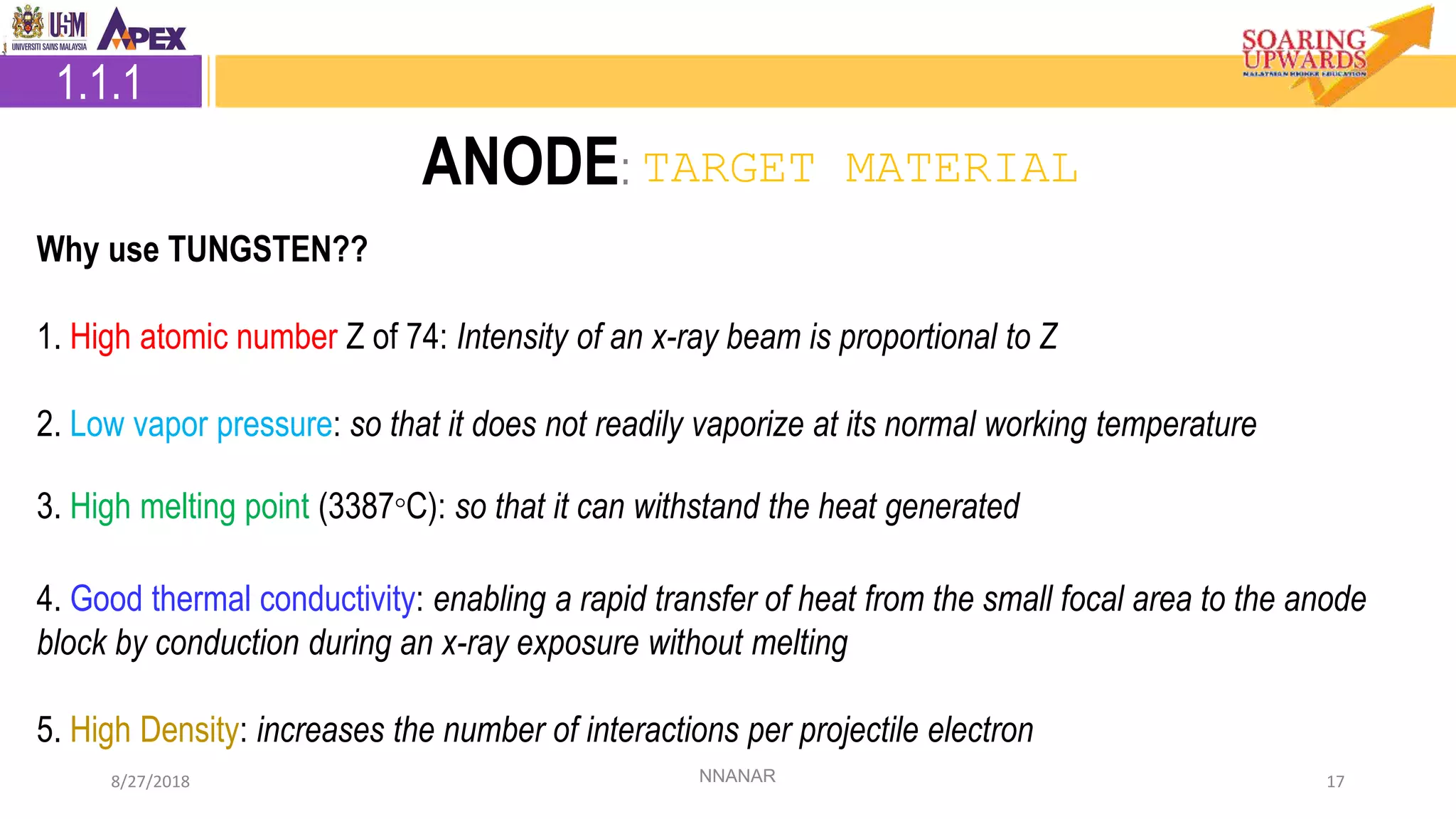
Why use TUNGSTEN??
1. High atomic number Z of 74: Intensity of an x-ray beam is proportional to Z
2. Low vapor pressure: so that it does not readily vaporize at its normal working temperature
3. High melting point (3387°C): so that it can withstand the heat generated
4. Good thermal conductivity: enabling a rapid transfer of heat from the small focal area to the anode
block by conduction during an x-ray exposure without melting
5. High Density: increases the number of interactions per projectile electron
1.1.2 Types of Anode
1827/8/2018 Dr. Nik Noor Ashikin Bt Nik Ab Razak
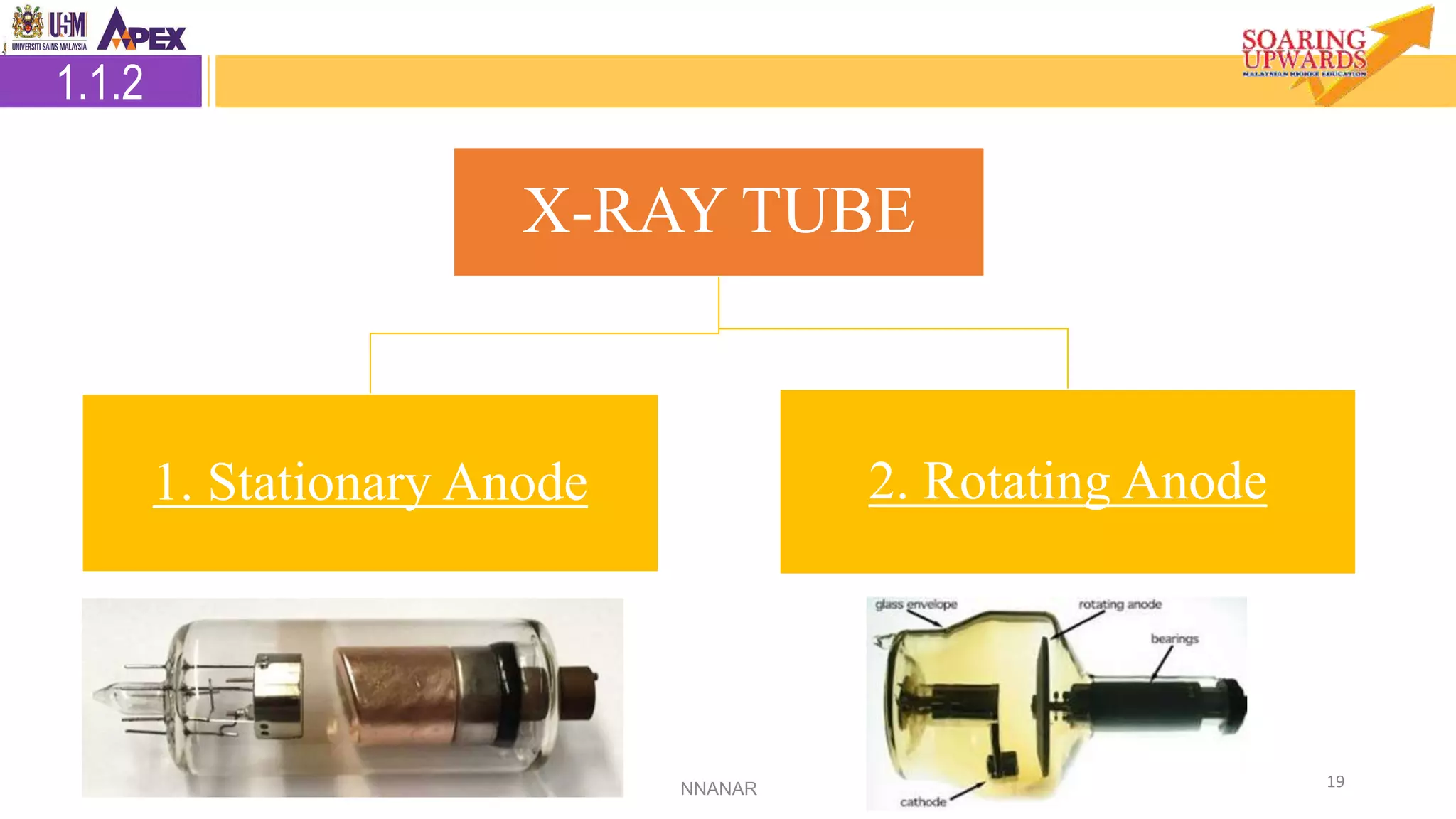
X-RAY TUBE
1. Stationary Anode 2. Rotating Anode
8/27/2018 19NNANAR
2.2.11.1.2
1.1.2.1 Stationary Anode
2027/8/2018 Dr. Nik Noor Ashikin Bt Nik Ab Razak
2.1.2.1 Stationary anode
27/8/2018 Dr. Nik Noor Ashikin Bt Nik Ab Razak 21
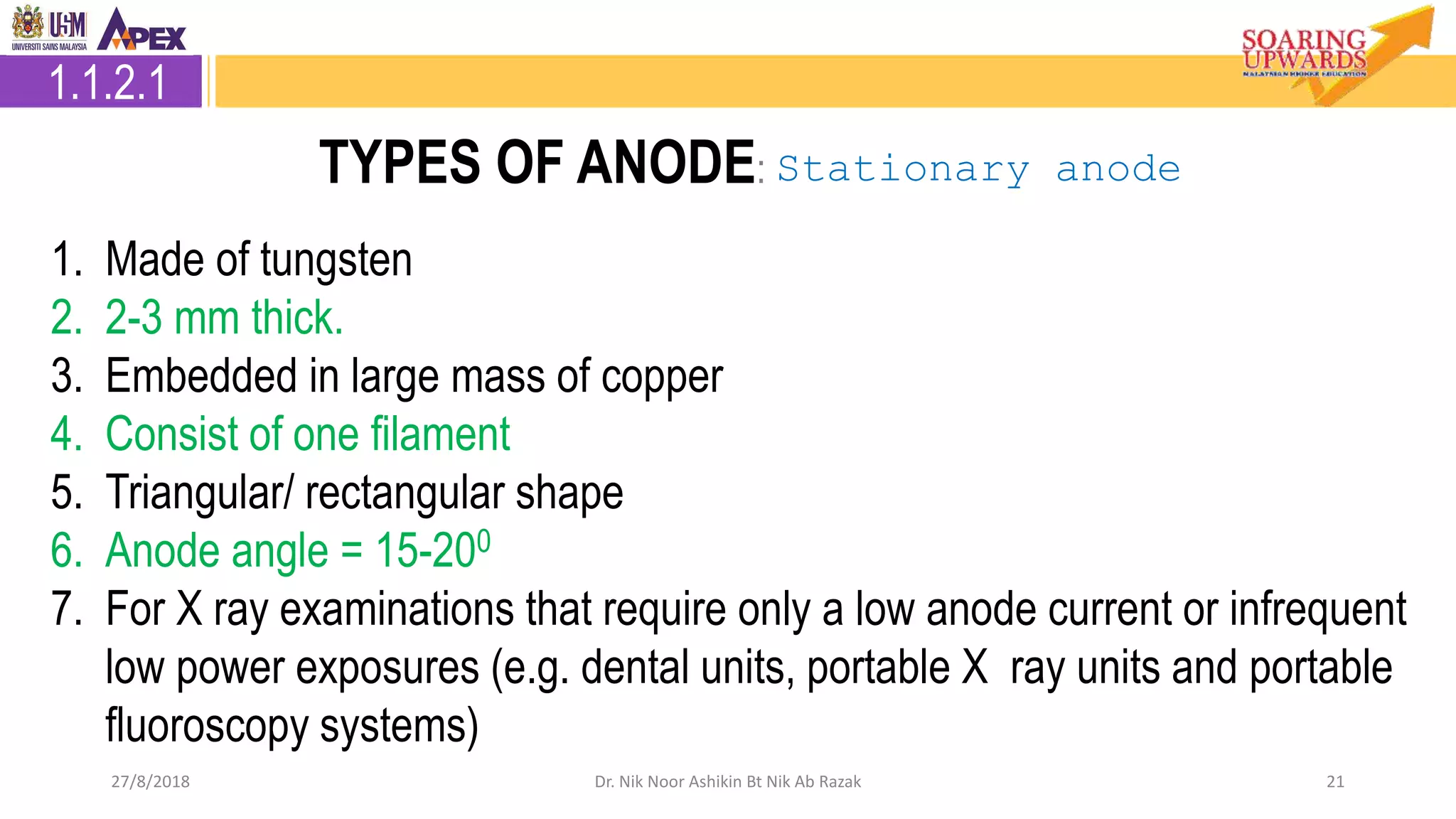
1. Made of tungsten
2. 2-3 mm thick.
3. Embedded in large mass of copper
4. Consist of one filament
5. Triangular/ rectangular shape
6. Anode angle = 15-200
7. For X ray examinations that require only a low anode current or infrequent
low power exposures (e.g. dental units, portable X ray units and portable
fluoroscopy systems)
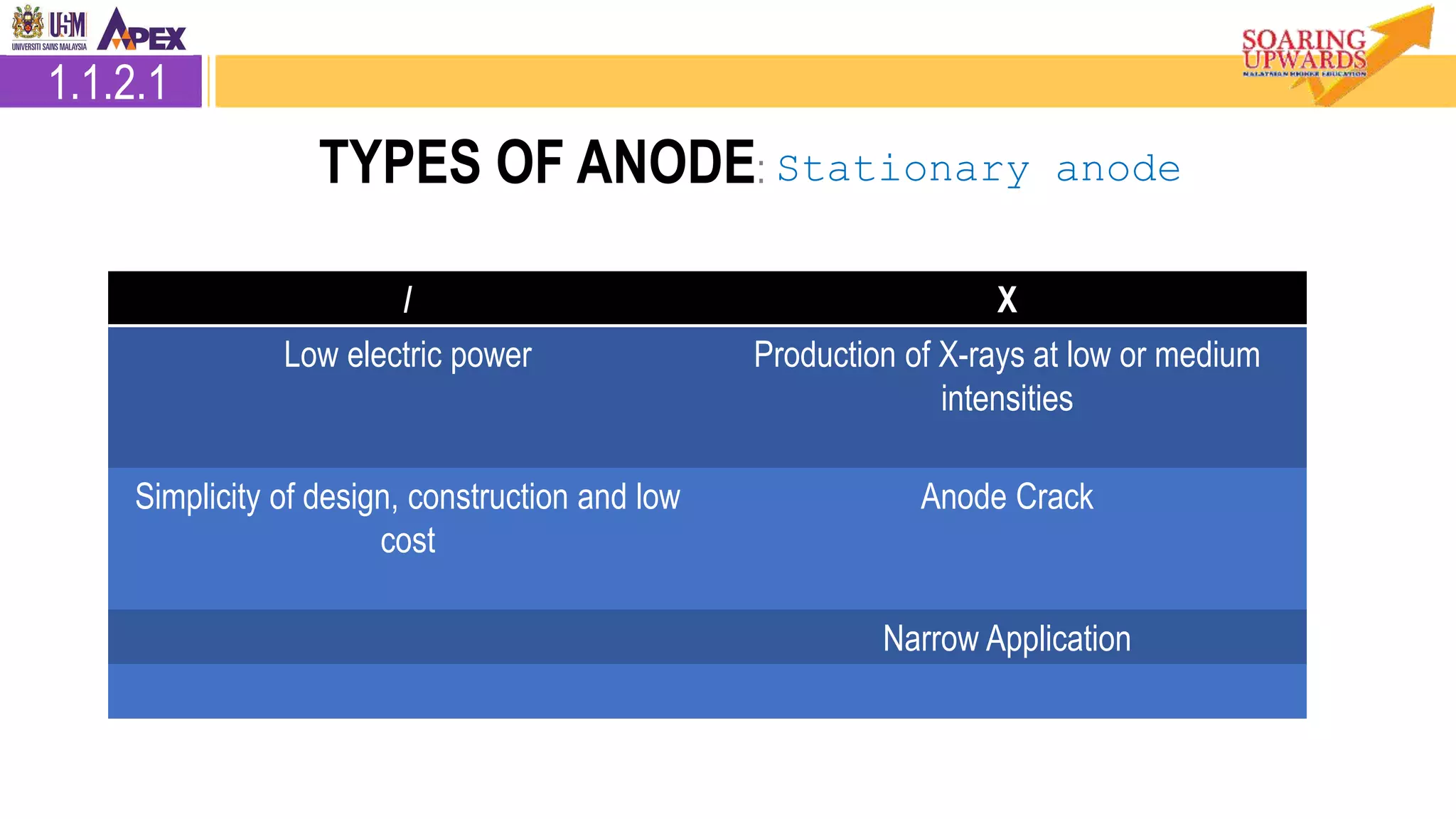
1.1.2.1
TYPES OF ANODE: Stationary anode
/ X
Low electric power Production of X-rays at low or medium
intensities
Simplicity of design, construction and low
cost
Anode Crack
Narrow Application
2.1.2.1 Stationary anode1.1.2.1
TYPES OF ANODE: Stationary anode
23NNANAR
1.1.2.2 Rotating Anode
2527/8/2018 Dr. Nik Noor Ashikin Bt Nik Ab Razak
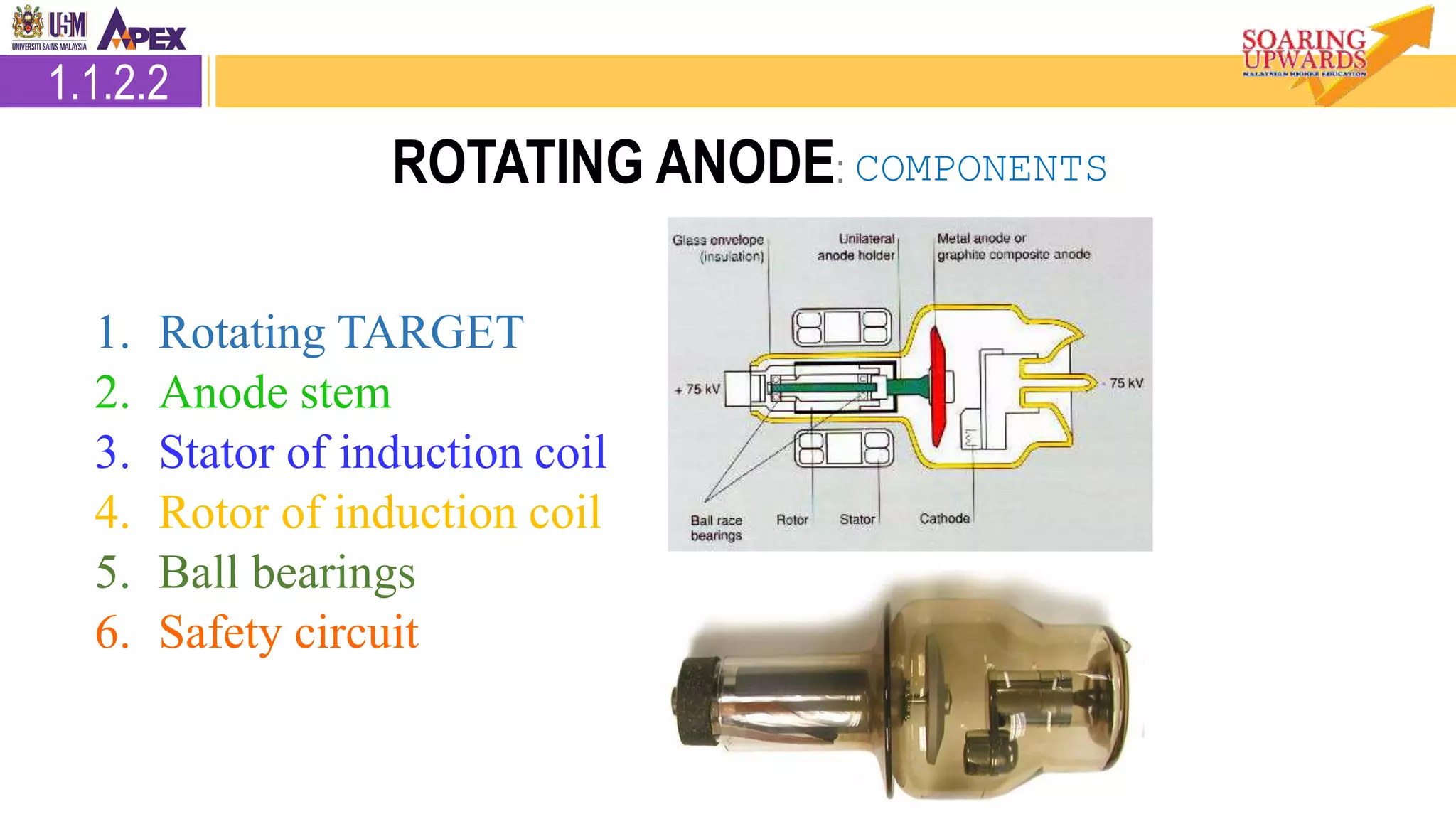
1. Rotating TARGET
2. Anode stem
3. Stator of induction coil
4. Rotor of induction coil
5. Ball bearings
6. Safety circuit
2.1.2.2 Rotating Anode1.1.2.2
ROTATING ANODE: COMPONENTS
The block and stem is made of copper
The target or an inset of a thin (~ 2-3 mm) tungsten plate
Rotor
Typical materials are a tungsten-rhenium target on
a molybdenum core, backed with graphite.
The target is the AREA of the anode struck by the electrons from the
cathode.
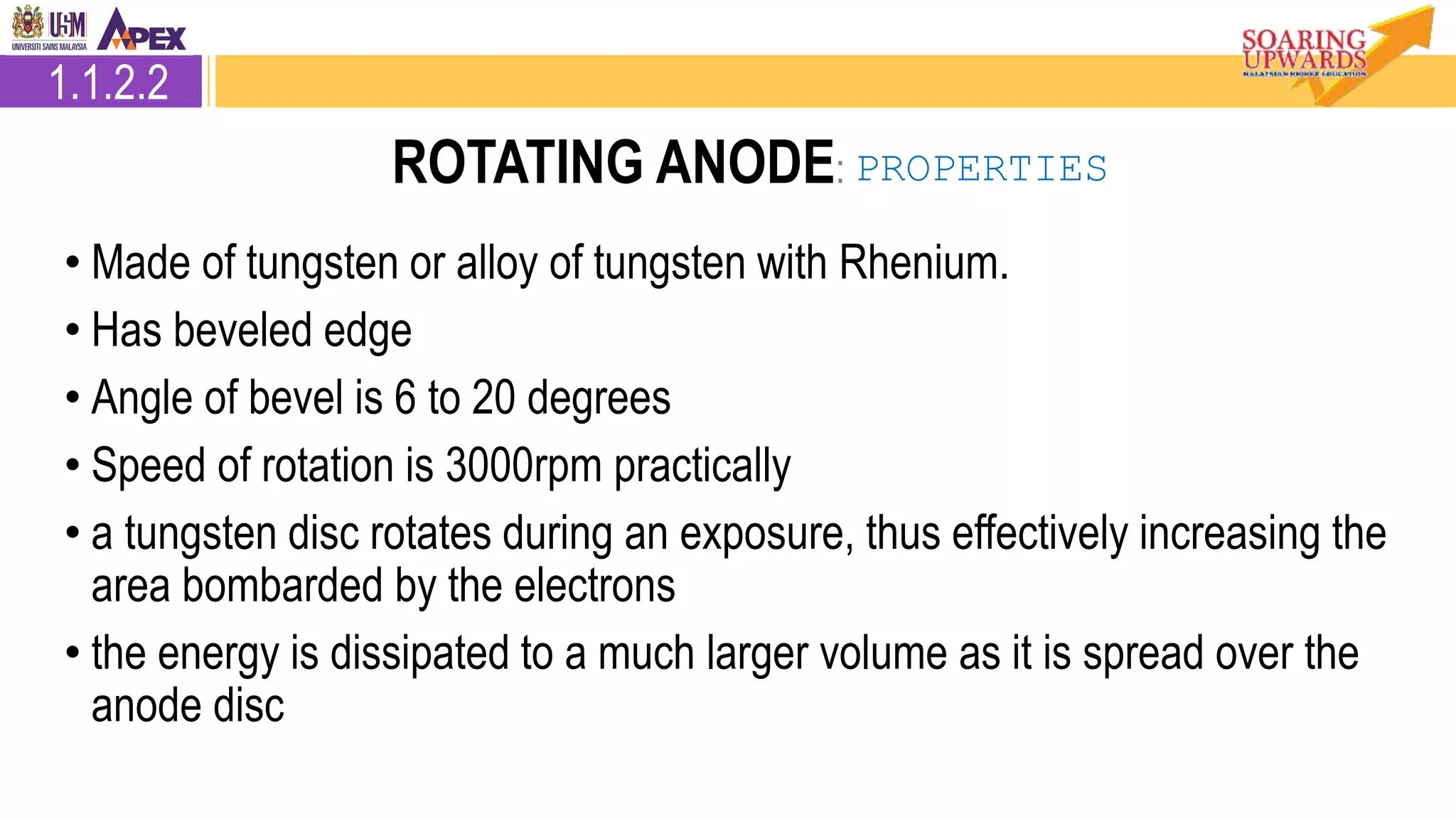
• Made of tungsten or alloy of tungsten with Rhenium.
• Has beveled edge
• Angle of bevel is 6 to 20 degrees
• Speed of rotation is 3000rpm practically
• a tungsten disc rotates during an exposure, thus effectively increasing the
area bombarded by the electrons
• the energy is dissipated to a much larger volume as it is spread over the
anode disc
2.1.2.2 Rotating Anode1.1.2.2
ROTATING ANODE: PROPERTIES
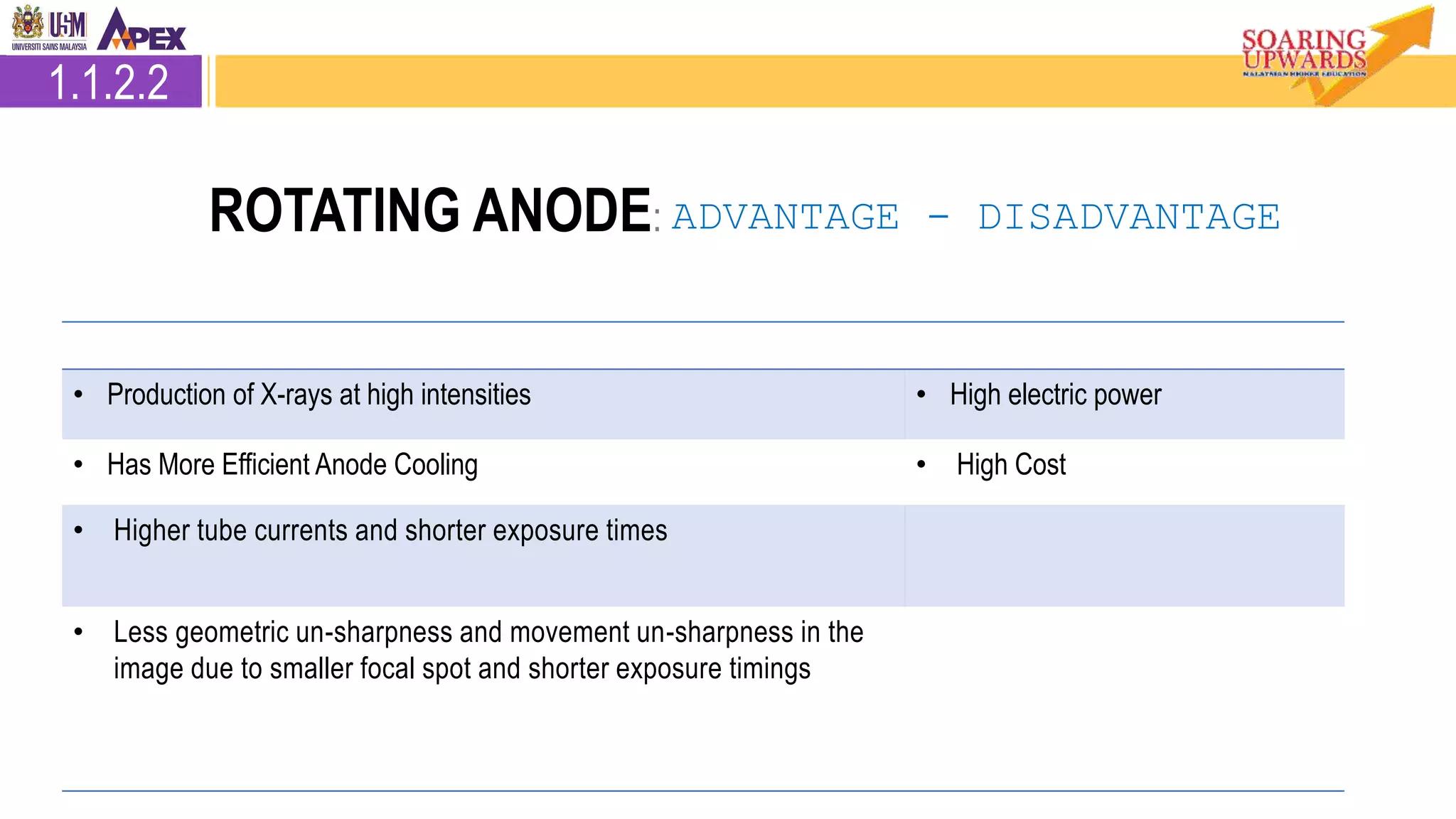
• Production of X-rays at high intensities • High electric power
• Has More Efficient Anode Cooling • High Cost
• Higher tube currents and shorter exposure times
• Less geometric un-sharpness and movement un-sharpness in the
image due to smaller focal spot and shorter exposure timings
2.1.2.2 Rotating Anode1.1.2.2
ROTATING ANODE: ADVANTAGE - DISADVANTAGE
• Depends on roughing and pitting of surface of
anode exposed to electron beam.
• Prevented by using alloy of 90% tungsten and
10% rhenium
1.1.2.2
ROTATING ANODE: HALF-LIFE
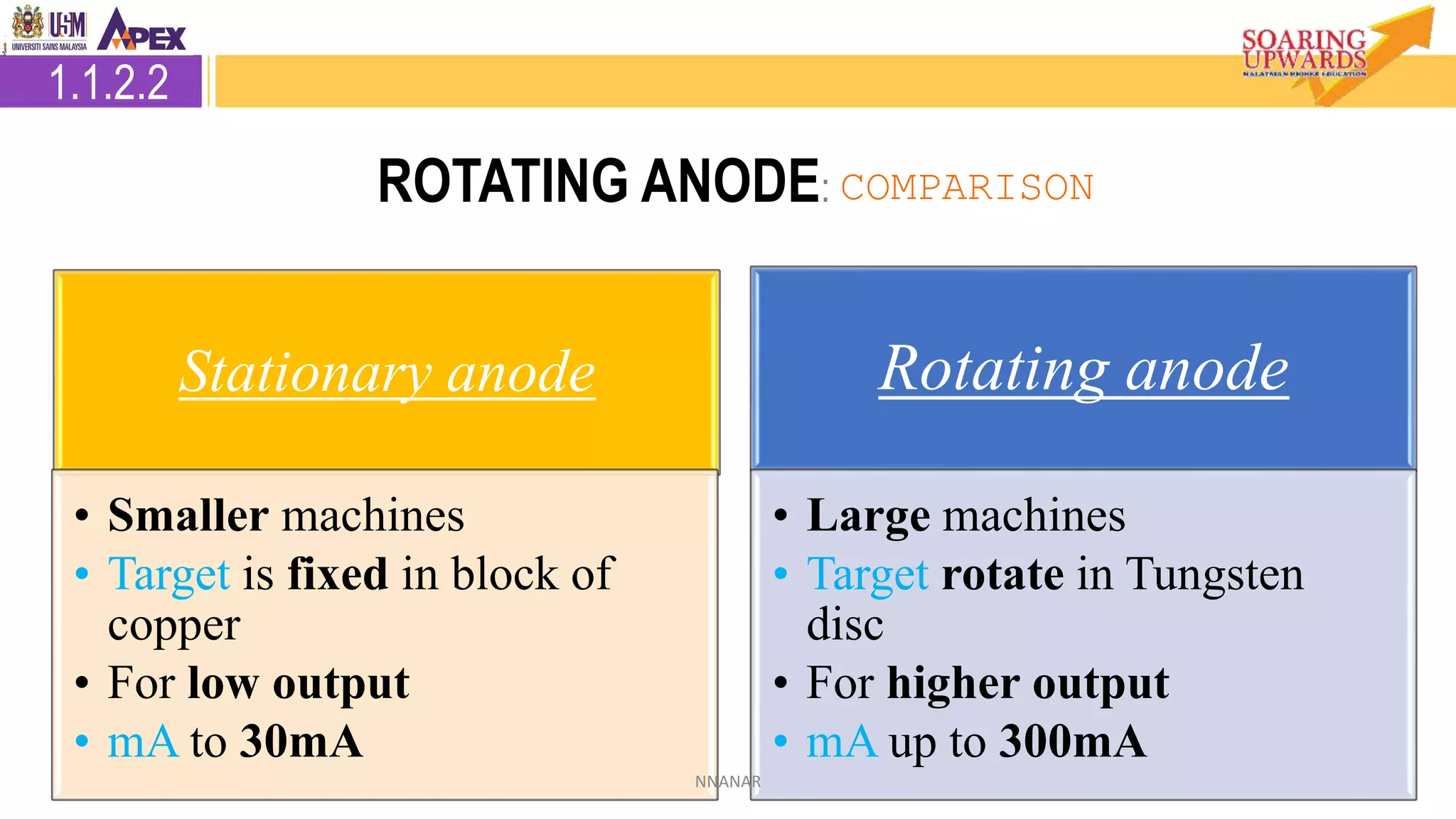
Stationary anode
• Smaller machines
• Target is fixed in block of
copper
• For low output
• mA to 30mA
Rotating anode
• Large machines
• Target rotate in Tungsten
disc
• For higher output
• mA up to 300mA
NNANAR
1.1.2.2
ROTATING ANODE: COMPARISON
1.1.3 Anode Stem & Bearing
3327/8/2018 Dr. Nik Noor Ashikin Bt Nik Ab Razak
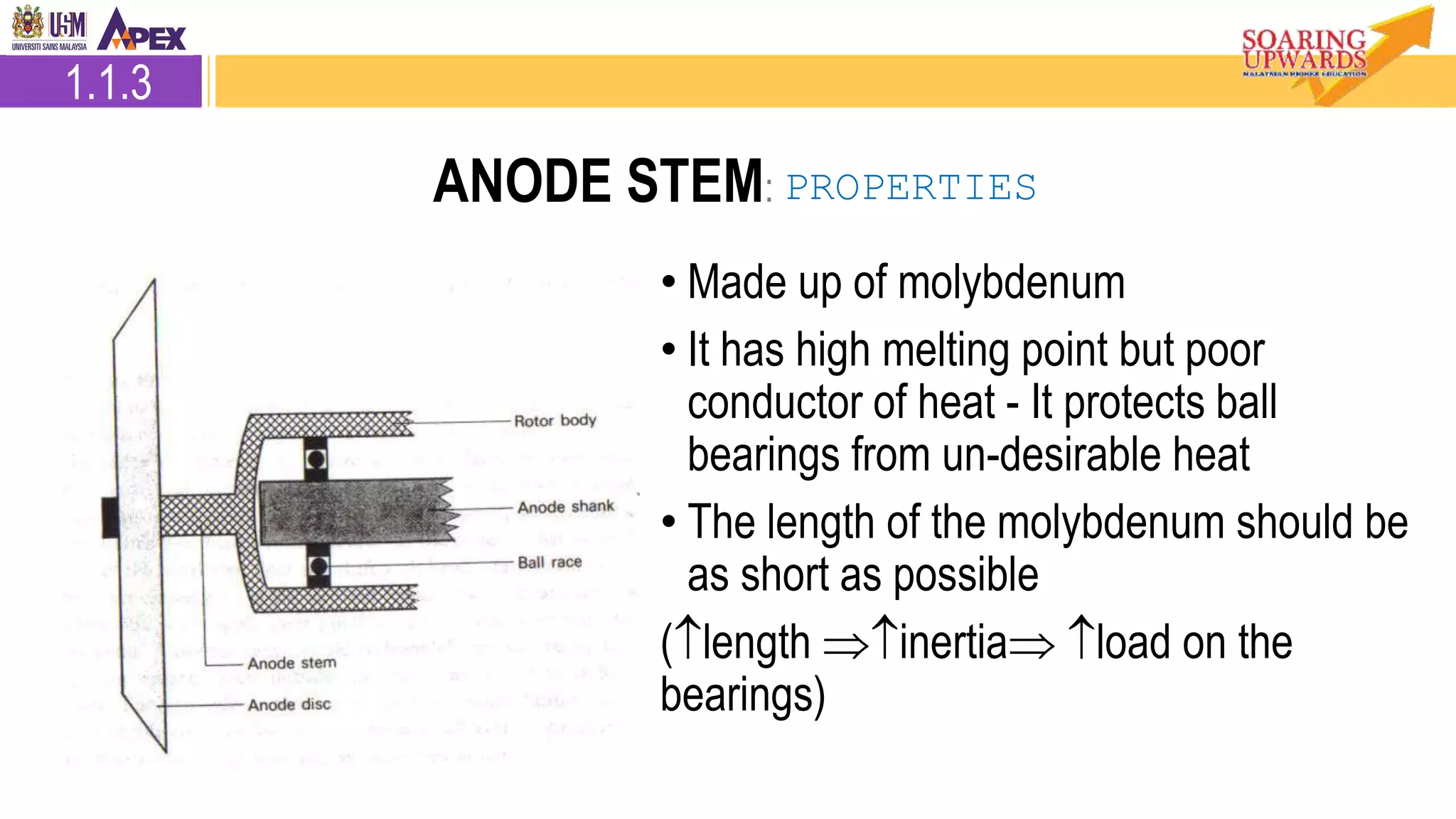
• Made up of molybdenum
• It has high melting point but poor
conductor of heat - It protects ball
bearings from un-desirable heat
• The length of the molybdenum should be
as short as possible
(length inertia load on the
bearings)
1.1.3
ANODE STEM: PROPERTIES
•Increases life of the tube.
•Lubricant used is silver.
•Silver is suitable in vacuum
1.1.3
BEARINGS: PROPERTIES
1.1.4 Rotor and Motor System
3627/8/2018 Dr. Nik Noor Ashikin Bt Nik Ab Razak
3727/8/2018 Dr. Nik Noor Ashikin Bt Nik Ab Razak
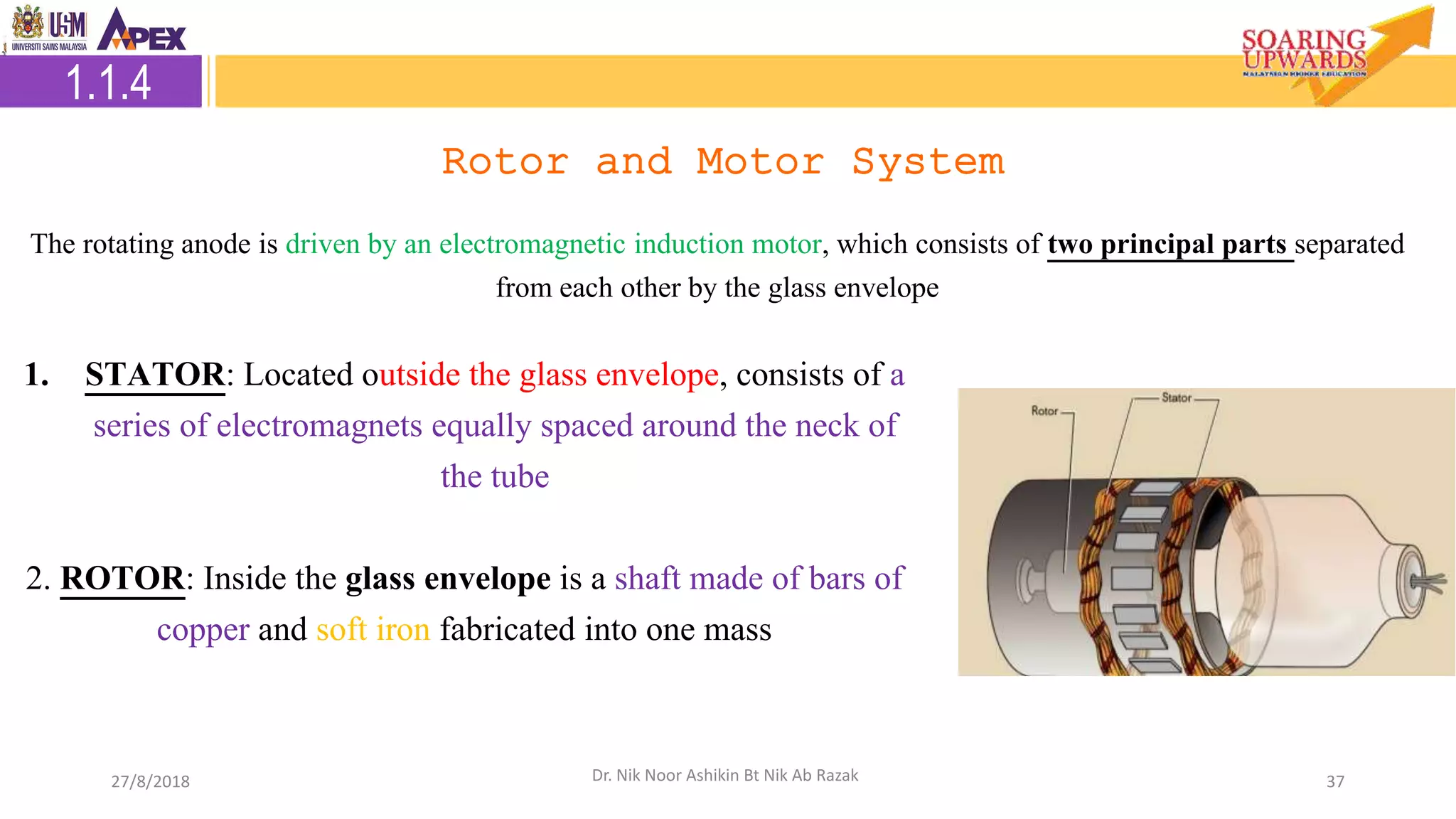
The rotating anode is driven by an electromagnetic induction motor, which consists of two principal parts separated
from each other by the glass envelope
1. STATOR: Located outside the glass envelope, consists of a
series of electromagnets equally spaced around the neck of
the tube
2. ROTOR: Inside the glass envelope is a shaft made of bars of
copper and soft iron fabricated into one mass
1.1.4
Rotor and Motor System
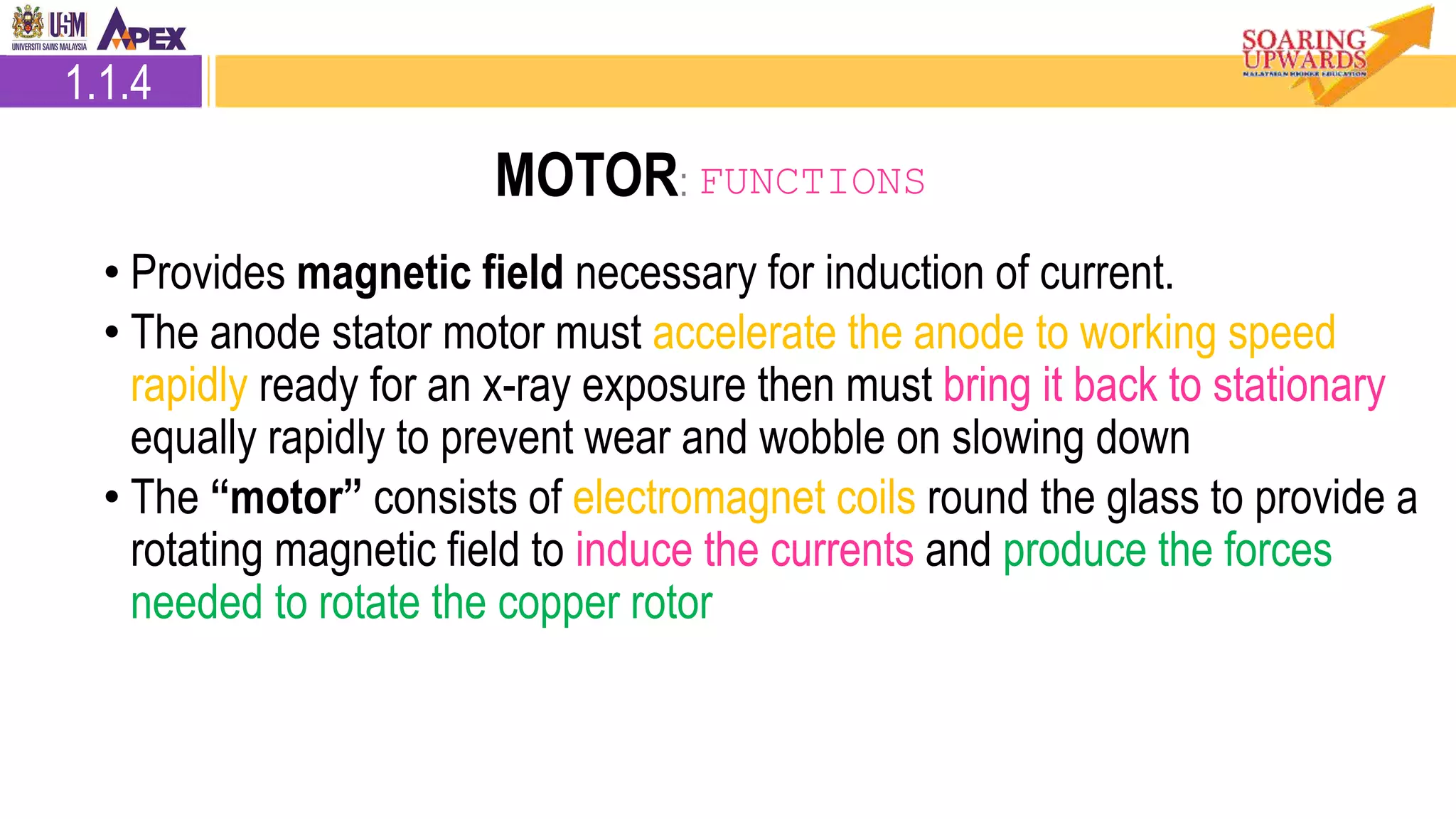
• Provides magnetic field necessary for induction of current.
• The anode stator motor must accelerate the anode to working speed
rapidly ready for an x-ray exposure then must bring it back to stationary
equally rapidly to prevent wear and wobble on slowing down
• The “motor” consists of electromagnet coils round the glass to provide a
rotating magnetic field to induce the currents and produce the forces
needed to rotate the copper rotor
1.1.4
MOTOR: FUNCTIONS
The induction motor is energized for about 1 second before high voltage is
applied to the x-ray tube. This delay ensures that electrons do not strike the
target before the anode reaches its maximum speed of rotation.
1.1.4
MOTOR: FUNCTIONS
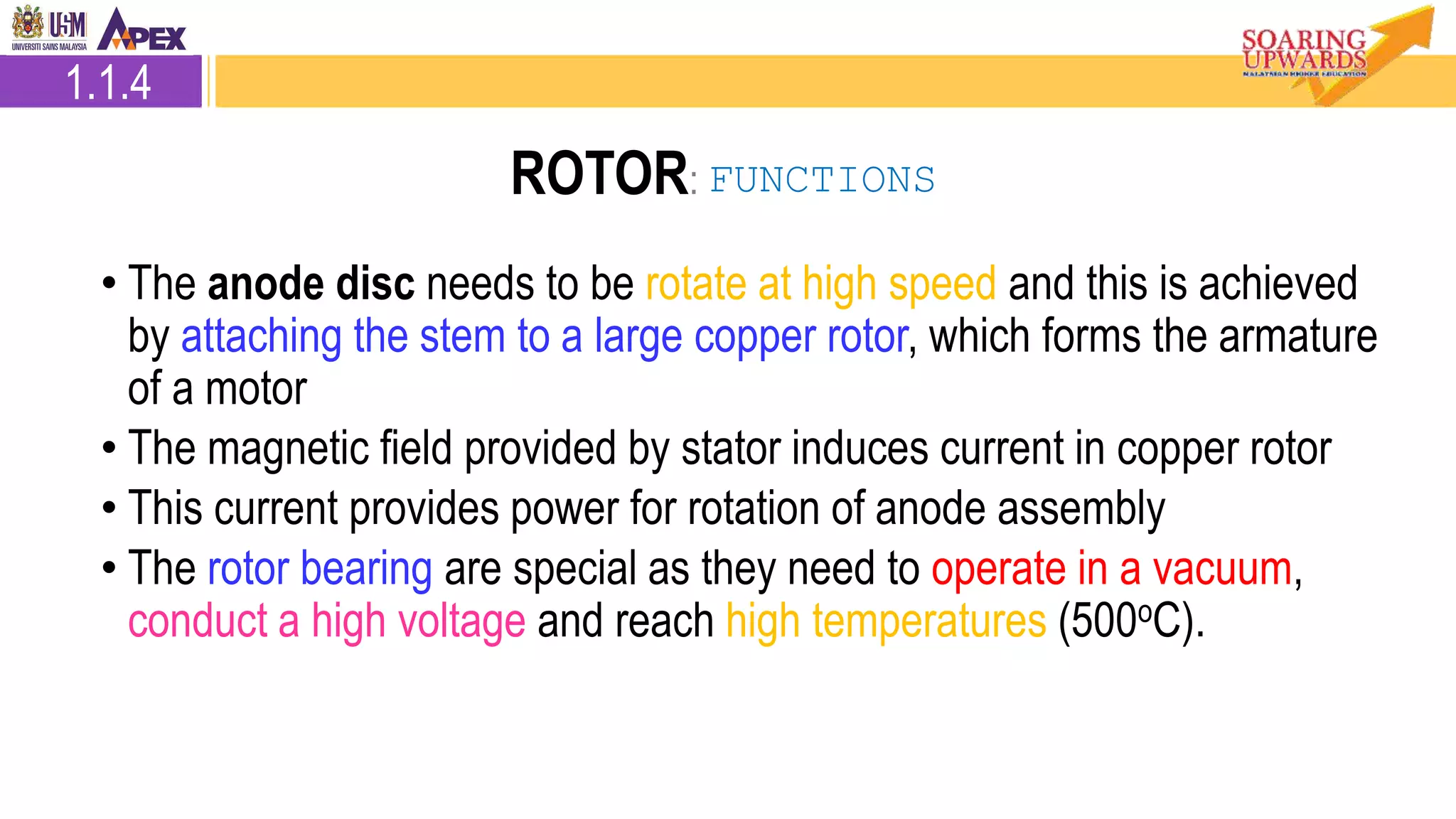
• The anode disc needs to be rotate at high speed and this is achieved
by attaching the stem to a large copper rotor, which forms the armature
of a motor
• The magnetic field provided by stator induces current in copper rotor
• This current provides power for rotation of anode assembly
• The rotor bearing are special as they need to operate in a vacuum,
conduct a high voltage and reach high temperatures (500oC).
1.1.4
ROTOR: FUNCTIONS
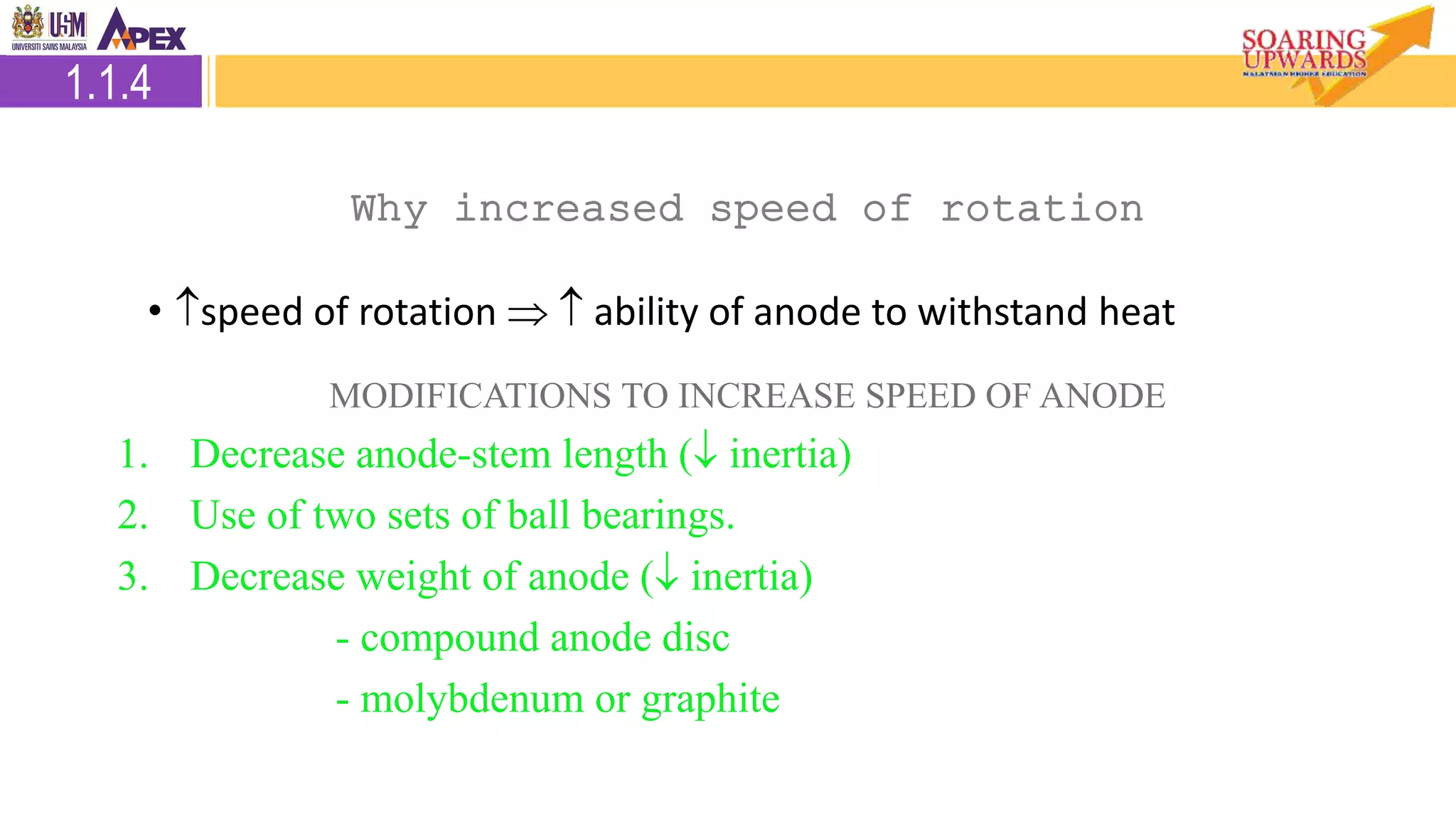
• speed of rotation   ability of anode to withstand heat
MODIFICATIONS TO INCREASE SPEED OF ANODE
1. Decrease anode-stem length ( inertia)
2. Use of two sets of ball bearings.
3. Decrease weight of anode ( inertia)
- compound anode disc
- molybdenum or graphite
1.1.4
Why increased speed of rotation
1.1.5 Focal Spot
4227/8/2018 Dr. Nik Noor Ashikin Bt Nik Ab Razak
2.1.5 Focal Spot
4327/8/2018 Dr. Nik Noor Ashikin Bt Nik Ab Razak
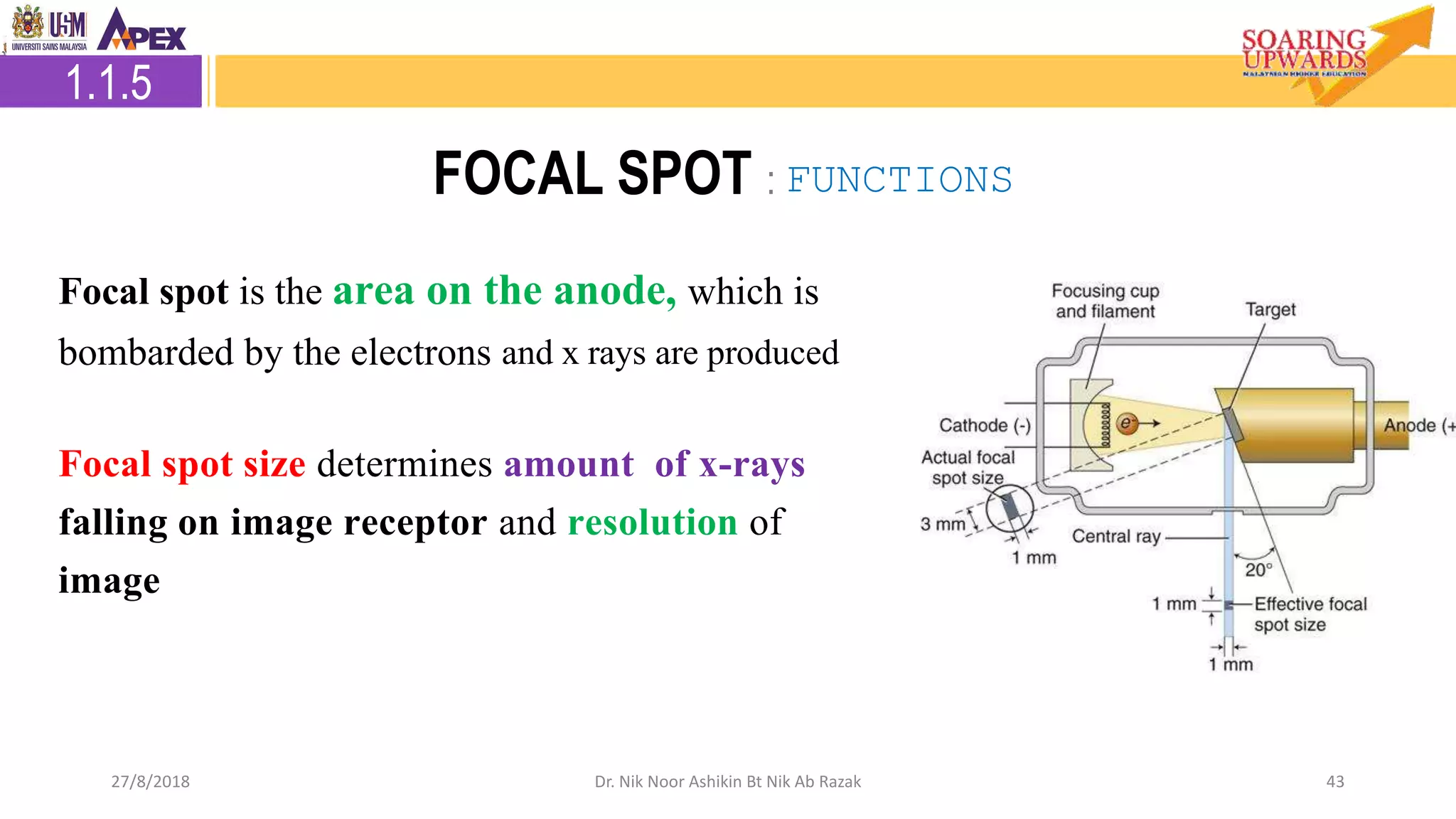
Focal spot is the area on the anode, which is
bombarded by the electrons and x rays are produced
Focal spot size determines amount of x-rays
falling on image receptor and resolution of
image
1.1.5
FOCAL SPOT : FUNCTIONS
1.1.5
4527/8/2018 Dr. Nik Noor Ashikin Bt Nik Ab Razak
2.1.5 Focal Spot
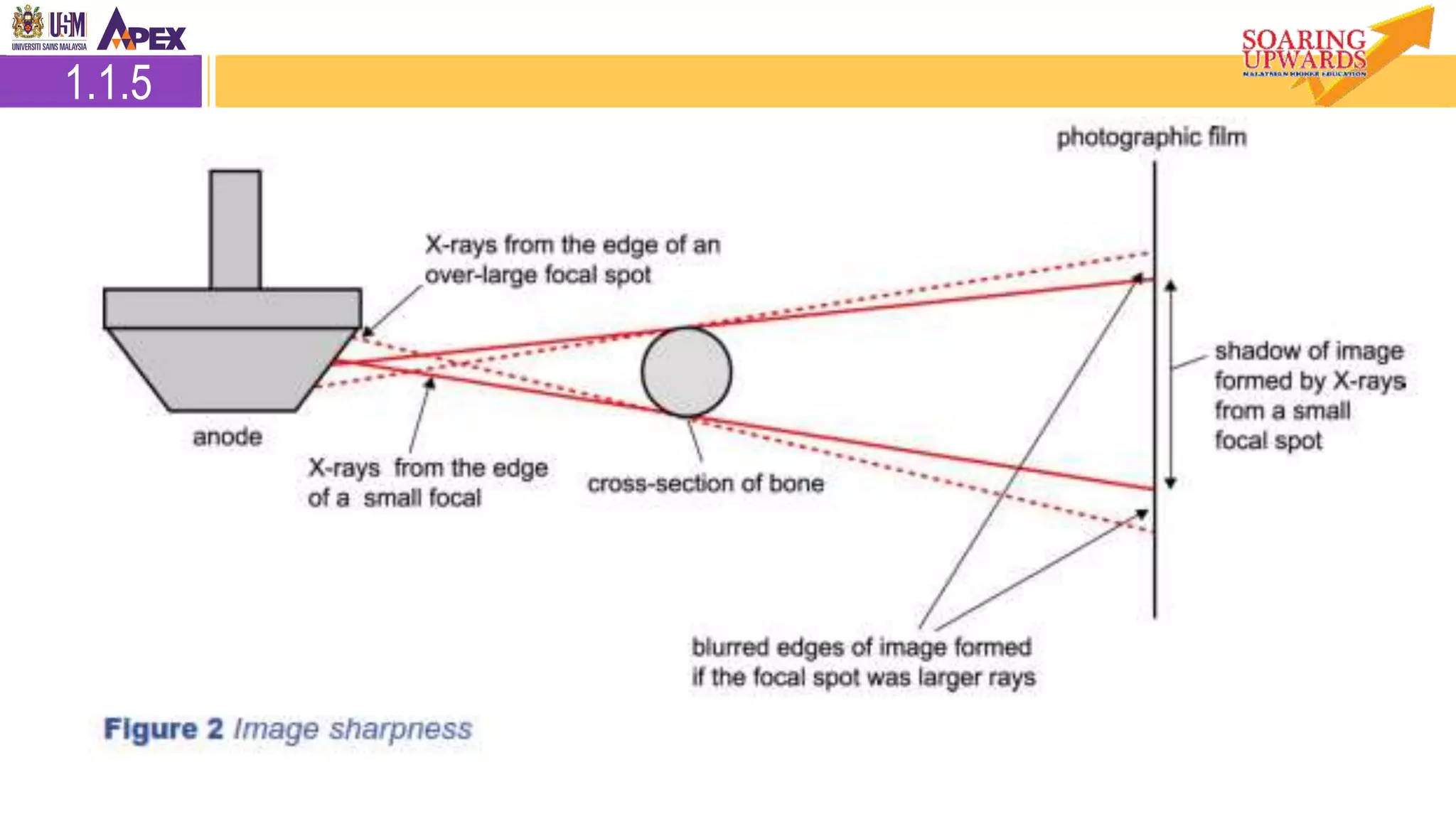
To produce radiographic images with
sharp edges, focal spot size should be
small
“Small focal spot from a small filament
Electron emitted from SMALL FILAMENT
Electron emitted from LARGE FILAMENT
1.1.5
FOCAL SPOT : FUNCTIONS
4627/8/2018 Dr. Nik Noor Ashikin Bt Nik Ab Razak
2.1.5 Focal Spot
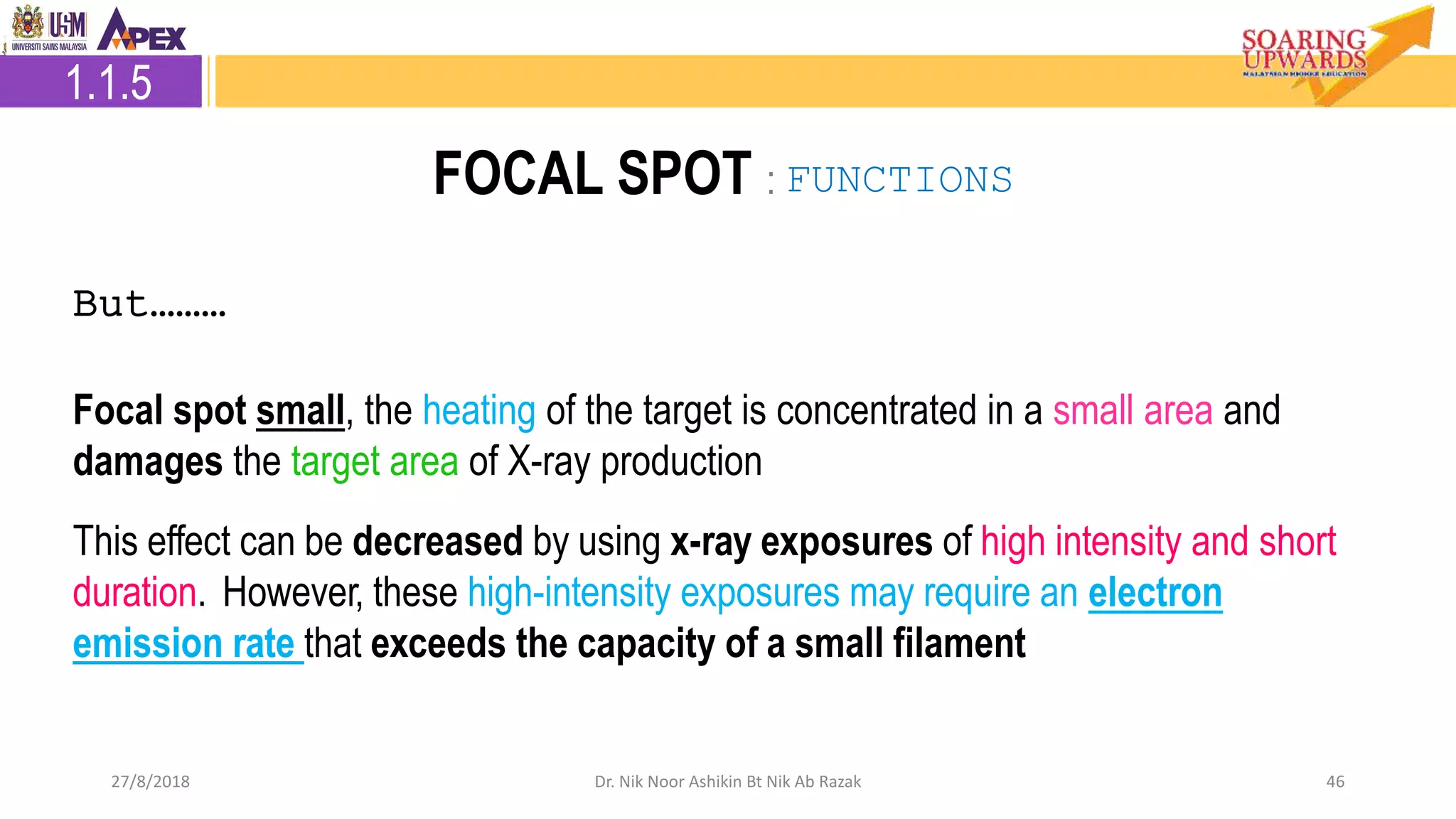
But………
Focal spot small, the heating of the target is concentrated in a small area and
damages the target area of X-ray production
This effect can be decreased by using x-ray exposures of high intensity and short
duration. However, these high-intensity exposures may require an electron
emission rate that exceeds the capacity of a small filament
1.1.5
FOCAL SPOT : FUNCTIONS
8/27/2018 Footer Text 47
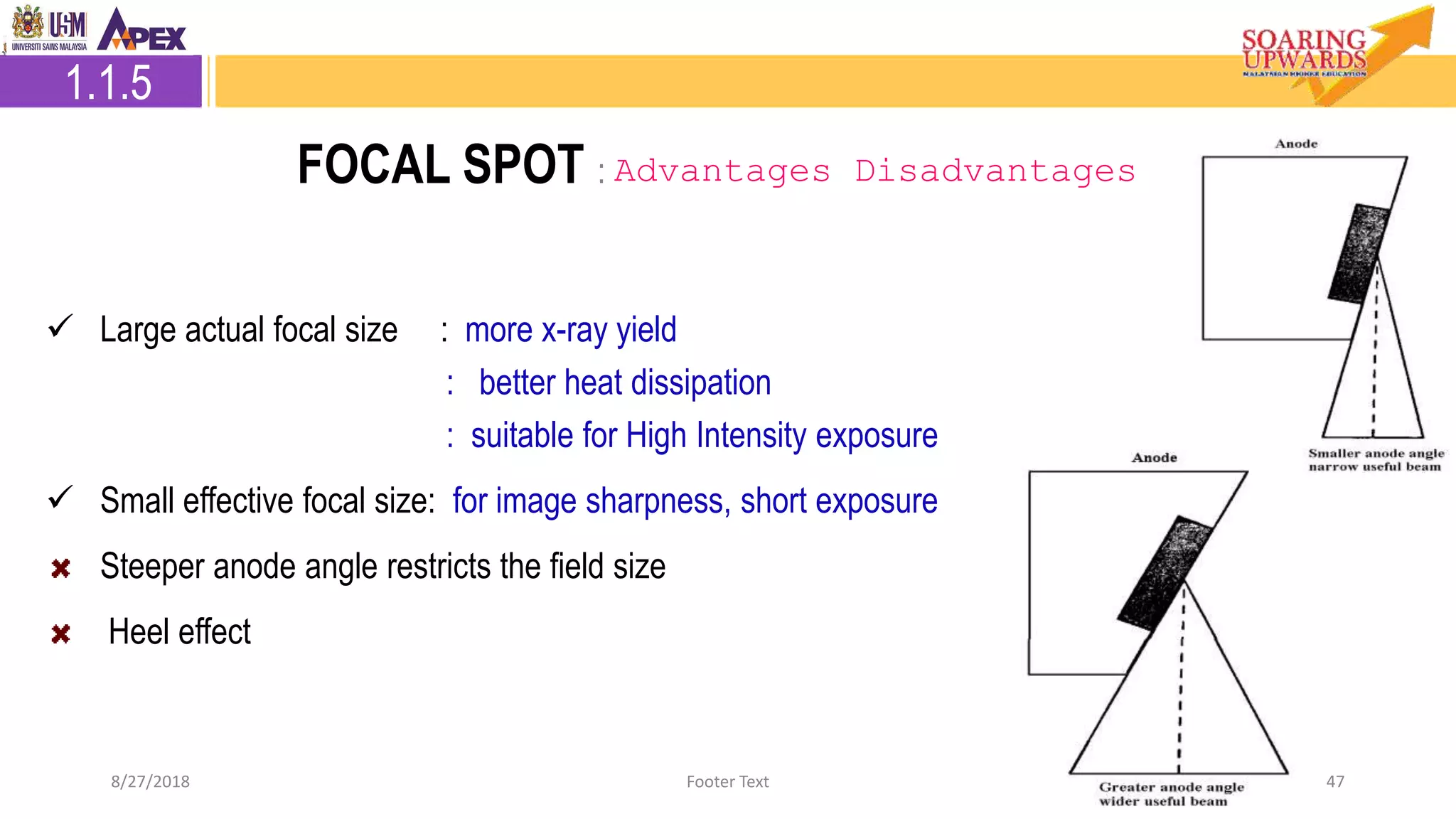
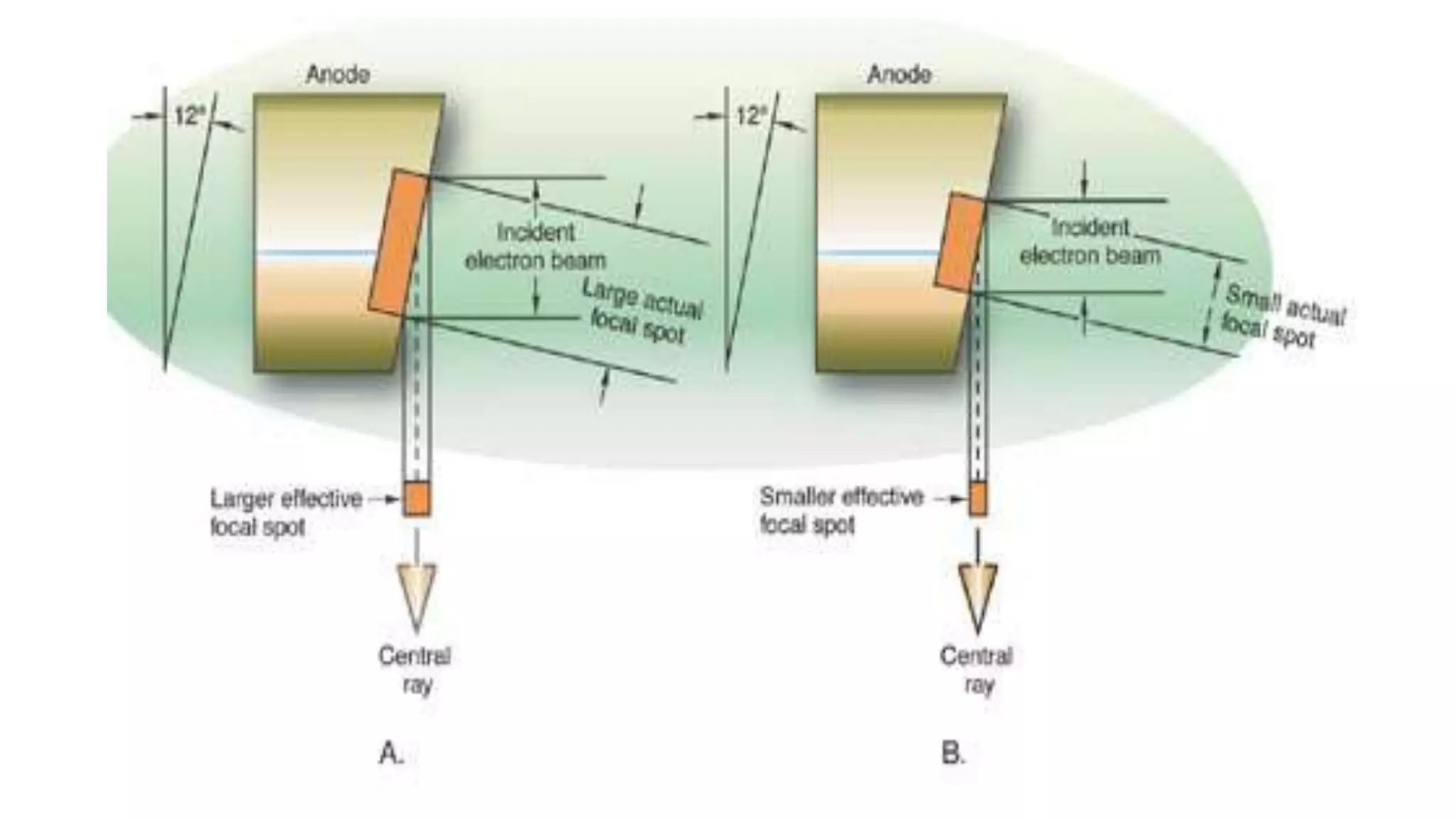
 Large actual focal size : more x-ray yield
: better heat dissipation
: suitable for High Intensity exposure
 Small effective focal size: for image sharpness, short exposure
Steeper anode angle restricts the field size
Heel effect
2.1.5 Focal Spot1.1.5
FOCAL SPOT : Advantages Disadvantages
1.1.5
FOCAL SPOT : Advantages Disadvantages
27/8/2018 Dr. Nik Noor Ashikin Bt Nik Ab Razak 49
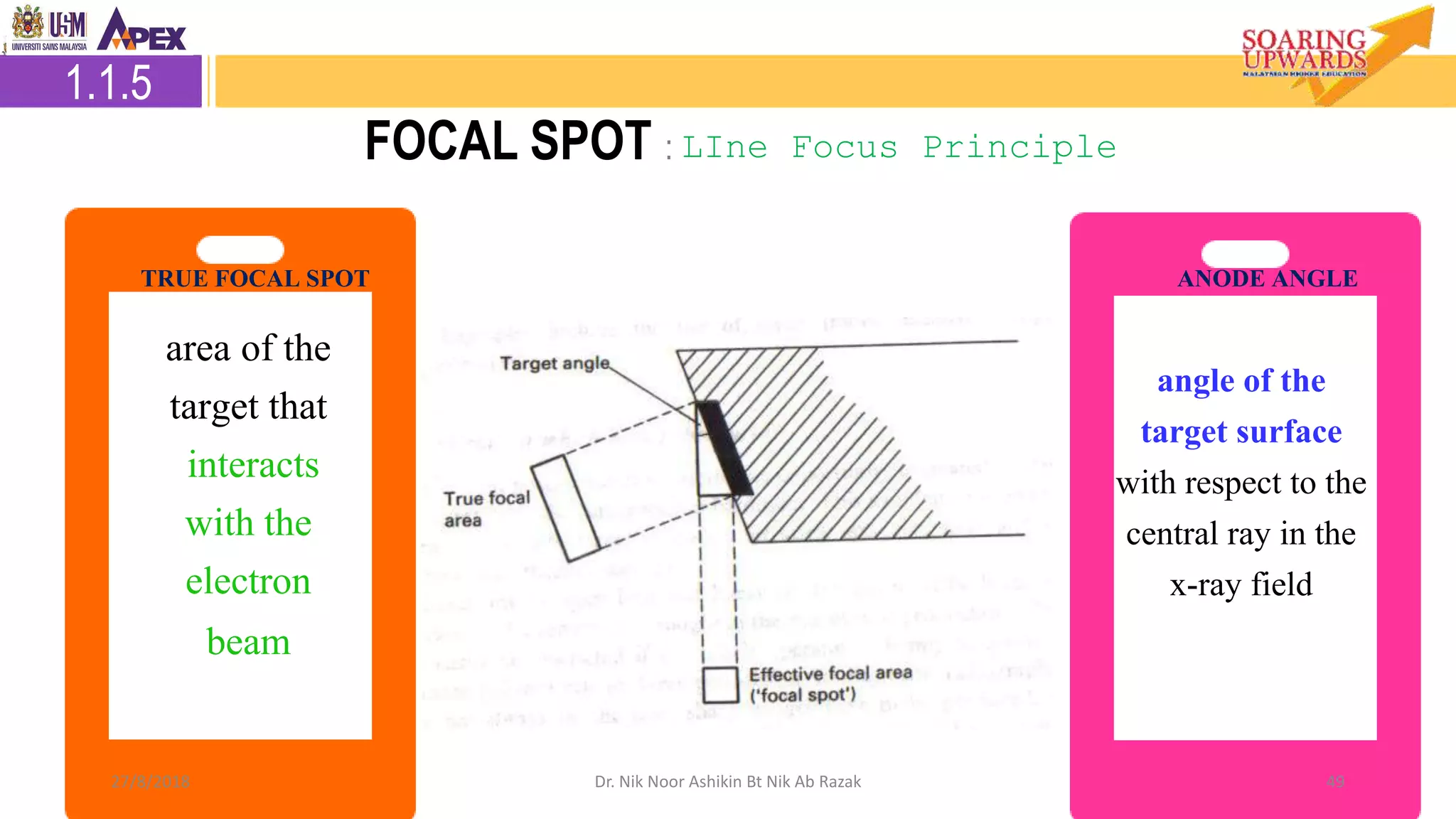
area of the
target that
interacts
with the
electron
beam
TRUE FOCAL SPOT
angle of the
target surface
with respect to the
central ray in the
x-ray field
ANODE ANGLE
1.1.5
FOCAL SPOT : LIne Focus Principle
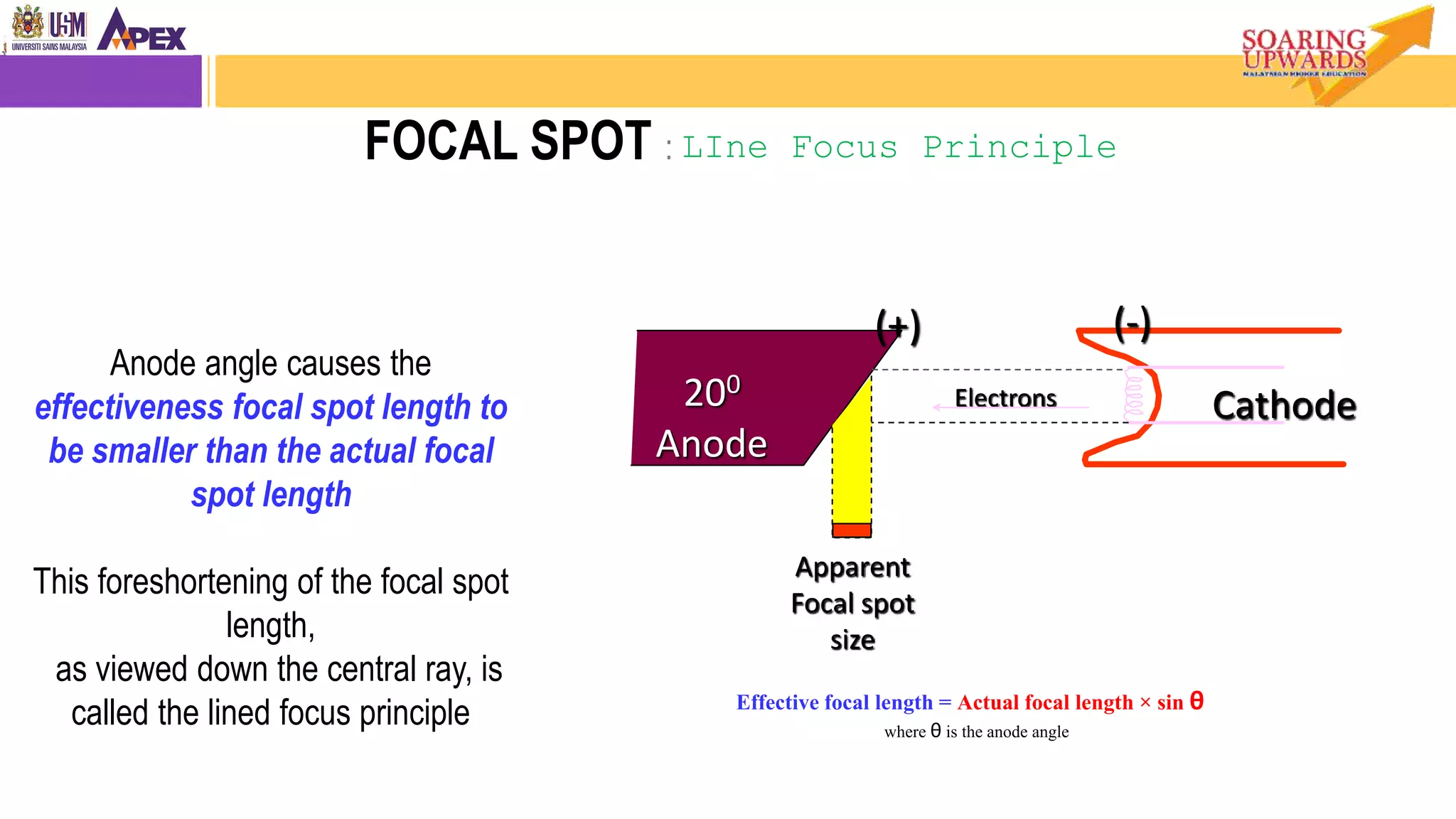
Anode angle causes the
effectiveness focal spot length to
be smaller than the actual focal
spot length
This foreshortening of the focal spot
length,
as viewed down the central ray, is
called the lined focus principle
CathodeElectrons
Apparent
Focal spot
size
200
Anode
(-)(+)
FOCAL SPOT : LIne Focus Principle
Effective focal length = Actual focal length × sin θ
where θ is the anode angle
53
• the area of the anode hit by the electrons should be as large as possible, to keep
the power density within acceptable limits.
For high anode currents……..
• to balance the need for substantial heat dissipation with that of a small focal spot
size
the line focus principle is used…….
• 6° to 22°,depending on their task, with 10–16° used for general purpose tubes
Anode angles in diagnostic tubes range….
27/8/2018 Dr. Nik Noor Ashikin Bt Nik Ab Razak
1.1.5
FOCAL SPOT : LIne Focus Principle
5427/8/2018 Dr. Nik Noor Ashikin Bt Nik Ab Razak
ADV
ANT
AGE
S
the heat to be spread over an area about 3 times larger than the
effective focus
•minimising the temperature rise in the target
•(requiring a large focal area)
•minimising the size of the X-ray source (requiring a small focal
area).
provides the sharpness of image of a small focal spot
1.1.5
FOCAL SPOT : LIne Focus Principle
1.1.6 Heel Effect
5527/8/2018 Dr. Nik Noor Ashikin Bt Nik Ab Razak
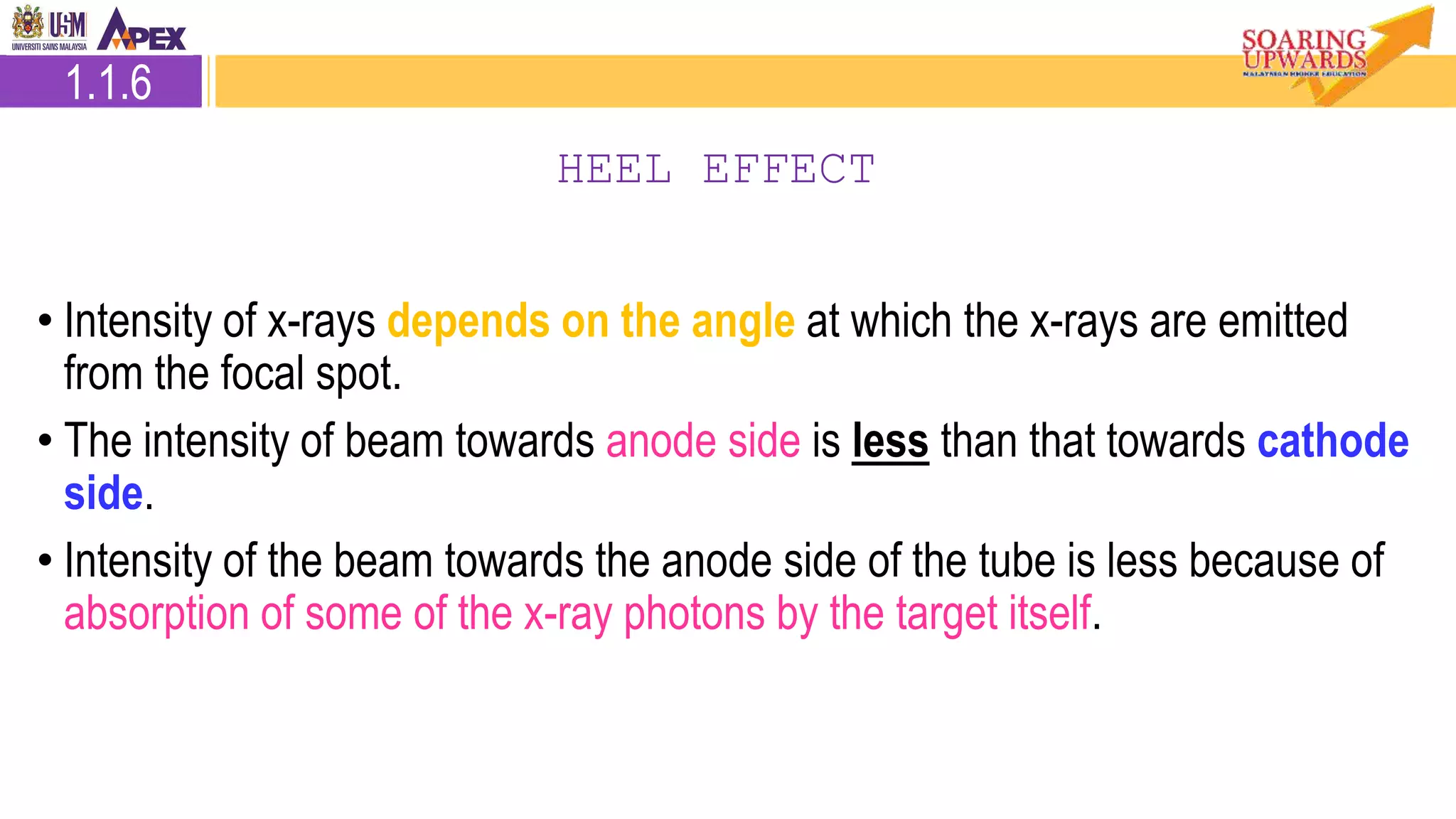
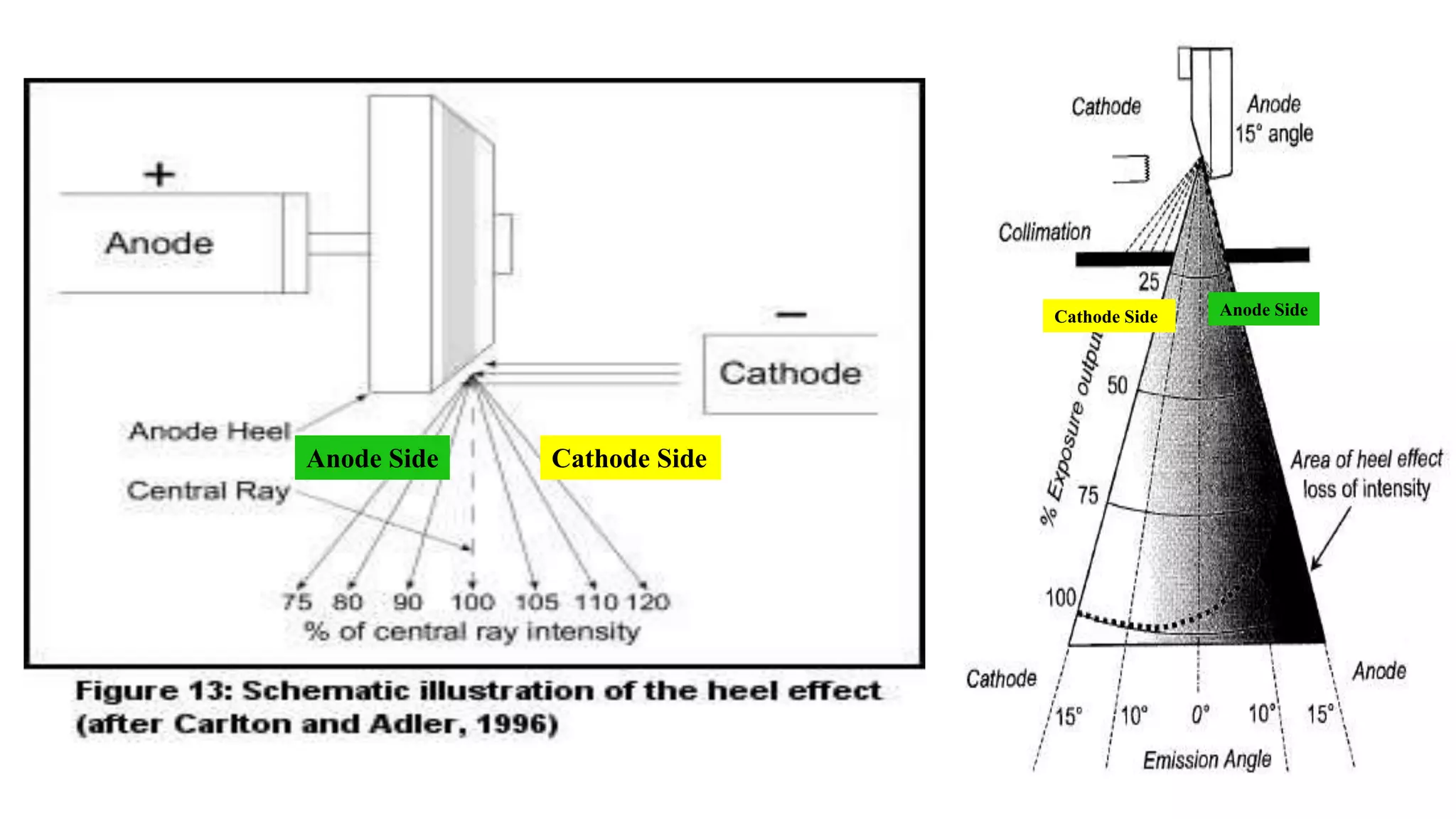
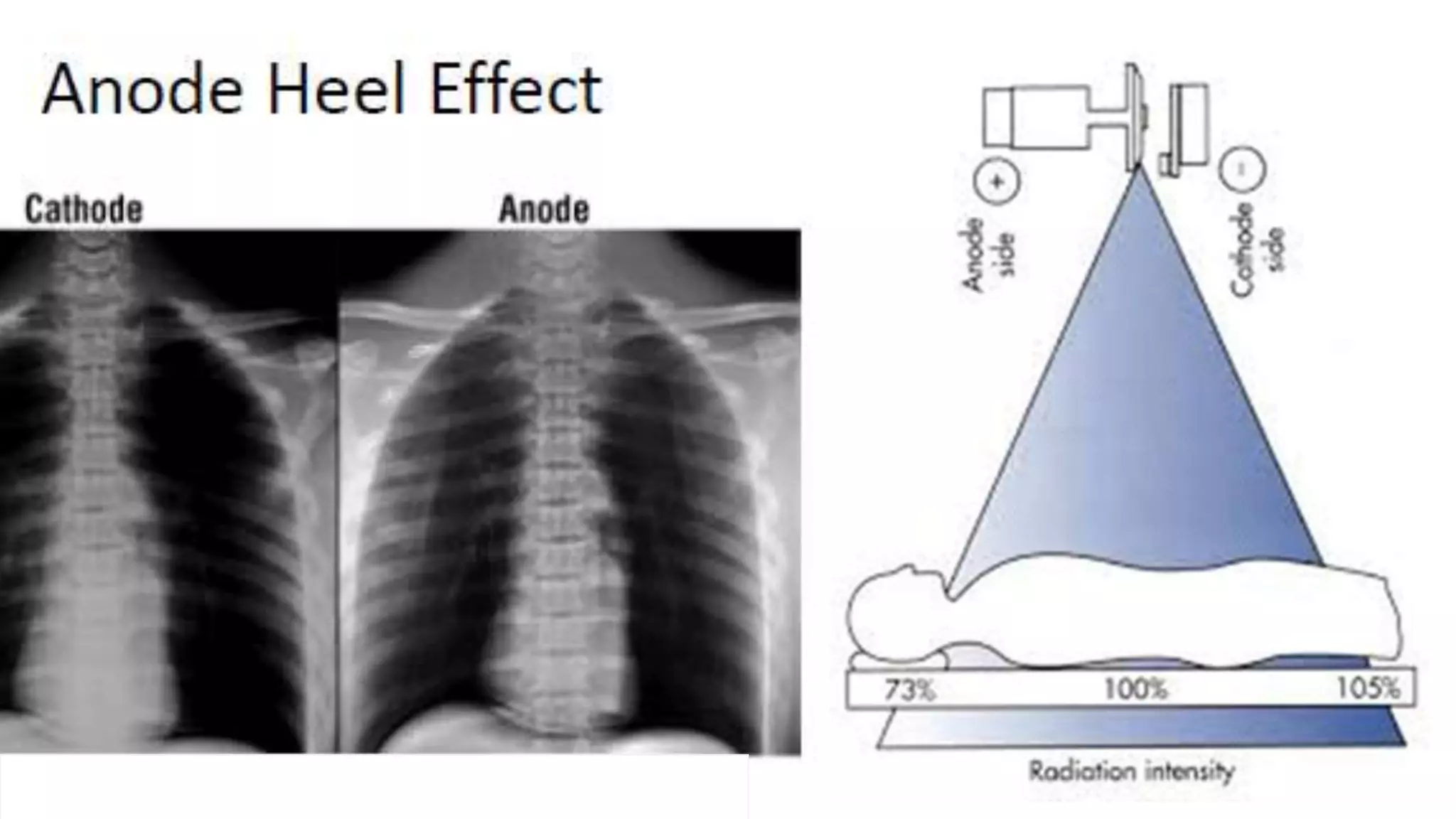
• Intensity of x-rays depends on the angle at which the x-rays are emitted
from the focal spot.
• The intensity of beam towards anode side is less than that towards cathode
side.
• Intensity of the beam towards the anode side of the tube is less because of
absorption of some of the x-ray photons by the target itself.
1.1.6
HEEL EFFECT
2.1.6 Heel Effect
5727/8/2018 Dr. Nik Noor Ashikin Bt Nik Ab Razak
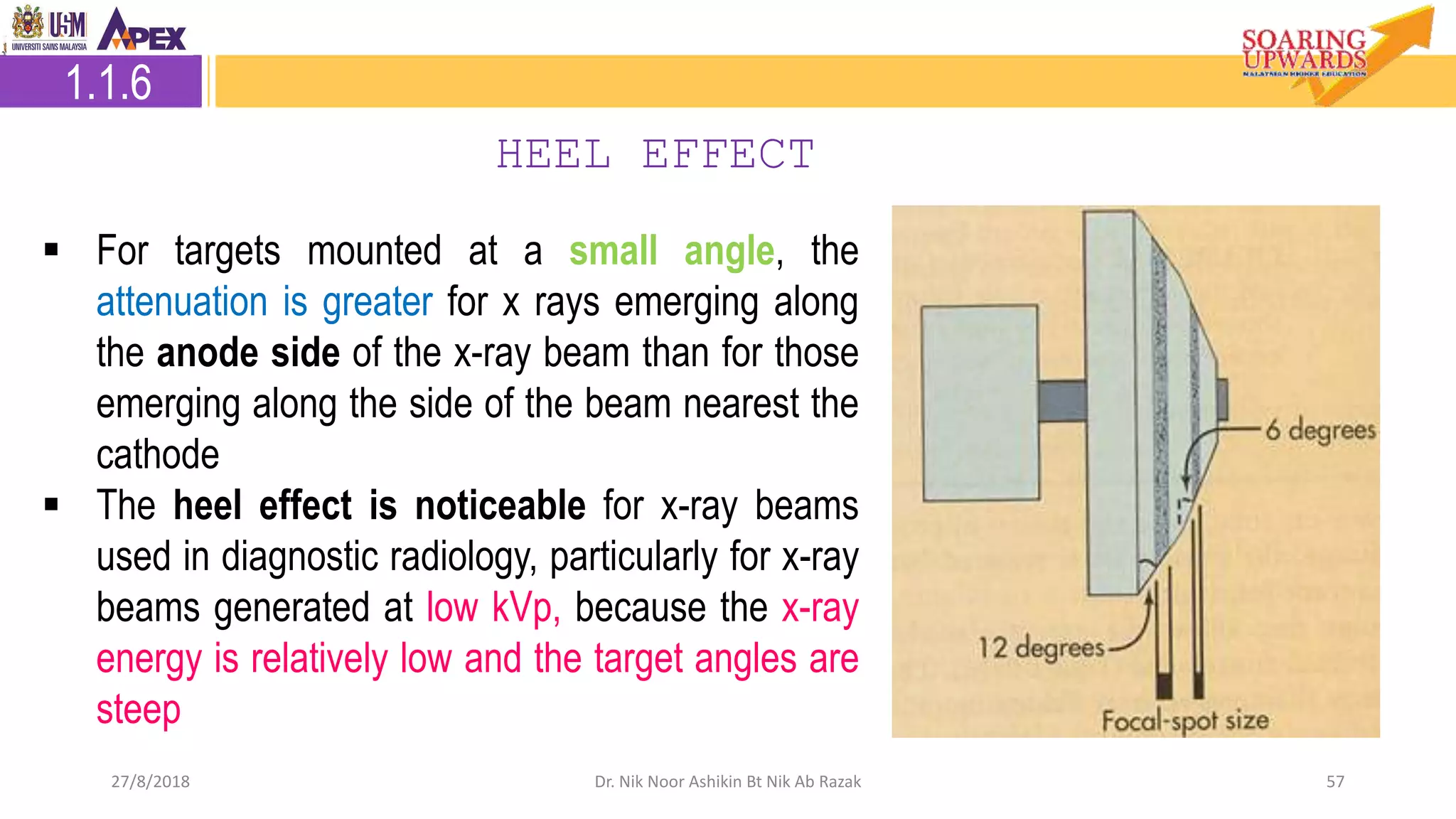
 For targets mounted at a small angle, the
attenuation is greater for x rays emerging along
the anode side of the x-ray beam than for those
emerging along the side of the beam nearest the
cathode
 The heel effect is noticeable for x-ray beams
used in diagnostic radiology, particularly for x-ray
beams generated at low kVp, because the x-ray
energy is relatively low and the target angles are
steep
1.1.6
HEEL EFFECT
Anode Side Cathode Side
Cathode Side Anode Side
2.1.6 Heel Effect
5927/8/2018 Dr. Nik Noor Ashikin Bt Nik Ab Razak
(1) A FILTER may be installed in the tube housing near the exit portal of
the x-ray beam. The thickness of such a filter increases from the
anode to the cathode side of the x-ray beam
(2) Positioning thicker portions of a patient near the cathode side of
the x-ray beam also helps to compensate for the heel effect
1.1.6
HEEL EFFECT: To compensate
1. Used for obtaining balanced densities in radiographs of body parts of
different thickness, i.e. thicker parts towards cathode
2. When FFD is increased, heel effect is reduced.
3. For smaller films, less heel effect.
1.1.6
HEEL EFFECT: CLINICAL IMPORTANCE

X-RAY TUBE (ANODE)

  • 1.
    TOPIC 1 1 Dr. NikNoor Ashikin Nik Ab Razak School of Physics Universiti Sains Malaysia nnashikin@usm.my X-RAY IMAGING SYSTEM Dr. Nik Noor Ashikin Bt Nik Ab Razak X-RAY IMAGING SYSTEM ZME 336 MEDICAL INSTRUMENTATION
  • 2.
    Course outcome 227/8/2018 Dr.Nik Noor Ashikin Bt Nik Ab Razak
  • 3.
    Objective 327/8/2018 Dr. NikNoor Ashikin Bt Nik Ab Razak 1.The students will understand the main components of X-ray tube and their functions 2.Describe the events that occur within the tube that lead to x-ray production 3.Explain the application X-ray in medical instrumentation as radiation source Course outcome
  • 5.
    1.0 X-RAY TUBE 1.1Anode 1.2 Cathode 1.3 Glass Envelope 1.4 Tube Housing 527/8/2018 Dr. Nik Noor Ashikin Bt Nik Ab Razak
  • 6.
    1.0 X-RAY TUBE 627/8/2018Dr. Nik Noor Ashikin Bt Nik Ab Razak
  • 7.
    7 NNANAR Insrument Application Energy LinacRadiotherapy High (4-22 MV) General X-ray General Diagnostic Low (40 – 140 kV) Dental X-ray Dental Low (20 - 40 kV) Mammogram Mammography Low (30 – 40 kV) Fluoroscopy Dynamic Diagnostic Imaging Interventional Radiology
  • 8.
  • 9.
    • Function: Toproduce X-ray radiation Converts input (electrical energy) into an output (X-ray energy and heat) Composed of Cathode & Anode (Each of these is called an electrode), 20-35 cm long and 15 cm in diameter 2.0 X-ray Tube X-ray tube
  • 10.
    1.1 ANODE 1.1.1Target Material 1.1.2Type of Anode 1.1.3 Anode Stem & Bearing 1.1.4 Rotor & Motor system 1.1.5 Focal Spot 1.1.6 Heel Effect 1027/8/2018 Dr. Nik Noor Ashikin Bt Nik Ab Razak
  • 11.
    ANODE 1127/8/2018 Dr. NikNoor Ashikin Bt Nik Ab Razak FUNCTIONS 1. accelerating the electrons 2. houses the target material 3. cool the tube 1.1
  • 12.
    1227/8/2018 Dr. Nik NoorAshikin 2.1 Anode ANODE positively charged electrode electrons from the cathode hit the target area and interact high - density metal target opposing the cathode 1.1
  • 13.
    The block andstem is made of copper The target or an inset of a thin (~ 2-3 mm) tungsten plate Rotor Typical materials are a tungsten-rhenium target on a molybdenum core, backed with graphite. The target is the AREA of the anode struck by the electrons from the cathode.
  • 14.
    1.1.1 Target Material 1427/8/2018Dr. Nik Noor Ashikin Bt Nik Ab Razak
  • 15.
    2.1.1 Target Material 1527/8/2018Dr. Nik Noor Ashikin Bt Nik Ab Razak 1. The atomic number of the target affects both the quantity and quality of x-rays 2. Increasing the target atomic number increases the efficiency of x-ray production and the energy of characteristic and bremsstrahlung x- rays 3. Typical materials are a tungsten-rhenium target on a molybdenum core, backed with graphite 4. The rhenium makes the tungsten more ductile and resistant to wear from impact of the electron beams. The molybdenum conducts heat from the target. The graphite provides thermal storage for the anode, and minimizes the rotating mass of the anode. 1.1.1 ANODE: TARGET MATERIAL
  • 16.
    Anode construction forrotating anode x-ray tube. 1.1.1 ANODE: TARGET MATERIAL
  • 17.
    8/27/2018 17 2.2.1 TargetMaterial NNANAR 2.1.1 Target Material 1.1.1 ANODE: TARGET MATERIAL Why use TUNGSTEN?? 1. High atomic number Z of 74: Intensity of an x-ray beam is proportional to Z 2. Low vapor pressure: so that it does not readily vaporize at its normal working temperature 3. High melting point (3387°C): so that it can withstand the heat generated 4. Good thermal conductivity: enabling a rapid transfer of heat from the small focal area to the anode block by conduction during an x-ray exposure without melting 5. High Density: increases the number of interactions per projectile electron
  • 18.
    1.1.2 Types ofAnode 1827/8/2018 Dr. Nik Noor Ashikin Bt Nik Ab Razak
  • 19.
    X-RAY TUBE 1. StationaryAnode 2. Rotating Anode 8/27/2018 19NNANAR 2.2.11.1.2
  • 20.
    1.1.2.1 Stationary Anode 2027/8/2018Dr. Nik Noor Ashikin Bt Nik Ab Razak
  • 21.
    2.1.2.1 Stationary anode 27/8/2018Dr. Nik Noor Ashikin Bt Nik Ab Razak 21 1. Made of tungsten 2. 2-3 mm thick. 3. Embedded in large mass of copper 4. Consist of one filament 5. Triangular/ rectangular shape 6. Anode angle = 15-200 7. For X ray examinations that require only a low anode current or infrequent low power exposures (e.g. dental units, portable X ray units and portable fluoroscopy systems) 1.1.2.1 TYPES OF ANODE: Stationary anode
  • 22.
    / X Low electricpower Production of X-rays at low or medium intensities Simplicity of design, construction and low cost Anode Crack Narrow Application 2.1.2.1 Stationary anode1.1.2.1 TYPES OF ANODE: Stationary anode
  • 23.
  • 25.
    1.1.2.2 Rotating Anode 2527/8/2018Dr. Nik Noor Ashikin Bt Nik Ab Razak
  • 26.
    1. Rotating TARGET 2.Anode stem 3. Stator of induction coil 4. Rotor of induction coil 5. Ball bearings 6. Safety circuit 2.1.2.2 Rotating Anode1.1.2.2 ROTATING ANODE: COMPONENTS
  • 27.
    The block andstem is made of copper The target or an inset of a thin (~ 2-3 mm) tungsten plate Rotor Typical materials are a tungsten-rhenium target on a molybdenum core, backed with graphite. The target is the AREA of the anode struck by the electrons from the cathode.
  • 29.
    • Made oftungsten or alloy of tungsten with Rhenium. • Has beveled edge • Angle of bevel is 6 to 20 degrees • Speed of rotation is 3000rpm practically • a tungsten disc rotates during an exposure, thus effectively increasing the area bombarded by the electrons • the energy is dissipated to a much larger volume as it is spread over the anode disc 2.1.2.2 Rotating Anode1.1.2.2 ROTATING ANODE: PROPERTIES
  • 30.
    • Production ofX-rays at high intensities • High electric power • Has More Efficient Anode Cooling • High Cost • Higher tube currents and shorter exposure times • Less geometric un-sharpness and movement un-sharpness in the image due to smaller focal spot and shorter exposure timings 2.1.2.2 Rotating Anode1.1.2.2 ROTATING ANODE: ADVANTAGE - DISADVANTAGE
  • 31.
    • Depends onroughing and pitting of surface of anode exposed to electron beam. • Prevented by using alloy of 90% tungsten and 10% rhenium 1.1.2.2 ROTATING ANODE: HALF-LIFE
  • 32.
    Stationary anode • Smallermachines • Target is fixed in block of copper • For low output • mA to 30mA Rotating anode • Large machines • Target rotate in Tungsten disc • For higher output • mA up to 300mA NNANAR 1.1.2.2 ROTATING ANODE: COMPARISON
  • 33.
    1.1.3 Anode Stem& Bearing 3327/8/2018 Dr. Nik Noor Ashikin Bt Nik Ab Razak
  • 34.
    • Made upof molybdenum • It has high melting point but poor conductor of heat - It protects ball bearings from un-desirable heat • The length of the molybdenum should be as short as possible (length inertia load on the bearings) 1.1.3 ANODE STEM: PROPERTIES
  • 35.
    •Increases life ofthe tube. •Lubricant used is silver. •Silver is suitable in vacuum 1.1.3 BEARINGS: PROPERTIES
  • 36.
    1.1.4 Rotor andMotor System 3627/8/2018 Dr. Nik Noor Ashikin Bt Nik Ab Razak
  • 37.
    3727/8/2018 Dr. NikNoor Ashikin Bt Nik Ab Razak The rotating anode is driven by an electromagnetic induction motor, which consists of two principal parts separated from each other by the glass envelope 1. STATOR: Located outside the glass envelope, consists of a series of electromagnets equally spaced around the neck of the tube 2. ROTOR: Inside the glass envelope is a shaft made of bars of copper and soft iron fabricated into one mass 1.1.4 Rotor and Motor System
  • 38.
    • Provides magneticfield necessary for induction of current. • The anode stator motor must accelerate the anode to working speed rapidly ready for an x-ray exposure then must bring it back to stationary equally rapidly to prevent wear and wobble on slowing down • The “motor” consists of electromagnet coils round the glass to provide a rotating magnetic field to induce the currents and produce the forces needed to rotate the copper rotor 1.1.4 MOTOR: FUNCTIONS
  • 39.
    The induction motoris energized for about 1 second before high voltage is applied to the x-ray tube. This delay ensures that electrons do not strike the target before the anode reaches its maximum speed of rotation. 1.1.4 MOTOR: FUNCTIONS
  • 40.
    • The anodedisc needs to be rotate at high speed and this is achieved by attaching the stem to a large copper rotor, which forms the armature of a motor • The magnetic field provided by stator induces current in copper rotor • This current provides power for rotation of anode assembly • The rotor bearing are special as they need to operate in a vacuum, conduct a high voltage and reach high temperatures (500oC). 1.1.4 ROTOR: FUNCTIONS
  • 41.
    • speed ofrotation   ability of anode to withstand heat MODIFICATIONS TO INCREASE SPEED OF ANODE 1. Decrease anode-stem length ( inertia) 2. Use of two sets of ball bearings. 3. Decrease weight of anode ( inertia) - compound anode disc - molybdenum or graphite 1.1.4 Why increased speed of rotation
  • 42.
    1.1.5 Focal Spot 4227/8/2018Dr. Nik Noor Ashikin Bt Nik Ab Razak
  • 43.
    2.1.5 Focal Spot 4327/8/2018Dr. Nik Noor Ashikin Bt Nik Ab Razak Focal spot is the area on the anode, which is bombarded by the electrons and x rays are produced Focal spot size determines amount of x-rays falling on image receptor and resolution of image 1.1.5 FOCAL SPOT : FUNCTIONS
  • 44.
  • 45.
    4527/8/2018 Dr. NikNoor Ashikin Bt Nik Ab Razak 2.1.5 Focal Spot To produce radiographic images with sharp edges, focal spot size should be small “Small focal spot from a small filament Electron emitted from SMALL FILAMENT Electron emitted from LARGE FILAMENT 1.1.5 FOCAL SPOT : FUNCTIONS
  • 46.
    4627/8/2018 Dr. NikNoor Ashikin Bt Nik Ab Razak 2.1.5 Focal Spot But……… Focal spot small, the heating of the target is concentrated in a small area and damages the target area of X-ray production This effect can be decreased by using x-ray exposures of high intensity and short duration. However, these high-intensity exposures may require an electron emission rate that exceeds the capacity of a small filament 1.1.5 FOCAL SPOT : FUNCTIONS
  • 47.
    8/27/2018 Footer Text47  Large actual focal size : more x-ray yield : better heat dissipation : suitable for High Intensity exposure  Small effective focal size: for image sharpness, short exposure Steeper anode angle restricts the field size Heel effect 2.1.5 Focal Spot1.1.5 FOCAL SPOT : Advantages Disadvantages
  • 48.
    1.1.5 FOCAL SPOT :Advantages Disadvantages
  • 49.
    27/8/2018 Dr. NikNoor Ashikin Bt Nik Ab Razak 49 area of the target that interacts with the electron beam TRUE FOCAL SPOT angle of the target surface with respect to the central ray in the x-ray field ANODE ANGLE 1.1.5 FOCAL SPOT : LIne Focus Principle
  • 50.
    FOCAL SPOT :LIne Focus Principle
  • 51.
    Anode angle causesthe effectiveness focal spot length to be smaller than the actual focal spot length This foreshortening of the focal spot length, as viewed down the central ray, is called the lined focus principle CathodeElectrons Apparent Focal spot size 200 Anode (-)(+) FOCAL SPOT : LIne Focus Principle Effective focal length = Actual focal length × sin θ where θ is the anode angle
  • 53.
    53 • the areaof the anode hit by the electrons should be as large as possible, to keep the power density within acceptable limits. For high anode currents…….. • to balance the need for substantial heat dissipation with that of a small focal spot size the line focus principle is used……. • 6° to 22°,depending on their task, with 10–16° used for general purpose tubes Anode angles in diagnostic tubes range…. 27/8/2018 Dr. Nik Noor Ashikin Bt Nik Ab Razak 1.1.5 FOCAL SPOT : LIne Focus Principle
  • 54.
    5427/8/2018 Dr. NikNoor Ashikin Bt Nik Ab Razak ADV ANT AGE S the heat to be spread over an area about 3 times larger than the effective focus •minimising the temperature rise in the target •(requiring a large focal area) •minimising the size of the X-ray source (requiring a small focal area). provides the sharpness of image of a small focal spot 1.1.5 FOCAL SPOT : LIne Focus Principle
  • 55.
    1.1.6 Heel Effect 5527/8/2018Dr. Nik Noor Ashikin Bt Nik Ab Razak
  • 56.
    • Intensity ofx-rays depends on the angle at which the x-rays are emitted from the focal spot. • The intensity of beam towards anode side is less than that towards cathode side. • Intensity of the beam towards the anode side of the tube is less because of absorption of some of the x-ray photons by the target itself. 1.1.6 HEEL EFFECT
  • 57.
    2.1.6 Heel Effect 5727/8/2018Dr. Nik Noor Ashikin Bt Nik Ab Razak  For targets mounted at a small angle, the attenuation is greater for x rays emerging along the anode side of the x-ray beam than for those emerging along the side of the beam nearest the cathode  The heel effect is noticeable for x-ray beams used in diagnostic radiology, particularly for x-ray beams generated at low kVp, because the x-ray energy is relatively low and the target angles are steep 1.1.6 HEEL EFFECT
  • 58.
    Anode Side CathodeSide Cathode Side Anode Side
  • 59.
    2.1.6 Heel Effect 5927/8/2018Dr. Nik Noor Ashikin Bt Nik Ab Razak (1) A FILTER may be installed in the tube housing near the exit portal of the x-ray beam. The thickness of such a filter increases from the anode to the cathode side of the x-ray beam (2) Positioning thicker portions of a patient near the cathode side of the x-ray beam also helps to compensate for the heel effect 1.1.6 HEEL EFFECT: To compensate
  • 61.
    1. Used forobtaining balanced densities in radiographs of body parts of different thickness, i.e. thicker parts towards cathode 2. When FFD is increased, heel effect is reduced. 3. For smaller films, less heel effect. 1.1.6 HEEL EFFECT: CLINICAL IMPORTANCE

Editor's Notes

  • #36 Oil not used as it would vapuorise. Graphite would wear off.