TOPIC 1 : History of
Radiation (PART II)
1.0 History of Radiation
1.1 Radiation Source
1.2 Radiation Types
1.3 Radiation Uses
1.4 Radiation Hazard
1.1 Radiation Source
1.1.1 Natural Radiation
1.1.2 Artificial Radiation
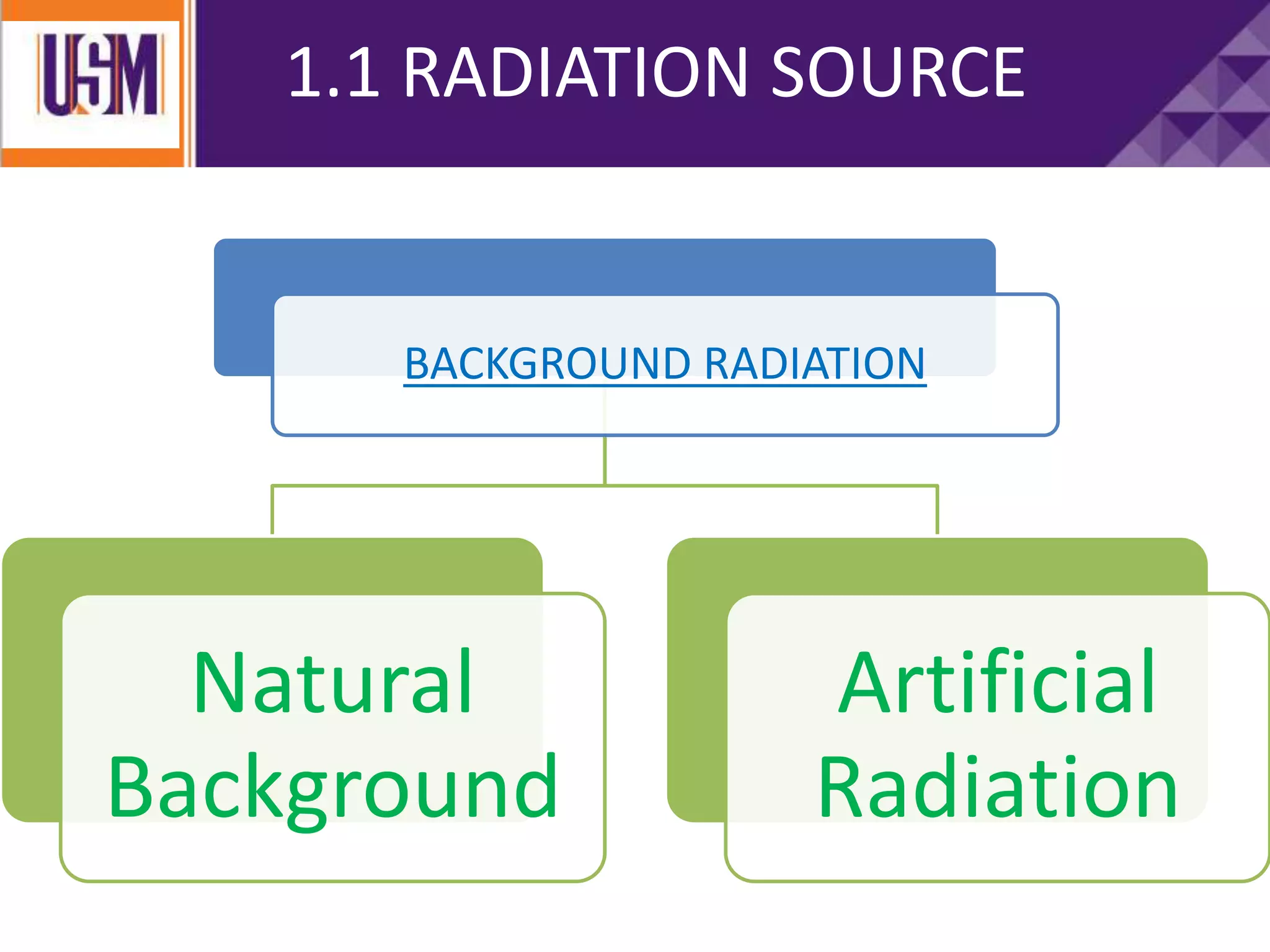
1.1 RADIATION SOURCE
Humans are exposed to radiation all the
time. This radiation is called
background radiation. Most of the
background radiation is from natural
sources (natural background
radiation). A small amount of the
background radiation is from artificial
sources (Artificial background
radiation).
1.1 RADIATION SOURCE
BACKGROUND RADIATION
Natural
Background
Artificial
Radiation
1.1.1 NATURAL RADIATION
1.1.1a Cosmic Ray
1.1.1b Rocks and Soils
1.1.1c Human body/Food
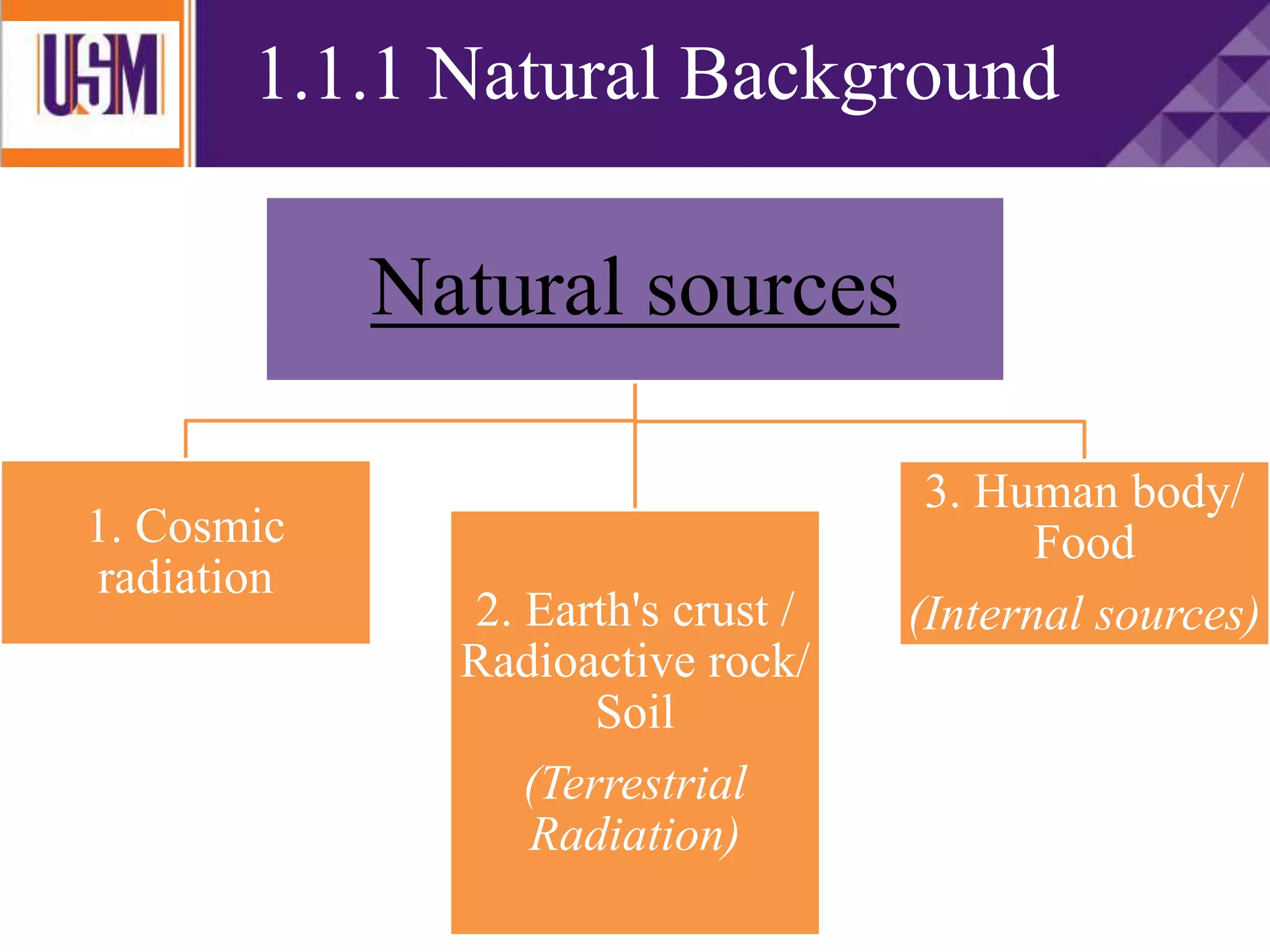
Natural sources
1. Cosmic
radiation
2. Earth's crust /
Radioactive rock/
Soil
(Terrestrial
Radiation)
3. Human body/
Food
(Internal sources)
1.1.1 Natural Background
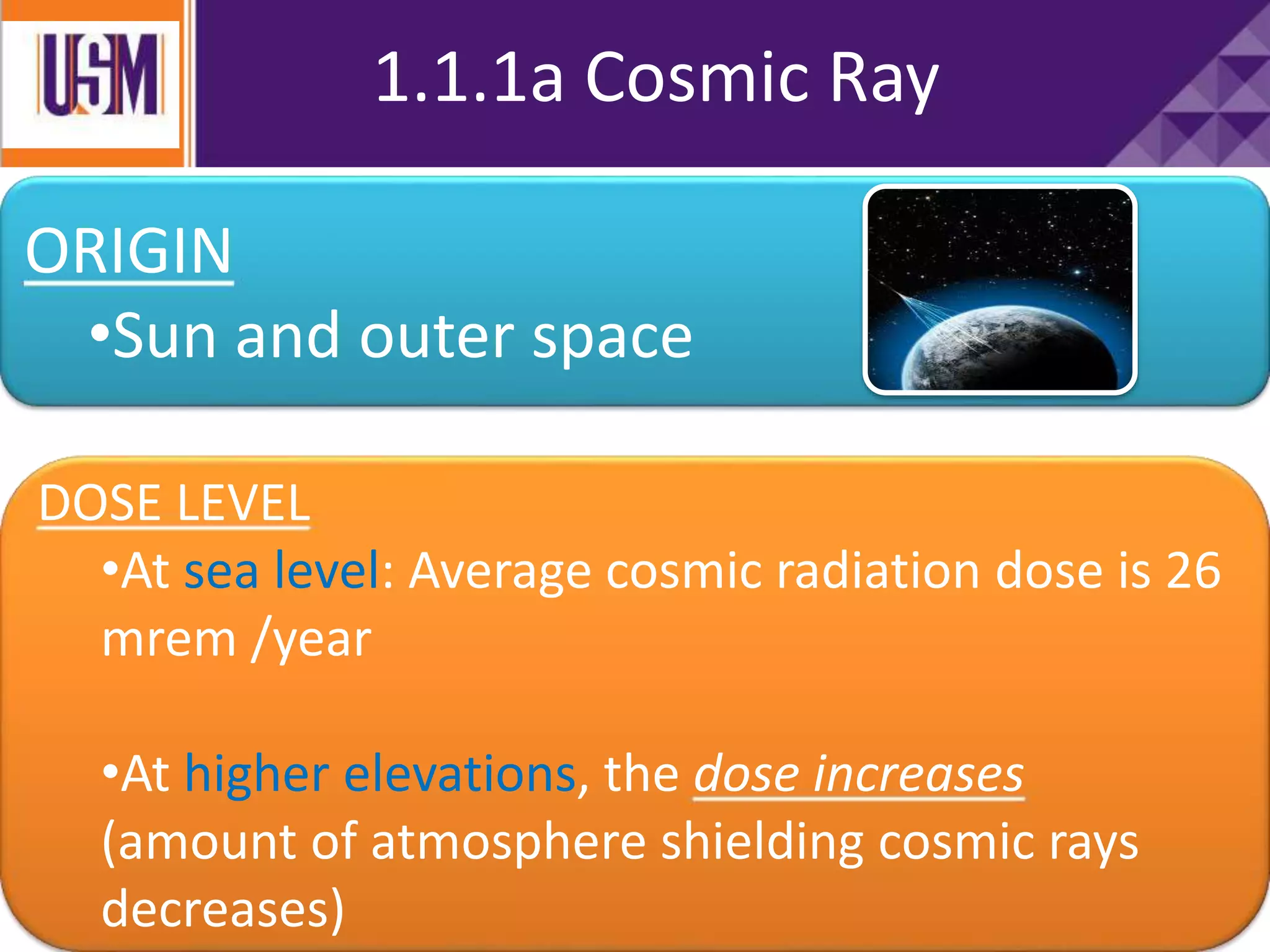
1.1.1a Cosmic Ray
ORIGIN
•Sun and outer space
DOSE LEVEL
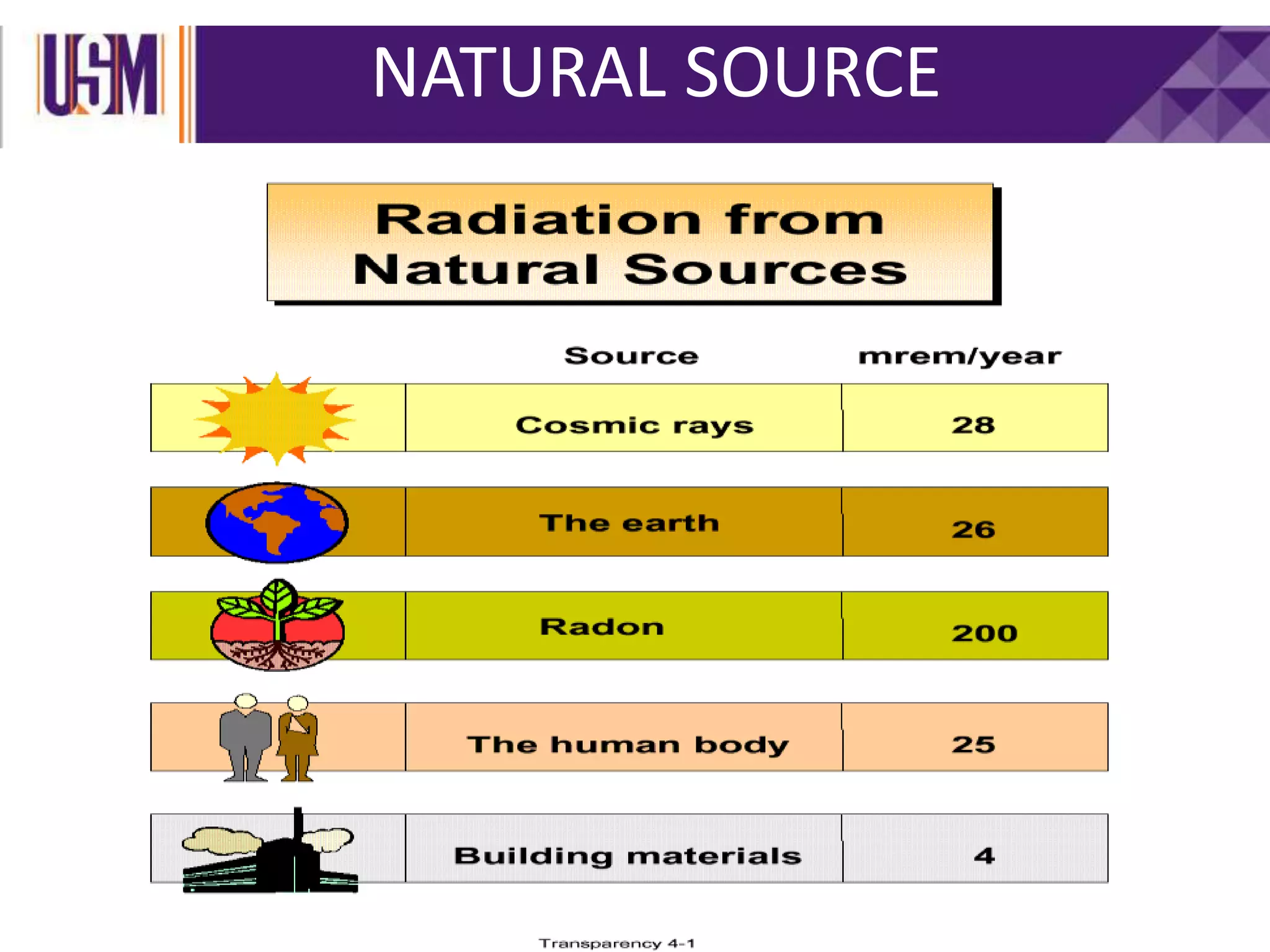
•At sea level: Average cosmic radiation dose is 26
mrem /year
•At higher elevations, the dose increases
(amount of atmosphere shielding cosmic rays
decreases)
Cosmic Ray
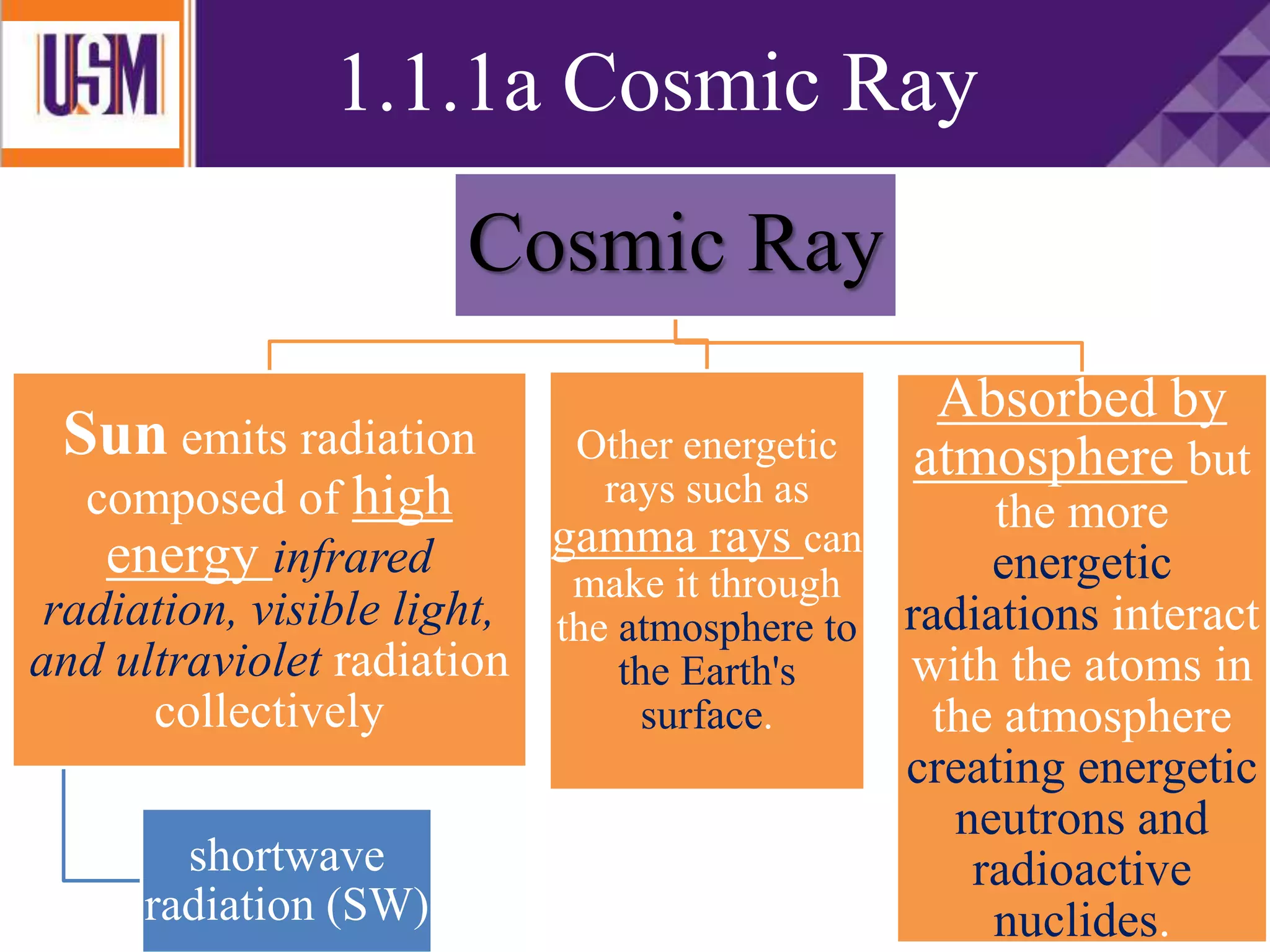
Sun emits radiation
composed of high
energy infrared
radiation, visible light,
and ultraviolet radiation
collectively
shortwave
radiation (SW)
Other energetic
rays such as
gamma rays can
make it through
the atmosphere to
the Earth's
surface.
Absorbed by
atmosphere but
the more
energetic
radiations interact
with the atoms in
the atmosphere
creating energetic
neutrons and
radioactive
nuclides.
1.1.1a Cosmic Ray
1.1.1a Cosmic Ray
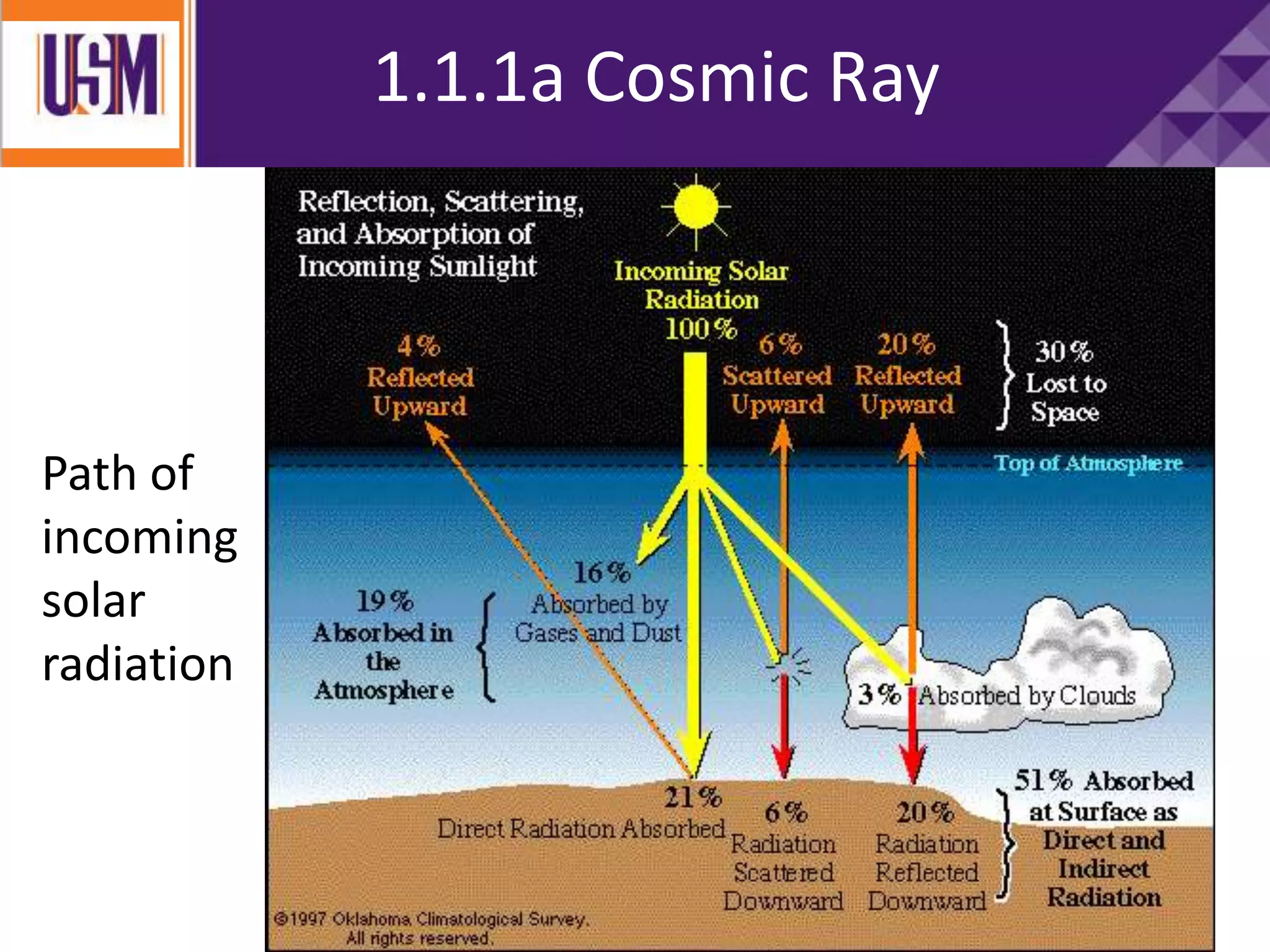
Path of
incoming
solar
radiation
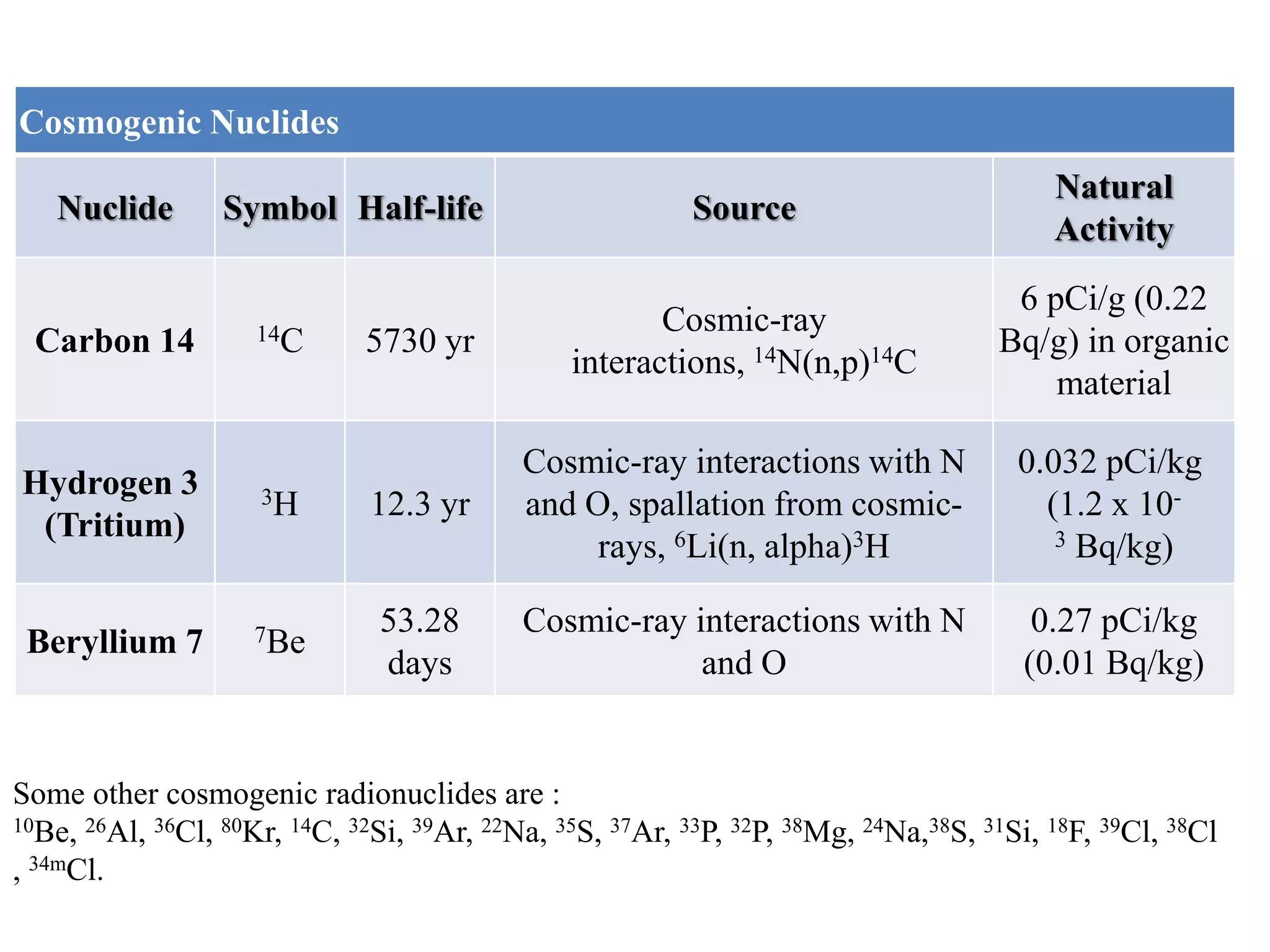
Some other cosmogenic radionuclides are :
10Be, 26Al, 36Cl, 80Kr, 14C, 32Si, 39Ar, 22Na, 35S, 37Ar, 33P, 32P, 38Mg, 24Na,38S, 31Si, 18F, 39Cl, 38Cl
, 34mCl.
Cosmogenic Nuclides
Nuclide Symbol Half-life Source
Natural
Activity
Carbon 14 14C 5730 yr
Cosmic-ray
interactions, 14N(n,p)14C
6 pCi/g (0.22
Bq/g) in organic
material
Hydrogen 3
(Tritium)
3H 12.3 yr
Cosmic-ray interactions with N
and O, spallation from cosmic-
rays, 6Li(n, alpha)3H
0.032 pCi/kg
(1.2 x 10-
3 Bq/kg)
Beryllium 7 7Be
53.28
days
Cosmic-ray interactions with N
and O
0.27 pCi/kg
(0.01 Bq/kg)
1.1.1b - Rocks and soil
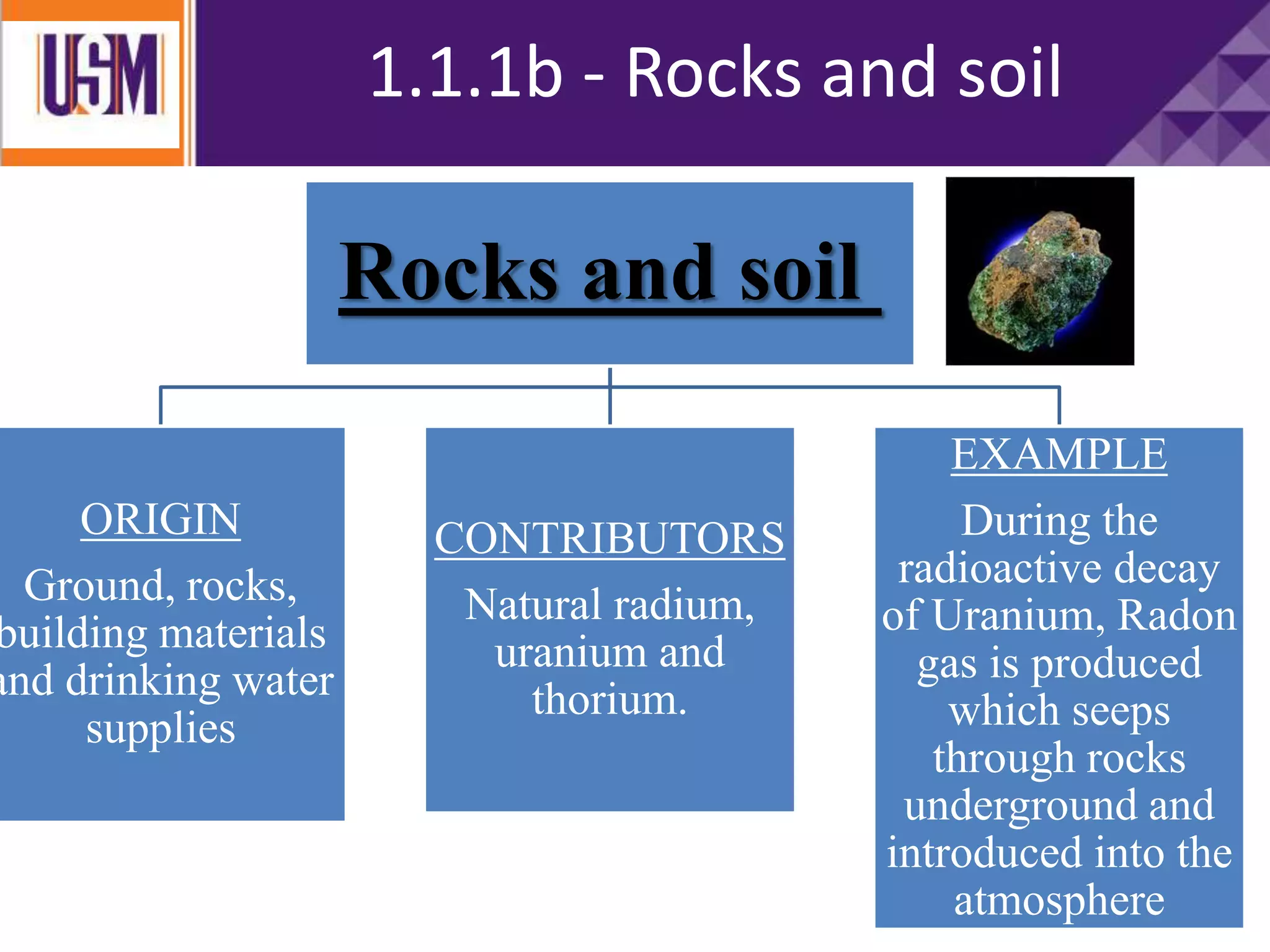
Rocks and soil
ORIGIN
Ground, rocks,
building materials
and drinking water
supplies
CONTRIBUTORS
Natural radium,
uranium and
thorium.
EXAMPLE
During the
radioactive decay
of Uranium, Radon
gas is produced
which seeps
through rocks
underground and
introduced into the
atmosphere
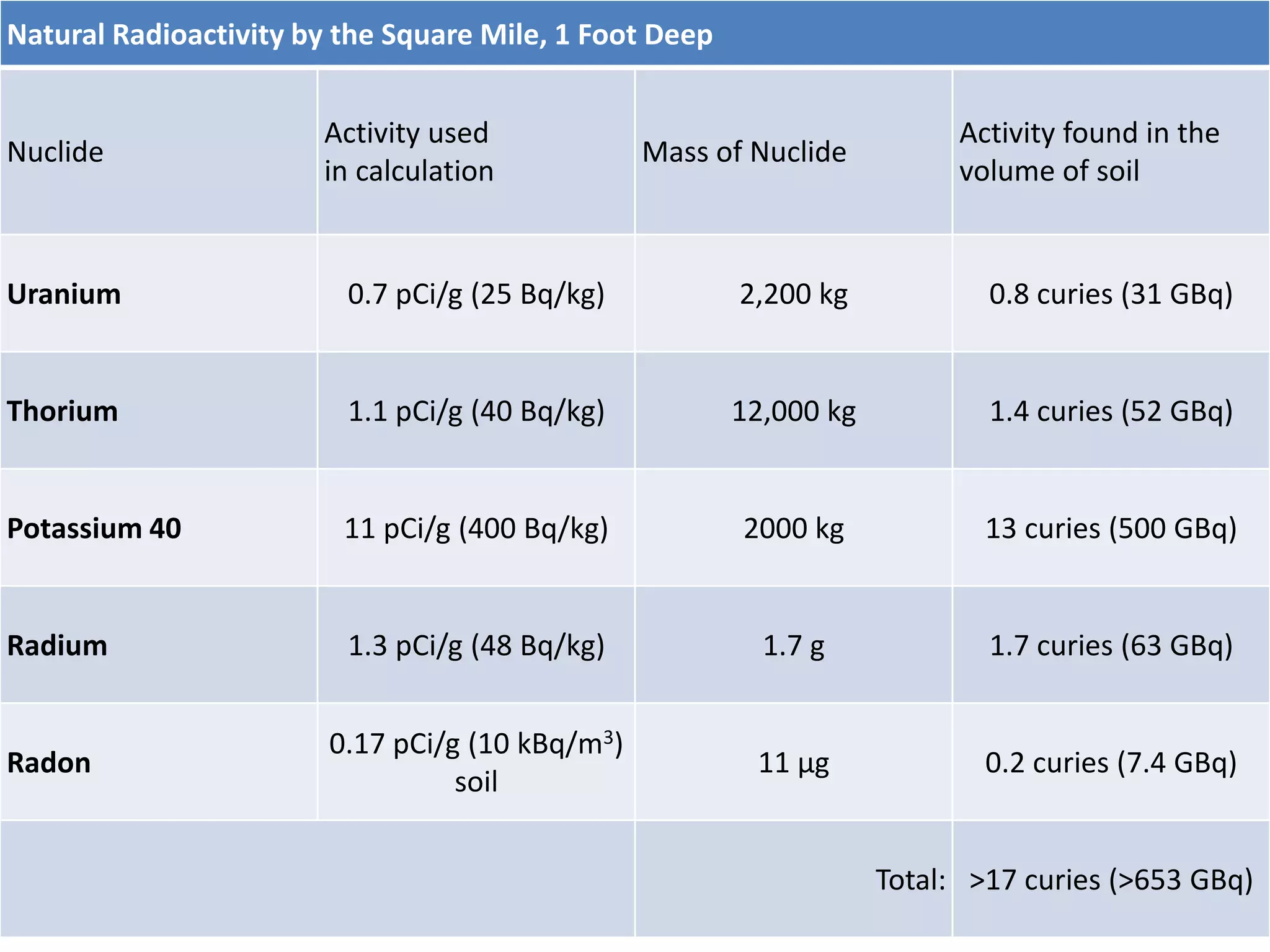
Natural Radioactivity by the Square Mile, 1 Foot Deep
Nuclide
Activity used
in calculation
Mass of Nuclide
Activity found in the
volume of soil
Uranium 0.7 pCi/g (25 Bq/kg) 2,200 kg 0.8 curies (31 GBq)
Thorium 1.1 pCi/g (40 Bq/kg) 12,000 kg 1.4 curies (52 GBq)
Potassium 40 11 pCi/g (400 Bq/kg) 2000 kg 13 curies (500 GBq)
Radium 1.3 pCi/g (48 Bq/kg) 1.7 g 1.7 curies (63 GBq)
Radon
0.17 pCi/g (10 kBq/m3)
soil
11 µg 0.2 curies (7.4 GBq)
Total: >17 curies (>653 GBq)
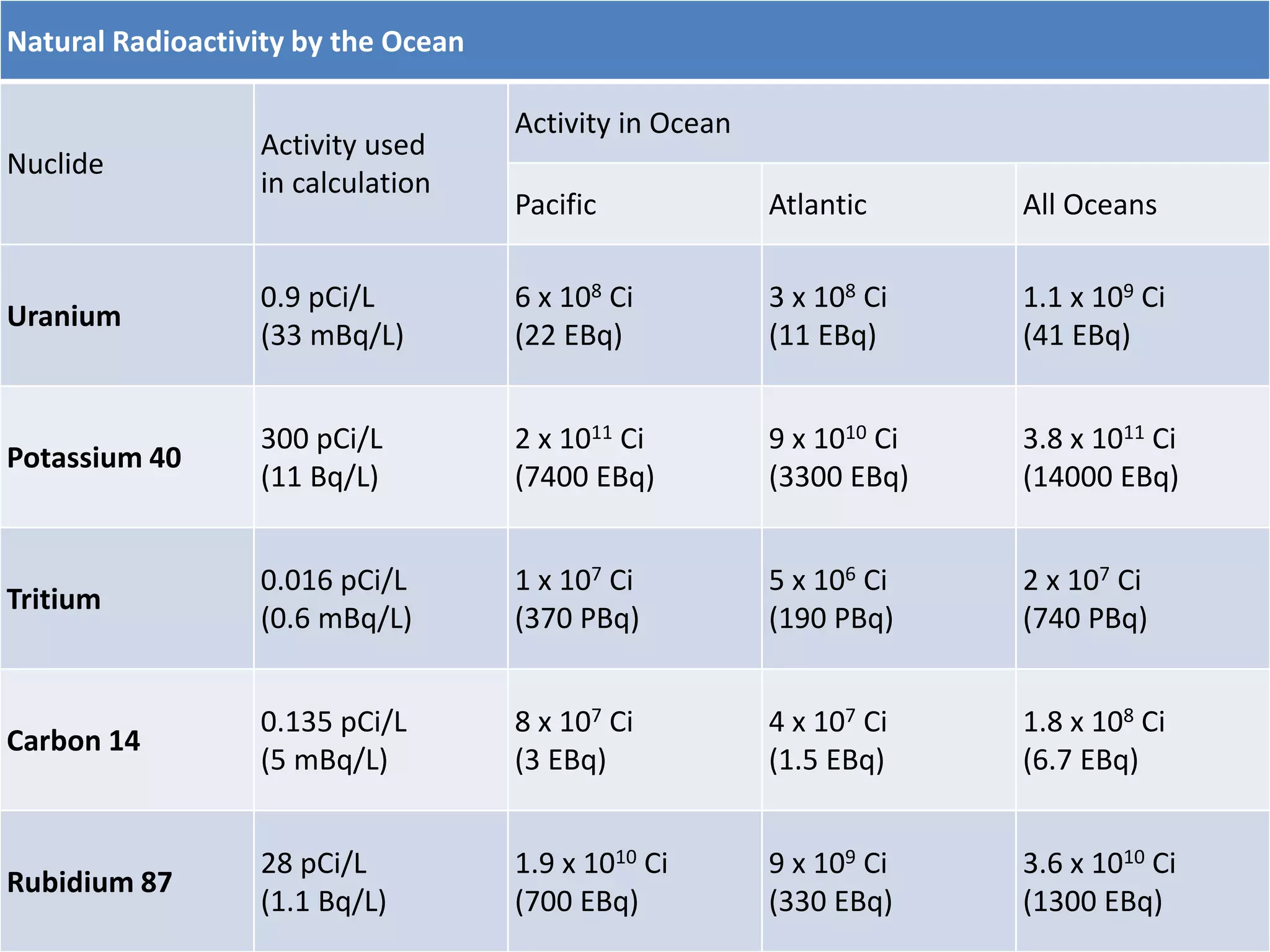
Natural Radioactivity by the Ocean
Nuclide
Activity used
in calculation
Activity in Ocean
Pacific Atlantic All Oceans
Uranium
0.9 pCi/L
(33 mBq/L)
6 x 10⁸ Ci
(22 EBq)
3 x 10⁸ Ci
(11 EBq)
1.1 x 10⁹ Ci
(41 EBq)
Potassium 40
300 pCi/L
(11 Bq/L)
2 x 10¹¹ Ci
(7400 EBq)
9 x 10¹⁰ Ci
(3300 EBq)
3.8 x 10¹¹ Ci
(14000 EBq)
Tritium
0.016 pCi/L
(0.6 mBq/L)
1 x 10⁷ Ci
(370 PBq)
5 x 10⁶ Ci
(190 PBq)
2 x 10⁷ Ci
(740 PBq)
Carbon 14
0.135 pCi/L
(5 mBq/L)
8 x 10⁷ Ci
(3 EBq)
4 x 10⁷ Ci
(1.5 EBq)
1.8 x 10⁸ Ci
(6.7 EBq)
Rubidium 87
28 pCi/L
(1.1 Bq/L)
1.9 x 10¹⁰ Ci
(700 EBq)
9 x 10⁹ Ci
(330 EBq)
3.6 x 10¹⁰ Ci
(1300 EBq)
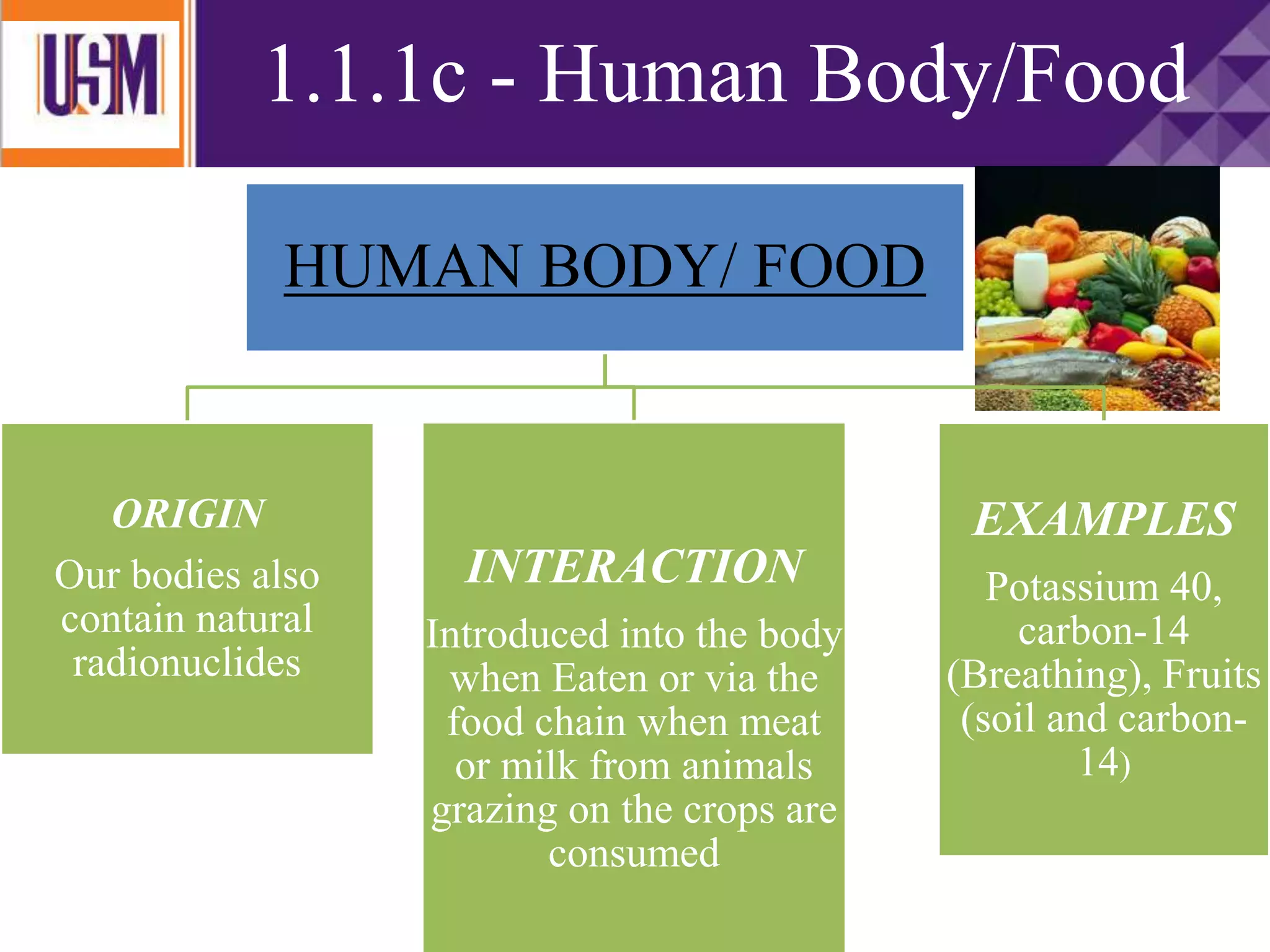
1.1.1c - Human Body/Food
HUMAN BODY/ FOOD
ORIGIN
Our bodies also
contain natural
radionuclides
INTERACTION
Introduced into the body
when Eaten or via the
food chain when meat
or milk from animals
grazing on the crops are
consumed
EXAMPLES
Potassium 40,
carbon-14
(Breathing), Fruits
(soil and carbon-
14)
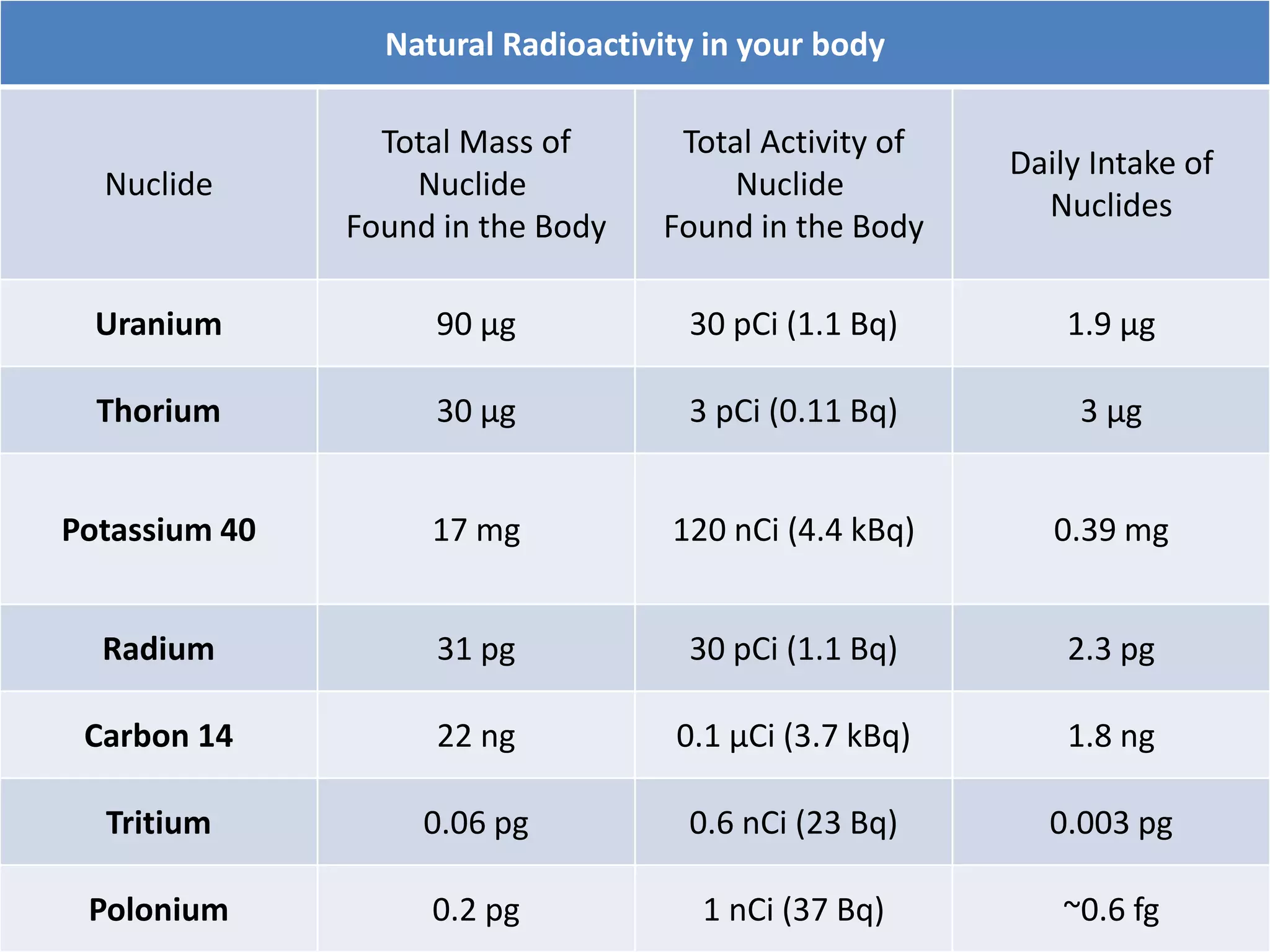
Natural Radioactivity in your body
Nuclide
Total Mass of
Nuclide
Found in the Body
Total Activity of
Nuclide
Found in the Body
Daily Intake of
Nuclides
Uranium 90 µg 30 pCi (1.1 Bq) 1.9 µg
Thorium 30 µg 3 pCi (0.11 Bq) 3 µg
Potassium 40 17 mg 120 nCi (4.4 kBq) 0.39 mg
Radium 31 pg 30 pCi (1.1 Bq) 2.3 pg
Carbon 14 22 ng 0.1 µCi (3.7 kBq) 1.8 ng
Tritium 0.06 pg 0.6 nCi (23 Bq) 0.003 pg
Polonium 0.2 pg 1 nCi (37 Bq) ~0.6 fg
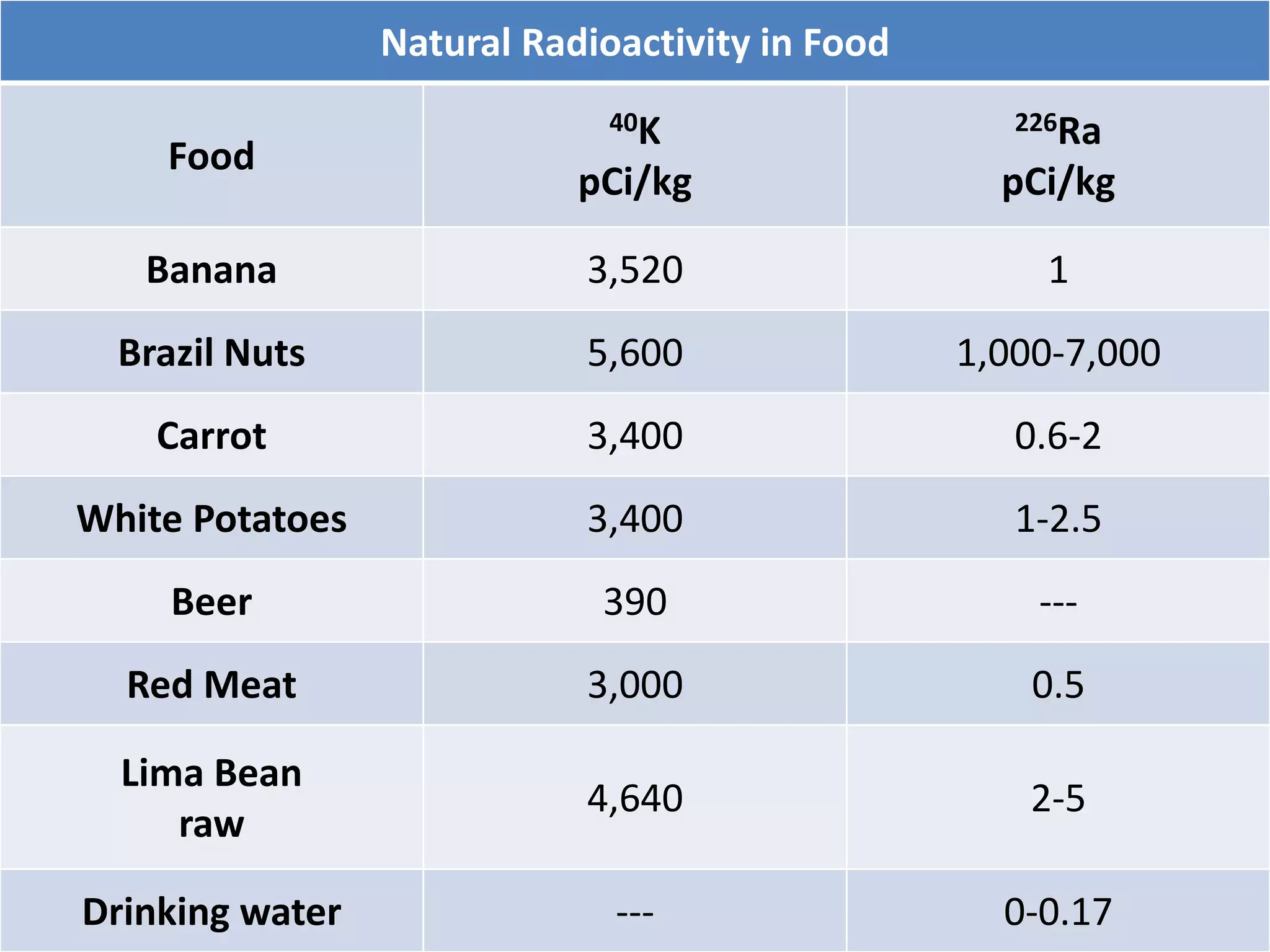
Natural Radioactivity in Food
Food
40K
pCi/kg
226Ra
pCi/kg
Banana 3,520 1
Brazil Nuts 5,600 1,000-7,000
Carrot 3,400 0.6-2
White Potatoes 3,400 1-2.5
Beer 390 ---
Red Meat 3,000 0.5
Lima Bean
raw
4,640 2-5
Drinking water --- 0-0.17
1.1.2 ARTIFICIAL SOURCE
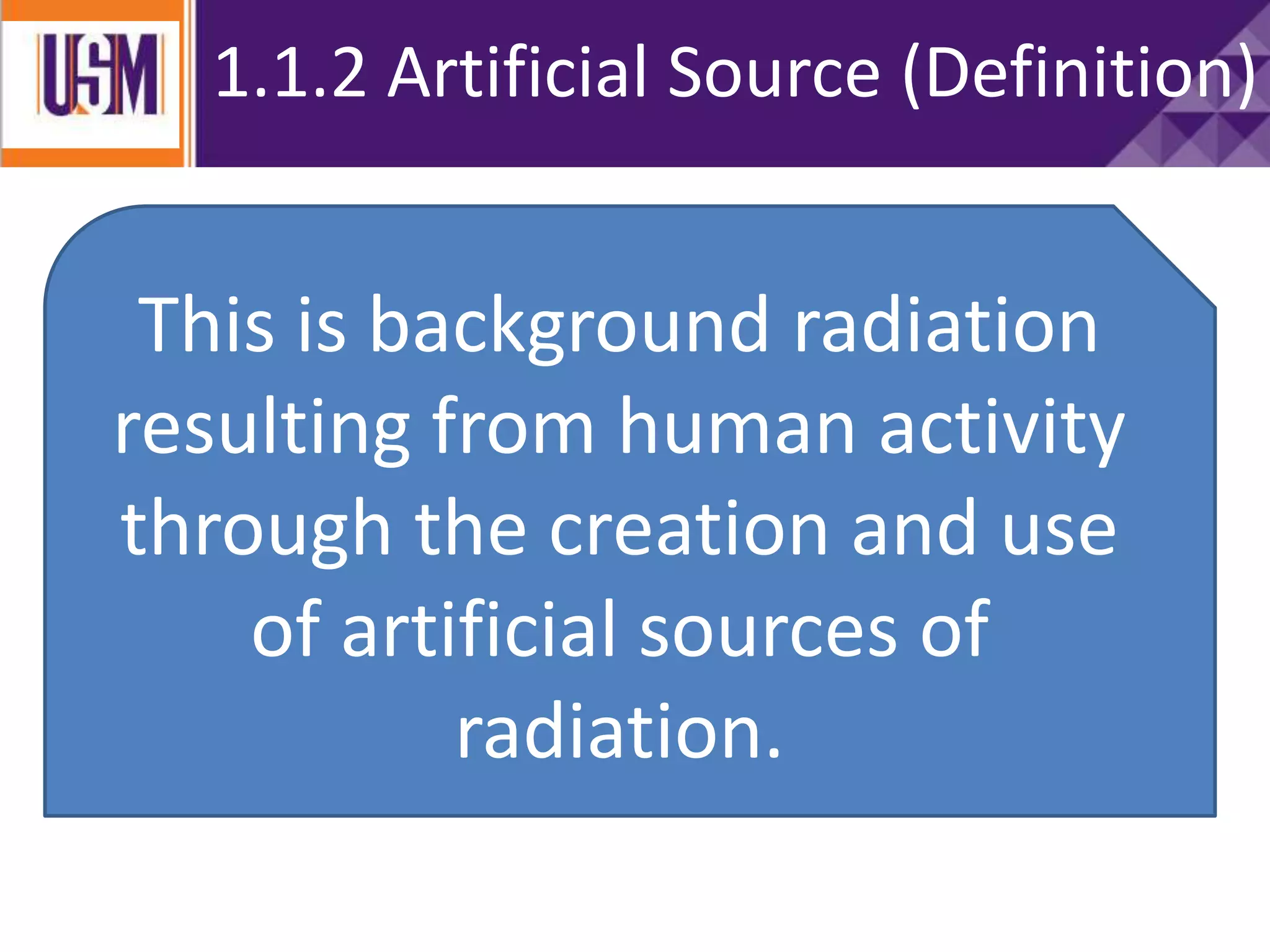
1.1.2 Artificial Source (Definition)
This is background radiation
resulting from human activity
through the creation and use
of artificial sources of
radiation.
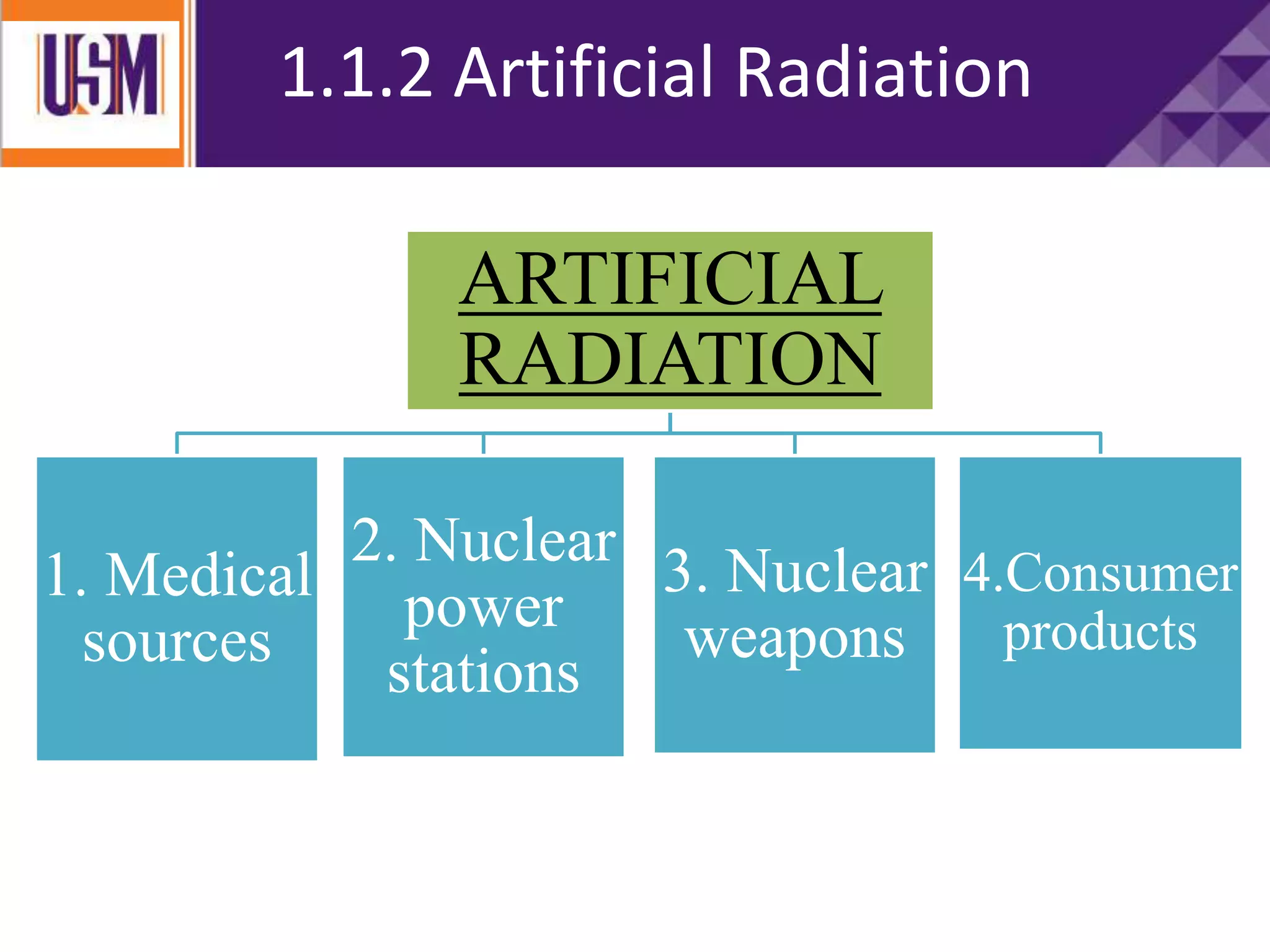
ARTIFICIAL
RADIATION
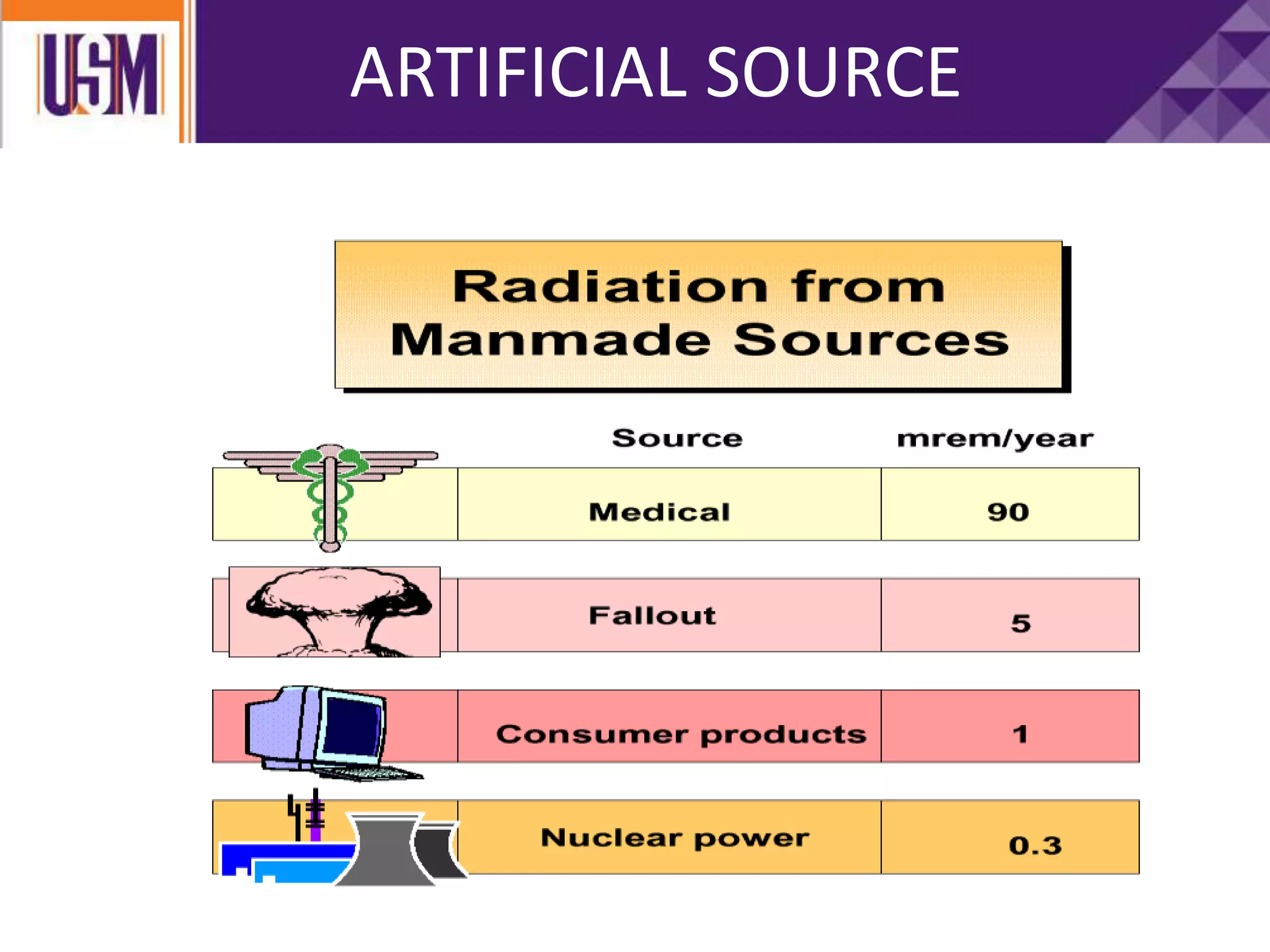
1. Medical
sources
2. Nuclear
power
stations
3. Nuclear
weapons
4.Consumer
products
1.1.2 Artificial Radiation
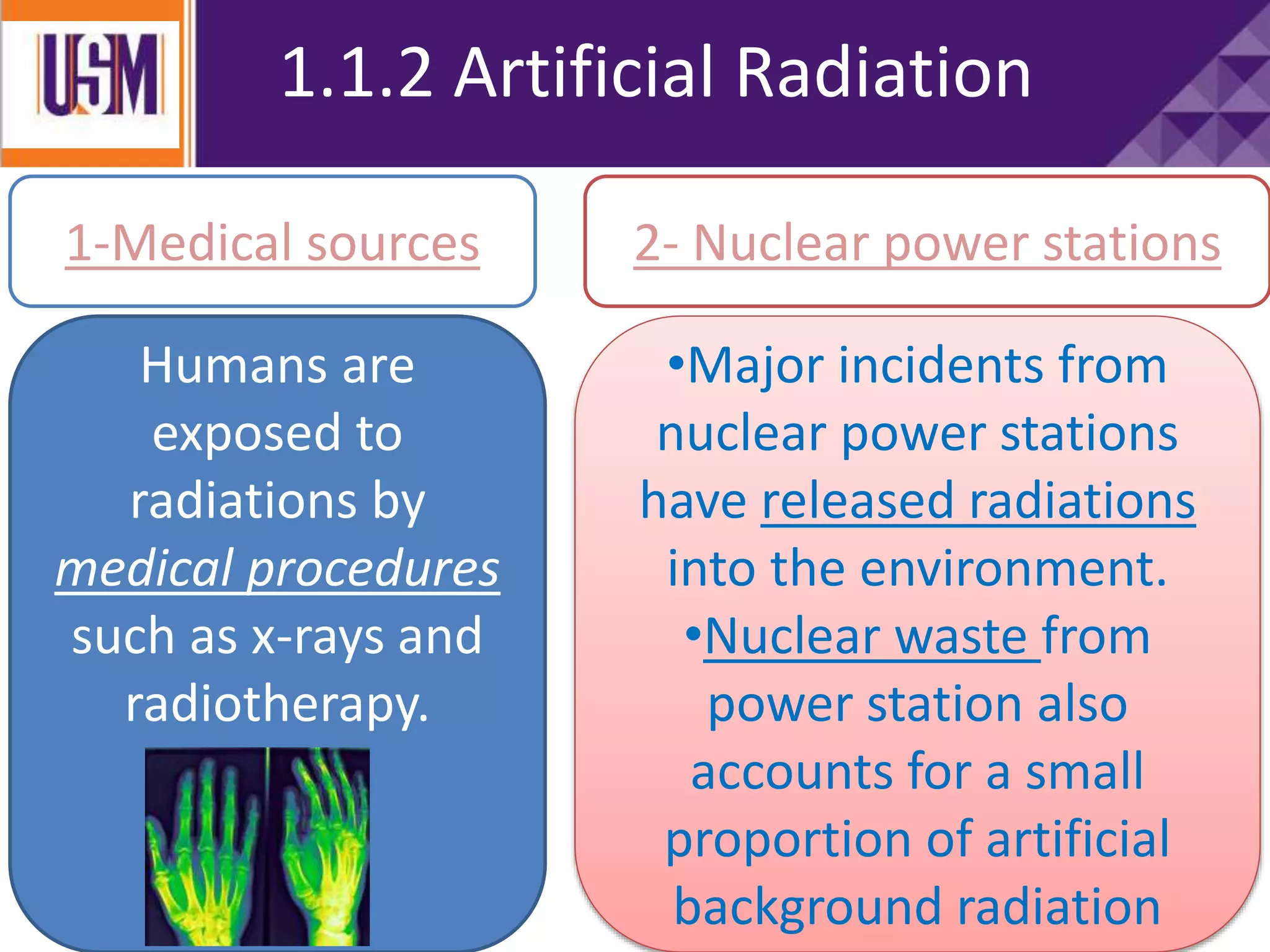
Humans are
exposed to
radiations by
medical procedures
such as x-rays and
radiotherapy.
1-Medical sources 2- Nuclear power stations
•Major incidents from
nuclear power stations
have released radiations
into the environment.
•Nuclear waste from
power station also
accounts for a small
proportion of artificial
background radiation
1.1.2 Artificial Radiation
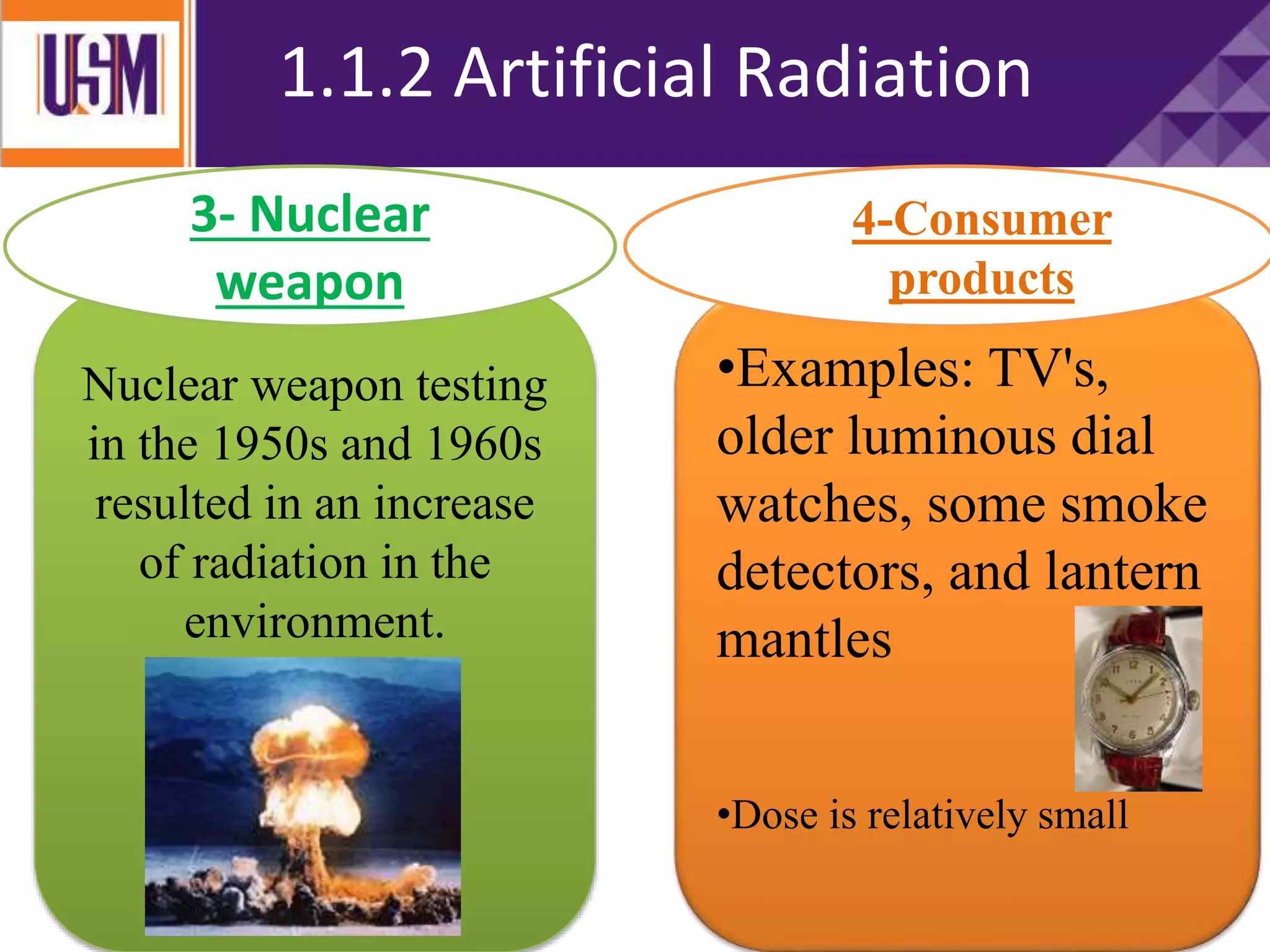
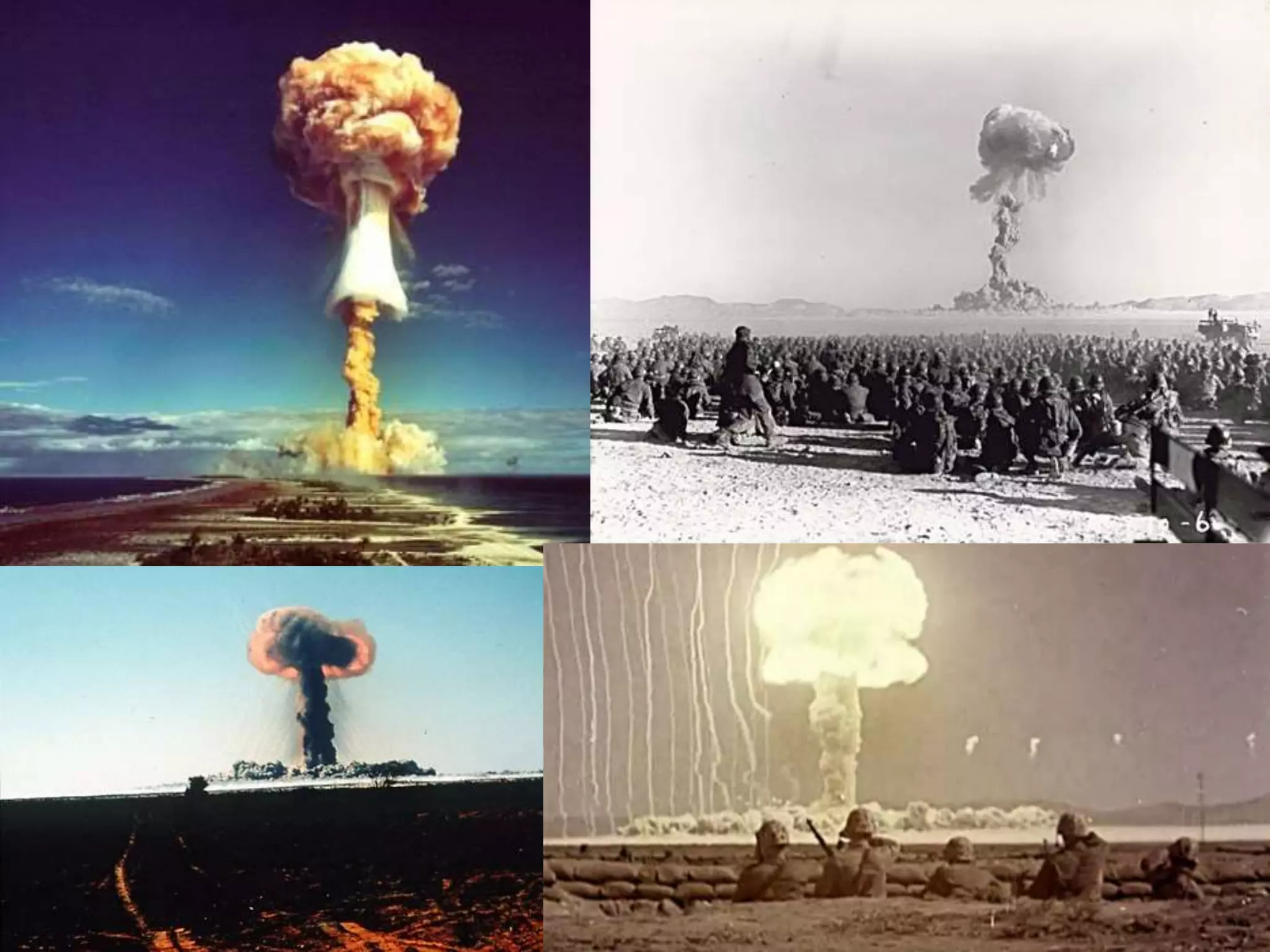
Nuclear weapon testing
in the 1950s and 1960s
resulted in an increase
of radiation in the
environment.
•Examples: TV's,
older luminous dial
watches, some smoke
detectors, and lantern
mantles
•Dose is relatively small
3- Nuclear
weapon
4-Consumer
products
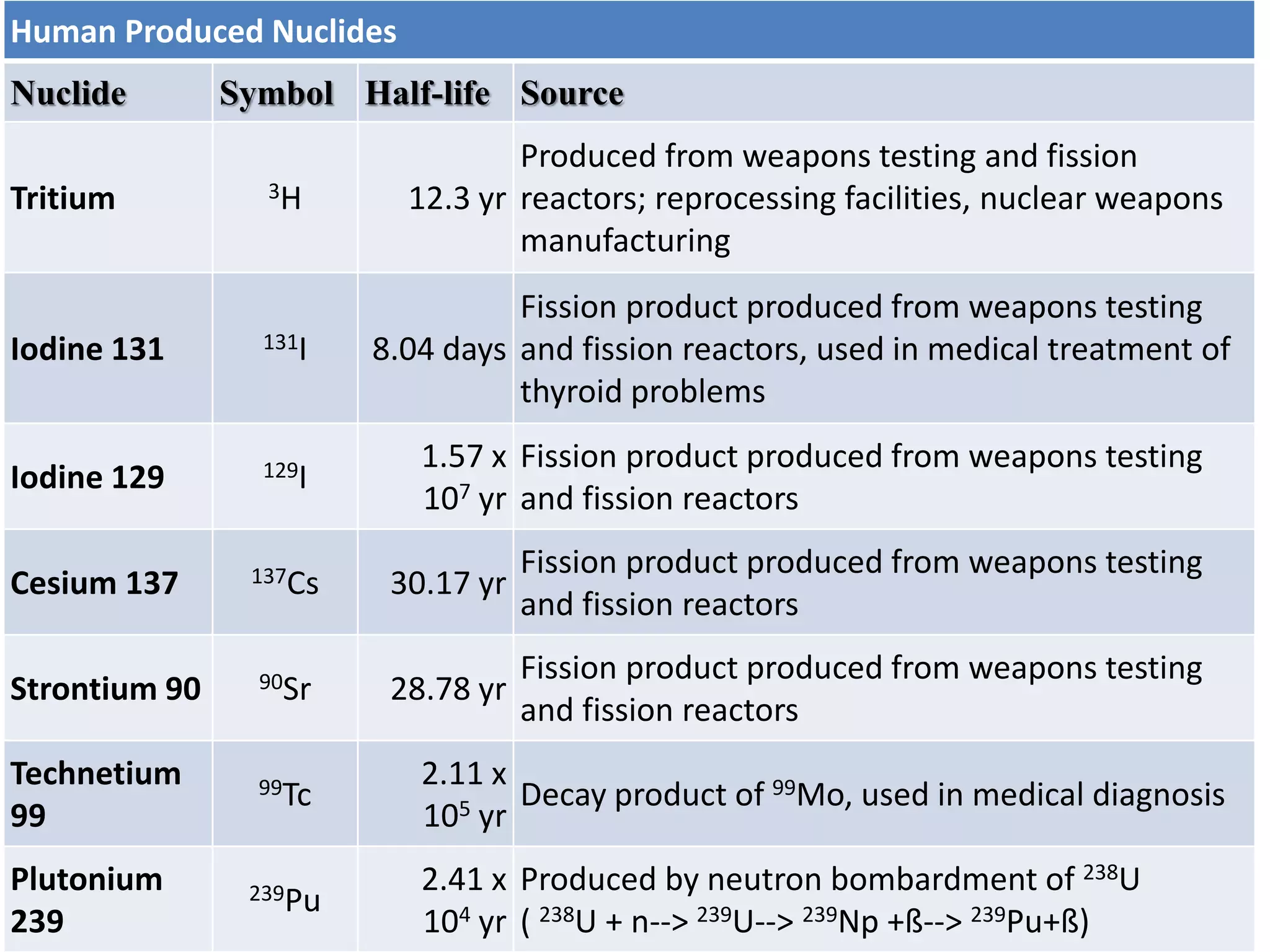
Human Produced Nuclides
Nuclide Symbol Half-life Source
Tritium 3H 12.3 yr
Produced from weapons testing and fission
reactors; reprocessing facilities, nuclear weapons
manufacturing
Iodine 131 131I 8.04 days
Fission product produced from weapons testing
and fission reactors, used in medical treatment of
thyroid problems
Iodine 129 129I
1.57 x
107 yr
Fission product produced from weapons testing
and fission reactors
Cesium 137 137Cs 30.17 yr
Fission product produced from weapons testing
and fission reactors
Strontium 90 90Sr 28.78 yr
Fission product produced from weapons testing
and fission reactors
Technetium
99
99Tc
2.11 x
105 yr
Decay product of 99Mo, used in medical diagnosis
Plutonium
239
239Pu
2.41 x
104 yr
Produced by neutron bombardment of 238U
( 238U + n--> 239U--> 239Np +ß--> 239Pu+ß)
SUMMARY
•As a whole, these sources of natural and human-made
radiation are referred to as background radiation.
•The pie chart below shows the average contribution from
the various sources to background radiation.
NATURAL SOURCE
ARTIFICIAL SOURCE
VIDEO 1
VIDEO 2
1.2 RADIATION TYPES
1.2.1 Ionizing Radiation
1.2.2 Non-ionizing Radiation
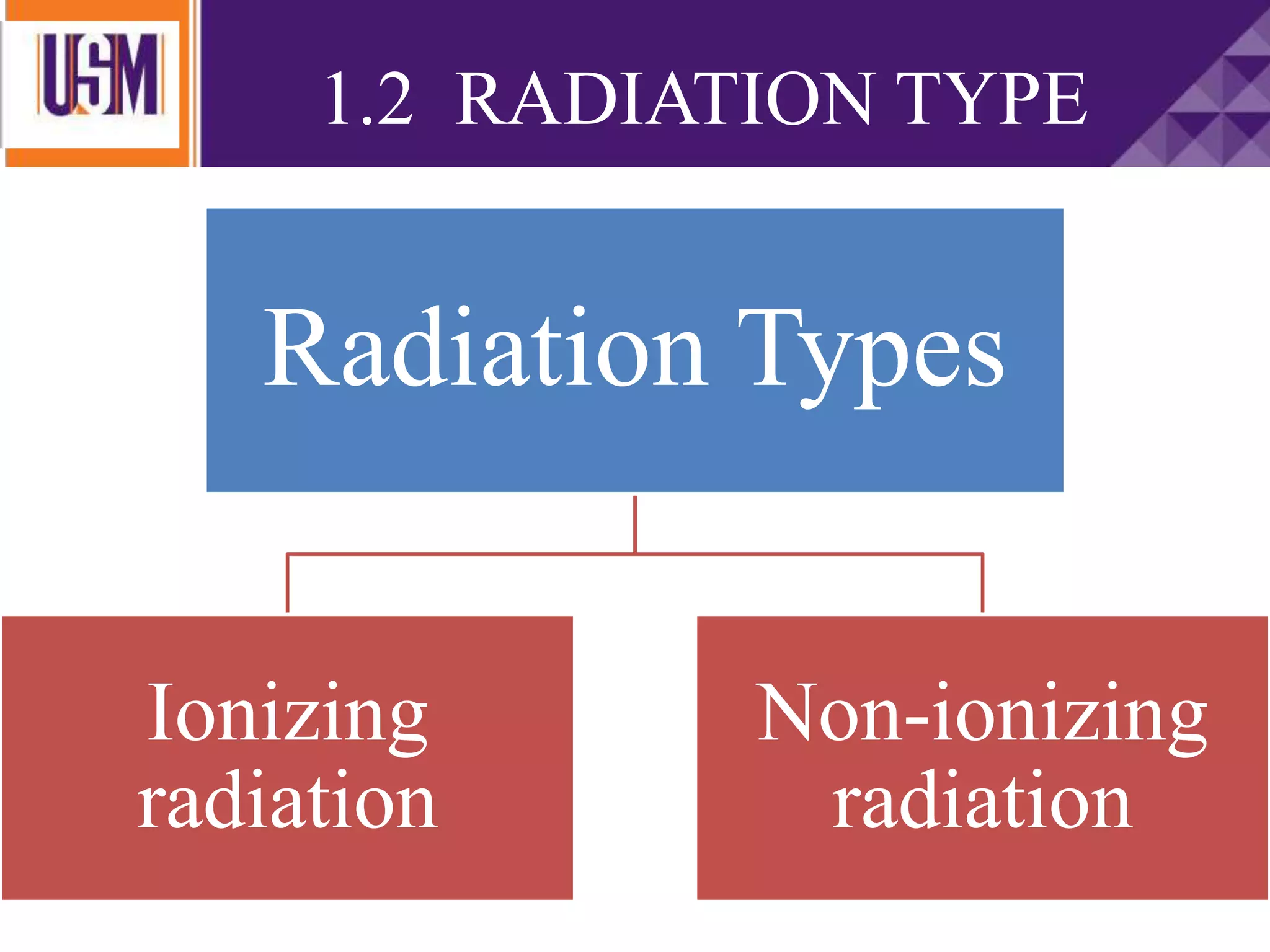
Radiation Types
Ionizing
radiation
Non-ionizing
radiation
1.2 RADIATION TYPE
Ionizing radiation is produced by unstable atoms.
Unstable atoms differ from stable atoms because they have
an excess of energy or mass or both.
Unstable atoms are said to be radioactive. In order to reach
stability, these atoms give off, or emit, the excess energy or
mass. These emissions are called radiation.
Radioactive decay is the spontaneous decay of atoms by
emitting alpha, beta or gamma particles.
New elements are always formed during alpha and beta
decay
Extra Notes….
Ionization & Radioactive decay
1.2.1 Ionizing Radiation
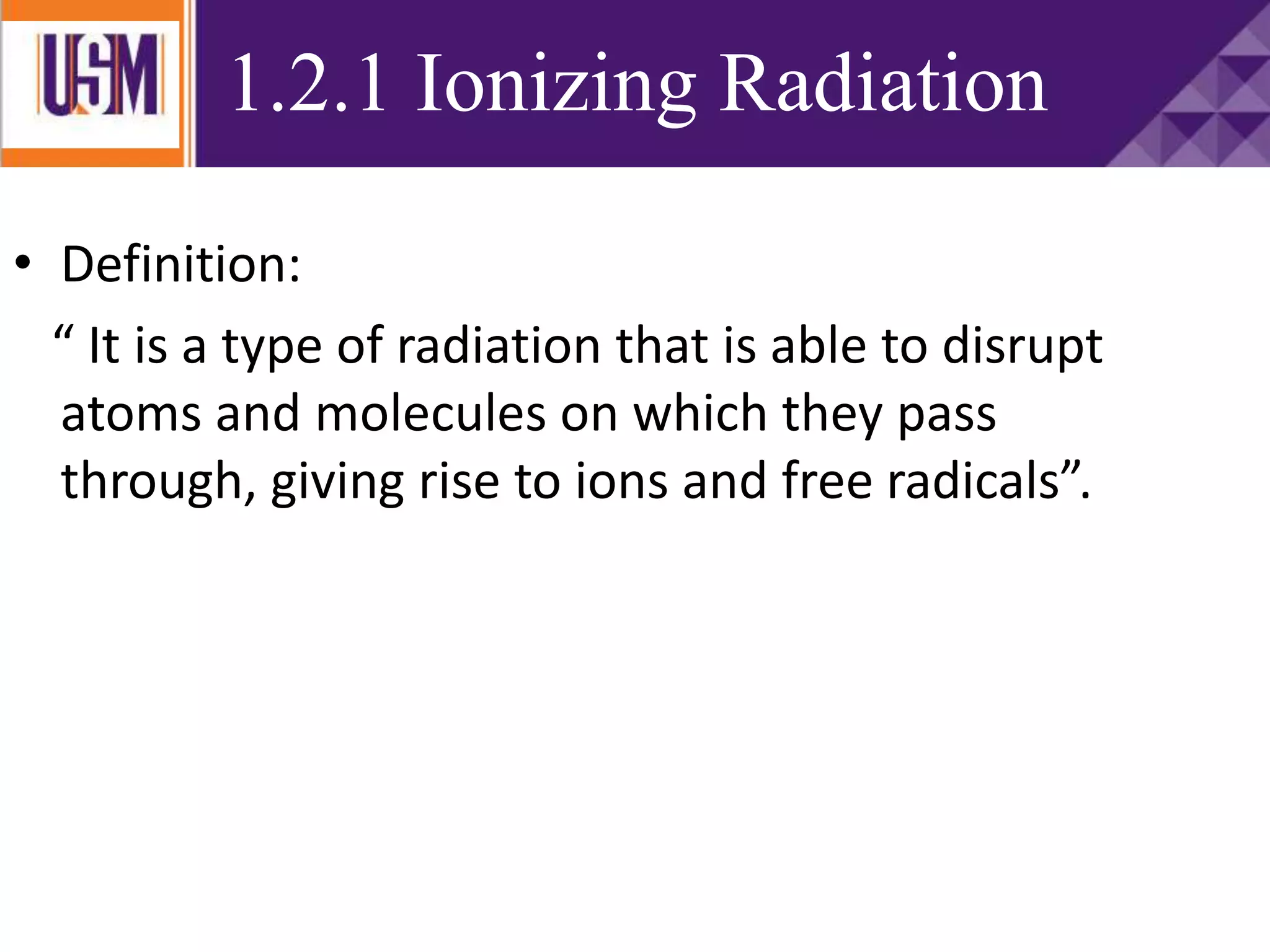
• Definition:
“ It is a type of radiation that is able to disrupt
atoms and molecules on which they pass
through, giving rise to ions and free radicals”.
Ionizing Radiation
Higher energy
electromagnetic
waves (x-ray, gamma)
or
heavy particles (beta
and alpha)
Enough energy to pull
electron from orbit
1.2.1 Ionizing Radiation
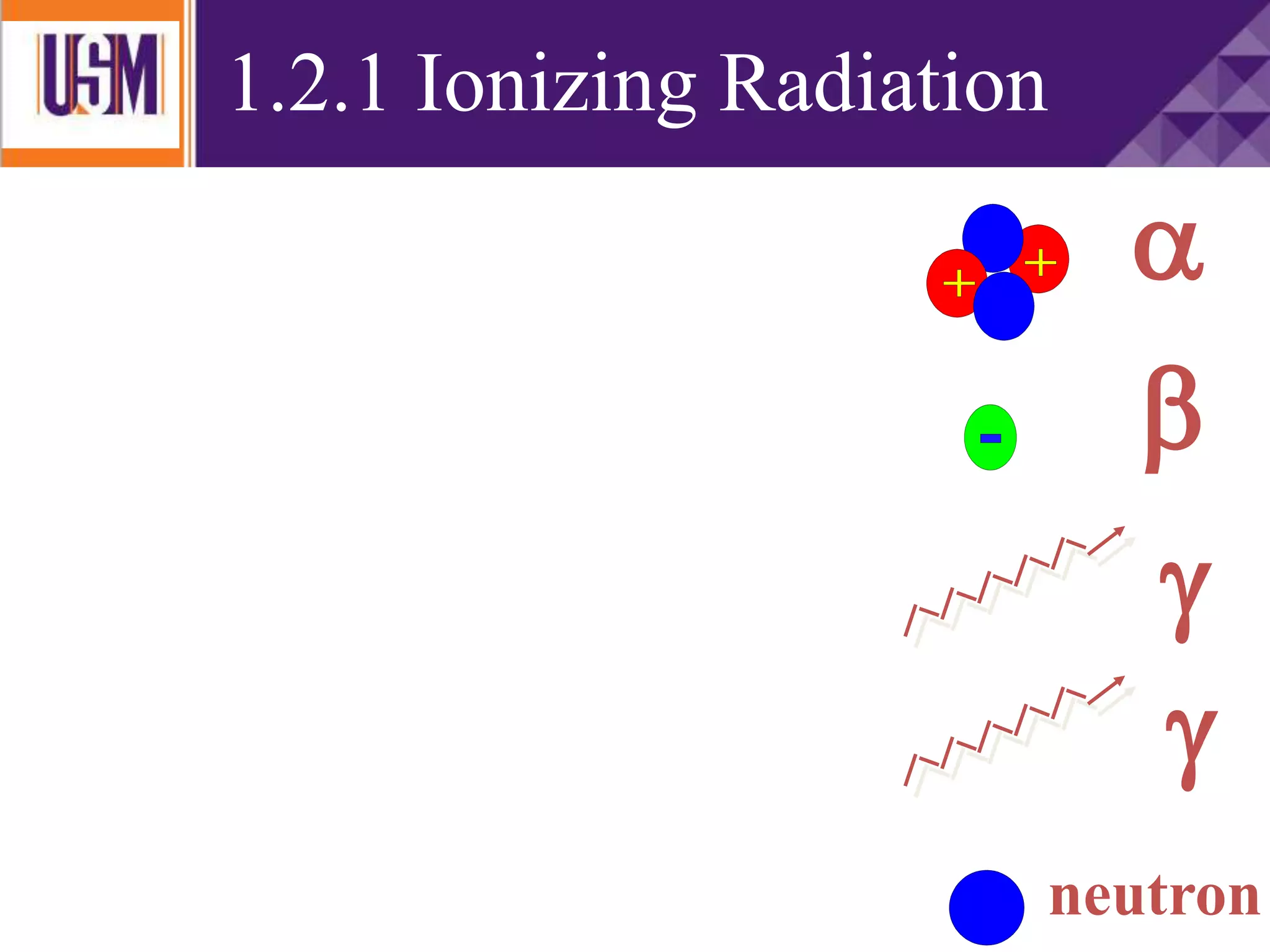



neutron

1.2.1 Ionizing Radiation
Photon
X-rays
emitted from
electron orbits
(KeV's)
Gamma
rays
from nucleus(often as
part of radioactive decay)
(Mev's)
PHOTON
1.2.1 Ionizing Radiation
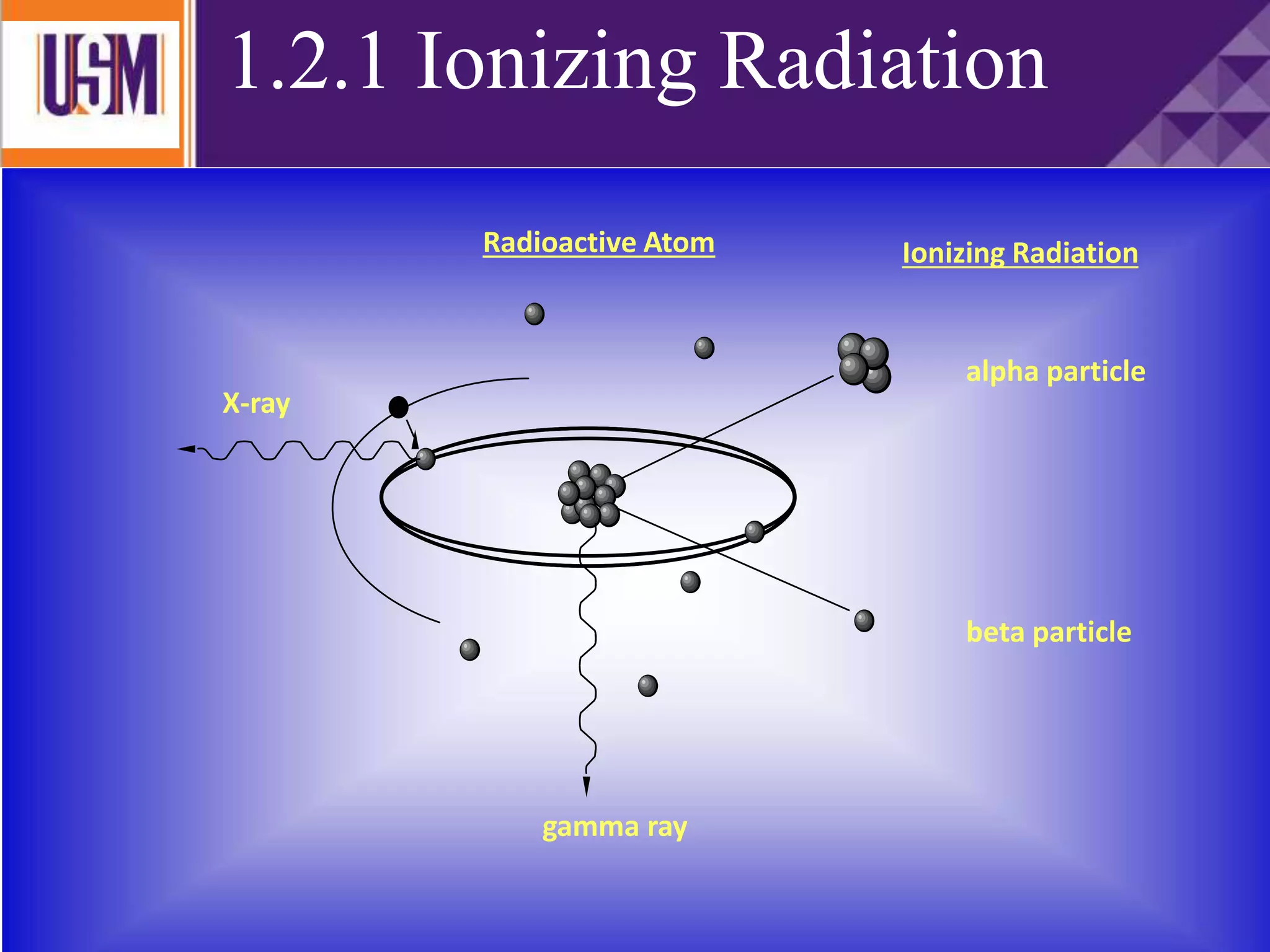
Ionizing Radiation
alpha particle
beta particle
Radioactive Atom
X-ray
gamma ray
1.2.1 Ionizing Radiation
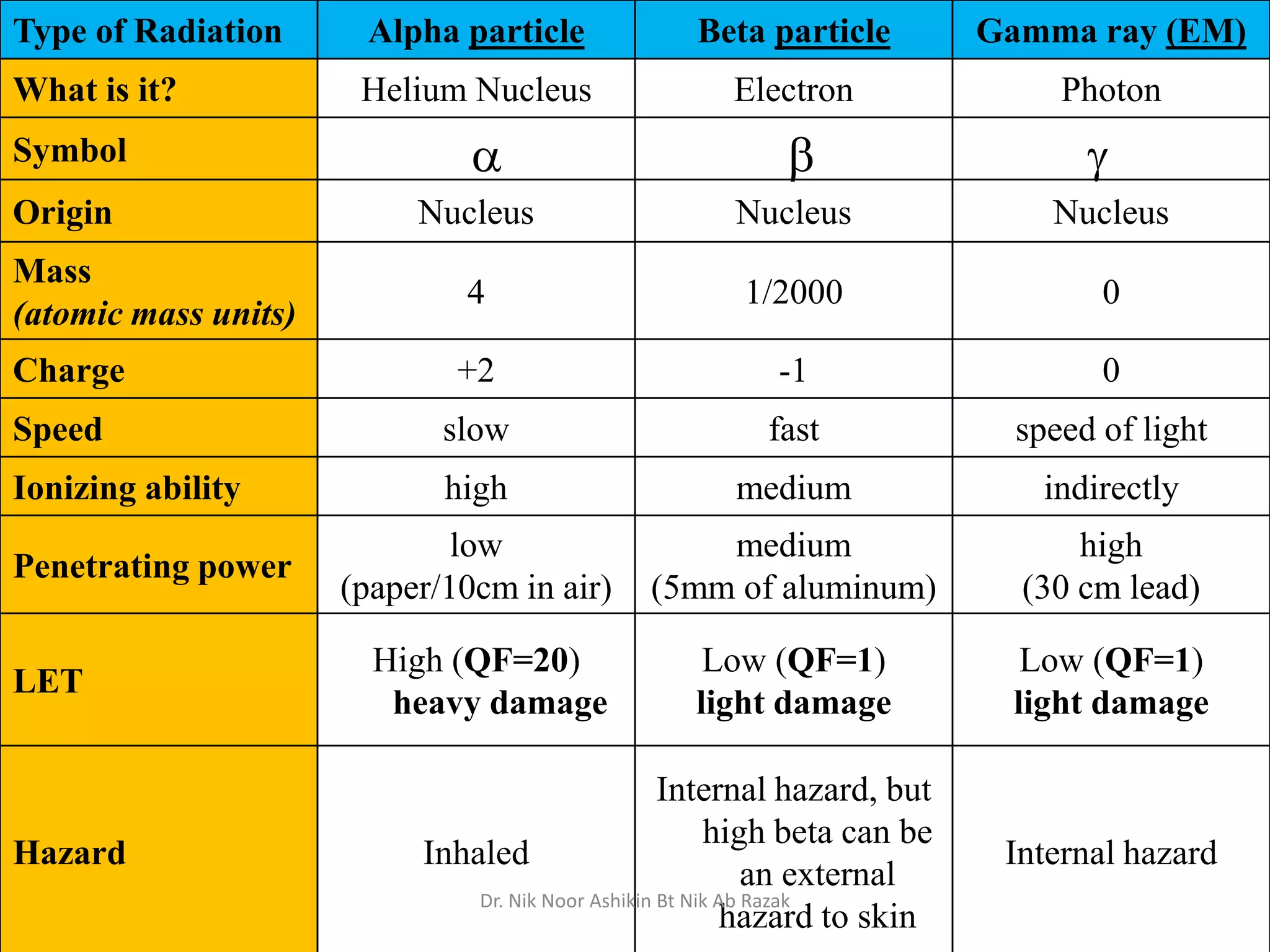
Type of Radiation Alpha particle Beta particle Gamma ray (EM)
What is it? Helium Nucleus Electron Photon
Symbol
Origin Nucleus Nucleus Nucleus
Mass
(atomic mass units)
4 1/2000 0
Charge +2 -1 0
Speed slow fast speed of light
Ionizing ability high medium indirectly
Penetrating power
low
(paper/10cm in air)
medium
(5mm of aluminum)
high
(30 cm lead)
LET
High (QF=20)
heavy damage
Low (QF=1)
light damage
Low (QF=1)
light damage
Hazard Inhaled
Internal hazard, but
high beta can be
an external
hazard to skin
Internal hazard
Dr. Nik Noor Ashikin Bt Nik Ab Razak
 
VIDEO 3
VIDEO 4
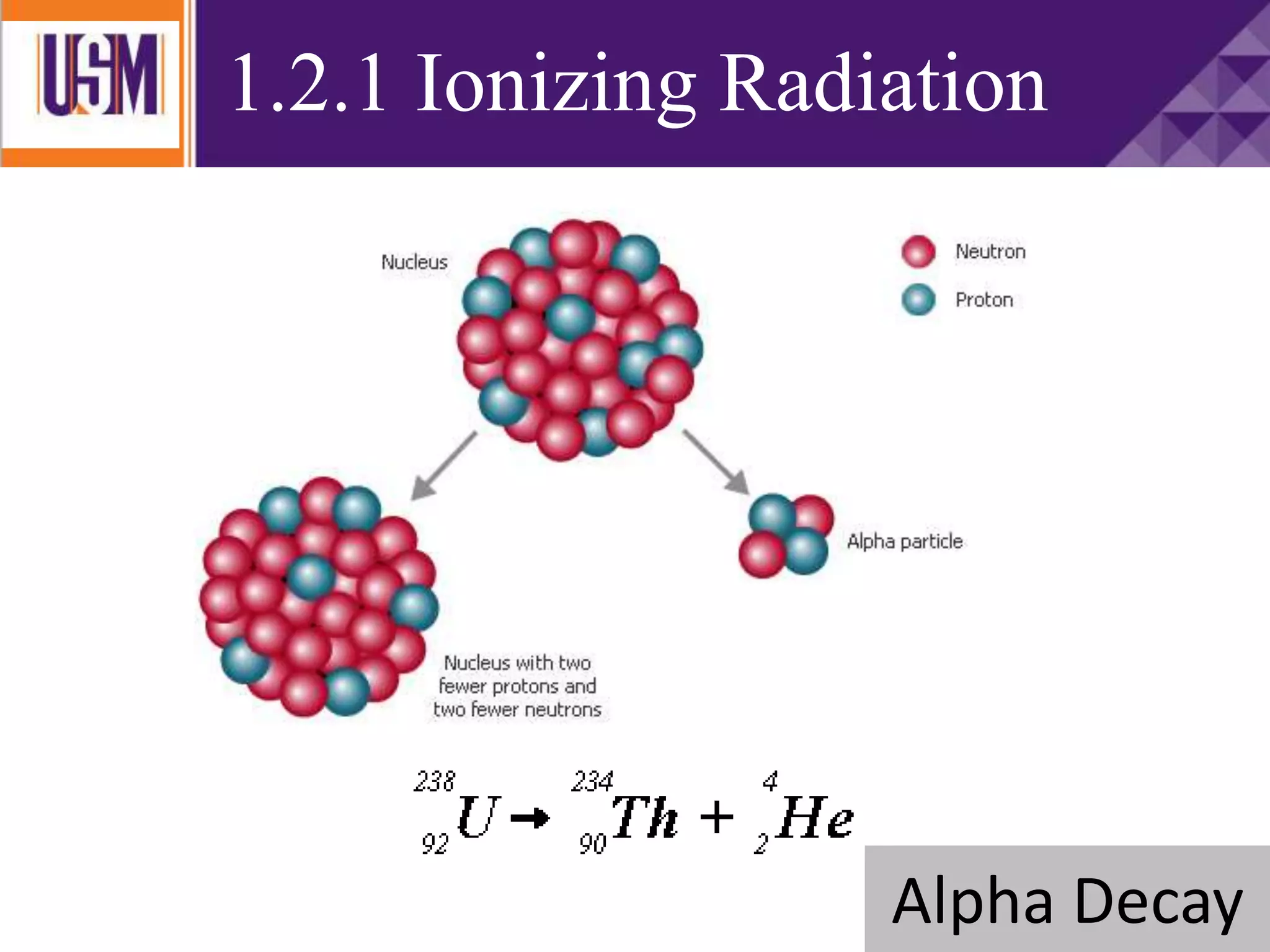
Alpha Decay
1.2.1 Ionizing Radiation
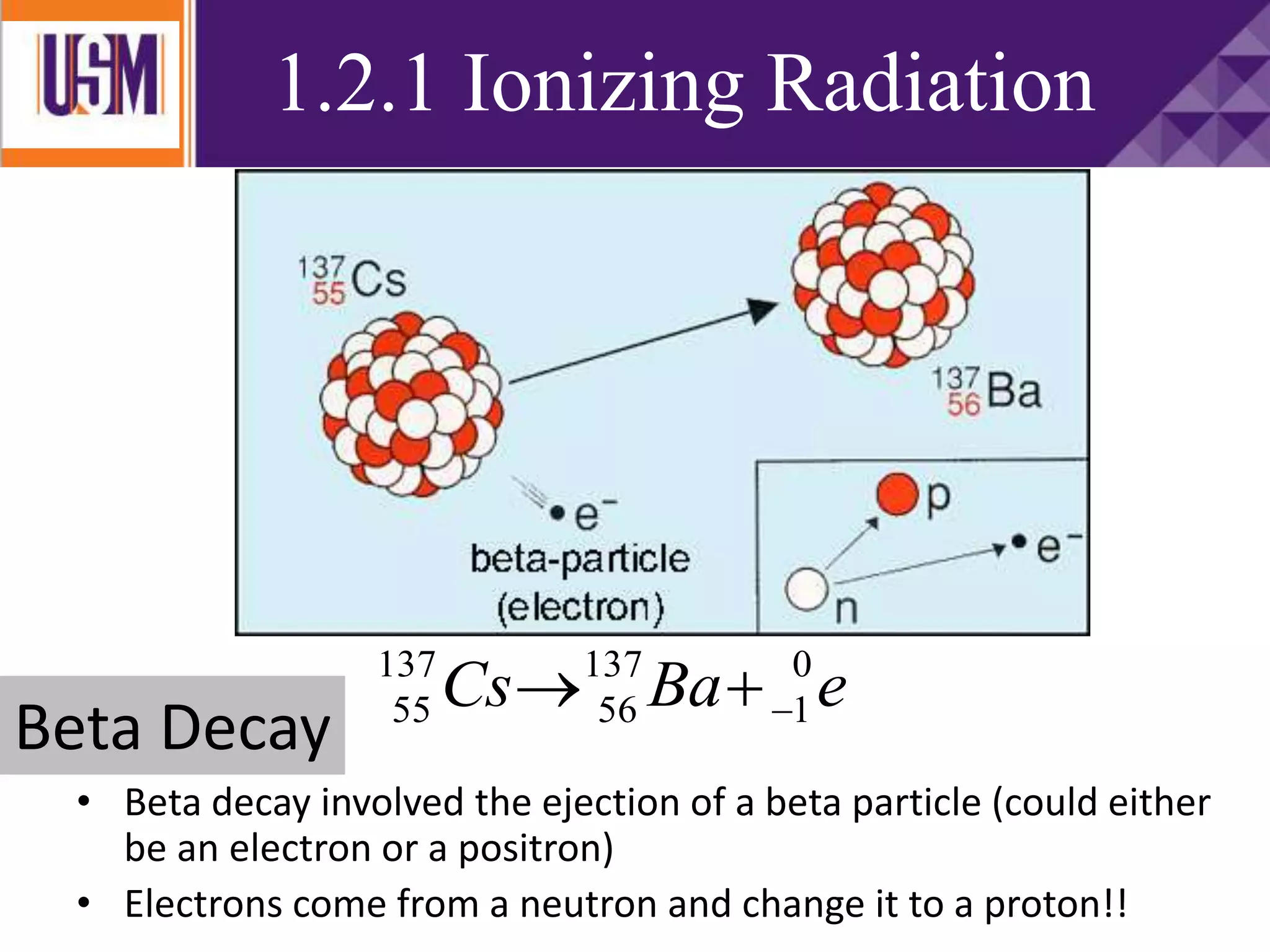
• Beta decay involved the ejection of a beta particle (could either
be an electron or a positron)
• Electrons come from a neutron and change it to a proton!!
eBaCs 0
1
137
56
137
55 
Beta Decay
1.2.1 Ionizing Radiation
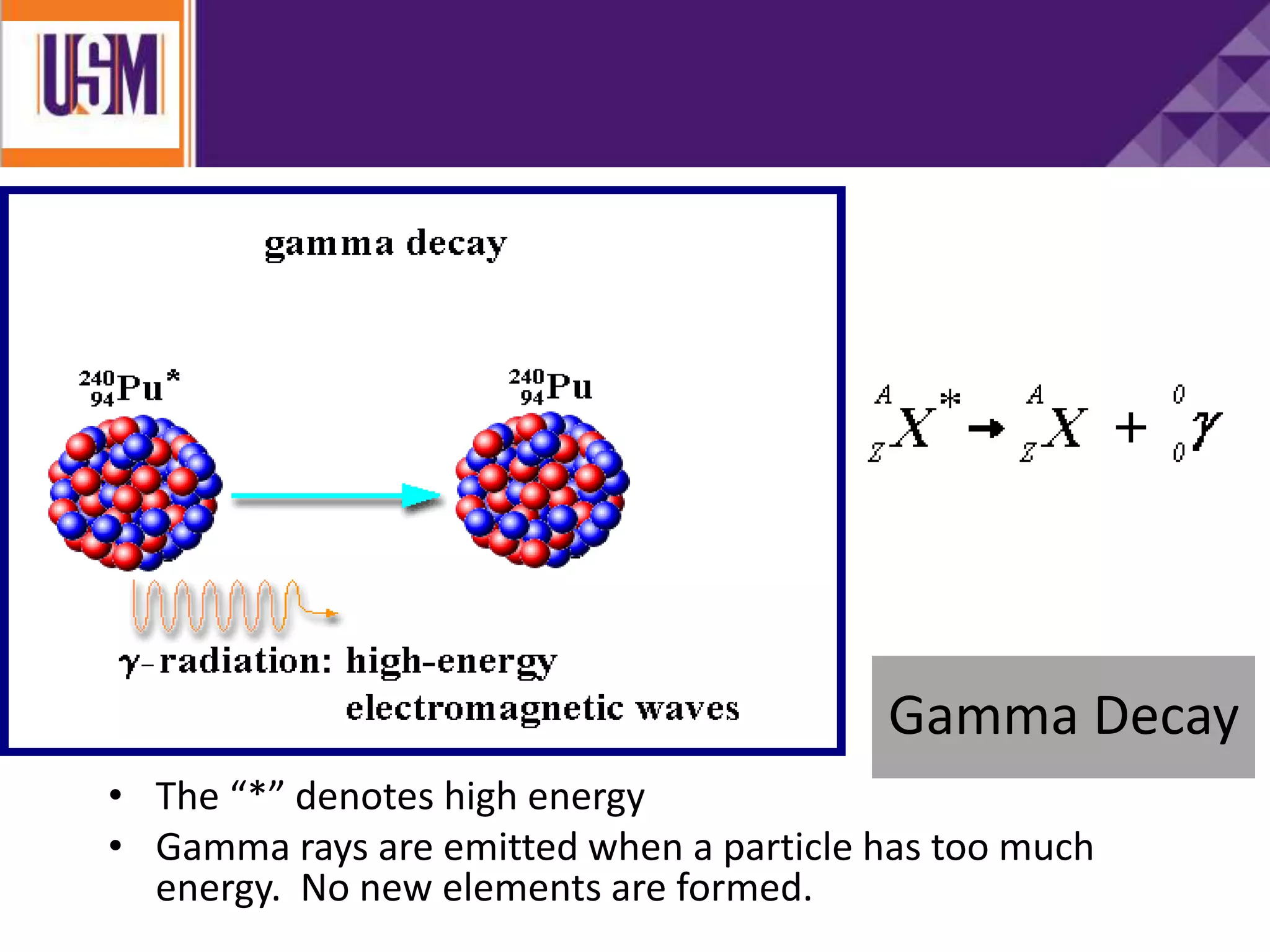
• The “*” denotes high energy
• Gamma rays are emitted when a particle has too much
energy. No new elements are formed.
Gamma Decay
Balancing Nuclear Equations
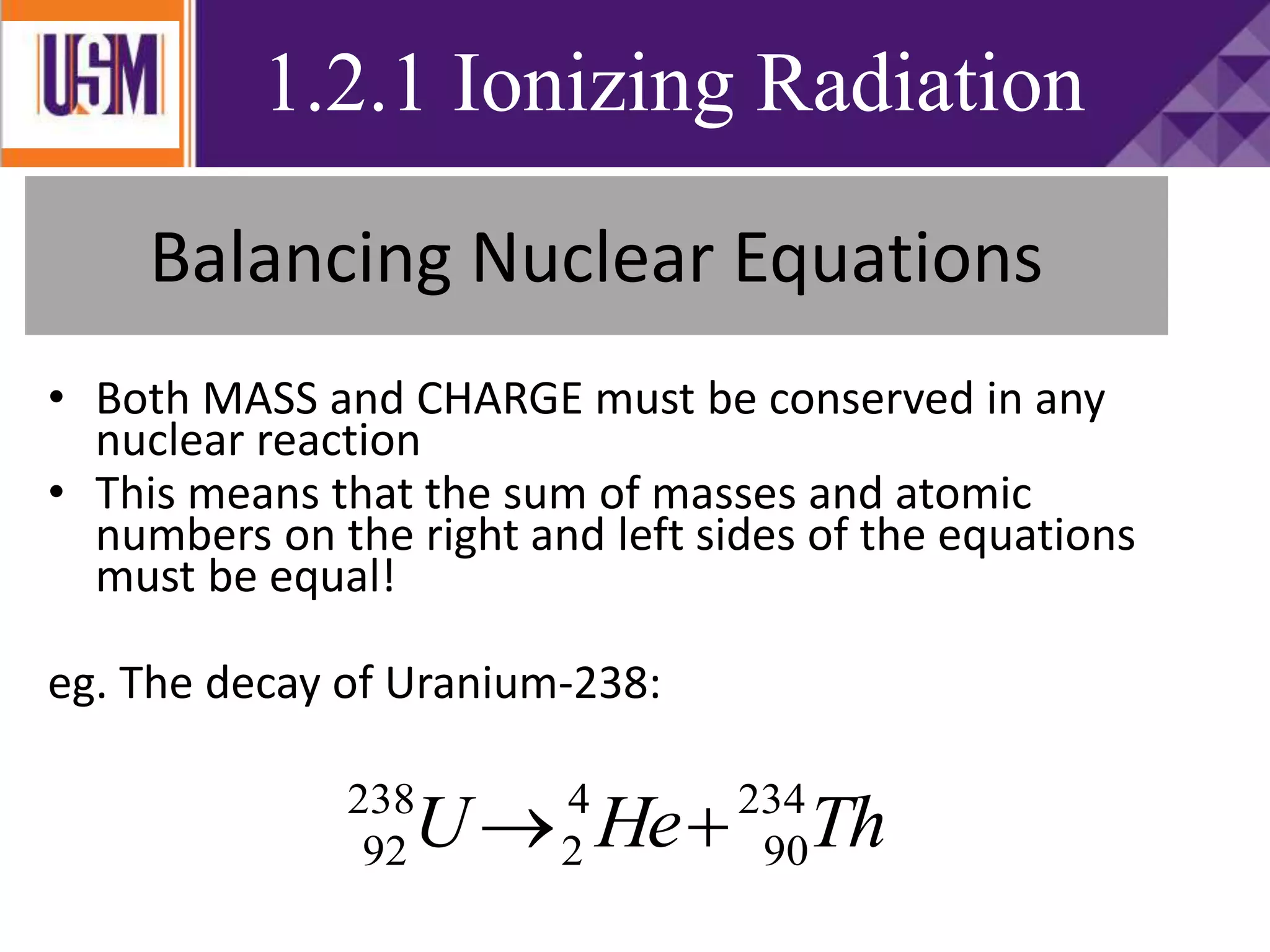
• Both MASS and CHARGE must be conserved in any
nuclear reaction
• This means that the sum of masses and atomic
numbers on the right and left sides of the equations
must be equal!
eg. The decay of Uranium-238:
ThHeU 234
90
4
2
238
92 
1.2.1 Ionizing Radiation
Balancing examples:
 HeRa 4
2
226
88
 eK 0
1
42
19
 nHeK 1
0
4
2
241
95 2
Rn222
86
Ca42
20
Bk243
97
1.2.1 Ionizing Radiation
“ They are electromagnetic waves
incapable of producing ions while
passing through matter, due to their
lower energy.”
1.2.2 Non-Ionizing Radiation
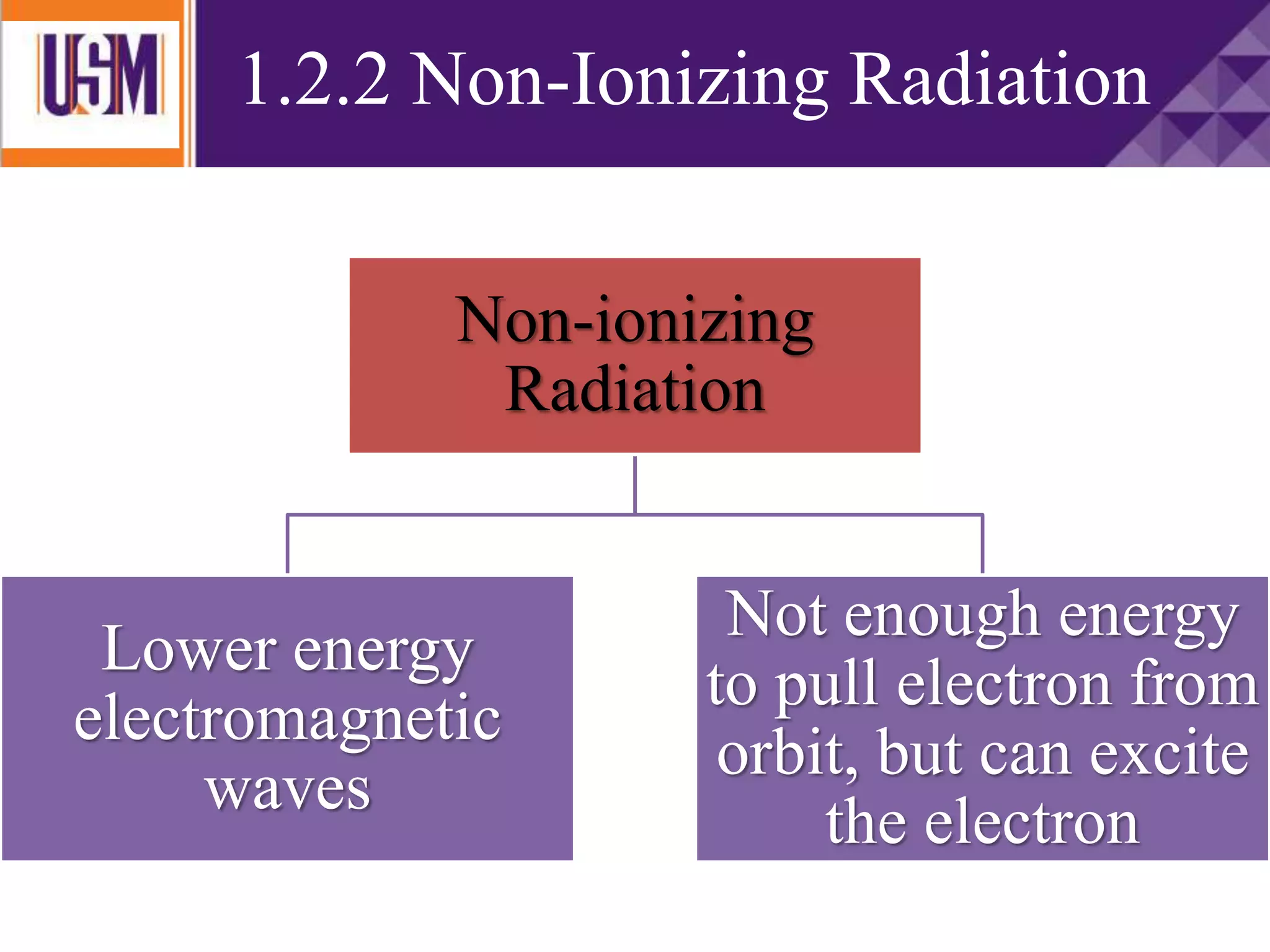
Non-ionizing
Radiation
Lower energy
electromagnetic
waves
Not enough energy
to pull electron from
orbit, but can excite
the electron
1.2.2 Non-Ionizing Radiation
Examples on Non-ionizing Radiation Sources
• Visible light
• Microwaves
• Radios
• Video Display Terminals
• Power lines
• Radiofrequency Diathermy (Physical Therapy)
• Lasers
1.2.2 Non-Ionizing Radiation
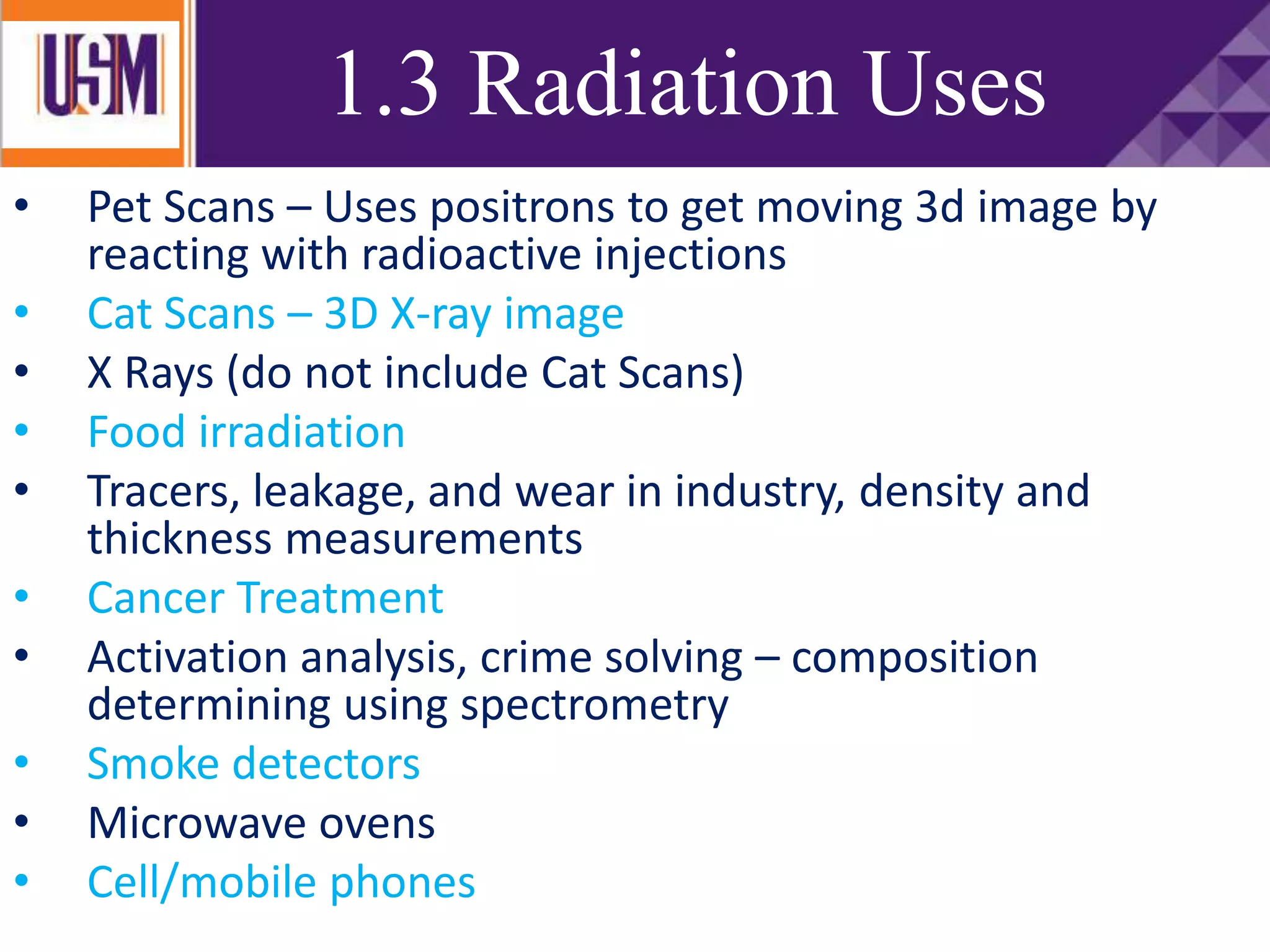
• Pet Scans – Uses positrons to get moving 3d image by
reacting with radioactive injections
• Cat Scans – 3D X-ray image
• X Rays (do not include Cat Scans)
• Food irradiation
• Tracers, leakage, and wear in industry, density and
thickness measurements
• Cancer Treatment
• Activation analysis, crime solving – composition
determining using spectrometry
• Smoke detectors
• Microwave ovens
• Cell/mobile phones
1.3 Radiation Uses
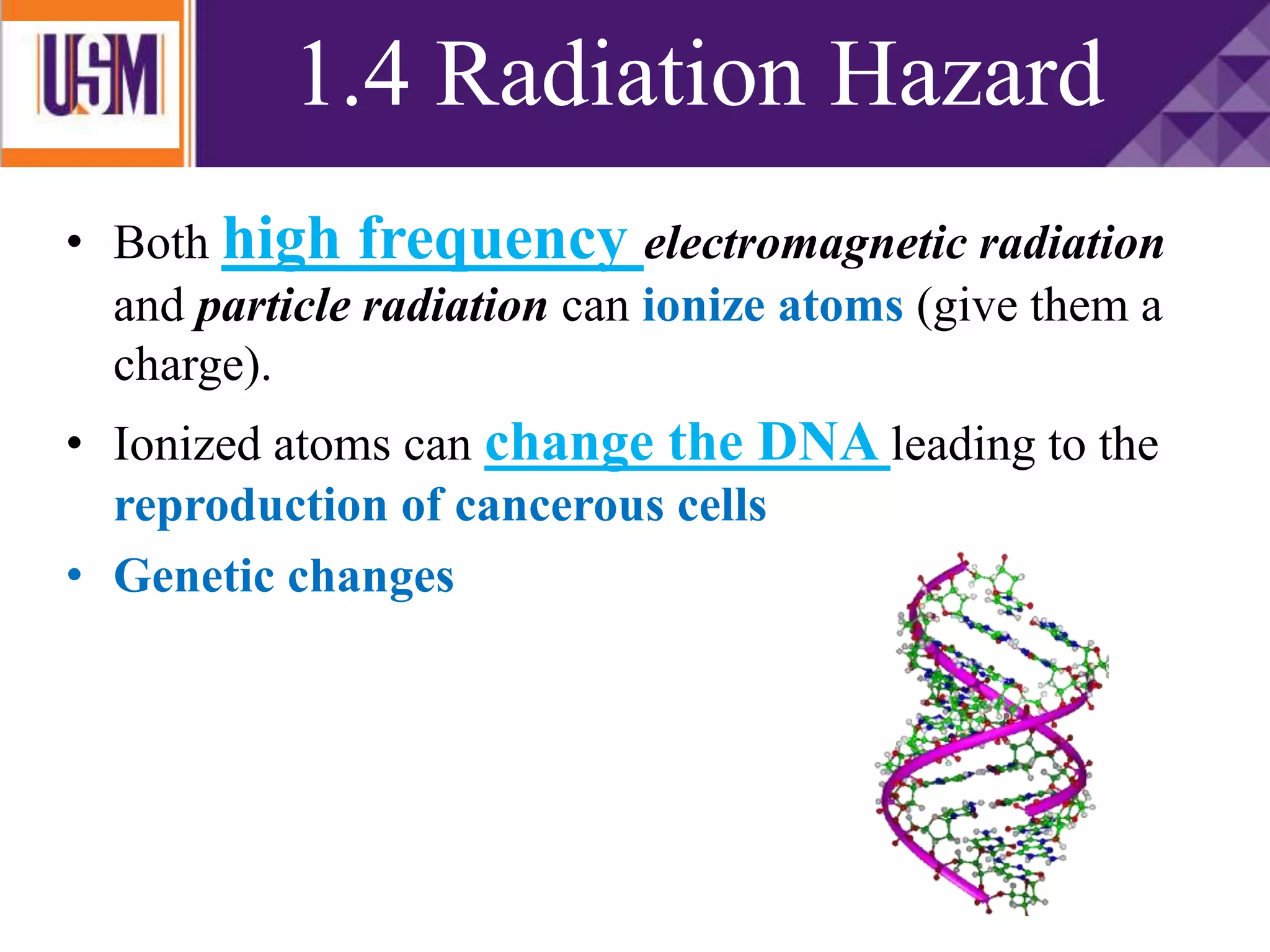
• Both high frequency electromagnetic radiation
and particle radiation can ionize atoms (give them a
charge).
• Ionized atoms can change the DNA leading to the
reproduction of cancerous cells
• Genetic changes
1.4 Radiation Hazard
Effects waves /cell phone
 Radiofrequency Ranges (10 kHz to 300 GHz)
– Effects only possible at ten times the permissible
exposure limit
– Heating of the body (thermal effect)
– Cataracts
– Some studies show effects of teratoginicity and
carcinogenicity.
1.4 Radiation Hazard
VIDEO 5

TOPIC 1: HISTORY OF RADIATION (PART 2)

  • 1.
    TOPIC 1 :History of Radiation (PART II)
  • 2.
    1.0 History ofRadiation 1.1 Radiation Source 1.2 Radiation Types 1.3 Radiation Uses 1.4 Radiation Hazard
  • 3.
    1.1 Radiation Source 1.1.1Natural Radiation 1.1.2 Artificial Radiation
  • 4.
    1.1 RADIATION SOURCE Humansare exposed to radiation all the time. This radiation is called background radiation. Most of the background radiation is from natural sources (natural background radiation). A small amount of the background radiation is from artificial sources (Artificial background radiation).
  • 5.
    1.1 RADIATION SOURCE BACKGROUNDRADIATION Natural Background Artificial Radiation
  • 6.
    1.1.1 NATURAL RADIATION 1.1.1aCosmic Ray 1.1.1b Rocks and Soils 1.1.1c Human body/Food
  • 7.
    Natural sources 1. Cosmic radiation 2.Earth's crust / Radioactive rock/ Soil (Terrestrial Radiation) 3. Human body/ Food (Internal sources) 1.1.1 Natural Background
  • 8.
    1.1.1a Cosmic Ray ORIGIN •Sunand outer space DOSE LEVEL •At sea level: Average cosmic radiation dose is 26 mrem /year •At higher elevations, the dose increases (amount of atmosphere shielding cosmic rays decreases)
  • 9.
    Cosmic Ray Sun emitsradiation composed of high energy infrared radiation, visible light, and ultraviolet radiation collectively shortwave radiation (SW) Other energetic rays such as gamma rays can make it through the atmosphere to the Earth's surface. Absorbed by atmosphere but the more energetic radiations interact with the atoms in the atmosphere creating energetic neutrons and radioactive nuclides. 1.1.1a Cosmic Ray
  • 10.
    1.1.1a Cosmic Ray Pathof incoming solar radiation
  • 11.
    Some other cosmogenicradionuclides are : 10Be, 26Al, 36Cl, 80Kr, 14C, 32Si, 39Ar, 22Na, 35S, 37Ar, 33P, 32P, 38Mg, 24Na,38S, 31Si, 18F, 39Cl, 38Cl , 34mCl. Cosmogenic Nuclides Nuclide Symbol Half-life Source Natural Activity Carbon 14 14C 5730 yr Cosmic-ray interactions, 14N(n,p)14C 6 pCi/g (0.22 Bq/g) in organic material Hydrogen 3 (Tritium) 3H 12.3 yr Cosmic-ray interactions with N and O, spallation from cosmic- rays, 6Li(n, alpha)3H 0.032 pCi/kg (1.2 x 10- 3 Bq/kg) Beryllium 7 7Be 53.28 days Cosmic-ray interactions with N and O 0.27 pCi/kg (0.01 Bq/kg)
  • 12.
    1.1.1b - Rocksand soil Rocks and soil ORIGIN Ground, rocks, building materials and drinking water supplies CONTRIBUTORS Natural radium, uranium and thorium. EXAMPLE During the radioactive decay of Uranium, Radon gas is produced which seeps through rocks underground and introduced into the atmosphere
  • 13.
    Natural Radioactivity bythe Square Mile, 1 Foot Deep Nuclide Activity used in calculation Mass of Nuclide Activity found in the volume of soil Uranium 0.7 pCi/g (25 Bq/kg) 2,200 kg 0.8 curies (31 GBq) Thorium 1.1 pCi/g (40 Bq/kg) 12,000 kg 1.4 curies (52 GBq) Potassium 40 11 pCi/g (400 Bq/kg) 2000 kg 13 curies (500 GBq) Radium 1.3 pCi/g (48 Bq/kg) 1.7 g 1.7 curies (63 GBq) Radon 0.17 pCi/g (10 kBq/m3) soil 11 µg 0.2 curies (7.4 GBq) Total: >17 curies (>653 GBq)
  • 14.
    Natural Radioactivity bythe Ocean Nuclide Activity used in calculation Activity in Ocean Pacific Atlantic All Oceans Uranium 0.9 pCi/L (33 mBq/L) 6 x 10⁸ Ci (22 EBq) 3 x 10⁸ Ci (11 EBq) 1.1 x 10⁹ Ci (41 EBq) Potassium 40 300 pCi/L (11 Bq/L) 2 x 10¹¹ Ci (7400 EBq) 9 x 10¹⁰ Ci (3300 EBq) 3.8 x 10¹¹ Ci (14000 EBq) Tritium 0.016 pCi/L (0.6 mBq/L) 1 x 10⁷ Ci (370 PBq) 5 x 10⁶ Ci (190 PBq) 2 x 10⁷ Ci (740 PBq) Carbon 14 0.135 pCi/L (5 mBq/L) 8 x 10⁷ Ci (3 EBq) 4 x 10⁷ Ci (1.5 EBq) 1.8 x 10⁸ Ci (6.7 EBq) Rubidium 87 28 pCi/L (1.1 Bq/L) 1.9 x 10¹⁰ Ci (700 EBq) 9 x 10⁹ Ci (330 EBq) 3.6 x 10¹⁰ Ci (1300 EBq)
  • 15.
    1.1.1c - HumanBody/Food HUMAN BODY/ FOOD ORIGIN Our bodies also contain natural radionuclides INTERACTION Introduced into the body when Eaten or via the food chain when meat or milk from animals grazing on the crops are consumed EXAMPLES Potassium 40, carbon-14 (Breathing), Fruits (soil and carbon- 14)
  • 16.
    Natural Radioactivity inyour body Nuclide Total Mass of Nuclide Found in the Body Total Activity of Nuclide Found in the Body Daily Intake of Nuclides Uranium 90 µg 30 pCi (1.1 Bq) 1.9 µg Thorium 30 µg 3 pCi (0.11 Bq) 3 µg Potassium 40 17 mg 120 nCi (4.4 kBq) 0.39 mg Radium 31 pg 30 pCi (1.1 Bq) 2.3 pg Carbon 14 22 ng 0.1 µCi (3.7 kBq) 1.8 ng Tritium 0.06 pg 0.6 nCi (23 Bq) 0.003 pg Polonium 0.2 pg 1 nCi (37 Bq) ~0.6 fg
  • 17.
    Natural Radioactivity inFood Food 40K pCi/kg 226Ra pCi/kg Banana 3,520 1 Brazil Nuts 5,600 1,000-7,000 Carrot 3,400 0.6-2 White Potatoes 3,400 1-2.5 Beer 390 --- Red Meat 3,000 0.5 Lima Bean raw 4,640 2-5 Drinking water --- 0-0.17
  • 18.
  • 19.
    1.1.2 Artificial Source(Definition) This is background radiation resulting from human activity through the creation and use of artificial sources of radiation.
  • 20.
    ARTIFICIAL RADIATION 1. Medical sources 2. Nuclear power stations 3.Nuclear weapons 4.Consumer products 1.1.2 Artificial Radiation
  • 21.
    1.1.2 Artificial Radiation Humansare exposed to radiations by medical procedures such as x-rays and radiotherapy. 1-Medical sources 2- Nuclear power stations •Major incidents from nuclear power stations have released radiations into the environment. •Nuclear waste from power station also accounts for a small proportion of artificial background radiation
  • 22.
    1.1.2 Artificial Radiation Nuclearweapon testing in the 1950s and 1960s resulted in an increase of radiation in the environment. •Examples: TV's, older luminous dial watches, some smoke detectors, and lantern mantles •Dose is relatively small 3- Nuclear weapon 4-Consumer products
  • 24.
    Human Produced Nuclides NuclideSymbol Half-life Source Tritium 3H 12.3 yr Produced from weapons testing and fission reactors; reprocessing facilities, nuclear weapons manufacturing Iodine 131 131I 8.04 days Fission product produced from weapons testing and fission reactors, used in medical treatment of thyroid problems Iodine 129 129I 1.57 x 10⁷ yr Fission product produced from weapons testing and fission reactors Cesium 137 137Cs 30.17 yr Fission product produced from weapons testing and fission reactors Strontium 90 90Sr 28.78 yr Fission product produced from weapons testing and fission reactors Technetium 99 99Tc 2.11 x 10⁵ yr Decay product of 99Mo, used in medical diagnosis Plutonium 239 239Pu 2.41 x 10⁴ yr Produced by neutron bombardment of 238U ( 238U + n--> 239U--> 239Np +ß--> 239Pu+ß)
  • 25.
    SUMMARY •As a whole,these sources of natural and human-made radiation are referred to as background radiation. •The pie chart below shows the average contribution from the various sources to background radiation.
  • 26.
  • 27.
  • 28.
  • 29.
    1.2 RADIATION TYPES 1.2.1Ionizing Radiation 1.2.2 Non-ionizing Radiation
  • 30.
  • 31.
    Ionizing radiation isproduced by unstable atoms. Unstable atoms differ from stable atoms because they have an excess of energy or mass or both. Unstable atoms are said to be radioactive. In order to reach stability, these atoms give off, or emit, the excess energy or mass. These emissions are called radiation. Radioactive decay is the spontaneous decay of atoms by emitting alpha, beta or gamma particles. New elements are always formed during alpha and beta decay Extra Notes…. Ionization & Radioactive decay
  • 32.
    1.2.1 Ionizing Radiation •Definition: “ It is a type of radiation that is able to disrupt atoms and molecules on which they pass through, giving rise to ions and free radicals”.
  • 33.
    Ionizing Radiation Higher energy electromagnetic waves(x-ray, gamma) or heavy particles (beta and alpha) Enough energy to pull electron from orbit 1.2.1 Ionizing Radiation
  • 34.
  • 35.
    Photon X-rays emitted from electron orbits (KeV's) Gamma rays fromnucleus(often as part of radioactive decay) (Mev's) PHOTON 1.2.1 Ionizing Radiation
  • 36.
    Ionizing Radiation alpha particle betaparticle Radioactive Atom X-ray gamma ray 1.2.1 Ionizing Radiation
  • 37.
    Type of RadiationAlpha particle Beta particle Gamma ray (EM) What is it? Helium Nucleus Electron Photon Symbol Origin Nucleus Nucleus Nucleus Mass (atomic mass units) 4 1/2000 0 Charge +2 -1 0 Speed slow fast speed of light Ionizing ability high medium indirectly Penetrating power low (paper/10cm in air) medium (5mm of aluminum) high (30 cm lead) LET High (QF=20) heavy damage Low (QF=1) light damage Low (QF=1) light damage Hazard Inhaled Internal hazard, but high beta can be an external hazard to skin Internal hazard Dr. Nik Noor Ashikin Bt Nik Ab Razak  
  • 38.
  • 39.
  • 40.
    • Beta decayinvolved the ejection of a beta particle (could either be an electron or a positron) • Electrons come from a neutron and change it to a proton!! eBaCs 0 1 137 56 137 55  Beta Decay 1.2.1 Ionizing Radiation
  • 41.
    • The “*”denotes high energy • Gamma rays are emitted when a particle has too much energy. No new elements are formed. Gamma Decay
  • 42.
    Balancing Nuclear Equations •Both MASS and CHARGE must be conserved in any nuclear reaction • This means that the sum of masses and atomic numbers on the right and left sides of the equations must be equal! eg. The decay of Uranium-238: ThHeU 234 90 4 2 238 92  1.2.1 Ionizing Radiation
  • 43.
    Balancing examples:  HeRa4 2 226 88  eK 0 1 42 19  nHeK 1 0 4 2 241 95 2 Rn222 86 Ca42 20 Bk243 97 1.2.1 Ionizing Radiation
  • 44.
    “ They areelectromagnetic waves incapable of producing ions while passing through matter, due to their lower energy.” 1.2.2 Non-Ionizing Radiation
  • 45.
    Non-ionizing Radiation Lower energy electromagnetic waves Not enoughenergy to pull electron from orbit, but can excite the electron 1.2.2 Non-Ionizing Radiation
  • 46.
    Examples on Non-ionizingRadiation Sources • Visible light • Microwaves • Radios • Video Display Terminals • Power lines • Radiofrequency Diathermy (Physical Therapy) • Lasers 1.2.2 Non-Ionizing Radiation
  • 47.
    • Pet Scans– Uses positrons to get moving 3d image by reacting with radioactive injections • Cat Scans – 3D X-ray image • X Rays (do not include Cat Scans) • Food irradiation • Tracers, leakage, and wear in industry, density and thickness measurements • Cancer Treatment • Activation analysis, crime solving – composition determining using spectrometry • Smoke detectors • Microwave ovens • Cell/mobile phones 1.3 Radiation Uses
  • 48.
    • Both highfrequency electromagnetic radiation and particle radiation can ionize atoms (give them a charge). • Ionized atoms can change the DNA leading to the reproduction of cancerous cells • Genetic changes 1.4 Radiation Hazard
  • 49.
    Effects waves /cellphone  Radiofrequency Ranges (10 kHz to 300 GHz) – Effects only possible at ten times the permissible exposure limit – Heating of the body (thermal effect) – Cataracts – Some studies show effects of teratoginicity and carcinogenicity. 1.4 Radiation Hazard

  • 50.

Editor's Notes