Terms associated with elements:
1. Isotopes: Atoms having same atomic number of protons but different mass number.
e. g. Hydrogen (1H1), Deuterium (1D2) and Tritium (1T3)
2. Isobar: Elements having same mass number. e.g. 19K40 and 20Ca40
3. Isotone: Elements having same number of neutrons. e.g. (6C13) and (7N14)
4. Isoelectronics: Species/elements having same number of electrons. e.g. N3-, O2-, F-
5. Isodiaphers: Elements having different atomic number and mass number but same
neutron excess which is the difference between number of neutrons and protons in in
the nucleus (N-Z). E. g. 90Th234, 92U238 Th = 234-90 = 144, 144-90 = 54; U = 238-92 =
146, 146-92 = 54
6. Paramagnetic: Species having one or more unpaired electrons. e.g. C, N, O etc.
7. Diamagnetic: Species having no unpaired electrons. e.g. He, Ne, N3-, O2-, F-
Rutherford’s model:
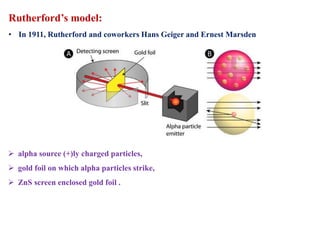
• In 1911, Rutherford and coworkers Hans Geiger and Ernest Marsden
 alpha source (+)ly charged particles,
 gold foil on which alpha particles strike,
 ZnS screen enclosed gold foil .
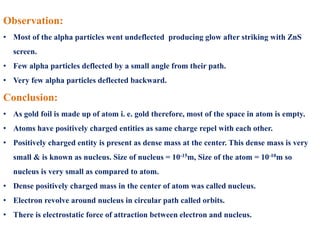
Observation:
• Most of the alpha particles went undeflected producing glow after striking with ZnS
screen.
• Few alpha particles deflected by a small angle from their path.
• Very few alpha particles deflected backward.
Conclusion:
• As gold foil is made up of atom i. e. gold therefore, most of the space in atom is empty.
• Atoms have positively charged entities as same charge repel with each other.
• Positively charged entity is present as dense mass at the center. This dense mass is very
small & is known as nucleus. Size of nucleus = 10-15m, Size of the atom = 10-10m so
nucleus is very small as compared to atom.
• Dense positively charged mass in the center of atom was called nucleus.
• Electron revolve around nucleus in circular path called orbits.
• There is electrostatic force of attraction between electron and nucleus.
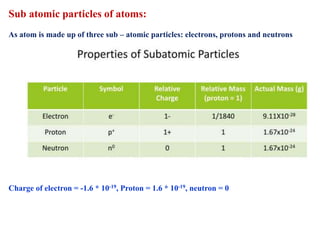
Sub atomic particles of atoms:
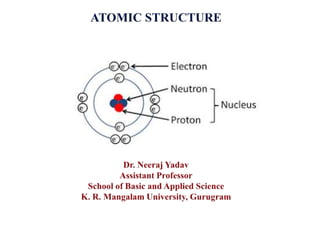
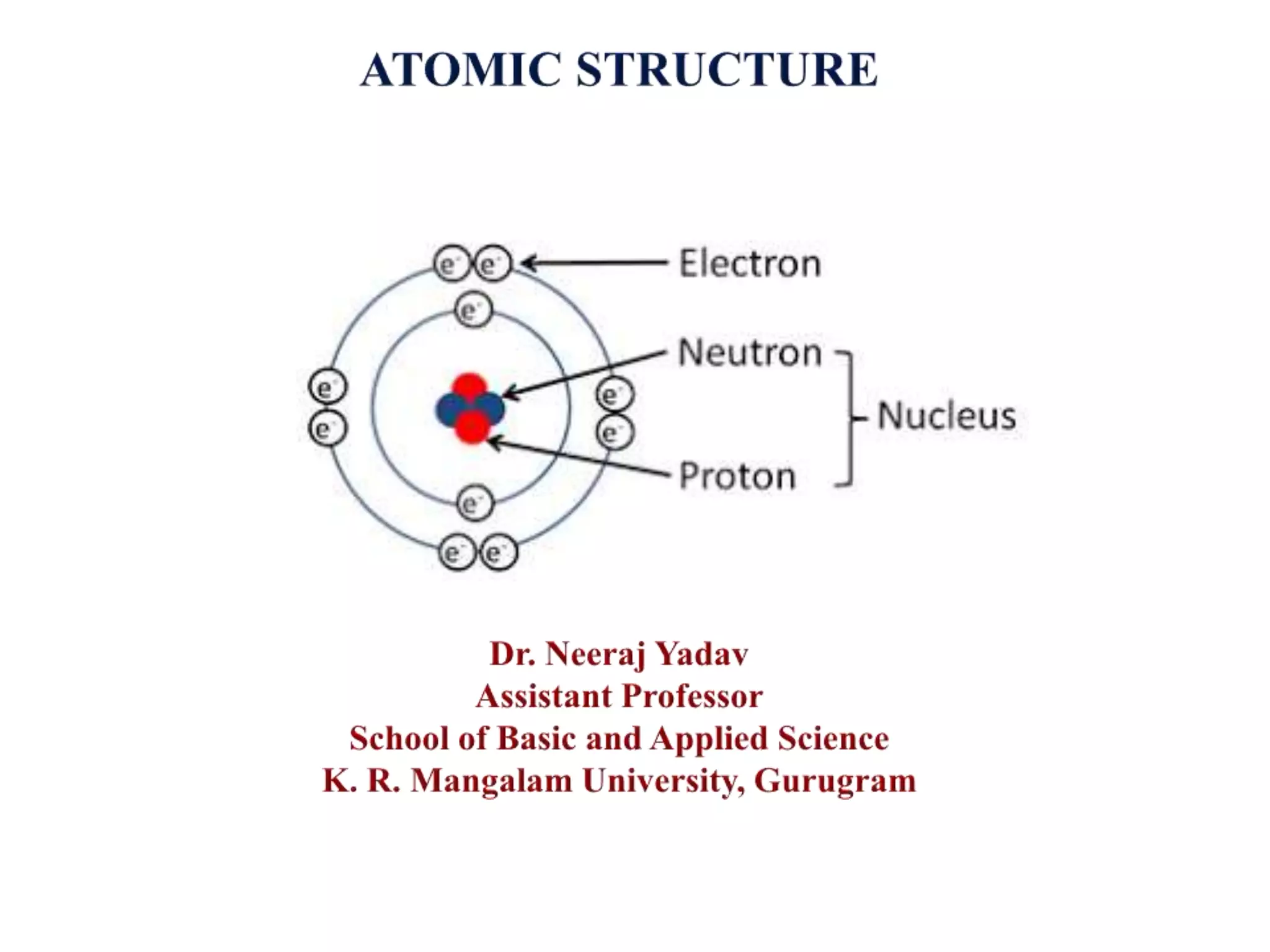
As atom is made up of three sub – atomic particles: electrons, protons and neutrons
Charge of electron = -1.6 * 10-19, Proton = 1.6 * 10-19, neutron = 0
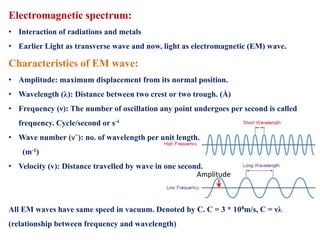
Electromagnetic spectrum:
• Interaction of radiations and metals
• Earlier Light as transverse wave and now, light as electromagnetic (EM) wave.
Characteristics of EM wave:
• Amplitude: maximum displacement from its normal position.
• Wavelength (λ): Distance between two crest or two trough. (Å)
• Frequency (ν): The number of oscillation any point undergoes per second is called
frequency. Cycle/second or s-1
• Wave number (vˉ): no. of wavelength per unit length.
(m-1)
• Velocity (v): Distance travelled by wave in one second.
All EM waves have same speed in vacuum. Denoted by C. C = 3 * 108m/s, C = νλ
(relationship between frequency and wavelength)
Amplitude
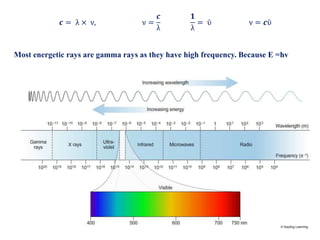
𝒄 = λ × ν, ν =
𝒄
λ
𝟏
λ
= ῡ ν = 𝒄ῡ
Most energetic rays are gamma rays as they have high frequency. Because E =hv
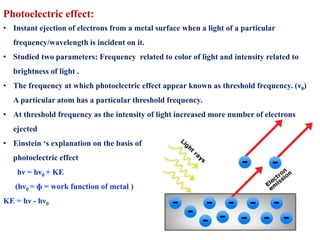
Photoelectric effect:
• Instant ejection of electrons from a metal surface when a light of a particular
frequency/wavelength is incident on it.
• Studied two parameters: Frequency related to color of light and intensity related to
brightness of light .
• The frequency at which photoelectric effect appear known as threshold frequency. (ν0)
A particular atom has a particular threshold frequency.
• At threshold frequency as the intensity of light increased more number of electrons
ejected
• Einstein ‘s explanation on the basis of
photoelectric effect
hν = hν0 + KE
(hν0 = ɸ = work function of metal )
KE = hν - hν0
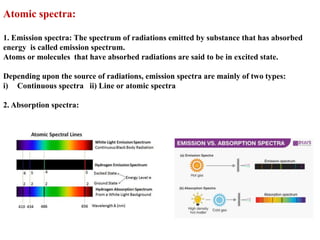
Atomic spectra:
1. Emission spectra: The spectrum of radiations emitted by substance that has absorbed
energy is called emission spectrum.
Atoms or molecules that have absorbed radiations are said to be in excited state.
Depending upon the source of radiations, emission spectra are mainly of two types:
i) Continuous spectra ii) Line or atomic spectra
2. Absorption spectra:
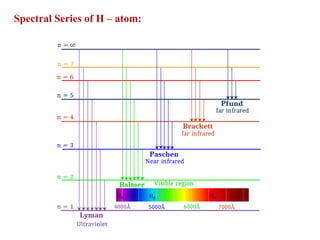
Spectral Series of H – atom:
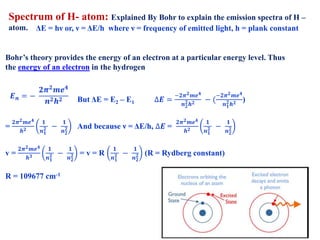
Spectrum of H- atom: Explained By Bohr to explain the emission spectra of H –
atom.
Bohr’s theory provides the energy of an electron at a particular energy level. Thus
the energy of an electron in the hydrogen
But ΔE = E2 – E1 ∆𝑬 =
−𝟐𝝅 𝟐 𝒎𝒆 𝟒
𝒏 𝟐
𝟐 𝒉 𝟐 − (
−𝟐𝝅 𝟐 𝒎𝒆 𝟒
𝒏 𝟏
𝟐 𝒉 𝟐 )
=
𝟐𝝅 𝟐 𝒎𝒆 𝟒
𝒉 𝟐
𝟏
𝒏 𝟏
𝟐 −
𝟏
𝒏 𝟐
𝟐 And because ν = ΔE/h, ∆𝑬 =
𝟐𝝅 𝟐 𝒎𝒆 𝟒
𝒉 𝟐
𝟏
𝒏 𝟏
𝟐 −
𝟏
𝒏 𝟐
𝟐
v =
𝟐𝝅 𝟐 𝒎𝒆 𝟒
𝒉 𝟑
𝟏
𝒏 𝟏
𝟐 −
𝟏
𝒏 𝟐
𝟐 = v = R
𝟏
𝒏 𝟏
𝟐 −
𝟏
𝒏 𝟐
𝟐 (R = Rydberg constant)
R = 109677 cm-1
ΔE = hν or, ν = ΔE/h where ν = frequency of emitted light, h = plank constant
𝑬 𝒏 = −
𝟐𝝅 𝟐 𝒎𝒆 𝟒
𝒏 𝟐 𝒉 𝟐
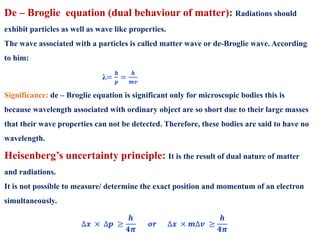
De – Broglie equation (dual behaviour of matter): Radiations should
exhibit particles as well as wave like properties.
The wave associated with a particles is called matter wave or de-Broglie wave. According
to him:
λ=
𝒉
𝒑
=
𝒉
𝒎𝒗
Significance: de – Broglie equation is significant only for microscopic bodies this is
because wavelength associated with ordinary object are so short due to their large masses
that their wave properties can not be detected. Therefore, these bodies are said to have no
wavelength.
Heisenberg’s uncertainty principle: It is the result of dual nature of matter
and radiations.
It is not possible to measure/ determine the exact position and momentum of an electron
simultaneously.
∆𝒙 × ∆𝒑 ≥
𝒉
𝟒𝝅
𝒐𝒓 ∆𝒙 × 𝒎∆𝒗 ≥
𝒉
𝟒𝝅
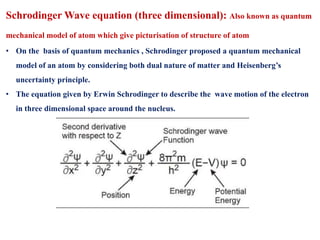
Schrodinger Wave equation (three dimensional): Also known as quantum
mechanical model of atom which give picturisation of structure of atom
• On the basis of quantum mechanics , Schrodinger proposed a quantum mechanical
model of an atom by considering both dual nature of matter and Heisenberg’s
uncertainty principle.
• The equation given by Erwin Schrodinger to describe the wave motion of the electron
in three dimensional space around the nucleus.
Schrodinger Wave equation (three dimensional):
When this equation is solved for ψ, three integer were obtained like n, l, m which are
called quantum numbers.
Significance of ψ 2 = probability density of finding the electron at any point and that is
called orbital.
Helps in formation of boundary surface plots.
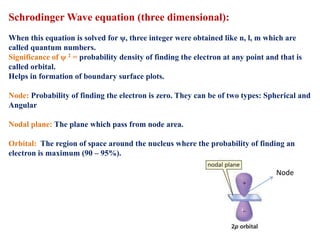
Node: Probability of finding the electron is zero. They can be of two types: Spherical and
Angular
Nodal plane: The plane which pass from node area.
Orbital: The region of space around the nucleus where the probability of finding an
electron is maximum (90 – 95%).
Node
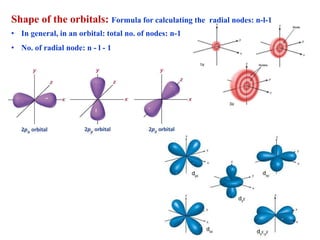
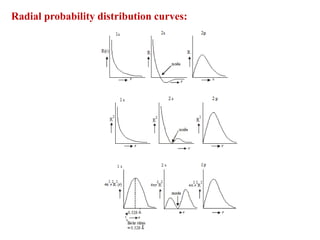
Shape of the orbitals: Formula for calculating the radial nodes: n-l-1
• In general, in an orbital: total no. of nodes: n-1
• No. of radial node: n - l - 1
Radial probability distribution curves:
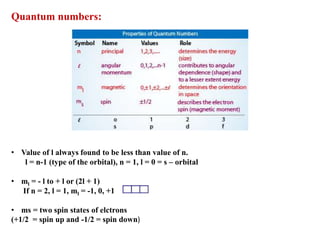
Quantum numbers:
• Value of l always found to be less than value of n.
l = n-1 (type of the orbital), n = 1, l = 0 = s – orbital
• ml = - l to + l or (2l + 1)
If n = 2, l = 1, ml = -1, 0, +1
• ms = two spin states of elctrons
(+1/2 = spin up and -1/2 = spin down)
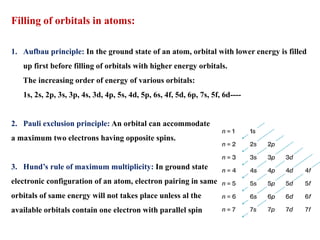
Filling of orbitals in atoms:
1. Aufbau principle: In the ground state of an atom, orbital with lower energy is filled
up first before filling of orbitals with higher energy orbitals.
The increasing order of energy of various orbitals:
1s, 2s, 2p, 3s, 3p, 4s, 3d, 4p, 5s, 4d, 5p, 6s, 4f, 5d, 6p, 7s, 5f, 6d----
2. Pauli exclusion principle: An orbital can accommodate
a maximum two electrons having opposite spins.
3. Hund’s rule of maximum multiplicity: In ground state
electronic configuration of an atom, electron pairing in same
orbitals of same energy will not takes place unless al the
available orbitals contain one electron with parallel spin
1. The increasing order (lower first) for the values of e/m for electron, proton, neutron and α –
particles is:
a) n, α, p, e b) p, e n, α c) α, n, p, e d) α, e, p, n
2. Which electronic level would allow the hydrogen atom to absorb a photon but not to emit a
photon?
a) 3s b) 2p c) 2s d) 1s
3. Bohr Model can explain
a) The spectrum of H-atom only
b) the spectrum of an atom or ion containing one electron only
c) The spectrum of hydrogen molecule
d) The solar spectrum
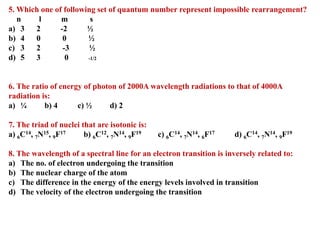
5. Which one of following set of quantum number represent impossible rearrangement?
n l m s
a) 3 2 -2 ½
b) 4 0 0 ½
c) 3 2 -3 ½
d) 5 3 0 -1/2
6. The ratio of energy of photon of 2000A wavelength radiations to that of 4000A
radiation is:
a) ¼ b) 4 c) ½ d) 2
7. The triad of nuclei that are isotonic is:
a) 6C14, 7N15, 9F17 b) 6C12, 7N14, 9F19 c) 6C14, 7N14, 6F17 d) 6C14, 7N14, 9F19
8. The wavelength of a spectral line for an electron transition is inversely related to:
a) The no. of electron undergoing the transition
b) The nuclear charge of the atom
c) The difference in the energy of the energy levels involved in transition
d) The velocity of the electron undergoing the transition
9. The orbital diagram in which the Aufbau Principle is violated:
10. The outermost electronic configuration of most electronegative element is:
a) ns2np3 b) ns2np4 c) ns2np5 ns2np6
11. The correct G. S. electronic configuration of Cr atom is:
a) [Ar]3d54s1 b) [Ar]3d44s2 c) [Ar] 3d64s0 d) [Ar]4d55s1
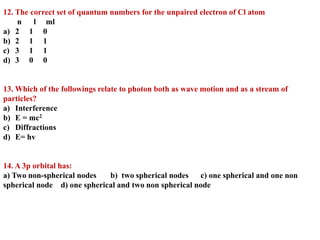
12. The correct set of quantum numbers for the unpaired electron of Cl atom
n l ml
a) 2 1 0
b) 2 1 1
c) 3 1 1
d) 3 0 0
13. Which of the followings relate to photon both as wave motion and as a stream of
particles?
a) Interference
b) E = mc2
c) Diffractions
d) E= hv
14. A 3p orbital has:
a) Two non-spherical nodes b) two spherical nodes c) one spherical and one non
spherical node d) one spherical and two non spherical node
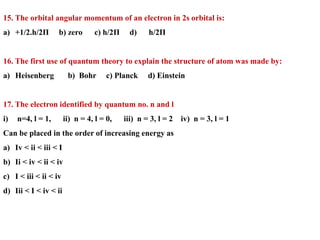
15. The orbital angular momentum of an electron in 2s orbital is:
a) +1/2.h/2Π b) zero c) h/2Π d) h/2Π
16. The first use of quantum theory to explain the structure of atom was made by:
a) Heisenberg b) Bohr c) Planck d) Einstein
17. The electron identified by quantum no. n and l
i) n=4, l = 1, ii) n = 4, l = 0, iii) n = 3, l = 2 iv) n = 3, l = 1
Can be placed in the order of increasing energy as
a) Iv < ii < iii < I
b) Ii < iv < ii < iv
c) I < iii < ii < iv
d) Iii < I < iv < ii
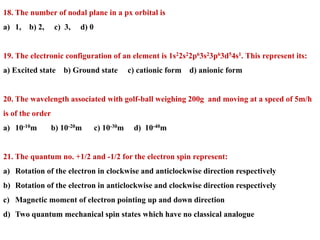
18. The number of nodal plane in a px orbital is
a) 1, b) 2, c) 3, d) 0
19. The electronic configuration of an element is 1s22s22p63s23p63d54s1. This represent its:
a) Excited state b) Ground state c) cationic form d) anionic form
20. The wavelength associated with golf-ball weighing 200g and moving at a speed of 5m/h
is of the order
a) 10-10m b) 10-20m c) 10-30m d) 10-40m
21. The quantum no. +1/2 and -1/2 for the electron spin represent:
a) Rotation of the electron in clockwise and anticlockwise direction respectively
b) Rotation of the electron in anticlockwise and clockwise direction respectively
c) Magnetic moment of electron pointing up and down direction
d) Two quantum mechanical spin states which have no classical analogue
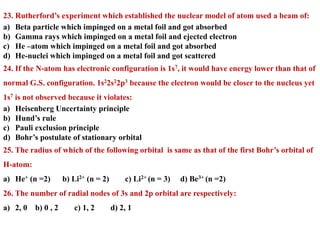
23. Rutherford’s experiment which established the nuclear model of atom used a beam of:
a) Beta particle which impinged on a metal foil and got absorbed
b) Gamma rays which impinged on a metal foil and ejected electron
c) He –atom which impinged on a metal foil and got absorbed
d) He-nuclei which impinged on a metal foil and got scattered
24. If the N-atom has electronic configuration is 1s7, it would have energy lower than that of
normal G.S. configuration. 1s22s22p3 because the electron would be closer to the nucleus yet
1s7 is not observed because it violates:
a) Heisenberg Uncertainty principle
b) Hund’s rule
c) Pauli exclusion principle
d) Bohr’s postulate of stationary orbital
25. The radius of which of the following orbital is same as that of the first Bohr’s orbital of
H-atom:
a) He+ (n =2) b) Li2+ (n = 2) c) Li2+ (n = 3) d) Be3+ (n =2)
26. The number of radial nodes of 3s and 2p orbital are respectively:
a) 2, 0 b) 0 , 2 c) 1, 2 d) 2, 1

Atomic structure presentation

  • 2.
    Terms associated withelements: 1. Isotopes: Atoms having same atomic number of protons but different mass number. e. g. Hydrogen (1H1), Deuterium (1D2) and Tritium (1T3) 2. Isobar: Elements having same mass number. e.g. 19K40 and 20Ca40 3. Isotone: Elements having same number of neutrons. e.g. (6C13) and (7N14) 4. Isoelectronics: Species/elements having same number of electrons. e.g. N3-, O2-, F- 5. Isodiaphers: Elements having different atomic number and mass number but same neutron excess which is the difference between number of neutrons and protons in in the nucleus (N-Z). E. g. 90Th234, 92U238 Th = 234-90 = 144, 144-90 = 54; U = 238-92 = 146, 146-92 = 54 6. Paramagnetic: Species having one or more unpaired electrons. e.g. C, N, O etc. 7. Diamagnetic: Species having no unpaired electrons. e.g. He, Ne, N3-, O2-, F-
  • 3.
    Rutherford’s model: • In1911, Rutherford and coworkers Hans Geiger and Ernest Marsden  alpha source (+)ly charged particles,  gold foil on which alpha particles strike,  ZnS screen enclosed gold foil .
  • 4.
    Observation: • Most ofthe alpha particles went undeflected producing glow after striking with ZnS screen. • Few alpha particles deflected by a small angle from their path. • Very few alpha particles deflected backward. Conclusion: • As gold foil is made up of atom i. e. gold therefore, most of the space in atom is empty. • Atoms have positively charged entities as same charge repel with each other. • Positively charged entity is present as dense mass at the center. This dense mass is very small & is known as nucleus. Size of nucleus = 10-15m, Size of the atom = 10-10m so nucleus is very small as compared to atom. • Dense positively charged mass in the center of atom was called nucleus. • Electron revolve around nucleus in circular path called orbits. • There is electrostatic force of attraction between electron and nucleus.
  • 5.
    Sub atomic particlesof atoms: As atom is made up of three sub – atomic particles: electrons, protons and neutrons Charge of electron = -1.6 * 10-19, Proton = 1.6 * 10-19, neutron = 0
  • 6.
    Electromagnetic spectrum: • Interactionof radiations and metals • Earlier Light as transverse wave and now, light as electromagnetic (EM) wave. Characteristics of EM wave: • Amplitude: maximum displacement from its normal position. • Wavelength (λ): Distance between two crest or two trough. (Å) • Frequency (ν): The number of oscillation any point undergoes per second is called frequency. Cycle/second or s-1 • Wave number (vˉ): no. of wavelength per unit length. (m-1) • Velocity (v): Distance travelled by wave in one second. All EM waves have same speed in vacuum. Denoted by C. C = 3 * 108m/s, C = νλ (relationship between frequency and wavelength) Amplitude
  • 7.
    𝒄 = λ× ν, ν = 𝒄 λ 𝟏 λ = ῡ ν = 𝒄ῡ Most energetic rays are gamma rays as they have high frequency. Because E =hv
  • 8.
    Photoelectric effect: • Instantejection of electrons from a metal surface when a light of a particular frequency/wavelength is incident on it. • Studied two parameters: Frequency related to color of light and intensity related to brightness of light . • The frequency at which photoelectric effect appear known as threshold frequency. (ν0) A particular atom has a particular threshold frequency. • At threshold frequency as the intensity of light increased more number of electrons ejected • Einstein ‘s explanation on the basis of photoelectric effect hν = hν0 + KE (hν0 = ɸ = work function of metal ) KE = hν - hν0
  • 9.
    Atomic spectra: 1. Emissionspectra: The spectrum of radiations emitted by substance that has absorbed energy is called emission spectrum. Atoms or molecules that have absorbed radiations are said to be in excited state. Depending upon the source of radiations, emission spectra are mainly of two types: i) Continuous spectra ii) Line or atomic spectra 2. Absorption spectra:
  • 10.
    Spectral Series ofH – atom:
  • 11.
    Spectrum of H-atom: Explained By Bohr to explain the emission spectra of H – atom. Bohr’s theory provides the energy of an electron at a particular energy level. Thus the energy of an electron in the hydrogen But ΔE = E2 – E1 ∆𝑬 = −𝟐𝝅 𝟐 𝒎𝒆 𝟒 𝒏 𝟐 𝟐 𝒉 𝟐 − ( −𝟐𝝅 𝟐 𝒎𝒆 𝟒 𝒏 𝟏 𝟐 𝒉 𝟐 ) = 𝟐𝝅 𝟐 𝒎𝒆 𝟒 𝒉 𝟐 𝟏 𝒏 𝟏 𝟐 − 𝟏 𝒏 𝟐 𝟐 And because ν = ΔE/h, ∆𝑬 = 𝟐𝝅 𝟐 𝒎𝒆 𝟒 𝒉 𝟐 𝟏 𝒏 𝟏 𝟐 − 𝟏 𝒏 𝟐 𝟐 v = 𝟐𝝅 𝟐 𝒎𝒆 𝟒 𝒉 𝟑 𝟏 𝒏 𝟏 𝟐 − 𝟏 𝒏 𝟐 𝟐 = v = R 𝟏 𝒏 𝟏 𝟐 − 𝟏 𝒏 𝟐 𝟐 (R = Rydberg constant) R = 109677 cm-1 ΔE = hν or, ν = ΔE/h where ν = frequency of emitted light, h = plank constant 𝑬 𝒏 = − 𝟐𝝅 𝟐 𝒎𝒆 𝟒 𝒏 𝟐 𝒉 𝟐
  • 12.
    De – Broglieequation (dual behaviour of matter): Radiations should exhibit particles as well as wave like properties. The wave associated with a particles is called matter wave or de-Broglie wave. According to him: λ= 𝒉 𝒑 = 𝒉 𝒎𝒗 Significance: de – Broglie equation is significant only for microscopic bodies this is because wavelength associated with ordinary object are so short due to their large masses that their wave properties can not be detected. Therefore, these bodies are said to have no wavelength. Heisenberg’s uncertainty principle: It is the result of dual nature of matter and radiations. It is not possible to measure/ determine the exact position and momentum of an electron simultaneously. ∆𝒙 × ∆𝒑 ≥ 𝒉 𝟒𝝅 𝒐𝒓 ∆𝒙 × 𝒎∆𝒗 ≥ 𝒉 𝟒𝝅
  • 13.
    Schrodinger Wave equation(three dimensional): Also known as quantum mechanical model of atom which give picturisation of structure of atom • On the basis of quantum mechanics , Schrodinger proposed a quantum mechanical model of an atom by considering both dual nature of matter and Heisenberg’s uncertainty principle. • The equation given by Erwin Schrodinger to describe the wave motion of the electron in three dimensional space around the nucleus.
  • 14.
    Schrodinger Wave equation(three dimensional): When this equation is solved for ψ, three integer were obtained like n, l, m which are called quantum numbers. Significance of ψ 2 = probability density of finding the electron at any point and that is called orbital. Helps in formation of boundary surface plots. Node: Probability of finding the electron is zero. They can be of two types: Spherical and Angular Nodal plane: The plane which pass from node area. Orbital: The region of space around the nucleus where the probability of finding an electron is maximum (90 – 95%). Node
  • 15.
    Shape of theorbitals: Formula for calculating the radial nodes: n-l-1 • In general, in an orbital: total no. of nodes: n-1 • No. of radial node: n - l - 1
  • 16.
  • 17.
    Quantum numbers: • Valueof l always found to be less than value of n. l = n-1 (type of the orbital), n = 1, l = 0 = s – orbital • ml = - l to + l or (2l + 1) If n = 2, l = 1, ml = -1, 0, +1 • ms = two spin states of elctrons (+1/2 = spin up and -1/2 = spin down)
  • 18.
    Filling of orbitalsin atoms: 1. Aufbau principle: In the ground state of an atom, orbital with lower energy is filled up first before filling of orbitals with higher energy orbitals. The increasing order of energy of various orbitals: 1s, 2s, 2p, 3s, 3p, 4s, 3d, 4p, 5s, 4d, 5p, 6s, 4f, 5d, 6p, 7s, 5f, 6d---- 2. Pauli exclusion principle: An orbital can accommodate a maximum two electrons having opposite spins. 3. Hund’s rule of maximum multiplicity: In ground state electronic configuration of an atom, electron pairing in same orbitals of same energy will not takes place unless al the available orbitals contain one electron with parallel spin
  • 19.
    1. The increasingorder (lower first) for the values of e/m for electron, proton, neutron and α – particles is: a) n, α, p, e b) p, e n, α c) α, n, p, e d) α, e, p, n 2. Which electronic level would allow the hydrogen atom to absorb a photon but not to emit a photon? a) 3s b) 2p c) 2s d) 1s 3. Bohr Model can explain a) The spectrum of H-atom only b) the spectrum of an atom or ion containing one electron only c) The spectrum of hydrogen molecule d) The solar spectrum
  • 20.
    5. Which oneof following set of quantum number represent impossible rearrangement? n l m s a) 3 2 -2 ½ b) 4 0 0 ½ c) 3 2 -3 ½ d) 5 3 0 -1/2 6. The ratio of energy of photon of 2000A wavelength radiations to that of 4000A radiation is: a) ¼ b) 4 c) ½ d) 2 7. The triad of nuclei that are isotonic is: a) 6C14, 7N15, 9F17 b) 6C12, 7N14, 9F19 c) 6C14, 7N14, 6F17 d) 6C14, 7N14, 9F19 8. The wavelength of a spectral line for an electron transition is inversely related to: a) The no. of electron undergoing the transition b) The nuclear charge of the atom c) The difference in the energy of the energy levels involved in transition d) The velocity of the electron undergoing the transition
  • 21.
    9. The orbitaldiagram in which the Aufbau Principle is violated: 10. The outermost electronic configuration of most electronegative element is: a) ns2np3 b) ns2np4 c) ns2np5 ns2np6 11. The correct G. S. electronic configuration of Cr atom is: a) [Ar]3d54s1 b) [Ar]3d44s2 c) [Ar] 3d64s0 d) [Ar]4d55s1
  • 22.
    12. The correctset of quantum numbers for the unpaired electron of Cl atom n l ml a) 2 1 0 b) 2 1 1 c) 3 1 1 d) 3 0 0 13. Which of the followings relate to photon both as wave motion and as a stream of particles? a) Interference b) E = mc2 c) Diffractions d) E= hv 14. A 3p orbital has: a) Two non-spherical nodes b) two spherical nodes c) one spherical and one non spherical node d) one spherical and two non spherical node
  • 23.
    15. The orbitalangular momentum of an electron in 2s orbital is: a) +1/2.h/2Π b) zero c) h/2Π d) h/2Π 16. The first use of quantum theory to explain the structure of atom was made by: a) Heisenberg b) Bohr c) Planck d) Einstein 17. The electron identified by quantum no. n and l i) n=4, l = 1, ii) n = 4, l = 0, iii) n = 3, l = 2 iv) n = 3, l = 1 Can be placed in the order of increasing energy as a) Iv < ii < iii < I b) Ii < iv < ii < iv c) I < iii < ii < iv d) Iii < I < iv < ii
  • 24.
    18. The numberof nodal plane in a px orbital is a) 1, b) 2, c) 3, d) 0 19. The electronic configuration of an element is 1s22s22p63s23p63d54s1. This represent its: a) Excited state b) Ground state c) cationic form d) anionic form 20. The wavelength associated with golf-ball weighing 200g and moving at a speed of 5m/h is of the order a) 10-10m b) 10-20m c) 10-30m d) 10-40m 21. The quantum no. +1/2 and -1/2 for the electron spin represent: a) Rotation of the electron in clockwise and anticlockwise direction respectively b) Rotation of the electron in anticlockwise and clockwise direction respectively c) Magnetic moment of electron pointing up and down direction d) Two quantum mechanical spin states which have no classical analogue
  • 25.
    23. Rutherford’s experimentwhich established the nuclear model of atom used a beam of: a) Beta particle which impinged on a metal foil and got absorbed b) Gamma rays which impinged on a metal foil and ejected electron c) He –atom which impinged on a metal foil and got absorbed d) He-nuclei which impinged on a metal foil and got scattered 24. If the N-atom has electronic configuration is 1s7, it would have energy lower than that of normal G.S. configuration. 1s22s22p3 because the electron would be closer to the nucleus yet 1s7 is not observed because it violates: a) Heisenberg Uncertainty principle b) Hund’s rule c) Pauli exclusion principle d) Bohr’s postulate of stationary orbital 25. The radius of which of the following orbital is same as that of the first Bohr’s orbital of H-atom: a) He+ (n =2) b) Li2+ (n = 2) c) Li2+ (n = 3) d) Be3+ (n =2) 26. The number of radial nodes of 3s and 2p orbital are respectively: a) 2, 0 b) 0 , 2 c) 1, 2 d) 2, 1

Editor's Notes

  • #7 As all the experiment were done on the basis of interaction of radiation and metal. So we should get an idea about the radiation and for that electromagnetic spectrum is necessary. In the starting, light was considered as wave like transverse wave. But now light is considered as EM wave.
  • #9 (less brightness means less intensity and more brightness means more intensity). Threshold frequency should be minimum via threshold wavelength.