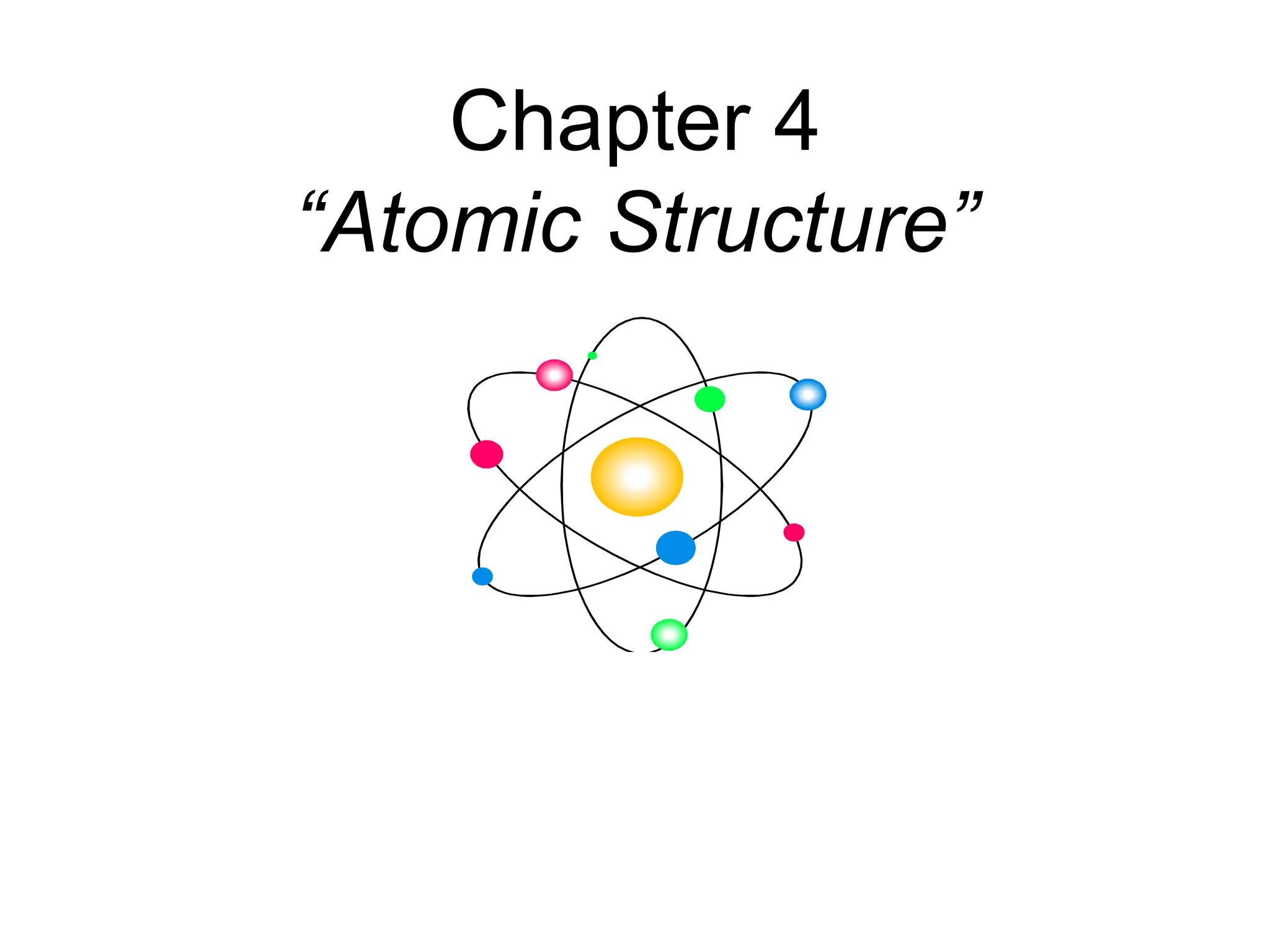
Chapter 4
“Atomic Structure”
• The Greek philosopher Democritus (460
B.C. – 370 B.C.) was among the first to
suggest the existence of atoms (from
the Greek word “atomos”)
– He believed that atoms were indivisible and
indestructible
– His ideas did agree with later scientific
theory, but did not explain chemical
behavior, and was not based on the
scientific method – but just philosophy
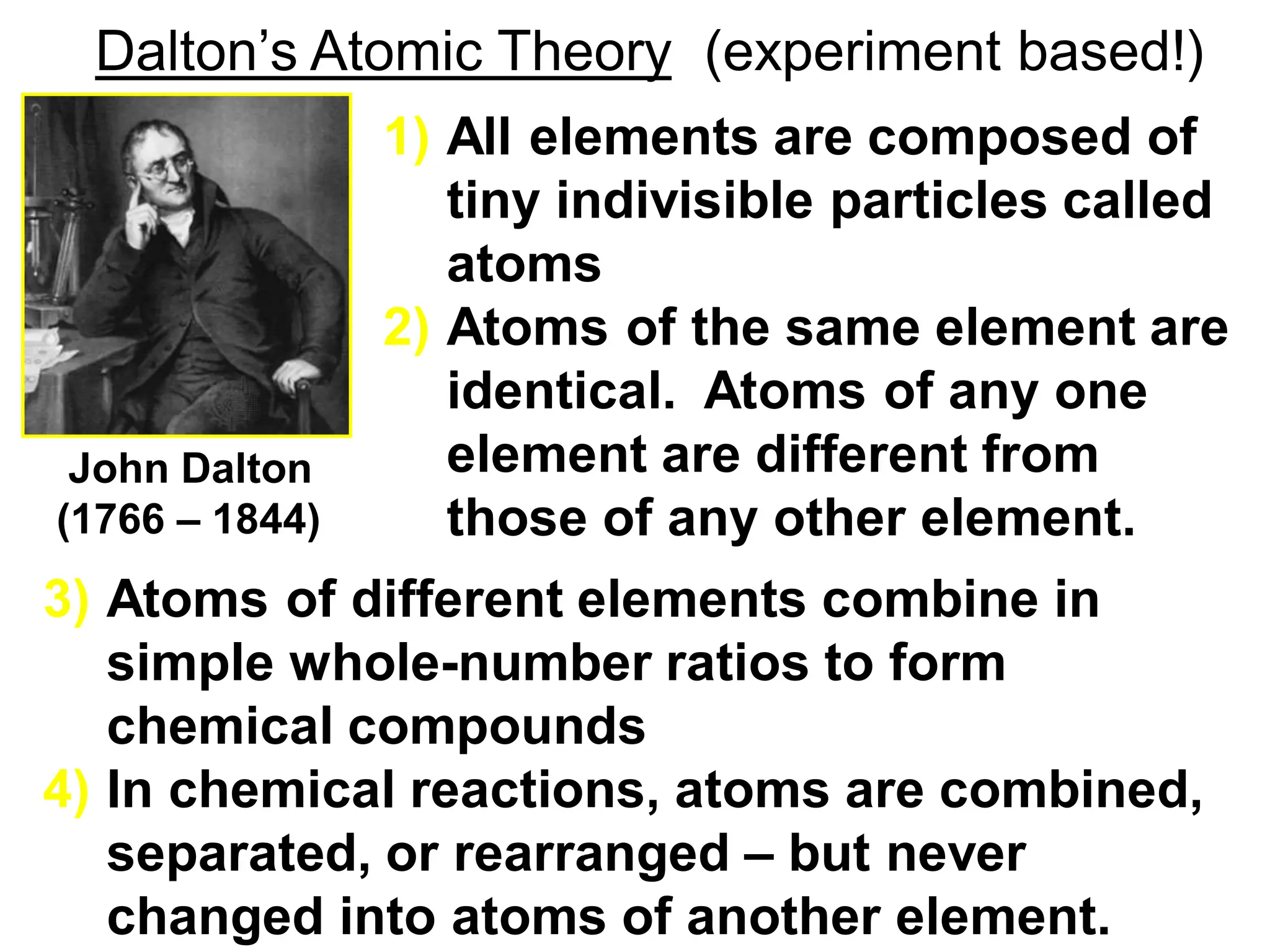
Dalton’s Atomic Theory (experiment based!)
3) Atoms of different elements combine in
simple whole-number ratios to form
chemical compounds
4) In chemical reactions, atoms are combined,
separated, or rearranged – but never
changed into atoms of another element.
1) All elements are composed of
tiny indivisible particles called
atoms
2) Atoms of the same element are
identical. Atoms of any one
element are different from
those of any other element.
John Dalton
(1766 – 1844)
Sizing up the Atom
 Elements are able to be subdivided into
smaller and smaller particles – these are
the atoms, and they still have properties
of that element
If you could line up 100,000,000
copper atoms in a single file, they
would be approximately 1 cm long
Despite their small size, individual
atoms are observable with instruments
such as scanning tunneling (electron)
microscopes
Structure of the Nuclear Atom
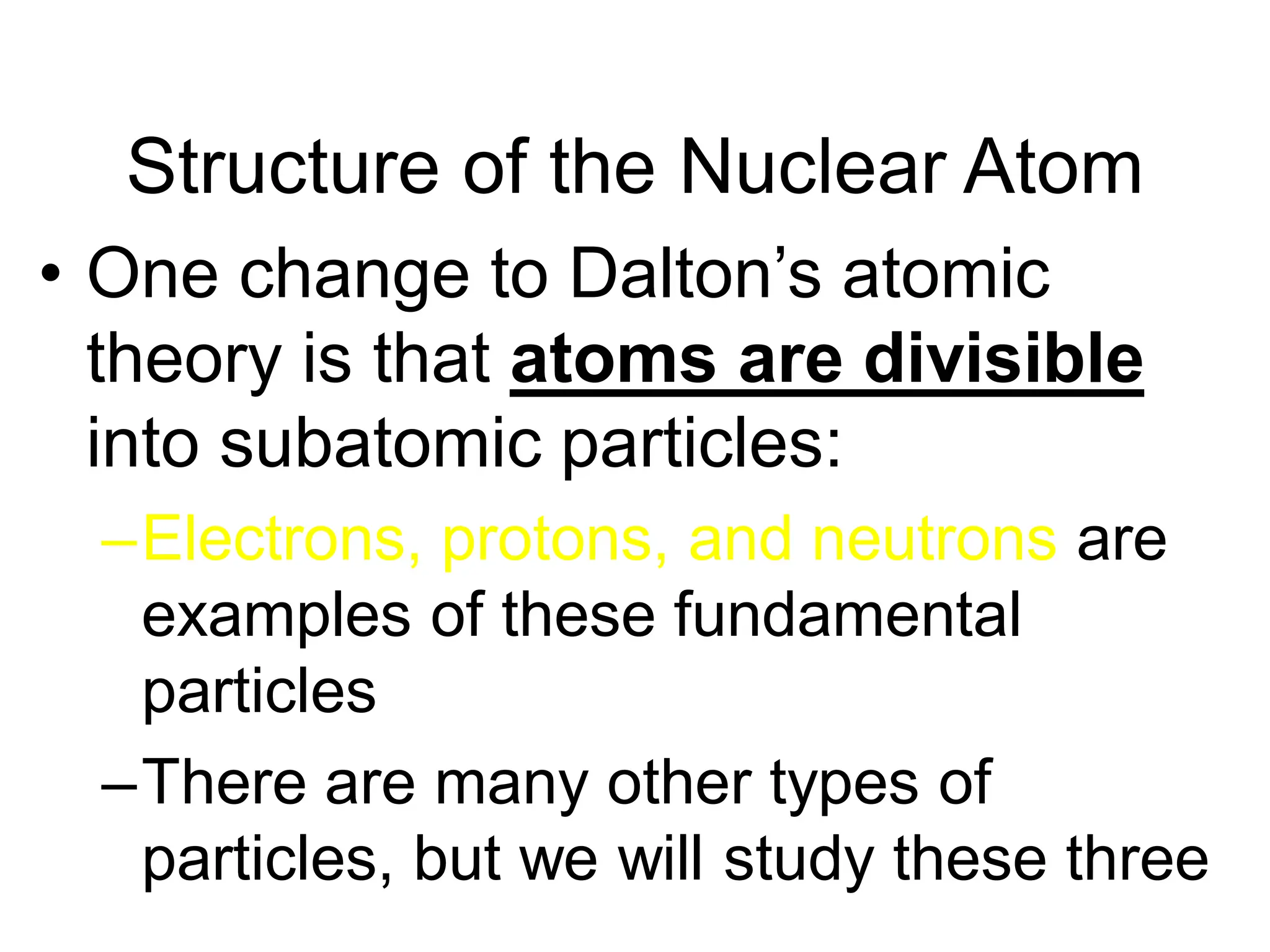
• One change to Dalton’s atomic
theory is that atoms are divisible
into subatomic particles:
–Electrons, protons, and neutrons are
examples of these fundamental
particles
–There are many other types of
particles, but we will study these three
Discovery of the Electron
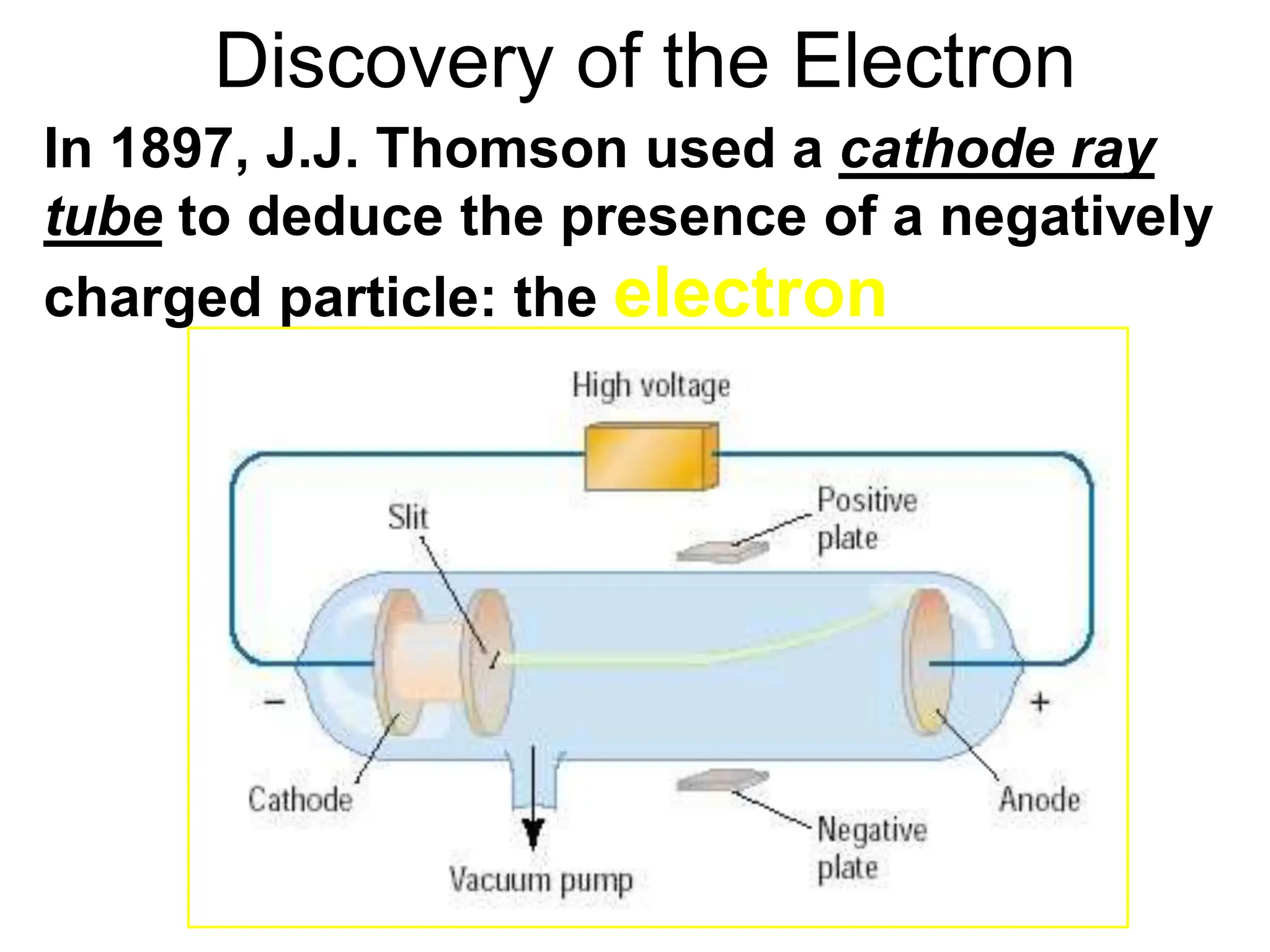
In 1897, J.J. Thomson used a cathode ray
tube to deduce the presence of a negatively
charged particle: the electron
Modern Cathode Ray Tubes
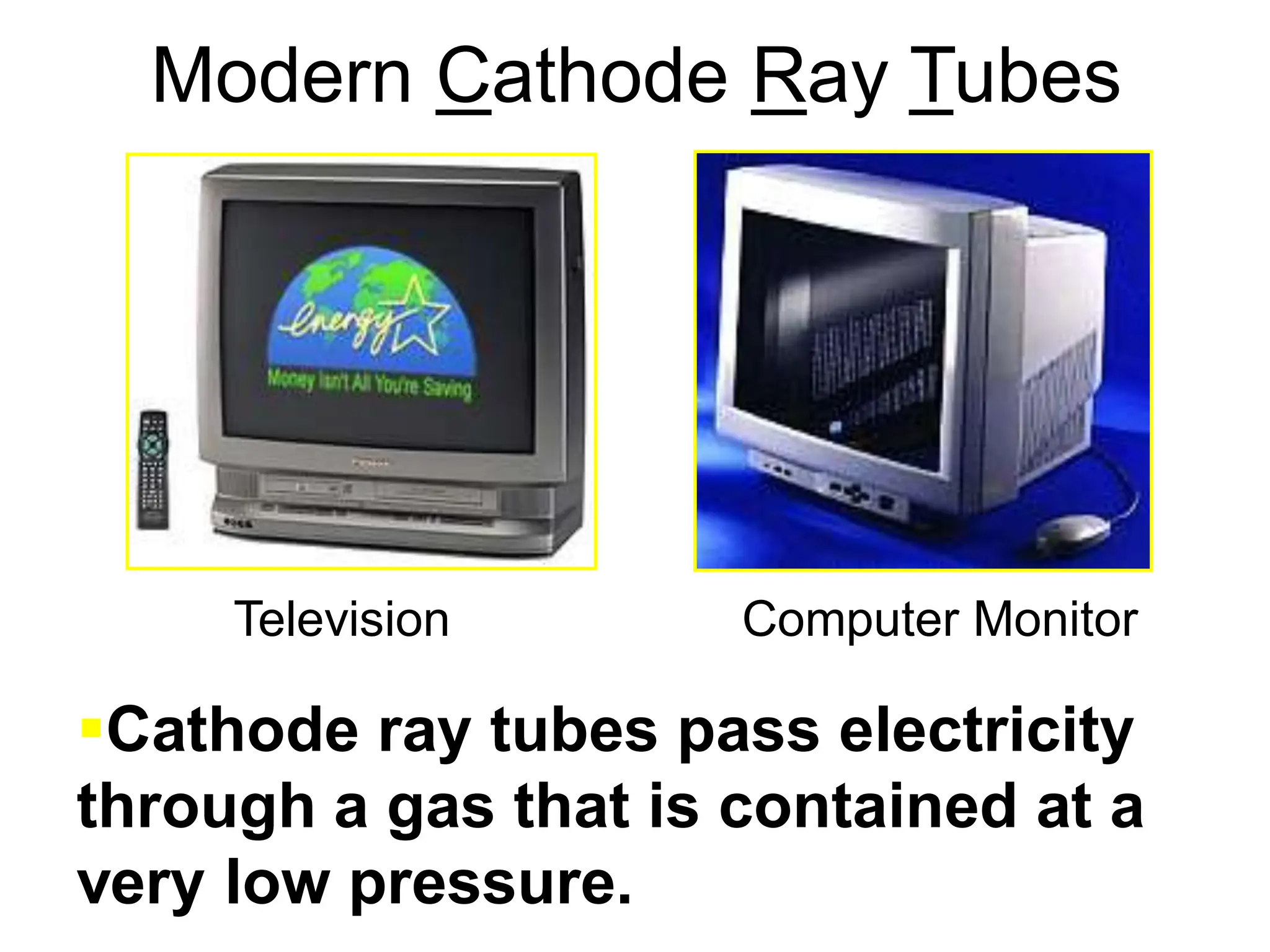
Cathode ray tubes pass electricity
through a gas that is contained at a
very low pressure.
Television Computer Monitor
Mass of the Electron
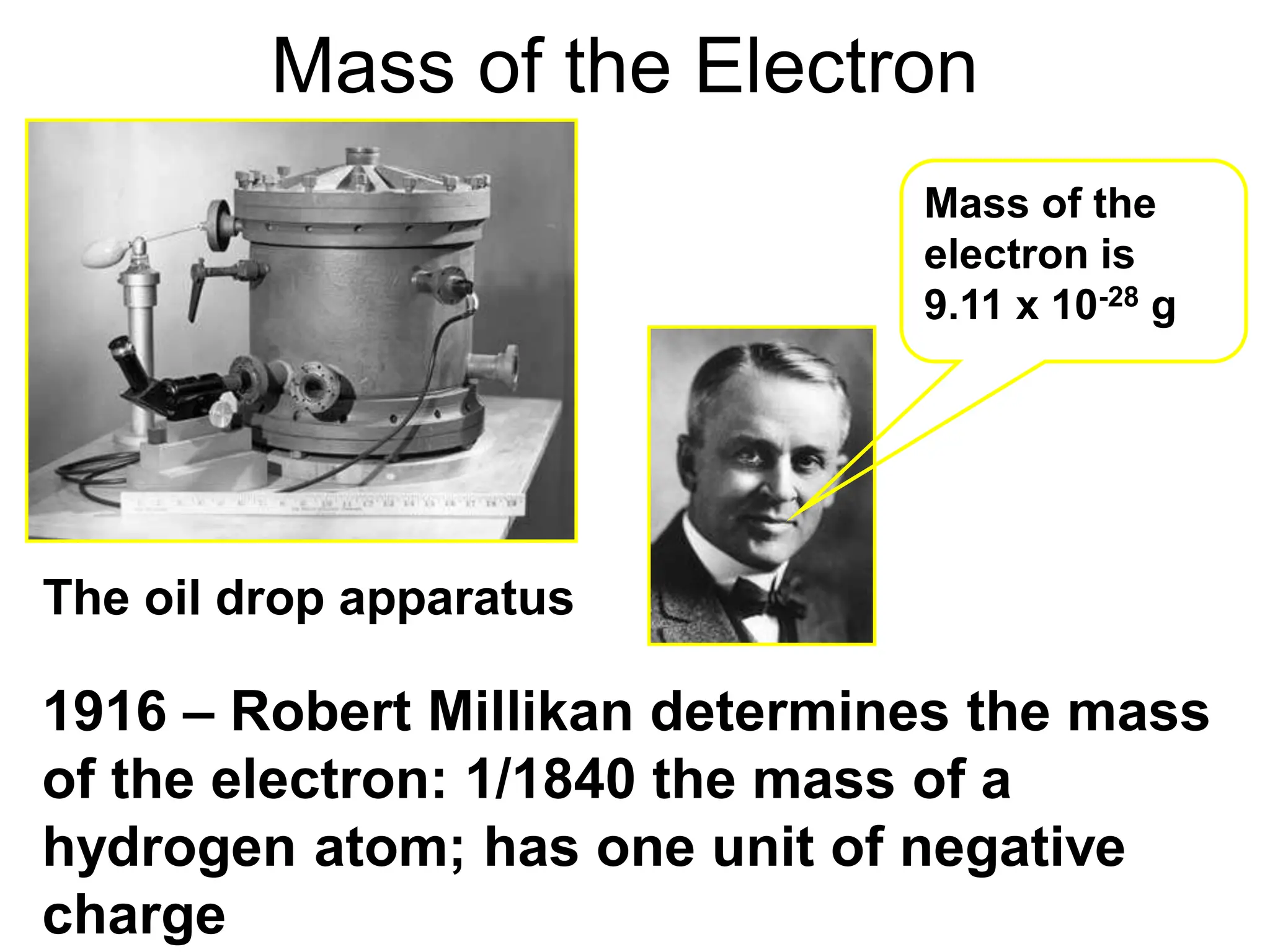
1916 – Robert Millikan determines the mass
of the electron: 1/1840 the mass of a
hydrogen atom; has one unit of negative
charge
The oil drop apparatus
Mass of the
electron is
9.11 x 10⁻²⁸ g
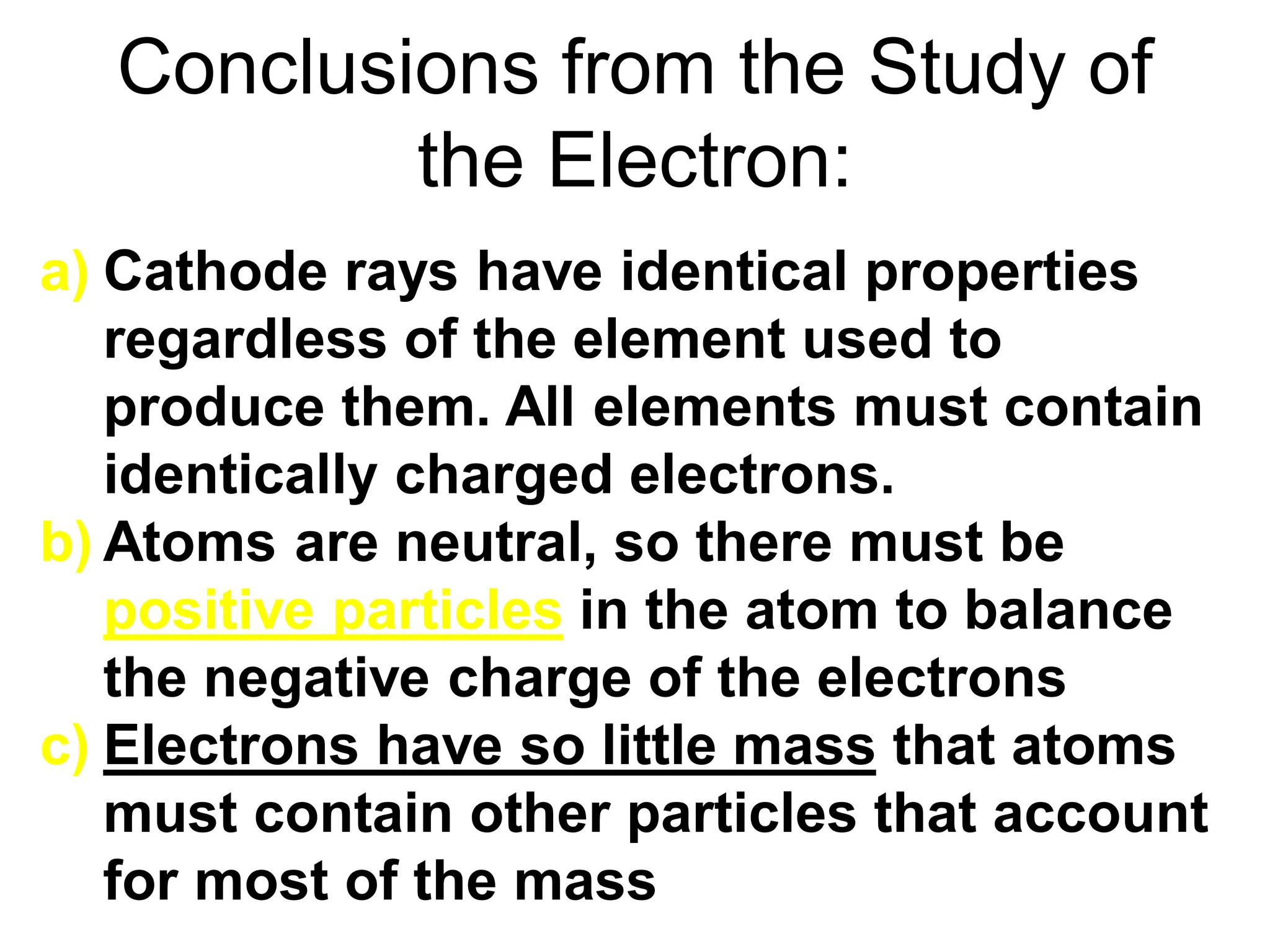
Conclusions from the Study of
the Electron:
a) Cathode rays have identical properties
regardless of the element used to
produce them. All elements must contain
identically charged electrons.
b) Atoms are neutral, so there must be
positive particles in the atom to balance
the negative charge of the electrons
c) Electrons have so little mass that atoms
must contain other particles that account
for most of the mass
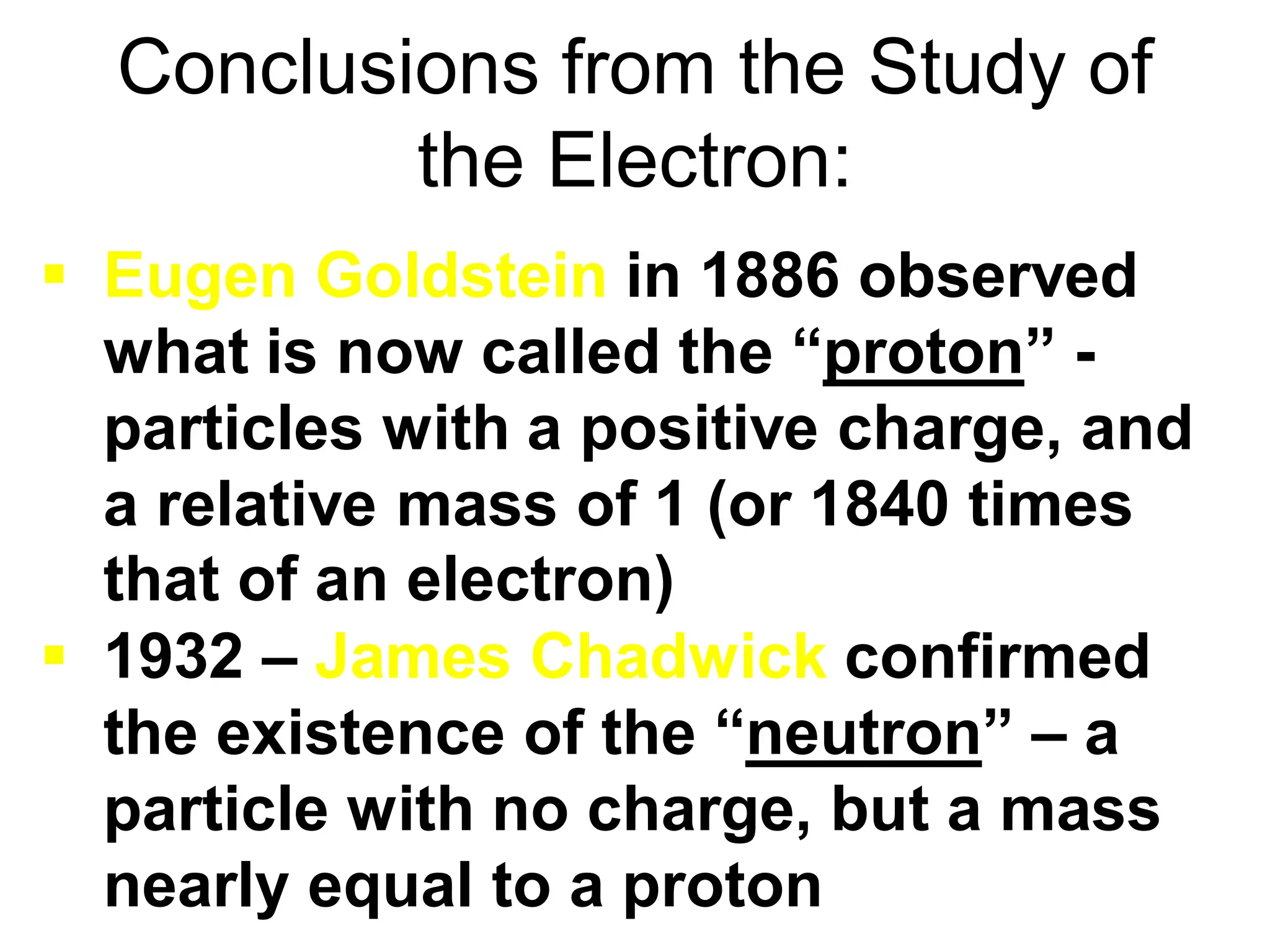
Conclusions from the Study of
the Electron:
 Eugen Goldstein in 1886 observed
what is now called the “proton” -
particles with a positive charge, and
a relative mass of 1 (or 1840 times
that of an electron)
 1932 – James Chadwick confirmed
the existence of the “neutron” – a
particle with no charge, but a mass
nearly equal to a proton
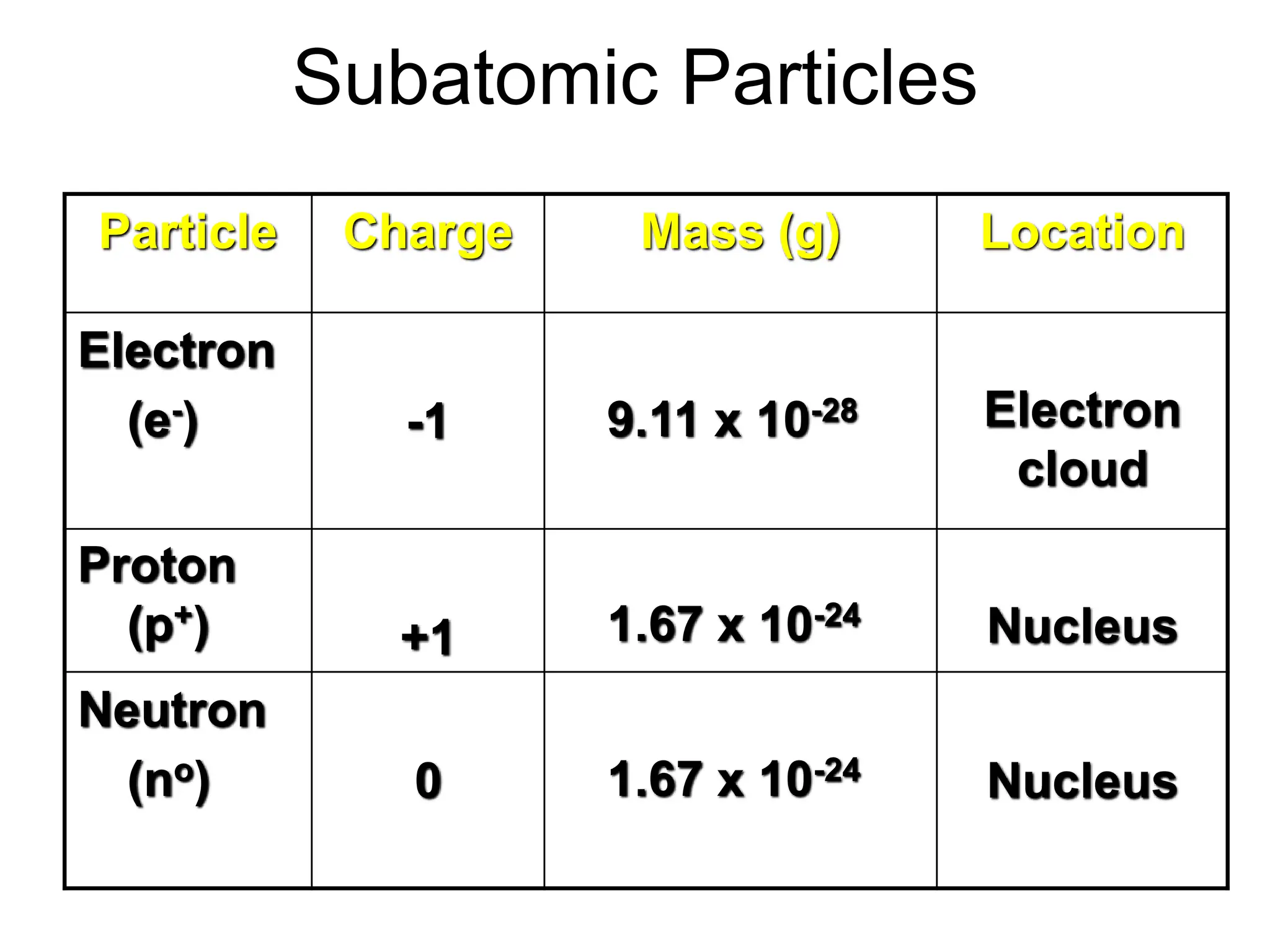
Subatomic Particles
Particle Charge Mass (g) Location
Electron
(e-) -1 9.11 x 10⁻²⁸ Electron
cloud
Proton
(p+) +1 1.67 x 10⁻²⁴
Nucleus
Neutron
(no) 0 1.67 x 10⁻²⁴
Nucleus
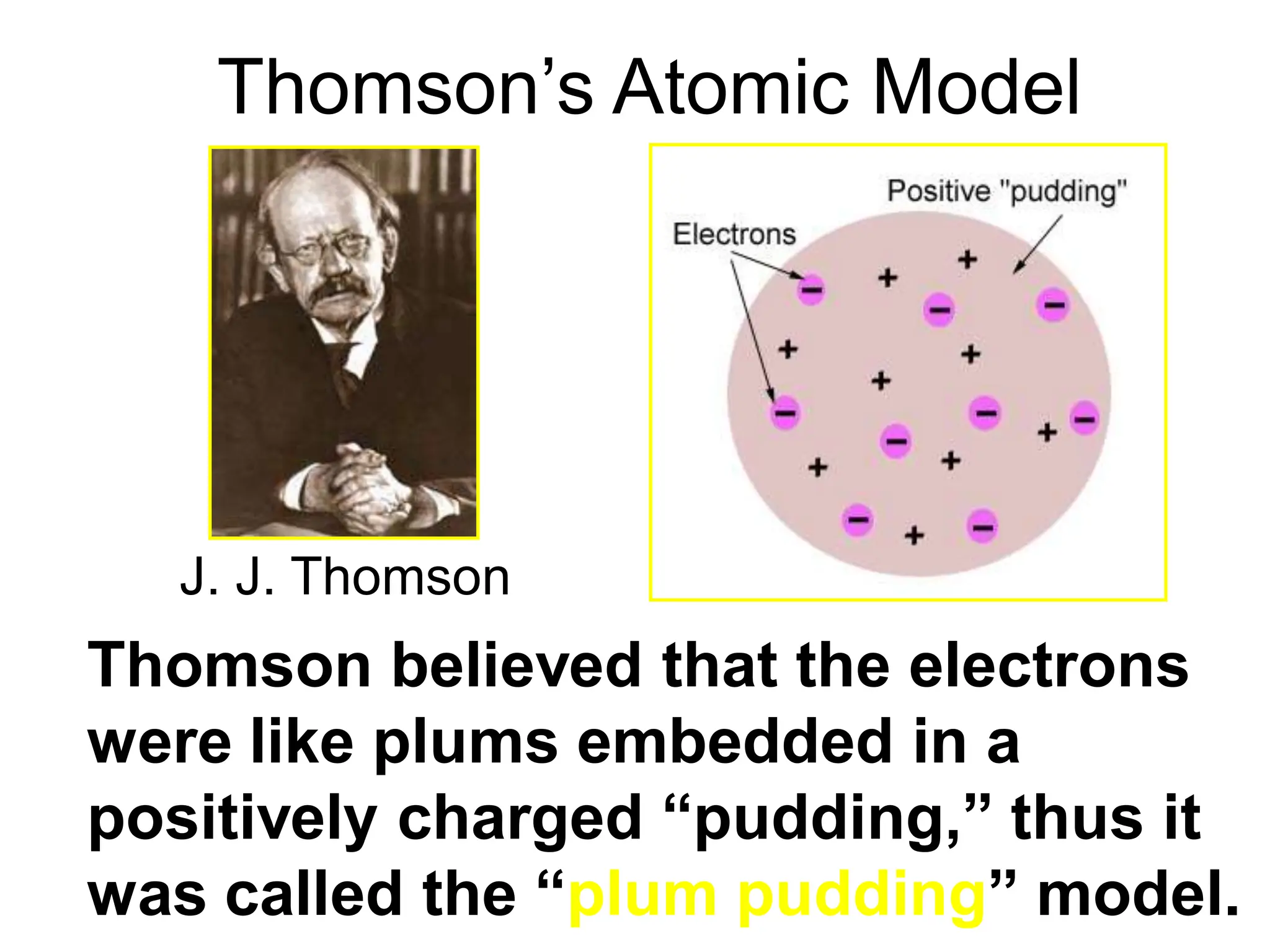
Thomson’s Atomic Model
Thomson believed that the electrons
were like plums embedded in a
positively charged “pudding,” thus it
was called the “plum pudding” model.
J. J. Thomson
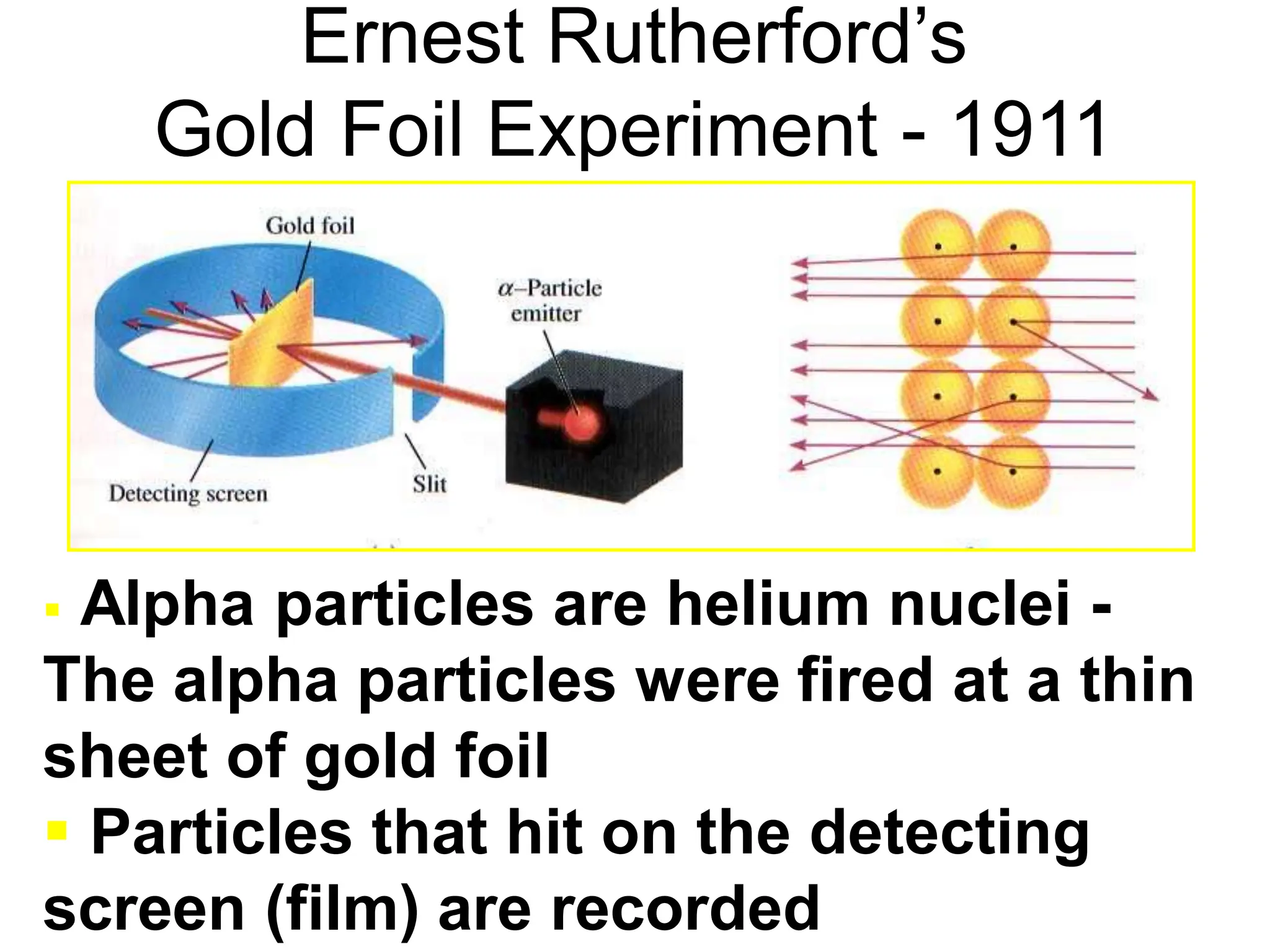
Ernest Rutherford’s
Gold Foil Experiment - 1911
 Alpha particles are helium nuclei -
The alpha particles were fired at a thin
sheet of gold foil
 Particles that hit on the detecting
screen (film) are recorded
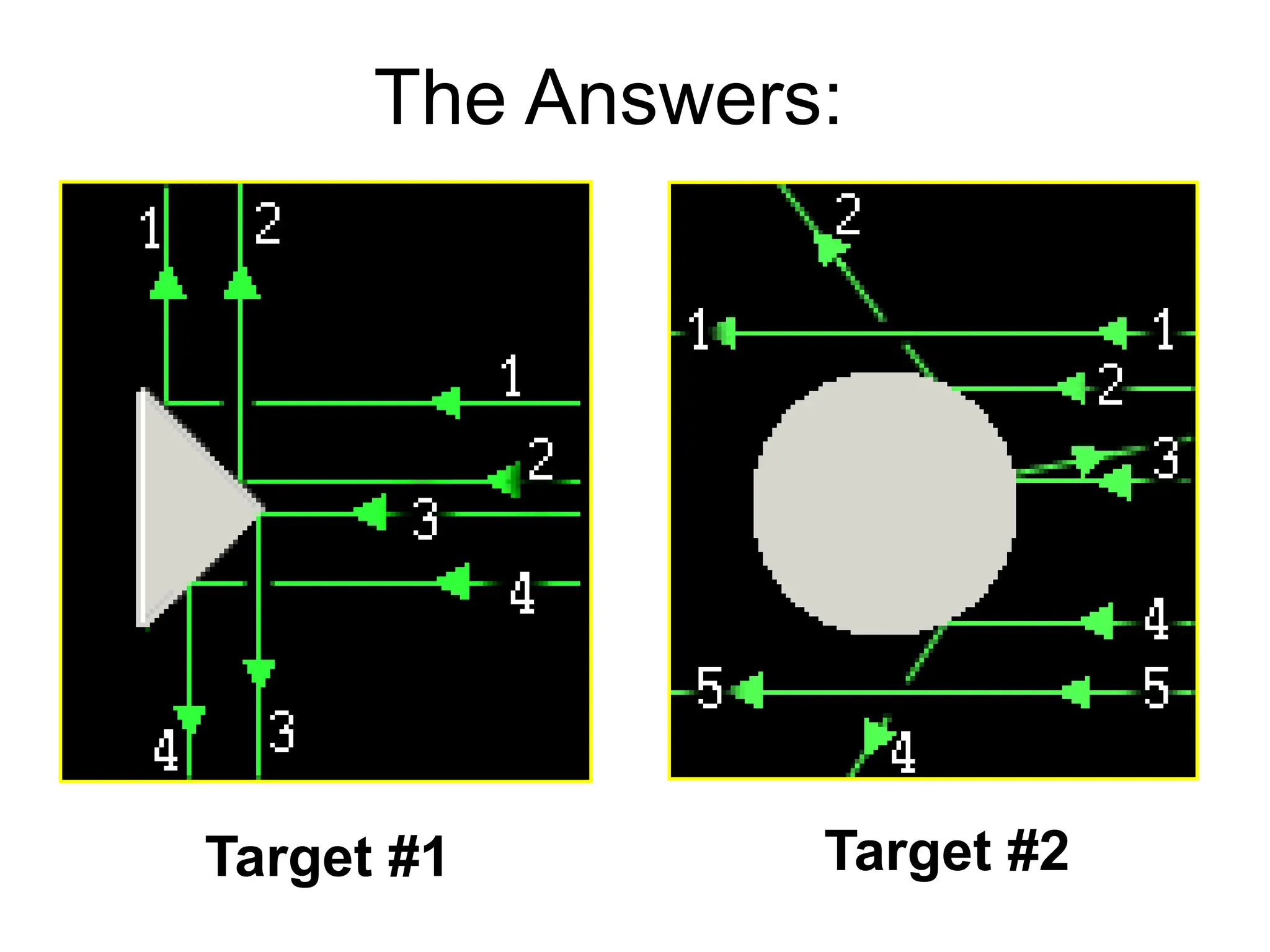
Rutherford’s problem:
In the following pictures, there is a target
hidden by a cloud. To figure out the shape of
the target, we shot some beams into the cloud
and recorded where the beams came out. Can
you figure out the shape of the target?
Target
#1
Target
#2
The Answers:
Target #1 Target #2
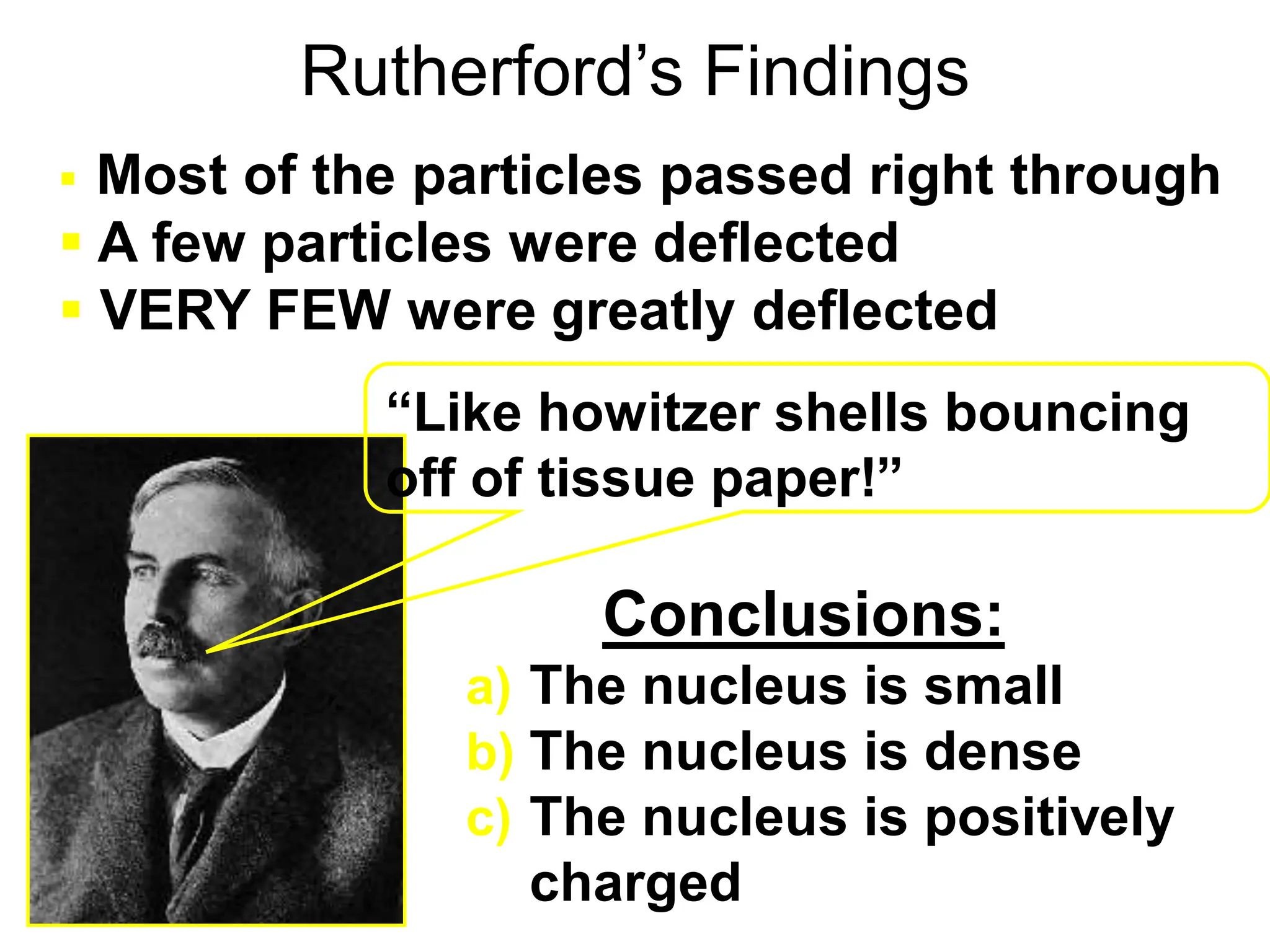
Rutherford’s Findings
a) The nucleus is small
b) The nucleus is dense
c) The nucleus is positively
charged
 Most of the particles passed right through
 A few particles were deflected
 VERY FEW were greatly deflected
“Like howitzer shells bouncing
off of tissue paper!”
Conclusions:
The Rutherford Atomic Model
• Based on his experimental evidence:
–The atom is mostly empty space
–All the positive charge, and almost all
the mass is concentrated in a small area
in the center. He called this a “nucleus”
–The nucleus is composed of protons
and neutrons (they make the nucleus!)
–The electrons distributed around the
nucleus, and occupy most of the volume
–His model was called a “nuclear model”
Atomic Number
• Atoms are composed of identical
protons, neutrons, and electrons
– How then are atoms of one element
different from another element?
• Elements are different because they
contain different numbers of PROTONS
• The “atomic number” of an element is
the number of protons in the nucleus
• # protons in an atom = # electrons
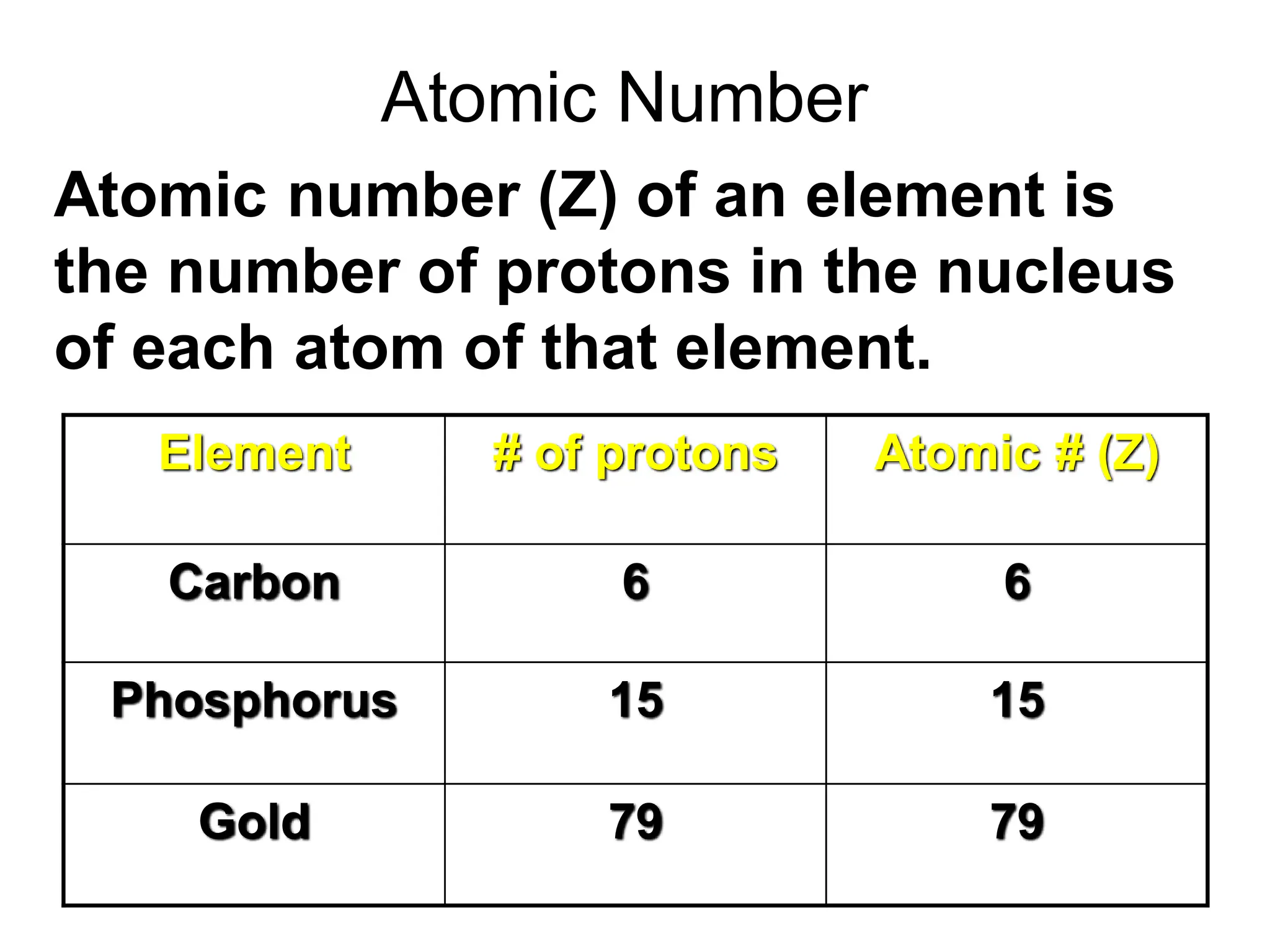
Atomic Number
Atomic number (Z) of an element is
the number of protons in the nucleus
of each atom of that element.
Element # of protons Atomic # (Z)
Carbon 6 6
Phosphorus 15 15
Gold 79 79
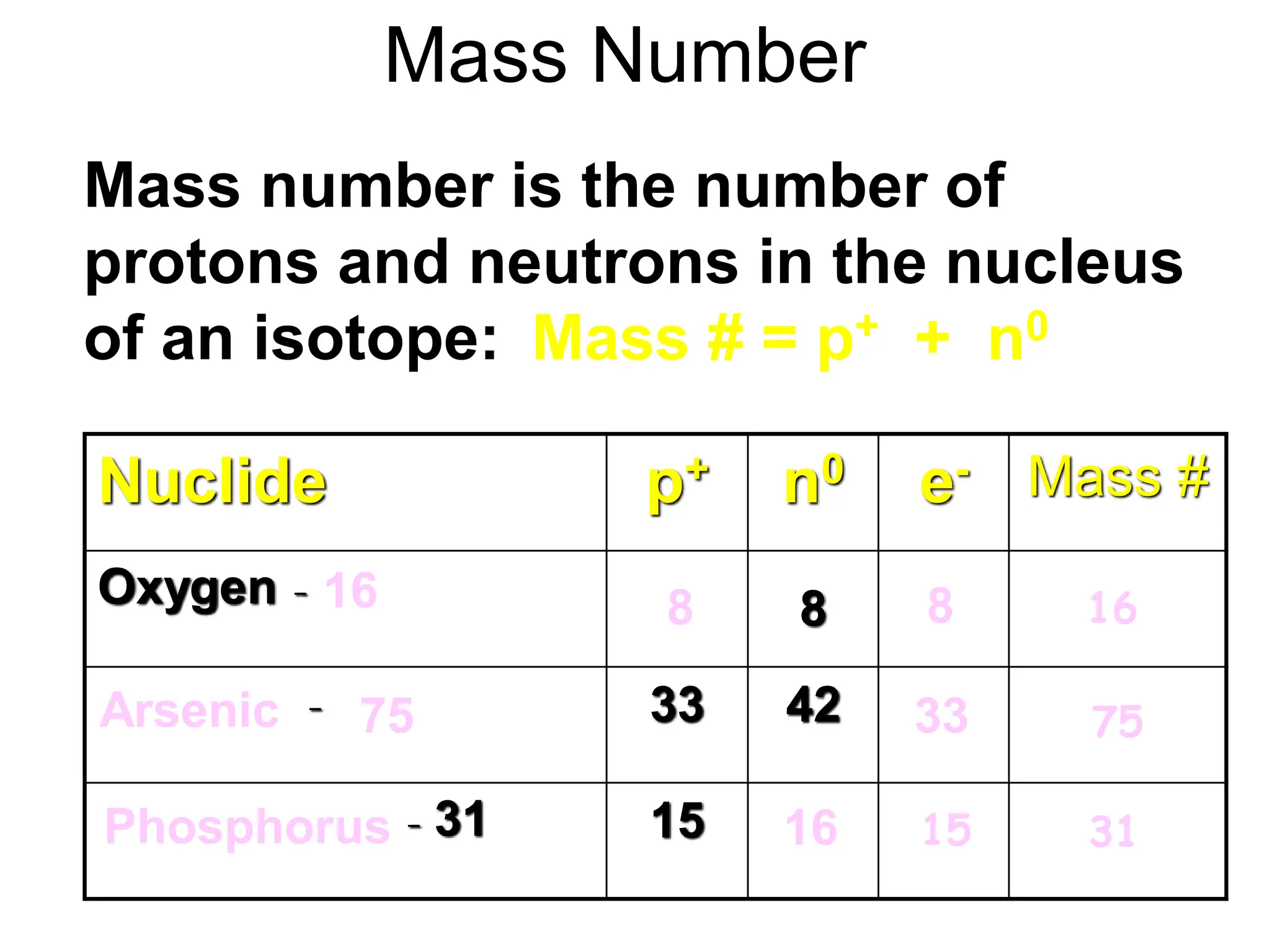
Mass Number
Mass number is the number of
protons and neutrons in the nucleus
of an isotope: Mass # = p+ + n0
Nuclide p+ n0 e- Mass #
Oxygen - 8
- 33 42
- 31 15
8 8 16
16
Arsenic 75 33 75
Phosphorus 15 31
16
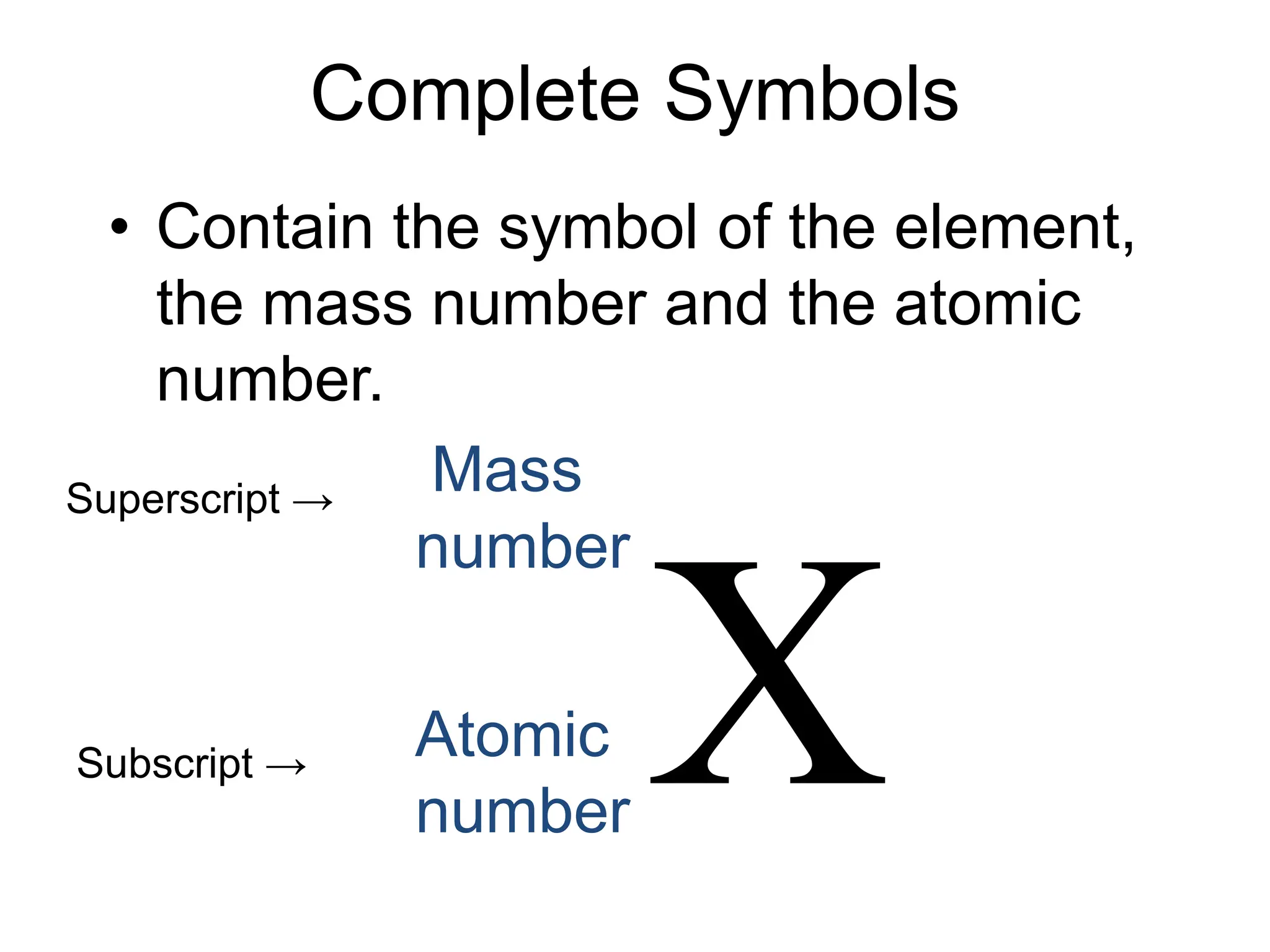
Complete Symbols
• Contain the symbol of the element,
the mass number and the atomic
number.
X
Mass
number
Atomic
number
Subscript →
Superscript →
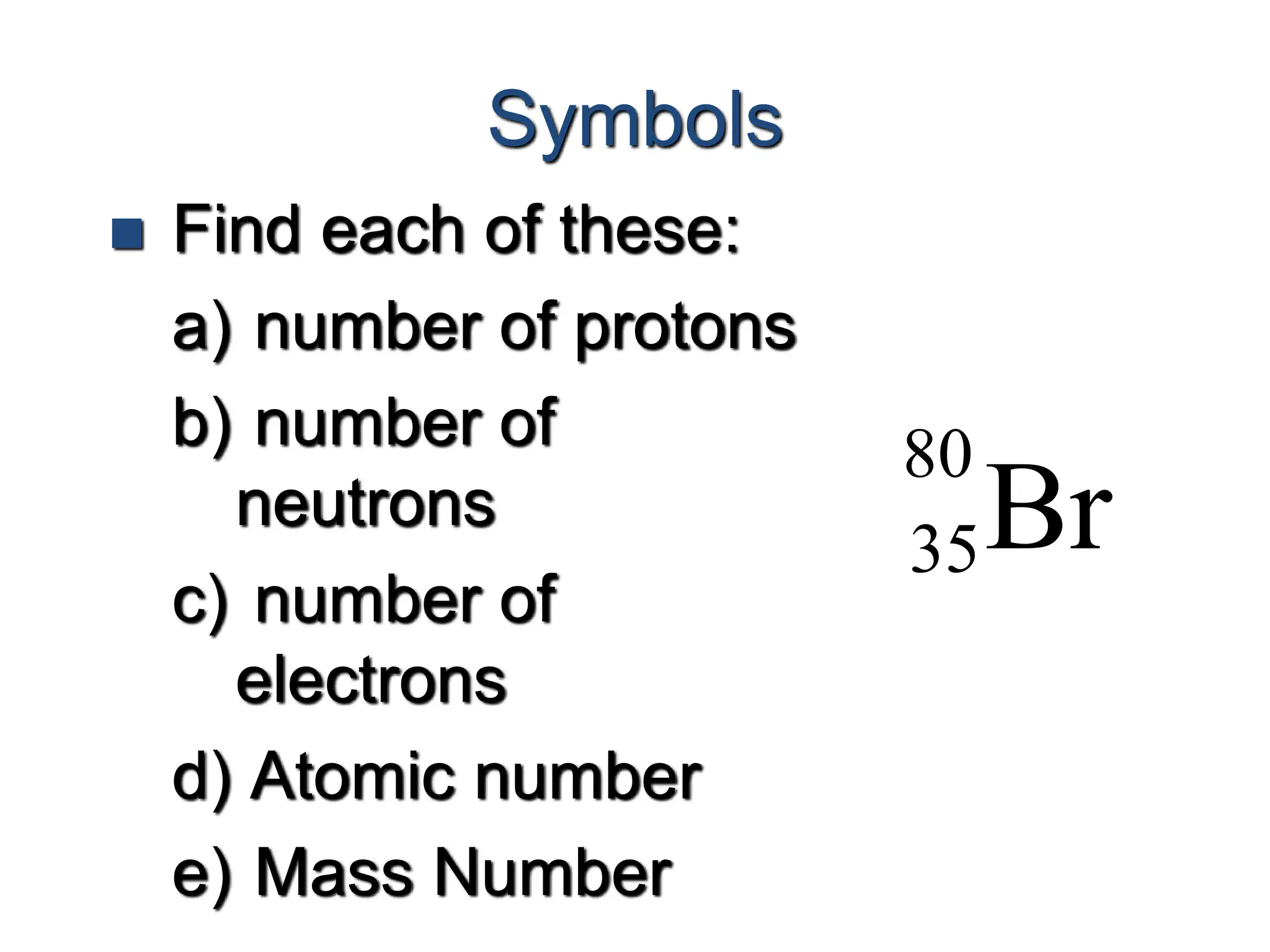
Symbols
 Find each of these:
a) number of protons
b) number of
neutrons
c) number of
electrons
d) Atomic number
e) Mass Number
Br
80
35
Symbols
 If an element has an atomic
number of 34 and a mass
number of 78, what is the:
a) number of protons
b) number of neutrons
c) number of electrons
d) complete symbol
Symbols
 If an element has 91
protons and 140 neutrons
what is the
a) Atomic number
b) Mass number
c) number of electrons
d) complete symbol
Symbols
 If an element has 78
electrons and 117 neutrons
what is the
a) Atomic number
b) Mass number
c) number of protons
d) complete symbol
Isotopes
• Dalton was wrong about all
elements of the same type being
identical
• Atoms of the same element can
have different numbers of
neutrons.
• Thus, different mass numbers.
• These are called isotopes.
Isotopes
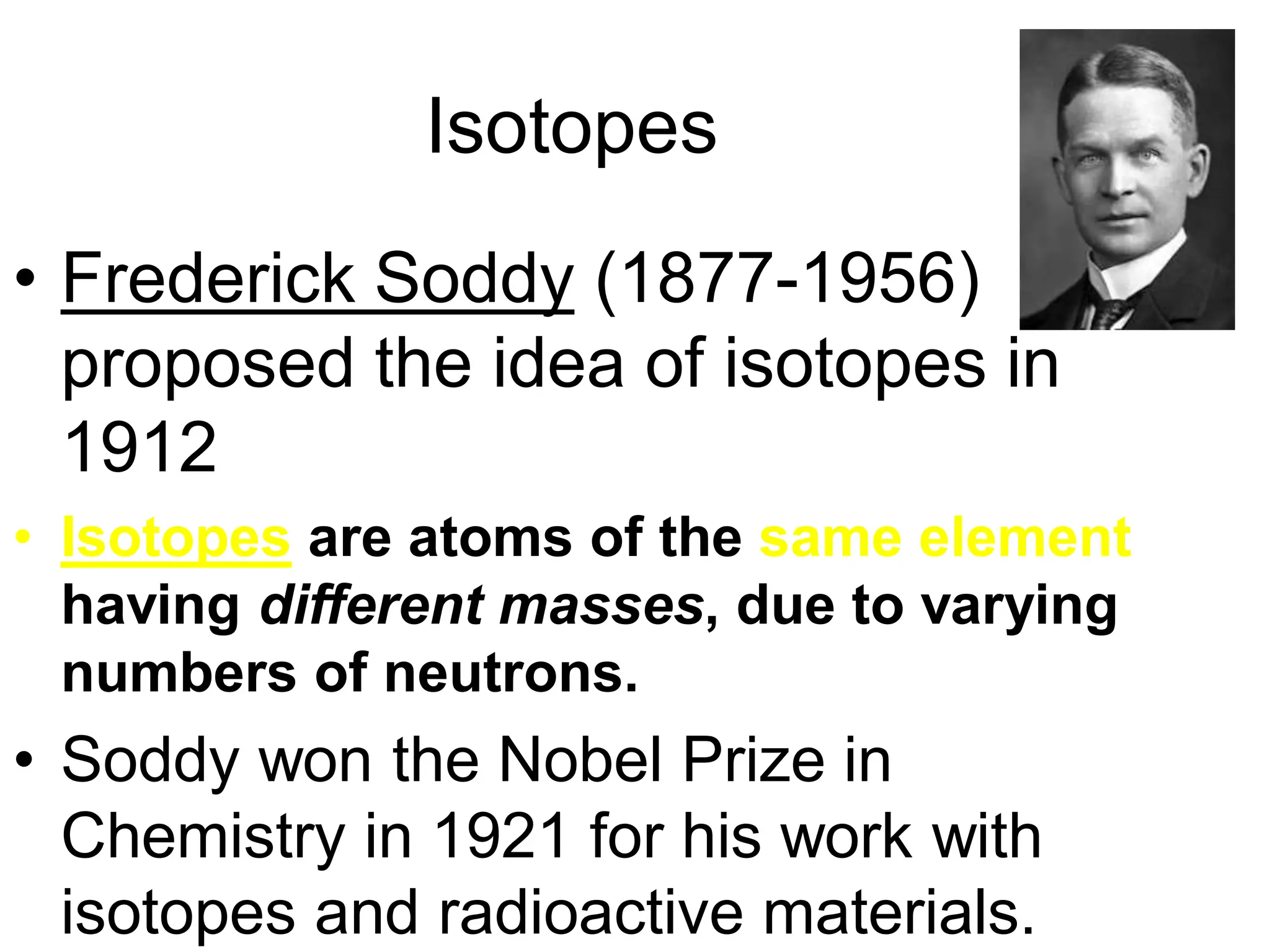
• Frederick Soddy (1877-1956)
proposed the idea of isotopes in
1912
• Isotopes are atoms of the same element
having different masses, due to varying
numbers of neutrons.
• Soddy won the Nobel Prize in
Chemistry in 1921 for his work with
isotopes and radioactive materials.
Naming Isotopes
• We can also put the mass
number after the name of the
element:
–carbon-12
–carbon-14
–uranium-235
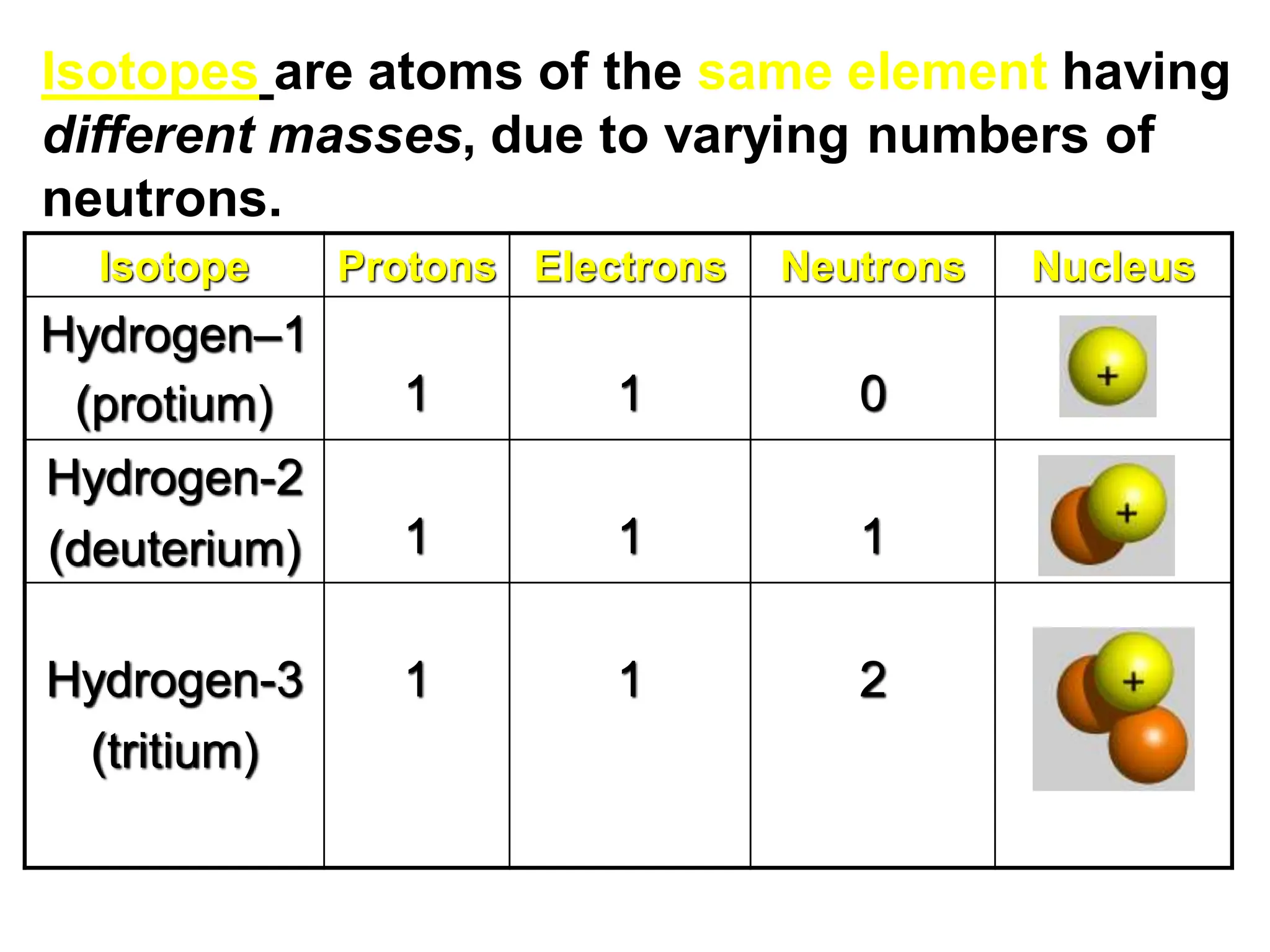
Isotopes are atoms of the same element having
different masses, due to varying numbers of
neutrons.
Isotope Protons Electrons Neutrons Nucleus
Hydrogen–1
(protium) 1 1 0
Hydrogen-2
(deuterium) 1 1 1
Hydrogen-3
(tritium)
1 1 2
Isotopes
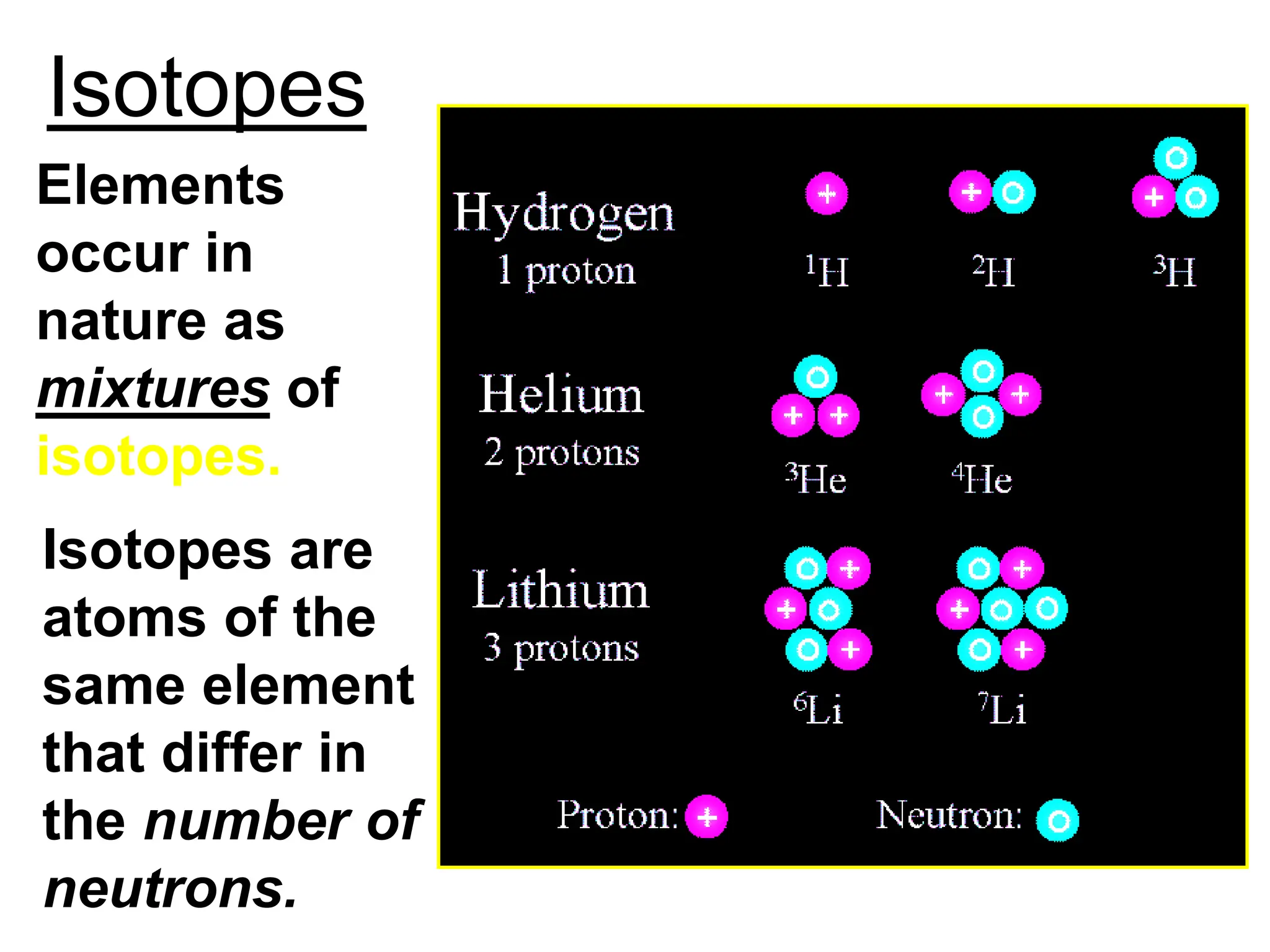
Elements
occur in
nature as
mixtures of
isotopes.
Isotopes are
atoms of the
same element
that differ in
the number of
neutrons.
Atomic Mass
 How heavy is an atom of oxygen?
 It depends, because there are different
kinds of oxygen atoms.
 We are more concerned with the average
atomic mass.
 This is based on the abundance
(percentage) of each variety of that
element in nature.
 We don’t use grams for this mass because
the numbers would be too small.
Measuring Atomic Mass
• Instead of grams, the unit we use
is the Atomic Mass Unit (amu)
• It is defined as one-twelfth the
mass of a carbon-12 atom.
– Carbon-12 chosen because of its isotope purity.
• Each isotope has its own atomic
mass, thus we determine the
average from percent abundance.
To calculate the average:
• Multiply the atomic mass of
each isotope by it’s
abundance (expressed as a
decimal), then add the
results.
• If not told otherwise, the mass of the
isotope is expressed in atomic mass
units (amu)
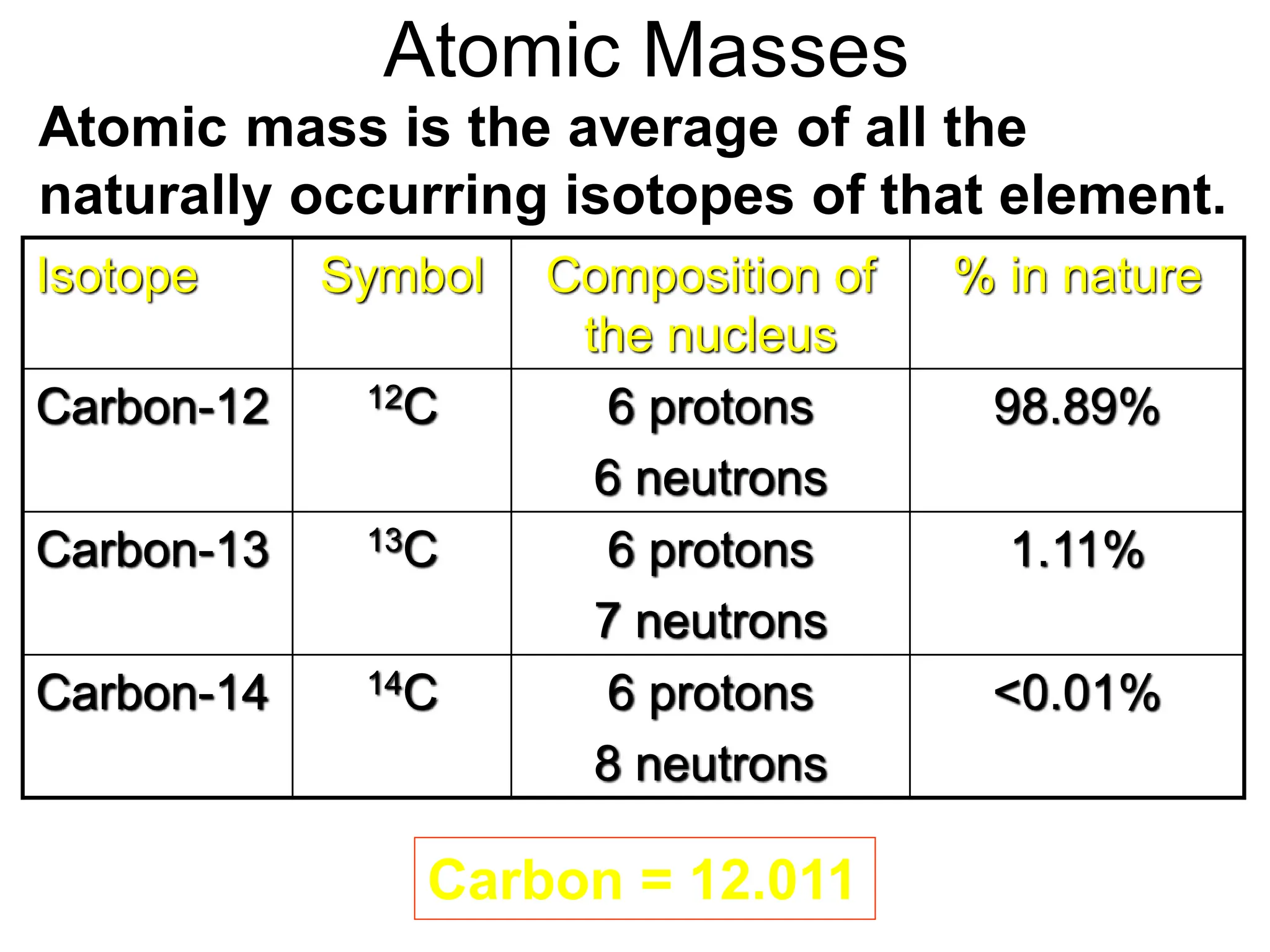
Atomic Masses
Isotope Symbol Composition of
the nucleus
% in nature
Carbon-12 12C 6 protons
6 neutrons
98.89%
Carbon-13 13C 6 protons
7 neutrons
1.11%
Carbon-14 14C 6 protons
8 neutrons
<0.01%
Atomic mass is the average of all the
naturally occurring isotopes of that element.
Carbon = 12.011
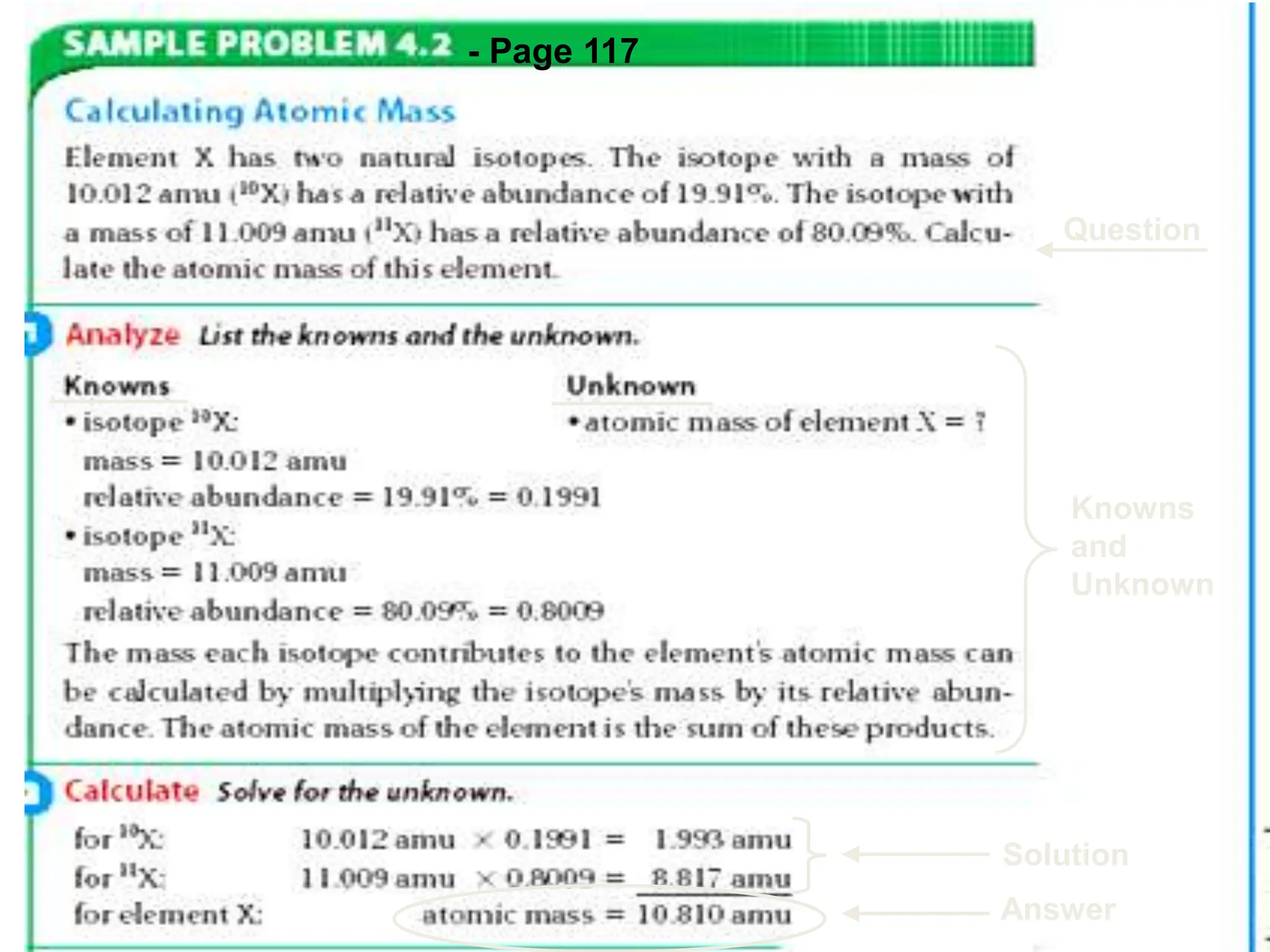
- Page 117
Question
Solution
Answer
Knowns
and
Unknown
The Periodic Table:
A Preview
 A “periodic table” is an
arrangement of elements in which
the elements are separated into
groups based on a set of repeating
properties
The periodic table allows you to
easily compare the properties of
one element to another
The Periodic Table:
A Preview
 Each horizontal row (there are 7 of
them) is called a period
Each vertical column is called a
group, or family
Elements in a group have similar
chemical and physical properties
Identified with a number and
either an “A” or “B”
More presented in Chapter 6
Atomic Structure for educational purposes

  • 1.
  • 2.
    • The Greekphilosopher Democritus (460 B.C. – 370 B.C.) was among the first to suggest the existence of atoms (from the Greek word “atomos”) – He believed that atoms were indivisible and indestructible – His ideas did agree with later scientific theory, but did not explain chemical behavior, and was not based on the scientific method – but just philosophy
  • 3.
    Dalton’s Atomic Theory(experiment based!) 3) Atoms of different elements combine in simple whole-number ratios to form chemical compounds 4) In chemical reactions, atoms are combined, separated, or rearranged – but never changed into atoms of another element. 1) All elements are composed of tiny indivisible particles called atoms 2) Atoms of the same element are identical. Atoms of any one element are different from those of any other element. John Dalton (1766 – 1844)
  • 4.
    Sizing up theAtom  Elements are able to be subdivided into smaller and smaller particles – these are the atoms, and they still have properties of that element If you could line up 100,000,000 copper atoms in a single file, they would be approximately 1 cm long Despite their small size, individual atoms are observable with instruments such as scanning tunneling (electron) microscopes
  • 5.
    Structure of theNuclear Atom • One change to Dalton’s atomic theory is that atoms are divisible into subatomic particles: –Electrons, protons, and neutrons are examples of these fundamental particles –There are many other types of particles, but we will study these three
  • 6.
    Discovery of theElectron In 1897, J.J. Thomson used a cathode ray tube to deduce the presence of a negatively charged particle: the electron
  • 7.
    Modern Cathode RayTubes Cathode ray tubes pass electricity through a gas that is contained at a very low pressure. Television Computer Monitor
  • 8.
    Mass of theElectron 1916 – Robert Millikan determines the mass of the electron: 1/1840 the mass of a hydrogen atom; has one unit of negative charge The oil drop apparatus Mass of the electron is 9.11 x 10⁻²⁸ g
  • 9.
    Conclusions from theStudy of the Electron: a) Cathode rays have identical properties regardless of the element used to produce them. All elements must contain identically charged electrons. b) Atoms are neutral, so there must be positive particles in the atom to balance the negative charge of the electrons c) Electrons have so little mass that atoms must contain other particles that account for most of the mass
  • 10.
    Conclusions from theStudy of the Electron:  Eugen Goldstein in 1886 observed what is now called the “proton” - particles with a positive charge, and a relative mass of 1 (or 1840 times that of an electron)  1932 – James Chadwick confirmed the existence of the “neutron” – a particle with no charge, but a mass nearly equal to a proton
  • 11.
    Subatomic Particles Particle ChargeMass (g) Location Electron (e-) -1 9.11 x 10⁻²⁸ Electron cloud Proton (p+) +1 1.67 x 10⁻²⁴ Nucleus Neutron (no) 0 1.67 x 10⁻²⁴ Nucleus
  • 12.
    Thomson’s Atomic Model Thomsonbelieved that the electrons were like plums embedded in a positively charged “pudding,” thus it was called the “plum pudding” model. J. J. Thomson
  • 13.
    Ernest Rutherford’s Gold FoilExperiment - 1911  Alpha particles are helium nuclei - The alpha particles were fired at a thin sheet of gold foil  Particles that hit on the detecting screen (film) are recorded
  • 14.
    Rutherford’s problem: In thefollowing pictures, there is a target hidden by a cloud. To figure out the shape of the target, we shot some beams into the cloud and recorded where the beams came out. Can you figure out the shape of the target? Target #1 Target #2
  • 15.
  • 16.
    Rutherford’s Findings a) Thenucleus is small b) The nucleus is dense c) The nucleus is positively charged  Most of the particles passed right through  A few particles were deflected  VERY FEW were greatly deflected “Like howitzer shells bouncing off of tissue paper!” Conclusions:
  • 17.
    The Rutherford AtomicModel • Based on his experimental evidence: –The atom is mostly empty space –All the positive charge, and almost all the mass is concentrated in a small area in the center. He called this a “nucleus” –The nucleus is composed of protons and neutrons (they make the nucleus!) –The electrons distributed around the nucleus, and occupy most of the volume –His model was called a “nuclear model”
  • 18.
    Atomic Number • Atomsare composed of identical protons, neutrons, and electrons – How then are atoms of one element different from another element? • Elements are different because they contain different numbers of PROTONS • The “atomic number” of an element is the number of protons in the nucleus • # protons in an atom = # electrons
  • 19.
    Atomic Number Atomic number(Z) of an element is the number of protons in the nucleus of each atom of that element. Element # of protons Atomic # (Z) Carbon 6 6 Phosphorus 15 15 Gold 79 79
  • 20.
    Mass Number Mass numberis the number of protons and neutrons in the nucleus of an isotope: Mass # = p+ + n0 Nuclide p+ n0 e- Mass # Oxygen - 8 - 33 42 - 31 15 8 8 16 16 Arsenic 75 33 75 Phosphorus 15 31 16
  • 21.
    Complete Symbols • Containthe symbol of the element, the mass number and the atomic number. X Mass number Atomic number Subscript → Superscript →
  • 22.
    Symbols  Find eachof these: a) number of protons b) number of neutrons c) number of electrons d) Atomic number e) Mass Number Br 80 35
  • 23.
    Symbols  If anelement has an atomic number of 34 and a mass number of 78, what is the: a) number of protons b) number of neutrons c) number of electrons d) complete symbol
  • 24.
    Symbols  If anelement has 91 protons and 140 neutrons what is the a) Atomic number b) Mass number c) number of electrons d) complete symbol
  • 25.
    Symbols  If anelement has 78 electrons and 117 neutrons what is the a) Atomic number b) Mass number c) number of protons d) complete symbol
  • 26.
    Isotopes • Dalton waswrong about all elements of the same type being identical • Atoms of the same element can have different numbers of neutrons. • Thus, different mass numbers. • These are called isotopes.
  • 27.
    Isotopes • Frederick Soddy(1877-1956) proposed the idea of isotopes in 1912 • Isotopes are atoms of the same element having different masses, due to varying numbers of neutrons. • Soddy won the Nobel Prize in Chemistry in 1921 for his work with isotopes and radioactive materials.
  • 28.
    Naming Isotopes • Wecan also put the mass number after the name of the element: –carbon-12 –carbon-14 –uranium-235
  • 29.
    Isotopes are atomsof the same element having different masses, due to varying numbers of neutrons. Isotope Protons Electrons Neutrons Nucleus Hydrogen–1 (protium) 1 1 0 Hydrogen-2 (deuterium) 1 1 1 Hydrogen-3 (tritium) 1 1 2
  • 30.
    Isotopes Elements occur in nature as mixturesof isotopes. Isotopes are atoms of the same element that differ in the number of neutrons.
  • 31.
    Atomic Mass  Howheavy is an atom of oxygen?  It depends, because there are different kinds of oxygen atoms.  We are more concerned with the average atomic mass.  This is based on the abundance (percentage) of each variety of that element in nature.  We don’t use grams for this mass because the numbers would be too small.
  • 32.
    Measuring Atomic Mass •Instead of grams, the unit we use is the Atomic Mass Unit (amu) • It is defined as one-twelfth the mass of a carbon-12 atom. – Carbon-12 chosen because of its isotope purity. • Each isotope has its own atomic mass, thus we determine the average from percent abundance.
  • 33.
    To calculate theaverage: • Multiply the atomic mass of each isotope by it’s abundance (expressed as a decimal), then add the results. • If not told otherwise, the mass of the isotope is expressed in atomic mass units (amu)
  • 34.
    Atomic Masses Isotope SymbolComposition of the nucleus % in nature Carbon-12 12C 6 protons 6 neutrons 98.89% Carbon-13 13C 6 protons 7 neutrons 1.11% Carbon-14 14C 6 protons 8 neutrons <0.01% Atomic mass is the average of all the naturally occurring isotopes of that element. Carbon = 12.011
  • 35.
  • 36.
    The Periodic Table: APreview  A “periodic table” is an arrangement of elements in which the elements are separated into groups based on a set of repeating properties The periodic table allows you to easily compare the properties of one element to another
  • 37.
    The Periodic Table: APreview  Each horizontal row (there are 7 of them) is called a period Each vertical column is called a group, or family Elements in a group have similar chemical and physical properties Identified with a number and either an “A” or “B” More presented in Chapter 6