INTRODUCTION
• An Indianphilosopher Maharshi Kanad
postulated that matter is made up of tiny
particles known as paramanu
• Ancient Greek philosophers-Democritus and
Leucippus suggested that matter is made of
tiny particles which can not be divisible.
Democritus called these indivisible particles
atoms.
3.
Dalton Postulates
(i) Allmatter is made of very tiny particles called
atoms.
(ii) Atoms are indivisible particles.
(iii) Atoms of different elements have different masses
and chemical properties.
4.
•Based on seriesof experiments like studying
static electricity, it was observed that atoms
are divisible.
•While combing dry hair or rubbing a glass
rod with silk cloth, it was observed that both
the objects become electrically charged. This
indicates that atoms are divisible containing
charged particles
5.
ELECTRONS
• From theCathode Ray Tube experiments, J.J.
Thomson invented the electrons. These are the one of
the constituent particles present in an atom.
• Electrons are indicated with e-
• These are negatively charged. Charge is equal to ‘-1’.
• Mass of electron is negligible. It is approximately equal to
( 1/2000)of a proton.
6.
PROTONS
• In 1886,E. Goldstein discovered the presence of
positively charged particles in atom through Cathode
Ray Tube experiments. These particles are named as
protons.
(i) Protons are indicated with p+
.
(ii) These are positively charged. Charge is equal to
+1.
(iii) Mass of proton is 2000 times to that of electron.
This mass was taken as 1 unit.
7.
NEUTRONS
• In 1932,J. Chadwick discovered another sub atomic
particle known as neutron.
(i) Neutrons are indicated with ‘n’.
(ii) Charge of neutrons is ‘0’.
(iii) Mass of neutron is slightly greater than mass of
proton. It was also taken as one unit.
8.
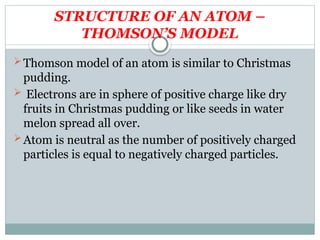
STRUCTURE OF ANATOM –
THOMSON’S MODEL
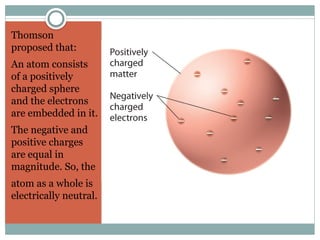
Thomson model of an atom is similar to Christmas
pudding.
Electrons are in sphere of positive charge like dry
fruits in Christmas pudding or like seeds in water
melon spread all over.
Atom is neutral as the number of positively charged
particles is equal to negatively charged particles.
9.
Thomson
proposed that:
An atomconsists
of a positively
charged sphere
and the electrons
are embedded in it.
The negative and
positive charges
are equal in
magnitude. So, the
atom as a whole is
electrically neutral.
10.
Drawbacks
It couldnot explain the results of Rutherford’s α-
ray scattering experiment.
11.
STRUCTURE OF ANATOM –
RUTHERFORD’S MODEL
He selected a gold foil because he wanted as thin a
layer as possible.
α-particles are doubly-charged helium ions. Since
they have a mass of 4 u, the fast-moving a-particles
have a considerable amount of energy.
It was expected that α-particles would be deflected
by the sub-atomic particles in the gold atoms.
Since the α-particles were much heavier than the
protons, he did not expect to see large deflections.
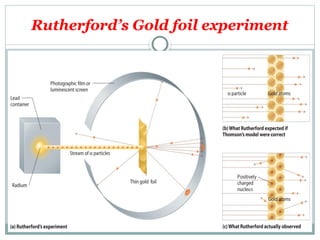
Rutherford’s observations
(i) Mostof the fast moving a-particles passed straight
through the gold foil.
(ii) Some of the a-particles were deflected by the foil by
small angles.
(iii) Surprisingly one out of every 12000 particles
appeared to rebound.
14.
Rutherford’s conclusions
Mostof the space inside the atom is empty because most of
the α- particles passed through the gold foil without getting
deflected.
Very few particles were deflected from their path,
indicating that the positive charge of the atom occupies
very little space.
A very small fraction of a-particles were deflected by 1800
,
indicating that all the positive charge and mass of the gold
atom were concentrated in a very small volume within the
atom.
15.
Rutherford’s nuclear model
Thereis a positively charged centre in an atom called
the nucleus.
Nearly all the mass of an atom resides in the nucleus.
The size of the nucleus is very small as compared to the
size of the atom. It is 1/100000 of size of atom.
The electrons revolve around the nucleus in circular
paths.
16.
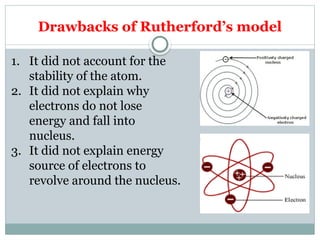
Drawbacks of Rutherford’smodel
1. It did not account for the
stability of the atom.
2. It did not explain why
electrons do not lose
energy and fall into
nucleus.
3. It did not explain energy
source of electrons to
revolve around the nucleus.
17.
Bohr’s model ofan Atom
• Electrons revolve around the nucleus only in certain
circular orbits.
• These circular orbits are known as discrete orbits.
• The energies of these discrete orbits are fixed. Hence
these are also called stationary states or Energy levels
or shells. These are designated by letters K, L, M, N etc
or numbers, n = 1, 2, 3, 4 etc.
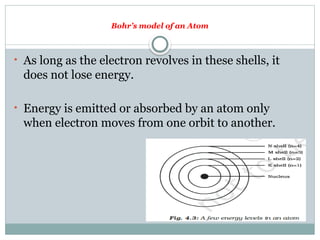
18.
• As longas the electron revolves in these shells, it
does not lose energy.
• Energy is emitted or absorbed by an atom only
when electron moves from one orbit to another.
Bohr’s model of an Atom
19.
Distribution of electronsin different shells
(Bohr-Bury scheme)
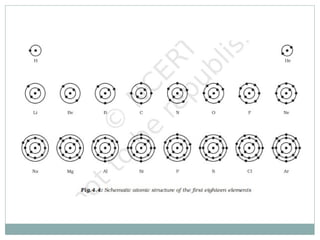
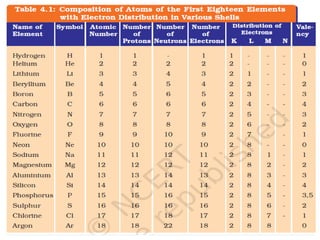
The maximum number of electrons present in a shell
is given by the formula 2n2
, where ‘n’ is the orbit
number or energy level index, 1,2,3,….
20.
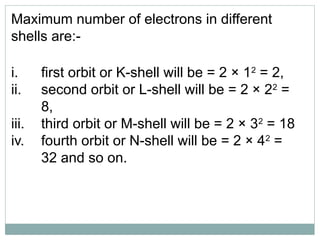
Maximum number ofelectrons in different
shells are:-
i. first orbit or K-shell will be = 2 × 12
= 2,
ii. second orbit or L-shell will be = 2 × 22
=
8,
iii. third orbit or M-shell will be = 2 × 32
= 18
iv. fourth orbit or N-shell will be = 2 × 42
=
32 and so on.
21.
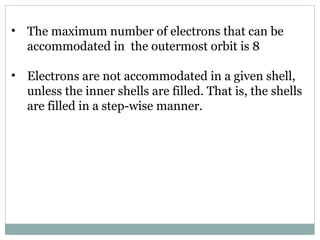
• The maximumnumber of electrons that can be
accommodated in the outermost orbit is 8
• Electrons are not accommodated in a given shell,
unless the inner shells are filled. That is, the shells
are filled in a step-wise manner.
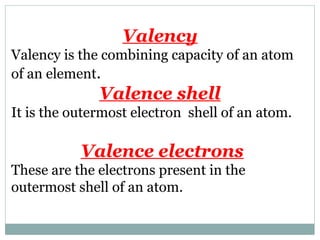
24.
Valency
Valency is thecombining capacity of an atom
of an element.
Valence shell
It is the outermost electron shell of an atom.
Valence electrons
These are the electrons present in the
outermost shell of an atom.
25.
I. Number ofelectrons gained, lost or shared to
possess an octet gives the valency of that atom.
Completely filled outer most shell is called octet.
Helium atom can only accommodate 2 electrons
i.e.duplet.
II. Octet and duplet are highly stable and atoms with
these don't react with other atoms. So they only
exist as monoatom ie gases or inert gases.
26.
Helium is onlyinert gas with two electrons in
its outer most shell.
• Valency of elements having ≤ 4 electrons in
valence shell= No. of valence electrons.
• Valency of elements having > 4 electrons in
valence shell= 8- No. of valence electrons.
27.
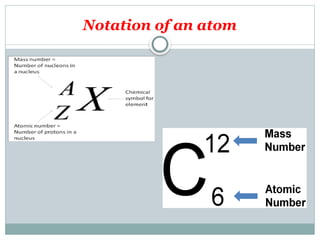
Atomic Number
Atomic number:Atomic number of an element is the
number of protons present in the nucleus of the
atom of that element. It is denoted by ‘Z’. All the
atoms of that element will have the same number of
protons.
Eg:-
Hydrogen(Z) = 1 (1 proton)
Helium (Z) = 2 (2 protons)
Lithium (Z) = 3 (3 protons)
28.
MASS NUMBER
Massnumber(A):Themass number of an element is the sum of the
number of nucleons (protons and neutrons) present in the nucleus of an
atom.
Mass of an atom is almost equal to the mass of the protons and neutrons
in the nucleus of the atom as mass of electrons is negligible as compared
to them.
Eg:-
Carbon –Mass number=12
(6protons+6neutrons) Mass = 12u
Aluminium-Mass number=27
(13protons+14neutrons)Mass= 27u
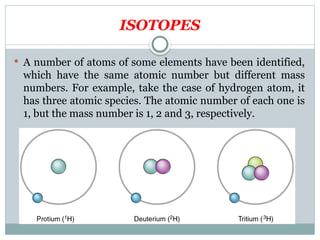
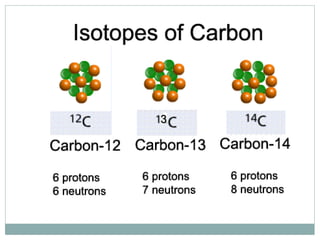
ISOTOPES
A numberof atoms of some elements have been identified,
which have the same atomic number but different mass
numbers. For example, take the case of hydrogen atom, it
has three atomic species. The atomic number of each one is
1, but the mass number is 1, 2 and 3, respectively.
32.
Uses of Isotopes
An isotope of uranium(U-235) is used as a fuel
in nuclear reactors.
An isotope of cobalt( Co-60) is used in the
treatment of cancer.
An isotope of iodine ( I-131)is used in the
treatment of goitre.
33.
ISOBARS
Isobars are atomsof different elements having
different atomic numbers but same mass
numbers.
These pairs of elements have the same number of
nucleons.
Eg:-
Calcium (Ca: Z=20&A=40) and Argon (Z=18 & A=40)
This is due to equal number of nucleons:-
Ca:20 protons + 20 neutrons
Ar:18 protons + 22 neutrons
34.
NOTE
1. The chemicalproperties of Isotopes are similar but their
physical properties are different.(Both atoms are same)
2. The properties of Isobars are different. (Both atoms are
different)
3. Generally we will consider average atomic mass of an
element as it occurs in isotopic forms.
For example, Chlorine occurs in two Isotopic forms i.e. Cl-35
(75%) and Cl-75 ( 25%).Hence It’s average atomic mass is
calculated as 35.5u
[35(75/100) + 37(25/100)] = 35.5

![NOTE
1. The chemical properties of Isotopes are similar but their
physical properties are different.(Both atoms are same)
2. The properties of Isobars are different. (Both atoms are
different)
3. Generally we will consider average atomic mass of an
element as it occurs in isotopic forms.
For example, Chlorine occurs in two Isotopic forms i.e. Cl-35
(75%) and Cl-75 ( 25%).Hence It’s average atomic mass is
calculated as 35.5u
[35(75/100) + 37(25/100)] = 35.5](https://image.slidesharecdn.com/structureofanatom-250816122927-bd56eb4d/85/Atomic-Structure-and-its-various-components-34-320.jpg)