BASICS OF ATOMIC
STRUCTURE
Divya Mariam John
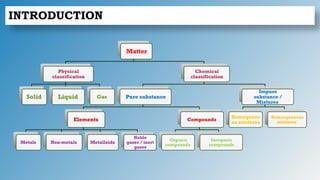
Matter
Physical
classification
Solid Liquid Gas
Chemical
classification
Pure substance
Elements
Metals Non-metals Metalloids
Noble
gases / inert
gases
Compounds
Organic
compounds
Inorganic
compounds
Impure
substance /
Mixtures
Homogeneo
us mixtures
Heterogeneous
mixtures
INTRODUCTION
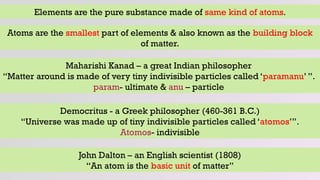
Atoms are the smallest part of elements & also known as the building block
of matter.
Elements are the pure substance made of same kind of atoms.
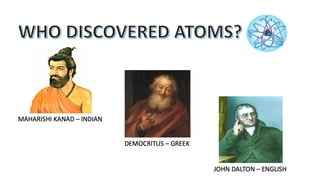
Maharishi Kanad – a great Indian philosopher
“Matter around is made of very tiny indivisible particles called ‘paramanu’ ”.
param- ultimate & anu – particle
Democritus - a Greek philosopher (460-361 B.C.)
“Universe was made up of tiny indivisible particles called ‘atomos’”.
Atomos- indivisible
John Dalton – an English scientist (1808)
“An atom is the basic unit of matter”
DALTON’S ATOMIC THEORY
• An atom is the smallest particle of matter which cannot be divided further into smaller
particles.
• Atoms of the same elements are all identical but they differ from the atoms of other
elements.
• An atom of an element exhibits all the properties of that element.
• Atoms can neither be created nor be destroyed.
• Atoms may or may not have independent existence but they can take place in chemical
reaction.
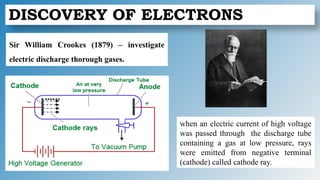
DISCOVERY OF ELECTRONS
Sir William Crookes (1879) – investigate
electric discharge thorough gases.
when an electric current of high voltage
was passed through the discharge tube
containing a gas at low pressure, rays
were emitted from negative terminal
(cathode) called cathode ray.
 Electrons are an integral part of all atoms.
 Its properties are independent of the nature of the gas
in the discharge tube.
 An electron has a definite mass and it carries a definite
electric charge.
 The mass of an electron has been found to be 1/1837 of
the mass of a hydrogen atom (9.108 x 10⁻²⁸g)
 Its charge is one unit negative charge i,e.1.602x 10 ¹
⁻ ⁹C.
J J Thomson (1897) – expt. on cathode ray
 Cathode ray consist of negatively charged
particles called electrons.
₋₁e⁰
charge
mass
DISCOVERY OF PROTONS
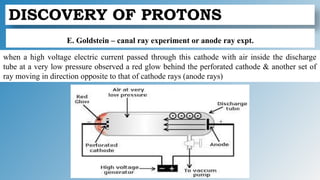
E. Goldstein – canal ray experiment or anode ray expt.
when a high voltage electric current passed through this cathode with air inside the discharge
tube at a very low pressure observed a red glow behind the perforated cathode & another set of
ray moving in direction opposite to that of cathode rays (anode rays)
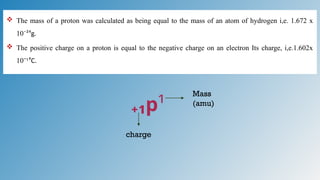
 The mass of a proton was calculated as being equal to the mass of an atom of hydrogen i,e. 1.672 x
10⁻²⁴g.
 The positive charge on a proton is equal to the negative charge on an electron Its charge, i,e.1.602x
10 ¹
⁻ ⁹C.
₊₁p¹
charge
Mass
(amu)
THOMSON’S MODEL OF ATOM
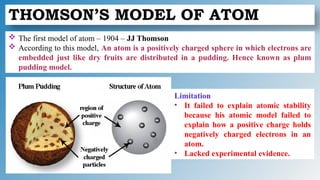
 The first model of atom – 1904 – JJ Thomson
 According to this model, An atom is a positively charged sphere in which electrons are
embedded just like dry fruits are distributed in a pudding. Hence known as plum
pudding model.
Limitation
• It failed to explain atomic stability
because his atomic model failed to
explain how a positive charge holds
negatively charged electrons in an
atom.
• Lacked experimental evidence.
DISCOVERY OF NUCLEUS
Ernest Rutherford- conducted expt. to find the arrangement of electrons and protons in an
atom  led to the discovery of a small positively charged nucleus in the center of atom.
 Expt. – Alpha ray scattering experiment.
 Requirements – radioactive source, gold foil, detecting screen.
Radioactive source produce
alpha particles which are
positively charged with 2 unit
of positive charge & 4 units
of mass.
Gold is the most malleable metal and he
wanted the thinnest layer of metal. The
gold sheet used was around 1000 atoms
thick. Therefore, Rutherford selected a gold
foil in his alpha scattering experiment.
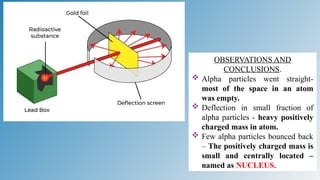
OBSERVATIONS AND
CONCLUSIONS.
 Alpha particles went straight-
most of the space in an atom
was empty.
 Deflection in small fraction of
alpha particles - heavy positively
charged mass in atom.
 Few alpha particles bounced back
– The positively charged mass is
small and centrally located –
named as NUCLEUS.
RUTHERFORD’S MODEL OF ATOM
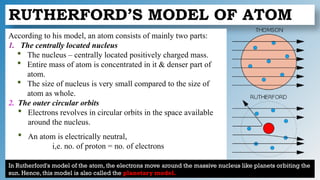
According to his model, an atom consists of mainly two parts:
1. The centrally located nucleus
 The nucleus – centrally located positively charged mass.
 Entire mass of atom is concentrated in it & denser part of
atom.
 The size of nucleus is very small compared to the size of
atom as whole.
2. The outer circular orbits
 Electrons revolves in circular orbits in the space available
around the nucleus.
 An atom is electrically neutral,
i,e. no. of proton = no. of electrons
In Rutherford's model of the atom, the electrons move around the massive nucleus like planets orbiting the
sun. Hence, this model is also called the planetary model.
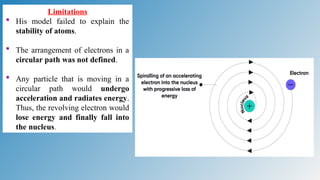
Limitations
 His model failed to explain the
stability of atoms.
 The arrangement of electrons in a
circular path was not defined.
 Any particle that is moving in a
circular path would undergo
acceleration and radiates energy.
Thus, the revolving electron would
lose energy and finally fall into
the nucleus.
BOHR’S MODEL OF ATOM
 Neils Bohr – 1913 – proposed modified version of Rutherford’s atomic model.
Main features
• Electron revolve around the nucleus in
fixed circular orbitals/shells.
• Shells have a fixed size and energy. The
shell nearest to the nucleus has the
minimum energy & farther the energy
increases.
• Bohr labelled the shells as K,L,M,N…
starting from the innermost shell.
DISCOVERY OF NEUTRON
Expt. - Bombarded Beryllium with alpha particles from the natural radioactive decay of Polonium
 James Chadwick – 1932 – discovered Neutron.
Properties
• Mass of neutron – 1.6 72 x 10⁻²⁴g.
• No charge – electrically neutral.
• Atoms of same element may differ in the number of neutrons leading to the formation of isotopes.
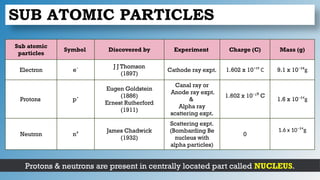
SUB ATOMIC PARTICLES
Sub atomic
particles
Symbol Discovered by Experiment Charge (C) Mass (g)
Electron e⁻
J J Thomson
(1897)
Cathode ray expt. 1.602 x 10¯¹⁹ C 9.1 x 10⁻²⁸g
Protons p⁺
Eugen Goldstein
(1886)
Ernest Rutherford
(1911)
Canal ray or
Anode ray expt.
&
Alpha ray
scattering expt.
1.602 x 10⁻¹ C
⁹
1.6 x 10⁻²⁴g
Neutron n⁰
James Chadwick
(1932)
Scattering expt.
(Bombarding Be
nucleus with
alpha particles)
0
1.6 x 10⁻²⁴g
Protons & neutrons are present in centrally located part called NUCLEUS.
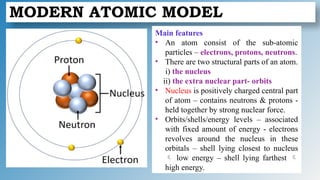
MODERN ATOMIC MODEL
Main features
• An atom consist of the sub-atomic
particles – electrons, protons, neutrons.
• There are two structural parts of an atom.
i) the nucleus
ii) the extra nuclear part- orbits
• Nucleus is positively charged central part
of atom – contains neutrons & protons -
held together by strong nuclear force.
• Orbits/shells/energy levels – associated
with fixed amount of energy - electrons
revolves around the nucleus in these
orbitals – shell lying closest to nucleus
 low energy – shell lying farthest 
high energy.
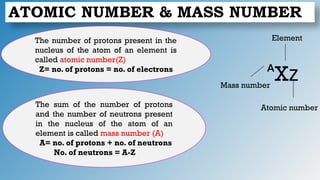
ATOMIC NUMBER & MASS NUMBER
The number of protons present in the
nucleus of the atom of an element is
called atomic number(Z)
Z= no. of protons = no. of electrons
ᴬXⴭ
Atomic number
Mass number
The sum of the number of protons
and the number of neutrons present
in the nucleus of the atom of an
element is called mass number (A)
A= no. of protons + no. of neutrons
No. of neutrons = A-Z
Element
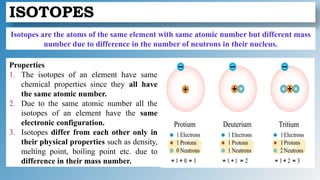
ISOTOPES
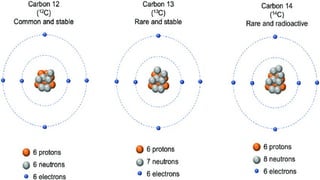
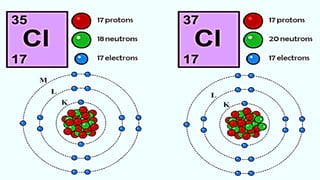
Isotopes are the atoms of the same element with same atomic number but different mass
number due to difference in the number of neutrons in their nucleus.
Properties
1. The isotopes of an element have same
chemical properties since they all have
the same atomic number.
2. Due to the same atomic number all the
isotopes of an element have the same
electronic configuration.
3. Isotopes differ from each other only in
their physical properties such as density,
melting point, boiling point etc. due to
difference in their mass number.
ELECTRONIC CONFIGURATION
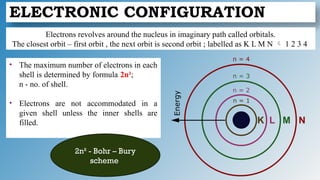
Electrons revolves around the nucleus in imaginary path called orbitals.
The closest orbit – first orbit , the next orbit is second orbit ; labelled as K L M N  1 2 3 4
• The maximum number of electrons in each
shell is determined by formula 2n²;
n - no. of shell.
• Electrons are not accommodated in a
given shell unless the inner shells are
filled.
2n² - Bohr – Bury
scheme
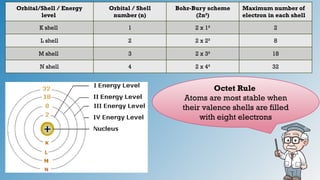
Orbital/Shell / Energy
level
Orbital / Shell
number (n)
Bohr-Bury scheme
(2n²)
Maximum number of
electron in each shell
K shell 1 2 x 1² 2
L shell 2 2 x 2² 8
M shell 3 2 x 3² 18
N shell 4 2 x 4² 32
Octet Rule
Atoms are most stable when
their valence shells are filled
with eight electrons
RADICALS / IONS
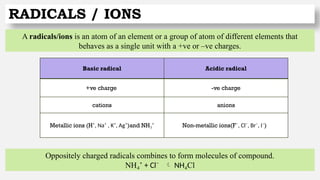
A radicals/ions is an atom of an element or a group of atom of different elements that
behaves as a single unit with a +ve or –ve charges.
Basic radical Acidic radical
+ve charge -ve charge
cations anions
Metallic ions (H⁺, Na⁺ , K⁺, Ag⁺)and NH₃⁺ Non-metallic ions(F⁻, Cl⁻, Br⁻, I⁻)
Oppositely charged radicals combines to form molecules of compound.
NH₄⁺ + Cl⁻  NH Cl
₄
VALANCY & VARIABLE VALANCY
Valancy is the combining capacity of an element or a radicle.
Elements have more than one valency which is known as variable valency.
An element exhibits two different +ve valencies -
Suffix “OUS”- lower valancy
Suffix “IC”- higher valancy
Metal Radical Valency
Iron (Fe)
Ferrous [Fe(II)] – Fe²⁺ 2
Ferric [Fe(III)] – Fe³⁺ 3
Mercury (Hg)
Mercurous [Hg(I)] - Hg⁺ 1
Mercuric [Hg(II)] - Hg²⁺ 2
Tin (Sn)
Stannous [Sn(II)] - Sn²⁺ 2
Stannic [Sn(IV)] – Sn⁴⁺ 4
Atomic structure  & electronic configuration

Atomic structure & electronic configuration

  • 1.
  • 2.
    Matter Physical classification Solid Liquid Gas Chemical classification Puresubstance Elements Metals Non-metals Metalloids Noble gases / inert gases Compounds Organic compounds Inorganic compounds Impure substance / Mixtures Homogeneo us mixtures Heterogeneous mixtures INTRODUCTION
  • 3.
    Atoms are thesmallest part of elements & also known as the building block of matter. Elements are the pure substance made of same kind of atoms. Maharishi Kanad – a great Indian philosopher “Matter around is made of very tiny indivisible particles called ‘paramanu’ ”. param- ultimate & anu – particle Democritus - a Greek philosopher (460-361 B.C.) “Universe was made up of tiny indivisible particles called ‘atomos’”. Atomos- indivisible John Dalton – an English scientist (1808) “An atom is the basic unit of matter”
  • 5.
    DALTON’S ATOMIC THEORY •An atom is the smallest particle of matter which cannot be divided further into smaller particles. • Atoms of the same elements are all identical but they differ from the atoms of other elements. • An atom of an element exhibits all the properties of that element. • Atoms can neither be created nor be destroyed. • Atoms may or may not have independent existence but they can take place in chemical reaction.
  • 6.
    DISCOVERY OF ELECTRONS SirWilliam Crookes (1879) – investigate electric discharge thorough gases. when an electric current of high voltage was passed through the discharge tube containing a gas at low pressure, rays were emitted from negative terminal (cathode) called cathode ray.
  • 7.
     Electrons arean integral part of all atoms.  Its properties are independent of the nature of the gas in the discharge tube.  An electron has a definite mass and it carries a definite electric charge.  The mass of an electron has been found to be 1/1837 of the mass of a hydrogen atom (9.108 x 10⁻²⁸g)  Its charge is one unit negative charge i,e.1.602x 10 ¹ ⁻ ⁹C. J J Thomson (1897) – expt. on cathode ray  Cathode ray consist of negatively charged particles called electrons. ₋₁e⁰ charge mass
  • 8.
    DISCOVERY OF PROTONS E.Goldstein – canal ray experiment or anode ray expt. when a high voltage electric current passed through this cathode with air inside the discharge tube at a very low pressure observed a red glow behind the perforated cathode & another set of ray moving in direction opposite to that of cathode rays (anode rays)
  • 9.
     The massof a proton was calculated as being equal to the mass of an atom of hydrogen i,e. 1.672 x 10⁻²⁴g.  The positive charge on a proton is equal to the negative charge on an electron Its charge, i,e.1.602x 10 ¹ ⁻ ⁹C. ₊₁p¹ charge Mass (amu)
  • 10.
    THOMSON’S MODEL OFATOM  The first model of atom – 1904 – JJ Thomson  According to this model, An atom is a positively charged sphere in which electrons are embedded just like dry fruits are distributed in a pudding. Hence known as plum pudding model. Limitation • It failed to explain atomic stability because his atomic model failed to explain how a positive charge holds negatively charged electrons in an atom. • Lacked experimental evidence.
  • 11.
    DISCOVERY OF NUCLEUS ErnestRutherford- conducted expt. to find the arrangement of electrons and protons in an atom  led to the discovery of a small positively charged nucleus in the center of atom.  Expt. – Alpha ray scattering experiment.  Requirements – radioactive source, gold foil, detecting screen. Radioactive source produce alpha particles which are positively charged with 2 unit of positive charge & 4 units of mass. Gold is the most malleable metal and he wanted the thinnest layer of metal. The gold sheet used was around 1000 atoms thick. Therefore, Rutherford selected a gold foil in his alpha scattering experiment.
  • 12.
    OBSERVATIONS AND CONCLUSIONS.  Alphaparticles went straight- most of the space in an atom was empty.  Deflection in small fraction of alpha particles - heavy positively charged mass in atom.  Few alpha particles bounced back – The positively charged mass is small and centrally located – named as NUCLEUS.
  • 13.
    RUTHERFORD’S MODEL OFATOM According to his model, an atom consists of mainly two parts: 1. The centrally located nucleus  The nucleus – centrally located positively charged mass.  Entire mass of atom is concentrated in it & denser part of atom.  The size of nucleus is very small compared to the size of atom as whole. 2. The outer circular orbits  Electrons revolves in circular orbits in the space available around the nucleus.  An atom is electrically neutral, i,e. no. of proton = no. of electrons In Rutherford's model of the atom, the electrons move around the massive nucleus like planets orbiting the sun. Hence, this model is also called the planetary model.
  • 14.
    Limitations  His modelfailed to explain the stability of atoms.  The arrangement of electrons in a circular path was not defined.  Any particle that is moving in a circular path would undergo acceleration and radiates energy. Thus, the revolving electron would lose energy and finally fall into the nucleus.
  • 15.
    BOHR’S MODEL OFATOM  Neils Bohr – 1913 – proposed modified version of Rutherford’s atomic model. Main features • Electron revolve around the nucleus in fixed circular orbitals/shells. • Shells have a fixed size and energy. The shell nearest to the nucleus has the minimum energy & farther the energy increases. • Bohr labelled the shells as K,L,M,N… starting from the innermost shell.
  • 16.
    DISCOVERY OF NEUTRON Expt.- Bombarded Beryllium with alpha particles from the natural radioactive decay of Polonium  James Chadwick – 1932 – discovered Neutron. Properties • Mass of neutron – 1.6 72 x 10⁻²⁴g. • No charge – electrically neutral. • Atoms of same element may differ in the number of neutrons leading to the formation of isotopes.
  • 17.
    SUB ATOMIC PARTICLES Subatomic particles Symbol Discovered by Experiment Charge (C) Mass (g) Electron e⁻ J J Thomson (1897) Cathode ray expt. 1.602 x 10¯¹⁹ C 9.1 x 10⁻²⁸g Protons p⁺ Eugen Goldstein (1886) Ernest Rutherford (1911) Canal ray or Anode ray expt. & Alpha ray scattering expt. 1.602 x 10⁻¹ C ⁹ 1.6 x 10⁻²⁴g Neutron n⁰ James Chadwick (1932) Scattering expt. (Bombarding Be nucleus with alpha particles) 0 1.6 x 10⁻²⁴g Protons & neutrons are present in centrally located part called NUCLEUS.
  • 18.
    MODERN ATOMIC MODEL Mainfeatures • An atom consist of the sub-atomic particles – electrons, protons, neutrons. • There are two structural parts of an atom. i) the nucleus ii) the extra nuclear part- orbits • Nucleus is positively charged central part of atom – contains neutrons & protons - held together by strong nuclear force. • Orbits/shells/energy levels – associated with fixed amount of energy - electrons revolves around the nucleus in these orbitals – shell lying closest to nucleus  low energy – shell lying farthest  high energy.
  • 19.
    ATOMIC NUMBER &MASS NUMBER The number of protons present in the nucleus of the atom of an element is called atomic number(Z) Z= no. of protons = no. of electrons ᴬXⴭ Atomic number Mass number The sum of the number of protons and the number of neutrons present in the nucleus of the atom of an element is called mass number (A) A= no. of protons + no. of neutrons No. of neutrons = A-Z Element
  • 20.
    ISOTOPES Isotopes are theatoms of the same element with same atomic number but different mass number due to difference in the number of neutrons in their nucleus. Properties 1. The isotopes of an element have same chemical properties since they all have the same atomic number. 2. Due to the same atomic number all the isotopes of an element have the same electronic configuration. 3. Isotopes differ from each other only in their physical properties such as density, melting point, boiling point etc. due to difference in their mass number.
  • 23.
    ELECTRONIC CONFIGURATION Electrons revolvesaround the nucleus in imaginary path called orbitals. The closest orbit – first orbit , the next orbit is second orbit ; labelled as K L M N  1 2 3 4 • The maximum number of electrons in each shell is determined by formula 2n²; n - no. of shell. • Electrons are not accommodated in a given shell unless the inner shells are filled. 2n² - Bohr – Bury scheme
  • 24.
    Orbital/Shell / Energy level Orbital/ Shell number (n) Bohr-Bury scheme (2n²) Maximum number of electron in each shell K shell 1 2 x 1² 2 L shell 2 2 x 2² 8 M shell 3 2 x 3² 18 N shell 4 2 x 4² 32 Octet Rule Atoms are most stable when their valence shells are filled with eight electrons
  • 28.
    RADICALS / IONS Aradicals/ions is an atom of an element or a group of atom of different elements that behaves as a single unit with a +ve or –ve charges. Basic radical Acidic radical +ve charge -ve charge cations anions Metallic ions (H⁺, Na⁺ , K⁺, Ag⁺)and NH₃⁺ Non-metallic ions(F⁻, Cl⁻, Br⁻, I⁻) Oppositely charged radicals combines to form molecules of compound. NH₄⁺ + Cl⁻  NH Cl ₄
  • 29.
    VALANCY & VARIABLEVALANCY Valancy is the combining capacity of an element or a radicle. Elements have more than one valency which is known as variable valency. An element exhibits two different +ve valencies - Suffix “OUS”- lower valancy Suffix “IC”- higher valancy Metal Radical Valency Iron (Fe) Ferrous [Fe(II)] – Fe²⁺ 2 Ferric [Fe(III)] – Fe³⁺ 3 Mercury (Hg) Mercurous [Hg(I)] - Hg⁺ 1 Mercuric [Hg(II)] - Hg²⁺ 2 Tin (Sn) Stannous [Sn(II)] - Sn²⁺ 2 Stannic [Sn(IV)] – Sn⁴⁺ 4

Editor's Notes

  • #5 1) Explain Dalton’s atomic theory.
  • #6 1) Explain Dalton’s atomic theory.
  • #7 1) Explain Dalton’s atomic theory.
  • #8 1) Explain Dalton’s atomic theory.
  • #9 1) Explain Dalton’s atomic theory.
  • #10 1) Explain Dalton’s atomic theory.
  • #11 1) Explain Dalton’s atomic theory.
  • #12 1) Explain Dalton’s atomic theory.
  • #13 1) Explain Dalton’s atomic theory.
  • #14 1) Explain Dalton’s atomic theory.
  • #15 1) Explain Dalton’s atomic theory.
  • #16 1) Explain Dalton’s atomic theory.
  • #18 1) Explain Dalton’s atomic theory.
  • #19 6) Molecular formula with example.
  • #20 1) Explain Dalton’s atomic theory.
  • #23 1) Explain Dalton’s atomic theory.
  • #24 1) Explain Dalton’s atomic theory.
  • #28 10) Define radicles and what are the two types of radicles?