TOPIC 2
ATOMIC STRUCTURE
2.1
THENUCLEAR ATOM
By: Merinda Sautel
Alameda Int’l Jr/Sr High School
Lakewood, CO
msautel@jeffco.k12.co.us
2.
ESSENTIAL IDEA
The massof an atom is concentrated in
its minute, positively charged nucleus.
NATURE OF SCIENCE (1.8)
Evidence and improvements in instrumentation - alpha
particles were used in the development of the nuclear
model of the atom that was first proposed by Rutherford.
NATURE OF SCIENCE (2.3)
Paradigm shifts – the subatomic particle theory of matter
represents a paradigm shift in science that occurred in the
late 1800s.
THEORY OF KNOWLEDGE
RichardFeynman: “If all of scientific knowledge
were to be destroyed and only one sentence
passed on to the next generation, I believe it is
that all things are made of atoms.” Are the models
and theories which scientists create accurate
descriptions of the natural world, or are they
primarily useful interpretations for prediction,
explanation and control of the natural world?
No subatomic particle can be or will be directly
observed. Which ways of knowing do we use to
interpret indirect evidence, gained through the
use of technology?
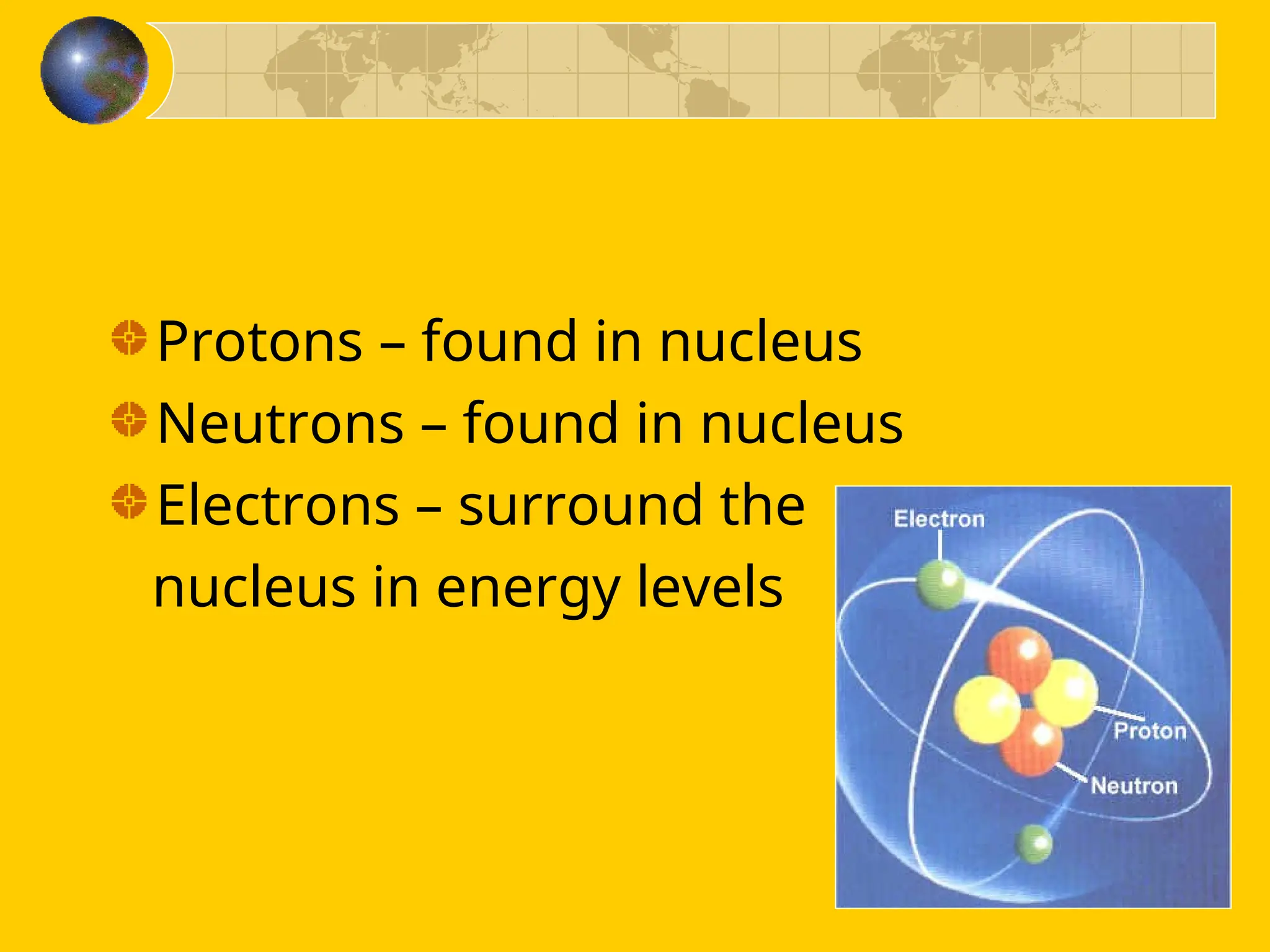
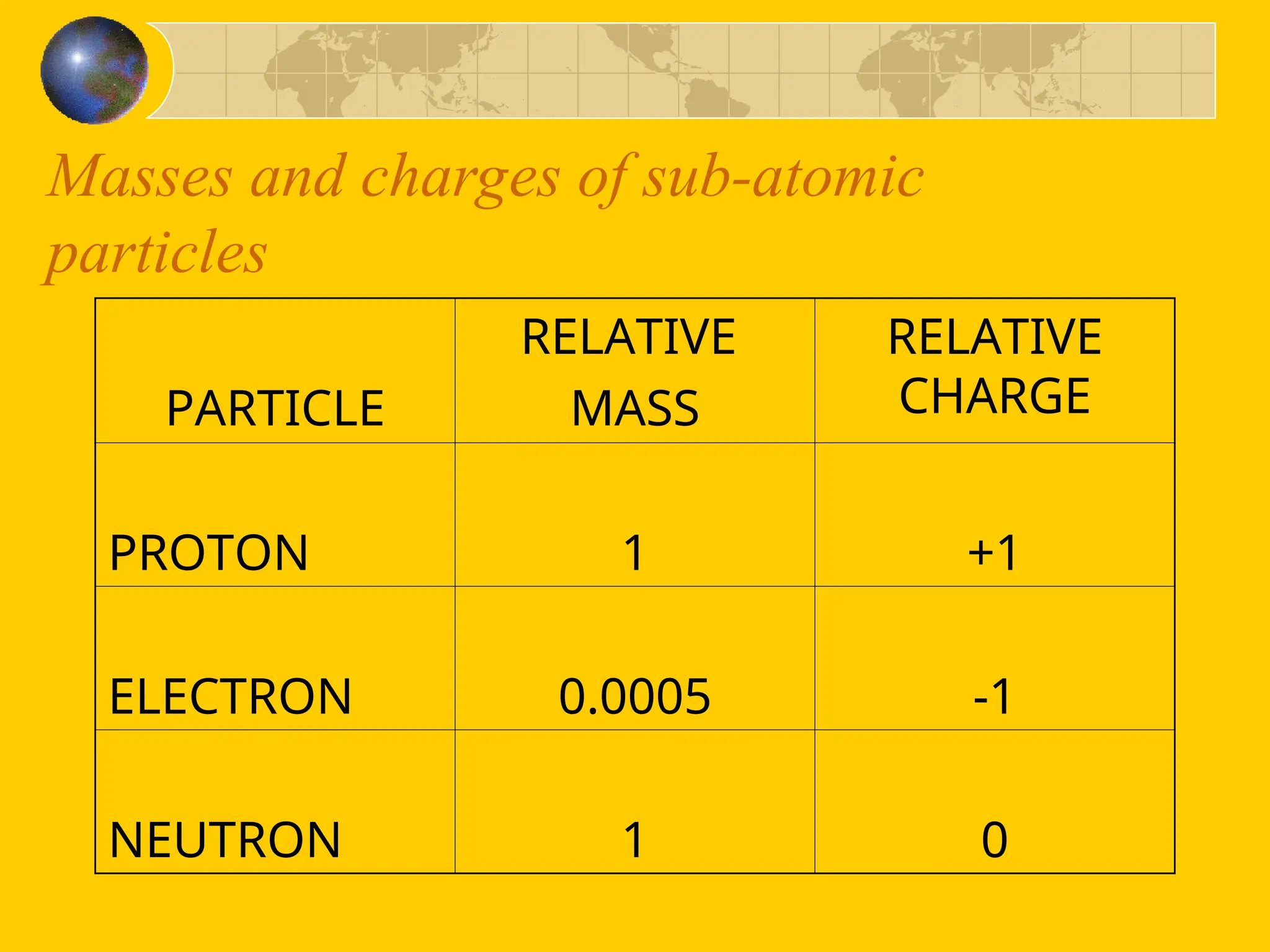
Protons – foundin nucleus
Neutrons – found in nucleus
Electrons – surround the
nucleus in energy levels
8.
Element – substancethat cannot be
broken down into simpler substances
by a chemical reaction.
Atom – smallest particle (species) of
an element that retains the
properties of that element.
Compound – the chemical
combination of two or more elements
9.
MODELS OF THEATOM
John Dalton – Dalton’s atomic theory
JJ Thomson – plum pudding model and
discovered the electron
Ernest Rutherford – gold foil experiment
and discovered the proton
Niels Bohr – solar system model where the
electrons orbit the nucleus
Quantum Mechanical Model – modern
theory where electrons exist in cloud
shapes or “orbitals”
10.
1. All elementsare composed of atoms.
2. Each element has atoms that are different
from the atoms of any other element.
3. Atoms cannot be subdivided, created or
destroyed.
4. Atoms of different elements combine in
simple ratios to form chemical compounds.
5. One type of atom cannot be changed into
another type of atom by a chemical reaction.
DALTON’S ATOMIC THEORY
11.
Not all aspectsof Dalton’s theory proved to
be correct.
Atoms can be subdivided.
Atoms can have different masses (isotopes).
Important parts that are still relevant:
All matter is composed of atoms.
Atoms of one element differ in properties
from those of every other element.
MODERN ATOMIC THEORY
12.
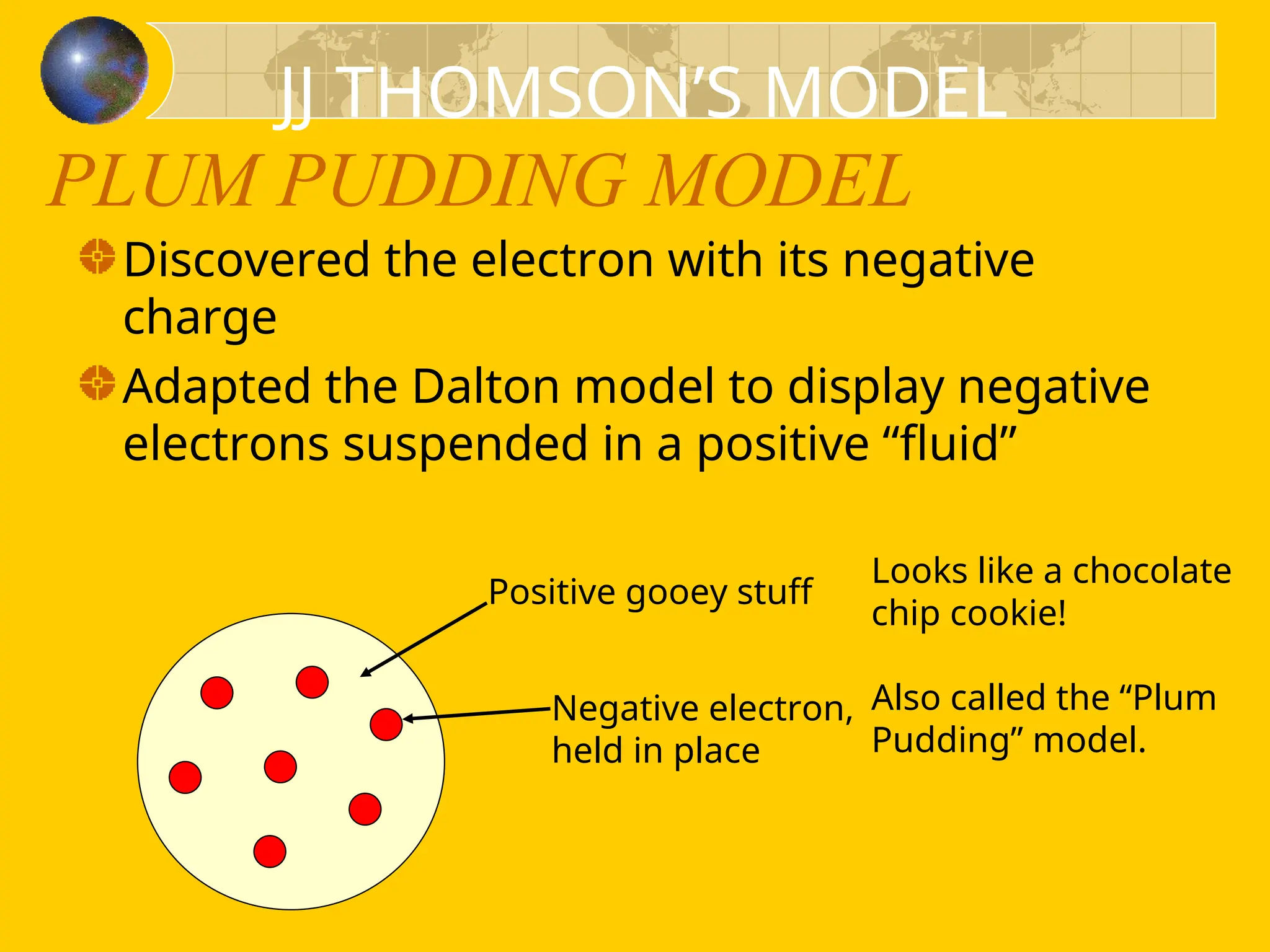
PLUM PUDDING MODEL
Discoveredthe electron with its negative
charge
Adapted the Dalton model to display negative
electrons suspended in a positive “fluid”
Positive gooey stuff
Negative electron,
held in place
Looks like a chocolate
chip cookie!
Also called the “Plum
Pudding” model.
JJ THOMSON’S MODEL
13.
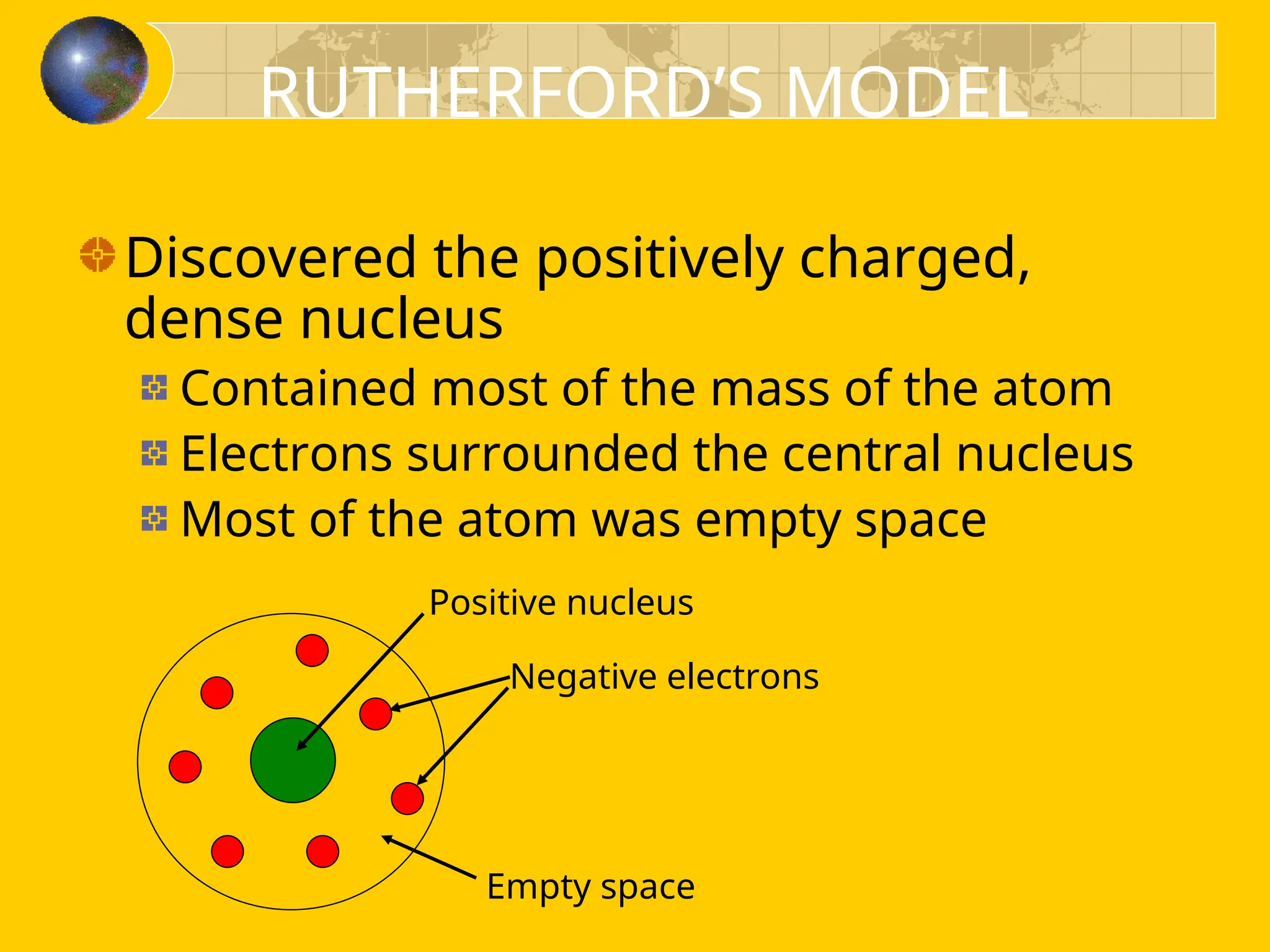
Discovered the positivelycharged,
dense nucleus
Contained most of the mass of the atom
Electrons surrounded the central nucleus
Most of the atom was empty space
Positive nucleus
Negative electrons
Empty space
RUTHERFORD’S MODEL
14.
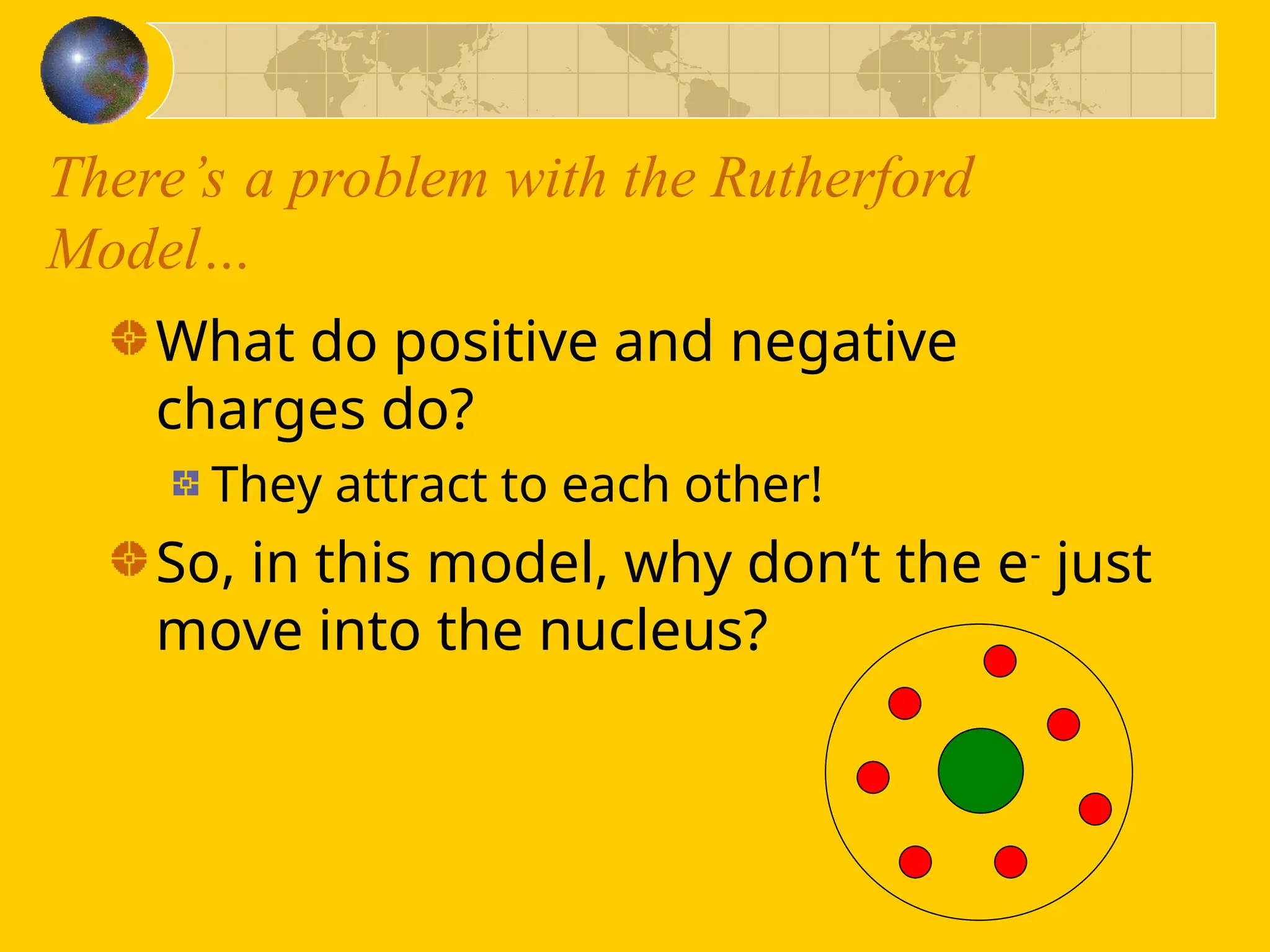
There’s a problemwith the Rutherford
Model…
What do positive and negative
charges do?
They attract to each other!
So, in this model, why don’t the e-
just
move into the nucleus?
15.
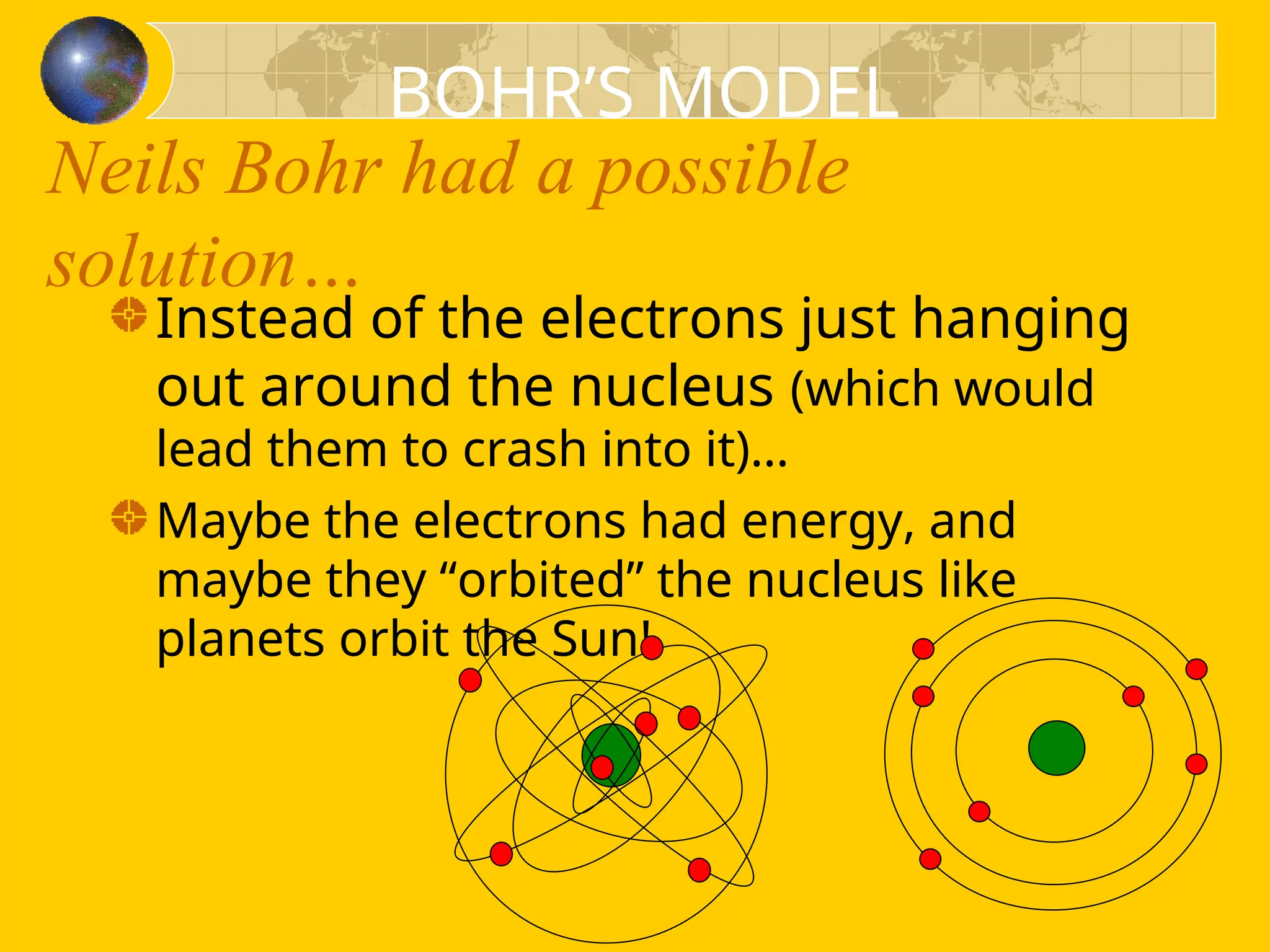
Neils Bohr hada possible
solution…
Instead of the electrons just hanging
out around the nucleus (which would
lead them to crash into it)…
Maybe the electrons had energy, and
maybe they “orbited” the nucleus like
planets orbit the Sun!
BOHR’S MODEL
16.
Bohr came upwith the idea that the
size of an electron’s orbit was related
to how much energy the electron
had.
the energy level of an electron would
determine how far away from the
nucleus the electron would be.
17.
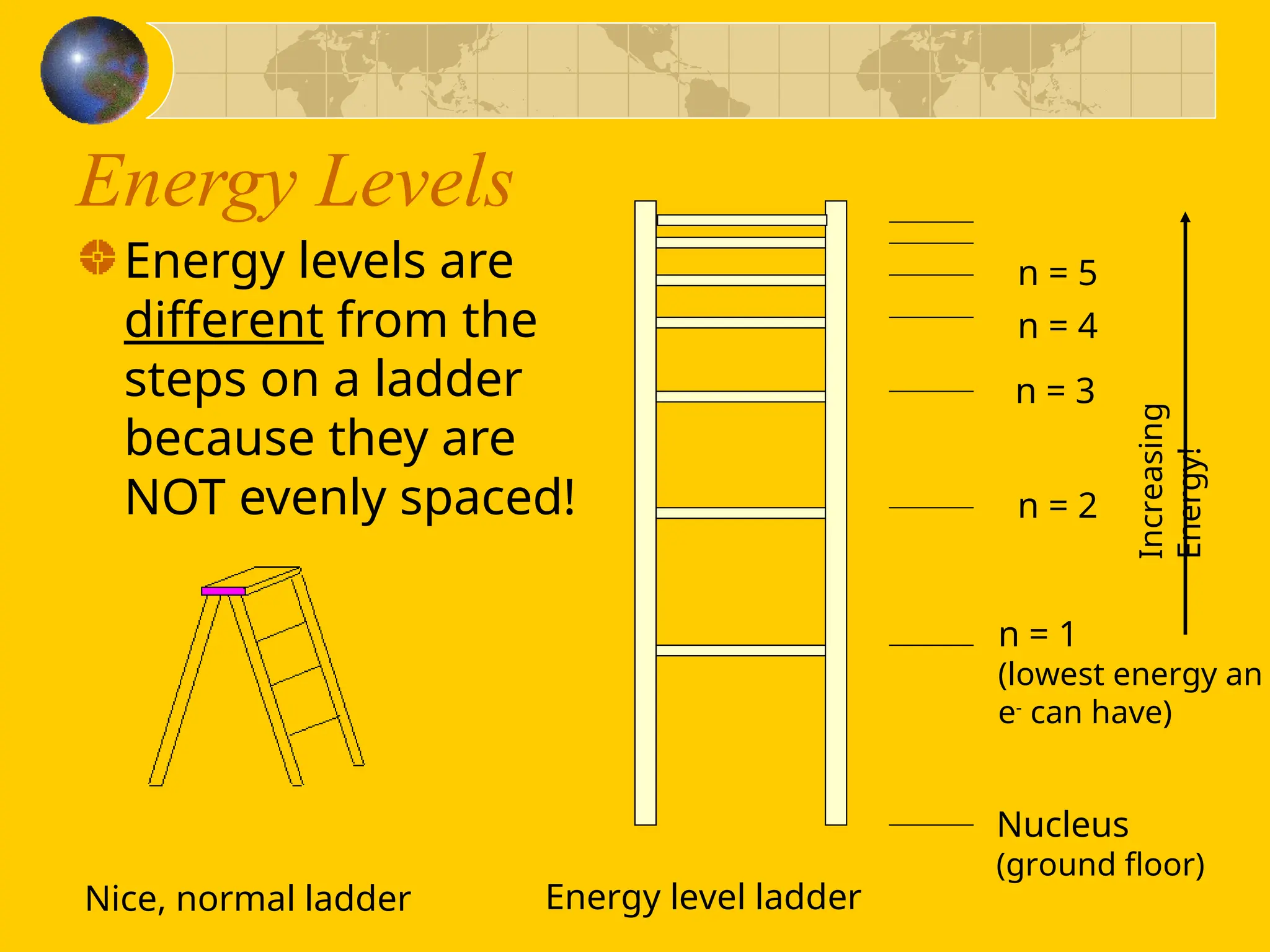
Energy Levels
Energy levelsare like the steps on a
ladder:
You can’t stand between the steps on a
ladder, and electrons cannot hang out
between energy levels.
Number the energy levels: n = 1, 2, 3, 4,
…
18.
Energy Levels
Energy levelsare
different from the
steps on a ladder
because they are
NOT evenly spaced!
Nice, normal ladder Energy level ladder
n = 1
(lowest energy an
e-
can have)
Nucleus
(ground floor)
n = 2
n = 3
n = 4
n = 5
Increasing
Energy!
19.
Quantum Mechanical Model
Now,we know that electrons do not follow
in specific paths around the nucleus
Instead, we currently believe that they pop in and
out of existence, so fast it’s crazy.
• Like camera flashes going off when a superstar
walks in!
Quantum Mechanics is used to explain this
crazy behavior
It’s based on probabilities (chances) that something
will be true.
20.
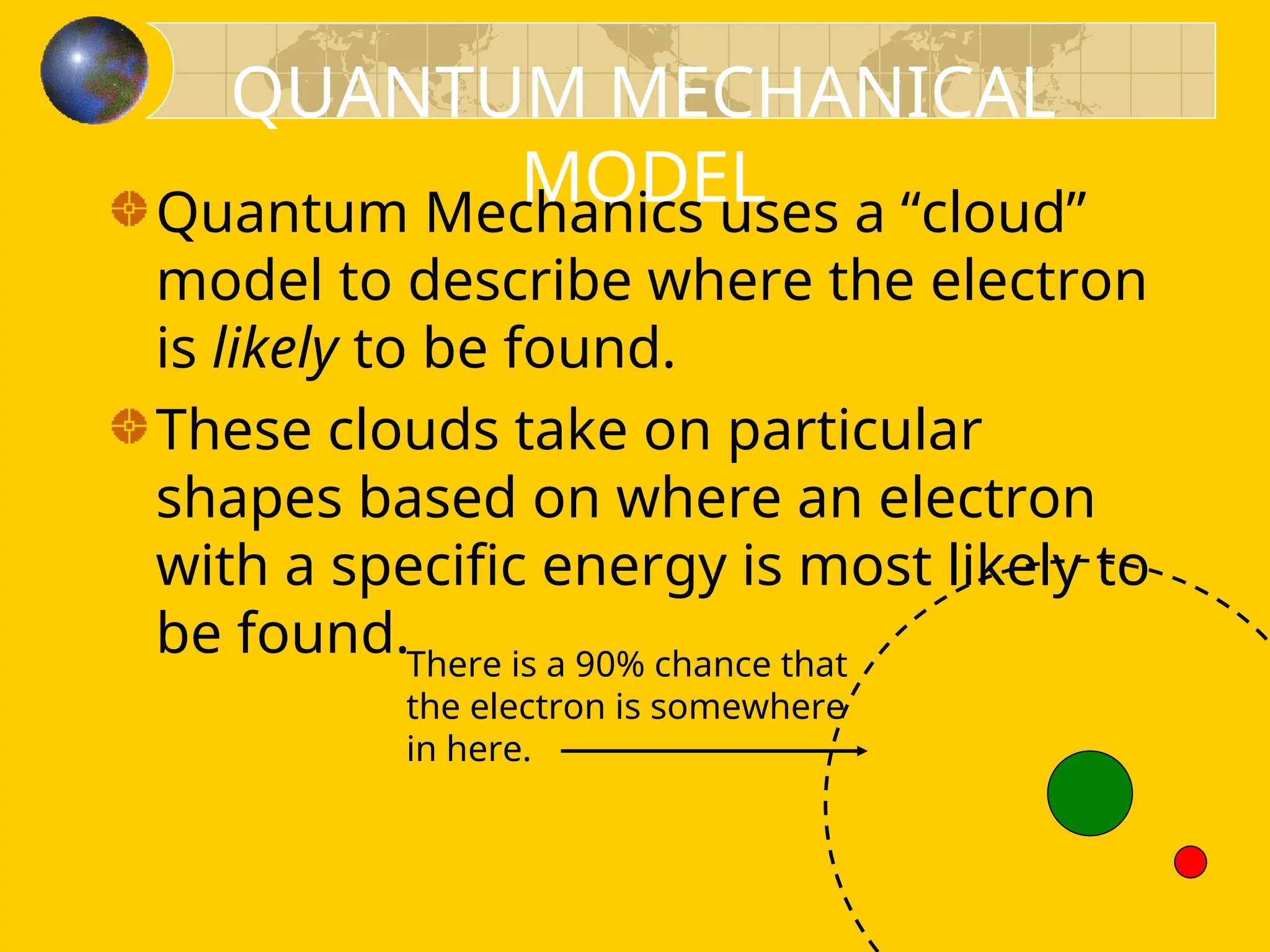
Quantum Mechanics usesa “cloud”
model to describe where the electron
is likely to be found.
These clouds take on particular
shapes based on where an electron
with a specific energy is most likely to
be found.There is a 90% chance that
the electron is somewhere
in here.
QUANTUM MECHANICAL
MODEL
21.
Quantum Mechanical Model- Orbitals
Quantum Mechanics keeps the idea
of energy levels – these are actually
the rows on the periodic table.
It also adds sublevels, known as “atomic
orbitals”
These orbitals are referred to as s, p, d, f
The shapes of atomic orbitals depend on
the energy levels.
22.
APPLICATION/SKILLS
Be able touse the nuclear
symbol A
ZX to deduce the
number of protons, neutrons
and electrons in atoms and ions.
23.
Atomic number –number of protons
in the nucleus
Mass number – number of protons
plus neutrons in an atom
Isotope – atoms with the same
number of protons but different
numbers of neutrons (in other words
different mass numbers)
Ion – atomthat has lost or gained an
electron
Cation – positive ion formed by the
loss of one or more electrons
Anion – negative ion formed by the
gain of one or more electrons
26.
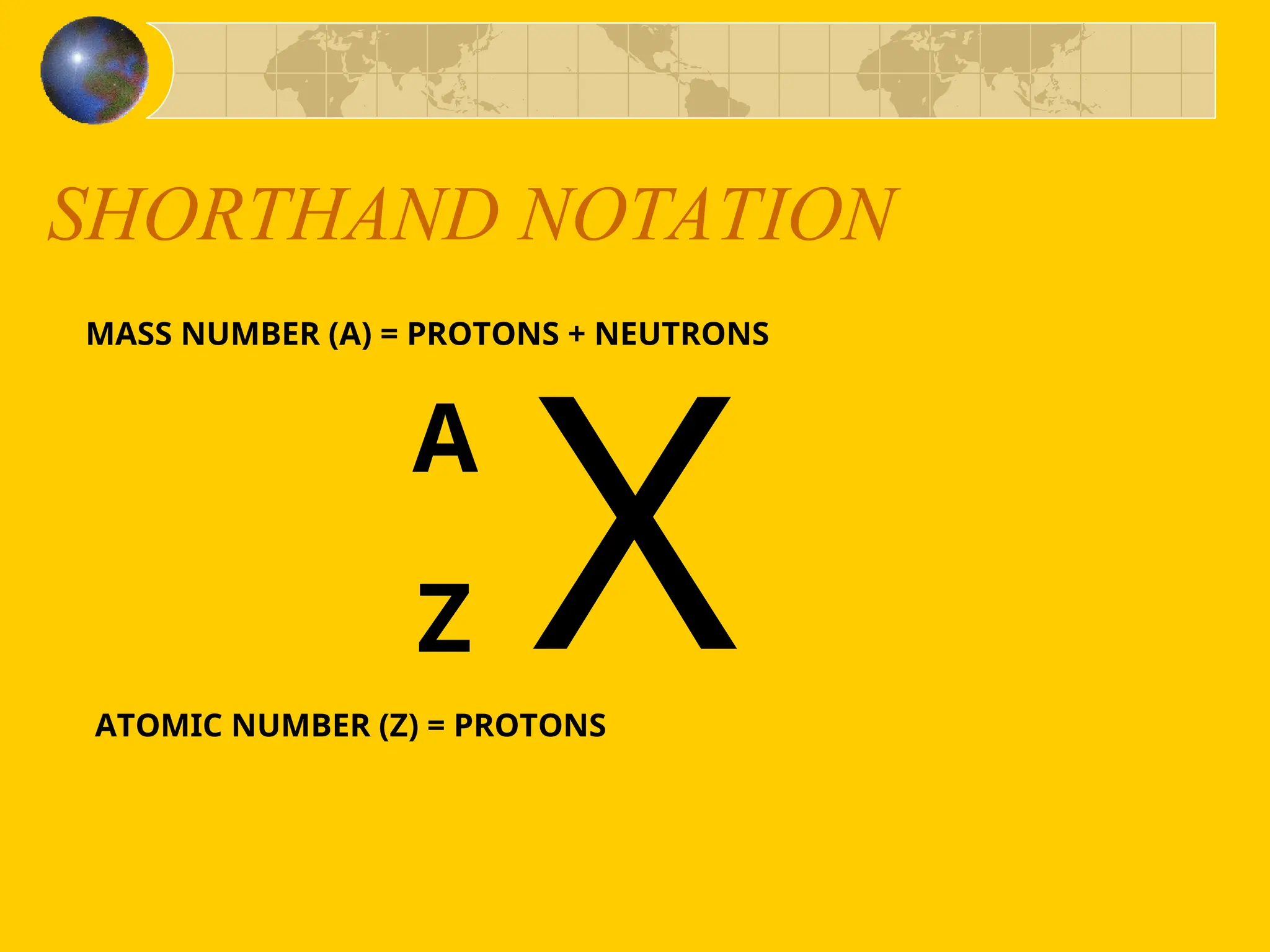
Given shorthand notation,isotopic
information or an ion, you should be
able to figure out how many protons,
neutrons and electrons are present.
Remember the proton number
identifies the element.
To be neutral, electrons and protons
must equal.
If you have an ion, your electrons will
be either more or less than the
protons depending upon the charge.
27.
ISOTOPE SYMBOLS
Chlorine existsas 2 isotopes: 35
Cl and
37
Cl
These can also be written as chlorine-
35 and chlorine-37.
The difference is the number of
neutrons.
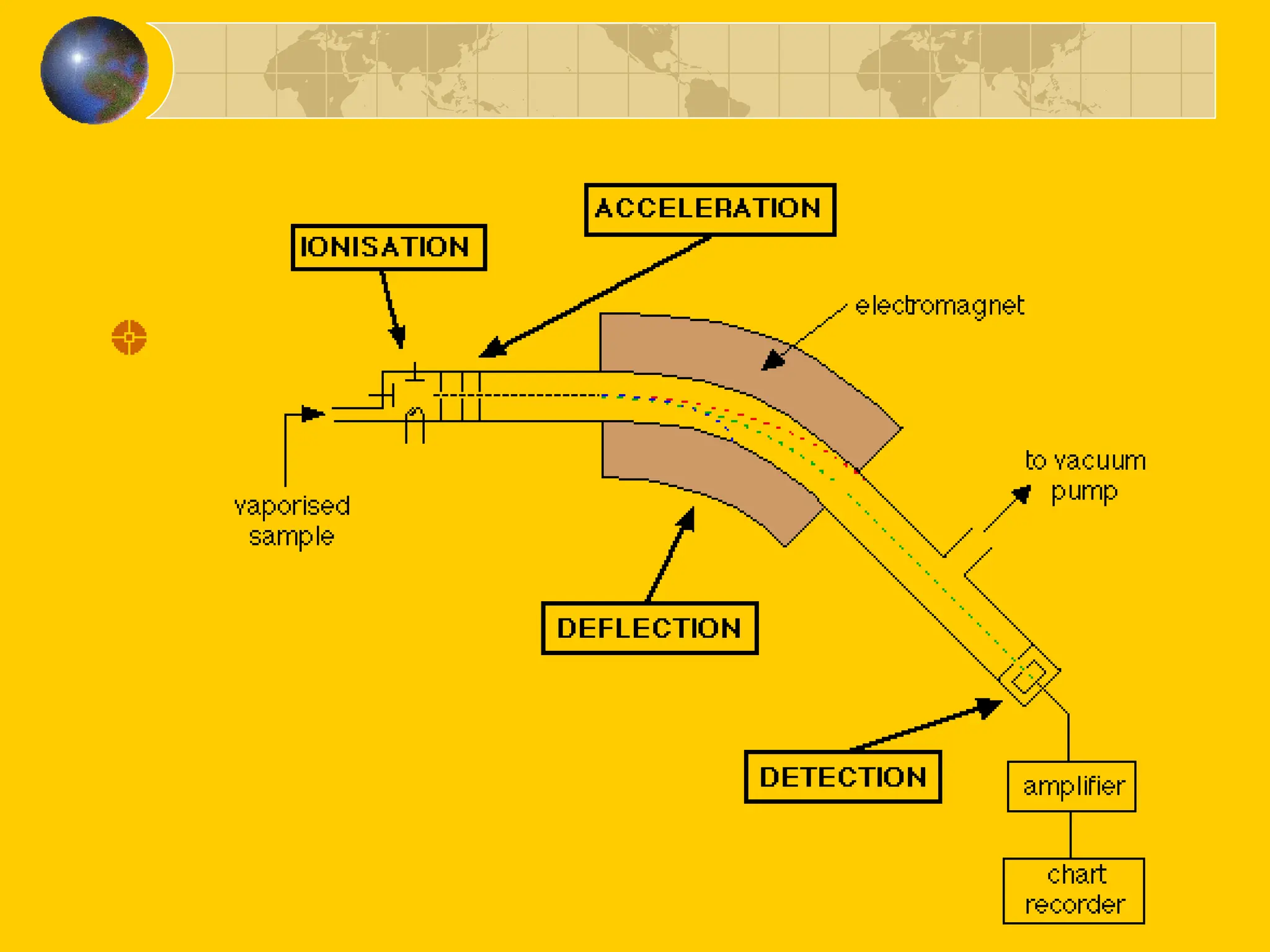
THE MASS SPECTROMETER
Themass spectrometer is used to
measure the masses of different
isotopes and their relative
abundance.
It has 5 basic operations.
34.
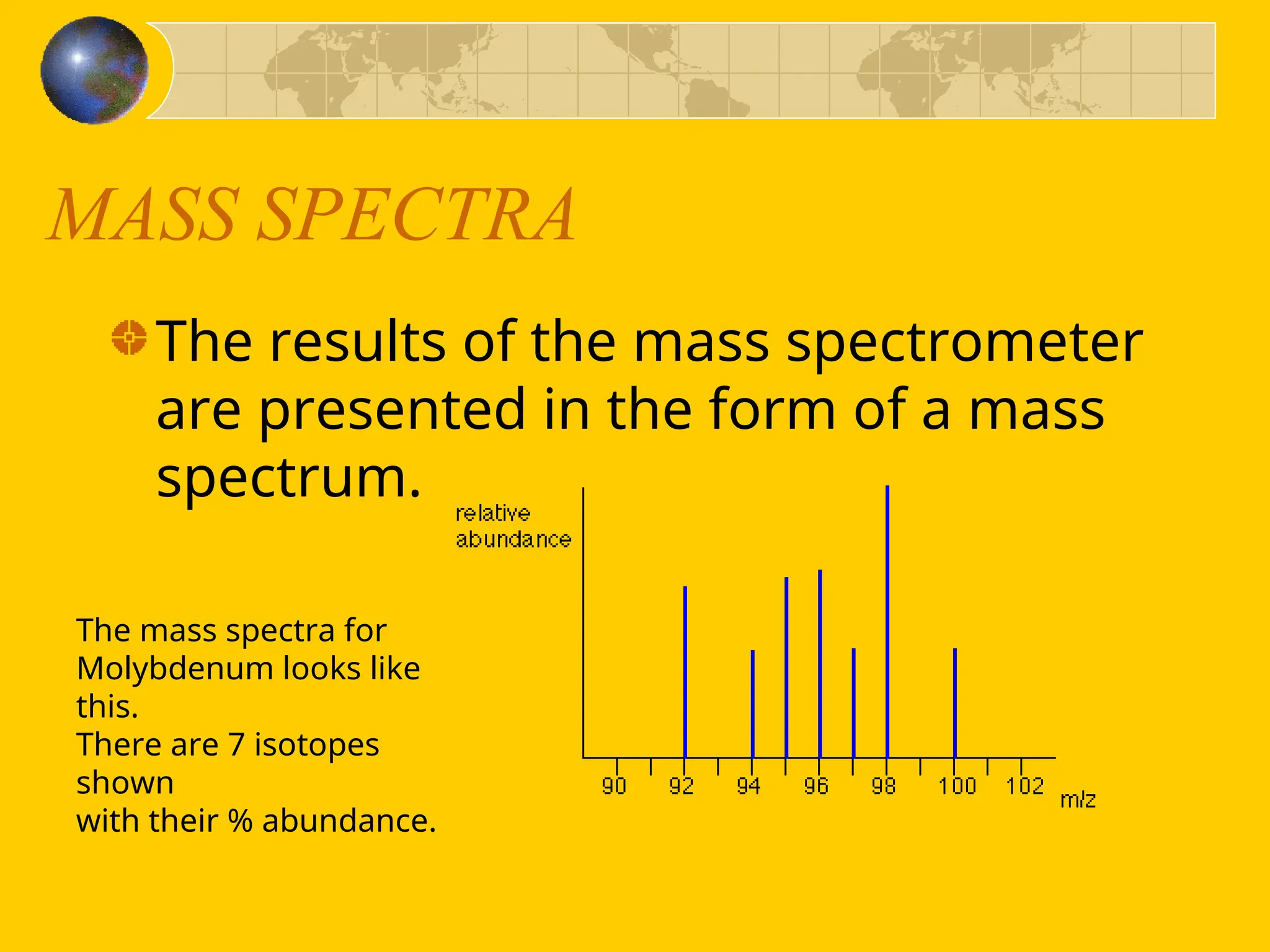
MASS SPECTRA
The resultsof the mass spectrometer
are presented in the form of a mass
spectrum.
The mass spectra for
Molybdenum looks like
this.
There are 7 isotopes
shown
with their % abundance.
35.
RELATIVE ATOMIC MASS
Therelative atomic mass (Ar) of an
element is the average mass of an
atom of the element taking into
account all its isotopes and their
relative abundance.
This is why the atomic mass is not a
whole number.
36.
APPLICATION/SKILLS
Be able tocalculate non-integer
relative atomic masses and
abundance of isotopes from
given data, including mass
spectra.
37.
The masses ofatoms of all elements
actually range from 1x10-24
to 1x10-22
g.
These numbers are difficult to
manage so we use relative values.
To use relative values, a standard has
to be agreed upon.
The carbon-12 isotope was chosen as
the standard in 1961 and was given
the relative mass of 12.000 exactly.
The masses of all other elements are
measured relative to 12
C.
38.
EXAMPLE 1
What isthe relative atomic mass of
chlorine if it has two isotopes with the
following abundances: 35
Cl at 75%
and 37
Cl at 25%?
Multiply the isotope mass by the
abundance and add them together.
(35 x .75) + (37 x .25) = 35.5amu
39.
EXAMPLE 2
Boron existsin 2 isotopic forms, 10
B
and 11
B. Use your periodic table to
find the abundances of the two
isotopes.
You must recognize that the atomic
mass for Boron is 10.81 so it should
make sense to you that more of 11
B
exists since 11 is closer to 10.81 than 10
is.
40.
Let x atomsbe 10
B, therefore 11
B would
be 1 – x.
Remember you have to multiply the
isotope mass by the abundance to get
total mass.
10x + 11(1-x) = 10.81
10x + 11 – 11x = 10.81
11 – x = 10.81
11-10.81 = x
.19 = x
So the abundances are 10
B = 19.00% and
11
B = 81.00%
41.
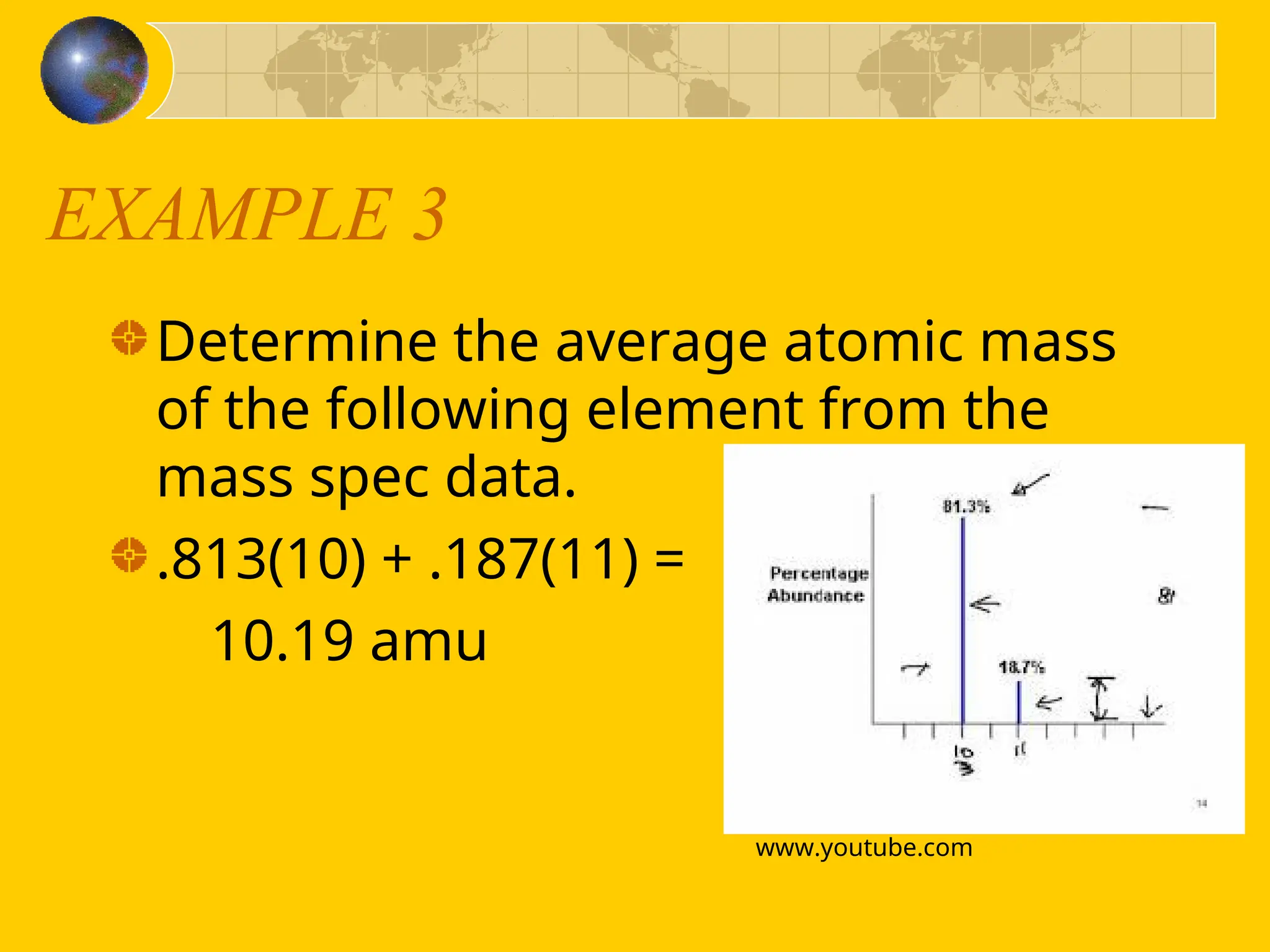
EXAMPLE 3
Determine theaverage atomic mass
of the following element from the
mass spec data.
.813(10) + .187(11) =
10.19 amu
www.youtube.com
Isotopes show thesame chemical
properties as their parent element
since neutrons do not affect how they
react.
Isotopes with more neutrons are
heavier and move more slowly at a
given temperature. This can be used
as a means to separate them.
44.
The difference inneutrons does
affect physical properties like boiling
and melting points, mass, density
and rate of diffusion for gases.
Remember a physical property is
something that can be measured
without changing the chemical
composition of the substance.
45.
Citations
International Baccalaureate Organization.Chemistry
Guide, First assessment 2016. Updated 2015.
Brown, Catrin, and Mike Ford. Higher Level Chemistry. 2nd
ed. N.p.: Pearson Baccalaureate, 2014. Print.
ISBN 978 1 447 95975 5
eBook 978 1 447 95976 2
Most of the information found in this power point comes
directly from this textbook.
The power point has been made to directly complement
the Higher Level Chemistry textbook by Brown and Ford
and is used for direct instructional purposes only.
![Structure of atom-class 9th [Autosaved].pptx](https://cdn.slidesharecdn.com/ss_thumbnails/structureofatom-class9thautosaved-251207071253-6553800d-thumbnail.jpg?width=640&height=640&fit=bounds)


![Ppt 2 S1.4Counting particles by mass The mole [Autosaved].pptx](https://cdn.slidesharecdn.com/ss_thumbnails/ppt2s1-240830135241-76f72799-thumbnail.jpg?width=640&height=640&fit=bounds)


