Basic Physics
Structure of Atom
1 Structure of MatterBasic Physics
Reference Books:
F.M.Khan-The Physics of Radiation Therapy,
H.E.Jones-The Physics Of Radiology
By
P.Velliangiri M.Sc., MBA
Medical Physicist
North Bengal Oncology Centre,
Rangapani Near Siliguri
Darjeeling Dist, West Bengal
India
Mail ID – p.velliangirii@gmail.com
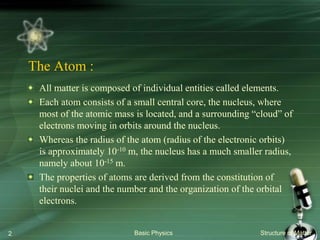
The Atom :
All matter is composed of individual entities called elements.
Each atom consists of a small central core, the nucleus, where
most of the atomic mass is located, and a surrounding “cloud” of
electrons moving in orbits around the nucleus.
Whereas the radius of the atom (radius of the electronic orbits)
is approximately 10-10 m, the nucleus has a much smaller radius,
namely about 10-15 m.
The properties of atoms are derived from the constitution of
their nuclei and the number and the organization of the orbital
electrons.
Basic Physics Structure of Matter2
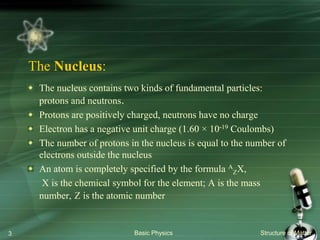
The Nucleus:
The nucleus contains two kinds of fundamental particles:
protons and neutrons.
Protons are positively charged, neutrons have no charge
Electron has a negative unit charge (1.60 × 10⁻¹⁹ Coulombs)
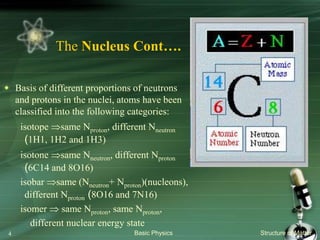
The number of protons in the nucleus is equal to the number of
electrons outside the nucleus
An atom is completely specified by the formula A
ZX,
X is the chemical symbol for the element; A is the mass
number, Z is the atomic number
Basic Physics Structure of Matter3
The Nucleus Cont….
Basis of different proportions of neutrons
and protons in the nuclei, atoms have been
classified into the following categories:
isotope same Nproton, different Nneutron
(1H1, 1H2 and 1H3)
isotone same Nneutron, different Nproton
(6C14 and 8O16)
isobar same (Nneutron+ Nproton)(nucleons),
different Nproton (8O16 and 7N16)
isomer  same Nproton, same Nproton,
different nuclear energy state
Basic Physics Structure of Matter4
Atomic Mass and Energy Units :
Masses of atoms and atomic particles are conveniently given in
terms of atomic mass unit (amu).
amu :
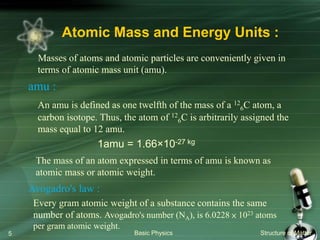
An amu is defined as one twelfth of the mass of a 12
6C atom, a
carbon isotope. Thus, the atom of 12
6C is arbitrarily assigned the
mass equal to 12 amu.
1amu = 1.66×10⁻²⁷ kg
Basic Physics Structure of Matter5
The mass of an atom expressed in terms of amu is known as
atomic mass or atomic weight.
Avogadro's law :
Every gram atomic weight of a substance contains the same
number of atoms. Avogadro's number (NA), is 6.0228 × 10²³ atoms
per gram atomic weight.
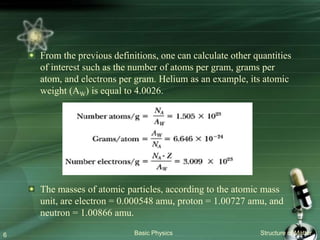
From the previous definitions, one can calculate other quantities
of interest such as the number of atoms per gram, grams per
atom, and electrons per gram. Helium as an example, its atomic
weight (AW) is equal to 4.0026.
The masses of atomic particles, according to the atomic mass
unit, are electron = 0.000548 amu, proton = 1.00727 amu, and
neutron = 1.00866 amu.
Basic Physics Structure of Matter6
Distribution of Orbital Electrons :
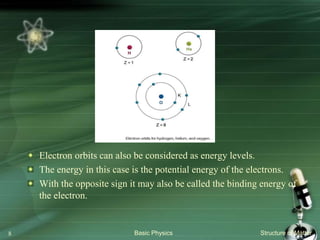
The electrons revolve around the nucleus in specific orbits and are
prevented from leaving the atom by the centripetal force of attraction
between the positively charged nucleus and the negatively charged
electron.
The innermost orbit or shell is called the K shell. The next shells are
L, M, N, and O.
The maximum number of electrons in an orbit is given by 2n2, where
n is the orbit number.
For example, a maximum of two electrons can exist in the first orbit,
eight in the second, and 18 in the third.
Basic Physics Structure of Matter7
Electron orbits can also be considered as energy levels.
The energy in this case is the potential energy of the electrons.
With the opposite sign it may also be called the binding energy of
the electron.
Basic Physics Structure of Matter8
Atomic Energy Levels :
The binding energies of the electrons in various shells depend on the
magnitude of Coulomb force of attraction between the nucleus and
the orbital electrons.
Thus, the binding energies for the higher-Z atoms are greater
because of the greater nuclear charge.
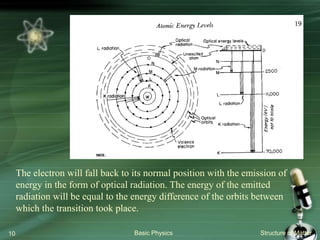
In the case of tungsten (Z = 74), the electrons in the K, L, and M
shells have binding energies of about 70,000, 11,000, and 2,500 eV,
respectively.
Basic Physics Structure of Matter9
Basic Physics Structure of Matter10
The electron will fall back to its normal position with the emission of
energy in the form of optical radiation. The energy of the emitted
radiation will be equal to the energy difference of the orbits between
which the transition took place.
K, L, and M shells where the electrons are more tightly bound
(because of larger Coulomb forces), the absorption or emission
of energy will involve higher-energy radiation.
Also, if sufficient energy is imparted to an inner-orbit electron
so that it is completely ejected from the atom, the vacancy or the
hole created in that shell will be almost instantaneously filled by
an electron from a higher-level orbit, resulting in the emission of
radiation.
This is the mechanism for the production of characteristic x-
rays.
Basic Physics Structure of Matter11
Nuclear Forces :
There are four different forces in nature. These are, in the order
of their strengths: (a) strong nuclear force, (b) electromagnetic
force, (c) weak nuclear force, and (d) gravitational force.
Of these, the gravitational force involved in the nucleus is very
weak and can be ignored.
The electromagnetic force between charged nucleons is quite
strong, but it is repulsive and tends to disrupt the nucleus. A
force much larger than the electromagnetic force is the strong
nuclear force that is responsible for holding the nucleons
together in the nucleus.
Basic Physics Structure of Matter12
The weak nuclear force is much weaker and appears in certain
types of radioactive decay (e.g., β decay).
The strong nuclear force is a short-range force that comes into
play when the distance between the nucleons becomes smaller
than the nuclear diameter (~10-15 m).
In the case of a positively charged particle approaching the
nucleus, there will be a potential barrier due to the Coulomb
forces of repulsion, preventing the particle from approaching the
nucleus.
Basic Physics Structure of Matter13
Nuclear Energy Levels :
The shell model of the nucleus assumes that the nucleons are
arranged in shells, representing discrete energy states of the
nucleus similar to the atomic energy levels.
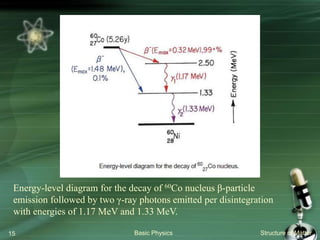
Energy-level diagram with a decay scheme for a cobalt-60
(60
27Co) nucleus that has been made radioactive in a reactor by
bombarding stable 59
27Co atoms with neutrons. The excited
60
27Co nucleus first emits a particle, known as a β- particle and
then, in two successive jumps, emits packets of energy, known
as photons.
The emission of a β- particle is the result of a nuclear
transformation in which one of the neutrons in the nucleus
disintegrates into a proton, an electron, and a neutrino. The
electron and neutrino are emitted instantaneously and share the
released energy with the recoiling nucleus.
Basic Physics Structure of Matter14
Basic Physics Structure of Matter15
Energy-level diagram for the decay of 60Co nucleus β-particle
emission followed by two γ-ray photons emitted per disintegration
with energies of 1.17 MeV and 1.33 MeV.
Particle Radiation :
The term radiation applies to the emission and propagation of
energy through space or a material medium.
By particle radiation, we mean energy propagated by traveling
corpuscles that have a definite rest mass and within limits have a
definite momentum and defined position at any instant.
These particles can travel with high speeds, depending on their
kinetic energy, but never attain exactly the speed of light in a
vacuum. Also, they interact with matter and produce varying
degrees of energy transfer to the medium.
Basic Physics Structure of Matter16
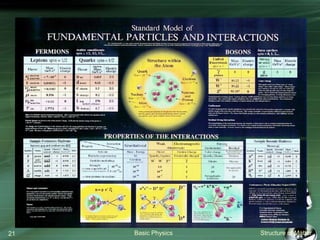
Elementary Particles :
 The study of the structure of atom reveals that the fundamental
particles electron, proton and neutron are the building blocks of
an atom.
 But the extensive studies on cosmic rays have revealed the
existence of numerous new nuclear particles like mesons.
 These particles are classified into four major groups as photons,
leptons mesons and baryons.
Basic Physics Structure of Matter17
Photon :
Photon is a quantum of radiation with no charge and no mass,
but it is a carrier of energy. It travels with velocity of light.
Basic Physics Structure of Matter18
Lepton :
 Leptons are lighter particles having mass equal to or less than
about 207 times the mass of an electron except neutrino and
antineutrino.
 This group contains particles such as electron, positron,
neutrino, antineutrino, positive and negative muons.
 The electron and positron are the antiparticles. Neutrino and
antineutrino are also associated with β-ray emission.
 The neutrinos and antineutrinos are massless and chargeless
particles, but carrier of energy and spin. Muons were discovered
in cosmic ray studies.
Mesons :
Mesons are fundamental particles carrying a single unit of
charge and possessing mass intermediate between electron and
proton (me and mp).
The name meson was given by Yukawa in 1935.
The three types of mesons are (i) π-meson (pion) (ii) K−meson
(kaon) and (iii) η- meson.
The mesons are the interaction agents between nucleons.
The rest mass of mesons vary between 250 me and 1000 me
Basic Physics Structure of Matter19
Baryons :
Baryons form the heavier particle group.
Protons and neutrons are called nucleons and the rest of the
heavier particles other than nucleons are known as hyperons.
There are four types of hyperons which are lambda, sigma, xi
and omega hyperons.
Protons and neutrons are around 1836 times the mass of the
electron, whereas the mass of the hyperons vary from 2180 me
and 3275 me.
Basic Physics Structure of Matter20
Basic Physics Structure of Matter21
Electromagnetic Radiation:
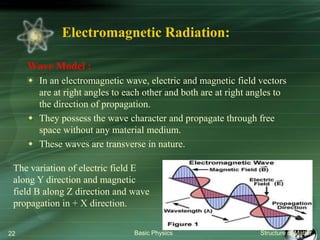
Wave Model :
In an electromagnetic wave, electric and magnetic field vectors
are at right angles to each other and both are at right angles to
the direction of propagation.
They possess the wave character and propagate through free
space without any material medium.
These waves are transverse in nature.
Basic Physics Structure of Matter22
The variation of electric field E
along Y direction and magnetic
field B along Z direction and wave
propagation in + X direction.
Basic Physics Structure of Matter23
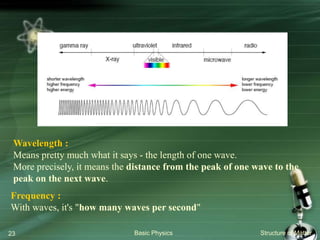
Wavelength :
Means pretty much what it says - the length of one wave.
More precisely, it means the distance from the peak of one wave to the
peak on the next wave.
Frequency :
With waves, it's "how many waves per second"
Electromagnetic spectrum :
The electromagnetic spectrum is the range of all possible
frequencies of electromagnetic radiation.
Uses of electromagnetic spectrum :
Radio waves :
These waves are used in radio and television communication
systems. AM band is from 530 kHz to 1710 kHz. Higher
frequencies upto 54 MHz are used for short waves bands.
Television waves range from 54 MHz to 890 MHz. FM band is
from 88 MHz to 108 MHz. Cellular phones use radio waves in
ultra high frequency (UHF) band.
Basic Physics Structure of Matter24
Microwaves : Due to their short wavelengths, they are used in
radar communication system. Microwave ovens are an
interesting domestic application of these waves.
Infra red waves :
(i) Infrared lamps are used in physiotherapy.
(ii) Infrared photographs are used in weather forecasting.
(iii) As infrared radiations are not absorbed by air, thick fog, mist
etc, they are used to take photograph of long distance objects.
(iv) Infra red absorption spectrum is used to study the molecular
structure.
Basic Physics Structure of Matter25
Visible light : Visible light emitted or reflected from objects
around us provides information about the world. The
wavelength range of visible light is 4000 Å to 8000 Å.
Ultra−violet radiations :
(i) They are used to destroy the bacteria and for sterilizing surgical
instruments.
(ii) These radiations are used in detection of forged documents,
finger prints in forensic laboratories.
(iii) They are used to preserve the food items.
(iv) They help to find the structure of atoms.
Basic Physics Structure of Matter26
X rays :
(i) X rays are used as a diagonistic tool in medicine.
(ii) It Is used to study the crystal structure in solids.
γ−rays :
Study of γ rays gives useful information about the nuclear
structure and it is used for treatment of cancer.
Basic Physics Structure of Matter26
Quantum Model :
To explain the results of certain experiments involving
interaction of radiation with matter, such as the photoelectric
effect and the Compton scattering, one has to consider
electromagnetic radiations as particles rather than waves. The
amount of energy carried by such a packet of energy, or photon,
is given by:
E = hv
where E is the energy (joules) carried by the photon, h is the
Planck's constant (6.62 × 10⁻³⁴ J-sec), and ν is the frequency
(cycles/second).
Basic Physics Structure of Matter28
Basic Physics Structure of Matter29

Structure of Atom

  • 1.
    Basic Physics Structure ofAtom 1 Structure of MatterBasic Physics Reference Books: F.M.Khan-The Physics of Radiation Therapy, H.E.Jones-The Physics Of Radiology By P.Velliangiri M.Sc., MBA Medical Physicist North Bengal Oncology Centre, Rangapani Near Siliguri Darjeeling Dist, West Bengal India Mail ID – p.velliangirii@gmail.com
  • 2.
    The Atom : Allmatter is composed of individual entities called elements. Each atom consists of a small central core, the nucleus, where most of the atomic mass is located, and a surrounding “cloud” of electrons moving in orbits around the nucleus. Whereas the radius of the atom (radius of the electronic orbits) is approximately 10-10 m, the nucleus has a much smaller radius, namely about 10-15 m. The properties of atoms are derived from the constitution of their nuclei and the number and the organization of the orbital electrons. Basic Physics Structure of Matter2
  • 3.
    The Nucleus: The nucleuscontains two kinds of fundamental particles: protons and neutrons. Protons are positively charged, neutrons have no charge Electron has a negative unit charge (1.60 × 10⁻¹⁹ Coulombs) The number of protons in the nucleus is equal to the number of electrons outside the nucleus An atom is completely specified by the formula A ZX, X is the chemical symbol for the element; A is the mass number, Z is the atomic number Basic Physics Structure of Matter3
  • 4.
    The Nucleus Cont…. Basisof different proportions of neutrons and protons in the nuclei, atoms have been classified into the following categories: isotope same Nproton, different Nneutron (1H1, 1H2 and 1H3) isotone same Nneutron, different Nproton (6C14 and 8O16) isobar same (Nneutron+ Nproton)(nucleons), different Nproton (8O16 and 7N16) isomer  same Nproton, same Nproton, different nuclear energy state Basic Physics Structure of Matter4
  • 5.
    Atomic Mass andEnergy Units : Masses of atoms and atomic particles are conveniently given in terms of atomic mass unit (amu). amu : An amu is defined as one twelfth of the mass of a 12 6C atom, a carbon isotope. Thus, the atom of 12 6C is arbitrarily assigned the mass equal to 12 amu. 1amu = 1.66×10⁻²⁷ kg Basic Physics Structure of Matter5 The mass of an atom expressed in terms of amu is known as atomic mass or atomic weight. Avogadro's law : Every gram atomic weight of a substance contains the same number of atoms. Avogadro's number (NA), is 6.0228 × 10²³ atoms per gram atomic weight.
  • 6.
    From the previousdefinitions, one can calculate other quantities of interest such as the number of atoms per gram, grams per atom, and electrons per gram. Helium as an example, its atomic weight (AW) is equal to 4.0026. The masses of atomic particles, according to the atomic mass unit, are electron = 0.000548 amu, proton = 1.00727 amu, and neutron = 1.00866 amu. Basic Physics Structure of Matter6
  • 7.
    Distribution of OrbitalElectrons : The electrons revolve around the nucleus in specific orbits and are prevented from leaving the atom by the centripetal force of attraction between the positively charged nucleus and the negatively charged electron. The innermost orbit or shell is called the K shell. The next shells are L, M, N, and O. The maximum number of electrons in an orbit is given by 2n2, where n is the orbit number. For example, a maximum of two electrons can exist in the first orbit, eight in the second, and 18 in the third. Basic Physics Structure of Matter7
  • 8.
    Electron orbits canalso be considered as energy levels. The energy in this case is the potential energy of the electrons. With the opposite sign it may also be called the binding energy of the electron. Basic Physics Structure of Matter8
  • 9.
    Atomic Energy Levels: The binding energies of the electrons in various shells depend on the magnitude of Coulomb force of attraction between the nucleus and the orbital electrons. Thus, the binding energies for the higher-Z atoms are greater because of the greater nuclear charge. In the case of tungsten (Z = 74), the electrons in the K, L, and M shells have binding energies of about 70,000, 11,000, and 2,500 eV, respectively. Basic Physics Structure of Matter9
  • 10.
    Basic Physics Structureof Matter10 The electron will fall back to its normal position with the emission of energy in the form of optical radiation. The energy of the emitted radiation will be equal to the energy difference of the orbits between which the transition took place.
  • 11.
    K, L, andM shells where the electrons are more tightly bound (because of larger Coulomb forces), the absorption or emission of energy will involve higher-energy radiation. Also, if sufficient energy is imparted to an inner-orbit electron so that it is completely ejected from the atom, the vacancy or the hole created in that shell will be almost instantaneously filled by an electron from a higher-level orbit, resulting in the emission of radiation. This is the mechanism for the production of characteristic x- rays. Basic Physics Structure of Matter11
  • 12.
    Nuclear Forces : Thereare four different forces in nature. These are, in the order of their strengths: (a) strong nuclear force, (b) electromagnetic force, (c) weak nuclear force, and (d) gravitational force. Of these, the gravitational force involved in the nucleus is very weak and can be ignored. The electromagnetic force between charged nucleons is quite strong, but it is repulsive and tends to disrupt the nucleus. A force much larger than the electromagnetic force is the strong nuclear force that is responsible for holding the nucleons together in the nucleus. Basic Physics Structure of Matter12
  • 13.
    The weak nuclearforce is much weaker and appears in certain types of radioactive decay (e.g., β decay). The strong nuclear force is a short-range force that comes into play when the distance between the nucleons becomes smaller than the nuclear diameter (~10-15 m). In the case of a positively charged particle approaching the nucleus, there will be a potential barrier due to the Coulomb forces of repulsion, preventing the particle from approaching the nucleus. Basic Physics Structure of Matter13
  • 14.
    Nuclear Energy Levels: The shell model of the nucleus assumes that the nucleons are arranged in shells, representing discrete energy states of the nucleus similar to the atomic energy levels. Energy-level diagram with a decay scheme for a cobalt-60 (60 27Co) nucleus that has been made radioactive in a reactor by bombarding stable 59 27Co atoms with neutrons. The excited 60 27Co nucleus first emits a particle, known as a β- particle and then, in two successive jumps, emits packets of energy, known as photons. The emission of a β- particle is the result of a nuclear transformation in which one of the neutrons in the nucleus disintegrates into a proton, an electron, and a neutrino. The electron and neutrino are emitted instantaneously and share the released energy with the recoiling nucleus. Basic Physics Structure of Matter14
  • 15.
    Basic Physics Structureof Matter15 Energy-level diagram for the decay of 60Co nucleus β-particle emission followed by two γ-ray photons emitted per disintegration with energies of 1.17 MeV and 1.33 MeV.
  • 16.
    Particle Radiation : Theterm radiation applies to the emission and propagation of energy through space or a material medium. By particle radiation, we mean energy propagated by traveling corpuscles that have a definite rest mass and within limits have a definite momentum and defined position at any instant. These particles can travel with high speeds, depending on their kinetic energy, but never attain exactly the speed of light in a vacuum. Also, they interact with matter and produce varying degrees of energy transfer to the medium. Basic Physics Structure of Matter16
  • 17.
    Elementary Particles : The study of the structure of atom reveals that the fundamental particles electron, proton and neutron are the building blocks of an atom.  But the extensive studies on cosmic rays have revealed the existence of numerous new nuclear particles like mesons.  These particles are classified into four major groups as photons, leptons mesons and baryons. Basic Physics Structure of Matter17 Photon : Photon is a quantum of radiation with no charge and no mass, but it is a carrier of energy. It travels with velocity of light.
  • 18.
    Basic Physics Structureof Matter18 Lepton :  Leptons are lighter particles having mass equal to or less than about 207 times the mass of an electron except neutrino and antineutrino.  This group contains particles such as electron, positron, neutrino, antineutrino, positive and negative muons.  The electron and positron are the antiparticles. Neutrino and antineutrino are also associated with β-ray emission.  The neutrinos and antineutrinos are massless and chargeless particles, but carrier of energy and spin. Muons were discovered in cosmic ray studies.
  • 19.
    Mesons : Mesons arefundamental particles carrying a single unit of charge and possessing mass intermediate between electron and proton (me and mp). The name meson was given by Yukawa in 1935. The three types of mesons are (i) π-meson (pion) (ii) K−meson (kaon) and (iii) η- meson. The mesons are the interaction agents between nucleons. The rest mass of mesons vary between 250 me and 1000 me Basic Physics Structure of Matter19
  • 20.
    Baryons : Baryons formthe heavier particle group. Protons and neutrons are called nucleons and the rest of the heavier particles other than nucleons are known as hyperons. There are four types of hyperons which are lambda, sigma, xi and omega hyperons. Protons and neutrons are around 1836 times the mass of the electron, whereas the mass of the hyperons vary from 2180 me and 3275 me. Basic Physics Structure of Matter20
  • 21.
  • 22.
    Electromagnetic Radiation: Wave Model: In an electromagnetic wave, electric and magnetic field vectors are at right angles to each other and both are at right angles to the direction of propagation. They possess the wave character and propagate through free space without any material medium. These waves are transverse in nature. Basic Physics Structure of Matter22 The variation of electric field E along Y direction and magnetic field B along Z direction and wave propagation in + X direction.
  • 23.
    Basic Physics Structureof Matter23 Wavelength : Means pretty much what it says - the length of one wave. More precisely, it means the distance from the peak of one wave to the peak on the next wave. Frequency : With waves, it's "how many waves per second"
  • 24.
    Electromagnetic spectrum : Theelectromagnetic spectrum is the range of all possible frequencies of electromagnetic radiation. Uses of electromagnetic spectrum : Radio waves : These waves are used in radio and television communication systems. AM band is from 530 kHz to 1710 kHz. Higher frequencies upto 54 MHz are used for short waves bands. Television waves range from 54 MHz to 890 MHz. FM band is from 88 MHz to 108 MHz. Cellular phones use radio waves in ultra high frequency (UHF) band. Basic Physics Structure of Matter24
  • 25.
    Microwaves : Dueto their short wavelengths, they are used in radar communication system. Microwave ovens are an interesting domestic application of these waves. Infra red waves : (i) Infrared lamps are used in physiotherapy. (ii) Infrared photographs are used in weather forecasting. (iii) As infrared radiations are not absorbed by air, thick fog, mist etc, they are used to take photograph of long distance objects. (iv) Infra red absorption spectrum is used to study the molecular structure. Basic Physics Structure of Matter25
  • 26.
    Visible light :Visible light emitted or reflected from objects around us provides information about the world. The wavelength range of visible light is 4000 Å to 8000 Å. Ultra−violet radiations : (i) They are used to destroy the bacteria and for sterilizing surgical instruments. (ii) These radiations are used in detection of forged documents, finger prints in forensic laboratories. (iii) They are used to preserve the food items. (iv) They help to find the structure of atoms. Basic Physics Structure of Matter26
  • 27.
    X rays : (i)X rays are used as a diagonistic tool in medicine. (ii) It Is used to study the crystal structure in solids. γ−rays : Study of γ rays gives useful information about the nuclear structure and it is used for treatment of cancer. Basic Physics Structure of Matter26
  • 28.
    Quantum Model : Toexplain the results of certain experiments involving interaction of radiation with matter, such as the photoelectric effect and the Compton scattering, one has to consider electromagnetic radiations as particles rather than waves. The amount of energy carried by such a packet of energy, or photon, is given by: E = hv where E is the energy (joules) carried by the photon, h is the Planck's constant (6.62 × 10⁻³⁴ J-sec), and ν is the frequency (cycles/second). Basic Physics Structure of Matter28
  • 29.