THE HISTORICALTHE HISTORICAL
DEVELOPMENTDEVELOPMENT
ofof
ATOMSATOMS
Aristotle
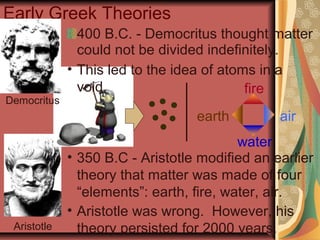
Early Greek Theories
400 B.C. - Democritus thought matter
could not be divided indefinitely.
• 350 B.C - Aristotle modified an earlier
theory that matter was made of four
“elements”: earth, fire, water, air.
Democritus
• Aristotle was wrong. However, his
theory persisted for 2000 years.
fire
air
water
earth
• This led to the idea of atoms in a
void.
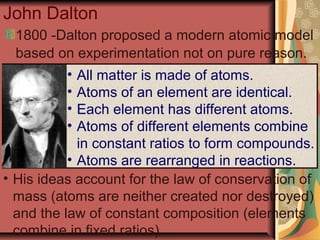
John Dalton
1800 -Dalton proposed a modern atomic model
based on experimentation not on pure reason.
• All matter is made of atoms.
• Atoms of an element are identical.
• Each element has different atoms.
• Atoms of different elements combine
in constant ratios to form compounds.
• Atoms are rearranged in reactions.
• His ideas account for the law of conservation of
mass (atoms are neither created nor destroyed)
and the law of constant composition (elements
combine in fixed ratios).
Adding Electrons to the Model
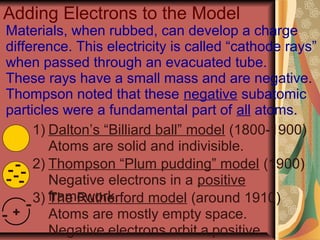
1) Dalton’s “Billiard ball” model (1800-1900)
Atoms are solid and indivisible.
2) Thompson “Plum pudding” model (1900)
Negative electrons in a positive
framework.3) The Rutherford model (around 1910)
Atoms are mostly empty space.
Negative electrons orbit a positive
Materials, when rubbed, can develop a charge
difference. This electricity is called “cathode rays”
when passed through an evacuated tube.
These rays have a small mass and are negative.
Thompson noted that these negative subatomic
particles were a fundamental part of all atoms.
Ernest Rutherford
Most particles passed through.
So, atoms are mostly empty.
Some positive α-particles
deflected or bounced back!
Thus, a “nucleus” is positive &
holds most of an atom’s mass.
Radioactive
substance path of invisible
α-particles
Rutherford shot alpha (α) particles at gold foil.
Lead block
Zinc sulfide screen Thin gold foil
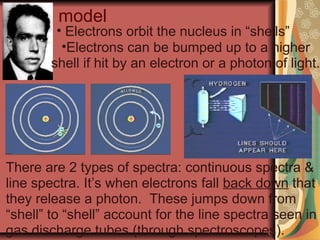
Bohr’s model
There are 2 types of spectra: continuous spectra &
line spectra. It’s when electrons fall back down that
they release a photon. These jumps down from
“shell” to “shell” account for the line spectra seen in
gas discharge tubes (through spectroscopes).
• Electrons orbit the nucleus in “shells”
•Electrons can be bumped up to a higher
shell if hit by an electron or a photon of light.
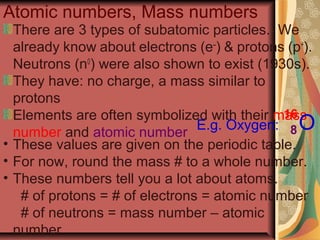
Atomic numbers, Mass numbers
There are 3 types of subatomic particles. We
already know about electrons (e–
) & protons (p+
).
Neutrons (n0
) were also shown to exist (1930s).
They have: no charge, a mass similar to
protons
Elements are often symbolized with their mass
number and atomic number
E.g. Oxygen: O
16
8
• These values are given on the periodic table.
• For now, round the mass # to a whole number.
• These numbers tell you a lot about atoms.
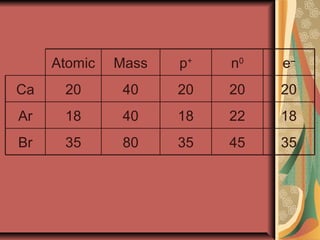
# of protons = # of electrons = atomic number
# of neutrons = mass number – atomic
number
3545358035Br
1822184018Ar
2020204020Ca
e–
n0
p+
MassAtomic
3 p+
4 n0
2e–
1e–
Li shorthand
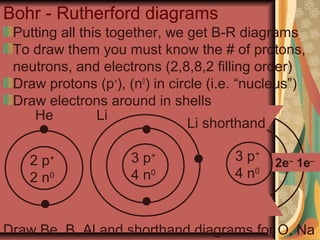
Bohr - Rutherford diagrams
Putting all this together, we get B-R diagrams
To draw them you must know the # of protons,
neutrons, and electrons (2,8,8,2 filling order)
Draw protons (p+
), (n0
) in circle (i.e. “nucleus”)
Draw electrons around in shells
2 p+
2 n0
He
3 p+
4 n0
Li
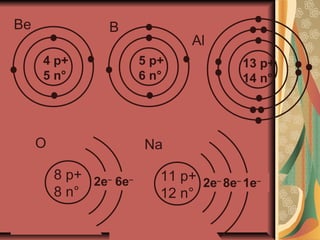
Draw Be, B, Al and shorthand diagrams for O, Na
11 p+
12 n°
2e–
8e–
1e–
Na
8 p+
8 n°
2e–
6e–
O
4 p+
5 n°
Be
5 p+
6 n°
B
13 p+
14 n°
Al
Isotopes and Radioisotopes
Atoms of the same element that have different
numbers of neutrons are called isotopes.
Due to isotopes, mass #s are not round #s.
Li (6.9) is made up of both 6
Li and 7
Li.
Often, at least one isotope is unstable.
It breaks down, releasing radioactivity.
These types of isotopes are called
radioisotopes
Q- Sometimes an isotope is written without its
atomic number - e.g. 35
S (or S-35). Why?
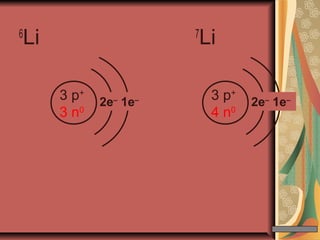
Q- Draw B-R diagrams for the two Li isotopes.
A- The atomic # of an element doesn’t change
Although the number of neutrons can vary,
3 p+
3 n0
2e–
1e–
6
Li 7
Li
3 p+
4 n0
2e–
1e–

Atomic models

  • 1.
  • 2.
    Aristotle Early Greek Theories 400B.C. - Democritus thought matter could not be divided indefinitely. • 350 B.C - Aristotle modified an earlier theory that matter was made of four “elements”: earth, fire, water, air. Democritus • Aristotle was wrong. However, his theory persisted for 2000 years. fire air water earth • This led to the idea of atoms in a void.
  • 3.
    John Dalton 1800 -Daltonproposed a modern atomic model based on experimentation not on pure reason. • All matter is made of atoms. • Atoms of an element are identical. • Each element has different atoms. • Atoms of different elements combine in constant ratios to form compounds. • Atoms are rearranged in reactions. • His ideas account for the law of conservation of mass (atoms are neither created nor destroyed) and the law of constant composition (elements combine in fixed ratios).
  • 4.
    Adding Electrons tothe Model 1) Dalton’s “Billiard ball” model (1800-1900) Atoms are solid and indivisible. 2) Thompson “Plum pudding” model (1900) Negative electrons in a positive framework.3) The Rutherford model (around 1910) Atoms are mostly empty space. Negative electrons orbit a positive Materials, when rubbed, can develop a charge difference. This electricity is called “cathode rays” when passed through an evacuated tube. These rays have a small mass and are negative. Thompson noted that these negative subatomic particles were a fundamental part of all atoms.
  • 5.
    Ernest Rutherford Most particlespassed through. So, atoms are mostly empty. Some positive α-particles deflected or bounced back! Thus, a “nucleus” is positive & holds most of an atom’s mass. Radioactive substance path of invisible α-particles Rutherford shot alpha (α) particles at gold foil. Lead block Zinc sulfide screen Thin gold foil
  • 6.
    Bohr’s model There are2 types of spectra: continuous spectra & line spectra. It’s when electrons fall back down that they release a photon. These jumps down from “shell” to “shell” account for the line spectra seen in gas discharge tubes (through spectroscopes). • Electrons orbit the nucleus in “shells” •Electrons can be bumped up to a higher shell if hit by an electron or a photon of light.
  • 7.
    Atomic numbers, Massnumbers There are 3 types of subatomic particles. We already know about electrons (e– ) & protons (p+ ). Neutrons (n0 ) were also shown to exist (1930s). They have: no charge, a mass similar to protons Elements are often symbolized with their mass number and atomic number E.g. Oxygen: O 16 8 • These values are given on the periodic table. • For now, round the mass # to a whole number. • These numbers tell you a lot about atoms. # of protons = # of electrons = atomic number # of neutrons = mass number – atomic number
  • 8.
  • 9.
    3 p+ 4 n0 2e– 1e– Lishorthand Bohr - Rutherford diagrams Putting all this together, we get B-R diagrams To draw them you must know the # of protons, neutrons, and electrons (2,8,8,2 filling order) Draw protons (p+ ), (n0 ) in circle (i.e. “nucleus”) Draw electrons around in shells 2 p+ 2 n0 He 3 p+ 4 n0 Li Draw Be, B, Al and shorthand diagrams for O, Na
  • 10.
    11 p+ 12 n° 2e– 8e– 1e– Na 8p+ 8 n° 2e– 6e– O 4 p+ 5 n° Be 5 p+ 6 n° B 13 p+ 14 n° Al
  • 11.
    Isotopes and Radioisotopes Atomsof the same element that have different numbers of neutrons are called isotopes. Due to isotopes, mass #s are not round #s. Li (6.9) is made up of both 6 Li and 7 Li. Often, at least one isotope is unstable. It breaks down, releasing radioactivity. These types of isotopes are called radioisotopes Q- Sometimes an isotope is written without its atomic number - e.g. 35 S (or S-35). Why? Q- Draw B-R diagrams for the two Li isotopes. A- The atomic # of an element doesn’t change Although the number of neutrons can vary,
  • 12.
    3 p+ 3 n0 2e– 1e– 6 Li7 Li 3 p+ 4 n0 2e– 1e–