ZME 335
114/4/2017
Dr. Nik Noor Ashikin Bt Nik Ab Razak
RADIOTHERAPY
&
NUC MEDICINE
TOPIC 4
Photon Dosimetry concepts
and
Calculations
214/4/2017
Dr. Nik Noor Ashikin Bt Nik Ab Razak
PART 1
Photon Dosimetry
Concepts
314/4/2017
Dr. Nik Noor Ashikin Bt Nik Ab Razak
414/4/2017 Dr. Nik Noor Ashikin Bt Nik Ab Razak
1. Dose Calculation
• The treatment planning team has to quantify the overall
prescribed dose of radiation and determine how much dose will
be delivered over the time frame outlined.
• There are many parameters of photon beam calculation.
514/4/2017 Dr. Nik Noor Ashikin Bt Nik Ab Razak
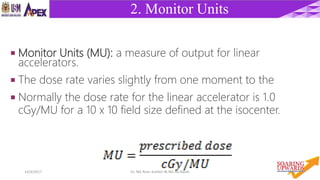
2. Monitor Units
 Monitor Units (MU): a measure of output for linear
accelerators.
 The dose rate varies slightly from one moment to the
 Normally the dose rate for the linear accelerator is 1.0
cGy/MU for a 10 x 10 field size defined at the isocenter.
614/4/2017 Dr. Nik Noor Ashikin Bt Nik Ab Razak
The most common definitions are:
1. The monitor chamber reads 100 MU when an absorbed dose of
1 GRAY (100 RADS) is delivered to a point at the depth of
maximum dose in a water-equivalent phantom whose surface
is at the isocentre of the machine (i.e. usually at 100 cm
from the source) with a field size at the surface of
10 cm × 10 cm.
2. Monitor Units
714/4/2017 Dr. Nik Noor Ashikin Bt Nik Ab Razak
2. The monitor chamber reads 100 MU when an absorbed dose of
1 Gy (100 rad) is delivered to a point at a given depth in the
phantom with the surface of the phantom positioned so that the
specified point is at the ISOCENTRE of the machine and the
field size is 10 cm × 10 cm at the isocentre.
2. Monitor Units
814/4/2017 Dr. Nik Noor Ashikin Bt Nik Ab Razak
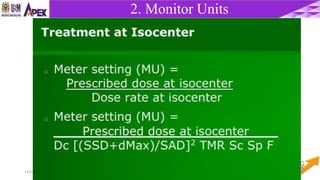
2. Monitor Units
914/4/2017 Dr. Nik Noor Ashikin Bt Nik Ab Razak
3. Treatment Time
 Treatment time: length of time a unit is physically
left on to deliver a measured dose.
 Factors considered:
 Beam energy
 Distance from the source of radiation
 Field size
1014/4/2017 Dr. Nik Noor Ashikin Bt Nik Ab Razak
4. Dose
5. DEPTH
Dose (absorbed dose): measured at a specific
point in a medium and refers to the energy
deposited at that point.
Measured in gray (Gy), which is defined so that 1
Gy equals 1J/kg.
1114/4/2017 Dr. Nik Noor Ashikin Bt Nik Ab Razak
5. Depth
Depth: distance beneath the skin surface where
the prescribed dose is to be delivered.
 Opposed fields: patient’s midplane is used
 Multiple field arrangements: isocenter used
Depth affects measurements of dose
attenuation.
1214/4/2017 Dr. Nik Noor Ashikin Bt Nik Ab Razak
6. Source Distance
Source to Skin Distance (SSD): the distance
from the source or target of the treatment
machine to the surface of the patient.
Source-axis Distance: the distance from the
source of photons to the isocenter.
1314/4/2017 Dr. Nik Noor Ashikin Bt Nik Ab Razak
7. Setup
SSD: Isocenter established at the patients skin
surface
 When the gantry rotates around the patient, the
SSD will continually change.
 Dose calculations often at DMAX. (Given dose)
SAD: Isocenter established within the patient
 The SAD and the isocenter are at a fixed distance
and therefore do not change.
1414/4/2017 Dr. Nik Noor Ashikin Bt Nik Ab Razak
8. . Isocenter
 Field Size: the physical size set on the collimator of
the therapy unit that determines the size of the
treatment field at a reference distance (defined at
the machine’s isocenter)
 SAD: the field size set inside the patient (size measured
on patients skin will be smaller)
 SSD: field size set on the collimator will be the same
measured at the patients skin
1514/4/2017 Dr. Nik Noor Ashikin Bt Nik Ab Razak
10. Scatter
Backscatter: radiation that is deflected back
toward the patient
Most of the absorbed dose received by the
patient results from the collisions of the
scattered electrons produced when the primary
photon interacts with the collimator.
1614/4/2017 Dr. Nik Noor Ashikin Bt Nik Ab Razak
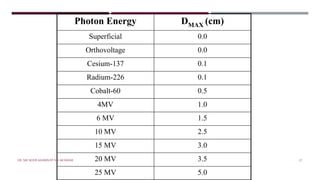
11. DMAX
 DMAX: the depth at which electronic equilibrium
occurs for photon beams; the point where dose
reaches its maximum value.
 Mainly depends on the energy of the beam
 The depth of maximum ionization increases as the energy of the
beam increases.
 Factors such as field size and distance may also influence
the depth
Photon Energy DMAX (cm)
Superficial 0.0
Orthovoltage 0.0
Cesium-137 0.1
Radium-226 0.1
Cobalt-60 0.5
4MV 1.0
6 MV 1.5
10 MV 2.5
15 MV 3.0
20 MV 3.5
25 MV 5.0
DR. NIK NOOR ASHIKIN BT NIK AB RAZAK 17
1814/4/2017 Dr. Nik Noor Ashikin Bt Nik Ab Razak
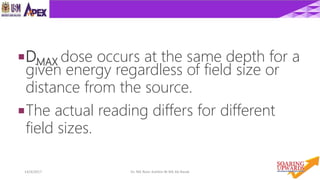
DMAX dose occurs at the same depth for a
given energy regardless of field size or
distance from the source.
The actual reading differs for different
field sizes.
1914/4/2017 Dr. Nik Noor Ashikin Bt Nik Ab Razak
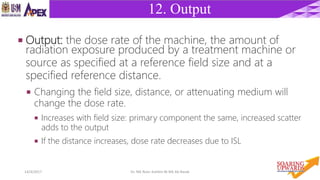
12. Output
 Output: the dose rate of the machine, the amount of
radiation exposure produced by a treatment machine or
source as specified at a reference field size and at a
specified reference distance.
 Changing the field size, distance, or attenuating medium will
change the dose rate.
 Increases with field size: primary component the same, increased scatter
adds to the output
 If the distance increases, dose rate decreases due to ISL
2014/4/2017 Dr. Nik Noor Ashikin Bt Nik Ab Razak
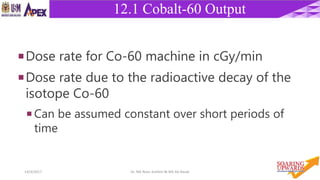
12.1 Cobalt-60 Output
Dose rate for Co-60 machine in cGy/min
Dose rate due to the radioactive decay of the
isotope Co-60
 Can be assumed constant over short periods of
time
2114/4/2017 Dr. Nik Noor Ashikin Bt Nik Ab Razak
12.2 Linac Output
Dose rate for Linac in cGy/MU
Dose rate varies from one moment to the
next
Ionization chamber shuts down machine after
predetermined dose has been given
2214/4/2017 Dr. Nik Noor Ashikin Bt Nik Ab Razak
13. Output Factor
 Output Factor: the ratio of the dose rate of a given
field size to the dose rate of the reference field
 Allows for the change in scatter as the collimator
changes
 Relates the dose rate of a given collimator setting to
dose rate of the reference field size
2314/4/2017 Dr. Nik Noor Ashikin Bt Nik Ab Razak
14. Dose Rate
 Commonly measured at the isocenter of the treatment machine.
 The dose rate of the beam is inversely proportional to the square of
the distance
 Dose rate(Given f.s.) = Dose rate(Reference f.s.) x Output factor(Given
f.s.)
 Dose Rate:
 Output (of machine)
 Output factor (C.S. field size)
 Scatter Ratio BSF or PSF (EFS/CS)
 PDD(EFS)/100
 Tray factor
 Inverse square correction
2414/4/2017 Dr. Nik Noor Ashikin Bt Nik Ab Razak
15. Equivalent Squares
 Equivalent Squares: rectangular field size that
demonstrate the same measurable scattering and
attenuation characteristics of a square field size.
 Used to find the output, output factor, and tissue
absorption factors.
 4 (A/P)
2514/4/2017 Dr. Nik Noor Ashikin Bt Nik Ab Razak
16. Tissue Absorption Factors
 Tissue absorption factors: different methods for measuring
the attenuation of the beam as it travels through matter.
 Percent Depth Dose (PDD):
 works best with SSD setups
 Tissue Air Ratio (TAR)
 Tissue Phantom Ratio (TPR)
 Tissue Maximum Ratio (TMR)
2614/4/2017 Dr. Nik Noor Ashikin Bt Nik Ab Razak
16.1 Percent Depth Dose (PDD)
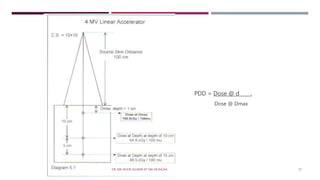
 Percent Depth Dose (PDD): the ratio expressed as a percentage, of
the absorbed dose at a given depth to the absorbed dose at a fixed
reference depth usually DMAX.
 Calculated from two measurements at two different points in space.
 Requires SSD be constant.
 Written as PDD(d,s,SSD)=
 Dependant on:
 ↑ Energy- more penetrating- ↑ PDD
 ↑ Depth- ↓ PDD due to attenuation through matter
 ↑ Field size- more scatter- ↑ PDD
 ↑ SSD- ↑ PDD- ISL
PERCENT DEPTH DOSE (PDD)
PDD = Dose @ d .
Dose @ Dmax
DR. NIK NOOR ASHIKIN BT NIK AB RAZAK 27
2814/4/2017 Dr. Nik Noor Ashikin Bt Nik Ab Razak
16.2 Tissue Air Ratio (TAR
 Tissue Air Ratio (TAR): the ratio of the absorbed dose at a
given depth in tissue to the absorbed dose at the same
in air.
 Dependant of:
 ↑Energy- ↑TAR
 ↑Field size- ↑ TAR
 ↑Depth- ↓ TAR
 Independent of SSD
2914/4/2017 Dr. Nik Noor Ashikin Bt Nik Ab Razak
16.2 Tissue Air Ratio (TAR)
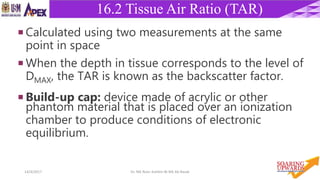
 Calculated using two measurements at the same
point in space
 When the depth in tissue corresponds to the level of
DMAX, the TAR is known as the backscatter factor.
 Build-up cap: device made of acrylic or other
phantom material that is placed over an ionization
chamber to produce conditions of electronic
equilibrium.
Tissue Air Ratio (TAR)
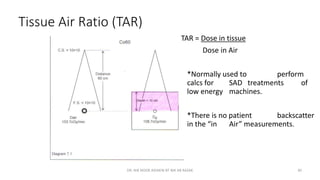
TAR = Dose in tissue
Dose in Air
*Normally used to perform
calcs for SAD treatments of
low energy machines.
*There is no patient backscatter
in the “in Air” measurements.
DR. NIK NOOR ASHIKIN BT NIK AB RAZAK 30
3114/4/2017 Dr. Nik Noor Ashikin Bt Nik Ab Razak
Backscatter Factor (BSF)
 When blocks are used.
 Backscatter Factor (BSF): the ratio of the dose rate
with a scattering medium to the dose rate at the same
point without a scattering medium at the level of
maximum equilibrium. (TAR at the level of DMAX)
 PSF for megavoltage units.
Backscatter Factor (BSF)
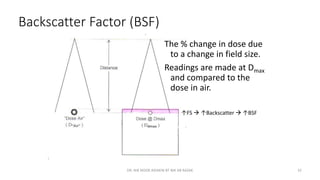
The % change in dose due
to a change in field size.
Readings are made at Dmax
and compared to the
dose in air.
↑FS  ↑Backscatter  ↑BSF
DR. NIK NOOR ASHIKIN BT NIK AB RAZAK 32
3314/4/2017 Dr. Nik Noor Ashikin Bt Nik Ab Razak
16.3 Scatter Air Ratio (SAR)
 Scatter Air Ratio (SAR): the difference between the
TAR for a field of definite area and that for a zero
area.
 The primary part of the total absorbed dose is
represented by the zero area TAR.
 A measure of the contribution from scattered
radiation.
3414/4/2017 Dr. Nik Noor Ashikin Bt Nik Ab Razak
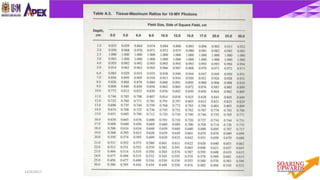
16.4 Tissue Phantom Ratio (TPR)
Tissue Phantom Ratio (TPR): the absorbed dose
at a given depth in phantom to the absorbed
dose at the same point at a reference depth in
phantom.
The deeper the reference depth the greater the
TPR.
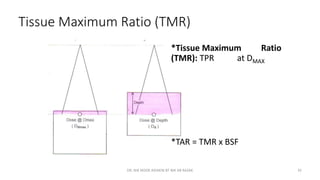
Tissue Maximum Ratio (TMR)
*Tissue Maximum Ratio
(TMR): TPR at DMAX
*TAR = TMR x BSF
DR. NIK NOOR ASHIKIN BT NIK AB RAZAK 35
PART 2
Photon Dosimetry
CALCULATIONS
3614/4/2017
Dr. Nik Noor Ashikin Bt Nik Ab Razak
3714/4/2017 Dr. Nik Noor Ashikin Bt Nik Ab Razak
1. Calculations
 Field size variations, energy changes, and modifiers in the
beam’s path can alter the amount of radiation received by
the patient.
Time setting = Dose at a point/Dose rate at that point
 Dose at a point: the prescribed dose as determined by the
doctor
 Dose rate at that point: represents the dose rate of the
treatment unit at the point of calculation
3814/4/2017 Dr. Nik Noor Ashikin Bt Nik Ab Razak
1. Calculations
When calculating dose to a given depth, all
other points in the radiation field will be
exposed to radiation for the same amount of
time.
The dose to these points is dependent on
their depth.
3914/4/2017 Dr. Nik Noor Ashikin Bt Nik Ab Razak
2. SSD Calculations
 Output or dose rate of the machine should be expressed at the depth of DMAX
 Field size: defined at the skin surface
 Dose rate: measured in tissue at the depth of DMAX
1. Find equivalent square of the collimator setting (used for output
factor)
2. Find equivalent square of the EFS (used for PDD)
3. Determine the PDD
4. Determine prescribed dose
5. Determine the treatment unit setting
4014/4/2017 Dr. Nik Noor Ashikin Bt Nik Ab Razak
3. Extended Distance
 Extended Distance: patient is set up at a distance
beyond the isocenter or reference distance.
 PDD is used because its nonisocentric
 When MUs are calculated for setup at distances
greater than the standard, ISL is used to account for
the decrease in dose rates beyond the isocenter.
4114/4/2017 Dr. Nik Noor Ashikin Bt Nik Ab Razak
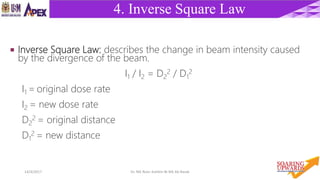
4. Inverse Square Law
 Inverse Square Law: describes the change in beam intensity caused
by the divergence of the beam.
I1 / I2 = D2
2 / D1
2
I1 = original dose rate
I2 = new dose rate
D2
2 = original distance
D1
2 = new distance
4214/4/2017 Dr. Nik Noor Ashikin Bt Nik Ab Razak
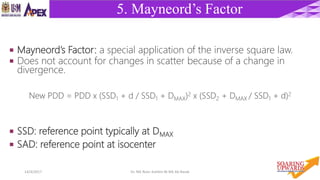
5. Mayneord’s Factor
 Mayneord’s Factor: a special application of the inverse square law.
 Does not account for changes in scatter because of a change in
divergence.
New PDD = PDD x (SSD1 + d / SSD1 + DMAX)2 x (SSD2 + DMAX / SSD1 + d)2
 SSD: reference point typically at DMAX
 SAD: reference point at isocenter
4314/4/2017 Dr. Nik Noor Ashikin Bt Nik Ab Razak
6. TMR/TPR SAD
 COF(C.S.) (collimator output factor): used to
determine scatter, measured in air, from the
collimators
 The increase in the collimator opening, the more
collimator surface area the photons will have to interact
with.
 PSF(EFS) (phantom scatter factor): used to determine
scatter from the patient.
EXAMPLE OF DOSE CALCULATION
4514/4/2017 Dr. Nik Noor Ashikin Bt Nik Ab Razak
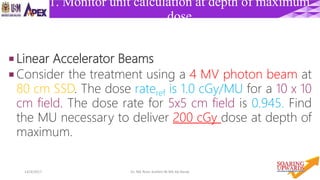
1. Monitor unit calculation at depth of maximum
dose
 Linear Accelerator Beams
 Consider the treatment using a 4 MV photon beam at
80 cm SSD. The dose rateref is 1.0 cGy/MU for a 10 x 10
cm field. The dose rate for 5x5 cm field is 0.945. Find
the MU necessary to deliver 200 cGy dose at depth of
maximum.
4614/4/2017 Dr. Nik Noor Ashikin Bt Nik Ab Razak
ANSWER:
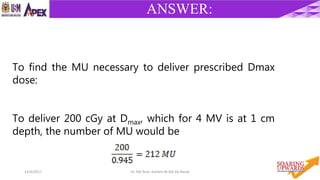
To find the MU necessary to deliver prescribed Dmax
dose:
To deliver 200 cGy at Dmax, which for 4 MV is at 1 cm
depth, the number of MU would be
4714/4/2017 Dr. Nik Noor Ashikin Bt Nik Ab Razak
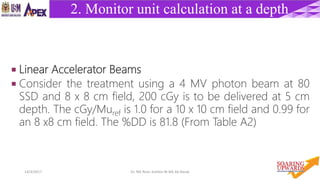
2. Monitor unit calculation at a depth
 Linear Accelerator Beams
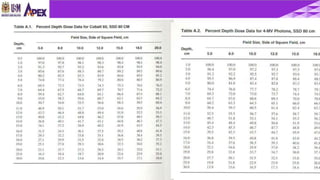
 Consider the treatment using a 4 MV photon beam at 80
SSD and 8 x 8 cm field, 200 cGy is to be delivered at 5 cm
depth. The cGy/Muref is 1.0 for a 10 x 10 cm field and 0.99 for
an 8 x8 cm field. The %DD is 81.8 (From Table A2)
4814/4/2017 Dr. Nik Noor Ashikin Bt Nik Ab Razak
2. Monitor unit calculation at a depth
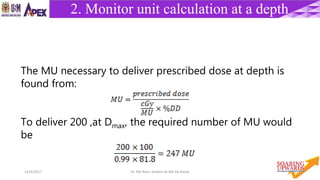
The MU necessary to deliver prescribed dose at depth is
found from:
To deliver 200 ,at Dmax, the required number of MU would
be
4914/4/2017 Dr. Nik Noor Ashikin Bt Nik Ab Razak
3. Monitor unit calculation at a depth
 Linear Accelerator Beams
 Consider the treatment using a 4 MV photon beams. The
cGy/MU is 1.03 for a 15 x 15 cm field. The %DD is 62.4 (From
Table A2). Find the MU necessary to deliver 100 cGy at 10 cm
depth
5014/4/2017 Dr. Nik Noor Ashikin Bt Nik Ab Razak
3. Monitor unit calculation at a depth
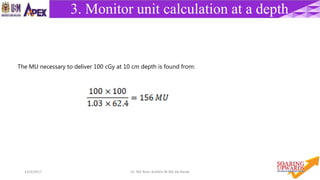
The MU necessary to deliver 100 cGy at 10 cm depth is found from:
5114/4/2017 Dr. Nik Noor Ashikin Bt Nik Ab Razak
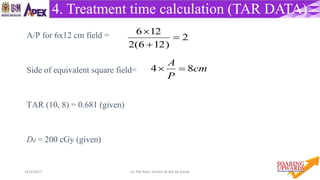
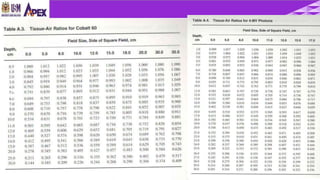
4. Treatment time calculation (TAR DATA)
Determine the time required to deliver 200 cGy (rad) with a 60Co ray beam
at isocenter (a point of intersection of the collimator axis and the gantry
axis of rotation) which is placed at 10 cm depth in the patient.
Given the following data: SAD = 80 cm, field size = 6 x 12 cm (at the
isocenter), dose rate free space at the SAD for this field = 120 cGy/min and
TAR = 0.681
5214/4/2017 Dr. Nik Noor Ashikin Bt Nik Ab Razak
4. Treatment time calculation (TAR DATA)
A/P for 6x12 cm field =
Side of equivalent square field=
TAR (10, 8) = 0.681 (given)
Dd = 200 cGy (given)
2
)126(2
126



cm
P
A
84 
5314/4/2017 Dr. Nik Noor Ashikin Bt Nik Ab Razak
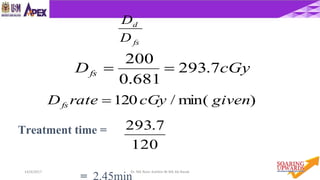
Treatment time =
= 2.45min
cGyDfs 7.293
681.0
200

)min(/120 givencGyrateDfs 
fs
d
D
D
120
7.293
5414/4/2017 Dr. Nik Noor Ashikin Bt Nik Ab Razak
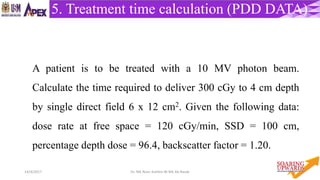
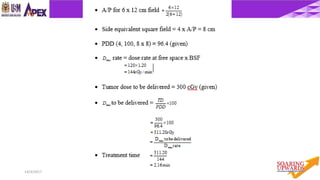
5. Treatment time calculation (PDD DATA)
A patient is to be treated with a 10 MV photon beam.
Calculate the time required to deliver 300 cGy to 4 cm depth
by single direct field 6 x 12 cm2. Given the following data:
dose rate at free space = 120 cGy/min, SSD = 100 cm,
percentage depth dose = 96.4, backscatter factor = 1.20.
5514/4/2017 Dr. Nik Noor Ashikin Bt Nik Ab Razak
5614/4/2017 Dr. Nik Noor Ashikin Bt Nik Ab Razak
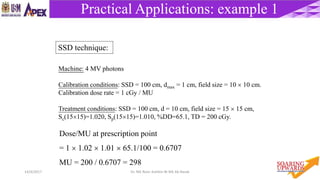
Practical Applications: example 1
Machine: 4 MV photons
Calibration conditions: SSD = 100 cm, dmax = 1 cm, field size = 10  10 cm.
Calibration dose rate = 1 cGy / MU
Treatment conditions: SSD = 100 cm, d = 10 cm, field size = 15  15 cm,
Sc(1515)=1.020, Sp(1515)=1.010, %DD=65.1, TD = 200 cGy.
Dose/MU at prescription point
= 1  1.02  1.01  65.1/100 = 0.6707
MU = 200 / 0.6707 = 298
SSD technique:
5714/4/2017 Dr. Nik Noor Ashikin Bt Nik Ab Razak
Practical Applications: example 2
Machine: 4 MV photons
Calibration conditions: SSD = 100 cm, dmax = 1 cm, field size = 10  10 cm.
Calibration dose rate = 1 cGy / MU
Treatment conditions: SSD = 120 cm, d = 10 cm, field size = 15  15 cm,
Sc(12.512.5)=1.010, Sp(1515)=1.010, %DD=66.7, TD = 200 cGy.
Dose/MU at prescription point
= 1  1.01  1.01  [(100+1)/(120+1)]2  0.667 = 0.474
MU = 200 / 0.474 = 422
SSD technique:
5814/4/2017 Dr. Nik Noor Ashikin Bt Nik Ab Razak
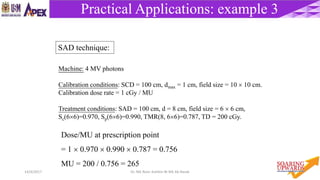
Practical Applications: example 3
Machine: 4 MV photons
Calibration conditions: SCD = 100 cm, dmax = 1 cm, field size = 10  10 cm.
Calibration dose rate = 1 cGy / MU
Treatment conditions: SAD = 100 cm, d = 8 cm, field size = 6  6 cm,
Sc(66)=0.970, Sp(66)=0.990, TMR(8, 66)=0.787, TD = 200 cGy.
Dose/MU at prescription point
= 1  0.970  0.990  0.787 = 0.756
MU = 200 / 0.756 = 265
SAD technique:
5914/4/2017 Dr. Nik Noor Ashikin Bt Nik Ab Razak
Practical Applications: example 4
SAD technique:
Machine: 4 MV photons
Calibration conditions: SCD = 101 cm, dmax = 1 cm, field size = 10  10 cm.
Calibration dose rate = 1 cGy / MU
Treatment conditions: SAD = 100 cm, d = 8 cm, field size = 6  6 cm,
Sc(66)=0.970, Sp(66)=0.990, TMR(8, 66)=0.787, TD = 200 cGy.
Dose/MU at prescription point
= 1  0.970  0.990  [(100+1)/(100)]2  0.787 = 0.771
MU = 200 / 0.771 = 259
6014/4/2017 Dr. Nik Noor Ashikin Bt Nik Ab Razak
Practical Applications: example 5
Machine: Co-60 photons
Calibration conditions: SSD = 80 cm, dmax = 0.5 cm, field size = 10  10 cm.
Calibration dose rate = 130 cGy / min
Treatment conditions: SSD = 100 cm, d = 8 cm, field size = 15  15 cm,
Sc(1212)=1.012, Sp(1515)=1.014, %DD(8,15  15,100)=68.7, TD = 200 cGy.
Dose/MU at prescription point
= 130  1.012  1.014  [(80+0.5)/(100+0.5)]2  68.7/100 = 58.80
MU = 200 / 58.80 = 3.40 min
SSD technique:
6114/4/2017 Dr. Nik Noor Ashikin Bt Nik Ab Razak
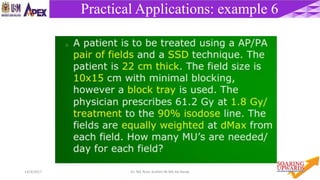
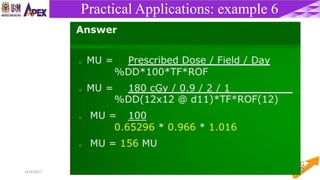
Practical Applications: example 6
6214/4/2017 Dr. Nik Noor Ashikin Bt Nik Ab Razak
Practical Applications: example 6
DR. NIK NOOR ASHIKIN BT NIK AB RAZAK 63
6414/4/2017 Dr. Nik Noor Ashikin Bt Nik Ab Razak
6514/4/2017 Dr. Nik Noor Ashikin Bt Nik Ab Razak
6614/4/2017 Dr. Nik Noor Ashikin Bt Nik Ab Razak

RADIOTHERAPY CALCULATION

  • 1.
    ZME 335 114/4/2017 Dr. NikNoor Ashikin Bt Nik Ab Razak RADIOTHERAPY & NUC MEDICINE
  • 2.
    TOPIC 4 Photon Dosimetryconcepts and Calculations 214/4/2017 Dr. Nik Noor Ashikin Bt Nik Ab Razak
  • 3.
    PART 1 Photon Dosimetry Concepts 314/4/2017 Dr.Nik Noor Ashikin Bt Nik Ab Razak
  • 4.
    414/4/2017 Dr. NikNoor Ashikin Bt Nik Ab Razak 1. Dose Calculation • The treatment planning team has to quantify the overall prescribed dose of radiation and determine how much dose will be delivered over the time frame outlined. • There are many parameters of photon beam calculation.
  • 5.
    514/4/2017 Dr. NikNoor Ashikin Bt Nik Ab Razak 2. Monitor Units  Monitor Units (MU): a measure of output for linear accelerators.  The dose rate varies slightly from one moment to the  Normally the dose rate for the linear accelerator is 1.0 cGy/MU for a 10 x 10 field size defined at the isocenter.
  • 6.
    614/4/2017 Dr. NikNoor Ashikin Bt Nik Ab Razak The most common definitions are: 1. The monitor chamber reads 100 MU when an absorbed dose of 1 GRAY (100 RADS) is delivered to a point at the depth of maximum dose in a water-equivalent phantom whose surface is at the isocentre of the machine (i.e. usually at 100 cm from the source) with a field size at the surface of 10 cm × 10 cm. 2. Monitor Units
  • 7.
    714/4/2017 Dr. NikNoor Ashikin Bt Nik Ab Razak 2. The monitor chamber reads 100 MU when an absorbed dose of 1 Gy (100 rad) is delivered to a point at a given depth in the phantom with the surface of the phantom positioned so that the specified point is at the ISOCENTRE of the machine and the field size is 10 cm × 10 cm at the isocentre. 2. Monitor Units
  • 8.
    814/4/2017 Dr. NikNoor Ashikin Bt Nik Ab Razak 2. Monitor Units
  • 9.
    914/4/2017 Dr. NikNoor Ashikin Bt Nik Ab Razak 3. Treatment Time  Treatment time: length of time a unit is physically left on to deliver a measured dose.  Factors considered:  Beam energy  Distance from the source of radiation  Field size
  • 10.
    1014/4/2017 Dr. NikNoor Ashikin Bt Nik Ab Razak 4. Dose 5. DEPTH Dose (absorbed dose): measured at a specific point in a medium and refers to the energy deposited at that point. Measured in gray (Gy), which is defined so that 1 Gy equals 1J/kg.
  • 11.
    1114/4/2017 Dr. NikNoor Ashikin Bt Nik Ab Razak 5. Depth Depth: distance beneath the skin surface where the prescribed dose is to be delivered.  Opposed fields: patient’s midplane is used  Multiple field arrangements: isocenter used Depth affects measurements of dose attenuation.
  • 12.
    1214/4/2017 Dr. NikNoor Ashikin Bt Nik Ab Razak 6. Source Distance Source to Skin Distance (SSD): the distance from the source or target of the treatment machine to the surface of the patient. Source-axis Distance: the distance from the source of photons to the isocenter.
  • 13.
    1314/4/2017 Dr. NikNoor Ashikin Bt Nik Ab Razak 7. Setup SSD: Isocenter established at the patients skin surface  When the gantry rotates around the patient, the SSD will continually change.  Dose calculations often at DMAX. (Given dose) SAD: Isocenter established within the patient  The SAD and the isocenter are at a fixed distance and therefore do not change.
  • 14.
    1414/4/2017 Dr. NikNoor Ashikin Bt Nik Ab Razak 8. . Isocenter  Field Size: the physical size set on the collimator of the therapy unit that determines the size of the treatment field at a reference distance (defined at the machine’s isocenter)  SAD: the field size set inside the patient (size measured on patients skin will be smaller)  SSD: field size set on the collimator will be the same measured at the patients skin
  • 15.
    1514/4/2017 Dr. NikNoor Ashikin Bt Nik Ab Razak 10. Scatter Backscatter: radiation that is deflected back toward the patient Most of the absorbed dose received by the patient results from the collisions of the scattered electrons produced when the primary photon interacts with the collimator.
  • 16.
    1614/4/2017 Dr. NikNoor Ashikin Bt Nik Ab Razak 11. DMAX  DMAX: the depth at which electronic equilibrium occurs for photon beams; the point where dose reaches its maximum value.  Mainly depends on the energy of the beam  The depth of maximum ionization increases as the energy of the beam increases.  Factors such as field size and distance may also influence the depth
  • 17.
    Photon Energy DMAX(cm) Superficial 0.0 Orthovoltage 0.0 Cesium-137 0.1 Radium-226 0.1 Cobalt-60 0.5 4MV 1.0 6 MV 1.5 10 MV 2.5 15 MV 3.0 20 MV 3.5 25 MV 5.0 DR. NIK NOOR ASHIKIN BT NIK AB RAZAK 17
  • 18.
    1814/4/2017 Dr. NikNoor Ashikin Bt Nik Ab Razak DMAX dose occurs at the same depth for a given energy regardless of field size or distance from the source. The actual reading differs for different field sizes.
  • 19.
    1914/4/2017 Dr. NikNoor Ashikin Bt Nik Ab Razak 12. Output  Output: the dose rate of the machine, the amount of radiation exposure produced by a treatment machine or source as specified at a reference field size and at a specified reference distance.  Changing the field size, distance, or attenuating medium will change the dose rate.  Increases with field size: primary component the same, increased scatter adds to the output  If the distance increases, dose rate decreases due to ISL
  • 20.
    2014/4/2017 Dr. NikNoor Ashikin Bt Nik Ab Razak 12.1 Cobalt-60 Output Dose rate for Co-60 machine in cGy/min Dose rate due to the radioactive decay of the isotope Co-60  Can be assumed constant over short periods of time
  • 21.
    2114/4/2017 Dr. NikNoor Ashikin Bt Nik Ab Razak 12.2 Linac Output Dose rate for Linac in cGy/MU Dose rate varies from one moment to the next Ionization chamber shuts down machine after predetermined dose has been given
  • 22.
    2214/4/2017 Dr. NikNoor Ashikin Bt Nik Ab Razak 13. Output Factor  Output Factor: the ratio of the dose rate of a given field size to the dose rate of the reference field  Allows for the change in scatter as the collimator changes  Relates the dose rate of a given collimator setting to dose rate of the reference field size
  • 23.
    2314/4/2017 Dr. NikNoor Ashikin Bt Nik Ab Razak 14. Dose Rate  Commonly measured at the isocenter of the treatment machine.  The dose rate of the beam is inversely proportional to the square of the distance  Dose rate(Given f.s.) = Dose rate(Reference f.s.) x Output factor(Given f.s.)  Dose Rate:  Output (of machine)  Output factor (C.S. field size)  Scatter Ratio BSF or PSF (EFS/CS)  PDD(EFS)/100  Tray factor  Inverse square correction
  • 24.
    2414/4/2017 Dr. NikNoor Ashikin Bt Nik Ab Razak 15. Equivalent Squares  Equivalent Squares: rectangular field size that demonstrate the same measurable scattering and attenuation characteristics of a square field size.  Used to find the output, output factor, and tissue absorption factors.  4 (A/P)
  • 25.
    2514/4/2017 Dr. NikNoor Ashikin Bt Nik Ab Razak 16. Tissue Absorption Factors  Tissue absorption factors: different methods for measuring the attenuation of the beam as it travels through matter.  Percent Depth Dose (PDD):  works best with SSD setups  Tissue Air Ratio (TAR)  Tissue Phantom Ratio (TPR)  Tissue Maximum Ratio (TMR)
  • 26.
    2614/4/2017 Dr. NikNoor Ashikin Bt Nik Ab Razak 16.1 Percent Depth Dose (PDD)  Percent Depth Dose (PDD): the ratio expressed as a percentage, of the absorbed dose at a given depth to the absorbed dose at a fixed reference depth usually DMAX.  Calculated from two measurements at two different points in space.  Requires SSD be constant.  Written as PDD(d,s,SSD)=  Dependant on:  ↑ Energy- more penetrating- ↑ PDD  ↑ Depth- ↓ PDD due to attenuation through matter  ↑ Field size- more scatter- ↑ PDD  ↑ SSD- ↑ PDD- ISL
  • 27.
    PERCENT DEPTH DOSE(PDD) PDD = Dose @ d . Dose @ Dmax DR. NIK NOOR ASHIKIN BT NIK AB RAZAK 27
  • 28.
    2814/4/2017 Dr. NikNoor Ashikin Bt Nik Ab Razak 16.2 Tissue Air Ratio (TAR  Tissue Air Ratio (TAR): the ratio of the absorbed dose at a given depth in tissue to the absorbed dose at the same in air.  Dependant of:  ↑Energy- ↑TAR  ↑Field size- ↑ TAR  ↑Depth- ↓ TAR  Independent of SSD
  • 29.
    2914/4/2017 Dr. NikNoor Ashikin Bt Nik Ab Razak 16.2 Tissue Air Ratio (TAR)  Calculated using two measurements at the same point in space  When the depth in tissue corresponds to the level of DMAX, the TAR is known as the backscatter factor.  Build-up cap: device made of acrylic or other phantom material that is placed over an ionization chamber to produce conditions of electronic equilibrium.
  • 30.
    Tissue Air Ratio(TAR) TAR = Dose in tissue Dose in Air *Normally used to perform calcs for SAD treatments of low energy machines. *There is no patient backscatter in the “in Air” measurements. DR. NIK NOOR ASHIKIN BT NIK AB RAZAK 30
  • 31.
    3114/4/2017 Dr. NikNoor Ashikin Bt Nik Ab Razak Backscatter Factor (BSF)  When blocks are used.  Backscatter Factor (BSF): the ratio of the dose rate with a scattering medium to the dose rate at the same point without a scattering medium at the level of maximum equilibrium. (TAR at the level of DMAX)  PSF for megavoltage units.
  • 32.
    Backscatter Factor (BSF) The% change in dose due to a change in field size. Readings are made at Dmax and compared to the dose in air. ↑FS  ↑Backscatter  ↑BSF DR. NIK NOOR ASHIKIN BT NIK AB RAZAK 32
  • 33.
    3314/4/2017 Dr. NikNoor Ashikin Bt Nik Ab Razak 16.3 Scatter Air Ratio (SAR)  Scatter Air Ratio (SAR): the difference between the TAR for a field of definite area and that for a zero area.  The primary part of the total absorbed dose is represented by the zero area TAR.  A measure of the contribution from scattered radiation.
  • 34.
    3414/4/2017 Dr. NikNoor Ashikin Bt Nik Ab Razak 16.4 Tissue Phantom Ratio (TPR) Tissue Phantom Ratio (TPR): the absorbed dose at a given depth in phantom to the absorbed dose at the same point at a reference depth in phantom. The deeper the reference depth the greater the TPR.
  • 35.
    Tissue Maximum Ratio(TMR) *Tissue Maximum Ratio (TMR): TPR at DMAX *TAR = TMR x BSF DR. NIK NOOR ASHIKIN BT NIK AB RAZAK 35
  • 36.
  • 37.
    3714/4/2017 Dr. NikNoor Ashikin Bt Nik Ab Razak 1. Calculations  Field size variations, energy changes, and modifiers in the beam’s path can alter the amount of radiation received by the patient. Time setting = Dose at a point/Dose rate at that point  Dose at a point: the prescribed dose as determined by the doctor  Dose rate at that point: represents the dose rate of the treatment unit at the point of calculation
  • 38.
    3814/4/2017 Dr. NikNoor Ashikin Bt Nik Ab Razak 1. Calculations When calculating dose to a given depth, all other points in the radiation field will be exposed to radiation for the same amount of time. The dose to these points is dependent on their depth.
  • 39.
    3914/4/2017 Dr. NikNoor Ashikin Bt Nik Ab Razak 2. SSD Calculations  Output or dose rate of the machine should be expressed at the depth of DMAX  Field size: defined at the skin surface  Dose rate: measured in tissue at the depth of DMAX 1. Find equivalent square of the collimator setting (used for output factor) 2. Find equivalent square of the EFS (used for PDD) 3. Determine the PDD 4. Determine prescribed dose 5. Determine the treatment unit setting
  • 40.
    4014/4/2017 Dr. NikNoor Ashikin Bt Nik Ab Razak 3. Extended Distance  Extended Distance: patient is set up at a distance beyond the isocenter or reference distance.  PDD is used because its nonisocentric  When MUs are calculated for setup at distances greater than the standard, ISL is used to account for the decrease in dose rates beyond the isocenter.
  • 41.
    4114/4/2017 Dr. NikNoor Ashikin Bt Nik Ab Razak 4. Inverse Square Law  Inverse Square Law: describes the change in beam intensity caused by the divergence of the beam. I1 / I2 = D2 2 / D1 2 I1 = original dose rate I2 = new dose rate D2 2 = original distance D1 2 = new distance
  • 42.
    4214/4/2017 Dr. NikNoor Ashikin Bt Nik Ab Razak 5. Mayneord’s Factor  Mayneord’s Factor: a special application of the inverse square law.  Does not account for changes in scatter because of a change in divergence. New PDD = PDD x (SSD1 + d / SSD1 + DMAX)2 x (SSD2 + DMAX / SSD1 + d)2  SSD: reference point typically at DMAX  SAD: reference point at isocenter
  • 43.
    4314/4/2017 Dr. NikNoor Ashikin Bt Nik Ab Razak 6. TMR/TPR SAD  COF(C.S.) (collimator output factor): used to determine scatter, measured in air, from the collimators  The increase in the collimator opening, the more collimator surface area the photons will have to interact with.  PSF(EFS) (phantom scatter factor): used to determine scatter from the patient.
  • 44.
    EXAMPLE OF DOSECALCULATION
  • 45.
    4514/4/2017 Dr. NikNoor Ashikin Bt Nik Ab Razak 1. Monitor unit calculation at depth of maximum dose  Linear Accelerator Beams  Consider the treatment using a 4 MV photon beam at 80 cm SSD. The dose rateref is 1.0 cGy/MU for a 10 x 10 cm field. The dose rate for 5x5 cm field is 0.945. Find the MU necessary to deliver 200 cGy dose at depth of maximum.
  • 46.
    4614/4/2017 Dr. NikNoor Ashikin Bt Nik Ab Razak ANSWER: To find the MU necessary to deliver prescribed Dmax dose: To deliver 200 cGy at Dmax, which for 4 MV is at 1 cm depth, the number of MU would be
  • 47.
    4714/4/2017 Dr. NikNoor Ashikin Bt Nik Ab Razak 2. Monitor unit calculation at a depth  Linear Accelerator Beams  Consider the treatment using a 4 MV photon beam at 80 SSD and 8 x 8 cm field, 200 cGy is to be delivered at 5 cm depth. The cGy/Muref is 1.0 for a 10 x 10 cm field and 0.99 for an 8 x8 cm field. The %DD is 81.8 (From Table A2)
  • 48.
    4814/4/2017 Dr. NikNoor Ashikin Bt Nik Ab Razak 2. Monitor unit calculation at a depth The MU necessary to deliver prescribed dose at depth is found from: To deliver 200 ,at Dmax, the required number of MU would be
  • 49.
    4914/4/2017 Dr. NikNoor Ashikin Bt Nik Ab Razak 3. Monitor unit calculation at a depth  Linear Accelerator Beams  Consider the treatment using a 4 MV photon beams. The cGy/MU is 1.03 for a 15 x 15 cm field. The %DD is 62.4 (From Table A2). Find the MU necessary to deliver 100 cGy at 10 cm depth
  • 50.
    5014/4/2017 Dr. NikNoor Ashikin Bt Nik Ab Razak 3. Monitor unit calculation at a depth The MU necessary to deliver 100 cGy at 10 cm depth is found from:
  • 51.
    5114/4/2017 Dr. NikNoor Ashikin Bt Nik Ab Razak 4. Treatment time calculation (TAR DATA) Determine the time required to deliver 200 cGy (rad) with a 60Co ray beam at isocenter (a point of intersection of the collimator axis and the gantry axis of rotation) which is placed at 10 cm depth in the patient. Given the following data: SAD = 80 cm, field size = 6 x 12 cm (at the isocenter), dose rate free space at the SAD for this field = 120 cGy/min and TAR = 0.681
  • 52.
    5214/4/2017 Dr. NikNoor Ashikin Bt Nik Ab Razak 4. Treatment time calculation (TAR DATA) A/P for 6x12 cm field = Side of equivalent square field= TAR (10, 8) = 0.681 (given) Dd = 200 cGy (given) 2 )126(2 126    cm P A 84 
  • 53.
    5314/4/2017 Dr. NikNoor Ashikin Bt Nik Ab Razak Treatment time = = 2.45min cGyDfs 7.293 681.0 200  )min(/120 givencGyrateDfs  fs d D D 120 7.293
  • 54.
    5414/4/2017 Dr. NikNoor Ashikin Bt Nik Ab Razak 5. Treatment time calculation (PDD DATA) A patient is to be treated with a 10 MV photon beam. Calculate the time required to deliver 300 cGy to 4 cm depth by single direct field 6 x 12 cm2. Given the following data: dose rate at free space = 120 cGy/min, SSD = 100 cm, percentage depth dose = 96.4, backscatter factor = 1.20.
  • 55.
    5514/4/2017 Dr. NikNoor Ashikin Bt Nik Ab Razak
  • 56.
    5614/4/2017 Dr. NikNoor Ashikin Bt Nik Ab Razak Practical Applications: example 1 Machine: 4 MV photons Calibration conditions: SSD = 100 cm, dmax = 1 cm, field size = 10  10 cm. Calibration dose rate = 1 cGy / MU Treatment conditions: SSD = 100 cm, d = 10 cm, field size = 15  15 cm, Sc(1515)=1.020, Sp(1515)=1.010, %DD=65.1, TD = 200 cGy. Dose/MU at prescription point = 1  1.02  1.01  65.1/100 = 0.6707 MU = 200 / 0.6707 = 298 SSD technique:
  • 57.
    5714/4/2017 Dr. NikNoor Ashikin Bt Nik Ab Razak Practical Applications: example 2 Machine: 4 MV photons Calibration conditions: SSD = 100 cm, dmax = 1 cm, field size = 10  10 cm. Calibration dose rate = 1 cGy / MU Treatment conditions: SSD = 120 cm, d = 10 cm, field size = 15  15 cm, Sc(12.512.5)=1.010, Sp(1515)=1.010, %DD=66.7, TD = 200 cGy. Dose/MU at prescription point = 1  1.01  1.01  [(100+1)/(120+1)]2  0.667 = 0.474 MU = 200 / 0.474 = 422 SSD technique:
  • 58.
    5814/4/2017 Dr. NikNoor Ashikin Bt Nik Ab Razak Practical Applications: example 3 Machine: 4 MV photons Calibration conditions: SCD = 100 cm, dmax = 1 cm, field size = 10  10 cm. Calibration dose rate = 1 cGy / MU Treatment conditions: SAD = 100 cm, d = 8 cm, field size = 6  6 cm, Sc(66)=0.970, Sp(66)=0.990, TMR(8, 66)=0.787, TD = 200 cGy. Dose/MU at prescription point = 1  0.970  0.990  0.787 = 0.756 MU = 200 / 0.756 = 265 SAD technique:
  • 59.
    5914/4/2017 Dr. NikNoor Ashikin Bt Nik Ab Razak Practical Applications: example 4 SAD technique: Machine: 4 MV photons Calibration conditions: SCD = 101 cm, dmax = 1 cm, field size = 10  10 cm. Calibration dose rate = 1 cGy / MU Treatment conditions: SAD = 100 cm, d = 8 cm, field size = 6  6 cm, Sc(66)=0.970, Sp(66)=0.990, TMR(8, 66)=0.787, TD = 200 cGy. Dose/MU at prescription point = 1  0.970  0.990  [(100+1)/(100)]2  0.787 = 0.771 MU = 200 / 0.771 = 259
  • 60.
    6014/4/2017 Dr. NikNoor Ashikin Bt Nik Ab Razak Practical Applications: example 5 Machine: Co-60 photons Calibration conditions: SSD = 80 cm, dmax = 0.5 cm, field size = 10  10 cm. Calibration dose rate = 130 cGy / min Treatment conditions: SSD = 100 cm, d = 8 cm, field size = 15  15 cm, Sc(1212)=1.012, Sp(1515)=1.014, %DD(8,15  15,100)=68.7, TD = 200 cGy. Dose/MU at prescription point = 130  1.012  1.014  [(80+0.5)/(100+0.5)]2  68.7/100 = 58.80 MU = 200 / 58.80 = 3.40 min SSD technique:
  • 61.
    6114/4/2017 Dr. NikNoor Ashikin Bt Nik Ab Razak Practical Applications: example 6
  • 62.
    6214/4/2017 Dr. NikNoor Ashikin Bt Nik Ab Razak Practical Applications: example 6
  • 63.
    DR. NIK NOORASHIKIN BT NIK AB RAZAK 63
  • 64.
    6414/4/2017 Dr. NikNoor Ashikin Bt Nik Ab Razak
  • 65.
    6514/4/2017 Dr. NikNoor Ashikin Bt Nik Ab Razak
  • 66.
    6614/4/2017 Dr. NikNoor Ashikin Bt Nik Ab Razak