sgisave@ymail.com
1
Tools of Data
Collection
By,
S.G.Isave,
Assistant Professor,
Tilak College of Education,
Pune - India
sgisave@ymail.com 2
Tools
• Questionnaire
• Interview schedule
• observation
sgisave@ymail.com 3
Interview schedule
sgisave@ymail.com 4
Meaning of Interview schedule
• One to one direct communication
between researcher and subject for
collection of data.
• Series of a questions to be asked in an
interview is called interview schedule.
sgisave@ymail.com 5
Types of Interview schedule
• Structured (for research)
• Semi-structured ( flexible but
structured)
• Non-directive ( free talk on issues)
• Focused ( in depth talk on an issue )
(Media)
sgisave@ymail.com 6
How to conduct an Interview
• Interview schedule should as per objectives.
• Planning of time, duration, place, mode of
recording.
• Follow Formalities.
• Respect not to answer right of subject.
• Use of appropriate Language.
• Positive body language.
• Directing the interview.
• Questioning – proper stress and tone, use of
sub questions if required.
sgisave@ymail.com 7
Limitations
• Hesitation to express
• Vague
• Time restrictions
• Less time for thinking
• Subjective
• Researcher’s influence
• Consciousness
• Manipulated/polished/sophisticated/socially
accepted responses may be preferred.
sgisave@ymail.com 8
Questionnaire
sgisave@ymail.com 9
Meaning
• Series of questions in written form.
• Indirect interview
• Widely used tool
sgisave@ymail.com 10
When to use
• Objective tool
• Factual data required
• Large sample
• Minimum cost & time
• Crossing Geographical limitations
sgisave@ymail.com 11
Types
• Open
• Close
• Mixed
• E-mail
• Web based
• Live
• Distance
sgisave@ymail.com 12
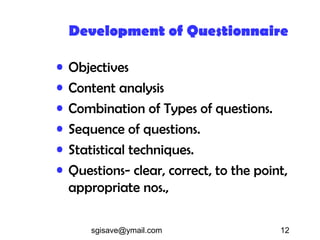
Development of Questionnaire
• Objectives
• Content analysis
• Combination of Types of questions.
• Sequence of questions.
• Statistical techniques.
• Questions- clear, correct, to the point,
appropriate nos.,
sgisave@ymail.com 13
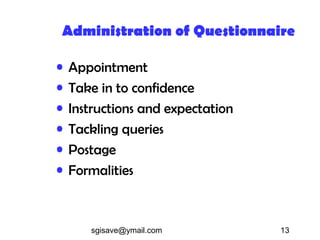
Administration of Questionnaire
• Appointment
• Take in to confidence
• Instructions and expectation
• Tackling queries
• Postage
• Formalities
sgisave@ymail.com 14
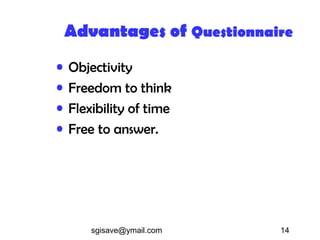
Advantages of Questionnaire
• Objectivity
• Freedom to think
• Flexibility of time
• Free to answer.
sgisave@ymail.com 15
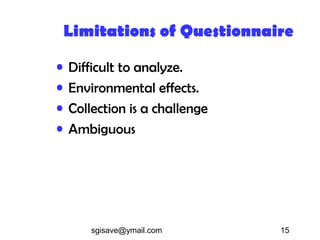
Limitations of Questionnaire
• Difficult to analyze.
• Environmental effects.
• Collection is a challenge
• Ambiguous
sgisave@ymail.com 16
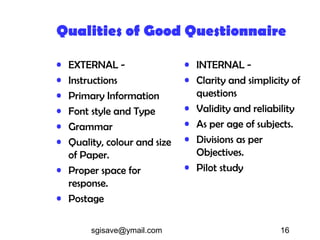
Qualities of Good Questionnaire
• EXTERNAL -
• Instructions
• Primary Information
• Font style and Type
• Grammar
• Quality, colour and size
of Paper.
• Proper space for
response.
• Postage
• INTERNAL -
• Clarity and simplicity of
questions
• Validity and reliability
• As per age of subjects.
• Divisions as per
Objectives.
• Pilot study
sgisave@ymail.com 17
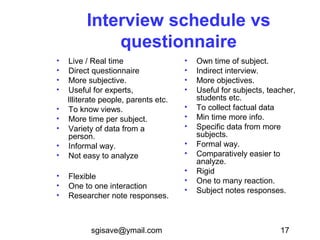
Interview schedule vs
questionnaire
• Live / Real time
• Direct questionnaire
• More subjective.
• Useful for experts,
Illiterate people, parents etc.
• To know views.
• More time per subject.
• Variety of data from a
person.
• Informal way.
• Not easy to analyze
• Flexible
• One to one interaction
• Researcher note responses.
• Own time of subject.
• Indirect interview.
• More objectives.
• Useful for subjects, teacher,
students etc.
• To collect factual data
• Min time more info.
• Specific data from more
subjects.
• Formal way.
• Comparatively easier to
analyze.
• Rigid
• One to many reaction.
• Subject notes responses.
sgisave@ymail.com 18
Observation
sgisave@ymail.com 19
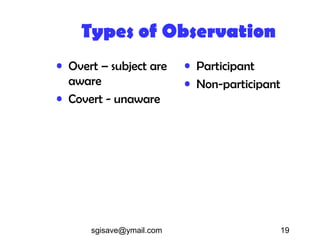
Types of Observation
• Overt – subject are
aware
• Covert - unaware
• Participant
• Non-participant
sgisave@ymail.com 20
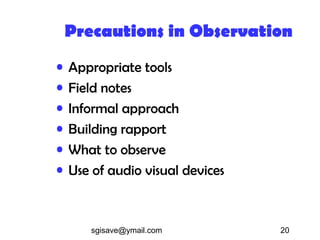
Precautions in Observation
• Appropriate tools
• Field notes
• Informal approach
• Building rapport
• What to observe
• Use of audio visual devices
sgisave@ymail.com 21
Advantages
• Natural response
• Real collection of a data
• All round data
• Self experience
• Understanding the subject.
• Useful for sociological research.
• Useful for linear research.
sgisave@ymail.com 22
Limitations
• Subjectivity
• Temporary form of data is acquired.
• Difficult to analyze the data.
• Time consumable.
• Practical difficulties.
sgisave@ymail.com 23
Lets go beyond content…
sgisave@ymail.com 24
Ask yourself ….
sgisave@ymail.com
25
Can I qualify in
first attempt?
……..Yes,
Why not !
sgisave@ymail.com 26
If I do this
• Believe yourself.
• Understand the nature of the exam.
• Collect all the units of syllabus.
• Don’t be scared of passing
percentage of the exam.
sgisave@ymail.com 27
If I do this..
• Prepare seriously.
• Don’t just try for experience.
• Prepare your own notes.
• Practice to write answers.
• Avoid Grammatical mistakes.
sgisave@ymail.com 28
If I do this
• Solve old question paper with time
management and get it checked
from an expert.
• Construct diagrams.
• Update your knowledge with books,
periodicals, internet etc.
• Discuss with peer, teachers,
successful candidates.
sgisave@ymail.com 29
• Be confident.
• Be healthy, because learning is also
physical activity.
• Be careful about filling application
form, attaching documents, admit
cart,
sgisave@ymail.com 30
All the Best
• If you try hard in proper
direction, “You all will
qualify in coming SET
exam. in first attempt.”
sgisave@ymail.com 31
THANK YOU !