Sushant Luitel
Data Collection Tools & Technique
and Steps of Data Collection
6/20/2021
1
Data and Data Collection
 Data are units of information, often numeric, that are collected through
observation.
 Data collection is the process by which the researcher collect the
information needed to answer the research problems.
6/20/2021
2
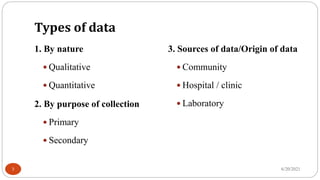
Types of data
1. By nature
 Qualitative
 Quantitative
2. By purpose of collection
 Primary
 Secondary
3. Sources of data/Origin of data
 Community
 Hospital / clinic
 Laboratory
6/20/2021
3
Primary Data
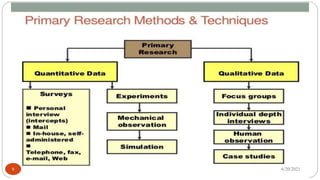
 The data collected for the first time are called primary data.
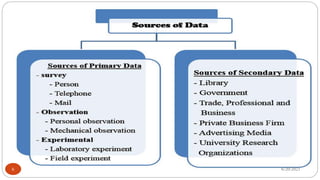
 The methods mostly used in collecting primary data are survey, observation and
experiment.
 Generally, all these methods are not used in a same project, because they have
both good and bad aspects.
 The question which method of primary data collection should be selected
depends on the nature, time and cost.
 The method should be selected according to the nature, time and cost.
6/20/2021
4
Secondary Data
 The data used once are called secondary data.
 It becomes much easier to collect secondary data than the primary ones.
 Secondary data can be collected from several sources.
6/20/2021
5
6/20/2021
6
Qualitative data
 Qualitative data are mostly non-numerical and usually descriptive or nominal in nature.
This means the data collected are in the form of words and sentences.
 Often, such data captures feelings, emotions, or subjective perceptions of something.
 Qualitative approaches aim to address the ‘how’ and ‘why’ of a program and tend to use
unstructured methods of data collection to fully explore the topic.
 Qualitative questions are open-ended.
 Qualitative methods include focus groups, group discussions and interviews.
 They are, however, expensive and time consuming to implement
6/20/2021
7
Quantitative data
 Quantitative data is numerical in nature and can be mathematically computed.
 Quantitative data measure uses different scales, which can be classified as nominal scale, ordinal
scale, interval scale and ratio scale. Often, such data includes measurements of something.
 Quantitative approaches address the ‘what’ of the program.
 Quantitative approaches have the advantage that they are cheaper to implement, are standardized
so comparisons can be easily made and the size of the effect can usually be measured.
 Quantitative approaches however are limited in their capacity for the investigation and
explanation of similarities and unexpected differences
6/20/2021
8
6/20/2021
9
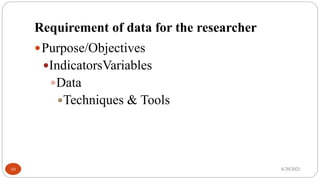
Requirement of data for the researcher
Purpose/Objectives
IndicatorsVariables
Data
Techniques & Tools
6/20/2021
10
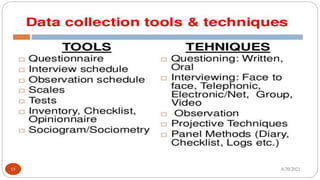
Data collection Tools
 The instruments or aids that we use for the purpose of collecting
and/or recording the data are called data collection tools.
 Questionnaire
 Observation checklist
 Guidelines (such as FGD guidelines, KII guideline etc)
 Survey etc
6/20/2021
11
TOOLS PREPARATION FOR DATA
COLLECTION
 Data collected on tools like Qestionnaires or schedules.
 Objectives of the study to be kept in mind
 Type of participants, nature of information and method of
analysis to kept in mind
 List of variables to be prepared
 Logical sequencing has to adopted
6/20/2021
12
Data Collection Techniques
 Data collection techniques allow us to systematically collect information about
our objects of study (people, objects, phenomena) and about the settings in
which they occur.
 In the collection of data we have to be systematic.
 If data are collected haphazardly, it will be difficult to answer our research
questions in a conclusive way.
6/20/2021
13
Various data collection techniques can be used such as:
Using available information
Observing
Interviewing (face-to-face)
Administering written questionnaires
Focus group discussions
 Social mapping
6/20/2021
14
6/20/2021
15
Questionnaire
 A questionnaire is a research instrument that consists of a set of questions or
other types of prompts that aims to collect information from a respondent.
 Often a questionnaire uses both open and closed questions to collect data.
 The data collected from a data collection questionnaire can be both qualitative as well as
quantitative in nature.
 A verbatim response refers to what an interviewer records as an answer to an open-
ended question when writing down the exact words spoken by the respondent which
helps to give the qualitative information on research.
6/20/2021
16
Observation
 Observation method of information gathering is used by monitoring participants
in a specific situation or environment at a given time and day.
 Basically, researchers observe the behaviour of the surrounding environments or
people that are being studied.
 This type of study can be:
 Controlled
 Natural
 Participant
6/20/2021
17
Cont…
 Controlled observation is when the researcher uses a standardised procedure of
observing participants or the environment.
 Natural observation is when participants are being observed in their natural
conditions.
 Participant observation is where the researcher becomes part of the group
being studied.
6/20/2021
18
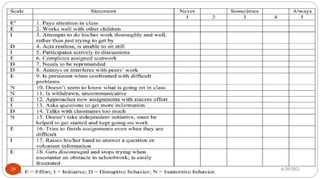
Observation checklist
 An observation checklist is a set of questions that evaluate the
performance and behavior of teachers and students in a classroom setting.
 Observation checklists assist an observer to identify skill gaps and
problem areas to further improve teaching strategies, classroom settings,
and student learning development.
6/20/2021
19
6/20/2021
20
Interview
 Interview is a qualitative method of data collection whose results are
based on intensive engagement with respondents about a particular study.
Usually, interviews are used in order to collect in-depth responses from the
professionals being interviewed.
 Interview can be structured (formal), semi-structured or unstructured
(informal). In essence, an interview method of data collection can be
conducted through face-to-face meeting with the interviewees or through
telephone.
6/20/2021
21
Key informant interviews
 Key informant interviews are qualitative in-depth interviews with people
who know what is going on in the community.
 The purpose of key informant interviews is to collect information from a
wide range of people including community leaders, professionals, or
residents who have first hand knowledge about the community.
6/20/2021
22
How to Conduct the Key Informant Interviews
 Formulate study questions.
 Prepare a short interview guide.
 Select key informants.
 Conduct interviews.
 Take adequate notes.
 Analyse interview data.
 Check for reliability and validity.
6/20/2021
23
Survey
 A survey is a research method used for collecting data from a predefined
group of respondents to gain information and insights into various topics
of interest.
 They can have multiple purposes, and researchers can conduct it in many
ways depending on the methodology chosen and the study’s goal.
 The process involves asking people for information through
a questionnaire, which can be either online or offline.
6/20/2021
24
Focus Group Discussion
 A focus group discussion involves gathering people from similar.
backgrounds or experiences together to discuss a specific topic of. Interest
 A focus group is a group interview of approximately six to twelve people
who share similar characteristics or common interests.
 Focus groups are a qualitative data collection method “perceptions
attitudes, beliefs, opinion or ideas”, meaning that the data is descriptive
and cannot be measured numerically.
6/20/2021
25
Cont…
 The common and simplest method for selecting participants for focus
groups is called "purposive" or "convenience" sampling.
 This means that you select those members of the community who you
think will provide you with the best information.
6/20/2021
26
Steps of Conducting Focus Group Discussion
Step 1: Define the Purpose
Step 2: Select the Participants and Leader
Step 3: Manage the Atmospherics
Step 4: Develop the Questions
Step 5: Conduct the Session
Step 6: Analyse the Results
6/20/2021
27
Social Mapping
 Social mapping is a visual method of showing the relative location of
households and the distribution of different people together with
the social structure, groups and organisations of an area.
 Social mapping is making visible what has been invisible for a very long
time (i.e the cultural and indigenous landscapes). It helps us understand
histories and our sense of connection with them, and provides perspectives
on the future.
6/20/2021
28
Steps to Data Collection
Step 1: Clarify your data collection goals.
Step 2: Develop operational definitions and procedures.
Step 3: Validate the measurement system.
Step 4: Begin data collection.
Step 5: Continue improving measurement system and ensure people are
following the data collection guidelines.
6/20/2021
29
The GATHER steps
G= Greet clients in an open, respectful manner
A= Ask clients about themselves and pay attention to what clients express
T= Tell clients about the objectives of the interview
H= Help clients about to choose their answer and give their opinion
E= Explain fully about the survey and its benefits too.
R= Return
6/20/2021
30
6/20/2021
31
6/20/2021
32

Data collection tools and technique

  • 1.
    Sushant Luitel Data CollectionTools & Technique and Steps of Data Collection 6/20/2021 1
  • 2.
    Data and DataCollection  Data are units of information, often numeric, that are collected through observation.  Data collection is the process by which the researcher collect the information needed to answer the research problems. 6/20/2021 2
  • 3.
    Types of data 1.By nature  Qualitative  Quantitative 2. By purpose of collection  Primary  Secondary 3. Sources of data/Origin of data  Community  Hospital / clinic  Laboratory 6/20/2021 3
  • 4.
    Primary Data  Thedata collected for the first time are called primary data.  The methods mostly used in collecting primary data are survey, observation and experiment.  Generally, all these methods are not used in a same project, because they have both good and bad aspects.  The question which method of primary data collection should be selected depends on the nature, time and cost.  The method should be selected according to the nature, time and cost. 6/20/2021 4
  • 5.
    Secondary Data  Thedata used once are called secondary data.  It becomes much easier to collect secondary data than the primary ones.  Secondary data can be collected from several sources. 6/20/2021 5
  • 6.
  • 7.
    Qualitative data  Qualitativedata are mostly non-numerical and usually descriptive or nominal in nature. This means the data collected are in the form of words and sentences.  Often, such data captures feelings, emotions, or subjective perceptions of something.  Qualitative approaches aim to address the ‘how’ and ‘why’ of a program and tend to use unstructured methods of data collection to fully explore the topic.  Qualitative questions are open-ended.  Qualitative methods include focus groups, group discussions and interviews.  They are, however, expensive and time consuming to implement 6/20/2021 7
  • 8.
    Quantitative data  Quantitativedata is numerical in nature and can be mathematically computed.  Quantitative data measure uses different scales, which can be classified as nominal scale, ordinal scale, interval scale and ratio scale. Often, such data includes measurements of something.  Quantitative approaches address the ‘what’ of the program.  Quantitative approaches have the advantage that they are cheaper to implement, are standardized so comparisons can be easily made and the size of the effect can usually be measured.  Quantitative approaches however are limited in their capacity for the investigation and explanation of similarities and unexpected differences 6/20/2021 8
  • 9.
  • 10.
    Requirement of datafor the researcher Purpose/Objectives IndicatorsVariables Data Techniques & Tools 6/20/2021 10
  • 11.
    Data collection Tools The instruments or aids that we use for the purpose of collecting and/or recording the data are called data collection tools.  Questionnaire  Observation checklist  Guidelines (such as FGD guidelines, KII guideline etc)  Survey etc 6/20/2021 11
  • 12.
    TOOLS PREPARATION FORDATA COLLECTION  Data collected on tools like Qestionnaires or schedules.  Objectives of the study to be kept in mind  Type of participants, nature of information and method of analysis to kept in mind  List of variables to be prepared  Logical sequencing has to adopted 6/20/2021 12
  • 13.
    Data Collection Techniques Data collection techniques allow us to systematically collect information about our objects of study (people, objects, phenomena) and about the settings in which they occur.  In the collection of data we have to be systematic.  If data are collected haphazardly, it will be difficult to answer our research questions in a conclusive way. 6/20/2021 13
  • 14.
    Various data collectiontechniques can be used such as: Using available information Observing Interviewing (face-to-face) Administering written questionnaires Focus group discussions  Social mapping 6/20/2021 14
  • 15.
  • 16.
    Questionnaire  A questionnaireis a research instrument that consists of a set of questions or other types of prompts that aims to collect information from a respondent.  Often a questionnaire uses both open and closed questions to collect data.  The data collected from a data collection questionnaire can be both qualitative as well as quantitative in nature.  A verbatim response refers to what an interviewer records as an answer to an open- ended question when writing down the exact words spoken by the respondent which helps to give the qualitative information on research. 6/20/2021 16
  • 17.
    Observation  Observation methodof information gathering is used by monitoring participants in a specific situation or environment at a given time and day.  Basically, researchers observe the behaviour of the surrounding environments or people that are being studied.  This type of study can be:  Controlled  Natural  Participant 6/20/2021 17
  • 18.
    Cont…  Controlled observationis when the researcher uses a standardised procedure of observing participants or the environment.  Natural observation is when participants are being observed in their natural conditions.  Participant observation is where the researcher becomes part of the group being studied. 6/20/2021 18
  • 19.
    Observation checklist  Anobservation checklist is a set of questions that evaluate the performance and behavior of teachers and students in a classroom setting.  Observation checklists assist an observer to identify skill gaps and problem areas to further improve teaching strategies, classroom settings, and student learning development. 6/20/2021 19
  • 20.
  • 21.
    Interview  Interview isa qualitative method of data collection whose results are based on intensive engagement with respondents about a particular study. Usually, interviews are used in order to collect in-depth responses from the professionals being interviewed.  Interview can be structured (formal), semi-structured or unstructured (informal). In essence, an interview method of data collection can be conducted through face-to-face meeting with the interviewees or through telephone. 6/20/2021 21
  • 22.
    Key informant interviews Key informant interviews are qualitative in-depth interviews with people who know what is going on in the community.  The purpose of key informant interviews is to collect information from a wide range of people including community leaders, professionals, or residents who have first hand knowledge about the community. 6/20/2021 22
  • 23.
    How to Conductthe Key Informant Interviews  Formulate study questions.  Prepare a short interview guide.  Select key informants.  Conduct interviews.  Take adequate notes.  Analyse interview data.  Check for reliability and validity. 6/20/2021 23
  • 24.
    Survey  A surveyis a research method used for collecting data from a predefined group of respondents to gain information and insights into various topics of interest.  They can have multiple purposes, and researchers can conduct it in many ways depending on the methodology chosen and the study’s goal.  The process involves asking people for information through a questionnaire, which can be either online or offline. 6/20/2021 24
  • 25.
    Focus Group Discussion A focus group discussion involves gathering people from similar. backgrounds or experiences together to discuss a specific topic of. Interest  A focus group is a group interview of approximately six to twelve people who share similar characteristics or common interests.  Focus groups are a qualitative data collection method “perceptions attitudes, beliefs, opinion or ideas”, meaning that the data is descriptive and cannot be measured numerically. 6/20/2021 25
  • 26.
    Cont…  The commonand simplest method for selecting participants for focus groups is called "purposive" or "convenience" sampling.  This means that you select those members of the community who you think will provide you with the best information. 6/20/2021 26
  • 27.
    Steps of ConductingFocus Group Discussion Step 1: Define the Purpose Step 2: Select the Participants and Leader Step 3: Manage the Atmospherics Step 4: Develop the Questions Step 5: Conduct the Session Step 6: Analyse the Results 6/20/2021 27
  • 28.
    Social Mapping  Socialmapping is a visual method of showing the relative location of households and the distribution of different people together with the social structure, groups and organisations of an area.  Social mapping is making visible what has been invisible for a very long time (i.e the cultural and indigenous landscapes). It helps us understand histories and our sense of connection with them, and provides perspectives on the future. 6/20/2021 28
  • 29.
    Steps to DataCollection Step 1: Clarify your data collection goals. Step 2: Develop operational definitions and procedures. Step 3: Validate the measurement system. Step 4: Begin data collection. Step 5: Continue improving measurement system and ensure people are following the data collection guidelines. 6/20/2021 29
  • 30.
    The GATHER steps G=Greet clients in an open, respectful manner A= Ask clients about themselves and pay attention to what clients express T= Tell clients about the objectives of the interview H= Help clients about to choose their answer and give their opinion E= Explain fully about the survey and its benefits too. R= Return 6/20/2021 30
  • 31.
  • 32.