DR. AMITABH MISHRA 1
 “Data collection means the assembling, for
the purpose of particular investigation of
entirely new data, presumably not already
available in published sources”.
DR. AMITABH MISHRA 2
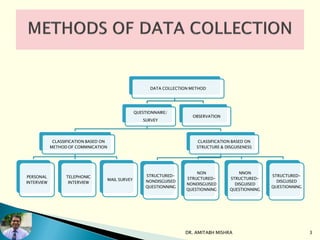
DATA COLLECTION METHOD
QUESTIONNAIRE/
SURVEY
CLASSIFICATION BASED ON
METHOD OF COMMNICATION
PERSONAL
INTERVIEW
TELEPHONIC
INTERVIEW
MAIL SURVEY
CLASSIFICATION BASED ON
STRUCTURE & DISGUISENESS
STRUCTURED-
NONDISGUISED
QUESTIONNING
NON
STRUCTURED-
NONDISGUISED
QUESTIONNING
NNON
STRUCTURED-
DISGUISED
QUESTIONNING
STRUCTURED-
DISGUISED
QUESTIONNING
OBSERVATION
DR. AMITABH MISHRA 3
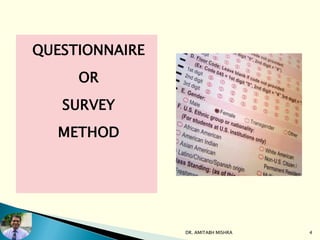
QUESTIONNAIRE
OR
SURVEY
METHOD
DR. AMITABH MISHRA 4
 “A formal list of questions are called
questionnaire”.
 “A questionnaire is the vehicle used to pose
the questions that the researcher wants
respondents to answer”.
DR. AMITABH MISHRA 5
DR. AMITABH MISHRA 6
 In questionnaire method data are collected by
asking questions to the people who are thought of
having desired information.
 Questions may be asked in written or in person.
 Translates the research objectives into specific
questions
 Standardizes those questions and the response
categories
 Fosters cooperation and motivation
 Serves as permanent records of the research
7DR. AMITABH MISHRA
 Can speed up the process of data analysis.
 Can serve as the basis for reliability and
validity measures.
8DR. AMITABH MISHRA
1. Many marketing problems can be studied only by asking
questions.
Ex- knowledge , opinion, motivation, intention etc.
2. Questionnaire are faster and cheaper than observation.
Interviewer can proceed from one interview to another with
no wait in between.
DR. AMITABH MISHRA 9
3. Some events that take place over a time period, would
require lengthy observations, but questions can be answered
in few seconds.
Ex: no. of trip to the supermarket in a week
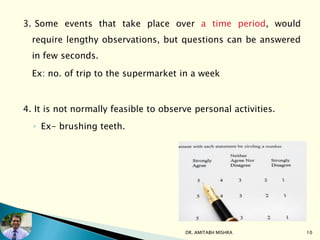
4. It is not normally feasible to observe personal activities.
◦ Ex- brushing teeth.
DR. AMITABH MISHRA 10
1. Unwillingness of respondents to provide information.
1. Questions about income or about personal subjects frequently meet
refusal.
2. Inability of respondents to provide information.
1. Many motivations are largely subconscious.
2. Most products are brought without any conscious array of reasons for
and against.
Ex- How many consumers analyze their reason for buying a particular
bar of soap?
DR. AMITABH MISHRA 11
3. Respondents can not furnish information
because they are unable to remember it
Ex- How many times did you eat corn flakes for breakfast
last months. (only those who always or never eat cornflakes
could answer such questions accurately)
4. The questioning process influence the result
obtained
Ex- “Don’t you see any problem with using credit cards for
online purchases?”
5. Often respondents attempts to give answer
that they will think please the interviewer
DR. AMITABH MISHRA 12
DR. AMITABH MISHRA 13
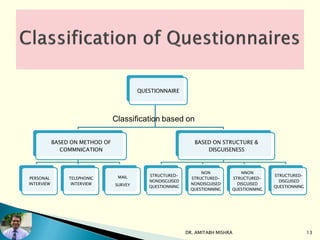
QUESTIONNAIRE
BASED ON METHOD OF
COMMNICATION
PERSONAL
INTERVIEW
TELEPHONIC
INTERVIEW
MAIL
SURVEY
BASED ON STRUCTURE &
DISGUISENESS
STRUCTURED-
NONDISGUISED
QUESTIONNING
NON
STRUCTURED-
NONDISGUISED
QUESTIONNING
NNON
STRUCTURED-
DISGUISED
QUESTIONNING
STRUCTURED-
DISGUISED
QUESTIONNING
Classification based on
DR. AMITABH MISHRA 14
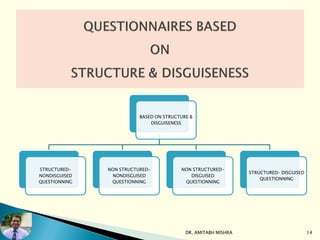
BASED ON STRUCTURE &
DISGUISENESS
STRUCTURED-
NONDISGUISED
QUESTIONNING
NON STRUCTURED-
NONDISGUISED
QUESTIONNING
NON STRUCTURED-
DISGUISED
QUESTIONNING
STRUCTURED- DISGUISED
QUESTIONNING
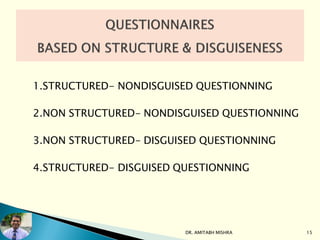
1.STRUCTURED- NONDISGUISED QUESTIONNING
2.NON STRUCTURED- NONDISGUISED QUESTIONNING
3.NON STRUCTURED- DISGUISED QUESTIONNING
4.STRUCTURED- DISGUISED QUESTIONNING
DR. AMITABH MISHRA 15
 “A process of following a prescribed sequence of questions
is referred as structured study”. While other is Non
structured study.
 “In Non Disguised questioning questionnaire are constructed
in such a way that the objective is clear to the respondent”.
In Disguised questioning questionnaire are constructed in
such a way that the objective is not clear to the respondent”.
DR. AMITABH MISHRA 16
 In Marketing research most of questionnaire study are
structured and non disguised study.
 Data obtained in structured and non disguised study are
easier to tabulate and interpret than data gathered in other
ways.
DR. AMITABH MISHRA 17
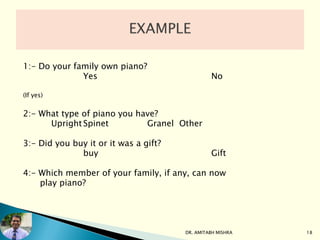
1:- Do your family own piano?
Yes No
(If yes)
2:- What type of piano you have?
Upright Spinet Granel Other
3:- Did you buy it or it was a gift?
buy Gift
4:- Which member of your family, if any, can now
play piano?
DR. AMITABH MISHRA 18
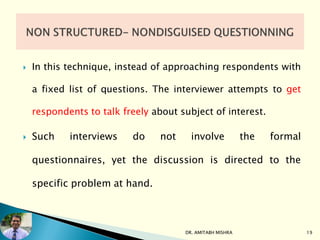
 In this technique, instead of approaching respondents with
a fixed list of questions. The interviewer attempts to get
respondents to talk freely about subject of interest.
 Such interviews do not involve the formal
questionnaires, yet the discussion is directed to the
specific problem at hand.
DR. AMITABH MISHRA 19
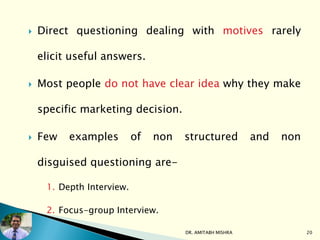
 Direct questioning dealing with motives rarely
elicit useful answers.
 Most people do not have clear idea why they make
specific marketing decision.
 Few examples of non structured and non
disguised questioning are-
1. Depth Interview.
2. Focus-group Interview.
DR. AMITABH MISHRA 20
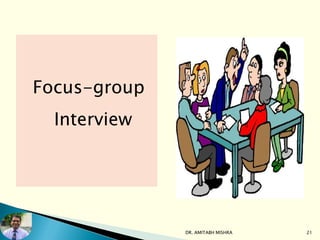
Focus-group
Interview
DR. AMITABH MISHRA 21
 The focus group interview is a panel of people, led
by a trained moderator, who meet for 90 min to 2
hrs. The moderator uses the principle of group
dynamics to focus or guide the group in an
exchange of ideas, feelings and experience on
specific topic.
 The moderator’s task is to ensure that open
discussion is “focused” on some area of interest.
DR. AMITABH MISHRA 22
 Focus groups are used to generate ideas, to learn
the respondents’ “vocabulary,” and to gain some
insights into basic needs and attitudes.
 Focus group interviews may be-
1. Traditional
2. Non Traditional or Online
DR. AMITABH MISHRA 23
DR. AMITABH MISHRA 24
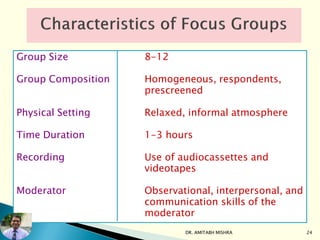
Group Size 8-12
Group Composition Homogeneous, respondents,
prescreened
Physical Setting Relaxed, informal atmosphere
Time Duration 1-3 hours
Recording Use of audiocassettes and
videotapes
Moderator Observational, interpersonal, and
communication skills of the
moderator
1. Traditional: Select 6 to 12 persons and meet in a dedicated room
with one-way mirror for client viewing, for about two hours.
2. Nontraditional: Online focus groups are a form of nontraditional
focus groups. Online focus group is one in which the respondents
and/or clients communicate and/or observe by use of the
Internet.
◦ Online with client viewing from distant locations.
◦ May have 25 or even 50 respondents.
◦ Allow client interaction.
◦ May take place in nontraditional locations.
DR. AMITABH MISHRA 25
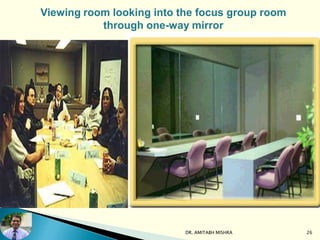
Viewing room looking into the focus group room
through one-way mirror
DR. AMITABH MISHRA 26
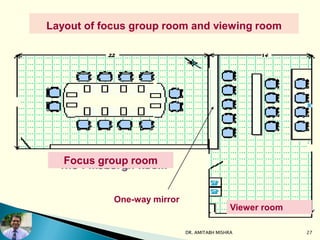
One-way mirror
DR. AMITABH MISHRA 27
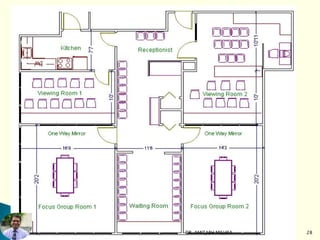
Layout of focus group room and viewing room
Viewer room
Focus group room
DR. AMITABH MISHRA 28
 Generate fresh ideas
 Allow clients to observe their participants
 May be directed at understanding a wide
variety of issues
 Allow fairly easy access to special respondent
groups
DR. AMITABH MISHRA 29
 Representativeness of participants
 Interpretation sometimes difficult
 High cost per participant
DR. AMITABH MISHRA 30
DR. AMITABH MISHRA 31
Depth
Interviews
 “Depth interview is an unstructured, direct, personal
interview in which a single respondent is probed by a
highly skilled interviewer to uncover underlying
motivations, beliefs, attitude and feeling on a topic”
 Depth interview is a set of probing questions posed
one-on-one to a subject by a trained interviewer so
as to gain an idea of what the subject thinks about
something or why he or she behaves a certain way.
DR. AMITABH MISHRA 32
 A depth interview can take from 30 min to 1 hr.
 Unlike focus group interview, depth interview are
conducted on a one to one basis.
 Like focus group interview, depth interview are
unstructured and direct way of obtaining
information.
DR. AMITABH MISHRA 33
DR. AMITABH MISHRA 34
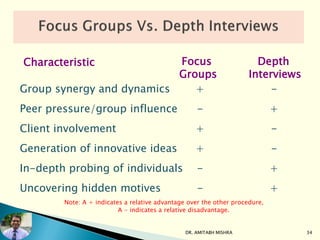
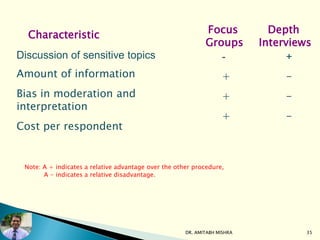
Characteristic Focus
Groups
Depth
Interviews
Group synergy and dynamics + -
Peer pressure/group influence - +
Client involvement + -
Generation of innovative ideas + -
In-depth probing of individuals - +
Uncovering hidden motives - +
Note: A + indicates a relative advantage over the other procedure,
A - indicates a relative disadvantage.
DR. AMITABH MISHRA 35
Note: A + indicates a relative advantage over the other procedure,
A - indicates a relative disadvantage.
Discussion of sensitive topics
Amount of information
Bias in moderation and
interpretation
Cost per respondent
-
+
+
+
+
-
-
-
Characteristic Focus
Groups
Depth
Interviews
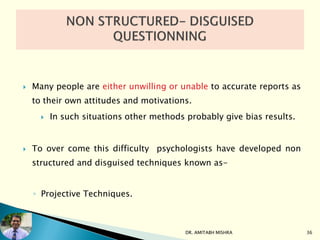
 Many people are either unwilling or unable to accurate reports as
to their own attitudes and motivations.
 In such situations other methods probably give bias results.
 To over come this difficulty psychologists have developed non
structured and disguised techniques known as-
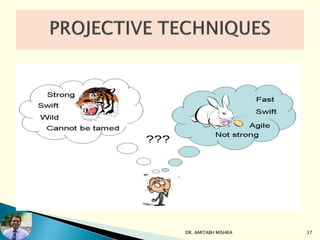
◦ Projective Techniques.
DR. AMITABH MISHRA 36
DR. AMITABH MISHRA 37
 “An unstructured, indirect form of questioning that
encourages respondents to project their underlying
motivations, beliefs, attitudes or feelings regarding
the issues of concern”.
 In projective techniques all individuals, in
describing a situation, interpret that situation to a
degree.
 The description they give is a mixture of their own
attitude, belief, feeling and motivation.
DR. AMITABH MISHRA 38
 In projective techniques, respondents are asked to interpret
the behavior of others.
 In interpreting the behavior of others, respondents indirectly
project their own motivations, beliefs, attitudes, or feelings
into the situation.
DR. AMITABH MISHRA 39
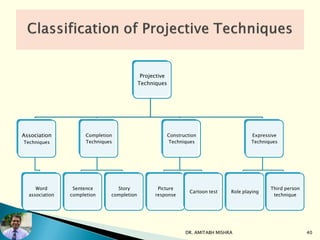
Projective
Techniques
Association
Techniques
Word
association
Completion
Techniques
Sentence
completion
Story
completion
Construction
Techniques
Picture
response
Cartoon test
Expressive
Techniques
Role playing
Third person
technique
DR. AMITABH MISHRA 40
 In association technique, an individual is presented
with a stimulus and asked to respond with the first
thing that comes to mind.
 Word association is best known Projective
Technique.
DR. AMITABH MISHRA 41
In Word association, a series of word is read one at a time to
respondents. After each word the respondent say the first thing that
come in to their mind.
The words of interest, called test words, are interspersed throughout the
list which also contains some neutral, or filler words to disguise the
purpose of the study.
DR. AMITABH MISHRA 42
 Responses are analyzed by calculating:
◦ The frequency with which any word is given as a response;
◦ The amount of time that elapses before a response is given
and
◦ The number of respondents who do not respond at all to a
test word within a reasonable period of time.
DR. AMITABH MISHRA 43
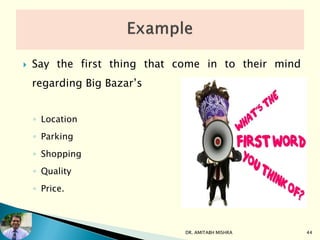
 Say the first thing that come in to their mind
regarding Big Bazar’s
◦ Location
◦ Parking
◦ Shopping
◦ Quality
◦ Price.
DR. AMITABH MISHRA 44
“In completion technique the respondent is asked to complete an
incomplete stimulus situation”.
Completion techniques can be classified as-
1. Sentence completion.
2. Story completion.
DR. AMITABH MISHRA 45
DR. AMITABH MISHRA 46
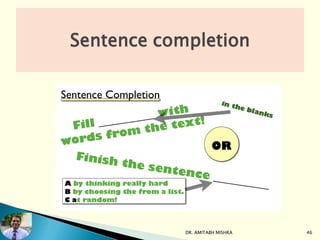
Sentence completion
 In sentence completion, respondents are given an
incomplete sentences and asked to complete them.
Generally, they are asked to use the first word or
phrase that comes to mind.
 In Sentence Completion respondents are required to
complete a partial sentence.
DR. AMITABH MISHRA 47
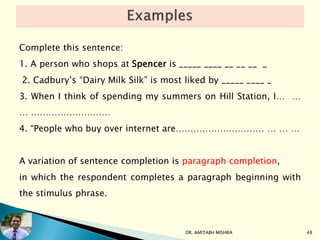
Complete this sentence:
1. A person who shops at Spencer is _____ ____ __ __ __ _
2. Cadbury’s “Dairy Milk Silk” is most liked by _____ ____ _
3. When I think of spending my summers on Hill Station, I… …
… ………………………
4. “People who buy over internet are………………………… … … …
A variation of sentence completion is paragraph completion,
in which the respondent completes a paragraph beginning with
the stimulus phrase.
DR. AMITABH MISHRA 48
DR. AMITABH MISHRA 49
DR. AMITABH MISHRA 50
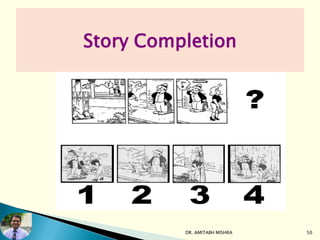
Story Completion
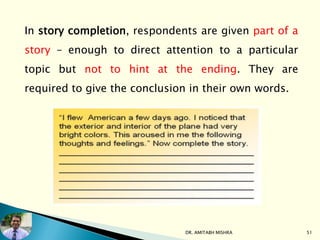
In story completion, respondents are given part of a
story – enough to direct attention to a particular
topic but not to hint at the ending. They are
required to give the conclusion in their own words.
DR. AMITABH MISHRA 51
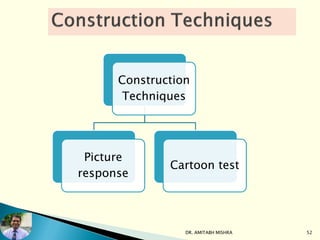
Construction
Techniques
Picture
response
Cartoon test
DR. AMITABH MISHRA 52
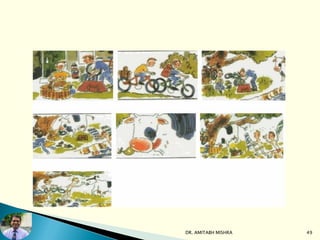
With a picture response, the respondents are asked to
describe a series of pictures of ordinary as well as
unusual events. The respondent's interpretation of
the pictures gives indications of that individual's
personality.
DR. AMITABH MISHRA 53
DR. AMITABH MISHRA
54
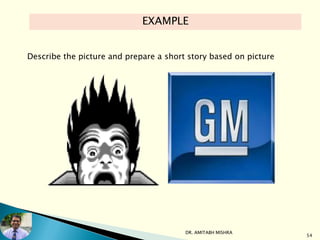
Describe the picture and prepare a short story based on picture
EXAMPLE
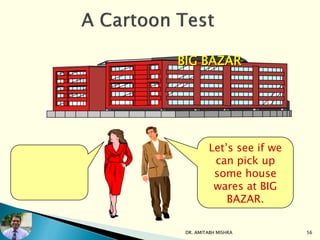
 In cartoon tests, cartoon characters are shown in a
specific situation related to the problem. The
respondents are asked to indicate what one
cartoon character might say in response to the
comments of another character. Cartoon tests are
simpler to administer and analyze than picture
response techniques.
DR. AMITABH MISHRA 55
DR. AMITABH MISHRA 56
Let’s see if we
can pick up
some house
wares at BIG
BAZAR.
BIG BAZAR
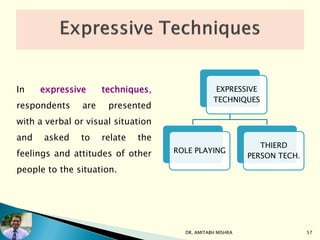
In expressive techniques,
respondents are presented
with a verbal or visual situation
and asked to relate the
feelings and attitudes of other
people to the situation.
EXPRESSIVE
TECHNIQUES
ROLE PLAYING
THIERD
PERSON TECH.
DR. AMITABH MISHRA 57
 Role playing. Respondents are asked to play the role or
assume the behavior of someone else.
 Third-person technique. The respondent is presented
with a verbal or visual situation and the respondent is
asked to relate the beliefs and attitudes of a third person
rather than directly expressing personal beliefs and
attitudes. This third person may be a friend, neighbor,
colleague, or a “typical” person.
DR. AMITABH MISHRA 58
 They may elicit responses that subjects would be
unwilling or unable to give if they knew the purpose of
the study.
 Helpful when the issues to be addressed are personal,
sensitive, or subject to strong social norms.
 Helpful when underlying motivations, beliefs, and
attitudes are operating at a subconscious level.
DR. AMITABH MISHRA 59
 Suffer from many of the disadvantages of unstructured
direct techniques, but to a greater extent.
 Require highly-trained interviewers.
 Skilled interpreters are also required to analyze the
responses.
 There is a serious risk of interpretation bias.
 They tend to be expensive.
 May require respondents to engage in unusual behavior.
DR. AMITABH MISHRA 60
DR. AMITABH MISHRA 61
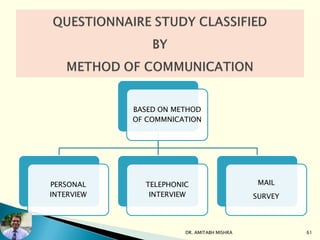
BASED ON METHOD
OF COMMNICATION
PERSONAL
INTERVIEW
TELEPHONIC
INTERVIEW
MAIL
SURVEY
 Telephone Interview
 Personal Interview
 Mail Survey
 Electronic
DR. AMITABH MISHRA 62
 Telephone Interviews
are those in which an
interviewer obtain
information from
respondents via a
telephone device.
DR. AMITABH MISHRA 63
 Speed
 Cost
 Absence of face-to-face contact
 Cooperation
 Incentives to respond
 Limited duration
 Lack of visual medium
DR. AMITABH MISHRA 64
DR. AMITABH MISHRA 65
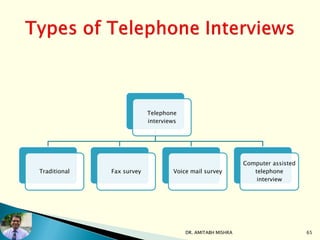
Telephone
interviews
Traditional Fax survey Voice mail survey
Computer assisted
telephone
interview
 Traditional telephone interviews involves phoning a
sample of respondents and asking them a series of
questions.
 The interviewer uses a paper questionnaire and
records the responses with a pencil.
DR. AMITABH MISHRA 66
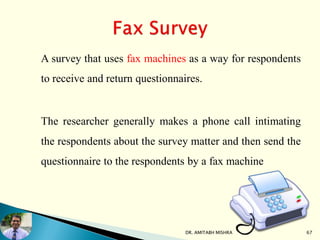
A survey that uses fax machines as a way for respondents
to receive and return questionnaires.
The researcher generally makes a phone call intimating
the respondents about the survey matter and then send the
questionnaire to the respondents by a fax machine
DR. AMITABH MISHRA 67
◦ Fax survey reduces sender’s printing and postage costs
◦ Fax survey is quicker than traditional mail surveys
◦ In Fax surveys, Only respondents with fax machines who
are willing to exert the extra effort will return
questionnaires.
◦ Fax survey is not suitable for household survey as the fax
machines are rarely found in houses.
DR. AMITABH MISHRA 68
 Voice mail survey is completely automated telephone survey method
where fixed response questions are posed to respondents through a
pre recorded voice of the professional interviewer and the
respondent is supposed to press the telephone button to register
the responses.
 The process is completely mechanical and lack the personal touch of
the interviewer.
DR. AMITABH MISHRA 69
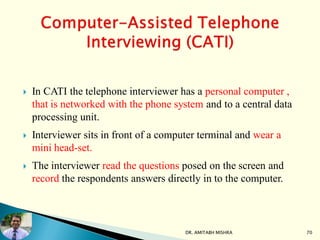
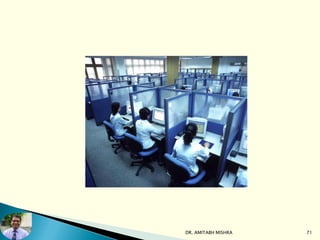
 In CATI the telephone interviewer has a personal computer ,
that is networked with the phone system and to a central data
processing unit.
 Interviewer sits in front of a computer terminal and wear a
mini head-set.
 The interviewer read the questions posed on the screen and
record the respondents answers directly in to the computer.
DR. AMITABH MISHRA 70
DR. AMITABH MISHRA 71
 Interviewing time is reduced.
 Data quality is enhanced.
 Laborious steps in data collection,
questionnaire coding and entering the data in
to computer is eliminated.
DR. AMITABH MISHRA 72
 Personal Interview (face to face interview) are
those in which an interviewer obtain information
from respondents in face to face meeting.
DR. AMITABH MISHRA 73
DR. AMITABH MISHRA 74
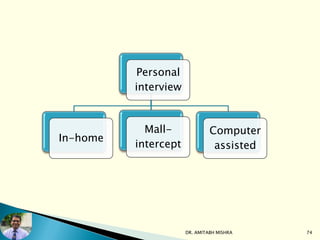
Personal
interview
In-home
Mall-
intercept
Computer
assisted
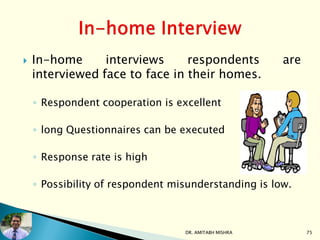
 In-home interviews respondents are
interviewed face to face in their homes.
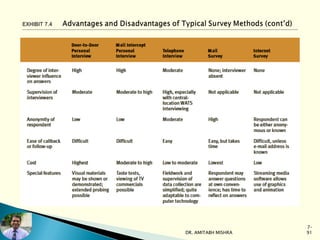
◦ Respondent cooperation is excellent
◦ long Questionnaires can be executed
◦ Response rate is high
◦ Possibility of respondent misunderstanding is low.
DR. AMITABH MISHRA 75
◦ Degree of interviewer influence of answer is high
◦ call back or follow-up is difficult
◦ Cost is highest due to travel costs
◦ visual materials may be shown or demonstrated;
extended probing possible
DR. AMITABH MISHRA 76
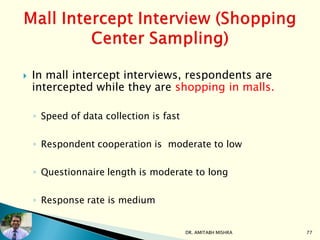
 In mall intercept interviews, respondents are
intercepted while they are shopping in malls.
◦ Speed of data collection is fast
◦ Respondent cooperation is moderate to low
◦ Questionnaire length is moderate to long
◦ Response rate is medium
DR. AMITABH MISHRA 77
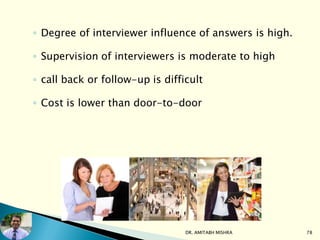
◦ Degree of interviewer influence of answers is high.
◦ Supervision of interviewers is moderate to high
◦ call back or follow-up is difficult
◦ Cost is lower than door-to-door
DR. AMITABH MISHRA 78
 In CAPI the respondent sits in front of a
computer terminal and answer the
questionnaire on computer screen by using
key board and mouse.
DR. AMITABH MISHRA 79
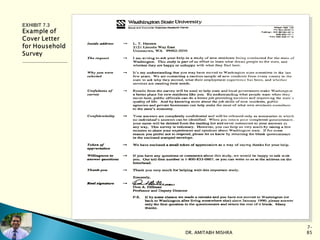
 In Mail Survey Questionnaires are mailed to respondents who
also return them by mail.
 A typical mail interview package consist of-
◦ Out going envelop.
◦ Cover letter.
◦ Questionnaire.
◦ Return envelop.
◦ An incentive
DR. AMITABH MISHRA 80
DR. AMITABH MISHRA 81
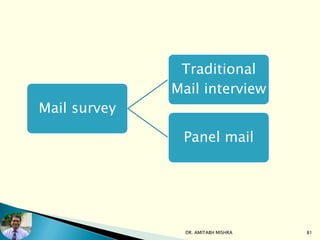
Mail survey
Traditional
Mail interview
Panel mail
 In traditional mail interview, questionnaires
are mailed to preselected potential
respondents. The respondents complete and
return the questionnaire.
 There is no verbal interaction between
researcher and respondent.
DR. AMITABH MISHRA 82
 Mail panel consist of a large, nationally representative sample
of households that have agreed to participate in periodic mail
questionnaire and product tests.
 Household are compensated with various incentives.
 Data on the panel is updated every year.
DR. AMITABH MISHRA 83
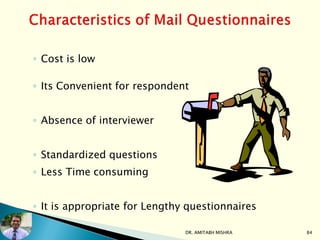
◦ Cost is low
◦ Its Convenient for respondent
◦ Absence of interviewer
◦ Standardized questions
◦ Less Time consuming
◦ It is appropriate for Lengthy questionnaires
DR. AMITABH MISHRA 84
DR. AMITABH MISHRA
7–
85
DR. AMITABH MISHRA 86
◦ Surveys distributed through electronic mail.
◦ Benefits:
 Speed of distribution; Lower distribution and processing costs
 Faster turnaround time ; Flexibility & Less handling of paper
questionnaires
◦ Potential Problems:
 Anonymity of respondents creating response bias
 Capacity of e-mail systems and computers
 Computer skills/competencies of respondents
DR. AMITABH MISHRA 87
◦ A self-administered questionnaire posted
on a Web site.
 Respondents provide answers to
questions displayed online by:
 Highlighting a phrase,
 Clicking an icon, or
 Keying in an answer.
DR. AMITABH MISHRA
◦ Not all individuals have internet access.
◦ Respondents may lack powerful computers with
high-speed connections to the internet.
◦ Respondents’ computer skills may be relatively
unsophisticated.
DR. AMITABH MISHRA 89
DR. AMITABH MISHRA
7–
90
DR. AMITABH MISHRA
7–
91

Questionnaire Method of Data Collection

  • 1.
  • 2.
     “Data collectionmeans the assembling, for the purpose of particular investigation of entirely new data, presumably not already available in published sources”. DR. AMITABH MISHRA 2
  • 3.
    DATA COLLECTION METHOD QUESTIONNAIRE/ SURVEY CLASSIFICATIONBASED ON METHOD OF COMMNICATION PERSONAL INTERVIEW TELEPHONIC INTERVIEW MAIL SURVEY CLASSIFICATION BASED ON STRUCTURE & DISGUISENESS STRUCTURED- NONDISGUISED QUESTIONNING NON STRUCTURED- NONDISGUISED QUESTIONNING NNON STRUCTURED- DISGUISED QUESTIONNING STRUCTURED- DISGUISED QUESTIONNING OBSERVATION DR. AMITABH MISHRA 3
  • 4.
  • 5.
     “A formallist of questions are called questionnaire”.  “A questionnaire is the vehicle used to pose the questions that the researcher wants respondents to answer”. DR. AMITABH MISHRA 5
  • 6.
    DR. AMITABH MISHRA6  In questionnaire method data are collected by asking questions to the people who are thought of having desired information.  Questions may be asked in written or in person.
  • 7.
     Translates theresearch objectives into specific questions  Standardizes those questions and the response categories  Fosters cooperation and motivation  Serves as permanent records of the research 7DR. AMITABH MISHRA
  • 8.
     Can speedup the process of data analysis.  Can serve as the basis for reliability and validity measures. 8DR. AMITABH MISHRA
  • 9.
    1. Many marketingproblems can be studied only by asking questions. Ex- knowledge , opinion, motivation, intention etc. 2. Questionnaire are faster and cheaper than observation. Interviewer can proceed from one interview to another with no wait in between. DR. AMITABH MISHRA 9
  • 10.
    3. Some eventsthat take place over a time period, would require lengthy observations, but questions can be answered in few seconds. Ex: no. of trip to the supermarket in a week 4. It is not normally feasible to observe personal activities. ◦ Ex- brushing teeth. DR. AMITABH MISHRA 10
  • 11.
    1. Unwillingness ofrespondents to provide information. 1. Questions about income or about personal subjects frequently meet refusal. 2. Inability of respondents to provide information. 1. Many motivations are largely subconscious. 2. Most products are brought without any conscious array of reasons for and against. Ex- How many consumers analyze their reason for buying a particular bar of soap? DR. AMITABH MISHRA 11
  • 12.
    3. Respondents cannot furnish information because they are unable to remember it Ex- How many times did you eat corn flakes for breakfast last months. (only those who always or never eat cornflakes could answer such questions accurately) 4. The questioning process influence the result obtained Ex- “Don’t you see any problem with using credit cards for online purchases?” 5. Often respondents attempts to give answer that they will think please the interviewer DR. AMITABH MISHRA 12
  • 13.
    DR. AMITABH MISHRA13 QUESTIONNAIRE BASED ON METHOD OF COMMNICATION PERSONAL INTERVIEW TELEPHONIC INTERVIEW MAIL SURVEY BASED ON STRUCTURE & DISGUISENESS STRUCTURED- NONDISGUISED QUESTIONNING NON STRUCTURED- NONDISGUISED QUESTIONNING NNON STRUCTURED- DISGUISED QUESTIONNING STRUCTURED- DISGUISED QUESTIONNING Classification based on
  • 14.
    DR. AMITABH MISHRA14 BASED ON STRUCTURE & DISGUISENESS STRUCTURED- NONDISGUISED QUESTIONNING NON STRUCTURED- NONDISGUISED QUESTIONNING NON STRUCTURED- DISGUISED QUESTIONNING STRUCTURED- DISGUISED QUESTIONNING
  • 15.
    1.STRUCTURED- NONDISGUISED QUESTIONNING 2.NONSTRUCTURED- NONDISGUISED QUESTIONNING 3.NON STRUCTURED- DISGUISED QUESTIONNING 4.STRUCTURED- DISGUISED QUESTIONNING DR. AMITABH MISHRA 15
  • 16.
     “A processof following a prescribed sequence of questions is referred as structured study”. While other is Non structured study.  “In Non Disguised questioning questionnaire are constructed in such a way that the objective is clear to the respondent”. In Disguised questioning questionnaire are constructed in such a way that the objective is not clear to the respondent”. DR. AMITABH MISHRA 16
  • 17.
     In Marketingresearch most of questionnaire study are structured and non disguised study.  Data obtained in structured and non disguised study are easier to tabulate and interpret than data gathered in other ways. DR. AMITABH MISHRA 17
  • 18.
    1:- Do yourfamily own piano? Yes No (If yes) 2:- What type of piano you have? Upright Spinet Granel Other 3:- Did you buy it or it was a gift? buy Gift 4:- Which member of your family, if any, can now play piano? DR. AMITABH MISHRA 18
  • 19.
     In thistechnique, instead of approaching respondents with a fixed list of questions. The interviewer attempts to get respondents to talk freely about subject of interest.  Such interviews do not involve the formal questionnaires, yet the discussion is directed to the specific problem at hand. DR. AMITABH MISHRA 19
  • 20.
     Direct questioningdealing with motives rarely elicit useful answers.  Most people do not have clear idea why they make specific marketing decision.  Few examples of non structured and non disguised questioning are- 1. Depth Interview. 2. Focus-group Interview. DR. AMITABH MISHRA 20
  • 21.
  • 22.
     The focusgroup interview is a panel of people, led by a trained moderator, who meet for 90 min to 2 hrs. The moderator uses the principle of group dynamics to focus or guide the group in an exchange of ideas, feelings and experience on specific topic.  The moderator’s task is to ensure that open discussion is “focused” on some area of interest. DR. AMITABH MISHRA 22
  • 23.
     Focus groupsare used to generate ideas, to learn the respondents’ “vocabulary,” and to gain some insights into basic needs and attitudes.  Focus group interviews may be- 1. Traditional 2. Non Traditional or Online DR. AMITABH MISHRA 23
  • 24.
    DR. AMITABH MISHRA24 Group Size 8-12 Group Composition Homogeneous, respondents, prescreened Physical Setting Relaxed, informal atmosphere Time Duration 1-3 hours Recording Use of audiocassettes and videotapes Moderator Observational, interpersonal, and communication skills of the moderator
  • 25.
    1. Traditional: Select6 to 12 persons and meet in a dedicated room with one-way mirror for client viewing, for about two hours. 2. Nontraditional: Online focus groups are a form of nontraditional focus groups. Online focus group is one in which the respondents and/or clients communicate and/or observe by use of the Internet. ◦ Online with client viewing from distant locations. ◦ May have 25 or even 50 respondents. ◦ Allow client interaction. ◦ May take place in nontraditional locations. DR. AMITABH MISHRA 25
  • 26.
    Viewing room lookinginto the focus group room through one-way mirror DR. AMITABH MISHRA 26
  • 27.
    One-way mirror DR. AMITABHMISHRA 27 Layout of focus group room and viewing room Viewer room Focus group room
  • 28.
  • 29.
     Generate freshideas  Allow clients to observe their participants  May be directed at understanding a wide variety of issues  Allow fairly easy access to special respondent groups DR. AMITABH MISHRA 29
  • 30.
     Representativeness ofparticipants  Interpretation sometimes difficult  High cost per participant DR. AMITABH MISHRA 30
  • 31.
    DR. AMITABH MISHRA31 Depth Interviews
  • 32.
     “Depth interviewis an unstructured, direct, personal interview in which a single respondent is probed by a highly skilled interviewer to uncover underlying motivations, beliefs, attitude and feeling on a topic”  Depth interview is a set of probing questions posed one-on-one to a subject by a trained interviewer so as to gain an idea of what the subject thinks about something or why he or she behaves a certain way. DR. AMITABH MISHRA 32
  • 33.
     A depthinterview can take from 30 min to 1 hr.  Unlike focus group interview, depth interview are conducted on a one to one basis.  Like focus group interview, depth interview are unstructured and direct way of obtaining information. DR. AMITABH MISHRA 33
  • 34.
    DR. AMITABH MISHRA34 Characteristic Focus Groups Depth Interviews Group synergy and dynamics + - Peer pressure/group influence - + Client involvement + - Generation of innovative ideas + - In-depth probing of individuals - + Uncovering hidden motives - + Note: A + indicates a relative advantage over the other procedure, A - indicates a relative disadvantage.
  • 35.
    DR. AMITABH MISHRA35 Note: A + indicates a relative advantage over the other procedure, A - indicates a relative disadvantage. Discussion of sensitive topics Amount of information Bias in moderation and interpretation Cost per respondent - + + + + - - - Characteristic Focus Groups Depth Interviews
  • 36.
     Many peopleare either unwilling or unable to accurate reports as to their own attitudes and motivations.  In such situations other methods probably give bias results.  To over come this difficulty psychologists have developed non structured and disguised techniques known as- ◦ Projective Techniques. DR. AMITABH MISHRA 36
  • 37.
  • 38.
     “An unstructured,indirect form of questioning that encourages respondents to project their underlying motivations, beliefs, attitudes or feelings regarding the issues of concern”.  In projective techniques all individuals, in describing a situation, interpret that situation to a degree.  The description they give is a mixture of their own attitude, belief, feeling and motivation. DR. AMITABH MISHRA 38
  • 39.
     In projectivetechniques, respondents are asked to interpret the behavior of others.  In interpreting the behavior of others, respondents indirectly project their own motivations, beliefs, attitudes, or feelings into the situation. DR. AMITABH MISHRA 39
  • 40.
  • 41.
     In associationtechnique, an individual is presented with a stimulus and asked to respond with the first thing that comes to mind.  Word association is best known Projective Technique. DR. AMITABH MISHRA 41
  • 42.
    In Word association,a series of word is read one at a time to respondents. After each word the respondent say the first thing that come in to their mind. The words of interest, called test words, are interspersed throughout the list which also contains some neutral, or filler words to disguise the purpose of the study. DR. AMITABH MISHRA 42
  • 43.
     Responses areanalyzed by calculating: ◦ The frequency with which any word is given as a response; ◦ The amount of time that elapses before a response is given and ◦ The number of respondents who do not respond at all to a test word within a reasonable period of time. DR. AMITABH MISHRA 43
  • 44.
     Say thefirst thing that come in to their mind regarding Big Bazar’s ◦ Location ◦ Parking ◦ Shopping ◦ Quality ◦ Price. DR. AMITABH MISHRA 44
  • 45.
    “In completion techniquethe respondent is asked to complete an incomplete stimulus situation”. Completion techniques can be classified as- 1. Sentence completion. 2. Story completion. DR. AMITABH MISHRA 45
  • 46.
    DR. AMITABH MISHRA46 Sentence completion
  • 47.
     In sentencecompletion, respondents are given an incomplete sentences and asked to complete them. Generally, they are asked to use the first word or phrase that comes to mind.  In Sentence Completion respondents are required to complete a partial sentence. DR. AMITABH MISHRA 47
  • 48.
    Complete this sentence: 1.A person who shops at Spencer is _____ ____ __ __ __ _ 2. Cadbury’s “Dairy Milk Silk” is most liked by _____ ____ _ 3. When I think of spending my summers on Hill Station, I… … … ……………………… 4. “People who buy over internet are………………………… … … … A variation of sentence completion is paragraph completion, in which the respondent completes a paragraph beginning with the stimulus phrase. DR. AMITABH MISHRA 48
  • 49.
  • 50.
    DR. AMITABH MISHRA50 Story Completion
  • 51.
    In story completion,respondents are given part of a story – enough to direct attention to a particular topic but not to hint at the ending. They are required to give the conclusion in their own words. DR. AMITABH MISHRA 51
  • 52.
  • 53.
    With a pictureresponse, the respondents are asked to describe a series of pictures of ordinary as well as unusual events. The respondent's interpretation of the pictures gives indications of that individual's personality. DR. AMITABH MISHRA 53
  • 54.
    DR. AMITABH MISHRA 54 Describethe picture and prepare a short story based on picture EXAMPLE
  • 55.
     In cartoontests, cartoon characters are shown in a specific situation related to the problem. The respondents are asked to indicate what one cartoon character might say in response to the comments of another character. Cartoon tests are simpler to administer and analyze than picture response techniques. DR. AMITABH MISHRA 55
  • 56.
    DR. AMITABH MISHRA56 Let’s see if we can pick up some house wares at BIG BAZAR. BIG BAZAR
  • 57.
    In expressive techniques, respondentsare presented with a verbal or visual situation and asked to relate the feelings and attitudes of other people to the situation. EXPRESSIVE TECHNIQUES ROLE PLAYING THIERD PERSON TECH. DR. AMITABH MISHRA 57
  • 58.
     Role playing.Respondents are asked to play the role or assume the behavior of someone else.  Third-person technique. The respondent is presented with a verbal or visual situation and the respondent is asked to relate the beliefs and attitudes of a third person rather than directly expressing personal beliefs and attitudes. This third person may be a friend, neighbor, colleague, or a “typical” person. DR. AMITABH MISHRA 58
  • 59.
     They mayelicit responses that subjects would be unwilling or unable to give if they knew the purpose of the study.  Helpful when the issues to be addressed are personal, sensitive, or subject to strong social norms.  Helpful when underlying motivations, beliefs, and attitudes are operating at a subconscious level. DR. AMITABH MISHRA 59
  • 60.
     Suffer frommany of the disadvantages of unstructured direct techniques, but to a greater extent.  Require highly-trained interviewers.  Skilled interpreters are also required to analyze the responses.  There is a serious risk of interpretation bias.  They tend to be expensive.  May require respondents to engage in unusual behavior. DR. AMITABH MISHRA 60
  • 61.
    DR. AMITABH MISHRA61 BASED ON METHOD OF COMMNICATION PERSONAL INTERVIEW TELEPHONIC INTERVIEW MAIL SURVEY
  • 62.
     Telephone Interview Personal Interview  Mail Survey  Electronic DR. AMITABH MISHRA 62
  • 63.
     Telephone Interviews arethose in which an interviewer obtain information from respondents via a telephone device. DR. AMITABH MISHRA 63
  • 64.
     Speed  Cost Absence of face-to-face contact  Cooperation  Incentives to respond  Limited duration  Lack of visual medium DR. AMITABH MISHRA 64
  • 65.
    DR. AMITABH MISHRA65 Telephone interviews Traditional Fax survey Voice mail survey Computer assisted telephone interview
  • 66.
     Traditional telephoneinterviews involves phoning a sample of respondents and asking them a series of questions.  The interviewer uses a paper questionnaire and records the responses with a pencil. DR. AMITABH MISHRA 66
  • 67.
    A survey thatuses fax machines as a way for respondents to receive and return questionnaires. The researcher generally makes a phone call intimating the respondents about the survey matter and then send the questionnaire to the respondents by a fax machine DR. AMITABH MISHRA 67
  • 68.
    ◦ Fax surveyreduces sender’s printing and postage costs ◦ Fax survey is quicker than traditional mail surveys ◦ In Fax surveys, Only respondents with fax machines who are willing to exert the extra effort will return questionnaires. ◦ Fax survey is not suitable for household survey as the fax machines are rarely found in houses. DR. AMITABH MISHRA 68
  • 69.
     Voice mailsurvey is completely automated telephone survey method where fixed response questions are posed to respondents through a pre recorded voice of the professional interviewer and the respondent is supposed to press the telephone button to register the responses.  The process is completely mechanical and lack the personal touch of the interviewer. DR. AMITABH MISHRA 69
  • 70.
     In CATIthe telephone interviewer has a personal computer , that is networked with the phone system and to a central data processing unit.  Interviewer sits in front of a computer terminal and wear a mini head-set.  The interviewer read the questions posed on the screen and record the respondents answers directly in to the computer. DR. AMITABH MISHRA 70
  • 71.
  • 72.
     Interviewing timeis reduced.  Data quality is enhanced.  Laborious steps in data collection, questionnaire coding and entering the data in to computer is eliminated. DR. AMITABH MISHRA 72
  • 73.
     Personal Interview(face to face interview) are those in which an interviewer obtain information from respondents in face to face meeting. DR. AMITABH MISHRA 73
  • 74.
    DR. AMITABH MISHRA74 Personal interview In-home Mall- intercept Computer assisted
  • 75.
     In-home interviewsrespondents are interviewed face to face in their homes. ◦ Respondent cooperation is excellent ◦ long Questionnaires can be executed ◦ Response rate is high ◦ Possibility of respondent misunderstanding is low. DR. AMITABH MISHRA 75
  • 76.
    ◦ Degree ofinterviewer influence of answer is high ◦ call back or follow-up is difficult ◦ Cost is highest due to travel costs ◦ visual materials may be shown or demonstrated; extended probing possible DR. AMITABH MISHRA 76
  • 77.
     In mallintercept interviews, respondents are intercepted while they are shopping in malls. ◦ Speed of data collection is fast ◦ Respondent cooperation is moderate to low ◦ Questionnaire length is moderate to long ◦ Response rate is medium DR. AMITABH MISHRA 77
  • 78.
    ◦ Degree ofinterviewer influence of answers is high. ◦ Supervision of interviewers is moderate to high ◦ call back or follow-up is difficult ◦ Cost is lower than door-to-door DR. AMITABH MISHRA 78
  • 79.
     In CAPIthe respondent sits in front of a computer terminal and answer the questionnaire on computer screen by using key board and mouse. DR. AMITABH MISHRA 79
  • 80.
     In MailSurvey Questionnaires are mailed to respondents who also return them by mail.  A typical mail interview package consist of- ◦ Out going envelop. ◦ Cover letter. ◦ Questionnaire. ◦ Return envelop. ◦ An incentive DR. AMITABH MISHRA 80
  • 81.
    DR. AMITABH MISHRA81 Mail survey Traditional Mail interview Panel mail
  • 82.
     In traditionalmail interview, questionnaires are mailed to preselected potential respondents. The respondents complete and return the questionnaire.  There is no verbal interaction between researcher and respondent. DR. AMITABH MISHRA 82
  • 83.
     Mail panelconsist of a large, nationally representative sample of households that have agreed to participate in periodic mail questionnaire and product tests.  Household are compensated with various incentives.  Data on the panel is updated every year. DR. AMITABH MISHRA 83
  • 84.
    ◦ Cost islow ◦ Its Convenient for respondent ◦ Absence of interviewer ◦ Standardized questions ◦ Less Time consuming ◦ It is appropriate for Lengthy questionnaires DR. AMITABH MISHRA 84
  • 85.
  • 86.
  • 87.
    ◦ Surveys distributedthrough electronic mail. ◦ Benefits:  Speed of distribution; Lower distribution and processing costs  Faster turnaround time ; Flexibility & Less handling of paper questionnaires ◦ Potential Problems:  Anonymity of respondents creating response bias  Capacity of e-mail systems and computers  Computer skills/competencies of respondents DR. AMITABH MISHRA 87
  • 88.
    ◦ A self-administeredquestionnaire posted on a Web site.  Respondents provide answers to questions displayed online by:  Highlighting a phrase,  Clicking an icon, or  Keying in an answer. DR. AMITABH MISHRA
  • 89.
    ◦ Not allindividuals have internet access. ◦ Respondents may lack powerful computers with high-speed connections to the internet. ◦ Respondents’ computer skills may be relatively unsophisticated. DR. AMITABH MISHRA 89
  • 90.
  • 91.