Lecture 2
Survey Research & Design in Psychology
James Neill, 2017
Creative Commons Attribution 4.0
Survey Design
2
Overview
1. Lecture 1 summary
2. Survey administration methods
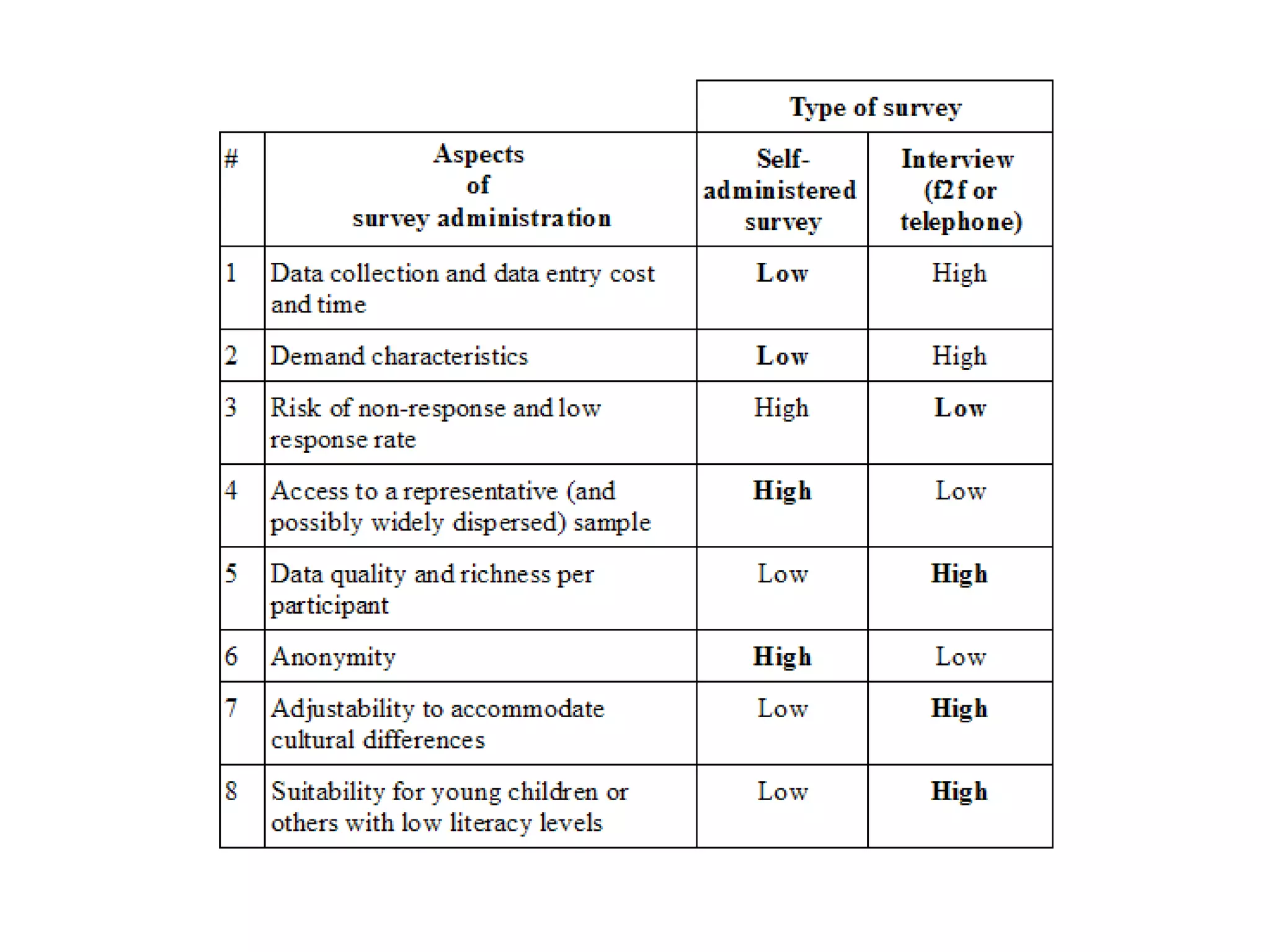
– Interview vs. self-administered
3. Survey construction
4. Levels of measurement
5. Biases
6. Sampling
3
Lecture 1 Summary
Survey research
1. Research types (3)
1. Experimental
2. Quasi-experimental
3. Non-experimental
2. Purposes (4)
1. Information gathering (2)
1. Exploratory
2. Descriptive
2. Theory testing (2)
1. Explanatory
2. Predictive
4
Lecture 1 Summary
Survey research
1. What is a survey?
1. A standardised stimulus used as a social
science measurement tool
2. Survey research
1. Pros
1. Ecological validity
2. Cost-efficient
3. Can obtain lots of data
2. Cons
1. Low compliance
2. Reliance on self-report
5
Survey
administration
methods
6
Survey administration methods
Consider the pros and cons of two
common survey
administration methods:
1. Interview-based
2. Self-report
7
Types of surveys
Self -
administered
Interview -
administered
Postal Delivered and
collected
TelephoneFace to face
structured
interview
Online
Email Web Mobile
8
Advantages and disadvantages of
self- and interview-administered surveys
9
Self-administered
–Pros:
• Cost
• demand characteristics
• access to representative sample
• anonymity
–Cons:
• Non-response
• adjustment to cultural differences,
special needs
Survey types
Opposite for
interview-
administered
surveys
10
Survey
construction
11
Survey construction
Examine the nuts & bolts of
questionnaire design
including:
1. Questionnaire development
2. Question styles
3. Response formats
12
Survey construction
1. Survey design is science and art
2. Questionnaire development
1. Stages of development
2. Parts of a survey
3. Order, flow and structure
4. Demographics and personal information
5. Ending the survey
6. Layout
7. Pre- and pilot-testing
3. Writing questions
1. Types of questions
2. Response formats
13
“Surveys are a mixture of
science and art, and a good
researcher will save their cost
many times over by knowing
how to ask the correct
questions.”
- Creative Research Systems (2008)
Survey design
is a science and an art
14
1. Formulate
generic
questionnaire
2. Expand
the
questionnaire
Create separate
sections for each
study objective.
Draft qs &
response
formats
4. Finalise
questionnaire
& implement
Question
order &
funnel qs
Stages of
questionnaire development
3. Pre-test,
pilot test,
& redraft
15
Parts of a survey
• Title page
• Participant information sheet
• Informed consent form
• Instructions
• Questionnaire structured into sections
which contain measurement items
relating to each objective
• End page(s)
16
• Layout should be clear, simple, and
easy to navigate
• Readability:
– Large font size (14 pt) and clear
(non-serif) font type
– High contrast e.g., avoid text in
coloured boxes, etc.
• Minimise the number of pages
• Organise into a logical flow/order
• Number each question
Layout
17
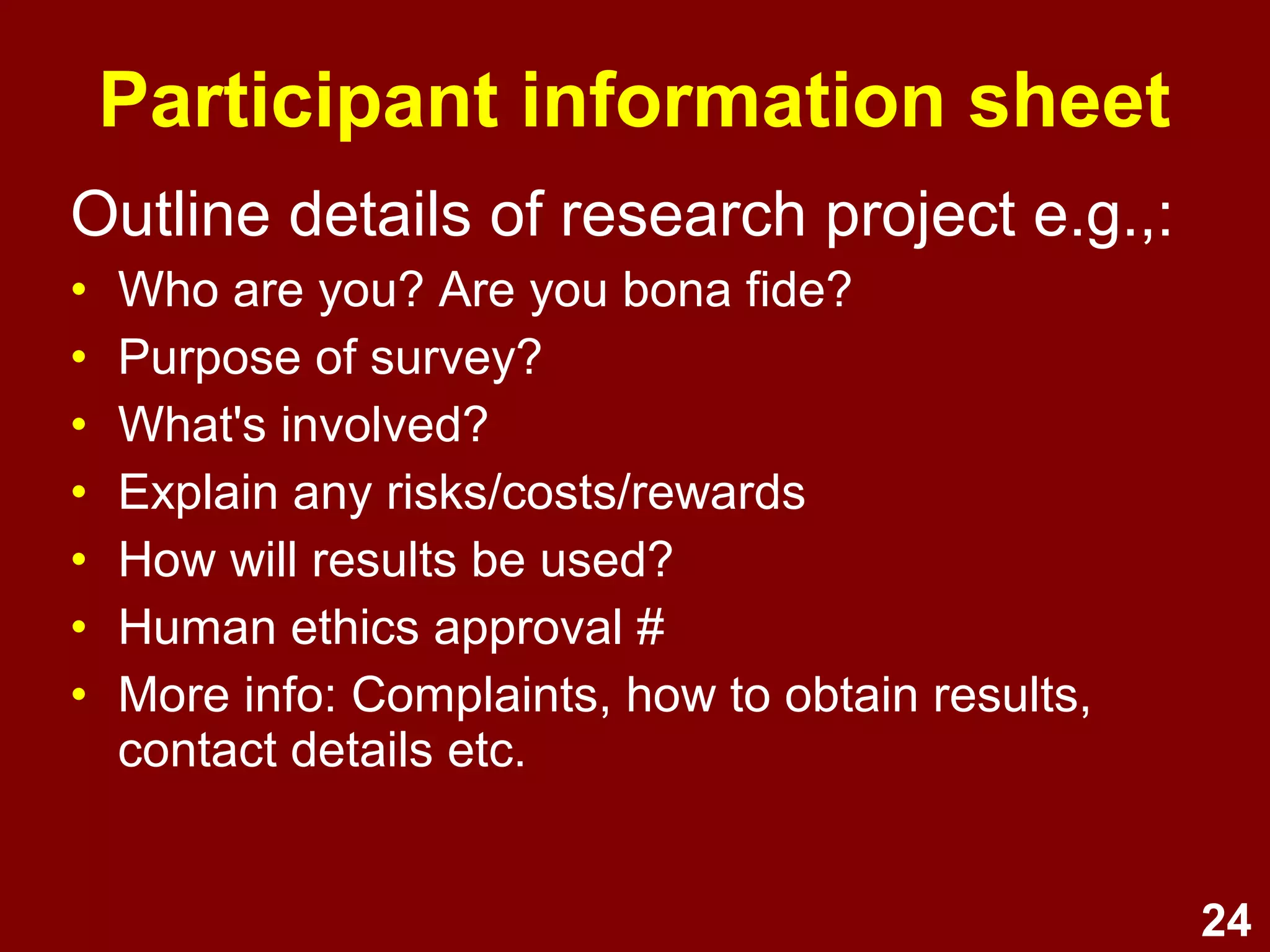
Participant information
Summarise important details about the
research project e.g.,:
• Name of the study
• Who are the researchers? (Are they bona fide)?
• Purpose of the study?
• What's required of participants?
• Voluntary nature of participation
• What are the risks/costs/rewards?
• How will results be used?
• Human ethics approval #?
• More info: Making a complaint, obtaining results,
contacting the researcher etc.
18
Informed consent
• Active consent: A page or screen
which allows participants to indicate
whether or not they consent to
participate in the study
• Passive content: If you consent to
participate, then please continue,
otherwise hand the survey back or
close the screen
19
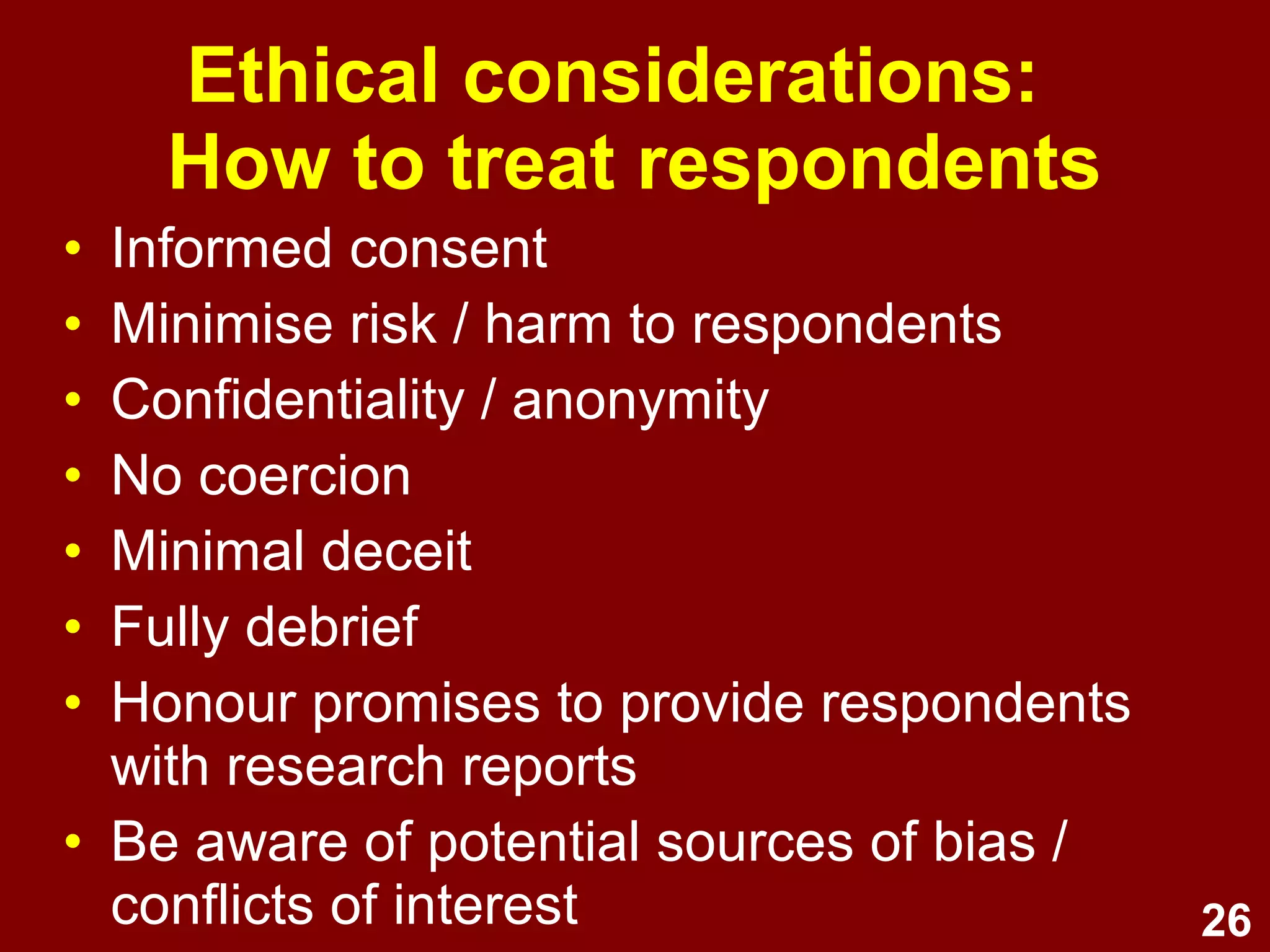
Ethical considerations
• Informed consent
• Minimise risk / harm to respondents
• Confidentiality / anonymity
• No coercion
• Minimal deceit
• Fully debrief
• Honour promises to provide respondents
with research reports
• Be aware of potential sources of bias /
conflicts of interest
20
• Instructions help to ensure
consistency i.e., standard conditions
across different administrations
• Few will read them without
prompting
• Explain how to do the survey in a
user-friendly manner, possibly with
examples
Survey instructions
21
• Start gently; ease respondent in
• Group similar questions together
• Consider order effects:
– Habituation (e.g., polarisation of responses,
yea-saying, nay-saying)
– Fatigue
– Min. switching between response formats
• Consider counter-balanced orders
Order, flow and structure
22
• Single section, usually at
beginning or end of questionnaire
• Only include personal questions
that are justified by the research
question(s)
Background information
23
• Space for comments?
• Indicate the end of the survey - say
thanks!
• Instructions about how to return the
survey or submit responses
• Provide debrief or referral
information
• Repeat details about how to
contact researchers, obtain results,
make complaint etc.
Ending the survey
24
Pre-testing
• Pre-test items on conveniently
sampled others – watch responses
and ask for feedback
• Revise items e.g.,
– which don’t apply to everybody
– are redundant
– are misunderstood
– are non-completed
• Reconsider ordering and layout
25
Pilot-testing
• Pilot test on a small sample from the
target population
• Analyse data
• Revise survey
26
Survey questions
27
Survey questions:
Overview
1. How to get the results you want
2. Double-barrelled, double-negative,
leading, and loaded questions
3. Survey question tips
4. Objective vs. subjective questions
5. Open- vs. closed-ended questions
6. Closed-ended response formats
7. Improving survey questions (Exercise)
28
• Direct: Focus directly on topic/issue
• Clear: Use simple and clear language
(avoid big words)
● Brevity: Keep questions as short as
possible
● Ask questions: Phrase as questions
Survey question tips
29
Survey question tips
● Related tools: Check/use similar
surveys
● Focus on objectives: Only ask
questions which relate to research
objectives
● Define target constructs: Be as
concrete and unambiguous as possible;
the meaning must be clear to all
respondents
30
Survey question tips
• Applicability: Questions must be
applicable to all respondents (or use skip
rules).
• Exhaustive: Response options must be
exhaustive (i.e., provide options for suitable
for each respondent) and mutually exclusive
(i.e., not overlapping)
• Demand: Recall of detail must not be
unnecessary or excessive
31
Watch out for questions which are …
double-barrelled
Questions which contain more than one
concept or purpose should be simplified or
split into separate questions:
e.g.,
“What do you think the speed limit should be
for cars and trucks?” vs.
“What do you think the speed limit should be
for cars?”
“What do you think the speed limit should be
for trucks?”
32
Watch out for questions which are …
double negative
Negatively worded questions are often
confusing because responding "no" creates a
double negative. e.g.,
“Do you disapprove of gay marriage?” vs
“Do you approve of gay marriage?”
33
Watch out for questions which are …
leading
A question that suggests the answer the
researcher is looking for is leading:
e.g.,
“Do you agree that psychologists should earn more
than they are currently paid?” vs.
“Do you think that psychologists' wages are lower
than they should be, higher than they should be, or
about right?”
“What dangers do you see with the new policy?” vs.
“What do you think about the new policy?”
34
How to design a poll
to get the results you
want by using leading
questions
(Yes Minister clip)
35
Watch out for questions which are …
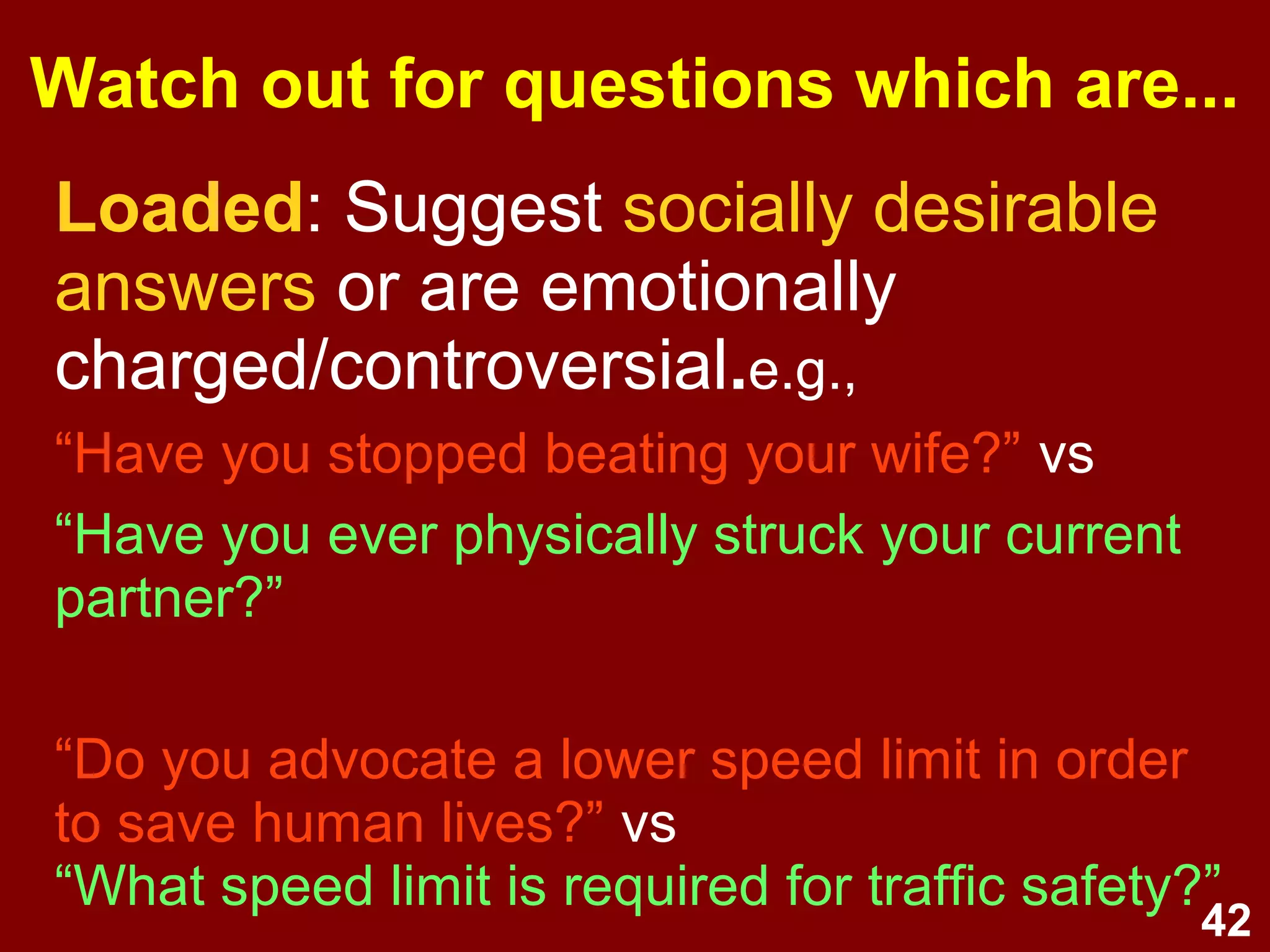
loaded
A question that suggests socially desirable
answers or is emotionally charged is loaded:
e.g.,
“Have you stopped beating your wife?” vs
“Have you ever physically harmed your
partner?”
“Do you advocate a lower speed limit in order
to save human lives?” vs
“What speed limit is required for traffic safety?”
36
Objective questions
● A verifiably true answer exists
(i.e., factual info).
● An observer (in theory) could
provide an accurate answer.
e.g.,
How many times during the
previous calendar year did you
visit a general medical
practitioner? ______
37
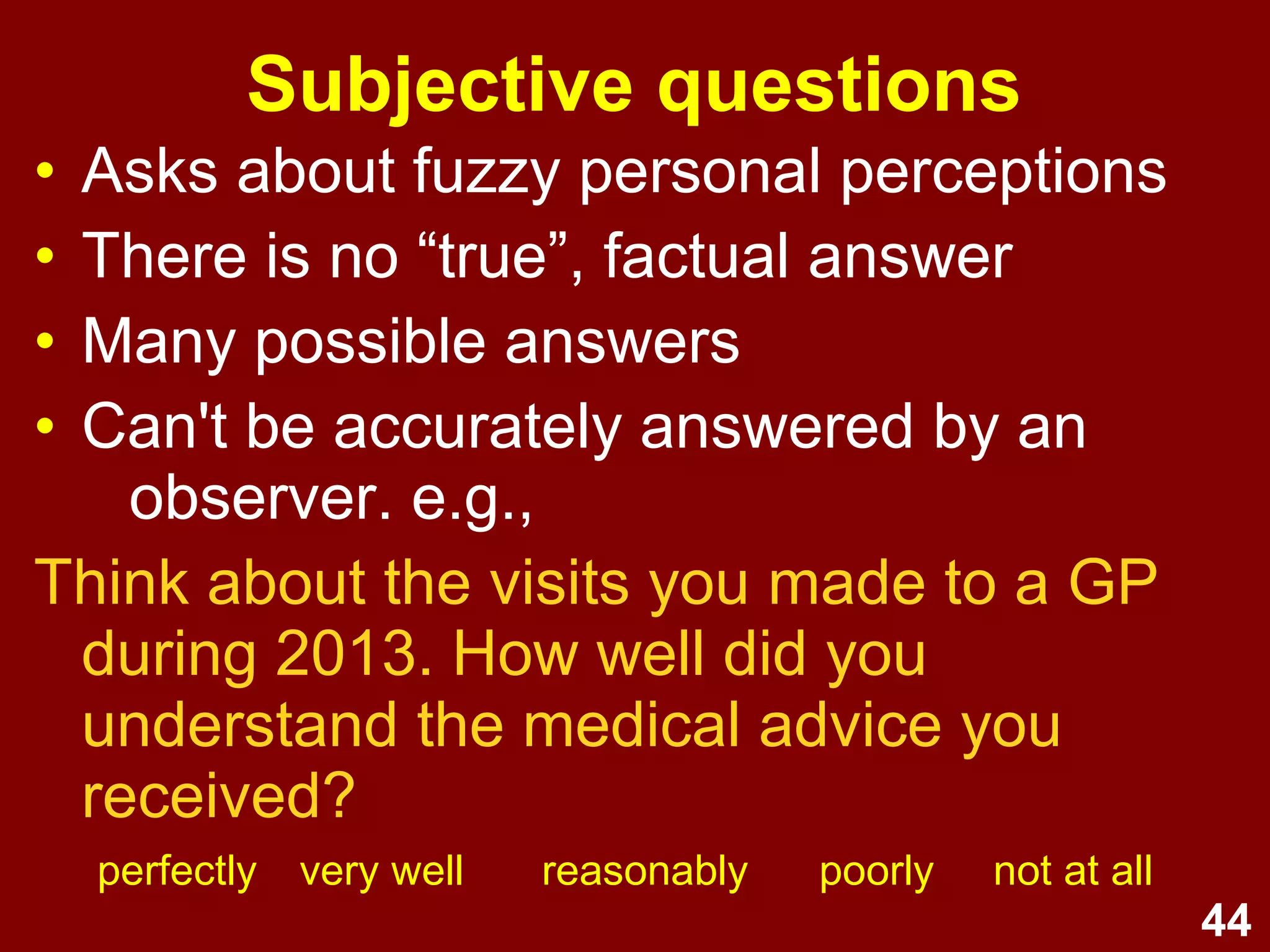
Subjective questions
• Asks about fuzzy personal perceptions
• There is no “true”, factual answer
• Many possible answers
• Can't be accurately answered by an
observer. e.g.,
Think about the visits you made to a GP
during the previous calendar year. How
well did you understand the medical
advice you were given?
perfectly very well reasonably poorly not at all
38
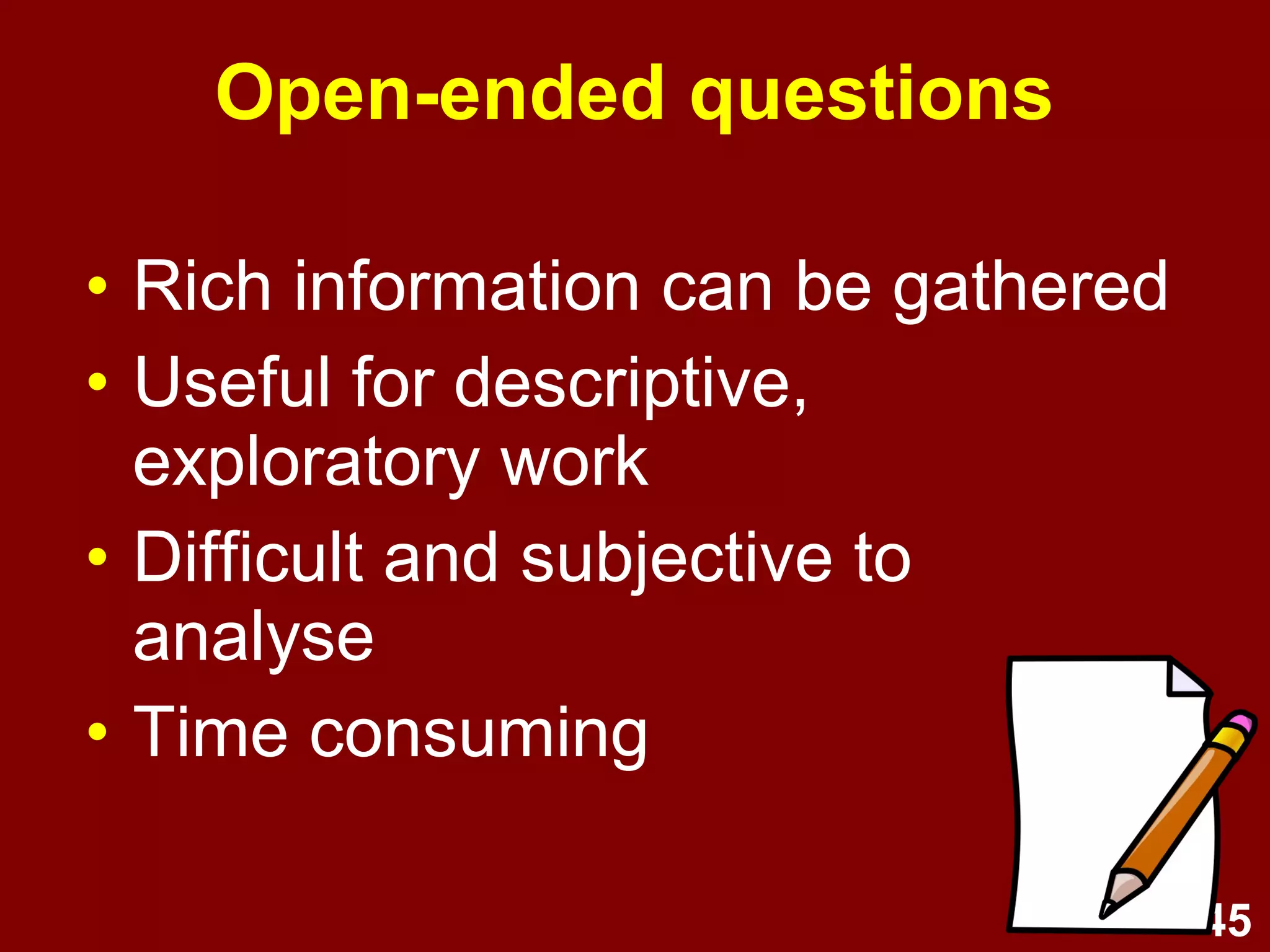
Open-ended questions
• Rich information can be gathered
• Useful for descriptive,
exploratory work
• Difficult and subjective to
analyse
• Time consuming
39
Open-ended questions:
Examples
What are the main issues you are
currently facing in your life?
How many hours did you spend
studying last week? _________
40
Closed-ended questions
• Important information may be
lost forever
• Useful for hypothesis testing
• Easy and objective to analyse
• Time efficient
41
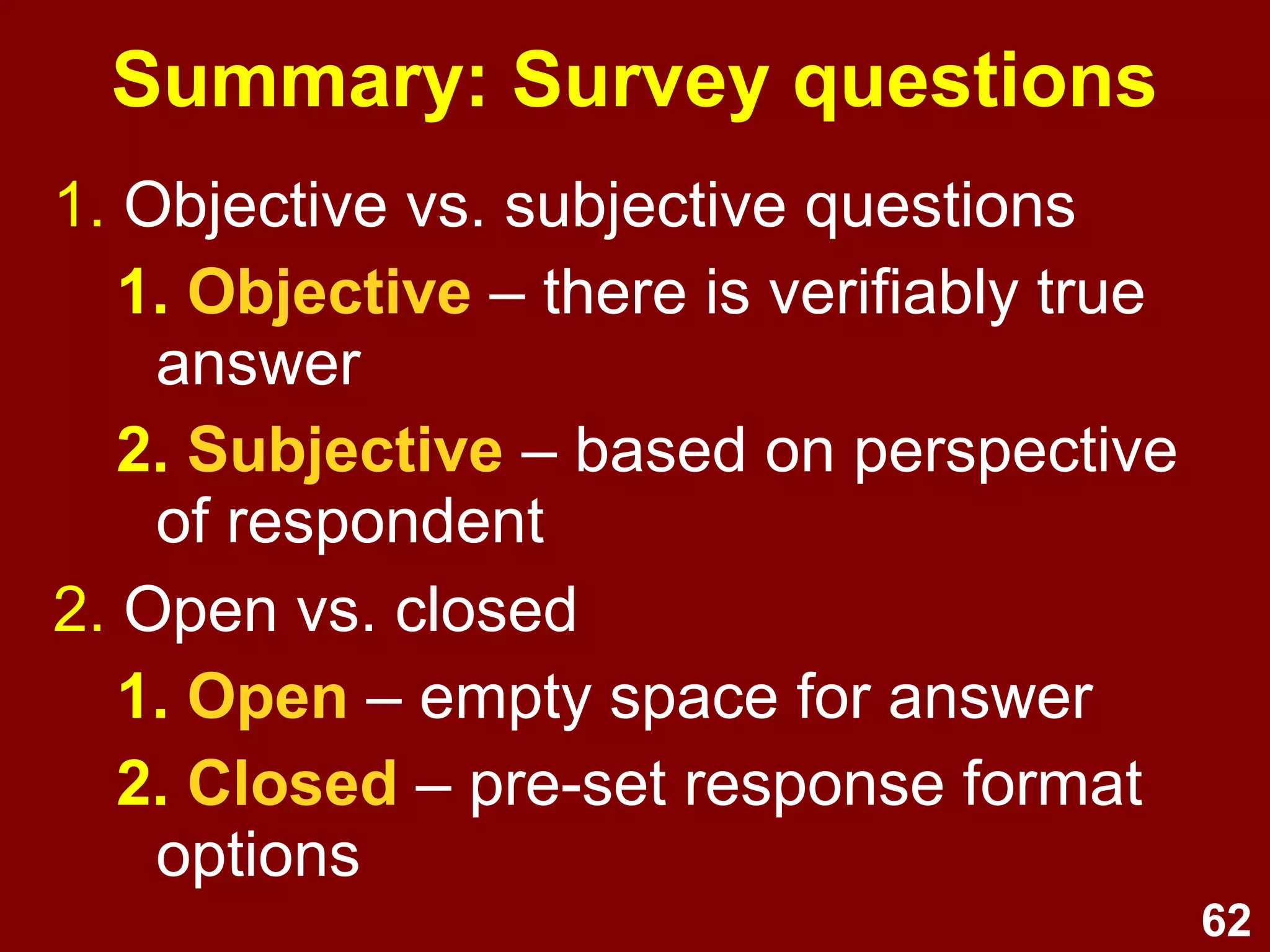
Summary: Survey questions
1. Objective vs. subjective questions
1. Objective – there is a verifiably true
answer
2. Subjective – based on perspective
of respondent
2. Open vs. closed
1. Open – empty space for answer
2. Closed – pre-set response format
options
42
Closed-ended response formats
1.Dichotomous
2.Multichotomous
3.The list (multiple response)
4.Ranking
5.Verbal frequency scale
6.Likert scale
7.Graphical rating scale
8.Semantic differential
9.Non-verbal (idiographic)
43
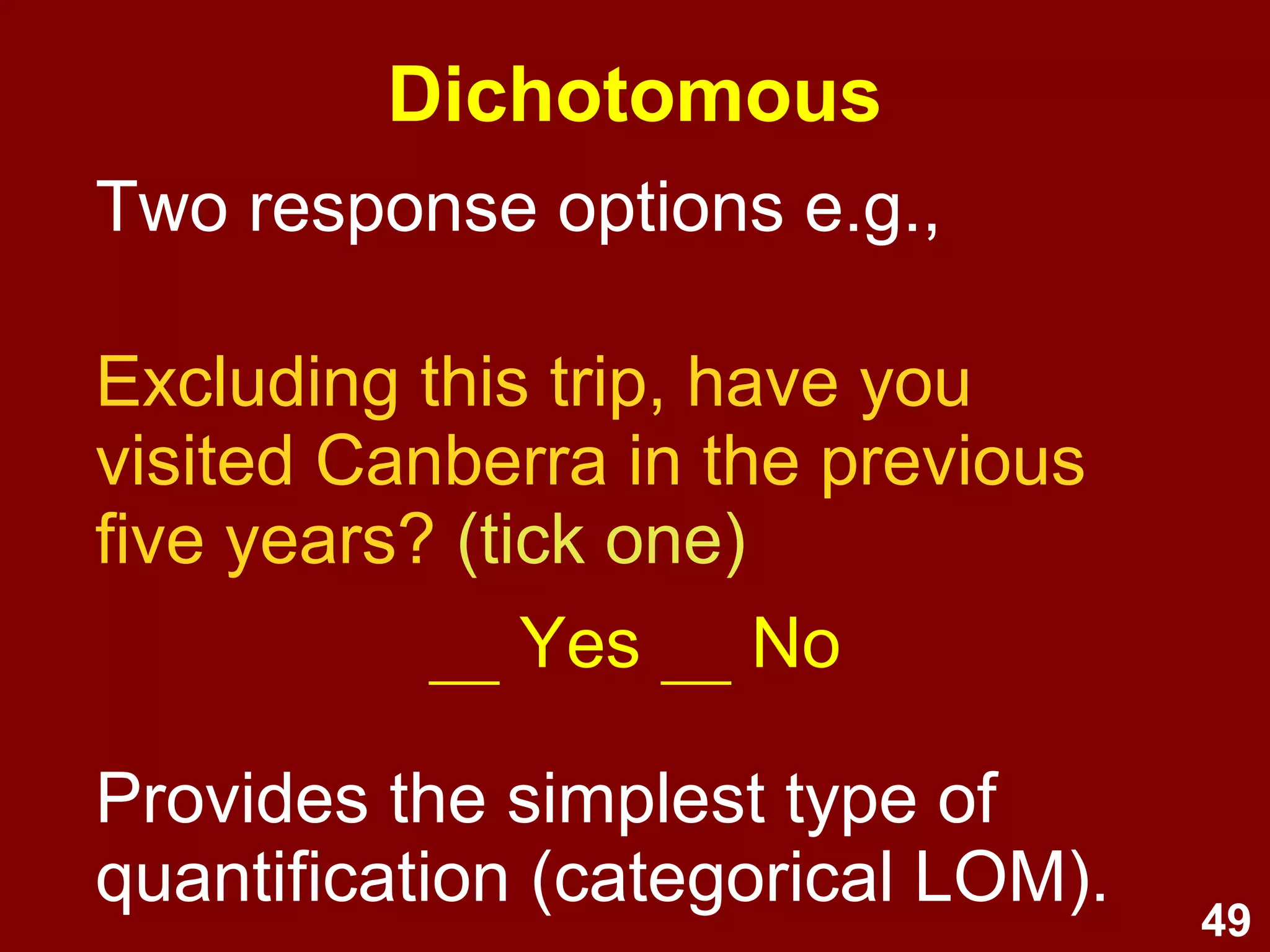
Dichotomous
Two response options e.g.,
Excluding this trip, have you
visited Canberra in the previous
five years? (tick one)
__ Yes __ No
Provides the simplest type of
quantification (categorical LOM).
44
Multichotomous
Choose one of more than two
possible answers e.g.,
What type of attractions in your
current trip to Canberra most appeal
to you? (tick the most appealing one)
__ historic buildings
__ museum/art galleries
__ parks and gardens
45
The list (multiple response)
Provides a list of answers for
respondents to choose from e.g.,
Tick any words or phrases that
describe your perception of
Canberra as a travel destination:
__ Exciting __ Important
__ Boring __ Enjoyable
__ Interesting __ Historical
46
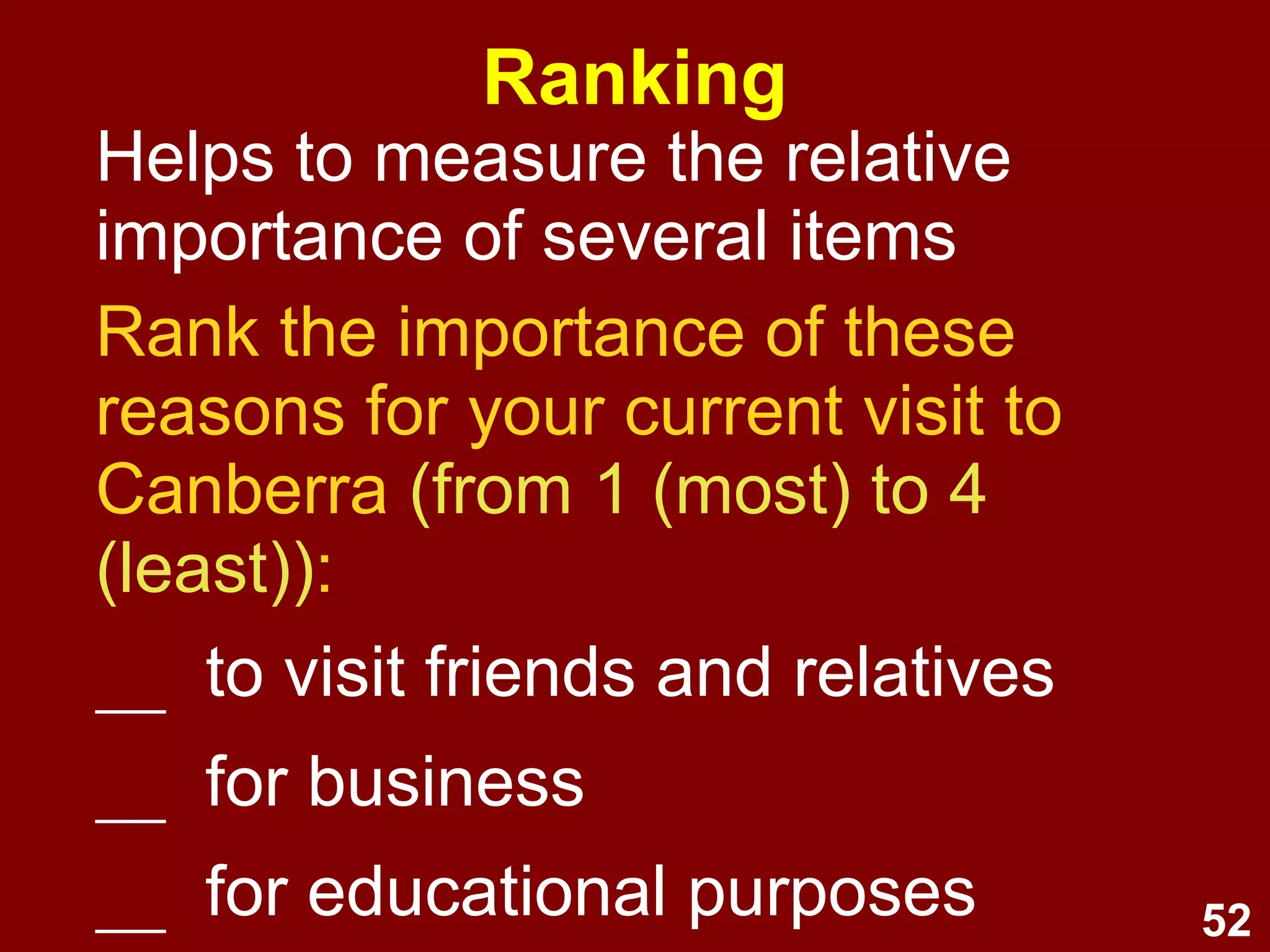
Ranking
Measures the relative importance of
several items
Rank the importance of these
reasons for your current visit to
Canberra (from 1 (most) to 4
(least)):
__ to visit friends and relatives
__ for business
__ for educational purposes
47
Verbal frequency scale
Over the last [period of time], how
often have you argued with your
intimate partner? (circle one)
1. All the time
2. Fairly often
3. Occasionally
4. Never
5. Doesn’t apply to me at the moment
48
Likert scale
1 2 3 4 5
strongly disagree neutral agree strongly
disagree agree
Measures strength of feeling or
perception.
Indicate your degree of agreement
with this statement:
“I am an adventurous person.”
(circle the best response for you)
49
AGREEMENT ABOUT SOMETHING
2-Categories
DISAGREE AGREE
3-Categories
DISAGREE NEUTRAL AGREE
4-Categories
STRONGLY MILDLY MILDLY STRONGLY
DISAGREE DISAGREE AGREE AGREE
5-Categories
STRONGLY MILDLY MILDLY STRONGLY
DISAGREE DISAGREE NEUTRAL AGREE AGREE
Number of response options?
Likert scale example
50
• How many response options?
–Minimum = 2
–Common = 3 to 9
–Maximum = 10?
–Basic guide: 7 +/- 2
• Scales should be sensitive (more
categories) yet reliable (fewer
categories).
• Watch out for too few or too many
options.
Number of response options?
51
Watch out for too many or too
few response options
“Capital punishment should be
reintroduced for serious crimes”
1 = Agree 2 = Disagree
1 = Very, Very Strongly Agree 7 = Slightly Disagree
2 = Very Strongly Agree 8 = Disagree
3 = Strongly Agree 9 = Strongly Disagree
4 = Agree 10 = V. Strongly Disagree
5 = Slightly Agree 11 = V, V Strongly Disagree
6 = Neutral
52
Graphical rating scale
Rate your enjoyment of the movie
you just saw.
Mark your response with a cross
(X) on the line below.
not very
enjoyable enjoyable
53
What is your view of tobacco smoking?
Place one tick on each row to show your
opinion.
Bad ___:___:___:___:___:___:___ Good
Strong ___:___:___:___:___:___:___ Weak
Masculine ___:___:___:___:___:___:___ Feminine
Unattractive ___:___:___:___:___:___:___ Attractive
Passive ___:___:___:___:___:___:___ Active
Semantic differential
54
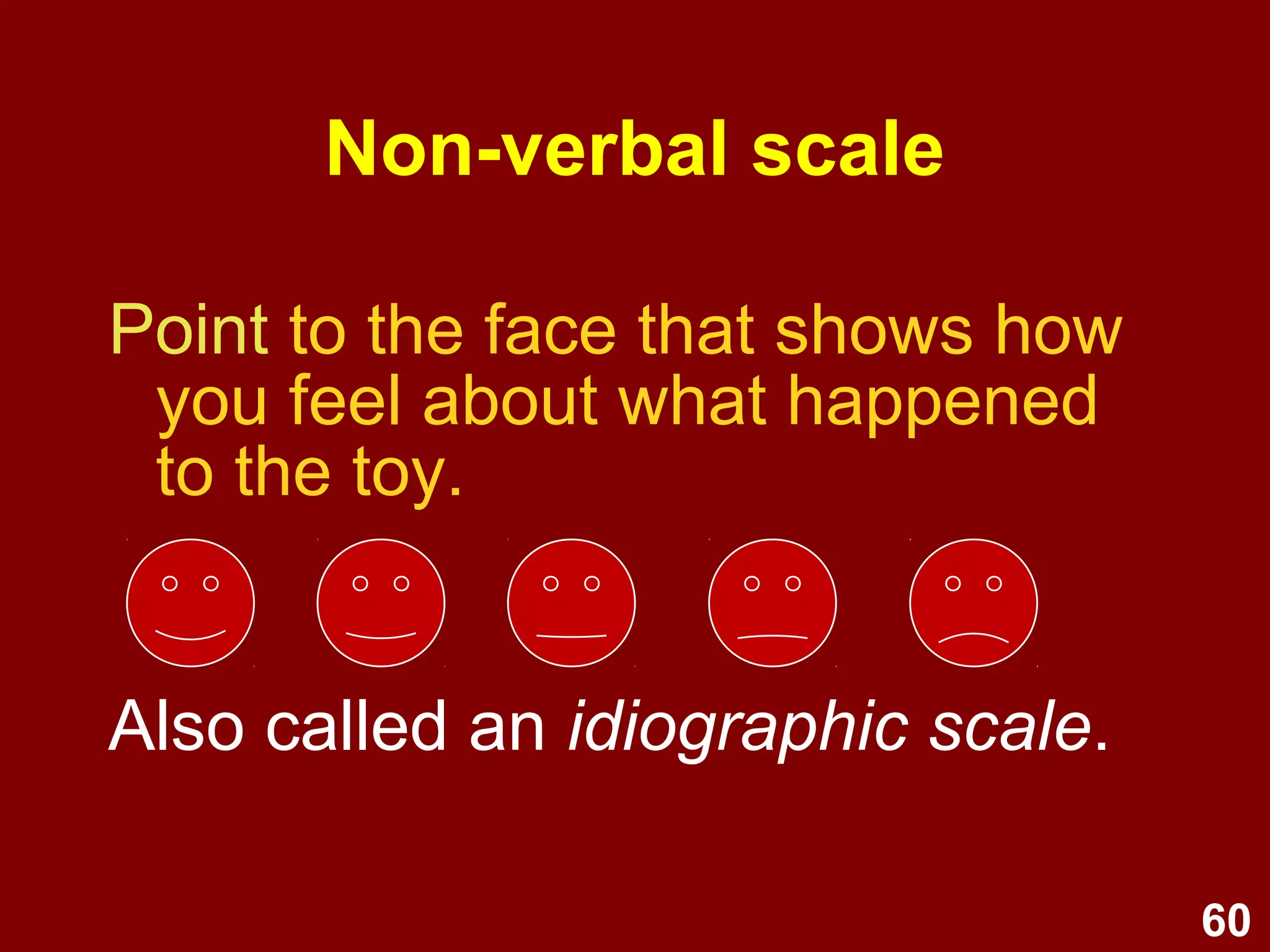
Non-verbal
(idiographic) scale
Point to the face that shows how
you feel about what happened
to the toy.
Responses are converted into a
number e.g., 1 to 5.
55
Summary: Response formats
1. Dichotomous and multichotomous
2. Multiple response
3. Verbal frequency scale (Never ... Often)
4. Ranking (in order → Ordinal)
5. Likert scale (equal distances →
Interval, typically with 3 to 9 options)
6. Graphical rating scale (e.g., line)
7. Semantic differential (opposing words)
8. Non-verbal (idiographic)
56
How could these
survey questions
be improved?
57
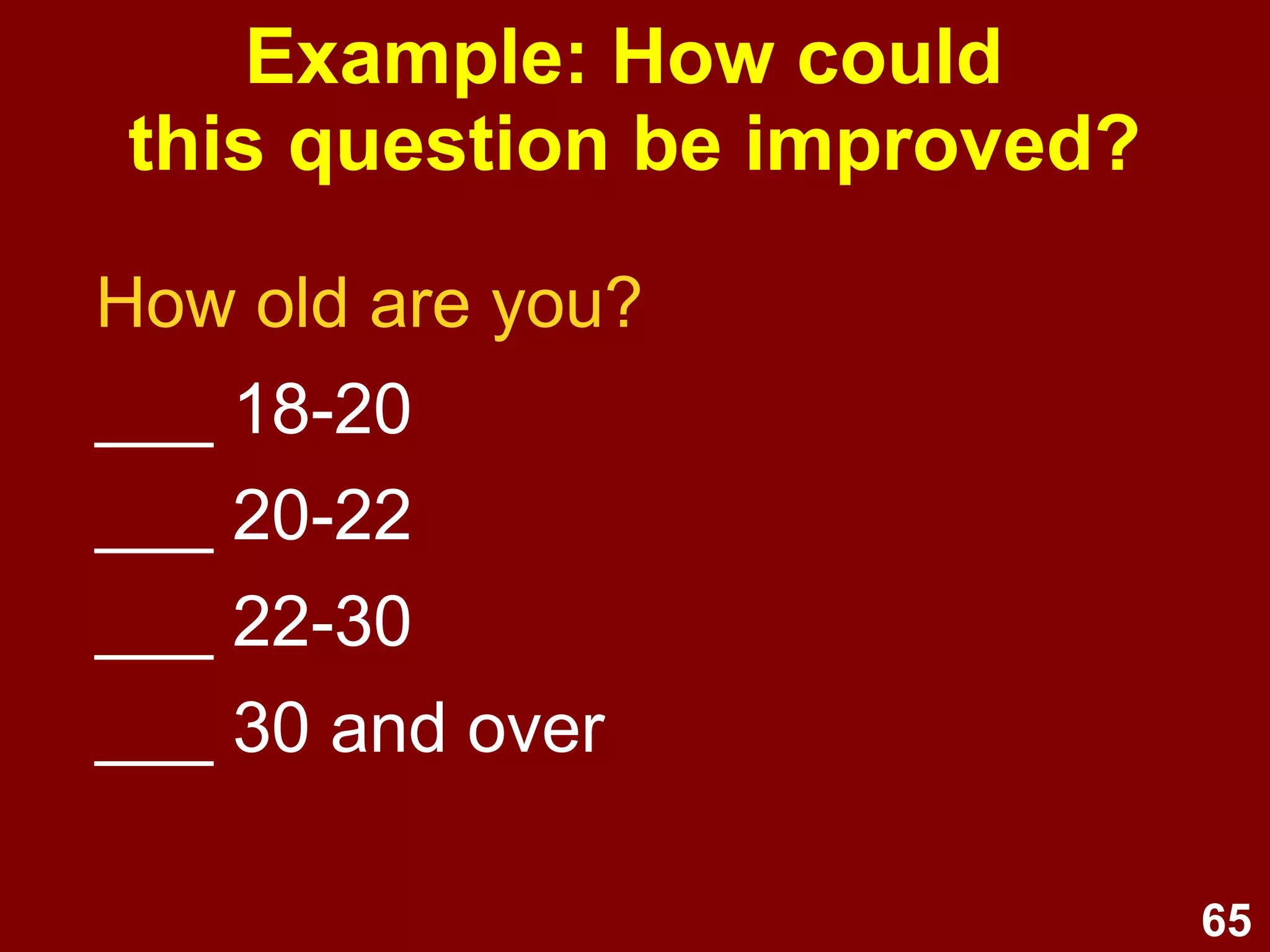
Example: How could
this question be improved?
How old are you in years?
(circle one response)
18-20
20-22
22-30
30 and over
58
Are you satisfied with your marriage
and your job?
(write your answer below)
__________________________
Example: How could
this question be improved?
59
You didn’t think the food was very
good, did you?
(tick your answer)
_____ Yes _____ No
Example: How could
this question be improved?
60
Environmental issues have become
increasingly important in choosing
hotels. Are environmental
considerations an important factor
when deciding on your choice of
hotel accommodation?
(tick an answer)
____ Yes ____ No
Example: How could
this question be improved?
61
How did you hear about this
restaurant?
(please circle appropriate
responses)
____ yellow pages
____ Internet
____ word of mouth
Example: How could
this question be improved?
62
Levels of
measurement
=
Type of data
Stevens (1946)
63
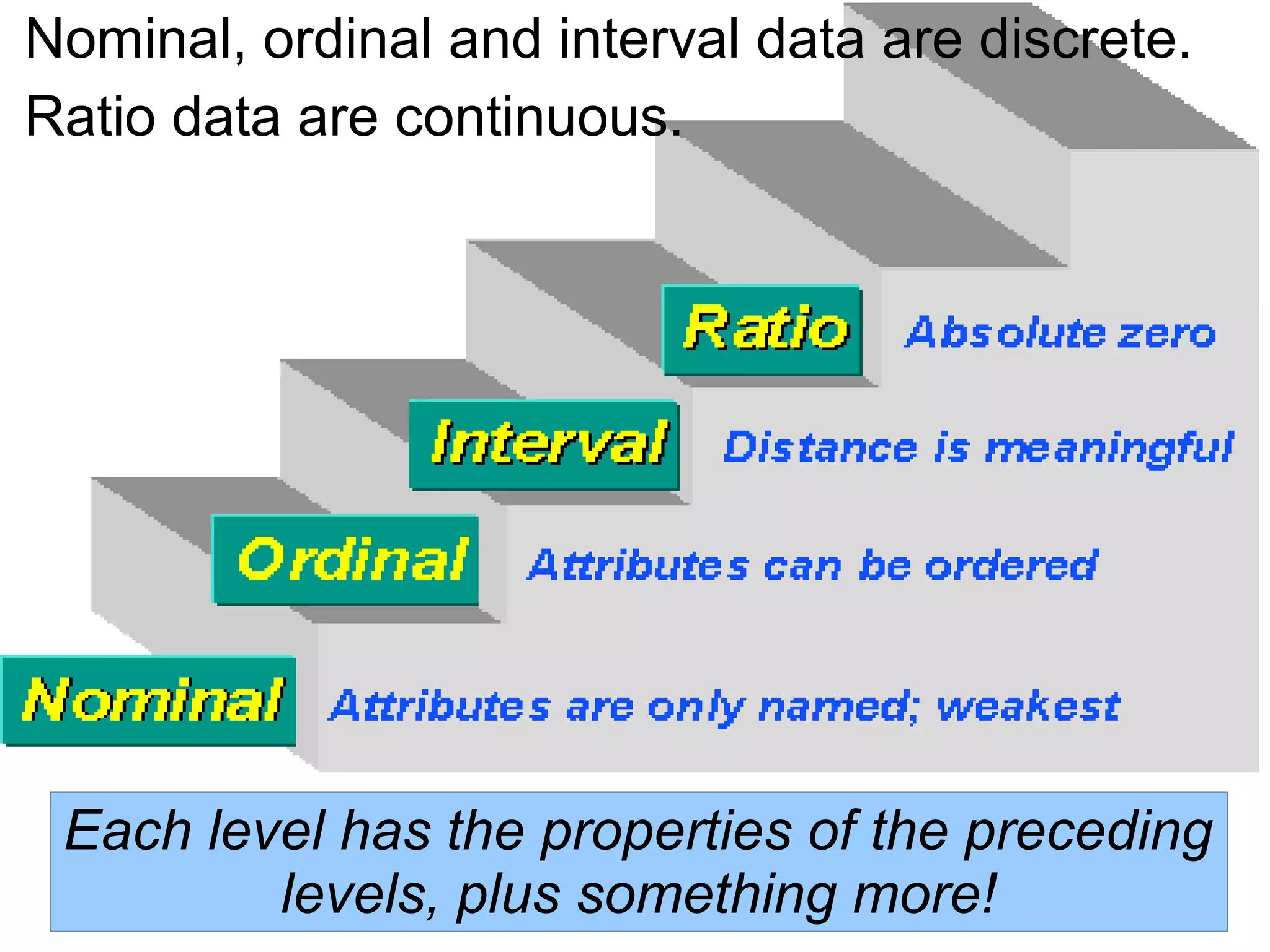
Levels of measurement
● Nominal / Categorical
● Ordinal
● Interval
● Ratio
Each level has the properties of the preceding
levels, plus something more!
Ratio data
are continuous.
Nominal,
ordinal and
interval data
are discrete.
64
Categorical / nominal
• Conveys a category label
• (Arbitrary) assignment of #s to
categories
e.g. Gender
• No useful information, except as
labels
65
Ordinal / ranked scale
• Conveys order, but not distance
e.g. in a race, 1st, 2nd, 3rd, etc. or
ranking of favourites or preferences
66
Interval scale
• Conveys order & distance
• 0 is arbitrary
• e.g., interval scale
1 2 3 4 5
STRONGLY MILDLY MILDLY STRONGLY
DISAGREE DISAGREE NEUTRAL AGREE AGREE
• For data analysis assumption
testing, usually treat as continuous if
> 5 intervals are used.
67
Ratio scale
• Conveys order & distance
• Meaningful 0 point
e.g. height, age, weight, time, number of times
an event has occurred
• Continuous (i.e., there can be fractional
amounts / decimal places)
• Ratio statements can be made
e.g. X is twice as old (or high or heavy) as Y
68
Why do levels of
measurement matter?
Different analytical procedures
are used for different
levels of data.
More powerful statistics can be
applied to higher levels
69
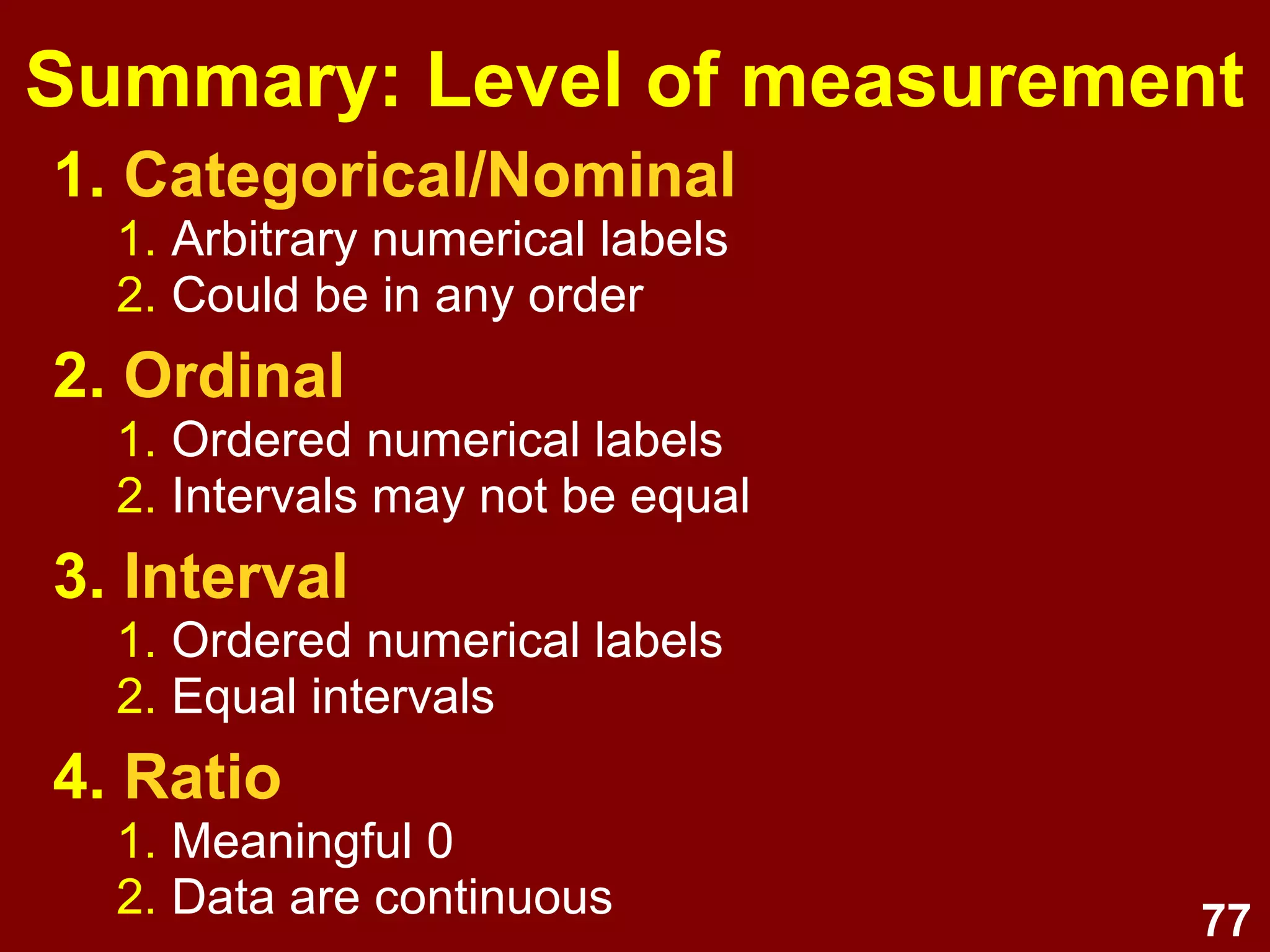
Summary: Level of measurement
1. Categorical/Nominal
1. Arbitrary numerical labels
2. Could be in any order
2. Ordinal
1. Ordered numerical labels
2. Intervals may not be equal
3. Interval
1. Ordered numerical labels
2. Equal intervals
4. Ratio
1. Meaningful 0
2. Data are continuous
70
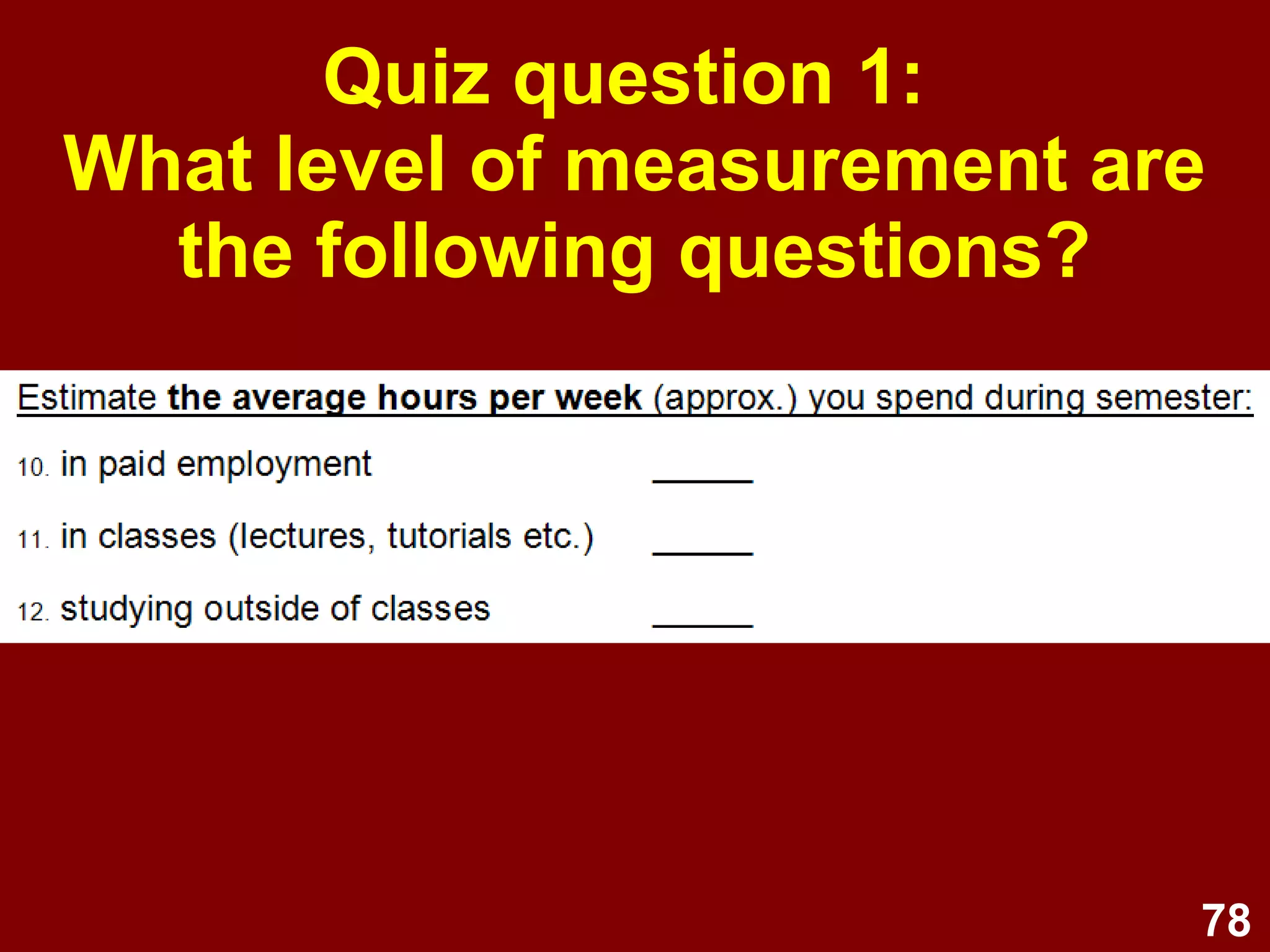
Quiz question 1:
What level of measurement are
the following questions?
71
Quiz question 2:
What level of measurement is
used for this survey question?
How well do you think you have
understood this lecture about survey
design so far?
perfectly very well reasonably poorly not at all
72
Quiz question 3:
What level of measurement is
used for this survey question?
Rate your view about this statement:
Australia should provide residency to more
asylum seekers.
1 2 3 4 5
strongly disagree neutral agree strongly
disagree agree
73
Quiz question 4:
What level of measurement is
used for this survey question?
What is your favourite primary colour?
(choose one of the following options)
• Red
• Yellow
• Blue
74
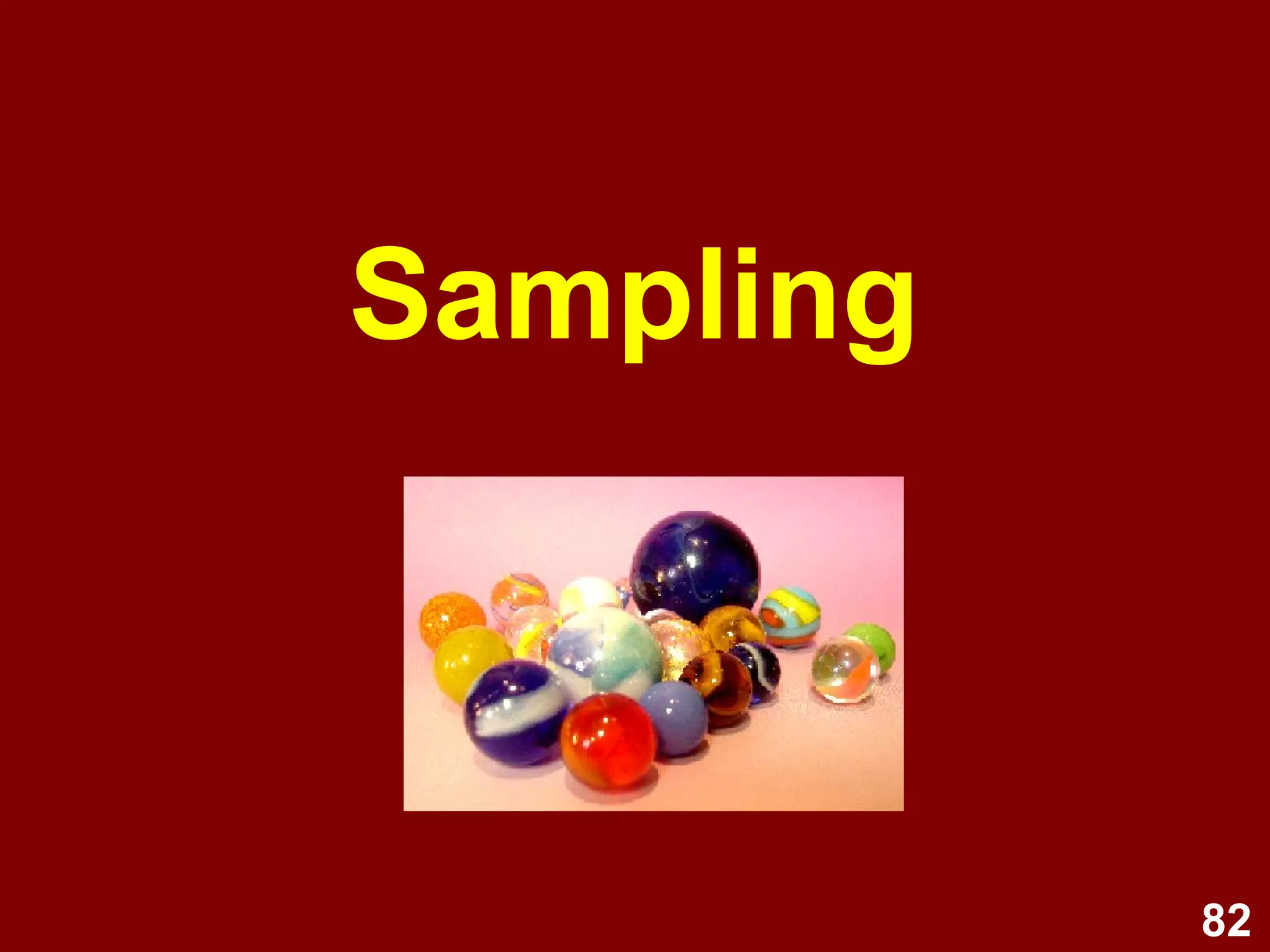
Sampling
75
Survey implementation issues
Consider survey research
implementation issues,
including:
1. Sampling methods
2. Sample size and return rates
3. Representativeness
76
Sampling:
Overview
1. Sampling terms
2. What is sampling?
3. Why sample?
4. Sampling methods
77
Sampling terms
• Target population
– To whom do you wish to generalise?
• Sampling frame
– Who has a chance of being selected?
• Sample
– Who was selected and responded?
• Representativeness
– To what extent is the sample a good
indicator of the target population?
78
What is sampling?
“Sampling is the process of
selecting units (e.g., people,
organizations) from a population of
interest so that by studying the
sample we may fairly generalize
our results back to the
population from which they were
chosen.”
- Trochim (2006)
79
Why sample?
• Reduces cost, time, sample
size etc.
• If the sample is representative,
the sample data allows
inferences to be drawn about
the target population.
80
Sampling process
● Identify target population and
sampling frame
● Select sampling method
● Calculate sample size for desired
power.
● Maximise return rate
81
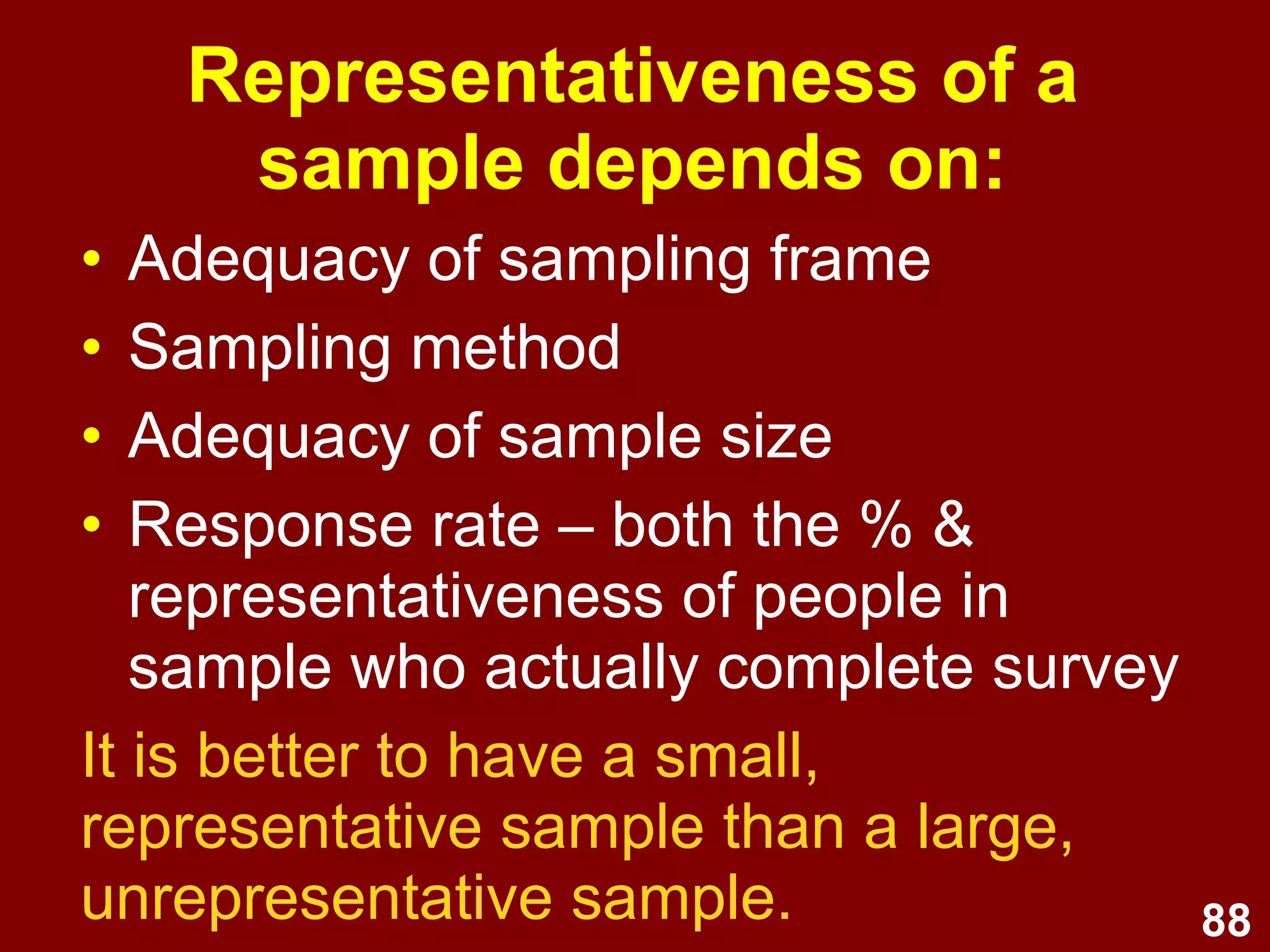
Representativeness of a
sample depends on:
• Adequacy of sampling frame
• Sampling method
• Adequacy of sample size
• Response rate – both the % &
representativeness of people in
sample who actually complete survey
It is better to have a small,
representative sample than a large,
unrepresentative sample.
82
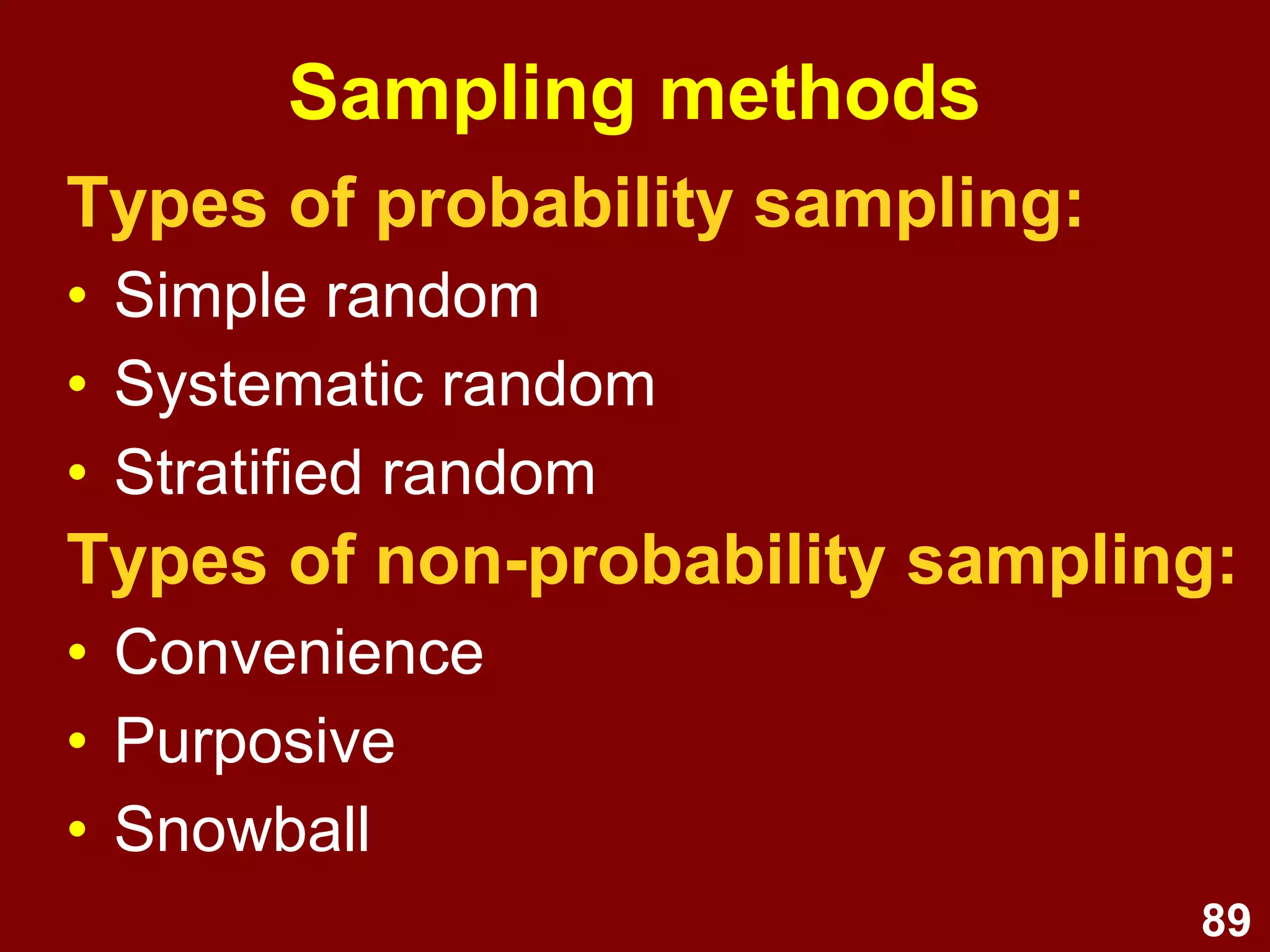
Sampling methods
Types of probability sampling:
• Simple random
• Systematic random
• Stratified random
Types of non-probability sampling:
• Convenience
• Purposive
• Snowball
83
Probability sampling
• Each unit has an equal chance of
selection
• Selection occurs entirely by
random chance
84
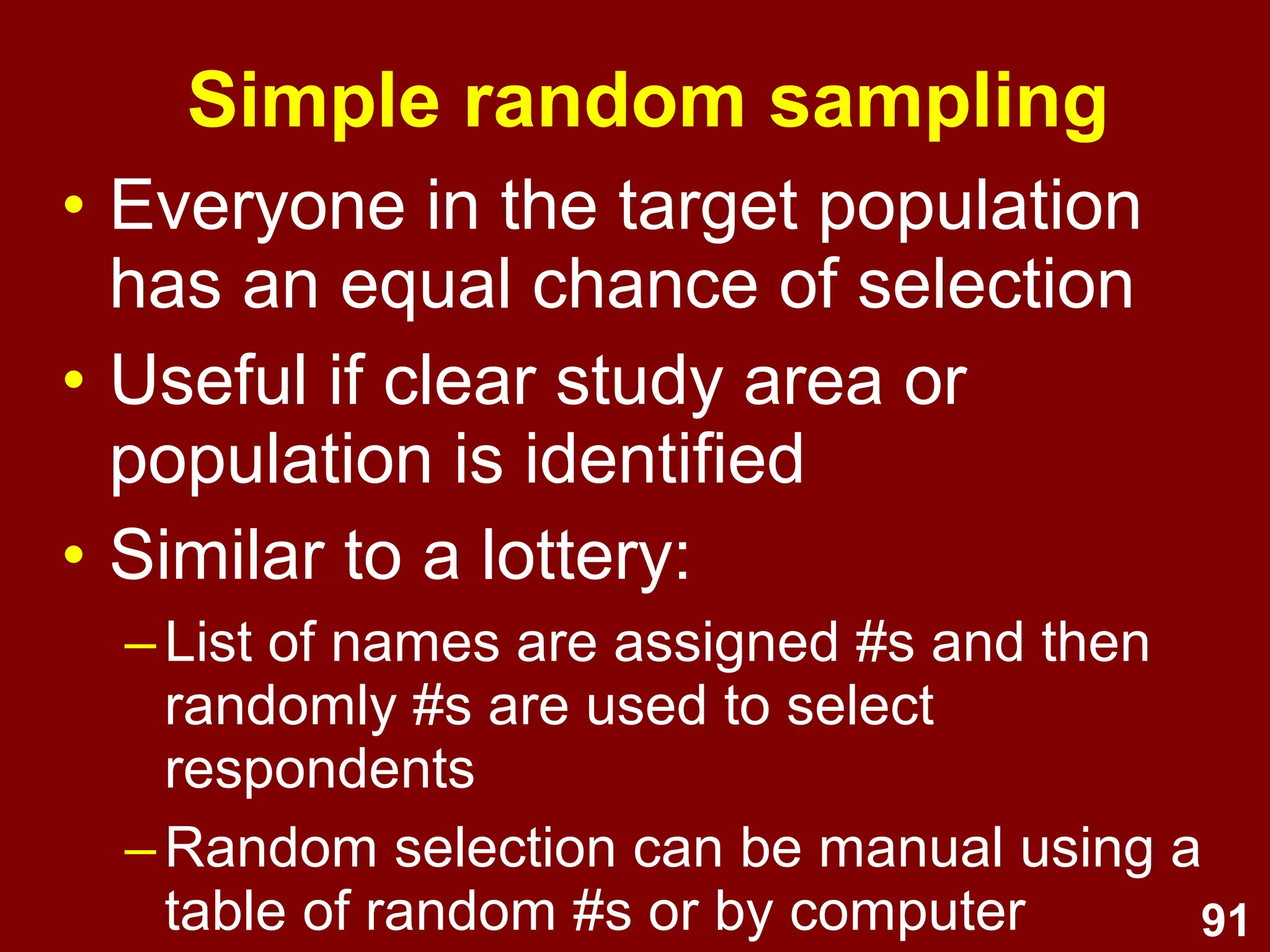
Simple random sampling
• Everyone in the target population
has an equal chance of selection
• Useful if clear study area or
population is identified
• Similar to a lottery:
–List of names are assigned #s and then
randomly #s are used to select
respondents
–Random selection can be manual using a
table of random #s or by computer
85
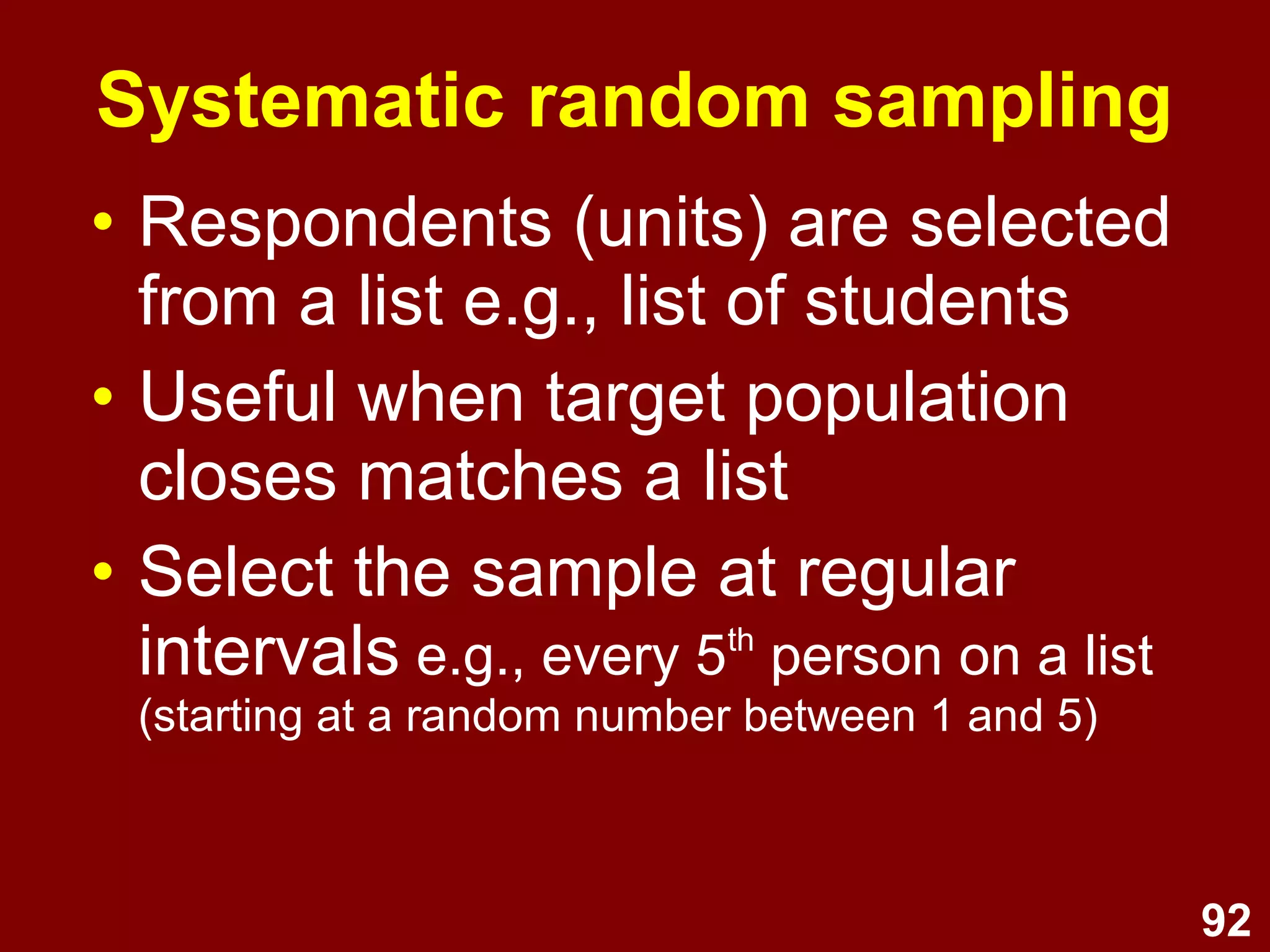
Systematic random sampling
• Respondents (units) are selected
from a list e.g., list of students
• Useful when target population
closes matches a list
• Select the sample at regular
intervals e.g., every 5th
person on a list
(starting at a random number between 1 and 5)
86
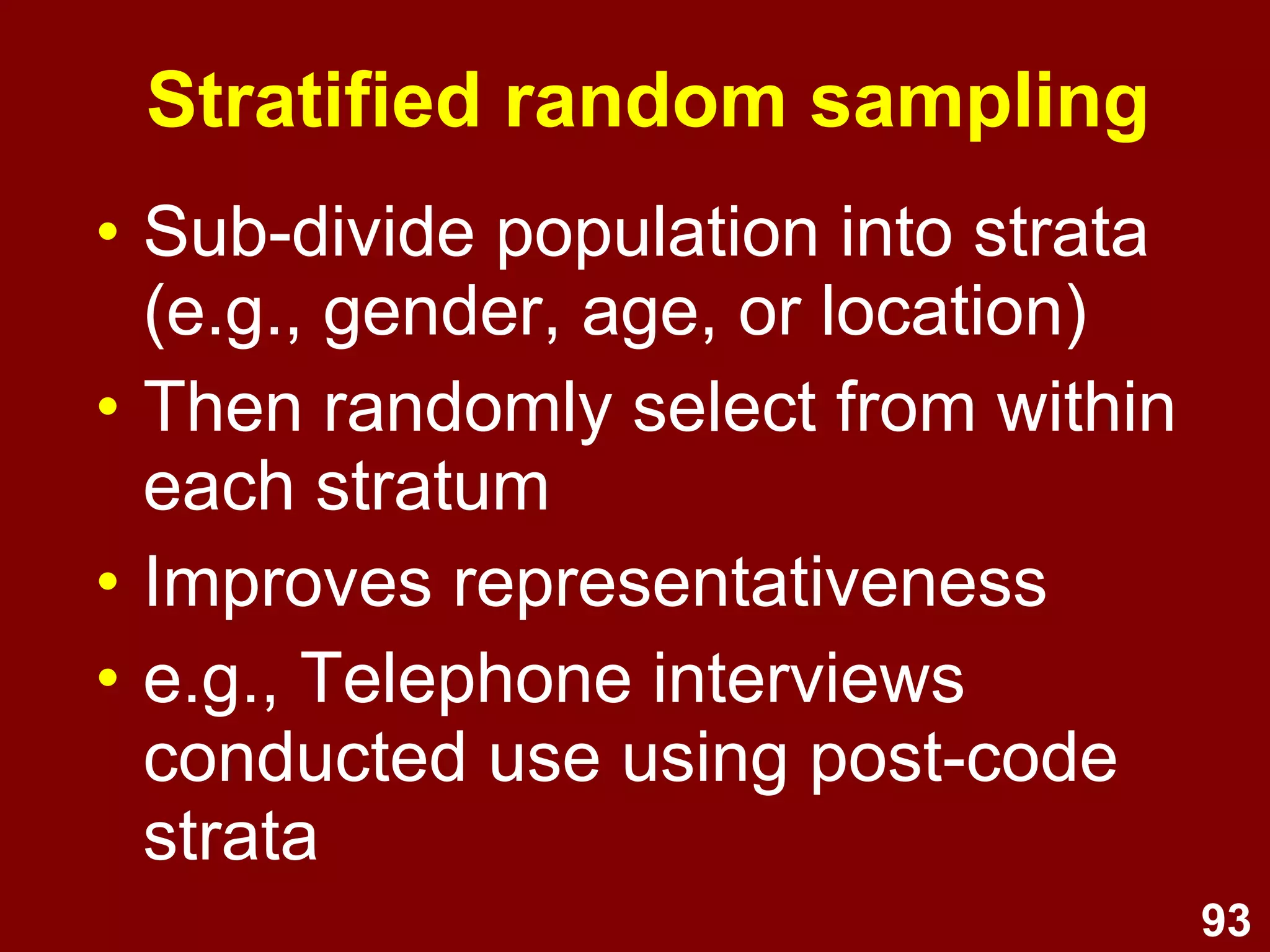
Stratified random sampling
• Sub-divide population into strata
(e.g., gender, age, or location)
• Then randomly select from within
each stratum
• Improves representativeness
• e.g., Telephone interviews
conducted use using post-code
strata
87
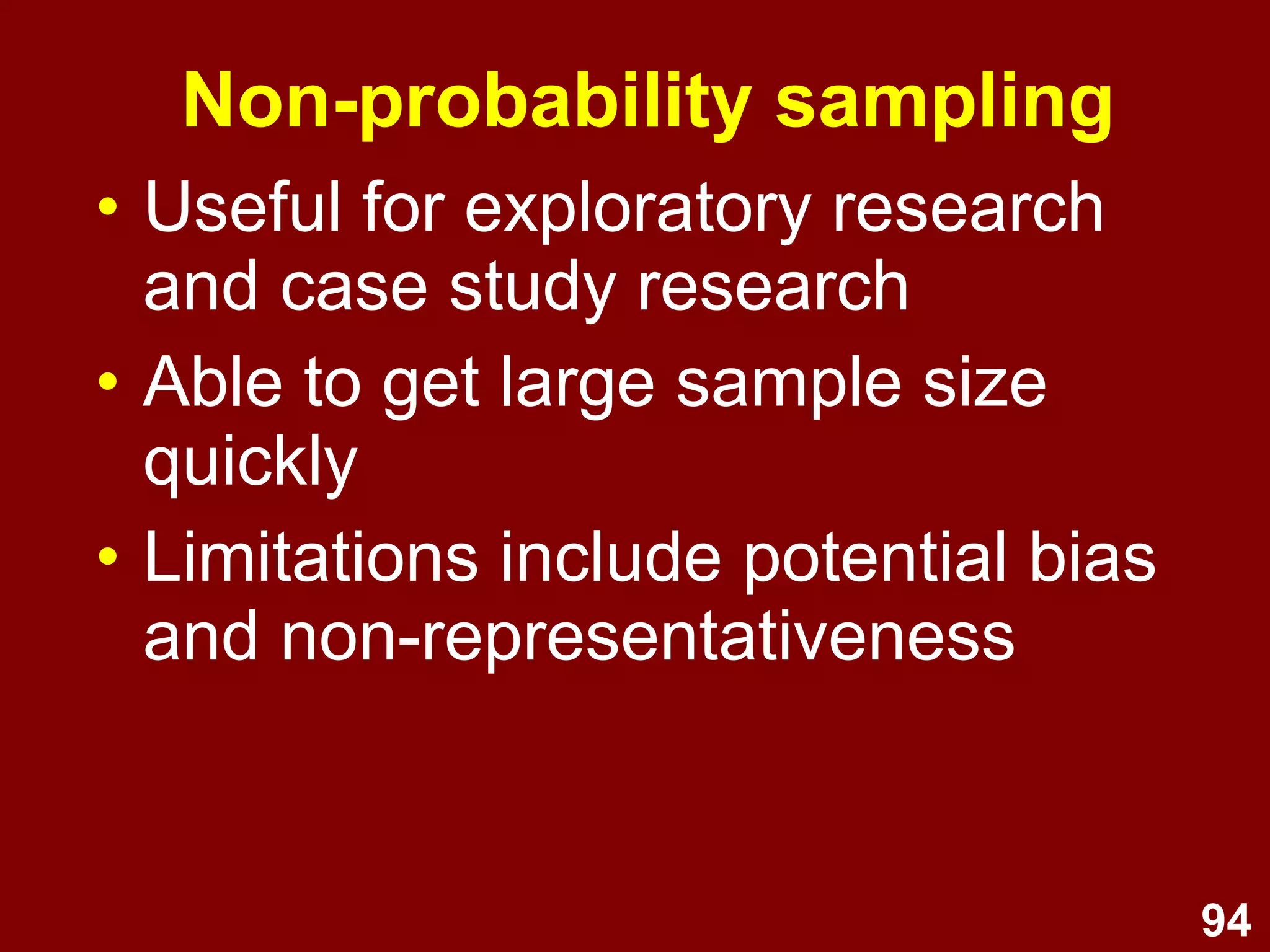
Non-probability sampling
• Useful for exploratory research
and case study research
• Able to get large sample size
quickly
• Limitations include potential
selection bias and non-
representativeness
88
Convenience sampling
• Sampling is by convenience (i.e.,
whoever is available) rather than
randomly
e.g. surveying visitors to a tourist attraction
over one weekend
• Less cost/time involved than
random sampling
• Subject to sampling bias
89
Purposive sampling
• Respondents are selected for a
particular reason e.g., because
they are “typical” respondents
• e.g., for a tourism study, select a sample of
tourists aged 40-60 for interviews as this is
the typical age group of visitors to Canberra
• e.g., Contacting Frequent Flyer members to
participate in a survey about service quality
in an airline setting
90
Snowball sampling
• Respondents are asked to
recommend other respondents
• Useful for difficult to access
populations e.g., illegal
immigrants, illegal drug users
• e.g., in studying ecstasy users, a research
may gain trust of a few potential
respondents and ask then these
respondents to recommend the researcher
to other potential respondents
91
Summary: Sampling
1. Key terms
1. (Target) population
2. Sampling frame
3. Sample
2. Sampling
–Probability (random)
1. Simple
2. Systematic
3. Stratified
2. Non-probability
1. Convenience
2. Purposive
3. Snowball
92
Biases
93
Learning outcomes:
Biases
Consider the potential for bias in
survey research including:
1. Sampling biases
2. Non-sampling biases
94
Biases
Biases which can influence survey
research data:
• Sampling biases
– Sample does not represent target
population
• Non-sampling biases
– Measurement tool reliability and validity
– Response biases
95
Response biases
• Acquiescence
– yea-saying
– nay-saying
• Order effects
• Fatigue effects
• Demand characteristics
• Hawthorne effect
• Self-serving bias
• Social desirability
96
Demand characteristics
Participants form an interpretation of
the researcher's purpose and
unconsciously change their behaviour
to fit that interpretation.
Interview
• Higher demand characteristics
Questionnaire
• Lower demand characteristics
97
Maximising response rate
• Respondent’s level of interest
• Rewards
• Accompanying letter / introduction
• Layout and design
• Colour of paper
• Mail surveys - self-addressed
stamped return envelope
• Reminders or follow up calls
98
Summary:
Non-sampling biases
1. Acquiescence
2. Order effects
3. Fatigue effects
4. Demand characteristics
5. Hawthorne effect
6. Self-serving bias
7. Social desirability
99
References
• Alreck, P. & Settle, R. (1995). The survey
research handbook (2nd
ed.). New York: Irwin.
• Reeve, J. (2009). Understanding motivation and
emotion (5th ed.). Hoboken, NJ: Wiley.
• Stevens, S.S. (1946). On the theory of scales of
measurement. Science, 103, 677-680.
• Trochim, W. M. K. (2006). *. In
Research Methods Knowledge BaseSampling.
• Wikipedia (2009). Shere Hite - Methodology.
100
Open Office Impress
● This presentation was made using
Open Office Impress.
● Free and open source software.
● http://www.openoffice.org/product/impress.html

Survey Design

  • 1.
    Lecture 2 Survey Research& Design in Psychology James Neill, 2017 Creative Commons Attribution 4.0 Survey Design
  • 2.
    2 Overview 1. Lecture 1summary 2. Survey administration methods – Interview vs. self-administered 3. Survey construction 4. Levels of measurement 5. Biases 6. Sampling
  • 3.
    3 Lecture 1 Summary Surveyresearch 1. Research types (3) 1. Experimental 2. Quasi-experimental 3. Non-experimental 2. Purposes (4) 1. Information gathering (2) 1. Exploratory 2. Descriptive 2. Theory testing (2) 1. Explanatory 2. Predictive
  • 4.
    4 Lecture 1 Summary Surveyresearch 1. What is a survey? 1. A standardised stimulus used as a social science measurement tool 2. Survey research 1. Pros 1. Ecological validity 2. Cost-efficient 3. Can obtain lots of data 2. Cons 1. Low compliance 2. Reliance on self-report
  • 5.
  • 6.
    6 Survey administration methods Considerthe pros and cons of two common survey administration methods: 1. Interview-based 2. Self-report
  • 7.
    7 Types of surveys Self- administered Interview - administered Postal Delivered and collected TelephoneFace to face structured interview Online Email Web Mobile
  • 8.
    8 Advantages and disadvantagesof self- and interview-administered surveys
  • 9.
    9 Self-administered –Pros: • Cost • demandcharacteristics • access to representative sample • anonymity –Cons: • Non-response • adjustment to cultural differences, special needs Survey types Opposite for interview- administered surveys
  • 10.
  • 11.
    11 Survey construction Examine thenuts & bolts of questionnaire design including: 1. Questionnaire development 2. Question styles 3. Response formats
  • 12.
    12 Survey construction 1. Surveydesign is science and art 2. Questionnaire development 1. Stages of development 2. Parts of a survey 3. Order, flow and structure 4. Demographics and personal information 5. Ending the survey 6. Layout 7. Pre- and pilot-testing 3. Writing questions 1. Types of questions 2. Response formats
  • 13.
    13 “Surveys are amixture of science and art, and a good researcher will save their cost many times over by knowing how to ask the correct questions.” - Creative Research Systems (2008) Survey design is a science and an art
  • 14.
    14 1. Formulate generic questionnaire 2. Expand the questionnaire Createseparate sections for each study objective. Draft qs & response formats 4. Finalise questionnaire & implement Question order & funnel qs Stages of questionnaire development 3. Pre-test, pilot test, & redraft
  • 15.
    15 Parts of asurvey • Title page • Participant information sheet • Informed consent form • Instructions • Questionnaire structured into sections which contain measurement items relating to each objective • End page(s)
  • 16.
    16 • Layout shouldbe clear, simple, and easy to navigate • Readability: – Large font size (14 pt) and clear (non-serif) font type – High contrast e.g., avoid text in coloured boxes, etc. • Minimise the number of pages • Organise into a logical flow/order • Number each question Layout
  • 17.
    17 Participant information Summarise importantdetails about the research project e.g.,: • Name of the study • Who are the researchers? (Are they bona fide)? • Purpose of the study? • What's required of participants? • Voluntary nature of participation • What are the risks/costs/rewards? • How will results be used? • Human ethics approval #? • More info: Making a complaint, obtaining results, contacting the researcher etc.
  • 18.
    18 Informed consent • Activeconsent: A page or screen which allows participants to indicate whether or not they consent to participate in the study • Passive content: If you consent to participate, then please continue, otherwise hand the survey back or close the screen
  • 19.
    19 Ethical considerations • Informedconsent • Minimise risk / harm to respondents • Confidentiality / anonymity • No coercion • Minimal deceit • Fully debrief • Honour promises to provide respondents with research reports • Be aware of potential sources of bias / conflicts of interest
  • 20.
    20 • Instructions helpto ensure consistency i.e., standard conditions across different administrations • Few will read them without prompting • Explain how to do the survey in a user-friendly manner, possibly with examples Survey instructions
  • 21.
    21 • Start gently;ease respondent in • Group similar questions together • Consider order effects: – Habituation (e.g., polarisation of responses, yea-saying, nay-saying) – Fatigue – Min. switching between response formats • Consider counter-balanced orders Order, flow and structure
  • 22.
    22 • Single section,usually at beginning or end of questionnaire • Only include personal questions that are justified by the research question(s) Background information
  • 23.
    23 • Space forcomments? • Indicate the end of the survey - say thanks! • Instructions about how to return the survey or submit responses • Provide debrief or referral information • Repeat details about how to contact researchers, obtain results, make complaint etc. Ending the survey
  • 24.
    24 Pre-testing • Pre-test itemson conveniently sampled others – watch responses and ask for feedback • Revise items e.g., – which don’t apply to everybody – are redundant – are misunderstood – are non-completed • Reconsider ordering and layout
  • 25.
    25 Pilot-testing • Pilot teston a small sample from the target population • Analyse data • Revise survey
  • 26.
  • 27.
    27 Survey questions: Overview 1. Howto get the results you want 2. Double-barrelled, double-negative, leading, and loaded questions 3. Survey question tips 4. Objective vs. subjective questions 5. Open- vs. closed-ended questions 6. Closed-ended response formats 7. Improving survey questions (Exercise)
  • 28.
    28 • Direct: Focusdirectly on topic/issue • Clear: Use simple and clear language (avoid big words) ● Brevity: Keep questions as short as possible ● Ask questions: Phrase as questions Survey question tips
  • 29.
    29 Survey question tips ●Related tools: Check/use similar surveys ● Focus on objectives: Only ask questions which relate to research objectives ● Define target constructs: Be as concrete and unambiguous as possible; the meaning must be clear to all respondents
  • 30.
    30 Survey question tips •Applicability: Questions must be applicable to all respondents (or use skip rules). • Exhaustive: Response options must be exhaustive (i.e., provide options for suitable for each respondent) and mutually exclusive (i.e., not overlapping) • Demand: Recall of detail must not be unnecessary or excessive
  • 31.
    31 Watch out forquestions which are … double-barrelled Questions which contain more than one concept or purpose should be simplified or split into separate questions: e.g., “What do you think the speed limit should be for cars and trucks?” vs. “What do you think the speed limit should be for cars?” “What do you think the speed limit should be for trucks?”
  • 32.
    32 Watch out forquestions which are … double negative Negatively worded questions are often confusing because responding "no" creates a double negative. e.g., “Do you disapprove of gay marriage?” vs “Do you approve of gay marriage?”
  • 33.
    33 Watch out forquestions which are … leading A question that suggests the answer the researcher is looking for is leading: e.g., “Do you agree that psychologists should earn more than they are currently paid?” vs. “Do you think that psychologists' wages are lower than they should be, higher than they should be, or about right?” “What dangers do you see with the new policy?” vs. “What do you think about the new policy?”
  • 34.
    34 How to designa poll to get the results you want by using leading questions (Yes Minister clip)
  • 35.
    35 Watch out forquestions which are … loaded A question that suggests socially desirable answers or is emotionally charged is loaded: e.g., “Have you stopped beating your wife?” vs “Have you ever physically harmed your partner?” “Do you advocate a lower speed limit in order to save human lives?” vs “What speed limit is required for traffic safety?”
  • 36.
    36 Objective questions ● Averifiably true answer exists (i.e., factual info). ● An observer (in theory) could provide an accurate answer. e.g., How many times during the previous calendar year did you visit a general medical practitioner? ______
  • 37.
    37 Subjective questions • Asksabout fuzzy personal perceptions • There is no “true”, factual answer • Many possible answers • Can't be accurately answered by an observer. e.g., Think about the visits you made to a GP during the previous calendar year. How well did you understand the medical advice you were given? perfectly very well reasonably poorly not at all
  • 38.
    38 Open-ended questions • Richinformation can be gathered • Useful for descriptive, exploratory work • Difficult and subjective to analyse • Time consuming
  • 39.
    39 Open-ended questions: Examples What arethe main issues you are currently facing in your life? How many hours did you spend studying last week? _________
  • 40.
    40 Closed-ended questions • Importantinformation may be lost forever • Useful for hypothesis testing • Easy and objective to analyse • Time efficient
  • 41.
    41 Summary: Survey questions 1.Objective vs. subjective questions 1. Objective – there is a verifiably true answer 2. Subjective – based on perspective of respondent 2. Open vs. closed 1. Open – empty space for answer 2. Closed – pre-set response format options
  • 42.
    42 Closed-ended response formats 1.Dichotomous 2.Multichotomous 3.Thelist (multiple response) 4.Ranking 5.Verbal frequency scale 6.Likert scale 7.Graphical rating scale 8.Semantic differential 9.Non-verbal (idiographic)
  • 43.
    43 Dichotomous Two response optionse.g., Excluding this trip, have you visited Canberra in the previous five years? (tick one) __ Yes __ No Provides the simplest type of quantification (categorical LOM).
  • 44.
    44 Multichotomous Choose one ofmore than two possible answers e.g., What type of attractions in your current trip to Canberra most appeal to you? (tick the most appealing one) __ historic buildings __ museum/art galleries __ parks and gardens
  • 45.
    45 The list (multipleresponse) Provides a list of answers for respondents to choose from e.g., Tick any words or phrases that describe your perception of Canberra as a travel destination: __ Exciting __ Important __ Boring __ Enjoyable __ Interesting __ Historical
  • 46.
    46 Ranking Measures the relativeimportance of several items Rank the importance of these reasons for your current visit to Canberra (from 1 (most) to 4 (least)): __ to visit friends and relatives __ for business __ for educational purposes
  • 47.
    47 Verbal frequency scale Overthe last [period of time], how often have you argued with your intimate partner? (circle one) 1. All the time 2. Fairly often 3. Occasionally 4. Never 5. Doesn’t apply to me at the moment
  • 48.
    48 Likert scale 1 23 4 5 strongly disagree neutral agree strongly disagree agree Measures strength of feeling or perception. Indicate your degree of agreement with this statement: “I am an adventurous person.” (circle the best response for you)
  • 49.
    49 AGREEMENT ABOUT SOMETHING 2-Categories DISAGREEAGREE 3-Categories DISAGREE NEUTRAL AGREE 4-Categories STRONGLY MILDLY MILDLY STRONGLY DISAGREE DISAGREE AGREE AGREE 5-Categories STRONGLY MILDLY MILDLY STRONGLY DISAGREE DISAGREE NEUTRAL AGREE AGREE Number of response options? Likert scale example
  • 50.
    50 • How manyresponse options? –Minimum = 2 –Common = 3 to 9 –Maximum = 10? –Basic guide: 7 +/- 2 • Scales should be sensitive (more categories) yet reliable (fewer categories). • Watch out for too few or too many options. Number of response options?
  • 51.
    51 Watch out fortoo many or too few response options “Capital punishment should be reintroduced for serious crimes” 1 = Agree 2 = Disagree 1 = Very, Very Strongly Agree 7 = Slightly Disagree 2 = Very Strongly Agree 8 = Disagree 3 = Strongly Agree 9 = Strongly Disagree 4 = Agree 10 = V. Strongly Disagree 5 = Slightly Agree 11 = V, V Strongly Disagree 6 = Neutral
  • 52.
    52 Graphical rating scale Rateyour enjoyment of the movie you just saw. Mark your response with a cross (X) on the line below. not very enjoyable enjoyable
  • 53.
    53 What is yourview of tobacco smoking? Place one tick on each row to show your opinion. Bad ___:___:___:___:___:___:___ Good Strong ___:___:___:___:___:___:___ Weak Masculine ___:___:___:___:___:___:___ Feminine Unattractive ___:___:___:___:___:___:___ Attractive Passive ___:___:___:___:___:___:___ Active Semantic differential
  • 54.
    54 Non-verbal (idiographic) scale Point tothe face that shows how you feel about what happened to the toy. Responses are converted into a number e.g., 1 to 5.
  • 55.
    55 Summary: Response formats 1.Dichotomous and multichotomous 2. Multiple response 3. Verbal frequency scale (Never ... Often) 4. Ranking (in order → Ordinal) 5. Likert scale (equal distances → Interval, typically with 3 to 9 options) 6. Graphical rating scale (e.g., line) 7. Semantic differential (opposing words) 8. Non-verbal (idiographic)
  • 56.
    56 How could these surveyquestions be improved?
  • 57.
    57 Example: How could thisquestion be improved? How old are you in years? (circle one response) 18-20 20-22 22-30 30 and over
  • 58.
    58 Are you satisfiedwith your marriage and your job? (write your answer below) __________________________ Example: How could this question be improved?
  • 59.
    59 You didn’t thinkthe food was very good, did you? (tick your answer) _____ Yes _____ No Example: How could this question be improved?
  • 60.
    60 Environmental issues havebecome increasingly important in choosing hotels. Are environmental considerations an important factor when deciding on your choice of hotel accommodation? (tick an answer) ____ Yes ____ No Example: How could this question be improved?
  • 61.
    61 How did youhear about this restaurant? (please circle appropriate responses) ____ yellow pages ____ Internet ____ word of mouth Example: How could this question be improved?
  • 62.
  • 63.
    63 Levels of measurement ●Nominal / Categorical ● Ordinal ● Interval ● Ratio Each level has the properties of the preceding levels, plus something more! Ratio data are continuous. Nominal, ordinal and interval data are discrete.
  • 64.
    64 Categorical / nominal •Conveys a category label • (Arbitrary) assignment of #s to categories e.g. Gender • No useful information, except as labels
  • 65.
    65 Ordinal / rankedscale • Conveys order, but not distance e.g. in a race, 1st, 2nd, 3rd, etc. or ranking of favourites or preferences
  • 66.
    66 Interval scale • Conveysorder & distance • 0 is arbitrary • e.g., interval scale 1 2 3 4 5 STRONGLY MILDLY MILDLY STRONGLY DISAGREE DISAGREE NEUTRAL AGREE AGREE • For data analysis assumption testing, usually treat as continuous if > 5 intervals are used.
  • 67.
    67 Ratio scale • Conveysorder & distance • Meaningful 0 point e.g. height, age, weight, time, number of times an event has occurred • Continuous (i.e., there can be fractional amounts / decimal places) • Ratio statements can be made e.g. X is twice as old (or high or heavy) as Y
  • 68.
    68 Why do levelsof measurement matter? Different analytical procedures are used for different levels of data. More powerful statistics can be applied to higher levels
  • 69.
    69 Summary: Level ofmeasurement 1. Categorical/Nominal 1. Arbitrary numerical labels 2. Could be in any order 2. Ordinal 1. Ordered numerical labels 2. Intervals may not be equal 3. Interval 1. Ordered numerical labels 2. Equal intervals 4. Ratio 1. Meaningful 0 2. Data are continuous
  • 70.
    70 Quiz question 1: Whatlevel of measurement are the following questions?
  • 71.
    71 Quiz question 2: Whatlevel of measurement is used for this survey question? How well do you think you have understood this lecture about survey design so far? perfectly very well reasonably poorly not at all
  • 72.
    72 Quiz question 3: Whatlevel of measurement is used for this survey question? Rate your view about this statement: Australia should provide residency to more asylum seekers. 1 2 3 4 5 strongly disagree neutral agree strongly disagree agree
  • 73.
    73 Quiz question 4: Whatlevel of measurement is used for this survey question? What is your favourite primary colour? (choose one of the following options) • Red • Yellow • Blue
  • 74.
  • 75.
    75 Survey implementation issues Considersurvey research implementation issues, including: 1. Sampling methods 2. Sample size and return rates 3. Representativeness
  • 76.
    76 Sampling: Overview 1. Sampling terms 2.What is sampling? 3. Why sample? 4. Sampling methods
  • 77.
    77 Sampling terms • Targetpopulation – To whom do you wish to generalise? • Sampling frame – Who has a chance of being selected? • Sample – Who was selected and responded? • Representativeness – To what extent is the sample a good indicator of the target population?
  • 78.
    78 What is sampling? “Samplingis the process of selecting units (e.g., people, organizations) from a population of interest so that by studying the sample we may fairly generalize our results back to the population from which they were chosen.” - Trochim (2006)
  • 79.
    79 Why sample? • Reducescost, time, sample size etc. • If the sample is representative, the sample data allows inferences to be drawn about the target population.
  • 80.
    80 Sampling process ● Identifytarget population and sampling frame ● Select sampling method ● Calculate sample size for desired power. ● Maximise return rate
  • 81.
    81 Representativeness of a sampledepends on: • Adequacy of sampling frame • Sampling method • Adequacy of sample size • Response rate – both the % & representativeness of people in sample who actually complete survey It is better to have a small, representative sample than a large, unrepresentative sample.
  • 82.
    82 Sampling methods Types ofprobability sampling: • Simple random • Systematic random • Stratified random Types of non-probability sampling: • Convenience • Purposive • Snowball
  • 83.
    83 Probability sampling • Eachunit has an equal chance of selection • Selection occurs entirely by random chance
  • 84.
    84 Simple random sampling •Everyone in the target population has an equal chance of selection • Useful if clear study area or population is identified • Similar to a lottery: –List of names are assigned #s and then randomly #s are used to select respondents –Random selection can be manual using a table of random #s or by computer
  • 85.
    85 Systematic random sampling •Respondents (units) are selected from a list e.g., list of students • Useful when target population closes matches a list • Select the sample at regular intervals e.g., every 5th person on a list (starting at a random number between 1 and 5)
  • 86.
    86 Stratified random sampling •Sub-divide population into strata (e.g., gender, age, or location) • Then randomly select from within each stratum • Improves representativeness • e.g., Telephone interviews conducted use using post-code strata
  • 87.
    87 Non-probability sampling • Usefulfor exploratory research and case study research • Able to get large sample size quickly • Limitations include potential selection bias and non- representativeness
  • 88.
    88 Convenience sampling • Samplingis by convenience (i.e., whoever is available) rather than randomly e.g. surveying visitors to a tourist attraction over one weekend • Less cost/time involved than random sampling • Subject to sampling bias
  • 89.
    89 Purposive sampling • Respondentsare selected for a particular reason e.g., because they are “typical” respondents • e.g., for a tourism study, select a sample of tourists aged 40-60 for interviews as this is the typical age group of visitors to Canberra • e.g., Contacting Frequent Flyer members to participate in a survey about service quality in an airline setting
  • 90.
    90 Snowball sampling • Respondentsare asked to recommend other respondents • Useful for difficult to access populations e.g., illegal immigrants, illegal drug users • e.g., in studying ecstasy users, a research may gain trust of a few potential respondents and ask then these respondents to recommend the researcher to other potential respondents
  • 91.
    91 Summary: Sampling 1. Keyterms 1. (Target) population 2. Sampling frame 3. Sample 2. Sampling –Probability (random) 1. Simple 2. Systematic 3. Stratified 2. Non-probability 1. Convenience 2. Purposive 3. Snowball
  • 92.
  • 93.
    93 Learning outcomes: Biases Consider thepotential for bias in survey research including: 1. Sampling biases 2. Non-sampling biases
  • 94.
    94 Biases Biases which caninfluence survey research data: • Sampling biases – Sample does not represent target population • Non-sampling biases – Measurement tool reliability and validity – Response biases
  • 95.
    95 Response biases • Acquiescence –yea-saying – nay-saying • Order effects • Fatigue effects • Demand characteristics • Hawthorne effect • Self-serving bias • Social desirability
  • 96.
    96 Demand characteristics Participants forman interpretation of the researcher's purpose and unconsciously change their behaviour to fit that interpretation. Interview • Higher demand characteristics Questionnaire • Lower demand characteristics
  • 97.
    97 Maximising response rate •Respondent’s level of interest • Rewards • Accompanying letter / introduction • Layout and design • Colour of paper • Mail surveys - self-addressed stamped return envelope • Reminders or follow up calls
  • 98.
    98 Summary: Non-sampling biases 1. Acquiescence 2.Order effects 3. Fatigue effects 4. Demand characteristics 5. Hawthorne effect 6. Self-serving bias 7. Social desirability
  • 99.
    99 References • Alreck, P.& Settle, R. (1995). The survey research handbook (2nd ed.). New York: Irwin. • Reeve, J. (2009). Understanding motivation and emotion (5th ed.). Hoboken, NJ: Wiley. • Stevens, S.S. (1946). On the theory of scales of measurement. Science, 103, 677-680. • Trochim, W. M. K. (2006). *. In Research Methods Knowledge BaseSampling. • Wikipedia (2009). Shere Hite - Methodology.
  • 100.
    100 Open Office Impress ●This presentation was made using Open Office Impress. ● Free and open source software. ● http://www.openoffice.org/product/impress.html

Editor's Notes

  • #2 7126/6667 Survey Research & Design in Psychology Semester 1, 2017, University of Canberra, ACT, Australia James T. Neill http://en.wikiversity.org/wiki/Survey_research_and_design_in_psychology/Lectures/Survey_design http://ucspace.canberra.edu.au/display/7126 http://www.slideshare.net/jtneill/survey-design-ii Image source: http://commons.wikimedia.org/wiki/File:Note.svg Image license: Public domain Image source:http://www.flickr.com/photos/31910792@N05/3163866325/ Image license: CC-by-A 2.0 Image author: jamesdal10 http://www.flickr.com/photos/31910792@N05/
  • #3 Image source: http://commons.wikimedia.org/wiki/File:Information_icon4.svg Image author: penubag, http://commons.wikimedia.org/wiki/User:Penubag Image license: Public domain
  • #9 Image source: Self-created Image author: James Neill, 2012/02/13 Image license: Creative Commons Attribution 3.0
  • #11 Image source: http://commons.wikimedia.org/wiki/File:Under_construction_icon-blue.svg Image author: Dsmurat, http://commons.wikimedia.org/wiki/User:Dsmurat Image license: GNU LGPL, http://en.wikipedia.org/wiki/GNU_Lesser_General_Public_License Image source: Questionnaire (http://www.flickr.com/photos/tupwanders/82946852/) Image author: Tuppus (http://www.flickr.com/photos/tupwanders/82946852/) License: Creative Commons Attribution 2.0
  • #13 Image source: http://commons.wikimedia.org/wiki/File:Information_icon4.svg Image author: penubag, http://commons.wikimedia.org/wiki/User:Penubag Image license: Public domain Other image: ClipArt
  • #14 <number>
  • #18 Participant information sheet – a user-friendly, simple-language cover letter which explains the purpose of the study, what is involved for a participant, and info about whether the study has been approved by a Human Research Ethics Committee. Voluntary nature of participation: State that participants are free to not participate in any part of the study and to withdraw at any time.
  • #25 <number> e.g., skewed response items
  • #26 <number> e.g., skewed response items
  • #28 Image source: http://commons.wikimedia.org/wiki/File:Information_icon4.svg Image author: penubag, http://commons.wikimedia.org/wiki/User:Penubag Image license: Public domain
  • #34 1st two questions are from http://knowledge-base.supersurvey.com/response-bias.htm
  • #35 For more examples of bias questions, see Nardi (2006). pp. 66-67 Image source:http://commons.wikimedia.org/wiki/File:Parodyfilm.png Image author: FRacco, http://commons.wikimedia.org/wiki/User:FRacco Image license: Creative Commons Attribution 3.0 unported, http://creativecommons.org/licenses/by-sa/3.0/deed.en
  • #37 <number>
  • #38 <number> See alos: The Power of Survey Design By Giuseppe Iarossi http://books.google.com/books?id=E-8XHVsqoeUC&pg=PA58&lpg=PA58&dq=survey+design+types+of+questions+objective+subjective&source=bl&ots=fwFJdFznwn&sig=7Sil7P1uq4j6ctHzw3oKqliUhB4&hl=en&ei=KBSqSd6NJpm0sQPI3pzlDw&sa=X&oi=book_result&resnum=2&ct=result#PPA59,M1
  • #39 <number>
  • #41 <number>
  • #45 eg. Which of the following statements best describes your reasons for taking a holiday to Canberra? (please tick one only) Ž to visit friends and relatives Ž for business Ž for educational purposes Ž for holiday/ sightseeing
  • #49 Consider number of points (avoid over ~10) Consider direction Consider layout
  • #50 <number>
  • #51 <number>
  • #55 Image source: Unknown.
  • #58 Overlapping categories (not mutually exclusive) Categories are not equally spaced Could be open-ended – simpler and would obtain richer data, but may be less private; otherwise use categories of similar sizes
  • #59 Double-barrelled Leading (satisfied? Dissaatisfied?) Answer is yes/no, so either ask a more open-ended question or use a closed-ended response format
  • #60 Loaded – Be objective Dichotomous only options – provide more options Consider open-ended as well
  • #61 Too lengthy and complicated – remove first sentence
  • #62 Limited options – use none or more
  • #63 <number> Image source: Unknown.
  • #64 <number> Image source: Unknown.
  • #65 <number>
  • #66 <number> Image: Cropped version of http://www.flickr.com/photos/beatkueng/1350250361/?addedcomment=1#comment72157605326099631 CC-by-A by Beat - http://www.flickr.com/photos/beatkueng/
  • #67 <number>
  • #68 <number>
  • #69 <number> Image source: Unknown.
  • #71 Ratio
  • #72 Ordinal (although it could be argued that this is interval)
  • #73 Interval
  • #74 Categorical/Nominal
  • #75 Image source: http://commons.wikimedia.org/wiki/File:Marbles_canicas.PNG
  • #77 <number> Image source: Unknown.
  • #78 Population - set of all individuals having some common characteristic, e.g., Australians Sampling Frame – subset of the population from which the sample is actually drawn – e.g., White pages Sample – set of people who actually contribute data to – e.g., Every 1000th person in the white pages who answers the phone and responds Representativeness – How similar is the sample to the population with regard to the constructs of interest?
  • #79 Image source: Unknown
  • #81 <number>
  • #83 Probability sampling - each member of population has a specific probability of being chosen. Random Sampling - everyone in population has an equal chance of being selected. Systematic Sampling - e.g., every 10th student ID number Stratified Random Sampling - population divided into strata, then random sampling from within each stratum (e.g., an equal number of males/females are selected) Cluster Sampling - identify ‘clusters’ of individuals & sample from these (e.g., 1 person per household) Multi-Stage Cluster Sampling – (e.g., 1 person per selected household per selected suburb) Non-probability sampling - arbitrary, sample not representative of population Quota Sampling - e.g., 50% psychology students, 30% economics students, 20% law students Convenience Sampling - “take them where you find them” method e.g., at shopping mall Snowball Sampling - ask each respondent if they know someone else suitable for survey e.g., studying drug-users.
  • #86 Sometimes called file sampling
  • #96 Social desirability Acquiescence or Yea- and Nay-saying - tendency to agree or disagree with everything, use reversed items to control Self-serving bias - tendency to enhance self Order effects - routine, fatigue
  • #97 <number>