By
Dr. Anamika Ray
Assistant Professor in Mass Communication
Gauhati University, Assam, India
 Data Collection is a process to find out the
answer for the research problem.
 There are two types of data - primary and
secondary
 The primary data are collected fresh and
for the first time from the field.
 If the interaction or observation or
sometimes both methods are framed
properly, there will be any loophole in the
collected primary data.
 The secondary data are collected from secondary sources.
 Secondary source means which work has been done by
someone like book, research thesis, article, research paper,
government document and file report, web information etc.
 The usefulness and relevancy of secondary data depends
upon-
1) Reliability of data
2) Sustainability of data
3) Adequacy of data
There are broadly two approaches which are followed in data
collection process-
 Experiments
 Surveys
An experiment refers to investigation. The factor or variable
under the test and its effect are measured.
Survey refers to the method of securing information concerning a
phenomena under the study from all or a selected number of
respondents of the concerned universe.
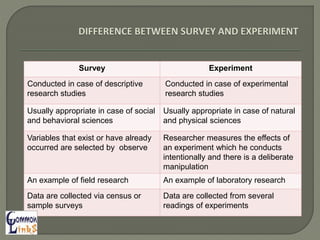
Survey Experiment
Conducted in case of descriptive
research studies
Conducted in case of experimental
research studies
Usually appropriate in case of social
and behavioral sciences
Usually appropriate in case of natural
and physical sciences
Variables that exist or have already
occurred are selected by observe
Researcher measures the effects of
an experiment which he conducts
intentionally and there is a deliberate
manipulation
An example of field research An example of laboratory research
Data are collected via census or
sample surveys
Data are collected from several
readings of experiments
a) Case Study method
b) Observational method
c) Interview method
d) Questionnaire method
e) Schedule method
1. The case study method is a very popular method in qualitative analysis.
2. It involves a careful and complete observation of social unit.
3. Social Unit- a person or a family, or an institution or a cultural group or
the entire community.
4. It is an in depth study of relevant incidents related to the selected topic
of research.
5. E.g.- A lawyer refers many relevant case histories similar to the case of
his/her client and tries to influence the judgment in favour of his/her
client, likewise the researcher also put forward many previous instances
to establish the answer of his/her research question.
 Collecting data involves presentation of oral verbal stimuli and reply
in terms of oral verbal responses.
 Two types of taking interviews –
 Personal interview
 Telephonic interview
 Personal interview-This method requires a person known as the
interviewer asking questions generally in a face to face contact to
the other person or persons who are considered as interviewee.
 Telephonic interview-This method of collecting information consists
in contacting respondents via telephone.
 Collection of information through investigator’s own direct
observation without asking from the respondent.
 Subjective bias is eliminated if observation is done
accurately.
 The information is obtained based on what is happening.
 This method is independent from respondent’s willingness
to respond .
1. A questionnaire consists of a number of questions
printed or typed in a definite order on a form or set
of forms.
2. The questionnaire is mailed or posted or sent
personally to the respondents.
3. The respondents are expected to read and
understand the questions and write down the reply
in the given space.
 This method is very similar to questionnaire.
 But the difference which lies in the fact that schedules
are being filled in by the researcher after getting the
reply from the respondents.
 This method is very useful in extensive enquiries and
can lead to fairly reliable results.
 Census is done especially through this method.
 Warranty card.
 Distribution or store audits.
 Pantry audits.
 Consumer panels.
 Use of mechanical devices.
 Projective techniques.
 Depth interviews.
 Content analysis.
 Nature, scope and objective of research: The selected data collection
method should always maintain a balance among nature, scope and
objectives of the study.
 Budget: Availability of funds for the research project determines to a
large extent which the method would be suitable for the collection of
data.
 Time: Prefixed time frame for the research project has also to be
taken into account in deciding a particular method of data collection.
 Sufficient knowledge: Proper procedure and required sufficient
knowledge helps to select the perfect data collection method.
Thank you

Data Collection

  • 1.
    By Dr. Anamika Ray AssistantProfessor in Mass Communication Gauhati University, Assam, India
  • 2.
     Data Collectionis a process to find out the answer for the research problem.  There are two types of data - primary and secondary  The primary data are collected fresh and for the first time from the field.  If the interaction or observation or sometimes both methods are framed properly, there will be any loophole in the collected primary data.
  • 3.
     The secondarydata are collected from secondary sources.  Secondary source means which work has been done by someone like book, research thesis, article, research paper, government document and file report, web information etc.  The usefulness and relevancy of secondary data depends upon- 1) Reliability of data 2) Sustainability of data 3) Adequacy of data
  • 4.
    There are broadlytwo approaches which are followed in data collection process-  Experiments  Surveys An experiment refers to investigation. The factor or variable under the test and its effect are measured. Survey refers to the method of securing information concerning a phenomena under the study from all or a selected number of respondents of the concerned universe.
  • 5.
    Survey Experiment Conducted incase of descriptive research studies Conducted in case of experimental research studies Usually appropriate in case of social and behavioral sciences Usually appropriate in case of natural and physical sciences Variables that exist or have already occurred are selected by observe Researcher measures the effects of an experiment which he conducts intentionally and there is a deliberate manipulation An example of field research An example of laboratory research Data are collected via census or sample surveys Data are collected from several readings of experiments
  • 6.
    a) Case Studymethod b) Observational method c) Interview method d) Questionnaire method e) Schedule method
  • 7.
    1. The casestudy method is a very popular method in qualitative analysis. 2. It involves a careful and complete observation of social unit. 3. Social Unit- a person or a family, or an institution or a cultural group or the entire community. 4. It is an in depth study of relevant incidents related to the selected topic of research. 5. E.g.- A lawyer refers many relevant case histories similar to the case of his/her client and tries to influence the judgment in favour of his/her client, likewise the researcher also put forward many previous instances to establish the answer of his/her research question.
  • 8.
     Collecting datainvolves presentation of oral verbal stimuli and reply in terms of oral verbal responses.  Two types of taking interviews –  Personal interview  Telephonic interview  Personal interview-This method requires a person known as the interviewer asking questions generally in a face to face contact to the other person or persons who are considered as interviewee.  Telephonic interview-This method of collecting information consists in contacting respondents via telephone.
  • 9.
     Collection ofinformation through investigator’s own direct observation without asking from the respondent.  Subjective bias is eliminated if observation is done accurately.  The information is obtained based on what is happening.  This method is independent from respondent’s willingness to respond .
  • 10.
    1. A questionnaireconsists of a number of questions printed or typed in a definite order on a form or set of forms. 2. The questionnaire is mailed or posted or sent personally to the respondents. 3. The respondents are expected to read and understand the questions and write down the reply in the given space.
  • 11.
     This methodis very similar to questionnaire.  But the difference which lies in the fact that schedules are being filled in by the researcher after getting the reply from the respondents.  This method is very useful in extensive enquiries and can lead to fairly reliable results.  Census is done especially through this method.
  • 12.
     Warranty card. Distribution or store audits.  Pantry audits.  Consumer panels.  Use of mechanical devices.  Projective techniques.  Depth interviews.  Content analysis.
  • 13.
     Nature, scopeand objective of research: The selected data collection method should always maintain a balance among nature, scope and objectives of the study.  Budget: Availability of funds for the research project determines to a large extent which the method would be suitable for the collection of data.  Time: Prefixed time frame for the research project has also to be taken into account in deciding a particular method of data collection.  Sufficient knowledge: Proper procedure and required sufficient knowledge helps to select the perfect data collection method.
  • 14.