






Research
Issues and Concerns
Dr. N.Asokan
94451 91369
ntvasokan@gmail.com
Outline• Purpose
• Definition
• Issues Related to Research
• Issues related to
Guide – Student Relationship
• Issues Related to Research scholars
• Class Room Research
• Research Outcomes from Books
Why do I want to do
Research?
Beyond Ph.D & Making Money
To Solve Every Day Problems
To Prove to Every other Person
Research- Definition
To solve the unknown problem,
logically,
scientifically and
precisely
with document evidence
Assume Nothing, Question Everything
Start Thinking, Learn the Truth
Issues Related
to
Research
Issues Related to Research
• Finance (Source)
• University
• Identifying the Guide
• Identifying the Topic
Finance• Part Time / Full Time
• Semester Fees
• DC Meeting
• Course Work
• Fees to Guide
• Attending Conferences
• Paper Presentation
• Purchase of original
research papers / Books
/ Articles / stationery
• A4 sheets
• Printer / Printout
• Lunch / Dinner
• Travelling Expenses
• Compliments
• Viva-Voice
• Thesis Binding
Finance
Work - Finance
• Cost of Experiment
• Research materials
• Fabrication cost
• Testing cost
• Simulation S/W
When one’s working, one works between absolute Confidence and absolute Doubt
University
• Regulations
• Time Limit
• Entrance Exams /
Interview
• Admission
• Registration
• Continuous Report to
University
• N I T Trichy
• Anna University
• Deemed University
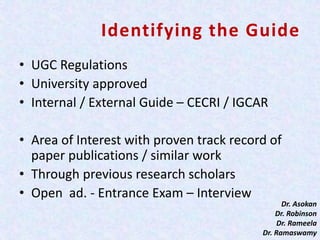
Identifying the Guide
• UGC Regulations
• University approved
• Internal / External Guide – CECRI / IGCAR
• Area of Interest with proven track record of
paper publications / similar work
• Through previous research scholars
• Open ad. - Entrance Exam – Interview
Dr. Asokan
Dr. Robinson
Dr. Rameela
Dr. Ramaswamy
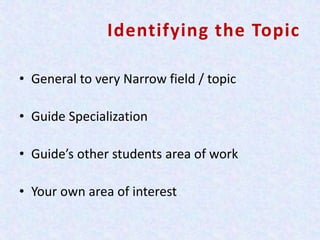
Identifying the Topic
• General to very Narrow field / topic
• Guide Specialization
• Guide’s other students area of work
• Your own area of interest
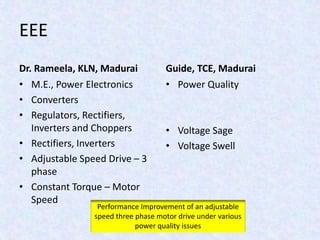
EEE
Dr. Rameela, KLN, Madurai
• M.E., Power Electronics
• Converters
• Regulators, Rectifiers,
Inverters and Choppers
• Rectifiers, Inverters
• Adjustable Speed Drive – 3
phase
• Constant Torque – Motor
Speed
Guide, TCE, Madurai
• Power Quality
• Voltage Sage
• Voltage Swell
Performance Improvement of an adjustable
speed three phase motor drive under various
power quality issues
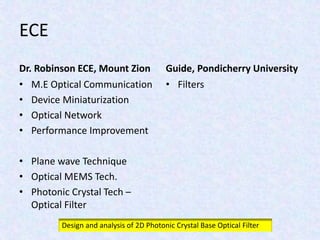
ECE
Dr. Robinson ECE, Mount Zion
• M.E Optical Communication
• Device Miniaturization
• Optical Network
• Performance Improvement
• Plane wave Technique
• Optical MEMS Tech.
• Photonic Crystal Tech –
Optical Filter
Guide, Pondicherry University
• Filters
Design and analysis of 2D Photonic Crystal Base Optical Filter
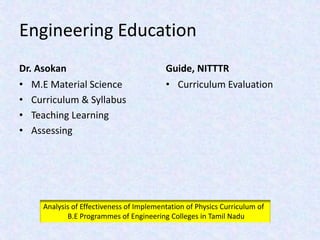
Engineering Education
Dr. Asokan
• M.E Material Science
• Curriculum & Syllabus
• Teaching Learning
• Assessing
Guide, NITTTR
• Curriculum Evaluation
Analysis of Effectiveness of Implementation of Physics Curriculum of
B.E Programmes of Engineering Colleges in Tamil Nadu
Issues related
to
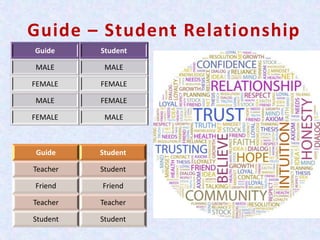
Guide – Student Relationship
Guide Student
MALE MALE
FEMALE FEMALE
MALE FEMALE
FEMALE MALE
Guide Student
Teacher Student
Friend Friend
Teacher Teacher
Student Student
OutlinePurpose
Definition
Issues Related to Research
Issues related to
Guide – Student Relationship
• Issues Related to Research scholars
• Class Room Research
• Research Outcomes from Books
Issues related
to
Research Scholars
Requisite Characteristics
• Acquire Knowledge
• Develop Skills
• Refine Talent
• Change Belief, Thought and Assumption
• Spread Networking
• Don’t stop asking Questions
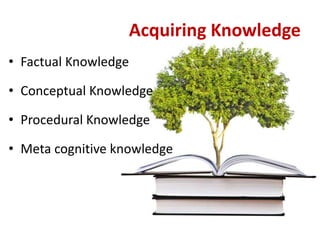
Acquiring Knowledge
• Factual Knowledge
• Conceptual Knowledge
• Procedural Knowledge
• Meta cognitive knowledge
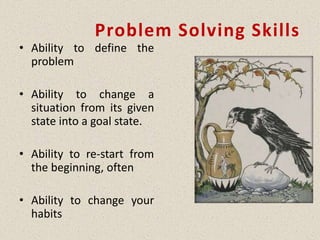
Problem Solving Skills
• Ability to define the
problem
• Ability to change a
situation from its given
state into a goal state.
• Ability to re-start from
the beginning, often
• Ability to change your
habits
Life Long Learner
• The willingness to act towards what you want,
to risk, to fail
• Willingness to practice
• Self discipline
• Comfort with repetitiveness
• If required, comfort with being alone
Live till old, Learn till you live
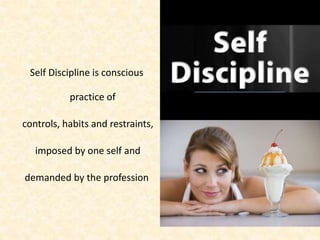
Self Discipline
Self Discipline is conscious
practice of
controls, habits and restraints,
imposed by one self and
demanded by the profession
Recurring pattern of
thought,
feeling,
action or
behaviour
that can be productively
applied
Examples:
Instinctively inquisitive ,
Competitive,
Charming,
Persistent
Nervousness?
Along with
What If?
Skill determine
if you
can do something
Talent reveals something
more important:
how well and
how often you do it
Traces of Talents
• Spontaneous,
• Top-of-the mind reactions
• Reactions under extreme stress
• Rapid Learning
• Satisfactions
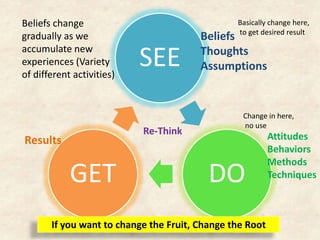
SEE
DOGET
Attitudes
Behaviors
Methods
Techniques
Beliefs
Thoughts
Assumptions
Results
If you want to change the Fruit, Change the Root
Change in here,
no use
Basically change here,
to get desired result
Beliefs change
gradually as we
accumulate new
experiences (Variety
of different activities)
Re-Think
Don’t Stop Asking Questions
• Do we have the right questions?
• How can we do what we are already doing even
better?
• What is the worst that can possibly happen?
• How things are working?
• What can go wrong?
What if? ,What nex t?
Class Room Research
Best Practices in Technical Education
Case Study:
BY
Dr. N. Asokan ,
N. Meenakshi , Lecturer(IT)
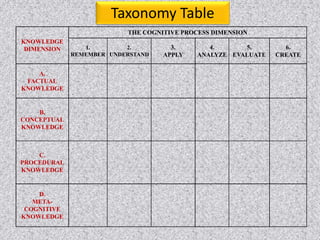
Best Practices
1. Pre-requisite knowledge
2. Mapping of five units
3. Mapping with other subjects
4. Delivering pre-requisite knowledge
5. Specific instructional objectives in accordance with
Bloom’s revised taxonomy
6. Lesson plan
7. Teaching learning process
8. Evaluation at the end of the semester in accordance with
Bloom’s revised taxonomy
9. Mapping of objectives, teaching learning process and
assessment in the Bloom’s revised taxonomy table.
KNOWLEDGE
DIMENSION
THE COGNITIVE PROCESS DIMENSION
1.
REMEMBER
2.
UNDERSTAND
3.
APPLY
4.
ANALYZE
5.
EVALUATE
6.
CREATE
A.
FACTUAL
KNOWLEDGE
B.
CONCEPTUAL
KNOWLEDGE
C.
PROCEDURAL
KNOWLEDGE
D.
META-
COGNITIVE
KNOWLEDGE
Taxonomy Table
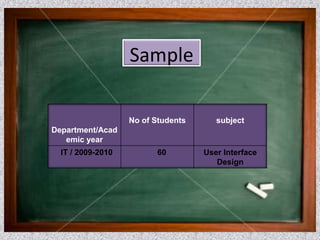
Department/Acad
emic year
No of Students subject
IT / 2009-2010 60 User Interface
Design
Sample
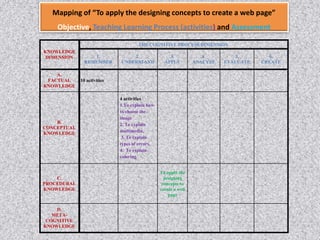
KNOWLEDGE
DIMENSION
THE COGNITIVE PROCESS DIMENSION
1.
REMEMBER
2.
UNDERSTAND
3.
APPLY
4.
ANALYZE
5.
EVALUATE
6.
CREATE
A.
FACTUAL
KNOWLEDGE
10 activities
B.
CONCEPTUAL
KNOWLEDGE
4 activities
1.To explain how
to choose the
image
2. To explain
multimedia,
3. To explain
types of errors,
4. To explain
coloring
C.
PROCEDURAL
KNOWLEDGE
To apply the
designing
concepts to
create a web
page
D.
META-
COGNITIVE
KNOWLEDGE
Mapping of “To apply the designing concepts to create a web page”
Objective, Teaching Learning Process (activities) and Assessment
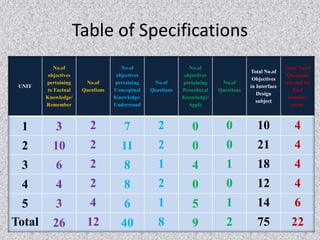
Table of Specifications
UNIT
No.of
objectives
pertaining
to Factual
Knowledge/
Remember
No.of
Questions
No.of
objectives
pertaining
Conceptual
Knowledge/
Understand
No.of
Questions
No.of
objectives
pertaining
Procedural
Knowledge/
Apply
No.of
Questions
Total No.of
Objectives
in Interface
Design
subject
Total No.of
Questions
selected for
End
semester
exam.
1 3 2 7 2 0 0 10 4
2 10 2 11 2 0 0 21 4
3 6 2 8 1 4 1 18 4
4 4 2 8 2 0 0 12 4
5 3 4 6 1 5 1 14 6
Total 26 12 40 8 9 2 75 22
KNOWLEDGE
DIMENSION
THE COGNITIVE PROCESS DIMENSION
1.
REMEMBER
2.
UNDERSTAND
3.
APPLY
4.
ANALYZE
5.
EVALUATE
6.
CREATE
A.
FACTUAL
KNOWLEDGE
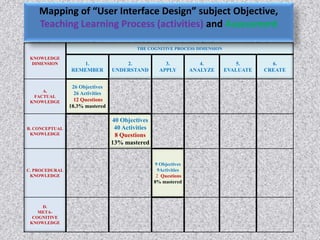
26 Objectives
26 Activities
12 Questions
18.3% mastered
B. CONCEPTUAL
KNOWLEDGE
40 Objectives
40 Activities
8 Questions
13% mastered
C. PROCEDURAL
KNOWLEDGE
9 Objectives
9Activities
2 Questions
8% mastered
D.
META-
COGNITIVE
KNOWLEDGE
Mapping of “User Interface Design” subject Objective,
Teaching Learning Process (activities) and Assessment
Findings
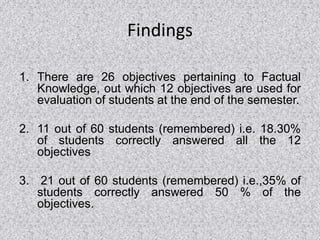
1. There are 26 objectives pertaining to Factual
Knowledge, out which 12 objectives are used for
evaluation of students at the end of the semester.
2. 11 out of 60 students (remembered) i.e. 18.30%
of students correctly answered all the 12
objectives
3. 21 out of 60 students (remembered) i.e.,35% of
students correctly answered 50 % of the
objectives.
(contd….)
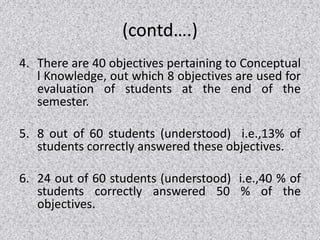
4. There are 40 objectives pertaining to Conceptual
l Knowledge, out which 8 objectives are used for
evaluation of students at the end of the
semester.
5. 8 out of 60 students (understood) i.e.,13% of
students correctly answered these objectives.
6. 24 out of 60 students (understood) i.e.,40 % of
students correctly answered 50 % of the
objectives.
(contd…)
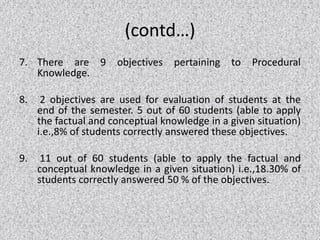
7. There are 9 objectives pertaining to Procedural
Knowledge.
8. 2 objectives are used for evaluation of students at the
end of the semester. 5 out of 60 students (able to apply
the factual and conceptual knowledge in a given situation)
i.e.,8% of students correctly answered these objectives.
9. 11 out of 60 students (able to apply the factual and
conceptual knowledge in a given situation) i.e.,18.30% of
students correctly answered 50 % of the objectives.
Conclusion
• If all the objectives, activities and assessment are
placed in the taxonomy table, then it helps us to
"understand about understanding".
• The "miss-alignments" can be identified with the help
of this taxonomy table.
• By examining the taxonomy table the teacher can
easily identify areas of knowledge, or levels of the
cognitive domain, that has not been covered by the
learning activities.
OutlinePurpose
Definition
Issues Related to Research
Issues related to
Guide – Student Relationship
Issues Related to Personal Mastery
Class Room Research
• Research Outcomes from Books
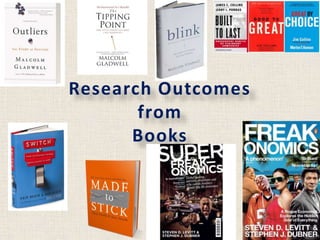
Research Outcomes
from
Books
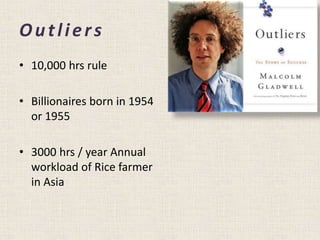
Outliers
• 10,000 hrs rule
• Billionaires born in 1954
or 1955
• 3000 hrs / year Annual
workload of Rice farmer
in Asia
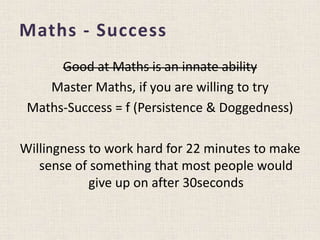
Maths - Success
Good at Maths is an innate ability
Master Maths, if you are willing to try
Maths-Success = f (Persistence & Doggedness)
Willingness to work hard for 22 minutes to make
sense of something that most people would
give up on after 30seconds
Cheating (Getting More for Less)
school Teachers in Chicago
• What might a cheating
teacher’s class room look
like?
• What are the characteristics
of a cheating teacher?
• Drunk & Drive /
• Drunk & Walk
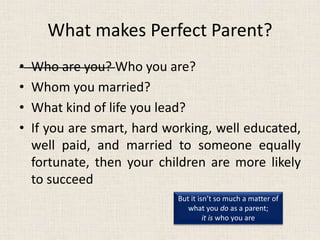
What makes Perfect Parent?
• Who are you? Who you are?
• Whom you married?
• What kind of life you lead?
• If you are smart, hard working, well educated,
well paid, and married to someone equally
fortunate, then your children are more likely
to succeed
But it isn’t so much a matter of
what you do as a parent;
it is who you are
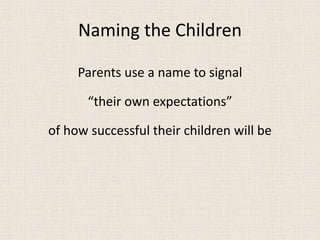
Naming the Children
Parents use a name to signal
“their own expectations”
of how successful their children will be
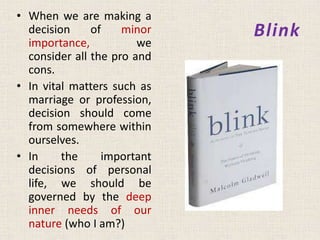
Blink
• When we are making a
decision of minor
importance, we
consider all the pro and
cons.
• In vital matters such as
marriage or profession,
decision should come
from somewhere within
ourselves.
• In the important
decisions of personal
life, we should be
governed by the deep
inner needs of our
nature (who I am?)
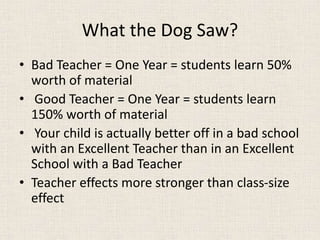
What the Dog Saw?
• Bad Teacher = One Year = students learn 50%
worth of material
• Good Teacher = One Year = students learn
150% worth of material
• Your child is actually better off in a bad school
with an Excellent Teacher than in an Excellent
School with a Bad Teacher
• Teacher effects more stronger than class-size
effect
• Research Issues
in
Different Domains
• Marriage Issues
in
Different Roles
• Identifying the Groom /
Bride
• Husband/Wife –In-laws
Relationships
• Finance to lead life
• Lessons from other
couples
Five Units of Report
1. Introduction
–Objectives / Research Questions
2. Review of Literature
3. Experiment Description and Observation
4. Analysis, Interpretation and Discussion
5. Results and Conclusion
1. Introduction
– Objectives / Research Questions
If the guide
do not possess
the requisite characteristics?
Guide
point of
View
Purpose
Definition
Issues Related to Research
Issues related to
Guide – Student Relationship
Issues Related to Research Scholars
Class Room Research
Research Outcomes from Books
56

Research Issues and Concerns

  • 1.
    Research Issues and Concerns Dr.N.Asokan 94451 91369 ntvasokan@gmail.com
  • 2.
    Outline• Purpose • Definition •Issues Related to Research • Issues related to Guide – Student Relationship • Issues Related to Research scholars • Class Room Research • Research Outcomes from Books
  • 3.
    Why do Iwant to do Research? Beyond Ph.D & Making Money
  • 4.
    To Solve EveryDay Problems To Prove to Every other Person
  • 5.
    Research- Definition To solvethe unknown problem, logically, scientifically and precisely with document evidence Assume Nothing, Question Everything Start Thinking, Learn the Truth
  • 6.
  • 7.
    Issues Related toResearch • Finance (Source) • University • Identifying the Guide • Identifying the Topic
  • 8.
    Finance• Part Time/ Full Time • Semester Fees • DC Meeting • Course Work • Fees to Guide • Attending Conferences • Paper Presentation
  • 9.
    • Purchase oforiginal research papers / Books / Articles / stationery • A4 sheets • Printer / Printout • Lunch / Dinner • Travelling Expenses • Compliments • Viva-Voice • Thesis Binding Finance
  • 10.
    Work - Finance •Cost of Experiment • Research materials • Fabrication cost • Testing cost • Simulation S/W When one’s working, one works between absolute Confidence and absolute Doubt
  • 11.
    University • Regulations • TimeLimit • Entrance Exams / Interview • Admission • Registration • Continuous Report to University • N I T Trichy • Anna University • Deemed University
  • 12.
    Identifying the Guide •UGC Regulations • University approved • Internal / External Guide – CECRI / IGCAR • Area of Interest with proven track record of paper publications / similar work • Through previous research scholars • Open ad. - Entrance Exam – Interview Dr. Asokan Dr. Robinson Dr. Rameela Dr. Ramaswamy
  • 13.
    Identifying the Topic •General to very Narrow field / topic • Guide Specialization • Guide’s other students area of work • Your own area of interest
  • 14.
    EEE Dr. Rameela, KLN,Madurai • M.E., Power Electronics • Converters • Regulators, Rectifiers, Inverters and Choppers • Rectifiers, Inverters • Adjustable Speed Drive – 3 phase • Constant Torque – Motor Speed Guide, TCE, Madurai • Power Quality • Voltage Sage • Voltage Swell Performance Improvement of an adjustable speed three phase motor drive under various power quality issues
  • 15.
    ECE Dr. Robinson ECE,Mount Zion • M.E Optical Communication • Device Miniaturization • Optical Network • Performance Improvement • Plane wave Technique • Optical MEMS Tech. • Photonic Crystal Tech – Optical Filter Guide, Pondicherry University • Filters Design and analysis of 2D Photonic Crystal Base Optical Filter
  • 16.
    Engineering Education Dr. Asokan •M.E Material Science • Curriculum & Syllabus • Teaching Learning • Assessing Guide, NITTTR • Curriculum Evaluation Analysis of Effectiveness of Implementation of Physics Curriculum of B.E Programmes of Engineering Colleges in Tamil Nadu
  • 17.
    Issues related to Guide –Student Relationship
  • 18.
    Guide – StudentRelationship Guide Student MALE MALE FEMALE FEMALE MALE FEMALE FEMALE MALE Guide Student Teacher Student Friend Friend Teacher Teacher Student Student
  • 19.
    OutlinePurpose Definition Issues Related toResearch Issues related to Guide – Student Relationship • Issues Related to Research scholars • Class Room Research • Research Outcomes from Books
  • 20.
  • 21.
    Requisite Characteristics • AcquireKnowledge • Develop Skills • Refine Talent • Change Belief, Thought and Assumption • Spread Networking • Don’t stop asking Questions
  • 22.
    Acquiring Knowledge • FactualKnowledge • Conceptual Knowledge • Procedural Knowledge • Meta cognitive knowledge
  • 23.
    Problem Solving Skills •Ability to define the problem • Ability to change a situation from its given state into a goal state. • Ability to re-start from the beginning, often • Ability to change your habits
  • 24.
    Life Long Learner •The willingness to act towards what you want, to risk, to fail • Willingness to practice • Self discipline • Comfort with repetitiveness • If required, comfort with being alone Live till old, Learn till you live
  • 25.
    Self Discipline Self Disciplineis conscious practice of controls, habits and restraints, imposed by one self and demanded by the profession
  • 26.
    Recurring pattern of thought, feeling, actionor behaviour that can be productively applied Examples: Instinctively inquisitive , Competitive, Charming, Persistent Nervousness? Along with What If?
  • 27.
    Skill determine if you cando something Talent reveals something more important: how well and how often you do it
  • 28.
    Traces of Talents •Spontaneous, • Top-of-the mind reactions • Reactions under extreme stress • Rapid Learning • Satisfactions
  • 29.
    SEE DOGET Attitudes Behaviors Methods Techniques Beliefs Thoughts Assumptions Results If you wantto change the Fruit, Change the Root Change in here, no use Basically change here, to get desired result Beliefs change gradually as we accumulate new experiences (Variety of different activities) Re-Think
  • 30.
    Don’t Stop AskingQuestions • Do we have the right questions? • How can we do what we are already doing even better? • What is the worst that can possibly happen? • How things are working? • What can go wrong? What if? ,What nex t?
  • 31.
  • 32.
    Best Practices inTechnical Education Case Study: BY Dr. N. Asokan , N. Meenakshi , Lecturer(IT)
  • 33.
    Best Practices 1. Pre-requisiteknowledge 2. Mapping of five units 3. Mapping with other subjects 4. Delivering pre-requisite knowledge 5. Specific instructional objectives in accordance with Bloom’s revised taxonomy 6. Lesson plan 7. Teaching learning process 8. Evaluation at the end of the semester in accordance with Bloom’s revised taxonomy 9. Mapping of objectives, teaching learning process and assessment in the Bloom’s revised taxonomy table.
  • 34.
    KNOWLEDGE DIMENSION THE COGNITIVE PROCESSDIMENSION 1. REMEMBER 2. UNDERSTAND 3. APPLY 4. ANALYZE 5. EVALUATE 6. CREATE A. FACTUAL KNOWLEDGE B. CONCEPTUAL KNOWLEDGE C. PROCEDURAL KNOWLEDGE D. META- COGNITIVE KNOWLEDGE Taxonomy Table
  • 35.
    Department/Acad emic year No ofStudents subject IT / 2009-2010 60 User Interface Design Sample
  • 36.
    KNOWLEDGE DIMENSION THE COGNITIVE PROCESSDIMENSION 1. REMEMBER 2. UNDERSTAND 3. APPLY 4. ANALYZE 5. EVALUATE 6. CREATE A. FACTUAL KNOWLEDGE 10 activities B. CONCEPTUAL KNOWLEDGE 4 activities 1.To explain how to choose the image 2. To explain multimedia, 3. To explain types of errors, 4. To explain coloring C. PROCEDURAL KNOWLEDGE To apply the designing concepts to create a web page D. META- COGNITIVE KNOWLEDGE Mapping of “To apply the designing concepts to create a web page” Objective, Teaching Learning Process (activities) and Assessment
  • 37.
    Table of Specifications UNIT No.of objectives pertaining toFactual Knowledge/ Remember No.of Questions No.of objectives pertaining Conceptual Knowledge/ Understand No.of Questions No.of objectives pertaining Procedural Knowledge/ Apply No.of Questions Total No.of Objectives in Interface Design subject Total No.of Questions selected for End semester exam. 1 3 2 7 2 0 0 10 4 2 10 2 11 2 0 0 21 4 3 6 2 8 1 4 1 18 4 4 4 2 8 2 0 0 12 4 5 3 4 6 1 5 1 14 6 Total 26 12 40 8 9 2 75 22
  • 38.
    KNOWLEDGE DIMENSION THE COGNITIVE PROCESSDIMENSION 1. REMEMBER 2. UNDERSTAND 3. APPLY 4. ANALYZE 5. EVALUATE 6. CREATE A. FACTUAL KNOWLEDGE 26 Objectives 26 Activities 12 Questions 18.3% mastered B. CONCEPTUAL KNOWLEDGE 40 Objectives 40 Activities 8 Questions 13% mastered C. PROCEDURAL KNOWLEDGE 9 Objectives 9Activities 2 Questions 8% mastered D. META- COGNITIVE KNOWLEDGE Mapping of “User Interface Design” subject Objective, Teaching Learning Process (activities) and Assessment
  • 39.
    Findings 1. There are26 objectives pertaining to Factual Knowledge, out which 12 objectives are used for evaluation of students at the end of the semester. 2. 11 out of 60 students (remembered) i.e. 18.30% of students correctly answered all the 12 objectives 3. 21 out of 60 students (remembered) i.e.,35% of students correctly answered 50 % of the objectives.
  • 40.
    (contd….) 4. There are40 objectives pertaining to Conceptual l Knowledge, out which 8 objectives are used for evaluation of students at the end of the semester. 5. 8 out of 60 students (understood) i.e.,13% of students correctly answered these objectives. 6. 24 out of 60 students (understood) i.e.,40 % of students correctly answered 50 % of the objectives.
  • 41.
    (contd…) 7. There are9 objectives pertaining to Procedural Knowledge. 8. 2 objectives are used for evaluation of students at the end of the semester. 5 out of 60 students (able to apply the factual and conceptual knowledge in a given situation) i.e.,8% of students correctly answered these objectives. 9. 11 out of 60 students (able to apply the factual and conceptual knowledge in a given situation) i.e.,18.30% of students correctly answered 50 % of the objectives.
  • 42.
    Conclusion • If allthe objectives, activities and assessment are placed in the taxonomy table, then it helps us to "understand about understanding". • The "miss-alignments" can be identified with the help of this taxonomy table. • By examining the taxonomy table the teacher can easily identify areas of knowledge, or levels of the cognitive domain, that has not been covered by the learning activities.
  • 43.
    OutlinePurpose Definition Issues Related toResearch Issues related to Guide – Student Relationship Issues Related to Personal Mastery Class Room Research • Research Outcomes from Books
  • 44.
  • 45.
    Outliers • 10,000 hrsrule • Billionaires born in 1954 or 1955 • 3000 hrs / year Annual workload of Rice farmer in Asia
  • 46.
    Maths - Success Goodat Maths is an innate ability Master Maths, if you are willing to try Maths-Success = f (Persistence & Doggedness) Willingness to work hard for 22 minutes to make sense of something that most people would give up on after 30seconds
  • 47.
    Cheating (Getting Morefor Less) school Teachers in Chicago • What might a cheating teacher’s class room look like? • What are the characteristics of a cheating teacher? • Drunk & Drive / • Drunk & Walk
  • 48.
    What makes PerfectParent? • Who are you? Who you are? • Whom you married? • What kind of life you lead? • If you are smart, hard working, well educated, well paid, and married to someone equally fortunate, then your children are more likely to succeed But it isn’t so much a matter of what you do as a parent; it is who you are
  • 49.
    Naming the Children Parentsuse a name to signal “their own expectations” of how successful their children will be
  • 50.
    Blink • When weare making a decision of minor importance, we consider all the pro and cons. • In vital matters such as marriage or profession, decision should come from somewhere within ourselves. • In the important decisions of personal life, we should be governed by the deep inner needs of our nature (who I am?)
  • 51.
    What the DogSaw? • Bad Teacher = One Year = students learn 50% worth of material • Good Teacher = One Year = students learn 150% worth of material • Your child is actually better off in a bad school with an Excellent Teacher than in an Excellent School with a Bad Teacher • Teacher effects more stronger than class-size effect
  • 52.
    • Research Issues in DifferentDomains • Marriage Issues in Different Roles • Identifying the Groom / Bride • Husband/Wife –In-laws Relationships • Finance to lead life • Lessons from other couples
  • 53.
    Five Units ofReport 1. Introduction –Objectives / Research Questions 2. Review of Literature 3. Experiment Description and Observation 4. Analysis, Interpretation and Discussion 5. Results and Conclusion 1. Introduction – Objectives / Research Questions
  • 54.
    If the guide donot possess the requisite characteristics?
  • 55.
    Guide point of View Purpose Definition Issues Relatedto Research Issues related to Guide – Student Relationship Issues Related to Research Scholars Class Room Research Research Outcomes from Books
  • 56.